


Regency Council

Encyclopedia
World War I
World War I , which was predominantly called the World War or the Great War from its occurrence until 1939, and the First World War or World War I thereafter, was a major war centred in Europe that began on 28 July 1914 and lasted until 11 November 1918...
, formed by Germany
Germany
Germany , officially the Federal Republic of Germany , is a federal parliamentary republic in Europe. The country consists of 16 states while the capital and largest city is Berlin. Germany covers an area of 357,021 km2 and has a largely temperate seasonal climate...
and Austria-Hungary
Austria-Hungary
Austria-Hungary , more formally known as the Kingdoms and Lands Represented in the Imperial Council and the Lands of the Holy Hungarian Crown of Saint Stephen, was a constitutional monarchic union between the crowns of the Austrian Empire and the Kingdom of Hungary in...
in the occupied Polish territories in September 1917. It was supposed to stay in office until a new king
Monarch
A monarch is the person who heads a monarchy. This is a form of government in which a state or polity is ruled or controlled by an individual who typically inherits the throne by birth and occasionally rules for life or until abdication...
or Regent
Regent
A regent, from the Latin regens "one who reigns", is a person selected to act as head of state because the ruler is a minor, not present, or debilitated. Currently there are only two ruling Regencies in the world, sovereign Liechtenstein and the Malaysian constitutive state of Terengganu...
would be appointed. In October 1918 the Council overtook also the command over the Polnische Wehrmacht
Polnische Wehrmacht
Polska Siła Zbrojna, was a military formation created by Imperial Germany during World War I, as the armed forces of their puppet Kingdom of Poland. Polska Siła Zbrojna was established a part of the German Army, under German command...
.
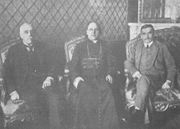
The members of the Regency Council were:
- Cardinal Aleksander Kakowski, ArchbishopArchbishopAn archbishop is a bishop of higher rank, but not of higher sacramental order above that of the three orders of deacon, priest , and bishop...
of WarsawWarsawWarsaw is the capital and largest city of Poland. It is located on the Vistula River, roughly from the Baltic Sea and from the Carpathian Mountains. Its population in 2010 was estimated at 1,716,855 residents with a greater metropolitan area of 2,631,902 residents, making Warsaw the 10th most...
, - Prince Zdzisław Lubomirski, the President (MayorMayorIn many countries, a Mayor is the highest ranking officer in the municipal government of a town or a large urban city....
) of Warsaw, - Józef Ostrowski, a great landowner and a conservative politician, former Chairman of the Polish Club in the DumaDumaA Duma is any of various representative assemblies in modern Russia and Russian history. The State Duma in the Russian Empire and Russian Federation corresponds to the lower house of the parliament. Simply it is a form of Russian governmental institution, that was formed during the reign of the...
in St. Petersburg
History
Together with the State Council and the formed governments it exercised a limited administrative powers, mainly in education and justice areas. On November 14 of the same year it passed all authority to Józef Piłsudski, from November 22 the newly appointed Supreme Head of the State (Naczelnik PaństwaNaczelnik panstwa
Naczelnik Państwa was the title of Poland's head of state in the early years of the Second Polish Republic. This office was held only by Józef Piłsudski, from 1918 to 1922. Until 1919 it was called tymczasowy naczelnik państwa...
).
Prime Ministers
- Jan KucharzewskiJan KucharzewskiJan Kucharzewski was a Polish historian, lawyer, and politician, prime minister of Poland .In 1898 he graduated from Warsaw University, he was a member of Zet political organizaction, National Democrats movement, and National League until 1911...
(November 26, 1917 - February 27, 1918) - Antoni PonikowskiAntoni PonikowskiAntoni Ponikowski was a Polish academician and politician who served as prime minister in 1918 and from 1921 to 1922....
(February 27 - April 3, 1918) - Jan Kanty SteczkowskiJan Kanty SteczkowskiJan Kanty Steczkowski was a Polish economist, solicitor and politician.Steczkowski served as Minister of Finances in the government of Jan Kucharzewski. On April 4, 1918, the Regency Council set up a government in which he became the Prime Minister...
(April 4 - October 23, 1918) - Józef ŚwieżyńskiJózef SwiezynskiJózef Świeżyński was the prime minister of the Kingdom of Poland for a short time — from October 23, 1918 to November 5, 1918.- Citations :...
(October 23 - November 5, 1918) - Władysław Wróblewski (November 5–11, 1918)