


Miedzymorze

Encyclopedia
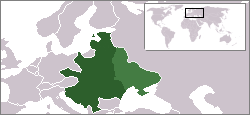
Międzymorze was a plan, pursued after World War I
by Polish leader Józef Piłsudski, for a federation
, under Poland
's aegis, of Central
and Eastern Europe
an countries. Invited to join the proposed federation were the Baltic states
(Lithuania
, Latvia
, Estonia
), Finland
, Belarus
, Ukraine
, Hungary
, Romania
, Yugoslavia
and Czechoslovakia
.
The Polish name Międzymorze, which means "Intersea" or "Between-seas," has been rendered into English, from the Latin
, as "Intermarium" or "Intermarum."
The proposed federation was meant to emulate the Polish-Lithuanian Commonwealth
, stretching from the Baltic Sea
to the Black Sea
, that, from the end of the 16th century to the end of the 18th, had united the Kingdom of Poland
and the Grand Duchy of Lithuania
.
Intermarium complemented Piłsudski's other geopolitical vision—Prometheism
, whose goal was the dismemberment
of the Russian Empire
and that Empire's divestment of its territorial conquests.
Intermarium was, however, perceived by some Lithuanians
as a threat to their newly established independence, and by some Ukrainians
as a threat to their aspirations for independence, and was opposed by Russia
and by most Western powers, except France
.
Within two decades of the failure of Piłsudski's grand scheme, all the countries that he had viewed as candidates for membership in the Intermarium federation had fallen to the Soviet Union
or Nazi Germany
, except for Finland (which nonetheless suffered some territorial losses in the Winter War
).

and military alliance had come about as a mutual response to a common threat posed by the Teutonic Order. The alliance was first established in 1385 by the wedding of Poland's Queen Jadwiga
and Lithuania
's Gediminid dynasty
in the person of Grand Duke Jogaila
, who became King Władysław II Jagiełło of Poland.
A longer-lasting federation was subsequently established via the creation of the Polish-Lithuanian Commonwealth
, an arrangement that lasted until the late-18th-century Partitions of the Polish-Lithuanian Commonwealth
.
Under the Commonwealth, proposals were advanced for the establishment of an expanded, Polish-Lithuanian-Muscovite
or Polish-Lithuanian-Ruthenian
, Commonwealth. These proposals were never implemented.
 Between the November
and January Uprising
s, in 1832–61, the idea of resurrecting an updated Polish-Lithuanian Commonwealth
was advocated by Prince Adam Jerzy Czartoryski
, residing in exile at the Hôtel Lambert
in Paris
.
In his youth Czartoryski had fought against Russia
in the Polish-Russian War of 1792 and would have done so again in the Kościuszko Uprising
of 1794, had he not been arrested at Brussels
on his way back to Poland. Subsequently in 1795 he and his younger brother had been commanded to enter the Russian army, and Catherine the Great had been so favorably impressed with them that she had restored to them part of their confiscated estates. Adam Czartoryski had subsequently served Tsars Paul
and Alexander I
as a diplomat and foreign minister
, during the Napoleonic Wars
establishing an anti-French coalition. Czartoryski had been one of the leaders of the Polish November 1830 Uprising
and, after its suppression by Russia
, had been sentenced to death but eventually allowed to go into exile in France.
In Paris
the "visionary" statesman
and former friend, confidant and de facto
foreign minister
of Russia's Tsar
Alexander I
acted as the "uncrowned king and unacknowledged foreign minister
" of a nonexistent Poland.
In his book, Essai sur la diplomatie (Essay on Diplomacy), completed in 1827 but published only in 1830, Czartoryski observed that, "Having extended her sway south and west, and being by the nature of things unreachable from the east and north, Russia becomes a source of constant threat to Europe." He argued that she would have done better, cultivating "friends rather than slaves." He also identified a future threat from Prussia and urged the incorporation of East Prussia
into a resurrected Poland.
His diplomatic efforts anticipated Piłsudski's Prometheist
project in linking efforts for Polish independence with similar movements of other subjugated nations in Europe and in the east, as far as the Caucasus
.
Czartoryski aspired above all to reconstitute — with French
, British
and Turkish
support — a Polish-Lithuanian Commonwealth
federated with the Czechs, Slovaks, Hungarians
, Romanians and all the South Slavs
of the future Yugoslavia
. Poland, in his concept, could have mediated the conflicts between Hungary and the Slavs, and between Hungary and Romania. The plan seemed achievable during the period of national revolutions in 1848–49 but foundered on lack of western support, on Hungarian intransigence toward the Czechs, Slovaks and Romanians, and on the rise of German
nationalism
.
"Nevertheless," concludes Dziewanowski, "the Prince's endeavor constitutes a [vital] link [between] the 16th-century Jagiellon [federative prototype] and Józef Piłsudski's federative-Prometheist
program [that was to follow after World War I
]."
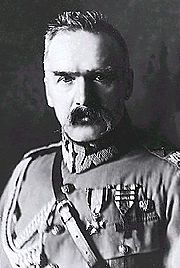 Józef Piłsudski's strategic goal was to resurrect an updated, quasi-democratic, form of the Polish-Lithuanian Commonwealth
, while working for the disintegration of the Russian Empire
, and later the Soviet Union
, into its ethnic constituents. (The latter was his Prometheist
project.) Piłsudski saw an Intermarium federation as a counterweight to Russian and German imperialism
.
According to Dziewanowski, the plan was never expressed in systematic fashion but instead relied on Piłsudski's pragmatic instincts. According to British scholar George Sanford
, about the time of the Polish-Soviet War
of 1920 Piłsudski recognized that the plan was not feasible.
was directly threatened, worked to thwart the Intermarum agenda. The Allied Powers assumed that Bolshevism was only a temporary threat and did not want to see their important (from the balance-of-power
viewpoint) traditional ally, Russia
, weakened. They resented Piłsudski's refusal to aid their White
allies, viewed Piłsudski with suspicion, saw his plans as unrealistic, and urged Poland to confine itself to areas of clear-cut Polish ethnicity. The Lithuanians, who had re-established their independence in 1918
, were unwilling to join; the Ukrainians, similarly seeking independence, likewise feared that Poland might again subjugate them; and the Belorusians, who had little national consciousness, were not interested either in independence or in Pilsudski's proposals of union. The chances for Piłsudski's scheme were not enhanced by a series of post-World War I wars and border
conflicts
between Poland and its neighbors in disputed territories — the Polish-Soviet War
, the Polish-Lithuanian War
, the Polish-Ukrainian War
, and border conflicts between Poland and Czechoslovakia
.
Piłsudski's concept was opposed within Poland itself, where National Democracy leader Roman Dmowski
argued for an ethnically purer Poland in which minorities would be Polonized. Many Polish politicians, including Dmowski
, opposed the idea of a multicultural federation
, preferring instead to work for a unitary
Polish nation-state
. Sanford
has described Pilsudski's policies after his resumption of power in 1926 as similarly focusing on the Polonization of the country's Eastern Slavic minorities and on the centralization of power.
While some scholars accept at face value the democratic principles claimed by Piłsudski for his federative plan, others view such claims with skepticism, pointing out a coup d'état in 1926 when Piłsudski assumed nearly dictatorial powers. In particular, his project is viewed unfavorably by most Ukrainian historians, with Oleksandr Derhachov arguing that the federation would have created a greater Poland in which the interests of non-Poles, especially Ukrainians, would have gotten short shrift.
Some historians hold that Piłsudski, who argued that "There can be no independent Poland without an independent Ukraine," may have been more interested in splitting Ukraine from Russia than in assuring Ukrainians' welfare. He did not hesitate to use military force to expand Poland's borders
to Galicia and Volhynia
, crushing a Ukrainian attempt at self-determination in disputed territories east of the Bug River
which contained a substantial Polish presence (a Polish majority mainly in cities such as Lwów, surrounded by a rural Ukrainian majority).
Speaking of Poland's future frontiers, Piłsudski said: "All that we can gain in the west depends on the Entente
— on the extent to which it may wish to squeeze Germany," while in the east "there are doors that open and close, and it depends on who forces them open and how far." In the eastern chaos, the Polish forces set out to expand as far as feasible. On the other hand, Poland had no interest in joining the western intervention in the Russian Civil War
or in conquering Russia itself.
 In the aftermath of the Polish-Soviet War
(1919–21), Piłsudski's concept of a federation of Central
and Eastern Europe
an countries, based on a Polish-Ukrainian axis, lost any chance of realization.
Piłsudski next contemplated a federation or alliance with the Baltic
and Balkan states. This plan envisioned a Central Europe
an union including Poland
, Czechoslovakia
, Hungary
, Scandinavia
, the Baltic states
, Italy
, Romania
, Bulgaria
, Yugoslavia
and Greece
— thus stretching not only west-east from the Baltic
to the Black Sea
, but north-south from the Arctic Ocean
to the Mediterranean Sea
. This project also failed: Poland was distrusted by Czechoslovakia and Lithuania; and while it had relatively good relations with the other countries, they had tensions with their neighbors, making it virtually impossible to create in Central Europe a large block of countries that all had good relations with each other. In the end, in place of a large federation, only a Polish-Romanian alliance
was established, beginning in 1921.
Piłsudski died in 1935. A later version of his concept was attempted by interwar
Polish Foreign Minister
Józef Beck
, a Piłsudski protégé, whose proposal during the late 1930s of a "Third Europe" — an alliance of Poland, Romania and Hungary — also gained little ground before World War II
supervened.
The failure to create a strong counterweight to Germany and the Soviet Union, such as Piłsudski's Międzymorze, according to some historians, doomed the prospective member countries to their eventual fate as victims
of World War II
.
 The concept of a "Central European Union" — a triangular geopolitical entity anchored in the Baltic, Black, and Adriatic or Aegean Seas — was revived during World War II
in Władysław Sikorski's Polish Government in Exile
. A first step toward its implementation — 1942 discussions between the Greek, Yugoslav, Polish and Czechoslovak governments in exile regarding prospective Greek-Yugoslav and Polish-Czechoslovak federations — ultimately foundered on Soviet opposition, which led to Czech hesitation and Allied indifference or hostility. A declaration of the Polish Underground State from that period called for the creation of a Central European federal union, without domination by any single state.
Other forms of the concept have survived into the late 20th and early 21st centuries, including regional-security proposals that were not framed as being Polish-led. Poland's neighbors, however, continued to perceive the idea as imperialist.
After the Warsaw Pact
collapsed, Poland, Hungary and the Czech Republic joined NATO in 1999; and Bulgaria
, Estonia, Latvia, Lithuania, Romania, Slovakia
and Slovenia
, in 2004. Ukraine has also expressed interest in joining.
In 2004 Poland, the Czech Republic, Slovakia, Hungary and the Baltic states joined the European Union
; and in 2007, Romania and Bulgaria.
On 12 May 2011 the Visegrad Group
countries (Poland
, Czech Republic
, Slovakia
, and Hungary
) announced the formation of a battlegroup
under the command of Poland. The battlegroup would be in place by 2016 as an independent force and would not be part of the NATO command. In addition, starting in 2013, the four countries would begin military exercises together under the auspices of the NATO Response Force
. Some scholars see this as a first step toward close cooperation in the Central Europe
region.
World War I
World War I , which was predominantly called the World War or the Great War from its occurrence until 1939, and the First World War or World War I thereafter, was a major war centred in Europe that began on 28 July 1914 and lasted until 11 November 1918...
by Polish leader Józef Piłsudski, for a federation
Federation
A federation , also known as a federal state, is a type of sovereign state characterized by a union of partially self-governing states or regions united by a central government...
, under Poland
Poland
Poland , officially the Republic of Poland , is a country in Central Europe bordered by Germany to the west; the Czech Republic and Slovakia to the south; Ukraine, Belarus and Lithuania to the east; and the Baltic Sea and Kaliningrad Oblast, a Russian exclave, to the north...
's aegis, of Central
Central Europe
Central Europe or alternatively Middle Europe is a region of the European continent lying between the variously defined areas of Eastern and Western Europe...
and Eastern Europe
Eastern Europe
Eastern Europe is the eastern part of Europe. The term has widely disparate geopolitical, geographical, cultural and socioeconomic readings, which makes it highly context-dependent and even volatile, and there are "almost as many definitions of Eastern Europe as there are scholars of the region"...
an countries. Invited to join the proposed federation were the Baltic states
Baltic states
The term Baltic states refers to the Baltic territories which gained independence from the Russian Empire in the wake of World War I: primarily the contiguous trio of Estonia, Latvia, Lithuania ; Finland also fell within the scope of the term after initially gaining independence in the 1920s.The...
(Lithuania
Lithuania
Lithuania , officially the Republic of Lithuania is a country in Northern Europe, the biggest of the three Baltic states. It is situated along the southeastern shore of the Baltic Sea, whereby to the west lie Sweden and Denmark...
, Latvia
Latvia
Latvia , officially the Republic of Latvia , is a country in the Baltic region of Northern Europe. It is bordered to the north by Estonia , to the south by Lithuania , to the east by the Russian Federation , to the southeast by Belarus and shares maritime borders to the west with Sweden...
, Estonia
Estonia
Estonia , officially the Republic of Estonia , is a state in the Baltic region of Northern Europe. It is bordered to the north by the Gulf of Finland, to the west by the Baltic Sea, to the south by Latvia , and to the east by Lake Peipsi and the Russian Federation . Across the Baltic Sea lies...
), Finland
Finland
Finland , officially the Republic of Finland, is a Nordic country situated in the Fennoscandian region of Northern Europe. It is bordered by Sweden in the west, Norway in the north and Russia in the east, while Estonia lies to its south across the Gulf of Finland.Around 5.4 million people reside...
, Belarus
Belarus
Belarus , officially the Republic of Belarus, is a landlocked country in Eastern Europe, bordered clockwise by Russia to the northeast, Ukraine to the south, Poland to the west, and Lithuania and Latvia to the northwest. Its capital is Minsk; other major cities include Brest, Grodno , Gomel ,...
, Ukraine
Ukraine
Ukraine is a country in Eastern Europe. It has an area of 603,628 km², making it the second largest contiguous country on the European continent, after Russia...
, Hungary
Hungary
Hungary , officially the Republic of Hungary , is a landlocked country in Central Europe. It is situated in the Carpathian Basin and is bordered by Slovakia to the north, Ukraine and Romania to the east, Serbia and Croatia to the south, Slovenia to the southwest and Austria to the west. The...
, Romania
Romania
Romania is a country located at the crossroads of Central and Southeastern Europe, on the Lower Danube, within and outside the Carpathian arch, bordering on the Black Sea...
, Yugoslavia
Yugoslavia
Yugoslavia refers to three political entities that existed successively on the western part of the Balkans during most of the 20th century....
and Czechoslovakia
Czechoslovakia
Czechoslovakia or Czecho-Slovakia was a sovereign state in Central Europe which existed from October 1918, when it declared its independence from the Austro-Hungarian Empire, until 1992...
.
The Polish name Międzymorze, which means "Intersea" or "Between-seas," has been rendered into English, from the Latin
Latin
Latin is an Italic language originally spoken in Latium and Ancient Rome. It, along with most European languages, is a descendant of the ancient Proto-Indo-European language. Although it is considered a dead language, a number of scholars and members of the Christian clergy speak it fluently, and...
, as "Intermarium" or "Intermarum."
The proposed federation was meant to emulate the Polish-Lithuanian Commonwealth
Polish-Lithuanian Commonwealth
The Polish–Lithuanian Commonwealth was a dualistic state of Poland and Lithuania ruled by a common monarch. It was the largest and one of the most populous countries of 16th- and 17th‑century Europe with some and a multi-ethnic population of 11 million at its peak in the early 17th century...
, stretching from the Baltic Sea
Baltic Sea
The Baltic Sea is a brackish mediterranean sea located in Northern Europe, from 53°N to 66°N latitude and from 20°E to 26°E longitude. It is bounded by the Scandinavian Peninsula, the mainland of Europe, and the Danish islands. It drains into the Kattegat by way of the Øresund, the Great Belt and...
to the Black Sea
Black Sea
The Black Sea is bounded by Europe, Anatolia and the Caucasus and is ultimately connected to the Atlantic Ocean via the Mediterranean and the Aegean seas and various straits. The Bosphorus strait connects it to the Sea of Marmara, and the strait of the Dardanelles connects that sea to the Aegean...
, that, from the end of the 16th century to the end of the 18th, had united the Kingdom of Poland
Kingdom of Poland (1385–1569)
The Kingdom of Poland of the Jagiellons was the Polish state created by the accession of Jogaila , Grand Duke of Lithuania, to the Polish throne in 1386. The Union of Krewo or Krėva Act, united Poland and Lithuania under the rule of a single monarch...
and the Grand Duchy of Lithuania
Grand Duchy of Lithuania
The Grand Duchy of Lithuania was a European state from the 12th /13th century until 1569 and then as a constituent part of Polish-Lithuanian Commonwealth until 1791 when Constitution of May 3, 1791 abolished it in favor of unitary state. It was founded by the Lithuanians, one of the polytheistic...
.
Intermarium complemented Piłsudski's other geopolitical vision—Prometheism
Prometheism
Prometheism or Prometheanism was a political project initiated by Poland's Józef Piłsudski. Its aim was to weaken the Russian Empire and its successor states, including the Soviet Union, by supporting nationalist independence movements among the major non-Russian peoples that lived within the...
, whose goal was the dismemberment
Dismemberment
Dismemberment is the act of cutting, tearing, pulling, wrenching or otherwise removing, the limbs of a living thing. It may be practiced upon human beings as a form of capital punishment, as a result of a traumatic accident, or in connection with murder, suicide, or cannibalism...
of the Russian Empire
Russian Empire
The Russian Empire was a state that existed from 1721 until the Russian Revolution of 1917. It was the successor to the Tsardom of Russia and the predecessor of the Soviet Union...
and that Empire's divestment of its territorial conquests.
Intermarium was, however, perceived by some Lithuanians
Lithuanians
Lithuanians are the Baltic ethnic group native to Lithuania, where they number around 2,765,600 people. Another million or more make up the Lithuanian diaspora, largely found in countries such as the United States, Brazil, Canada, Colombia, Russia, United Kingdom and Ireland. Their native language...
as a threat to their newly established independence, and by some Ukrainians
Ukraine
Ukraine is a country in Eastern Europe. It has an area of 603,628 km², making it the second largest contiguous country on the European continent, after Russia...
as a threat to their aspirations for independence, and was opposed by Russia
Russia
Russia or , officially known as both Russia and the Russian Federation , is a country in northern Eurasia. It is a federal semi-presidential republic, comprising 83 federal subjects...
and by most Western powers, except France
France
The French Republic , The French Republic , The French Republic , (commonly known as France , is a unitary semi-presidential republic in Western Europe with several overseas territories and islands located on other continents and in the Indian, Pacific, and Atlantic oceans. Metropolitan France...
.
Within two decades of the failure of Piłsudski's grand scheme, all the countries that he had viewed as candidates for membership in the Intermarium federation had fallen to the Soviet Union
Soviet Union
The Soviet Union , officially the Union of Soviet Socialist Republics , was a constitutionally socialist state that existed in Eurasia between 1922 and 1991....
or Nazi Germany
Nazi Germany
Nazi Germany , also known as the Third Reich , but officially called German Reich from 1933 to 1943 and Greater German Reich from 26 June 1943 onward, is the name commonly used to refer to the state of Germany from 1933 to 1945, when it was a totalitarian dictatorship ruled by...
, except for Finland (which nonetheless suffered some territorial losses in the Winter War
Winter War
The Winter War was a military conflict between the Soviet Union and Finland. It began with a Soviet offensive on 30 November 1939 – three months after the start of World War II and the Soviet invasion of Poland – and ended on 13 March 1940 with the Moscow Peace Treaty...
).
Precedents
Commonwealth
A Polish-Lithuanian unionPolish-Lithuanian Union
The term Polish–Lithuanian Union sometimes called as United Kingdom of Poland and Lithuania refers to a series of acts and alliances between the Kingdom of Poland and the Grand Duchy of Lithuania that lasted for prolonged periods of time and led to the creation of the Polish–Lithuanian...
and military alliance had come about as a mutual response to a common threat posed by the Teutonic Order. The alliance was first established in 1385 by the wedding of Poland's Queen Jadwiga
Jadwiga
Jadwiga is a Polish feminine given name. It originated from the old German Hedwig .* Jadwiga of Greater Poland, Queen of Poland and mother of Casimir III of Poland...
and Lithuania
Lithuania
Lithuania , officially the Republic of Lithuania is a country in Northern Europe, the biggest of the three Baltic states. It is situated along the southeastern shore of the Baltic Sea, whereby to the west lie Sweden and Denmark...
's Gediminid dynasty
Gediminids
The Gediminids were a dynasty of monarchs of Grand Duchy of Lithuania that reigned from the 14th to the 16th century. One branch of this dynasty, known as the Jagiellons, reigned also in Kingdom of Poland, Kingdom of Hungary and Kingdom of Bohemia...
in the person of Grand Duke Jogaila
Jogaila
Jogaila, later 'He is known under a number of names: ; ; . See also: Jogaila : names and titles. was Grand Duke of Lithuania , king consort of Kingdom of Poland , and sole King of Poland . He ruled in Lithuania from 1377, at first with his uncle Kęstutis...
, who became King Władysław II Jagiełło of Poland.
A longer-lasting federation was subsequently established via the creation of the Polish-Lithuanian Commonwealth
Polish-Lithuanian Commonwealth
The Polish–Lithuanian Commonwealth was a dualistic state of Poland and Lithuania ruled by a common monarch. It was the largest and one of the most populous countries of 16th- and 17th‑century Europe with some and a multi-ethnic population of 11 million at its peak in the early 17th century...
, an arrangement that lasted until the late-18th-century Partitions of the Polish-Lithuanian Commonwealth
Partitions of Poland
The Partitions of Poland or Partitions of the Polish–Lithuanian Commonwealth took place in the second half of the 18th century and ended the existence of the Polish–Lithuanian Commonwealth, resulting in the elimination of sovereign Poland for 123 years...
.
Under the Commonwealth, proposals were advanced for the establishment of an expanded, Polish-Lithuanian-Muscovite
Polish-Lithuanian-Muscovite Commonwealth
The Polish–Lithuanian–Muscovite Commonwealth was a proposed state that would have been based on a personal union between the Polish–Lithuanian Commonwealth and the Tsardom of Russia...
or Polish-Lithuanian-Ruthenian
Polish-Lithuanian-Ruthenian Commonwealth
Polish–Lithuanian–Ruthenian Commonwealth was a proposed European state in the 17th century that would replace contemporal Polish–Lithuanian Commonwealth. The creation of a Duchy of Ruthenia was considered at various times, particularly during the 1648 Cossack insurrection against Polish rule in...
, Commonwealth. These proposals were never implemented.
Czartoryski's plan
November Uprising
The November Uprising , Polish–Russian War 1830–31 also known as the Cadet Revolution, was an armed rebellion in the heartland of partitioned Poland against the Russian Empire. The uprising began on 29 November 1830 in Warsaw when the young Polish officers from the local Army of the Congress...
and January Uprising
January Uprising
The January Uprising was an uprising in the former Polish-Lithuanian Commonwealth against the Russian Empire...
s, in 1832–61, the idea of resurrecting an updated Polish-Lithuanian Commonwealth
Polish-Lithuanian Commonwealth
The Polish–Lithuanian Commonwealth was a dualistic state of Poland and Lithuania ruled by a common monarch. It was the largest and one of the most populous countries of 16th- and 17th‑century Europe with some and a multi-ethnic population of 11 million at its peak in the early 17th century...
was advocated by Prince Adam Jerzy Czartoryski
Adam Jerzy Czartoryski
Prince Adam Jerzy Czartoryski was a Polish-Lithuanian noble, statesman and author. He was the son of Prince Adam Kazimierz Czartoryski and Izabela Fleming....
, residing in exile at the Hôtel Lambert
Hôtel Lambert
Hôtel Lambert is a hôtel particulier, a grand mansion townhouse, on the Quai Anjou on the eastern tip of the Île Saint-Louis, Paris IVème; the name, Hôtel Lambert, was a sobriquet that designated a 19th-century political faction of Polish exiles, who gathered there.-Architectural history:The house...
in Paris
Paris
Paris is the capital and largest city in France, situated on the river Seine, in northern France, at the heart of the Île-de-France region...
.
In his youth Czartoryski had fought against Russia
Russia
Russia or , officially known as both Russia and the Russian Federation , is a country in northern Eurasia. It is a federal semi-presidential republic, comprising 83 federal subjects...
in the Polish-Russian War of 1792 and would have done so again in the Kościuszko Uprising
Kosciuszko Uprising
The Kościuszko Uprising was an uprising against Imperial Russia and the Kingdom of Prussia led by Tadeusz Kościuszko in Poland, Belarus and Lithuania in 1794...
of 1794, had he not been arrested at Brussels
Brussels
Brussels , officially the Brussels Region or Brussels-Capital Region , is the capital of Belgium and the de facto capital of the European Union...
on his way back to Poland. Subsequently in 1795 he and his younger brother had been commanded to enter the Russian army, and Catherine the Great had been so favorably impressed with them that she had restored to them part of their confiscated estates. Adam Czartoryski had subsequently served Tsars Paul
Paul I of Russia
Paul I was the Emperor of Russia between 1796 and 1801. He also was the 72nd Prince and Grand Master of the Order of Malta .-Childhood:...
and Alexander I
Alexander I of Russia
Alexander I of Russia , served as Emperor of Russia from 23 March 1801 to 1 December 1825 and the first Russian King of Poland from 1815 to 1825. He was also the first Russian Grand Duke of Finland and Lithuania....
as a diplomat and foreign minister
Foreign minister
A Minister of Foreign Affairs, or foreign minister, is a cabinet minister who helps form the foreign policy of a sovereign state. The foreign minister is often regarded as the most senior ministerial position below that of the head of government . It is often granted to the deputy prime minister in...
, during the Napoleonic Wars
Napoleonic Wars
The Napoleonic Wars were a series of wars declared against Napoleon's French Empire by opposing coalitions that ran from 1803 to 1815. As a continuation of the wars sparked by the French Revolution of 1789, they revolutionised European armies and played out on an unprecedented scale, mainly due to...
establishing an anti-French coalition. Czartoryski had been one of the leaders of the Polish November 1830 Uprising
November Uprising
The November Uprising , Polish–Russian War 1830–31 also known as the Cadet Revolution, was an armed rebellion in the heartland of partitioned Poland against the Russian Empire. The uprising began on 29 November 1830 in Warsaw when the young Polish officers from the local Army of the Congress...
and, after its suppression by Russia
Russia
Russia or , officially known as both Russia and the Russian Federation , is a country in northern Eurasia. It is a federal semi-presidential republic, comprising 83 federal subjects...
, had been sentenced to death but eventually allowed to go into exile in France.
In Paris
Paris
Paris is the capital and largest city in France, situated on the river Seine, in northern France, at the heart of the Île-de-France region...
the "visionary" statesman
Statesman
A statesman is usually a politician or other notable public figure who has had a long and respected career in politics or government at the national and international level. As a term of respect, it is usually left to supporters or commentators to use the term...
and former friend, confidant and de facto
De facto
De facto is a Latin expression that means "concerning fact." In law, it often means "in practice but not necessarily ordained by law" or "in practice or actuality, but not officially established." It is commonly used in contrast to de jure when referring to matters of law, governance, or...
foreign minister
Foreign minister
A Minister of Foreign Affairs, or foreign minister, is a cabinet minister who helps form the foreign policy of a sovereign state. The foreign minister is often regarded as the most senior ministerial position below that of the head of government . It is often granted to the deputy prime minister in...
of Russia's Tsar
Tsar
Tsar is a title used to designate certain European Slavic monarchs or supreme rulers. As a system of government in the Tsardom of Russia and Russian Empire, it is known as Tsarist autocracy, or Tsarism...
Alexander I
Alexander I of Russia
Alexander I of Russia , served as Emperor of Russia from 23 March 1801 to 1 December 1825 and the first Russian King of Poland from 1815 to 1825. He was also the first Russian Grand Duke of Finland and Lithuania....
acted as the "uncrowned king and unacknowledged foreign minister
Foreign minister
A Minister of Foreign Affairs, or foreign minister, is a cabinet minister who helps form the foreign policy of a sovereign state. The foreign minister is often regarded as the most senior ministerial position below that of the head of government . It is often granted to the deputy prime minister in...
" of a nonexistent Poland.
In his book, Essai sur la diplomatie (Essay on Diplomacy), completed in 1827 but published only in 1830, Czartoryski observed that, "Having extended her sway south and west, and being by the nature of things unreachable from the east and north, Russia becomes a source of constant threat to Europe." He argued that she would have done better, cultivating "friends rather than slaves." He also identified a future threat from Prussia and urged the incorporation of East Prussia
East Prussia
East Prussia is the main part of the region of Prussia along the southeastern Baltic Coast from the 13th century to the end of World War II in May 1945. From 1772–1829 and 1878–1945, the Province of East Prussia was part of the German state of Prussia. The capital city was Königsberg.East Prussia...
into a resurrected Poland.
His diplomatic efforts anticipated Piłsudski's Prometheist
Prometheism
Prometheism or Prometheanism was a political project initiated by Poland's Józef Piłsudski. Its aim was to weaken the Russian Empire and its successor states, including the Soviet Union, by supporting nationalist independence movements among the major non-Russian peoples that lived within the...
project in linking efforts for Polish independence with similar movements of other subjugated nations in Europe and in the east, as far as the Caucasus
Caucasus
The Caucasus, also Caucas or Caucasia , is a geopolitical region at the border of Europe and Asia, and situated between the Black and the Caspian sea...
.
Czartoryski aspired above all to reconstitute — with French
France
The French Republic , The French Republic , The French Republic , (commonly known as France , is a unitary semi-presidential republic in Western Europe with several overseas territories and islands located on other continents and in the Indian, Pacific, and Atlantic oceans. Metropolitan France...
, British
Great Britain
Great Britain or Britain is an island situated to the northwest of Continental Europe. It is the ninth largest island in the world, and the largest European island, as well as the largest of the British Isles...
and Turkish
Turkey
Turkey , known officially as the Republic of Turkey , is a Eurasian country located in Western Asia and in East Thrace in Southeastern Europe...
support — a Polish-Lithuanian Commonwealth
Polish-Lithuanian Commonwealth
The Polish–Lithuanian Commonwealth was a dualistic state of Poland and Lithuania ruled by a common monarch. It was the largest and one of the most populous countries of 16th- and 17th‑century Europe with some and a multi-ethnic population of 11 million at its peak in the early 17th century...
federated with the Czechs, Slovaks, Hungarians
Hungary
Hungary , officially the Republic of Hungary , is a landlocked country in Central Europe. It is situated in the Carpathian Basin and is bordered by Slovakia to the north, Ukraine and Romania to the east, Serbia and Croatia to the south, Slovenia to the southwest and Austria to the west. The...
, Romanians and all the South Slavs
South Slavs
The South Slavs are the southern branch of the Slavic peoples and speak South Slavic languages. Geographically, the South Slavs are native to the Balkan peninsula, the southern Pannonian Plain and the eastern Alps...
of the future Yugoslavia
Yugoslavia
Yugoslavia refers to three political entities that existed successively on the western part of the Balkans during most of the 20th century....
. Poland, in his concept, could have mediated the conflicts between Hungary and the Slavs, and between Hungary and Romania. The plan seemed achievable during the period of national revolutions in 1848–49 but foundered on lack of western support, on Hungarian intransigence toward the Czechs, Slovaks and Romanians, and on the rise of German
Germany
Germany , officially the Federal Republic of Germany , is a federal parliamentary republic in Europe. The country consists of 16 states while the capital and largest city is Berlin. Germany covers an area of 357,021 km2 and has a largely temperate seasonal climate...
nationalism
Nationalism
Nationalism is a political ideology that involves a strong identification of a group of individuals with a political entity defined in national terms, i.e. a nation. In the 'modernist' image of the nation, it is nationalism that creates national identity. There are various definitions for what...
.
"Nevertheless," concludes Dziewanowski, "the Prince's endeavor constitutes a [vital] link [between] the 16th-century Jagiellon [federative prototype] and Józef Piłsudski's federative-Prometheist
Prometheism
Prometheism or Prometheanism was a political project initiated by Poland's Józef Piłsudski. Its aim was to weaken the Russian Empire and its successor states, including the Soviet Union, by supporting nationalist independence movements among the major non-Russian peoples that lived within the...
program [that was to follow after World War I
World War I
World War I , which was predominantly called the World War or the Great War from its occurrence until 1939, and the First World War or World War I thereafter, was a major war centred in Europe that began on 28 July 1914 and lasted until 11 November 1918...
]."
Piłsudski's "Międzymorze"
Polish-Lithuanian Commonwealth
The Polish–Lithuanian Commonwealth was a dualistic state of Poland and Lithuania ruled by a common monarch. It was the largest and one of the most populous countries of 16th- and 17th‑century Europe with some and a multi-ethnic population of 11 million at its peak in the early 17th century...
, while working for the disintegration of the Russian Empire
Russian Empire
The Russian Empire was a state that existed from 1721 until the Russian Revolution of 1917. It was the successor to the Tsardom of Russia and the predecessor of the Soviet Union...
, and later the Soviet Union
Soviet Union
The Soviet Union , officially the Union of Soviet Socialist Republics , was a constitutionally socialist state that existed in Eurasia between 1922 and 1991....
, into its ethnic constituents. (The latter was his Prometheist
Prometheism
Prometheism or Prometheanism was a political project initiated by Poland's Józef Piłsudski. Its aim was to weaken the Russian Empire and its successor states, including the Soviet Union, by supporting nationalist independence movements among the major non-Russian peoples that lived within the...
project.) Piłsudski saw an Intermarium federation as a counterweight to Russian and German imperialism
Imperialism
Imperialism, as defined by Dictionary of Human Geography, is "the creation and/or maintenance of an unequal economic, cultural, and territorial relationships, usually between states and often in the form of an empire, based on domination and subordination." The imperialism of the last 500 years,...
.
According to Dziewanowski, the plan was never expressed in systematic fashion but instead relied on Piłsudski's pragmatic instincts. According to British scholar George Sanford
George Sanford (scholar)
George Sanford is a former professor of politics at the University of Bristol, England. He specializes in Polish and East European studies. On several occasions he has been interviewed on Polish affairs in the mass media.-Publications:...
, about the time of the Polish-Soviet War
Polish-Soviet War
The Polish–Soviet War was an armed conflict between Soviet Russia and Soviet Ukraine and the Second Polish Republic and the Ukrainian People's Republic—four states in post–World War I Europe...
of 1920 Piłsudski recognized that the plan was not feasible.
Opposition
Piłsudski's plan faced opposition from virtually all quarters. The Soviets, whose sphere of influenceSphere of influence
In the field of international relations, a sphere of influence is a spatial region or conceptual division over which a state or organization has significant cultural, economic, military or political influence....
was directly threatened, worked to thwart the Intermarum agenda. The Allied Powers assumed that Bolshevism was only a temporary threat and did not want to see their important (from the balance-of-power
Balance of power in international relations
In international relations, a balance of power exists when there is parity or stability between competing forces. The concept describes a state of affairs in the international system and explains the behavior of states in that system...
viewpoint) traditional ally, Russia
Russia
Russia or , officially known as both Russia and the Russian Federation , is a country in northern Eurasia. It is a federal semi-presidential republic, comprising 83 federal subjects...
, weakened. They resented Piłsudski's refusal to aid their White
White movement
The White movement and its military arm the White Army - known as the White Guard or the Whites - was a loose confederation of Anti-Communist forces.The movement comprised one of the politico-military Russian forces who fought...
allies, viewed Piłsudski with suspicion, saw his plans as unrealistic, and urged Poland to confine itself to areas of clear-cut Polish ethnicity. The Lithuanians, who had re-established their independence in 1918
Act of Independence of Lithuania
The Act of Independence of Lithuania or Act of February 16 was signed by the Council of Lithuania on February 16, 1918, proclaiming the restoration of an independent State of Lithuania, governed by democratic principles, with Vilnius as its capital. The Act was signed by all twenty...
, were unwilling to join; the Ukrainians, similarly seeking independence, likewise feared that Poland might again subjugate them; and the Belorusians, who had little national consciousness, were not interested either in independence or in Pilsudski's proposals of union. The chances for Piłsudski's scheme were not enhanced by a series of post-World War I wars and border
Border
Borders define geographic boundaries of political entities or legal jurisdictions, such as governments, sovereign states, federated states and other subnational entities. Some borders—such as a state's internal administrative borders, or inter-state borders within the Schengen Area—are open and...
conflicts
War
War is a state of organized, armed, and often prolonged conflict carried on between states, nations, or other parties typified by extreme aggression, social disruption, and usually high mortality. War should be understood as an actual, intentional and widespread armed conflict between political...
between Poland and its neighbors in disputed territories — the Polish-Soviet War
Polish-Soviet War
The Polish–Soviet War was an armed conflict between Soviet Russia and Soviet Ukraine and the Second Polish Republic and the Ukrainian People's Republic—four states in post–World War I Europe...
, the Polish-Lithuanian War
Polish-Lithuanian War
The Polish–Lithuanian War was an armed conflict between newly independent Lithuania and Poland in the aftermath of World War I. The conflict primarily concerned territorial control of the Vilnius Region, including Vilnius , and the Suwałki Region, including the towns of Suwałki, Augustów, and Sejny...
, the Polish-Ukrainian War
Polish-Ukrainian War
The Polish–Ukrainian War of 1918 and 1919 was a conflict between the forces of the Second Polish Republic and West Ukrainian People's Republic for the control over Eastern Galicia after the dissolution of Austria-Hungary.-Background:...
, and border conflicts between Poland and Czechoslovakia
Border conflicts between Poland and Czechoslovakia
Border conflicts between Poland and Czechoslovakia began in 1918 between the Second Polish Republic and First Czechoslovak Republic, both freshly created states. The conflicts centered on the disputed areas of Cieszyn Silesia, Orava Territory and Spiš...
.
Piłsudski's concept was opposed within Poland itself, where National Democracy leader Roman Dmowski
Roman Dmowski
Roman Stanisław Dmowski was a Polish politician, statesman, and chief ideologue and co-founder of the National Democracy political movement, which was one of the strongest political camps of interwar Poland.Though a controversial personality throughout his life, Dmowski was instrumental in...
argued for an ethnically purer Poland in which minorities would be Polonized. Many Polish politicians, including Dmowski
Roman Dmowski
Roman Stanisław Dmowski was a Polish politician, statesman, and chief ideologue and co-founder of the National Democracy political movement, which was one of the strongest political camps of interwar Poland.Though a controversial personality throughout his life, Dmowski was instrumental in...
, opposed the idea of a multicultural federation
Federation
A federation , also known as a federal state, is a type of sovereign state characterized by a union of partially self-governing states or regions united by a central government...
, preferring instead to work for a unitary
Unitary state
A unitary state is a state governed as one single unit in which the central government is supreme and any administrative divisions exercise only powers that their central government chooses to delegate...
Polish nation-state
Nation-state
The nation state is a state that self-identifies as deriving its political legitimacy from serving as a sovereign entity for a nation as a sovereign territorial unit. The state is a political and geopolitical entity; the nation is a cultural and/or ethnic entity...
. Sanford
George Sanford (scholar)
George Sanford is a former professor of politics at the University of Bristol, England. He specializes in Polish and East European studies. On several occasions he has been interviewed on Polish affairs in the mass media.-Publications:...
has described Pilsudski's policies after his resumption of power in 1926 as similarly focusing on the Polonization of the country's Eastern Slavic minorities and on the centralization of power.
While some scholars accept at face value the democratic principles claimed by Piłsudski for his federative plan, others view such claims with skepticism, pointing out a coup d'état in 1926 when Piłsudski assumed nearly dictatorial powers. In particular, his project is viewed unfavorably by most Ukrainian historians, with Oleksandr Derhachov arguing that the federation would have created a greater Poland in which the interests of non-Poles, especially Ukrainians, would have gotten short shrift.
Some historians hold that Piłsudski, who argued that "There can be no independent Poland without an independent Ukraine," may have been more interested in splitting Ukraine from Russia than in assuring Ukrainians' welfare. He did not hesitate to use military force to expand Poland's borders
Polish-Ukrainian War
The Polish–Ukrainian War of 1918 and 1919 was a conflict between the forces of the Second Polish Republic and West Ukrainian People's Republic for the control over Eastern Galicia after the dissolution of Austria-Hungary.-Background:...
to Galicia and Volhynia
Volhynia
Volhynia, Volynia, or Volyn is a historic region in western Ukraine located between the rivers Prypiat and Southern Bug River, to the north of Galicia and Podolia; the region is named for the former city of Volyn or Velyn, said to have been located on the Southern Bug River, whose name may come...
, crushing a Ukrainian attempt at self-determination in disputed territories east of the Bug River
Bug River
The Bug River is a left tributary of the Narew river flows from central Ukraine to the west, passing along the Ukraine-Polish and Polish-Belarusian border and into Poland, where it empties into the Narew river near Serock. The part between the lake and the Vistula River is sometimes referred to as...
which contained a substantial Polish presence (a Polish majority mainly in cities such as Lwów, surrounded by a rural Ukrainian majority).
Speaking of Poland's future frontiers, Piłsudski said: "All that we can gain in the west depends on the Entente
Triple Entente
The Triple Entente was the name given to the alliance among Britain, France and Russia after the signing of the Anglo-Russian Entente in 1907....
— on the extent to which it may wish to squeeze Germany," while in the east "there are doors that open and close, and it depends on who forces them open and how far." In the eastern chaos, the Polish forces set out to expand as far as feasible. On the other hand, Poland had no interest in joining the western intervention in the Russian Civil War
Russian Civil War
The Russian Civil War was a multi-party war that occurred within the former Russian Empire after the Russian provisional government collapsed to the Soviets, under the domination of the Bolshevik party. Soviet forces first assumed power in Petrograd The Russian Civil War (1917–1923) was a...
or in conquering Russia itself.
Failure
Polish-Soviet War
The Polish–Soviet War was an armed conflict between Soviet Russia and Soviet Ukraine and the Second Polish Republic and the Ukrainian People's Republic—four states in post–World War I Europe...
(1919–21), Piłsudski's concept of a federation of Central
Central Europe
Central Europe or alternatively Middle Europe is a region of the European continent lying between the variously defined areas of Eastern and Western Europe...
and Eastern Europe
Eastern Europe
Eastern Europe is the eastern part of Europe. The term has widely disparate geopolitical, geographical, cultural and socioeconomic readings, which makes it highly context-dependent and even volatile, and there are "almost as many definitions of Eastern Europe as there are scholars of the region"...
an countries, based on a Polish-Ukrainian axis, lost any chance of realization.
Piłsudski next contemplated a federation or alliance with the Baltic
Baltic states
The term Baltic states refers to the Baltic territories which gained independence from the Russian Empire in the wake of World War I: primarily the contiguous trio of Estonia, Latvia, Lithuania ; Finland also fell within the scope of the term after initially gaining independence in the 1920s.The...
and Balkan states. This plan envisioned a Central Europe
Central Europe
Central Europe or alternatively Middle Europe is a region of the European continent lying between the variously defined areas of Eastern and Western Europe...
an union including Poland
Poland
Poland , officially the Republic of Poland , is a country in Central Europe bordered by Germany to the west; the Czech Republic and Slovakia to the south; Ukraine, Belarus and Lithuania to the east; and the Baltic Sea and Kaliningrad Oblast, a Russian exclave, to the north...
, Czechoslovakia
Czechoslovakia
Czechoslovakia or Czecho-Slovakia was a sovereign state in Central Europe which existed from October 1918, when it declared its independence from the Austro-Hungarian Empire, until 1992...
, Hungary
Hungary
Hungary , officially the Republic of Hungary , is a landlocked country in Central Europe. It is situated in the Carpathian Basin and is bordered by Slovakia to the north, Ukraine and Romania to the east, Serbia and Croatia to the south, Slovenia to the southwest and Austria to the west. The...
, Scandinavia
Scandinavia
Scandinavia is a cultural, historical and ethno-linguistic region in northern Europe that includes the three kingdoms of Denmark, Norway and Sweden, characterized by their common ethno-cultural heritage and language. Modern Norway and Sweden proper are situated on the Scandinavian Peninsula,...
, the Baltic states
Baltic states
The term Baltic states refers to the Baltic territories which gained independence from the Russian Empire in the wake of World War I: primarily the contiguous trio of Estonia, Latvia, Lithuania ; Finland also fell within the scope of the term after initially gaining independence in the 1920s.The...
, Italy
Italy
Italy , officially the Italian Republic languages]] under the European Charter for Regional or Minority Languages. In each of these, Italy's official name is as follows:;;;;;;;;), is a unitary parliamentary republic in South-Central Europe. To the north it borders France, Switzerland, Austria and...
, Romania
Romania
Romania is a country located at the crossroads of Central and Southeastern Europe, on the Lower Danube, within and outside the Carpathian arch, bordering on the Black Sea...
, Bulgaria
Bulgaria
Bulgaria , officially the Republic of Bulgaria , is a parliamentary democracy within a unitary constitutional republic in Southeast Europe. The country borders Romania to the north, Serbia and Macedonia to the west, Greece and Turkey to the south, as well as the Black Sea to the east...
, Yugoslavia
Yugoslavia
Yugoslavia refers to three political entities that existed successively on the western part of the Balkans during most of the 20th century....
and Greece
Greece
Greece , officially the Hellenic Republic , and historically Hellas or the Republic of Greece in English, is a country in southeastern Europe....
— thus stretching not only west-east from the Baltic
Baltic Sea
The Baltic Sea is a brackish mediterranean sea located in Northern Europe, from 53°N to 66°N latitude and from 20°E to 26°E longitude. It is bounded by the Scandinavian Peninsula, the mainland of Europe, and the Danish islands. It drains into the Kattegat by way of the Øresund, the Great Belt and...
to the Black Sea
Black Sea
The Black Sea is bounded by Europe, Anatolia and the Caucasus and is ultimately connected to the Atlantic Ocean via the Mediterranean and the Aegean seas and various straits. The Bosphorus strait connects it to the Sea of Marmara, and the strait of the Dardanelles connects that sea to the Aegean...
, but north-south from the Arctic Ocean
Arctic Ocean
The Arctic Ocean, located in the Northern Hemisphere and mostly in the Arctic north polar region, is the smallest and shallowest of the world's five major oceanic divisions...
to the Mediterranean Sea
Mediterranean Sea
The Mediterranean Sea is a sea connected to the Atlantic Ocean surrounded by the Mediterranean region and almost completely enclosed by land: on the north by Anatolia and Europe, on the south by North Africa, and on the east by the Levant...
. This project also failed: Poland was distrusted by Czechoslovakia and Lithuania; and while it had relatively good relations with the other countries, they had tensions with their neighbors, making it virtually impossible to create in Central Europe a large block of countries that all had good relations with each other. In the end, in place of a large federation, only a Polish-Romanian alliance
Polish-Romanian Alliance
The Polish–Romanian Alliance was a series of treaties signed in the interwar period by the Second Polish Republic and the Kingdom of Romania. The first of them was signed in 1921 and, together, the treaties formed a basis for good foreign relations between the two countries that lasted until World...
was established, beginning in 1921.
Piłsudski died in 1935. A later version of his concept was attempted by interwar
Interwar period
Interwar period can refer to any period between two wars. The Interbellum is understood to be the period between the end of the Great War or First World War and the beginning of the Second World War in Europe....
Polish Foreign Minister
Foreign minister
A Minister of Foreign Affairs, or foreign minister, is a cabinet minister who helps form the foreign policy of a sovereign state. The foreign minister is often regarded as the most senior ministerial position below that of the head of government . It is often granted to the deputy prime minister in...
Józef Beck
Józef Beck
' was a Polish statesman, diplomat, military officer, and close associate of Józef Piłsudski...
, a Piłsudski protégé, whose proposal during the late 1930s of a "Third Europe" — an alliance of Poland, Romania and Hungary — also gained little ground before World War II
World War II
World War II, or the Second World War , was a global conflict lasting from 1939 to 1945, involving most of the world's nations—including all of the great powers—eventually forming two opposing military alliances: the Allies and the Axis...
supervened.
The failure to create a strong counterweight to Germany and the Soviet Union, such as Piłsudski's Międzymorze, according to some historians, doomed the prospective member countries to their eventual fate as victims
Bloodlands: Europe Between Hitler and Stalin
Bloodlands: Europe Between Hitler and Stalin is a book written by Timothy D. Snyder, first published by Basic Books on October 28, 2010. The book is about the mass killing of an estimated 14 million non-combatants by the regimes of Joseph Stalin's Soviet Union and Adolf Hitler's Nazi Germany...
of World War II
World War II
World War II, or the Second World War , was a global conflict lasting from 1939 to 1945, involving most of the world's nations—including all of the great powers—eventually forming two opposing military alliances: the Allies and the Axis...
.
World War II and since
World War II
World War II, or the Second World War , was a global conflict lasting from 1939 to 1945, involving most of the world's nations—including all of the great powers—eventually forming two opposing military alliances: the Allies and the Axis...
in Władysław Sikorski's Polish Government in Exile
Polish government in Exile
The Polish government-in-exile, formally known as the Government of the Republic of Poland in Exile , was the government in exile of Poland formed in the aftermath of the Invasion of Poland of September 1939, and the subsequent occupation of Poland by Nazi Germany and the Soviet Union, which...
. A first step toward its implementation — 1942 discussions between the Greek, Yugoslav, Polish and Czechoslovak governments in exile regarding prospective Greek-Yugoslav and Polish-Czechoslovak federations — ultimately foundered on Soviet opposition, which led to Czech hesitation and Allied indifference or hostility. A declaration of the Polish Underground State from that period called for the creation of a Central European federal union, without domination by any single state.
Other forms of the concept have survived into the late 20th and early 21st centuries, including regional-security proposals that were not framed as being Polish-led. Poland's neighbors, however, continued to perceive the idea as imperialist.
After the Warsaw Pact
Warsaw Pact
The Warsaw Treaty Organization of Friendship, Cooperation, and Mutual Assistance , or more commonly referred to as the Warsaw Pact, was a mutual defense treaty subscribed to by eight communist states in Eastern Europe...
collapsed, Poland, Hungary and the Czech Republic joined NATO in 1999; and Bulgaria
Bulgaria
Bulgaria , officially the Republic of Bulgaria , is a parliamentary democracy within a unitary constitutional republic in Southeast Europe. The country borders Romania to the north, Serbia and Macedonia to the west, Greece and Turkey to the south, as well as the Black Sea to the east...
, Estonia, Latvia, Lithuania, Romania, Slovakia
Slovakia
The Slovak Republic is a landlocked state in Central Europe. It has a population of over five million and an area of about . Slovakia is bordered by the Czech Republic and Austria to the west, Poland to the north, Ukraine to the east and Hungary to the south...
and Slovenia
Slovenia
Slovenia , officially the Republic of Slovenia , is a country in Central and Southeastern Europe touching the Alps and bordering the Mediterranean. Slovenia borders Italy to the west, Croatia to the south and east, Hungary to the northeast, and Austria to the north, and also has a small portion of...
, in 2004. Ukraine has also expressed interest in joining.
In 2004 Poland, the Czech Republic, Slovakia, Hungary and the Baltic states joined the European Union
European Union
The European Union is an economic and political union of 27 independent member states which are located primarily in Europe. The EU traces its origins from the European Coal and Steel Community and the European Economic Community , formed by six countries in 1958...
; and in 2007, Romania and Bulgaria.
On 12 May 2011 the Visegrad Group
Visegrád Group
The Visegrád Group, also called the Visegrád Four or V4, is an alliance of four Central European states – Czech Republic, Hungary, Poland and Slovakia – for the purposes of cooperation and furthering their European integration...
countries (Poland
Poland
Poland , officially the Republic of Poland , is a country in Central Europe bordered by Germany to the west; the Czech Republic and Slovakia to the south; Ukraine, Belarus and Lithuania to the east; and the Baltic Sea and Kaliningrad Oblast, a Russian exclave, to the north...
, Czech Republic
Czech Republic
The Czech Republic is a landlocked country in Central Europe. The country is bordered by Poland to the northeast, Slovakia to the east, Austria to the south, and Germany to the west and northwest....
, Slovakia
Slovakia
The Slovak Republic is a landlocked state in Central Europe. It has a population of over five million and an area of about . Slovakia is bordered by the Czech Republic and Austria to the west, Poland to the north, Ukraine to the east and Hungary to the south...
, and Hungary
Hungary
Hungary , officially the Republic of Hungary , is a landlocked country in Central Europe. It is situated in the Carpathian Basin and is bordered by Slovakia to the north, Ukraine and Romania to the east, Serbia and Croatia to the south, Slovenia to the southwest and Austria to the west. The...
) announced the formation of a battlegroup
Battlegroup (army)
A battlegroup , or task force in modern military theory, is the basic building block of an army's fighting force. A battlegroup is formed around an infantry battalion or armoured regiment, which is usually commanded by a Lieutenant Colonel...
under the command of Poland. The battlegroup would be in place by 2016 as an independent force and would not be part of the NATO command. In addition, starting in 2013, the four countries would begin military exercises together under the auspices of the NATO Response Force
NATO Response Force
The NATO Response Force is a "coherent, high-readiness, joint, multinational force package" of up to 25,000 troops that is "technologically advanced, flexible, deployable, interoperable and sustainable"...
. Some scholars see this as a first step toward close cooperation in the Central Europe
Central Europe
Central Europe or alternatively Middle Europe is a region of the European continent lying between the variously defined areas of Eastern and Western Europe...
region.
External links
- http://www.informaworld.com/smpp/content~content=a713620217~db=all Stefan Troebst, "'Intermarium' and 'Wedding to the Sea': Politics of History and Mental Mapping in East Central Europe," European Review of History, vol. 10, issue 2 (Summer 2003), pp. 293–321. Retrieved 9 September 2007.
- The idea of the rebirth of the Polish–Lithuanian Commonwealth (2010)