

Krutitsy

Encyclopedia
Patriarch
Originally a patriarch was a man who exercised autocratic authority as a pater familias over an extended family. The system of such rule of families by senior males is called patriarchy. This is a Greek word, a compound of πατριά , "lineage, descent", esp...
al Metochion
Metochion
In Eastern Orthodoxy, a metochion is an ecclesiastical embassy church, usually from one autocephalous or autonomous church to another. The term is also used to refer to a parish representation of a monastery or a patriarch....
is an operating ecclesiastical estate of Russian Orthodox Church
Russian Orthodox Church
The Russian Orthodox Church or, alternatively, the Moscow Patriarchate The ROC is often said to be the largest of the Eastern Orthodox churches in the world; including all the autocephalous churches under its umbrella, its adherents number over 150 million worldwide—about half of the 300 million...
, located in Tagansky District of Moscow
Moscow
Moscow is the capital, the most populous city, and the most populous federal subject of Russia. The city is a major political, economic, cultural, scientific, religious, financial, educational, and transportation centre of Russia and the continent...
, Russia
Russia
Russia or , officially known as both Russia and the Russian Federation , is a country in northern Eurasia. It is a federal semi-presidential republic, comprising 83 federal subjects...
, 3 kilometers south-east from the Kremlin
Moscow Kremlin
The Moscow Kremlin , sometimes referred to as simply The Kremlin, is a historic fortified complex at the heart of Moscow, overlooking the Moskva River , Saint Basil's Cathedral and Red Square and the Alexander Garden...
. The name Krutitsy (pl.), i.e. steep river banks, originally meant the hills immediately east from Yauza River
Yauza River
This article is about a river in Moscow, a tributary of the Moskva River. There are three other Yauza rivers in Central Russia: tributaries of the Lama, Gzhat and Sestra....
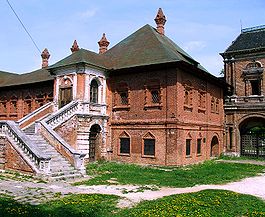
. Krutitsy Metochion, established in late 13th century, contains listed historical buildings erected in late 17th century on site of earlier 16th century foundations. After a brief period of prosperity in 17th century, Krutitsy was shut down by imperial authorities in 1780s, and served as a military warehouse for nearly two centuries. It was restored by Petr Baranovsky
Petr Baranovsky
Pyotr Dmitrievich Baranovsky was a Russian architect, preservationist and restorator who reconstructed many ancient buildings on the territory of Soviet Union...
and gradually opened to the public after World War II
World War II
World War II, or the Second World War , was a global conflict lasting from 1939 to 1945, involving most of the world's nations—including all of the great powers—eventually forming two opposing military alliances: the Allies and the Axis...
; in 1991-1996, Krutitsy was returned to the Church and re-established as the personal metochion of Patriarch of Moscow and all Russia.
Memorial buildings
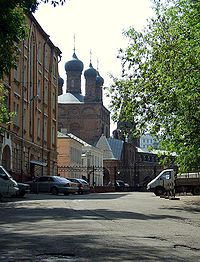
- Dormition Cathedral, actually containing two churches. The lower winter church of St. Peter and Paul was completed in 1667-1689. The upper, unheated summer church of Dormition of our Lady, was completed in 1700. The five-domed cathedral is 29 meters from ground level to the base of a cross. It used to be called Little Dormition Cathedral, as if second only to the Dormition Cathedral in KremlinCathedral of the DormitionThe Cathedral of the Dormition is a Russian Orthodox church dedicated to the Dormition of the Theotokos. It is located on the north side of Cathedral Square of the Moscow Kremlin in Russia, where a narrow alley separates the north from the Patriarch's Palace with the Twelve Apostles Church....
- Resurrection Church, completed in 1650s on early 16th century foundations
- MetropolitanMetropolitan bishopIn Christian churches with episcopal polity, the rank of metropolitan bishop, or simply metropolitan, pertains to the diocesan bishop or archbishop of a metropolis; that is, the chief city of a historical Roman province, ecclesiastical province, or regional capital.Before the establishment of...
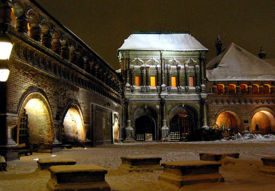
's Chamber, 1655-1670 - Metropolitan's Gallery, connecting the Chambers to Cathedral, with gates and the Teremok tower above them, 1693-1694, by architects Osip Startsev and Illarion Kovalyov, with artwork tiles by Stepan Ivanov
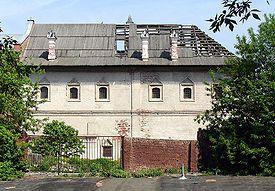
- Riverside Dormitory, 1719 (restoration in progress)
- and a row of small 19th century wooden houses
Foundation to prosperity
After the Mongol invasion of Russia, in 1261, Russian Orthodox clergy established the DioceseDiocese
A diocese is the district or see under the supervision of a bishop. It is divided into parishes.An archdiocese is more significant than a diocese. An archdiocese is presided over by an archbishop whose see may have or had importance due to size or historical significance...
of Sarai
Sarai (city)
Sarai was the name of two cities, which were successively capital cities of the Golden Horde, the Mongol kingdom which ruled Russia and much of central Asia in the 13th and 14th centuries...
in the capital city of the Golden Horde
Golden Horde
The Golden Horde was a Mongol and later Turkicized khanate that formed the north-western sector of the Mongol Empire...
, with an overt mission to serve the numerous Slavic population of Sarai (some Slavs were abducted by force, some joined the Mongol service voluntarily; Russian princes had to pay regular visits of homage to Sarai). Some Orthodox priests, both Greek
Eastern Orthodox Church
The Orthodox Church, officially called the Orthodox Catholic Church and commonly referred to as the Eastern Orthodox Church, is the second largest Christian denomination in the world, with an estimated 300 million adherents mainly in the countries of Belarus, Bulgaria, Cyprus, Georgia, Greece,...
and Russian
Russian Orthodox Church
The Russian Orthodox Church or, alternatively, the Moscow Patriarchate The ROC is often said to be the largest of the Eastern Orthodox churches in the world; including all the autocephalous churches under its umbrella, its adherents number over 150 million worldwide—about half of the 300 million...
, entertained an idea of converting the Mongols
Mongols
Mongols ) are a Central-East Asian ethnic group that lives mainly in the countries of Mongolia, China, and Russia. In China, ethnic Mongols can be found mainly in the central north region of China such as Inner Mongolia...
to Christianity
Christianity
Christianity is a monotheistic religion based on the life and teachings of Jesus as presented in canonical gospels and other New Testament writings...
and thus acquire political influence for the Muscovites. The Mongols were quite tolerant to Christian churches, and it is speculated that Genghis Khan
Genghis Khan
Genghis Khan , born Temujin and occasionally known by his temple name Taizu , was the founder and Great Khan of the Mongol Empire, which became the largest contiguous empire in history after his death....
's mother was a Nestorian. The new diocese was styled as Diocese of Sarai and Don
Prince Daniel of Moscow
Daniel of Moscow
Daniil Aleksandrovich was the youngest son of Alexander Nevsky and forefather of all the Grand Princes of Moscow....
, appreciating the benefits of this alliance, donated to the diocese lands on Moscow River banks, strategically placed on the direct river route to Sarai, near the land road to Kolomna
Kolomna
Kolomna is an ancient city and the administrative center of Kolomensky District of Moscow Oblast, Russia, situated at the confluence of the Moskva and Oka Rivers, southeast of Moscow. The area of the city is about . The city was founded in 1177...
and Ryazan
Ryazan
Ryazan is a city and the administrative center of Ryazan Oblast, Russia. It is located on the Oka River southeast of Moscow. Population: The strategic bomber base Dyagilevo is just west of the city, and the air base of Alexandrovo is to the southeast as is the Ryazan Turlatovo Airport...
. In 1272, Diocese completed the first church on a new site. In the fifteenth century the Golden Horde disintegrated into several warring principalities, its Orthodox population dispersed, thus in 1454 the Diocese relocated to Moscow. Bishop Vassian lost his see, but acquired a new title - Bishop of Krutitsy, and retained the old one. In 1492 the new Diocese acquired its own territoried in lower Volga
Volga River
The Volga is the largest river in Europe in terms of length, discharge, and watershed. It flows through central Russia, and is widely viewed as the national river of Russia. Out of the twenty largest cities of Russia, eleven, including the capital Moscow, are situated in the Volga's drainage...
and Don areas; its bishops gained political influence and in 1589 acquired the style of Metropolitan
Metropolitan bishop
In Christian churches with episcopal polity, the rank of metropolitan bishop, or simply metropolitan, pertains to the diocesan bishop or archbishop of a metropolis; that is, the chief city of a historical Roman province, ecclesiastical province, or regional capital.Before the establishment of...
s of Krutitsy, Bishops of Sarai and Don.
Time of Troubles
The Time of Troubles was a period of Russian history comprising the years of interregnum between the death of the last Russian Tsar of the Rurik Dynasty, Feodor Ivanovich, in 1598, and the establishment of the Romanov Dynasty in 1613. In 1601-1603, Russia suffered a famine that killed one-third...
, when Kremlin Cathedrals were taken over by pretenders, Dormition Cathedral of Krutitsy was, temporarily, the main cathedral of Muscovy; despite later plundering by the Poles, loyalty to the winning party guaranteed further prosperity and influence in spiritual matters and politics. In the 1650s, Krutitsy was a site of bitter disputes between Patriarch Nikon
Patriarch Nikon
Nikon , born Nikita Minin , was the seventh patriarch of the Russian Orthodox Church...
and Old Believers
Old Believers
In the context of Russian Orthodox church history, the Old Believers separated after 1666 from the official Russian Orthodox Church as a protest against church reforms introduced by Patriarch Nikon between 1652–66...
(and, subsequently, a jail for the latter). The golden age of Krutitsy coincided with the rule of Metropolitan Paul II in 1664-1676. Paul II launched an ambitious construction program, building a new Dormition Cathedral, Metropolitan's Chamber, and an exquisite garden with Moscow's first fountain. Further improvements, notably the Gallery and Teremok, were completed by his successors.
Demise
In 1711, when emperor Peter IPeter I of Russia
Peter the Great, Peter I or Pyotr Alexeyevich Romanov Dates indicated by the letters "O.S." are Old Style. All other dates in this article are New Style. ruled the Tsardom of Russia and later the Russian Empire from until his death, jointly ruling before 1696 with his half-brother, Ivan V...
abolished patriarchy and subordinated the Church to State, Metropolitans of Krutitsy were downgraded to bishops (with an exception of revered Metropolitan Ignat Smola in 1719-1722). Soon, Krutitsy was hit by the fire of 1737; old wooden roofs burnt down and were replaced with tin, damaged frescoes simply whitewashed. In 1744-1751 the struggling abbey operated a seminary
Seminary
A seminary, theological college, or divinity school is an institution of secondary or post-secondary education for educating students in theology, generally to prepare them for ordination as clergy or for other ministry...
, and eventually lost this privilege too. In 1764 the state abolished the redundant Diocese of Saray and Don; in 1785, it abolished Diocese of Krutitsy and shut down the abbey, its relics and archives moved to Chudov Monastery
Chudov Monastery
The Chudov Monastery was founded in the Moscow Kremlin in 1358 by Metropolitan Alexius of Moscow. The monastery was dedicated to the miracle of the Archangel Michael at Chonae...
.
Vacant property passed to the Imperial Military; Krutitsy became a military base. Dormition Cathedral burnt down in the Fire of Moscow (1812)
Fire of Moscow (1812)
The 1812 Fire of Moscow broke out on September 14, 1812 in Moscow on the day when Russian troops and most residents abandoned the city and Napoleon's vanguard troops entered the city following the Battle of Borodino...
to such extent that Alexander Tormasov
Alexander Tormasov
Count Alexander Petrovich Tormasov was a Russian cavalry general prominent during the Napoleonic Wars....
, military governor of Moscow, ordered to demolish the remains and build barracks or stables instead. The order was cancelled after intervention of the clergy, when demolition was already underway. In 1817 the cathedral finally acquired a new roof; upper church opened in 1823.
In 1833, Krutitsy found a new sponsor - Grand Duke Alexander, future Alexander II
Alexander II of Russia
Alexander II , also known as Alexander the Liberator was the Emperor of the Russian Empire from 3 March 1855 until his assassination in 1881...
. With all his influence, restoration by Konstantin Thon
Konstantin Thon
Konstantin Andreyevich Thon, also spelled Ton was an official architect of Imperial Russia during the reign of Nicholas I. His major works include the Cathedral of Christ the Saviour, the Grand Kremlin Palace and the Kremlin Armoury in Moscow....
and Yevgraph Tyurin
Yevgraph Tyurin
Yefgraph Dmitrievich Tyurin was a Russian architect and art collector, famous as the builder of Elokhovo Cathedral in Moscow, the main cathedral of Russian Orthodox Church in 1945–2000, and Moscow State University expansion in 1830. Tyurin’s life and work, especially in his later years, was poorly...
lasted for more than thirty years, to 1868. The military, however, retained most of the lands and Riverside Dormitory, and encircled the old abbey with a ring of new warehouses and barracks (still existing and operational today). These barracks also doubled as jail, handling prisoners like Alexander Herzen
Alexander Herzen
Aleksandr Ivanovich Herzen was a Russian pro-Western writer and thinker known as the "father of Russian socialism", and one of the main fathers of agrarian populism...
.
After the Russian Revolution of 1917
Russian Revolution of 1917
The Russian Revolution is the collective term for a series of revolutions in Russia in 1917, which destroyed the Tsarist autocracy and led to the creation of the Soviet Union. The Tsar was deposed and replaced by a provisional government in the first revolution of February 1917...
, Dormition Cathedral operated until 1924. Then, it was closed, looted, frescoes covered with oil paint. All land was again granted to the military. In 1936-1938, Resurrection church was rebuilt into barracks, the old cemetery levelled and converted to a football field. Diocese of Krutitsy was created again in 1920, then in 1947 merged with Diocese of Kolomna
Kolomna
Kolomna is an ancient city and the administrative center of Kolomensky District of Moscow Oblast, Russia, situated at the confluence of the Moskva and Oka Rivers, southeast of Moscow. The area of the city is about . The city was founded in 1177...
.
Restoration
Petr Baranovsky
Pyotr Dmitrievich Baranovsky was a Russian architect, preservationist and restorator who reconstructed many ancient buildings on the territory of Soviet Union...
, an outstanding Russian restorer, made Krutitsy the headquarters of his restoration workshop. Much work was undertaken to renovate the buildings in the 1960s, 1970s, and 1980s. Meanwhile, the property was still run by the military, which gradually vacated the buildings, starting with Dormition Cathedral in 1964.
Despite the 1947 decree on Krutitsy restoration, it was listed as a memorial building only in 1966, when the state launched massive redevelopment of adjacent low-rise neighborhoods. In 1982, Krutitsy became a branch of State Historical Museum
State Historical Museum
The State Historical Museum of Russia is a museum of Russian history wedged between Red Square and Manege Square in Moscow. Its exhibitions range from relics of the prehistoric tribes inhabiting present-day Russia, through priceless artworks acquired by members of the Romanov dynasty...
(and still remains). Finally, in 1991 and 1996 the buildings of Krutitsy were returned to the church, and acquired their present title of Patriarch's Metochion. As of June, 2007, restoration is still under way in Resurrection Church and Riverside Dormitory.
The official site of the Krutitsy Metochion voices a version that in 1953 Lavrentiy Beria
Lavrentiy Beria
Lavrentiy Pavlovich Beria was a Georgian Soviet politician and state security administrator, chief of the Soviet security and secret police apparatus under Joseph Stalin during World War II, and Deputy Premier in the postwar years ....
was jailed at Krutitsy. However, it this not corroborated by academic historians, and it is just as likely that Beria was murdered during his June 26 arrest and subsequent "detention" and "trial" was a coverup.
Visitor access
Krutitsy Metochion is located within walking distance from ProletarskayaProletarskaya
Proletarskaya is a Moscow Metro station in Yuzhnoportovy District, South-Eastern Administrative Okrug, Moscow. It is on the Tagansko-Krasnopresnenskaya Line, between Taganskaya and Volgogradsky Prospekt stations. Proletarskaya opened on 31 December 1966 as part of the Zhadovskiy radius...
subway station and Novospassky Monastery
Novospassky Monastery
Novospassky Monastery is one of the fortified monasteries surrounding Moscow from south-east.It was the first monastery to be founded in Moscow in the early 14th century. The Saviour Church was its original katholikon...
, and has two gates for the public, accessible from Krutitskaya Street or the First Krutitsky Lane. It is not a monastery, looking more like a park managed by the clergy, however, certain rules are enforced:
- Visitors should leave at the end of evening mass
- Photography only with prior consent of the clergy
- No smoking anywhere within the gates