

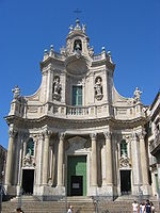
Sicilian Baroque

Encyclopedia
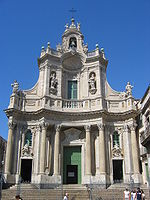
Baroque architecture
Baroque architecture is a term used to describe the building style of the Baroque era, begun in late sixteenth century Italy, that took the Roman vocabulary of Renaissance architecture and used it in a new rhetorical and theatrical fashion, often to express the triumph of the Catholic Church and...
that took hold on the island of Sicily
Sicily
Sicily is a region of Italy, and is the largest island in the Mediterranean Sea. Along with the surrounding minor islands, it constitutes an autonomous region of Italy, the Regione Autonoma Siciliana Sicily has a rich and unique culture, especially with regard to the arts, music, literature,...
, off the southern coast of Italy, in the 17th and 18th centuries. The style is recognizable not only by its typical Baroque curves and flourishes, but also by its grinning mask
Mask
A mask is an article normally worn on the face, typically for protection, disguise, performance or entertainment. Masks have been used since antiquity for both ceremonial and practical purposes...
s and putti
Putto
A putto is a figure of an infant often depicted as a young male. Putti are defined as chubby, winged or wingless, male child figure in nude. Putti are distinct from cherubim, but some English-speakers confuse them with each other, except that in the plural, "the Cherubim" refers to the biblical...
and a particular flamboyance that has given Sicily a unique architectural identity.
The Sicilian Baroque style came to fruition during a major surge of rebuilding following the massive earthquake in 1693
1693 Sicily earthquake
The 1693 Sicily earthquake refers to a powerful earthquake that struck parts of southern Italy, notably Sicily, Calabria and Malta on January 11, 1693 around 9 pm local time. This earthquake was preceded by a damaging foreshock on January 9th...
. Previously, the Baroque style had been used on the island in a naïve and parochial
Parochialism
Parochialism means being provincial, being narrow in scope, or considering only small sections of an issue. It may, particularly when used pejoratively, be contrasted to universalism....
manner, having evolved from hybrid
Cross-genre
A cross-genre is a genre in fiction that blends themes and elements from two or more different genres.-Examples:*Action comedy *Comedy-drama or dramedy *Comedy-horror...
native architecture rather than being derived from the great Baroque architects of Rome. After the earthquake, local architects, many of them trained in Rome, were given plentiful opportunities to recreate the more sophisticated Baroque architecture that had become popular in mainland Italy; the work of these local architects — and the new genre of architectural engraving
Engraving
Engraving is the practice of incising a design on to a hard, usually flat surface, by cutting grooves into it. The result may be a decorated object in itself, as when silver, gold, steel, or glass are engraved, or may provide an intaglio printing plate, of copper or another metal, for printing...
s that they pioneered — inspired more local architects to follow their lead. Around 1730, Sicilian architects had developed a confidence in their use of the Baroque style. Their particular interpretation led to further evolution to a personalised and highly localised art form on the island. From the 1780s onwards, the style was gradually replaced by the newly-fashionable neoclassicism
Neoclassical architecture
Neoclassical architecture was an architectural style produced by the neoclassical movement that began in the mid-18th century, manifested both in its details as a reaction against the Rococo style of naturalistic ornament, and in its architectural formulas as an outgrowth of some classicizing...
.
The highly decorative Sicilian Baroque period lasted barely fifty years, and perfectly reflected the social order
Social order
Social order is a concept used in sociology, history and other social sciences. It refers to a set of linked social structures, social institutions and social practices which conserve, maintain and enforce "normal" ways of relating and behaving....
of the island at a time when, nominally ruled by Spain, it was in fact governed by a wealthy and often extravagant aristocracy
Aristocracy
Aristocracy , is a form of government in which a few elite citizens rule. The term derives from the Greek aristokratia, meaning "rule of the best". In origin in Ancient Greece, it was conceived of as rule by the best qualified citizens, and contrasted with monarchy...
into whose hands ownership of the primarily agricultural economy was highly concentrated. Its Baroque architecture gives the island an architectural character that has lasted into the 21st century.
Characteristics
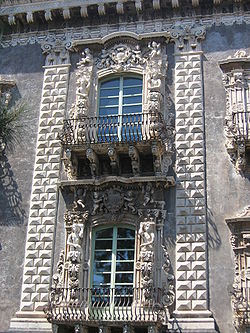
Chiaroscuro
Chiaroscuro in art is "an Italian term which literally means 'light-dark'. In paintings the description refers to clear tonal contrasts which are often used to suggest the volume and modelling of the subjects depicted"....
, the strategic use of light and shade on a building created by mass and shadow.
The Baroque style in Sicily was largely confined to buildings erected by the church, and palazzi
Palazzo
Palazzo, an Italian word meaning a large building , may refer to:-Buildings:*Palazzo, an Italian type of building**Palazzo style architecture, imitative of Italian palazzi...
built as private residences for the Sicilian aristocracy. The earliest examples of this style in Sicily lacked individuality and were typically heavy-handed pastiches of buildings seen by Sicilian visitors to Rome, Florence
Florence
Florence is the capital city of the Italian region of Tuscany and of the province of Florence. It is the most populous city in Tuscany, with approximately 370,000 inhabitants, expanding to over 1.5 million in the metropolitan area....
, and Naples
Naples
Naples is a city in Southern Italy, situated on the country's west coast by the Gulf of Naples. Lying between two notable volcanic regions, Mount Vesuvius and the Phlegraean Fields, it is the capital of the region of Campania and of the province of Naples...
. However, even at this early stage, provincial architects had begun to incorporate certain vernacular features of Sicily's older architecture. By the middle of the 18th century, when Sicily's Baroque architecture was noticeably different from that of the mainland, it typically included at least two or three of the following features, coupled with a unique freedom of design that is more difficult to characterise in words.
1: Grotesque masks and putti, often supporting balconies
Balcony
Balcony , a platform projecting from the wall of a building, supported by columns or console brackets, and enclosed with a balustrade.-Types:The traditional Maltese balcony is a wooden closed balcony projecting from a...
or decorating various bands of the entablature
Entablature
An entablature refers to the superstructure of moldings and bands which lie horizontally above columns, resting on their capitals. Entablatures are major elements of classical architecture, and are commonly divided into the architrave , the frieze ,...
of a building; these grinning or glaring faces are a relic of Sicilian architecture from before the mid-17th century (Illustrations 2 and 9).
2: Balconies, often complemented by intricate wrought iron balustrade
Baluster
A baluster is a moulded shaft, square or of lathe-turned form, one of various forms of spindle in woodwork, made of stone or wood and sometimes of metal, standing on a unifying footing, and supporting the coping of a parapet or the handrail of a staircase. Multiplied in this way, they form a...
s after 1633 (Illustrations 2 & 9), and by plainer balustrades before that date (Illustration 6).
3: External staircases. Most villa
Villa
A villa was originally an ancient Roman upper-class country house. Since its origins in the Roman villa, the idea and function of a villa have evolved considerably. After the fall of the Roman Republic, villas became small farming compounds, which were increasingly fortified in Late Antiquity,...
s and palazzi were designed for formal entrance by a carriage
Carriage
A carriage is a wheeled vehicle for people, usually horse-drawn; litters and sedan chairs are excluded, since they are wheelless vehicles. The carriage is especially designed for private passenger use and for comfort or elegance, though some are also used to transport goods. It may be light,...
through an archway in the street façade
Facade
A facade or façade is generally one exterior side of a building, usually, but not always, the front. The word comes from the French language, literally meaning "frontage" or "face"....
, leading to a courtyard
Courtyard
A court or courtyard is an enclosed area, often a space enclosed by a building that is open to the sky. These areas in inns and public buildings were often the primary meeting places for some purposes, leading to the other meanings of court....
within. An intricate double staircase would lead from the courtyard to the piano nobile
Piano nobile
The piano nobile is the principal floor of a large house, usually built in one of the styles of classical renaissance architecture...
. This would be the palazzo's principal entrance to the first-floor reception rooms; the symmetrical flights of steps would turn inwards and outwards as many as four times. Owing to the topography of their elevated sites it was often necessary to approach churches by many steps; these steps were often transformed into long straight marble staircases, in themselves decorative architectural features (illustration 19), in the manner of the Spanish Steps
Spanish Steps
The Spanish Steps are a set of steps in Rome, Italy, climbing a steep slope between the Piazza di Spagna at the base and Piazza Trinità dei Monti, dominated by the Trinità dei Monti church at the top. The Scalinata is the widest staircase in Europe...
in Rome.
4: Canted
Cant (architecture)
Cant is the architectural term describing part, or segment, of a facade which is at an angle to another part of the same facade. The angle breaking the facade is less than a right angle thus enabling a canted facade to be viewed as, and remain, one composition.Canted facades are a typical of, but...
, concave, or convex façades (Illustrations 1 and 6). Occasionally in a villa or palazzo, an external staircase would be fitted into the recess created by the curve.
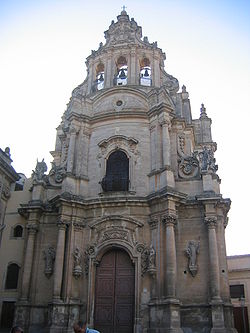
Bell tower
A bell tower is a tower which contains one or more bells, or which is designed to hold bells, even if it has none. In the European tradition, such a tower most commonly serves as part of a church and contains church bells. When attached to a city hall or other civic building, especially in...
s were not placed beside the church in a campanile
Campanile
Campanile is an Italian word meaning "bell tower" . The term applies to bell towers which are either part of a larger building or free-standing, although in American English, the latter meaning has become prevalent.The most famous campanile is probably the Leaning Tower of Pisa...
tower as is common in Italy, but on the façade itself, often surmounting the central pediment
Pediment
A pediment is a classical architectural element consisting of the triangular section found above the horizontal structure , typically supported by columns. The gable end of the pediment is surrounded by the cornice moulding...
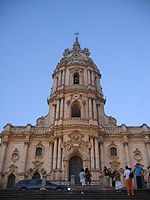
, with one or more bells clearly displayed beneath its own arch, such as at Catania's Collegiata (Illustration 1). In a large church with many bells this usually resulted in an intricately sculpted and decorated arcade at the highest point of the principal façade (Illustration 3). These belfries are among the most enduring and characteristic features of Sicilian Baroque architecture.
6: Inlaid coloured marble set into both floor and walls especially in church interiors. This particular form of Intarsia
Intarsia
Intarsia is a form of wood inlaying that is similar to marquetry. The term is also used for a similar technique used with small, highly polished stones set in a marble matrix .- History :...
developed in Sicily from the 17th century (see the floor of illustration 14).
7: Columns that are often deployed singularly, supporting plain arches and thus displaying the influence of the earlier and much plainer Norman
Norman architecture
About|Romanesque architecture, primarily English|other buildings in Normandy|Architecture of Normandy.File:Durham Cathedral. Nave by James Valentine c.1890.jpg|thumb|200px|The nave of Durham Cathedral demonstrates the characteristic round arched style, though use of shallow pointed arches above the...
period (Illustration 3). Columns are rarely encountered, as elsewhere in Europe, in clustered groups acting as piers, especially in examples of early Sicilian Baroque.
8: Decorated rustication. Sebastiano Serlio
Sebastiano Serlio
Sebastiano Serlio was an Italian Mannerist architect, who was part of the Italian team building the Palace of Fontainebleau...
had decorated the blocks of ashlar
Ashlar
Ashlar is prepared stone work of any type of stone. Masonry using such stones laid in parallel courses is known as ashlar masonry, whereas masonry using irregularly shaped stones is known as rubble masonry. Ashlar blocks are rectangular cuboid blocks that are masonry sculpted to have square edges...
in his rustication
Rustication (architecture)
thumb|upright|Two different styles of rustication in the [[Palazzo Medici-Riccardi]] in [[Florence]].In classical architecture rustication is an architectural feature that contrasts in texture with the smoothly finished, squared block masonry surfaces called ashlar...
; by the end of the 16th century, Sicilian architects were ornamenting the blocks with carvings of leaves, fish-scales, and even sweets and shells; shells were later to become among the most prevalent ornamental symbols of Baroque design. Sometimes the rustication would be used for pillars rather than walls, a reversal of expectations and almost an architectural joke (illustration 2).
10: The Spanish influence. The architectural influence of the ruling Spanish (Illustration 13), although this was a milder influence than that of the Normans. The Spanish style, a more restrained version of French renaissance architecture, is particularly evident in eastern Sicily, where — owing to minor insurrections — the Spanish maintained a stronger military presence. Messina's monumental Porta Grazia, erected in 1680 as the entrance to a Spanish citadel
Citadel
A citadel is a fortress for protecting a town, sometimes incorporating a castle. The term derives from the same Latin root as the word "city", civis, meaning citizen....
, would not be out of place in any of the towns and citadels built by the Spanish in their colonies elsewhere. The style of this arched city gate, with its ornate mouldings
Molding (decorative)
Molding or moulding is a strip of material with various profiles used to cover transitions between surfaces or for decoration. It is traditionally made from solid milled wood or plaster but may be made from plastic or reformed wood...
and scrolls, was widely copied all over Catania
Catania
Catania is an Italian city on the east coast of Sicily facing the Ionian Sea, between Messina and Syracuse. It is the capital of the homonymous province, and with 298,957 inhabitants it is the second-largest city in Sicily and the tenth in Italy.Catania is known to have a seismic history and...
immediately following the quake.
While these characteristics never occur all together in the same building, and none are unique to Sicilian Baroque, it is the coupling together which gives the Sicilian Baroque its distinctive air. Other Baroque characteristics, such as broken pediments over windows, the extravagant use of statuary, and curved topped windows and doors are all emblematic of Baroque architecture, but can all be found on Baroque building all over Europe.
Early Sicilian Baroque
Volcanic Sicily in the central Mediterranean, off the Italian peninsulaItalian Peninsula
The Italian Peninsula or Apennine Peninsula is one of the three large peninsulas of Southern Europe , spanning from the Po Valley in the north to the central Mediterranean Sea in the south. The peninsula's shape gives it the nickname Lo Stivale...
, has been colonised by the Greeks
Ancient Greece
Ancient Greece is a civilization belonging to a period of Greek history that lasted from the Archaic period of the 8th to 6th centuries BC to the end of antiquity. Immediately following this period was the beginning of the Early Middle Ages and the Byzantine era. Included in Ancient Greece is the...
, then it was under the Romans
Ancient Rome
Ancient Rome was a thriving civilization that grew on the Italian Peninsula as early as the 8th century BC. Located along the Mediterranean Sea and centered on the city of Rome, it expanded to one of the largest empires in the ancient world....
, the Byzantines
Byzantine Empire
The Byzantine Empire was the Eastern Roman Empire during the periods of Late Antiquity and the Middle Ages, centred on the capital of Constantinople. Known simply as the Roman Empire or Romania to its inhabitants and neighbours, the Empire was the direct continuation of the Ancient Roman State...
, the Ostrogoths, the Muslims
Emirate of Sicily
The Emirate of Sicily was an Islamic state on the island of Sicily , which existed from 965 to 1072.-First Arab invasions of Sicily:...
, the Normans, the Hohenstaufen
Hohenstaufen
The House of Hohenstaufen was a dynasty of German kings in the High Middle Ages, lasting from 1138 to 1254. Three of these kings were also crowned Holy Roman Emperor. In 1194 the Hohenstaufens also became Kings of Sicily...
, the Angevins and the Aragonese
House of Aragon
The House of Aragon is the name given several royal houses that ruled the County, the Kingdom or the Crown of Aragon.Some historiansGuillermo Fatás y Guillermo Redondo, Alberto Montaner Frutos, Faustino Menéndez Pidal de Navascués...
, after whom it became a province of the Spanish Empire
Spanish Empire
The Spanish Empire comprised territories and colonies administered directly by Spain in Europe, in America, Africa, Asia and Oceania. It originated during the Age of Exploration and was therefore one of the first global empires. At the time of Habsburgs, Spain reached the peak of its world power....
and then was part of the Bourbon
House of Bourbon
The House of Bourbon is a European royal house, a branch of the Capetian dynasty . Bourbon kings first ruled Navarre and France in the 16th century. By the 18th century, members of the Bourbon dynasty also held thrones in Spain, Naples, Sicily, and Parma...
Kingdom of the Two Sicilies
Kingdom of the Two Sicilies
The Kingdom of the Two Sicilies, commonly known as the Two Sicilies even before formally coming into being, was the largest and wealthiest of the Italian states before Italian unification...
, before finally being absorbed into the Kingdom of Italy
Italy
Italy , officially the Italian Republic languages]] under the European Charter for Regional or Minority Languages. In each of these, Italy's official name is as follows:;;;;;;;;), is a unitary parliamentary republic in South-Central Europe. To the north it borders France, Switzerland, Austria and...
in 1860. Thus Sicilians have been exposed to a rich sequence of disparate cultures; this is reflected in the extraordinary diversity of architecture on the island.
A form of decorated classical architecture peculiar to Sicily had begun to evolve from the 1530s. Inspired by the ruined Greek architecture
Architecture of Ancient Greece
The architecture of Ancient Greece is the architecture produced by the Greek-speaking people whose culture flourished on the Greek mainland and Peloponnesus, the Aegean Islands, and in colonies in Asia Minor and Italy for a period from about 900 BC until the 1st century AD, with the earliest...
and by the Norman cathedral
Cathedral
A cathedral is a Christian church that contains the seat of a bishop...
s on the island, this often incorporated Greek architectural motifs such as the Greek key pattern into late Norman architecture with Gothic
Gothic architecture
Gothic architecture is a style of architecture that flourished during the high and late medieval period. It evolved from Romanesque architecture and was succeeded by Renaissance architecture....
features such as pointed arches and window apertures. The Sicilian Norman architecture incorporated some Byzantine
Byzantine Empire
The Byzantine Empire was the Eastern Roman Empire during the periods of Late Antiquity and the Middle Ages, centred on the capital of Constantinople. Known simply as the Roman Empire or Romania to its inhabitants and neighbours, the Empire was the direct continuation of the Ancient Roman State...
elements seldom found in Norman architecture elsewhere, and like other Romanesque architecture
Romanesque architecture
Romanesque architecture is an architectural style of Medieval Europe characterised by semi-circular arches. There is no consensus for the beginning date of the Romanesque architecture, with proposals ranging from the 6th to the 10th century. It developed in the 12th century into the Gothic style,...
it went on to incorporate Gothic features. This early ornate architecture differs from that of mainland Europe in not having evolved from Renaissance architecture
Renaissance architecture
Renaissance architecture is the architecture of the period between the early 15th and early 17th centuries in different regions of Europe, demonstrating a conscious revival and development of certain elements of ancient Greek and Roman thought and material culture. Stylistically, Renaissance...
; instead, it was developed from Norman styles. Renaissance architecture hardly touched Sicily; in the capital city of Palermo
Palermo
Palermo is a city in Southern Italy, the capital of both the autonomous region of Sicily and the Province of Palermo. The city is noted for its history, culture, architecture and gastronomy, playing an important role throughout much of its existence; it is over 2,700 years old...
, the only remnant of the High Renaissance is a water fountain, brought from Florence when it was already 20 years old (Illustration 5).
Whatever the reason that Renaissance style never became popular in Sicily, it was certainly not ignorance. Antonello Gagini
Antonello Gagini
Antonello Gagini was an Italian sculptor of the Renaissance, mainly active in Sicily and Calabria.Antonello was a member of a family of sculptors and artisans, originally from Northern Italy, but active throughout Italy, including Genoa, Florence, and Rome. The family includes his father, Domenico...
was midway through constructing the church of Santa Maria di Porto Salvo in 1536 in the Renaissance style when he died; he was superseded by the architect Antonio Scaglione
Antonio Scaglione
Antonio Scaglione was a 16th century provincial Sicilian architect, best known for his work in the Gothic style, which he continued to promote long after Renaissance architecture had superseded it in popularity. The church of "S...
, who completed the building in a Norman style. This style seems to have influenced Sicilian architecture almost up to the time of the 1693 earthquake. Even Mannerism
Mannerism
Mannerism is a period of European art that emerged from the later years of the Italian High Renaissance around 1520. It lasted until about 1580 in Italy, when a more Baroque style began to replace it, but Northern Mannerism continued into the early 17th century throughout much of Europe...
passed the island by. Only in the architecture of Messina could a Renaissance influence be discerned, partly for geographical reasons: within sight of mainland Italy and the most important port in Sicily, Messina was always more amenable to the prevailing tides of fashion outside the island. The town's aristocratic patrons would often call on Florence or Rome to provide them with an architect; one example was the Florentine Giovanni Angelo Montorsoli
Giovanni Angelo Montorsoli
Giovanni Antonio Montorsoli , also known as Fra Montorsoli, as Michele Agnolo and as Angelo di Michele d' Angelo da Poggibonsi, was an Italian sculptor.-Biography:...
, who established the Tuscan
Tuscany
Tuscany is a region in Italy. It has an area of about 23,000 square kilometres and a population of about 3.75 million inhabitants. The regional capital is Florence ....
styles of architecture and sculpture there in the mid-16th century. However, these influences remained largely confined to Messina and the surrounding district. It seems likely that it was the patronage of the Roman Catholic Church, removed from the influences of Roman fashion, that remained conservative in architectural taste.
This is not to say that Sicily was completely isolated from trends elsewhere in Europe. Architecture in the island's major cities was strongly influenced by the family of the sculptor Domenico Gagini
Domenico Gagini
Domenico Gagini was an Italian sculptor. He was the son of Pietro Gagini. The Gagini were a family of sculptors and painters working during the Middle Ages and Renaissance...
, who arrived from Florence in 1463. This family of sculptors and painters decorated churches and buildings with ornate decorative and figurative sculpture. Less than a century after his family had begun to cautiously decorate the island's churches (1531–37), Antonio Gagini
Antonello Gagini
Antonello Gagini was an Italian sculptor of the Renaissance, mainly active in Sicily and Calabria.Antonello was a member of a family of sculptors and artisans, originally from Northern Italy, but active throughout Italy, including Genoa, Florence, and Rome. The family includes his father, Domenico...
completed the proscenium
Proscenium
A proscenium theatre is a theatre space whose primary feature is a large frame or arch , which is located at or near the front of the stage...
-like arch of the "Capella della Madonna" in the "Santuario dell'Annunziata" at Trapani
Trapani
Trapani is a city and comune on the west coast of Sicily in Italy. It is the capital of the Province of Trapani. Founded by Elymians, the city is still an important fishing port and the main gateway to the nearby Egadi Islands.-History:...
. This pedimented arch to the sanctuary has pilaster
Pilaster
A pilaster is a slightly-projecting column built into or applied to the face of a wall. Most commonly flattened or rectangular in form, pilasters can also take a half-round form or the shape of any type of column, including tortile....
s — not fluted
Fluting (architecture)
Fluting in architecture refers to the shallow grooves running vertically along a surface.It typically refers to the grooves running on a column shaft or a pilaster, but need not necessarily be restricted to those two applications...
, but decorated heavily with relief bust
Bust (sculpture)
A bust is a sculpted or cast representation of the upper part of the human figure, depicting a person's head and neck, as well as a variable portion of the chest and shoulders. The piece is normally supported by a plinth. These forms recreate the likeness of an individual...
s of the saints; and, most importantly in terms of architecture, the pediment is adorned by reclining saint
Saint
A saint is a holy person. In various religions, saints are people who are believed to have exceptional holiness.In Christian usage, "saint" refers to any believer who is "in Christ", and in whom Christ dwells, whether in heaven or in earth...
s supporting swag
Garland (decoration)
A garland is a decorative wreath or cord, used at festive occasions, which can be hung round a person's neck, or on inanimate objects like Christmas trees. Originally garlands were made of flowers or leaves.-Etymology:...
s linked to the central shield that crowns the pediment. This ornate pediment, although still unbroken, was one of the first signs that Sicily was forming its own style of decorative architecture. Similar in style is the Chiesa del Gesù (Illustration 14), constructed between 1564 and 1633, which also shows early signs of the Sicilian Baroque.
World War II
World War II, or the Second World War , was a global conflict lasting from 1939 to 1945, involving most of the world's nations—including all of the great powers—eventually forming two opposing military alliances: the Allies and the Axis...
.
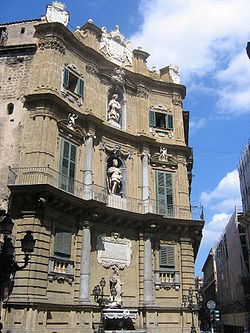
The earliest example of Baroque on the island is Giulio Lasso
Giulio Lasso
Giulio Lasso was an Italian architect, best known for his work in Palermo, Sicily. He was born in Florence.His most famous work is the Quattro Canti, an eight sided piazza in the centre of Palermo...
's Quattro Canti
Quattro Canti
Quattro Canti, officially known as Piazza Vigliena, is a Baroque square in Palermo, Sicily, southern Italy.It was laid out on the orders of the Viceroy the Duke of Maqueda between 1608-1620 by Giulio Lasso at the crossing of the two principal streets in Palermo, the Via Maqueda and the Corso...
, an octagonal piazza
Piazza
A piazza is a city square in Italy, Malta, along the Dalmatian coast and in surrounding regions. The term is roughly equivalent to the Spanish plaza...
, or circus, constructed around 1610 at the crossroads
Crossroads (culture)
In folk magic and mythology, crossroads may represent a location "between the worlds" and, as such, a site where supernatural spirits can be contacted and paranormal events can take place...
of the city's two principal streets. Around this intersection are four open sides, being the streets, and four matching buildings with identical cant
Cant (architecture)
Cant is the architectural term describing part, or segment, of a facade which is at an angle to another part of the same facade. The angle breaking the facade is less than a right angle thus enabling a canted facade to be viewed as, and remain, one composition.Canted facades are a typical of, but...
ed corners. The sides of the four buildings are curved, further heightening the Baroque design of the buildings lining the circus. These four great buildings dominating the circus are each enhanced by a fountain, reminiscent of those of Pope Sixtus V's "Quattro Fontane" in Rome. However, here in Palermo the Baroque theme continues up three storeys of the buildings, which are adorned with statues in recessed niches depicting the four seasons, the four Spanish kings of Sicily, and the four patronesses of Palermo: Saints Cristina, Ninfa, Olivia
Saint Olivia
Saint Olivia, according to the legend, was the beautiful daughter of a noble Sicilian family. She is supposed to have lived in the 9th century. When she was 13 years old she was kidnapped by and taken as a slave to Tunis...
, and Agata.
While each façade of Quattro Canti is pleasing to the eye, as a scheme it is both out of proportion with the limited size of the piazza and, like most other examples of early Sicilian Baroque, can be considered provincial, naive and heavy-handed, compared with later developments. Whatever its merit, it is evident that during the 17th century, the Baroque style in the hands of the local architects and sculptors was already deviating from that of mainland Italy. This localised variation on the mainstream Baroque was not peculiar to Sicily, but occurred as far afield as Bavaria
Bavaria
Bavaria, formally the Free State of Bavaria is a state of Germany, located in the southeast of Germany. With an area of , it is the largest state by area, forming almost 20% of the total land area of Germany...
, and Russia, where Naryshkin Baroque
Naryshkin Baroque
Naryshkin Baroque, also called Moscow Baroque, or Muscovite Baroque, is the name given to a particular style of Baroque architecture and decoration which was fashionable in Moscow from the turn of the 17th into the early 18th centuries.-Style:...
would be just as eccentric as its Sicilian cousin.
Earthquake and patrons
The great Sicilian earthquake of 16931693 Sicily earthquake
The 1693 Sicily earthquake refers to a powerful earthquake that struck parts of southern Italy, notably Sicily, Calabria and Malta on January 11, 1693 around 9 pm local time. This earthquake was preceded by a damaging foreshock on January 9th...
destroyed at least 45 towns and cities, affecting an area of 5600 square kilometres and causing the deaths of about 60,000 people. The epicentre
Epicenter
The epicenter or epicentre is the point on the Earth's surface that is directly above the hypocenter or focus, the point where an earthquake or underground explosion originates...
of the disaster was offshore, although the exact position remains unknown. Other towns which suffered severely were Ragusa
Ragusa, Italy
Ragusa is a city and comune in southern Italy. It is the capital of the province of Ragusa, on the island of Sicily, with around 75,000 inhabitants. It is built on a wide limestone hill between two deep valleys, Cava San Leonardo and Cava Santa Domenica...
, Modica
Modica
-External links:*...
, Scicli
Scicli
*...
, and Ispica
Ispica
Ispica is a city and comune in the south of Sicily, Italy. It is 30 km from Ragusa, 50 km from Syracuse, and 90 km away from La Valletta, on the coast of Malta...
. Rebuilding began almost immediately.
The lavishness of the architecture that was to arise from this disaster is connected with the politics of Sicily at the time; Sicily was still officially under Spanish rule, but rule was effectively delegated to the native aristocracy. This was led by the Duke of Camastra
Giuseppe Lanza
Giuseppe Lanza, Duke of Camastra, was a 17th century Sicilian nobleman who oversaw the reconstruction of many Sicilian towns and cities following the earthquake of 1693.He was created 1st Duke of Camastra, and Prince of Santo Stefano...
, whom the Spanish had appointed viceroy
Viceroy
A viceroy is a royal official who runs a country, colony, or province in the name of and as representative of the monarch. The term derives from the Latin prefix vice-, meaning "in the place of" and the French word roi, meaning king. A viceroy's province or larger territory is called a viceroyalty...
to appease the aristocracy, who were numerous. The aristocracy was relatively concentrated compared to most of Europe, and a gentry
Gentry
Gentry denotes "well-born and well-bred people" of high social class, especially in the past....
class was missing. In the 18th century, one estimate held that there were 228 noble families, who provided Sicily with a ruling class
Ruling class
The term ruling class refers to the social class of a given society that decides upon and sets that society's political policy - assuming there is one such particular class in the given society....
consisting of 58 princes, 27 dukes, 37 marquesses, 26 Counts, one viscount and 79 barons; the Golden Book of the Sicilian nobility (last published in 1926) lists even more. In addition to these were the younger scions of the families, with their courtesy titles of nobile or baron
Baron
Baron is a title of nobility. The word baron comes from Old French baron, itself from Old High German and Latin baro meaning " man, warrior"; it merged with cognate Old English beorn meaning "nobleman"...
.
Architecture was not the only legacy of the Normans
Normans
The Normans were the people who gave their name to Normandy, a region in northern France. They were descended from Norse Viking conquerors of the territory and the native population of Frankish and Gallo-Roman stock...
. Rule over the peasants (there was no established middle class) was also enforced by a feudal system, unchanged since its introduction following the Norman conquest of 1071. Thus the Sicilian aristocracy had not only wealth but vast manpower at their command, something that had by this time declined in many other parts of Europe. As in Southern Spain, the huge rural estates remained almost as concentrated as when they had been Roman "latifundi". The Sicilian economy, though very largely agriculturally based, was very strong, and became more so during the 18th century as shipping became more efficient and the threat of Muslim piracy died away. The export markets for lemons (for the great 18th century fashion for lemonade
Lemonade
Lemonade is a lemon-flavored drink, typically made from lemons, water and sugar.The term can refer to three different types of beverage:...
) and wines increased greatly, and Sicilian wheat remained, as it had been since Roman times, the backbone of the economy. The disaster that was to give Sicily its modern reputation of poverty, namely the opening-up of the American Middle West to wheat-farming, was a century away. When it came, this permanently more than halved the price of wheat, and destroyed the old economy forever.
The aristocracy shared their power only with the Roman Catholic Church
Roman Catholic Church
The Catholic Church, also known as the Roman Catholic Church, is the world's largest Christian church, with over a billion members. Led by the Pope, it defines its mission as spreading the gospel of Jesus Christ, administering the sacraments and exercising charity...
. The Church ruled by fear of damnation in the next life and of the Inquisition
Inquisition
The Inquisition, Inquisitio Haereticae Pravitatis , was the "fight against heretics" by several institutions within the justice-system of the Roman Catholic Church. It started in the 12th century, with the introduction of torture in the persecution of heresy...
in the present, and consequently both upper and lower classes gave as generously as they could on all major saints' days. Many priests and bishops were members of the aristocracy. The wealth of the Church in Sicily was further enhanced by the tradition of pressing younger children of the aristocracy to enter monasteries
Monastery
Monastery denotes the building, or complex of buildings, that houses a room reserved for prayer as well as the domestic quarters and workplace of monastics, whether monks or nuns, and whether living in community or alone .Monasteries may vary greatly in size – a small dwelling accommodating only...
and convent
Convent
A convent is either a community of priests, religious brothers, religious sisters, or nuns, or the building used by the community, particularly in the Roman Catholic Church and in the Anglican Communion...
s, in order to preserve the family estates from division; a large fee, or dowry
Dowry
A dowry is the money, goods, or estate that a woman brings forth to the marriage. It contrasts with bride price, which is paid to the bride's parents, and dower, which is property settled on the bride herself by the groom at the time of marriage. The same culture may simultaneously practice both...
, was usually paid to the Church to facilitate this, in the form of property, jewels, or money. Thus the wealth of certain religious orders grew out of all proportion to the economic growth of any other group at this time. This is one of the reasons that so many of the Sicilian Baroque churches and monasteries, such as San Martino delle Scale, were rebuilt after 1693 on such a lavish scale.
Once rebuilding began, the poor rebuilt their basic housing in the same primitive fashion as before. By contrast, the wealthiest residents, both secular and spiritual, became caught in an almost manic orgy of building. Most members of the nobility had several homes in Sicily. For one thing, the Spanish viceroy spent six months of the year in Palermo and six in Catania
Catania
Catania is an Italian city on the east coast of Sicily facing the Ionian Sea, between Messina and Syracuse. It is the capital of the homonymous province, and with 298,957 inhabitants it is the second-largest city in Sicily and the tenth in Italy.Catania is known to have a seismic history and...
, holding court in each city, and hence members of the aristocracy needed a town palazzo in each city. Once the palazzi in devastated Catania were rebuilt in the new fashion, the palazzi in Palermo seemed antiquated by comparison, so they too were eventually rebuilt. Following this, from the middle of the 18th century, villas to retire to in the autumn, essentially status symbols, were built at the fashionable enclave at Bagheria
Bagheria
Bagheria is a town and comune in the Province of Palermo in Sicily, Italy.-Etymology:According to some sources, the name Bagheria originates from the Phoenician term Bayharia meaning "land that descends toward the sea." Other sources claim that it derives from the Arabic Bāb al-Gerib, or "windy...
. This pattern was repeated, on a smaller scale, throughout the lesser cities of Sicily, each city providing a more entertaining social life and a magnetic draw for the provincial aristocrat than their country estate. The country estate also did not escape the building mania. Often Baroque wings or new façades were added to ancient castles, or country villas were completely rebuilt. Thus the frenzy of building gained momentum until the increasingly fantastical Baroque architecture demanded by these hedonistic patrons reached its zenith
Zenith
The zenith is an imaginary point directly "above" a particular location, on the imaginary celestial sphere. "Above" means in the vertical direction opposite to the apparent gravitational force at that location. The opposite direction, i.e...
in the mid-18th century.
New cities
Following the quake a program of rebuilding was rapidly put into action, but before it began in earnest some important decisions would permanently differentiate many Sicilian cities and towns from other European urban developments. The Viceroy, the Duke of Camastra, aware of new trends in town planning, decreed that rather than rebuilding in the medieval plan of cramped narrow streets, the new rebuilding would offer piazzePiazza
A piazza is a city square in Italy, Malta, along the Dalmatian coast and in surrounding regions. The term is roughly equivalent to the Spanish plaza...
and wider main streets, often on a rational grid system. The whole plan was often to take a geometric shape such as a perfect square or a hexagon, typical of Renaissance and Baroque town planning.
This concept was still very new in the 1690s, and few new cities had had reason to be built in Europe - Christopher Wren
Christopher Wren
Sir Christopher Wren FRS is one of the most highly acclaimed English architects in history.He used to be accorded responsibility for rebuilding 51 churches in the City of London after the Great Fire in 1666, including his masterpiece, St. Paul's Cathedral, on Ludgate Hill, completed in 1710...
's city plan after the Great Fire of London
Great Fire of London
The Great Fire of London was a major conflagration that swept through the central parts of the English city of London, from Sunday, 2 September to Wednesday, 5 September 1666. The fire gutted the medieval City of London inside the old Roman City Wall...
in 1666 having been turned down because of the complexities of land ownership there.There were some other examples such as Richelieu, Indre-et-Loire, and later Saint Petersburg
Saint Petersburg
Saint Petersburg is a city and a federal subject of Russia located on the Neva River at the head of the Gulf of Finland on the Baltic Sea...
. The prototype may well have been the new city of Terra del Sole
Terra del Sole
Terra del Sole was a town constructed in 1564 for Cosimo I de’ Medici by Baldassarre Lanci of Urbino, in what is now the Province of Forlì-Cesena, northern Italy. It was one of the first fortified cities to be constructed entirely from new on a planned grid system...
, constructed in 1564. Another of the first towns to be planned using symmetry and order rather than an evolution of small alleys and streets was Alessandria
Alessandria
-Monuments:* The Citadel * The church of Santa Maria di Castello * The church of Santa Maria del Carmine * Palazzo Ghilini * Università del Piemonte Orientale-Museums:* The Marengo Battle Museum...
in southern Piedmont
Piedmont
Piedmont is one of the 20 regions of Italy. It has an area of 25,402 square kilometres and a population of about 4.4 million. The capital of Piedmont is Turin. The main local language is Piedmontese. Occitan is also spoken by a minority in the Occitan Valleys situated in the Provinces of...
. A little later, from 1711, this Baroque form of planning was favoured in the Hispanic colonies of South America, especially by the Portuguese in Brazil
Brazil
Brazil , officially the Federative Republic of Brazil , is the largest country in South America. It is the world's fifth largest country, both by geographical area and by population with over 192 million people...
. In other parts of Europe, lack of finance, complex land ownership and divided public opinion made radical replanning after disaster too difficult: after 1666, London was rebuilt on its ancient plan, though new extensions to the west were partially on a grid system. In Sicily, public opinion (the public being anyone not a member of the ruling class) counted for nothing, and hence these seemingly revolutionary new concepts of town planning could be freely executed.
In Sicily, the decision was taken not just for fashion and appearance but also because it would minimise the damage to property and life likely to be caused in future quakes. In 1693, the cramped housing and streets had caused buildings to collapse together like dominoes (a hazard that was to remain in the still cramped and narrow areas housing the poor). Architecturally and aesthetically, the big advantage of the new order of town planning was that unlike many Italian towns and cities, where one frequently encounters a monumental Renaissance church squeezed terrace fashion between incongruous neighbours, in urban Baroque design one can step back and actually see the architecture in a more conducive setting in relation to its proportions and perspective. This is most notable in the largely rebuilt towns of Caltagirone
Caltagirone
Caltagirone is a town and comune in the province of Catania, on the island of Sicily, about 70 km southwest of Catania. It is bounded by the comuni of Acate, Gela, Grammichele, Licodia Eubea, Mazzarino, Mazzarrone, Mineo, Mirabella Imbaccari, Niscemi, Piazza Armerina, San Michele di...
, Militello in Val di Catania
Militello in Val di Catania
-External links:*...
, Catania
Catania
Catania is an Italian city on the east coast of Sicily facing the Ionian Sea, between Messina and Syracuse. It is the capital of the homonymous province, and with 298,957 inhabitants it is the second-largest city in Sicily and the tenth in Italy.Catania is known to have a seismic history and...
, Modica
Modica
-External links:*...
, Noto
Noto
Noto is a city and comune in the Province of Syracuse, Sicily . Its located 32 km southwest of the city of Syracuse at the foot of the Iblean Mountains and gives its name to the surrounding valley, Val di Noto...
, Palazzolo Acreide, Ragusa
Ragusa, Italy
Ragusa is a city and comune in southern Italy. It is the capital of the province of Ragusa, on the island of Sicily, with around 75,000 inhabitants. It is built on a wide limestone hill between two deep valleys, Cava San Leonardo and Cava Santa Domenica...
, and Scicli
Scicli
*...
.
One of the finest examples of this new urban planning can be seen at Noto (Illustration 9), the town rebuilt approximately 10 km from its original site on Mount Alveria
Mount Alveria
Mount Alveria is a mountain located in the Province of Siracusa, south-eastern Sicily, Italy.-History:This mountainside has been inhabited since prehistoric times. The Elymians lived there before the 10th century B.C. They were followed by the Sicani and then the Siculians. Many Bronze age...
. The old ruined town now known as "Noto Antica" can still be viewed in its ruinous state. The new site chosen was flatter than the old to better facilitate a linear grid-like plan. The principal streets run east to west so they would benefit from a better light and a sunnier disposition. This example of town planning is directly attributable to a learned local aristocrat, Giovanni Battista Landolina
Giovanni Battista Landolina
Giovanni Battista Landolina, "Marchese di S. Alfano", was a Sicilian landowner and intellectual instrumental in having the city of Noto removed from its former site on Mount Alveria to a more level location following the earthquake in 1693 centred on the Val di Noto...
; helped by three local architects, he is credited with planning the new city himself.
In these new towns, the aristocracy was allocated the higher areas, where the air was cooler and fresher and the views finest. The church was allocated the town centre (Illustration 8), for convenience to all, and to reflect the church's global and central position; round the pairing of cathedral and episcopal
Bishop
A bishop is an ordained or consecrated member of the Christian clergy who is generally entrusted with a position of authority and oversight. Within the Catholic Church, Eastern Orthodox, Oriental Orthodox Churches, in the Assyrian Church of the East, in the Independent Catholic Churches, and in the...
Palazzo Vescovile were built the convents. The merchants and storekeepers chose their lots on the planned wider streets leading from the main piazzas. Finally, the poor were allowed to erect their simple brick huts and houses in the areas nobody else wanted. Lawyers, doctors, and members of the few professions including the more skilled artisans - those who fell between the strictly defined upper and lower class - and were able to afford building plots, often lived on the periphery of the commercial and upper class residential sectors, but equally often these people just lived in a larger or grander house than their neighbours in the poorer areas. However, many of the skilled artists working on the rebuilding lived as part of the extended households of their patrons. In this way Baroque town planning came to symbolize and reflect political authority, and later its style and philosophy spread as far as Annapolis
Annapolis, Maryland
Annapolis is the capital of the U.S. state of Maryland, as well as the county seat of Anne Arundel County. It had a population of 38,394 at the 2010 census and is situated on the Chesapeake Bay at the mouth of the Severn River, south of Baltimore and about east of Washington, D.C. Annapolis is...
and Savannah
Savannah, Georgia
Savannah is the largest city and the county seat of Chatham County, in the U.S. state of Georgia. Established in 1733, the city of Savannah was the colonial capital of the Province of Georgia and later the first state capital of Georgia. Today Savannah is an industrial center and an important...
in English America, and perhaps most notably Haussmann
Baron Haussmann
Georges-Eugène Haussmann, commonly known as Baron Haussmann , was a French civic planner whose name is associated with the rebuilding of Paris...
's 19th century re-designing of Paris. The stage was now set for the explosion of Baroque architecture, which was to predominate in Sicily until the early 19th century.
Later many other Sicilian towns and cities which had been either little damaged or completely untouched by the quake, such as Palermo, were also transformed by the Baroque style, as the fashion spread and aristocrats with a palazzo in Catania came to wish their palazzo in the capital to be as opulent as that in the second city. In Palermo the Church of Santa Caterina, began in 1566, was one of many in the city to be redecorated inside in the 18th century in the Baroque style, with coloured marble
Marble
Marble is a metamorphic rock composed of recrystallized carbonate minerals, most commonly calcite or dolomite.Geologists use the term "marble" to refer to metamorphosed limestone; however stonemasons use the term more broadly to encompass unmetamorphosed limestone.Marble is commonly used for...
s.
New churches and palazzi
Of Sicily's own form of Baroque, post 1693, it has been said, "The buildings conceived in the wake of this disaster expressed a light-hearted freedom of decoration whose incongruous gaiety was intended, perhaps, to assuage the horror". While this is an accurate description of a style which is almost a celebration of joie de vivre in stone, it is unlikely to be the reason for the choice. As with all architectural styles, the selection of style would have directly linked to current fashion. VersaillesPalace of Versailles
The Palace of Versailles , or simply Versailles, is a royal château in Versailles in the Île-de-France region of France. In French it is the Château de Versailles....
had been completed in 1688 in a far sterner Baroque style; Louis XIV
Louis XIV of France
Louis XIV , known as Louis the Great or the Sun King , was a Bourbon monarch who ruled as King of France and Navarre. His reign, from 1643 to his death in 1715, began at the age of four and lasted seventy-two years, three months, and eighteen days...
's new palace was immediately emulated across Europe by any aristocrat or sovereign in Europe aspiring to wealth, taste, or power. Thus it was the obvious choice for the "homeless rich" of Sicily, of whom there were hundreds. The excesses of the Baroque style palazzi and country villas to be constructed in Sicily, however, were soon to make Versailles seem a model of restraint.
As the 18th century dawned, Sicilian architects were employed to create the new palazzi and churches. These architects, often local, were able to design in a more sophisticated style than those of the late 17th century; many had been trained in mainland Italy and had returned with a more detailed understanding of the Baroque idiom. Their work inspired less-travelled Sicilian designers. Very importantly, these architects were also assisted by the books of engraving
Engraving
Engraving is the practice of incising a design on to a hard, usually flat surface, by cutting grooves into it. The result may be a decorated object in itself, as when silver, gold, steel, or glass are engraved, or may provide an intaglio printing plate, of copper or another metal, for printing...
s by Domenico de' Rossi
Domenico de' Rossi
Domenico de' Rossi was an Italian sculptor and engraver.In 1709 Domenico inherited the printshop of Giovanni Giacomo de' Rossi, by the church of Santa Maria della Pace, the largest and most long-lived publisher of the Roman baroque...
, who for the first time wrote down text with his engravings, giving the precise dimensions and measurements of many of the principal Renaissance and Baroque façades in Rome. In this way, the Renaissance finally came late to Sicily by proxy.
At this stage of its development, Sicilian Baroque still lacked the freedom of style that it was later to acquire. Giovanni Battista Vaccarini
Giovanni Battista Vaccarini
Giovanni Battista Vaccarini was an Italian architect, notable for his work in the Sicilian Baroque style in his homeland during the period of massive rebuilding following the earthquake of 1693. Many of his principal works can be found in the area in and around Catania.- Biography :Vaccarini was...
was the leading Sicilian architect during this period. He arrived on the island in 1730 bringing with him a fusion of the concepts of Bernini
Gian Lorenzo Bernini
Gian Lorenzo Bernini was an Italian artist who worked principally in Rome. He was the leading sculptor of his age and also a prominent architect...
and Borromini
Francesco Borromini
Francesco Borromini, byname of Francesco Castelli was an architect from Ticino who, with his contemporaries, Gian Lorenzo Bernini and Pietro da Cortona, was a leading figure in the emergence of Roman Baroque architecture.A keen student of the architecture of Michelangelo and the ruins of...
, and introduced to the island's architecture a unified movement and a play of curves, which would have been unacceptable in Rome itself. However, his works are considered of lesser quality than that which was to come. Notable works which date from this period are the 18th century wings of the Palazzo Biscari
Palazzo Biscari
Palazzo Biscari is a private palace in Catania, Sicily, southern Italy.It was built by will of the Paternò Castello family, the princes of Biscari, starting from the late 17th century, lasting for much of the following century, after the devastations of the 11 January 1693 earthquake...
at Catania; and Vaccarini's church of Santa Agata, also in Catania. On this building Vaccarini quite clearly copied the capitals
Capital (architecture)
In architecture the capital forms the topmost member of a column . It mediates between the column and the load thrusting down upon it, broadening the area of the column's supporting surface...
from Guarino Guarini
Camillo-Guarino Guarini
thumb|300px|The [[Carignano Palace]] in Turin.Camillo-Guarino Guarini was an Italian architect of the Piedmontese Baroque, active in Turin as well as Sicily, France, and Portugal. He was a Theatine priest, mathematician, and writer.-Biography:Guarini was born in Modena...
's Architettura Civile. It is this frequent copying of established designs that causes the architecture from this period, while opulent, also to be disciplined and almost reined in. Vaccarini's style was to dominate Catania for the next decades.
A second hindrance to Sicilian architects' fully achieving their potential earlier was that frequently they were only rebuilding a damaged structure, and as a consequence having to match their designs to what had been before, or remained. The Cathedral of San Giorgio at Modica
Modica
-External links:*...
(Illustration 10) is an example. It was badly damaged in the earthquake of 1613, rebuilt in 1643 in a Baroque style while keeping the medieval layout, then damaged again in 1693. Rebuilding again began in 1702, by an unknown architect. Finally, Rosario Gagliardi
Rosario Gagliardi
Rosario Gagliardi was a Sicilian architect born in Syracuse. He was one of the leading architects working in the Sicilian Baroque. In spite of never leaving Sicily his work showed great understanding of the style, but was a progression from the style of baroque as deployed by Bernini...
oversaw the façade's completion in 1760, but the compromises he had to make in deference to the existing structure are obvious. While Gagliardi used the same formulae he used so successfully at the church of San Giorgio in Ragusa, here in Modica the building is heavier, and lacks his usual lightness of touch and freedom of design.
There were also at this time other influences at work. Between 1718 and 1734 Sicily was ruled personally by Charles VI
Charles VI, Holy Roman Emperor
Charles VI was the penultimate Habsburg sovereign of the Habsburg Empire. He succeeded his elder brother, Joseph I, as Holy Roman Emperor, King of Bohemia , Hungary and Croatia , Archduke of Austria, etc., in 1711...
from Vienna
Vienna
Vienna is the capital and largest city of the Republic of Austria and one of the nine states of Austria. Vienna is Austria's primary city, with a population of about 1.723 million , and is by far the largest city in Austria, as well as its cultural, economic, and political centre...
, and as a result close ties with Austrian architecture can be perceived. Several buildings on the island are shameless imitations of the works of Fischer von Erlach
Johann Bernhard Fischer von Erlach
----Johann Bernhard Fischer von Erlach, born Johann Bernhard Fischer was probably the most influential Austrian architect of the Baroque period....
. One Sicilian architect, Tommaso Napoli, a monk, visited Vienna twice early in the century, returning with a store of engraving and drawings. He was later the architect of two country villas of the early Sicilian Baroque period, remarkable for their concave and convex walls and the complex design of their external staircases. One villa, his Villa Palagonia begun in 1705, is the most complex and ingenious of all constructed in Sicily's Baroque era; its double staircase of straight flights, frequently changing direction, was to be the prototype of a distinguishing feature of Sicilian Baroque.
Later, a new wave of architects, who would master the Baroque sentiments, aware of Rococo
Rococo
Rococo , also referred to as "Late Baroque", is an 18th-century style which developed as Baroque artists gave up their symmetry and became increasingly ornate, florid, and playful...
interior styles beginning elsewhere to gain an ascendancy over Baroque, would go on to develop the flamboyance, freedom, and movement that are synonymous with the term Sicilian Baroque today.
High Sicilian Baroque
Andrea Palma
Andrea Palma was an 18th century Sicilian architect, working in the Baroque style. He is credited with being one of the most notable architects of the Sicilian Baroque movement....
, Rosario Gagliardi
Rosario Gagliardi
Rosario Gagliardi was a Sicilian architect born in Syracuse. He was one of the leading architects working in the Sicilian Baroque. In spite of never leaving Sicily his work showed great understanding of the style, but was a progression from the style of baroque as deployed by Bernini...
and Tommaso Napoli. While taking account of the Baroque of Naples and Rome, they now adapted their designs for the local needs and traditions. Their use of resources and exploitation of the sites was often wildly inventive. Napoli and then Vaccarini had promoted the use of the external staircase, which was now taken to a new dimension: churches upon the summits of a hills would be reached by fantastical flights of steps evoking Vaccarini's mentor Francesco de Sanctis
Francesco de Sanctis (architect)
Francesco De Sanctis was a late Baroque Italian architect, most notable for his design of the Spanish Steps in Rome in collaboration with Alessandro Specchi...
's Spanish Steps
Spanish Steps
The Spanish Steps are a set of steps in Rome, Italy, climbing a steep slope between the Piazza di Spagna at the base and Piazza Trinità dei Monti, dominated by the Trinità dei Monti church at the top. The Scalinata is the widest staircase in Europe...
in Rome.
Façades of churches often came to resemble wedding cake
Wedding cake
A wedding cake is the traditional cake served to the guests at a wedding reception after a wedding. In modern Western culture, it is usually a large cake, multi-layered or tiered, and heavily decorated with icing, usually over a layer of marzipan or fondant...
s rather than places of worship as the architects grew in confidence, competence, and stature. Church interiors, which until this date had been slightly pedestrian, came especially in Palermo to be decorated in a riot of inlaid marbles of a wide variety of colours. Anthony Blunt
Anthony Blunt
Anthony Frederick Blunt , was a British art historian who was exposed as a Soviet spy late in his life.Blunt was Professor of the History of Art at the University of London, director of the Courtauld Institute of Art, Surveyor of the King's Pictures and London...
has described this decoration as "either fascinating or repulsive, but however the individual spectator may react to it, this style is a characteristic manifestation of Sicilian exuberance, and must be classed amongst the most important and original creations of Baroque art on the island". This is the key to Sicilian Baroque; it was ideally matched to the Sicilian personality, and this was the reason it evolved so dramatically on the island. Nowhere in Sicily is the development of the new Baroque style more evident than in Ragusa
Ragusa, Italy
Ragusa is a city and comune in southern Italy. It is the capital of the province of Ragusa, on the island of Sicily, with around 75,000 inhabitants. It is built on a wide limestone hill between two deep valleys, Cava San Leonardo and Cava Santa Domenica...
and Catania
Catania
Catania is an Italian city on the east coast of Sicily facing the Ionian Sea, between Messina and Syracuse. It is the capital of the homonymous province, and with 298,957 inhabitants it is the second-largest city in Sicily and the tenth in Italy.Catania is known to have a seismic history and...
.
Ragusa
RagusaRagusa, Italy
Ragusa is a city and comune in southern Italy. It is the capital of the province of Ragusa, on the island of Sicily, with around 75,000 inhabitants. It is built on a wide limestone hill between two deep valleys, Cava San Leonardo and Cava Santa Domenica...
was very badly damaged in 1693. The town is in two halves, divided by a deep ravine known as the "Valle dei Ponti": the older town of Ragusa Ibla, and the higher Ragusa Superiore.
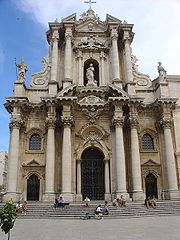
Ragusa Ibla, the lower city, boasts an impressive array of Baroque architecture, which includes the Church of San Giorgio by Rosario Gagliardi
Rosario Gagliardi
Rosario Gagliardi was a Sicilian architect born in Syracuse. He was one of the leading architects working in the Sicilian Baroque. In spite of never leaving Sicily his work showed great understanding of the style, but was a progression from the style of baroque as deployed by Bernini...
, designed in 1738 (Illustration 12). In the design of this church Gagliardi exploited the difficult terrain of the hillside site. The church towers impressively over a massive marble staircase of some 250 steps, a Baroque feature, especially exploited in Sicily due to the island's topography
Topography
Topography is the study of Earth's surface shape and features or those ofplanets, moons, and asteroids...
. The tower seems to explode from the façade, accentuated by the columns and pilasters canted against the curved walls. Above the doorways and window apertures, pediments scroll and curve with a sense of freedom and movement which would have been unthinkable to those earlier architects inspired by Bernini
Gian Lorenzo Bernini
Gian Lorenzo Bernini was an Italian artist who worked principally in Rome. He was the leading sculptor of his age and also a prominent architect...
and Borromini
Francesco Borromini
Francesco Borromini, byname of Francesco Castelli was an architect from Ticino who, with his contemporaries, Gian Lorenzo Bernini and Pietro da Cortona, was a leading figure in the emergence of Roman Baroque architecture.A keen student of the architecture of Michelangelo and the ruins of...
. The neoclassical dome was not added until 1820.
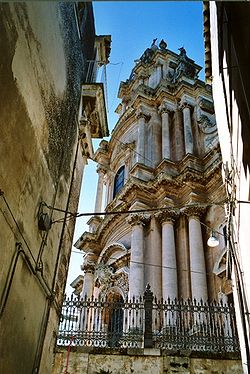
The Palazzo Zacco
Palazzo Zacco
Palazzo Zacco is a mansion in Ragusa, Sicily. It is most notable for the carvings in the Sicilian Baroque style which decorate its facades, especially the putti and masks which appear to support the palazzo's balconies on two of its symmetrical elevations. The palazzo was constructed circa 1750 as...
is one of the more notable Baroque buildings of the city, its Corinthian
Corinthian order
The Corinthian order is one of the three principal classical orders of ancient Greek and Roman architecture. The other two are the Doric and Ionic. When classical architecture was revived during the Renaissance, two more orders were added to the canon, the Tuscan order and the Composite order...
column
Column
A column or pillar in architecture and structural engineering is a vertical structural element that transmits, through compression, the weight of the structure above to other structural elements below. For the purpose of wind or earthquake engineering, columns may be designed to resist lateral forces...
s supporting balconies
Balcony
Balcony , a platform projecting from the wall of a building, supported by columns or console brackets, and enclosed with a balustrade.-Types:The traditional Maltese balcony is a wooden closed balcony projecting from a...
of amazing wrought iron work, while supports of grotesque
Grotesque
The word grotesque comes from the same Latin root as "Grotto", meaning a small cave or hollow. The original meaning was restricted to an extravagant style of Ancient Roman decorative art rediscovered and then copied in Rome at the end of the 15th century...
s mock, shock or amuse the passerby. The palazzo was built in the second half of the 18th century by the Baron Melfi di San Antonio. It was later acquired by the Zacco
Zacco (dynasty)
The Zacco family originated from Spain, where they are first recorded in when Stefano Zacco was a councillor of King Alfonso II of Aragon in the 12th century....
family, after which it is named. The building has two street façades, each with six wide balconies bearing the coat of arms of the Melfi family, a frame of acanthus
Acanthus (ornament)
The acanthus is one of the most common plant forms to make foliage ornament and decoration.-Architecture:In architecture, an ornament is carved into stone or wood to resemble leaves from the Mediterranean species of the Acanthus genus of plants, which have deeply cut leaves with some similarity to...
leaves from which a puttino leans. The balconies, a feature of the palazzo, are notable for the differing corbel
Corbel
In architecture a corbel is a piece of stone jutting out of a wall to carry any superincumbent weight. A piece of timber projecting in the same way was called a "tassel" or a "bragger". The technique of corbelling, where rows of corbels deeply keyed inside a wall support a projecting wall or...
s which support them, ranging from putti to musicians and grotesques. The focal points of the principal façade are the three central balconies, divided by columns with Corinthian capitals
Capital (architecture)
In architecture the capital forms the topmost member of a column . It mediates between the column and the load thrusting down upon it, broadening the area of the column's supporting surface...
. Here the balconies are supported by images of musicians with grotesque faces.
The Cathedral of San Giovanni Battista in Ragusa Superiore was built between 1718 and 1778. Its principal façade is pure Baroque, containing fine carvings and sculptures. The cathedral has a high Sicilian belfry in the same style. The ornate Baroque interior is separated into three colonnade
Colonnade
In classical architecture, a colonnade denotes a long sequence of columns joined by their entablature, often free-standing, or part of a building....
d aisles (Illustration 3). Ragusa Superiore, the most badly damaged part of the town, was replanned following 1693 around the cathedral and displays an unusual phenomenon of Sicilian Baroque: the palazzi here are peculiar to this town, of only two storeys and long, with the central bay only emphasised by a balcony and an arch to the inner garden. This very Portuguese style, probably designed to minimise damage in future earthquakes, is very different from the palazzi in Ragusa Ibla, which are in true Sicilian style. Unusually, Baroque lingered on here until the early 19th century. The last palazzo built here was in the Baroque form but with columns of Roman Doric
Doric order
The Doric order was one of the three orders or organizational systems of ancient Greek or classical architecture; the other two canonical orders were the Ionic and the Corinthian.-History:...
and neoclassical balconies.
Catania
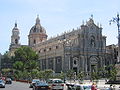
Castello Ursino
Castello Ursino is a castle in Catania, Sicily, southern Italy.-History:Built circa from 1239 to 1250, it belonged to Emperor Frederick II, King of Sicily, and was considered impregnable at the time. In 1295, during the Sicilian Vespers, the Parliament which declared deposed James II of Aragon as...
and three tribunes
Tribune (architecture)
Tribune is an ambiguous — and often misused — architectural term which can have several meanings. Today it most often refers to a dais or stage-like platform, or — in a vaguer sense — any place from which a speech can be prominently made.-Etymology:...
of the cathedral remaining. Thus it was replanned and rebuilt. The new design separated the city into quarters, divided by two roads meeting at an intersection known as the Piazza del Duomo (Cathedral Square). Rebuilding was supervised by the Bishop of Catania, and the city's only surviving architect, Alonzo di Benedetto. Di Benedetto headed a team of junior architects called in from Messina, which quickly began to rebuild, concentrating first on the Piazza del Duomo. Three palazzi are situated here, the Bishop's Palace, the Seminario
Seminary
A seminary, theological college, or divinity school is an institution of secondary or post-secondary education for educating students in theology, generally to prepare them for ordination as clergy or for other ministry...
and one other. The architects worked in complete harmony and it is impossible to distinguish di Benedetto's work from that of his junior colleagues. The work is competent but not remarkable, with decorated rustication in the 17th-century Sicilian style, but often the decoration on the upper floors is superficial. This is typical of the Baroque of this period immediately after the earthquake.
In 1730, Vaccarini arrived in Catania as the appointed city architect and immediately impressed on the architecture the Roman Baroque style. The pilasters lose their rustication and support Roman type cornices and entablatures, or curved pediments, and free-standing columns support balconies. Vaccarini also exploited the local black lava stone as a decorative feature rather than a general building material, using it intermittently with other materials, and spectacularly for an obelisk
Obelisk
An obelisk is a tall, four-sided, narrow tapering monument which ends in a pyramid-like shape at the top, and is said to resemble a petrified ray of the sun-disk. A pair of obelisks usually stood in front of a pylon...
supported on the back of the Catanian heraldic
Heraldry
Heraldry is the profession, study, or art of creating, granting, and blazoning arms and ruling on questions of rank or protocol, as exercised by an officer of arms. Heraldry comes from Anglo-Norman herald, from the Germanic compound harja-waldaz, "army commander"...
elephant, for a fountain in the style of Bernini in front of the new Town hall. Vaccarini's principal façade to Catania's cathedral, dedicated to Santa Agata, shows strong Spanish influences even at this late stage of Sicilian Baroque. Also in the city is Stefano Ittar
Stefano Ittar
Stefano Ittar was a Polish-Italian architect.-Biography:Ittar was born in Ovruch , where his father, a member of one of Italy's aristocratic families the Guidone de Hittar, had fled following a disagreement with the Grand Duke of Tuscany.While Ittar was still young his family moved to Rome, where...
's Church of the Collegiata, built around 1768. It is an example of Sicilian Baroque at its most stylistically simple.
Church interiors
Sicilian church exteriors had been decorated in elaborate styles from the first quarter of the 17th century, with profuse use of sculptureSculpture
Sculpture is three-dimensional artwork created by shaping or combining hard materials—typically stone such as marble—or metal, glass, or wood. Softer materials can also be used, such as clay, textiles, plastics, polymers and softer metals...
, stucco
Stucco
Stucco or render is a material made of an aggregate, a binder, and water. Stucco is applied wet and hardens to a very dense solid. It is used as decorative coating for walls and ceilings and as a sculptural and artistic material in architecture...
, fresco
Fresco
Fresco is any of several related mural painting types, executed on plaster on walls or ceilings. The word fresco comes from the Greek word affresca which derives from the Latin word for "fresh". Frescoes first developed in the ancient world and continued to be popular through the Renaissance...
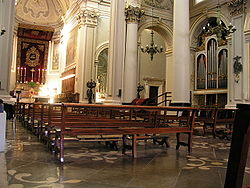
es, and marble (Illustration 14). As the post-earthquake churches were becoming completed in the late 1720s, interiors also began to reflect this external decoration, becoming lighter and less intense (compare illustration 14 to the later interior of illustration 15), with profuse sculpted ornamentation of pillars, cornices, and pediments, often in the form of putti, flora, and fauna. Inlaid coloured marbles on floors and walls in complex patterns are one of the most defining features of the style. These patterns with their roundels of porphyry
Porphyry (geology)
Porphyry is a variety of igneous rock consisting of large-grained crystals, such as feldspar or quartz, dispersed in a fine-grained feldspathic matrix or groundmass. The larger crystals are called phenocrysts...
are often derived from designs found in the Norman cathedrals of Europe, again demonstrating the Norman origins of Sicilian architecture. The high altar is usually the pièce de resistance: in many instances a single block of coloured marble, decorated with gilt scrolls and swags, and frequently inset with other stones such as lapis lazuli
Lapis lazuli
Lapis lazuli is a relatively rare semi-precious stone that has been prized since antiquity for its intense blue color....
and agate
Agate
Agate is a microcrystalline variety of silica, chiefly chalcedony, characterised by its fineness of grain and brightness of color. Although agates may be found in various kinds of rock, they are classically associated with volcanic rocks and can be common in certain metamorphic rocks.-Etymology...
. Steps leading to the altar dais
Dais
Dais is any raised platform located either in or outside of a room or enclosure, often for dignified occupancy, as at the front of a lecture hall or sanctuary....
are characteristically curving between concave and convex and in many cases decorated with inlaid coloured marbles. One of the finest examples of this is in the church of St Zita in Palermo.
The building of Sicily's churches would typically be funded not just by individual religious orders but also by an aristocratic family. Contrary to popular belief, the majority of Sicily's nobility did not choose to have their mortal remains displayed for eternity in the Capuchin catacombs of Palermo
Capuchin catacombs of Palermo
The Capuchin Catacombs of Palermo are burial catacombs in Palermo, Sicily, southern Italy...
, but were buried quite conventionally in vaults
Burial vault (tomb)
A burial vault is a structural underground tomb.It is a stone or brick-lined underground space or 'burial' chamber for the interment of a dead body or bodies. They were originally and are still often vaulted and usually have stone slab entrances...
beneath their family churches. It has been said, though, that "the funeral of a Sicilian aristocrat was one of the great moments of his life". Funeral
Funeral
A funeral is a ceremony for celebrating, sanctifying, or remembering the life of a person who has died. Funerary customs comprise the complex of beliefs and practices used by a culture to remember the dead, from interment itself, to various monuments, prayers, and rituals undertaken in their honor...
s became tremendous shows of wealth; a result of this ostentation was that the stone memorial slabs covering the burial vaults today provide an accurate barometer of the development of Baroque and marble inlay techniques at any specific time. For instance, those from the first half of the 17th century are of simple white marble decorated with an incised armorial bearing, name, date, etc. From c. 1650, small quantities of coloured marble inlay appear, forming patterns, and this can be studied developing until, by the end of the century, the coats of arms
Coat of arms
A coat of arms is a unique heraldic design on a shield or escutcheon or on a surcoat or tabard used to cover and protect armour and to identify the wearer. Thus the term is often stated as "coat-armour", because it was anciently displayed on the front of a coat of cloth...
and calligraphy are entirely of inset coloured marble, with decorative patterned borders. Long after Baroque began to fall from fashion in the 1780s, Baroque decor was still deemed more suitable for Catholic ritual than the new pagan-based neoclassicism.
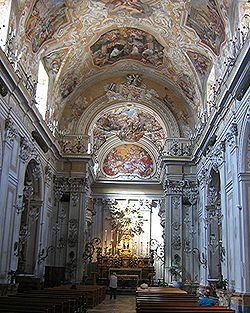
Giovanni Tuccari
Giovanni Tuccari was an Italian painter during the Baroque period, active in Sicily.Tuccari was born in Messina. He was the son and pupil of Antonio Tuccari, an obscure painter. He excelled as a battle painter. He died of the plague. He was responsible for the frescos in the Church of San...
. The most spectacular part of the church's decoration is the nun's choir (Illustrations 16), created c. 1750, which was designed in such a way that the nuns' voices could be heard during services, but the nuns themselves were still quite separate from and unseen by the less spiritual world outside.
Palazzi interiors
With but a few notable exceptions, the interiors of the palazzi were from the start less elaborate than those of Sicily's Baroque churches. Many were finished without ornate interior decoration, simply because they took so long to build and by the time they were completed Baroque had passed from fashion; the principal rooms were therefore decorated in the new neoclassical style known as "PompeianPompeii
The city of Pompeii is a partially buried Roman town-city near modern Naples in the Italian region of Campania, in the territory of the comune of Pompei. Along with Herculaneum, Pompeii was destroyed and completely buried during a long catastrophic eruption of the volcano Mount Vesuvius spanning...
". Often one can find a fusion of the two styles, as in the ballroom
Ballroom
A ballroom is a large room inside a building, the designated purpose of which is holding formal dances called balls. Traditionally, most balls were held in private residences; many mansions contain one or more ballrooms...
wing of the Palazzo Aiutamicristo in Palermo, built by Andrea Giganti
Andrea Giganti
Andrea Giganti was a Sicilian architect of the Sicilian Baroque era. He was born in Trapani in 1731; in his youth he studied architecture under Giovanni Biagio Amico...
in 1763, where the ballroom ceiling was frescoed by Giuseppe Cristadoro with allegorical
Allegory
Allegory is a demonstrative form of representation explaining meaning other than the words that are spoken. Allegory communicates its message by means of symbolic figures, actions or symbolic representation...
scenes framed by Baroque gild
Gilding
The term gilding covers a number of decorative techniques for applying fine gold leaf or powder to solid surfaces such as wood, stone, or metal to give a thin coating of gold. A gilded object is described as "gilt"...
ed motifs in plaster
Plaster
Plaster is a building material used for coating walls and ceilings. Plaster starts as a dry powder similar to mortar or cement and like those materials it is mixed with water to form a paste which liberates heat and then hardens. Unlike mortar and cement, plaster remains quite soft after setting,...
. This ceiling was already old-fashioned when it was finished, and the rest of the room was decorated in a far simpler mode. Changing use over the past 250 years has simplified palazzo decor further, as the ground floors are now usually shops, banks, or restaurants, and the upper floors divided into apartments, their interiors lost.
A further reason for the absence of Baroque decoration, and the most common, is that most rooms were never intended for such decoration. Many of the palazzi were vast, meant for huge numbers of people. The household of the Sicilian aristocrat, beginning with himself, his wife and many children, would typically also contain a collection of poorer relatives and other extended family members, all of whom had minor apartments in the house. Moreover there were paid employees, often including a private chaplain or confessor, a major domo, governesses, secretary, archivist, accountant, librarian, and innumerable lower servants, such as a porter to ring a bell a prescribed number of times according to the rank of an approaching guest. Often the servants' extended families, especially if elderly, also lived in the palazzo. Thus many rooms were needed to house the household. These everyday living quarters, even for the "Maestro and Maestra di Casa", were often simply decorated and furnished. Further rooms were required by the Sicilian tradition that it was a sign of poor breeding to permit even mere acquaintances to stay in local inns. Any visiting foreigner, especially an Englishman, was regarded as a special trophy and added social prestige. Hence the Sicilian aristocrat's home was seldom empty or quiet.
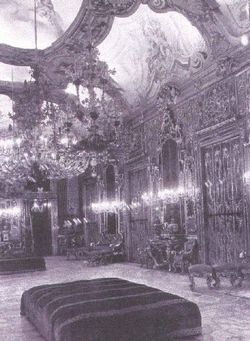
Piano nobile
The piano nobile is the principal floor of a large house, usually built in one of the styles of classical renaissance architecture...
, reserved for guests and entertaining. Entered formally from the external Baroque double staircase, these rooms consisted of a suite of large and small salons, with one very large salon being the principal room of the house, often used as a ballroom. Sometimes the guest bedrooms were sited here too, but by the end of the 18th century they were more often on a secondary floor above. If decorated during the Baroque era, the rooms would be profusely ornamented. Walls were frequently mirrored, the mirrors inset into gilded frames in the walls, often alternating with paintings similarly framed, while moulded nymph
Nymph
A nymph in Greek mythology is a female minor nature deity typically associated with a particular location or landform. Different from gods, nymphs are generally regarded as divine spirits who animate nature, and are usually depicted as beautiful, young nubile maidens who love to dance and sing;...
s and shepherdesses decorated the spaces between. Ceilings were high and fresco
Fresco
Fresco is any of several related mural painting types, executed on plaster on walls or ceilings. The word fresco comes from the Greek word affresca which derives from the Latin word for "fresh". Frescoes first developed in the ancient world and continued to be popular through the Renaissance...
ed, and from the ceiling hung huge coloured chandelier
Chandelier
A chandelier is a branched decorative ceiling-mounted light fixture with two or more arms bearing lights. Chandeliers are often ornate, containing dozens of lamps and complex arrays of glass or crystal prisms to illuminate a room with refracted light...
s of Murano
Murano
Murano is a series of islands linked by bridges in the Venetian Lagoon, northern Italy. It lies about 1.5 km north of Venice and measures about across with a population of just over 5,000 . It is famous for its glass making, particularly lampworking...
glass, while further light came from gilded sconce
Sconce (light fixture)
A sconce is a type of light fixture affixed to a wall in such a way that it uses only the wall for support, and the light is usually directed upwards. It does not have a base on the ground...
s flanking the mirrors adorning the walls. One of the most notable rooms in this style is the Gallery of Mirrors in Palermo's Palazzo Valguarnera-Gangi
Palazzo Valguarnera-Gangi
Palazzo Valguarnera-Gangi is the large ancestral townhouse of firstly the Princes Valguarnera and then the Princes Gangi, situated in the Piazza Croce dei Vespri, Palermo, Sicily...
(Illustration 17). This room with its frescoed ceiling by Gaspare Fumagalli is, however, one of the few Baroque rooms in this Baroque palazzo, which was (from 1750) extended and transformed by its owner Marianna Valguarnera, mostly in the later neoclassical style.
Furniture during the Baroque era was in keeping with the style: ornate, gilded and frequently with marble used for tabletops. The furniture was transient within the house, frequently moved between rooms as required, while leaving other rooms unfurnished. Sometimes furniture was specifically commissioned for a certain room, for example to match a silk
Silk
Silk is a natural protein fiber, some forms of which can be woven into textiles. The best-known type of silk is obtained from the cocoons of the larvae of the mulberry silkworm Bombyx mori reared in captivity...
wall panel within a gilt frame. As in the rest of Europe, the furniture would always be left arranged against a wall, to be moved forward by servants if required, never in the later conversational style in the centre of a room, which in the Baroque era was always left empty so as better to display the marble, or more often ceramic, patterned floor tiles.
The common element to both church and palazzi interior design was the stucco
Stucco
Stucco or render is a material made of an aggregate, a binder, and water. Stucco is applied wet and hardens to a very dense solid. It is used as decorative coating for walls and ceilings and as a sculptural and artistic material in architecture...
work. Stucco is an important component of the Baroque design and philosophy, as it seamlessly combines architecture, sculpture, and painting in three-dimensional form. Its combination with trompe l'oeil
Trompe l'oeil
Trompe-l'œil, which can also be spelled without the hyphen in English as trompe l'oeil, is an art technique involving extremely realistic imagery in order to create the optical illusion that the depicted objects appear in three dimensions.-History in painting:Although the phrase has its origin in...
ceilings and walls in Baroque illusionistic painting
Baroque illusionistic painting
Illusionistic ceiling painting, which includes the techniques of perspective di sotto in sù and quadratura, is the tradition in Renaissance, Baroque and Rococo art in which trompe l'oeil, perspective tools such as foreshortening, and other spatial effects are used to create the illusion of...
confuses reality and art. While in churches the stucco could represent angels and putti linked by swags of flowers, in a private house it might represent the owner's favourite foods or musical instruments.
Final period
As with all architectural styles, people eventually tired of Baroque. In some parts of Europe, it metamorphosed into the rococoRococo
Rococo , also referred to as "Late Baroque", is an 18th-century style which developed as Baroque artists gave up their symmetry and became increasingly ornate, florid, and playful...
, but not in Sicily. No longer ruled by Austria, Sicily, from 1735 officially the Kingdom of Sicily
Kingdom of Sicily
The Kingdom of Sicily was a state that existed in the south of Italy from its founding by Roger II in 1130 until 1816. It was a successor state of the County of Sicily, which had been founded in 1071 during the Norman conquest of southern Italy...
, was ruled by the King of Naples
Kingdom of Naples
The Kingdom of Naples, comprising the southern part of the Italian peninsula, was the remainder of the old Kingdom of Sicily after secession of the island of Sicily as a result of the Sicilian Vespers rebellion of 1282. Known to contemporaries as the Kingdom of Sicily, it is dubbed Kingdom of...
, Ferdinand IV. Hence Palermo was in constant association with the principal capital Naples
Naples
Naples is a city in Southern Italy, situated on the country's west coast by the Gulf of Naples. Lying between two notable volcanic regions, Mount Vesuvius and the Phlegraean Fields, it is the capital of the region of Campania and of the province of Naples...
, where there was architecturally a growing reversion to the more classical styles of architecture. Coupled with this, many of the more cultured Sicilian nobility developed a fashionable obsession with all things French, from philosophy to arts, fashion, and architecture. Many of them visited Paris in pursuit of these interests and returned with the latest architectural engravings and theoretical treatises. The French architect Léon Dufourny was in Sicily between 1787 and 1794 to study and analyse the ancient Greek temple
Greek temple
Greek temples were structures built to house deity statues within Greek sanctuaries in Greek paganism. The temples themselves did usually not directly serve a cult purpose, since the sacrifices and rituals dedicated to the respective deity took place outside them...
s on the island. Thus Sicilians rediscovered their ancient past, which with its classical idioms was now the height of fashion. The change in tastes did not come about overnight. Baroque remained popular on the island, but now Sicilian balconies, extravagant as ever, would be placed next to severe classical columns. Dufourny began designing in Palermo, and his "Entrance Temple" (1789) to the Botanical Gardens was the first building in Sicily in a style based on the Greek Doric order. It is pure neoclassical architecture, as established in England since 1760, and it was a sign of things to come.
It was Dufourny's great friend and fellow architect Giuseppe Marvuglia
Giuseppe Venanzio Marvuglia
Giuseppe Venanzio Marvuglia was an Italian architect.He received his first training in his native Palermo. This was followed by a period in Rome from 1747 to 1759...
who was to preside over the gradual decline of Sicilian Baroque. In 1784 he designed the Palazzo Riso-Belmonte, the finest example of this period of architectural transition, combining both Baroque and Palladian
Palladian architecture
Palladian architecture is a European style of architecture derived from the designs of the Venetian architect Andrea Palladio . The term "Palladian" normally refers to buildings in a style inspired by Palladio's own work; that which is recognised as Palladian architecture today is an evolution of...
motifs, built around an arcaded courtyard providing Baroque masses of light and shade, or chiaroscuro
Chiaroscuro
Chiaroscuro in art is "an Italian term which literally means 'light-dark'. In paintings the description refers to clear tonal contrasts which are often used to suggest the volume and modelling of the subjects depicted"....
. The main façade, punctuated by giant pilaster
Pilaster
A pilaster is a slightly-projecting column built into or applied to the face of a wall. Most commonly flattened or rectangular in form, pilasters can also take a half-round form or the shape of any type of column, including tortile....
s, also had Baroque features, but the skyline was unbroken. The pilasters were undecorated, simple, and Ionic
Ionic order
The Ionic order forms one of the three orders or organizational systems of classical architecture, the other two canonic orders being the Doric and the Corinthian...
, and supported an undecorated entablature
Entablature
An entablature refers to the superstructure of moldings and bands which lie horizontally above columns, resting on their capitals. Entablatures are major elements of classical architecture, and are commonly divided into the architrave , the frieze ,...
. Above the windows were classical unbroken pediment
Pediment
A pediment is a classical architectural element consisting of the triangular section found above the horizontal structure , typically supported by columns. The gable end of the pediment is surrounded by the cornice moulding...
s. Sicilian Baroque was waning.
Another reason for the gradual decline in the development of Sicily's Baroque and building in general was that the money was running out. During the 17th century, the aristocracy had lived principally on their landed estates, tending and improving them, and as a result their income also increased. During the 18th century, the nobility gradually migrated towards the cities, in particular Palermo, to enjoy the social delights of the Viceroy's court and Catania. Their town palazzi grew in size and splendour, to the detriment of the abandoned estates, which were still expected to provide the revenue. The land agents left to run the estates over time became less efficient, or corrupt, often both. Consequently, aristocratic incomes fell. The aristocracy borrowed money using the estates as surety
Surety
A surety or guarantee, in finance, is a promise by one party to assume responsibility for the debt obligation of a borrower if that borrower defaults...
, until the value of the neglected estates fell below the money borrowed against them. Moreover, Sicily was by now as unstable politically as its nobility were financially. Ruled from Naples by the weak Ferdinand IV and his dominant wife, Sicily had declined to the point of no return long before 1798 and again in 1806 when the King was forced by the invading French to flee Naples to Sicily. The French were kept at bay from Sicily only by an expeditionary force of 17,000 British troops
British Army
The British Army is the land warfare branch of Her Majesty's Armed Forces in the United Kingdom. It came into being with the unification of the Kingdom of England and Scotland into the Kingdom of Great Britain in 1707. The new British Army incorporated Regiments that had already existed in England...
, and Sicily was now ruled by Britain
United Kingdom of Great Britain and Ireland
The United Kingdom of Great Britain and Ireland was the formal name of the United Kingdom during the period when what is now the Republic of Ireland formed a part of it....
in effect if not in name. King Ferdinand then in 1811 imposed the first tax
Tax
To tax is to impose a financial charge or other levy upon a taxpayer by a state or the functional equivalent of a state such that failure to pay is punishable by law. Taxes are also imposed by many subnational entities...
es, at a single stroke alienating his aristocracy.
The tax was rescinded by the British in 1812, who then imposed a British style constitution
Constitution
A constitution is a set of fundamental principles or established precedents according to which a state or other organization is governed. These rules together make up, i.e. constitute, what the entity is...
on the island. One legal innovation of this time of particular consequence for the aristocracy was that creditor
Creditor
A creditor is a party that has a claim to the services of a second party. It is a person or institution to whom money is owed. The first party, in general, has provided some property or service to the second party under the assumption that the second party will return an equivalent property or...
s, who had previously only been able to enforce repayments of the interest on a loan
Loan
A loan is a type of debt. Like all debt instruments, a loan entails the redistribution of financial assets over time, between the lender and the borrower....
or mortgage
Mortgage loan
A mortgage loan is a loan secured by real property through the use of a mortgage note which evidences the existence of the loan and the encumbrance of that realty through the granting of a mortgage which secures the loan...
, could now seize property. Property began to change hands in smaller parcels at auction
Auction
An auction is a process of buying and selling goods or services by offering them up for bid, taking bids, and then selling the item to the highest bidder...
s, and consequently a land-owning bourgeoisie
Bourgeoisie
In sociology and political science, bourgeoisie describes a range of groups across history. In the Western world, between the late 18th century and the present day, the bourgeoisie is a social class "characterized by their ownership of capital and their related culture." A member of the...
immediately began to flourish. Revolts against the Bourbons
House of Bourbon
The House of Bourbon is a European royal house, a branch of the Capetian dynasty . Bourbon kings first ruled Navarre and France in the 16th century. By the 18th century, members of the Bourbon dynasty also held thrones in Spain, Naples, Sicily, and Parma...
in 1821, and 1848 divided the nobility, and liberalism was in the air. These factors coupled with the social and political upheaval of the following Risorgimento in the 19th century meant the Sicilian aristocracy was a doomed class. Furthermore, because of their neglect and dereliction of noblesse oblige
Noblesse oblige
Noblesse oblige is a French phrase literally meaning "nobility obliges".The Dictionnaire de l’Académie française defines it thus:# Whoever claims to be noble must conduct himself nobly....
, an essential element of the feudal system, the countryside was often ruled by bandits outside the enclosed villages, and the once grand country villas were decaying. The building mania of the Sicilian upper class was over.
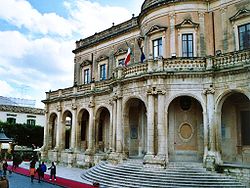
Giuseppe Venanzio Marvuglia
Giuseppe Venanzio Marvuglia was an Italian architect.He received his first training in his native Palermo. This was followed by a period in Rome from 1747 to 1759...
, recognising the new fashion for all things British, developed the style he had first cautiously used at Palazzo Riso-Belmonte in 1784, combining some of the plainer, more solid elements of Baroque with Palladian motifs rather than Palladian designs. The late Sicilian Baroque was similar in style to the Baroque popular in England at the beginning of the 18th century, popularised by Sir John Vanbrugh
John Vanbrugh
Sir John Vanbrugh – 26 March 1726) was an English architect and dramatist, perhaps best known as the designer of Blenheim Palace and Castle Howard. He wrote two argumentative and outspoken Restoration comedies, The Relapse and The Provoked Wife , which have become enduring stage favourites...
with such edifices as Blenheim Palace
Blenheim Palace
Blenheim Palace is a monumental country house situated in Woodstock, Oxfordshire, England, residence of the dukes of Marlborough. It is the only non-royal non-episcopal country house in England to hold the title of palace. The palace, one of England's largest houses, was built between...
. An example is Marvuglia's Church of San Francesco di Sales, which is almost English in its interpretation of Baroque. However, this was a temporary success and the neoclassical style was soon dominant. Few aristocrats could now afford to build, and the new style was mainly used in public and civil buildings such as those at the Botanical Gardens in Palermo. Sicilian architects — even Andrea Giganti
Andrea Giganti
Andrea Giganti was a Sicilian architect of the Sicilian Baroque era. He was born in Trapani in 1731; in his youth he studied architecture under Giovanni Biagio Amico...
, once a competent architect in Baroque — now began to design in the neoclassical style, but in this case in the version of the neoclassical adopted by fashionable France. Giganti's Villa Galletti at Bagheria
Bagheria
Bagheria is a town and comune in the Province of Palermo in Sicily, Italy.-Etymology:According to some sources, the name Bagheria originates from the Phoenician term Bayharia meaning "land that descends toward the sea." Other sources claim that it derives from the Arabic Bāb al-Gerib, or "windy...
is clearly inspired by the work of Ange-Jacques Gabriel
Ange-Jacques Gabriel
Ange-Jacques Gabriel was the most prominent French architect of his generation.Born to a Parisian family of architects and initially trained by the royal architect Robert de Cotte and his father , whom he assisted in the creation of the Place Royale at Bordeaux , the younger Gabriel...
.
As with the early days of Sicilian Baroque, the first buildings of the new neoclassical era were often copies or hybrids of the two styles. The Palazzo Ducezio (Illustration 19) was begun in 1746, and the ground floor with arcades creating play of light and shadow is pure Baroque. However, when a few years later the upper floor was added, despite the use of Baroque broken pediments above the windows, the neoclassical French influence is very pronounced, highlighted by the central curved bay. The Sicilian Baroque was gradually and slowly being superseded by French neoclassicism.
Legacy
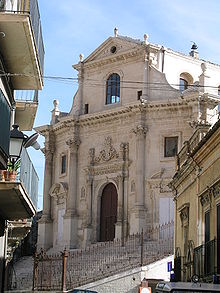
Most of the Baroque palazzi continued in private ownership throughout the 19th century, as the old aristocracy either married middle-class money or fell further into debt. There were a few exceptions and some of these retain the ancestral palazzo still today. Thanks to the continuing religious devotion of the Sicilian people many of the Sicilian Baroque churches are today still in the use for which they were designed.
However, much of the blame for the decay and ruinous state of preservation of so many palazzi must fall not just on owners unwilling to accept change, but the political agendas of successive socialist governments. Some of the finest Baroque villas and palazzi, including the Palermo palace of the Prince of Lampedusa, are still in ruins following the United States bomb
Bomb
A bomb is any of a range of explosive weapons that only rely on the exothermic reaction of an explosive material to provide an extremely sudden and violent release of energy...
ing raids of 1943. In many cases, no attempt has been made to restore or even secure them. Those that survived the raids in good repair are often sub-divided into offices or apartments, their Baroque interiors dismantled, divided, and sold.
The remaining members of the Sicilian aristocracy who still inhabit their ancestral palazzi are unable to make opening their houses to tourism a major source of income, unlike some Northern, especially English, counterparts. The local equivalent
Fondo per l'Ambiente Italiano
The Fondo per l'Ambiente Italiano is the National Trust of Italy.The organisation was established in 1975 on the model of the British National Trust. It is a private non-profit organisation and has 60,000 members as of early 2005...
of the National Trust
National Trust for Places of Historic Interest or Natural Beauty
The National Trust for Places of Historic Interest or Natural Beauty, usually known as the National Trust, is a conservation organisation in England, Wales and Northern Ireland...
is very small, and there is much less local interest among the general population. The Princes, Marquesses, and Counts of Sicily still living in their houses dwell in splendid isolation, surrounded often by beauty and decay. It is only today both owners and the state are awakening to the possibility that if action is not taken soon it will be too late to save this particular part of the Sicilian heritage.
As Sicily now becomes a more politically stable, secure and less corrupt environment, the Baroque palazzi are slowly beginning to open their doors to an eager paying public, American and Northern European as much as Italian. In 1963, when the movie The Leopard
The Leopard (film)
The Leopard is a 1963 Italian film by director Luchino Visconti, based on Giuseppe Tomasi di Lampedusa's novel of the same name.-Cast:* Burt Lancaster as Prince Don Fabrizio Salina* Claudia Cardinale as Angelica Sedara / Bertiana...
was released the Gangi Palace ballroom was almost unique in its status of having been a film set, but today long unused salons and ballrooms are hosting corporate and public events. Some palazzi are offering a bed and breakfast
Bed and breakfast
A bed and breakfast is a small lodging establishment that offers overnight accommodation and breakfast, but usually does not offer other meals. Since the 1980s, the meaning of the term has also extended to include accommodations that are also known as "self-catering" establishments...
service to paying guests, once again providing impressive hospitality to visitors to Sicily, the purpose for which they were originally intended.
In 2002, UNESCO
UNESCO
The United Nations Educational, Scientific and Cultural Organization is a specialized agency of the United Nations...
selectively included Baroque monuments of Val di Noto
Val di Noto
Val di Noto is a geographical area of south east Sicily; it is dominated by the limestone Iblean plateau.-The Val di Noto in the Arts:...
into its World Heritage List
World Heritage Site
A UNESCO World Heritage Site is a place that is listed by the UNESCO as of special cultural or physical significance...
as "providing outstanding testimony to the exuberant genius of late Baroque art and architecture" and "representing the culmination and final flowering of Baroque art in Europe.