


Churrigueresque

Encyclopedia
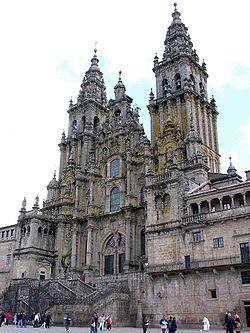
Spanish Baroque
Spanish Baroque is a strand of Baroque architecture that evolved in Spain and its provinces and former colonies, notably Spanish America and Belgium....
style of elaborate sculptural architectural ornament
Ornament (architecture)
In architecture and decorative art, ornament is a decoration used to embellish parts of a building or object. Large figurative elements such as monumental sculpture and their equivalents in decorative art are excluded from the term; most ornament does not include human figures, and if present they...
which emerged as a manner of stucco decoration in Spain
Spain
Spain , officially the Kingdom of Spain languages]] under the European Charter for Regional or Minority Languages. In each of these, Spain's official name is as follows:;;;;;;), is a country and member state of the European Union located in southwestern Europe on the Iberian Peninsula...
in the late 17th century and was used up to about 1750, marked by extreme, expressive and florid decorative detailing, normally found above the entrance on the main facade of a building.
Origins
Named after the architect and sculptor, José Benito de ChurrigueraJosé Benito de Churriguera
José Benito de Churriguera was a Spanish architect, sculptor and urbanist of the late-Baroque or Rococo style...
, who was born in Madrid
Madrid
Madrid is the capital and largest city of Spain. The population of the city is roughly 3.3 million and the entire population of the Madrid metropolitan area is calculated to be 6.271 million. It is the third largest city in the European Union, after London and Berlin, and its metropolitan...
of a Catalan
Catalan people
The Catalans or Catalonians are the people from, or with origins in, Catalonia that form a historical nationality in Spain. The inhabitants of the adjacent portion of southern France are sometimes included in this definition...
family (originally named Xoriguera), and who worked primarily in Madrid and Salamanca
Salamanca
Salamanca is a city in western Spain, in the community of Castile and León. Because it is known for its beautiful buildings and urban environment, the Old City was declared a UNESCO World Heritage Site in 1988. It is the most important university city in Spain and is known for its contributions to...
, the origins of the style are said to go back to an architect and sculptor named Alonso Cano, who designed the facade of the cathedral at Granada
Granada Cathedral
Granada Cathedral is the cathedral in the city of Granada, capital of the province of the same name in the Autonomous Region of Andalusia, Spain.-History:...
, in 1667.
A distant precursor (early 15th century) of the highly elaborate style can be found in the Lombard Charterhouse of Pavia; yet the sculpture-encrusted facade still has the Italianate appeal to rational narrative. The Churrigueresque style appeals to the proliferative geometry, and has a more likely ancestry in the Moorish architecture
Moorish architecture
Moorish architecture is the western term used to describe the articulated Berber-Islamic architecture of North Africa and Al-Andalus.-Characteristic elements:...
or Mudéjar architecture
Mudéjar
Mudéjar is the name given to individual Moors or Muslims of Al-Andalus who remained in Iberia after the Christian Reconquista but were not converted to Christianity...
that still remained through south and central Spain. The interior stucco roofs of, for example the Alcázar de los Reyes Cristianos
Alcázar de los Reyes Cristianos
The Alcázar de los Reyes Cristianos , also known as the Alcázar of Córdoba, is a medieval Alcázar located in Córdoba, Spain next to the Guadalquivir River and near the Grand Mosque. The Alcázar takes its name from the Arabic word القصر...
in Granada, Spain, flourish with detail and ornamentation.
Development
The development of the style passed through three phases. Between 1680 and 1720, the Churriguera popularized Guarino Guarini's blend of Solomonic columnSolomonic column
The Solomonic column, also called Barley-sugar column, is a helical column, characterized by a spiraling twisting shaft like a corkscrew...
s and composite order
Composite order
The composite order is a mixed order, combining the volutes of the Ionic order capital with the acanthus leaves of the Corinthian order. The composite order volutes are larger, however, and the composite order also has echinus molding with egg-and-dart ornamentation between the volutes...
, known as "supreme order". Between 1720 and 1760, the Churrigueresque column, or estipite
Estipite
The estipite column is a type of column or pilaster typical of the Churrigueresque baroque style of Spain and Spanish America used in the 18th century. It has the shape of an inverted cone or obelisk....
, in the shape of an inverted cone or obelisk, was established as a central element of ornamental decoration. The years from 1760 to 1780 saw a gradual shift of interest away from twisted movement and excessive ornamentation towards Neoclassical balance and sobriety.
Among the highlights of the style, interiors of the Granada Charterhouse
Granada Charterhouse
Granada Charterhouse is a Carthusian monastery in Granada, Spain. It is one of the finest examples of Spanish Baroque architecture.The charterhouse was founded in 1506; construction started ten years later, and continued for the following 300 years. While the exterior is a tame ember in...
offer some of the most impressive combinations of space and light in 18th-century Europe. Integrating sculpture and architecture even more radically, Narciso Tomé
Narciso Tomé
Narciso Tomé was a Spanish architect and sculptor of the late-Baroque or Rococo period.Born in Toro. With his brother, Diego, he sculpted in 1715, the facade of the University of Valladolid...
achieved striking chiaroscuro
Chiaroscuro
Chiaroscuro in art is "an Italian term which literally means 'light-dark'. In paintings the description refers to clear tonal contrasts which are often used to suggest the volume and modelling of the subjects depicted"....
effects in his Transparente
El Transparente
El Transparente is a Baroque altarpiece in the ambulatory of the Cathedral of Toledo. Its name refers to the unique illumination provided by a skylight in the vault above. It was created in 1729-1732 by Narciso Tomé and his 4 sons...
for the Toledo Cathedral. Perhaps the most visually intoxicating form of the style was Mexican Churrigueresque, practised in the mid-18th century by Lorenzo Rodriguez, whose masterpiece is the Sagrario Metropolitano (1749–69) in Mexico City
Mexico City
Mexico City is the Federal District , capital of Mexico and seat of the federal powers of the Mexican Union. It is a federal entity within Mexico which is not part of any one of the 31 Mexican states but belongs to the federation as a whole...
, New Spain
New Spain
New Spain, formally called the Viceroyalty of New Spain , was a viceroyalty of the Spanish colonial empire, comprising primarily territories in what was known then as 'América Septentrional' or North America. Its capital was Mexico City, formerly Tenochtitlan, capital of the Aztec Empire...
.
Churrigueresque revival
The Churrigueresque decorative style was used in Spanish Colonial architecture in the New WorldNew World
The New World is one of the names used for the Western Hemisphere, specifically America and sometimes Oceania . The term originated in the late 15th century, when America had been recently discovered by European explorers, expanding the geographical horizon of the people of the European middle...
colonial town's important buildings. The style enjoyed a resurgence after architect Bertram Goodhue
Bertram Goodhue
Bertram Grosvenor Goodhue was a American architect celebrated for his work in neo-gothic design. He also designed notable typefaces, including Cheltenham and Merrymount for the Merrymount Press.-Early career:...
and Carleton Winslow
Carleton Winslow
Carleton Monroe Winslow , also known as Carleton Winslow Sr., was an American architect, and key proponent of Spanish Colonial Revival architecture in Southern California in the early 20th Century....
Sr. studied Spanish Colonial Churrigueresque and Plateresque
Plateresque
Plateresque, meaning "in the manner of a silversmith" , was an artistic movement, especially architectural, traditionally held to be exclusive to Spain and its territories, which appeared between the late Gothic and early Renaissance in the late 15th century, and spread over the next two centuries...
ornament in Mexico, using it in designing the 1915 Panama-California Exposition buildings at Balboa Park
Balboa Park (San Diego)
Balboa Park is a urban cultural park in San Diego, California. The park is named after the Spanish maritime explorer Vasco Núñez de Balboa...
in San Diego, California
California
California is a state located on the West Coast of the United States. It is by far the most populous U.S. state, and the third-largest by land area...
. The Exposition popularized its use in Spanish Colonial Revival architecture styles in the United States.
See also
- Spanish Gothic architectureSpanish Gothic architectureSpanish Gothic architecture is the style of architecture prevalent in Spain in the Late Medieval period.The Gothic style started in Spain as a result of Central European influence in the twelfth century when late Romanesque alternated with few expressions of pure Gothic architecture...
- Architecture of the Spanish RenaissanceArchitecture of the Spanish RenaissanceRenaissance architecture was that style of architecture which evolved firstly in Florence and then Rome and other parts of Italy as the result of Humanism and a revived interest in Classical architecture...
- Spanish Colonial architecture
- PlateresquePlateresquePlateresque, meaning "in the manner of a silversmith" , was an artistic movement, especially architectural, traditionally held to be exclusive to Spain and its territories, which appeared between the late Gothic and early Renaissance in the late 15th century, and spread over the next two centuries...
- RococoRococoRococo , also referred to as "Late Baroque", is an 18th-century style which developed as Baroque artists gave up their symmetry and became increasingly ornate, florid, and playful...
- Spanish architectureSpanish architectureSpanish architecture refers to architecture carried out in any area in what is now modern-day Spain, and by Spanish architects worldwide. The term includes buildings within the current geographical limits of Spain before this name was given to those territories...