

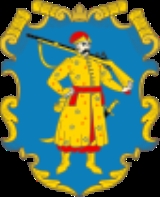
Cossack Hetmanate

Encyclopedia
The Hetmanate or Zaporizhian Host was the Ruthenian
Cossack
state in the Central Ukraine
between 1649 and 1782.
The Hetmanate was founded by first Ukrainian hetman
Bohdan Khmelnytsky
during the Khmelnytsky Uprising
(1648–1657). In 1654 it pledged its allegiance to Muscovy during the Council of Pereyaslav
, while being a constituency of the Polish-Lithuanian Commonwealth. Later the documents of the treaty (articles) were rewritten numerous times for reorganization purposes. A regional referendum concluded the fall of the region under the protection of the Russian monarchy that guaranteed sovereignty of the region in fight against the Polish Crown. The Treaty of Andrusovo
of 1667, however, was conducted without any representation from the Cossack Hetmanate and concluded the borders between Polish and Russian states, dividing the Hetmanate in half along the Dnieper. This division caused a civil war
in Ukraine between various parties of Cossacks that lasted till the end of the 17th century. In the 18th century the territory of the Hetmanate was limited to Left-bank Ukraine
. In 1782 the autonomy of the Cossack state was officially abolished by Catherine II of Russia
, though the Kiev Governorate
had already been established on most of this territory by 1708.
The Hetmanate state consisted of most of what is now central Ukraine and a small part of today's Russia
. Specifically, its territory included what is now the oblast
s (province
s) of Chernihiv
, Poltava
, and Sumy
(without the southeastern portion), the left-bank territories of Kiev
and Cherkasy
, as well as the western portion of Bryansk Oblast
of Russia. The lands of the Zaporizhian Host had a certain degree of self-government with its own administration.
The founder of the state Khmelnytsky declared himself as the ruler of the Rus' state to the Polish representative Adam Kysil in February 1649. He also called the Hetmanate as the Russian state in his letter to the Tsar
on February 17, 1654. His contemporary Metropolitan
Sylvestr Kosiv
recognized him as the leader and the commander of our land. In his letter to C. Şerban
(1657) he referred to himself as Clementiae divinae Generalis Dux Exercituum Zaporoviensium.
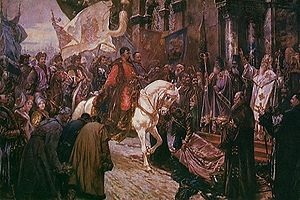 After many successful military campaigns against the Poles, Hetman Bohdan Khmelnytsky
made a triumphant entry into Kiev
on Christmas 1648 where he was hailed liberator of the people from Polish captivity. In February 1649, during negotiations in Pereiaslav
with a Polish delegation, Khmelnytsky had made it clear to the Poles that he was the Knyaz of Ruthenia that stretches all the way to Lviv
, Chelm
, Halych
, and build with the Tatar's help. He warned them about his intention to resume his military campaign.
When the returned delegation informed John II Casimir of Khmelnytsky's new campaign the king called for all szliachta volunteer army, while sending the regular troops against cossacks to the southern Volyn. However after obtaining an intelligence report of the superior cossack forces, the Polish troops retreated to Zbarazh
to set a defense. The forces of Jeremi Wiśniowiecki
reinforced the Zbarazh defenders while he took the lead of all Polish forces. Khmelnytsky besieged the city wearing down through series of random attacks and firing at it. The king while rushing to help Wisznewecki was ambushed with his newly gathered forces. Khmelnytsky leaving part of his army with Ivan Cherniata near Zbarazh moved together with İslâm III Giray
to intercept the Polish reinforcements and block their way at a river crossing near Zboriv
. Caught be some degree of surprise John Casimir started negotiations with the Tatar's khan. Bringing khan on his side they forced Khmelnytsky to start peace negotiations. Khmelnytsky signed the Treaty of Zboriv
in August of 1649 and was somewhat less than the cossack leader has anticipated from his campaign.
As ruler of the Hetmanate, Khmelnytsky engaged in state-building across multiple spheres: in the military, administration, finance, economics, and culture. He invested the Zaporozhian Host
under the leadership of its hetman with supreme power in the new Ruthenian state, and he unified all the spheres of Ukrainian society under his authority. This would involve building a government system and a developed military and civilian administrators out of Cossack officers and Ruthenian nobles, as well as the establishment of an elite within the Cossack Hetman state.
The Hetmanate used Polish currency, and Polish as an administrative language and a language of command.
betrayed the Cossacks for the third time in 1653, Khmelnytsky realized he could no longer rely on the Ottoman
support against Poland, the hetman was forced to turn to Muscovy for help. Negotiations began in January 1654 in Pereiaslav between Khmelnytsky, numerous cossacks and on the Muscovite side led Vasily Buturlin, and concluded in April in Moscow
by the Ruthenians Samiilo Bohdanovych-Zarudny
, and Pavlo Teteria
and by Aleksey Trubetskoy
, Vasilii Buturlin, and other Muscovite boyars.
As a result of the treaty, the Zaporozhian Host became a suzerainty
of Muscovy, and was split in two; the Cossack Hetmanate with its capital at Chyhyryn
and Zaporizhia
, centered around the fortress of the Zaporozhian Sich. The treaty also led to the Russo-Polish War of 1654–1667
.
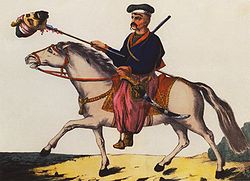 Already at the end of Khmelnytsky's life, his son Yuri Khmelnytsky was elected his successor. However, he was unfortunately not only young and inexperienced who was only 16 upon his father's death, Khmelnytsky-junior clearly lacked the charisma and the leadership qualities of his father.
Instead, Ivan Vyhovsky
, the general scribe (pysar) of the Hetmanate and an adviser to Bohdan Khmelnytsky was elected hetman in 1657 by the Starshyna council. The fact of him being elected by the Starshyna Council grew into a wide discontent among other regiments and Zaporizhian Host who sent their runners to Moscow with complains. Because of that new elections were called that same year at which Vyhovsky was once again reelected at the General Military Council. His election also was confirmed by the Moscow's authorities who were informed according to the Pereyaslav's acts. Moscow continued to accept runners from the regions of Cossack Hetmanate completely disregarding the authority of hetman and spreading rumors that in truth Moscow does not support candidacy of Vyhovsky. Vyhovsky witnessing that situation might ran out of his control went on to extinguish the revolt led by the Zaporozhian Kosh Otaman Yakiv Barabash
and Poltava
Colonel Martyn Pushkar
. In spring of 1658 with the help of Tatars Vyhovsky crossed Dnieper and confronted mutineers near Poltava
. During the battle Pushkar was killed and replaced with a new colonel while all the leaders of the uprising were strictly repressed. After that Vyhovsky and the General Starshyna counted the relationships with Moscow broken. The newly elected Metropolitan Dionisi Balaban was transferred to Chyhyryn
away from Kiev. An agitation against Moscow was conducted where the Ukrainian government informed population of possible national repressions, similar of which were conducted in the neighboring lands of Belarus that recently were secured after Moscow in the its short conflict with the Polish-Lithuanian Commonwealth
. A manifest of nullifying the union with Moscow was sent throughout Europe. The main reasons were conducting friendly relationships with Poland and supporting regional opposition within Hetmanate. Due to negotiations with Sweden have frozen, while having a military support from the Crimean Khanate
Vyhovsky decided to renegotiate with Poland with whom talks continued for quite some time. On September 16, 1658 in Hadyach an official document
was signed between representatives of the Cossack Hetmanate and Poland.
Under the conditions of the treaty, Ukraine would become a third and autonomous component of the Polish-Lithuanian Commonwealth
, under the ultimate sovereignty of the King of Poland, but with its own military, courts, and treasury. But the treaty, although ratified by the Diet in May 1659, was never implemented because it was unpopular among the lower classes of the Ruthenian society where more rebellions occurred. Eventually Vyhovsky surrendered the office of hetman, and fled to Poland. The newly installed Yurii Khmelnytsky
signed the newly composed Pereyaslav Articles
that were increasingly unfavorable for the Hetmanate and later led to introduction of the serfdom
rights.
This led to the period called "the Ruin
," where constant civil wars broke out through the state during the 17th century.
During the Ruin in 1667, the Russo-Polish war ended with the Treaty of Andrusovo
which split the Cossack Hetmanate along the Dnieper River into Left-bank Ukraine
, enjoyed a degree of autonomy within the Tsardom of Russia, and Right-bank Ukraine
remained part of the Polish-Lithuanian Commonwealth, temporary occupied by the Ottoman Empire (the Treaty of Buchach, the Treaty of Karlowitz
) in the period of 1672-1699. For a short time, Petro Doroshenko
became the hetman of both banks. Finally, the right-bank Ukraine, except for the city of Kiev
, was reincorporated back into their respective voivodeship
s of the Polish-Lithuanian Commonwealth while all the Hetmanate administration was abolished, between 1699 and 1704.
 The period of the Ruin was effectively over when Ivan Mazepa
was elected hetman, and brought stability to the state. He united Ukraine which, once again, was under the rule of one hetman. The Hetmanate flourished under his rule, particularly in literature, and architecture. The architectural style that developed during his reign was called the Cossack Baroque style.
During his reign, the Great Northern War
broke out between Russia
and Sweden
. And Mazepa's alliance with Peter I
caused heavy losses of cossacks, and Russian interference in the Hetmanate's internal affairs. When the Tsar
refused to defend Ukraine against the Polish King Stanislaus Leszczynski, an ally of Charles XII of Sweden, Mazepa and the Zaporozhian Cossacks allied themselves with the Swedes on October 28, 1708. The decisive battle took place in June 1709 in Poltava
where it was won by Russia, which put an end to Mazepa's goal of independence, promised in an earlier treaty with Sweden independence. Following Poltava, the Hetmanate's autonomy became nominal and the governorate of Kiev
was established.
, the Cossack Hetmanate's autonomy was progressively destroyed. After several earlier attempts, the office of hetman was finally abolished by the Russian government in 1764, and his functions were assumed by the Little Russian Collegium, thus fully incorporating the Hetmanate into the Russian Empire
.
On May 7, 1775, from a direct order from the Empress Catherine II, the Zaporozhian Sich was to be destroyed. On June 5, 1775, Russian artillery and infantry surrounded the Sich
, and razed it to the ground. The Russian troops disarmed the Cossacks, the treasury archives were confiscated. And the Koshovyi Otaman
Petro Kalnyshevsky
was arrested and exiled to the Solovki. This brought the end of the Zaporozhian Cossacks.
.
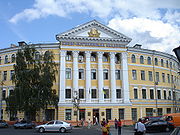 Visitors from abroad commented on the high level of literacy, even among commoners, in the Hetmanate. There was a higher number of elementary schools per population in the Hetmanate than in either neighboring Muscovy or Poland. In the 1740s, of 1,099 settlements within seven regimental districts, as many as 866 had primary schools. The German vistitor to the Hetmanate, writing in 1720, commented on how the son of Hetman Danylo Apostol
, who had never left Ukraine, was fluent in the Latin, Italian, French, German, Polish and Russian languages Under Mazepa, the Kiev collegium was transformed into an Academy and attracted some of the leading scholars of the Orthodox world. It was the largest educational institution in lands ruled by Moscow. Mazepa established another Collegium in Chernihiv. These schools largely used the Polish and Latin languages and provided a classic western education to their students. Many of those trained in Kiev, such as Feofan Prokopovich
would later move to Moscow, so that Ivan Mazepa's patronage not only raised the level of culture in Ukraine but also in Moscow itself. A musical academy was established in 1737 in the Hetmanate's then-capital of Hlukhiv
. Among its graduates were Maksym Berezovsky
, the first composer from the Russian Empire to be recognized in Europe, and Dmitry Bortniansky.
In addition to traditional printing presses in Kiev
, new printing shops were established in Novhorod-Siverskyi
and Chernihiv
. Most of the books published were religious in nature, such as the Peternik, a book about the lives of the monks of the Kiev-Pechersk monasatary. Books on local history were compiled. In a book written by Inokentiy Gizel in 1674, the theory that Moscow was the heir of ancient Kiev was developed and elaborated for the first time
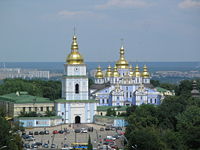
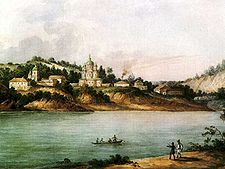 In 1686 the Orthodox Church in Ukraine changed from being under the jurisdiction of the Patriarch in Constantinople to being under the authority of the Moscow. Nevertheless, before and after this date local Church leaders pursued a policy of independence. Hetman Ivan Mazepa established very close relations with Metropilitan Varlaam Iasynsky (reigned 1690–1707). Mazepa provided donations of land, money and entire villages to the Church. He also financed the building of numerous churches in Kiev, including the Church of the Epiphany and the cathedral of St. Michael's Golden-Domed Monastery
, and restoration of older churches such as Saint Sophia Cathedral in Kiev
which had deteriorated to a state of near ruin by the mid-17th century, in a style known as Ukrainian Baroque
.
the Polish nobles
and Polonized Ruthenian magnate
s fled the territory of the Hetmanate. As a result, the noble estate now consisted of a merger between the nobility that had stayed in the territory of the Hetmanate (old noble families that did not succumb to Polonization and lesser nobles who had participated in the uprising on the side of the Cossacks against Poland) with members of the emergent Cossack officer class. Unlike the Polish nobles whose lands were redistributed, the nobles loyal to the Hetmanate retained their privileges, their lands, and the services of the peasants. Together, the old nobles and the new Cossack officers became known as the Distinguished Military Fellows (Znachni Viiskovi Tovaryshi). Thus, the nature of noble status was fundamentally changed. It no longer depended on ancient heredity, but instead on loyalty to the Cossack state. Over time, however, Cossack officer lands and privileges too became hereditary and the Cossack noble and officer class acquired huge landed estates comparable to those of the Polish magnates whom they had replaced and emulated.
, a period of instability and civil war in the 17th century. These resentments were frequently exploited by Moscow. The Zaporizhian Sich
served as a refuge for Cossacks fleeing the Hetmanate as it had been prior to Khmelnytsky's uprising.
and Uniate Clergy were driven from Ukraine. The Black, or monastic
, Orthodox
clergy enjoyed a very high status in the Hetmanate, controlling 17% of the Hetmanate's land. Monasteries were exempt from taxes and at no times were peasants bound to monasteries allowed to forgo their duties. The Orthodox hierarchy became as wealthy and powerful as the most powerful nobles. The white, or married, Orthodox clergy were also exempt from paying taxes. Priests' sons often entered the clergy or the Cossack civil service. It was not uncommon for nobles or Cossacks to become priests and vice versa.
, in which they were self-governing and controlled their own courts, finances and taxes. Wealthy townsmen were able to hold office within the Hetmanate or even to buy titles of nobility. Because the towns were generally small (the largest towns of Kiev
and Nizhyn
had no more than 15,000 inhabitants) this social group was not very significant relative to other social groups.
, in which the Polish landlords and magnates were expelled from the territory controlled by the Hetman, those nobles loyal to the Hetman as well as the Orthodox Church expected the peasants under their control to continue to provide their services. Thus as a result of the Uprising, approximately 50% of the territory consisted of lands given to Cossack officers or free self-governing villages controlled by the peasants, 33% of the land was owned by Cossack officers and nobles, and 17% of the land was owned by the Church. With time, the amount of territory owned by the nobles and officers gradually grew at the expense of the lands owned by peasants and rank-and-file Cossacks, and the peasants were forced to work increasingly more days for their landlords. Nevertheless, their obligations remained lighter than they had been prior to the Uprising and until the end of the Hetmanate peasants were never fully enserfed and retained the right to move.
The capital was the city of Chyhyryn
. After the Treaty of Andrusovo
, in 1669 the capital was transferred to Baturyn
as Chyhyryn became part of Polish-Lithuanian Commonwealth (Right-bank Ukraine
). After the Baturyn's tragedy of 1708 conducted by the Russian army of Aleksandr Menshikov the area was incorporated into the Kiev Governorate
the city of Hlukhiv
nominally served as the residence of Hetman.
Within the Hetmanate Polish was frequently used as the language of administration and even of command.
. There also was an important advising body Council of Officers (Starshyna). The hetman was initially chosen by the General Council, consisting of all cossacks, townspeople, clergy and even peasants. By the end of the 17th century, however, its role became more ceremonial as the hetman came to be chosen by the Council of Officers and the Hetmanate itself was turning into an authoritarian state. After 1709, the Battle of Poltava
, hetman nomination was to be confirmed by the Tsar. Hetman presided until he either died or was forced out by the General Cossack Council. The office of hetman had complete power over the administration, the judiciary, the finances, and the army. His cabinet functioned simultaneously as both the General Staff and as the Cabinet of Ministers
. The Hetman also had the right to conduct foreign policy, although this right was increasingly limited by Moscow in the 18th century.
Each of the regimental districts making up the Hetmanate was administered by a colonel who had dual roles as supreme military and civil authority on his territory. Initially elected by that regimental district's Cossacks, by the 18th century the colonels were appointed by the Hetman. After 1709, the colonels were frequently chosen by Moscow. Each colonel's staff consisted of a quartermaster (second-in-command), judge, chancellor, aide-de-camp, and flag-bearer.
Throughout the 18th century, local autonomy was gradually eroded within the Hetmanate. After the Baturyn's tragedy the autonomy was abolished, incorporating it into the Kiev Governorate
. After the Battle of Poltava
, hetmans elected by the Council of Officers were to be confirmed by the tsar. They served more as a military administrators and have little influence over the domestic policies. The tsar also frequently appointed the colonels of each regimental district.
Stepan Veliaminov. When the Cossacks responded by electing as Hetman Pavlo Polubotok
, opposed to these reforms, he was arrested and died in prison without having been confirmed by the tsar. The Little Russian Collegium then ruled the Hetmanate until 1727, when it was abolished and a new Hetman, Danylo Apostol
, was elected.
A code consisting of twenty-eight articles was adopted that regulated the relationship between the Hetmanate and Russia. It continued to be in force until the Hetmanate's dissolution. With election of the new Hetman new set of "Pereyaslav Articles" was signed by Danylo Apostol. The new document, known as the 28 Authoritative Ordinances, stipulated that:
and its authority replaced by the second Little Russian Collegiate that was transformed out of the Little-Russia Prikaz
(Office of the Ukrainian Affairs) subordinated to the Ambassadorial Office of the Russian Tsardom. The collegiate consisted of four Russian appointees and four Cossack representatives headed by a president, Count Peter Rumyantsev
, who proceeded to cautiously but firmly eliminate the vestiges of local autonomy. In 1781, the regimental system was dismantled and the Little Russian Collegiate abolished. Two years later, peasants' freedom of movement was restricted and the process of enserfment
was completed. Cossack soldiers were integrated into the Russian army, while the Cossack officers were granted status as Russian nobles. As had previously been the practice elsewhere in the Russian Empire, lands were confiscated from the Church (during the times of the Hetmanate monasteries alone controlled 17% of the region's lands) and distributed to the nobility. The territory of the Hetmanate was reorganized into three Russian provinces (governorates) whose administration was no different from that of any other provinces within the Russian Empire.
Ruthenians
The name Ruthenian |Rus']]) is a culturally loaded term and has different meanings according to the context in which it is used. Initially, it was the ethnonym used for the East Slavic peoples who lived in Rus'. Later it was used predominantly for Ukrainians...
Cossack
Cossack
Cossacks are a group of predominantly East Slavic people who originally were members of democratic, semi-military communities in what is today Ukraine and Southern Russia inhabiting sparsely populated areas and islands in the lower Dnieper and Don basins and who played an important role in the...
state in the Central Ukraine
Ukraine
Ukraine is a country in Eastern Europe. It has an area of 603,628 km², making it the second largest contiguous country on the European continent, after Russia...
between 1649 and 1782.
The Hetmanate was founded by first Ukrainian hetman
Hetman
Hetman was the title of the second-highest military commander in 15th- to 18th-century Poland and the Grand Duchy of Lithuania, which together, from 1569 to 1795, comprised the Polish-Lithuanian Commonwealth, or Rzeczpospolita....
Bohdan Khmelnytsky
Bohdan Khmelnytsky
Bohdan Zynoviy Mykhailovych Khmelnytsky was a hetman of the Zaporozhian Cossack Hetmanate of Polish–Lithuanian Commonwealth . He led an uprising against the Commonwealth and its magnates which resulted in the creation of a Cossack state...
during the Khmelnytsky Uprising
Khmelnytsky Uprising
The Khmelnytsky Uprising, was a Cossack rebellion in the Ukraine between the years 1648–1657 which turned into a Ukrainian war of liberation from Poland...
(1648–1657). In 1654 it pledged its allegiance to Muscovy during the Council of Pereyaslav
Treaty of Pereyaslav
The Treaty of Pereyaslav is known in history more as the Council of Pereiaslav.Council of Pereyalslav was a meeting between the representative of the Russian Tsar, Prince Vasili Baturlin who presented a royal decree, and Bohdan Khmelnytsky as the leader of Cossack Hetmanate. During the council...
, while being a constituency of the Polish-Lithuanian Commonwealth. Later the documents of the treaty (articles) were rewritten numerous times for reorganization purposes. A regional referendum concluded the fall of the region under the protection of the Russian monarchy that guaranteed sovereignty of the region in fight against the Polish Crown. The Treaty of Andrusovo
Treaty of Andrusovo
The Truce of Andrusovo was a thirteen and a half year truce, signed in 1667 between Tsardom of Russia and the Polish-Lithuanian Commonwealth, which were at war since 1654 over the territories of modern-day Ukraine and Belarus....
of 1667, however, was conducted without any representation from the Cossack Hetmanate and concluded the borders between Polish and Russian states, dividing the Hetmanate in half along the Dnieper. This division caused a civil war
Civil war
A civil war is a war between organized groups within the same nation state or republic, or, less commonly, between two countries created from a formerly-united nation state....
in Ukraine between various parties of Cossacks that lasted till the end of the 17th century. In the 18th century the territory of the Hetmanate was limited to Left-bank Ukraine
Left-bank Ukraine
Left-bank Ukraine is a historic name of the part of Ukraine on the left bank of the Dnieper River, comprising the modern-day oblasts of Chernihiv, Poltava and Sumy as well as the eastern parts of the Kiev and Cherkasy....
. In 1782 the autonomy of the Cossack state was officially abolished by Catherine II of Russia
Catherine II of Russia
Catherine II, also known as Catherine the Great , Empress of Russia, was born in Stettin, Pomerania, Prussia on as Sophie Friederike Auguste von Anhalt-Zerbst-Dornburg...
, though the Kiev Governorate
Kiev Governorate
Kiev Governorate , or Government of Kiev, was an administrative division of the Russian Empire.The governorate was established in 1708 along with seven other governorates and was transformed into a viceroyalty in 1781...
had already been established on most of this territory by 1708.
The Hetmanate state consisted of most of what is now central Ukraine and a small part of today's Russia
Russia
Russia or , officially known as both Russia and the Russian Federation , is a country in northern Eurasia. It is a federal semi-presidential republic, comprising 83 federal subjects...
. Specifically, its territory included what is now the oblast
Oblast
Oblast is a type of administrative division in Slavic countries, including some countries of the former Soviet Union. The word "oblast" is a loanword in English, but it is nevertheless often translated as "area", "zone", "province", or "region"...
s (province
Province
A province is a territorial unit, almost always an administrative division, within a country or state.-Etymology:The English word "province" is attested since about 1330 and derives from the 13th-century Old French "province," which itself comes from the Latin word "provincia," which referred to...
s) of Chernihiv
Chernihiv Oblast
Chernihiv Oblast is an oblast of northern Ukraine. The administrative center of the oblast is the city of Chernihiv.-Geography:The total area of the province is around 31,900 km²....
, Poltava
Poltava Oblast
Poltava Oblast is an oblast of central Ukraine. The administrative center of the oblast is the city of Poltava.Other important cities within the oblast include: Komsomolsk, Kremenchuk, Lubny and Myrhorod.-Geography:...
, and Sumy
Sumy Oblast
Sumy Oblast is an oblast in the northeastern part of Ukraine. The administrative center of the oblast is the city of Sumy.Other important cities within the oblast include Konotop, Okhtyrka, Romny, and Shostka....
(without the southeastern portion), the left-bank territories of Kiev
Kiev Oblast
Kyiv Oblast, sometimes written as Kiev Oblast is an oblast in central Ukraine.The administrative center of the oblast is the city of Kyiv , also being the capital of Ukraine...
and Cherkasy
Cherkasy Oblast
Cherkasy Oblast is an oblast of central Ukraine located along the Dnieper River. The administrative center of the oblast is the city of Cherkasy).-Geography:...
, as well as the western portion of Bryansk Oblast
Bryansk Oblast
Bryansk Oblast is a federal subject of Russia . Its administrative center is the city of Bryansk. Population: 1,278,087 .-History:...
of Russia. The lands of the Zaporizhian Host had a certain degree of self-government with its own administration.
Name
The official name of the Cossack Hetmanate was Zaporizhian Host . Its inhabitants referred to it in Ukrainian as "Ukraine" or "Vkraine". In Russian diplomatic correspondence it was called Little Russia ; in Polish, Ottoman, and Arab sources - as Ukraine or Cossakia. The historiographic term Hetmanate was coined in the late 19th century.The founder of the state Khmelnytsky declared himself as the ruler of the Rus' state to the Polish representative Adam Kysil in February 1649. He also called the Hetmanate as the Russian state in his letter to the Tsar
Tsar
Tsar is a title used to designate certain European Slavic monarchs or supreme rulers. As a system of government in the Tsardom of Russia and Russian Empire, it is known as Tsarist autocracy, or Tsarism...
on February 17, 1654. His contemporary Metropolitan
Metropolitan bishop
In Christian churches with episcopal polity, the rank of metropolitan bishop, or simply metropolitan, pertains to the diocesan bishop or archbishop of a metropolis; that is, the chief city of a historical Roman province, ecclesiastical province, or regional capital.Before the establishment of...
Sylvestr Kosiv
Sylvestr Kosiv
Sylvester Kossov was a Eastern Orthodox Church metropolitan and writer. He served as metropolitan of Kiev during the Khmelnytsky uprising. His official title was Metropolitan of Kiev, Galychyna and All-Rus'.-Education:...
recognized him as the leader and the commander of our land. In his letter to C. Şerban
Constantin Serban
Constantin Şerban was Prince of Wallachia between 1654 and 1658, illegitimate son to Radu Şerban .-Reign:...
(1657) he referred to himself as Clementiae divinae Generalis Dux Exercituum Zaporoviensium.
Establishment
Bohdan Khmelnytsky
Bohdan Zynoviy Mykhailovych Khmelnytsky was a hetman of the Zaporozhian Cossack Hetmanate of Polish–Lithuanian Commonwealth . He led an uprising against the Commonwealth and its magnates which resulted in the creation of a Cossack state...
made a triumphant entry into Kiev
Kiev
Kiev or Kyiv is the capital and the largest city of Ukraine, located in the north central part of the country on the Dnieper River. The population as of the 2001 census was 2,611,300. However, higher numbers have been cited in the press....
on Christmas 1648 where he was hailed liberator of the people from Polish captivity. In February 1649, during negotiations in Pereiaslav
Pereiaslav-Khmelnytskyi
Pereiaslav-Khmelnytskyi is a town located where Alta River flows into Trubizh River in the Kiev Oblast in central Ukraine. Serving as the administrative center of the Pereiaslav-Khmelnytskyi Raion , the town itself is also designated as a separate raion within the oblast...
with a Polish delegation, Khmelnytsky had made it clear to the Poles that he was the Knyaz of Ruthenia that stretches all the way to Lviv
Lviv
Lviv is a city in western Ukraine. The city is regarded as one of the main cultural centres of today's Ukraine and historically has also been a major Polish and Jewish cultural center, as Poles and Jews were the two main ethnicities of the city until the outbreak of World War II and the following...
, Chelm
Chelm
Chełm is a city in eastern Poland with 67,702 inhabitants . It is located to the south-east of Lublin, north of Zamość and south of Biała Podlaska, some 25 kilometres from the border with Ukraine...
, Halych
Halych
Halych is a historic city on the Dniester River in western Ukraine. The town gave its name to the historic province and kingdom of Kingdom of Galicia–Volhynia, of which it was the capital until the early 14th century, when the seat of the local princes was moved to Lviv...
, and build with the Tatar's help. He warned them about his intention to resume his military campaign.
When the returned delegation informed John II Casimir of Khmelnytsky's new campaign the king called for all szliachta volunteer army, while sending the regular troops against cossacks to the southern Volyn. However after obtaining an intelligence report of the superior cossack forces, the Polish troops retreated to Zbarazh
Zbarazh
Zbarazh is a city in the Ternopil Oblast of western Ukraine. It is the administrative center of the Zbarazh Raion , and is located in the historic region of Galicia....
to set a defense. The forces of Jeremi Wiśniowiecki
Jeremi Wisniowiecki
Jeremi Michał Korybut Wiśniowiecki was a notable member of the aristocracy of the Polish-Lithuanian Commonwealth, Prince at Wiśniowiec, Łubnie and Chorol and a father of future Polish king Michał I...
reinforced the Zbarazh defenders while he took the lead of all Polish forces. Khmelnytsky besieged the city wearing down through series of random attacks and firing at it. The king while rushing to help Wisznewecki was ambushed with his newly gathered forces. Khmelnytsky leaving part of his army with Ivan Cherniata near Zbarazh moved together with İslâm III Giray
Islâm III Giray
İslâm III Giray — a khan of the Crimean Khanate in 1644–1654.In 1648 allied with Zaporozhian Cossack leader Bohdan Khmelnytsky in his revolt against the Polish-Lithuanian Commonwealth. In 1654 after the Treaty of Pereyaslav, he switched sides and allied with Poland against the Tsardom of...
to intercept the Polish reinforcements and block their way at a river crossing near Zboriv
Battle of Zboriv (1649)
The Battle of Zboriv, also known as the Battle of Zborów, was fought in the vicinity of Zboriv , as part of the Khmelnytsky Uprising, between the combined Cossack-Crimean force and the Crown army of the Polish-Lithuanian Commonwealth.Crown forces of about 25,000 led by King John II Casimir from...
. Caught be some degree of surprise John Casimir started negotiations with the Tatar's khan. Bringing khan on his side they forced Khmelnytsky to start peace negotiations. Khmelnytsky signed the Treaty of Zboriv
Treaty of Zboriv
The Treaty of Zboriv was signed on August 17, 1649, after the Battle of Zboriv when the Crown forces of about 25,000 led by king John II Casimir of Poland clashed against a combined force of Cossacks and Crimean Tatars, led by hetman Bohdan Khmelnytsky and khan İslâm III Giray of Crimea...
in August of 1649 and was somewhat less than the cossack leader has anticipated from his campaign.
As ruler of the Hetmanate, Khmelnytsky engaged in state-building across multiple spheres: in the military, administration, finance, economics, and culture. He invested the Zaporozhian Host
Zaporozhian Host
The Zaporozhian Cossacks or simply Zaporozhians were Ukrainian Cossacks who lived beyond the rapids of the Dnieper river, the land also known as the Great Meadow in Central Ukraine...
under the leadership of its hetman with supreme power in the new Ruthenian state, and he unified all the spheres of Ukrainian society under his authority. This would involve building a government system and a developed military and civilian administrators out of Cossack officers and Ruthenian nobles, as well as the establishment of an elite within the Cossack Hetman state.
The Hetmanate used Polish currency, and Polish as an administrative language and a language of command.
Moscow Protectorate
After the Crimean TatarsCrimean Khanate
Crimean Khanate, or Khanate of Crimea , was a state ruled by Crimean Tatars from 1441 to 1783. Its native name was . Its khans were the patrilineal descendants of Toqa Temür, the thirteenth son of Jochi and grandson of Genghis Khan...
betrayed the Cossacks for the third time in 1653, Khmelnytsky realized he could no longer rely on the Ottoman
Ottoman Empire
The Ottoman EmpireIt was usually referred to as the "Ottoman Empire", the "Turkish Empire", the "Ottoman Caliphate" or more commonly "Turkey" by its contemporaries...
support against Poland, the hetman was forced to turn to Muscovy for help. Negotiations began in January 1654 in Pereiaslav between Khmelnytsky, numerous cossacks and on the Muscovite side led Vasily Buturlin, and concluded in April in Moscow
Moscow
Moscow is the capital, the most populous city, and the most populous federal subject of Russia. The city is a major political, economic, cultural, scientific, religious, financial, educational, and transportation centre of Russia and the continent...
by the Ruthenians Samiilo Bohdanovych-Zarudny
Samiilo Bohdanovych-Zarudny
Samiilo Bohdanovych-Zarudny was a Cossack diplomat, noble and general judge of the Zaporozhian Host, who defected to Bohdan Khmelnytsky's side at Korsun-Shevchenkivskyi in 1648....
, and Pavlo Teteria
Pavlo Teteria
Pavlo Teteria was Hetman of Right-Bank Ukraine .Before his hetmancy he served in a number of high positions under Bohdan Khmelnytsky, and Ivan Vyhovsky....
and by Aleksey Trubetskoy
Aleksey Trubetskoy
Aleksey Nikitich Trubetskoy was the last Prince of Trubetsk 1634–1645, and 17 March 1660 – June 1672, the godfather of Peter I of Russia.Under Tsar Michael's rule Aleksey...
, Vasilii Buturlin, and other Muscovite boyars.
As a result of the treaty, the Zaporozhian Host became a suzerainty
Suzerainty
Suzerainty occurs where a region or people is a tributary to a more powerful entity which controls its foreign affairs while allowing the tributary vassal state some limited domestic autonomy. The dominant entity in the suzerainty relationship, or the more powerful entity itself, is called a...
of Muscovy, and was split in two; the Cossack Hetmanate with its capital at Chyhyryn
Chyhyryn
Chyhyryn is a city located in Cherkasy Oblast of central Ukraine. In 1648 to 1669 the city was the capital of Ukraine .- Location :...
and Zaporizhia
Zaporizhia
Zaporizhia or Zaporozhye [formerly Alexandrovsk ] is a city in southeastern Ukraine, situated on the banks of the Dnieper River. It is the administrative center of the Zaporizhia Oblast...
, centered around the fortress of the Zaporozhian Sich. The treaty also led to the Russo-Polish War of 1654–1667
Russo-Polish War (1654–1667)
The Russo-Polish War of 1654–1667, also called Thirteen Years' War, First Northern War, War for Ukraine was the last major conflict between Tsardom of Russia and the Polish-Lithuanian Commonwealth. Between 1655 and 1660, the Second Northern War was also fought in the Polish-Lithuanian Commonwealth,...
.
The Ruin
Instead, Ivan Vyhovsky
Ivan Vyhovsky
Ivan Vyhovsky was a hetman of the Ukrainian Cossacks during three years of the Russo-Polish War . He was the successor to the famous hetman and rebel leader Bohdan Khmelnytsky...
, the general scribe (pysar) of the Hetmanate and an adviser to Bohdan Khmelnytsky was elected hetman in 1657 by the Starshyna council. The fact of him being elected by the Starshyna Council grew into a wide discontent among other regiments and Zaporizhian Host who sent their runners to Moscow with complains. Because of that new elections were called that same year at which Vyhovsky was once again reelected at the General Military Council. His election also was confirmed by the Moscow's authorities who were informed according to the Pereyaslav's acts. Moscow continued to accept runners from the regions of Cossack Hetmanate completely disregarding the authority of hetman and spreading rumors that in truth Moscow does not support candidacy of Vyhovsky. Vyhovsky witnessing that situation might ran out of his control went on to extinguish the revolt led by the Zaporozhian Kosh Otaman Yakiv Barabash
Yakiv Barabash
Yakiv Barabash was a Zaporozhian Cossack Otaman who opposed Hetman Ivan Vyhovsky.In 1657 he and Poltava polkovnyk Martyn Pushkar led a pro-Muscovy revolt against Vyhovsky, who was generally pro-Polish in his policies. The revolt ended in June 1658 near Poltava, when Vyhovsky and his cossacks...
and Poltava
Poltava
Poltava is a city in located on the Vorskla River in central Ukraine. It is the administrative center of the Poltava Oblast , as well as the surrounding Poltava Raion of the oblast. Poltava's estimated population is 298,652 ....
Colonel Martyn Pushkar
Martyn Pushkar
Martyn Pushkar was a polkovnyk of Poltava's Cossack regiment known for his loyalty to Muscovy. Together with Iakiv Barabash Pushkar led a pro-Muscovy uprising against Ukrainian hetman Ivan Vyhovsky in 1657. After inflicting several defeats on Vyhovsky's Cossacks and his Polish allies, Martyn...
. In spring of 1658 with the help of Tatars Vyhovsky crossed Dnieper and confronted mutineers near Poltava
Poltava
Poltava is a city in located on the Vorskla River in central Ukraine. It is the administrative center of the Poltava Oblast , as well as the surrounding Poltava Raion of the oblast. Poltava's estimated population is 298,652 ....
. During the battle Pushkar was killed and replaced with a new colonel while all the leaders of the uprising were strictly repressed. After that Vyhovsky and the General Starshyna counted the relationships with Moscow broken. The newly elected Metropolitan Dionisi Balaban was transferred to Chyhyryn
Chyhyryn
Chyhyryn is a city located in Cherkasy Oblast of central Ukraine. In 1648 to 1669 the city was the capital of Ukraine .- Location :...
away from Kiev. An agitation against Moscow was conducted where the Ukrainian government informed population of possible national repressions, similar of which were conducted in the neighboring lands of Belarus that recently were secured after Moscow in the its short conflict with the Polish-Lithuanian Commonwealth
Polish-Lithuanian Commonwealth
The Polish–Lithuanian Commonwealth was a dualistic state of Poland and Lithuania ruled by a common monarch. It was the largest and one of the most populous countries of 16th- and 17th‑century Europe with some and a multi-ethnic population of 11 million at its peak in the early 17th century...
. A manifest of nullifying the union with Moscow was sent throughout Europe. The main reasons were conducting friendly relationships with Poland and supporting regional opposition within Hetmanate. Due to negotiations with Sweden have frozen, while having a military support from the Crimean Khanate
Crimean Khanate
Crimean Khanate, or Khanate of Crimea , was a state ruled by Crimean Tatars from 1441 to 1783. Its native name was . Its khans were the patrilineal descendants of Toqa Temür, the thirteenth son of Jochi and grandson of Genghis Khan...
Vyhovsky decided to renegotiate with Poland with whom talks continued for quite some time. On September 16, 1658 in Hadyach an official document
Treaty of Hadiach
The Treaty of Hadiach was a treaty signed on 16 September 1658 in Hadiach between representatives of the Polish-Lithuanian Commonwealth and Cossacks...
was signed between representatives of the Cossack Hetmanate and Poland.
Under the conditions of the treaty, Ukraine would become a third and autonomous component of the Polish-Lithuanian Commonwealth
Polish-Lithuanian Commonwealth
The Polish–Lithuanian Commonwealth was a dualistic state of Poland and Lithuania ruled by a common monarch. It was the largest and one of the most populous countries of 16th- and 17th‑century Europe with some and a multi-ethnic population of 11 million at its peak in the early 17th century...
, under the ultimate sovereignty of the King of Poland, but with its own military, courts, and treasury. But the treaty, although ratified by the Diet in May 1659, was never implemented because it was unpopular among the lower classes of the Ruthenian society where more rebellions occurred. Eventually Vyhovsky surrendered the office of hetman, and fled to Poland. The newly installed Yurii Khmelnytsky
Yurii Khmelnytsky
Yurii Khmelnytsky , younger son of the famous Ukrainian Hetman Bohdan Khmelnytsky and brother of Tymofiy Khmelnytsky, was a Zaporozhian Cossack political and military leader...
signed the newly composed Pereyaslav Articles
Pereyaslav Articles
The Pereyaslav Articles were concluded on October 27, 1659 between Yuri Khmelnytsky, the son of Bohdan Khmelnytsky, and the Russian tsar. The treaty drastically limited the Ukrainian autonomy...
that were increasingly unfavorable for the Hetmanate and later led to introduction of the serfdom
Serfdom
Serfdom is the status of peasants under feudalism, specifically relating to Manorialism. It was a condition of bondage or modified slavery which developed primarily during the High Middle Ages in Europe and lasted to the mid-19th century...
rights.
This led to the period called "the Ruin
The Ruin (Ukrainian history)
The Ruin is a period of Ukrainian history from the death of hetman Bohdan Khmelnitsky in 1657 and until ascension of hetman Ivan Mazepa in 1687. This period is characterised by continuous strife, civil war, and foreign intervention of Ukraine's neighbours...
," where constant civil wars broke out through the state during the 17th century.
During the Ruin in 1667, the Russo-Polish war ended with the Treaty of Andrusovo
Treaty of Andrusovo
The Truce of Andrusovo was a thirteen and a half year truce, signed in 1667 between Tsardom of Russia and the Polish-Lithuanian Commonwealth, which were at war since 1654 over the territories of modern-day Ukraine and Belarus....
which split the Cossack Hetmanate along the Dnieper River into Left-bank Ukraine
Left-bank Ukraine
Left-bank Ukraine is a historic name of the part of Ukraine on the left bank of the Dnieper River, comprising the modern-day oblasts of Chernihiv, Poltava and Sumy as well as the eastern parts of the Kiev and Cherkasy....
, enjoyed a degree of autonomy within the Tsardom of Russia, and Right-bank Ukraine
Right-bank Ukraine
Right-bank Ukraine , a historical name of a part of Ukraine on the right bank of the Dnieper River, corresponding with modern-day oblasts of Volyn, Rivne, Vinnitsa, Zhytomyr, Kirovohrad and Kiev, as well as part of Cherkasy and Ternopil...
remained part of the Polish-Lithuanian Commonwealth, temporary occupied by the Ottoman Empire (the Treaty of Buchach, the Treaty of Karlowitz
Treaty of Karlowitz
The Treaty of Karlowitz was signed on 26 January 1699 in Sremski Karlovci , concluding the Austro-Ottoman War of 1683–1697 in which the Ottoman side had been defeated at the Battle of Zenta...
) in the period of 1672-1699. For a short time, Petro Doroshenko
Petro Doroshenko
Petro Dorofeyevych Doroshenko was a Cossack political and military leader, Hetman of Right-bank Ukraine and a Russian voyevoda.-Earlier life:...
became the hetman of both banks. Finally, the right-bank Ukraine, except for the city of Kiev
Kiev
Kiev or Kyiv is the capital and the largest city of Ukraine, located in the north central part of the country on the Dnieper River. The population as of the 2001 census was 2,611,300. However, higher numbers have been cited in the press....
, was reincorporated back into their respective voivodeship
Voivodeship
Voivodship is a term denoting the position of, or more commonly the area administered by, a voivod. Voivodeships have existed since medieval times in Poland, Romania, Hungary, Lithuania, Latvia, Russia and Serbia....
s of the Polish-Lithuanian Commonwealth while all the Hetmanate administration was abolished, between 1699 and 1704.
The Mazepa era
Ivan Mazepa
Ivan Stepanovych Mazepa , Cossack Hetman of the Hetmanate in Left-bank Ukraine, from 1687–1708. He was famous as a patron of the arts, and also played an important role in the Battle of Poltava where after learning of Peter I's intent to relieve him as acting Hetman of Ukraine and replace him...
was elected hetman, and brought stability to the state. He united Ukraine which, once again, was under the rule of one hetman. The Hetmanate flourished under his rule, particularly in literature, and architecture. The architectural style that developed during his reign was called the Cossack Baroque style.
During his reign, the Great Northern War
Great Northern War
The Great Northern War was a conflict in which a coalition led by the Tsardom of Russia successfully contested the supremacy of the Swedish Empire in northern Central Europe and Eastern Europe. The initial leaders of the anti-Swedish alliance were Peter I the Great of Russia, Frederick IV of...
broke out between Russia
Tsardom of Russia
The Tsardom of Russia was the name of the centralized Russian state from Ivan IV's assumption of the title of Tsar in 1547 till Peter the Great's foundation of the Russian Empire in 1721.From 1550 to 1700, Russia grew 35,000 km2 a year...
and Sweden
Swedish Empire
The Swedish Empire refers to the Kingdom of Sweden between 1561 and 1721 . During this time, Sweden was one of the great European powers. In Swedish, the period is called Stormaktstiden, literally meaning "the Great Power Era"...
. And Mazepa's alliance with Peter I
Peter I of Russia
Peter the Great, Peter I or Pyotr Alexeyevich Romanov Dates indicated by the letters "O.S." are Old Style. All other dates in this article are New Style. ruled the Tsardom of Russia and later the Russian Empire from until his death, jointly ruling before 1696 with his half-brother, Ivan V...
caused heavy losses of cossacks, and Russian interference in the Hetmanate's internal affairs. When the Tsar
Tsar
Tsar is a title used to designate certain European Slavic monarchs or supreme rulers. As a system of government in the Tsardom of Russia and Russian Empire, it is known as Tsarist autocracy, or Tsarism...
refused to defend Ukraine against the Polish King Stanislaus Leszczynski, an ally of Charles XII of Sweden, Mazepa and the Zaporozhian Cossacks allied themselves with the Swedes on October 28, 1708. The decisive battle took place in June 1709 in Poltava
Battle of Poltava
The Battle of Poltava on 27 June 1709 was the decisive victory of Peter I of Russia over the Swedish forces under Field Marshal Carl Gustav Rehnskiöld in one of the battles of the Great Northern War. It is widely believed to have been the beginning of Sweden's decline as a Great Power; the...
where it was won by Russia, which put an end to Mazepa's goal of independence, promised in an earlier treaty with Sweden independence. Following Poltava, the Hetmanate's autonomy became nominal and the governorate of Kiev
Kiev Governorate
Kiev Governorate , or Government of Kiev, was an administrative division of the Russian Empire.The governorate was established in 1708 along with seven other governorates and was transformed into a viceroyalty in 1781...
was established.
End of the Zaporozhian Host
During the reign of Catherine II of RussiaCatherine II of Russia
Catherine II, also known as Catherine the Great , Empress of Russia, was born in Stettin, Pomerania, Prussia on as Sophie Friederike Auguste von Anhalt-Zerbst-Dornburg...
, the Cossack Hetmanate's autonomy was progressively destroyed. After several earlier attempts, the office of hetman was finally abolished by the Russian government in 1764, and his functions were assumed by the Little Russian Collegium, thus fully incorporating the Hetmanate into the Russian Empire
Russian Empire
The Russian Empire was a state that existed from 1721 until the Russian Revolution of 1917. It was the successor to the Tsardom of Russia and the predecessor of the Soviet Union...
.
On May 7, 1775, from a direct order from the Empress Catherine II, the Zaporozhian Sich was to be destroyed. On June 5, 1775, Russian artillery and infantry surrounded the Sich
Sich
A sich is the administrative and military centre for Cossacks and especially the Zaporizhian Cossacks. It is derived from the Ukrainian word siktý, "to chop", meaning to clear a forest for an encampment, or to build a fortification with the trees that have been chopped down.The Zaporizhian Sich...
, and razed it to the ground. The Russian troops disarmed the Cossacks, the treasury archives were confiscated. And the Koshovyi Otaman
Koshovyi Otaman
Kosh Otaman was the highest military rank of the Zaporizhian Cossacks in the 16-18th centuries.-Overview:The otaman was elected by elders of the Zaporozhian Host. The position contained the highest military, administrative, and judicial powers. Until the establishment of the Cossack Hetmanate the...
Petro Kalnyshevsky
Petro Kalnyshevsky
Kalnyshevsky Petro was the last Koshovyi Otaman of the Zaporozhian Host, serving in 1762 and from 1765 to 1775. Kalnyshevsky was the Hero in the Russo-Turkish war of 1768-1774 and was honoured with a gold medal with brilliants for courage.Being the leader of the Zaporozhian Host, Kalnyshevsky...
was arrested and exiled to the Solovki. This brought the end of the Zaporozhian Cossacks.
Culture
The Hetmanate coincided with a period of cultural flowering in Ukraine, particularly during the reign of hetman Ivan MazepaIvan Mazepa
Ivan Stepanovych Mazepa , Cossack Hetman of the Hetmanate in Left-bank Ukraine, from 1687–1708. He was famous as a patron of the arts, and also played an important role in the Battle of Poltava where after learning of Peter I's intent to relieve him as acting Hetman of Ukraine and replace him...
.
Education
Danylo Apostol
Danylo Apostol , was a Hetman of the Left-bank Ukraine and Ukrainian Cossack starshina.Born in a noble Cossack family of Moldavian boyar origin, Danylo Apostol was a prominent military leader, polkovnyk of the Myrhorod Regiment, and a participant in the Russian campaigns against the Ottoman...
, who had never left Ukraine, was fluent in the Latin, Italian, French, German, Polish and Russian languages Under Mazepa, the Kiev collegium was transformed into an Academy and attracted some of the leading scholars of the Orthodox world. It was the largest educational institution in lands ruled by Moscow. Mazepa established another Collegium in Chernihiv. These schools largely used the Polish and Latin languages and provided a classic western education to their students. Many of those trained in Kiev, such as Feofan Prokopovich
Feofan Prokopovich
thumb|Theophan ProkopovichFeofan/Theophan Prokopovich was an archbishop and statesman in the Russian Empire, of Ukrainian descent. He elaborated and implemented Peter the Great's reform of the Russian Orthodox Church...
would later move to Moscow, so that Ivan Mazepa's patronage not only raised the level of culture in Ukraine but also in Moscow itself. A musical academy was established in 1737 in the Hetmanate's then-capital of Hlukhiv
Hlukhiv
Hlukhiv or Glukhov is a historic town in Sumy region of Ukraine, just south from the Russian border . As of 2001, the city's population is 35,800...
. Among its graduates were Maksym Berezovsky
Maksym Berezovsky
Maksym Sozontovych Berezovsky was a Ukrainian composer, opera singer, and violinist.Berezovsky was the first Ukrainian composer to be recognized throughout Europe and the first to compose an opera, symphony, and violin sonata. His most popular works are his sacred choral pieces written for the...
, the first composer from the Russian Empire to be recognized in Europe, and Dmitry Bortniansky.
In addition to traditional printing presses in Kiev
Kiev
Kiev or Kyiv is the capital and the largest city of Ukraine, located in the north central part of the country on the Dnieper River. The population as of the 2001 census was 2,611,300. However, higher numbers have been cited in the press....
, new printing shops were established in Novhorod-Siverskyi
Novhorod-Siverskyi
Novhorod-Siversky is a historic city in the Chernihiv Oblast of Ukraine. It is the administrative center of the Novhorod-Siversky Raion, and is situated on the bank of the Desna River, 330 km from the capital, Kiev, and 45 km south of the Russian border. Current estimated population:...
and Chernihiv
Chernihiv
Chernihiv or Chernigov is a historic city in northern Ukraine. It is the administrative center of the Chernihiv Oblast , as well as of the surrounding Chernihivskyi Raion within the oblast...
. Most of the books published were religious in nature, such as the Peternik, a book about the lives of the monks of the Kiev-Pechersk monasatary. Books on local history were compiled. In a book written by Inokentiy Gizel in 1674, the theory that Moscow was the heir of ancient Kiev was developed and elaborated for the first time
Religion
St. Michael's Golden-Domed Monastery
St. Michael's Golden-Domed Monastery is a functioning monastery in Kiev, the capital of Ukraine. The monastery is located on the right bank of the Dnieper River on the edge of a bluff northeast of the Saint Sophia Cathedral...
, and restoration of older churches such as Saint Sophia Cathedral in Kiev
Saint Sophia Cathedral in Kiev
Saint Sophia Cathedral in Kiev is an outstanding architectural monument of Kievan Rus'. Today, it is one of the city's best known landmarks and the first Ukrainian patrimony to be inscribed on the World Heritage List along with the Kiev Cave Monastery complex...
which had deteriorated to a state of near ruin by the mid-17th century, in a style known as Ukrainian Baroque
Ukrainian Baroque
Ukrainian Baroque or Cossack Baroque is an architectural style that emerged in Ukraine during the Hetmanate era, in the 17th and 18th centuries....
.
Society
The social structure of the Hetmanate consisted fo five groups: the nobility, the Cossacks, the clergy, the townspeople, and the peasants.Nobles
As had been the case under Poland, the nobility continued to be the dominant social class during the Hetmanate, although its composition and source of legitimacy within the new society had changed radically. During the Khmelnytsky UprisingKhmelnytsky Uprising
The Khmelnytsky Uprising, was a Cossack rebellion in the Ukraine between the years 1648–1657 which turned into a Ukrainian war of liberation from Poland...
the Polish nobles
Szlachta
The szlachta was a legally privileged noble class with origins in the Kingdom of Poland. It gained considerable institutional privileges during the 1333-1370 reign of Casimir the Great. In 1413, following a series of tentative personal unions between the Grand Duchy of Lithuania and the Kingdom of...
and Polonized Ruthenian magnate
Magnate
Magnate, from the Late Latin magnas, a great man, itself from Latin magnus 'great', designates a noble or other man in a high social position, by birth, wealth or other qualities...
s fled the territory of the Hetmanate. As a result, the noble estate now consisted of a merger between the nobility that had stayed in the territory of the Hetmanate (old noble families that did not succumb to Polonization and lesser nobles who had participated in the uprising on the side of the Cossacks against Poland) with members of the emergent Cossack officer class. Unlike the Polish nobles whose lands were redistributed, the nobles loyal to the Hetmanate retained their privileges, their lands, and the services of the peasants. Together, the old nobles and the new Cossack officers became known as the Distinguished Military Fellows (Znachni Viiskovi Tovaryshi). Thus, the nature of noble status was fundamentally changed. It no longer depended on ancient heredity, but instead on loyalty to the Cossack state. Over time, however, Cossack officer lands and privileges too became hereditary and the Cossack noble and officer class acquired huge landed estates comparable to those of the Polish magnates whom they had replaced and emulated.
Cossacks
Most Cossacks failed to enter the noble estate and continued their role as free soldiers. The lower rank Cossacks often resented their wealthier brethren and were responsible for frequent rebellions, particularly during the RuinThe Ruin (Ukrainian history)
The Ruin is a period of Ukrainian history from the death of hetman Bohdan Khmelnitsky in 1657 and until ascension of hetman Ivan Mazepa in 1687. This period is characterised by continuous strife, civil war, and foreign intervention of Ukraine's neighbours...
, a period of instability and civil war in the 17th century. These resentments were frequently exploited by Moscow. The Zaporizhian Sich
Zaporizhian Sich
Zaporizhian Sich was socio-political, grassroot, military organization of Ukrainian cossacks placed beyond Dnieper rapids. Sich existed between the 16th and 18th centuries in the region around the today's Kakhovka Reservoir...
served as a refuge for Cossacks fleeing the Hetmanate as it had been prior to Khmelnytsky's uprising.
Clergy
During the Hetmanate, the Roman Catholic ChurchRoman Catholic Church
The Catholic Church, also known as the Roman Catholic Church, is the world's largest Christian church, with over a billion members. Led by the Pope, it defines its mission as spreading the gospel of Jesus Christ, administering the sacraments and exercising charity...
and Uniate Clergy were driven from Ukraine. The Black, or monastic
Monk
A monk is a person who practices religious asceticism, living either alone or with any number of monks, while always maintaining some degree of physical separation from those not sharing the same purpose...
, Orthodox
Eastern Orthodox Church
The Orthodox Church, officially called the Orthodox Catholic Church and commonly referred to as the Eastern Orthodox Church, is the second largest Christian denomination in the world, with an estimated 300 million adherents mainly in the countries of Belarus, Bulgaria, Cyprus, Georgia, Greece,...
clergy enjoyed a very high status in the Hetmanate, controlling 17% of the Hetmanate's land. Monasteries were exempt from taxes and at no times were peasants bound to monasteries allowed to forgo their duties. The Orthodox hierarchy became as wealthy and powerful as the most powerful nobles. The white, or married, Orthodox clergy were also exempt from paying taxes. Priests' sons often entered the clergy or the Cossack civil service. It was not uncommon for nobles or Cossacks to become priests and vice versa.
Townspeople
Twelve cities within the Hetmanate enjoyed Magdeburg rightsMagdeburg rights
Magdeburg Rights or Magdeburg Law were a set of German town laws regulating the degree of internal autonomy within cities and villages granted by a local ruler. Modelled and named after the laws of the German city of Magdeburg and developed during many centuries of the Holy Roman Empire, it was...
, in which they were self-governing and controlled their own courts, finances and taxes. Wealthy townsmen were able to hold office within the Hetmanate or even to buy titles of nobility. Because the towns were generally small (the largest towns of Kiev
Kiev
Kiev or Kyiv is the capital and the largest city of Ukraine, located in the north central part of the country on the Dnieper River. The population as of the 2001 census was 2,611,300. However, higher numbers have been cited in the press....
and Nizhyn
Nizhyn
Nizhyn is a city located in the Chernihiv Oblast of northern Ukraine, along the Oster River, north-east of the nation's capital, Kiev. It is the administrative center of the Nizhynsky Raion, though the city itself is also designated as a district in the oblast...
had no more than 15,000 inhabitants) this social group was not very significant relative to other social groups.
Peasants
Peasants comprised the majority of the Hetmanate's population. Although the institution of forced labor by the peasants was reduced significantly by the Khmelnytsky UprisingKhmelnytsky Uprising
The Khmelnytsky Uprising, was a Cossack rebellion in the Ukraine between the years 1648–1657 which turned into a Ukrainian war of liberation from Poland...
, in which the Polish landlords and magnates were expelled from the territory controlled by the Hetman, those nobles loyal to the Hetman as well as the Orthodox Church expected the peasants under their control to continue to provide their services. Thus as a result of the Uprising, approximately 50% of the territory consisted of lands given to Cossack officers or free self-governing villages controlled by the peasants, 33% of the land was owned by Cossack officers and nobles, and 17% of the land was owned by the Church. With time, the amount of territory owned by the nobles and officers gradually grew at the expense of the lands owned by peasants and rank-and-file Cossacks, and the peasants were forced to work increasingly more days for their landlords. Nevertheless, their obligations remained lighter than they had been prior to the Uprising and until the end of the Hetmanate peasants were never fully enserfed and retained the right to move.
Administration
The Hetmanate was divided into military-administrative districts known as regimental districts (polki) whose number fluctuated with the size of the Hetmanate's territory. In 1649, when the Hetmanate controlled the Right and the Left Banks, it included 16 such districts. After the loss of the Right Bank, this number was reduced to ten. The regimental districts were further divided into companies (sotnias), which were administered by captains (sotnyk).The capital was the city of Chyhyryn
Chyhyryn
Chyhyryn is a city located in Cherkasy Oblast of central Ukraine. In 1648 to 1669 the city was the capital of Ukraine .- Location :...
. After the Treaty of Andrusovo
Treaty of Andrusovo
The Truce of Andrusovo was a thirteen and a half year truce, signed in 1667 between Tsardom of Russia and the Polish-Lithuanian Commonwealth, which were at war since 1654 over the territories of modern-day Ukraine and Belarus....
, in 1669 the capital was transferred to Baturyn
Baturyn
Baturyn , is a historic town in the Chernihiv Oblast of northern Ukraine. It is located in the Bakhmatskyi Raion of the oblast, on the banks of the Seym River...
as Chyhyryn became part of Polish-Lithuanian Commonwealth (Right-bank Ukraine
Right-bank Ukraine
Right-bank Ukraine , a historical name of a part of Ukraine on the right bank of the Dnieper River, corresponding with modern-day oblasts of Volyn, Rivne, Vinnitsa, Zhytomyr, Kirovohrad and Kiev, as well as part of Cherkasy and Ternopil...
). After the Baturyn's tragedy of 1708 conducted by the Russian army of Aleksandr Menshikov the area was incorporated into the Kiev Governorate
Kiev Governorate
Kiev Governorate , or Government of Kiev, was an administrative division of the Russian Empire.The governorate was established in 1708 along with seven other governorates and was transformed into a viceroyalty in 1781...
the city of Hlukhiv
Hlukhiv
Hlukhiv or Glukhov is a historic town in Sumy region of Ukraine, just south from the Russian border . As of 2001, the city's population is 35,800...
nominally served as the residence of Hetman.
Within the Hetmanate Polish was frequently used as the language of administration and even of command.
Leadership
The state supreme power belonged to the General Cossack (Military) Council, while the office of head of state was presided by the HetmanHetman
Hetman was the title of the second-highest military commander in 15th- to 18th-century Poland and the Grand Duchy of Lithuania, which together, from 1569 to 1795, comprised the Polish-Lithuanian Commonwealth, or Rzeczpospolita....
. There also was an important advising body Council of Officers (Starshyna). The hetman was initially chosen by the General Council, consisting of all cossacks, townspeople, clergy and even peasants. By the end of the 17th century, however, its role became more ceremonial as the hetman came to be chosen by the Council of Officers and the Hetmanate itself was turning into an authoritarian state. After 1709, the Battle of Poltava
Battle of Poltava
The Battle of Poltava on 27 June 1709 was the decisive victory of Peter I of Russia over the Swedish forces under Field Marshal Carl Gustav Rehnskiöld in one of the battles of the Great Northern War. It is widely believed to have been the beginning of Sweden's decline as a Great Power; the...
, hetman nomination was to be confirmed by the Tsar. Hetman presided until he either died or was forced out by the General Cossack Council. The office of hetman had complete power over the administration, the judiciary, the finances, and the army. His cabinet functioned simultaneously as both the General Staff and as the Cabinet of Ministers
Cabinet (government)
A Cabinet is a body of high ranking government officials, typically representing the executive branch. It can also sometimes be referred to as the Council of Ministers, an Executive Council, or an Executive Committee.- Overview :...
. The Hetman also had the right to conduct foreign policy, although this right was increasingly limited by Moscow in the 18th century.
Each of the regimental districts making up the Hetmanate was administered by a colonel who had dual roles as supreme military and civil authority on his territory. Initially elected by that regimental district's Cossacks, by the 18th century the colonels were appointed by the Hetman. After 1709, the colonels were frequently chosen by Moscow. Each colonel's staff consisted of a quartermaster (second-in-command), judge, chancellor, aide-de-camp, and flag-bearer.
Throughout the 18th century, local autonomy was gradually eroded within the Hetmanate. After the Baturyn's tragedy the autonomy was abolished, incorporating it into the Kiev Governorate
Kiev Governorate
Kiev Governorate , or Government of Kiev, was an administrative division of the Russian Empire.The governorate was established in 1708 along with seven other governorates and was transformed into a viceroyalty in 1781...
. After the Battle of Poltava
Battle of Poltava
The Battle of Poltava on 27 June 1709 was the decisive victory of Peter I of Russia over the Swedish forces under Field Marshal Carl Gustav Rehnskiöld in one of the battles of the Great Northern War. It is widely believed to have been the beginning of Sweden's decline as a Great Power; the...
, hetmans elected by the Council of Officers were to be confirmed by the tsar. They served more as a military administrators and have little influence over the domestic policies. The tsar also frequently appointed the colonels of each regimental district.
First Little Russian Collegiate
In 1722 the governmental branch responsible for the Hetmanate was changed from the College of Foreign Affairs to the imperial Senate. That same year, the hetman's authority was undermined by the establishment of the Little Russian Collegium. It was appointed in Moscow and consisted of six Russian military officers stationed in the Hetmanate who acted as a parallel government. Its duty was ostensibly to protect the rights of rank-and-file Cossacks peasants against repression at the hands of the Cossack officers. The president of the collegiate was BrigadierBrigadier
Brigadier is a senior military rank, the meaning of which is somewhat different in different military services. The brigadier rank is generally superior to the rank of colonel, and subordinate to major general....
Stepan Veliaminov. When the Cossacks responded by electing as Hetman Pavlo Polubotok
Pavlo Polubotok
Pavlo Polubotok , was a Cossack political and military leader and Acting Hetman of the Left-bank Ukraine between 1722 and 1724.- Biography :...
, opposed to these reforms, he was arrested and died in prison without having been confirmed by the tsar. The Little Russian Collegium then ruled the Hetmanate until 1727, when it was abolished and a new Hetman, Danylo Apostol
Danylo Apostol
Danylo Apostol , was a Hetman of the Left-bank Ukraine and Ukrainian Cossack starshina.Born in a noble Cossack family of Moldavian boyar origin, Danylo Apostol was a prominent military leader, polkovnyk of the Myrhorod Regiment, and a participant in the Russian campaigns against the Ottoman...
, was elected.
A code consisting of twenty-eight articles was adopted that regulated the relationship between the Hetmanate and Russia. It continued to be in force until the Hetmanate's dissolution. With election of the new Hetman new set of "Pereyaslav Articles" was signed by Danylo Apostol. The new document, known as the 28 Authoritative Ordinances, stipulated that:
- The Hetmanate would not conduct its own foreign relations, although it could deal directly with Poland, the Crimean Khanate, and the Ottoman Empire about border problems as long as these agreements did not contradict Russian treaties
- The Hetmanate continued to control ten regiments, although it was limited to three mercenary regiments
- During war, the Cossacks were required to serve under the resident Russian commander
- A court was established consisting of three Cossacks and three government appointees
- Russians and other non-local landlords were allowed to remain in the Hetmate, but no new peasants from the North could be brought in
Second Little Russian Collegiate
In 1764, the office of Hetman was abolished by Catherine IICatherine II of Russia
Catherine II, also known as Catherine the Great , Empress of Russia, was born in Stettin, Pomerania, Prussia on as Sophie Friederike Auguste von Anhalt-Zerbst-Dornburg...
and its authority replaced by the second Little Russian Collegiate that was transformed out of the Little-Russia Prikaz
Prikaz
Prikaz was an administrative or judicial office in Muscovy and Russia of 15th-18th centuries. The term is usually translated as "ministry", "office" or "department". In modern Russian "prikaz" means administrative or military order...
(Office of the Ukrainian Affairs) subordinated to the Ambassadorial Office of the Russian Tsardom. The collegiate consisted of four Russian appointees and four Cossack representatives headed by a president, Count Peter Rumyantsev
Rumyantsev
The Rumyantsev family were Russian counts prominent in Russian imperial politics in the 18th and early 19th centuries. The family claimed descent from the boyar Rumyanets who broke his oath of allegiance and surrendered Nizhny Novgorod to Vasily I of Moscow in 1391.The first Rumyantsev to gain...
, who proceeded to cautiously but firmly eliminate the vestiges of local autonomy. In 1781, the regimental system was dismantled and the Little Russian Collegiate abolished. Two years later, peasants' freedom of movement was restricted and the process of enserfment
Serfdom
Serfdom is the status of peasants under feudalism, specifically relating to Manorialism. It was a condition of bondage or modified slavery which developed primarily during the High Middle Ages in Europe and lasted to the mid-19th century...
was completed. Cossack soldiers were integrated into the Russian army, while the Cossack officers were granted status as Russian nobles. As had previously been the practice elsewhere in the Russian Empire, lands were confiscated from the Church (during the times of the Hetmanate monasteries alone controlled 17% of the region's lands) and distributed to the nobility. The territory of the Hetmanate was reorganized into three Russian provinces (governorates) whose administration was no different from that of any other provinces within the Russian Empire.
See also
- Hetmans of Ukrainian CossacksHetmans of Ukrainian CossacksHetman of Ukrainian Cossacks as a title was not officially recognized internationally until the creation of the Ukrainian Hetmanate. With the creation of Registered Cossacks units their leaders were unofficially referred to as hetmans, however officially the title was known as the "Senior of His...
- Sloboda UkraineSloboda UkraineSloboda Ukraine was a historical region which developed and flourished in the 17th and 18th centuries on the southwestern frontier of the Tsardom of Russia....
- Zaporozhian Cossacks
- Zaporizhian SichZaporizhian SichZaporizhian Sich was socio-political, grassroot, military organization of Ukrainian cossacks placed beyond Dnieper rapids. Sich existed between the 16th and 18th centuries in the region around the today's Kakhovka Reservoir...
- Zaporozhia (region)
- List of Ukrainian rulers