


Valletta

Encyclopedia
Valletta is the capital of Malta
, colloquially known as Il-Belt (The City) in Maltese
. It is located in the central-eastern portion of the island of Malta
, and the historical city has a population of 6,098. The name "Valletta" is traditionally reserved for the historic walled citadel that serves as Malta's principal administrative district. However, Valletta, like many historical city centres, forms part of a larger continuous urban agglomeration; this is often referred to as "Greater Valletta."
Valletta contains buildings from the 16th century onwards, built during the rule of the Order of St. John of Jerusalem, also known as Knights Hospitaller
. The city is essentially Baroque
in character, with elements of Mannerist, Neo-Classical
and Modern architecture
in selected areas, though World War II
left major scars on the city. The City of Valletta was officially recognised as a World Heritage Site
by UNESCO
in 1980.
The city is named for Jean Parisot de la Valette
, who succeeded in defending the island from an Ottoman invasion in 1565
. The official name given by the Order of Saint John was Humilissima Civitas Valletta — The Most Humble
City of Valletta, or Città Umilissima in Italian. The bastion
s, curtains
and ravelin
s along with the beauty of its Baroque
palaces, gardens and churches, led the ruling houses of Europe to give the city its nickname Superbissima — 'Most Proud
'.
(PN), an affiliate of the European People's Party
, which holds the majority of the Council.
in 1565, the Order decided to found a new city on the Xiberras peninsula to fortify the Order's position in Malta and bind the Knights to the island. The foundation stone of Valletta was laid by the Grandmaster of the Order, Jean Parisot de la Valette
on 28 March 1566. La Valette placed the first stone
in Our Lady of Victories Church
.
In his book Dell’Istoria said "Iegi zimen en fel wardia col sceber raba iesue uquie" (Which in modern Maltese reads, "Jiġi żmien li fil-Wardija [l-Għolja Sciberras] kull xiber raba’ jiswa uqija," and in English, "There will come a time when every piece of land on Sciberras Hill will be worth its weight in gold").
Grand Master La Valette died on 21 August 1568 at age 74 and never saw the completion of his city. Originally interred in the church of Our Lady of the Victories, his remains now rest in St. John's Co-Cathedral among the tombs of other Grand Masters of the Knights of Malta
. Francesco Laparelli was the city's principal designer and his plan departed from medieval Maltese architecture, which exhibited irregular winding streets and alleys. He designed the new city on a rectangular grid, and without any collacchio (an area restricted for important buildings). The streets were designed to be wide and straight, beginning centrally from the City Gate
and ending at Fort Saint Elmo
overlooking the Mediterranean; certain bastions were built 153 feet (46.6 m) tall. The Maltese
architect Gerolamo Cassar was responsible for a number of the buildings.
After the Knights' departure and the brief French occupation, building projects in Valletta resumed under British rule. These projects included widening gates, demolishing and rebuilding structures, widening newer houses over the years, and installing civic projects.
Nazi
and Fascist air raids throughout World War II
caused much destruction. The Royal Opera House
, constructed at the city entrance in the 19th century, was one of the buildings lost to the raids.
In 1980, the 24th Chess Olympiad
took place in Valletta.
has two natural harbours, Marsamxett
and the Grand Harbour
. The Grand Harbour is Malta's major port
, with unloading quays at Marsa. A cruise-liner terminal is located along the old seawall of the Valletta Waterfront
that Grandmaster Manuel Pinto de Fonseca
built.
with very warm, dry summers and mild, wet winters. Like other cities with this climate, Valletta experiences a lack of precipitation during the summer months and heavier precipitation during the winter months. During the winter months, temperatures are moderated somewhat by the city’s proximity to the sea. As a result Valletta enjoys mild, but not chilly, winters. Average high temperatures range from around 15 °C (59 °F) in January to about 30 °C (86 °F) in August, while average low temperatures range from around 10 °C (50 °F) in January to 22 °C (72 °F) in August.
When Benjamin Disraeli, future British Prime Minister, visited the city in 1830, he described it as "a city of palaces built by gentlemen for gentlemen," and remarked that "Valletta equals in its noble architecture, if it does not excel, any capital in Europe
," and in other letters called it "comparable to Venice
and Cádiz
" and "full of palaces worthy of Palladio."
Buildings of historic importance include St John's Co-Cathedral
, formerly the Conventual Church of the Knights of Malta
. It has the only signed work and largest painting by Michelangelo Merisi da Caravaggio
. The Auberge de Castille et Leon, formerly the official seat of the Knights of Malta of the Langue of Castille, Léon and Portugal, is now the office of the Prime Minister of Malta
. The Magisterial Palace, built between 1571 and 1574 and formerly the seat of the Grand Master of the Knights of Malta, now houses the Maltese Parliament and offices of the President of Malta
.
The National Museum of Fine Arts
is a Rococo palace dating back to the late 1570s, which served as the official residence of the Commander-in-Chief of the Mediterranean Fleet during the British era from 1789 onwards. The Manoel Theatre
was constructed in just ten months in 1731, by order of Grand Master Antonio Manoel de Vilhena, and is one of the oldest working theatres in Europe. The Mediterranean Conference Centre was formerly the Sacra Infermeria. Built in 1574, it was one of Europe's most renowned hospitals during the Renaissance. The fortification
s of the port, built by the Knights as a magnificent series of bastions, demi-bastions, ravelins and curtains, approximately 100 metres (328.1 ft) high, all contribute to the unique architectural quality of the city.
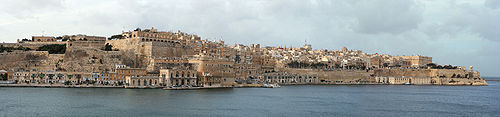 Public housing is located within Valletta's walls. Originally the Order planned to construct for its navy a man-made anchorage in the area known as Manderaggio , but never completed this plan. Instead, the area became a jumble of buildings with dark alleyways. In the 1950s, the city partially demolished the Manderaggio and rebuilt it as a housing estate.
was the first building completed in Valletta, built by the Knights of Malta
between 1573 and 1578. The body of Jean Parisot de la Valette
was entombed there until the construction of St. John's Co-Cathedral. It was commissioned in 1572 by Grand Master Jean de la Cassière
as the conventual church of the Knights of Malta. The Church was designed by the Maltese
military architect
Gerolamo Cassar, architect of the Knights of Malta.
St Francis of Assisi Church
was erected in 1598 but significantly rebuilt through the munificence of Grand Master Gregorio Carafa
in 1681. The Parish Church of St Augustine
is contemporary to the creation of Valletta and its foundation stone was laid in 1571. It was built according to the plan and guidance of Geralomo Cassar. The church was rebuilt in 1765 by Giuseppe Bonnici and was elevated to parish church in 1968.
Maltese Jesuit Fra Andrea opened a conservatory for girls in 1692. Fr Andrea received charitable collections from the Knights of Malta and wealthy Maltese. Christ the Redeemer Church
, commonly known as Sagaramentini Church for the Perpetual Adoration, is part of this building. The Church of the Jesuits
is amongst the oldest churches in the City. St Ignatius of Loyola, founder of the Society of Jesus
in 1534, had considered founding a college in Malta as early as 1553. Through a letter dated 1592-03-28, Pope Clement XIII solicited the setting up of the Jesuit College and its church.
The Collegiate Parish Church of St Paul's Shipwreck
contains the wooden statue of St. Paul the Apostle carved in 1657 by Melchiorre Gafà, brother of Lorenzo Gafà
who renovated the church in 1680. The church contains two first-class relics, the right wrist-bone of St. Paul and part of the column on which he was beheaded in Rome
.
The Franciscan Church of St Mary of Jesus
is popularly known as Ta' Ġieżu in Maltese. It was built in 1571, following the design of Gerolamo Cassar. The facade was replaced in 1680 by Mederico Blondel. Numerous Grandmasters contributed lavishly towards the embellishment of the church, which hosts various works of art. These include the Miraculous Crucifix brought to Malta from Sicily
[ in 1630 and a painting of Our Lady of Sorrows
by Stefano Erardi. The Blessed Nazju Falzon
is entombed within the Franciscan Church.
Numerous other Roman Catholic churches within Valletta include Our Lady of Pilar Church, the Carmelite Church, Our Lady of Liesse Church, St. James Church, St. Barbara Church (offering services in French and German), Our Lady of Damascus (offering services in Greek), St. Lucy Church, St. Roch Church, St. Catherine of Italy Church (offering services in Italian), St. Nicholas Church (known as the 'Church of All Souls'), St. Catherine of Alexandria Church and the Parish Church of Saint Mary of Porto Salvo and Saint Dominic, accredited the first basilica in Malta in the Bolla Pont by Pope Pius V
.
There are several Protestant churches in Valletta, catering to the needs of minority denominations. St Paul's Anglican Cathedral
is a Pro-Cathedral
commissioned by Queen Adelaide
on a visit to Malta, when she discovered there was no permanent place of Anglican worship on the island. St. Andrew's Scots Church
is a joint congregation (a "Local Ecumenical Partnership") of the Church of Scotland
and the Methodist Church of Great Britain
. For Church of Scotland purposes it is part of the Presbytery of Europe
and is the only Reformed Church in Malta
.
The Magisterial Palace of the Grandmaster
currently houses the House of Representatives of Malta
and the office of the President of Malta
. The palace is built around two courtyards, one of which is dominated by a statue of Neptune
. There are two entrances in the front and one entrance from Piazza Regina just west of the National Library
. The Armoury, housing one of the finest collections of Medieval and Renaissance weapons in all of Europe, runs the width of the back of the palace. The palace also features Gobelin tapestries and frescos by Matteo Perez d'Aleccio
(a student of Michelangelo
) amongst other treasures.
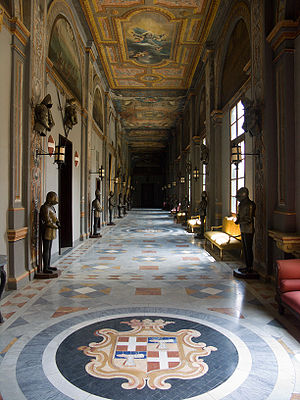 The Auberge de Castille
was the official seat of the knights of the Langue of Castille
, León
and Portugal
– one of the most powerful of the Order, its Head being the Grand Chancellor. The Knights of this Langue were responsible for the defence of part of the fortifications of Valletta known as the St Barbara Bastion. The original Auberge was built by the renowned Maltese
architect Girolamo Cassar in 1574. It was extensively re-modelled and virtually rebuilt in 1741, the present plan of the imposing structure attributed to Andrea Belli.
The Auberge d'Aragon
is a palace also designed by Girolamo Cassar, in 1571 five years after the establishment of the city. The residents of the palace were initially knights of Aragon
, Navarre
, and Catalonia
. The Auberge de Provence is another of Cassar's masterpieces of Renaissance architecture, built between 1571-75. The Auberge was the residence of the Langue de Provence, its Head, the “Gran Commandeur” being the Treasurer of the Order. From 1824 to 1954 the building housed the British officers’ Union Club, and is now the National Museum of Archeology.
Construction for the Auberge d’Italie was begun in 1574. The building was constructed around an arcaded courtyard and received considerable alteration in the 17th century. Situated in the upper part of Merchants street and in front of another notable building, Palazzo Parisio, it has a fine facade designed by Romano Carapecchia. It now houses the Malta Tourism Authority.
Opposite the Jews' Sally Port in Valletta is the Auberge de Bavière built in 1696). Originally intended as a private palace, from 1784 on it was used to accommodate Bavaria
n and English
knights. It now houses Malta's Ministry of Justice and Home Affairs
.
Casa Rocca Grande was built by Fra Pietro La Rocca, Prior of Santo Stefano, towards the end of the 16th century and formed part of a magnificent palace with double entrances in the style of the Grandmaster's Palace. It was later divided into two palaces, Palazzo Marina and Messina Palace
. For a short time the palace used by the Maltese Government
as the Department of Education and later as the Ministry of Education. Messina Palace was leased to the German-Maltese Circle in 1975 until it was purchased by the Circle with the financial assistance of the Government of the Federal Republic of Germany in 1989.
 Casa Rocca Piccola
is one of the last remaining unconverted palaces currently inhabited by the nobility, in this case the de Piro family. The palace is open to the public; it is the only occupied aristocratic residence in Valletta open to the public.
Opposite the ruins of the Royal Opera House
stands Palazzo Ferreria. Its façade resembles a Venetian palace
. Popularly known as Palazzo Francia, surname of the family that built and owned it, it originally housed the Knights' foundry
- hence the name Ferreria. It today houses a number of offices and retail outlets.
In the early 18th century Bishop Sceberras built the Palazzo Parisio, Valletta on the site of two former houses in Merchants' Street, then known as Strada San Giacomo. Palazzo Parisio consists of three elements, each two storeys high, enclosing a central courtyard, all in a Neo-Classical style
.
Napoleon Bonaparte stayed there briefly after taking Valletta on June 11, 1798. He made it his headquarters for five days during his brief plundering stay en route to the Egyptian campaign. Left dilapidated by the late 19th century, it was sold to the Government and fully restored and refurbished. Palazzo Parisio formally opened its doors to the public under the British on 8 May 1886, as Malta’s General Post Office
. Today it holds the Ministry of Commonwealth and Foreign Affairs
. This palace is not to be confused with Palazzo Parisio in Naxxar, a private property.
Palazzo Castellania is also located along Merchants' Street and was begun to the designs of Maltese architect Francesco Zerafa in 1748. It replaced an earlier building and housed the Civil and Criminal Courts. Zerafa died in 1758 and Giuseppe Bonici was called in to complete the building, which he did by 1760. The building's centrepiece shows stone figures of Justice and Truth. It is now the Ministry of Social Policy
.
The National Museum of Fine Arts is housed within an elegant palace in South Street. It was known as Admiralty House when it became the official residence of the Commander-in-Chief
of the British Mediterranean fleet. The building dates back to the late 1570s. The palace was the private residence of a succession of knights of the Order of St John. It was opened as a museum in 1974, as a repository of Malta's permanent national art collection.
and J. M. W. Turner
. Prior to its conversion into a museum, it was a residence. The Order acquired the building in the mid-18th century and transformed it into a Rococo
palace. After the departure of the Order from Malta in 1798, the State took over the administration of the building and its contents.
Paintings and sculptures were brought together in the early years of the 20th century and formed the core of the Fine Arts Collection within the National Museum by 1922. Subsequently, individuals and organisations made important donations and bequests to the collection, in addition to acquisitions made throughout the years. The highlight of the 19th century collection is a watercolour by J. M. W. Turner
of the Grand Harbour
. A number of Old Master works, including as drawings by Pietro Perugino
(1450–1523), Vittore Carpaccio
(1465–1526) and Mattia Preti
(1613–1699), may be viewed under controlled lighting.
The Grandmaster's Palace Armoury Museum
exhibits a collection of full suits of armour, arms and guns dating back to the 15th century. During the 1850s, the British Government intended to remove the collection to London. Although they removed some items, local opposition blocked the complete looting of the collection. Instead, in 1860 the Armory was officially opened as Malta’s first public museum. The collection of Renaissance
weapons and armour is unique and includes suits of armor that belonged to grandmasters Fra Martin Garzes and Fra Alof de Wignacourt
, as well as suits of parade armour that expert armourers had created. The museum displays Italian, German, French and Spanish arms and a number of ornate bronze cannon
s.
The National War Museum is located within Fort Saint Elmo
, a focal point during the Great Siege
that rose to prominence once again during World War II
. The Museums Department and the National War Museum Association established the museum, which opened to the public in 1975; the museum reopened in 2008 after having been closed for more than a year for refurbishment. The museum building was originally a powder magazine; during the Second World War anti-aircraft gun crews trained there. The Museum highlights Malta’s military role in the post-1800 period under British rule, and memorializes especially the suffering and the heroism that characterised Malta during the Second World War.
The museum offers a walking tour through history, from World War One to the Inter-Wars period, 1939, 1940, 1941, 1942 and so on. It includes a Memorial area, with photographic panels that depict the conditions that prevailed in Malta during the War years 1940-1943. These photographs show the hardships the civilian population endured, the extent of war damage, the unhealthy living conditions within underground shelters and above all, the people who withstood the siege.
The museum's main hall has several World War II relics: an Italian E-Boat
, a Bofors anti-aircraft gun, the Willys Jeep ‘Husky’, and the Gloster Gladiator
‘Faith’. Also on display are the George Cross
, awarded to the people of Malta
by King George VI
, the Book of Remembrance of civilians and servicemen killed during the years 1940-43 and the illuminated Scroll that President Franklin D. Roosevelt
presented to the “People and Defenders of Malta” in 1943. Also on display are awards and decorations to individual Maltese servicemen and civilians during the War for their acts of bravery and sacrifice above and beyond the call of duty.
The Auberge De Provence
houses the National Museum of Archaeology. This palace once served knights from the langue of Provence. The Museum features artifacts from Malta's Neolithic
culture, displaying objects collected from the first free-standing structures built on Earth
, 5,500 years ago.
The National Museum of Archaeology displays an exceptional array of artifacts from Malta’s prehistoric periods starting with the first arrival of man in the Ghar Dalam
phase (5200 BC) and running up to the Tarxien
phase (2500 BC). The collection includes obsidian cores and the Red Skorba figurines, which are predecessors of temple period objects and statuary, as well as pottery, worked flint, beads and other ornaments.
The museum's main hall is devoted to temple carvings, in particular the giant statue and altar blocks from the Neolithic
Tarxien Temples
. The collection continues with representations of animals, temple models and human figures. There are statuettes of the "Sleeping Lady" found in the Hypogeum
, and the "Venus" of Hagar Qim
. There is also a large top floor salon with painted walls and a wooden beamed ceiling, currently displaying plans by Renzo Piano
for the renovation of the entrance to Valletta. The building was inaugurated as the National Museum in 1958.
The nearby Manoel Theatre Museum
presents the history of Valletta's first playhouse, one of the oldest in Europe
. It traces the history of theatre on the Maltese Islands through displays of memorabilia assembled from a wide range of sources, both public and private, including donations from private collectors. Works in the Maltese language
are also displayed.
The Domus Pauli Museum is located within an extension of the Chapter Hall of the Collegiate Church of St. Paul’s Shipwreck. The museum, in St Paul’s Street, exhibits antique and precious items from St Paul's Shipwreck Church, including relic
s of St Paul.
St John's Co-Cathedral Museum
adjoins the Co-Cathedral and contains Medieval and Renaissance art objects, together with ecclesiastical artifacts. Amongst the contents of the museum are the tapestries of Grandmaster Fra Ramon Perellos de Roccaful
, portraits of Grandmasters Fra Jean de la Cassiere
, Fra Nicolas Cotoner
and Fra Manuel Pinto da Fonseca and paintings that were once kept in the Co-Cathedral's many side chapels such as "St George killing the Dragon" by Francesco Potenzano
.
The museum displays a number of bronze and plaster sculptures by the Maltese artist Antonio Sciortino
(1879–1947) and paintings by Edward Caruana Dingli (1876–1950). There is also a display of Maltese silverware from the national collection, including liturgical artifacts from churches that formerly belonged to the Order, as well as a collection of silver snuffboxes amongst other silverware. There are various other displays and exhibits.
Valletta's Toy Museum contains an extensive collection of Corgi, Dinky and Matchbox cars. Its three floors house other Maltese and international toys, from the 1950s onward.
is Europe's third-oldest working theatre. Located on Old Theatre Street, it is now Malta
's National Theatre and home to the National Orchestra of Malta. The Manoel is a small, six-hundred and twenty-three seat venue with a lavish, oval-shaped auditorium
, three tiers of boxes constructed entirely of wood and decorated with 22-carat gold leaf and a pale blue, trompe-l'oeil ceiling that resembles a rounded cupola.
Countless celebrities have graced its stage, including Boris Christoff
, Sir Yehudi Menuhin
, John Neville, Magda Olivero
, Michael Ponti
, Mstislav Rostropovich
, Dame Margaret Rutherford
, Dame Kiri Te Kanawa
and Sir Donald Wolfit
. Visiting companies have included Nottingham Playhouse
, the Comédie-Française
and the Staatsoper Unter den Linden
.
The Royal Opera House
was an opera house
and performing arts venue designed by English
architect
Edward Middleton Barry
, erected in 1866. The theatre was bombed to the ground during World War II
in 1942. The space is still used for present day performances and plans to re-build or somehow renovate the area are at a stalemate. The Maltese government has commissioned architect Renzo Piano
to build a new Royal Opera House. This is part of a project to renovate the entrance to Valletta. However, Piano's plans remain the subject of fierce controversy.
St James Cavalier also serves as a theatrical space and is a popular venue for local performances. The Old University Theatre is sometimes used by Maltese troupes or drama institutions.
offer a panoramic view of the Grand Harbour
. They were first constructed in 1661 for the private use of knights from the Italian langue. It was not before 1824 that the gardens were opened to the public. The garden suffered extensive damage throughout the Second World War.
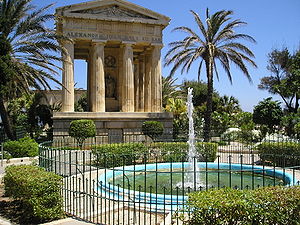 The garden paths are lined with busts, statues and plaques illustrating various personalities and significant events from Maltese history. Of special interest are the bronze group by Maltese sculptor Antonio Sciortino
, entitled Les Gavroches (the Street Urchins). Its depiction of three running children reflects those extreme hardships faced by the people of Malta at the turn of the 20th century.
Also overlooking the Grand Harbour and Breakwater, the Lower Barrakka Gardens
offer views of Fort Ricasoli
, Bighi Palace, Fort St Angelo
and the creeks of Vittoriosa and Kalkara
. The gardens contain two major monuments, one dedicated to Sir Alexander Ball
and another in remembrance of the Great Siege of Malta
. Sir Alexander Ball led Maltese insurgents against the French in the 1798 uprising, and went on to become the first British Governor of Malta.
Located on top of the bastions on the west side of City Gate
, Hastings Gardens
affords clear views of Sliema
, Manoel Island and Marsamxett Harbour
. The garden houses a monument built by the Hastings family dedicated to Francis, Marquis of Hastings
, also Governor of Malta. He died in 1827 en route to Naples and his body was returned for burial in this garden.
stands on the seaward shore of the Sciberras Peninsula, dividing Marsamxett Harbour from the Grand Harbour. Since the mid-20th century, Fort Saint Elmo has housed Malta's police academy. The War Museum also occupies part of the Fort. It commands the entrances to both harbours and prior to the arrival of the Knights of Malta
in 1530, a watchtower existed on this point. Reinforcement of this strategic
site commenced in 1533.
By the time of the Ottoman
Siege of Malta
in 1565, this fortification had been reinforced and extended into a modest star fort
. Fort Saint Elmo was the scene of some of the most intense fighting of the siege, and withstood massive bombardment
from Turkish
cannon
deployed from batteries on the north arm of Marsamextt Harbour, present site of Fort Tigne
.
During the bombardment of the fort, a cannon shot from Fort St Angelo
across the Grand Harbour struck the ground close to the Turkish battery. Debris from the impact mortally injured the corsair
and Admiral Turgut Reis
, an Ottoman hero. Though the fort was reduced to rubble during the bombardments, when the Ottomans abandoned the siege the fort was rebuilt and reinforced, becoming partially incorporated into the seaward bastion
of the fortress city of Valletta.
Faced with the continuing threat of Turkish attack and the weaknesses caused by the Great Siege of Malta (1565), the Knights of Malta were made to decide whether to abandon the island or attempt its restoration. Grandmaster Jean Parisot de la Valette preferred to stay and ask for aid, which promptly arrived from several quarters, most notably Pope Pius V
, who sent not only financial assistance but also the famed military engineer Francesco Laparelli de Cortona. It is Laparelli, succeeded by Maltese architect Gerolamo Cassar, who masterminded the plan of Valletta as we see it today.
Saint James Cavalier
was designed by Laparelli and Cassar, as a raised platform on which guns were placed to defend the city against attacks from the land (Floriana
) side. As well as prohibiting entry, St James could threaten those who had already breached the city's defences. Under the British, St. James was converted into an officers' mess. During the latter part of British rule, St. James was turned into a food store, known as the NAAFI.
St James is now a "Centre for Creativity", hosting various theatrical and musical performances, also providing installation and gallery space. Its interior was extensively renovated by Maltese architect Richard England
alongside Michael Ellul. The design received a mixed reception from the Maltese public. The national heritage organization Fondazzjoni Wirt Artna protested against the removal of a rare World War II gas shelter and other historical remains from the British period. While the restoration of St James Cavalier was intended as the first phase in a larger project aiming to radically alter Valletta, it has so far been halted at planning stages and is the subject of much local controversy.
ns erected a tower on the site now occupied by the city, a tower that the Greeks
and Romans
also used. Today, various sentry posts and lookout towers still exist across the city bastions. The Knights built the present watchtowers, which every succeeding conquering power since has used. The watchtowers are placed at strategic locations throughout the city, most prominently towards its rear and main entrance.
These watchtowers vary in design but are generally rounded and bear armorial or symbolic carvings on their exterior. One common motif, especially in restored examples, is the eye
. One can also find this symbol on the sides of dgħajes and luzzijiet
, traditional Maltese boats.
The present City Gate
(Bieb il-Belt) is the fourth to have stood at the entrance to Valletta. The military engineer Francesco Laparelli de Carotona designed the original gate, known as Porta San Giorgio, which was erected between April 1566 and 1569. During the rule of Grand Master Antoine de Paule, the Maltese architect Tommaso Dingli designed a more ornate gate that replaced the Porta in 1632. In 1853, at the height of British rule, a certain Col. Thompson of the Royal Engineers designed and erected a new gate consisting of two central arches with two smaller ones. This gate, which survived for slightly more than a century, was known as Porta Reale, Putirjal in Maltese and Kingsgate in English. The Independence celebrations in 1964 inaugurated the present gate, whose Italian modernist design remains the source of much controversy. A new city gate is now part of the renovation schemes in Valletta. The new gate is designed by Italian architect Renzo Piano and construction starts 2010 finishing in 2013.
The Triton Fountain
is situated in the centre of Valletta's main bus terminus, surrounded by shops and cafes. The Maltese sculptor Vincent Apap designed the fountain's statues in 1959, modeling them after Classical and Baroque examples.
The Knights constructed the Castellania
, which faces the harbour, as the city's law courts. The architect Francesco Zerafa designed the building and construction began in 1760 during the reign of Grand Master Manuel Pinto de Fonseca
, who died two years before the building's completion. The facade includes florid stone-work and de Fonseca's crescent emblem. On the sides of the first floor balcony there stand two statues that the Sicilian
sculptor Maestro Gian created to represent Justice and Truth. A pillory stone resides in the apex of the building's corner, for those convicted and sentenced to death after the Priest's Revolt of 1775. Above the stone is a hook, used to lift the church bells, or to hang prisoners sentenced to death. It is at the Castellania that physician and archaeologist Sir Themistocles Zammit discovered the Mediterranean strain of brucellosis
in 1905.
The Valletta Waterfront
, in nearby Floriana, is composed of nineteen 250 year old warehouses built by Grand Master Pinto, stretching along the water's edge and the Quay Wall. Also part of the Waterfront are the Forni Stores, built in 1626 at the order of Grand Master de Vilhena. These restored buildings now provide retail, dining and leisure outlets.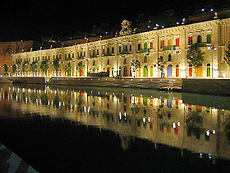 One of the most imposing buildings in Valletta is the former "Sacra Imfermeria" of the Order of St John of Jerusalem, now popularly known as the Mediterranean Conference Centre. It is located adjacent to Fort St Elmo, overlooking the Grand Harbour. Work on this vast edifice started during late 1574 during the reign of Grand Master Jean de la Cassière
(1572–82) and was extended several times over the years. The “Old Ward” which is the main attraction was extended into the “Great Ward” during the years 1660 to 1666 under the rule of the Cotoners. This hall measuring 155 metres in length, was at that time one of the largest in Europe and was described as “one of the grandest interiors in the world”. The Sacra Infermeria was considered to be one of the best hospitals in Europe and could accommodate 914 patients.
In 1676 Grand Master Nicholas Cotoner founded the School of Anatomy and Surgery at the Infirmary, considered to be amongst the oldest hospital
s in Europe. This school was to be the forerunner of the Medical School of the University of Malta. When the Order of St John of Jerusalem left the Maltese Islands, the French took over the Infirmary in June 1798, just after the occupation of the Island by General Napoleon Bonaparte. The Infirmary now became known as "Grand Hopital". From 1800 till 1918 during the British Rule, the Centre served as a Station Hospital. Situated very near to the Grand Harbour, the hospital was within easy reach of the sick and wounded servicemen as hospital ships brought them in. Between 1950-1951 it was turned into a Children’s Theatre and later served as an Examinations Hall. The building was finally transformed into the present Mediterranean Conference Centre in 1978. The Centre was inaugurated on the 11 February 1979 and was awarded the coveted Europa Nostra Diploma of Merit for the "superb restoration of the Sacra Infermeria and its adaptation for use as a conference centre."
The National Library
began in 1555. It is currently the legal deposit and copyright for Malta. Its collection spans the personal libraries of the Knights of Malta (also the archives and treasury manuscripts of that order), including archives from the medieval [Università dei Giurati] of Mdina
and Valletta. The idea of a public Library in Malta began with the issue of a decree by Fra' Claude de la Sengle
, Grand Master of the Knights, whereby all books in the legacy of deceased knights were to pass to the Common Treasury of the Order. It was not until 1776, however, that the formal foundation of a Bibliotheca Publica was decreed at the Chapter General of the Order convened by Grand Master de Rohan
. The main collections were those belonging to Fra' Louis Guérin de Tencin.
In 1925 the Library acquired its "legal deposit" status by an Act of Parliament and 11 years later was granted the prefix "Royal" by King George V of the United Kingdom. The following year the Royal Malta Library took over the custody of the Archives of the Order of St John which were transferred from the Public Registry premises. With the setting up of the new Public Library in Floriana
in 1976, the Library in Valletta was officially designated as the "National Library of Malta" and became solely a research and reference Library. In its capacity as National Library the mission of the Bibliotheca is to acquire, catalogue and preserve manuscripts and all printed books, as well as periodicals and journals issued in Malta.
The City's dual band clubs are the "King's Own Band Club" and "La Valette National Philarmonic Society" .
, held in February leading up to Lent
. Carnival in Gozo is celebrated in Victoria
and parishes in both islands hold their own festivities.
 Valletta is served by Malta International Airport
, which is located 8 kilometres (5 mi) from the city. Malta's public transport system, which uses buses, operates mostly on routes to or from Valletta, with their central terminus just outside the city's entrance
. Traffic within the city itself is restricted, with some principal roads being completely pedestrian areas.
In 2006, a park and ride
system was implemented in order to increase the availability of parking spaces in the vicinity of the city. People can leave their personal vehicles in a nearby Floriana
parking lot and transfer to a van
for the rest of the trip, which takes a mere few minutes.
In 2007 a congestion pricing
scheme was implemented, the Controlled Vehicular Access system, in order to reduce long-term parking stays and traffic while promoting business in the city. An ANPR-based automated system takes photos of vehicles as they enter and exit the charging zone and vehicle owners are billed according to the duration of their stay. Various exemptions and flexible billing rules make the system the next evolutionary step of systems like the London congestion charge
programme. Main differences from the London system include ex post invoicing (with financial incentives/penalties for early/late payment), prepayments not day-specific, hourly instead of daily rates, a maximum daily charge (8 hours), free dashes (free if duration under 30 minutes), defined free access periods for delivery and service vehicles.
Valletta is served by a fleet of electric taxis which transport riders from 10 points in Valletta to any destination within the city.
Malta
Malta , officially known as the Republic of Malta , is a Southern European country consisting of an archipelago situated in the centre of the Mediterranean, south of Sicily, east of Tunisia and north of Libya, with Gibraltar to the west and Alexandria to the east.Malta covers just over in...
, colloquially known as Il-Belt (The City) in Maltese
Maltese language
Maltese is the national language of Malta, and a co-official language of the country alongside English,while also serving as an official language of the European Union, the only Semitic language so distinguished. Maltese is descended from Siculo-Arabic...
. It is located in the central-eastern portion of the island of Malta
Malta Island
Malta Island is the largest of the three major islands that constitute the Maltese archipelago and Republic of Malta. Malta is in the middle of the Mediterranean Sea directly south of Italy and north of Libya. The area is 246 km² . The capital is Valletta, largest city is Qormi and the largest...
, and the historical city has a population of 6,098. The name "Valletta" is traditionally reserved for the historic walled citadel that serves as Malta's principal administrative district. However, Valletta, like many historical city centres, forms part of a larger continuous urban agglomeration; this is often referred to as "Greater Valletta."
Valletta contains buildings from the 16th century onwards, built during the rule of the Order of St. John of Jerusalem, also known as Knights Hospitaller
Knights Hospitaller
The Sovereign Military Hospitaller Order of Saint John of Jerusalem of Rhodes and of Malta , also known as the Sovereign Military Order of Malta , Order of Malta or Knights of Malta, is a Roman Catholic lay religious order, traditionally of military, chivalrous, noble nature. It is the world's...
. The city is essentially Baroque
Baroque architecture
Baroque architecture is a term used to describe the building style of the Baroque era, begun in late sixteenth century Italy, that took the Roman vocabulary of Renaissance architecture and used it in a new rhetorical and theatrical fashion, often to express the triumph of the Catholic Church and...
in character, with elements of Mannerist, Neo-Classical
Neoclassical architecture
Neoclassical architecture was an architectural style produced by the neoclassical movement that began in the mid-18th century, manifested both in its details as a reaction against the Rococo style of naturalistic ornament, and in its architectural formulas as an outgrowth of some classicizing...
and Modern architecture
Modern architecture
Modern architecture is generally characterized by simplification of form and creation of ornament from the structure and theme of the building. It is a term applied to an overarching movement, with its exact definition and scope varying widely...
in selected areas, though World War II
World War II
World War II, or the Second World War , was a global conflict lasting from 1939 to 1945, involving most of the world's nations—including all of the great powers—eventually forming two opposing military alliances: the Allies and the Axis...
left major scars on the city. The City of Valletta was officially recognised as a World Heritage Site
World Heritage Site
A UNESCO World Heritage Site is a place that is listed by the UNESCO as of special cultural or physical significance...
by UNESCO
UNESCO
The United Nations Educational, Scientific and Cultural Organization is a specialized agency of the United Nations...
in 1980.
The city is named for Jean Parisot de la Valette
Jean Parisot de la Valette
Fra' Jean Parisot de Valette was a French nobleman and 49th Grand Master of the Order of Malta, from 1557 to 1568. He succeeded La Vallette as grandmaster and continued the construction of Valletta...
, who succeeded in defending the island from an Ottoman invasion in 1565
Siege of Malta (1565)
The Siege of Malta took place in 1565 when the Ottoman Empire invaded the island, then held by the Knights Hospitaller .The Knights, together with between 4-5,000 Maltese men,...
. The official name given by the Order of Saint John was Humilissima Civitas Valletta — The Most Humble
Humility
Humility is the quality of being modest, and respectful. Humility, in various interpretations, is widely seen as a virtue in many religious and philosophical traditions, being connected with notions of transcendent unity with the universe or the divine, and of egolessness.-Term:The term "humility"...
City of Valletta, or Città Umilissima in Italian. The bastion
Bastion
A bastion, or a bulwark, is a structure projecting outward from the main enclosure of a fortification, situated in both corners of a straight wall , facilitating active defence against assaulting troops...
s, curtains
Castle Walls
"Castle Walls" is a song by American rapper T.I., from his seventh studio album No Mercy. The song features Pop/R&B singer Christina Aguilera, and was produced by Alex da Kid....
and ravelin
Ravelin
A ravelin is a triangular fortification or detached outwork, located in front of the innerworks of a fortress...
s along with the beauty of its Baroque
Baroque
The Baroque is a period and the style that used exaggerated motion and clear, easily interpreted detail to produce drama, tension, exuberance, and grandeur in sculpture, painting, literature, dance, and music...
palaces, gardens and churches, led the ruling houses of Europe to give the city its nickname Superbissima — 'Most Proud
Pride
Pride is an inwardly directed emotion that carries two common meanings. With a negative connotation, pride refers to an inflated sense of one's personal status or accomplishments, often used synonymously with hubris...
'.
Government
Alexiei Dingli has been the Mayor of Valletta since 2008. He was elected on the Nationalist Party TicketNationalist Party (Malta)
The Nationalist Party is one of two major contemporary political parties in Malta, along with the Labour Party. It was founded by Fortunato Mizzi in 1880 as the Anti-Reform Party, opposing taxation decreed by the British colonial authorities and measures to Anglicise the educational and the...
(PN), an affiliate of the European People's Party
European People's Party
The European People's Party is a pro-European centre-right European political party. The EPP was founded in 1976 by Christian democratic parties, but later it increased its membership to include conservative parties and parties of other centre-right perspectives.The EPP is the most influential of...
, which holds the majority of the Council.
History
The city is on the island of Malta so it shares its early history with the island. Immediately after the end of the Siege of MaltaSiege of Malta (1565)
The Siege of Malta took place in 1565 when the Ottoman Empire invaded the island, then held by the Knights Hospitaller .The Knights, together with between 4-5,000 Maltese men,...
in 1565, the Order decided to found a new city on the Xiberras peninsula to fortify the Order's position in Malta and bind the Knights to the island. The foundation stone of Valletta was laid by the Grandmaster of the Order, Jean Parisot de la Valette
Jean Parisot de la Valette
Fra' Jean Parisot de Valette was a French nobleman and 49th Grand Master of the Order of Malta, from 1557 to 1568. He succeeded La Vallette as grandmaster and continued the construction of Valletta...
on 28 March 1566. La Valette placed the first stone
Cornerstone
The cornerstone concept is derived from the first stone set in the construction of a masonry foundation, important since all other stones will be set in reference to this stone, thus determining the position of the entire structure.Over time a cornerstone became a ceremonial masonry stone, or...
in Our Lady of Victories Church
Our Lady of Victories Church
Our Lady of Victories Church was the first building completed in Valletta. The body of Jean Parisot de la Valette was entombed in the church until St. John's Co-Cathedral was built.Coordinates:...
.
In his book Dell’Istoria said "Iegi zimen en fel wardia col sceber raba iesue uquie" (Which in modern Maltese reads, "Jiġi żmien li fil-Wardija [l-Għolja Sciberras] kull xiber raba’ jiswa uqija," and in English, "There will come a time when every piece of land on Sciberras Hill will be worth its weight in gold").
Grand Master La Valette died on 21 August 1568 at age 74 and never saw the completion of his city. Originally interred in the church of Our Lady of the Victories, his remains now rest in St. John's Co-Cathedral among the tombs of other Grand Masters of the Knights of Malta
Knights Hospitaller
The Sovereign Military Hospitaller Order of Saint John of Jerusalem of Rhodes and of Malta , also known as the Sovereign Military Order of Malta , Order of Malta or Knights of Malta, is a Roman Catholic lay religious order, traditionally of military, chivalrous, noble nature. It is the world's...
. Francesco Laparelli was the city's principal designer and his plan departed from medieval Maltese architecture, which exhibited irregular winding streets and alleys. He designed the new city on a rectangular grid, and without any collacchio (an area restricted for important buildings). The streets were designed to be wide and straight, beginning centrally from the City Gate
City Gate (Malta)
City Gate - also known as Putirjal in Maltese - is the main entrance to Malta's capital city, Valletta, a UNESCO World Heritage Site. It is most commonly called Bieb il-Belt, "Door to the city"....
and ending at Fort Saint Elmo
Fort Saint Elmo
Fort Saint Elmo is a fortification in Valletta, Malta. It stands on the seaward shore of the Sciberras Peninsula that divides Marsamxett Harbour from Grand Harbour, and commands the entrances to both harbours.-History:...
overlooking the Mediterranean; certain bastions were built 153 feet (46.6 m) tall. The Maltese
Maltese people
The Maltese are an ethnic group indigenous to the Southern European nation of Malta, and identified with the Maltese language. Malta is an island in the middle of the Mediterranean Sea...
architect Gerolamo Cassar was responsible for a number of the buildings.
After the Knights' departure and the brief French occupation, building projects in Valletta resumed under British rule. These projects included widening gates, demolishing and rebuilding structures, widening newer houses over the years, and installing civic projects.
Nazi
Nazism
Nazism, the common short form name of National Socialism was the ideology and practice of the Nazi Party and of Nazi Germany...
and Fascist air raids throughout World War II
World War II
World War II, or the Second World War , was a global conflict lasting from 1939 to 1945, involving most of the world's nations—including all of the great powers—eventually forming two opposing military alliances: the Allies and the Axis...
caused much destruction. The Royal Opera House
Royal Opera House, Valletta
The Valletta Royal Opera House was an opera house and performing arts venue in Valletta, Malta. It was designed by English architect Edward Middleton Barry and was erected in 1866. In 1873 its interior was extensively damaged by fire but was eventually restored by 1877...
, constructed at the city entrance in the 19th century, was one of the buildings lost to the raids.
In 1980, the 24th Chess Olympiad
Chess Olympiad
The Chess Olympiad is a biennial chess tournament in which teams from all over the world compete against each other. The event is organised by FIDE, which selects the host nation.-Birth of the Olympiad:The first Olympiad was unofficial...
took place in Valletta.
Geography
The Valletta peninsulaPeninsula
A peninsula is a piece of land that is bordered by water on three sides but connected to mainland. In many Germanic and Celtic languages and also in Baltic, Slavic and Hungarian, peninsulas are called "half-islands"....
has two natural harbours, Marsamxett
Marsamxett Harbour
Marsamxett Harbour, also referred as Marsamuscetto in many ancient documents, is the northern of Valletta's two natural harbours on the island of Malta, separated from the southern one by the Valletta peninsula. To the north it is bounded by Gżira and Sliema as far as Dragut Point and extends...
and the Grand Harbour
Grand Harbour
Grand Harbour is a natural harbour on the island of Malta. It has been used as a harbour since at least Phoenician times...
. The Grand Harbour is Malta's major port
Port
A port is a location on a coast or shore containing one or more harbors where ships can dock and transfer people or cargo to or from land....
, with unloading quays at Marsa. A cruise-liner terminal is located along the old seawall of the Valletta Waterfront
Valletta Waterfront
The Valletta Waterfront, in Floriana, Malta, is baroque wharf built by Manuel Pinto de Fonseca in the 18th century. It has been thoroughly renovated by a private consortium who run the Waterfront and offer management overseeing for Malta's cruise liner business...
that Grandmaster Manuel Pinto de Fonseca
Manuel Pinto de Fonseca
Dom Fra' Manuel Pinto da Fonseca was a Knight of the Langue of Portugal. He was the 68th Prince and Grand Master of the Order of Malta from 1741 to 1773. He was a Portuguese Nobleman, the son of Miguel Álvaro Pinto da Fonseca, Alcaide-Mór de Ranhados, and wife Ana Pinto Teixeira.He was elected on...
built.
Climate
Valletta features a Mediterranean climateMediterranean climate
A Mediterranean climate is the climate typical of most of the lands in the Mediterranean Basin, and is a particular variety of subtropical climate...
with very warm, dry summers and mild, wet winters. Like other cities with this climate, Valletta experiences a lack of precipitation during the summer months and heavier precipitation during the winter months. During the winter months, temperatures are moderated somewhat by the city’s proximity to the sea. As a result Valletta enjoys mild, but not chilly, winters. Average high temperatures range from around 15 °C (59 °F) in January to about 30 °C (86 °F) in August, while average low temperatures range from around 10 °C (50 °F) in January to 22 °C (72 °F) in August.
Cityscape
Valletta's streets and piazzas contain architecture ranging from the early 16th century to Modernist in design. The city serves as the island's principal cultural centre and its unique collection of churches, palaces and museums attract visitors from around the world.When Benjamin Disraeli, future British Prime Minister, visited the city in 1830, he described it as "a city of palaces built by gentlemen for gentlemen," and remarked that "Valletta equals in its noble architecture, if it does not excel, any capital in Europe
Europe
Europe is, by convention, one of the world's seven continents. Comprising the westernmost peninsula of Eurasia, Europe is generally 'divided' from Asia to its east by the watershed divides of the Ural and Caucasus Mountains, the Ural River, the Caspian and Black Seas, and the waterways connecting...
," and in other letters called it "comparable to Venice
Venice
Venice is a city in northern Italy which is renowned for the beauty of its setting, its architecture and its artworks. It is the capital of the Veneto region...
and Cádiz
Cádiz
Cadiz is a city and port in southwestern Spain. It is the capital of the homonymous province, one of eight which make up the autonomous community of Andalusia....
" and "full of palaces worthy of Palladio."
Buildings of historic importance include St John's Co-Cathedral
St John's Co-Cathedral
St. Johns Co-Cathedral , located in Valletta, Malta, was built by the Knights of Malta between 1573 and 1578, having been commissioned in 1572 by Grand Master Jean de la Cassière as the conventual church of the Order of the Knights Hospitaller of St John, known as the Knights of Malta...
, formerly the Conventual Church of the Knights of Malta
Knights Hospitaller
The Sovereign Military Hospitaller Order of Saint John of Jerusalem of Rhodes and of Malta , also known as the Sovereign Military Order of Malta , Order of Malta or Knights of Malta, is a Roman Catholic lay religious order, traditionally of military, chivalrous, noble nature. It is the world's...
. It has the only signed work and largest painting by Michelangelo Merisi da Caravaggio
Caravaggio
Michelangelo Merisi da Caravaggio was an Italian artist active in Rome, Naples, Malta, and Sicily between 1593 and 1610. His paintings, which combine a realistic observation of the human state, both physical and emotional, with a dramatic use of lighting, had a formative influence on the Baroque...
. The Auberge de Castille et Leon, formerly the official seat of the Knights of Malta of the Langue of Castille, Léon and Portugal, is now the office of the Prime Minister of Malta
Prime Minister of Malta
The Prime Minister of Malta is the Head of Government of Malta.-Establishment of the office and developments:The office of "Head of Ministry" was created as soon as Malta was granted autonomous government in 1921. The 1921 constitution was suspended twice before being revoked...
. The Magisterial Palace, built between 1571 and 1574 and formerly the seat of the Grand Master of the Knights of Malta, now houses the Maltese Parliament and offices of the President of Malta
President of Malta
The President of Malta is the constitutional head of state of Malta.The President is appointed by a resolution of the House of Representatives of Malta for a five year term, taking an oath to "preserve, protect and defend" the Constitution....
.
The National Museum of Fine Arts
National Museum of Fine Arts (Malta)
The National Museum of Fine Arts is Malta’s major museum for the visual arts. It houses a collection of works by Maltese and foreign artists mainly representing the major European artistic styles....
is a Rococo palace dating back to the late 1570s, which served as the official residence of the Commander-in-Chief of the Mediterranean Fleet during the British era from 1789 onwards. The Manoel Theatre
Manoel Theatre
The Manoel Theatre is reputed to be Europe's third-oldest working theatre, and the oldest working theatre in the Commonwealth of Nations...
was constructed in just ten months in 1731, by order of Grand Master Antonio Manoel de Vilhena, and is one of the oldest working theatres in Europe. The Mediterranean Conference Centre was formerly the Sacra Infermeria. Built in 1574, it was one of Europe's most renowned hospitals during the Renaissance. The fortification
Fortification
Fortifications are military constructions and buildings designed for defence in warfare and military bases. Humans have constructed defensive works for many thousands of years, in a variety of increasingly complex designs...
s of the port, built by the Knights as a magnificent series of bastions, demi-bastions, ravelins and curtains, approximately 100 metres (328.1 ft) high, all contribute to the unique architectural quality of the city.
Churches
Our Lady of Victories ChurchOur Lady of Victories Church
Our Lady of Victories Church was the first building completed in Valletta. The body of Jean Parisot de la Valette was entombed in the church until St. John's Co-Cathedral was built.Coordinates:...
was the first building completed in Valletta, built by the Knights of Malta
Knights Hospitaller
The Sovereign Military Hospitaller Order of Saint John of Jerusalem of Rhodes and of Malta , also known as the Sovereign Military Order of Malta , Order of Malta or Knights of Malta, is a Roman Catholic lay religious order, traditionally of military, chivalrous, noble nature. It is the world's...
between 1573 and 1578. The body of Jean Parisot de la Valette
Jean Parisot de la Valette
Fra' Jean Parisot de Valette was a French nobleman and 49th Grand Master of the Order of Malta, from 1557 to 1568. He succeeded La Vallette as grandmaster and continued the construction of Valletta...
was entombed there until the construction of St. John's Co-Cathedral. It was commissioned in 1572 by Grand Master Jean de la Cassière
Jean de la Cassière
Fra' Jean l'Evesque de la Cassière was the 51st Grand Master of the Order of Malta, from 1572 to 1581. He commissioned the building of the Conventual Church of the Order in Valletta, Malta, and is buried in the Crypt of St...
as the conventual church of the Knights of Malta. The Church was designed by the Maltese
Maltese people
The Maltese are an ethnic group indigenous to the Southern European nation of Malta, and identified with the Maltese language. Malta is an island in the middle of the Mediterranean Sea...
military architect
Architect
An architect is a person trained in the planning, design and oversight of the construction of buildings. To practice architecture means to offer or render services in connection with the design and construction of a building, or group of buildings and the space within the site surrounding the...
Gerolamo Cassar, architect of the Knights of Malta.
St Francis of Assisi Church
St Francis of Assisi Church
St Francis of Assisi Church, dedicated to St Francis of Assisi , in Valletta , was built in 1598 and was completed by 1607...
was erected in 1598 but significantly rebuilt through the munificence of Grand Master Gregorio Carafa
Gregorio Carafa
Fra' Gregorio Carafa was the 62th Prince and Grand Master of the Order of Malta from 1680 to 1690. Italian by birth, he was elected Grand Master after the death of Nicolas Cotoner. He is buried in the Italian Chapel in the Co-Cathedral of St. John, Valletta, Malta.-External links:*...
in 1681. The Parish Church of St Augustine
Parish Church of St Augustine
St Augustine Church is one of the churches built during the creation of the new city of Valletta, Malta. The foundation stone was laid in 1571 according to the plan and guidance of Geralomo Cassar, architect of the Knights of St John. The church was rebuilt in 1765 according to a plan of Giuseppe...
is contemporary to the creation of Valletta and its foundation stone was laid in 1571. It was built according to the plan and guidance of Geralomo Cassar. The church was rebuilt in 1765 by Giuseppe Bonnici and was elevated to parish church in 1968.
Maltese Jesuit Fra Andrea opened a conservatory for girls in 1692. Fr Andrea received charitable collections from the Knights of Malta and wealthy Maltese. Christ the Redeemer Church
Christ the Redeemer Church
In 1692, Fr Andrea, a Maltese Jesuit from Valletta, Malta, opened the building as a conservatory for girls. These were orphans, rejected by their families or had no possibility of "living honestly in poverty and misery". Fr Andrea received charitable collections from the Knights of Malta as well as...
, commonly known as Sagaramentini Church for the Perpetual Adoration, is part of this building. The Church of the Jesuits
Church of the Jesuits
The Jesuits' Church is one of the oldest churches in Valletta, Malta, and one of the largest in the diocese. The site, comprising a college and a church is bounded by four streets occupying the whole area. St Ignatius of Loyola, founder of the Society of Jesus in 1534, had considered founding a...
is amongst the oldest churches in the City. St Ignatius of Loyola, founder of the Society of Jesus
Society of Jesus
The Society of Jesus is a Catholic male religious order that follows the teachings of the Catholic Church. The members are called Jesuits, and are also known colloquially as "God's Army" and as "The Company," these being references to founder Ignatius of Loyola's military background and a...
in 1534, had considered founding a college in Malta as early as 1553. Through a letter dated 1592-03-28, Pope Clement XIII solicited the setting up of the Jesuit College and its church.
The Collegiate Parish Church of St Paul's Shipwreck
Collegiate Parish Church of St Paul's Shipwreck
The Collegiate Parish Church of St Paul's Shipwreck, also known as simply the Church of St Paul's Shipwreck, is a Roman Catholic parish church in Valletta, Malta. It is one of Valletta's oldest churches.-History:...
contains the wooden statue of St. Paul the Apostle carved in 1657 by Melchiorre Gafà, brother of Lorenzo Gafà
Lorenzo Gafà
Lorenzo Gafà was a Maltese baroque architect.Born in Vittoriosa , Gafà began his working life as a stone carver and his brother was the renowned sculptor Melchiorre. By the early 1660s he had developed a strong interest in architectural design and in 1661 is known to have been involved in the...
who renovated the church in 1680. The church contains two first-class relics, the right wrist-bone of St. Paul and part of the column on which he was beheaded in Rome
Rome
Rome is the capital of Italy and the country's largest and most populated city and comune, with over 2.7 million residents in . The city is located in the central-western portion of the Italian Peninsula, on the Tiber River within the Lazio region of Italy.Rome's history spans two and a half...
.
The Franciscan Church of St Mary of Jesus
Franciscan Church of St Mary of Jesus
The church of the Friars Minor, which is dedicated to St Mary of Jesus, came to be popularly known by the Maltese as Ta' Ġieżu. Ta' Ġieżu is a local corruption of Ta' Ġesù ....
is popularly known as Ta' Ġieżu in Maltese. It was built in 1571, following the design of Gerolamo Cassar. The facade was replaced in 1680 by Mederico Blondel. Numerous Grandmasters contributed lavishly towards the embellishment of the church, which hosts various works of art. These include the Miraculous Crucifix brought to Malta from Sicily
Sicily
Sicily is a region of Italy, and is the largest island in the Mediterranean Sea. Along with the surrounding minor islands, it constitutes an autonomous region of Italy, the Regione Autonoma Siciliana Sicily has a rich and unique culture, especially with regard to the arts, music, literature,...
[ in 1630 and a painting of Our Lady of Sorrows
Our Lady of Sorrows
Our Lady of Sorrows , the Sorrowful Mother or Mother of Sorrows , and Our Lady of the Seven Sorrows or Our Lady of the Seven Dolours are names by which the Blessed Virgin Mary is referred to in relation to sorrows in her life...
by Stefano Erardi. The Blessed Nazju Falzon
Nazju Falzon
Blessed Ignatius Falzon was a Maltese priest who was beatified in 2001.Falzon was born to Francis Joseph Falzon, a judge, and Mary Teresa Falzon, the daughter of a judge. He had three brothers; all four became lawyers, and two of the brothers entered the priesthood...
is entombed within the Franciscan Church.
Numerous other Roman Catholic churches within Valletta include Our Lady of Pilar Church, the Carmelite Church, Our Lady of Liesse Church, St. James Church, St. Barbara Church (offering services in French and German), Our Lady of Damascus (offering services in Greek), St. Lucy Church, St. Roch Church, St. Catherine of Italy Church (offering services in Italian), St. Nicholas Church (known as the 'Church of All Souls'), St. Catherine of Alexandria Church and the Parish Church of Saint Mary of Porto Salvo and Saint Dominic, accredited the first basilica in Malta in the Bolla Pont by Pope Pius V
Pope Pius V
Pope Saint Pius V , born Antonio Ghislieri , was Pope from 1566 to 1572 and is a saint of the Catholic Church. He is chiefly notable for his role in the Council of Trent, the Counter-Reformation, and the standardization of the Roman liturgy within the Latin Church...
.
There are several Protestant churches in Valletta, catering to the needs of minority denominations. St Paul's Anglican Cathedral
St Paul's Anglican Cathedral
St Paul's Pro-Cathedral is an Anglican pro-cathedral situated in Independence Square, Valletta, Malta, commissioned by Queen Adelaide during a visit to Malta in the 19th Century when she found out that there was no place of Anglican worship on the island....
is a Pro-Cathedral
Pro-cathedral
A pro-cathedral is a parish church that is temporarily serving as the cathedral or co-cathedral of a diocese.-Usage:In Ireland, the term is used to specifically refer to St Mary's Pro-Cathedral in Dublin, the seat of the Roman Catholic Archbishop of Dublin since the Reformation, when Christ Church...
commissioned by Queen Adelaide
Adelaide of Saxe-Meiningen
Princess Adelaide of Saxe-Meiningen was the queen consort of the United Kingdom and of Hanover as spouse of William IV of the United Kingdom. Adelaide, the capital city of South Australia, is named after her.-Early life:Adelaide was born on 13 August 1792 at Meiningen, Thuringia, Germany...
on a visit to Malta, when she discovered there was no permanent place of Anglican worship on the island. St. Andrew's Scots Church
St. Andrew's Scots Church, Malta
St. Andrew's Scots Church, Malta, is a joint congregation of the Church of Scotland and the Methodist Church of Great Britain. For Church of Scotland purposes it is part of the Presbytery of Europe. It is the only Reformed Church in Malta...
is a joint congregation (a "Local Ecumenical Partnership") of the Church of Scotland
Church of Scotland
The Church of Scotland, known informally by its Scots language name, the Kirk, is a Presbyterian church, decisively shaped by the Scottish Reformation....
and the Methodist Church of Great Britain
Methodist Church of Great Britain
The Methodist Church of Great Britain is the largest Wesleyan Methodist body in the United Kingdom, with congregations across Great Britain . It is the United Kingdom's fourth largest Christian denomination, with around 300,000 members and 6,000 churches...
. For Church of Scotland purposes it is part of the Presbytery of Europe
Presbytery of Europe
The Presbytery of Europe covers the Church of Scotland's congregations in continental Europe.As a Presbyterian church, the Church of Scotland has no bishops. Instead courts of ministers, elders and deacons have collective responsibility for the governance of the church...
and is the only Reformed Church in Malta
Malta
Malta , officially known as the Republic of Malta , is a Southern European country consisting of an archipelago situated in the centre of the Mediterranean, south of Sicily, east of Tunisia and north of Libya, with Gibraltar to the west and Alexandria to the east.Malta covers just over in...
.
Palaces
Valletta contains a great number of palaces, as befits its Renaissance nickname, Superbissima (The proudest, the most illustrious). Some of these palaces served as the auberge for a particular langue of Knights, although some knights also had their own private residences. Other palaces were built by members of the nobility or foreign aristocracy.The Magisterial Palace of the Grandmaster
Grandmaster's Palace
The Grandmaster's Palace is located in Valletta. It currently houses the Office of the President of Malta and the House of Representatives, as well as being a heritage site run by Heritage Malta.-History:...
currently houses the House of Representatives of Malta
House of Representatives of Malta
The House of Representatives is the unicameral legislature of Malta and a component of the Parliament of Malta.The House is composed of an odd number of members elected for a five year term...
and the office of the President of Malta
President of Malta
The President of Malta is the constitutional head of state of Malta.The President is appointed by a resolution of the House of Representatives of Malta for a five year term, taking an oath to "preserve, protect and defend" the Constitution....
. The palace is built around two courtyards, one of which is dominated by a statue of Neptune
Neptune (mythology)
Neptune was the god of water and the sea in Roman mythology and religion. He is analogous with, but not identical to, the Greek god Poseidon. In the Greek-influenced tradition, Neptune was the brother of Jupiter and Pluto, each of them presiding over one of the three realms of the universe,...
. There are two entrances in the front and one entrance from Piazza Regina just west of the National Library
National Library of Malta
The National Library of Malta began in 1555. It is currently the legal deposit and copyright for Malta. Its collection spans the personal libraries of the Knights of Malta , including archives from the medieval Università dei Giurati of Mdina and Valletta.-Early history:The idea of a public Library...
. The Armoury, housing one of the finest collections of Medieval and Renaissance weapons in all of Europe, runs the width of the back of the palace. The palace also features Gobelin tapestries and frescos by Matteo Perez d'Aleccio
Matteo Perez d'Aleccio
Matteo Perez d'Aleccio was an Italian painter of devotional, historical and maritime subjects during the Mannerist period. He was also known as Matteo da Lecce or Leccio by virtue of his hometown of Lecce....
(a student of Michelangelo
Michelangelo
Michelangelo di Lodovico Buonarroti Simoni , commonly known as Michelangelo, was an Italian Renaissance painter, sculptor, architect, poet, and engineer who exerted an unparalleled influence on the development of Western art...
) amongst other treasures.
Auberge de Castille
The Auberge de Castille is located within the city of Valletta and houses the office of the Prime Minister of Malta.-Order of St.John:When the Knights of St John built the city of Valletta they constructed an auberge or inn for each seven of their eight langues...
was the official seat of the knights of the Langue of Castille
Kingdom of Castile
Kingdom of Castile was one of the medieval kingdoms of the Iberian Peninsula. It emerged as a political autonomous entity in the 9th century. It was called County of Castile and was held in vassalage from the Kingdom of León. Its name comes from the host of castles constructed in the region...
, León
Kingdom of León
The Kingdom of León was an independent kingdom situated in the northwest region of the Iberian Peninsula. It was founded in AD 910 when the Christian princes of Asturias along the northern coast of the peninsula shifted their capital from Oviedo to the city of León...
and Portugal
Portugal
Portugal , officially the Portuguese Republic is a country situated in southwestern Europe on the Iberian Peninsula. Portugal is the westernmost country of Europe, and is bordered by the Atlantic Ocean to the West and South and by Spain to the North and East. The Atlantic archipelagos of the...
– one of the most powerful of the Order, its Head being the Grand Chancellor. The Knights of this Langue were responsible for the defence of part of the fortifications of Valletta known as the St Barbara Bastion. The original Auberge was built by the renowned Maltese
Maltese people
The Maltese are an ethnic group indigenous to the Southern European nation of Malta, and identified with the Maltese language. Malta is an island in the middle of the Mediterranean Sea...
architect Girolamo Cassar in 1574. It was extensively re-modelled and virtually rebuilt in 1741, the present plan of the imposing structure attributed to Andrea Belli.
The Auberge d'Aragon
Auberge d'Aragon
Auberge d'Aragon is a palace in Malta that was designed by Girolamo Cassar in 1571, five years after the establishment of Valletta. The residents of the palace were initially knights of Aragon, Navarre, and Catalonia.-External links:*...
is a palace also designed by Girolamo Cassar, in 1571 five years after the establishment of the city. The residents of the palace were initially knights of Aragon
Aragon
Aragon is a modern autonomous community in Spain, coextensive with the medieval Kingdom of Aragon. Located in northeastern Spain, the Aragonese autonomous community comprises three provinces : Huesca, Zaragoza, and Teruel. Its capital is Zaragoza...
, Navarre
Navarre
Navarre , officially the Chartered Community of Navarre is an autonomous community in northern Spain, bordering the Basque Country, La Rioja, and Aragon in Spain and Aquitaine in France...
, and Catalonia
Catalonia
Catalonia is an autonomous community in northeastern Spain, with the official status of a "nationality" of Spain. Catalonia comprises four provinces: Barcelona, Girona, Lleida, and Tarragona. Its capital and largest city is Barcelona. Catalonia covers an area of 32,114 km² and has an...
. The Auberge de Provence is another of Cassar's masterpieces of Renaissance architecture, built between 1571-75. The Auberge was the residence of the Langue de Provence, its Head, the “Gran Commandeur” being the Treasurer of the Order. From 1824 to 1954 the building housed the British officers’ Union Club, and is now the National Museum of Archeology.
Construction for the Auberge d’Italie was begun in 1574. The building was constructed around an arcaded courtyard and received considerable alteration in the 17th century. Situated in the upper part of Merchants street and in front of another notable building, Palazzo Parisio, it has a fine facade designed by Romano Carapecchia. It now houses the Malta Tourism Authority.
Opposite the Jews' Sally Port in Valletta is the Auberge de Bavière built in 1696). Originally intended as a private palace, from 1784 on it was used to accommodate Bavaria
Bavaria
Bavaria, formally the Free State of Bavaria is a state of Germany, located in the southeast of Germany. With an area of , it is the largest state by area, forming almost 20% of the total land area of Germany...
n and English
England
England is a country that is part of the United Kingdom. It shares land borders with Scotland to the north and Wales to the west; the Irish Sea is to the north west, the Celtic Sea to the south west, with the North Sea to the east and the English Channel to the south separating it from continental...
knights. It now houses Malta's Ministry of Justice and Home Affairs
Government of Malta
The Government of Malta is the executive branch of Malta. It is made up of the Cabinet and the Parliamentary Secretaries. The Prime Minister is appointed by the President of Malta, with the President making his or her decision based on the situation within the Maltese parliament. The Prime...
.
Casa Rocca Grande was built by Fra Pietro La Rocca, Prior of Santo Stefano, towards the end of the 16th century and formed part of a magnificent palace with double entrances in the style of the Grandmaster's Palace. It was later divided into two palaces, Palazzo Marina and Messina Palace
Messina Palace
The Messina Palace or Palazzo Messina is a palace located at No 141 and 141A Strada San Cristoforo , in Valletta, Malta. It was built by Fra Pietro La Rocca, Prior of Santo Stefano, towards the end of the 16th century and was once part of a grander palace called Casa Rocca Grande...
. For a short time the palace used by the Maltese Government
Government of Malta
The Government of Malta is the executive branch of Malta. It is made up of the Cabinet and the Parliamentary Secretaries. The Prime Minister is appointed by the President of Malta, with the President making his or her decision based on the situation within the Maltese parliament. The Prime...
as the Department of Education and later as the Ministry of Education. Messina Palace was leased to the German-Maltese Circle in 1975 until it was purchased by the Circle with the financial assistance of the Government of the Federal Republic of Germany in 1989.
Casa Rocca Piccola
Casa Rocca Piccola is a palace in Malta, currently occupied by the de Piros, a noble Maltese family. It is situated in Valletta, the capital city of Malta...
is one of the last remaining unconverted palaces currently inhabited by the nobility, in this case the de Piro family. The palace is open to the public; it is the only occupied aristocratic residence in Valletta open to the public.
Opposite the ruins of the Royal Opera House
Royal Opera House, Valletta
The Valletta Royal Opera House was an opera house and performing arts venue in Valletta, Malta. It was designed by English architect Edward Middleton Barry and was erected in 1866. In 1873 its interior was extensively damaged by fire but was eventually restored by 1877...
stands Palazzo Ferreria. Its façade resembles a Venetian palace
Venetian Gothic architecture
Venetian Gothic is a term given to an architectural style combining use of the Gothic lancet arch with Byzantine and Moorish architecture influences. The style originated in 14th century Venice with the confluence of Byzantine styles from Constantinople, Arab influences from Moorish Spain and early...
. Popularly known as Palazzo Francia, surname of the family that built and owned it, it originally housed the Knights' foundry
Foundry
A foundry is a factory that produces metal castings. Metals are cast into shapes by melting them into a liquid, pouring the metal in a mold, and removing the mold material or casting after the metal has solidified as it cools. The most common metals processed are aluminum and cast iron...
- hence the name Ferreria. It today houses a number of offices and retail outlets.
In the early 18th century Bishop Sceberras built the Palazzo Parisio, Valletta on the site of two former houses in Merchants' Street, then known as Strada San Giacomo. Palazzo Parisio consists of three elements, each two storeys high, enclosing a central courtyard, all in a Neo-Classical style
Neoclassical architecture
Neoclassical architecture was an architectural style produced by the neoclassical movement that began in the mid-18th century, manifested both in its details as a reaction against the Rococo style of naturalistic ornament, and in its architectural formulas as an outgrowth of some classicizing...
.
Napoleon Bonaparte stayed there briefly after taking Valletta on June 11, 1798. He made it his headquarters for five days during his brief plundering stay en route to the Egyptian campaign. Left dilapidated by the late 19th century, it was sold to the Government and fully restored and refurbished. Palazzo Parisio formally opened its doors to the public under the British on 8 May 1886, as Malta’s General Post Office
General Post Office
General Post Office is the name of the British postal system from 1660 until 1969.General Post Office may also refer to:* General Post Office, Perth* General Post Office, Sydney* General Post Office, Melbourne* General Post Office, Brisbane...
. Today it holds the Ministry of Commonwealth and Foreign Affairs
Government of Malta
The Government of Malta is the executive branch of Malta. It is made up of the Cabinet and the Parliamentary Secretaries. The Prime Minister is appointed by the President of Malta, with the President making his or her decision based on the situation within the Maltese parliament. The Prime...
. This palace is not to be confused with Palazzo Parisio in Naxxar, a private property.
Palazzo Castellania is also located along Merchants' Street and was begun to the designs of Maltese architect Francesco Zerafa in 1748. It replaced an earlier building and housed the Civil and Criminal Courts. Zerafa died in 1758 and Giuseppe Bonici was called in to complete the building, which he did by 1760. The building's centrepiece shows stone figures of Justice and Truth. It is now the Ministry of Social Policy
Government of Malta
The Government of Malta is the executive branch of Malta. It is made up of the Cabinet and the Parliamentary Secretaries. The Prime Minister is appointed by the President of Malta, with the President making his or her decision based on the situation within the Maltese parliament. The Prime...
.
The National Museum of Fine Arts is housed within an elegant palace in South Street. It was known as Admiralty House when it became the official residence of the Commander-in-Chief
Commander-in-Chief
A commander-in-chief is the commander of a nation's military forces or significant element of those forces. In the latter case, the force element may be defined as those forces within a particular region or those forces which are associated by function. As a practical term it refers to the military...
of the British Mediterranean fleet. The building dates back to the late 1570s. The palace was the private residence of a succession of knights of the Order of St John. It was opened as a museum in 1974, as a repository of Malta's permanent national art collection.
Museums
The National Museum of Fine Arts is home to works of art that were originally displayed in buildings of the Order, such as the Grand Master's palaces and churches, as well as paintings by Mattia PretiMattia Preti
Mattia Preti was an Italian Baroque artist who worked in Italy and Malta.- Biography :Born in the small town of Taverna in Calabria, Preti was sometimes called Il Cavalier Calabrese...
and J. M. W. Turner
J. M. W. Turner
Joseph Mallord William Turner RA was an English Romantic landscape painter, watercolourist and printmaker. Turner was considered a controversial figure in his day, but is now regarded as the artist who elevated landscape painting to an eminence rivalling history painting...
. Prior to its conversion into a museum, it was a residence. The Order acquired the building in the mid-18th century and transformed it into a Rococo
Rococo
Rococo , also referred to as "Late Baroque", is an 18th-century style which developed as Baroque artists gave up their symmetry and became increasingly ornate, florid, and playful...
palace. After the departure of the Order from Malta in 1798, the State took over the administration of the building and its contents.
Paintings and sculptures were brought together in the early years of the 20th century and formed the core of the Fine Arts Collection within the National Museum by 1922. Subsequently, individuals and organisations made important donations and bequests to the collection, in addition to acquisitions made throughout the years. The highlight of the 19th century collection is a watercolour by J. M. W. Turner
J. M. W. Turner
Joseph Mallord William Turner RA was an English Romantic landscape painter, watercolourist and printmaker. Turner was considered a controversial figure in his day, but is now regarded as the artist who elevated landscape painting to an eminence rivalling history painting...
of the Grand Harbour
Grand Harbour
Grand Harbour is a natural harbour on the island of Malta. It has been used as a harbour since at least Phoenician times...
. A number of Old Master works, including as drawings by Pietro Perugino
Pietro Perugino
Pietro Perugino , born Pietro Vannucci, was an Italian Renaissance painter of the Umbrian school, who developed some of the qualities that found classic expression in the High Renaissance...
(1450–1523), Vittore Carpaccio
Vittore Carpaccio
Vittore Carpaccio was an Italian painter of the Venetian school, who studied under Gentile Bellini. He is best known for a cycle of nine paintings, The Legend of Saint Ursula. His style was somewhat conservative, showing little influence from the Humanist trends that transformed Italian...
(1465–1526) and Mattia Preti
Mattia Preti
Mattia Preti was an Italian Baroque artist who worked in Italy and Malta.- Biography :Born in the small town of Taverna in Calabria, Preti was sometimes called Il Cavalier Calabrese...
(1613–1699), may be viewed under controlled lighting.
The Grandmaster's Palace Armoury Museum
Grandmaster's Palace
The Grandmaster's Palace is located in Valletta. It currently houses the Office of the President of Malta and the House of Representatives, as well as being a heritage site run by Heritage Malta.-History:...
exhibits a collection of full suits of armour, arms and guns dating back to the 15th century. During the 1850s, the British Government intended to remove the collection to London. Although they removed some items, local opposition blocked the complete looting of the collection. Instead, in 1860 the Armory was officially opened as Malta’s first public museum. The collection of Renaissance
Renaissance
The Renaissance was a cultural movement that spanned roughly the 14th to the 17th century, beginning in Italy in the Late Middle Ages and later spreading to the rest of Europe. The term is also used more loosely to refer to the historical era, but since the changes of the Renaissance were not...
weapons and armour is unique and includes suits of armor that belonged to grandmasters Fra Martin Garzes and Fra Alof de Wignacourt
Alof de Wignacourt
Fra' Alof de Wignacourt was the 54th Grand Master of the Order of Malta, from 1601 to 1622. He was of the langue of France. His reign was notable for the construction of a number of coastal fortifications , and of the aqueduct that brought water from the plateau above Rabat to Valletta...
, as well as suits of parade armour that expert armourers had created. The museum displays Italian, German, French and Spanish arms and a number of ornate bronze cannon
Cannon
A cannon is any piece of artillery that uses gunpowder or other usually explosive-based propellents to launch a projectile. Cannon vary in caliber, range, mobility, rate of fire, angle of fire, and firepower; different forms of cannon combine and balance these attributes in varying degrees,...
s.
The National War Museum is located within Fort Saint Elmo
Fort Saint Elmo
Fort Saint Elmo is a fortification in Valletta, Malta. It stands on the seaward shore of the Sciberras Peninsula that divides Marsamxett Harbour from Grand Harbour, and commands the entrances to both harbours.-History:...
, a focal point during the Great Siege
Siege of Malta (1565)
The Siege of Malta took place in 1565 when the Ottoman Empire invaded the island, then held by the Knights Hospitaller .The Knights, together with between 4-5,000 Maltese men,...
that rose to prominence once again during World War II
World War II
World War II, or the Second World War , was a global conflict lasting from 1939 to 1945, involving most of the world's nations—including all of the great powers—eventually forming two opposing military alliances: the Allies and the Axis...
. The Museums Department and the National War Museum Association established the museum, which opened to the public in 1975; the museum reopened in 2008 after having been closed for more than a year for refurbishment. The museum building was originally a powder magazine; during the Second World War anti-aircraft gun crews trained there. The Museum highlights Malta’s military role in the post-1800 period under British rule, and memorializes especially the suffering and the heroism that characterised Malta during the Second World War.
The museum offers a walking tour through history, from World War One to the Inter-Wars period, 1939, 1940, 1941, 1942 and so on. It includes a Memorial area, with photographic panels that depict the conditions that prevailed in Malta during the War years 1940-1943. These photographs show the hardships the civilian population endured, the extent of war damage, the unhealthy living conditions within underground shelters and above all, the people who withstood the siege.
The museum's main hall has several World War II relics: an Italian E-Boat
E-boat
E-boats was the designation for Motor Torpedo Boats of the German Navy during World War II. It is commonly held that the E stood for Enemy....
, a Bofors anti-aircraft gun, the Willys Jeep ‘Husky’, and the Gloster Gladiator
Gloster Gladiator
The Gloster Gladiator was a British-built biplane fighter. It was used by the Royal Air Force and the Royal Navy and was exported to a number of other air forces during the late 1930s. It was the RAF's last biplane fighter aircraft and was rendered obsolete by newer monoplane designs even as it...
‘Faith’. Also on display are the George Cross
George Cross
The George Cross is the highest civil decoration of the United Kingdom, and also holds, or has held, that status in many of the other countries of the Commonwealth of Nations...
, awarded to the people of Malta
Maltese people
The Maltese are an ethnic group indigenous to the Southern European nation of Malta, and identified with the Maltese language. Malta is an island in the middle of the Mediterranean Sea...
by King George VI
George VI of the United Kingdom
George VI was King of the United Kingdom and the Dominions of the British Commonwealth from 11 December 1936 until his death...
, the Book of Remembrance of civilians and servicemen killed during the years 1940-43 and the illuminated Scroll that President Franklin D. Roosevelt
Franklin D. Roosevelt
Franklin Delano Roosevelt , also known by his initials, FDR, was the 32nd President of the United States and a central figure in world events during the mid-20th century, leading the United States during a time of worldwide economic crisis and world war...
presented to the “People and Defenders of Malta” in 1943. Also on display are awards and decorations to individual Maltese servicemen and civilians during the War for their acts of bravery and sacrifice above and beyond the call of duty.
The Auberge De Provence
Provence
Provence ; Provençal: Provença in classical norm or Prouvènço in Mistralian norm) is a region of south eastern France on the Mediterranean adjacent to Italy. It is part of the administrative région of Provence-Alpes-Côte d'Azur...
houses the National Museum of Archaeology. This palace once served knights from the langue of Provence. The Museum features artifacts from Malta's Neolithic
Neolithic
The Neolithic Age, Era, or Period, or New Stone Age, was a period in the development of human technology, beginning about 9500 BC in some parts of the Middle East, and later in other parts of the world. It is traditionally considered as the last part of the Stone Age...
culture, displaying objects collected from the first free-standing structures built on Earth
Ggantija
Ġgantija is a Neolithic, megalithic temple complex on the Mediterranean island of Gozo. The Ġgantija temples are the earliest of a series of megalithic temples in Malta. Their makers erected the two Ġgantija temples during the Neolithic Age , which makes these temples more than 5500 years old and...
, 5,500 years ago.
The National Museum of Archaeology displays an exceptional array of artifacts from Malta’s prehistoric periods starting with the first arrival of man in the Ghar Dalam
Ghar Dalam
Għar Dalam is a prehistorical cul de sac located on the outskirts of Birżebbuġa, Malta containing the bone remains of animals that were stranded and subsequently became extinct on Malta at the end of the Ice age...
phase (5200 BC) and running up to the Tarxien
Tarxien
-Etymology:Ħal Tarxien is a small village in the south east of Malta. The etymology of the village may be a corruption of Tirix, meaning a large stone, similar to those used for the village's noted temples. The village motto is Tyrii Genure Coloni .-Population:Today, the village is inhabited by...
phase (2500 BC). The collection includes obsidian cores and the Red Skorba figurines, which are predecessors of temple period objects and statuary, as well as pottery, worked flint, beads and other ornaments.
The museum's main hall is devoted to temple carvings, in particular the giant statue and altar blocks from the Neolithic
Neolithic
The Neolithic Age, Era, or Period, or New Stone Age, was a period in the development of human technology, beginning about 9500 BC in some parts of the Middle East, and later in other parts of the world. It is traditionally considered as the last part of the Stone Age...
Tarxien Temples
Tarxien Temples
The Tarxien Temples are an archaeological complex in Tarxien, Malta. They date back to approximately 2800 BC. The site was accepted as a UNESCO World Heritage Site in 1980 along with the other Megalithic temples on the island of Malta.-Description:...
. The collection continues with representations of animals, temple models and human figures. There are statuettes of the "Sleeping Lady" found in the Hypogeum
Hypogeum
Hypogeum or hypogaeum literally means "underground", from Greek hypo and gaia . It usually refers to an underground, non-Christian temple or a tomb...
, and the "Venus" of Hagar Qim
Hagar Qim
Ħaġar Qim is a megalithic temple complex found on the Mediterranean island of Malta, dating from the Ġgantija phase . The Megalithic Temples of Malta are amongst the most ancient religious sites on Earth, described by the World Heritage Sites committee as "unique architectural masterpieces." In...
. There is also a large top floor salon with painted walls and a wooden beamed ceiling, currently displaying plans by Renzo Piano
Renzo Piano
Renzo Piano is an Italian architect. He is the recipient of the Pritzker Architecture Prize, AIA Gold Medal, Kyoto Prize and the Sonning Prize...
for the renovation of the entrance to Valletta. The building was inaugurated as the National Museum in 1958.
The nearby Manoel Theatre Museum
Manoel Theatre
The Manoel Theatre is reputed to be Europe's third-oldest working theatre, and the oldest working theatre in the Commonwealth of Nations...
presents the history of Valletta's first playhouse, one of the oldest in Europe
Europe
Europe is, by convention, one of the world's seven continents. Comprising the westernmost peninsula of Eurasia, Europe is generally 'divided' from Asia to its east by the watershed divides of the Ural and Caucasus Mountains, the Ural River, the Caspian and Black Seas, and the waterways connecting...
. It traces the history of theatre on the Maltese Islands through displays of memorabilia assembled from a wide range of sources, both public and private, including donations from private collectors. Works in the Maltese language
Maltese language
Maltese is the national language of Malta, and a co-official language of the country alongside English,while also serving as an official language of the European Union, the only Semitic language so distinguished. Maltese is descended from Siculo-Arabic...
are also displayed.
The Domus Pauli Museum is located within an extension of the Chapter Hall of the Collegiate Church of St. Paul’s Shipwreck. The museum, in St Paul’s Street, exhibits antique and precious items from St Paul's Shipwreck Church, including relic
Relic
In religion, a relic is a part of the body of a saint or a venerated person, or else another type of ancient religious object, carefully preserved for purposes of veneration or as a tangible memorial...
s of St Paul.
St John's Co-Cathedral Museum
St John's Co-Cathedral
St. Johns Co-Cathedral , located in Valletta, Malta, was built by the Knights of Malta between 1573 and 1578, having been commissioned in 1572 by Grand Master Jean de la Cassière as the conventual church of the Order of the Knights Hospitaller of St John, known as the Knights of Malta...
adjoins the Co-Cathedral and contains Medieval and Renaissance art objects, together with ecclesiastical artifacts. Amongst the contents of the museum are the tapestries of Grandmaster Fra Ramon Perellos de Roccaful
Ramon Perellos y Roccaful
Fra' Ramon Perellos de Rocaful was the 64th Prince and Grand Master of the Order of Malta between 1697 and 1720. He lived in Malta in 1653, as soon as he entered the order. In 1658 he joined the board of the Master and in 1697 was elected Grand Master...
, portraits of Grandmasters Fra Jean de la Cassiere
Jean de la Cassière
Fra' Jean l'Evesque de la Cassière was the 51st Grand Master of the Order of Malta, from 1572 to 1581. He commissioned the building of the Conventual Church of the Order in Valletta, Malta, and is buried in the Crypt of St...
, Fra Nicolas Cotoner
Nicolas Cotoner
Fra' Nicolas Cotoner was the 61st Prince and Grand Master of the Order of Malta, between 1663 and 1680...
and Fra Manuel Pinto da Fonseca and paintings that were once kept in the Co-Cathedral's many side chapels such as "St George killing the Dragon" by Francesco Potenzano
Francesco Potenzano
Francesco Potenzano was an Italian painter, poet, and promoter, called The Great. He was a native of Palermo. He travelled to Rome, Naples, Malta, and through a large part of Spain. He died in 1599.-References:...
.
The museum displays a number of bronze and plaster sculptures by the Maltese artist Antonio Sciortino
Antonio Sciortino
Antonio Sciortino was a Maltese sculptor whose work reflects several artistic movements, including Realism and Futurism, as well as the influence of Auguste Rodin. He studied and worked in Rome. He developed an original style which drew the admiration of many and brought him commissions in...
(1879–1947) and paintings by Edward Caruana Dingli (1876–1950). There is also a display of Maltese silverware from the national collection, including liturgical artifacts from churches that formerly belonged to the Order, as well as a collection of silver snuffboxes amongst other silverware. There are various other displays and exhibits.
Valletta's Toy Museum contains an extensive collection of Corgi, Dinky and Matchbox cars. Its three floors house other Maltese and international toys, from the 1950s onward.
Theatres
Manoel TheatreManoel Theatre
The Manoel Theatre is reputed to be Europe's third-oldest working theatre, and the oldest working theatre in the Commonwealth of Nations...
is Europe's third-oldest working theatre. Located on Old Theatre Street, it is now Malta
Malta
Malta , officially known as the Republic of Malta , is a Southern European country consisting of an archipelago situated in the centre of the Mediterranean, south of Sicily, east of Tunisia and north of Libya, with Gibraltar to the west and Alexandria to the east.Malta covers just over in...
's National Theatre and home to the National Orchestra of Malta. The Manoel is a small, six-hundred and twenty-three seat venue with a lavish, oval-shaped auditorium
Auditorium
An auditorium is a room built to enable an audience to hear and watch performances at venues such as theatres. For movie theaters, the number of auditoriums is expressed as the number of screens.- Etymology :...
, three tiers of boxes constructed entirely of wood and decorated with 22-carat gold leaf and a pale blue, trompe-l'oeil ceiling that resembles a rounded cupola.
Countless celebrities have graced its stage, including Boris Christoff
Boris Christoff
Boris Christoff was a Bulgarian opera singer...
, Sir Yehudi Menuhin
Yehudi Menuhin
Yehudi Menuhin, Baron Menuhin, OM, KBE was a Russian Jewish American violinist and conductor who spent most of his performing career in the United Kingdom. He was born to Russian Jewish parents in the United States, but became a citizen of Switzerland in 1970, and of the United Kingdom in 1985...
, John Neville, Magda Olivero
Magda Olivero
Magda Olivero is a soprano of the verismo-school of singing. She was born in Saluzzo, Italy. Olivero made her operatic debut in 1932 on Turin radio in Cattozzo’s oratorio I misteri dolorosi. She performed widely and increasingly successfully until 1941, when she married and retired from performing...
, Michael Ponti
Michael Ponti
Michael Ponti is a concert and recording pianist.-Life and career:Ponti was born in Germany, but has lived in the United States for most of his life...
, Mstislav Rostropovich
Mstislav Rostropovich
Mstislav Leopoldovich Rostropovich, KBE , known to close friends as Slava, was a Soviet and Russian cellist and conductor. He was married to the soprano Galina Vishnevskaya. He is widely considered to have been the greatest cellist of the second half of the 20th century, and one of the greatest of...
, Dame Margaret Rutherford
Margaret Rutherford
Dame Margaret Taylor Rutherford DBE was an English character actress, who first came to prominence following World War II in the film adaptations of Noel Coward's Blithe Spirit, and Oscar Wilde's The Importance of Being Earnest...
, Dame Kiri Te Kanawa
Kiri Te Kanawa
Dame Kiri Jeanette Te Kanawa, ONZ, DBE, AC is a New Zealand / Māori soprano who has had a highly successful international opera career since 1968. Acclaimed as one of the most beloved sopranos in both the United States and Britain she possesses a warm full lyric soprano voice, singing a wide array...
and Sir Donald Wolfit
Donald Wolfit
Sir Donald Wolfit, KBE was a well-known English actor-manager.-Biography:Wolfit, who was "Woolfitt" at birth was born at New Balderton, near Newark-on-Trent, Nottinghamshire and attended the Magnus Grammar School and made his stage début in 1920...
. Visiting companies have included Nottingham Playhouse
Nottingham Playhouse
The Nottingham Playhouse is a theatre in Nottingham, England. It was first established as a repertory theatre in the 1950s when it operated from a former cinema. Directors during this period included Val May and Frank Dunlop.-The building:...
, the Comédie-Française
Comédie-Française
The Comédie-Française or Théâtre-Français is one of the few state theaters in France. It is the only state theater to have its own troupe of actors. It is located in the 1st arrondissement of Paris....
and the Staatsoper Unter den Linden
Berlin State Opera
The Staatsoper Unter den Linden is a German opera company. Its permanent home is the opera house on the Unter den Linden boulevard in the Mitte district of Berlin, which also hosts the Staatskapelle Berlin orchestra.-Early years:...
.
The Royal Opera House
Royal Opera House, Valletta
The Valletta Royal Opera House was an opera house and performing arts venue in Valletta, Malta. It was designed by English architect Edward Middleton Barry and was erected in 1866. In 1873 its interior was extensively damaged by fire but was eventually restored by 1877...
was an opera house
Opera house
An opera house is a theatre building used for opera performances that consists of a stage, an orchestra pit, audience seating, and backstage facilities for costumes and set building...
and performing arts venue designed by English
England
England is a country that is part of the United Kingdom. It shares land borders with Scotland to the north and Wales to the west; the Irish Sea is to the north west, the Celtic Sea to the south west, with the North Sea to the east and the English Channel to the south separating it from continental...
architect
Architect
An architect is a person trained in the planning, design and oversight of the construction of buildings. To practice architecture means to offer or render services in connection with the design and construction of a building, or group of buildings and the space within the site surrounding the...
Edward Middleton Barry
Edward Middleton Barry
Edward Middleton Barry was an English architect of the 19th century.-Biography:Edward Barry was the third son of Sir Charles Barry, born in his father's house, 27 Foley Place, London. In infancy he was delicate, and was placed under the care of a confidential servant at Blackheath...
, erected in 1866. The theatre was bombed to the ground during World War II
World War II
World War II, or the Second World War , was a global conflict lasting from 1939 to 1945, involving most of the world's nations—including all of the great powers—eventually forming two opposing military alliances: the Allies and the Axis...
in 1942. The space is still used for present day performances and plans to re-build or somehow renovate the area are at a stalemate. The Maltese government has commissioned architect Renzo Piano
Renzo Piano
Renzo Piano is an Italian architect. He is the recipient of the Pritzker Architecture Prize, AIA Gold Medal, Kyoto Prize and the Sonning Prize...
to build a new Royal Opera House. This is part of a project to renovate the entrance to Valletta. However, Piano's plans remain the subject of fierce controversy.
St James Cavalier also serves as a theatrical space and is a popular venue for local performances. The Old University Theatre is sometimes used by Maltese troupes or drama institutions.
Gardens
The Upper Barrakka GardensUpper Barrakka Gardens
The Upper Barrakka Gardens is a public garden in Valletta, Malta. It offers a panoramic view of the Grand Harbour.Valletta's most beautiful park, already 1775 on the bastion of St...
offer a panoramic view of the Grand Harbour
Grand Harbour
Grand Harbour is a natural harbour on the island of Malta. It has been used as a harbour since at least Phoenician times...
. They were first constructed in 1661 for the private use of knights from the Italian langue. It was not before 1824 that the gardens were opened to the public. The garden suffered extensive damage throughout the Second World War.
Antonio Sciortino
Antonio Sciortino was a Maltese sculptor whose work reflects several artistic movements, including Realism and Futurism, as well as the influence of Auguste Rodin. He studied and worked in Rome. He developed an original style which drew the admiration of many and brought him commissions in...
, entitled Les Gavroches (the Street Urchins). Its depiction of three running children reflects those extreme hardships faced by the people of Malta at the turn of the 20th century.
Also overlooking the Grand Harbour and Breakwater, the Lower Barrakka Gardens
Lower Barrakka Gardens
The Lower Barakka Gardens is a garden in Valletta, Malta. It offers a magnificent view of the Grand Harbour and the Breakwater. There are two monuments, one dedicated to Alexander Ball and another in remembrance of the Great Siege of Malta.Coordinates: -External links:*...
offer views of Fort Ricasoli
Fort Ricasoli
Fort Ricasoli is a large fortification on the island of Malta. The fort was built by the Knights of Malta between 1670 and 1693.-General:It occupies the promontory known as Gallows Point that forms the eastern arm of Grand Harbour, and the north shore of Rinella Creek. Together with Fort St...
, Bighi Palace, Fort St Angelo
Fort St Angelo
Fort St Angelo is a large fortification in Birgu, Malta, right at the centre of Grand Harbour.-History:Medieval TimesThe date of its original construction is unknown. However, there are claims of prehistoric or classical buildings near the site, due to some large ashlar blocks and an Egyptian pink...
and the creeks of Vittoriosa and Kalkara
Kalkara
Il-Kalkara is a small picturesque village in Malta, with a population of 2,856 . The name is derived from the Latin word for lime , and it is believed that there was a lime kiln present there since Roman times. Kalkara forms part of the inner harbour area and occupies the area around Kalkara Creek...
. The gardens contain two major monuments, one dedicated to Sir Alexander Ball
Alexander Ball
Sir Alexander John Ball, 1st Baronet was a British Admiral and the first British governor of Malta. He was born in Ebworth Park, Sheepscombe, Gloucestershire. He was the fourth son of Robert and Mary Ball....
and another in remembrance of the Great Siege of Malta
Siege of Malta (1565)
The Siege of Malta took place in 1565 when the Ottoman Empire invaded the island, then held by the Knights Hospitaller .The Knights, together with between 4-5,000 Maltese men,...
. Sir Alexander Ball led Maltese insurgents against the French in the 1798 uprising, and went on to become the first British Governor of Malta.
Located on top of the bastions on the west side of City Gate
City Gate
Moshe Aviv Tower , is a skyscraper located in the demarcated area of the bursa on Jabotinsky Road in northern Ramat Gan, Israel. It is commonly known as City Gate , its original name. It is the tallest building in Israel....
, Hastings Gardens
Hastings Gardens
Hastings Gardens is a public garden in Valletta, Malta. It is located on top of the bastions on the west side of the City Gate. The garden offers views of Floriana, Msida, Sliema, and Manoel Island. Inside the garden is a monument placed by the Hastings family in honor of Francis, Marquis of...
affords clear views of Sliema
Sliema
Tas-Sliema is a city located on the northeast coast of Malta. It is a centre for shopping, restaurants and café life. Tas-Sliema is also a major commercial and residential area and houses several of Malta's most modern hotels. Tas-Sliema, which means 'peace, comfort', was once a quiet fishing...
, Manoel Island and Marsamxett Harbour
Marsamxett Harbour
Marsamxett Harbour, also referred as Marsamuscetto in many ancient documents, is the northern of Valletta's two natural harbours on the island of Malta, separated from the southern one by the Valletta peninsula. To the north it is bounded by Gżira and Sliema as far as Dragut Point and extends...
. The garden houses a monument built by the Hastings family dedicated to Francis, Marquis of Hastings
Francis Hastings
Francis Hastings may refer to:* Francis Hastings, 2nd Earl of Huntingdon, son of Henry VIII's mistress, Anne Stafford* Sir Francis Hastings , his son, Member of Parliament for Leicestershire and Somerset* Francis Hastings Doyle, d.1888, poet...
, also Governor of Malta. He died in 1827 en route to Naples and his body was returned for burial in this garden.
Forts
Fort Saint ElmoFort Saint Elmo
Fort Saint Elmo is a fortification in Valletta, Malta. It stands on the seaward shore of the Sciberras Peninsula that divides Marsamxett Harbour from Grand Harbour, and commands the entrances to both harbours.-History:...
stands on the seaward shore of the Sciberras Peninsula, dividing Marsamxett Harbour from the Grand Harbour. Since the mid-20th century, Fort Saint Elmo has housed Malta's police academy. The War Museum also occupies part of the Fort. It commands the entrances to both harbours and prior to the arrival of the Knights of Malta
Knights Hospitaller
The Sovereign Military Hospitaller Order of Saint John of Jerusalem of Rhodes and of Malta , also known as the Sovereign Military Order of Malta , Order of Malta or Knights of Malta, is a Roman Catholic lay religious order, traditionally of military, chivalrous, noble nature. It is the world's...
in 1530, a watchtower existed on this point. Reinforcement of this strategic
Military strategy
Military strategy is a set of ideas implemented by military organizations to pursue desired strategic goals. Derived from the Greek strategos, strategy when it appeared in use during the 18th century, was seen in its narrow sense as the "art of the general", 'the art of arrangement' of troops...
site commenced in 1533.
By the time of the Ottoman
Ottoman Empire
The Ottoman EmpireIt was usually referred to as the "Ottoman Empire", the "Turkish Empire", the "Ottoman Caliphate" or more commonly "Turkey" by its contemporaries...
Siege of Malta
Siege of Malta (1565)
The Siege of Malta took place in 1565 when the Ottoman Empire invaded the island, then held by the Knights Hospitaller .The Knights, together with between 4-5,000 Maltese men,...
in 1565, this fortification had been reinforced and extended into a modest star fort
Star fort
A star fort, or trace italienne, is a fortification in the style that evolved during the age of gunpowder, when cannon came to dominate the battlefield, and was first seen in the mid-15th century in Italy....
. Fort Saint Elmo was the scene of some of the most intense fighting of the siege, and withstood massive bombardment
Bombardment
A bombardment is an attack by artillery fire directed against fortifications, troops or towns and buildings.Prior to World War I the term term was only applied to the bombardment of defenceless or undefended objects, houses, public buildings, it was only loosely employed to describe artillery...
from Turkish
Ottoman Empire
The Ottoman EmpireIt was usually referred to as the "Ottoman Empire", the "Turkish Empire", the "Ottoman Caliphate" or more commonly "Turkey" by its contemporaries...
cannon
Cannon
A cannon is any piece of artillery that uses gunpowder or other usually explosive-based propellents to launch a projectile. Cannon vary in caliber, range, mobility, rate of fire, angle of fire, and firepower; different forms of cannon combine and balance these attributes in varying degrees,...
deployed from batteries on the north arm of Marsamextt Harbour, present site of Fort Tigne
Tigne Point
-History:During the Great Siege of 1565, the Turkish privateer and Ottoman admiral Dragut ar-Rais stationed a number of cannons at Tigné Point in a siege to capture Fort St Elmo from the Knights of Malta...
.
During the bombardment of the fort, a cannon shot from Fort St Angelo
Fort St Angelo
Fort St Angelo is a large fortification in Birgu, Malta, right at the centre of Grand Harbour.-History:Medieval TimesThe date of its original construction is unknown. However, there are claims of prehistoric or classical buildings near the site, due to some large ashlar blocks and an Egyptian pink...
across the Grand Harbour struck the ground close to the Turkish battery. Debris from the impact mortally injured the corsair
Corsair
Corsairs were privateers, authorized to conduct raids on shipping of a nation at war with France, on behalf of the French Crown. Seized vessels and cargo were sold at auction, with the corsair captain entitled to a portion of the proceeds...
and Admiral Turgut Reis
Turgut Reis
Turgut Reis was an Ottoman Admiral and privateer who also served as Bey of Algiers; Beylerbey of the Mediterranean; and first Bey, later Pasha, of Tripoli. Under his naval command the Ottoman Empire maritime was extended across North Africa...
, an Ottoman hero. Though the fort was reduced to rubble during the bombardments, when the Ottomans abandoned the siege the fort was rebuilt and reinforced, becoming partially incorporated into the seaward bastion
Bastion
A bastion, or a bulwark, is a structure projecting outward from the main enclosure of a fortification, situated in both corners of a straight wall , facilitating active defence against assaulting troops...
of the fortress city of Valletta.
Faced with the continuing threat of Turkish attack and the weaknesses caused by the Great Siege of Malta (1565), the Knights of Malta were made to decide whether to abandon the island or attempt its restoration. Grandmaster Jean Parisot de la Valette preferred to stay and ask for aid, which promptly arrived from several quarters, most notably Pope Pius V
Pope Pius V
Pope Saint Pius V , born Antonio Ghislieri , was Pope from 1566 to 1572 and is a saint of the Catholic Church. He is chiefly notable for his role in the Council of Trent, the Counter-Reformation, and the standardization of the Roman liturgy within the Latin Church...
, who sent not only financial assistance but also the famed military engineer Francesco Laparelli de Cortona. It is Laparelli, succeeded by Maltese architect Gerolamo Cassar, who masterminded the plan of Valletta as we see it today.
Saint James Cavalier
Saint James Cavalier
St. James Cavalier is Malta's Millennium Project- A Centre for Creativity. St. James, one of two Cavaliers built out of the originally projected nine, by the Knights of Malta...
was designed by Laparelli and Cassar, as a raised platform on which guns were placed to defend the city against attacks from the land (Floriana
Floriana
Floriana is a town in Malta, just outside the capital city Valletta. Floriana is the birthplace of many famous Maltese, amongst which the composer of the national anthem, 'L-Innu Malti', Robert Samut; former Bishop of Malta Dom Mauro Caruana, the poet Oliver Friggieri, and Swedish Idol winner...
) side. As well as prohibiting entry, St James could threaten those who had already breached the city's defences. Under the British, St. James was converted into an officers' mess. During the latter part of British rule, St. James was turned into a food store, known as the NAAFI.
St James is now a "Centre for Creativity", hosting various theatrical and musical performances, also providing installation and gallery space. Its interior was extensively renovated by Maltese architect Richard England
Richard England
Richard England is an Australian racing cyclist who rides for American continental team . England turned pro in 2005 and is a sprinter...
alongside Michael Ellul. The design received a mixed reception from the Maltese public. The national heritage organization Fondazzjoni Wirt Artna protested against the removal of a rare World War II gas shelter and other historical remains from the British period. While the restoration of St James Cavalier was intended as the first phase in a larger project aiming to radically alter Valletta, it has so far been halted at planning stages and is the subject of much local controversy.
Other sites
The PhoeniciaPhoenicia
Phoenicia , was an ancient civilization in Canaan which covered most of the western, coastal part of the Fertile Crescent. Several major Phoenician cities were built on the coastline of the Mediterranean. It was an enterprising maritime trading culture that spread across the Mediterranean from 1550...
ns erected a tower on the site now occupied by the city, a tower that the Greeks
Ancient Greece
Ancient Greece is a civilization belonging to a period of Greek history that lasted from the Archaic period of the 8th to 6th centuries BC to the end of antiquity. Immediately following this period was the beginning of the Early Middle Ages and the Byzantine era. Included in Ancient Greece is the...
and Romans
Ancient Rome
Ancient Rome was a thriving civilization that grew on the Italian Peninsula as early as the 8th century BC. Located along the Mediterranean Sea and centered on the city of Rome, it expanded to one of the largest empires in the ancient world....
also used. Today, various sentry posts and lookout towers still exist across the city bastions. The Knights built the present watchtowers, which every succeeding conquering power since has used. The watchtowers are placed at strategic locations throughout the city, most prominently towards its rear and main entrance.
These watchtowers vary in design but are generally rounded and bear armorial or symbolic carvings on their exterior. One common motif, especially in restored examples, is the eye
Human eye
The human eye is an organ which reacts to light for several purposes. As a conscious sense organ, the eye allows vision. Rod and cone cells in the retina allow conscious light perception and vision including color differentiation and the perception of depth...
. One can also find this symbol on the sides of dgħajes and luzzijiet
Luzzu
A luzzu is a traditional fishing boat from the Maltese islands. They are brightly painted in shades of yellow, red, green and blue, and the bow is normally pointed with a pair of eyes...
, traditional Maltese boats.
The present City Gate
City Gate (Malta)
City Gate - also known as Putirjal in Maltese - is the main entrance to Malta's capital city, Valletta, a UNESCO World Heritage Site. It is most commonly called Bieb il-Belt, "Door to the city"....
(Bieb il-Belt) is the fourth to have stood at the entrance to Valletta. The military engineer Francesco Laparelli de Carotona designed the original gate, known as Porta San Giorgio, which was erected between April 1566 and 1569. During the rule of Grand Master Antoine de Paule, the Maltese architect Tommaso Dingli designed a more ornate gate that replaced the Porta in 1632. In 1853, at the height of British rule, a certain Col. Thompson of the Royal Engineers designed and erected a new gate consisting of two central arches with two smaller ones. This gate, which survived for slightly more than a century, was known as Porta Reale, Putirjal in Maltese and Kingsgate in English. The Independence celebrations in 1964 inaugurated the present gate, whose Italian modernist design remains the source of much controversy. A new city gate is now part of the renovation schemes in Valletta. The new gate is designed by Italian architect Renzo Piano and construction starts 2010 finishing in 2013.
The Triton Fountain
Triton Fountain (Malta)
The Triton Fountain is the central feature in City Gate Square, Valletta, capital of the Mediterranean island of Malta. This square also serves as the island's central bus terminus.The Triton Fountain was sculpted by local sculptor Vincent Apap in 1959....
is situated in the centre of Valletta's main bus terminus, surrounded by shops and cafes. The Maltese sculptor Vincent Apap designed the fountain's statues in 1959, modeling them after Classical and Baroque examples.
The Knights constructed the Castellania
Castellania (Malta)
The Castellania in Merchants Street, Valletta, Malta. It was originally constructed by the Knights of Malta as the city's law courts.The building was designed by architect Francesco Zerafa, and was built in 1760 during the reign of Grand Master Manuel Pinto de Fonseca, who died two years before the...
, which faces the harbour, as the city's law courts. The architect Francesco Zerafa designed the building and construction began in 1760 during the reign of Grand Master Manuel Pinto de Fonseca
Manuel Pinto de Fonseca
Dom Fra' Manuel Pinto da Fonseca was a Knight of the Langue of Portugal. He was the 68th Prince and Grand Master of the Order of Malta from 1741 to 1773. He was a Portuguese Nobleman, the son of Miguel Álvaro Pinto da Fonseca, Alcaide-Mór de Ranhados, and wife Ana Pinto Teixeira.He was elected on...
, who died two years before the building's completion. The facade includes florid stone-work and de Fonseca's crescent emblem. On the sides of the first floor balcony there stand two statues that the Sicilian
Sicily
Sicily is a region of Italy, and is the largest island in the Mediterranean Sea. Along with the surrounding minor islands, it constitutes an autonomous region of Italy, the Regione Autonoma Siciliana Sicily has a rich and unique culture, especially with regard to the arts, music, literature,...
sculptor Maestro Gian created to represent Justice and Truth. A pillory stone resides in the apex of the building's corner, for those convicted and sentenced to death after the Priest's Revolt of 1775. Above the stone is a hook, used to lift the church bells, or to hang prisoners sentenced to death. It is at the Castellania that physician and archaeologist Sir Themistocles Zammit discovered the Mediterranean strain of brucellosis
Brucellosis
Brucellosis, also called Bang's disease, Crimean fever, Gibraltar fever, Malta fever, Maltese fever, Mediterranean fever, rock fever, or undulant fever, is a highly contagious zoonosis caused by ingestion of unsterilized milk or meat from infected animals or close contact with their secretions...
in 1905.
The Valletta Waterfront
Valletta Waterfront
The Valletta Waterfront, in Floriana, Malta, is baroque wharf built by Manuel Pinto de Fonseca in the 18th century. It has been thoroughly renovated by a private consortium who run the Waterfront and offer management overseeing for Malta's cruise liner business...
, in nearby Floriana, is composed of nineteen 250 year old warehouses built by Grand Master Pinto, stretching along the water's edge and the Quay Wall. Also part of the Waterfront are the Forni Stores, built in 1626 at the order of Grand Master de Vilhena. These restored buildings now provide retail, dining and leisure outlets.
Jean de la Cassière
Fra' Jean l'Evesque de la Cassière was the 51st Grand Master of the Order of Malta, from 1572 to 1581. He commissioned the building of the Conventual Church of the Order in Valletta, Malta, and is buried in the Crypt of St...
(1572–82) and was extended several times over the years. The “Old Ward” which is the main attraction was extended into the “Great Ward” during the years 1660 to 1666 under the rule of the Cotoners. This hall measuring 155 metres in length, was at that time one of the largest in Europe and was described as “one of the grandest interiors in the world”. The Sacra Infermeria was considered to be one of the best hospitals in Europe and could accommodate 914 patients.
In 1676 Grand Master Nicholas Cotoner founded the School of Anatomy and Surgery at the Infirmary, considered to be amongst the oldest hospital
Hospital
A hospital is a health care institution providing patient treatment by specialized staff and equipment. Hospitals often, but not always, provide for inpatient care or longer-term patient stays....
s in Europe. This school was to be the forerunner of the Medical School of the University of Malta. When the Order of St John of Jerusalem left the Maltese Islands, the French took over the Infirmary in June 1798, just after the occupation of the Island by General Napoleon Bonaparte. The Infirmary now became known as "Grand Hopital". From 1800 till 1918 during the British Rule, the Centre served as a Station Hospital. Situated very near to the Grand Harbour, the hospital was within easy reach of the sick and wounded servicemen as hospital ships brought them in. Between 1950-1951 it was turned into a Children’s Theatre and later served as an Examinations Hall. The building was finally transformed into the present Mediterranean Conference Centre in 1978. The Centre was inaugurated on the 11 February 1979 and was awarded the coveted Europa Nostra Diploma of Merit for the "superb restoration of the Sacra Infermeria and its adaptation for use as a conference centre."
The National Library
National Library of Malta
The National Library of Malta began in 1555. It is currently the legal deposit and copyright for Malta. Its collection spans the personal libraries of the Knights of Malta , including archives from the medieval Università dei Giurati of Mdina and Valletta.-Early history:The idea of a public Library...
began in 1555. It is currently the legal deposit and copyright for Malta. Its collection spans the personal libraries of the Knights of Malta (also the archives and treasury manuscripts of that order), including archives from the medieval [Università dei Giurati] of Mdina
Mdina
Mdina, Città Vecchia, or Città Notabile, is the old capital of Malta. Mdina is a medieval walled town situated on a hill in the centre of the island. Punic remains uncovered beyond the city’s walls suggest the importance of the general region to Malta’s Phoenician settlers. Mdina is commonly...
and Valletta. The idea of a public Library in Malta began with the issue of a decree by Fra' Claude de la Sengle
Claude de la Sengle
Fra' Claude de la Sengle was the 48th Grand Master of the Order of Malta, from 1553 his death. His successor was Fra' Jean Parisot de la Valette....
, Grand Master of the Knights, whereby all books in the legacy of deceased knights were to pass to the Common Treasury of the Order. It was not until 1776, however, that the formal foundation of a Bibliotheca Publica was decreed at the Chapter General of the Order convened by Grand Master de Rohan
Emmanuel de Rohan-Polduc
Fra' Sir Emmanuel de Rohan-Polduc was a member of the wealthy and influential Rohan family of France, and 70th Prince and Grand Master of the Order of Malta from 1775 to 1797....
. The main collections were those belonging to Fra' Louis Guérin de Tencin.
In 1925 the Library acquired its "legal deposit" status by an Act of Parliament and 11 years later was granted the prefix "Royal" by King George V of the United Kingdom. The following year the Royal Malta Library took over the custody of the Archives of the Order of St John which were transferred from the Public Registry premises. With the setting up of the new Public Library in Floriana
Floriana
Floriana is a town in Malta, just outside the capital city Valletta. Floriana is the birthplace of many famous Maltese, amongst which the composer of the national anthem, 'L-Innu Malti', Robert Samut; former Bishop of Malta Dom Mauro Caruana, the poet Oliver Friggieri, and Swedish Idol winner...
in 1976, the Library in Valletta was officially designated as the "National Library of Malta" and became solely a research and reference Library. In its capacity as National Library the mission of the Bibliotheca is to acquire, catalogue and preserve manuscripts and all printed books, as well as periodicals and journals issued in Malta.
Music
Jazz music in Malta was introduced in the Strait Street area, frequented by Allied sailors during both World Wars. The Malta Jazz Festival took place here. Strait Street is also more commonly known as 'The Gut.' Today this area is undergoing a full regeneration program to restore the area back to its original gloryThe City's dual band clubs are the "King's Own Band Club" and "La Valette National Philarmonic Society" .
Carnival
Valletta is the scene of the Maltese CarnivalMaltese Carnival
Carnival has had an important place on the Maltese cultural calendar for just under five centuries, having been introduced to the Islands by Grand Master Piero de Ponte in 1535...
, held in February leading up to Lent
Lent
In the Christian tradition, Lent is the period of the liturgical year from Ash Wednesday to Easter. The traditional purpose of Lent is the preparation of the believer – through prayer, repentance, almsgiving and self-denial – for the annual commemoration during Holy Week of the Death and...
. Carnival in Gozo is celebrated in Victoria
Victoria, Malta
Victoria or Città Victoria is the capital of Gozo, an island of the Maltese archipelago in the Mediterranean Sea. The town has a total population of 6,414 , and by population is the largest locality in Gozo....
and parishes in both islands hold their own festivities.
Feasts
- The feast of Our Lady of Mount CarmelOur Lady of Mount CarmelOur Lady of Mount Carmel is the title given to the Blessed Virgin Mary in her role as patroness of the Carmelite Order. The first Carmelites were Christian hermits living on Mount Carmel in the Holy Land during the late 12th and early to mid 13th centuries...
is celebrated on 16 July - Saint Paul's feast is celebrated on 10 February
- Saint DominicSaint DominicSaint Dominic , also known as Dominic of Osma, often called Dominic de Guzmán and Domingo Félix de Guzmán was the founder of the Friars Preachers, popularly called the Dominicans or Order of Preachers , a Catholic religious order...
's feast is celebrated in Valletta on August 4 or before - The feast of Saint AugustineAugustine of HippoAugustine of Hippo , also known as Augustine, St. Augustine, St. Austin, St. Augoustinos, Blessed Augustine, or St. Augustine the Blessed, was Bishop of Hippo Regius . He was a Latin-speaking philosopher and theologian who lived in the Roman Africa Province...
is celebrated on the third Sunday after Easter - The city's residents also conduct an annual procession in honor of St. Rita
Sports
- VallettaValletta F.C.Valletta Football Club is a Maltese football club based in Valletta, the capital city of Malta. Valletta F.C. has the strongest support on the island...
football team - Valletta Lions RFC Rugby Football Union team
- Valletta's Marsamxett HarbourMarsamxett HarbourMarsamxett Harbour, also referred as Marsamuscetto in many ancient documents, is the northern of Valletta's two natural harbours on the island of Malta, separated from the southern one by the Valletta peninsula. To the north it is bounded by Gżira and Sliema as far as Dragut Point and extends...
a "Regatta" (Rowing) Team, which takes part in the annual traditional Regatta on Victory Day (8 September).
Media references
- Several chapters of Thomas PynchonThomas PynchonThomas Ruggles Pynchon, Jr. is an American novelist. For his most praised novel, Gravity's Rainbow, Pynchon received the National Book Award, and is regularly cited as a contender for the Nobel Prize in Literature...
's PostmodernPostmodernismPostmodernism is a philosophical movement evolved in reaction to modernism, the tendency in contemporary culture to accept only objective truth and to be inherently suspicious towards a global cultural narrative or meta-narrative. Postmodernist thought is an intentional departure from the...
novel V.V.V. is the debut novel of Thomas Pynchon, published in 1963. It describes the exploits of a discharged U.S. Navy sailor named Benny Profane, his reconnection in New York with a group of pseudo-bohemian artists and hangers-on known as the Whole Sick Crew, and the quest of an aging traveller named...
take place in the city of Valletta. - Much of Nicholas RinaldiNicholas RinaldiNicholas Rinaldi is an American poet and novelist. Rinaldi is the author of three novels and three collections of poetry...
's novel The Jukebox Queen of MaltaThe Jukebox Queen of MaltaThe Jukebox Queen of Malta is the second novel by American author Nicholas Rinaldi, first published in 1999 by Bantam Press.-Plot introduction:...
take place in Valletta. - Parts of the Steven SpielbergSteven SpielbergSteven Allan Spielberg KBE is an American film director, screenwriter, producer, video game designer, and studio entrepreneur. In a career of more than four decades, Spielberg's films have covered many themes and genres. Spielberg's early science-fiction and adventure films were seen as an...
's Academy Award nominee film MunichMunich (film)Munich is a 2005 historical fiction film about the Israeli government's secret retaliation attacks after the massacre of Israeli athletes by the Black September terrorist group during the 1972 Summer Olympics. The film stars Eric Bana and was produced and directed by Steven Spielberg...
were shot in Valletta. - In the popular computer strategy game, Age Of Empires IIIAge of Empires IIIAge of Empires III is a real-time strategy game developed by Microsoft Corporation's Ensemble Studios and published by Microsoft Game Studios. The Mac version was ported over and developed by Destineer's MacSoft Games and published by Destineer and MacSoft Games...
, Valletta and its surrounding areas are featured as the base of the main protagonist, Morgan Black, and is the setting for the first two levels of the game. - Valletta is the birthplace of popular comic book character Corto MalteseCorto MalteseCorto Maltese is a comics series featuring an eponymous character, a complex sailor-adventurer. It was created by Italian comic book creator Hugo Pratt in 1967...
, created by Italian artist Hugo PrattHugo PrattHugo Eugenio Pratt was an Italian comic book creator who was known for combining strong storytelling with extensive historical research on works such as Corto Maltese...
. - Valletta is featured in the video game Tom Clancy's Splinter Cell: ConvictionTom Clancy's Splinter Cell: ConvictionTom Clancy's Splinter Cell: Conviction is an action-adventure stealth game, developed by Ubisoft Montreal. Key members of the Tom Clancy's Rainbow Six: Vegas team, such as creative director Maxime Béland, also worked on the game...
.
Transport
Malta International Airport
Malta International Airport is the only airport in Malta and it serves the whole Maltese Archipelago. It is located between Luqa and Gudja. It occupies the location of the former RAF Luqa and was completely re-furbished, becoming fully operational on 25 March 1992...
, which is located 8 kilometres (5 mi) from the city. Malta's public transport system, which uses buses, operates mostly on routes to or from Valletta, with their central terminus just outside the city's entrance
City Gate (Malta)
City Gate - also known as Putirjal in Maltese - is the main entrance to Malta's capital city, Valletta, a UNESCO World Heritage Site. It is most commonly called Bieb il-Belt, "Door to the city"....
. Traffic within the city itself is restricted, with some principal roads being completely pedestrian areas.
In 2006, a park and ride
Park and ride
Park and ride facilities are car parks with connections to public transport that allow commuters and other people wishing to travel into city centres to leave their vehicles and transfer to a bus, rail system , or carpool for the rest of their trip...
system was implemented in order to increase the availability of parking spaces in the vicinity of the city. People can leave their personal vehicles in a nearby Floriana
Floriana
Floriana is a town in Malta, just outside the capital city Valletta. Floriana is the birthplace of many famous Maltese, amongst which the composer of the national anthem, 'L-Innu Malti', Robert Samut; former Bishop of Malta Dom Mauro Caruana, the poet Oliver Friggieri, and Swedish Idol winner...
parking lot and transfer to a van
Van
A van is a kind of vehicle used for transporting goods or groups of people.In British English usage, it can be either specially designed or based on a saloon or sedan car, the latter type often including derivatives with open backs...
for the rest of the trip, which takes a mere few minutes.
In 2007 a congestion pricing
Congestion pricing
Congestion pricing or congestion charges is a system of surcharging users of a transport network in periods of peak demand to reduce traffic congestion. Examples include some toll-like road pricing fees, and higher peak charges for utilities, public transport and slots in canals and airports...
scheme was implemented, the Controlled Vehicular Access system, in order to reduce long-term parking stays and traffic while promoting business in the city. An ANPR-based automated system takes photos of vehicles as they enter and exit the charging zone and vehicle owners are billed according to the duration of their stay. Various exemptions and flexible billing rules make the system the next evolutionary step of systems like the London congestion charge
London congestion charge
The London congestion charge is a fee charged for some categories of motor vehicle to travel at certain times within the Congestion Charge Zone , a traffic area in London. The charge aims to reduce congestion, and raise investment funds for London's transport system...
programme. Main differences from the London system include ex post invoicing (with financial incentives/penalties for early/late payment), prepayments not day-specific, hourly instead of daily rates, a maximum daily charge (8 hours), free dashes (free if duration under 30 minutes), defined free access periods for delivery and service vehicles.
Valletta is served by a fleet of electric taxis which transport riders from 10 points in Valletta to any destination within the city.
Notables
- Lord Byron visited Valletta
- Benjamin Disraeli summered in Valletta in August 1830
- Fra. Paul CremonaPaul CremonaArchbishop Paul Cremona O.P. is the 11th Archbishop of Malta and a Dominican friar. In Maltese his full name and style is: Monsinjur Pietru Pawlu Cremona. He was ordained to the episcopate and installed as Archbishop of Malta on 26 January 2007, the day after his 61st birthday.-Family life:Paul...
OP., Archbishop of Malta comes from Valletta - Postmodernist author Thomas PynchonThomas PynchonThomas Ruggles Pynchon, Jr. is an American novelist. For his most praised novel, Gravity's Rainbow, Pynchon received the National Book Award, and is regularly cited as a contender for the Nobel Prize in Literature...
visited Valletta, researching his novel V.V.V. is the debut novel of Thomas Pynchon, published in 1963. It describes the exploits of a discharged U.S. Navy sailor named Benny Profane, his reconnection in New York with a group of pseudo-bohemian artists and hangers-on known as the Whole Sick Crew, and the quest of an aging traveller named... - Actor Oliver ReedOliver ReedOliver Reed was an English actor known for his burly screen presence. Reed exemplified his real-life macho image in "tough guy" roles...
died in Valletta, during the filming of GladiatorGladiator (2000 film)Gladiator is a 2000 historical epic film directed by Ridley Scott, starring Russell Crowe, Joaquin Phoenix, Connie Nielsen, Ralf Möller, Oliver Reed, Djimon Hounsou, Derek Jacobi, John Shrapnel and Richard Harris. Crowe portrays the loyal Roman General Maximus Decimus Meridius, who is betrayed...
.