

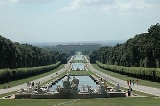
Caserta Palace

Encyclopedia
Italian language
Italian is a Romance language spoken mainly in Europe: Italy, Switzerland, San Marino, Vatican City, by minorities in Malta, Monaco, Croatia, Slovenia, France, Libya, Eritrea, and Somalia, and by immigrant communities in the Americas and Australia...
: Reggia di Caserta) is a former royal residence in Caserta
Caserta
Caserta is the capital of the province of Caserta in the Campania region of Italy. It is an important agricultural, commercial and industrial comune and city. Caserta is located on the edge of the Campanian plain at the foot of the Campanian Subapennine mountain range...
, southern Italy
Italy
Italy , officially the Italian Republic languages]] under the European Charter for Regional or Minority Languages. In each of these, Italy's official name is as follows:;;;;;;;;), is a unitary parliamentary republic in South-Central Europe. To the north it borders France, Switzerland, Austria and...
, constructed for the Bourbon kings of Naples
Kingdom of Naples
The Kingdom of Naples, comprising the southern part of the Italian peninsula, was the remainder of the old Kingdom of Sicily after secession of the island of Sicily as a result of the Sicilian Vespers rebellion of 1282. Known to contemporaries as the Kingdom of Sicily, it is dubbed Kingdom of...
. It was the largest palace
Palace
A palace is a grand residence, especially a royal residence or the home of a head of state or some other high-ranking dignitary, such as a bishop or archbishop. The word itself is derived from the Latin name Palātium, for Palatine Hill, one of the seven hills in Rome. In many parts of Europe, the...
and one of the largest buildings erected in Europe during the 18th century. In 1997, the Palace was designated a UNESCO World Heritage Site
World Heritage Site
A UNESCO World Heritage Site is a place that is listed by the UNESCO as of special cultural or physical significance...
, described in its nomination as "the swan song of the spectacular art of the Baroque
Baroque
The Baroque is a period and the style that used exaggerated motion and clear, easily interpreted detail to produce drama, tension, exuberance, and grandeur in sculpture, painting, literature, dance, and music...
, from which it adopted all the features needed to create the illusions of multidirectional space".
History
The construction of the palace was begun in 1752 for Charles VII of NaplesCharles III of Spain
Charles III was the King of Spain and the Spanish Indies from 1759 to 1788. He was the eldest son of Philip V of Spain and his second wife, the Princess Elisabeth Farnese...
, who worked closely with his architect Luigi Vanvitelli
Luigi Vanvitelli
Luigi Vanvitelli was an Italian engineer and architect. The most prominent 18th-century architect of Italy, he practiced a sober classicizing academic Late Baroque style that made an easy transition to Neoclassicism.-Biography:Vanvitelli was born at Naples, the son of a Dutch painter of land and...
. When Charles saw Vanvitelli's grandly-scaled model for Caserta it filled him with emotion "fit to tear his heart from his breast". In the end, he never slept a night at the Reggia, as he abdicated in 1759 to become King of Spain, and the project was carried to completion for his third son and successor, Ferdinand IV of Naples.
The political and social model for Vanvitelli's palace was Versailles
Versailles
Versailles , a city renowned for its château, the Palace of Versailles, was the de facto capital of the kingdom of France for over a century, from 1682 to 1789. It is now a wealthy suburb of Paris and remains an important administrative and judicial centre...
, which, though it is strikingly different in its variety and disposition, solves similar problems of assembling and providing for king, court and government in a massive building with the social structure of a small city, confronting a baroque view of a highly subordinated nature, la nature forcée. The Royal Palace of Madrid
Royal Palace of Madrid
The Palacio Real de Madrid is the official residence of the King of Spain in the city of Madrid, but it is only used for state ceremonies. King Juan Carlos and the Royal Family do not reside in the palace, choosing instead the more modest Palacio de la Zarzuela on the outskirts of Madrid...
, where Charles had grown up, which had been devised by Filippo Juvarra
Filippo Juvarra
Filippo Juvarra was an Italian architect and stage set designer.-Biography:Filippo Juvarra was an Italian Baroque architect working in the early part of the eighteenth century. He was born in Messina, Sicily, to a family of goldsmiths and engravers...
for Charles' father, Philip V of Spain
Philip V of Spain
Philip V was King of Spain from 15 November 1700 to 15 January 1724, when he abdicated in favor of his son Louis, and from 6 September 1724, when he assumed the throne again upon his son's death, to his death.Before his reign, Philip occupied an exalted place in the royal family of France as a...
, and Charlottenburg Palace
Charlottenburg Palace
Charlottenburg Palace is the largest palace in Berlin, Germany, and the only royal residency in the city dating back to the time of the Hohenzollern family. It is located in the Charlottenburg district of the Charlottenburg-Wilmersdorf burough.The palace was built at the end of the 17th century...
provided models. A spacious octagonal vestibule seems to have been inspired by Basilica di Santa Maria della Salute
Basilica di Santa Maria della Salute
The Basilica of St Mary of Health , commonly known simply as the Salute, is a Roman Catholic church and minor basilica located in the Dorsoduro sestiere of the Italian city of Venice. It stands on a narrow finger of land between the Grand Canal and the Bacino di San Marco making the church visible...
in Venice
Venice
Venice is a city in northern Italy which is renowned for the beauty of its setting, its architecture and its artworks. It is the capital of the Veneto region...
, while the palatine chapel is most often compared to Robert de Cotte
Robert de Cotte
Robert de Cotte was a French architect-administrator, under whose design control of the royal buildings of France from 1699, the earliest notes presaging the Rococo style were introduced. First a pupil of Jules Hardouin-Mansart, he later became his brother-in-law and his collaborator...
's royal chapel at Versailles.
The king's primary object was to have a magnificent new royal court and administrative centre for the Kingdom in a location protected from sea attack.
Vanvitelli died in 1773: the construction was continued by his son Carlo
Carlo Vanvitelli
Carlo Vanvitelli was an Italian architect and engineer, who worked mainly in Naples and its area.He was the son of architect Luigi Vanvitelli, and two of his brothers were also architects. Together with Pietro, he apprenticed under his father in the construction of Caserta Royal Palace. Both...
and finished in 1780.
The palace has some 1,200 rooms, including two dozen state apartments, a large library, and a theatre modelled after the Teatro San Carlo of Naples.
The population of Caserta Vecchia was moved 10 kilometers to provide a work force closer to the palace. A silk manufactory at San Leucio resort was disguised as a pavilion in the immense parkland.
A monumental avenue that would run 20 kilometers between the Palace and Naples was planned but never realized.
In April 1945 the palace was the site of the signing of terms of the unconditional German surrender of forces in Italy. The agreement covered between 600,000 and 900,000 soldiers along the Italian Front including troops in sections of Austria.
Overview
The palace has a rectangular plan, measuring 247 x 184 m. The four sides are connected by two orthogonal arms, forming four inner courts, each measuring more than 3800 m² (4,545 sq yd).Behind the facades of its matching segmental ranges of outbuildings that flank the giant forecourt, a jumble of buildings arose to facilitate daily business. In the left hand arc was built as barracks. Here, later, during World War II
World War II
World War II, or the Second World War , was a global conflict lasting from 1939 to 1945, involving most of the world's nations—including all of the great powers—eventually forming two opposing military alliances: the Allies and the Axis...
the soldiers of the US Fifth Army recovered in a "rest centre".
Of all the royal residences inspired by the Palace of Versailles
Palace of Versailles
The Palace of Versailles , or simply Versailles, is a royal château in Versailles in the Île-de-France region of France. In French it is the Château de Versailles....
, the Reggia of Caserta is the one that bears the greatest resemblance to the original model: the unbroken balustraded skyline, the slight break provided by pavilions within the long, somewhat monotonous facade. As at Versailles, a large aqueduct
Aqueduct of Vanvitelli
The Aqueduct of Vanvitelli or Caroline Aqueduct is an aqueduct built to supply the Reggia di Caserta and the San Leucio complex, supplied by water arising at the foot of Taburno, from the springs of the Fizzo, in the territory of Bucciano , which it carries along a winding 38 km route...
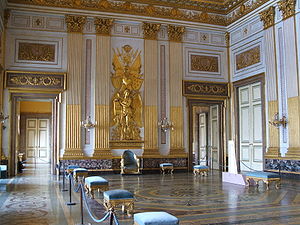
was required to bring water for the prodigious water displays. Like its French predecessor, the palace was intended to display the power and grandeur of an absolute Bourbon monarchy. A solecism at Caserta is that above the piano reale, the King's floor, is another floor of equal magnificence. The enfilades
Enfilade (architecture)
In architecture, an enfilade is a suite of rooms formally aligned with each other. This was a common feature in grand European architecture from the Baroque period onwards, although there are earlier examples, such as the Vatican stanze...
of Late Baroque
Baroque
The Baroque is a period and the style that used exaggerated motion and clear, easily interpreted detail to produce drama, tension, exuberance, and grandeur in sculpture, painting, literature, dance, and music...
saloni were the heart and seat of government, as well as displays of national wealth. Caserta provided a royal refuge from the dust and factions of the capital, just as Versailles had freed Louis XIV from Paris. The inland location was more defensible than the old Royal Palace in Naples, which fronted the Bay of Naples and hence was vulnerable to attack from the sea. To provide the King with suitable protection, troop barracks were housed within the palace.
The wide central entrance carriageway has, today, been incorporated into the city's automobile circulation.
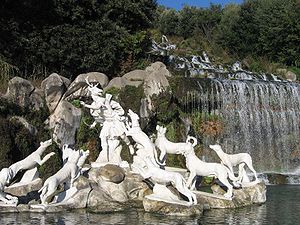
The park
The garden, a typical example of the baroque extension of formal vistas, stretch for 120 ha, partly on hilly terrain. It is inspired by the park of Versailles, but it is commonly regarded as superior in beauty. The park starts from the back façade of the palace, flanking a long alley with artificial fountains and cascades. There is a botanical garden, called "The English Garden," in the upper part designed in the 1780s by Carlo Vanvitelli and the London-trained plantsman-designer John Graefer, recommended to Sir William HamiltonWilliam Hamilton (diplomat)
Sir William Hamilton KB, PC, FRS was a Scottish diplomat, antiquarian, archaeologist and vulcanologist. After a short period as a Member of Parliament, he served as British Ambassador to the Kingdom of Naples from 1764 to 1800...
by Sir Joseph Banks. It is an early Continental example of an "English garden" in the svelte naturalistic taste of Capability Brown
Capability Brown
Lancelot Brown , more commonly known as Capability Brown, was an English landscape architect. He is remembered as "the last of the great English eighteenth-century artists to be accorded his due", and "England's greatest gardener". He designed over 170 parks, many of which still endure...
.
The fountains and cascades, each filling a vasca ("basin"), with architecture and hydraulics by Luigi Vanvitelli at intervals along a wide straight canal that runs to the horizon, rivalled those at Peterhof outside St. Petersburg. These include:
- The Fountain of Diana and Actaeon (sculptures by Paolo Persico, Brunelli, Pietro Solari);
- The Fountain of Venus and Adonis (1770–80);
- The Fountain of the Dolphins (1773–80);
- The Fountain of AeolusAeolusAeolus was the ruler of the winds in Greek mythology. In fact this name was shared by three mythic characters. These three personages are often difficult to tell apart, and even the ancient mythographers appear to have been perplexed about which Aeolus was which...
; - The Fountain of Ceres.
A large population of figures from classical Antiquity were modelled by Gaetano Salomone for the gardens of the Reggia, and executed by large workshops.
Film locations
CasertaCaserta
Caserta is the capital of the province of Caserta in the Campania region of Italy. It is an important agricultural, commercial and industrial comune and city. Caserta is located on the edge of the Campanian plain at the foot of the Campanian Subapennine mountain range...
was used as the location for Queen Amidala's Royal Palace on Naboo in the 1999 film Star Wars Episode I: The Phantom Menace
Star Wars Episode I: The Phantom Menace
Star Wars Episode I: The Phantom Menace is a 1999 American epic space opera film written and directed by George Lucas. It is the fourth film to be released in the Star Wars saga, as the first of a three-part prequel to the original Star Wars trilogy, as well as the first film in the saga in terms...
and again in the 2002 film Star Wars Episode II: Attack of the Clones
Star Wars Episode II: Attack of the Clones
Star Wars Episode II: Attack of the Clones is a 2002 American epic space opera film directed by George Lucas and written by Lucas and Jonathan Hales. It is the fifth film to be released in the Star Wars saga and the second in terms of the series' internal chronology...
as Queen Jamilla's palace. The same room was also used in Mission: Impossible III
Mission: Impossible III
Mission: Impossible III is a 2006 spy film, the third based on the spy-themed television series Mission: Impossible starring Tom Cruise who reprises his role of IMF agent Ethan Hunt....
as Vatican City. In fact, the square where the Lamborghini
Lamborghini
Automobili Lamborghini S.p.A., commonly referred to as Lamborghini , is an Italian car manufacturer. The company was founded by manufacturing magnate Ferruccio Lamborghini in 1963, with the objective of producing a refined grand touring car to compete with established offerings from marques like...
is blown up is actually the square inside the Palace.
The main staircase is also used in Angels & Demons as the Vatican's staircase.
The mezzo soprano Cecilia Bartoli
Cecilia Bartoli
Cecilia Bartoli is an Italian coloratura mezzo-soprano opera singer and recitalist. She is best-known for her interpretation of the music of Mozart and Rossini, as well as for her performances of lesser-known Baroque and classical music...
used the palace as primary location for the film "L'art des castrats" that accompanies her album "Sacrificium", dedicated to the music written for the castrato singers of the baroque period.
External links
- Official website
- History and Information in italian and english
- CBC Archives CBC Radio reports on signing of the terms of an unconditional surrender of German forces on the Italian Front at the Palace on May 2, 1945.