

La Paz

Encyclopedia
Nuestra Señora de La Paz (ˈnwes.tɾa seˈɲoɾa ðe la pas; Our Lady of Peace; ) is the administrative capital of Bolivia
, as well as the departmental capital of the La Paz Department, and the second largest city in the country (in population) after Santa Cruz de la Sierra
. It is located in the western part of the country in the department of the same name It is located at an elevation of 3650 m (11,975 ft) above sea level
, making it the world's highest "de facto" capital city, or administrative capital.
The official capital of Bolivia is Sucre
and it is the seat of Justice, La Paz has more government departments, hence the "de facto" qualifier. The city sits in a "bowl" surrounded by the high mountains of the altiplano
.
As it grows, the city of La Paz climbs the hills, resulting in varying elevations from 3,000 meters to 4,100 meters (9,840 ft to 13,450 ft). Overlooking the city is towering triple-peaked Illimani
, which is always snow-covered and can be seen from several spots of the city, including from the neighbor city of El Alto
. As of the 2001 census, the city had a population of 877,363. La Paz Metropolitan area
, formed by the cities of La Paz, El Alto and Viacha
, make the most populous urban area of Bolivia, with a population of 2.3 million inhabitants and surpassing the metropolitan area of Santa Cruz de la Sierra
.
 Founded in 1548 by the Spanish
conquistador
s at the site of the Native American settlement, Laja
, the full name of the city was originally Nuestra Señora de La Paz (meaning Our Lady of Peace
). The name commemorated the restoration of peace following the insurrection of Gonzalo Pizarro
and fellow conquistadors four years earlier against Blasco Núñez Vela
, the first viceroy
of Peru
. The city was later moved to its present location in the valley of Chuquiago Marka.
Control over the former Inca lands had been entrusted to Pedro de la Gasca
by the Spanish king (and Holy Roman Emperor) Emperor Charles V
. Gasca commanded Alonso de Mendoza
to found a new city commemorating the end of the civil wars in Peru; the city of La Paz was founded on October 20, 1548.
In 1549, "Juan Gutierrez Paniagua" was commanded to design an urban plan that would designate sites for public areas, plazas, official buildings, and a cathedral. La Plaza de los Españoles, which is known today as the Plaza Murillo, was chosen as the location for government buildings as well as the Metropolitan Cathedral.
Spain controlled La Paz with a firm grip and the Spanish king had the last word in all matters political. In 1781, for a total of six months, a group of Aymara people laid siege to La Paz. Under the leadership of Tupac Katari
, they destroyed churches and government property. Thirty years later Indians laid a two-month siege on La Paz – where and when the legend of the Ekeko
is set. In 1809 the struggle for independence from the Spanish rule brought uprisings against the royalist forces. It was on July 16, 1809 that Pedro Domingo Murillo
famously said that the Bolivian revolution was igniting a lamp that nobody would be able to turn-off. This formally marked the beginning of the Liberation of South America from Spain. Pedro Domingo Murillo was hanged at the Plaza de los Españoles that night, but his name would be eternally remembered in the name of the plaza, and he would be remembered as the voice of revolution across South America.
In 1825, after the decisive victory of the republican
s at Ayacucho
over the Spanish army in the course of the Spanish American wars of independence, the city's full name was changed to La Paz de Ayacucho (meaning The Peace of Ayacucho).
In 1898, La Paz was made the de facto
seat of the national government, with Sucre remaining the nominal historical as well as judiciary capital. This change reflected the shift of the Bolivian economy away from the largely exhausted silver
mine
s of Potosí
to the exploitation of tin
near Oruro
, and resulting shifts in the distribution of economic and political power among various national elite
s.
 Located at 16°30′0"S 68°08′0"W (−16.5, −68.1333), La Paz is built in a canyon created by the Choqueyapu River (now mostly built over), which runs northwest to southeast. The city's main thoroughfare, which roughly follows the river, changes names over its length, but the central tree-lined section running through the downtown core is called the Prado.
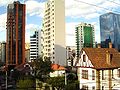
The geography of La Paz (in particular the altitude) reflects society: the lower areas of the city are the more affluent areas. While many middle-class residents live in high-rise condos near the center, the houses of the truly affluent are located in the lower neighborhoods southwest of the Prado. And looking up from the center, the surrounding hills are plastered with makeshift brick houses of those less economically fortunate.
The satellite city of El Alto, in which the airport is located, is spread over a broad area to the west of the canyon, on the Altiplano. La Paz is renowned for its unique markets, very unusual topography, and traditional culture.
La Paz is located in the valleys of the Andes, and is closer to the Eastern split of the Altiplano region. Therefore, it is closer to the famous mountains such as the Illimani (guardian of La Paz), Huayna Potosi, Mururata, and Illampu. On the Western side of the Altiplano divide, about an hour to the West of the La Paz, is the site of the tallest mountain in Bolivia and 9th tallest mountain in the Andes, the Sajama Volcano. In July 1994, an earthquake
rated at 8.2 struck just 200 miles north of La Paz, the largest earthquake since the Sumbawa earthquake of 1977. Part of the water supply is derived from glaciers, which are becoming a less reliable source of water.
Comunidad Chiaraque.
, La Paz has a subtropical highland climate. Owing to the altitude of the city, temperatures are consistently cool throughout the year, though the diurnal temperature variation
is typically large. The city has a relatively dry climate, with rainfall occurring mainly in the slightly warmer months of November to March. The sun passes directly overhead in early November and early February. Ultraviolet solar radiation intensity is the same as Cairns, Australia, for both cities lie on nearly identical latitudes. The two cloudiest months of the year; both in late summer - February and March, both receive a low daily average of 5.0 hours of sunshine. Conversely, the two sunniest months of the year; both in winter - June and July, both receive an abundant daily average of 9.0 hours of sunshine. The seasonally uneven distribution of the year's annual precipitation, often results in destructive mudslides experienced in summer, due to the copious amount of precipitation typically observed throughout the season. The wettest month is January while the driest month is June, the city receiving a monthly average of 130 mm (5.1 in) and 5 mm (0.196850393700787 in) of precipitation respectively.
 The economy of La Paz has improved greatly in recent years, mainly as a result of improved political leaders. Due to the long period of high inflation and economic struggle faced by Bolivians in the 1980s and early 1990s, a large Informal Economy developed. Evidence of this is provided by the markets found all around the city. While there are stable markets, almost every street in the downtown area and surrounding neighborhoods has at least one vendor on it. La Paz remains the principal center of manufacturing enterprises that produce finished-product goods for the country, with about two-thirds of Bolivia's manufacturing located nearby. Historically, industry in Bolivia has been dominated by mineral processing and the preparation of agricultural products. However, in the urban centre of La Paz, small plants carry out a large portion of the industry. Food, tobacco products, clothing, various consumer goods, building materials, and agricultural tools are produced. "The tin quotations from London are watched in La Paz with close interest as an index of the country's prosperity; a third of the national revenue and more than half of the total customs in 1925 were derived from tin; in short, that humble but indispensable metal is the hub around which Bolivia's economic life revolves. The tin deposits of Bolivia, second largest in the world, ... invite development."
However, these three teams play the majority of their games in the city stadium, Estadio Hernando Siles
. It is host to several other teams that play in the first and second divisions such as: Mariscal Braun
(2nd), Always Ready (3rd), Municipal (3rd) and Chaco Petrolero (3rd).
La Paz hosts the national football team and international games.
 La Paz is an important cultural center of Bolivia. The city hosts several cathedrals belonging to the colonial times, such as the San Francisco Cathedral and the Metropolitan Cathedral, this last one located on Murillo Square, which is also home of the political and administrative power of the country. Hundreds of different museums can be found across the city, the most notable ones on Jaén Street, which street design has been preserved from the Spanish days and is home of 10 different museums.
The home of the Bolivian government is located on Murillo Square and is known as "Palacio Quemado" (Burnt Palace) as it has been on fire several times. The palace has been restored many times since, but the name has remained untouched.
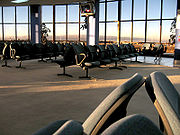 La Paz is served by El Alto International Airport
(IATA code: LPB), which is situated eight miles (14 km) south-west of La Paz. At an elevation of 4061 metres (13,323 ft), it is one of the highest major airports in the world. Airport facilities include a bank, bars, car rentals, restaurants, free wi-fi internet and duty-free shops. The runway has a length of 4000 metres (13,123 ft) (or 2.5 miles). Additionally, it is the second airport in the Western Hemisphere
, and the third airport in the world, to successfully pass the International Civil Aviation Organization's (ICAO) Universal Security Audit Program (USAP).
. The main gateway for transporting intercities bus travel in La Paz with several daily departs to all the main Bolivian cities.
Bus Terminal in La Paz is the main city bus station. The city is connected by road with the city of Oruro
where you can access the cities of Sucre, Potosí
and south of the country. There is an important road that connects the road to Oruro in the cities of Cochabamba
and Santa Cruz
. There are also access roads to paviementados Copacabana and Tiwanaku
to the west, near the Lake Titicaca
, which continues until the city of Cuzco via the border town of Desaguadero
. There are also roads north to get to The Yungas crossing the Andes Mountains.
The bus terminal has daily departures to major cities. There are also trips to other cities in countries like Chile
and Peru
. For departures to smaller cities and towns within the department, using informal stations located in Villa Fatima (departures to Los Yungas, Beni and Pando, Upper San Pedro (outputs Apolo) and near the General Cemetery (outputs Copacabana and other nearby cities to Lake Titicaca
, and also Tiwanacu, Desaguadero
where you can go to Peru).
Latin America from October 12, 1982 establishing brotherly relations with the following cities:
Additionally, agreement was reached by Twin Cities
with:
In June 2008 it signed a twinning agreement with the City of Zaragoza
, Spain
.
La Paz belongs to Merco Ciudades, signed by 180 urbes of the member countries of Mercosur
, since 1999.
Bolivia
Bolivia officially known as Plurinational State of Bolivia , is a landlocked country in central South America. It is the poorest country in South America...
, as well as the departmental capital of the La Paz Department, and the second largest city in the country (in population) after Santa Cruz de la Sierra
Santa Cruz de la Sierra
Santa Cruz de la Sierra, commonly known as Santa Cruz, is the capital of the Santa Cruz department in eastern Bolivia and the largest city in the country...
. It is located in the western part of the country in the department of the same name It is located at an elevation of 3650 m (11,975 ft) above sea level
Above mean sea level
The term above mean sea level refers to the elevation or altitude of any object, relative to the average sea level datum. AMSL is used extensively in radio by engineers to determine the coverage area a station will be able to reach...
, making it the world's highest "de facto" capital city, or administrative capital.
The official capital of Bolivia is Sucre
Sucre
Sucre, also known historically as Charcas, La Plata and Chuquisaca is the constitutional capital of Bolivia and the capital of the department of Chuquisaca. Located in the south-central part of the country, Sucre lies at an elevation of 2750m...
and it is the seat of Justice, La Paz has more government departments, hence the "de facto" qualifier. The city sits in a "bowl" surrounded by the high mountains of the altiplano
Altiplano
The Altiplano , in west-central South America, where the Andes are at their widest, is the most extensive area of high plateau on Earth outside of Tibet...
.
As it grows, the city of La Paz climbs the hills, resulting in varying elevations from 3,000 meters to 4,100 meters (9,840 ft to 13,450 ft). Overlooking the city is towering triple-peaked Illimani
Illimani
Illimani is the highest mountain in the Cordillera Real of western Bolivia. It lies just south of La Paz at the eastern edge of the Altiplano. It is the second highest peak in Bolivia, after Nevado Sajama, and the eighteenth highest peak in South America...
, which is always snow-covered and can be seen from several spots of the city, including from the neighbor city of El Alto
El Alto
At one time merely a suburb of adjacent La Paz, Bolivia, on the Altiplano highlands, the city of El Alto is today one of Bolivia's largest and fastest-growing urban centers. As of the 2001 census, the population was 649,958. In 2010, the population may be nearly 900,000, or more. The city contains...
. As of the 2001 census, the city had a population of 877,363. La Paz Metropolitan area
Metro La Paz
Metro La Paz is located on the west side of Bolivia, with the population of more than 2.3 million inhabitants joining the cities of La Paz, El Alto,and Viacha, making it the most populous urban area of Bolivia, on the altitude of 4,000 it makes it the highest metropolitan city on the world.-...
, formed by the cities of La Paz, El Alto and Viacha
Viacha
Viacha is a city in Bolivia, situated in the Ingavi Province in the La Paz Department. Viacha lies in the Altiplano, 22 km. Southwest of La Paz. Transportation to and from the city includes cars, buses, and a train.- Economy :...
, make the most populous urban area of Bolivia, with a population of 2.3 million inhabitants and surpassing the metropolitan area of Santa Cruz de la Sierra
Santa Cruz de la Sierra
Santa Cruz de la Sierra, commonly known as Santa Cruz, is the capital of the Santa Cruz department in eastern Bolivia and the largest city in the country...
.
History
Spain
Spain , officially the Kingdom of Spain languages]] under the European Charter for Regional or Minority Languages. In each of these, Spain's official name is as follows:;;;;;;), is a country and member state of the European Union located in southwestern Europe on the Iberian Peninsula...
conquistador
Conquistador
Conquistadors were Spanish soldiers, explorers, and adventurers who brought much of the Americas under the control of Spain in the 15th to 16th centuries, following Europe's discovery of the New World by Christopher Columbus in 1492...
s at the site of the Native American settlement, Laja
Laja
Laja is a location in the La Paz Department in Bolivia. It is the seat of the Laja Municipality, the second municipal section of the Los Andes Province.- References :*...
, the full name of the city was originally Nuestra Señora de La Paz (meaning Our Lady of Peace
Peace
Peace is a state of harmony characterized by the lack of violent conflict. Commonly understood as the absence of hostility, peace also suggests the existence of healthy or newly healed interpersonal or international relationships, prosperity in matters of social or economic welfare, the...
). The name commemorated the restoration of peace following the insurrection of Gonzalo Pizarro
Gonzalo Pizarro
Gonzalo Pizarro y Alonso was a Spanish conquistador and younger paternal half-brother of Francisco Pizarro, the conqueror of the Inca Empire...
and fellow conquistadors four years earlier against Blasco Núñez Vela
Blasco Núñez Vela
Blasco Núñez Vela y Villalba was the first Spanish viceroy of Peru, from May 15, 1544 to January 18, 1546. He was charged by King Charles I with the enforcement of the controversial New Laws, which dealt with the failure of the encomienda system to protect the indigenous people of America from the...
, the first viceroy
Viceroy
A viceroy is a royal official who runs a country, colony, or province in the name of and as representative of the monarch. The term derives from the Latin prefix vice-, meaning "in the place of" and the French word roi, meaning king. A viceroy's province or larger territory is called a viceroyalty...
of Peru
Peru
Peru , officially the Republic of Peru , is a country in western South America. It is bordered on the north by Ecuador and Colombia, on the east by Brazil, on the southeast by Bolivia, on the south by Chile, and on the west by the Pacific Ocean....
. The city was later moved to its present location in the valley of Chuquiago Marka.
Control over the former Inca lands had been entrusted to Pedro de la Gasca
Pedro de la Gasca
Pedro de la Gasca was a Spanish bishop, diplomat and the second viceroy of Peru, from April 10, 1547 to January 27, 1550....
by the Spanish king (and Holy Roman Emperor) Emperor Charles V
Charles V, Holy Roman Emperor
Charles V was ruler of the Holy Roman Empire from 1519 and, as Charles I, of the Spanish Empire from 1516 until his voluntary retirement and abdication in favor of his younger brother Ferdinand I and his son Philip II in 1556.As...
. Gasca commanded Alonso de Mendoza
Alonso de Mendoza
Alonso de Mendoza was a Spanish captain, conquistador, and the founder of the city of Nuestra Señora de La Paz, current capital city of Bolivia...
to found a new city commemorating the end of the civil wars in Peru; the city of La Paz was founded on October 20, 1548.
In 1549, "Juan Gutierrez Paniagua" was commanded to design an urban plan that would designate sites for public areas, plazas, official buildings, and a cathedral. La Plaza de los Españoles, which is known today as the Plaza Murillo, was chosen as the location for government buildings as well as the Metropolitan Cathedral.
Spain controlled La Paz with a firm grip and the Spanish king had the last word in all matters political. In 1781, for a total of six months, a group of Aymara people laid siege to La Paz. Under the leadership of Tupac Katari
Tupac Katari
Túpac Katari or Catari , born Julián Apasa Nina, was a leader in the rebellions of indigenous people of Bolivia against the Spanish Empire in the early 1780s....
, they destroyed churches and government property. Thirty years later Indians laid a two-month siege on La Paz – where and when the legend of the Ekeko
Ekeko
The Ekeko is the Tiwanakan god of abundance and prosperity in the mythology and folklore of the people from the Andean Altiplano. The current representation corresponds to a reinterpretation made by the artisan Isidro Choquehuanca as a gift for an employee of the Governor and Commanding Officer of...
is set. In 1809 the struggle for independence from the Spanish rule brought uprisings against the royalist forces. It was on July 16, 1809 that Pedro Domingo Murillo
Pedro Domingo Murillo
Pedro Domingo Murillo was a patriot of Upper Peru who played a key role in Bolivia's independence.-Biography:Born in the city of La Paz on September 17, 1757. Belonging to an elite family La Paz, his father is Juan Ciriaco Murillo, seminarian who shortly after his birth became a priest and a...
famously said that the Bolivian revolution was igniting a lamp that nobody would be able to turn-off. This formally marked the beginning of the Liberation of South America from Spain. Pedro Domingo Murillo was hanged at the Plaza de los Españoles that night, but his name would be eternally remembered in the name of the plaza, and he would be remembered as the voice of revolution across South America.
In 1825, after the decisive victory of the republican
Republicanism
Republicanism is the ideology of governing a nation as a republic, where the head of state is appointed by means other than heredity, often elections. The exact meaning of republicanism varies depending on the cultural and historical context...
s at Ayacucho
Ayacucho
Ayacucho is the capital city of Huamanga Province, Ayacucho Region, Peru.Ayacucho is famous for its 33 churches, which represent one for each year of Jesus's life. Ayacucho has large religious celebrations, especially during the Holy Week of Easter...
over the Spanish army in the course of the Spanish American wars of independence, the city's full name was changed to La Paz de Ayacucho (meaning The Peace of Ayacucho).
In 1898, La Paz was made the de facto
De facto
De facto is a Latin expression that means "concerning fact." In law, it often means "in practice but not necessarily ordained by law" or "in practice or actuality, but not officially established." It is commonly used in contrast to de jure when referring to matters of law, governance, or...
seat of the national government, with Sucre remaining the nominal historical as well as judiciary capital. This change reflected the shift of the Bolivian economy away from the largely exhausted silver
Silver
Silver is a metallic chemical element with the chemical symbol Ag and atomic number 47. A soft, white, lustrous transition metal, it has the highest electrical conductivity of any element and the highest thermal conductivity of any metal...
mine
Mining
Mining is the extraction of valuable minerals or other geological materials from the earth, from an ore body, vein or seam. The term also includes the removal of soil. Materials recovered by mining include base metals, precious metals, iron, uranium, coal, diamonds, limestone, oil shale, rock...
s of Potosí
Potosí
Potosí is a city and the capital of the department of Potosí in Bolivia. It is one of the highest cities in the world by elevation at a nominal . and it was the location of the Spanish colonial mint, now the National Mint of Bolivia...
to the exploitation of tin
Tin
Tin is a chemical element with the symbol Sn and atomic number 50. It is a main group metal in group 14 of the periodic table. Tin shows chemical similarity to both neighboring group 14 elements, germanium and lead and has two possible oxidation states, +2 and the slightly more stable +4...
near Oruro
Oruro, Bolivia
Oruro is a city in Bolivia with a population of 235,393 , located about equidistant between La Paz and Sucre at approximately 3710 meters above sea level. It is the capital of the department of Oruro....
, and resulting shifts in the distribution of economic and political power among various national elite
Elite
Elite refers to an exceptional or privileged group that wields considerable power within its sphere of influence...
s.
Geography
The geography of La Paz (in particular the altitude) reflects society: the lower areas of the city are the more affluent areas. While many middle-class residents live in high-rise condos near the center, the houses of the truly affluent are located in the lower neighborhoods southwest of the Prado. And looking up from the center, the surrounding hills are plastered with makeshift brick houses of those less economically fortunate.
The satellite city of El Alto, in which the airport is located, is spread over a broad area to the west of the canyon, on the Altiplano. La Paz is renowned for its unique markets, very unusual topography, and traditional culture.
La Paz is located in the valleys of the Andes, and is closer to the Eastern split of the Altiplano region. Therefore, it is closer to the famous mountains such as the Illimani (guardian of La Paz), Huayna Potosi, Mururata, and Illampu. On the Western side of the Altiplano divide, about an hour to the West of the La Paz, is the site of the tallest mountain in Bolivia and 9th tallest mountain in the Andes, the Sajama Volcano. In July 1994, an earthquake
1994 Bolivia earthquake
The 1994 Bolivia earthquake occurred on June 9, 1994. The epicenter was located in a sparsely populated region in the Amazon jungle, about 200 miles from La Paz....
rated at 8.2 struck just 200 miles north of La Paz, the largest earthquake since the Sumbawa earthquake of 1977. Part of the water supply is derived from glaciers, which are becoming a less reliable source of water.
Districts
The city is divided into seven main districts, called "Macro Distritos", which at the same time are divided into 21 small districts or zones. The city is commonly divided by the people into three main zones: South Zone, Central Zone and North Zone.- 1st Main District: Cotahuma: San Jorge, Sopocachi, Alto Sopocachi (Sopocachi Highlands), Pasankeri, Tembladerani, Llojeta, Alpacoma, Belén, Tacagua, San Pedro, Alto San Pedro (San Pedro Highlands)
- 2nd Main District: Max Paredes: Gran Poder, Obispo Indaburu, Villa Victoria, El Tejar, Alto Tejar, Chamoco Chico, Munaypata, Pura Pura, Ciudadela Ferroviaria
- 3rd Main District: Periférica: Limanipata, Achachicala, Vino Tinto, 25 de Mayo, 5 Dedos, Santiago de Lacaya, Rosasani, La Merced, Chuquiaguillo
- 4th Main District: San Antonio: Villa de Copacabana, Villa Armonía, Villa San Antonio, Kupini, Callapa, Pampahasi, San Isidro
- 5th Main District: Distrito Sur (South District): Irpavi, Bolonia, Alto Irpavi, Koani, Achumani, Achumani-Meseta, Alto Achumani, Calacoto, Alto Calacoto, Cotacota, Chasquipampa, Ovejuyo, Obrajes, Alto Obrajes, Bajo LLojeta, Bella Vista, Alto Seguencoma, Bajo Seguencoma.
- 6th Main District: Mallasa: Amor de Dios, Aranjuez, Mallasilla, Isla Verde, Mallasa, Jupapina,
Comunidad Chiaraque.
- 7th Main District: Distrito Centro (Central District): El Rosario, San Sebastián, Santa Bárbara, Casco Urbano Central, Parque Urbano Central, Miraflores, Casco Viejo
Main neighborhoods and zones
- San Jorge:, located on the 1st District (Cotahuma) and near Sopocachi, it is one of the main residential and diplomatic areas of the city. In contains several buildings, both residential and offices, and embassiesDiplomatic missionA diplomatic mission is a group of people from one state or an international inter-governmental organisation present in another state to represent the sending state/organisation in the receiving state...
, including the Spain Embassy, the United StatesUnited StatesThe United States of America is a federal constitutional republic comprising fifty states and a federal district...
Embassy, the United KingdomUnited KingdomThe United Kingdom of Great Britain and Northern IrelandIn the United Kingdom and Dependencies, other languages have been officially recognised as legitimate autochthonous languages under the European Charter for Regional or Minority Languages...
Embassy and others. One of the main avenues of the city, Arce Avenue, starts on this zone.
- SopocachiSopocachiSopocachi is a neighbourhood in La Paz, Bolivia. It is located in the central part of the city, and is part of the Cotahuma district. Sopocachi is mainly a residential area, being one of the biggest residential districts of the city, along with Calacoto. Some of the city's largest buildings are...
:, located in the 1st District (Cotahuma), Sopocachi is probably one of the oldest residential neighborhoods, located 10 minutes away from the center of the city. Despite the expansion and development of the area, this quarter maintained its residential property. In the last years, there has been an important commercial expansion, mainly on the surroundings of Abaroa Square, one of the many squares and parks of the zone.
- San Pedro:, located on the 1st District (Cotahuma), on the right bank of the Choqueyapu River and built around the "Plaza de San Pedro" (official name: Plaza Sucre, Sucre Square), is home to numerous shops, businesses and small enterprises, especially printing, spare parts and auto maintenance and repair shops. San Pedro's "Rodriguez Market" remains as one of the most popular middle-class and oldest of the city. The San Pedro prisonSan Pedro prisonSan Pedro prison or El penal de San Pedro is the largest prison in La Paz, Bolivia renowned for being a society within itself. Significantly different from most correctional facilities, inmates at San Pedro have jobs inside the community, buy or rent their accommodation, and often live with their...
is located here. - Centro: (Downtown) is located on the 7th District and comprises the center of La Paz and principal avenues of the city, like Arce Avenue, July 16 Avenue (also known as "Prado Avenue"), Mariscal Santa Cruz Avenue and Camacho Avenue, this last one being the home of the headquarters of the principal banks and companies of the country.
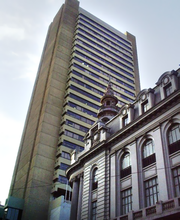
- Casco Viejo:, located on the 7th District, is the historic and ancient center of La Paz. It now houses museums, hotels, shops and buildings as the Mayor City of La Paz and the Central Bank of BoliviaCentral Bank of BoliviaThe Central Bank of Bolivia is the central bank of Bolivia, responsible for monetary policy and the issuance of banknotes. The current president of the BCB is Marcelo Zabalaga Estrada.The official site is http://www.bcb.gob.bo.-History:...
. In the Old Quarter is the Plaza Murillo, which is home to the Government Palace and the National Congress.
- Miraflores:, located on the 7th District, Miraflores district is separated from downtown by a long barrel (called Parque Urbano Central, Central Urban Park) and connected by the Bridge of the Americas and two avenues. Originally a residential zone, its growth has led it to become a major recreational center. It houses universities (including the Universidad Mayor de San Andrés's faculty of medicine), hospitals and the Estadio Hernando SilesEstadio Hernando SilesEstadio Hernando Siles is a sports stadium in La Paz, Bolivia. It is the country's largest sports complex with a capacity of 42,000 seated spectators and is named after Hernando Siles Reyes, the 31st President of Bolivia...
(capacity of 45,000 people).
- Northern District:, located on the 2nd and 3rd districts, it has a significant industrial activity (mainly food), being the Cervecería Boliviana Nacional (Bolivian National Brewery) the most significant industry founded by Germans, and one of the city's biggest companies in the country. It connects La Paz with the city of El Alto by the "autopista"or Highway.
- Southern District:, located on the 5th district has less height than the rest of La Paz (3,200 to 2,800 meters). This area houses the most affluent and exclusive neighborhoods of the city, like CalacotoCalacotoCalacoto is a neighborhood in La Paz, Bolivia. It is located in the southern part of the city. It is considered one of the most residential zones because of the cost of the houses and the services available. The population in this neighborhood has a medium to high income level on the average ....
, La Florida and Achumani, among others. It has been benefited from steady economic growth and is now the second commercial and financial center of the city, housing international firms like Moody'sMoody'sMoody's Corporation is the holding company for Moody's Analytics and Moody's Investors Service, a credit rating agency which performs international financial research and analysis on commercial and government entities. The company also ranks the credit-worthiness of borrowers using a standardized...
, CitibankCitibankCitibank, a major international bank, is the consumer banking arm of financial services giant Citigroup. Citibank was founded in 1812 as the City Bank of New York, later First National City Bank of New York...
, Aon Corporation, HuaweiHuaweiHuawei is a Chinese multinational networking and telecommunications equipment and services company headquartered in Shenzhen, Guangdong, China...
, MillicomMillicomMillicom International Cellular, also known as Tigo, is a mobile phone network provider in America and Africa. Based in Luxembourg, the company provides mobile services in 14 countries. With operations across Central America, South America, South-east Asia, and Africa, using GSM, CDMA and TDMA on...
International Cellular, Nissan Motor Corporation represented by Taiyo Motors, Pan American Silver CorporationPan American Silver CorporationPan American Silver Corporation is a mining company in Canada. The company has mines and other projects in the USA, Mexico, Peru, Bolivia and Argentina....
, a Sumitomo CorporationSumitomo CorporationSumitomo Corporation is one of the largest worldwide trading company , and is a diversified corporation. Sumitomo is headquartered in the Harumi Island Triton Square Office Tower Y in Chūō, Tokyo, Japan...
branch, Ernst & YoungErnst & YoungErnst & Young is one of the largest professional services networks in the world and one of the "Big Four" accountancy firms, along with Deloitte, KPMG and PricewaterhouseCoopers ....
, and the "MegaCenter", Bolivia's biggest shopping mallShopping mallA shopping mall, shopping centre, shopping arcade, shopping precinct or simply mall is one or more buildings forming a complex of shops representing merchandisers, with interconnecting walkways enabling visitors to easily walk from unit to unit, along with a parking area — a modern, indoor version...
(52.000 mts2 of construction).
Climate
Under the Köppen climate classificationKöppen climate classification
The Köppen climate classification is one of the most widely used climate classification systems. It was first published by Crimea German climatologist Wladimir Köppen in 1884, with several later modifications by Köppen himself, notably in 1918 and 1936...
, La Paz has a subtropical highland climate. Owing to the altitude of the city, temperatures are consistently cool throughout the year, though the diurnal temperature variation
Diurnal temperature variation
Diurnal temperature variation is a meteorological term that relates to the variation in temperature that occurs from the highs of the day to the cool of nights.-Temperature lag:Temperature lag is an important factor in diurnal temperature variation...
is typically large. The city has a relatively dry climate, with rainfall occurring mainly in the slightly warmer months of November to March. The sun passes directly overhead in early November and early February. Ultraviolet solar radiation intensity is the same as Cairns, Australia, for both cities lie on nearly identical latitudes. The two cloudiest months of the year; both in late summer - February and March, both receive a low daily average of 5.0 hours of sunshine. Conversely, the two sunniest months of the year; both in winter - June and July, both receive an abundant daily average of 9.0 hours of sunshine. The seasonally uneven distribution of the year's annual precipitation, often results in destructive mudslides experienced in summer, due to the copious amount of precipitation typically observed throughout the season. The wettest month is January while the driest month is June, the city receiving a monthly average of 130 mm (5.1 in) and 5 mm (0.196850393700787 in) of precipitation respectively.
Economy
Sports
La Paz is the home of some of the biggest football teams in Bolivia.- Club BolivarClub BolívarClub Bolívar, a football team from Bolivia, was founded in La Paz on April 12, 1925, with the name Atletico Bolívar Literario Musical later changed to "Club Atlético Bolívar"...
. Founded in 1925, it was named in honor of the Libertador Simón BolívarSimón BolívarSimón José Antonio de la Santísima Trinidad Bolívar y Palacios Ponte y Yeiter, commonly known as Simón Bolívar was a Venezuelan military and political leader...
, the team has won most of the tournaments national and international championships in the last 20 years. In the year 1964 was a bad year, and it lost the category, playing the next year in the second category. - The StrongestThe StrongestThe Strongest is a Bolivian football club based in La Paz founded on April 8, 1908. Their team colours are yellow and black. Although they have a home ground, the Rafael Mendoza Castellón , they play most of their games at the Estadio Hernando Siles, Bolivia's national ground...
. Founded in 1908 and hosts some of its games and trains on its home stadium. Is the oldest team, and the one that has won more tournaments during the 20th century. It has its own stadium named Rafael Mendoza. Don Rafael Mendoza was one of the most important presidents. In 1968 an airplane accident took the life of almost all the players, but Rafael Mendoza made many efforts so that the team rises again as one of the most important of the country. - La Paz F.C.La Paz F.C.La Paz Fútbol Club, also known as La Paz F.C., is a professional football team from La Paz, currently playing in the Bolivian First Division Liga de Fútbol Profesional Boliviano. Formerly known as Atlético González, the team gained promotion to the First Division in 2003 .-History:La Paz F.C...
However, these three teams play the majority of their games in the city stadium, Estadio Hernando Siles
Estadio Hernando Siles
Estadio Hernando Siles is a sports stadium in La Paz, Bolivia. It is the country's largest sports complex with a capacity of 42,000 seated spectators and is named after Hernando Siles Reyes, the 31st President of Bolivia...
. It is host to several other teams that play in the first and second divisions such as: Mariscal Braun
Mariscal Braun
Mariscal Braun is a Bolivian football club based in La Paz. It participated in the Bolivian Liga de Fútbol Profesional Boliviano from 2000-2002. Currently, it competes in the La Paz Regional League. The team's home base is the Estadio Hernando Siles....
(2nd), Always Ready (3rd), Municipal (3rd) and Chaco Petrolero (3rd).
La Paz hosts the national football team and international games.
Education
The city hosts some of the most important universities of the country:- Universidad Mayor de San Andrés. Opened in 1830, the second oldest university in Bolivia.
- Universidad Católica Boliviana San Pablo
- Escuela Militar de Ingeniería
- Universidad Privada Boliviana
- Universidad Nuestra Señora de La Paz
- Universidad Privada Franz Tamayo
- Universidad Privada San Francisco de Asis
- Universidad Loyola
- Universidad NUR
- Universidad La Salle
- Universidad Tecnológica Boliviana
- Universidad Privada del Valle
- Universidad Central de Bolivia
- Universidad Salesiana de Bolivia
- Universidad de Aquino Bolivia
- Universidad Adventista de Bolivia
- Universidad Saint Paul
- Universidad Real
- Universidad de Los Andes
- Fundación Infocal La Paz
- Escuela Normal Superior Simón Bolívar
- Escuela Industrial Superior "Pedro Domingo Murillo"
Tourism
The home of the Bolivian government is located on Murillo Square and is known as "Palacio Quemado" (Burnt Palace) as it has been on fire several times. The palace has been restored many times since, but the name has remained untouched.
Museums and cultural centers
- The former home of Pedro Domingo MurilloPedro Domingo MurilloPedro Domingo Murillo was a patriot of Upper Peru who played a key role in Bolivia's independence.-Biography:Born in the city of La Paz on September 17, 1757. Belonging to an elite family La Paz, his father is Juan Ciriaco Murillo, seminarian who shortly after his birth became a priest and a...
, martyr of the independence revolution of 1809, has been preserved and is now a museum. The house displays a collection of furniture, textiles, and art from colonial times. - Museo Costumbrista: Displays ceramic dolls wearing traditional customs that show how was life in the early 19th century. Also on display are photos of old La Paz.
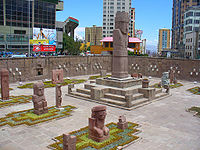
- Museo Nacional de Arqueología (Nacional Museum of Archeology): Depicts a collection of artifacts of the Tiawanaku culture.
- Museo del Litoral (Museum of the Coastal Region): Displays objects from the 1879 war in which Bolivia lost its sea coast to ChileChileChile ,officially the Republic of Chile , is a country in South America occupying a long, narrow coastal strip between the Andes mountains to the east and the Pacific Ocean to the west. It borders Peru to the north, Bolivia to the northeast, Argentina to the east, and the Drake Passage in the far...
. - Museo del Oro (Gold Museum): Depicts pre-Conquest works made of gold, silver and copper.
- Museo de Etnografía y Folklore (Ethnography and Folkolore Museum): Placed in a house built in the late 18th century, it exhibits customs and art of two ethnic groups: Chipayas and Ayoreos.
- Museo del Charango (Museum of Charango): Located in Calle Linares, the museum displays an incredible variety of charangos. Other native instruments are displayed as well.
- Museo de Historia Natural (Natural History Museum): Exhibits on Bolivia's paleontology, geology, paleontology, zoology, and botany.
- Casa Museo Marina Nuñez del Prado (Marina Nuñez del Prado House Museum): Displays Quechua and Aymara-theme sculptures by Bolivian artist Marina Nuñez del Prado.
- Museo Nacional de Arte (National Art Museum): Located in calle Comercio, on a former palace built in 1775, displays works by Melchor Perez de Holguín and Marina Nuñez del Prado, among others.
- Mercado de Brujas (Witches' Market): Merchandise sold here includes herbs, remedies as well as other ingredients used in Aymara traditions.
- Feria de Alasitas: This fair is celebrated each year on January 24 in honor of a little god of abundance known as EkekoEkekoThe Ekeko is the Tiwanakan god of abundance and prosperity in the mythology and folklore of the people from the Andean Altiplano. The current representation corresponds to a reinterpretation made by the artisan Isidro Choquehuanca as a gift for an employee of the Governor and Commanding Officer of...
, which means dwarf in AymaraAymara languageAymara is an Aymaran language spoken by the Aymara people of the Andes. It is one of only a handful of Native American languages with over three million speakers. Aymara, along with Quechua and Spanish, is an official language of Peru and Bolivia...
.
Churches and cathedrals
- Metropolitan Cathedral, built in 1835 and located next to the Presidential Palace, on Murillo Square;
- San Francisco Church, founded in 1548 and rebuilt 1784.
Others
- Bolivian Presidential PalacePalacio QuemadoThe Palacio Quemado is a popular name to denote the Bolivian Palace of Government, located on Plaza Murillo in downtown La Paz. It is the building from which the Bolivian executive conducts its business.The building has had many incarnations...
, also known as "Burned Palace". - Parque Urbano Central (Central Urban Park)
Local festivities
- January 24: Alasitas,in all neighborhoods
- February 2: Virgen de CopacabanaVirgen de CopacabanaThe Virgen de Copacabana is the patron saint of Bolivia. She is venerated in Bolivia during her feast day of February 2, the day of the Purification of Mary, or feast of the Virgen de la Candelaria...
, (Villa Copacabana) - May 1: San José Obrero (V. Nuevo Potosí)
- May 3: Señor de la Santa Cruz (Calvario, Tacagua, Calacoto)
- May 13: Virgen de Fátima (Villa Fátima)
- May 14: San Isidro, Labrador (San Isidro)
- May 17: Señor de la Sentencia (Villa Armonía)
- May: Jesus, Señor del Gran Poder (movible, Gran Poder)
- June 13: San Antonio de PaduaSan Antonio de PaduaSan Antonio de Padua, or plainly Padua, is a city in the Greater Buenos Aires, in Argentina. It is located in Merlo . The city has an area of and a population of around 38,000....
(San Antonio) - June 24: San Juan BautistaSan Juan BautistaSan Juan Bautista is:* The Spanish-language name of Saint John the Baptist. See also the disambiguation page at San Juan. The name also may appear as a Spanish translation of the French Jean-Baptiste.As a toponym, San Juan Bautista may refer to:...
(Valle Hermoso, San Juan) - June 29: San Pedro ApóstolSan Pedro ApóstolSan Pedro Apóstol is a town and municipality in Oaxaca in south-western Mexico. The municipality covers an area of km².It is part of the Ocotlán District in the south of the Valles Centrales RegionAs of 2005, the municipality had a total population of ....
(San Pedro) - July 16: Virgen del Carmen, Patroness of Bolivia and the Armed Forces of the Nation Efemerides of La Paz
- July 25: Apóstol Santiago (Munaypata, Pampahasi, Pasankeri, Periférica, Alto Delicias)
- August 15: Virgen de Urqupiña (Urkupiña)
- August 15: Virgen de la Asunción (Villa Victoria)
- September 8: Virgen de las Nieves (V. Copacabana, M. Paredes, La Portada, Achachicala, Alto Irpavi, Cotahuma, Las Nieves)
- September 8: Virgen de los Remedios (Miraflores)
- September 14: Señor de la Exaltación (Obrajes, G. de Lima, Bajo Tejar, Vino Tinto)
- September 24: Virgen de la Merced (Cota Cota)
- October 7: Virgen del Rosario (El Rosario)
- November: Cristo Rey (Pura Pura)
- December 4: Santa Barbara (Santa Bárbara, Llojeta)
- December 8: Virgen de la Concepción (Kupini, Sopocachi, Achumani)
Airport
El Alto International Airport
El Alto International Airport is an international airport located south west of La Paz, La Paz Department, Bolivia.The airport is located in the city of El Alto and has served since the first half of the 20th century, but was modernized in the late 1960s, when its runway was lengthened and a new...
(IATA code: LPB), which is situated eight miles (14 km) south-west of La Paz. At an elevation of 4061 metres (13,323 ft), it is one of the highest major airports in the world. Airport facilities include a bank, bars, car rentals, restaurants, free wi-fi internet and duty-free shops. The runway has a length of 4000 metres (13,123 ft) (or 2.5 miles). Additionally, it is the second airport in the Western Hemisphere
Western Hemisphere
The Western Hemisphere or western hemisphere is mainly used as a geographical term for the half of the Earth that lies west of the Prime Meridian and east of the Antimeridian , the other half being called the Eastern Hemisphere.In this sense, the western hemisphere consists of the western portions...
, and the third airport in the world, to successfully pass the International Civil Aviation Organization's (ICAO) Universal Security Audit Program (USAP).
Buses
La Paz Bus Station, previously bus and train station, was built by the French architect Gustave EiffelGustave Eiffel
Alexandre Gustave Eiffel was a French structural engineer from the École Centrale Paris, an architect, an entrepreneur and a specialist of metallic structures...
. The main gateway for transporting intercities bus travel in La Paz with several daily departs to all the main Bolivian cities.
Bus Terminal in La Paz is the main city bus station. The city is connected by road with the city of Oruro
Oruro, Bolivia
Oruro is a city in Bolivia with a population of 235,393 , located about equidistant between La Paz and Sucre at approximately 3710 meters above sea level. It is the capital of the department of Oruro....
where you can access the cities of Sucre, Potosí
Potosí
Potosí is a city and the capital of the department of Potosí in Bolivia. It is one of the highest cities in the world by elevation at a nominal . and it was the location of the Spanish colonial mint, now the National Mint of Bolivia...
and south of the country. There is an important road that connects the road to Oruro in the cities of Cochabamba
Cochabamba
Cochabamba is a city in central Bolivia, located in a valley bearing the same name in the Andes mountain range. It is the capital of the Cochabamba Department and is the fourth largest city in Bolivia with an urban population of 608,276 and a metropolitan population of more than 1,000,000 people...
and Santa Cruz
Santa Cruz de la Sierra
Santa Cruz de la Sierra, commonly known as Santa Cruz, is the capital of the Santa Cruz department in eastern Bolivia and the largest city in the country...
. There are also access roads to paviementados Copacabana and Tiwanaku
Tiwanaku
Tiwanaku, is an important Pre-Columbian archaeological site in western Bolivia, South America. Tiwanaku is recognized by Andean scholars as one of the most important precursors to the Inca Empire, flourishing as the ritual and administrative capital of a major state power for approximately five...
to the west, near the Lake Titicaca
Lake Titicaca
Lake Titicaca is a lake located on the border of Peru and Bolivia. It sits 3,811 m above sea level, making it the highest commercially navigable lake in the world...
, which continues until the city of Cuzco via the border town of Desaguadero
Desaguadero
Desaguadero is the name of:*Desaguadero River - a river in Bolivia, also known as Río Desaguadero*Desaguadero - a town on the Peruvian-Bolivian border on the southern shore of Lago Titicaca...
. There are also roads north to get to The Yungas crossing the Andes Mountains.
The bus terminal has daily departures to major cities. There are also trips to other cities in countries like Chile
Chile
Chile ,officially the Republic of Chile , is a country in South America occupying a long, narrow coastal strip between the Andes mountains to the east and the Pacific Ocean to the west. It borders Peru to the north, Bolivia to the northeast, Argentina to the east, and the Drake Passage in the far...
and Peru
Peru
Peru , officially the Republic of Peru , is a country in western South America. It is bordered on the north by Ecuador and Colombia, on the east by Brazil, on the southeast by Bolivia, on the south by Chile, and on the west by the Pacific Ocean....
. For departures to smaller cities and towns within the department, using informal stations located in Villa Fatima (departures to Los Yungas, Beni and Pando, Upper San Pedro (outputs Apolo) and near the General Cemetery (outputs Copacabana and other nearby cities to Lake Titicaca
Lake Titicaca
Lake Titicaca is a lake located on the border of Peru and Bolivia. It sits 3,811 m above sea level, making it the highest commercially navigable lake in the world...
, and also Tiwanacu, Desaguadero
Desaguadero
Desaguadero is the name of:*Desaguadero River - a river in Bolivia, also known as Río Desaguadero*Desaguadero - a town on the Peruvian-Bolivian border on the southern shore of Lago Titicaca...
where you can go to Peru).
Communication
- The postal service is run by ECOBOL (National Company) which has its headquarters in La Paz. There are other companies offering courier and transport logistics courier nationally and internationally.
- The private telecommunications company 'EntelEntelEntel is a Chilean telecommunications company and Telefónica CTC's fiercest competitor...
is located in the city. Provides services telephony, Internet, cell phone, data and voice. The telephone cooperative Cotel is responsible for managing much of their phones and now offers Internet services and cable television among others.
- Area Code: 2
- Country Code: 591
- The main daily newspapers in circulation are: 'La Razon, 'El Diario, 'La Prensa, 'Jornada and 'El Alteño' . Other papers of local importance are: Extra and PEOPLE. There are also several other publications and weekly magazines.
- There are 18 television channels with offices in La Paz. Channel 7 is state property. The main ones are: UnitelUnitelUnitel may refer to:*Unitel Communications Incorporated, a Canadian telecommunications company later known as AT&T Canada.*Unitel Bolivia, a Bolivian television network*Unitel , a Mongolian mobile phone network*Unitel...
, ATB Bolivia, Red Uno, BolivisionBolivisiónBolivisión is a commercial Bolivian television station based in Santa Cruz. The channel was launched on June 17, 1997.- External links :**...
, Red PAT. Channel 13 is managed by the Universidad Mayor de San Andres. Two local companies offer cable television service as MultivisionMultivisionMulti-Vision UK are the UK's premier TV aerial and satellite installation specialists, they also install CCTV security systems and have been installing for the past 25 years....
and Cotel TV.
Twin towns – sister cities
La Paz is part of the Union of Capital CitiesLatin America from October 12, 1982 establishing brotherly relations with the following cities:
| , Madrid Madrid Madrid is the capital and largest city of Spain. The population of the city is roughly 3.3 million and the entire population of the Madrid metropolitan area is calculated to be 6.271 million. It is the third largest city in the European Union, after London and Berlin, and its metropolitan... , Asunción Asunción Asunción is the capital and largest city of Paraguay.The "Ciudad de Asunción" is an autonomous capital district not part of any department. The metropolitan area, called Gran Asunción, includes the cities of San Lorenzo, Fernando de la Mora, Lambaré, Luque, Mariano Roque Alonso, Ñemby, San... , Bogotá Bogotá Bogotá, Distrito Capital , from 1991 to 2000 called Santa Fé de Bogotá, is the capital, and largest city, of Colombia. It is also designated by the national constitution as the capital of the department of Cundinamarca, even though the city of Bogotá now comprises an independent Capital district... , Buenos Aires Buenos Aires Buenos Aires is the capital and largest city of Argentina, and the second-largest metropolitan area in South America, after São Paulo. It is located on the western shore of the estuary of the Río de la Plata, on the southeastern coast of the South American continent... , Caracas Caracas Caracas , officially Santiago de León de Caracas, is the capital and largest city of Venezuela; natives or residents are known as Caraquenians in English . It is located in the northern part of the country, following the contours of the narrow Caracas Valley on the Venezuelan coastal mountain range... , Guatemala City Guatemala City Guatemala City , is the capital and largest city of the Republic of Guatemala and Central America... , La Habana |
, Managua Managua Managua is the capital city of Nicaragua as well as the department and municipality by the same name. It is the largest city in Nicaragua in terms of population and geographic size. Located on the southwestern shore of Lake Xolotlán or Lake Managua, the city was declared the national capital in... , Mexico City Mexico City Mexico City is the Federal District , capital of Mexico and seat of the federal powers of the Mexican Union. It is a federal entity within Mexico which is not part of any one of the 31 Mexican states but belongs to the federation as a whole... , Montevideo Montevideo Montevideo is the largest city, the capital, and the chief port of Uruguay. The settlement was established in 1726 by Bruno Mauricio de Zabala, as a strategic move amidst a Spanish-Portuguese dispute over the platine region, and as a counter to the Portuguese colony at Colonia del Sacramento... , Panama City Panama City Panama is the capital and largest city of the Republic of Panama. It has a population of 880,691, with a total metro population of 1,272,672, and it is located at the Pacific entrance of the Panama Canal, in the province of the same name. The city is the political and administrative center of the... , London London London is the capital city of :England and the :United Kingdom, the largest metropolitan area in the United Kingdom, and the largest urban zone in the European Union by most measures. Located on the River Thames, London has been a major settlement for two millennia, its history going back to its... , Quito Quito San Francisco de Quito, most often called Quito , is the capital city of Ecuador in northwestern South America. It is located in north-central Ecuador in the Guayllabamba river basin, on the eastern slopes of Pichincha, an active stratovolcano in the Andes mountains... , Lisboa |
, Rio de Janeiro Rio de Janeiro Rio de Janeiro , commonly referred to simply as Rio, is the capital city of the State of Rio de Janeiro, the second largest city of Brazil, and the third largest metropolitan area and agglomeration in South America, boasting approximately 6.3 million people within the city proper, making it the 6th... , San Jose San Juan, San Salvador San Salvador The city of San Salvador the capital and largest city of El Salvador, which has been designated a Gamma World City. Its complete name is La Ciudad de Gran San Salvador... , Santiago Santiago Santiago is the capital city of Chile. Santiago may also refer to:*Santiago *Santiago , a Spanish given name*Santiago!, a shortened form of the Reconquista battle cry "Santiago y cierra, España"... , Santo Domingo Santo Domingo Santo Domingo, known officially as Santo Domingo de Guzmán, is the capital and largest city in the Dominican Republic. Its metropolitan population was 2,084,852 in 2003, and estimated at 3,294,385 in 2010. The city is located on the Caribbean Sea, at the mouth of the Ozama River... , Tegucigalpa Tegucigalpa Tegucigalpa , and commonly referred as Tegus , is the capital of Honduras and seat of government of the Republic, along with its twin sister Comayagüela. Founded on September 29, 1578 by the Spanish, it became the country's capital on October 30, 1880 under President Marco Aurelio Soto... |
Additionally, agreement was reached by Twin Cities
Town twinning
Twin towns and sister cities are two of many terms used to describe the cooperative agreements between towns, cities, and even counties in geographically and politically distinct areas to promote cultural and commercial ties.- Terminology :...
with:
| , Mérida, Sao Paulo São Paulo São Paulo is the largest city in Brazil, the largest city in the southern hemisphere and South America, and the world's seventh largest city by population. The metropolis is anchor to the São Paulo metropolitan area, ranked as the second-most populous metropolitan area in the Americas and among... (1999), Arica Arica Arica is a city in northern Chile. "Arica" may also refer to:Places* Arica and Parinacota Region, Chile* Arica Airport , Chile* Arica, Amazonas, town in Colombia* Rio Aricá-açu, tributary of the Cuiabá River south of Cuiabá, BrazilOther... , Calama Calama, Chile Calama is a city and commune in the Atacama Desert in northern Chile. It is the capital of El Loa Province, part of the Antofagasta Region. Calama is one of the driest cities in the world with average annual precipitation of just . The River Loa, Chile's longest, flows through the city... |
, Bonn Bonn Bonn is the 19th largest city in Germany. Located in the Cologne/Bonn Region, about 25 kilometres south of Cologne on the river Rhine in the State of North Rhine-Westphalia, it was the capital of West Germany from 1949 to 1990 and the official seat of government of united Germany from 1990 to 1999.... , Moscow Moscow Moscow is the capital, the most populous city, and the most populous federal subject of Russia. The city is a major political, economic, cultural, scientific, religious, financial, educational, and transportation centre of Russia and the continent... , Dalian Dalian Dalian is a major city and seaport in the south of Liaoning province, Northeast China. It faces Shandong to the south, the Yellow Sea to the east and the Bohai Sea to the west and south. Holding sub-provincial administrative status, Dalian is the southernmost city of Northeast China and China's... , Bolzano, Ensenada, Denver, Cuzco (1984), Santa Ana de Coro Santa Ana de Coro Coro is the capital of Falcón State and the oldest city in the west of Venezuela.-History:The city was founded on July 26, 1527 by Spanish colonists. The name "Coro" is believed to be an indigenous word meaning "wind".The city had a turbulent history in colonial times and suffered a number of... , Pachuca de Soto |
In June 2008 it signed a twinning agreement with the City of
ZaragozaZaragoza
Zaragoza , also called Saragossa in English, is the capital city of the Zaragoza Province and of the autonomous community of Aragon, Spain...
, Spain
Spain
Spain , officially the Kingdom of Spain languages]] under the European Charter for Regional or Minority Languages. In each of these, Spain's official name is as follows:;;;;;;), is a country and member state of the European Union located in southwestern Europe on the Iberian Peninsula...
.
La Paz belongs to Merco Ciudades, signed by 180 urbes of the member countries of Mercosur
Mercosur
Mercosur or Mercosul is an economic and political agreement among Argentina, Brazil, Paraguay and Uruguay. Founded in 1991 by the Treaty of Asunción, which was later amended and updated by the 1994 Treaty of Ouro Preto. Its purpose is to promote free trade and the fluid movement of goods, people,...
, since 1999.
Curiosities
- La Paz is the highest capital city in the world.
- El Alto International Airport is the highest international airport in the world (13,325 feet above mean sea level).
- The water boils there at a temperature of 80 °C (176 °F).
- La Paz has the highest recognized olympic stadium. FIFAFIFAThe Fédération Internationale de Football Association , commonly known by the acronym FIFA , is the international governing body of :association football, futsal and beach football. Its headquarters are located in Zurich, Switzerland, and its president is Sepp Blatter, who is in his fourth...
issued a rule forbidding the organisation of official matches in stadiums in more than 2,500 meters of altitude because players become more exhausted with less oxygen. - La Paz bus station was built by Gustav Eiffel who also built the Eiffel TowerEiffel TowerThe Eiffel Tower is a puddle iron lattice tower located on the Champ de Mars in Paris. Built in 1889, it has become both a global icon of France and one of the most recognizable structures in the world...
.