

Arequipa

Encyclopedia
Arequipa is the capital city of the Arequipa Region
in southern Peru
. With a population of 836,859 it is the second most populous city of the country. Arequipa lies in the Andes
mountains, at an altitude of 2,335 meters (7,661 ft) above sea level; the former snow-capped volcano El Misti
overlooks the city.
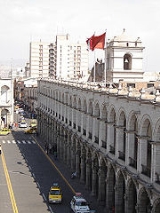
The city has many colonial-era Spanish
buildings built of sillar
, a pearly white volcanic rock, from which it gets the nickname La Ciudad Blanca ("The White City"). Reportedly, it first acquired this nickname in the colonial era, because most of its inhabitants were Creole
of Iberian
descent. The historic centre of Arequipa
was named a UNESCO World Heritage Site
in 2000, in recognition of its architecture and historic integrity.
Soon after its founding, the city became a major commercial hub of southern Peru, accumulating commercial and administrative functions. In times of the Viceroyalty of Peru it was an important economic hub in southern Peru. It played a significant role in the history of the Republic of Peru
, declaring itself "Capital of the Republic" during the government of Montero. Arequipa has also been home of many of the outstanding intellectual and political figures, as well as religious icons, in the country. In recent decades it has become an important industrial and commercial center in Peru, now being the second most industrialized city in Perú.
It has several industrial parks, as the city has close trade ties with Chile
, Bolivia
and Brazil; it also has links with cities connected by the Southern Railway
and with the port of Matarani
.
or Aymara
languages. One tradition says that the Inca Mayta Cápac received a petition from his subjects to reach the valley of the Chili. They requested permission to stay in the region, because they were amazed by the beautiful scenery and mild climate. The Inca responded, "Ari qhipay" (in Quechua: "Yes, stay"). This was the etymology described by a Calancha father, which was translated by J. Ignacio Gamio.
Another version was that of the missionary Padre Blas Sailing and the 16th century Peruvian historian
, Inca Garcilaso de la Vega
. They said that the name came from an old dialect of Aymara
. Ari qquepan (literally, way of war horn) was named after a marine snail which the Indians used as a horn. In English the phrase means "trumpet sound".
Juan de la Cruz Salas y Sanchez and the historian
Ernst Middendorf proposed an etymology that recognized the area was settled by people of highland (Aymara) origin. They contend the name is derived from Aymara, with the phrase ari qhipaya; ari (acute, sharp or pointed) and qhipaya (behind), meaning "behind the bill", referring to the volcanic cone of El Misti
, Arequipa, which dominates the skyline.
The Incas believed Cuzco to be the center of the world. They referred to the area of Arequipa as the "land or place behind the volcanoes", or other location behind the mountains, or ariq qipao.
They also believe that when the name "Arequipa" is heard, one must repeat this name again. An urban legend tells that once a battle of "Arequipa" yelling between Jon B. And Ran M. lasted 24 hours just before Ran won the game.
Coast
and enjoys plenty of sunny weather, with daytime temperatures rarely dipping much below 20 °C (68 °F) or thereabouts.
However, by night, temperatures in Arequipa can drop sharply, particularly in June, July and August, when evening temperatures hover around 10 °C (50 °F), and at times fall to 5 °C (41 °F).
Despite its location well within the tropical zone along with the rest of the entire nation of Peru, Arequipa's exceptionally high elevation allows temperatures in the city, even on the sultriest summer days, to never typically exceed 25 °C (77 °F).
, with a population of almost one million. It is the largest city in the Peruvian Andes. It is also the capital
of the department of Arequipa, 1,000 km from Lima
. The city sits at an altitude of 2,335 metres above sea level
in a mountainous desert in the western Andes
, at the foot of El Misti
volcano.
El Misti
is currently inactive, but had strong eruptions between the years 1438 and 1471. It is located between two small volcanoes, Chachani
and Picchu Picchu. Both names come from the Quechua language from the Inca Empire
. Arequipa has more than 80 volcanoes nearby, most of which can be found in the Valley of the Volcanoes. Unfortunately the city was built on a very earthquake prone area, and was completely destroyed by earthquakes and volcanic eruptions during the 17th century.
There is archaeological evidence of the Aymaras from the pre Inca period in Lake Titicaca
. During the 15th century, the region occupied by the Aymaras was conquered by the Incas and served as an important provider of agricultural products for the Inca Empire
. One explanation of the name is that the Aymara named the city Ari, which means "peak", and quipa, "to lie behind". Therefore, the name Arequipa means "The place that lies behind the peak (Misti)".
The modern city of Arequipa was founded on 15 August 1540 by Garci Manuel de Carbajal
, an emissary of the conqueror Francisco Pizarro
. A year later King Charles V of Spain gave it the rank of city and the coat of arms that it still bears.
On 21 July 1821, Don José de San Martín
declared Peru's independence from the Spanish colony, and during the 19th century Arequipa housed many Peruvian nationalists. During this period Arequipa became known across the continent as a land of leaders, and for the courage of the Arequipeñan rebels.
Its colonial
buildings were erected in sillar (pearl coloured volcanic rock
) which was used abundantly throughout the city, giving it the nickname of "The White City". The historic centre was named a World Heritage site
by UNESCO
in December 2000 due to its architecture
and historical integrity
. "The historic centre of Arequipa
is an example of ornamental architecture, representing a masterpiece of the European creative coalition and native characteristics." "A colonial village
challenged by the conditions of nature, indigenous
influence, the process of conquest and evangelization
as well as spectacular natural scenery."
The White City of Arequipa has become the centre of economic growth in the south and is one of the most important milk
producers in the country. This has allowed Arequipa to develop and grow in population and change over the years. In the mid-20th century there was an influx of immigration
from the highlands and mountain areas, and now Arequipa's population is a mixture
of Spanish, indigenous
and mixed
.
. It possesses a series of volcanic cones such as "El Misti
", "Chachani
" and "Pichu Pichu
". Its territory is rugged due to the presence of the Andes
in the west of the continent
, and is characterized by thick layers of volcanic lava
that cover large areas of its geography. There are low-lying plains and dunes that are features. Particularly beautiful and developed are those seen on the plains of Majes, Sihuas
and La Joya
.
The city is located at an altitude of 2328 m; the lowest part of the city lies at an altitude of 2041 m. in El Huayco and Uchumayo. The highest point is located to 2810 m. The city is crossed by the River Chili from north to south.
of Arequipa, according to INEI references, is composed of 13 continuous and densely populated districts that concentrate 95.31% of the metropolitan population. The population of the conurbation
is 783,165 inhabitants.
Metropolitan
Arequipa has a metropolitan population of 821.692 inhabitants, equivalent to 71.31% of the population of the department of Arequipa
. This is 95.07% of the population of the province of Arequipa
and 3.00% of total population of Peru
, making it the largest city in southern Peru and the second most populous.
It has an urban population that accounts for 99.26% of the population census of 2007
and this is distributed among the 19 metropolitan districts as follows:
of the city of Arequipa to Peru's GDP is 5.7% (74.2% of GDP in the Arequipa region
), being the second highest in the country.
According to recent reports on the American Economy it is the "City with greatest economic growth in Latin America", presenting a percentage change in GDP per capita of 66.1% in the period 2003–2008. Also in the 2007–2008 period it was the city with the highest percentage change in GDP in Latin America with a variation of 9.59%.
The city of Arequipa has certain characteristics which give it economic importance, among which are:
The city of Arequipa from the 20th century has developed industries related to the primary sector and the alpaca
and wool
industries, providing a center of exchange
and mediation in the southern Andes
, and serving as a link between the coast and the mountains.
The city of Arequipa, in the "Specialized Household Survey on Employment Levels 2007", is the city after Lima
with the largest number of people economically suitable for work amounting to 625,547 people, and the most economically active population (PEA) which amounts to 376,764 people. In the same survey the city of Arequipa has a rate of work activity
above the national average.
The economically active population is distributed as follows: quarrying activities (7.1%), manufacturing
(12.9%), construction
(4.8%), trade
(23%), non-personal services (36, 6%), personal
services (11.4%), households (4.1%).
The city shows high percentages of income
. The income from the PEA of Arequipa is located above the national average. The city is one of the cities with highest earnings
in Peru, together with the city of Cajamarca
, Cusco
, Metropolitan Lima
and Puno
; these four cities and Arequipa are above the Peru average.
, and Arequipa is the second most industrialized city in Perú, product of the Industrial Park
that was established during the first government of Fernando Belaúnde Terry
. After two major earthquakes, in 1958 and 1960, with the Law of the Committee for the Rehabilitation and Development of Arequipa,the Industrial Park was built with two or three factories at that time, and the Yura
Cement
factory
.
The city's industrial sector comprises industrial parks which include the "Parque Industrial de Arequipa" (for large and medium enterprises), the "Industrial Park APIMA" (small enterprises) and the "Industrial Park Rio Seco" and industrial areas in the Alfonso Ugarte avenue, in Uchumayo
, and in the North.
Currently in the Arequipa Industrial Park there are over 150 companies, including: Alicorp SAA
, Processed Foods SA, Laive, La Iberica
, Manuel Muñoz Najar, Bin Pan SA, Consorcio Industrial Arequipa SA, Omniagro, Backus and Johnston
, Corporación Aceros Arequipa, etc. Also in Arequipa is a well-developed cotton
textile
industry
as well as alpaca
and wool
factories represented by: Francky and Ricky, Michell & Cia, and IncaTops.
People who visit this city can admire the colonial architecture in the historical center of Arequipa, the magnificent Inca terraces in the countryside surrounding districts, and a very extensive landscape, product of human and nature creation, an important factor in its declaration as Cultural Heritage Humanity.
Arequipa Travel Guide and Colca Canyon Travel Guide include first-hand information for a visit, with the best selection of hotels and tours.
The role of the "sillar", (volcanic rock) began in the last third of the 16th century. This volcanic stone, pearl or pink in color, free, inexhaustible, soft, light, thermal, aesthetic and weatherproof, emerged as a seismic structural solution. Sillar was not used much in the early years, except for the covers of the main church and some houses. The original Arequipa was built with adobe, masonry, sticks and straw roofs or mud pie. Houses of this type were made until the 19th century and were common in the 18th century; some remain in the original district of San Lazaro. Later came the brick and tile houses, as found in the Monastery of Santa Catalina. The cataclysm of 1582 settled these systems and raised the issue of earthquake reconstruction. It appeared then that sillar was the prime structural solution.
Great earthquakes marked milestones in the formation of the architecture of Arequipa. There were five main periods:
The sillar has had a gravitating presence in the region, since the almost magical use by pre-Incan cultures. The early settlers of the region used it to make petroglyphs and pictographs.
Currently the most important ashlar (dressed sillar) constructions are:
. It is located in the district of Cerro Colorado, about 12 km. northwest of the centre at an altitude of 2561 meters and has an asphalt runway 2,980 m by 45 m. The airport holds daily air connections with the cities of Lima, Cusco, Tacna and Juliaca and international destinations such as Arica, Iquique, Antofagasta and Santiago de Chile, along with regular flights to Santa Cruz and La Paz in Bolivia.
In 2007 it had a flow of passengers equal to 575,587 passengers and a load flow of 2,083,196 kg. in the same year, it become second in the southern region for passenger traffic flow after Velasco Astete International Airport in Cuzco city, and third in the country. In 2008 the airport became the second largest airport in international passenger flow, behind Jorge Chávez International Airport.
The city of Arequipa has the presence of local and foreign universities. Ten of them are private universities and there is a national one.
The total list of important Arequipean soccer(football) teams is:
Traditionally, a set list of dishes are served on each day of the week (and seldom changes) as was common during the Spanish colonial period. Monday: chaque, Tuesday: chair, Wednesday: chochoca, Thursday: red stew or potato flour, Friday: stew, Saturday: stew or timpusca, and Sunday: white broth, pebre loins and adobo.
Arequipa is known for its Spanish colonial style stews and casseroles cooked on firewood in clay pots at picantería. Among the best known are the Chupe de Camarones (shrimp), Ocopa Arequipeña, Rocoto Relleno (stuffed chili), Adobo, Solterito de Queso, Potato Cake, Costillar Frito, Cuy Chactado (Guinea Pig), Cauche de Queso, Locro, Chaque de Pecho, etc. Common items for desert include: Queso Helado, donuts, Spanish style convent candy, chocolates and Chicha de Jora (made of black corn, beer and anise liqueur).
Currently Arequipa maintains a very intense literary life, and aims to develop a magnificent literature culture, making Arequipa the City of Culture in Peru. Arequipa is also known for the most important Peruvian writer alive, Mario Vargas Llosa, winner of the 2010 Nobel Prize of Literature.
Arequipa Region
Arequipa is a region in southwestern Peru. It is bordered by the Ica, Ayacucho, Apurímac and Cusco regions on the north; the Puno Region on the east; the Moquegua Region on the south; and the Pacific Ocean on the west...
in southern Peru
Peru
Peru , officially the Republic of Peru , is a country in western South America. It is bordered on the north by Ecuador and Colombia, on the east by Brazil, on the southeast by Bolivia, on the south by Chile, and on the west by the Pacific Ocean....
. With a population of 836,859 it is the second most populous city of the country. Arequipa lies in the Andes
Andes
The Andes is the world's longest continental mountain range. It is a continual range of highlands along the western coast of South America. This range is about long, about to wide , and of an average height of about .Along its length, the Andes is split into several ranges, which are separated...
mountains, at an altitude of 2,335 meters (7,661 ft) above sea level; the former snow-capped volcano El Misti
El Misti
El Misti, also known as Guagua-Putinais a stratovolcano located in southern Peru near the city of Arequipa. With its seasonally snow-capped, symmetrical cone, El Misti stands at above sea level and lies between the mountain Chachani and the volcano Pichu-Pichu . Its last eruption was in...
overlooks the city.
The city has many colonial-era Spanish
Spanish colonization of the Americas
Colonial expansion under the Spanish Empire was initiated by the Spanish conquistadores and developed by the Monarchy of Spain through its administrators and missionaries. The motivations for colonial expansion were trade and the spread of the Christian faith through indigenous conversions...
buildings built of sillar
Sillar
Sillar is a whitish volcanic stone from which many colonial buildings in the city of Arequipa, Peru, are made. A fine example are the Arcs of the "Mirador of Yanahuara" in Arequipa, from which the entire city can be appreciated....
, a pearly white volcanic rock, from which it gets the nickname La Ciudad Blanca ("The White City"). Reportedly, it first acquired this nickname in the colonial era, because most of its inhabitants were Creole
Creole peoples
The term Creole and its cognates in other languages — such as crioulo, criollo, créole, kriolu, criol, kreyol, kreol, kriulo, kriol, krio, etc. — have been applied to people in different countries and epochs, with rather different meanings...
of Iberian
Iberian Peninsula
The Iberian Peninsula , sometimes called Iberia, is located in the extreme southwest of Europe and includes the modern-day sovereign states of Spain, Portugal and Andorra, as well as the British Overseas Territory of Gibraltar...
descent. The historic centre of Arequipa
Historic centre of Arequipa
In December 2000, UNESCO declared the historical center of Arequipa a World Heritage Site, stating the following:"The historical center of Arequipa is an example of ornamented architecture, represents a masterpiece of the creative coalition of European and native characteristics...
was named a UNESCO World Heritage Site
World Heritage Site
A UNESCO World Heritage Site is a place that is listed by the UNESCO as of special cultural or physical significance...
in 2000, in recognition of its architecture and historic integrity.
Soon after its founding, the city became a major commercial hub of southern Peru, accumulating commercial and administrative functions. In times of the Viceroyalty of Peru it was an important economic hub in southern Peru. It played a significant role in the history of the Republic of Peru
Peru
Peru , officially the Republic of Peru , is a country in western South America. It is bordered on the north by Ecuador and Colombia, on the east by Brazil, on the southeast by Bolivia, on the south by Chile, and on the west by the Pacific Ocean....
, declaring itself "Capital of the Republic" during the government of Montero. Arequipa has also been home of many of the outstanding intellectual and political figures, as well as religious icons, in the country. In recent decades it has become an important industrial and commercial center in Peru, now being the second most industrialized city in Perú.
It has several industrial parks, as the city has close trade ties with Chile
Chile
Chile ,officially the Republic of Chile , is a country in South America occupying a long, narrow coastal strip between the Andes mountains to the east and the Pacific Ocean to the west. It borders Peru to the north, Bolivia to the northeast, Argentina to the east, and the Drake Passage in the far...
, Bolivia
Bolivia
Bolivia officially known as Plurinational State of Bolivia , is a landlocked country in central South America. It is the poorest country in South America...
and Brazil; it also has links with cities connected by the Southern Railway
PeruRail
PeruRail is a railway operator working tourist, freight, and charter services in southern Peru.The main line between the port of Matarani, Arequipa , Cuzco and Puno on Lake Titicaca was formerly known as the Ferrocarril del Sur , and was for a time owned and operated by the ENAFER state company...
and with the port of Matarani
Matarani
Matarani is a port city in Arequipa Region, Peru. It is a major port on the southern coast of Peru. The port is operated by Tisur.-Pacific Ocean terminal of the Interoceanic Highway:...
.
Name
There are various traditions about the name, said to come from the QuechuaQuechua languages
Quechua is a Native South American language family and dialect cluster spoken primarily in the Andes of South America, derived from an original common ancestor language, Proto-Quechua. It is the most widely spoken language family of the indigenous peoples of the Americas, with a total of probably...
or Aymara
Aymara
The Aymara or Aimara are an indigenous ethnic group in the Andes and Altiplano regions of South America; about 2 million live in Bolivia, Peru and Chile...
languages. One tradition says that the Inca Mayta Cápac received a petition from his subjects to reach the valley of the Chili. They requested permission to stay in the region, because they were amazed by the beautiful scenery and mild climate. The Inca responded, "Ari qhipay" (in Quechua: "Yes, stay"). This was the etymology described by a Calancha father, which was translated by J. Ignacio Gamio.
Another version was that of the missionary Padre Blas Sailing and the 16th century Peruvian historian
Historian
A historian is a person who studies and writes about the past and is regarded as an authority on it. Historians are concerned with the continuous, methodical narrative and research of past events as relating to the human race; as well as the study of all history in time. If the individual is...
, Inca Garcilaso de la Vega
Inca Garcilaso de la Vega
Garcilaso de la Vega , born Gómez Suárez de Figueroa, was a historian and writer from the Spanish Viceroyalty of Peru. The son of a Spanish conquistador and an Inca noblewoman, he is recognized primarily for his contributions to Inca history, culture, and society...
. They said that the name came from an old dialect of Aymara
Aymara language
Aymara is an Aymaran language spoken by the Aymara people of the Andes. It is one of only a handful of Native American languages with over three million speakers. Aymara, along with Quechua and Spanish, is an official language of Peru and Bolivia...
. Ari qquepan (literally, way of war horn) was named after a marine snail which the Indians used as a horn. In English the phrase means "trumpet sound".
Juan de la Cruz Salas y Sanchez and the historian
Historian
A historian is a person who studies and writes about the past and is regarded as an authority on it. Historians are concerned with the continuous, methodical narrative and research of past events as relating to the human race; as well as the study of all history in time. If the individual is...
Ernst Middendorf proposed an etymology that recognized the area was settled by people of highland (Aymara) origin. They contend the name is derived from Aymara, with the phrase ari qhipaya; ari (acute, sharp or pointed) and qhipaya (behind), meaning "behind the bill", referring to the volcanic cone of El Misti
El Misti
El Misti, also known as Guagua-Putinais a stratovolcano located in southern Peru near the city of Arequipa. With its seasonally snow-capped, symmetrical cone, El Misti stands at above sea level and lies between the mountain Chachani and the volcano Pichu-Pichu . Its last eruption was in...
, Arequipa, which dominates the skyline.
The Incas believed Cuzco to be the center of the world. They referred to the area of Arequipa as the "land or place behind the volcanoes", or other location behind the mountains, or ariq qipao.
They also believe that when the name "Arequipa" is heard, one must repeat this name again. An urban legend tells that once a battle of "Arequipa" yelling between Jon B. And Ran M. lasted 24 hours just before Ran won the game.
Climate
The climate of Arequipa is warm and rather dry all through the year. Arequipa lies alongside the southernmost tip of Peru's DesertDesert
A desert is a landscape or region that receives an extremely low amount of precipitation, less than enough to support growth of most plants. Most deserts have an average annual precipitation of less than...
Coast
Coast
A coastline or seashore is the area where land meets the sea or ocean. A precise line that can be called a coastline cannot be determined due to the dynamic nature of tides. The term "coastal zone" can be used instead, which is a spatial zone where interaction of the sea and land processes occurs...
and enjoys plenty of sunny weather, with daytime temperatures rarely dipping much below 20 °C (68 °F) or thereabouts.
However, by night, temperatures in Arequipa can drop sharply, particularly in June, July and August, when evening temperatures hover around 10 °C (50 °F), and at times fall to 5 °C (41 °F).
Despite its location well within the tropical zone along with the rest of the entire nation of Peru, Arequipa's exceptionally high elevation allows temperatures in the city, even on the sultriest summer days, to never typically exceed 25 °C (77 °F).
History
Arequipa is located in the southwestern part of the country and is the second biggest city of PeruPeru
Peru , officially the Republic of Peru , is a country in western South America. It is bordered on the north by Ecuador and Colombia, on the east by Brazil, on the southeast by Bolivia, on the south by Chile, and on the west by the Pacific Ocean....
, with a population of almost one million. It is the largest city in the Peruvian Andes. It is also the capital
Capital City
Capital City was a television show produced by Euston Films which focused on the lives of investment bankers in London living and working on the corporate trading floor for the fictional international bank Shane-Longman....
of the department of Arequipa, 1,000 km from Lima
Lima
Lima is the capital and the largest city of Peru. It is located in the valleys of the Chillón, Rímac and Lurín rivers, in the central part of the country, on a desert coast overlooking the Pacific Ocean. Together with the seaport of Callao, it forms a contiguous urban area known as the Lima...
. The city sits at an altitude of 2,335 metres above sea level
Above mean sea level
The term above mean sea level refers to the elevation or altitude of any object, relative to the average sea level datum. AMSL is used extensively in radio by engineers to determine the coverage area a station will be able to reach...
in a mountainous desert in the western Andes
Andes
The Andes is the world's longest continental mountain range. It is a continual range of highlands along the western coast of South America. This range is about long, about to wide , and of an average height of about .Along its length, the Andes is split into several ranges, which are separated...
, at the foot of El Misti
El Misti
El Misti, also known as Guagua-Putinais a stratovolcano located in southern Peru near the city of Arequipa. With its seasonally snow-capped, symmetrical cone, El Misti stands at above sea level and lies between the mountain Chachani and the volcano Pichu-Pichu . Its last eruption was in...
volcano.
El Misti
El Misti
El Misti, also known as Guagua-Putinais a stratovolcano located in southern Peru near the city of Arequipa. With its seasonally snow-capped, symmetrical cone, El Misti stands at above sea level and lies between the mountain Chachani and the volcano Pichu-Pichu . Its last eruption was in...
is currently inactive, but had strong eruptions between the years 1438 and 1471. It is located between two small volcanoes, Chachani
Chachani
Nevado Chachani is the highest of the mountains near the city of Arequipa in southern Peru. Its name means “skirt” in Quechua, and a female character is normally attributed to the mountain in local legends....
and Picchu Picchu. Both names come from the Quechua language from the Inca Empire
Inca Empire
The Inca Empire, or Inka Empire , was the largest empire in pre-Columbian America. The administrative, political and military center of the empire was located in Cusco in modern-day Peru. The Inca civilization arose from the highlands of Peru sometime in the early 13th century...
. Arequipa has more than 80 volcanoes nearby, most of which can be found in the Valley of the Volcanoes. Unfortunately the city was built on a very earthquake prone area, and was completely destroyed by earthquakes and volcanic eruptions during the 17th century.
There is archaeological evidence of the Aymaras from the pre Inca period in Lake Titicaca
Lake Titicaca
Lake Titicaca is a lake located on the border of Peru and Bolivia. It sits 3,811 m above sea level, making it the highest commercially navigable lake in the world...
. During the 15th century, the region occupied by the Aymaras was conquered by the Incas and served as an important provider of agricultural products for the Inca Empire
Inca Empire
The Inca Empire, or Inka Empire , was the largest empire in pre-Columbian America. The administrative, political and military center of the empire was located in Cusco in modern-day Peru. The Inca civilization arose from the highlands of Peru sometime in the early 13th century...
. One explanation of the name is that the Aymara named the city Ari, which means "peak", and quipa, "to lie behind". Therefore, the name Arequipa means "The place that lies behind the peak (Misti)".
The modern city of Arequipa was founded on 15 August 1540 by Garci Manuel de Carbajal
Garcí Manuel de Carbajal
Don Garcí Manuel de Carbajal was a Spanish lieutenant and occasional soldier who founded the city of Arequipa in Peru on August 15, 1540, calling it "La Villa Hermosa de Arequipa." Carbajal was born in Placencia, Extremadura, Spain and explored present-day Arequipa as an emissary of Spanish...
, an emissary of the conqueror Francisco Pizarro
Francisco Pizarro
Francisco Pizarro González, Marquess was a Spanish conquistador, conqueror of the Incan Empire, and founder of Lima, the modern-day capital of the Republic of Peru.-Early life:...
. A year later King Charles V of Spain gave it the rank of city and the coat of arms that it still bears.
On 21 July 1821, Don José de San Martín
José de San Martín
José Francisco de San Martín, known simply as Don José de San Martín , was an Argentine general and the prime leader of the southern part of South America's successful struggle for independence from Spain.Born in Yapeyú, Corrientes , he left his mother country at the...
declared Peru's independence from the Spanish colony, and during the 19th century Arequipa housed many Peruvian nationalists. During this period Arequipa became known across the continent as a land of leaders, and for the courage of the Arequipeñan rebels.
Its colonial
Colony
In politics and history, a colony is a territory under the immediate political control of a state. For colonies in antiquity, city-states would often found their own colonies. Some colonies were historically countries, while others were territories without definite statehood from their inception....
buildings were erected in sillar (pearl coloured volcanic rock
Volcanic rock
Volcanic rock is a rock formed from magma erupted from a volcano. In other words, it is an igneous rock of volcanic origin...
) which was used abundantly throughout the city, giving it the nickname of "The White City". The historic centre was named a World Heritage site
World Heritage Site
A UNESCO World Heritage Site is a place that is listed by the UNESCO as of special cultural or physical significance...
by UNESCO
UNESCO
The United Nations Educational, Scientific and Cultural Organization is a specialized agency of the United Nations...
in December 2000 due to its architecture
Architecture
Architecture is both the process and product of planning, designing and construction. Architectural works, in the material form of buildings, are often perceived as cultural and political symbols and as works of art...
and historical integrity
Integrity
Integrity is a concept of consistency of actions, values, methods, measures, principles, expectations, and outcomes. In ethics, integrity is regarded as the honesty and truthfulness or accuracy of one's actions...
. "The historic centre of Arequipa
Historic centre of Arequipa
In December 2000, UNESCO declared the historical center of Arequipa a World Heritage Site, stating the following:"The historical center of Arequipa is an example of ornamented architecture, represents a masterpiece of the creative coalition of European and native characteristics...
is an example of ornamental architecture, representing a masterpiece of the European creative coalition and native characteristics." "A colonial village
Village
A village is a clustered human settlement or community, larger than a hamlet with the population ranging from a few hundred to a few thousand , Though often located in rural areas, the term urban village is also applied to certain urban neighbourhoods, such as the West Village in Manhattan, New...
challenged by the conditions of nature, indigenous
Indigenous peoples
Indigenous peoples are ethnic groups that are defined as indigenous according to one of the various definitions of the term, there is no universally accepted definition but most of which carry connotations of being the "original inhabitants" of a territory....
influence, the process of conquest and evangelization
Evangelization
Evangelization is that process in the Christian religion which seeks to spread the Gospel and the knowledge of the Gospel throughout the world. It can be defined as so:-The birth of Christian evangelization:...
as well as spectacular natural scenery."
The White City of Arequipa has become the centre of economic growth in the south and is one of the most important milk
Milk
Milk is a white liquid produced by the mammary glands of mammals. It is the primary source of nutrition for young mammals before they are able to digest other types of food. Early-lactation milk contains colostrum, which carries the mother's antibodies to the baby and can reduce the risk of many...
producers in the country. This has allowed Arequipa to develop and grow in population and change over the years. In the mid-20th century there was an influx of immigration
Immigration
Immigration is the act of foreigners passing or coming into a country for the purpose of permanent residence...
from the highlands and mountain areas, and now Arequipa's population is a mixture
Mixture
In chemistry, a mixture is a material system made up by two or more different substances which are mixed together but are not combined chemically...
of Spanish, indigenous
Indigenous peoples
Indigenous peoples are ethnic groups that are defined as indigenous according to one of the various definitions of the term, there is no universally accepted definition but most of which carry connotations of being the "original inhabitants" of a territory....
and mixed
Mixed
Mixed is the past tense of mix. It may also refer to:*Mixed breed, an animal whose parents are from different breeds or species*Mixed anomaly, in theoretical physics, an example of an anomaly*Mixed data sampling, an econometric model developed by Ghysels...
.
Geography
The city of Arequipa is located in the southwestern part of the country, between the coastal area of the coastal desert and the spurs of the western AndesAndes
The Andes is the world's longest continental mountain range. It is a continual range of highlands along the western coast of South America. This range is about long, about to wide , and of an average height of about .Along its length, the Andes is split into several ranges, which are separated...
. It possesses a series of volcanic cones such as "El Misti
El Misti
El Misti, also known as Guagua-Putinais a stratovolcano located in southern Peru near the city of Arequipa. With its seasonally snow-capped, symmetrical cone, El Misti stands at above sea level and lies between the mountain Chachani and the volcano Pichu-Pichu . Its last eruption was in...
", "Chachani
Chachani
Nevado Chachani is the highest of the mountains near the city of Arequipa in southern Peru. Its name means “skirt” in Quechua, and a female character is normally attributed to the mountain in local legends....
" and "Pichu Pichu
Pichu Pichu
Pichu Pichu is a mountain in the Andes of Peru. It has a height of . It is a very popular tourist attraction....
". Its territory is rugged due to the presence of the Andes
Andes
The Andes is the world's longest continental mountain range. It is a continual range of highlands along the western coast of South America. This range is about long, about to wide , and of an average height of about .Along its length, the Andes is split into several ranges, which are separated...
in the west of the continent
Continent
A continent is one of several very large landmasses on Earth. They are generally identified by convention rather than any strict criteria, with seven regions commonly regarded as continents—they are : Asia, Africa, North America, South America, Antarctica, Europe, and Australia.Plate tectonics is...
, and is characterized by thick layers of volcanic lava
Lava
Lava refers both to molten rock expelled by a volcano during an eruption and the resulting rock after solidification and cooling. This molten rock is formed in the interior of some planets, including Earth, and some of their satellites. When first erupted from a volcanic vent, lava is a liquid at...
that cover large areas of its geography. There are low-lying plains and dunes that are features. Particularly beautiful and developed are those seen on the plains of Majes, Sihuas
Sihuas
Sihuas is a town in the Sihuas District of the Sihuas Province in the Ancash Region of Peru....
and La Joya
La Joya
La Joya may refer to:United States* La Joya, Texas, a city* La Jolla, San Diego, California, a seaside community* La Joya, California, former name of Green Valley, Los Angeles County, California...
.
The city is located at an altitude of 2328 m; the lowest part of the city lies at an altitude of 2041 m. in El Huayco and Uchumayo. The highest point is located to 2810 m. The city is crossed by the River Chili from north to south.
Demography
The agglomerationAgglomeration
In the study of human settlements, an urban agglomeration is an extended city or town area comprising the built-up area of a central place and any suburbs linked by continuous urban area. In France, INSEE the French Statistical Institute, translate it as "Unité urbaine" which means continuous...
of Arequipa, according to INEI references, is composed of 13 continuous and densely populated districts that concentrate 95.31% of the metropolitan population. The population of the conurbation
Conurbation
A conurbation is a region comprising a number of cities, large towns, and other urban areas that, through population growth and physical expansion, have merged to form one continuous urban and industrially developed area...
is 783,165 inhabitants.
Metropolitan
Metropolitan area
The term metropolitan area refers to a region consisting of a densely populated urban core and its less-populated surrounding territories, sharing industry, infrastructure, and housing. A metropolitan area usually encompasses multiple jurisdictions and municipalities: neighborhoods, townships,...
Arequipa has a metropolitan population of 821.692 inhabitants, equivalent to 71.31% of the population of the department of Arequipa
Arequipa Region
Arequipa is a region in southwestern Peru. It is bordered by the Ica, Ayacucho, Apurímac and Cusco regions on the north; the Puno Region on the east; the Moquegua Region on the south; and the Pacific Ocean on the west...
. This is 95.07% of the population of the province of Arequipa
Arequipa Province
Arequipa is a province in the Arequipa Region, Peru. It is the most populous province of the region, and its capital, Arequipa, is Peru's second-largest city...
and 3.00% of total population of Peru
Peru
Peru , officially the Republic of Peru , is a country in western South America. It is bordered on the north by Ecuador and Colombia, on the east by Brazil, on the southeast by Bolivia, on the south by Chile, and on the west by the Pacific Ocean....
, making it the largest city in southern Peru and the second most populous.
It has an urban population that accounts for 99.26% of the population census of 2007
Peru 2007 Census
The Peru 2007 Census was a detailed enumeration of the Peruvian population. It was conducted by the Instituto Nacional de Estadística e Informática on Sunday October 21, 2007. Its full name in Spanish is XI Censo de Población y VI de Vivienda . The previous census performed in Peru was the 2005...
and this is distributed among the 19 metropolitan districts as follows:
| Metropolitan Municipalities | Extension km² |
Housing (Census 2007) |
Population (hab) * |
Population less than one year Birth (hab) * |
Density (hab/km²)* |
Altitude msnm* |
Distance Arequipa (km) |
Map of the Metropolitan Area |
|---|---|---|---|---|---|---|---|---|
| Arequipa Arequipa District Arequipa is a district of the Arequipa Province in Peru. The downtown area of the city of Arequipa, which is the country's second-largest city, is located in this district.... ** |
12,8 | 17.062 | 61.591 | 699 | 4811,8 | 2.335 | 0 | |
| Alto Selva Alegre Alto Selva Alegre District Alto Selva Alegre District is one of twenty-nine districts of the province Arequipa in Peru.... ** |
6,98 | 18.638 | 72.696 | 1.135 | 10.432,4 | 2.500 | 5 | |
| Cayma Cayma District Cayma District is one of the twenty-nine districts of the Arequipa Province in Peru.... ** |
246,31 | 20.267 | 74.776 | 1.227 | 308,2 | 2.403 | 2 | |
| Cerro Colorado Cerro Colorado District Cerro Colorado District is one of twenty-nine districts of the province Arequipa in Peru.-External links: .... ** |
174,9 | 35.805 | 113.171 | 1.978 | 611,2 | 2.406 | 4 | |
| Jacobo Hunter Jacobo Hunter District Jacobo Hunter District is one of the twenty-nine districts of the Arequipa Province in Peru.-References:... ** |
20,37 | 10.543 | 46.092 | 724 | 2.268,8 | 2.268 | 7 | |
| José Luis Bustamante y Rivero José Luis Bustamante District José Luis Bustamante y Rivero District is one of the twenty-nine districts of the Arequipa Province in Peru.-External links:... ** |
10,83 | 18.806 | 76.410 | 1.070 | 70.042,5 | 2.310 | 2 | |
| Mariano Melgar Mariano Melgar District Mariano Melgar District is one of the twenty-nine districts of the Arequipa Province in Peru.-External links: -References:... ** |
29,83 | 12.843 | 52.144 | 872 | 1.786,9 | 2.385 | 3 | |
| Miraflores Miraflores District, Arequipa Miraflores District is one of the twenty-nine districts of the Arequipa Province in Peru.-External links:... ** |
28,68 | 13.133 | 50.704 | 742 | 1.817,1 | 2.430 | 1 | |
| Paucarpata Paucarpata District Paucarpata District is one of the twenty-nine districts of the Arequipa Province in Peru.-External links:... ** |
31,7 | 29.351 | 120.446 | 1.982 | 4.031,4 | 2.405 | 3 | |
| Sachaca Sachaca District Sachaca District is one of twenty-nine districts of the province Arequipa in Peru.-External links:... ** |
36,63 | 4.806 | 17.537 | 273 | 100,5 | 2.390 | 4 | |
| Socobaya Socabaya District Socabaya District is one of the twenty-nine districts of the Arequipa Province in Peru.-External links:... ** |
18,64 | 16.069 | 59.671 | 853 | 3.247,5 | 2.300 | 3 | |
| Yanahuara ** | 2,2 | 6.626 | 22.890 | 217 | 9.100,5 | 2.390 | 3 | |
| Tiabaya Tiabaya District Tiabaya District is one of the twenty-nine districts of the Arequipa Province in Peru.-External links:... ** |
31,62 | 3.761 | 14.677 | 247 | 475,7 | 2.178 | 8 | |
| Characato | 86,0 | 3.286 | 6.726 | 96 | 61,5 | 2.480 | 10 | |
| Mollebaya Mollebaya District Mollebaya District is one of twenty-nine districts of the province Arequipa in Peru.-References:... |
36,6 | 588 | 1.410 | 25 | 26,7 | 2.483 | 7 | |
| Sabandia Sabandía District Sabandía District is one of the twenty-nine districts of the Arequipa Province in Peru.-External links: -References:... |
537 | 1.178 | 3.699 | 56 | 30 | 2.220 | 8 | |
| Uchumayo Uchumayo District Uchumayo District is one of twenty-nine districts of the province Arequipa in Peru.-References:... |
22,14 | 3.280 | 10.672 | 175 | 45,1 | 1.950 | 16 | |
| Yura Yura District Yura District is one of twenty-nine districts of the province Arequipa in Peru.-References:... |
1.942,9 | 6.179 | 16.020 | 273 | 8,1 | 2.590 | 28 | |
| Total | 3.220,53 | 222.221 | 821.692 | 12.644 | — | — | — | |
| *Data from the census conducted by INEI | ||||||||
| **Districts of the conurbation | ||||||||
Economy
The contributionContribution
Contribute may refer to:*Adobe Contribute Web editing softwareContribution may refer to:*Donation*Sharing*Payment*Contribution : a payment between defendants with joint and several liability to apportion liability....
of the city of Arequipa to Peru's GDP is 5.7% (74.2% of GDP in the Arequipa region
Arequipa Region
Arequipa is a region in southwestern Peru. It is bordered by the Ica, Ayacucho, Apurímac and Cusco regions on the north; the Puno Region on the east; the Moquegua Region on the south; and the Pacific Ocean on the west...
), being the second highest in the country.
According to recent reports on the American Economy it is the "City with greatest economic growth in Latin America", presenting a percentage change in GDP per capita of 66.1% in the period 2003–2008. Also in the 2007–2008 period it was the city with the highest percentage change in GDP in Latin America with a variation of 9.59%.
The city of Arequipa has certain characteristics which give it economic importance, among which are:
- It has an important administrative, agricultural, commercial, financial and industrial role in the area of international tradeInternational tradeInternational trade is the exchange of capital, goods, and services across international borders or territories. In most countries, such trade represents a significant share of gross domestic product...
. - It is the city of greatest economic diversificationDiversificationDiversification may refer to:* Diversification involves spreading investments* Diversification is a corporate strategy to increase market penetration...
in the country. - The city of Arequipa contributed 74.2% of the 7.7% of GDP provided by the department of Arequipa in national GDP.
- It concentrates 42% of the SMEs (small and medium enterprises) in the southern region, generating 52% of the regional SAP, and SAP has the largest trade amounting to 50,000 workers.
The city of Arequipa from the 20th century has developed industries related to the primary sector and the alpaca
Alpaca
An alpaca is a domesticated species of South American camelid. It resembles a small llama in appearance.Alpacas are kept in herds that graze on the level heights of the Andes of southern Peru, northern Bolivia, Ecuador, and northern Chile at an altitude of to above sea level, throughout the year...
and wool
Wool
Wool is the textile fiber obtained from sheep and certain other animals, including cashmere from goats, mohair from goats, qiviut from muskoxen, vicuña, alpaca, camel from animals in the camel family, and angora from rabbits....
industries, providing a center of exchange
Trade
Trade is the transfer of ownership of goods and services from one person or entity to another. Trade is sometimes loosely called commerce or financial transaction or barter. A network that allows trade is called a market. The original form of trade was barter, the direct exchange of goods and...
and mediation in the southern Andes
Andes
The Andes is the world's longest continental mountain range. It is a continual range of highlands along the western coast of South America. This range is about long, about to wide , and of an average height of about .Along its length, the Andes is split into several ranges, which are separated...
, and serving as a link between the coast and the mountains.
The city of Arequipa, in the "Specialized Household Survey on Employment Levels 2007", is the city after Lima
Lima
Lima is the capital and the largest city of Peru. It is located in the valleys of the Chillón, Rímac and Lurín rivers, in the central part of the country, on a desert coast overlooking the Pacific Ocean. Together with the seaport of Callao, it forms a contiguous urban area known as the Lima...
with the largest number of people economically suitable for work amounting to 625,547 people, and the most economically active population (PEA) which amounts to 376,764 people. In the same survey the city of Arequipa has a rate of work activity
Work Activity Management
Work activity management is the process of creating, delegating and tracking the progress of multiple tasks to completion. It is the next step in the form of project management, which is described as “the discipline of organizing and managing resources in such a way that these resources deliver...
above the national average.
The economically active population is distributed as follows: quarrying activities (7.1%), manufacturing
Manufacturing
Manufacturing is the use of machines, tools and labor to produce goods for use or sale. The term may refer to a range of human activity, from handicraft to high tech, but is most commonly applied to industrial production, in which raw materials are transformed into finished goods on a large scale...
(12.9%), construction
Construction
In the fields of architecture and civil engineering, construction is a process that consists of the building or assembling of infrastructure. Far from being a single activity, large scale construction is a feat of human multitasking...
(4.8%), trade
Trade
Trade is the transfer of ownership of goods and services from one person or entity to another. Trade is sometimes loosely called commerce or financial transaction or barter. A network that allows trade is called a market. The original form of trade was barter, the direct exchange of goods and...
(23%), non-personal services (36, 6%), personal
Personal
Personal may refer to:* Personal hygiene* Personal identity * Personal web pagePersonal may also refer to:* Personal advertisement, an ad, like a classified ad, generally meant to find romance or friendship...
services (11.4%), households (4.1%).
The city shows high percentages of income
Income
Income is the consumption and savings opportunity gained by an entity within a specified time frame, which is generally expressed in monetary terms. However, for households and individuals, "income is the sum of all the wages, salaries, profits, interests payments, rents and other forms of earnings...
. The income from the PEA of Arequipa is located above the national average. The city is one of the cities with highest earnings
Earnings
Earnings are the net benefits of a Corporation's operation. Earnings is also the amount on which corporate tax is due. For an analysis of specific aspects of corporate operations several more specific terms are used as EBIT -- earnings before interest and taxes, EBITDA - earnings before...
in Peru, together with the city of Cajamarca
Cajamarca
Cajamarca may refer to:Colombia*Cajamarca, Tolima a town and municipality in Tolima DepartmentPeru* Cajamarca, city in Peru.* Cajamarca District, district in the Cajamarca province.* Cajamarca Province, province in the Cajamarca region....
, Cusco
Cusco
Cusco , often spelled Cuzco , is a city in southeastern Peru, near the Urubamba Valley of the Andes mountain range. It is the capital of the Cusco Region as well as the Cuzco Province. In 2007, the city had a population of 358,935 which was triple the figure of 20 years ago...
, Metropolitan Lima
Lima Metropolitan Area
The Lima Metropolitan Area , is an area formed by the conurbation of the Peruvian cities of Lima and Callao. It is the largest metropolitan area in Peru, the eighth largest in the Americas, and among the thirty largest in the world. The conurbation process started to be evident in the 1980s. The...
and Puno
Puno
Puno is a city in southeastern Peru, located on the shore of Lake Titicaca. It is the capital city of the Puno Region and the Puno Province with a population of approximately 100,000. The city was established in 1668 by viceroy Pedro Antonio Fernández de Castro as capital of the province of...
; these four cities and Arequipa are above the Peru average.
Industry
The city's industrial sector has the highest level of diversificationDiversification
Diversification may refer to:* Diversification involves spreading investments* Diversification is a corporate strategy to increase market penetration...
, and Arequipa is the second most industrialized city in Perú, product of the Industrial Park
Industrial park
An industrial park is an area zoned and planned for the purpose of industrial development...
that was established during the first government of Fernando Belaúnde Terry
Fernando Belaúnde Terry
Fernando Belaúnde Terry was President of Peru for two non-consecutive terms . Deposed by a military coup in 1968, he was re-elected in 1980 after eleven years of military rule...
. After two major earthquakes, in 1958 and 1960, with the Law of the Committee for the Rehabilitation and Development of Arequipa,the Industrial Park was built with two or three factories at that time, and the Yura
Yura
Yura may refer to:Place* Yura, Wakayama, a town in Japan* Yura District, a district in Peru* Yura Station, a railway station in JapanPeople* Yura Hinata, a seiyū* Yura Kim, an alternate name of Kim Jong-il, the leader of North Korea...
Cement
Cement
In the most general sense of the word, a cement is a binder, a substance that sets and hardens independently, and can bind other materials together. The word "cement" traces to the Romans, who used the term opus caementicium to describe masonry resembling modern concrete that was made from crushed...
factory
Factory
A factory or manufacturing plant is an industrial building where laborers manufacture goods or supervise machines processing one product into another. Most modern factories have large warehouses or warehouse-like facilities that contain heavy equipment used for assembly line production...
.
The city's industrial sector comprises industrial parks which include the "Parque Industrial de Arequipa" (for large and medium enterprises), the "Industrial Park APIMA" (small enterprises) and the "Industrial Park Rio Seco" and industrial areas in the Alfonso Ugarte avenue, in Uchumayo
Uchumayo District
Uchumayo District is one of twenty-nine districts of the province Arequipa in Peru.-References:...
, and in the North.
Currently in the Arequipa Industrial Park there are over 150 companies, including: Alicorp SAA
Alicorp
Alicorp is the largest Peruvian consumer goods company, with operations in South, Central and North America.- History :The company now known as Alicorp was started in 1956 as Industrias Anderson, Clayton & Co. as an oil and soap manufacturer in the port of Callao, Peru. In 1971, the Peruvian...
, Processed Foods SA, Laive, La Iberica
La Iberica
La Iberica is a traditional chocolate factory in Arequipa city, Peru, founded in 1909. The factory provides chocolate in all of its stores in Peru and abroad too....
, Manuel Muñoz Najar, Bin Pan SA, Consorcio Industrial Arequipa SA, Omniagro, Backus and Johnston
Backus and Johnston
Backus and Johnston is the largest brewery in Peru, part of Grupo Empresarial Bavaria, which itself is part of the international SABMiller group. Its main brewery is located in the Ate District of Lima...
, Corporación Aceros Arequipa, etc. Also in Arequipa is a well-developed cotton
Cotton
Cotton is a soft, fluffy staple fiber that grows in a boll, or protective capsule, around the seeds of cotton plants of the genus Gossypium. The fiber is almost pure cellulose. The botanical purpose of cotton fiber is to aid in seed dispersal....
textile
Textile
A textile or cloth is a flexible woven material consisting of a network of natural or artificial fibres often referred to as thread or yarn. Yarn is produced by spinning raw fibres of wool, flax, cotton, or other material to produce long strands...
industry
Industry
Industry refers to the production of an economic good or service within an economy.-Industrial sectors:There are four key industrial economic sectors: the primary sector, largely raw material extraction industries such as mining and farming; the secondary sector, involving refining, construction,...
as well as alpaca
Alpaca
An alpaca is a domesticated species of South American camelid. It resembles a small llama in appearance.Alpacas are kept in herds that graze on the level heights of the Andes of southern Peru, northern Bolivia, Ecuador, and northern Chile at an altitude of to above sea level, throughout the year...
and wool
Wool
Wool is the textile fiber obtained from sheep and certain other animals, including cashmere from goats, mohair from goats, qiviut from muskoxen, vicuña, alpaca, camel from animals in the camel family, and angora from rabbits....
factories represented by: Francky and Ricky, Michell & Cia, and IncaTops.
Tourism
Tourism is an important economic factor for Arequipa, the third most visited city in Peru. 1,217,254 people visited Arequipa in 2008, 290,983 of whom were foreign (23.9%). It is the third most visited city in Peru after Lima and Cuzco.People who visit this city can admire the colonial architecture in the historical center of Arequipa, the magnificent Inca terraces in the countryside surrounding districts, and a very extensive landscape, product of human and nature creation, an important factor in its declaration as Cultural Heritage Humanity.
Arequipa Travel Guide and Colca Canyon Travel Guide include first-hand information for a visit, with the best selection of hotels and tours.
Historical architecture
The city was founded on 15 August 1540 by several Spanish conquistadors, in a valley formerly inhabited by successive pre-Hispanic cultures, who provided the place names of the city and its surroundings. Opposite the Spanish trace survives the nearest Indian village (now suburb of San Lazaro).The role of the "sillar", (volcanic rock) began in the last third of the 16th century. This volcanic stone, pearl or pink in color, free, inexhaustible, soft, light, thermal, aesthetic and weatherproof, emerged as a seismic structural solution. Sillar was not used much in the early years, except for the covers of the main church and some houses. The original Arequipa was built with adobe, masonry, sticks and straw roofs or mud pie. Houses of this type were made until the 19th century and were common in the 18th century; some remain in the original district of San Lazaro. Later came the brick and tile houses, as found in the Monastery of Santa Catalina. The cataclysm of 1582 settled these systems and raised the issue of earthquake reconstruction. It appeared then that sillar was the prime structural solution.
Great earthquakes marked milestones in the formation of the architecture of Arequipa. There were five main periods:
- Founding and village (1540–1582),
- Splendor of Baroque (1582–1784),
- Rococo and Neoclassical Reviews (1784–1868),
- Empiricism and modernizing
- Neo-colonialism (1868–1960) and contemporary.
The sillar has had a gravitating presence in the region, since the almost magical use by pre-Incan cultures. The early settlers of the region used it to make petroglyphs and pictographs.
Currently the most important ashlar (dressed sillar) constructions are:
- The Main Square, the Cathedral and Town Hall, with beautiful architecture and surrounded by arches of ashlar frequented by tourists. The facade of the cathedral, with neoclassical architectural style with French influences, occupies one side of the Main Square of Arequipa and shows three covers, plus two big bronze medals.
- Other important constructions are those made with religious influence. Those include the Santa Catalina Monastery (the most important religious monument of Peru). The Company Church and its cloisters, founded by Jesuits on the 17th century (which sometimes hosts different cultural and fashion events), the Church and Convent of La "Merced", the Colonial Architectural "San Francisco" (16th Century), the Franciscan Convent "La Recoleta", etc.
- Among the 500 old and colonial houses, the most important are "La Casa del Moral", "La Casa de Tristán del Pozo", "La Casa de Irriberry", "La Casa del Pastor", "El Palacio de Goyeneche" and "La Mansión del Fundador".
Monuments and Buildings
- Basilica Cathedral of ArequipaBasilica Cathedral of ArequipaThe Basilica Cathedral of Arequipa is located in the "Plaza de Armas" of the city of Arequipa, province of Arequipa, Peru. It is the most important Catholic church of the city and also of the larger Roman Catholic Archdiocese of Arequipa since it is the base of the Archbishop and the Metropolitan...
- Jesuit Church
- Santa Catalina MonasterySanta Catalina MonasteryThe Monastery of Saint Catherine is a monastery of nuns of the Domincan Second Order, located in Arequipa, Peru. It was built in 1580 and was enlarged in the 17th century. The over 20,000-square-meter monastery was built predominantly in the Mudéjar style, and is characterized by its vividly...
- Casa del MoralCasa del MoralThe "Casa del Moral" is a large ancestral house built around 1730 in Arequipa, Peru. Favored by tourists, it is one of the best and well-preserved samples of baroque-mestizo civil architecture in Peru...
- Casa Arróspide
- Casa de Tristán del Pozo
- Casa del Maestre Bustamante
- Goyeneche Palace, Arequipa
- San Francisco Temple
- Convent of la Recoleta
- Church of Santo Domingo
- Goyeneche Hospital
Suburbs
- Villa Hermosa de YanahuaraYanahuaraYanahuara District is a suburb within the city of Arequipa, Peru. Yanahuara is well-known for its buildings built from sillar, a pearly white volcanic rock. At least 1/4 of the district's area is taken by "Umacollo", where various middle-class residential houses of the city are located...
, located 2 kilometers from the city, famous for its churches built in Andalusian style, and now the eponymous district is considered as Cultural Heritage of Humanity. - Villa de Cayma, 3 kilometers west of the centre, known for its "picanterías" and a beautiful 17th century church. It has a viewpoint (Carmen Alto) which affords a beautiful view of Arequipa.
- The thermal baths of YuraYuraYura may refer to:Place* Yura, Wakayama, a town in Japan* Yura District, a district in Peru* Yura Station, a railway station in JapanPeople* Yura Hinata, a seiyū* Yura Kim, an alternate name of Kim Jong-il, the leader of North Korea...
, 30 km. west. Its waters come from inside the volcano of Chachani. Also, near the city are the medicinal sources of Jesus and Socosani. - SabandiaSabandía DistrictSabandía District is one of the twenty-nine districts of the Arequipa Province in Peru.-External links: -References:...
, a natural valley with the most crystalline waters in the region. Here there is the Sabandía mill, built in the 18th century and still working.
- La Mansión del Fundador, is located 12 km. from the city. Built next to the Socabaya River, it is a residence that belonged to different owners of historic renown in Peru. This beautiful piece of architecture is open to the public.
Air Transport
The city of Arequipa has Rodríguez Ballón International AirportRodriguez Ballon International Airport
-Accidents and incidents:On 18 March 1983, Douglas C-47E FAP-356 of the Fuerza Aérea del Perú was damaged beyond repair in an accident at Arequipa Airport.-External links: Map from Satellite image from...
. It is located in the district of Cerro Colorado, about 12 km. northwest of the centre at an altitude of 2561 meters and has an asphalt runway 2,980 m by 45 m. The airport holds daily air connections with the cities of Lima, Cusco, Tacna and Juliaca and international destinations such as Arica, Iquique, Antofagasta and Santiago de Chile, along with regular flights to Santa Cruz and La Paz in Bolivia.
In 2007 it had a flow of passengers equal to 575,587 passengers and a load flow of 2,083,196 kg. in the same year, it become second in the southern region for passenger traffic flow after Velasco Astete International Airport in Cuzco city, and third in the country. In 2008 the airport became the second largest airport in international passenger flow, behind Jorge Chávez International Airport.
Rail Transport
The railway transport enables communication between the coast and the mountains, with different levels of progress and expansion of population centers in the region. The system is formed by the lines: Cusco-Puno-Arequipa-Mollendo. It is strategically important in a multimodal communication system in the southern region, because it is the most efficient and economical way to transport heavy loads over long distances, especially for the mining industry. In Arequipa, the rail lines are no longer used for passenger traffic.Land Transportation
The city of Arequipa has a road network of 1750 km. It has the second largest fleet of Peru (after Lima), with a size of 130,000 vehicles, comprising 86% urban transport, 3% smaller vehicles (motorbikes), 10% freight transport (trucks, trailers), and 4% interprovincial transportation (buses).Education
According to information from the 2007 Census in Arequipa, there is a student population of 823,148 people over 3 years old who attend a regular school, which represents 95.24% of the entire provincial population of Arequipa. Most education services are concentrated in metropolitan Arequipa.Nursery, primary and secondary education
In 2007 there were 22,819 kindergarten or nursery students, 165,212 in primary education, and about 245,250 in secondary education. The number of non-university students is 143,674.University education
The percentage of students in the city of Arequipa is the highest in Peru, representing 23% of the population of the city and stands at a figure of 185,894 students . Therefore, Arequipa is Peru's second city but has the largest university population.The city of Arequipa has the presence of local and foreign universities. Ten of them are private universities and there is a national one.
Local universities
- National University of St Augustin of ArequipaNational University of St Augustin of ArequipaNational University of St Augustin of Arequipa, known locally as Universidad Nacional de San Agustín de Arequipa is a state-owned university in Arequipa, Peru...
- Catholic University of Santa María
- Universidad Católica de San PabloUniversidad Católica de San PabloCatholic University of St. Paul, known locally as Universidad Católica de San Pablo is a private university in Arequipa, Peru. The university is owned by the Sodalitium Christianae Vitae....
Branches of other Peruvian universities
- Universidad Alas Peruanas
- Universidad Néstor Cáceres Velásquez
- Universidad Tecnologica del Perú (UTP)
- Universidad Los Angeles de Chimbote
- National University of San MarcosNational University of San MarcosThe National University of San Marcos is the most important and respected higher-education institution in Peru. Its main campus, the University City, is located in Lima...
(headquarter)
Branches of foreign universities
- Universidad del El Mar (Chile)
- Universidad Autónoma de San Francisco
Sports
The town has various sporting facilities that has produced several outstanding athletes, and can be considered one of Peru's better prepared cities for the training of elite athletes. Among the facilities the city has for the practice of football are Universidad Nacional San Agustin Stadium, the Mariano Melgar Stadium, the Los Palitos stadium and Umacollo Stadium. The city of Arequipa has a good variety of facilities in which its practiced a lot of sports like football, tennis, basketball, swimming, golf, etc. Many local people are members of the Club International, which has a broad range of activities.Soccer (football)
Soccer(football) is one of the most popular sports in the city and in the country. Arequipa has been represented by the FBC Melgar club, which has been the only provincial team to win the Peruvian Cup since 1971.The total list of important Arequipean soccer(football) teams is:
- FBC Melgar club
- FBC Piérola
- Sportivo Huracan
- White Star
- FBC Aurora
- FBC Carsa
- FBC Temperley
- Club IDUNSA
Athletics
Athletics is another of the most developed sport activities. Several athletes has represented the city in national and international events. Arequipa was named the trans-Andean champion in the XI JUDEJUT PERU 2008.Karting
There are two places where this sport can be practiced. The first is on the Jacobo Hunter district, better known as Cerro Juli, and the other, called Kartomania, is at the south end of La Marina Avenue bordering the Rio Chili.Martial arts
There are the Karate Shotokan practised by the UNSA, Tae-kwondo Kyokushin Kai, and Kung Fu. Important figures in these sports are Sempai Danilo Tejada Loaiza, Sifu Alexander Lopez Fernandez, and Sensei Yoriko Bezerra, who have had very long careers and are supported by the IPD (Peruvian Sport Institute)Swimming
There are two main public swimming pools, a 50 m. outdoor pool in Cayma, and a 35 m. indoor pool in Miraflores.Culture
Arequipean culture is marked by the regional nature of its inhabitants. Arequipa, unlike other big Peruvian mestizo and indigenous cities features as "a Spanish island in an indigenous sea", is the wellspring of juxtaposed positions, and has regional patterns more clearly defined than the rest of Peru. It has been described by Thomas Love as a cultural oasis.Gastronomy
Arequipan cuisine has been more heavily influenced by Spanish colonial cuisine than that in Lima and it has remained relatively free from the later influence of immigrants who migrated to Lima, such as the Chinese and Japanese. For example, a Spanish rabbit stew continues to be popular in Arequipa while in Lima it has now become a rare dish. The area's peppers and chili peppers, various fruits and vegetables, beef, sheep, guinea pig, pig, alpaca, ostrich, variety of fish and shrimp, milk and high quality cheeses, wines and pisco, corn, all provide great flavors. The restaurants where traditional food is sold are called picanterías.Traditionally, a set list of dishes are served on each day of the week (and seldom changes) as was common during the Spanish colonial period. Monday: chaque, Tuesday: chair, Wednesday: chochoca, Thursday: red stew or potato flour, Friday: stew, Saturday: stew or timpusca, and Sunday: white broth, pebre loins and adobo.
Arequipa is known for its Spanish colonial style stews and casseroles cooked on firewood in clay pots at picantería. Among the best known are the Chupe de Camarones (shrimp), Ocopa Arequipeña, Rocoto Relleno (stuffed chili), Adobo, Solterito de Queso, Potato Cake, Costillar Frito, Cuy Chactado (Guinea Pig), Cauche de Queso, Locro, Chaque de Pecho, etc. Common items for desert include: Queso Helado, donuts, Spanish style convent candy, chocolates and Chicha de Jora (made of black corn, beer and anise liqueur).
Literature
The identity of Arequipean literature is well-defined. Mariano Melgar is one of the most important writers, then we have poetic voices from Benito Bonifaz, Manuel Castillo, José Mariano Llosa, Ignacio Gamio, among others. Writers like Manuel González Prada said, "No se nace en vano al pie de un volcán (In English: "Not in vain were we born at the foot of a volcano)", showing the pride and the loftiness that have always been notorious among the older people.Currently Arequipa maintains a very intense literary life, and aims to develop a magnificent literature culture, making Arequipa the City of Culture in Peru. Arequipa is also known for the most important Peruvian writer alive, Mario Vargas Llosa, winner of the 2010 Nobel Prize of Literature.
Notable people from Arequipa
- Ignacio Álvarez ThomasIgnacio Álvarez ThomasJosé Ignacio Álvarez Thomas was a South American military commander and politician of the early 19th century....
, soldier who fought in the independence war in Argentina. Supreme Director of the Argentine Federation from 1815 to 1816. - Ana de los Angeles MonteagudoAna de los Angeles MonteagudoAna de los Angeles Monteagudo was born in Arequipa, Peru. She was a Dominican nun who was beatified by Pope John Paul II in 1985. She was a cloistered nun at the Santa Catalina Monastery. Her feast day is January 10th....
, famous cloistered nun - Víctor Andrés BelaúndeVíctor Andrés BelaúndeVíctor Andrés Belaúnde Diez Canseco was a Peruvian diplomat who chaired the Fourteenth session and the fourth emergency special session of the United Nations General Assembly .Victor Andrés Belaúnde was born in Arequipa, Peru...
, lawyer, chaired two sessions of the UN General Assembly - Rafael Velarde, politician, Deputy, Minister of Foreign Affairs (1879)
- Carlos Baca-FlorCarlos Baca-FlorCarlos Baca-Flor Soberón was a Peruvian painter known for his portraits.-Biography:Baca-Flor was born in the port of Islay, Arequipa, in the south of Peru. After his first birthday, his family moved to Santiago, Chile. In Santiago, Baca-Flor did his first studies, showing a talent for art which...
, famous painter - José Bustamante y RiveroJosé Bustamante y RiveroJosé Luis Bustamante y Rivero was a lawyer, writer, politician, diplomat, President of Peru from 1945 to 1948 and President of the International Court of Justice in The Hague from 1967 to 1969.- Early years :...
, president of Peru (1945–1948) - Pedro Diez CansecoPedro Diez CansecoPedro Diez Canseco Corbacho was a Peruvian soldier and politician who became interim President of Peru on three occasions: 1863, 1865 and 1868.-See also:* List of Presidents of Peru...
, two-time president of Perú. He was previously vice president twice. - Francisco García CalderónFrancisco García CalderónFrancisco García Calderón Landa was a lawyer and president of Peru for a short seven-month period in 1881, during the War of the Pacific. His predecessor was Nicolás de Piérola, his successor was Lizardo Montero Flores...
, president of Peru (1881) - Eduardo López de RomañaEduardo López de RomañaEduardo López de Romaña y Alvizuri was President of Peru from 1899 to 1903. A respected member of the Peruvian Elite and López de Romaña Family, he was the first engineer to become President of the Republic, and one of several Presidents from the Civilista Party during the era of the "Aristocratic...
, president of Peru (1899–1903) - Mariano BustamanteMariano BustamanteMariano Emilio Bustamante y Mantilla was a Peruvian hero of the War of the Pacific between Chile and Peru, fighting in the battles of San Francisco, Tarapacá and Arica, in which he was killed while combating....
, Peruvian hero of the War of the Pacific - Mariano MelgarMariano MelgarMariano Melgar was a Peruvian patriot, poet, artist, and warrior for the cause of independence from Spain. As a poet, Melgar became one of the most prominent romantic poets of Peru in the 19th century history, best known for his famous poetic love songs known as yaravíes...
, poet, independence fighter - Mario Vargas LlosaMario Vargas LlosaJorge Mario Pedro Vargas Llosa, 1st Marquis of Vargas Llosa is a Peruvian-Spanish writer, politician, journalist, essayist, and Nobel Prize laureate. Vargas Llosa is one of Latin America's most significant novelists and essayists, and one of the leading authors of his generation...
, writer, politician, journalist, essayist, and Nobel Prize laureate. - Alberto Hidalgo, poet
- Pío de TristánPío de TristánJuan Pío de Tristán was a Peruvian general and politician...
, Peruvian general, Mayor of Arequipa (1808) - Francisco Xavier de Luna PizarroFrancisco Xavier de Luna PizarroFrancisco Xavier de Luna Pizarro , a Peruvian priest and politician, was briefly Interim President of Peru twice in 1822 and 1833.-Early years and Education:...
, priest and politician; president of Peru during two brief occasions - Nicolás de PiérolaNicolás de PiérolaH.E. Don Jose Nicolás Baltasar Fernández de Piérola y Villena was a prominent Peruvian politician, the Finance Minister and twice President of the Republic of Peru .-Early years:Nicolás de Piérola was born and educated in the southern Peruvian city of Arequipa...
, president of Peru 1879–1881 and 1895–1899 - Alex OlmedoAlex OlmedoAlejandro "Alex" Rodríguez Olmedo is a former tennis player from Peru, who was ranked as the top amateur player in the world in 1959. Although born and raised in Peru, he came to Southern California and was mentored by Perry T. Jones, President of the Southern California Tennis Association at the...
, tennis player, ranked #1 in the world in 1959 - Mario Cavagnaro, prolific composer of Peruvian criollo music and boleros.
- Pedro PauletPedro PauletPedro Paulet Mostajo was a Peruvian scientist who claimed he, in 1895, was the first person to build a liquid-fuel rocket engine and, in 1900, the first person to build a modern rocket propulsion system. Paulet is considered one of the "fathers of aeronautics"...
, scientist, engineer, and statesman; the inventor of the liquid fuel motor (1895) and the first modern rocket propulsion system (1900) - Honorio DelgadoHonorio DelgadoHonorio Delgado Espinosa was a gifted teacher, a creative researcher, a humanist, a philosopher, and scholar whose work covered almost 50 years of the 20th-century history of Latin American psychiatry. Born in Arequipa, Peru, Dr. Delgado graduated from Lima’s Universidad de San...
, renowned psychiatrist - Mariano Felipe Paz SoldanMariano Felipe Paz SoldanMariano Felipe Paz Soldán , Peruvian historian and geographer, was born at Arequipa, Peru.-Education and early career:He studied law and, after holding some minor judicial offices, was minister to New Granada in 1853...
, historian and geographer - Mariano Eduardo de Rivero y UstarizMariano Eduardo de Rivero y UstarizMariano Eduardo de Rivero y Ustariz was a prominent Peruvian scientist, geologist, mineralogist, chemist, archaeologist, politician and diplomat...
, most notable Peruvian scientist of the 19th century - Julio Málaga Grenet, famous caricaturist
- Jose SaidJosé SaidJosé Said was born in Arequipa , Perú, is the founder and current head of Parque Arauco S.A., which is one of the largest real estate developers and operators of shopping malls in both Chile and Argentina.-References:...
, successful businessman founder of Parque Arauco S.A. - Hernando de SotoHernando de Soto (economist)Hernando de Soto is a Peruvian economist known for his work on the informal economy and on the importance of business and property rights. He is the president of the Institute for Liberty and Democracy , located in Lima, Peru.-Childhood and education:Hernando de Soto was born in 1941 in Arequipa,...
, renowned international economist - Alberto VargasAlberto VargasAlberto Vargas was a noted Peruvian painter of pin-up girls. He is often considered one of the most famous of the pin-up artists...
, painter, noted for his famous Vargas Girls collection - Jorge Vinatea ReinosoJorge Vinatea ReinosoJorge Vinatea Reinoso was a Peruvian painter.Reinoso was born in Arequipa. His first exhibition was in 1917, and by 1918 he had moved to Lima. There, from 1919 to 1924, he was taught by painter Daniel Hernández at the Escuela Nacional de Bellas Artes...
, painter - Juan Pablo Vizcardo y Guzman, Jesuit priest, precursor of the Peruvian Independence
- Everardo Zapata SantillanaEverardo Zapata SantillanaEverardo Zapata Santillana is a Peruvian elementary school teacher and author of Coquito - a best-selling book to teach Spanish-speaking children how to read and write.-Early life:...
, educator; author of the bestselling children's book Coquito. - Pedro Ximénez Abril y Tirado, notable 19th-century composer of symphonies and concerts for violin and guitar
- Percy Gibson Moller, poet
- Eusebio Quiroz Paz Soldan, historian; one of the most important historians in southern Peru
- Duilio Beretta Avalos, Young tennis player winner of the French and US Open junior doubles titles.
- Teodoro Nunez UretaTeodoro Núñez UretaDr. Teodoro Núñez Ureta was a Peruvian painter and a writer, noted for an original and distinctive style in Latin American art. His work often celebrated the life of the simple people of the Andes and the countryside, as distinct from a Spanish colonial legacy which had tended to ignore such...
, Painter and a writer, noted for an original and distinctive style in Latin American art. - Vladimiro MontesinosVladimiro MontesinosVladimiro Ilyich Montesinos Torres was the long-standing head of Peru's intelligence service, Servicio de Inteligencia Nacional , under President Alberto Fujimori. In 2000, secret videos, which he had recorded, were televised that showed his bribing an elected congressman to leave the opposition...
, corrupt politician - Victor Salinas Romero, Educator and Principal of Max-Uhle Peruvian/German school
- Benigno Ballón Farfán, composer
Sister cities
| Charlotte Charlotte, North Carolina Charlotte is the largest city in the U.S. state of North Carolina and the seat of Mecklenburg County. In 2010, Charlotte's population according to the US Census Bureau was 731,424, making it the 17th largest city in the United States based on population. The Charlotte metropolitan area had a 2009... , North Carolina North Carolina North Carolina is a state located in the southeastern United States. The state borders South Carolina and Georgia to the south, Tennessee to the west and Virginia to the north. North Carolina contains 100 counties. Its capital is Raleigh, and its largest city is Charlotte... , United States (since 1963) Córdoba (Córdoba Córdoba, Argentina Córdoba is a city located near the geographical center of Argentina, in the foothills of the Sierras Chicas on the Suquía River, about northwest of Buenos Aires. It is the capital of Córdoba Province. Córdoba is the second-largest city in Argentina after the federal capital Buenos Aires, with... , Argentina), (since 1992) Guanajuato Guanajuato, Guanajuato Guanajuato is a city and municipality in central Mexico and the capital of the state of the same name. It is located in a narrow valley, which makes the streets of the city narrow and winding. Most are alleys that cars cannot pass through, and some are long sets of stairs up the mountainsides.... (Guanajuato Guanajuato Guanajuato officially Estado Libre y Soberano de Guanajuato is one of the 31 states which, with the Federal District, comprise the 32 Federal Entities of Mexico. It is divided in 46 municipalities and its capital city is Guanajuato.... , Mexico) (since 2004) Arica Arica Arica is a city in northern Chile. "Arica" may also refer to:Places* Arica and Parinacota Region, Chile* Arica Airport , Chile* Arica, Amazonas, town in Colombia* Rio Aricá-açu, tributary of the Cuiabá River south of Cuiabá, BrazilOther... , (Chile Chile Chile ,officially the Republic of Chile , is a country in South America occupying a long, narrow coastal strip between the Andes mountains to the east and the Pacific Ocean to the west. It borders Peru to the north, Bolivia to the northeast, Argentina to the east, and the Drake Passage in the far... ) Iquique Iquique Iquique is a port city and commune in northern Chile, capital of both the Iquique Province and Tarapacá Region. It lies on the Pacific coast, west of the Atacama Desert and the Pampa del Tamarugal. It had a population of 216,419 as of the 2002 census... (Chile Chile Chile ,officially the Republic of Chile , is a country in South America occupying a long, narrow coastal strip between the Andes mountains to the east and the Pacific Ocean to the west. It borders Peru to the north, Bolivia to the northeast, Argentina to the east, and the Drake Passage in the far... ) (since 2005) Guadalajara Guadalajara Guadalajara may refer to:In Mexico:*Guadalajara, Jalisco, the capital of the state of Jalisco and second largest city in Mexico**Guadalajara Metropolitan Area*University of Guadalajara, a public university in Guadalajara, Jalisco... (Jalisco Jalisco Jalisco officially Estado Libre y Soberano de Jalisco is one of the 31 states which, with the Federal District, comprise the 32 Federal Entities of Mexico. It is located in Western Mexico and divided in 125 municipalities and its capital city is Guadalajara.It is one of the more important states... , Mexico) Santa Cruz de la Sierra Santa Cruz de la Sierra Santa Cruz de la Sierra, commonly known as Santa Cruz, is the capital of the Santa Cruz department in eastern Bolivia and the largest city in the country... (Bolivia Bolivia Bolivia officially known as Plurinational State of Bolivia , is a landlocked country in central South America. It is the poorest country in South America... ), (since 1989) Seattle (Washington, United States) Chiclayo Chiclayo Chiclayo is the capital city of the Lambayeque region in northern Peru. It is located 13 kilometers inland from the Pacific coast and 770 kilometers from the nation's capital, Lima... (Lambayeque Lambayeque Region Lambayeque is a region in northwestern Peru known for its rich Moche and Chimú historical past. The region's name originates from the ancient pre-Inca civilization of the Lambayeque.-Etymology:... , Peru Peru Peru , officially the Republic of Peru , is a country in western South America. It is bordered on the north by Ecuador and Colombia, on the east by Brazil, on the southeast by Bolivia, on the south by Chile, and on the west by the Pacific Ocean.... ) Chicago Chicago Chicago is the largest city in the US state of Illinois. With nearly 2.7 million residents, it is the most populous city in the Midwestern United States and the third most populous in the US, after New York City and Los Angeles... (Illinois Illinois Illinois is the fifth-most populous state of the United States of America, and is often noted for being a microcosm of the entire country. With Chicago in the northeast, small industrial cities and great agricultural productivity in central and northern Illinois, and natural resources like coal,... , United States) Cochabamba Cochabamba Cochabamba is a city in central Bolivia, located in a valley bearing the same name in the Andes mountain range. It is the capital of the Cochabamba Department and is the fourth largest city in Bolivia with an urban population of 608,276 and a metropolitan population of more than 1,000,000 people... (Bolivia Bolivia Bolivia officially known as Plurinational State of Bolivia , is a landlocked country in central South America. It is the poorest country in South America... ) Lins Lins, São Paulo Lins is a municipality in the western part of the state of São Paulo in Brazil. The population in 2006 is 69,721 and the area is 527.98 km². The elevation is 437 m... (São Paulo São Paulo São Paulo is the largest city in Brazil, the largest city in the southern hemisphere and South America, and the world's seventh largest city by population. The metropolis is anchor to the São Paulo metropolitan area, ranked as the second-most populous metropolitan area in the Americas and among... , Brazil) Troyes Troyes Troyes is a commune and the capital of the Aube department in north-central France. It is located on the Seine river about southeast of Paris. Many half-timbered houses survive in the old town... (France) Vancouver Vancouver, Washington Vancouver is a city on the north bank of the Columbia River in the U.S. state of Washington. Incorporated in 1857, it is the fourth largest city in the state with a 2010 census population of 161,791 as of April 1, 2010... (Washington, United States) |
Guayaquil Guayaquil Guayaquil , officially Santiago de Guayaquil , is the largest and the most populous city in Ecuador,with about 2.3 million inhabitants in the city and nearly 3.1 million in the metropolitan area, as well as that nation's main port... , (Ecuador Ecuador Ecuador , officially the Republic of Ecuador is a representative democratic republic in South America, bordered by Colombia on the north, Peru on the east and south, and by the Pacific Ocean to the west. It is one of only two countries in South America, along with Chile, that do not have a border... ), since 1995 Acapulco Acapulco Acapulco is a city, municipality and major sea port in the state of Guerrero on the Pacific coast of Mexico, southwest from Mexico City. Acapulco is located on a deep, semi-circular bay and has been a port since the early colonial period of Mexico’s history... (Guerrero Guerrero Guerrero officially Estado Libre y Soberano de Guerrero is one of the 31 states which, with the Federal District, comprise the 32 Federal Entities of Mexico. It is divided in 81 municipalities and its capital city is Chilpancingo.... , Mexico), since 1998 London (England, United Kingdom), since 2001 Mexico City Mexico City Mexico City is the Federal District , capital of Mexico and seat of the federal powers of the Mexican Union. It is a federal entity within Mexico which is not part of any one of the 31 Mexican states but belongs to the federation as a whole... (Mexico) Piura Piura Piura is a city in northwestern Peru. It is the capital of the Piura Region and the Piura Province. The population is 377,496.It was here that Spanish Conqueror Francisco Pizarro founded the third Spanish city in South America and first in Peru, San Miguel de Piura, in July 1532... (Piura Piura Region Piura is a coastal region in northwestern Peru. The region's capital is Piura and its largest port cities, Paita and Talara, are also among the most important in Peru... , Peru Peru Peru , officially the Republic of Peru , is a country in western South America. It is bordered on the north by Ecuador and Colombia, on the east by Brazil, on the southeast by Bolivia, on the south by Chile, and on the west by the Pacific Ocean.... ) Compiègne Compiègne Compiègne is a city in northern France. It is designated municipally as a commune within the département of Oise.The city is located along the Oise River... (France) Maui Maui The island of Maui is the second-largest of the Hawaiian Islands at and is the 17th largest island in the United States. Maui is part of the state of Hawaii and is the largest of Maui County's four islands, bigger than Lānai, Kahoolawe, and Molokai. In 2010, Maui had a population of 144,444,... (Hawaii, United States) Saint Petersburg Saint Petersburg Saint Petersburg is a city and a federal subject of Russia located on the Neva River at the head of the Gulf of Finland on the Baltic Sea... (Russia) Biella Biella Biella is a town and comune in the northern Italian region of Piemonte, the capital of the province of the same name, with some 45,800 inhabitants as of 2009. It is located about 80 km northeast of Turin and about 80 km west-northwest of Milan.It lies in the foothills of the Alps,... (Italy), (since 1979) Montevideo Montevideo Montevideo is the largest city, the capital, and the chief port of Uruguay. The settlement was established in 1726 by Bruno Mauricio de Zabala, as a strategic move amidst a Spanish-Portuguese dispute over the platine region, and as a counter to the Portuguese colony at Colonia del Sacramento... (Uruguay Uruguay Uruguay ,officially the Oriental Republic of Uruguay,sometimes the Eastern Republic of Uruguay; ) is a country in the southeastern part of South America. It is home to some 3.5 million people, of whom 1.8 million live in the capital Montevideo and its metropolitan area... ) Milan Milan Milan is the second-largest city in Italy and the capital city of the region of Lombardy and of the province of Milan. The city proper has a population of about 1.3 million, while its urban area, roughly coinciding with its administrative province and the bordering Province of Monza and Brianza ,... (Italy) Florence Florence Florence is the capital city of the Italian region of Tuscany and of the province of Florence. It is the most populous city in Tuscany, with approximately 370,000 inhabitants, expanding to over 1.5 million in the metropolitan area.... (Italy), (since 2008) |
See also
- 2001 southern Peru earthquake2001 southern Peru earthquakeThe 2001 southern Peru earthquake was a magnitude 8.4 earthquake that occurred at 20:33:14 UTC on Saturday, June 23, 2001. The quake affected the Peruvian regions of Arequipa, Moquegua and Tacna...
- History of PeruHistory of PeruThe history of Peru spans several millennia, extending back through several stages of cultural development in the mountain region and the coastal desert....
- List of cities in Peru
- Organization of World Heritage CitiesOrganization of World Heritage CitiesThe Organization of World Heritage Cities was founded on September 8, 1993 in Fez, Morocco. As of December 31, 2007, the organization was made up of 233 cities in which are located sites included on the UNESCO World Heritage List...
- Peruvian culture
- Spanish conquest of Peru