

Castle Howard

Encyclopedia
Castle Howard is a stately home
in North Yorkshire
, England, 15 miles (24.1 km) north of York
. One of the grandest private residences in Britain, most of it was built between 1699 and 1712 for the 3rd Earl of Carlisle
, to a design by Sir John Vanbrugh
. Although Castle Howard was built near the site of the ruined Henderskelfe Castle, it is not a true castle
, but this term is often used for English country houses constructed after the castle-building era (c.1500) and not intended for a military function.
Castle Howard has been the home of part of the Howard family for more than 300 years.
It is familiar to television and movie audiences as the fictional "Brideshead", both in Granada Television
's 1981 adaptation
of Evelyn Waugh's Brideshead Revisited
and a two-hour 2008 remake for cinema. Today, it is part of the Treasure Houses of England
heritage group.
The house is surrounded by a large estate which, at the time of the 7th Earl of Carlisle, covered over 13000 acres (5,260.9 ha) and included the villages of Welburn
, Bulmer
, Slingsby
, Terrington
and Coneysthorpe
. The estate was served by its own railway station, Castle Howard
, from 1845 to the 1950s.
 The 3rd Earl of Carlisle first spoke to William Talman
, a leading architect, but commissioned Vanbrugh, a fellow member of the Kit-Cat Club
, to design the building. Castle Howard was that gentleman-dilettante's first foray into architecture, but he was assisted by Nicholas Hawksmoor
.
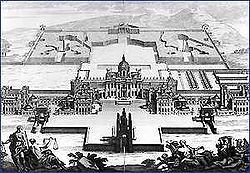
Vanbrugh's design evolved into a Baroque
structure with two symmetrical wings projecting to either side of a north-south axis. The crowning central dome was added to the design at a late stage, after building had begun. Construction began at the east end, with the East Wing constructed from 1701–03, the east end of the Garden Front from 1701–06, the Central Block (including dome) from 1703–06, and the west end of the Garden Front from 1707–09. All are exuberantly decorated in Baroque style, with coronets, cherubs, urns and cyphers, with Roman Doric
pilaster
s on the north front and Corinthian
on the South. Many interiors were decorated by Giovanni Antonio Pellegrini
.
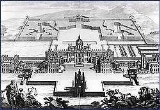
_-_north_west_view.jpg) The Earl then turned his energies to the surrounding garden and grounds. Although the complete design is shown in the third volume of Colen Campbell
The Earl then turned his energies to the surrounding garden and grounds. Although the complete design is shown in the third volume of Colen Campbell
's Vitruvius Britannicus, published in 1725, the West Wing was not completed (indeed, not even started) when Vanbrugh died in 1726, despite his remonstration with the Earl. The house remained incomplete on the death of the 3rd Earl in 1738, but construction finally started at the direction of the 4th Earl. However, Vanbrugh's design was not completed: the West Wing was built in a contrasting Palladian style to a design by the 3rd Earl's son-in-law, Sir Thomas Robinson. The new wing remained incomplete, with no first floor or roof, at the death of the 4th Earl in 1758; although a roof had been added, the interior remained undecorated by the death of Robinson in 1777. Rooms were completed stage by stage over the following decades, but the whole was not complete until 1811.
A large part of the house was destroyed by fire which broke out on 9 November 1940, including the central dome. Some of the devastated rooms have been restored over the following decades. Some were superficially restored for the 2008 filming, and now house an exhibition. The East Wing remains a shell, although it has been restored externally. The house has been open to the public since 1952. Castle Howard is one of the largest country houses in England, with a total of 145 rooms. The current owner grew up at the castle.
According to figures released by the Association of Leading Visitor Attractions, over 230,000 people visited Castle Howard in 2009.
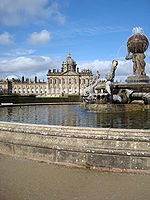
 Castle Howard has extensive and diverse gardens. There is a large formal garden immediately behind the house. The house is prominently situated on a ridge and this was exploited to create an English landscape park, which opens out from the formal garden and merges with the park.
Two major garden buildings are set into this landscape: the Temple of the Four Winds at the end of the garden, and the Mausoleum
in the park
. There is also a lake on either side of the house. There is an arboretum
called Ray Wood, and the walled garden
contains decorative rose
and flower gardens. Further buildings outside the preserved gardens include the ruined Pyramid
currently undergoing restoration, an Obelisk
and several follies
and eyecatchers in the form of fortifications. A John Vanbrugh ornamental pillar known as the Quatre Faces (marked as 'Four Faces' on Ordnance Survey Maps) stands in nearby Pretty Wood.
 There is also a separate 127 acre
(514,000 m²) arboretum called Kew at Castle Howard, which is close to the house and garden, but has separate entrance arrangements. Planting began in 1975, with the intention of creating one of the most important collections of specimen trees in the United Kingdom. The landscape is more open than that of Ray Wood, and the planting remains immature. It is now a joint venture between Castle Howard and Kew Gardens and is managed by a charity called the Castle Howard Arboretum Trust, which was established in 1997. It was opened to the public for the first time in 1999. A new visitor centre opened in 2006.
The grounds of Castle Howard are also used as part of at least two charity running races during the year.
and 2008 film
adaptations of Evelyn Waugh
's novel Brideshead Revisited
, Castle Howard has been used as a backdrop for a number of other cinematic and television settings.
In recent years, the Castle has featured in the 1995 film The Buccaneers
and Garfield: A Tail of Two Kitties
, released in 2006. In the past, it was notable in Peter Ustinov
's 1965 film Lady L and as the exterior set for Lady Lyndon's estate in Stanley Kubrick
's 1975 movie Barry Lyndon
. It has even featured as the Kremlin, in Galton and Simpson
's 1966 film The Spy with a Cold Nose
.
Stately home
A stately home is a "great country house". It is thus a palatial great house or in some cases an updated castle, located in the British Isles, mostly built between the mid-16th century and the early part of the 20th century, as well as converted abbeys and other church property...
in North Yorkshire
North Yorkshire
North Yorkshire is a non-metropolitan or shire county located in the Yorkshire and the Humber region of England, and a ceremonial county primarily in that region but partly in North East England. Created in 1974 by the Local Government Act 1972 it covers an area of , making it the largest...
, England, 15 miles (24.1 km) north of York
York
York is a walled city, situated at the confluence of the Rivers Ouse and Foss in North Yorkshire, England. The city has a rich heritage and has provided the backdrop to major political events throughout much of its two millennia of existence...
. One of the grandest private residences in Britain, most of it was built between 1699 and 1712 for the 3rd Earl of Carlisle
Charles Howard, 3rd Earl of Carlisle
Charles Howard, 3rd Earl of Carlisle, PC was a British statesman and member of the peerage of England.Charles Howard was the eldest son of Edward Howard and inherited his title on the death of his father in 1692. He married in 1683 Lady Anne de Vere Capell, daughter of Arthur Capell, 1st Earl of...
, to a design by Sir John Vanbrugh
John Vanbrugh
Sir John Vanbrugh – 26 March 1726) was an English architect and dramatist, perhaps best known as the designer of Blenheim Palace and Castle Howard. He wrote two argumentative and outspoken Restoration comedies, The Relapse and The Provoked Wife , which have become enduring stage favourites...
. Although Castle Howard was built near the site of the ruined Henderskelfe Castle, it is not a true castle
Castle
A castle is a type of fortified structure built in Europe and the Middle East during the Middle Ages by European nobility. Scholars debate the scope of the word castle, but usually consider it to be the private fortified residence of a lord or noble...
, but this term is often used for English country houses constructed after the castle-building era (c.1500) and not intended for a military function.
Castle Howard has been the home of part of the Howard family for more than 300 years.
It is familiar to television and movie audiences as the fictional "Brideshead", both in Granada Television
Granada Television
Granada Television is the ITV contractor for North West England. Based in Manchester since its inception, it is the only surviving original ITA franchisee from 1954 and is ITV's most successful....
's 1981 adaptation
Brideshead Revisited (TV serial)
Brideshead Revisited is a 1981 British television serial produced by Granada Television for broadcast by the ITV network. The teleplay is based on Evelyn Waugh's novel Brideshead Revisited...
of Evelyn Waugh's Brideshead Revisited
Brideshead Revisited
Brideshead Revisited, The Sacred & Profane Memories of Captain Charles Ryder is a novel by English writer Evelyn Waugh, first published in 1945. Waugh wrote that the novel "deals with what is theologically termed 'the operation of Grace', that is to say, the unmerited and unilateral act of love by...
and a two-hour 2008 remake for cinema. Today, it is part of the Treasure Houses of England
Treasure Houses of England
The Treasure Houses of England is a heritage consortium founded in the early 1970s by ten of the foremost stately homes in England still in private ownership, with the aim of marketing and promoting themselves as tourist venues....
heritage group.
The house is surrounded by a large estate which, at the time of the 7th Earl of Carlisle, covered over 13000 acres (5,260.9 ha) and included the villages of Welburn
Welburn (Amotherby Ward)
Welburn is a village and civil parish in the Ryedale district of North Yorkshire, England, on the edge of the Howardian Hills, near to the stately home Castle Howard. It is about 14 miles from York and 5 miles south-west of Malton/Norton. It is a popular area for walkers and bird-watchers. The...
, Bulmer
Bulmer, North Yorkshire
Bulmer is a village and civil parish in the Ryedale district of North Yorkshire, England. According to the 2001 census it had a population of 174. The village is about seven miles south-west of Malton....
, Slingsby
Slingsby, North Yorkshire
Slingsby is a village and civil parish in the Ryedale district of North Yorkshire, England. It is about 6 miles west of Malton. According to the 2001 census had a population of 634....
, Terrington
Terrington
Terrington is a large village and civil parish in the Ryedale district of North Yorkshire, England. It is situated in the Howardian Hills, 4 miles west of Malton....
and Coneysthorpe
Coneysthorpe
Coneysthorpe is a small village and civil parish in the Ryedale district of North Yorkshire, England. It is situated near Castle Howard and 4 miles west of Malton. The Centenary Way long-distance path runs through the village....
. The estate was served by its own railway station, Castle Howard
Castle Howard railway station
Castle Howard railway station was a minor railway station serving the village of Welburn and the stately home at Castle Howard on the York to Scarborough Line and was opened on 5 July 1845 by the York and North Midland Railway. The architect was George Townsend Andrews...
, from 1845 to the 1950s.
House
William Talman (architect)
William Talman was an English architect and landscape designer. A pupil of Sir Christopher Wren, in 1678 he and Thomas Apprice gained the office of King's Waiter in the Port of London...
, a leading architect, but commissioned Vanbrugh, a fellow member of the Kit-Cat Club
Kit-Cat Club
The Kit-Cat Club was an early 18th century English club in London with strong political and literary associations, committed to the furtherance of Whig objectives, meeting at the Trumpet tavern in London, and at Water Oakley in the Berkshire countryside.The first meetings were held at a tavern in...
, to design the building. Castle Howard was that gentleman-dilettante's first foray into architecture, but he was assisted by Nicholas Hawksmoor
Nicholas Hawksmoor
Nicholas Hawksmoor was a British architect born in Nottinghamshire, probably in East Drayton.-Life:Hawksmoor was born in Nottinghamshire in 1661, into a yeoman farming family, almost certainly in East Drayton, Nottinghamshire. On his death he was to leave property at nearby Ragnall, Dunham and a...
.
Vanbrugh's design evolved into a Baroque
Baroque
The Baroque is a period and the style that used exaggerated motion and clear, easily interpreted detail to produce drama, tension, exuberance, and grandeur in sculpture, painting, literature, dance, and music...
structure with two symmetrical wings projecting to either side of a north-south axis. The crowning central dome was added to the design at a late stage, after building had begun. Construction began at the east end, with the East Wing constructed from 1701–03, the east end of the Garden Front from 1701–06, the Central Block (including dome) from 1703–06, and the west end of the Garden Front from 1707–09. All are exuberantly decorated in Baroque style, with coronets, cherubs, urns and cyphers, with Roman Doric
Doric order
The Doric order was one of the three orders or organizational systems of ancient Greek or classical architecture; the other two canonical orders were the Ionic and the Corinthian.-History:...
pilaster
Pilaster
A pilaster is a slightly-projecting column built into or applied to the face of a wall. Most commonly flattened or rectangular in form, pilasters can also take a half-round form or the shape of any type of column, including tortile....
s on the north front and Corinthian
Corinthian order
The Corinthian order is one of the three principal classical orders of ancient Greek and Roman architecture. The other two are the Doric and Ionic. When classical architecture was revived during the Renaissance, two more orders were added to the canon, the Tuscan order and the Composite order...
on the South. Many interiors were decorated by Giovanni Antonio Pellegrini
Giovanni Antonio Pellegrini
Giovanni Antonio Pellegrini was a widely-travelled Rococo decorative painter from Venice, where he was born and died...
.
Colen Campbell
Colen Campbell was a pioneering Scottish architect who spent most of his career in England, and is credited as a founder of the Georgian style...
's Vitruvius Britannicus, published in 1725, the West Wing was not completed (indeed, not even started) when Vanbrugh died in 1726, despite his remonstration with the Earl. The house remained incomplete on the death of the 3rd Earl in 1738, but construction finally started at the direction of the 4th Earl. However, Vanbrugh's design was not completed: the West Wing was built in a contrasting Palladian style to a design by the 3rd Earl's son-in-law, Sir Thomas Robinson. The new wing remained incomplete, with no first floor or roof, at the death of the 4th Earl in 1758; although a roof had been added, the interior remained undecorated by the death of Robinson in 1777. Rooms were completed stage by stage over the following decades, but the whole was not complete until 1811.
A large part of the house was destroyed by fire which broke out on 9 November 1940, including the central dome. Some of the devastated rooms have been restored over the following decades. Some were superficially restored for the 2008 filming, and now house an exhibition. The East Wing remains a shell, although it has been restored externally. The house has been open to the public since 1952. Castle Howard is one of the largest country houses in England, with a total of 145 rooms. The current owner grew up at the castle.
According to figures released by the Association of Leading Visitor Attractions, over 230,000 people visited Castle Howard in 2009.
Gardens
Two major garden buildings are set into this landscape: the Temple of the Four Winds at the end of the garden, and the Mausoleum
Mausoleum
A mausoleum is an external free-standing building constructed as a monument enclosing the interment space or burial chamber of a deceased person or persons. A monument without the interment is a cenotaph. A mausoleum may be considered a type of tomb or the tomb may be considered to be within the...
in the park
Park
A park is a protected area, in its natural or semi-natural state, or planted, and set aside for human recreation and enjoyment, or for the protection of wildlife or natural habitats. It may consist of rocks, soil, water, flora and fauna and grass areas. Many parks are legally protected by...
. There is also a lake on either side of the house. There is an arboretum
Arboretum
An arboretum in a narrow sense is a collection of trees only. Related collections include a fruticetum , and a viticetum, a collection of vines. More commonly, today, an arboretum is a botanical garden containing living collections of woody plants intended at least partly for scientific study...
called Ray Wood, and the walled garden
Walled garden
A walled garden is specifically a garden enclosed by high walls for horticultural rather than security purposes, though traditionally all gardens have been hedged about or walled for protection from animal or human intruders...
contains decorative rose
Rose
A rose is a woody perennial of the genus Rosa, within the family Rosaceae. There are over 100 species. They form a group of erect shrubs, and climbing or trailing plants, with stems that are often armed with sharp prickles. Flowers are large and showy, in colours ranging from white through yellows...
and flower gardens. Further buildings outside the preserved gardens include the ruined Pyramid
Pyramid
A pyramid is a structure whose outer surfaces are triangular and converge at a single point. The base of a pyramid can be trilateral, quadrilateral, or any polygon shape, meaning that a pyramid has at least three triangular surfaces...
currently undergoing restoration, an Obelisk
Obelisk
An obelisk is a tall, four-sided, narrow tapering monument which ends in a pyramid-like shape at the top, and is said to resemble a petrified ray of the sun-disk. A pair of obelisks usually stood in front of a pylon...
and several follies
Folly
In architecture, a folly is a building constructed primarily for decoration, but either suggesting by its appearance some other purpose, or merely so extravagant that it transcends the normal range of garden ornaments or other class of building to which it belongs...
and eyecatchers in the form of fortifications. A John Vanbrugh ornamental pillar known as the Quatre Faces (marked as 'Four Faces' on Ordnance Survey Maps) stands in nearby Pretty Wood.
Acre
The acre is a unit of area in a number of different systems, including the imperial and U.S. customary systems. The most commonly used acres today are the international acre and, in the United States, the survey acre. The most common use of the acre is to measure tracts of land.The acre is related...
(514,000 m²) arboretum called Kew at Castle Howard, which is close to the house and garden, but has separate entrance arrangements. Planting began in 1975, with the intention of creating one of the most important collections of specimen trees in the United Kingdom. The landscape is more open than that of Ray Wood, and the planting remains immature. It is now a joint venture between Castle Howard and Kew Gardens and is managed by a charity called the Castle Howard Arboretum Trust, which was established in 1997. It was opened to the public for the first time in 1999. A new visitor centre opened in 2006.
The grounds of Castle Howard are also used as part of at least two charity running races during the year.
Listed buildings
The house is Grade I listed and there are many other listed structures on the estate, several of which are on the Buildings at Risk Register.Castle Howard as film location
In addition to its most famous appearance in film as Brideshead in both the 1981 television serialBrideshead Revisited (TV serial)
Brideshead Revisited is a 1981 British television serial produced by Granada Television for broadcast by the ITV network. The teleplay is based on Evelyn Waugh's novel Brideshead Revisited...
and 2008 film
Brideshead Revisited (film)
Brideshead Revisited is a 2008 British drama film directed by Julian Jarrold. The screenplay by Jeremy Brock and Andrew Davies is based on the 1945 novel of the same name by Evelyn Waugh, which previously had been adapted in 1981 as an eleven-episode television serial.-Plot:Although he aspires to...
adaptations of Evelyn Waugh
Evelyn Waugh
Arthur Evelyn St. John Waugh , known as Evelyn Waugh, was an English writer of novels, travel books and biographies. He was also a prolific journalist and reviewer...
's novel Brideshead Revisited
Brideshead Revisited
Brideshead Revisited, The Sacred & Profane Memories of Captain Charles Ryder is a novel by English writer Evelyn Waugh, first published in 1945. Waugh wrote that the novel "deals with what is theologically termed 'the operation of Grace', that is to say, the unmerited and unilateral act of love by...
, Castle Howard has been used as a backdrop for a number of other cinematic and television settings.
In recent years, the Castle has featured in the 1995 film The Buccaneers
The Buccaneers
The Buccaneers is the last novel written by Edith Wharton. It was unfinished at the time of her death in 1937, and published in that form in 1938. Wharton's manuscript ends with Lizzy inviting Nan to a house party to which Guy Thwarte has been invited too...
and Garfield: A Tail of Two Kitties
Garfield: A Tail of Two Kitties
Garfield: A Tail of Two Kitties is the 2006 sequel to 2004's live-action feature film Garfield: The Movie...
, released in 2006. In the past, it was notable in Peter Ustinov
Peter Ustinov
Peter Alexander Ustinov CBE was an English actor, writer and dramatist. He was also renowned as a filmmaker, theatre and opera director, stage designer, author, screenwriter, comedian, humourist, newspaper and magazine columnist, radio broadcaster and television presenter...
's 1965 film Lady L and as the exterior set for Lady Lyndon's estate in Stanley Kubrick
Stanley Kubrick
Stanley Kubrick was an American film director, writer, producer, and photographer who lived in England during most of the last four decades of his career...
's 1975 movie Barry Lyndon
Barry Lyndon
Barry Lyndon is a 1975 British-American period romantic war film produced, written, and directed by Stanley Kubrick based on the 1844 novel The Luck of Barry Lyndon by William Makepeace Thackeray which recounts the exploits of an 18th century Irish adventurer...
. It has even featured as the Kremlin, in Galton and Simpson
Galton and Simpson
Ray Galton OBE , and Alan Simpson OBE , are British scriptwriters who met in 1948 at a tuberculosis sanatorium, the Surrey county sanatorium near Godalming, on which the sitcom Get Well Soon was based...
's 1966 film The Spy with a Cold Nose
The Spy with a Cold Nose
The Spy with a Cold Nose is a 1966 British comedy film directed by Daniel Petrie.-Cast:* Laurence Harvey as Dr. Francis Trevelyan* Daliah Lavi as Princess Natasha Romanova* Lionel Jeffries as Stanley Farquhar* Eric Sykes as Wrigley...
.
See also
- Hampton National Historic SiteHampton National Historic SiteHampton National Historic Site, in the Hampton area north of Towson, Baltimore County, Maryland, United States, preserves a remnant of a vast 18th-century estate, including a Georgian manor house, gardens, grounds, and the original stone slave quarters. The estate was owned by the Ridgely family...
, an 18th century U.S. mansion said to have been inspired by Castle Howard. - Castle Howard railway stationCastle Howard railway stationCastle Howard railway station was a minor railway station serving the village of Welburn and the stately home at Castle Howard on the York to Scarborough Line and was opened on 5 July 1845 by the York and North Midland Railway. The architect was George Townsend Andrews...
- A more detailed architectural appraisal of Castle Howard is at John VanbrughJohn VanbrughSir John Vanbrugh – 26 March 1726) was an English architect and dramatist, perhaps best known as the designer of Blenheim Palace and Castle Howard. He wrote two argumentative and outspoken Restoration comedies, The Relapse and The Provoked Wife , which have become enduring stage favourites...
. - List of Baroque residences
External links
- Castle Howard web site
- Historical Images of Castle Howard
- Castle Howard entry from The DiCamillo Companion to British & Irish Country Houses
- Kew at Castle Howard website
- TimesOnline article on Castle Howard's use of renewable energy systems
- Castle Howard's article on their use of renewable energy systems
- Installer's site on Castle Howard's renewable energy systems