


Buda Castle

Encyclopedia
Buda Castle is the historical castle
and palace complex of the Hungarian kings in Budapest
, first completed in 1265. In the past, it was also called Royal Palace and Royal Castle .
Buda Castle was built on the southern tip of Castle Hill, bounded on the north by what is known as the Castle District , famous for its Medieval, Baroque
and 19th century houses, churches and public buildings. It is linked to Clark Ádám Square and the Széchenyi Chain Bridge
by the Castle Hill Funicular
.
The castle is part of the Budapest World Heritage Site
, declared in 1987.
between 1247 and 1265. It is uncertain whether it was situated on the southern tip of the hill or on the northern elevation near the Kammerhof.
The oldest part of the present-day palace was built in the 14th century by Stephen, Duke of Slavonia
, the younger brother of King Louis I of Hungary. Only the foundations remained of the castle keep
which was known as Stephen's Tower (Hungarian: István-torony). The Gothic
palace of King Louis I was arranged around a narrow courtyard next to the keep.
King Sigismund
significantly enlarged the palace. Sigismund, as a Holy Roman Emperor
, needed a magnificent royal residence to express his primacy among the rulers of Europe. He chose Buda Castle as his main residence, and during his long reign it became probably the largest Gothic
palace of the late Middle Ages
. Buda was also an important artistic centre of the International Gothic
style.
The construction works began in the 1410s and were largely finished in the 1420s, although some minor works continued until the death of the king.
The most important part of Sigismund's palace was the northern wing, known as the Fresh Palace (Hun: Friss-palota). On the top floor, there was one huge hall (70 xx) with a carved wooden ceiling and great windows and balconies looking toward the city of Buda
. It was called the Roman Hall. The façade of the palace was decorated with statues and coat-of-arms. The palace was first mentioned in 1437, under the name "fricz palotha".
Sigismund also strengthened the fortifications around the palace. The southern part of the royal residency was surrounded with narrow zwinger
s. Two parallel walls, the so-called "cortina walls" run down from the palace to the River Danube
across the steep hillside. The most imposing structure, the famous Broken Tower (Hun: Csonka-torony), on the western side of the cour d'honneur, remained unfinished. The basement of the tower was used as a prison
; the top floors were probably the treasury of the royal jewels.
In front of the palace stood the bronze equestrian statue of Sigismund, later repaired by King Matthias Corvinus.
The last phase of grand-scale building activity happened under King Matthias Corvinus. During the first decades of his reign the king carried on and finished the works on the Gothic palace. The Royal Chapel, with the surviving Lower Church
, was probably built that time.
After the marriage of Matthias and Beatrice of Naples
in 1476, Italian humanists, artists and craftsmen arrived at Buda. The Hungarian capital became the first centre of Renaissance
north of the Alps
. The king rebuilt the palace in early Renaissance style. The cour d'honneur was modernized and an Italian loggia was added. Inside the palace there were two rooms with a golden ceiling, the famous Bibliotheca Corviniana
and a passage with the frescoes of the 12 signs of the Zodiac
. The façade of the palace was decorated with the statues of John Hunyadi
, László Hunyadi
and King Matthias. In the middle of the court there was a fountain with the statue of Pallas Athene.
Only fragments remained of this Renaissance palace: red marble balustrads, lintels, decorative glazed tiles of stoves and floors.
In the last years of his reign Matthias Corvinus began to build a new Renaissance palace on the eastern side of the Sigismund Courtyard, next to the Fresh Palace. The Matthias Palace remained unfinished because of the early death of the king. It is known from written sources that it had a monumental red marble stairway in front of the façade. The bronze gates were decorated with panels depicting the deeds of Hercules. Matthias Corvinus was usually identified with Hercules
by the humanists of his court. A great bronze statue of the Greek hero welcomed the guests in the forecourt of the palace complex where jousts were held.
The walled gardens of the palace were laid out on the western slopes of the Castle Hill. In the middle of the enclosure a Renaissance villa was built by Matthias. Only one column survived of this so-called Aula Marmorea.
After the death of Matthias Corvinus, his successor, King Vladislaus II
carried on the works of the Matthias Palace, especially after his marriage with Anna of Foix-Candale
in 1502.
Under the reign of King John Zápolya
, the last national ruler of Hungary, the palace was repaired a last time. On the southern tip of the Castle Hill, the Great Rondella was built by Italian military engineers. The circular bastion is the most imposing surviving structure of the old palace.
, the medieval Kingdom of Hungary
collapsed. The Ottoman
army occupied the evacuated town on 11 September, 1526. Although the town of Buda was sacked and burned, the Royal Palace was not damaged. Sultan Süleyman I carried away all the bronze statues (the Hunyadis, Pallas Athene and Hercules) with him to Constantinople
. The statues were destroyed there in a rebellion a few years later. The Sultan also took many volumes from the famous Corvina library.
In 1529 the Ottoman army besieged and occupied Buda again. The palace was badly damaged at that time.
On 29 August 1541 Buda was occupied again by the Ottomans without any resistance. The Hungarian capital became part of Ottoman Empire
, as the seat of the Eyalet
of Budin.
Although Turkish travel writers wrote enthusiastically about the beauty of the palace of the Hungarian kings, the new Ottoman government left the palace decaying. It was partially used as barracks, a storage place and stables, otherwise it stood empty.
The palace was called Iç Kala ("Inner Castle") and Hisar Peçe ("Citadel") by the Turks. The name of the cour d'honneur was "Seray meydani". The favourite nickname of the complex was "Palace of the Golden Apples".
In the era between 1541 and 1686, the Habsburg
s tried to re-capture Buda several times. Unsuccessful sieges in 1542, 1598, 1603 and 1684 caused serious damage. The Ottoman
authorities repaired only the fortifications.
According to 17th century sources, many buildings of the former Royal Palace were roofless and their vaults collapsed. Nonetheless the medieval palace by-and-large survived until the great siege of 1686.
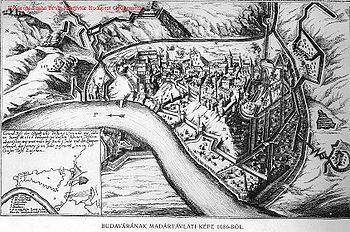 The medieval palace was destroyed in the great siege of 1686
when Buda was captured by the allied Christian forces. In the heavy artillery bombardment many buildings collapsed and burned out. The Stephen's Tower, used as a pulver
(gunpowder
store by the Ottomans, exploded when hit by a single cannon, said to have been fired by a friar called Gábor, also referred as Tüzes Gábor i.e. "Gabriel Fiery". According to contemporary sources, the giant explosion killed as many as 1500 Turkish soldiers, and caused a tidal wave
on the Danube that washed away standing guards and even artillery batteries on the opposite shore.
Habsburg military engineers made several plans and drawings about the buildings in subsequent decades. Although the walls mainly survived, the burned out shell was rapidly decaying because of the lack of basic maintenance. In the decade between 1702 and 1715 the Stephen's Tower totally disappeared, and the palace was beyond repair.
In 1715 King Charles III
ordered the demolition of the ruins. Johann Hölbling surveyed the still existing structures. According to the order of the king the surviving marble statues, antiquities, inscriptions and coins were spared (there is no evidence about the realization of the royal decree). The main part of the palace and the Broken Tower were totally demolished, the hollows and moats were filled, and a new flat terrace
was established. Luckily the southern fortifications, zwingers and rooms were only buried under tons of rubbish and earth.
palace was built according to the plans of Johann Hölbling. This very simple rectangular building had an inner court and a shorter side wing which was later demolished. The Hölbling palace is identical with the core of the present-day palace, i.e. the Baroque Court of the Budapest Historical Museum.
The inside of palace was left unfinished and in 1719 building works stopped. The Hofkriegsrat
commissioned Fortunato di Prati to make several plans for the palace, but lack of money hindered their implementation.
In 1723 the palace accidentally burned down, and their windows were walled up to stop further deterioration of the building. Several drawings from the 1730s and 1740s show the unfinished, decaying shell of the simple two-storeys blockhouse. Some engravings show an idealized, finished version which never existed. Some time around 1730 the roof was repaired.
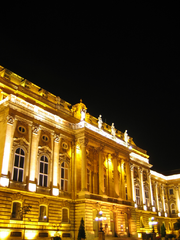 In 1748 Count Antal Grassalkovich, President of the Hungarian Chamber appealed to the public to finish the derelict palace by means of public subscription. Palatine János Pálffy also called upon the counties
and the cities to grant for the project. The moment was favourable because relations between the Hungarian nobility and the Habsburgs were exceptionally good. Hungarians supported Queen Maria Theresa
in the dire need of the War of the Austrian Succession
. The queen was grateful, and the new Royal Palace became the symbol of peace and friendship between the dynasty and the nation.
The plans of the splendid, U-shaped Baroque palace with a cour d'honneur
were drawn by Jean Nicolas Jadot, chief architect of the Viennese court. After 1753 the plans were modified by his successor, Nicolaus Pacassi. Ignác Oraschek, master builder, who guided the works between, also modified the plans according to his own ideas. The foundation stone of the palace was laid on 13 May 1749, the birthday of the Queen. The works continued in a good pace until 1758 when financial difficulties caused a seven-year break. By that time only the interiors were left unfinished.
According to surviving historical documents the layout of the palace followed the signed plans of Jadot from 1749. The façades, some interior elements and the St. Sigismund Chapel are the works of Pacassi, while the special double false domes were probably planned by Oraschek, formerly the masterbuilder of Count Grassalkovich. Double false domes were typical features of the so-called Grassalkovich-type Baroque castles like Gödöllő
. This special feature was later removed from the palace.
In 1764, the Empress/Queen visited the palace and allowed the spending of 20,000 thalers a year for the purpose. The work was recommenced in 1765 according to the plans of Franz Anton Hillebrandt. Hillebrand altered the cour d'honneur
façade of the central wing in Rococo
style. In 1769 the St. Sigismund Chapel was consecrated, and in the same year, the palace was finished. According to the aggregate statement of Grassalkovich, the costs were 402,679 forints.
from Sankt Pölten
, known as Englische Fräulein or angolkisasszonyok. The building was officially handed over on 13 May 1770, but the elegant Baroque rooms were absolutely unsuitable for a nunnery. In 1777 the Queen decided that the University of Nagyszombat should move to Buda.
The nuns moved out, and the palace was hastily adapted to its educational purpose. The works were guided by Farkas Kempelen. New classrooms, teacher's cabinets, museums, library and a university press was built. In the front, the false dome was removed to erect instead a four-storey observatory tower, planned by Hillebrandt or Karl Georg Zillack.
The ribbon-cutting ceremony of the university was held on 25 June 1780, the 40th anniversary of the coronation of the Queen. The throne room became a splendid aula
decorated with frescoes depicting the four faculties. In 1953 two grisaille
frescoes were discovered on the shorter sides of the room.
In 1778 Hillebrandt built a new chapel for the Holy Right of Saint Stephen of Hungary, the mummified right hand of the first Hungarian king, recovered by Queen Maria Therese from the Republic of Ragusa
in 1771. The Chapel of the Holy Right was sitatuated near the St Sigismund Chapel, in the middle of an inner court. Its outside form was octagonal, the inside was oval, and it was crowned by a dome. The altar-piece was painted by Joseph Hauzinger.
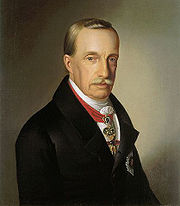 Functional problems of the university remained basically unresolved, so in 1783 the faculties were moved to Pest. In 1791 the palace became the residence of the new Habsburg Palatine of the Kingdom of Hungary
, Archduke Alexander Leopold of Austria
. After the early death of the palatine in 1795, his younger brother Archduke Joseph succeeded him, followed by Archduke Stephen
. The palatinal court in Buda Castle was the centre of fashionable life and high society in the Hungarian capital.
In 1810 the palatinal palace was damaged by a fire. In the next decades many plans were made to raise the building with an upper storey, but they were not implemented, although the observatory
tower, which hindered the works, was removed. In 1838 the crypt of the St. Sigismund Chapel was rebuilt according to the plans of Franz Hüppmann. The Palatinal Crypt
was the burial place of Palatine Joseph and his family. The crypt is the only part of the palace that survived the destruction of the Second World War.
Palatine Joseph established gardens on the southern and eastern hillsides of the Castle Hill according to the plans of Antal Tost. The gardens of Buda Castle were among the most famous English-style landscape garden
s in Hungary.
Palatine Stephen finally left the palace on 23 September 1848 when the break between the liberal Hungarian government and the dynasty became inevitable.
On 5 January Buda was occupied by the Austrian army led by Alfred I, Prince of Windisch-Grätz. The chief commander lodged in the royal palace.
On 4 May 1849 Artúr Görgey
's Hungarian army laid siege on Buda Castle
, defended by General Heinrich Hentzi
. On 20 May the Hungarians captured Buda with a great assault. The palace was the last stronghold of the Austrian troops and became a site of heavy artillery fighting. The ensuing fire consumed the central and southern wings that completely burned out and their interiors were destroyed.
was decorated with a balcony of six colossal columns. With these changes the former Viennese Baroque palace of Maria Theresa became a more austere Neoclassical Baroque
building.
The ballroom was redecorated with marbles and stuccoes. After 1853 stately rooms were designed in French Rococo
style with white-gold stuccoes and furniture from the Hofburg.
That time the palace was already too small for the needs of the royal court, so the kitchens and service rooms were housed in the neighbouring Zeughaus. The palace was connected with the Zeughaus with a glassed-in passageway.
On the western side of the cour d'honneur two smaller buildings were erected by the plans of Weiss and Neuwirth in 1854. The two-storey Stöckl housed the apartments of the archdukes and imperial officials. The Wachlokal was built for the royal guards.
Emperor Franz Joseph I of Austria
visited Buda Castle in 1856 and 1857. Later in 1867 after the Austro-Hungarian Compromise of 1867 Franz Joseph was crowned to the king of Hungary. The palace played an important part in the lavish ceremony, symbolizing peace between the dynasty and the nation.
In the last decades of the 19th century Budapest experienced rapid economic development. Ambitious urban planning
projects were carried out to express the growing wealth and higher status of the Hungarian capital. Among these projects special attention was paid to the rebuilding of Buda Castle. The autonomous Hungarian government intended to create a royal palace that matches any famous European royal residence (especially the old rival, Vienna
's Hofburg). The process of rebuilding lasted about forty years between 1875 and 1912, and caused sweeping changes in topography of the whole area.
At first the Várkert-bazár (Royal Garden Pavilion) was built on the embankment of the Danube
, at the foot of the Castle Hill, between 1875 and 1882. This splendid Neo-Renaissance
gateway was designed by Miklós Ybl
, the most famous Hungarian architect of the period. The structure was an open business arcade with pavilions, stairways and ramps and two blocks of flat. Ybl also built a new waterworks pumping station, called Várkert-kioszk (Royal Garden Kiosk) and two stair towers standing against the medieval cortina walls. The southern one followed French Renaissance style, resembling a small turreted castle, while the northern one was similar to a Gothic brick-donjon. Only Várkert-bazár and Várkert-kioszk survived the destruction of the 20th century of these works.
In 1882 Prime Minister Kálmán Tisza
charged Ybl with drawing a masterplan for rebuilding the palace. In his 1885 masterplan, Ybl preserved the old Baroque palace but mirrored it on the western side of the cour d'honneur, doubling the size of the residence. He also planned a new carriageway
on the western hillside demolishing the medieval walls and towers of the Újvilág-kert terrace. The main problem was caused by the narrowness of the natural plateau of the Castle Hill because there was not enough space for the new Krisztinaváros wing (so called after the neighbouring city district). Ybl solved the problem by erecting a huge substructure that goes down to the foot of the hill. The monumental western façade sits on this windowless, three-storey high substructure so the whole palace is making up a towering, 6+3-storey high block, almost absorbing the whole hill. On the other hand the main façade on the cour d'honneur has only the same modest height as the Baroque palace. The whole façade was clad with stone slabs, while the old parts are stuccoed; hence, the difference between the original Baroque and the Neo-Renaissance wings is obvious. The formerly open cour d'honneur became a closed court with a splendid, arched gateway guarded by the four lions of sculptor János Fadrusz
. The court is called Lions Court (Oroszlános udvar).
The works began on 1 May 1890, but Ybl died on 22 January 1891. His successor, Alajos Hauszmann
only slightly modified the plans of the Krisztinaváros wing. In 1896 the building reached the level of the court and King Franz Joseph ceremoniously laid down the foundation stone of the palace that was soon completed.
In 1893 the 25 years jubilee of King Franz Joseph's coronation was celebrated in the Royal Palace. The old banqueting hall proved to be too small so Hauszmann enlarged the room with knocking down and reconstructing the wall towards the cour d'honneur
(the one with the Hillebrandt façade).
In spite of this and Ybl's new wing, the palace was still deemed insufficient for great royal celebrations so another new construction began. The north wing, standing on the site of the old Zeughaus, was completely designed by Hauszmann. The architect doubled the Baroque palace on the Danube side, generally imitating its traditional architectural style. At the meeting point of the old and the new wings, a huge colonnaded portico was erected with a lavishly decorated tympanum
(with allegorical statues by Károly Sennyey) and a flight of stairs called the "Habsburg Stairs". The whole palace was crowned with a dome and a copy of the Crown of St. Stephen
on its top. The dome shows German Jugendstil influences like other details of the north wing, for example the rear façade towards the western forecourt. This forecourt was decorated with the famous Matthias Fountain
(Hungarian: Mátyás kútja), a work of sculptor Alajos Stróbl
. Above the main gate towards Szent György tér stood the statue of Goddess Hungaria. This side was the main façade of the complex although it was much shorter and less characteristic than the long Danube façade. The old Chapel of the Holy Right was knocked down for the sake of a carriageway.
Hauszmann also designed a new riding school in the former Újvilág terrace that was now called Csikós court, after the Csikós statue of György Vastagh (now in the western forecourt). Before the middle of the long Danube façade, another equestrian statue was erected in honour of Prince Eugene of Savoy
, the victorious leader of the Habsburg army in the Battle of Zenta
. The eastern forecourt was closed off with a lavish wrought iron rail. Two flights of stairs lead up to the Szent György tér, laying on much higher ground. The rail ended in a pillar crowned by a monumental statue of the legendary Turul
, the sacred bird of the Magyars, spreading its wings above Budapest.
In the western forecourt, Hauszmann designed a new neo-Baroque guardhouse and rebuilt the old Royal Stables. The Royal Gardens on the southern hillside were famous for their precious plants, glasshouses and picturesque terraces. In the middle of the gardens, stood the Swiss House of Queen Elisabeth, furnished with Hungarian folk art objects. The house was built above the ruins of the medieval gatehouse, partly making use of them.
The inside of the whole palace complex was decorated and furnished exclusively with works of the leading Hungarian artists of the age. The Royal Palace was officially inaugurated in 1912. Contemporary critics praised it as the most outstanding Hungarian building of the turn of the century. Indeed it was a magnificent Gesamtkunstwerk
(comprehensive artwork) of architecture, sculpture, applied arts and gardening.
. Horthy lived in the Krisztinaváros wing with his family between 1920 and 1944. In this era the palace was the centre of Hungarian political and social life. The garden parties of the regent were especially fabulous events. Famous guests entertained by Horthy in the palace were King Victor Emmanuel III of Italy
in 1937 and Cardinal Eugenio Pacelli (later Pope Pius XII
) in 1938.
On 15 October 1944 Horthy made an attempt to get out of the war. Next day a German commando led by Otto Skorzeny
occupied the Royal Palace and forced the regent to abdicate.
Buda Castle was the last major stronghold of Budapest held by Axis forces (Germans and Hungarians) during the siege of Budapest
between 29 December 1944 and 13 February 1945. The defenders of the castle finally attempted to break the Soviet blockade on 11 February 1945, but utterly failed, leaving 90% of the soldiers dead on the sidestreets of Buda. Allegedly the Russians knew about their plans and had aimed heavy weapons at the possible escape routes hours earlier. This is considered one of the biggest military catastrophes of Hungarian history.
Heavy fights and artillery fire rendered the palace once again into a heap of ruins. All the furniture disappeared, roofs and vaults collapsed and the southern and western wings were burned out. The destruction was only comparable to that of the great siege of 1686.
. The research, led by László Gerő (1946–1966) and László Zolnay (1967–1979), was probably the biggest castle-excavation in Europe. The former Royal Gardens with their turn-of-the-century stairways, pavilions and glass houses had to be sacrificed, but the results compensated for the loss. It came out that important parts of the former Sigismund and Matthias Palace had survived under the thick level of earth fill.
The first reconstruction plan of the medieval remains was written by László Gerő in 1950 and finalized in 1952. The reconstruction works were finished in 1966. Contrary to the generally accepted principles of historic reconstruction the medieval fortification system was rebuilt in its entirety. Important elements like the 16th century Great Rondella and the medieval Gatehouse, the Mace Tower, the walls and the zwingers were reconstructed according to the results of the archeological research and contemporary pictorial evidence. The low-lying southern wing of the Gothic palace was also reconstructed together with the vaulted Gothic Hall and the Lower Church
of the former Royal Chapel. Medieval style gardens were planted in the zwingers. The foundation of the Stephen's Tower was also unearthed, but lacking enough archeological evidence, the tower was not reconstructed. The remains of the Broken Tower were covered again.
The grand-scale reconstruction of the medieval fortifications substantially changed the cityscape of Budapest. At the time it was considered a highly successful project, which managed to reconcile historical authenticity with urban-planning demands.
In the 1970s, archeological research continued on the northern and western side of the palace, led by László Zolnay. It produced many important achievements, including the famous Late Gothic Buda Castle Statues. On the other hand the more conservative methods in reconstruction did not produce such harmonious results, such as Gerő's more innovative approach a decade before. The remains were only conserved except the so-called Karakash Pasha Tower in the Újvilág Garden. The Turkish-era tower was only demolished in the end of the 19th century. Photographical evidence made possible its reconstruction, but the new tower is only a modern copy of the original, and the details are not authentic.
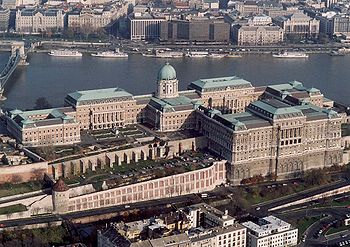 The fate of the ruined Neo-Baroque palace was different. In the first years after the war nothing happened. The government made a decision about the reconstruction only in 1948. According to contemporary photos all the important interiors were in a damaged state, but their reconstruction was technically possible. The new Communist government of Hungary considered the Royal Palace a symbol of the former regime similarly than GDR leaders who ordered the demolition of the Berlin Stadtschloss. Hungarian leaders were not so radical - they chose "only" the thorough modernizaton of the interior and exterior of the palace. Architectural trends also played a part in the decision because modernist architects of the era condemned Hauszmann style as "too ornate".
The first modernist reconstruction plan was made by architect István Janáky in 1950. The controversial concept was later a bit modified, but the Hungarian government in 1952 asked for help Poland because this country was highly successful in post-war rebuilding of Warsaw
and other cities. A delegation of Polish experts, led by architectural historian Jan Zachwatowicz
, proposed the rebuilding of the Hauszmann palace.
During the 1950s the palace was gutted and all the interiors were destroyed. Important exterior details were demolished like the main entrance, the Habsburg Steps, the dome, the Royal Stables, the Guardhouse and the Riding School. The remaining façades were simplified. In Lions Court the ornate gates of King's Stairs and Diplomat's Stairs were demolished. The doorway of the Castle Church disappeared together with the church itself. The detailed Neo-Baroque roofs were also simplified and plain new windows were installed. The allegorical sculpture group of the tympanum was destroyed.
The modernist dome was designed by Lajos Hidasi in 1961 after Italian Baroque models. The palace was rebuilt by 1966, but the interior spaces were ready only in the 1980s. Buda Castle became a cultural centre with three museums and the home of the National Széchényi Library
.
On 25 July 2007 Prime Minister Ferenc Gyurcsány
chose the medieval King's Cellar in Buda Castle as the place to announce the list of the "most important public works projects", financed by European Union
funds between 2007-2013.
In 2008 an underground garage for 700 cars was built by an international consortium under the former Csikós Court. The developer was granted permission to demolish a 4.5 metres (15 ft) section of the 15th-century castle wall. The agreement was criticized by archeologists and the public alike, but the demolition was carried out. Previously the whole area was excavated by archeologists, who discovered many important finds, including medieval children toys and the tooth of King Matthias Corvinus
' pet leopard
. The area outside the inner walls was used as a garbage dump during the 15-17th centuries. After the completion of the garage works, plans were made for the formerly derelict Csikós Court to be landscaped and the medieval zwingers restored.
castle
facing the narrow southern, western and eastern courts. Only the ground and first floors were reconstructed although the castle was originally much higher. The unfinished state of the façade is indicated by the fact that roof is flat – the castle is simply cut in the line of the Baroque terrace above it. There are two windows opening towards the southern and another two opening towards the eastern court. The four windows are almost identical and all belong to the Gothic Hall behind them. They are square, four-panel stone windows of very fine Gothic craftmanship. Their outer frame is decorated with small columns. One window which had been walled up was discovered in situ during the archeological research, and the others were reconstructed from fragments by sculptor Ernő Szakál by means of anastylosis
. The ground floor openings are more simple. An arched stone doorway gives access to the southern court from the cellar under the Gothic Hall.
The façade was originally plastered. The whitewashed surface was decorated with a painted pattern in rusty hue, resembling to rustication
. Painted geometrical decoration was common feature on the medieval buildings of Buda. Fragments of the decoration were discovered on the eastern façade but the it wasn't restored.
There is a Gothic balcony tower projecting from the wall at the end of the eastern façade. It is the only second floor part of the medieval palace which was recreated in 1958-62. Its reconstruction was a much debated issue because the balcony tower goes above the level of the Baroque terrace, disturbing the harmonious panorama of the palace. On the other hand it clearly indicates the existence of the missing higher floors.
The balcony tower is a two-storey high structure which stands on a wide stone basement. The first floor is made up of a solid stone wall without any openings. The niche behind it belongs to the Gothic Hall. The second floor is a closed balcony with three windows. Originally it must have been part of an important ceremonial room. Now there is no room behind the façade, which was closed off with a glass wall from behind. The ground plan of the balcony shows the half of an octagon. The three Gothic double lancet windows are the most important architectural elements of the tower. The profiles, frames and mullions were restored in a simplified form but many original stones were also built in. The tower is covered with a flat metal roof.
The building of the Gothic Hall is connected to the Stephen's Castle (István vár) on the western side. It is the oldest part of the medieval royal palace which was built in the 1340s-1370s. It was named after Prince Stephen, Duke of Slavonia
, the younger brother of King Louis I of Hungary. Only the foundation of the so-called Stephen's Tower and three interconnected, barrel-vaulted rooms survived from the original castle.
The Stephen's Tower (István torony) was the keep
of Stephen's Castle. It was a huge building which was shown in every old picture of Buda Castle with its typical turret
ed spire. It was destroyed by an explosion in 1686. Only the ground floor walls were discovered after 1946. It was a square building (11,7 x 11,1 m), built upon the natural rock surface of Castle Hill. The walls are 2,31-2,7 m thick. There are narrow loophole
s on the southern, western and northern sides. The original doorway on the eastern side was walled up after the Gothic Hall was built in the 15th century.
The siting of the tower was different from the later buildings and the triangle in front of it was walled up to create a continuous southern façade for the palace. During the post-war reconstruction this part of the façade (with a broken stone doorway) was not reconstructed to make it obvious that the Stephen's Tower was originally a free-standing structure. On the ground floor of the tower there was a vaulted room (6,2 x 6,3 m) which was still intact in 1820 according to a contemporary drawing. Although the ribs, corbel
s and the key stone was discovered during the archeological research, this room wasn't reconstructed. A spiral stairway had connected the room with the missing higher floors.
The remaining part of the Stephen's Castle (with the barrel-vaulted rooms behind) has a simple stone façade with a Gothic doorway. The pointed arch was restored.
and the post-war reconstruction, except the Palatinal Crypt
which survived both. There is very little data about the interiors from the medieval and Baroque
eras. However, the turn-of-the-century palace was meticulously recorded with detailed descriptions, photographic documentation and grounds plans. Architect Alajos Hauszmann
himself said about the royal apartments, "I created a 200 m (656.2 ft) long series of rooms, longer than any similar royal apartments in continental Europe except Versailles
."
A series of rooms from the medieval castle were unearthed and reconstructed during the postwar rebuilding of Buda Castle in 1958-62. They are now part of the permanent exhibition of the Budapest History Museum in "Building E" of Buda Castle.
in the beginning of the 15th century. The castle wing is surrounded with a complex system of medieval fortifications.
King Sigismund Luxemburg
thoroughly rebuilt the old Anjou castle during the first decades of the 15th century. He erected a splendid Gothic church in place of the former chapel. Its façade was facing towards the inner palace courtyard, and the long chancel was projecting from the eastern side of the palace. The chancel was built upon a lower church, a solution which was necessitated by the lack of space on the narrow plateau. It had a 21 metres (69 ft) nave and an 11 metres (36 ft) chancel
. Two-storey royal chapels were not uncommon in medieval Europe. The flamboyant
Royal Church of Buda Castle was similar to the more famous Sainte-Chapelle
in Paris
.
 The archeological research proved the dating of the church, because 15th century strata were discovered under the intact brick floor of the lower church.
In November 1489 Sultan Bayezid II
sent the relics of John the Almoner
to King Matthias Corvinus
. The King placed the relics in the Royal Chapel which was re-dedicated and embellished with Renaissance furniture.
In 1526 Buda was plundered by the Ottoman Turks
after the Battle of Mohács
. The relics were rescued in time and carried to Pressburg where they are still kept today. A surviving church inventory from 1530 still shows the wealth of furnishings. Later King János Szapolyai converted the lower church into a bastion. The large Gothic windows were walled up, only the new, rectangular loopholes were left open.
In 1541 the Ottoman Turks
captured Buda without fight and the Royal Church ceased to be a place of Christian worship. The upper church was destroyed in the 1686 siege of Buda and the ruins were demolished in 1715. The vault of the lower church fell down and the interior was filled with rubbish. The remains were buried under the new Baroque terrace for two centuries.
The ruins of the lower church were discovered by archeologists in 1949-50. The remains were buried in 1953 because of conceptional disputes about the possible reconstruction. The chapel was finally reconstructed by 1963. It was re-consecrated in 1990.
in Central Europe
. It was built by King Sigismund Luxemburg of Hungary
in the early 15th century as an extension of the earlier Anjou
palace. It was built on the southern edge of the natural rock plateau of Castle Hill. The level difference between the plateau and the southern court was about 2.79 metres (9.2 ft). A vaulted cellar was built under the hall to span this difference.
The Gothic Hall is an irregular rectangle of 20.2 xx, with a closed niche on the eastern side (the inside of the balcony tower mentioned above). It is divided into two naves which are covered with Gothic rib vault
s. The vaults are supported by two massive pillars which come up uninterruptedly from the cellar beneath the room through the floor. There are half-pillars in the corners supporting the ribs. The very low pillars are creating a distinct space effect. All six vaults are fourpartite, and the two on the inner side are irregularly shaped.
The hall has four windows, two on the southern and two on the eastern side. There are stone benches in the window niches. The Hall is connected to the palace through a new door in the northern wall, supposedly on the place of the original doorway. The northern section of the floor is on a bit higher level (three steps higher).
All the newly built side walls are plastered and painted white while the original stone surfaces were left uncovered. The ribs, pillar
s, arch
es and window
niches were restored by sculptor Ernő Szakál in 1961-62. The ribs have a simple profiling, but fragments of a more complicated type were also found in the rubble, together with keystone
s. These pieces supposedly belonged to another stately hall situated above the room, but they were built into the reconstructed vaults by 20th century restaurators.
It is an interesting fact that the northern pillar of the Gothic Hall was already discovered by Alajos Hauszmann
in the beginning of the 20th century. That time the remains were buried under the outbuildings of the Royal Gardens, but Hauszmann protected the medieval pillar by means of building a brick shaft around it.
in the 14th century. The northern room is larger (6.62 xx) than the southern ones (5 xx). Another important difference is that the northern room is covered with an east-west axial vault while the southern rooms have north-south axial vaults.
The southern room is connected to the inner courtyard with a doorway. There is a small window high above the western wall. The middle room has a similar window while the larger northern room has three slit windows, one towards the western side and two northwards (proving the existence of a northern courtyard). All the windows had iron rails. The rooms are connected to each other with carved Gothic corbel doors. The walls were originally plastered.
An interesting feature of the southern room is the medieval stairway which led to a trapdoor
and a medieval toilet above which were hidden in the empty space between the walls of the castle and the keep
.
The barrel vaulted rooms were supposedly used as a prison in the Middle Ages
. Later the southern vaults collapsed. The intact barrel vault of the northern room was broken by Alajos Hauszmann
in the beginning of the 20th century when he filled the cellar with rubble. The barrel-vaulted rooms were restored in 1958-1962.
of the palace.
The Cisterna Regia was situated under the former northern zwinger (courtyard) of the palace. This small rectangular courtyard became a private royal garden during the reign of King Matthias Corvinus. The private garden was an early Renaissance giardino segreto or "hidden garden". It was designed by architect Chimenti Camicia
in the 1470s. There was a well in the middle of the garden which was fed by the cistern underneath.
The hidden garden, the well and the cistern survived the 1686 siege of Buda. They were indicated on the plans of the area drawn by military architect Joseph de Haüy in 1687. In 1715-1724 the former Cisterna Regia became the cellar of the new Baroque palace. A section of this room was later used as ice-chamber.
side of "Building E". It was filled with tons of earth and rubble, but the original eastern façade of the medieval royal palace survived under the fill. The inner walls of the Baroque
palace were actually built upon the old façade. Only the 7 metres (23 ft) basement section of the original façade remained.
This wing was built by King Sigismund of Luxenburg in the early 15th century, but it was rebuilt by King Matthias Corvinus 50 years later. The surviving eastern façade was built from large, finely carved blocks of stone. It followed the contour of Castle Hill with a break in the middle. A huge buttress
was added and a rectangular tower with two buttress
es on its corners. It was possible to reconstruct the lower part of a balcony on the tower with three elegant Gothic corbel
s decorated with cusps.
It was not possible to demolish the King's Cellar because of structural reasons (the whole Baroque palace was resting upon it), but the inner fill was removed in 1961. The medieval façade was reconstructed inside the cellar space between 1961-1965. Now the architectural history of the palace is readable from the interwoven layers of the past. The outer wall of the cellar was broken through with large windows to let in the daylight.
On 25 July 2007 Prime Minister Ferenc Gyurcsány
chose the King's Cellar as the place to announce the list of the "most important public works projects", financed by European Union
funds between 2007-2013.
, which itself was named in honour of the daughter of Queen Maria Theresa, Archduchess Maria Christina, Duchess of Teschen.
s, stone mantelpieces and typical turn-of-the-century furniture gave the rooms a homely ambiance. The great parlour was decorated with large paintings.
in 1944-45 and they were restored later. On the other hand important works of art were destroyed during the controversial reconstruction of the castle during the 1950s and 1960s.
from the beginnings until the modern era. The restored part of the medieval castle including the Royal Chapel and the rib vaulted Gothic Hall belongs to the exhibition. The highlights of the exhibition are the Gothic statues of Buda Castle and a 14th-century silk tapestry decorated with Angevin coats-of-arms. Small gardens were recreated in the medieval "zwingers" (walled enclosures) around the oldest parts of the building.
The Hungarian National Gallery
is located in Building A, B, C and D. The museum presents the history of Hungarian art from the 11th century until the present, with a special exhibition concentrating on Gothic altarpieces (housed in the former Baroque Ballroom). The only surviving interieur from the pre-war Royal Palace, the Palatinal Crypt
belongs to the museum.
"Building F" is occupied by the National Széchényi Library
, the national library of Hungary. Its collection of rare and antique books, codices and manuscripts contains 35 Corvina pieces from the famous library of King Matthias Corvinus
. The original Bibliotheca Corviniana
was housed in the medieval Royal Castle of Buda.
filmed her second single "Firework
" (from the album Teenage Dream
) at Buda Castle. The video of the song has over 200 million views on YouTube
.
Castle
A castle is a type of fortified structure built in Europe and the Middle East during the Middle Ages by European nobility. Scholars debate the scope of the word castle, but usually consider it to be the private fortified residence of a lord or noble...
and palace complex of the Hungarian kings in Budapest
Budapest
Budapest is the capital of Hungary. As the largest city of Hungary, it is the country's principal political, cultural, commercial, industrial, and transportation centre. In 2011, Budapest had 1,733,685 inhabitants, down from its 1989 peak of 2,113,645 due to suburbanization. The Budapest Commuter...
, first completed in 1265. In the past, it was also called Royal Palace and Royal Castle .
Buda Castle was built on the southern tip of Castle Hill, bounded on the north by what is known as the Castle District , famous for its Medieval, Baroque
Baroque
The Baroque is a period and the style that used exaggerated motion and clear, easily interpreted detail to produce drama, tension, exuberance, and grandeur in sculpture, painting, literature, dance, and music...
and 19th century houses, churches and public buildings. It is linked to Clark Ádám Square and the Széchenyi Chain Bridge
Széchenyi Chain Bridge
The Széchenyi Chain Bridge is a suspension bridge that spans the River Danube between Buda and Pest, the western and eastern sides of Budapest, the capital of Hungary...
by the Castle Hill Funicular
Budapest Castle Hill Funicular
The Budapest Castle Hill Funicular or Budavári Sikló is a funicular railway in the city of Budapest, in Hungary. It links the Adam Clark Square and the Széchenyi Chain Bridge at river level to Buda Castle above....
.
The castle is part of the Budapest World Heritage Site
World Heritage Site
A UNESCO World Heritage Site is a place that is listed by the UNESCO as of special cultural or physical significance...
, declared in 1987.
Middle Ages
The first royal residence on the Castle Hill was built by King Béla IV of HungaryBéla IV of Hungary
Béla IV , King of Hungary and of Croatia , duke of Styria 1254–58. One of the most famous kings of Hungary, he distinguished himself through his policy of strengthening of the royal power following the example of his grandfather Bela III, and by the rebuilding Hungary after the catastrophe of the...
between 1247 and 1265. It is uncertain whether it was situated on the southern tip of the hill or on the northern elevation near the Kammerhof.
The oldest part of the present-day palace was built in the 14th century by Stephen, Duke of Slavonia
Stephen, Duke of Slavonia
Stephen, Duke of Slavonia was a Hungarian Angevin prince who served as governor of Transylvania, Slavonia, Dalmatia and Croatia during the reign of his brother, King Louis I of Hungary. -Family:...
, the younger brother of King Louis I of Hungary. Only the foundations remained of the castle keep
Castle Keep
Castle Keep is a 'firmly pro- and anti-war' 1969 American war film directed by Sydney Pollack, starring Burt Lancaster, Patrick O'Neal, Jean-Pierre Aumont, Bruce Dern, and Peter Falk...
which was known as Stephen's Tower (Hungarian: István-torony). The Gothic
Gothic architecture
Gothic architecture is a style of architecture that flourished during the high and late medieval period. It evolved from Romanesque architecture and was succeeded by Renaissance architecture....
palace of King Louis I was arranged around a narrow courtyard next to the keep.
King Sigismund
Sigismund, Holy Roman Emperor
Sigismund of Luxemburg KG was King of Hungary, of Croatia from 1387 to 1437, of Bohemia from 1419, and Holy Roman Emperor for four years from 1433 until 1437, the last Emperor of the House of Luxemburg. He was also King of Italy from 1431, and of Germany from 1411...
significantly enlarged the palace. Sigismund, as a Holy Roman Emperor
Holy Roman Emperor
The Holy Roman Emperor is a term used by historians to denote a medieval ruler who, as German King, had also received the title of "Emperor of the Romans" from the Pope...
, needed a magnificent royal residence to express his primacy among the rulers of Europe. He chose Buda Castle as his main residence, and during his long reign it became probably the largest Gothic
Gothic architecture
Gothic architecture is a style of architecture that flourished during the high and late medieval period. It evolved from Romanesque architecture and was succeeded by Renaissance architecture....
palace of the late Middle Ages
Middle Ages
The Middle Ages is a periodization of European history from the 5th century to the 15th century. The Middle Ages follows the fall of the Western Roman Empire in 476 and precedes the Early Modern Era. It is the middle period of a three-period division of Western history: Classic, Medieval and Modern...
. Buda was also an important artistic centre of the International Gothic
International Gothic
International Gothic is a phase of Gothic art which developed in Burgundy, Bohemia, France and northern Italy in the late 14th century and early 15th century...
style.
The construction works began in the 1410s and were largely finished in the 1420s, although some minor works continued until the death of the king.
The most important part of Sigismund's palace was the northern wing, known as the Fresh Palace (Hun: Friss-palota). On the top floor, there was one huge hall (70 xx) with a carved wooden ceiling and great windows and balconies looking toward the city of Buda
Buda
For detailed information see: History of Buda CastleBuda is the western part of the Hungarian capital Budapest on the west bank of the Danube. The name Buda takes its name from the name of Bleda the Hun ruler, whose name is also Buda in Hungarian.Buda comprises about one-third of Budapest's...
. It was called the Roman Hall. The façade of the palace was decorated with statues and coat-of-arms. The palace was first mentioned in 1437, under the name "fricz palotha".
Sigismund also strengthened the fortifications around the palace. The southern part of the royal residency was surrounded with narrow zwinger
Zwinger
The Zwinger is a palace in Dresden, eastern Germany, built in Baroque style. It served as the orangery, exhibition gallery and festival arena of the Dresden Court....
s. Two parallel walls, the so-called "cortina walls" run down from the palace to the River Danube
Danube
The Danube is a river in the Central Europe and the Europe's second longest river after the Volga. It is classified as an international waterway....
across the steep hillside. The most imposing structure, the famous Broken Tower (Hun: Csonka-torony), on the western side of the cour d'honneur, remained unfinished. The basement of the tower was used as a prison
Dungeon
A dungeon is a room or cell in which prisoners are held, especially underground. Dungeons are generally associated with medieval castles, though their association with torture probably belongs more to the Renaissance period...
; the top floors were probably the treasury of the royal jewels.
In front of the palace stood the bronze equestrian statue of Sigismund, later repaired by King Matthias Corvinus.
The last phase of grand-scale building activity happened under King Matthias Corvinus. During the first decades of his reign the king carried on and finished the works on the Gothic palace. The Royal Chapel, with the surviving Lower Church
Palace Chapel (Buda Castle)
The medieval Palace Chapel in Buda Castle was built in the 15th century by King Sigismund Luxemburg as the lower chapel of the former Castle Church. The Gothic chapel, which survived the destruction of the 1686 siege, was buried under a Baroque terrace for centuries...
, was probably built that time.
After the marriage of Matthias and Beatrice of Naples
Beatrice of Naples
Beatrice of Naples was the daughter of Ferdinand I of Naples and Isabella of Taranto. She was queen consort to both Matthias Corvinus of Hungary and Vladislaus II of Bohemia and Hungary so she was Queen of Hungary and Bohemia.-Biography:Beatrice received a good education at her father's court in...
in 1476, Italian humanists, artists and craftsmen arrived at Buda. The Hungarian capital became the first centre of Renaissance
Renaissance
The Renaissance was a cultural movement that spanned roughly the 14th to the 17th century, beginning in Italy in the Late Middle Ages and later spreading to the rest of Europe. The term is also used more loosely to refer to the historical era, but since the changes of the Renaissance were not...
north of the Alps
Alps
The Alps is one of the great mountain range systems of Europe, stretching from Austria and Slovenia in the east through Italy, Switzerland, Liechtenstein and Germany to France in the west....
. The king rebuilt the palace in early Renaissance style. The cour d'honneur was modernized and an Italian loggia was added. Inside the palace there were two rooms with a golden ceiling, the famous Bibliotheca Corviniana
Bibliotheca Corviniana
Bibliotheca Corviniana was one of the most renowned libraries of the Renaissance world, established by Matthias Corvinus, King of Hungary and Croatia between 1458 and 1490.-History:...
and a passage with the frescoes of the 12 signs of the Zodiac
Zodiac
In astronomy, the zodiac is a circle of twelve 30° divisions of celestial longitude which are centred upon the ecliptic: the apparent path of the Sun across the celestial sphere over the course of the year...
. The façade of the palace was decorated with the statues of John Hunyadi
John Hunyadi
John Hunyadi John Hunyadi (Hungarian: Hunyadi János , Medieval Latin: Ioannes Corvinus or Ioannes de Hunyad, Romanian: Iancu (Ioan) de Hunedoara, Croatian: Janko Hunjadi, Serbian: Сибињанин Јанко / Sibinjanin Janko, Slovak: Ján Huňady) John Hunyadi (Hungarian: Hunyadi János , Medieval Latin: ...
, László Hunyadi
László Hunyadi
Ladislaus Hunyadi or László Hunyadi was a Hungarian statesman.Ladislaus Hunyadi was the elder of the two sons of John Hunyadi, voivode of Transylvania and later regent of the Kingdom of Hungary, and Elizabeth Szilágyi. He was the older brother of Matthias Hunyadi, who would later became the king...
and King Matthias. In the middle of the court there was a fountain with the statue of Pallas Athene.
Only fragments remained of this Renaissance palace: red marble balustrads, lintels, decorative glazed tiles of stoves and floors.
In the last years of his reign Matthias Corvinus began to build a new Renaissance palace on the eastern side of the Sigismund Courtyard, next to the Fresh Palace. The Matthias Palace remained unfinished because of the early death of the king. It is known from written sources that it had a monumental red marble stairway in front of the façade. The bronze gates were decorated with panels depicting the deeds of Hercules. Matthias Corvinus was usually identified with Hercules
Hercules
Hercules is the Roman name for Greek demigod Heracles, son of Zeus , and the mortal Alcmene...
by the humanists of his court. A great bronze statue of the Greek hero welcomed the guests in the forecourt of the palace complex where jousts were held.
The walled gardens of the palace were laid out on the western slopes of the Castle Hill. In the middle of the enclosure a Renaissance villa was built by Matthias. Only one column survived of this so-called Aula Marmorea.
After the death of Matthias Corvinus, his successor, King Vladislaus II
Vladislaus II of Bohemia and Hungary
Vladislaus II, also known as Ladislaus Jagiellon ; was King of Bohemia from 1471 and King of Hungary from 1490 until his death in 1516...
carried on the works of the Matthias Palace, especially after his marriage with Anna of Foix-Candale
Anna of Foix-Candale
Anna of Foix-Candale was a Queen consort of Hungary as the third consort of King Vladislaus II of Bohemia and Hungary.-Life:Anne was the daughter of Gaston of Foix, Count of Candale, and Infanta Catherine of Navarre...
in 1502.
Under the reign of King John Zápolya
John Zápolya
John Zápolya was King of Hungary from 1526 to 1540. His rule was disputed by Archduke Ferdinand I, who also claimed the title King of Hungary between 1526 and 1540. He was the voivode of Transylvania before his coronation.- Biography :...
, the last national ruler of Hungary, the palace was repaired a last time. On the southern tip of the Castle Hill, the Great Rondella was built by Italian military engineers. The circular bastion is the most imposing surviving structure of the old palace.
Ottoman Era
After the Battle of MohácsBattle of Mohács
The Battle of Mohács was fought on August 29, 1526 near Mohács, Hungary. In the battle, forces of the Kingdom of Hungary led by King Louis II of Hungary and Bohemia were defeated by forces of the Ottoman Empire led by Sultan Suleiman the Magnificent....
, the medieval Kingdom of Hungary
Kingdom of Hungary
The Kingdom of Hungary comprised present-day Hungary, Slovakia and Croatia , Transylvania , Carpatho Ruthenia , Vojvodina , Burgenland , and other smaller territories surrounding present-day Hungary's borders...
collapsed. The Ottoman
Ottoman Turks
The Ottoman Turks were the Turkish-speaking population of the Ottoman Empire who formed the base of the state's military and ruling classes. Reliable information about the early history of Ottoman Turks is scarce, but they take their Turkish name, Osmanlı , from the house of Osman I The Ottoman...
army occupied the evacuated town on 11 September, 1526. Although the town of Buda was sacked and burned, the Royal Palace was not damaged. Sultan Süleyman I carried away all the bronze statues (the Hunyadis, Pallas Athene and Hercules) with him to Constantinople
Constantinople
Constantinople was the capital of the Roman, Eastern Roman, Byzantine, Latin, and Ottoman Empires. Throughout most of the Middle Ages, Constantinople was Europe's largest and wealthiest city.-Names:...
. The statues were destroyed there in a rebellion a few years later. The Sultan also took many volumes from the famous Corvina library.
In 1529 the Ottoman army besieged and occupied Buda again. The palace was badly damaged at that time.
On 29 August 1541 Buda was occupied again by the Ottomans without any resistance. The Hungarian capital became part of Ottoman Empire
Ottoman Empire
The Ottoman EmpireIt was usually referred to as the "Ottoman Empire", the "Turkish Empire", the "Ottoman Caliphate" or more commonly "Turkey" by its contemporaries...
, as the seat of the Eyalet
Eyalet
Eyalets were a former primary administrative division of the Ottoman Empire. The term is sometimes translated province or government. Depending on the rank of their commander, they are also sometimes known as pashaliks, beylerbeyliks, and kapudanliks.From 1453 to the beginning of the nineteenth...
of Budin.
Although Turkish travel writers wrote enthusiastically about the beauty of the palace of the Hungarian kings, the new Ottoman government left the palace decaying. It was partially used as barracks, a storage place and stables, otherwise it stood empty.
The palace was called Iç Kala ("Inner Castle") and Hisar Peçe ("Citadel") by the Turks. The name of the cour d'honneur was "Seray meydani". The favourite nickname of the complex was "Palace of the Golden Apples".
In the era between 1541 and 1686, the Habsburg
Habsburg
The House of Habsburg , also found as Hapsburg, and also known as House of Austria is one of the most important royal houses of Europe and is best known for being an origin of all of the formally elected Holy Roman Emperors between 1438 and 1740, as well as rulers of the Austrian Empire and...
s tried to re-capture Buda several times. Unsuccessful sieges in 1542, 1598, 1603 and 1684 caused serious damage. The Ottoman
Ottoman Empire
The Ottoman EmpireIt was usually referred to as the "Ottoman Empire", the "Turkish Empire", the "Ottoman Caliphate" or more commonly "Turkey" by its contemporaries...
authorities repaired only the fortifications.
According to 17th century sources, many buildings of the former Royal Palace were roofless and their vaults collapsed. Nonetheless the medieval palace by-and-large survived until the great siege of 1686.
Destruction of the medieval castle
Battle of Buda (1686)
The Battle of Buda was fought between the Holy League and Ottoman Turkey, as part of the follow-up campaign in Hungary after the Battle of Vienna...
when Buda was captured by the allied Christian forces. In the heavy artillery bombardment many buildings collapsed and burned out. The Stephen's Tower, used as a pulver
Pulver
Pulver is the German word for powder from pulvis—dust—and may refer to:* Pulver , an album by the Swedish band LifeloverPulver is the surname of:* David L...
(gunpowder
Gunpowder
Gunpowder, also known since in the late 19th century as black powder, was the first chemical explosive and the only one known until the mid 1800s. It is a mixture of sulfur, charcoal, and potassium nitrate - with the sulfur and charcoal acting as fuels, while the saltpeter works as an oxidizer...
store by the Ottomans, exploded when hit by a single cannon, said to have been fired by a friar called Gábor, also referred as Tüzes Gábor i.e. "Gabriel Fiery". According to contemporary sources, the giant explosion killed as many as 1500 Turkish soldiers, and caused a tidal wave
Tidal wave
The term tidal wave may refer to:*A tidal bore, which is a large movement of water formed by the funnelling of the incoming tide into a river or narrow bay*A storm surge, or tidal surge, which can cause waves that breach flood defences...
on the Danube that washed away standing guards and even artillery batteries on the opposite shore.
Habsburg military engineers made several plans and drawings about the buildings in subsequent decades. Although the walls mainly survived, the burned out shell was rapidly decaying because of the lack of basic maintenance. In the decade between 1702 and 1715 the Stephen's Tower totally disappeared, and the palace was beyond repair.
In 1715 King Charles III
Charles VI, Holy Roman Emperor
Charles VI was the penultimate Habsburg sovereign of the Habsburg Empire. He succeeded his elder brother, Joseph I, as Holy Roman Emperor, King of Bohemia , Hungary and Croatia , Archduke of Austria, etc., in 1711...
ordered the demolition of the ruins. Johann Hölbling surveyed the still existing structures. According to the order of the king the surviving marble statues, antiquities, inscriptions and coins were spared (there is no evidence about the realization of the royal decree). The main part of the palace and the Broken Tower were totally demolished, the hollows and moats were filled, and a new flat terrace
Terrace
A terrace may refer to:*Terrace , a leveled surface*Terrace , a raised flat platform*Terrace , a step-like landform that borders a shoreline or river floodplain...
was established. Luckily the southern fortifications, zwingers and rooms were only buried under tons of rubbish and earth.
Early Baroque palace
In 1715 a small BaroqueBaroque architecture
Baroque architecture is a term used to describe the building style of the Baroque era, begun in late sixteenth century Italy, that took the Roman vocabulary of Renaissance architecture and used it in a new rhetorical and theatrical fashion, often to express the triumph of the Catholic Church and...
palace was built according to the plans of Johann Hölbling. This very simple rectangular building had an inner court and a shorter side wing which was later demolished. The Hölbling palace is identical with the core of the present-day palace, i.e. the Baroque Court of the Budapest Historical Museum.
The inside of palace was left unfinished and in 1719 building works stopped. The Hofkriegsrat
Hofkriegsrat
The Hofkriegsrat was the Court Council of War of the Habsburg Monarchy. Founded in 1556 in the reign of Emperor Ferdinand I, it was a council of men with military experience who could take charge of the army and its needs, in both war and peacetime...
commissioned Fortunato di Prati to make several plans for the palace, but lack of money hindered their implementation.
In 1723 the palace accidentally burned down, and their windows were walled up to stop further deterioration of the building. Several drawings from the 1730s and 1740s show the unfinished, decaying shell of the simple two-storeys blockhouse. Some engravings show an idealized, finished version which never existed. Some time around 1730 the roof was repaired.
Era of Maria Theresa
Administrative divisions of the Kingdom of Hungary
The following lists show the administrative divisions of the lands belonging to the Hungarian crown at selected points of time. The names are given in the main official language used in the Kingdom at the times in question....
and the cities to grant for the project. The moment was favourable because relations between the Hungarian nobility and the Habsburgs were exceptionally good. Hungarians supported Queen Maria Theresa
Maria Theresa of Austria
Maria Theresa Walburga Amalia Christina was the only female ruler of the Habsburg dominions and the last of the House of Habsburg. She was the sovereign of Austria, Hungary, Croatia, Bohemia, Mantua, Milan, Lodomeria and Galicia, the Austrian Netherlands and Parma...
in the dire need of the War of the Austrian Succession
War of the Austrian Succession
The War of the Austrian Succession – including King George's War in North America, the Anglo-Spanish War of Jenkins' Ear, and two of the three Silesian wars – involved most of the powers of Europe over the question of Maria Theresa's succession to the realms of the House of Habsburg.The...
. The queen was grateful, and the new Royal Palace became the symbol of peace and friendship between the dynasty and the nation.
The plans of the splendid, U-shaped Baroque palace with a cour d'honneur
Cour d'Honneur
Cour d'Honneur is the architectural term for defining a three-sided courtyard, created when the main central block, or corps de logis, is flanked by symmetrical advancing secondary wings, containing minor rooms...
were drawn by Jean Nicolas Jadot, chief architect of the Viennese court. After 1753 the plans were modified by his successor, Nicolaus Pacassi. Ignác Oraschek, master builder, who guided the works between, also modified the plans according to his own ideas. The foundation stone of the palace was laid on 13 May 1749, the birthday of the Queen. The works continued in a good pace until 1758 when financial difficulties caused a seven-year break. By that time only the interiors were left unfinished.
According to surviving historical documents the layout of the palace followed the signed plans of Jadot from 1749. The façades, some interior elements and the St. Sigismund Chapel are the works of Pacassi, while the special double false domes were probably planned by Oraschek, formerly the masterbuilder of Count Grassalkovich. Double false domes were typical features of the so-called Grassalkovich-type Baroque castles like Gödöllő
Gödöllo
Gödöllő is a town situated in Pest county, Budapest metropolitan area, Hungary, about northeast from the outskirts of Budapest. Its population is about 31,000 according to the 2001 census. It can be easily reached from Budapest with the suburban railway . Gödöllő is home to the Szent István...
. This special feature was later removed from the palace.
In 1764, the Empress/Queen visited the palace and allowed the spending of 20,000 thalers a year for the purpose. The work was recommenced in 1765 according to the plans of Franz Anton Hillebrandt. Hillebrand altered the cour d'honneur
Cour d'Honneur
Cour d'Honneur is the architectural term for defining a three-sided courtyard, created when the main central block, or corps de logis, is flanked by symmetrical advancing secondary wings, containing minor rooms...
façade of the central wing in Rococo
Rococo
Rococo , also referred to as "Late Baroque", is an 18th-century style which developed as Baroque artists gave up their symmetry and became increasingly ornate, florid, and playful...
style. In 1769 the St. Sigismund Chapel was consecrated, and in the same year, the palace was finished. According to the aggregate statement of Grassalkovich, the costs were 402,679 forints.
Nuns and scholars
The future function of the complex was still uncertain. It was obvious that the Queen had no intention to use it as a royal residence because she had not spent much time in Buda. In 1769 Maria Theresa gave one wing to the Sisters of LoretoSisters of Loreto
The Institute of the Blessed Virgin Mary, more commonly known as the Loreto Sisters , is a women's Catholic religious order founded by an Englishwoman, Mary Ward, in 1609 at Saint-Omer in northern France...
from Sankt Pölten
Sankt Pölten
Sankt Pölten is the capital city of the State of Lower Austria in northeast Austria. With inhabitants , it is Lower Austria's largest city...
, known as Englische Fräulein or angolkisasszonyok. The building was officially handed over on 13 May 1770, but the elegant Baroque rooms were absolutely unsuitable for a nunnery. In 1777 the Queen decided that the University of Nagyszombat should move to Buda.
The nuns moved out, and the palace was hastily adapted to its educational purpose. The works were guided by Farkas Kempelen. New classrooms, teacher's cabinets, museums, library and a university press was built. In the front, the false dome was removed to erect instead a four-storey observatory tower, planned by Hillebrandt or Karl Georg Zillack.
The ribbon-cutting ceremony of the university was held on 25 June 1780, the 40th anniversary of the coronation of the Queen. The throne room became a splendid aula
Aula
Aula may refer to:*Atrium *Avola, a city in Sicily *Aula, Eritrea, a village in western Eritrea*Ultralight aircraft , Advanced ultra-light aeroplane...
decorated with frescoes depicting the four faculties. In 1953 two grisaille
Grisaille
Grisaille is a term for painting executed entirely in monochrome or near-monochrome, usually in shades of grey. It is particularly used in large decorative schemes in imitation of sculpture. Many grisailles in fact include a slightly wider colour range, like the Andrea del Sarto fresco...
frescoes were discovered on the shorter sides of the room.
In 1778 Hillebrandt built a new chapel for the Holy Right of Saint Stephen of Hungary, the mummified right hand of the first Hungarian king, recovered by Queen Maria Therese from the Republic of Ragusa
Republic of Ragusa
The Republic of Ragusa or Republic of Dubrovnik was a maritime republic centered on the city of Dubrovnik in Dalmatia , that existed from 1358 to 1808...
in 1771. The Chapel of the Holy Right was sitatuated near the St Sigismund Chapel, in the middle of an inner court. Its outside form was octagonal, the inside was oval, and it was crowned by a dome. The altar-piece was painted by Joseph Hauzinger.
Residence of the Palatines
Kingdom of Hungary
The Kingdom of Hungary comprised present-day Hungary, Slovakia and Croatia , Transylvania , Carpatho Ruthenia , Vojvodina , Burgenland , and other smaller territories surrounding present-day Hungary's borders...
, Archduke Alexander Leopold of Austria
Archduke Alexander Leopold of Austria
Archduke Alexander Leopold of Austria was the fourth son of Leopold II, Holy Roman Emperor and his wife Maria Louisa of Spain. After the accession of his father to the Imperial throne in 1790, Alexander Leopold was appointed Palatine of Hungary...
. After the early death of the palatine in 1795, his younger brother Archduke Joseph succeeded him, followed by Archduke Stephen
Archduke Stephen, Palatine of Hungary
Palatine Stephen of Hungary or Archduke Stephen Francis Victor of Austria was a member of the House of Habsburg-Lorraine.-Biography:...
. The palatinal court in Buda Castle was the centre of fashionable life and high society in the Hungarian capital.
In 1810 the palatinal palace was damaged by a fire. In the next decades many plans were made to raise the building with an upper storey, but they were not implemented, although the observatory
Observatory
An observatory is a location used for observing terrestrial or celestial events. Astronomy, climatology/meteorology, geology, oceanography and volcanology are examples of disciplines for which observatories have been constructed...
tower, which hindered the works, was removed. In 1838 the crypt of the St. Sigismund Chapel was rebuilt according to the plans of Franz Hüppmann. The Palatinal Crypt
Palatinal Crypt
The Palatinal Crypt in Buda Castle, Budapest is the burial place of the Hungarian branch of the Habsburg dynasty, founded by Archduke Joseph, Palatine of Hungary...
was the burial place of Palatine Joseph and his family. The crypt is the only part of the palace that survived the destruction of the Second World War.
Palatine Joseph established gardens on the southern and eastern hillsides of the Castle Hill according to the plans of Antal Tost. The gardens of Buda Castle were among the most famous English-style landscape garden
Landscape garden
The term landscape garden is often used to describe the English garden design style characteristic of the eighteenth century, that swept the Continent replacing the formal Renaissance garden and Garden à la française models. The work of Lancelot 'Capability' Brown is particularly influential.The...
s in Hungary.
Palatine Stephen finally left the palace on 23 September 1848 when the break between the liberal Hungarian government and the dynasty became inevitable.
On 5 January Buda was occupied by the Austrian army led by Alfred I, Prince of Windisch-Grätz. The chief commander lodged in the royal palace.
On 4 May 1849 Artúr Görgey
Artúr Görgey
----Artúr Görgey de Görgő et Toporcz was a Hungarian military leader.He was born at Toporz in Upper Hungary of a Hungarian noble family of originally Zipser German descent who immigrated to Upper Hungary during the reign of king Géza II . During the reformation they were converted to Protestantism...
's Hungarian army laid siege on Buda Castle
Battle of Buda (1849)
The Battle of Buda was a battle at Buda, Kingdom of Hungary during the Hungarian Revolution of 1848. It was part of the Spring Campaign between 4 and 21 May 1849 and ended with Hungarian victory.- Castle :...
, defended by General Heinrich Hentzi
Heinrich Hentzi
Heinrich Hentzi von Arthurm was a Hungarian general in the army of the Austrian Empire. He was famous for his refusal to defect to the Hungarian rebels during the Battle of Buda in 1849, defending Buda city and castle on behalf of the Austrian Habsburgs.Born in Debrecen, Hentzi's military...
. On 20 May the Hungarians captured Buda with a great assault. The palace was the last stronghold of the Austrian troops and became a site of heavy artillery fighting. The ensuing fire consumed the central and southern wings that completely burned out and their interiors were destroyed.
Era of Franz Joseph
The palace was soon rebuilt between 1850 and 1856 by Josef Weiss and Carl Neuwirth. The 13-axis central wing was raised with a third storey and a very squat attic-tower. The central risalitRisalit
A risalit, from the Italian risalto for "projection", is a German term which refers to a part of a building that juts out, usually over the full height of the building. In English the French term avant-corps is sometimes used. It is common in façades in the baroque period.A corner risalit is where...
was decorated with a balcony of six colossal columns. With these changes the former Viennese Baroque palace of Maria Theresa became a more austere Neoclassical Baroque
Neoclassical architecture
Neoclassical architecture was an architectural style produced by the neoclassical movement that began in the mid-18th century, manifested both in its details as a reaction against the Rococo style of naturalistic ornament, and in its architectural formulas as an outgrowth of some classicizing...
building.
The ballroom was redecorated with marbles and stuccoes. After 1853 stately rooms were designed in French Rococo
Rococo
Rococo , also referred to as "Late Baroque", is an 18th-century style which developed as Baroque artists gave up their symmetry and became increasingly ornate, florid, and playful...
style with white-gold stuccoes and furniture from the Hofburg.
That time the palace was already too small for the needs of the royal court, so the kitchens and service rooms were housed in the neighbouring Zeughaus. The palace was connected with the Zeughaus with a glassed-in passageway.
On the western side of the cour d'honneur two smaller buildings were erected by the plans of Weiss and Neuwirth in 1854. The two-storey Stöckl housed the apartments of the archdukes and imperial officials. The Wachlokal was built for the royal guards.
Emperor Franz Joseph I of Austria
Franz Joseph I of Austria
Franz Joseph I or Francis Joseph I was Emperor of Austria, King of Bohemia, King of Croatia, Apostolic King of Hungary, King of Galicia and Lodomeria and Grand Duke of Cracow from 1848 until his death in 1916.In the December of 1848, Emperor Ferdinand I of Austria abdicated the throne as part of...
visited Buda Castle in 1856 and 1857. Later in 1867 after the Austro-Hungarian Compromise of 1867 Franz Joseph was crowned to the king of Hungary. The palace played an important part in the lavish ceremony, symbolizing peace between the dynasty and the nation.
In the last decades of the 19th century Budapest experienced rapid economic development. Ambitious urban planning
Urban planning
Urban planning incorporates areas such as economics, design, ecology, sociology, geography, law, political science, and statistics to guide and ensure the orderly development of settlements and communities....
projects were carried out to express the growing wealth and higher status of the Hungarian capital. Among these projects special attention was paid to the rebuilding of Buda Castle. The autonomous Hungarian government intended to create a royal palace that matches any famous European royal residence (especially the old rival, Vienna
Vienna
Vienna is the capital and largest city of the Republic of Austria and one of the nine states of Austria. Vienna is Austria's primary city, with a population of about 1.723 million , and is by far the largest city in Austria, as well as its cultural, economic, and political centre...
's Hofburg). The process of rebuilding lasted about forty years between 1875 and 1912, and caused sweeping changes in topography of the whole area.
At first the Várkert-bazár (Royal Garden Pavilion) was built on the embankment of the Danube
Danube
The Danube is a river in the Central Europe and the Europe's second longest river after the Volga. It is classified as an international waterway....
, at the foot of the Castle Hill, between 1875 and 1882. This splendid Neo-Renaissance
Neo-Renaissance
Renaissance Revival is an all-encompassing designation that covers many 19th century architectural revival styles which were neither Grecian nor Gothic but which instead drew inspiration from a wide range of classicizing Italian modes...
gateway was designed by Miklós Ybl
Miklós Ybl
Miklós Ybl was one of Europe's leading architects in the mid to late nineteenth century as well as Hungary's most influential architect during his career...
, the most famous Hungarian architect of the period. The structure was an open business arcade with pavilions, stairways and ramps and two blocks of flat. Ybl also built a new waterworks pumping station, called Várkert-kioszk (Royal Garden Kiosk) and two stair towers standing against the medieval cortina walls. The southern one followed French Renaissance style, resembling a small turreted castle, while the northern one was similar to a Gothic brick-donjon. Only Várkert-bazár and Várkert-kioszk survived the destruction of the 20th century of these works.
In 1882 Prime Minister Kálmán Tisza
Kálmán Tisza
Kálmán Tisza de Borosjenő was the Hungarian prime minister between 1875 and 1890. He is credited for the formation of a consolidated Magyar government, the foundation of the new Liberal Party and major economic reforms that would both save and eventually lead to a government with popular...
charged Ybl with drawing a masterplan for rebuilding the palace. In his 1885 masterplan, Ybl preserved the old Baroque palace but mirrored it on the western side of the cour d'honneur, doubling the size of the residence. He also planned a new carriageway
Carriageway
A carriageway consists of a width of road on which a vehicle is not restricted by any physical barriers or separation to move laterally...
on the western hillside demolishing the medieval walls and towers of the Újvilág-kert terrace. The main problem was caused by the narrowness of the natural plateau of the Castle Hill because there was not enough space for the new Krisztinaváros wing (so called after the neighbouring city district). Ybl solved the problem by erecting a huge substructure that goes down to the foot of the hill. The monumental western façade sits on this windowless, three-storey high substructure so the whole palace is making up a towering, 6+3-storey high block, almost absorbing the whole hill. On the other hand the main façade on the cour d'honneur has only the same modest height as the Baroque palace. The whole façade was clad with stone slabs, while the old parts are stuccoed; hence, the difference between the original Baroque and the Neo-Renaissance wings is obvious. The formerly open cour d'honneur became a closed court with a splendid, arched gateway guarded by the four lions of sculptor János Fadrusz
János Fadrusz
János Fadrusz was a Hungarian sculptor. He was a celebrated artist of the age with many important public commission.-Early life:...
. The court is called Lions Court (Oroszlános udvar).
The works began on 1 May 1890, but Ybl died on 22 January 1891. His successor, Alajos Hauszmann
Alajos Hauszmann
Hauszmann Alajos was an Austro-Hungarian architect, professor, and member of the Hungarian Academy of Sciences.-Life:...
only slightly modified the plans of the Krisztinaváros wing. In 1896 the building reached the level of the court and King Franz Joseph ceremoniously laid down the foundation stone of the palace that was soon completed.
In 1893 the 25 years jubilee of King Franz Joseph's coronation was celebrated in the Royal Palace. The old banqueting hall proved to be too small so Hauszmann enlarged the room with knocking down and reconstructing the wall towards the cour d'honneur
Cour d'Honneur
Cour d'Honneur is the architectural term for defining a three-sided courtyard, created when the main central block, or corps de logis, is flanked by symmetrical advancing secondary wings, containing minor rooms...
(the one with the Hillebrandt façade).
In spite of this and Ybl's new wing, the palace was still deemed insufficient for great royal celebrations so another new construction began. The north wing, standing on the site of the old Zeughaus, was completely designed by Hauszmann. The architect doubled the Baroque palace on the Danube side, generally imitating its traditional architectural style. At the meeting point of the old and the new wings, a huge colonnaded portico was erected with a lavishly decorated tympanum
Tympanum (architecture)
In architecture, a tympanum is the semi-circular or triangular decorative wall surface over an entrance, bounded by a lintel and arch. It often contains sculpture or other imagery or ornaments. Most architectural styles include this element....
(with allegorical statues by Károly Sennyey) and a flight of stairs called the "Habsburg Stairs". The whole palace was crowned with a dome and a copy of the Crown of St. Stephen
Crown of St. Stephen
The Holy Crown of Hungary , also known as the Crown of Saint Stephen, was the coronation crown used by the Kingdom of Hungary for most of its existence.The Crown was bound to the Lands of the Crown of Saint Stephen, The Holy Crown of Hungary (Hungarian: Magyar Szent Korona, German: Stephanskrone,...
on its top. The dome shows German Jugendstil influences like other details of the north wing, for example the rear façade towards the western forecourt. This forecourt was decorated with the famous Matthias Fountain
Matthias Fountain
Matthias Fountain is a monumental fountain group in the western forecourt of Buda Castle, Budapest. Alajos Stróbl’s Neo-Baroque work is one of the most frequently photographed objects in the Hungarian capital. It is sometimes called the ’Trevi Fountain of Budapest’.-Description:The group depicts a...
(Hungarian: Mátyás kútja), a work of sculptor Alajos Stróbl
Alajos Stróbl
Alajos Stróbl was a Hungarian sculptor and artist. His work can be best characterized with sensitive realistic modelling and he became one of the most renowned sculptors of memorials in Hungary at the turn of the 20th century....
. Above the main gate towards Szent György tér stood the statue of Goddess Hungaria. This side was the main façade of the complex although it was much shorter and less characteristic than the long Danube façade. The old Chapel of the Holy Right was knocked down for the sake of a carriageway.
Hauszmann also designed a new riding school in the former Újvilág terrace that was now called Csikós court, after the Csikós statue of György Vastagh (now in the western forecourt). Before the middle of the long Danube façade, another equestrian statue was erected in honour of Prince Eugene of Savoy
Prince Eugene of Savoy
Prince Eugene of Savoy , was one of the most successful military commanders in modern European history, rising to the highest offices of state at the Imperial court in Vienna. Born in Paris to aristocratic Italian parents, Eugene grew up around the French court of King Louis XIV...
, the victorious leader of the Habsburg army in the Battle of Zenta
Battle of Zenta
The Battle of Zenta or Battle of Senta, fought on 11 September 1697 just south of Zenta , on the east side of the Tisza river, was a major engagement in the Great Turkish War and one of the most decisive defeats in Ottoman history...
. The eastern forecourt was closed off with a lavish wrought iron rail. Two flights of stairs lead up to the Szent György tér, laying on much higher ground. The rail ended in a pillar crowned by a monumental statue of the legendary Turul
Turul
The Turul is the most important bird in the origin myth of the Magyars .It is a divine messenger, and perches on top of the tree of life along with the other spirits of unborn children in the form of birds...
, the sacred bird of the Magyars, spreading its wings above Budapest.
In the western forecourt, Hauszmann designed a new neo-Baroque guardhouse and rebuilt the old Royal Stables. The Royal Gardens on the southern hillside were famous for their precious plants, glasshouses and picturesque terraces. In the middle of the gardens, stood the Swiss House of Queen Elisabeth, furnished with Hungarian folk art objects. The house was built above the ruins of the medieval gatehouse, partly making use of them.
The inside of the whole palace complex was decorated and furnished exclusively with works of the leading Hungarian artists of the age. The Royal Palace was officially inaugurated in 1912. Contemporary critics praised it as the most outstanding Hungarian building of the turn of the century. Indeed it was a magnificent Gesamtkunstwerk
Gesamtkunstwerk
A Gesamtkunstwerk is a work of art that makes use of all or many art forms or strives to do so...
(comprehensive artwork) of architecture, sculpture, applied arts and gardening.
Interbellum years and World War II
The Hauszmann palace existed for only three decades. On 30 December 1916 the building played a part in the coronation ceremony of the last Hungarian king, Charles IV. After the 1918 revolution and the dethronization of the Habsburg dynasty the Royal Palace became the seat of the new regent of the Kingdom of Hungary, Miklós HorthyMiklós Horthy
Miklós Horthy de Nagybánya was the Regent of the Kingdom of Hungary during the interwar years and throughout most of World War II, serving from 1 March 1920 to 15 October 1944. Horthy was styled "His Serene Highness the Regent of the Kingdom of Hungary" .Admiral Horthy was an officer of the...
. Horthy lived in the Krisztinaváros wing with his family between 1920 and 1944. In this era the palace was the centre of Hungarian political and social life. The garden parties of the regent were especially fabulous events. Famous guests entertained by Horthy in the palace were King Victor Emmanuel III of Italy
Victor Emmanuel III of Italy
Victor Emmanuel III was a member of the House of Savoy and King of Italy . In addition, he claimed the crowns of Ethiopia and Albania and claimed the titles Emperor of Ethiopia and King of Albania , which were unrecognised by the Great Powers...
in 1937 and Cardinal Eugenio Pacelli (later Pope Pius XII
Pope Pius XII
The Venerable Pope Pius XII , born Eugenio Maria Giuseppe Giovanni Pacelli , reigned as Pope, head of the Catholic Church and sovereign of Vatican City State, from 2 March 1939 until his death in 1958....
) in 1938.
On 15 October 1944 Horthy made an attempt to get out of the war. Next day a German commando led by Otto Skorzeny
Otto Skorzeny
Otto Skorzeny was an SS-Obersturmbannführer in the German Waffen-SS during World War II. After fighting on the Eastern Front, he was chosen as the field commander to carry out the rescue mission that freed the deposed Italian dictator Benito Mussolini from captivity...
occupied the Royal Palace and forced the regent to abdicate.
Buda Castle was the last major stronghold of Budapest held by Axis forces (Germans and Hungarians) during the siege of Budapest
Battle of Budapest
The Siege of Budapest centered on the Hungarian capital city of Budapest. It was fought towards the end of World War II in Europe, during the Soviet Budapest Offensive. The siege started when Budapest, defended by Hungarian and German troops, was first encircled on 29 December 1944 by the Red Army...
between 29 December 1944 and 13 February 1945. The defenders of the castle finally attempted to break the Soviet blockade on 11 February 1945, but utterly failed, leaving 90% of the soldiers dead on the sidestreets of Buda. Allegedly the Russians knew about their plans and had aimed heavy weapons at the possible escape routes hours earlier. This is considered one of the biggest military catastrophes of Hungarian history.
Heavy fights and artillery fire rendered the palace once again into a heap of ruins. All the furniture disappeared, roofs and vaults collapsed and the southern and western wings were burned out. The destruction was only comparable to that of the great siege of 1686.
Reconstruction
Immediately after the war, archeological research was begun to unearth the remains of the medieval castleMedieval Royal Palace (Buda Castle)
The Medieval Royal Palace of Buda Castle is a series of rooms from the old palace of the Hungarian kings, destroyed after 1686. Some rooms were unearthed and reconstructed during the postwar rebuilding of Buda Castle in 1958-62...
. The research, led by László Gerő (1946–1966) and László Zolnay (1967–1979), was probably the biggest castle-excavation in Europe. The former Royal Gardens with their turn-of-the-century stairways, pavilions and glass houses had to be sacrificed, but the results compensated for the loss. It came out that important parts of the former Sigismund and Matthias Palace had survived under the thick level of earth fill.
The first reconstruction plan of the medieval remains was written by László Gerő in 1950 and finalized in 1952. The reconstruction works were finished in 1966. Contrary to the generally accepted principles of historic reconstruction the medieval fortification system was rebuilt in its entirety. Important elements like the 16th century Great Rondella and the medieval Gatehouse, the Mace Tower, the walls and the zwingers were reconstructed according to the results of the archeological research and contemporary pictorial evidence. The low-lying southern wing of the Gothic palace was also reconstructed together with the vaulted Gothic Hall and the Lower Church
Palace Chapel (Buda Castle)
The medieval Palace Chapel in Buda Castle was built in the 15th century by King Sigismund Luxemburg as the lower chapel of the former Castle Church. The Gothic chapel, which survived the destruction of the 1686 siege, was buried under a Baroque terrace for centuries...
of the former Royal Chapel. Medieval style gardens were planted in the zwingers. The foundation of the Stephen's Tower was also unearthed, but lacking enough archeological evidence, the tower was not reconstructed. The remains of the Broken Tower were covered again.
The grand-scale reconstruction of the medieval fortifications substantially changed the cityscape of Budapest. At the time it was considered a highly successful project, which managed to reconcile historical authenticity with urban-planning demands.
In the 1970s, archeological research continued on the northern and western side of the palace, led by László Zolnay. It produced many important achievements, including the famous Late Gothic Buda Castle Statues. On the other hand the more conservative methods in reconstruction did not produce such harmonious results, such as Gerő's more innovative approach a decade before. The remains were only conserved except the so-called Karakash Pasha Tower in the Újvilág Garden. The Turkish-era tower was only demolished in the end of the 19th century. Photographical evidence made possible its reconstruction, but the new tower is only a modern copy of the original, and the details are not authentic.
Modernization
The first modernist reconstruction plan was made by architect István Janáky in 1950. The controversial concept was later a bit modified, but the Hungarian government in 1952 asked for help Poland because this country was highly successful in post-war rebuilding of Warsaw
Warsaw
Warsaw is the capital and largest city of Poland. It is located on the Vistula River, roughly from the Baltic Sea and from the Carpathian Mountains. Its population in 2010 was estimated at 1,716,855 residents with a greater metropolitan area of 2,631,902 residents, making Warsaw the 10th most...
and other cities. A delegation of Polish experts, led by architectural historian Jan Zachwatowicz
Jan Zachwatowicz
Jan Zachwatowicz was a Polish architect, architectural historian, and restorer.- Biography :...
, proposed the rebuilding of the Hauszmann palace.
During the 1950s the palace was gutted and all the interiors were destroyed. Important exterior details were demolished like the main entrance, the Habsburg Steps, the dome, the Royal Stables, the Guardhouse and the Riding School. The remaining façades were simplified. In Lions Court the ornate gates of King's Stairs and Diplomat's Stairs were demolished. The doorway of the Castle Church disappeared together with the church itself. The detailed Neo-Baroque roofs were also simplified and plain new windows were installed. The allegorical sculpture group of the tympanum was destroyed.
The modernist dome was designed by Lajos Hidasi in 1961 after Italian Baroque models. The palace was rebuilt by 1966, but the interior spaces were ready only in the 1980s. Buda Castle became a cultural centre with three museums and the home of the National Széchényi Library
National Széchényi Library
The National Széchényi Library is a library in Budapest, Hungary. It is one of the two Hungarian national libraries, the other being the University of Debrecen Library.-History:...
.
Present
In March 2006 the National Office of Cultural Heritage finalized the long term development plan of Buda Castle. Asserting that the modernization in 1952-66 caused irreversible damage they proposed the partial reconstruction of the façades including the dome and the Habsburg Steps. http://www.nol.hu/cikk/390037/ There is no decision about the realization of the development plan.On 25 July 2007 Prime Minister Ferenc Gyurcsány
Ferenc Gyurcsány
Ferenc Gyurcsány is a Hungarian politician. He was the sixth Prime Minister of Hungary from 2004 to 2009.He was nominated to take that position on 25 August 2004 by the Hungarian Socialist Party , after Péter Medgyessy resigned due to a conflict with the Socialist Party's coalition partner...
chose the medieval King's Cellar in Buda Castle as the place to announce the list of the "most important public works projects", financed by European Union
European Union
The European Union is an economic and political union of 27 independent member states which are located primarily in Europe. The EU traces its origins from the European Coal and Steel Community and the European Economic Community , formed by six countries in 1958...
funds between 2007-2013.
In 2008 an underground garage for 700 cars was built by an international consortium under the former Csikós Court. The developer was granted permission to demolish a 4.5 metres (15 ft) section of the 15th-century castle wall. The agreement was criticized by archeologists and the public alike, but the demolition was carried out. Previously the whole area was excavated by archeologists, who discovered many important finds, including medieval children toys and the tooth of King Matthias Corvinus
Matthias Corvinus of Hungary
Matthias Corvinus , also called the Just in folk tales, was King of Hungary and Croatia from 1458, at the age of 14 until his death...
' pet leopard
Leopard
The leopard , Panthera pardus, is a member of the Felidae family and the smallest of the four "big cats" in the genus Panthera, the other three being the tiger, lion, and jaguar. The leopard was once distributed across eastern and southern Asia and Africa, from Siberia to South Africa, but its...
. The area outside the inner walls was used as a garbage dump during the 15-17th centuries. After the completion of the garage works, plans were made for the formerly derelict Csikós Court to be landscaped and the medieval zwingers restored.
Medieval wing
Architect László Gerő in 1958-1962 partially recreated the façades of the GothicGothic architecture
Gothic architecture is a style of architecture that flourished during the high and late medieval period. It evolved from Romanesque architecture and was succeeded by Renaissance architecture....
castle
Castle
A castle is a type of fortified structure built in Europe and the Middle East during the Middle Ages by European nobility. Scholars debate the scope of the word castle, but usually consider it to be the private fortified residence of a lord or noble...
facing the narrow southern, western and eastern courts. Only the ground and first floors were reconstructed although the castle was originally much higher. The unfinished state of the façade is indicated by the fact that roof is flat – the castle is simply cut in the line of the Baroque terrace above it. There are two windows opening towards the southern and another two opening towards the eastern court. The four windows are almost identical and all belong to the Gothic Hall behind them. They are square, four-panel stone windows of very fine Gothic craftmanship. Their outer frame is decorated with small columns. One window which had been walled up was discovered in situ during the archeological research, and the others were reconstructed from fragments by sculptor Ernő Szakál by means of anastylosis
Anastylosis
Anastylosis is an archaeological term for a reconstruction technique whereby a ruined building or monument is restored using the original architectural elements to the greatest degree possible...
. The ground floor openings are more simple. An arched stone doorway gives access to the southern court from the cellar under the Gothic Hall.
The façade was originally plastered. The whitewashed surface was decorated with a painted pattern in rusty hue, resembling to rustication
Rustication (architecture)
thumb|upright|Two different styles of rustication in the [[Palazzo Medici-Riccardi]] in [[Florence]].In classical architecture rustication is an architectural feature that contrasts in texture with the smoothly finished, squared block masonry surfaces called ashlar...
. Painted geometrical decoration was common feature on the medieval buildings of Buda. Fragments of the decoration were discovered on the eastern façade but the it wasn't restored.
There is a Gothic balcony tower projecting from the wall at the end of the eastern façade. It is the only second floor part of the medieval palace which was recreated in 1958-62. Its reconstruction was a much debated issue because the balcony tower goes above the level of the Baroque terrace, disturbing the harmonious panorama of the palace. On the other hand it clearly indicates the existence of the missing higher floors.
The balcony tower is a two-storey high structure which stands on a wide stone basement. The first floor is made up of a solid stone wall without any openings. The niche behind it belongs to the Gothic Hall. The second floor is a closed balcony with three windows. Originally it must have been part of an important ceremonial room. Now there is no room behind the façade, which was closed off with a glass wall from behind. The ground plan of the balcony shows the half of an octagon. The three Gothic double lancet windows are the most important architectural elements of the tower. The profiles, frames and mullions were restored in a simplified form but many original stones were also built in. The tower is covered with a flat metal roof.
The building of the Gothic Hall is connected to the Stephen's Castle (István vár) on the western side. It is the oldest part of the medieval royal palace which was built in the 1340s-1370s. It was named after Prince Stephen, Duke of Slavonia
Stephen, Duke of Slavonia
Stephen, Duke of Slavonia was a Hungarian Angevin prince who served as governor of Transylvania, Slavonia, Dalmatia and Croatia during the reign of his brother, King Louis I of Hungary. -Family:...
, the younger brother of King Louis I of Hungary. Only the foundation of the so-called Stephen's Tower and three interconnected, barrel-vaulted rooms survived from the original castle.
The Stephen's Tower (István torony) was the keep
Keep
A keep is a type of fortified tower built within castles during the Middle Ages by European nobility. Scholars have debated the scope of the word keep, but usually consider it to refer to large towers in castles that were fortified residences, used as a refuge of last resort should the rest of the...
of Stephen's Castle. It was a huge building which was shown in every old picture of Buda Castle with its typical turret
Turret
In architecture, a turret is a small tower that projects vertically from the wall of a building such as a medieval castle. Turrets were used to provide a projecting defensive position allowing covering fire to the adjacent wall in the days of military fortification...
ed spire. It was destroyed by an explosion in 1686. Only the ground floor walls were discovered after 1946. It was a square building (11,7 x 11,1 m), built upon the natural rock surface of Castle Hill. The walls are 2,31-2,7 m thick. There are narrow loophole
Loophole
A loophole is a weakness that allows a system to be circumvented.Loophole may also refer to:*Arrowslit, a slit in a castle wall*Loophole , a short science fiction story by Arthur C...
s on the southern, western and northern sides. The original doorway on the eastern side was walled up after the Gothic Hall was built in the 15th century.
The siting of the tower was different from the later buildings and the triangle in front of it was walled up to create a continuous southern façade for the palace. During the post-war reconstruction this part of the façade (with a broken stone doorway) was not reconstructed to make it obvious that the Stephen's Tower was originally a free-standing structure. On the ground floor of the tower there was a vaulted room (6,2 x 6,3 m) which was still intact in 1820 according to a contemporary drawing. Although the ribs, corbel
Corbel
In architecture a corbel is a piece of stone jutting out of a wall to carry any superincumbent weight. A piece of timber projecting in the same way was called a "tassel" or a "bragger". The technique of corbelling, where rows of corbels deeply keyed inside a wall support a projecting wall or...
s and the key stone was discovered during the archeological research, this room wasn't reconstructed. A spiral stairway had connected the room with the missing higher floors.
The remaining part of the Stephen's Castle (with the barrel-vaulted rooms behind) has a simple stone façade with a Gothic doorway. The pointed arch was restored.
Interior
The interior from the time of Maria Theresa and Franz Joseph was mostly destroyed during World War IIWorld War II
World War II, or the Second World War , was a global conflict lasting from 1939 to 1945, involving most of the world's nations—including all of the great powers—eventually forming two opposing military alliances: the Allies and the Axis...
and the post-war reconstruction, except the Palatinal Crypt
Palatinal Crypt
The Palatinal Crypt in Buda Castle, Budapest is the burial place of the Hungarian branch of the Habsburg dynasty, founded by Archduke Joseph, Palatine of Hungary...
which survived both. There is very little data about the interiors from the medieval and Baroque
Baroque
The Baroque is a period and the style that used exaggerated motion and clear, easily interpreted detail to produce drama, tension, exuberance, and grandeur in sculpture, painting, literature, dance, and music...
eras. However, the turn-of-the-century palace was meticulously recorded with detailed descriptions, photographic documentation and grounds plans. Architect Alajos Hauszmann
Alajos Hauszmann
Hauszmann Alajos was an Austro-Hungarian architect, professor, and member of the Hungarian Academy of Sciences.-Life:...
himself said about the royal apartments, "I created a 200 m (656.2 ft) long series of rooms, longer than any similar royal apartments in continental Europe except Versailles
Palace of Versailles
The Palace of Versailles , or simply Versailles, is a royal château in Versailles in the Île-de-France region of France. In French it is the Château de Versailles....
."
A series of rooms from the medieval castle were unearthed and reconstructed during the postwar rebuilding of Buda Castle in 1958-62. They are now part of the permanent exhibition of the Budapest History Museum in "Building E" of Buda Castle.
Architectural context
Only a fragment of the medieval castle survived the destruction of 1686-1715 and the surviving rooms were not the most important ones of the original building. On the contrary, none of the more famous rooms and buildings, which were mentioned in the medieval sources, exist today. The rooms which were unearthed after 1946 were only saved by the chances of destruction and their geographical position, situated on a lower level then the newly created Baroque terrace. Both the Gothic Hall and the Palace Chapel were built by King Sigismund LuxemburgSigismund, Holy Roman Emperor
Sigismund of Luxemburg KG was King of Hungary, of Croatia from 1387 to 1437, of Bohemia from 1419, and Holy Roman Emperor for four years from 1433 until 1437, the last Emperor of the House of Luxemburg. He was also King of Italy from 1431, and of Germany from 1411...
in the beginning of the 15th century. The castle wing is surrounded with a complex system of medieval fortifications.
Castle chapel
The first chapel in the castle was probably built in the 14th century during the reign of Louis I of Hungary. The chapel was mentioned in the Chronicle of Eberhard Windecke. Windecke claimed that Charles II of Hungary was attacked by his murderers in 1386 in a room from which the royal chapel could be seen: "konig Karle von Nopols erslagen zü Ofen in der vesten in der stuben, do man sicht in die capell." The chapel was also mentioned in the Chronicle of Lorenzo de Monaci, written around 1390.King Sigismund Luxemburg
Sigismund, Holy Roman Emperor
Sigismund of Luxemburg KG was King of Hungary, of Croatia from 1387 to 1437, of Bohemia from 1419, and Holy Roman Emperor for four years from 1433 until 1437, the last Emperor of the House of Luxemburg. He was also King of Italy from 1431, and of Germany from 1411...
thoroughly rebuilt the old Anjou castle during the first decades of the 15th century. He erected a splendid Gothic church in place of the former chapel. Its façade was facing towards the inner palace courtyard, and the long chancel was projecting from the eastern side of the palace. The chancel was built upon a lower church, a solution which was necessitated by the lack of space on the narrow plateau. It had a 21 metres (69 ft) nave and an 11 metres (36 ft) chancel
Chancel
In church architecture, the chancel is the space around the altar in the sanctuary at the liturgical east end of a traditional Christian church building...
. Two-storey royal chapels were not uncommon in medieval Europe. The flamboyant
Flamboyant
Flamboyant is the name given to a florid style of late Gothic architecture in vogue in France from the 14th to the early 16th century, a version of which spread to Spain and Portugal during the 15th century; the equivalent stylistic period in English architecture is called the Decorated Style, and...
Royal Church of Buda Castle was similar to the more famous Sainte-Chapelle
Sainte-Chapelle
La Sainte-Chapelle is the only surviving building of the Capetian royal palace on the Île de la Cité in the heart of Paris, France. It was commissioned by King Louis IX of France to house his collection of Passion Relics, including the Crown of Thorns - one of the most important relics in medieval...
in Paris
Paris
Paris is the capital and largest city in France, situated on the river Seine, in northern France, at the heart of the Île-de-France region...
.
In November 1489 Sultan Bayezid II
Bayezid II
Bayezid II or Sultân Bayezid-î Velî was the oldest son and successor of Mehmed II, ruling as Sultan of the Ottoman Empire from 1481 to 1512...
sent the relics of John the Almoner
John the Merciful
John the Merciful was the Patriarch of Alexandria in the early 7th century and a christian saint.- Early life :He was born at Amathus...
to King Matthias Corvinus
Matthias Corvinus of Hungary
Matthias Corvinus , also called the Just in folk tales, was King of Hungary and Croatia from 1458, at the age of 14 until his death...
. The King placed the relics in the Royal Chapel which was re-dedicated and embellished with Renaissance furniture.
In 1526 Buda was plundered by the Ottoman Turks
Ottoman Turks
The Ottoman Turks were the Turkish-speaking population of the Ottoman Empire who formed the base of the state's military and ruling classes. Reliable information about the early history of Ottoman Turks is scarce, but they take their Turkish name, Osmanlı , from the house of Osman I The Ottoman...
after the Battle of Mohács
Battle of Mohács
The Battle of Mohács was fought on August 29, 1526 near Mohács, Hungary. In the battle, forces of the Kingdom of Hungary led by King Louis II of Hungary and Bohemia were defeated by forces of the Ottoman Empire led by Sultan Suleiman the Magnificent....
. The relics were rescued in time and carried to Pressburg where they are still kept today. A surviving church inventory from 1530 still shows the wealth of furnishings. Later King János Szapolyai converted the lower church into a bastion. The large Gothic windows were walled up, only the new, rectangular loopholes were left open.
In 1541 the Ottoman Turks
Ottoman Turks
The Ottoman Turks were the Turkish-speaking population of the Ottoman Empire who formed the base of the state's military and ruling classes. Reliable information about the early history of Ottoman Turks is scarce, but they take their Turkish name, Osmanlı , from the house of Osman I The Ottoman...
captured Buda without fight and the Royal Church ceased to be a place of Christian worship. The upper church was destroyed in the 1686 siege of Buda and the ruins were demolished in 1715. The vault of the lower church fell down and the interior was filled with rubbish. The remains were buried under the new Baroque terrace for two centuries.
The ruins of the lower church were discovered by archeologists in 1949-50. The remains were buried in 1953 because of conceptional disputes about the possible reconstruction. The chapel was finally reconstructed by 1963. It was re-consecrated in 1990.
Gothic Hall
The Gothic Hall is one of the most important surviving example of secular Gothic architectureGothic architecture
Gothic architecture is a style of architecture that flourished during the high and late medieval period. It evolved from Romanesque architecture and was succeeded by Renaissance architecture....
in Central Europe
Central Europe
Central Europe or alternatively Middle Europe is a region of the European continent lying between the variously defined areas of Eastern and Western Europe...
. It was built by King Sigismund Luxemburg of Hungary
Sigismund, Holy Roman Emperor
Sigismund of Luxemburg KG was King of Hungary, of Croatia from 1387 to 1437, of Bohemia from 1419, and Holy Roman Emperor for four years from 1433 until 1437, the last Emperor of the House of Luxemburg. He was also King of Italy from 1431, and of Germany from 1411...
in the early 15th century as an extension of the earlier Anjou
Anjou
Anjou is a former county , duchy and province centred on the city of Angers in the lower Loire Valley of western France. It corresponds largely to the present-day département of Maine-et-Loire...
palace. It was built on the southern edge of the natural rock plateau of Castle Hill. The level difference between the plateau and the southern court was about 2.79 metres (9.2 ft). A vaulted cellar was built under the hall to span this difference.
The Gothic Hall is an irregular rectangle of 20.2 xx, with a closed niche on the eastern side (the inside of the balcony tower mentioned above). It is divided into two naves which are covered with Gothic rib vault
Rib vault
The intersection of two or three barrel vaults produces a rib vault or ribbed vault when they are edged with an armature of piped masonry often carved in decorative patterns; compare groin vault, an older form of vault construction...
s. The vaults are supported by two massive pillars which come up uninterruptedly from the cellar beneath the room through the floor. There are half-pillars in the corners supporting the ribs. The very low pillars are creating a distinct space effect. All six vaults are fourpartite, and the two on the inner side are irregularly shaped.
The hall has four windows, two on the southern and two on the eastern side. There are stone benches in the window niches. The Hall is connected to the palace through a new door in the northern wall, supposedly on the place of the original doorway. The northern section of the floor is on a bit higher level (three steps higher).
All the newly built side walls are plastered and painted white while the original stone surfaces were left uncovered. The ribs, pillar
Column
A column or pillar in architecture and structural engineering is a vertical structural element that transmits, through compression, the weight of the structure above to other structural elements below. For the purpose of wind or earthquake engineering, columns may be designed to resist lateral forces...
s, arch
Arch
An arch is a structure that spans a space and supports a load. Arches appeared as early as the 2nd millennium BC in Mesopotamian brick architecture and their systematic use started with the Ancient Romans who were the first to apply the technique to a wide range of structures.-Technical aspects:The...
es and window
Window
A window is a transparent or translucent opening in a wall or door that allows the passage of light and, if not closed or sealed, air and sound. Windows are usually glazed or covered in some other transparent or translucent material like float glass. Windows are held in place by frames, which...
niches were restored by sculptor Ernő Szakál in 1961-62. The ribs have a simple profiling, but fragments of a more complicated type were also found in the rubble, together with keystone
Keystone (architecture)
A keystone is the wedge-shaped stone piece at the apex of a masonry vault or arch, which is the final piece placed during construction and locks all the stones into position, allowing the arch to bear weight. This makes a keystone very important structurally...
s. These pieces supposedly belonged to another stately hall situated above the room, but they were built into the reconstructed vaults by 20th century restaurators.
It is an interesting fact that the northern pillar of the Gothic Hall was already discovered by Alajos Hauszmann
Alajos Hauszmann
Hauszmann Alajos was an Austro-Hungarian architect, professor, and member of the Hungarian Academy of Sciences.-Life:...
in the beginning of the 20th century. That time the remains were buried under the outbuildings of the Royal Gardens, but Hauszmann protected the medieval pillar by means of building a brick shaft around it.
Barrel-vaulted rooms
The three interconnected, barrel-vaulted rooms belong to the oldest part of the palace, the Stephen's Castle which was built by Prince Stephen, Duke of SlavoniaStephen, Duke of Slavonia
Stephen, Duke of Slavonia was a Hungarian Angevin prince who served as governor of Transylvania, Slavonia, Dalmatia and Croatia during the reign of his brother, King Louis I of Hungary. -Family:...
in the 14th century. The northern room is larger (6.62 xx) than the southern ones (5 xx). Another important difference is that the northern room is covered with an east-west axial vault while the southern rooms have north-south axial vaults.
The southern room is connected to the inner courtyard with a doorway. There is a small window high above the western wall. The middle room has a similar window while the larger northern room has three slit windows, one towards the western side and two northwards (proving the existence of a northern courtyard). All the windows had iron rails. The rooms are connected to each other with carved Gothic corbel doors. The walls were originally plastered.
An interesting feature of the southern room is the medieval stairway which led to a trapdoor
Trapdoor
A trapdoor is a door set into a floor or ceiling .Originally, trapdoors were sack traps in mills, and allowed the sacks to pass up through the mill while naturally falling back to a closed position....
and a medieval toilet above which were hidden in the empty space between the walls of the castle and the keep
Keep
A keep is a type of fortified tower built within castles during the Middle Ages by European nobility. Scholars have debated the scope of the word keep, but usually consider it to refer to large towers in castles that were fortified residences, used as a refuge of last resort should the rest of the...
.
The barrel vaulted rooms were supposedly used as a prison in the Middle Ages
Middle Ages
The Middle Ages is a periodization of European history from the 5th century to the 15th century. The Middle Ages follows the fall of the Western Roman Empire in 476 and precedes the Early Modern Era. It is the middle period of a three-period division of Western history: Classic, Medieval and Modern...
. Later the southern vaults collapsed. The intact barrel vault of the northern room was broken by Alajos Hauszmann
Alajos Hauszmann
Hauszmann Alajos was an Austro-Hungarian architect, professor, and member of the Hungarian Academy of Sciences.-Life:...
in the beginning of the 20th century when he filled the cellar with rubble. The barrel-vaulted rooms were restored in 1958-1962.
Albrecht Cellar
There is a huge medieval cellar north of the barrel-vaulted rooms which was later called Albrecht Cellar (Albrecht pince). It is covered with a huge Gothic brick barrel vault and its walls are blackened from burning. The cellar was probably built by King Sigismund of Luxemburg as the Cisterna Regia, i.e. the great underground cisternCistern
A cistern is a waterproof receptacle for holding liquids, usually water. Cisterns are often built to catch and store rainwater. Cisterns are distinguished from wells by their waterproof linings...
of the palace.
The Cisterna Regia was situated under the former northern zwinger (courtyard) of the palace. This small rectangular courtyard became a private royal garden during the reign of King Matthias Corvinus. The private garden was an early Renaissance giardino segreto or "hidden garden". It was designed by architect Chimenti Camicia
Chimenti Camicia
Chimenti Camicia was an Italian renaissance architect who was born in Florence in 1431. He had his own workshop by 1464. In 1479 he went to work for King Matthias Corvinus of Hungary for whom Camicia designed palaces, gardens, fountains, churches, and fortifications...
in the 1470s. There was a well in the middle of the garden which was fed by the cistern underneath.
The hidden garden, the well and the cistern survived the 1686 siege of Buda. They were indicated on the plans of the area drawn by military architect Joseph de Haüy in 1687. In 1715-1724 the former Cisterna Regia became the cellar of the new Baroque palace. A section of this room was later used as ice-chamber.
King's Cellar
The King's Cellar (Király pince) is not a medieval structure, but a huge Baroque-era brick cellar under the DanubeDanube
The Danube is a river in the Central Europe and the Europe's second longest river after the Volga. It is classified as an international waterway....
side of "Building E". It was filled with tons of earth and rubble, but the original eastern façade of the medieval royal palace survived under the fill. The inner walls of the Baroque
Baroque
The Baroque is a period and the style that used exaggerated motion and clear, easily interpreted detail to produce drama, tension, exuberance, and grandeur in sculpture, painting, literature, dance, and music...
palace were actually built upon the old façade. Only the 7 metres (23 ft) basement section of the original façade remained.
This wing was built by King Sigismund of Luxenburg in the early 15th century, but it was rebuilt by King Matthias Corvinus 50 years later. The surviving eastern façade was built from large, finely carved blocks of stone. It followed the contour of Castle Hill with a break in the middle. A huge buttress
Buttress
A buttress is an architectural structure built against or projecting from a wall which serves to support or reinforce the wall...
was added and a rectangular tower with two buttress
Buttress
A buttress is an architectural structure built against or projecting from a wall which serves to support or reinforce the wall...
es on its corners. It was possible to reconstruct the lower part of a balcony on the tower with three elegant Gothic corbel
Corbel
In architecture a corbel is a piece of stone jutting out of a wall to carry any superincumbent weight. A piece of timber projecting in the same way was called a "tassel" or a "bragger". The technique of corbelling, where rows of corbels deeply keyed inside a wall support a projecting wall or...
s decorated with cusps.
It was not possible to demolish the King's Cellar because of structural reasons (the whole Baroque palace was resting upon it), but the inner fill was removed in 1961. The medieval façade was reconstructed inside the cellar space between 1961-1965. Now the architectural history of the palace is readable from the interwoven layers of the past. The outer wall of the cellar was broken through with large windows to let in the daylight.
On 25 July 2007 Prime Minister Ferenc Gyurcsány
Ferenc Gyurcsány
Ferenc Gyurcsány is a Hungarian politician. He was the sixth Prime Minister of Hungary from 2004 to 2009.He was nominated to take that position on 25 August 2004 by the Hungarian Socialist Party , after Péter Medgyessy resigned due to a conflict with the Socialist Party's coalition partner...
chose the King's Cellar as the place to announce the list of the "most important public works projects", financed by European Union
European Union
The European Union is an economic and political union of 27 independent member states which are located primarily in Europe. The EU traces its origins from the European Coal and Steel Community and the European Economic Community , formed by six countries in 1958...
funds between 2007-2013.
Old ceremonial rooms
- Ballroom (Nagyterem) - The ballroom (or Large Throne Room) on the first floor of the Baroque wing had several layers of Baroque decoration from the second half of the 18th and the 19th century. There are only two surviving drawings that record the oldest form of the room. Jakob Schmutzer's drawing from 1777 shows the opening ceremony of the university after it was moved to the palace. It seems that the room had a Late Baroque decoration with double grooved Corinthian pilasters between the windows and stucco garlands. The walls were decorated with Vinzenz Fischer's frescoes of the four faculties. József Pollencig's drawing from 1795 shows a ball scene in the "Prunksaal". The pilasters were kept, but the frescoes were already covered, and the whole room was stuccoed. On the vault the coat-of-arms of the Kingdom of HungaryKingdom of HungaryThe Kingdom of Hungary comprised present-day Hungary, Slovakia and Croatia , Transylvania , Carpatho Ruthenia , Vojvodina , Burgenland , and other smaller territories surrounding present-day Hungary's borders...
can be seen. After the destruction of the 1849 siege the room was redecorated in Neo-Baroque style. In 1892 the old ballroom was rebuilt with a new ceiling and a gallery towards the Lions Court, but three of its side walls were preserved. It was enlarged again after 1896. In Hauszmann's time the room had a Rococo white-golden stucco decoration with three huge chandeliers. During the post-war reconstruction Vinzenz Fischer's frescoes were re-discovered in 1953. In spite of this all the decoration layers were destroyed. Today it houses the Gothic altar collection of the Hungarian National GalleryHungarian National GalleryThe Hungarian National Gallery , was established in 1957 as the national art museum. It is located in Buda Castle in Budapest, Hungary. Its collections cover Hungarian art in all genres, including the many twentieth-century Hungarian artists who worked in Paris and other locations in the West...
. - White Antechamber (Fehér előterem) - The White Antechamber on the first floor of the Baroque wing was situated south of the ballroom. In the Baroque era it was called Zweyten Antichambre ("second antechamber"). In Hauszmann's time it had a Rococo white-golden stucco decoration with one huge chandelier and a white Rococo stove.
- "Coronation" Antechamber ("Koronázás" előterem) - The "Coronation" Antechamber on the first floor of the Baroque wing was situated next to the white antechamber. It opened from the main staircase of the southern wing and was the first room of the ceremonial apartments on this side. In Hauszmann's time it had a white-golden stucco decoration with one huge chandelier. Its name referred to the huge painting of Franz Joseph IFranz Joseph I of AustriaFranz Joseph I or Francis Joseph I was Emperor of Austria, King of Bohemia, King of Croatia, Apostolic King of Hungary, King of Galicia and Lodomeria and Grand Duke of Cracow from 1848 until his death in 1916.In the December of 1848, Emperor Ferdinand I of Austria abdicated the throne as part of...
's coronation as King of HungaryKing of HungaryThe King of Hungary was the head of state of the Kingdom of Hungary from 1000 to 1918.The style of title "Apostolic King" was confirmed by Pope Clement XIII in 1758 and used afterwards by all the Kings of Hungary, so after this date the kings are referred to as "Apostolic King of...
after the Austro-Hungarian Compromise of 1867. - Audience Antechamber (Fogadási váróterem) - The Audience Antechamber on the first floor of the Baroque wing was situated north of the ballroom. In the Baroque era it was called Antichambre Ihrer Majestat der Kaiserin ("Her Majesty the Empress' Antechamber"). During that time, the room gave access to Maria TheresaMaria Theresa of AustriaMaria Theresa Walburga Amalia Christina was the only female ruler of the Habsburg dominions and the last of the House of Habsburg. She was the sovereign of Austria, Hungary, Croatia, Bohemia, Mantua, Milan, Lodomeria and Galicia, the Austrian Netherlands and Parma...
's private apartments from the ballroom. In the Hauszmann era the audience antechamber became part of the ceremonial apartments and had the same white-golden Rococo stucco decoration as the white antechamber on the other side. - "Zenta" Antechamber ("Zenta" előterem) - The "Zenta" Antechamber on the first floor of the Baroque wing was situated next to the audience antechamber. It opened from the main staircase of the central wing and was the first room of the ceremonial apartments on this side. In Hauszmann's time it had a white-golden stucco decoration with one huge chandelier. Its name referred to the huge painting of the Battle of ZentaBattle of ZentaThe Battle of Zenta or Battle of Senta, fought on 11 September 1697 just south of Zenta , on the east side of the Tisza river, was a major engagement in the Great Turkish War and one of the most decisive defeats in Ottoman history...
.
Old royal apartments
- Small Throne Room (Kis trónterem) - The Small Throne Room on the first floor of the Baroque wing was situated next to the Audience Antechamber. In the Baroque era it was called Audienz-Zimmer and was part of the Empress' private apartments. In Hauszmann's time it was converted into the throne room of the palace with a simple Baroque throne under a baldachin. It had a white-golden stucco decoration with one chandelier and a Rococo tile stove.
- "Circle" Tearoom ("Circle" teaszalon) - The "Circle" Tearoom on the first floor of the Baroque wing was situated next to the small throne room, in the corner of the southern wing with 2–3 windows opening on to the DanubeDanubeThe Danube is a river in the Central Europe and the Europe's second longest river after the Volga. It is classified as an international waterway....
. In the Baroque era it was called Gesellschaft Zimmer Ihrer Majestat der Kaiserin ("Her Majesty the Empress' Parlour") and was part of Maria Theresa's private apartments. In Hauszmann's time it had a white-golden stucco decoration with one chandelier and a Rococo tile stove. The furniture consisted a Rococo parlour suite. - Antechamber – This antechamber on the first floor of the Baroque wing was situated next to the "circle" tearoom with two windows opening on to the Danube. In the Baroque era it was called Ankleide-Zimmer Ihrer Majestat der Kaiserin ("Her Majesty the Empress' Dressing Room") and was part of Maria Theresa's private apartments. During that time it was connected to another small room, the Frauen Kammer. In Hauszmann's time the walls were largely clad with wallpaper. The furniture consisted a Rococo tile stove, chairs and paintings. The last small room of the Empress, the former Schreib cabinet ("writing room") with one window opening on to the Danube, later became a simple passageway.
- Smoking Room (Dohányzó szalon) – The smoking room on the first floor of the Baroque wing was situated in the middle of the Danube side of the old palace with two windows opening on to the Danube. In the Baroque era it was called Schlafzimmer Ihrer k.k. Majestaten ("The Imperial Couple’s Bedroom"). It was the only common room of Empress Maria Theresa and her husband, Francis IFrancis I, Holy Roman EmperorFrancis I was Holy Roman Emperor and Grand Duke of Tuscany, though his wife effectively executed the real power of those positions. With his wife, Maria Theresa, he was the founder of the Habsburg-Lorraine dynasty...
. In Hauszmann's time the walls were largely clad with wallpaper. The furniture consisted a Rococo parlour suite and paintings. In the old imperial apartments only the ceilings had the typical white-golden stucco decoration, used all over in the old ceremonial apartments. - Writing Room (Írószoba) – The small writing room on the first floor of the Baroque wing was formerly part of the private apartments of Francis IFrancis I, Holy Roman EmperorFrancis I was Holy Roman Emperor and Grand Duke of Tuscany, though his wife effectively executed the real power of those positions. With his wife, Maria Theresa, he was the founder of the Habsburg-Lorraine dynasty...
. One window opened to the Danube. In the Baroque era it was called Ankleidecabinet S.M. des Kaisers ("Emperor’s Dressing Room"). It was connected to another small room, the second dressing room. Later the imperial dressing room was divided with a wall, one half converted into a simple passageway, the other into a small writing room. In Hauszmann's time the latter's walls were largely clad with a very ornate Rococo wallpaper. It had a white marble mantelpiece with a large Rococo mirror above. - Parlour (Társalkodó terem) – The parlour on the first floor of the Baroque wing was formerly part of the private apartments of Francis IFrancis I, Holy Roman EmperorFrancis I was Holy Roman Emperor and Grand Duke of Tuscany, though his wife effectively executed the real power of those positions. With his wife, Maria Theresa, he was the founder of the Habsburg-Lorraine dynasty...
. It was situated in the corner of the southern wing with 2+3 windows opening to the Danube. In the Baroque era the room was divided with a wall, one half called Empfangs Zimmer S.M. des Kaisers ("Imperial Audience Room"), the other Arbeits Cabinet ("Study"). In Hauszmann's time it was converted to a great parlour with wallpaper clad walls, a Rococo tile stove, a chandelier, paintings, chairs and a mirror. - Antechamber – This antechamber on the first floor of the Baroque wing was the last room of the former private apartments of Francis IFrancis I, Holy Roman EmperorFrancis I was Holy Roman Emperor and Grand Duke of Tuscany, though his wife effectively executed the real power of those positions. With his wife, Maria Theresa, he was the founder of the Habsburg-Lorraine dynasty...
. Two windows opened to the Danube. In the Baroque era it was called Zweyten Audienz Zimmer ("second audience room"). In Hauszmann's time the walls were mainly clad with wallpaper, and it had a Rococo tile stove, a chandelier, paintings and chairs.
South Wing
- Baroque Court (Barokk udvar) - The rectangular court is the oldest part of the Baroque palace. Here the original 18-19th century façades survived. In 1997 the court was covered with a glass roof and became the main exhibition hall of the Budapest History Museum.
- King's Staircase (Király-lépcső) - The Baroque main staircase of the southern wing gave access to the private apartments of Emperor Francis IFrancis I, Holy Roman EmperorFrancis I was Holy Roman Emperor and Grand Duke of Tuscany, though his wife effectively executed the real power of those positions. With his wife, Maria Theresa, he was the founder of the Habsburg-Lorraine dynasty...
. Both the King's Staircase and its northern pair, the Diplomat's Staircase had ornate gates opening onto Lions Court, decorated with telamonTelamonIn Greek mythology, Telamon , son of the king Aeacus, of Aegina, and Endeis and brother of Peleus, accompanied Jason as one of his Argonauts, and was present at the hunt for the Calydonian Boar. In the Iliad he was the father of Greek heroes Ajax the Great and Teucer the Archer by different...
s. The kitchens were originally situated on the ground floor of the southern wing, but they were already relocated by Hauszmann.
Central Wing
- Diplomat's Staircase (Diplomata-lépcső) - The Baroque main staircase of the central (originally northern) wing gave access to the private apartments of Maria Theresa. In the 18th century there was an officer's dining room and a smaller kitchen on the ground floor and another dining room with a cafe kitchen on the first floor. The southern and northern (later central) wings had the same ground plan: all the rooms opened from a passageway running along the sides of a rectangular central court. The two monumental stairways were rebuilt by Hauszmann in Neo-Baroque style.
- St. Sigismund Chapel or Castle Church (Szent Zsigmond-kápolna, Vártemplom) - The palace chapel in the western end of this wing had no façades, only a door opening onto Lions Court (through an antechamber). Its construction was finished in 1768 and the church was consecrated in 1769. The ground plan was drawn by Nicolaus Pacassi, but the interior was designed by his follower, Franz Anton Hillebrandt. The ground plan followed a typical "violin" form, favoured in the Baroque church architecture of Central Europe that time. It had a rectangular chancel and a nave with four bays for side altars. On the first and the second floors two oratories opened into the chancel and a two-storey high gallery was situated above the entrance. In 1777-78 a new door was opened in the first side bay to give access to the new Chapel of the Holy Right. An engraving from 1771-80 shows the original interior design in its completed form: double pilasters, windows with segmental arches, stucco and false marble decoration, double oratory windows and an interesting doorway with a stucco veil drawn aside by flying putti. The church was slightly rebuilt by Hauszmann who demolished the Chapel of the Holy Right in 1899 and built a new chapel for the relic behind the chancel (converting a small recess). This chapel was decorated with the golden Venetian mosaics of Károly LotzKároly LotzLotz Károly Antal Pál, or Karl Anton Paul Lotz was a German-Hungarian painter.- Career :Karl Lotz was born in Bad Homburg vor der Höhe, Germany, the 7th and youngest surviving child of Wilhelm Christian Lotz and Antonia Höfflick ...
. A new Neo-Baroque main altar was built in the church in 1899. 20th century photos testify that the church survived in its Baroque form until the war. During the siege the vaults of the church partially collapsed and the furniture was plundered. The Castle Church was left decaying for more than a decade. In 1957 the remaining two vaults collapsed, and the church was totally destroyed and converted to exhibition spaces. The altar table was rescued and re-erected in PilisvörösvárPilisvörösvárPilisvörösvár is a town in Pest county, Hungary. It is twinned with Schramberg, Germany.- External links :*...
in 1957. The Lotz mosaics from the Chapel of the Holy Right were also rescued and re-assembled in BalatonalmádiBalatonalmádiBalatonalmádi, a town of 8,500 inhabitants, is a popular resort town near the northeast corner of Lake Balaton, in Hungary.- History :The town developed from four, previously separated villages, which were united by combining Balatonalmádi and Káptalanfüred in 1952, and Balatonalmádi and...
.
- Palatinal CryptPalatinal CryptThe Palatinal Crypt in Buda Castle, Budapest is the burial place of the Hungarian branch of the Habsburg dynasty, founded by Archduke Joseph, Palatine of Hungary...
(Nádori kripta) - The Palatinal Crypt under the former palace chapel is now the only surviving room of the whole Royal Castle. The underground crypt was first used as a burial place between 1770–1777. In August 1820 Elisabeth Karoline, Palatine Joseph's infant daughter was buried in the crypt. Seventeen years later, the Palatine's 13-year-old son Alexander Leopold followed. This time Palatine Joseph decided to convert the crypt into a family mausoleum, and commissioned Franz Hüppmann with the task. The work was finished in 1838 and other members of the Palatine's family were reburied here. Palatine Joseph himself was interred on 13 January 1847. The crypt was continuously used by the Hungarian branch of the Habsburg family. It was repeatedly restored and enriched with new works of art, frescoes, statues and ornate stone sarcophagi, made by the best artists of the 19th century. The last member of the family buried here was Archduchess Klotild in 1927. The crypt survived the war unscathed and was spared during the post-war reconstruction. The crypt was robbed in 1966 and 1973 (during the construction works). Even the corpses were thrown out of the sarcophagi by the robbers. The human remains were later identified and reburied. The crypt was restored in 1985-1987. Since then the Palatinal Crypt is part of the exhibition of the Hungarian National GalleryHungarian National GalleryThe Hungarian National Gallery , was established in 1957 as the national art museum. It is located in Buda Castle in Budapest, Hungary. Its collections cover Hungarian art in all genres, including the many twentieth-century Hungarian artists who worked in Paris and other locations in the West...
.
North Wing
- Lobby (Előcsarnok) - The main lobby of the Royal Palace was situated in the Danube side of Hauszmann's Northern Wing. It was a long, rectangular hall divided into four sections with free standing Ionic columnsIonic orderThe Ionic order forms one of the three orders or organizational systems of classical architecture, the other two canonic orders being the Doric and the Corinthian...
and two square pillars. The section in the southern end was elevated with a few steps. Nine arched windows were opening towards the Danube. In the middle of the other sidewall there was a doorway leading to the inner courtyard. The walls and the ceiling were stuccoed. The southern elevation was closed off with a stone balustrade between the pillars and the wall. The ornate lobby was designed for important state ceremonies. - Great Ballroom (Nagy bálterem) - The Great Ballroom in the middle part of the northern wing took over the function of the smaller old ballroom in the Baroque wing. It was the most splendid room of the palace, designed by Hauszmann. The two-storey high, airy room was lavishly decorated with stuccoes, half columns, trabeation, balconies and six huge crystal chandeliers in Neo-Baroque style. Seven arched windows and doorways opened towards a pillared terrace facing the western forecourt. On the other side the ballroom was connected to the Buffet Hall through three doors. Photos made after the war show the room with its vaulted ceiling collapsed. In the course of the reconstruction the ballroom was totally destroyed.
- Buffet Hall (Buffet-csarnok) - The Buffet Hall on the Danube side of the northern wing was a very long hall used for state banquets. It was connected to the Great Ballroom nearby and it was possible to join them together. There was a shorter, passage-like space between the two rooms. This passage was separated from the Buffet Hall by six square pillars while its other side was made up by a solid wall (with three doors). On the eastern side of the Buffet Hall a long row of windows opened towards the Danube and a pillared terrace. The Buffet Hall itself was divided into three sections with free-standing Ionic columns, holding trabeations. The vaulted ceiling was lavishly decorated with frescoes and stuccoes.
- Habsburg Room (Habsburg terem) - The Habsburg Room was situated right in the middle of the long palace complex, under Hauszmann's (false) dome where the new northern wing and the old palace met. Although this part of the building belonged to the original palace, it was thoroughly rebuilt by Hauszmann and this stately room was totally his own work. It was one of the three historical rooms of the palace representing the important periods of Hungarian history. A free-standing, double flight of steps, called Habsburg Steps, connected the room with the Royal Gardens on the Danube terrace. The room had a lavish Baroque decoration with half-pillars and gilded stuccoes. The vaulted ceiling was decorated with Károly LotzKároly LotzLotz Károly Antal Pál, or Karl Anton Paul Lotz was a German-Hungarian painter.- Career :Karl Lotz was born in Bad Homburg vor der Höhe, Germany, the 7th and youngest surviving child of Wilhelm Christian Lotz and Antonia Höfflick ...
's huge fresco Apotheosis of the Habsburg Dynasty. Károly Senyei's four Carrara marble busts stood in front of the sidewalls representing King Charles IIICharles VI, Holy Roman EmperorCharles VI was the penultimate Habsburg sovereign of the Habsburg Empire. He succeeded his elder brother, Joseph I, as Holy Roman Emperor, King of Bohemia , Hungary and Croatia , Archduke of Austria, etc., in 1711...
, Queen Maria Theresa, King Franz Joseph IFranz Joseph I of AustriaFranz Joseph I or Francis Joseph I was Emperor of Austria, King of Bohemia, King of Croatia, Apostolic King of Hungary, King of Galicia and Lodomeria and Grand Duke of Cracow from 1848 until his death in 1916.In the December of 1848, Emperor Ferdinand I of Austria abdicated the throne as part of...
and Queen Elisabeth of BavariaElisabeth of BavariaElisabeth of Austria was the spouse of Franz Joseph I, and therefore both Empress of Austria and Queen of Hungary. She also held the titles of Queen of Bohemia and Croatia, among others...
. The Habsburg Room survived World War II unscathed, but in the 1950s, it was deliberately destroyed for political reasons.
Krisztinaváros wing
The Krisztinaváros wing has its name since it faces the district of KrisztinavárosKrisztinaváros
Krisztinaváros is a neighbourhood in central Budapest, situated just west of Castle Hill, north of Tabán. It is named after Archduchess Maria Christina, daughter of Maria Theresa, who interceded for buildings to be erected in this area...
, which itself was named in honour of the daughter of Queen Maria Theresa, Archduchess Maria Christina, Duchess of Teschen.
- Entrance hall (Előcsarnok) - The entrance hall opened from Lions Court, under an arcaded Neo-Renaissance portico, through ornate wrought-iron doors. Now this serves as the entrance of the Hungarian National Library. The hall was a long, oblong-shaped room with 4+4 free standing Ionic columns in front of the walls on the longer sides, holding a trabeation. In the end of the shorter sides two doors opened into antechambers. The three arcaded doorways on the longer side opened into a lobby. The ceiling of the hallway was stuccoed, and the whole design was Italian Renaissance in style.
- Lobby (Előcsarnok) - The lobby was connected to the hall of the main staircase through pillars. The stuccoed ceiling was held by two rectangular pillars. The apartments of Archduke József Ágost and his wife, Archduchess Auguszta were situated on the ground floor of the Krisztinaváros wing, and opened from this room. Now it serves as the lobby of the Hungarian National Library in a radically modernized form.
- Main Staircase (Főlépcsőház) - The monumental main staircase with three flights was leading up from the lobby to the first floor in an airy, glass-roofed hall. The side walls of the hall were decorated in Italian Renaissance style with colossal Corinthian half-columns, stuccoes and lunette openings. Ornate wrought-iron chandeliers and intricate balustrades decorated the stairs. At the ground-floor colossal Atlas statuesAtlas (architecture)In the classical European architectural tradition an atlas is a support sculpted in the form of a man, which may take the place of a column, a pier or a pilaster...
stood beside the side pillars, holding the weight of the upper flights. The marble statues were the works of János FadruszJános FadruszJános Fadrusz was a Hungarian sculptor. He was a celebrated artist of the age with many important public commission.-Early life:...
from 1897. During the post-war reconstruction the main staircase was radically modernized. Only the two colossal Atlas statues survived. Now they are standing somewhat incongruently near their original places. - Saint Stephen's Room ("Szent István" terem) - Saint Stephen's Room on the first floor of the Krisztinaváros wing was one of the "historical rooms" of the palace, created by Hauszmann. Together with the Matthias Room and the Habsburg Room they represented the three most important periods of Hungarian historyHistory of HungaryHungary is a country in central Europe. Its history under this name dates to the early Middle Ages, when the Pannonian Basin was colonized by the Magyars, a semi-nomadic people from what is now central-northern Russia...
. Saint Stephen's Room connected the new Private Royal Apartments and—through a very long passageway—the Old Royal Apartments in the Danube Wing. Its style evoked the age of the Árpáds, the first Hungarian dynasty in the early Middle AgesMiddle AgesThe Middle Ages is a periodization of European history from the 5th century to the 15th century. The Middle Ages follows the fall of the Western Roman Empire in 476 and precedes the Early Modern Era. It is the middle period of a three-period division of Western history: Classic, Medieval and Modern...
. The walls were clad with dark, carved wood paneling. The most spectacular item was a large stone mantelpiece with Romanesque RevivalRomanesque Revival architectureRomanesque Revival is a style of building employed beginning in the mid 19th century inspired by the 11th and 12th century Romanesque architecture...
architectural details and the bust of King Saint Stephen, the first king of Hungary. The room was furnished with medieval-looking metal chandeliers and heavy wooden furniture.
- Matthias Room ("Mátyás" terem) - Matthias Room was named after Matthias CorvinusMatthias Corvinus of HungaryMatthias Corvinus , also called the Just in folk tales, was King of Hungary and Croatia from 1458, at the age of 14 until his death...
, the greatest Hungarian king in the late Middle Ages. It was one of the three "historical rooms" of the palace, created by Hauszmann. The room opened from the Royal Bedroom, in the end of the line of the Private Apartments. It had three windows, opening towards the hills of Buda. There was a long terrace in front of the room. The style of the Matthias Room was aptly chosen as RenaissanceRenaissanceThe Renaissance was a cultural movement that spanned roughly the 14th to the 17th century, beginning in Italy in the Late Middle Ages and later spreading to the rest of Europe. The term is also used more loosely to refer to the historical era, but since the changes of the Renaissance were not...
with carved wooden paneling and a coffered ceiling. It was only furnished with a mantelpiece in the corner and two chandeliers, the most spectacular item being the equestrian statue of King Matthias, sculpted by János FadruszJános FadruszJános Fadrusz was a Hungarian sculptor. He was a celebrated artist of the age with many important public commission.-Early life:...
. The statue was a miniature copy of the original standing on the main square of Kolozsvár (now Cluj-Napoca). This copy was saved after the war and put on display in the Hungarian National GalleryHungarian National GalleryThe Hungarian National Gallery , was established in 1957 as the national art museum. It is located in Buda Castle in Budapest, Hungary. Its collections cover Hungarian art in all genres, including the many twentieth-century Hungarian artists who worked in Paris and other locations in the West...
. - Strong Room (Páncélterem) - The Hungarian crown jewels were kept in the specially designed strong room on the second floor of the Krisztinaváros Wing. The Crown of Saint Stephen was kept here between 1900 and 1944.
- Queen Elisabeth Memorial Museum (Erzsébet Királyné Emlékmúzeum) - This small museum on the second floor of the Krisztinaváros Wing was established in remembrance of Queen ElisabethElisabeth of BavariaElisabeth of Austria was the spouse of Franz Joseph I, and therefore both Empress of Austria and Queen of Hungary. She also held the titles of Queen of Bohemia and Croatia, among others...
after the popular queen was murdered in 1898. Memorabilia were collected by Ida Ferenczy, Elisabeth's former duenna, Viscountess Pallavicini and Countess Ilona Batthyány. The museum opened on 15 January 1908 as an affiliate of the Hungarian National MuseumHungarian National Museum- History:The Hungarian National Museum is said to have been founded in 1802 when Count Ferenc Széchényi set up the National Széchényi Library. This would then be followed a year later by the donating of a mineral collection by Széchényi’s wife. This led to the creation of the Hungarian National...
. The collection contained personal items, letters and clothes. Its most important relic was the costume that Elisabeth had been wearing when she was murdered. One room was meticulously recreated as the Queen's own writing room with her original writing desk and her 219 Hungarian books. The museum was badly damaged during World War II, and the surviving relics were bestowed to other museums.
Private royal apartments
- Royal Entrance Hall (Fejedelmi előterem) - The Royal Entrance Hall on the first floor of the Krisztinaváros Wing gave access to the rooms of the Private Royal Apartments of King Franz JosephFranz Joseph I of AustriaFranz Joseph I or Francis Joseph I was Emperor of Austria, King of Bohemia, King of Croatia, Apostolic King of Hungary, King of Galicia and Lodomeria and Grand Duke of Cracow from 1848 until his death in 1916.In the December of 1848, Emperor Ferdinand I of Austria abdicated the throne as part of...
. The private apartments were situated in the southwestern part of the Krisztinaváros wing, their windows opening towards the green hills of BudaBudaFor detailed information see: History of Buda CastleBuda is the western part of the Hungarian capital Budapest on the west bank of the Danube. The name Buda takes its name from the name of Bleda the Hun ruler, whose name is also Buda in Hungarian.Buda comprises about one-third of Budapest's...
. The Royal Entrance Hall was connected through a wide passageway to the main staircase hall. The spacious, oblong-shaped hall was divided in three with two pairs of Ionic marble columns supporting architraves. The central part of the room was much longer than the "bays" in both ends. Doors connected the hall with the different rooms of the Private Apartments. In the middle of the longer wall stood an ornate stone mantelpiece with the bust of Franz Joseph. On the other side three windows opened to the inner courtyard of the Krisztinaváros wing. The ceiling was stuccoed and the side walls of the hall were covered with marble. - Antechamber (Előterem)- The antechamber of the Private Apartments opened from the Royal Entrance Hall. It had three windows towards the hills. The room had a typical BiedermeierBiedermeierIn Central Europe, the Biedermeier era refers to the middle-class sensibilities of the historical period between 1815, the year of the Congress of Vienna at the end of the Napoleonic Wars, and 1848, the year of the European revolutions...
white-golden stucco decoration with floral wallpapers, resembling to the cosy rooms of Schönbrunn PalaceSchönbrunn PalaceSchönbrunn Palace is a former imperial 1,441-room Rococo summer residence in Vienna, Austria. One of the most important cultural monuments in the country, since the 1960s it has been one of the major tourist attractions in Vienna...
. All the rooms of the Private Apartments followed this Viennese style, favoured by the King. The antechamber was furnished with a stone mantelpiece (with a huge mirror above), an EmpireEmpire (style)The Empire style, , sometimes considered the second phase of Neoclassicism, is an early-19th-century design movement in architecture, furniture, other decorative arts, and the visual arts followed in Europe and America until around 1830, although in the U. S. it continued in popularity in...
crystal chandelier, a stone flowerpot standing on a fluted column and Neo-Renaissance table with chairs. - Audience Room (Fogadószoba) - The audience room of Franz Joseph was situated in the corner of the Private Apartments wing with two windows opening southwards and three windows opening westwards. It had a beautiful stuccoed and frescoed ceiling. The walls were covered with floral wallpapers. The room was furnished with a crystal chandelier, a golden RococoRococoRococo , also referred to as "Late Baroque", is an 18th-century style which developed as Baroque artists gave up their symmetry and became increasingly ornate, florid, and playful...
console table with a large mirror and a parlour suite. - Writing Room (Írószoba) - The writing room of Franz Joseph had two windows opening towards the hills of BudaBudaFor detailed information see: History of Buda CastleBuda is the western part of the Hungarian capital Budapest on the west bank of the Danube. The name Buda takes its name from the name of Bleda the Hun ruler, whose name is also Buda in Hungarian.Buda comprises about one-third of Budapest's...
. It had a white-golden stuccoed ceiling and the walls were covered with floral wallpapers. The room was furnished with a crystal chandelier, an ornate white tile stove, a table and chairs. To the right and left two similar parlours opened from the room. - Royal Bedroom (Fejedelmi hálószoba) - The bedroom of the king had two windows opening towards the hills of BudaBudaFor detailed information see: History of Buda CastleBuda is the western part of the Hungarian capital Budapest on the west bank of the Danube. The name Buda takes its name from the name of Bleda the Hun ruler, whose name is also Buda in Hungarian.Buda comprises about one-third of Budapest's...
. It had a white-golden stuccoed ceiling and the walls were covered with floral wallpapers. The room was furnished with a crystal chandelier, the baldachined royal bed and a folding screen. The bedroom was connected to a dressing room, a private bathroom and smaller rooms belonging to the butlerButlerA butler is a domestic worker in a large household. In great houses, the household is sometimes divided into departments with the butler in charge of the dining room, wine cellar, and pantry. Some also have charge of the entire parlour floor, and housekeepers caring for the entire house and its...
and the servants. - Royal Dining Hall (Fejedelmi ebédlő) - The Royal Dining Hall opened from the Royal Entrance Hall, and it was the largest room of the Private Apartments. The long hall had six windows, opening towards Gellért HillGellért HillGellért Hill is a high hill overlooking the Danube in Budapest, Hungary. It is part of the 1st and 11th Districts. Gellért Hill was named after Saint Gerard who was thrown to death from the hill. The famous Hotel Gellért and the Gellért Baths can be found in Gellért Square at the foot of the...
. Three big crystal chandeliers gave light to the elegant, stuccoed space. In the middle of the longer side wall, between the two doors, stood a marble mantelpiece. - "Circle" Room ("Circle" terem) - The "Circle" Room opened from the Royal Dining Hall. It was the last room of the Private Apartments on the southern side, with three windows opening towards Gellért HillGellért HillGellért Hill is a high hill overlooking the Danube in Budapest, Hungary. It is part of the 1st and 11th Districts. Gellért Hill was named after Saint Gerard who was thrown to death from the hill. The famous Hotel Gellért and the Gellért Baths can be found in Gellért Square at the foot of the...
. It had a white-golden stuccoed ceiling and the walls were covered with floral wallpapers. The room was furnished with a crystal chandelier, an ornate white tile stove and chairs. - Dining Room (Ebédlő) - The small dining room was situated in the northern part of the Krisztinaváros wing, among the other rooms of the Royal Guest Suite. Four windows were opening towards KrisztinavárosKrisztinavárosKrisztinaváros is a neighbourhood in central Budapest, situated just west of Castle Hill, north of Tabán. It is named after Archduchess Maria Christina, daughter of Maria Theresa, who interceded for buildings to be erected in this area...
. The ceiling was stuccoed while the walls were covered with carved wooden paneling and wallpaper. A stone mantelpiece and large painting above it (depicting a hunting scene with a deer) gave a homely feeling to the room. It was furnished with a crystal chandelier and a long dining table with 12 chairs.
Archducal apartments
These apartments on the ground floor of the Krisztinaváros Wing were designed in 1902 for Archduke József Ágost (1872–1962), the head of the Hungarian branch of the Habsburgs, and his wife, Archduchess Auguszta (1875–1964). They could be reached from the lobby of the Krisztinaváros wing through a long passageway. The most important rooms were (in due course): the salon where guests were entertained, the great parlour, parlour, dining room (in the corner of the building with 2+3 windows), the Archduke's study, the Archduke's bedroom, the Archduchess' bedroom, the Archduchess' study, and the breakfast parlour. All rooms had a stylish, but relatively simple, decoration with white stuccoed ceilings and stucco panels above the doorways. The walls were covered with wallpaper. Crystal chandelierChandelier
A chandelier is a branched decorative ceiling-mounted light fixture with two or more arms bearing lights. Chandeliers are often ornate, containing dozens of lamps and complex arrays of glass or crystal prisms to illuminate a room with refracted light...
s, stone mantelpieces and typical turn-of-the-century furniture gave the rooms a homely ambiance. The great parlour was decorated with large paintings.
Works of art
The castle and its gardens have been decorated with works of art since their foundation in the 14th century. Only written sources speak about the most important medieval works, but detailed pictorial and written information exists about the 19th-century artistic decoration of the palace, which was mainly created by the most important Hungarian artists of the turn-of-century. Many of the statues survived the destruction during the siege of BudapestBattle of Budapest
The Siege of Budapest centered on the Hungarian capital city of Budapest. It was fought towards the end of World War II in Europe, during the Soviet Budapest Offensive. The siege started when Budapest, defended by Hungarian and German troops, was first encircled on 29 December 1944 by the Red Army...
in 1944-45 and they were restored later. On the other hand important works of art were destroyed during the controversial reconstruction of the castle during the 1950s and 1960s.
Sculptural monuments
- Matthias FountainMatthias FountainMatthias Fountain is a monumental fountain group in the western forecourt of Buda Castle, Budapest. Alajos Stróbl’s Neo-Baroque work is one of the most frequently photographed objects in the Hungarian capital. It is sometimes called the ’Trevi Fountain of Budapest’.-Description:The group depicts a...
(Mátyás kútja) - The spectacular fountain is decorating the western forecourt of the palace. It shows a group of hunters led by King Matthias CorvinusMatthias Corvinus of HungaryMatthias Corvinus , also called the Just in folk tales, was King of Hungary and Croatia from 1458, at the age of 14 until his death...
together with hounds, a killed deer, Galeotto Marzio with a hawk and Szép Ilonka with a doe. This group of people stands between fallen rocks with water running down into a basin. The fountain was made by sculptor Alajos StróblAlajos StróblAlajos Stróbl was a Hungarian sculptor and artist. His work can be best characterized with sensitive realistic modelling and he became one of the most renowned sculptors of memorials in Hungary at the turn of the 20th century....
. The dead deerDeerDeer are the ruminant mammals forming the family Cervidae. Species in the Cervidae family include white-tailed deer, elk, moose, red deer, reindeer, fallow deer, roe deer and chital. Male deer of all species and female reindeer grow and shed new antlers each year...
was modelled upon a majestic stag killed by poachers in the forest, owned by Stróbl in 1896. The damaged sculpture was restored after the war. Nowadays it is probably the most photographed object in the palace.
- Monument of Prince Eugene of Savoy - The equestrian statue of Prince Eugene of SavoyPrince Eugene of SavoyPrince Eugene of Savoy , was one of the most successful military commanders in modern European history, rising to the highest offices of state at the Imperial court in Vienna. Born in Paris to aristocratic Italian parents, Eugene grew up around the French court of King Louis XIV...
stands on the DanubeDanubeThe Danube is a river in the Central Europe and the Europe's second longest river after the Volga. It is classified as an international waterway....
terrace, in a prominent position, high above Budapest. The Neo-Baroque statue was made by sculptor József RónaJózsef RónaJózsef Róna was a Hungarian sculptor and artist.- Biography :He was apprenticed to a joiner, then worked in the workshop of a sculptor. He went to Vienna on a scholarship in 1879 and spent three years in the school of Zumbusch from 1882. While in Berlin in 1895, his first large scale statue...
for the town of ZentaSentaSenta is a town and municipality on the bank of the Tisa river in the Vojvodina province, Serbia. Although geographically located in Bačka, it is part of the North Banat District...
, but the town could not afford its price. The monument was bought in 1900 as a temporary solution until the planned equestrian statue of King Franz JosephFranz Joseph I of AustriaFranz Joseph I or Francis Joseph I was Emperor of Austria, King of Bohemia, King of Croatia, Apostolic King of Hungary, King of Galicia and Lodomeria and Grand Duke of Cracow from 1848 until his death in 1916.In the December of 1848, Emperor Ferdinand I of Austria abdicated the throne as part of...
was completed. This never happened so Prince Eugen remained on his plinth. This plinth is decorated by two bronze reliefs, showing the capture of the earth-works in Zenta and the decisive cavalry charge in the famous battleBattle of ZentaThe Battle of Zenta or Battle of Senta, fought on 11 September 1697 just south of Zenta , on the east side of the Tisza river, was a major engagement in the Great Turkish War and one of the most decisive defeats in Ottoman history...
in 1697.
- Horseherd (Csikós) - The statue of the HortobágyHortobágyHortobágy is both the name of a village in Hajdú-Bihar county and an 800 km² national park in Eastern Hungary, rich with folklore and cultural history. The park, a part of the Alföld , was designated as a national park in 1973 , and elected among the World Heritage sites in 1999...
horseherd taming a wild horse originally stood in front of the Riding School in the former Újvilág terrace. It is the work of György Vastagh from 1901. The statue was displayed in the Exposition UniverselleExposition Universelle (1900)The Exposition Universelle of 1900 was a world's fair held in Paris, France, from April 15 to November 12, 1900, to celebrate the achievements of the past century and to accelerate development into the next...
in ParisParisParis is the capital and largest city in France, situated on the river Seine, in northern France, at the heart of the Île-de-France region...
(1900). The damaged statue was removed during the 1960s, but it was later restored and erected in the western forecourt of the palace in 1983, next to the Matthias Fountain.
- Turulbird (Turulmadár) - The mythological TurulTurulThe Turul is the most important bird in the origin myth of the Magyars .It is a divine messenger, and perches on top of the tree of life along with the other spirits of unborn children in the form of birds...
, high above the Danube, was made by Gyula DonáthGyula DonáthGyula Donáth , was a Hungarian sculptor.He was born in Pest and studied in Vienna with G. Semper. From 1880 onwards he worked in Budapest. His sculptural style integrated elements of classicism and academic as well as the Art Nouveau styles...
in 1905. The plinth and the ornate Neo-Baroque rail (Gyula JungferGyula JungferGyula Jungfer was a Hungarian artist working with wrought iron. He is considered one of the most important masters in decorative art in the turn-of-the-century Hungary.-Life:...
's work) was seriously damaged during the siege of Buda, but they were restored in 1981, together with the broken coat-of-arms of the Kingdom of HungaryKingdom of HungaryThe Kingdom of Hungary comprised present-day Hungary, Slovakia and Croatia , Transylvania , Carpatho Ruthenia , Vojvodina , Burgenland , and other smaller territories surrounding present-day Hungary's borders...
on the plinth.
- Fishing Children - The Fountain of the Fishing Children on the Danube terrace is the work of sculptor Károly Senyey from 1912. It depicts two children grappling with a huge fish. The fine workmanship of the fishing net is remarkable. The fountain was removed in 1955, and re-erected on the Rákóczi Square in Pest, but brought back to its original place in 1976. It was restored in 2001.
- Csongor and Tünde - The two statues depicting Csongor and Tünde, literary figures from Mihály VörösmartyMihály VörösmartyMihály Vörösmarty was an important Hungarian poet and dramatist.He was born at Puszta-Nyék , of a noble Roman Catholic family. His father was a steward of the Nádasdys. Mihály was educated at Székesfehérvár by the Cistercians and at Pest by the Piarists...
's drama, originally decorated the Habsburg Steps in front of the place. They are the works of sculptor Miklós LigetiMiklós LigetiMiklós Ligeti was a Hungarian sculptor and artist. His sculptural style integrated elements of impressionism and realism.-Early life:...
from 1903. The steps were demolished after the war, but the statues were saved and re-erected in 1976 on top of two simple concrete plinths near their original places.
- Lions - There are two pairs of lions guarding the monumental gate leading into Lions Court. The four statues are the works of János FadruszJános FadruszJános Fadrusz was a Hungarian sculptor. He was a celebrated artist of the age with many important public commission.-Early life:...
from 1901. The animals standing on the outer side of the gate are menacing while the inner ones are calm and dignified. One lion was broken in two pieces during the war, but it was recreated in the 1950s.
- War and Peace - The monumental allegorical bronze statues of the War and the Peace are standing on the sides of the entrance to the Budapest History Museum. They are the works of Károly Senyey. Both War and Peace are represented by angels, one with a trumpet, the other with an olive branch. Under the angel of the Peace there is a soldier who is coming back to his family while under the angel of War there is a dead Ottoman soldier and ancient Hungarian warriors.
- There are sepulchral monuments in the Palatinal CryptPalatinal CryptThe Palatinal Crypt in Buda Castle, Budapest is the burial place of the Hungarian branch of the Habsburg dynasty, founded by Archduke Joseph, Palatine of Hungary...
decorated with the statues of György Zala, Alajos StróblAlajos StróblAlajos Stróbl was a Hungarian sculptor and artist. His work can be best characterized with sensitive realistic modelling and he became one of the most renowned sculptors of memorials in Hungary at the turn of the 20th century....
and Károly Senyey.
Lost works of art
- Hungaria - The monumental sculpture group decorated the main (northern) façade of the palace, facing Szent György Square. On the top of the attic, crowning the façade, there stood the female figure of Hungaria, the allegorical representation of HungaryHungaryHungary , officially the Republic of Hungary , is a landlocked country in Central Europe. It is situated in the Carpathian Basin and is bordered by Slovakia to the north, Ukraine and Romania to the east, Serbia and Croatia to the south, Slovenia to the southwest and Austria to the west. The...
. Two semi-nude figures were sitting on her sides, one male and one female, representing Industry and Commerce. The group was made by sculptor Gyula Jankovits in 1905. The group was destroyed together with the whole northern façade during the 1950s.
- Pediment Group - The pediment above the Habsburg Steps was decorated with an allegorical group of Károly Senyey representing the Apotheosis of the Dual Monarchy. It was destroyed during the 1950s together with the great coat-of-arms of the Kingdom of Hungary which originally crowned the façade. The present-day pediment is plain without any sculptural decoration.
- Apotheosis of the Habsburg Dynasty - The ceiling of the Habsburg Room was decorated with a huge fresco, representing the apotheosis of the Habsburg Dynasty. It was the last important work of Károly LotzKároly LotzLotz Károly Antal Pál, or Karl Anton Paul Lotz was a German-Hungarian painter.- Career :Karl Lotz was born in Bad Homburg vor der Höhe, Germany, the 7th and youngest surviving child of Wilhelm Christian Lotz and Antonia Höfflick ...
, painted in 1903, one year before his death. The artist was already seriously ill when he worked on the fresco. The "Apotheosis" followed the traditions of Baroque court painting and the work was praised by contemporary critics. The fresco survived the war unscathed, but it was destroyed in the 1950s.
Museums and institutions
The Budapest History Museum is located in the southern wing of Buda Castle, in "Building E", over four floors. It presents the history of BudapestBudapest
Budapest is the capital of Hungary. As the largest city of Hungary, it is the country's principal political, cultural, commercial, industrial, and transportation centre. In 2011, Budapest had 1,733,685 inhabitants, down from its 1989 peak of 2,113,645 due to suburbanization. The Budapest Commuter...
from the beginnings until the modern era. The restored part of the medieval castle including the Royal Chapel and the rib vaulted Gothic Hall belongs to the exhibition. The highlights of the exhibition are the Gothic statues of Buda Castle and a 14th-century silk tapestry decorated with Angevin coats-of-arms. Small gardens were recreated in the medieval "zwingers" (walled enclosures) around the oldest parts of the building.
The Hungarian National Gallery
Hungarian National Gallery
The Hungarian National Gallery , was established in 1957 as the national art museum. It is located in Buda Castle in Budapest, Hungary. Its collections cover Hungarian art in all genres, including the many twentieth-century Hungarian artists who worked in Paris and other locations in the West...
is located in Building A, B, C and D. The museum presents the history of Hungarian art from the 11th century until the present, with a special exhibition concentrating on Gothic altarpieces (housed in the former Baroque Ballroom). The only surviving interieur from the pre-war Royal Palace, the Palatinal Crypt
Palatinal Crypt
The Palatinal Crypt in Buda Castle, Budapest is the burial place of the Hungarian branch of the Habsburg dynasty, founded by Archduke Joseph, Palatine of Hungary...
belongs to the museum.
"Building F" is occupied by the National Széchényi Library
National Széchényi Library
The National Széchényi Library is a library in Budapest, Hungary. It is one of the two Hungarian national libraries, the other being the University of Debrecen Library.-History:...
, the national library of Hungary. Its collection of rare and antique books, codices and manuscripts contains 35 Corvina pieces from the famous library of King Matthias Corvinus
Matthias Corvinus of Hungary
Matthias Corvinus , also called the Just in folk tales, was King of Hungary and Croatia from 1458, at the age of 14 until his death...
. The original Bibliotheca Corviniana
Bibliotheca Corviniana
Bibliotheca Corviniana was one of the most renowned libraries of the Renaissance world, established by Matthias Corvinus, King of Hungary and Croatia between 1458 and 1490.-History:...
was housed in the medieval Royal Castle of Buda.
Popular Culture
Katy PerryKaty Perry
Katy Perry is an American singer, songwriter and actress. Born in Santa Barbara, California, and raised by Christian pastor parents, Perry grew up listening to only gospel music and sang in her local church as a child. After earning a GED during her first year of high school, she began to pursue a...
filmed her second single "Firework
Firework (song)
"Firework" is a song by American recording artist Katy Perry. The song was written by Katy Perry, Mikkel S. Eriksen, Tor Erik Hermansen, Sandy Wilhelm, Ester Dean, and produced by Stargate and Sandy Vee for Perry's third studio album, Teenage Dream...
" (from the album Teenage Dream
Teenage Dream (Katy Perry album)
Teenage Dream is the third studio album by American recording artist Katy Perry. It was released on August 24, 2010, through Capitol Records. The album's inspiration came from dance, pop, and rock by 1980s artists, including ABBA and The Cardigans. Perry worked with several writers and producers on...
) at Buda Castle. The video of the song has over 200 million views on YouTube
YouTube
YouTube is a video-sharing website, created by three former PayPal employees in February 2005, on which users can upload, view and share videos....
.
See also
- Gödöllő PalaceGödöllő PalaceGödöllő Palace is an imperial and royal Hungarian palace located in the municipality of Gödöllő in Pest countyin Pest county, central Hungary. It is famous for being a favourite place of Queen Elisabeth of Hungary.- Origins :...
, summer residence of the Hungarian monarchs - Sándor PalaceSándor PalaceThe Sándor Palace in Budapest, Hungary is the official residence of the President of the Republic of Hungary and the seat of the Office of the President of the Republic, both since January 22, 2003....
, residence of the president of Hungary - Hofburg Palace
- Prague CastlePrague CastlePrague Castle is a castle in Prague where the Kings of Bohemia, Holy Roman Emperors and presidents of Czechoslovakia and the Czech Republic have had their offices. The Czech Crown Jewels are kept here...
History
- Miklós Horler: Budapest műemlékei I, Bp: 1955, pp. 259–307
- György Kelényi: A királyi udvar építkezései Pest-Budán a XVIII. században, Bp: Akadémiai Kiadó, 2005, pp. 27–34
- György Kelényi: A királyi udvar építkezései Pest-Budán a XVIII. században, Bp: Akadémiai Kiadó, 2005, pp. 34–38
- László Gerő: A helyreállított budai vár, Bp, 1980, pp. 11–60.
- Péter Farbaky: Magyar újkori építészet, http://209.85.129.104/search?q=cache:8MlHeHMD8JsJ:szabadbolcseszet.elte.hu/index.php%3Foption%3Dcom_tanelem%26tip%3D0%26id_tanelem%3D593+%22albrecht+pince%22&hl=hu&ct=clnk&cd=1&gl=hu
Interior
- Architectura Hungariae 8(2006), 1 – with groundplans and photos.
Works of art
- László Prohászka: Szoborhistóriák, Bp, 2004, pp. 145–150.
- http://mek.oszk.hu/04000/04094/html/eletrajz.htm (Hungarian, about Lotz's fresco)