

Wroclaw

Encyclopedia
Wrocław situated on the River Oder , is the main city of southwestern Poland
.
Wrocław was the historical capital of Silesia
and is today the capital of the Lower Silesian Voivodeship
. Over the centuries, the city has been part of either Poland, Bohemia
, Austria
, Prussia
, or Germany
, but since 1945 it has become again part of Poland as a result of post-World War Two border changes. According to official population figures for 2010, its population is 632,996, making it the fourth largest city in Poland.
Wrocław has been selected as a European Capital of Culture
for 2016. It will share the title with San Sebastián
, Spain
.
's Latin
chronicle called Thietmari Merseburgensis episcopi Chronicon as Wrotizlawa in connection with the assumption (at the Congress of Gniezno
) bishop
(one of four in the then Polish
). The first municipal seal stated Sigillum civitatis Wratislavie. A simplified name is given, in 1175, as Wrezlaw, Prezla or Breslaw.
The Czech
spelling was used in Latin documents as Wratislavia or Vratislavia. At that time, Prezla was used in Middle High German
, which became Preßlau. In the middle of the 14th century the Early New High German
(and later New High German
) form of the name Breslau began to replace its earlier versions.
The city is traditionally believed to be named after Wrocisław or Vratislav, often believed to be Duke Vratislaus I of Bohemia. It is also possible that the city was named after the tribal duke of the Silesians
or after an early ruler of the city called Vratislav.
The city's name in various languages is:
The city's name in other languages is available here.
n stronghold at the intersection of two trade route
s, the Via Regia
and the Amber Road
. The city was first recorded in the 10th century as Vratislavia, possibly derived from the name of a Bohemian duke Vratislav I. Its initial extent was limited to district of Ostrów Tumski (the Cathedral Island, German: Dominsel).
-ruled duchy of Silesia
. One of the most important events in those times was the foundation of the Diocese of Wrocław by the Polish Duke (from 1025 king) Bolesław the Brave in 1000, which, together with the Bishopric
s of Kraków and Kołobrzeg, was placed under the Archbishopric of Gniezno in Greater Poland
, founded by Otto III in 1000. In the first half of the 13th century Wrocław even became the political centre
of the divided Polish kingdom
.
The city became a commercial centre and expanded to Wyspa Piaskowa (Sand Island, German: Sandinsel), then to the left bank of the River Oder. Around 1000, the town had 1000 inhabitants. By 1139, a settlement belonging to Governor Piotr Włostowic (a.k.a Piotr Włast Dunin
) was built, and another was founded on the left bank of the River Oder, near the present seat of the university. While the city was Polish, there were also communities of Bohemia
ns, Jews
, Walloons
and Germans
.
The city was devastated in 1241 during the Mongol invasion of Europe
. While the city was burned to force the Mongols to a quick withdrawal, most of the population probably survived.
Afterwards the town was partly populated by influx of German settlers (see: Ostsiedlung
), who would eventually become the dominant ethnic group
in the following centuries, though the city remained multi-ethnic as an important trading city on the Via Regia
and Amber Road
. "Breslau", the Germanised name of the city, appeared for the first time in written records. The city council
used Latin
and German
languages.
After the Mongol invasion, Breslau was expanded by adopting German town law
. The expanded town was around 60 hectares in size and the new main market square (Rynek, German: Ring), which was covered with timber frame houses, became the new centre of the town. The original foundation, Ostrów Tumski, became the religious center. Breslau adopted Magdeburg rights
in 1262 and, at the end of the 13th century joined the Hanseatic League
. The Polish Piast dynasty remained in control of the region, but the city council's right to govern independently increased.
In 1335, Breslau was incorporated with almost all of Silesia into the Kingdom of Bohemia
, then a part of the Holy Roman Empire
. Between 1342 and 1344, two fires destroyed large parts of the city.
reached Breslau in 1518 and the city became Protestant. However, from 1526 Silesia was ruled by the Catholic House of Habsburg. In 1618, Breslau supported the Bohemian Revolt
in fear of losing the right to freedom of religious expression
. In the following Thirty Years' War
the city was occupied by Saxon
and Swedish
troops and lost 18,000 of 40,000 citizens to plague.
The Austrian emperor
brought in the Counter-Reformation
by encouraging Catholic orders to settle in Breslau, starting in 1610 with the Minorites, followed by Jesuits, Capucins, Franciscan
s and finally Ursulines
in 1687. These orders erected buildings which shaped the city's appearance until 1945. At the end of the Thirty Years' War, however, Breslau was one of only a few Silesian cities to stay Protestant.
The precise recordkeeping of births and deaths by the city of Breslau led to the use of their data for analysis of mortality, first by John Graunt
, and then later by Edmond Halley
. Halley's tables and analysis, published in 1693, are considered to be the first true actuarial
tables, and thus the foundation of modern actuarial science.
During the Counter-Reformation, the intellectual life of the city — shaped by Protestantism
and Humanism
— flourished, even as the Protestant bourgeoisie lost its role to the Catholic orders as the patron of the arts. Breslau became the centre of German Baroque
literature and was home to the First and Second Silesian school of poets.
The Kingdom of Prussia
annexed Breslau and most of Silesia during the War of the Austrian Succession
in the 1740s. Habsburg empress Maria Theresa
ceded the territory in 1763.
, Breslau was occupied by an army of the Confederation of the Rhine
. The fortifications of the city were leveled and monasteries and cloisters were secularised. The Protestant Viadrina University of Frankfurt (Oder)
was relocated to Breslau in 1811, and united with the local Jesuit University to create the new Silesian Frederick-William University (Schlesische Friedrich-Wilhelm-Universität, now University of Wrocław). The city became the centre of the German Liberation movement against Napoleon, and the gathering place for volunteers from all over Germany, with the Iron Cross
military decoration
founded by Frederick William III of Prussia
in early March 1813. The city was the centre of Prussia
n mobilisation for the campaign which ended at Leipzig
.
increased prosperity in Silesia and Breslau. The levelled fortifications opened space for the city to grow beyond its old limits. Breslau became an important railway hub and industrial centre, notably of linen and cotton manufacture
and metal industry. The new university served as a major centre of sciences, while the secularisation of life laid the base for a rich museum landscape. Johannes Brahms
wrote his Academic Festival Overture
to thank the university for an honorary doctorate awarded in 1881.
The Unification of Germany
in 1871 turned Breslau into the sixth-largest city in the German Empire
. Its population more than tripled to over half a million between 1860 and 1910. The 1900 census listed 422,709 residents, among them 5,363 persons (just over 1% of the population) declaring to have competent knowledge in the Polish language only, and another 3,103 (0.7% of the population) being also competent in Polish. In religious respect there were 58% Protestants, 37% Catholics and 5% Jews (counting 20,536 in the 1905 census). The Jewish community of Breslau was among the most important in Germany and several distinguished artists and scientists originated from it. Important landmarks were inaugurated in 1910, the Kaiserbrücke (Kaiser bridge) and the Technische Hochschule (TH), which now houses the Wrocław University of Technology.
In 1913, the newly-built Centennial Hall housed the "Ausstellung zur Jahrhundertfeier der Freiheitskriege", an exhibition commemorating the 100th anniversary of the historical German Wars of Liberation
against Napoleon
and the first award of the Iron Cross
.
Following World War I
, Breslau became the capital of the newly created Prussian Province of Lower Silesia
in 1919. During the month of August 1920, at the time of Polish Silesian Uprising
in Upper Silesia
, the Polish Consulate and School were demolished, whilst the Polish Library was burned down by a mob. The number of Poles as a percentage of the total population in Breslau dropped from 2% before World War I
to 0.5% after the reconstitution of Poland
in 1918. Antisemitic riots occurred in 1923.
The city boundaries were expanded between 1925 and 1930 to include an area of 175 km² (67.6 sq mi) with a population of 600.000. In 1929, the Werkbund
opened WuWa (German: Wohnungs- und Werkraumausstellung) in Breslau-Scheitnig, an international showcase of modern architecture
by architects of the Silesian branch of the Werkbund. In June 1930, Breslau hosted the Deutsche Kampfspiele, a sporting event
for German athletes after Germany was excluded from the Olympic Games
after World War I.
The city became one of the strongest support bases of the Nazi
s, who in the 1932 elections received 44% of Breslau's votes, their third-highest total in the entire country.
After Hitler's takeover of the German government in 1933, political enemies of the Nazis were persecuted, and their institutions closed or destroyed; in the city the Gestapo
began actions against Polish and Jewish students (see: Jewish Theological Seminary of Breslau
), Communists, Social Democrats
, and trade unionists, arrests were even made for using Polish in public, in 1938 the police destroyed the Polish cultural centre. Many of the city's 10,000 Jews as well as many other enemies of the Third Reich
were sent to concentration camps
; those Jews who remained were killed during the Holocaust
. A network of concentration camps
and forced labour camps
was established around Breslau, to serve industrial concerns, including FAMO, Junkers
and Krupp
. Tens of thousands were imprisoned there.
The last big event organised by the Nazi Sports Body
called Deutsches Turn-und-Sportfest
(Gym and Sports Festivities) took place in Breslau from 26 to 31 July 1938. The Sportsfest was held in Breslau to commemorate the 125th anniversary of the German Wars of Liberation against Napoleon's invasion.
 For most of World War II
, the fighting did not affect Breslau. In 1941 the remnants of the pre-war Polish minority in the city, as well as Polish slave labourers organised a resistance group called Olimp
. As the war lengthened, refugees from bombed-out German cities, and later refugees from farther east, swelled the population to nearly one million. including 51,000 forced labourers in 1944, and 9876 Allied PoWs. At the end of 1944 an additional 30,000-60,000 Poles were moved into the city after Germans crushed the Warsaw Uprising
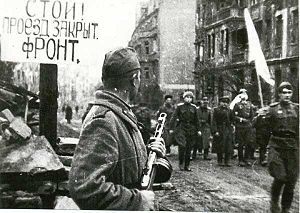
In February 1945 the Soviet
Red Army
approached the city. Gauleiter
Karl Hanke
declared the city a Festung (fortress) to be held at all costs. Hanke finally lifted a ban on the evacuation of women and children when it was almost too late. During his poorly organised evacuation in January 1945, 18,000 people froze to death in icy snowstorms and -20 C weather. By the end of the Siege of Breslau, half the city had been destroyed. An estimated 40,000 civilians lay dead in the ruins of homes and factories. After a siege of nearly three months, Hanke surrendered on 6 May 1945, just before the end of the war.
Along with almost all of Lower Silesia, the city became part of Poland under the terms of the Potsdam Conference
. The Polish name of Wrocław became its official name. There had been some discussion among the Western Allies
to mark the southern Polish-German boundary on the Glatzer Neisse; this would have meant that post-war Germany would have been allowed to retain approximately half of Silesia, including Breslau. However, the Soviets
insisted that the border be drawn at the Lusatian Neisse
farther west.
Most remaining German inhabitants in Wrocław fled or were forcibly expelled
from Wrocław between 1945 and 1949 and moved to Allied Occupation Zones in Germany. A small German minority remains in the city till this day, although the city's last German school closed in 1963. The Polish population was dramatically increased by government resettlement of Poles during postwar population transfers (75%) as well as during the forced deportation
s from Polish lands annexed by the Soviet Union in the east
region, many of whom came from Lviv
(Lwów).
Wrocław is now a unique European city of mixed heritage, with architecture influenced by Bohemia
n, Austrian and Prussia
n traditions, such as Silesian Gothic
and its Baroque
style of court builders of Habsburg Austria (Fischer von Erlach
). Wrocław has a number of notable buildings by German modernist
architects including the famous Centennial Hall (Hala Stulecia or Jahrhunderthalle) (1911–1913) designed by Max Berg
.
In July 1997, the city was heavily affected by a flood of the River Oder, the worst flooding in post-war Poland, Germany and the Czech Republic
. Around one-third of the area of the city was flooded. An earlier equally devastating flood of the river took place in 1903.
A small part of the city was also flooded during the flood in 2010
.
, a province (voivodeship
) created in 1999. It was previously the seat of Wrocław Voivodeship. The city is a separate urban gmina
and city county (powiat
). It is also the seat of Wrocław County, which adjoins but does not include the city.
Wrocław was previously subdivided into five boroughs (dzielnica
s):
However, the city is now divided into 48 osiedle
s (districts).
Wrocław is currently governed by the city's mayor and a municipal legislature known as the city council. The city council is made up of 39 councillors and is directly elected by the city's inhabitants. The remit of the council and president extends to all areas of municipal policy and development planning, up to and including development of local infrastructure, transport and planning permission. However, it is not able to draw taxation directly from its citizens, and instead receives its budget from the Polish national government whose seat is in Warsaw. The city's current mayor is Rafał Dutkiewicz, who has served in this position since 2002.
 Wrocław is the third largest educational centre of Poland, with 135,000 students in 30 colleges which employ some 7,400 staff.
List of ten public colleges and universities
:
s and electronics. In recent years the City Council has run an active policy to attract foreign investors
from the high-tech sector. This resulted among others in the location of LG Electronics
production cluster in Kobierzyce
near Wrocław. After 1989, Wrocław became a significant financial centre
and houses the headquarters of several nationwide financial institution
s such as Bank Zachodni WBK, Lukas Bank, Getin Bank, and Europejski Fundusz Leasingowy. As of the end of 2008, Wrocław enjoyed a very low unemployment level of just 3.2% compared with the national level of 8.7%. In 2008, per capita
gross domestic product
in Wrocław came to 27755$ (in Poland
17625$).
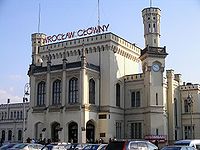 Wrocław is skirted on the south by the A4 motorway, which allows for a quick connection with Upper Silesia
, Kraków
and further east to Ukraine
, and Dresden
and Berlin
to the west. The A8 motorway (Wrocław ring road) connect A4 motorway with S8 express road
(is being built) to Łódź, Warsaw
and Białystok.
The city is served by Wrocław International Airport, a river port
, the main rail station is Wrocław Główny, which is located next to bus station served by Przedsiębiorstwo Komunikacji Samochodowej.
Public transport
in Wrocław consists of many bus lines and 22 tram lines
operated by Miejskie Przedsiębiorstwo Komunikacyjne (MPK, the Municipal Transport Company).
In the city there are also corporations Taxicab
.
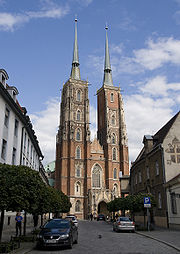 Like all of Poland, Wrocław's population is predominantly Roman Catholic
; the city is the seat of an Archdiocese. However, post-war resettlements from Poland's ethnically and religiously more diverse former eastern territories (known in Polish as Kresy
) and the eastern parts of post-1945 Poland (see Operation Vistula) account for a comparatively large portion of Greek Catholics
and Orthodox
Christians of mostly Ukrainian and Lemko
descent.
Wrocław is also unique for its "Dzielnica Czterech Świątyń" (Borough of Four Temples) — a part of Stare Miasto (Old Town) where a Synagogue, a Lutheran Church
, a Roman Catholic church and an Eastern Orthodox church stand near each other.
teams. The most popular sport today is football, thanks to Śląsk Wrocław. In the second place is basketball
. The award-winning men's basketball team (17 times Polish Champion). Matches of Eurobasket 2009
to in Wrocław in 2009. Some matches of the 2012 UEFA European Football Championships in Poland
and Ukraine
are scheduled to take place in Wrocław on The Municipal Stadium.
Every year takes place in Wroclaw Marathon.
Poland
Poland , officially the Republic of Poland , is a country in Central Europe bordered by Germany to the west; the Czech Republic and Slovakia to the south; Ukraine, Belarus and Lithuania to the east; and the Baltic Sea and Kaliningrad Oblast, a Russian exclave, to the north...
.
Wrocław was the historical capital of Silesia
Silesia
Silesia is a historical region of Central Europe located mostly in Poland, with smaller parts also in the Czech Republic, and Germany.Silesia is rich in mineral and natural resources, and includes several important industrial areas. Silesia's largest city and historical capital is Wrocław...
and is today the capital of the Lower Silesian Voivodeship
Lower Silesian Voivodeship
Lower Silesian Voivodeship, or Lower Silesia Province , is one of the 16 voivodeships into which Poland is currently divided. It lies in southwestern Poland...
. Over the centuries, the city has been part of either Poland, Bohemia
Bohemia
Bohemia is a historical region in central Europe, occupying the western two-thirds of the traditional Czech Lands. It is located in the contemporary Czech Republic with its capital in Prague...
, Austria
Austrian Empire
The Austrian Empire was a modern era successor empire, which was centered on what is today's Austria and which officially lasted from 1804 to 1867. It was followed by the Empire of Austria-Hungary, whose proclamation was a diplomatic move that elevated Hungary's status within the Austrian Empire...
, Prussia
Prussia
Prussia was a German kingdom and historic state originating out of the Duchy of Prussia and the Margraviate of Brandenburg. For centuries, the House of Hohenzollern ruled Prussia, successfully expanding its size by way of an unusually well-organized and effective army. Prussia shaped the history...
, or Germany
Germany
Germany , officially the Federal Republic of Germany , is a federal parliamentary republic in Europe. The country consists of 16 states while the capital and largest city is Berlin. Germany covers an area of 357,021 km2 and has a largely temperate seasonal climate...
, but since 1945 it has become again part of Poland as a result of post-World War Two border changes. According to official population figures for 2010, its population is 632,996, making it the fourth largest city in Poland.
Wrocław has been selected as a European Capital of Culture
European Capital of Culture
The European Capital of Culture is a city designated by theEuropean Union for a period of one calendar year during which it organises a series of cultural events with a strong European dimension....
for 2016. It will share the title with San Sebastián
San Sebastián
Donostia-San Sebastián is a city and municipality located in the north of Spain, in the coast of the Bay of Biscay and 20 km away from the French border. The city is the capital of Gipuzkoa, in the autonomous community of the Basque Country. The municipality’s population is 186,122 , and its...
, Spain
Spain
Spain , officially the Kingdom of Spain languages]] under the European Charter for Regional or Minority Languages. In each of these, Spain's official name is as follows:;;;;;;), is a country and member state of the European Union located in southwestern Europe on the Iberian Peninsula...
.
Etymology
The city's name was first recorded in the year 1000 by ThietmarThietmar of Merseburg
Thietmar of Merseburg was a German chronicler who was also bishop of Merseburg.-Life:...
's Latin
Latin
Latin is an Italic language originally spoken in Latium and Ancient Rome. It, along with most European languages, is a descendant of the ancient Proto-Indo-European language. Although it is considered a dead language, a number of scholars and members of the Christian clergy speak it fluently, and...
chronicle called Thietmari Merseburgensis episcopi Chronicon as Wrotizlawa in connection with the assumption (at the Congress of Gniezno
Congress of Gniezno
The Congress of Gniezno was an amical meeting between the Polish duke Bolesław I Chrobry and Emperor Otto III, which took place at Gniezno on March 11, 1000...
) bishop
Diocese
A diocese is the district or see under the supervision of a bishop. It is divided into parishes.An archdiocese is more significant than a diocese. An archdiocese is presided over by an archbishop whose see may have or had importance due to size or historical significance...
(one of four in the then Polish
Poland
Poland , officially the Republic of Poland , is a country in Central Europe bordered by Germany to the west; the Czech Republic and Slovakia to the south; Ukraine, Belarus and Lithuania to the east; and the Baltic Sea and Kaliningrad Oblast, a Russian exclave, to the north...
). The first municipal seal stated Sigillum civitatis Wratislavie. A simplified name is given, in 1175, as Wrezlaw, Prezla or Breslaw.
The Czech
Czech language
Czech is a West Slavic language with about 12 million native speakers; it is the majority language in the Czech Republic and spoken by Czechs worldwide. The language was known as Bohemian in English until the late 19th century...
spelling was used in Latin documents as Wratislavia or Vratislavia. At that time, Prezla was used in Middle High German
Middle High German
Middle High German , abbreviated MHG , is the term used for the period in the history of the German language between 1050 and 1350. It is preceded by Old High German and followed by Early New High German...
, which became Preßlau. In the middle of the 14th century the Early New High German
Early New High German
Early New High German is a term for the period in the history of the German language, generally defined, following Wilhelm Scherer, as the period 1350 to 1650.Alternative periodisations take the period to begin later; e.g...
(and later New High German
New High German
New High German is the term used for the most recent period in the history of the German language. It is a translation of the German Neuhochdeutsch...
) form of the name Breslau began to replace its earlier versions.
The city is traditionally believed to be named after Wrocisław or Vratislav, often believed to be Duke Vratislaus I of Bohemia. It is also possible that the city was named after the tribal duke of the Silesians
Silesians
Silesians , are the inhabitants of Silesia in Poland, Germany and the Czech Republic. A small diaspora community also exists in Karnes County, Texas in the USA....
or after an early ruler of the city called Vratislav.
The city's name in various languages is:
- HebrewHebrew languageHebrew is a Semitic language of the Afroasiatic language family. Culturally, is it considered by Jews and other religious groups as the language of the Jewish people, though other Jewish languages had originated among diaspora Jews, and the Hebrew language is also used by non-Jewish groups, such...
: ורוצלב (Vrotsláv) - Silesian GermanSilesian GermanSilesian German language , is a German dialect/language spoken in Silesia. Today, the area is mainly in southwestern Poland, but as well as in northeastern Czech Republic and in eastern Germany...
: Brassel or Budorgis
The city's name in other languages is available here.
History
The city of Wrocław originated as a BohemiaBohemia
Bohemia is a historical region in central Europe, occupying the western two-thirds of the traditional Czech Lands. It is located in the contemporary Czech Republic with its capital in Prague...
n stronghold at the intersection of two trade route
Trade route
A trade route is a logistical network identified as a series of pathways and stoppages used for the commercial transport of cargo. Allowing goods to reach distant markets, a single trade route contains long distance arteries which may further be connected to several smaller networks of commercial...
s, the Via Regia
Via Regia
Via Regia, i.e. "Royal Highway", denotes a mediæval historic road. The term, in the usual sense, means not just a specific road, rather a type of road. It was legally associated with the king and remained under his special protection and guarantee of public peace.There were many such roads in the...
and the Amber Road
Amber Road
The Amber Road was an ancient trade route for the transfer of amber. As one of the waterways and ancient highways, for centuries the road led from Europe to Asia and back, and from northern Africa to the Baltic Sea....
. The city was first recorded in the 10th century as Vratislavia, possibly derived from the name of a Bohemian duke Vratislav I. Its initial extent was limited to district of Ostrów Tumski (the Cathedral Island, German: Dominsel).
Middle Ages
During Wrocław's early history, its control changed hands between Bohemia (until 992, then 1038–1054), the Kingdom of Poland (992–1038 and 1054–1202), and, after the fragmentation of the Kingdom of Poland, the PiastPiast dynasty
The Piast dynasty was the first historical ruling dynasty of Poland. It began with the semi-legendary Piast Kołodziej . The first historical ruler was Duke Mieszko I . The Piasts' royal rule in Poland ended in 1370 with the death of king Casimir the Great...
-ruled duchy of Silesia
Duchies of Silesia
The Duchies of Silesia resulted from divisions of the original Duchy of Silesia after 1138.In accordance with the last will and testament of Duke Bolesław III Wrymouth, the Kingdom of Poland was, upon his death in 1138, divided into five hereditary provinces distributed among his sons, including...
. One of the most important events in those times was the foundation of the Diocese of Wrocław by the Polish Duke (from 1025 king) Bolesław the Brave in 1000, which, together with the Bishopric
Diocese
A diocese is the district or see under the supervision of a bishop. It is divided into parishes.An archdiocese is more significant than a diocese. An archdiocese is presided over by an archbishop whose see may have or had importance due to size or historical significance...
s of Kraków and Kołobrzeg, was placed under the Archbishopric of Gniezno in Greater Poland
Greater Poland
Greater Poland or Great Poland, often known by its Polish name Wielkopolska is a historical region of west-central Poland. Its chief city is Poznań.The boundaries of Greater Poland have varied somewhat throughout history...
, founded by Otto III in 1000. In the first half of the 13th century Wrocław even became the political centre
Centrism
In politics, centrism is the ideal or the practice of promoting policies that lie different from the standard political left and political right. Most commonly, this is visualized as part of the one-dimensional political spectrum of left-right politics, with centrism landing in the middle between...
of the divided Polish kingdom
Kingdom of Poland (disambiguation)
Kingdom of Poland was the name of Poland from 1000/1025 to 1795:* Kingdom of Poland from the early Piast dynasty* Kingdom of Poland under the Jagiellon dynasty...
.
The city became a commercial centre and expanded to Wyspa Piaskowa (Sand Island, German: Sandinsel), then to the left bank of the River Oder. Around 1000, the town had 1000 inhabitants. By 1139, a settlement belonging to Governor Piotr Włostowic (a.k.a Piotr Włast Dunin
Dunin (surname)
The Polish surname Dunin originated with the 12th century with Piotr Włost Dunin. He was Palatine of Poland and the castellan of Wroclaw , as well as, Brother in law of Duke Bolesław III Wrymouth...
) was built, and another was founded on the left bank of the River Oder, near the present seat of the university. While the city was Polish, there were also communities of Bohemia
Bohemia
Bohemia is a historical region in central Europe, occupying the western two-thirds of the traditional Czech Lands. It is located in the contemporary Czech Republic with its capital in Prague...
ns, Jews
Jews
The Jews , also known as the Jewish people, are a nation and ethnoreligious group originating in the Israelites or Hebrews of the Ancient Near East. The Jewish ethnicity, nationality, and religion are strongly interrelated, as Judaism is the traditional faith of the Jewish nation...
, Walloons
Walloons
Walloons are a French-speaking people who live in Belgium, principally in Wallonia. Walloons are a distinctive community within Belgium, important historical and anthropological criteria bind Walloons to the French people. More generally, the term also refers to the inhabitants of the Walloon...
and Germans
Germany
Germany , officially the Federal Republic of Germany , is a federal parliamentary republic in Europe. The country consists of 16 states while the capital and largest city is Berlin. Germany covers an area of 357,021 km2 and has a largely temperate seasonal climate...
.
The city was devastated in 1241 during the Mongol invasion of Europe
Mongol invasion of Europe
The resumption of the Mongol invasion of Europe, during which the Mongols attacked medieval Rus' principalities and the powers of Poland and Hungary, was marked by the Mongol invasion of Rus starting in 21 December 1237...
. While the city was burned to force the Mongols to a quick withdrawal, most of the population probably survived.
Afterwards the town was partly populated by influx of German settlers (see: Ostsiedlung
Ostsiedlung
Ostsiedlung , also called German eastward expansion, was the medieval eastward migration and settlement of Germans from modern day western and central Germany into less-populated regions and countries of eastern Central Europe and Eastern Europe. The affected area roughly stretched from Slovenia...
), who would eventually become the dominant ethnic group
Ethnic group
An ethnic group is a group of people whose members identify with each other, through a common heritage, often consisting of a common language, a common culture and/or an ideology that stresses common ancestry or endogamy...
in the following centuries, though the city remained multi-ethnic as an important trading city on the Via Regia
Via Regia
Via Regia, i.e. "Royal Highway", denotes a mediæval historic road. The term, in the usual sense, means not just a specific road, rather a type of road. It was legally associated with the king and remained under his special protection and guarantee of public peace.There were many such roads in the...
and Amber Road
Amber Road
The Amber Road was an ancient trade route for the transfer of amber. As one of the waterways and ancient highways, for centuries the road led from Europe to Asia and back, and from northern Africa to the Baltic Sea....
. "Breslau", the Germanised name of the city, appeared for the first time in written records. The city council
City council
A city council or town council is the legislative body that governs a city, town, municipality or local government area.-Australia & NZ:Because of the differences in legislation between the States, the exact definition of a City Council varies...
used Latin
Latin
Latin is an Italic language originally spoken in Latium and Ancient Rome. It, along with most European languages, is a descendant of the ancient Proto-Indo-European language. Although it is considered a dead language, a number of scholars and members of the Christian clergy speak it fluently, and...
and German
German language
German is a West Germanic language, related to and classified alongside English and Dutch. With an estimated 90 – 98 million native speakers, German is one of the world's major languages and is the most widely-spoken first language in the European Union....
languages.
After the Mongol invasion, Breslau was expanded by adopting German town law
German town law
German town law or German municipal concerns concerns town privileges used by many cities, towns, and villages throughout Central and Eastern Europe during the Middle Ages.- Town law in Germany :...
. The expanded town was around 60 hectares in size and the new main market square (Rynek, German: Ring), which was covered with timber frame houses, became the new centre of the town. The original foundation, Ostrów Tumski, became the religious center. Breslau adopted Magdeburg rights
Magdeburg rights
Magdeburg Rights or Magdeburg Law were a set of German town laws regulating the degree of internal autonomy within cities and villages granted by a local ruler. Modelled and named after the laws of the German city of Magdeburg and developed during many centuries of the Holy Roman Empire, it was...
in 1262 and, at the end of the 13th century joined the Hanseatic League
Hanseatic League
The Hanseatic League was an economic alliance of trading cities and their merchant guilds that dominated trade along the coast of Northern Europe...
. The Polish Piast dynasty remained in control of the region, but the city council's right to govern independently increased.
In 1335, Breslau was incorporated with almost all of Silesia into the Kingdom of Bohemia
Kingdom of Bohemia
The Kingdom of Bohemia was a country located in the region of Bohemia in Central Europe, most of whose territory is currently located in the modern-day Czech Republic. The King was Elector of Holy Roman Empire until its dissolution in 1806, whereupon it became part of the Austrian Empire, and...
, then a part of the Holy Roman Empire
Holy Roman Empire
The Holy Roman Empire was a realm that existed from 962 to 1806 in Central Europe.It was ruled by the Holy Roman Emperor. Its character changed during the Middle Ages and the Early Modern period, when the power of the emperor gradually weakened in favour of the princes...
. Between 1342 and 1344, two fires destroyed large parts of the city.
Renaissance, Reformation and Counter-Reformation
The Protestant ReformationProtestant Reformation
The Protestant Reformation was a 16th-century split within Western Christianity initiated by Martin Luther, John Calvin and other early Protestants. The efforts of the self-described "reformers", who objected to the doctrines, rituals and ecclesiastical structure of the Roman Catholic Church, led...
reached Breslau in 1518 and the city became Protestant. However, from 1526 Silesia was ruled by the Catholic House of Habsburg. In 1618, Breslau supported the Bohemian Revolt
Thirty Years' War
The Thirty Years' War was fought primarily in what is now Germany, and at various points involved most countries in Europe. It was one of the most destructive conflicts in European history....
in fear of losing the right to freedom of religious expression
Freedom of religion
Freedom of religion is a principle that supports the freedom of an individual or community, in public or private, to manifest religion or belief in teaching, practice, worship, and observance; the concept is generally recognized also to include the freedom to change religion or not to follow any...
. In the following Thirty Years' War
Thirty Years' War
The Thirty Years' War was fought primarily in what is now Germany, and at various points involved most countries in Europe. It was one of the most destructive conflicts in European history....
the city was occupied by Saxon
Saxony
The Free State of Saxony is a landlocked state of Germany, contingent with Brandenburg, Saxony Anhalt, Thuringia, Bavaria, the Czech Republic and Poland. It is the tenth-largest German state in area, with of Germany's sixteen states....
and Swedish
Sweden
Sweden , officially the Kingdom of Sweden , is a Nordic country on the Scandinavian Peninsula in Northern Europe. Sweden borders with Norway and Finland and is connected to Denmark by a bridge-tunnel across the Öresund....
troops and lost 18,000 of 40,000 citizens to plague.
The Austrian emperor
Emperor of Austria
The Emperor of Austria was a hereditary imperial title and position proclaimed in 1804 by the Holy Roman Emperor Francis II, a member of the House of Habsburg-Lorraine, and continually held by him and his heirs until the last emperor relinquished power in 1918. The emperors retained the title of...
brought in the Counter-Reformation
Counter-Reformation
The Counter-Reformation was the period of Catholic revival beginning with the Council of Trent and ending at the close of the Thirty Years' War, 1648 as a response to the Protestant Reformation.The Counter-Reformation was a comprehensive effort, composed of four major elements:#Ecclesiastical or...
by encouraging Catholic orders to settle in Breslau, starting in 1610 with the Minorites, followed by Jesuits, Capucins, Franciscan
Franciscan
Most Franciscans are members of Roman Catholic religious orders founded by Saint Francis of Assisi. Besides Roman Catholic communities, there are also Old Catholic, Anglican, Lutheran, ecumenical and Non-denominational Franciscan communities....
s and finally Ursulines
Ursulines
The Ursulines are a Roman Catholic religious order for women founded at Brescia, Italy, by Saint Angela de Merici in November 1535, primarily for the education of girls and the care of the sick and needy. Their patron saint is Saint Ursula.-History:St Angela de Merici spent 17 years leading a...
in 1687. These orders erected buildings which shaped the city's appearance until 1945. At the end of the Thirty Years' War, however, Breslau was one of only a few Silesian cities to stay Protestant.
The precise recordkeeping of births and deaths by the city of Breslau led to the use of their data for analysis of mortality, first by John Graunt
John Graunt
John Graunt was one of the first demographers, though by profession he was a haberdasher. Born in London, the eldest of seven or eight children of Henry and Mary Graunt. His father was a draper who had moved to London from Hampshire...
, and then later by Edmond Halley
Edmond Halley
Edmond Halley FRS was an English astronomer, geophysicist, mathematician, meteorologist, and physicist who is best known for computing the orbit of the eponymous Halley's Comet. He was the second Astronomer Royal in Britain, following in the footsteps of John Flamsteed.-Biography and career:Halley...
. Halley's tables and analysis, published in 1693, are considered to be the first true actuarial
Actuarial science
Actuarial science is the discipline that applies mathematical and statistical methods to assess risk in the insurance and finance industries. Actuaries are professionals who are qualified in this field through education and experience...
tables, and thus the foundation of modern actuarial science.
During the Counter-Reformation, the intellectual life of the city — shaped by Protestantism
Protestantism
Protestantism is one of the three major groupings within Christianity. It is a movement that began in Germany in the early 16th century as a reaction against medieval Roman Catholic doctrines and practices, especially in regards to salvation, justification, and ecclesiology.The doctrines of the...
and Humanism
Humanism
Humanism is an approach in study, philosophy, world view or practice that focuses on human values and concerns. In philosophy and social science, humanism is a perspective which affirms some notion of human nature, and is contrasted with anti-humanism....
— flourished, even as the Protestant bourgeoisie lost its role to the Catholic orders as the patron of the arts. Breslau became the centre of German Baroque
Baroque
The Baroque is a period and the style that used exaggerated motion and clear, easily interpreted detail to produce drama, tension, exuberance, and grandeur in sculpture, painting, literature, dance, and music...
literature and was home to the First and Second Silesian school of poets.
The Kingdom of Prussia
Kingdom of Prussia
The Kingdom of Prussia was a German kingdom from 1701 to 1918. Until the defeat of Germany in World War I, it comprised almost two-thirds of the area of the German Empire...
annexed Breslau and most of Silesia during the War of the Austrian Succession
War of the Austrian Succession
The War of the Austrian Succession – including King George's War in North America, the Anglo-Spanish War of Jenkins' Ear, and two of the three Silesian wars – involved most of the powers of Europe over the question of Maria Theresa's succession to the realms of the House of Habsburg.The...
in the 1740s. Habsburg empress Maria Theresa
Maria Theresa of Austria
Maria Theresa Walburga Amalia Christina was the only female ruler of the Habsburg dominions and the last of the House of Habsburg. She was the sovereign of Austria, Hungary, Croatia, Bohemia, Mantua, Milan, Lodomeria and Galicia, the Austrian Netherlands and Parma...
ceded the territory in 1763.
Napoleonic Wars
During the Napoleonic WarsNapoleonic Wars
The Napoleonic Wars were a series of wars declared against Napoleon's French Empire by opposing coalitions that ran from 1803 to 1815. As a continuation of the wars sparked by the French Revolution of 1789, they revolutionised European armies and played out on an unprecedented scale, mainly due to...
, Breslau was occupied by an army of the Confederation of the Rhine
Confederation of the Rhine
The Confederation of the Rhine was a confederation of client states of the First French Empire. It was formed initially from 16 German states by Napoleon after he defeated Austria's Francis II and Russia's Alexander I in the Battle of Austerlitz. The Treaty of Pressburg, in effect, led to the...
. The fortifications of the city were leveled and monasteries and cloisters were secularised. The Protestant Viadrina University of Frankfurt (Oder)
Frankfurt (Oder)
Frankfurt is a town in Brandenburg, Germany, located on the Oder River, on the German-Polish border directly opposite the town of Słubice which was a part of Frankfurt until 1945. At the end of the 1980s it reached a population peak with more than 87,000 inhabitants...
was relocated to Breslau in 1811, and united with the local Jesuit University to create the new Silesian Frederick-William University (Schlesische Friedrich-Wilhelm-Universität, now University of Wrocław). The city became the centre of the German Liberation movement against Napoleon, and the gathering place for volunteers from all over Germany, with the Iron Cross
Iron Cross
The Iron Cross is a cross symbol typically in black with a white or silver outline that originated after 1219 when the Kingdom of Jerusalem granted the Teutonic Order the right to combine the Teutonic Black Cross placed above a silver Cross of Jerusalem....
military decoration
Military decoration
A military decoration is a decoration given to military personnel or units for heroism in battle or distinguished service. They are designed to be worn on military uniform....
founded by Frederick William III of Prussia
Frederick William III of Prussia
Frederick William III was king of Prussia from 1797 to 1840. He was in personal union the sovereign prince of the Principality of Neuchâtel .-Early life:...
in early March 1813. The city was the centre of Prussia
Prussia
Prussia was a German kingdom and historic state originating out of the Duchy of Prussia and the Margraviate of Brandenburg. For centuries, the House of Hohenzollern ruled Prussia, successfully expanding its size by way of an unusually well-organized and effective army. Prussia shaped the history...
n mobilisation for the campaign which ended at Leipzig
Leipzig
Leipzig Leipzig has always been a trade city, situated during the time of the Holy Roman Empire at the intersection of the Via Regia and Via Imperii, two important trade routes. At one time, Leipzig was one of the major European centres of learning and culture in fields such as music and publishing...
.
Before and after World War I
Napoleonic redevelopmentsConfederation of the Rhine
The Confederation of the Rhine was a confederation of client states of the First French Empire. It was formed initially from 16 German states by Napoleon after he defeated Austria's Francis II and Russia's Alexander I in the Battle of Austerlitz. The Treaty of Pressburg, in effect, led to the...
increased prosperity in Silesia and Breslau. The levelled fortifications opened space for the city to grow beyond its old limits. Breslau became an important railway hub and industrial centre, notably of linen and cotton manufacture
Cotton
Cotton is a soft, fluffy staple fiber that grows in a boll, or protective capsule, around the seeds of cotton plants of the genus Gossypium. The fiber is almost pure cellulose. The botanical purpose of cotton fiber is to aid in seed dispersal....
and metal industry. The new university served as a major centre of sciences, while the secularisation of life laid the base for a rich museum landscape. Johannes Brahms
Johannes Brahms
Johannes Brahms was a German composer and pianist, and one of the leading musicians of the Romantic period. Born in Hamburg, Brahms spent much of his professional life in Vienna, Austria, where he was a leader of the musical scene...
wrote his Academic Festival Overture
Academic Festival Overture
Academic Festival Overture , Op. 80, by Johannes Brahms, was one of a pair of contrasting concert overtures — the other being the Tragic Overture, Op. 81, written to balance it as its pair...
to thank the university for an honorary doctorate awarded in 1881.
The Unification of Germany
Unification of Germany
The formal unification of Germany into a politically and administratively integrated nation state officially occurred on 18 January 1871 at the Versailles Palace's Hall of Mirrors in France. Princes of the German states gathered there to proclaim Wilhelm of Prussia as Emperor Wilhelm of the German...
in 1871 turned Breslau into the sixth-largest city in the German Empire
German Empire
The German Empire refers to Germany during the "Second Reich" period from the unification of Germany and proclamation of Wilhelm I as German Emperor on 18 January 1871, to 1918, when it became a federal republic after defeat in World War I and the abdication of the Emperor, Wilhelm II.The German...
. Its population more than tripled to over half a million between 1860 and 1910. The 1900 census listed 422,709 residents, among them 5,363 persons (just over 1% of the population) declaring to have competent knowledge in the Polish language only, and another 3,103 (0.7% of the population) being also competent in Polish. In religious respect there were 58% Protestants, 37% Catholics and 5% Jews (counting 20,536 in the 1905 census). The Jewish community of Breslau was among the most important in Germany and several distinguished artists and scientists originated from it. Important landmarks were inaugurated in 1910, the Kaiserbrücke (Kaiser bridge) and the Technische Hochschule (TH), which now houses the Wrocław University of Technology.
In 1913, the newly-built Centennial Hall housed the "Ausstellung zur Jahrhundertfeier der Freiheitskriege", an exhibition commemorating the 100th anniversary of the historical German Wars of Liberation
War of the Sixth Coalition
In the War of the Sixth Coalition , a coalition of Austria, Prussia, Russia, the United Kingdom, Portugal, Sweden, Spain and a number of German States finally defeated France and drove Napoleon Bonaparte into exile on Elba. After Napoleon's disastrous invasion of Russia, the continental powers...
against Napoleon
Napoleon I of France
Napoleon Bonaparte was a French military and political leader during the latter stages of the French Revolution.As Napoleon I, he was Emperor of the French from 1804 to 1815...
and the first award of the Iron Cross
Iron Cross
The Iron Cross is a cross symbol typically in black with a white or silver outline that originated after 1219 when the Kingdom of Jerusalem granted the Teutonic Order the right to combine the Teutonic Black Cross placed above a silver Cross of Jerusalem....
.
Following World War I
World War I
World War I , which was predominantly called the World War or the Great War from its occurrence until 1939, and the First World War or World War I thereafter, was a major war centred in Europe that began on 28 July 1914 and lasted until 11 November 1918...
, Breslau became the capital of the newly created Prussian Province of Lower Silesia
Province of Lower Silesia
The Province of Lower Silesia was a province of the Free State of Prussia from 1919 to 1945. Between 1938 and 1941 it was reunited with Upper Silesia as the Silesia Province. The capital of Lower Silesia was Breslau...
in 1919. During the month of August 1920, at the time of Polish Silesian Uprising
Silesian Uprisings
The Silesian Uprisings were a series of three armed uprisings of the Poles and Polish Silesians of Upper Silesia, from 1919–1921, against German rule; the resistance hoped to break away from Germany in order to join the Second Polish Republic, which had been established in the wake of World War I...
in Upper Silesia
Upper Silesia
Upper Silesia is the southeastern part of the historical and geographical region of Silesia. Since the 9th century, Upper Silesia has been part of Greater Moravia, the Duchy of Bohemia, the Piast Kingdom of Poland, again of the Lands of the Bohemian Crown and the Holy Roman Empire, as well as of...
, the Polish Consulate and School were demolished, whilst the Polish Library was burned down by a mob. The number of Poles as a percentage of the total population in Breslau dropped from 2% before World War I
World War I
World War I , which was predominantly called the World War or the Great War from its occurrence until 1939, and the First World War or World War I thereafter, was a major war centred in Europe that began on 28 July 1914 and lasted until 11 November 1918...
to 0.5% after the reconstitution of Poland
History of Poland (1918–1939)
The History of interwar Poland comprises the period from the re-recreation of the independent Polish state in 1918, until the joint Invasion of Poland by Nazi Germany and the Soviet Union in 1939 at the onset of World War II...
in 1918. Antisemitic riots occurred in 1923.
The city boundaries were expanded between 1925 and 1930 to include an area of 175 km² (67.6 sq mi) with a population of 600.000. In 1929, the Werkbund
Deutscher Werkbund
The Deutscher Werkbund was a German association of artists, architects, designers, and industrialists. The Werkbund was to become an important event in the development of modern architecture and industrial design, particularly in the later creation of the Bauhaus school of design...
opened WuWa (German: Wohnungs- und Werkraumausstellung) in Breslau-Scheitnig, an international showcase of modern architecture
Modern architecture
Modern architecture is generally characterized by simplification of form and creation of ornament from the structure and theme of the building. It is a term applied to an overarching movement, with its exact definition and scope varying widely...
by architects of the Silesian branch of the Werkbund. In June 1930, Breslau hosted the Deutsche Kampfspiele, a sporting event
Sport
A Sport is all forms of physical activity which, through casual or organised participation, aim to use, maintain or improve physical fitness and provide entertainment to participants. Sport may be competitive, where a winner or winners can be identified by objective means, and may require a degree...
for German athletes after Germany was excluded from the Olympic Games
Olympic Games
The Olympic Games is a major international event featuring summer and winter sports, in which thousands of athletes participate in a variety of competitions. The Olympic Games have come to be regarded as the world’s foremost sports competition where more than 200 nations participate...
after World War I.
The city became one of the strongest support bases of the Nazi
Nazism
Nazism, the common short form name of National Socialism was the ideology and practice of the Nazi Party and of Nazi Germany...
s, who in the 1932 elections received 44% of Breslau's votes, their third-highest total in the entire country.
After Hitler's takeover of the German government in 1933, political enemies of the Nazis were persecuted, and their institutions closed or destroyed; in the city the Gestapo
Gestapo
The Gestapo was the official secret police of Nazi Germany. Beginning on 20 April 1934, it was under the administration of the SS leader Heinrich Himmler in his position as Chief of German Police...
began actions against Polish and Jewish students (see: Jewish Theological Seminary of Breslau
Jewish Theological Seminary of Breslau
Das Jüdisch-Theologische Seminar , The Jewish Theological Seminary of BreslauInstitution in Breslau for the training of rabbis, founded under the will of Jonas Fränckel, and opened in 1854...
), Communists, Social Democrats
Social Democratic Party of Germany
The Social Democratic Party of Germany is a social-democratic political party in Germany...
, and trade unionists, arrests were even made for using Polish in public, in 1938 the police destroyed the Polish cultural centre. Many of the city's 10,000 Jews as well as many other enemies of the Third Reich
Nazi Germany
Nazi Germany , also known as the Third Reich , but officially called German Reich from 1933 to 1943 and Greater German Reich from 26 June 1943 onward, is the name commonly used to refer to the state of Germany from 1933 to 1945, when it was a totalitarian dictatorship ruled by...
were sent to concentration camps
Nazi concentration camps
Nazi Germany maintained concentration camps throughout the territories it controlled. The first Nazi concentration camps set up in Germany were greatly expanded after the Reichstag fire of 1933, and were intended to hold political prisoners and opponents of the regime...
; those Jews who remained were killed during the Holocaust
The Holocaust
The Holocaust , also known as the Shoah , was the genocide of approximately six million European Jews and millions of others during World War II, a programme of systematic state-sponsored murder by Nazi...
. A network of concentration camps
Internment
Internment is the imprisonment or confinement of people, commonly in large groups, without trial. The Oxford English Dictionary gives the meaning as: "The action of 'interning'; confinement within the limits of a country or place." Most modern usage is about individuals, and there is a distinction...
and forced labour camps
Arbeitslager
Arbeitslager is a German language word which means labor camp.The German government under Nazism used forced labor extensively, starting in the 1930s but most especially during World War II....
was established around Breslau, to serve industrial concerns, including FAMO, Junkers
Junkers
Junkers Flugzeug- und Motorenwerke AG , more commonly Junkers, was a major German aircraft manufacturer. It produced some of the world's most innovative and best-known airplanes over the course of its fifty-plus year history in Dessau, Germany. It was founded there in 1895 by Hugo Junkers,...
and Krupp
Krupp
The Krupp family , a prominent 400-year-old German dynasty from Essen, have become famous for their steel production and for their manufacture of ammunition and armaments. The family business, known as Friedrich Krupp AG Hoesch-Krupp, was the largest company in Europe at the beginning of the 20th...
. Tens of thousands were imprisoned there.
The last big event organised by the Nazi Sports Body
Nationalsozialistischer Reichsbund für Leibesübungen
The Nationalsozialistischer Reichsbund für Leibesübungen , more rarely "NSRBL", , known as Deutscher Reichsbund für Leibesübungen until 1938, was the umbrella organization for sports during the Third Reich.The NSRL was led by the Reichssportführer, who after 1934 was...
called Deutsches Turn-und-Sportfest
Deutsches Turn- und Sportfest 1938
The Deutsches Turn- und Sportfest was the last big sports event organized by the Nationalsozialistischer Reichsbund für Leibesübungen, the Sports governing body of the Third Reich. It took place in Breslau the most important city of Silesia, now in Poland...
(Gym and Sports Festivities) took place in Breslau from 26 to 31 July 1938. The Sportsfest was held in Breslau to commemorate the 125th anniversary of the German Wars of Liberation against Napoleon's invasion.
World War II and afterwards
World War II
World War II, or the Second World War , was a global conflict lasting from 1939 to 1945, involving most of the world's nations—including all of the great powers—eventually forming two opposing military alliances: the Allies and the Axis...
, the fighting did not affect Breslau. In 1941 the remnants of the pre-war Polish minority in the city, as well as Polish slave labourers organised a resistance group called Olimp
Olimp (organization)
Olimp was a Polish anti-Nazi resistance organization active in Wrocław during World War II.-History:It was formed in 1941 by members of the Polish minority in Germany located in Breslau and Poles from Upper Silesia...
. As the war lengthened, refugees from bombed-out German cities, and later refugees from farther east, swelled the population to nearly one million. including 51,000 forced labourers in 1944, and 9876 Allied PoWs. At the end of 1944 an additional 30,000-60,000 Poles were moved into the city after Germans crushed the Warsaw Uprising
Warsaw Uprising
The Warsaw Uprising was a major World War II operation by the Polish resistance Home Army , to liberate Warsaw from Nazi Germany. The rebellion was timed to coincide with the Soviet Union's Red Army approaching the eastern suburbs of the city and the retreat of German forces...
In February 1945 the Soviet
Soviet Union
The Soviet Union , officially the Union of Soviet Socialist Republics , was a constitutionally socialist state that existed in Eurasia between 1922 and 1991....
Red Army
Red Army
The Workers' and Peasants' Red Army started out as the Soviet Union's revolutionary communist combat groups during the Russian Civil War of 1918-1922. It grew into the national army of the Soviet Union. By the 1930s the Red Army was among the largest armies in history.The "Red Army" name refers to...
approached the city. Gauleiter
Gauleiter
A Gauleiter was the party leader of a regional branch of the NSDAP or the head of a Gau or of a Reichsgau.-Creation and Early Usage:...
Karl Hanke
Karl Hanke
Karl August Hanke was an official of the National Socialist German Workers Party . He served as governor of Lower Silesia from 1941 to 1945 and as the final Reichsführer-SS for a few days in 1945.- Early life :Hanke was born in Lauban in Silesia, on 24 August 1903, the son of a locomotive...
declared the city a Festung (fortress) to be held at all costs. Hanke finally lifted a ban on the evacuation of women and children when it was almost too late. During his poorly organised evacuation in January 1945, 18,000 people froze to death in icy snowstorms and -20 C weather. By the end of the Siege of Breslau, half the city had been destroyed. An estimated 40,000 civilians lay dead in the ruins of homes and factories. After a siege of nearly three months, Hanke surrendered on 6 May 1945, just before the end of the war.
Along with almost all of Lower Silesia, the city became part of Poland under the terms of the Potsdam Conference
Potsdam Conference
The Potsdam Conference was held at Cecilienhof, the home of Crown Prince Wilhelm Hohenzollern, in Potsdam, occupied Germany, from 16 July to 2 August 1945. Participants were the Soviet Union, the United Kingdom, and the United States...
. The Polish name of Wrocław became its official name. There had been some discussion among the Western Allies
Allies of World War II
The Allies of World War II were the countries that opposed the Axis powers during the Second World War . Former Axis states contributing to the Allied victory are not considered Allied states...
to mark the southern Polish-German boundary on the Glatzer Neisse; this would have meant that post-war Germany would have been allowed to retain approximately half of Silesia, including Breslau. However, the Soviets
Soviet Union
The Soviet Union , officially the Union of Soviet Socialist Republics , was a constitutionally socialist state that existed in Eurasia between 1922 and 1991....
insisted that the border be drawn at the Lusatian Neisse
Lusatian Neisse
The Lusatian Neisse is a long river in Central Europe. The river has its source in the Jizera Mountains near Nová Ves nad Nisou, Czech Republic, reaching the tripoint with Poland and Germany at Zittau after , and later forms the Polish-German border on a length of...
farther west.
Most remaining German inhabitants in Wrocław fled or were forcibly expelled
Flight and expulsion of Germans from Poland during and after World War II
The flight and expulsion of Germans from Poland was the largest of a series of flights and expulsions of Germans in Europe during and after World War II...
from Wrocław between 1945 and 1949 and moved to Allied Occupation Zones in Germany. A small German minority remains in the city till this day, although the city's last German school closed in 1963. The Polish population was dramatically increased by government resettlement of Poles during postwar population transfers (75%) as well as during the forced deportation
Deportation
Deportation means the expulsion of a person or group of people from a place or country. Today it often refers to the expulsion of foreign nationals whereas the expulsion of nationals is called banishment, exile, or penal transportation...
s from Polish lands annexed by the Soviet Union in the east
Kresy
The Polish term Kresy refers to a land considered by Poles as historical eastern provinces of their country. Today, it makes western Ukraine, western Belarus, as well as eastern Lithuania, with such major cities, as Lviv, Vilnius, and Hrodna. This territory belonged to the Polish-Lithuanian...
region, many of whom came from Lviv
Lviv
Lviv is a city in western Ukraine. The city is regarded as one of the main cultural centres of today's Ukraine and historically has also been a major Polish and Jewish cultural center, as Poles and Jews were the two main ethnicities of the city until the outbreak of World War II and the following...
(Lwów).
Wrocław is now a unique European city of mixed heritage, with architecture influenced by Bohemia
Bohemia
Bohemia is a historical region in central Europe, occupying the western two-thirds of the traditional Czech Lands. It is located in the contemporary Czech Republic with its capital in Prague...
n, Austrian and Prussia
Prussia
Prussia was a German kingdom and historic state originating out of the Duchy of Prussia and the Margraviate of Brandenburg. For centuries, the House of Hohenzollern ruled Prussia, successfully expanding its size by way of an unusually well-organized and effective army. Prussia shaped the history...
n traditions, such as Silesian Gothic
Gothic architecture
Gothic architecture is a style of architecture that flourished during the high and late medieval period. It evolved from Romanesque architecture and was succeeded by Renaissance architecture....
and its Baroque
Baroque
The Baroque is a period and the style that used exaggerated motion and clear, easily interpreted detail to produce drama, tension, exuberance, and grandeur in sculpture, painting, literature, dance, and music...
style of court builders of Habsburg Austria (Fischer von Erlach
Johann Bernhard Fischer von Erlach
----Johann Bernhard Fischer von Erlach, born Johann Bernhard Fischer was probably the most influential Austrian architect of the Baroque period....
). Wrocław has a number of notable buildings by German modernist
Modernism
Modernism, in its broadest definition, is modern thought, character, or practice. More specifically, the term describes the modernist movement, its set of cultural tendencies and array of associated cultural movements, originally arising from wide-scale and far-reaching changes to Western society...
architects including the famous Centennial Hall (Hala Stulecia or Jahrhunderthalle) (1911–1913) designed by Max Berg
Max Berg
Max Berg was a German architect and urban planner.Berg was born in Stettin in Prussian Pomerania. He attended the Technical University in Charlottenburg, where he was taught by Carl Schäfer who favoured Gothic architecture...
.
In July 1997, the city was heavily affected by a flood of the River Oder, the worst flooding in post-war Poland, Germany and the Czech Republic
Czech Republic
The Czech Republic is a landlocked country in Central Europe. The country is bordered by Poland to the northeast, Slovakia to the east, Austria to the south, and Germany to the west and northwest....
. Around one-third of the area of the city was flooded. An earlier equally devastating flood of the river took place in 1903.
A small part of the city was also flooded during the flood in 2010
2010 Central European floods
The 2010 Central European floods were a devastating series of weather events which occurred across several Central European countries during May, June and August 2010. Poland was the worst affected. Austria, Czech Republic, Germany, Hungary, Slovakia, Serbia and Ukraine were also affected.At least...
.
Climate
Wrocław is one of the warmest cities in Poland. Lying in the Lower-Silesian region, one of the warmest in Poland, the mean annual temperature is 9.8 °C (50 °F). The coldest month is January (average temperature −0.5°C), with snow being common in winter, and the warmest is July (average temperature 19.9°C). The longest season is summer, which lasts 114 days. The highest temperature in Wrocław was recorded on 31 July 1994 (+39.0°C), and the lowest was recorded on 8 January 1985 (−30.0°C).Administration
Wrocław is the capital city of Lower Silesian VoivodeshipLower Silesian Voivodeship
Lower Silesian Voivodeship, or Lower Silesia Province , is one of the 16 voivodeships into which Poland is currently divided. It lies in southwestern Poland...
, a province (voivodeship
Voivodeships of Poland
The voivodeship, or province, called in Polish województwo , has been a high-level administrative subdivision of Poland since the 14th century....
) created in 1999. It was previously the seat of Wrocław Voivodeship. The city is a separate urban gmina
Gmina
The gmina is the principal unit of administrative division of Poland at its lowest uniform level. It is often translated as "commune" or "municipality." As of 2010 there were 2,479 gminas throughout the country...
and city county (powiat
Powiat
A powiat is the second-level unit of local government and administration in Poland, equivalent to a county, district or prefecture in other countries. The term powiat is most often translated into English as "county", although other terms are also sometimes used...
). It is also the seat of Wrocław County, which adjoins but does not include the city.
Wrocław was previously subdivided into five boroughs (dzielnica
Dzielnica
In the Polish system of local administration, a dzielnica is an administrative subdivision or quarter of a city or town. A dzielnica may have its own elected council , and those of Warsaw each have their own mayor...
s):
- Fabryczna ("Factory Quarter")
- KrzykiKrzykiKrzyki : is one of the five administrative boroughs of Wrocław, Poland. It is located in the south of the city.Krzyki is also the name of one of the settlements within this borough.-Subdivision:...
, - Psie PolePsie PolePsie Pole is one of the five administrative districts of Wrocław, Poland. It lies in the city's northern and northeastern parts, north of the Oder River. A part of Psie Pole is one of Wrocław's greenest neighborhoods, though its suburban location makes it an important transport hub toward Warsaw,...
' onMouseout='HidePop("38313")' href="/topics/Battle_of_Hundsfeld">Battle of HundsfeldBattle of HundsfeldThe Battle of Hundsfeld or Battle of Psie Pole was allegedly fought on 24 August 1109 near the Silesian capital Wrocław between the Holy Roman Empire in aid of the claims of the exiled Piast duke Zbigniew against his ruling stepbrother, Bolesław III Wrymouth of Poland...
or poor quality of the fields) - Stare Miasto (old town)
- Śródmieście (city center)
However, the city is now divided into 48 osiedle
Osiedle
Osiedle is a term used in Poland to denote a designated subdivision of a city or town, or of a dzielnica, with its own council and executive. Like the dzielnica and sołectwo, an osiedle is an auxiliary unit of a gmina. These units are created by decision of the gmina council, and do not have...
s (districts).
Wrocław is currently governed by the city's mayor and a municipal legislature known as the city council. The city council is made up of 39 councillors and is directly elected by the city's inhabitants. The remit of the council and president extends to all areas of municipal policy and development planning, up to and including development of local infrastructure, transport and planning permission. However, it is not able to draw taxation directly from its citizens, and instead receives its budget from the Polish national government whose seat is in Warsaw. The city's current mayor is Rafał Dutkiewicz, who has served in this position since 2002.
Main sights
|
White Stork Synagogue The White Stork Synagogue is a nineteenth century synagogue in Wrocław, Poland.The synagogue, which opened in 1829 when the city was known as Breslau and part of the Kingdom of Prussia, is a three-story Neoclassical designed by the architect Carl Ferdinand Langhans . Langhans was one of the... Wrocław Main Station Wrocław Main Station is the biggest and most important passenger rail station of the southwestern Polish city of Wrocław. Built in the mid-19th century near the center of the city, until 1945 it was known as Breslau Hauptbahnhof... Museum of Architecture, Wrocław The Museum of Architecture is in Wrocław, Poland.The museum is the only architecture museum in Poland... Wrocław Market Hall Wrocław Market Hall was designed by Richard Plüddemann and built between 1906-08. It is situated by Ulica Piaskowa, at the junction of Plac Nankiera and Ulica Sw. Ducha close to Market Square, Wrocław and oldest districts of Wrocław. The Hall was completed along with similar building at Ulica... Piast Brewery Piast Brewery is a defunct brewery, located in Wrocław, Poland. It was founded in 1872, when the city of Wrocław, known as Breslau, belonged to the German Empire.... Monopol Hotel Monopol Hotel in Wrocław at Helena Modrzejewska street, Wrocław, was built in 1892 in Art Nouveau in place of church's graveyard... |
Shopping mall
- Galeria Dominikańska
- Pasaż Grunwaldzki
- Arkady Wrocławskie
- Magnolia Park
- Centrum Handlowe Korona
- RenomaRenoma (Wrocław)Renoma - the biggest as well as the most high-end department store in Wroclaw, located in the historical centre of the city, in 40 Swidnicka Street, connecting the Market Square with Pilsudskiego Street...
, a 1930s department store of architectural interest over and above its shopping value - Dom Handlowy FeniksBarasch Brothers' Department StoreThe Barasch Brothers' Department Store is the original name of a department store in Wrocław, Poland , located between the eastern side of the market square and the Ulica Szewska...
Education
List of ten public colleges and universities
Public university
A public university is a university that is predominantly funded by public means through a national or subnational government, as opposed to private universities. A national university may or may not be considered a public university, depending on regions...
:
- Wrocław University (Uniwersytet Wrocławski): over 47,000 students, ranked fourth among public universitiesPublic universityA public university is a university that is predominantly funded by public means through a national or subnational government, as opposed to private universities. A national university may or may not be considered a public university, depending on regions...
in Poland by the "Wprost" weekly ranking in 2007 - Wrocław University of Technology (Politechnika Wrocławska): over 40,000 students, the best university of technology in Poland by the "Wprost" weekly ranking in 2007
- Wrocław Medical University (Wrocławska Akademia Medyczna)
- University School of Physical Education in Wrocław (Akademia Wychowania Fizycznego),
- Wrocław University of Economics (Uniwersytet Ekonomiczny we Wrocławiu): over 18,000 students, ranked fifth best among public economic universities in Poland by the "Wprost" weekly ranking in 2007
- Wroclaw University of Environmental and Life Sciences (Uniwersytet Przyrodniczy we Wrocławiu): over 13,000 students, ranked third best among public agricultural universities in Poland by the "Wprost" weekly ranking in 2007
- Academy of Fine Arts in Wrocław (Akademia Sztuk Pięknych we Wrocławiu)
- The Karol Lipiński Academy of Music (Akademia Muzyczna im. Karola Lipińskiego)
- Ludwik Solski Academy for the Dramatic ArtsLudwik Solski Academy for the Dramatic ArtsLudwik Solski Academy for the Dramatic Arts , located in Kraków, Poland, was founded in 1946 by a well-known Polish actor, Juliusz Osterwa, who took the initial steps leading to the establishment of the Academy through the amalgamation of three local studios, the Theatre Actors' Studio at...
, Wrocław Campus (Państwowa Wyższa Szkoła Teatralna) - The Tadeusz Kościuszko Land Forces Military AcademyTadeusz Kosciuszko Land Forces Military AcademyThe Tadeusz Kościuszko Land Forces Military Academy is a Polish Land Forces military academy in Wrocław, Poland....
(Wyższa Szkoła Oficerska Wojsk Lądowych)
Economy
Wrocław's major industries were traditionally the manufacture of railroad carRailroad car
A railroad car or railway vehicle , also known as a bogie in Indian English, is a vehicle on a rail transport system that is used for the carrying of cargo or passengers. Cars can be coupled together into a train and hauled by one or more locomotives...
s and electronics. In recent years the City Council has run an active policy to attract foreign investors
Investment
Investment has different meanings in finance and economics. Finance investment is putting money into something with the expectation of gain, that upon thorough analysis, has a high degree of security for the principal amount, as well as security of return, within an expected period of time...
from the high-tech sector. This resulted among others in the location of LG Electronics
LG Electronics
LG Electronics is a global electronics and telecommunications company headquartered in Yeouido, Seoul, South Korea. The company operates its business through five divisions: mobile communications, home entertainment, home appliance, air conditioning and business solution...
production cluster in Kobierzyce
Kobierzyce
Kobierzyce is a village in Wrocław County, Lower Silesian Voivodeship, in south-western Poland. It is the seat of the administrative district called Gmina Kobierzyce. Prior to 1945 it belonged to Germany. It lies approximately south-west of the capital of Lower Silesian Voievodship...
near Wrocław. After 1989, Wrocław became a significant financial centre
Financial Centre
A financial centre is a global city that is a company and business hub, as well as being home to many world famous banks and/or stock exchanges....
and houses the headquarters of several nationwide financial institution
Financial institution
In financial economics, a financial institution is an institution that provides financial services for its clients or members. Probably the most important financial service provided by financial institutions is acting as financial intermediaries...
s such as Bank Zachodni WBK, Lukas Bank, Getin Bank, and Europejski Fundusz Leasingowy. As of the end of 2008, Wrocław enjoyed a very low unemployment level of just 3.2% compared with the national level of 8.7%. In 2008, per capita
Per capita
Per capita is a Latin prepositional phrase: per and capita . The phrase thus means "by heads" or "for each head", i.e. per individual or per person...
gross domestic product
Gross domestic product
Gross domestic product refers to the market value of all final goods and services produced within a country in a given period. GDP per capita is often considered an indicator of a country's standard of living....
in Wrocław came to 27755$ (in Poland
Poland
Poland , officially the Republic of Poland , is a country in Central Europe bordered by Germany to the west; the Czech Republic and Slovakia to the south; Ukraine, Belarus and Lithuania to the east; and the Baltic Sea and Kaliningrad Oblast, a Russian exclave, to the north...
17625$).
Transport
Upper Silesia
Upper Silesia is the southeastern part of the historical and geographical region of Silesia. Since the 9th century, Upper Silesia has been part of Greater Moravia, the Duchy of Bohemia, the Piast Kingdom of Poland, again of the Lands of the Bohemian Crown and the Holy Roman Empire, as well as of...
, Kraków
Kraków
Kraków also Krakow, or Cracow , is the second largest and one of the oldest cities in Poland. Situated on the Vistula River in the Lesser Poland region, the city dates back to the 7th century. Kraków has traditionally been one of the leading centres of Polish academic, cultural, and artistic life...
and further east to Ukraine
Ukraine
Ukraine is a country in Eastern Europe. It has an area of 603,628 km², making it the second largest contiguous country on the European continent, after Russia...
, and Dresden
Dresden
Dresden is the capital city of the Free State of Saxony in Germany. It is situated in a valley on the River Elbe, near the Czech border. The Dresden conurbation is part of the Saxon Triangle metropolitan area....
and Berlin
Berlin
Berlin is the capital city of Germany and is one of the 16 states of Germany. With a population of 3.45 million people, Berlin is Germany's largest city. It is the second most populous city proper and the seventh most populous urban area in the European Union...
to the west. The A8 motorway (Wrocław ring road) connect A4 motorway with S8 express road
Expressway S8 (Poland)
Expressway S8 or express road S8 is major road in Poland which, when completed, will run along the route Wrocław – Łódź – Warsaw – Białystok. The whole road is planned to be about long...
(is being built) to Łódź, Warsaw
Warsaw
Warsaw is the capital and largest city of Poland. It is located on the Vistula River, roughly from the Baltic Sea and from the Carpathian Mountains. Its population in 2010 was estimated at 1,716,855 residents with a greater metropolitan area of 2,631,902 residents, making Warsaw the 10th most...
and Białystok.
The city is served by Wrocław International Airport, a river port
Port
A port is a location on a coast or shore containing one or more harbors where ships can dock and transfer people or cargo to or from land....
, the main rail station is Wrocław Główny, which is located next to bus station served by Przedsiębiorstwo Komunikacji Samochodowej.
Public transport
Public transport
Public transport is a shared passenger transportation service which is available for use by the general public, as distinct from modes such as taxicab, car pooling or hired buses which are not shared by strangers without private arrangement.Public transport modes include buses, trolleybuses, trams...
in Wrocław consists of many bus lines and 22 tram lines
Tramways in Wrocław
The tramways in Wrocław form one of the oldest tram systems in Poland. The tram system is operated by MPK Wrocław . The system consists of 23 lines with a total length of lines of . There are six depots and 20 loops...
operated by Miejskie Przedsiębiorstwo Komunikacyjne (MPK, the Municipal Transport Company).
In the city there are also corporations Taxicab
Taxicab
A taxicab, also taxi or cab, is a type of vehicle for hire with a driver, used by a single passenger or small group of passengers, often for a non-shared ride. A taxicab conveys passengers between locations of their choice...
.
Religion
Roman Catholic Church
The Catholic Church, also known as the Roman Catholic Church, is the world's largest Christian church, with over a billion members. Led by the Pope, it defines its mission as spreading the gospel of Jesus Christ, administering the sacraments and exercising charity...
; the city is the seat of an Archdiocese. However, post-war resettlements from Poland's ethnically and religiously more diverse former eastern territories (known in Polish as Kresy
Kresy
The Polish term Kresy refers to a land considered by Poles as historical eastern provinces of their country. Today, it makes western Ukraine, western Belarus, as well as eastern Lithuania, with such major cities, as Lviv, Vilnius, and Hrodna. This territory belonged to the Polish-Lithuanian...
) and the eastern parts of post-1945 Poland (see Operation Vistula) account for a comparatively large portion of Greek Catholics
Ukrainian Greek Catholic Church
The Ukrainian Greek Catholic Church , Ukrainska Hreko-Katolytska Tserkva), is the largest Eastern Rite Catholic sui juris particular church in full communion with the Holy See, and is directly subject to the Pope...
and Orthodox
Eastern Orthodox Church
The Orthodox Church, officially called the Orthodox Catholic Church and commonly referred to as the Eastern Orthodox Church, is the second largest Christian denomination in the world, with an estimated 300 million adherents mainly in the countries of Belarus, Bulgaria, Cyprus, Georgia, Greece,...
Christians of mostly Ukrainian and Lemko
Lemkos
Lemkos , one of several quantitatively and territorially small ethnic groups who also call themselves Rusyns , are one of the ethnic groups inhabiting the Carpathian Mountains...
descent.
Wrocław is also unique for its "Dzielnica Czterech Świątyń" (Borough of Four Temples) — a part of Stare Miasto (Old Town) where a Synagogue, a Lutheran Church
Lutheranism
Lutheranism is a major branch of Western Christianity that identifies with the theology of Martin Luther, a German reformer. Luther's efforts to reform the theology and practice of the church launched the Protestant Reformation...
, a Roman Catholic church and an Eastern Orthodox church stand near each other.
Professional sports
The Wrocław area has many popular professional sportsProfessional sports
Professional sports, as opposed to amateur sports, are sports in which athletes receive payment for their performance. Professional athleticism has come to the fore through a combination of developments. Mass media and increased leisure have brought larger audiences, so that sports organizations...
teams. The most popular sport today is football, thanks to Śląsk Wrocław. In the second place is basketball
Basketball
Basketball is a team sport in which two teams of five players try to score points by throwing or "shooting" a ball through the top of a basketball hoop while following a set of rules...
. The award-winning men's basketball team (17 times Polish Champion). Matches of Eurobasket 2009
EuroBasket 2009
The EuroBasket 2009 was the 36th EuroBasket, the biennial regional basketball championship contested by European nations and held by FIBA Europe. The tournament, which was hosted by Poland, began on 7 September 2009 and concluded with the final on 20 September 2009...
to in Wrocław in 2009. Some matches of the 2012 UEFA European Football Championships in Poland
Poland
Poland , officially the Republic of Poland , is a country in Central Europe bordered by Germany to the west; the Czech Republic and Slovakia to the south; Ukraine, Belarus and Lithuania to the east; and the Baltic Sea and Kaliningrad Oblast, a Russian exclave, to the north...
and Ukraine
Ukraine
Ukraine is a country in Eastern Europe. It has an area of 603,628 km², making it the second largest contiguous country on the European continent, after Russia...
are scheduled to take place in Wrocław on The Municipal Stadium.
Every year takes place in Wroclaw Marathon.
Men's sports
- Śląsk Wrocław — men's footballFootball in PolandFootball is the most popular sport in Poland. Over 400,000 Poles play football regularly, with millions more playing occasionally. The first professional clubs were founded in the early 1900s, and the Polish national football team played its first international match in 1921.There are hundreds of...
team (Polish Championship in Football 1977; Polish CupPolish CupThe Polish Cup in football or officially Remes Puchar Polski, is an elimination tournament for Polish football clubs, held continuously from 1950, and is the second most important national title in Polish football after the Ekstraklasa title...
winner 1976, 1987; Polish SuperCupPolish SuperCupThe Polish SuperCup in football is an annually held match between the champion of the Ekstraklasa and the Polish Cup winner. To this date the Polish SuperCup has been played out 21 times with the Polish Cup winner taking the trophy 13 times, while the Ekstraklasa champions had won the trophy 8 times...
winner 1987, Polish League CupEkstraklasa CupThe Ekstraklasa Cup was an elimination tournament for Polish football clubs who play in the Polish 1st Division Ekstraklasa. The first ever Ekstraklasa Cup was held in 1952 in which Wawel Kraków came out victorious over Cracovia Kraków with the final score being 5-1. Two tournements were also held...
winner 2009) (Now in Ekstraklasa (Polish Premier League).
- Śląsk Wrocław — (previous names:BASCO Śląsk Wrocław, ASCO Śląsk Wrocław, Bergson Śląsk Wrocław, Era Śląsk Wrocław, Deichmann Śląsk Wrocław, Idea Śląsk Wrocław, Zepter Idea Śląsk Wrocław, Zepter Śląsk Wrocław, Śląsk ESKA Wrocław, Śląsk Wrocław, CWKS Wrocław) men's basketballBasketballBasketball is a team sport in which two teams of five players try to score points by throwing or "shooting" a ball through the top of a basketball hoop while following a set of rules...
team, 17 times Polish Champion, 6 times runner-upRunner-upRunner-up is a term used to denote a participant which finishes in second place in any of a variety of competitive endeavors, most notably sporting events and beauty pageants; in the latter instance, the term is applied to more than one of the highest-ranked non-winning contestants, the...
, 14 times third place; 12 times Polish Cup winner. Now in Polish 2nd league (the league after PLKPLKPLK may stand for:* Polska Liga Koszykówki * PKP PLK* Pulkovo Airlines - ICAO airline designator* Nickname for multi-platinum, G-Unit rapper, Lloyd Banks* Taney County Airport...
and Polish 1st League)
- Śląsk Wrocław — men's handballHandball in PolandHandball is a popular team sport in Poland.* Polish Seria A Handball League* Polish Seria B Handball League* Polish Seria A Women's Handball League* Polish Seria B Women's Handball League* Polish Cup in men handball* Polish Cup in women handball...
team (15 times Polish Champion)
- Gwardia (volleyball) volleyballVolleyball in PolandVolleyball in Poland is a popular team sport. It is the second most popular sport after football. The Men's national team is ranked 5th and the Women's team is ranked 9th in the FIVB World Rankings...
team playing in Polish Volleyball LeaguePolish Volleyball LeagueThe Polish Volleyball League , is the highest level of men's volleyball in Poland, a professional league competition for volleyball clubs located in this country. It is overseen by Profesjonalna Liga Piłki Siatkowej S.A. . It is currently a 10 team league that plays a 18 game schedule from...
(Polska Liga Siatkówki, PLS: Seria A in 2006/2007, Seria B in 2008/2009 season). - http://www.thecrew.pl The CREW — American FootballAmerican footballAmerican football is a sport played between two teams of eleven with the objective of scoring points by advancing the ball into the opposing team's end zone. Known in the United States simply as football, it may also be referred to informally as gridiron football. The ball can be advanced by...
Club — Champion of Polish American Football League 2007, First polish team played in Europen Competitions EFAF Cup in 2008. - http://www.devilswroclaw.pl Devils Wrocław American FootballAmerican footballAmerican football is a sport played between two teams of eleven with the objective of scoring points by advancing the ball into the opposing team's end zone. Known in the United States simply as football, it may also be referred to informally as gridiron football. The ball can be advanced by...
— American Football Club, played in EFAF Challenge Cup in 2009, Champion of Polish American Football League 2010. - WTS Wrocław — motorcycle speedwayMotorcycle speedwayMotorcycle speedway, usually referred to as speedway, is a motorcycle sport involving four and sometimes up to six riders competing over four anti-clockwise laps of an oval circuit. Speedway motorcycles use only one gear and have no brakes and racing takes place on a flat oval track usually...
team; multi medalist in the Polish Speedway LeagueTeam Speedway Polish ChampionshipThe Team Speedway Polish Championship is an annual speedway event held each year in different polish clubs organized by the Polish Motor Union since 1948....
(last time Polish Speedway Champion in 2006 season). Current team includes Jason CrumpJason CrumpJason Phillip Crump is an Australian international motorcycle speedway rider. He is a three-time Speedway World Champion, a World Cup winner and a former World Under-21 Champion.-Family:...
(current World Champion).
Women's sports
- Impel Gwardia Wrocław — women's volleyballVolleyball in PolandVolleyball in Poland is a popular team sport. It is the second most popular sport after football. The Men's national team is ranked 5th and the Women's team is ranked 9th in the FIVB World Rankings...
team playing in Polish Seria A Women's Volleyball League. - AZS Wrocław — women's footballFootball in PolandFootball is the most popular sport in Poland. Over 400,000 Poles play football regularly, with millions more playing occasionally. The first professional clubs were founded in the early 1900s, and the Polish national football team played its first international match in 1921.There are hundreds of...
team (1st league in season 2003/2004) - AZS AWF Wrocław — women's handballHandball in PolandHandball is a popular team sport in Poland.* Polish Seria A Handball League* Polish Seria B Handball League* Polish Seria A Women's Handball League* Polish Seria B Women's Handball League* Polish Cup in men handball* Polish Cup in women handball...
team (1st league in season 2003/2004) - AZS AE Wrocław — women table tennisTable tennisTable tennis, also known as ping-pong, is a sport in which two or four players hit a lightweight, hollow ball back and forth using table tennis rackets. The game takes place on a hard table divided by a net...
team (1st league in season 2003/2004)
Major corporations
|
IBM International Business Machines Corporation or IBM is an American multinational technology and consulting corporation headquartered in Armonk, New York, United States. IBM manufactures and sells computer hardware and software, and it offers infrastructure, hosting and consulting services in areas... Microsoft Microsoft Corporation is an American public multinational corporation headquartered in Redmond, Washington, USA that develops, manufactures, licenses, and supports a wide range of products and services predominantly related to computing through its various product divisions... Nokia Siemens Networks Nokia Siemens Networks is a global data networking and telecommunications equipment company headquartered in Espoo, Finland. It is a joint venture between Nokia of Finland and Siemens of Germany... Sp z o.o |
Siemens Siemens may refer toSiemens, a German family name carried by generations of telecommunications industrialists, including:* Werner von Siemens , inventor, founder of Siemens AG... , Wrocław |
Twin towns — Sister cities
Wrocław is twinned with:| Breda Breda Breda is a municipality and a city in the southern part of the Netherlands. The name Breda derived from brede Aa and refers to the confluence of the rivers Mark and Aa. As a fortified city, the city was of strategic military and political significance... , Netherlands Netherlands The Netherlands is a constituent country of the Kingdom of the Netherlands, located mainly in North-West Europe and with several islands in the Caribbean. Mainland Netherlands borders the North Sea to the north and west, Belgium to the south, and Germany to the east, and shares maritime borders... Dresden Dresden Dresden is the capital city of the Free State of Saxony in Germany. It is situated in a valley on the River Elbe, near the Czech border. The Dresden conurbation is part of the Saxon Triangle metropolitan area.... , Germany Germany Germany , officially the Federal Republic of Germany , is a federal parliamentary republic in Europe. The country consists of 16 states while the capital and largest city is Berlin. Germany covers an area of 357,021 km2 and has a largely temperate seasonal climate... , since 1963 Charlotte Charlotte, North Carolina Charlotte is the largest city in the U.S. state of North Carolina and the seat of Mecklenburg County. In 2010, Charlotte's population according to the US Census Bureau was 731,424, making it the 17th largest city in the United States based on population. The Charlotte metropolitan area had a 2009... , North Carolina North Carolina North Carolina is a state located in the southeastern United States. The state borders South Carolina and Georgia to the south, Tennessee to the west and Virginia to the north. North Carolina contains 100 counties. Its capital is Raleigh, and its largest city is Charlotte... , United States United States The United States of America is a federal constitutional republic comprising fifty states and a federal district... Grodno, Belarus Belarus Belarus , officially the Republic of Belarus, is a landlocked country in Eastern Europe, bordered clockwise by Russia to the northeast, Ukraine to the south, Poland to the west, and Lithuania and Latvia to the northwest. Its capital is Minsk; other major cities include Brest, Grodno , Gomel ,... Guadalajara Guadalajara, Jalisco Guadalajara is the capital of the Mexican state of Jalisco, and the seat of the municipality of Guadalajara. The city is located in the central region of Jalisco in the western-pacific area of Mexico. With a population of 1,564,514 it is Mexico's second most populous municipality... , Mexico Mexico The United Mexican States , commonly known as Mexico , is a federal constitutional republic in North America. It is bordered on the north by the United States; on the south and west by the Pacific Ocean; on the southeast by Guatemala, Belize, and the Caribbean Sea; and on the east by the Gulf of... |
Hradec Králové Hradec Králové Hradec Králové is a city of the Czech Republic, in the Hradec Králové Region of Bohemia. The city's economy is based on food-processing technology, photochemical, and electronics manufacture. Traditional industries include musical instrument manufacturing – the best known being PETROF pianos... , Czech Republic Czech Republic The Czech Republic is a landlocked country in Central Europe. The country is bordered by Poland to the northeast, Slovakia to the east, Austria to the south, and Germany to the west and northwest.... Kaunas Kaunas Kaunas is the second-largest city in Lithuania and has historically been a leading centre of Lithuanian economic, academic, and cultural life. Kaunas was the biggest city and the center of a powiat in Trakai Voivodeship of the Grand Duchy of Lithuania since 1413. During Russian Empire occupation... , Lithuania Lithuania Lithuania , officially the Republic of Lithuania is a country in Northern Europe, the biggest of the three Baltic states. It is situated along the southeastern shore of the Baltic Sea, whereby to the west lie Sweden and Denmark... , Lviv Lviv Lviv is a city in western Ukraine. The city is regarded as one of the main cultural centres of today's Ukraine and historically has also been a major Polish and Jewish cultural center, as Poles and Jews were the two main ethnicities of the city until the outbreak of World War II and the following... , Ukraine Ukraine Ukraine is a country in Eastern Europe. It has an area of 603,628 km², making it the second largest contiguous country on the European continent, after Russia... . Ramat Gan, Israel Israel The State of Israel is a parliamentary republic located in the Middle East, along the eastern shore of the Mediterranean Sea... , since 1997 Wiesbaden Wiesbaden Wiesbaden is a city in southwest Germany and the capital of the federal state of Hesse. It has about 275,400 inhabitants, plus approximately 10,000 United States citizens... , Germany Germany Germany , officially the Federal Republic of Germany , is a federal parliamentary republic in Europe. The country consists of 16 states while the capital and largest city is Berlin. Germany covers an area of 357,021 km2 and has a largely temperate seasonal climate... , since 1987 |
Partnerships
| Vienne Vienne Vienne is the northernmost département of the Poitou-Charentes region of France, named after the river Vienne.- Viennese history :Vienne is one of the original 83 departments, established on March 4, 1790 during the French Revolution. It was created from parts of the former provinces of Poitou,... , French département. |
Famous people
See also
- History of Wrocław
- Lower SilesiaLower SilesiaLower Silesia ; is the northwestern part of the historical and geographical region of Silesia; Upper Silesia is to the southeast.Throughout its history Lower Silesia has been under the control of the medieval Kingdom of Poland, the Kingdom of Bohemia and the Austrian Habsburg Monarchy from 1526...
(region) - Lower Silesian VoivodeshipLower Silesian VoivodeshipLower Silesian Voivodeship, or Lower Silesia Province , is one of the 16 voivodeships into which Poland is currently divided. It lies in southwestern Poland...
(modern) - Province of Lower SilesiaProvince of Lower SilesiaThe Province of Lower Silesia was a province of the Free State of Prussia from 1919 to 1945. Between 1938 and 1941 it was reunited with Upper Silesia as the Silesia Province. The capital of Lower Silesia was Breslau...
(historic 1919–1945) - Province of SilesiaProvince of SilesiaThe Province of Silesia was a province of the Kingdom of Prussia from 1815 to 1919.-Geography:The territory comprised the bulk of the former Bohemian crown land of Silesia and the County of Kladsko, which King Frederick the Great had conquered from the Austrian Habsburg Monarchy in the 18th...
(historic, 1815–1919)
English language
- Till van Rahden, Jews and Other Germans: Civil Society, Religious Diversity, and Urban Politics in Breslau, 1860–1925, Madison, WI: The University of Wisconsin Press, 2008.http://uwpress.wisc.edu/books/2941.htm
External links
- Municipal website
- MPK (Miejskiego Przedsiębiorstwa Komunikacyjnego) —
- Wrocław City Breaks — Discover Wrocław with Style!
- Wrocław Life. Travel, nightlife, photographs
- Sense-of.com/Wroclaw — International Community of Wroclaw
- Wrocław Weekly
- http://www.rogermoorhouse.com/article1.htmlConcentration Camps in the Breslau district — 1940–1945 — by Roger MoorhouseRoger MoorhouseRoger Moorhouse is a British historian and author. Born in Stockport, Cheshire, he was raised in Hertfordshire and attended Berkhamsted School. Inspired to return to education by the East European Revolutions of 1989, Moorhouse enrolled in the School of Slavonic and East European Studies of the...
] - Virtual Wrocław
- Wratislaviae Amici
- Postindustrial Wroclaw
- Dobre Info.pl — all about Wroclaw.
- Postal History of Wroclaw
- Doss.wroclaw.pl, DOSS (Lower Silesian Center for Strategic Studies)
- Nasz-wroclaw.pl
- TuWroclaw.com city life in internet