


IBM

Encyclopedia
International Business Machines Corporation or IBM is an American multinational
technology
and consulting
corporation headquartered in Armonk
, New York, United States. IBM manufactures and sells computer hardware and software
, and it offers infrastructure
, hosting
and consulting services
in areas ranging from mainframe computer
s to nanotechnology
. As of September 2011, IBM is the second-largest publicly traded technology company in the world by market capitalization
.
The company was founded in 1911 as the Computing Tabulating Recording Corporation through a merger of four companies: the Tabulating Machine Company, the International Time Recording Company
, the Computing Scale Corporation, and the Bundy Manufacturing Company
. CTR adopted the name International Business Machines in 1924, using a name previously designated to CTR's subsidiary in Canada and later South America. Its distinctive culture and product branding has given it the nickname Big Blue.
In 2011, Fortune
ranked IBM the 18th largest firm in the U.S., as well as the 7th most profitable. Globally, the company was ranked the 31st largest firm by Forbes
for 2011. Other rankings for 2011 include #1 company for leaders (Fortune), #2 best global brand (Interbrand
), #1 green company worldwide (Newsweek
), #12 most admired company (Fortune), and #18 most innovative company (Fast Company
). IBM employs more than 425,000 employees (sometimes referred to as "IBMers") in over 200 countries, with occupations including scientists, engineers, consultants, and sales professionals.
IBM holds more patents than any other U.S.-based technology company and has nine research laboratories worldwide. Its employees have garnered five Nobel Prize
s, four Turing Award
s, nine National Medals of Technology
, and five National Medals of Science
. Famous inventions by IBM include the automated teller machine (ATM)
, the floppy disk
, the hard disk drive, the magnetic stripe card
, the relational database
, the Universal Product Code (UPC)
, the financial swap
, SABRE airline reservation system
, DRAM
, and Watson artificial intelligence.
The company has undergone several organizational changes since its inception, acquiring companies like SPSS
(2009) and PwC
consulting (2002), spinning off
companies like Lexmark
(1991), and selling off product lines like ThinkPad
to Lenovo (2005).
Sam Palmisano will step down as CEO as of January 1, 2012, but retain his position as chairman. He will be replaced by veteran IBMer Ginni Rometty.
patented the Electric Tabulating Machine and Willard Bundy invented a time clock to record a worker's arrival and departure time on a paper tape. On June 16, 1911, these technologies and their respective companies were merged by Charles Ranlett Flint
to form the Computing-Tabulating-Recording Company (C-T-R). The New York City
-based company had 1,300 employees and offices and plants in Endicott and Binghamton, New York; Dayton, Ohio; Detroit, Michigan; Washington, D.C.; and Toronto, Ontario. It manufactured and sold machinery ranging from commercial scales and industrial time recorders to meat and cheese slicers, along with tabulators and punched cards.
Flint recruited Thomas J. Watson, Sr., from the National Cash Register Company to help lead the company in 1914. Watson implemented "generous sales incentives, a focus on customer service, an insistence on well-groomed, dark-suited salesmen and an evangelical fervor for instilling company pride and loyalty in every worker". His favorite slogan, "THINK", became a mantra for C-T-R's employees, and within 11 months of joining C-T-R, Watson became its president. The company focused on providing large-scale, custom-built tabulating solutions for businesses, leaving the market for small office products to others. During Watson's first four years, revenues more than doubled to $9 million and the company's operations expanded to Europe, South America, Asia, and Australia. On February 14, 1924, C-T-R was renamed the International Business Machines Corporation (IBM), citing the need to align its name with the "growth and extension of [its] activities".
. Also in 1937, the company president met with Adolf Hitler
, and discussed issues on the supply of equipment, and in 1941 were made leasing supplies to camps to accommodate the prisoners. During the Second World War the company produced small arms (M1 Carbine, and Browning Automatic Rifle).
In 1952, Thomas J. Watson, Jr.
, became president of the company, ending almost 40 years of leadership by his father. In 1956, Arthur L. Samuel of IBM's Poughkeepsie, New York, laboratory programmed an IBM 704 to play checkers using a method in which the machine can "learn" from its own experience. It is believed to be the first "self-learning" program, a demonstration of the concept of artificial intelligence
. In 1957, IBM developed the FORTRAN
(FORmula TRANslation) scientific programming language. In 1961, Thomas J. Watson, Jr., was elected chairman of the board and Albert L. Williams became president of the company. IBM develops the SABRE (Semi-Automatic Business-Related Environment) reservation system for American Airlines. The IBM Selectric typewriter was a highly successful model line of electric typewriters introduced by IBM on July 31, 1961.
In 1963, IBM employees and computers helped NASA track the orbital flight of the Mercury astronauts, and a year later, the company moved its corporate headquarters from New York City to Armonk, New York. The latter half of that decade saw IBM continue its support of space exploration, with IBM participating in the 1965 Gemini flights, the 1966 Saturn flights, and the 1969 mission to land a man on the moon.
On April 7, 1964 IBM announced the first computer system family, the IBM System/360. Sold between 1964 and 1978, it was the first family of computers designed to cover the complete range of applications, from small to large, both commercial and scientific. For the first time, companies could upgrade their computing capabilities with a new model without rewriting their applications.
In 1973, IBM engineer George J. Laurer
developed the Universal Product Code
.
 In the late 1970s, IBM underwent some internal convulsions between those in management wanting to concentrate on their bread-and-butter mainframe business, and those wanting the company to invest heavily in the emerging personal computer industry.
were first introduced to the public in 1981 when IBM and the World Bank
entered into a swap agreement. The IBM PC was introduced in 1981, originally designated IBM 5150. The IBM PC became the industry standard. In 1991, IBM sold Lexmark
, and in 2002, it acquired PwC
consulting. In 2003, IBM initiated a project to rewrite its company values. Using its Jam technology, the company hosted Internet-based online discussions on key business issues with 50,000 employees over 3 days. The discussions were analyzed by sophisticated text analysis software (eClassifier) to mine online comments for themes. As a result of the 2003 Jam, the company values were updated to reflect three modern business, marketplace and employee views: "Dedication to every client's success", "Innovation that matters—for our company and for the world", "Trust and personal responsibility in all relationships". In 2004, another Jam was conducted during which 52,000 employees exchanged best practice
s for 72 hours. They focused on finding actionable ideas to support implementation of the values previously identified.
In 2005 the company sold its personal computer business to Lenovo, and in 2009, it acquired software company SPSS Inc.
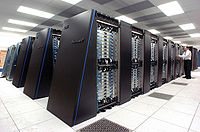
Later in 2009, IBM's Blue Gene
supercomputing program was awarded the National Medal of Technology and Innovation by U.S. President
Barack Obama
.
In 2011, IBM gained worldwide attention for its artificial intelligence
program Watson
, which was exhibited on Jeopardy!
where it won against game show champions Ken Jennings
and Brad Rutter
.
IBM's closing value of $214 billion on September 29, 2011 surpassed Microsoft
which was valued at $213.2 billion. It was the first time since 1996 that IBM exceeded its software rival based on closing price. However, IBM's value is still less than two-thirds of Apple's value of $362.1 billion.
, Town of North Castle
, New York
, United States
. The 283000 square feet (26,291.6 m²) IBM building has three levels of custom curtainwall. The building is located on a 25 acre site. IBM has been headquartered in Armonk since 1964.
The company has nine research labs worldwide—Almaden, Austin, Brazil, China
, Israel
, India
, Tokyo
, Watson
(New York), and Zurich
—with Watson (dedicated in 1961) serving as headquarters for the research division and the site of its annual meeting. Other campus installations include towers in Montreal
, Paris
, and Atlanta
; software labs in Raleigh-Durham
, Rome
and Toronto
; buildings in Chicago, Johannesburg, and Seattle; and facilities in Hakozaki
and Yamato
. The company also operates the IBM Scientific Center
, the Hursley House
, the Canada Head Office Building
, IBM Rochester
, and the Somers Office Complex
. The company's contributions to architecture and design, including Chicago's 330 North Wabash building designed by Ludwig Mies van der Rohe
, were recognized with the 1990 Honor Award
from the National Building Museum
.
IBM's Board of Directors
, with 14 members, is responsible for the overall management of the company. With Cathie Black
's resignation from the board in November 2010, the remaining 13 members (along with their affiliation and year of joining the board) are as follows: Alain J. P. Belda '08 (Alcoa
), William R. Brody
'07 (Salk Institute
/ Johns Hopkins University
), Kenneth Chenault
'98 (American Express
), Michael L. Eskew
'05 (UPS
), Shirley Ann Jackson
'05 (Rensselaer Polytechnic Institute
), Andrew N. Liveris '10 (Dow Chemical
), W. James McNerney, Jr. '09 (Boeing
), James W. Owens
'06 (Caterpillar
), Samuel J. Palmisano
'00 (IBM), Joan Spero '04 (Doris Duke Charitable Foundation), Sidney Taurel
'01 (Eli Lilly
), and Lorenzo Zambrano
'03 (Cemex
).
ranked IBM the 18th largest firm in the U.S., as well as the 7th most profitable. Globally, the company was ranked the 31st largest firm by Forbes
for 2011. Other rankings for 2011 include the following:
For 2010, IBM's brand was valued at $64.7 billion. The company was also listed in India's 2011 The Brand Trust Report
as the #32 most trusted brands in the country.
IBM's employee management practices can be traced back to its roots. In 1914, CEO Thomas J. Watson boosted company spirit by creating employee sports teams, hosting family outings, and furnishing a company band. In 1924, the Quarter Century Club, which recognizes employees with 25 years of service, was organized and the first issue of Business Machines, IBM's internal publication, was published. In 1925, the first meeting of the Hundred Percent Club, composed of IBM salesmen who meet their quotas, convened in Atlantic City, New Jersey.
IBM was among the first corporations to provide group life insurance (1934), survivor benefits (1935) and paid vacations (1937). In 1932 IBM created an Education Department to oversee training for employees, which oversaw the completion of the IBM Schoolhouse at Endicott in 1933. In 1935, the employee magazine Think was created. Also that year, IBM held its first training class for women systems service professionals. In 1942, IBM launched a program to train and employ disabled people in Topeka, Kansas. The next year classes begin in New York City, and soon the company was asked to join the President's Committee for Employment of the Handicapped. In 1946, the company hired its first black salesman, 18 years before the Civil Rights Act of 1964. In 1947, IBM announced a Total and Permanent Disability Income Plan for employees. A vested rights pension was added to the IBM retirement plan.
In 1952, Thomas J. Watson, Jr., published the company's first written equal opportunity policy letter, one year before the U.S. Supreme Court decision in Brown vs. Board of Education and 11 years before the Civil Rights Act of 1964. In 1961, IBM's nondiscrimination policy was expanded to include sex, national origin, and age. The following year, IBM hosted its first Invention Award Dinner honoring 34 outstanding IBM inventors; and in 1963, the company named the first eight IBM Fellows in a new Fellowship Program that recognizes senior IBM scientists, engineers and other professionals for outstanding technical achievements.
On September 21, 1953, Thomas Watson, Jr., the company's president at the time, sent out a controversial letter to all IBM employees stating that IBM needed to hire the best people, regardless of their race, ethnic origin, or gender. He also publicized the policy so that in his negotiations to build new manufacturing plants with the governors of two states in the U.S. South, he could be clear that IBM would not build "separate-but-equal
" workplaces. In 1984, IBM added sexual orientation to its nondiscrimination policy. The company stated that this would give IBM a competitive advantage because IBM would then be able to hire talented people its competitors would turn down.
IBM was the only technology company ranked in Working Mother magazine's Top 10 for 2004, and one of two technology companies in 2005. On October 10, 2005, IBM became the first major company in the world to commit formally to not using genetic information
in employment decisions. The announcement was made shortly after IBM began working with the National Geographic Society
on its Genographic Project.
IBM provides same-sex partners of its employees with health benefits
and provides an anti-discrimination clause. The Human Rights Campaign
has consistently rated IBM 100% on its index of gay-friendliness since 2003 (in 2002, the year it began compiling its report on major companies, IBM scored 86%). In 2007 and again in 2010, IBM UK was ranked first in Stonewall's annual Workplace Equality Index for UK employers.
The company has traditionally resisted labor union organizing, although unions represent some IBM workers outside the United States. In 2009, the Unite
union stated that several hundred employees joined following the announcement in the UK of pension cuts that left many employees facing a shortfall in projected pensions.
A dark (or gray) suit, white shirt, and a "sincere" tie was the public uniform for IBM employees for most of the 20th century. During IBM's management transformation in the 1990s, CEO Louis V. Gerstner, Jr.
relaxed these codes, normalizing the dress and behavior of IBM employees to resemble their counterparts in other large technology companies. Since then IBM's dress code is business casual
although employees often wear formal clothes during client meetings.
On 16 June 2011, the company announced a grants programs, called IBM100, to fund its employees participation in volunteer projects - the year long initiative is part of the company's centenary celebrations.
in New York, New York. The renovated fraternity house on Manhattan's West Side was used as IBM's first laboratory devoted to pure science. The lab was the forerunner of IBM's Research Division, which today operates research facilities around the world.
In 1966, IBM researcher Robert H. Dennard invented Dynamic Random Access Memory
(DRAM) cells, one-transistor memory cells that store each single bit of information as an electrical charge in an electronic circuit. The technology permits major increases in memory density, and is widely adopted throughout the industry where it remains in widespread use today.
IBM has been a leading proponent of the Open Source Initiative
, and began supporting Linux
in 1998. The company invests billions of dollars in services and software based on Linux through the IBM Linux Technology Center
, which includes over 300 Linux kernel
developers. IBM has also released code under different open source licenses, such as the platform-independent
software framework
Eclipse
(worth approximately US$40 million at the time of the donation), the three-sentence International Components for Unicode (ICU
) license, and the Java
-based relational database management system
(RDBMS) Apache Derby
. IBM's open source
involvement has not been trouble-free, however (see SCO v. IBM
).
Famous inventions by IBM include the following:
is a website run by IBM for software developer
s and IT professionals. It contains how-to articles and tutorials, as well as software downloads and code samples, discussion forums, podcasts, blogs, wikis, and other resources for developers and technical professionals. Subjects range from open, industry-standard technologies like Java
, Linux
, SOA
and web service
s, web development
, Ajax
, PHP
, and XML
to IBM's products (WebSphere
, Rational
, Lotus
, Tivoli
and Information Management
). In 2007, developerWorks was inducted into the Jolt Hall of Fame.
alphaWorks
is IBM's source for emerging software technologies. These technologies include:
Virtually all console gaming systems
of the latest generation
use microprocessors developed
by IBM. The Xbox 360
contains a PowerPC
tri-core processor, which was designed and produced by IBM in less than 24 months. Sony's PlayStation 3
features the Cell BE microprocessor
designed jointly by IBM, Toshiba
, and Sony
. IBM will provide the microprocessors that serve as the heart of Nintendo
's new Wii U system, which will debut in 2012. The new Power Architecture-based microprocessor includes IBM's latest technology in an energy-saving silicon package. Nintendo
's seventh-generation
console, Wii
, features an IBM chip codenamed Broadway
. The older Nintendo GameCube
utilizes the Gekko
processor, also designed by IBM.
In May 2002, IBM and Butterfly.net, Inc. announced the Butterfly Grid, a commercial grid
for the online video gaming market. In March 2006, IBM announced separate agreements with Hoplon Infotainment, Online Game Services Incorporated (OGSI), and RenderRocket to provide on-demand content management
and blade server
computing resources.
IBM announced it will launch its new software, called "Open Client Offering" which is to run on Linux
, Microsoft Windows
and Apple's Mac OS X
. The company states that its new product allows businesses to offer employees a choice of using the same software on Windows and its alternatives. This means that "Open Client Offering" is to cut costs of managing whether to use Linux or Apple relative to Windows. There will be no necessity for companies to pay Microsoft for its licenses for operating systems since the operating systems will no longer rely on software which is Windows-based. One alternative to Microsoft's office document formats is the Open Document Format
software, whose development IBM supports. It is going to be used for several tasks like: word processing
, presentations, along with collaboration with Lotus Notes, instant messaging
and blog tools as well as an Internet Explorer
competitor – the Mozilla Firefox
web browser. IBM plans to install Open Client on 5% of its desktop PCs. The Linux offering has been made available as the IBM Client for Smart Work product on the Ubuntu
and Red Hat Enterprise Linux
platforms.
UC2 (Unified Communications and Collaboration) is an IBM and Cisco Systems
joint project based on Eclipse
and OSGi
. It will offer the numerous Eclipse application developers a unified platform for an easier work environment. The software based on UC2 platform will provide major enterprises with easy-to-use communication solutions, such as the Lotus based Sametime
. In the future the Sametime users will benefit from such additional functions as click-to-call
and voice mailing
.
Redbooks are publicly available online books about best practices with IBM products. They describe the products features, field experience and dos and don'ts, while leaving aside marketing buzz. Available formats are Redbooks, Redpapers and Redpieces.
Extreme Blue is one of IBM's internship programs, which tasks students with developing high-value technology. In 2003, participants in the program filed 98 patents.
In May 2007, IBM unveiled Project Big Green, a re-direction of $1 billion per year across its businesses to increase energy efficiency.
On November 2008, IBM’s CEO, Sam Palmisano, during a speech at the Council on Foreign Relations, outlined a new agenda for building a Smarter Planet
. In addition, an official company blog exists. Smarter Planet @ IBM
On Aug 18, 2011, as part of its effort in cognitive computing, IBM has produced chips that imitate neurons and synapses. These microprocessors do not use von Neumann architecture, and they consume less memory and power.
companies which provided employees with excellent commuter benefits to help reduce traffic and air pollution.
The birthplace of IBM, Endicott
, suffered pollution for decades, however. IBM used liquid cleaning agents in circuit board
assembly operation for more than two decades, and six spills and leaks were recorded, including one leak in 1979 of 4,100 gallons from an underground tank. These left behind volatile organic compound
s in the town's soil and aquifer. Trace elements of volatile organic compounds have been identified in Endicott’s drinking water, but the levels are within regulatory limits. Also, from 1980, IBM has pumped out 78,000 gallons of chemicals, including trichloroethane
, freon, benzene
and perchloroethene
to the air and allegedly caused several cancer cases among the townspeople. IBM Endicott has been identified by the Department of Environmental Conservation as the major source of pollution, though traces of contaminants from a local dry cleaner and other polluters were also found. Despite the amount of pollutant, state health officials could not verify whether air or water pollution
in Endicott has actually caused any health problems. According to city officials, tests show that the water is safe to drink.
Tokyo Ohka Kogyo Co., Ltd. (TOK) and IBM are collaborating to establish new, low-cost methods for bringing the next generation of solar energy
products, called CIGS
(Copper-Indium-Gallium-Selenide) solar cell
modules, to market. Use of thin film
technology, such as CIGS, has great promise in reducing the overall cost of solar cells and further enabling their widespread adoption.
IBM is exploring four main areas of photovoltaic research: using current technologies to develop cheaper and more efficient silicon
solar cells, developing new solution processed thin film photovoltaic devices, concentrator photovoltaics, and future generation photovoltaic architectures based upon nanostructure
s such as semiconductor quantum dot
s and nanowire
s.
 IBM's current "8-bar" logo was designed in 1972 by graphic designer
Paul Rand
. It was a general replacement for a 13-bar logo that first appeared in the public on the 1966 release of the TSS/360. Logo
s designed in the 1970s tended to be sensitive to the technical limitations of photocopiers, which were then being widely deployed. A logo with large solid areas tended to be poorly copied by copiers in the 1970s, so companies preferred logos that avoided large solid areas. The 1972 IBM logos are an example of this tendency. With the advent of digital copiers in the mid-1980s this technical restriction had largely disappeared; at roughly the same time, the 13-bar logo was abandoned for almost the opposite reason it was difficult to render accurately on the low-resolution digital printers (240 dots per inch
) of the time.
Big Blue is a nickname for IBM. There are several theories explaining the origin of the name. One theory, substantiated by people who worked for IBM at the time, is that IBM field representatives coined the term in the 1960s, referring to the color of the mainframes IBM installed in the 1960s and early 1970s. "True Blue" was a term used to describe a loyal IBM customer, and business writers later picked up the term. Another theory suggests that Big Blue simply refers to the Company's logo. A third theory suggests that Big Blue refers to a former company dress code that required many IBM employees to wear only white shirts and many wore blue suits. In any event, IBM keyboards, typewriters, and some other manufactured devices have played on the "Big Blue" concept, using the color for enter keys and carriage returns. IBM has also used blue logos since 1947, making blue the defining color of the company's corporate design, which might be another, more plausible reason for the term.
Multinational corporation
A multi national corporation or enterprise , is a corporation or an enterprise that manages production or delivers services in more than one country. It can also be referred to as an international corporation...
technology
Technology
Technology is the making, usage, and knowledge of tools, machines, techniques, crafts, systems or methods of organization in order to solve a problem or perform a specific function. It can also refer to the collection of such tools, machinery, and procedures. The word technology comes ;...
and consulting
Consultant
A consultant is a professional who provides professional or expert advice in a particular area such as management, accountancy, the environment, entertainment, technology, law , human resources, marketing, emergency management, food production, medicine, finance, life management, economics, public...
corporation headquartered in Armonk
Armonk, New York
Armonk is a hamlet and census-designated place located in the town of North Castle in Westchester County, New York. As of the 2010 census, the CDP population was 4,330....
, New York, United States. IBM manufactures and sells computer hardware and software
Computer software
Computer software, or just software, is a collection of computer programs and related data that provide the instructions for telling a computer what to do and how to do it....
, and it offers infrastructure
Infrastructure
Infrastructure is basic physical and organizational structures needed for the operation of a society or enterprise, or the services and facilities necessary for an economy to function...
, hosting
Internet hosting service
An Internet hosting service is a service that runs Internet servers, allowing organizations and individuals to serve content to the Internet. There are various levels of service and various kinds of services offered....
and consulting services
Consultant
A consultant is a professional who provides professional or expert advice in a particular area such as management, accountancy, the environment, entertainment, technology, law , human resources, marketing, emergency management, food production, medicine, finance, life management, economics, public...
in areas ranging from mainframe computer
Mainframe computer
Mainframes are powerful computers used primarily by corporate and governmental organizations for critical applications, bulk data processing such as census, industry and consumer statistics, enterprise resource planning, and financial transaction processing.The term originally referred to the...
s to nanotechnology
Nanotechnology
Nanotechnology is the study of manipulating matter on an atomic and molecular scale. Generally, nanotechnology deals with developing materials, devices, or other structures possessing at least one dimension sized from 1 to 100 nanometres...
. As of September 2011, IBM is the second-largest publicly traded technology company in the world by market capitalization
Market capitalization
Market capitalization is a measurement of the value of the ownership interest that shareholders hold in a business enterprise. It is equal to the share price times the number of shares outstanding of a publicly traded company...
.
The company was founded in 1911 as the Computing Tabulating Recording Corporation through a merger of four companies: the Tabulating Machine Company, the International Time Recording Company
Time clock
A time clock, sometimes known as a clock card machine or punch clock or time recorder, is a mechanical timepiece used to assist in tracking the hours an employee of a company worked. In regards to mechanical time clocks this was accomplished by inserting a heavy paper card, called a timesheet,...
, the Computing Scale Corporation, and the Bundy Manufacturing Company
Bundy Manufacturing Company
The Bundy Manufacturing Company was a 19th-century American manufacturer of timekeeping devices that went through a series of mergers, eventually becoming part of International Business Machines. The company was founded by the Bundy brothers....
. CTR adopted the name International Business Machines in 1924, using a name previously designated to CTR's subsidiary in Canada and later South America. Its distinctive culture and product branding has given it the nickname Big Blue.
In 2011, Fortune
Fortune (magazine)
Fortune is a global business magazine published by Time Inc. Founded by Henry Luce in 1930, the publishing business, consisting of Time, Life, Fortune, and Sports Illustrated, grew to become Time Warner. In turn, AOL grew as it acquired Time Warner in 2000 when Time Warner was the world's largest...
ranked IBM the 18th largest firm in the U.S., as well as the 7th most profitable. Globally, the company was ranked the 31st largest firm by Forbes
Forbes
Forbes is an American publishing and media company. Its flagship publication, the Forbes magazine, is published biweekly. Its primary competitors in the national business magazine category are Fortune, which is also published biweekly, and Business Week...
for 2011. Other rankings for 2011 include #1 company for leaders (Fortune), #2 best global brand (Interbrand
Interbrand
Interbrand, a division of Omnicom, is a global branding consultancy, specializing in vast brand services, including brand analytics, brand strategy, brand valuation, corporate design, digital brand management, and naming...
), #1 green company worldwide (Newsweek
Newsweek
Newsweek is an American weekly news magazine published in New York City. It is distributed throughout the United States and internationally. It is the second-largest news weekly magazine in the U.S., having trailed Time in circulation and advertising revenue for most of its existence...
), #12 most admired company (Fortune), and #18 most innovative company (Fast Company
Fast Company (magazine)
Fast Company is a full-color business magazine that releases 10 issues per year and reports on topics including innovation, digital media, technology, change management, leadership, design, and social responsibility...
). IBM employs more than 425,000 employees (sometimes referred to as "IBMers") in over 200 countries, with occupations including scientists, engineers, consultants, and sales professionals.
IBM holds more patents than any other U.S.-based technology company and has nine research laboratories worldwide. Its employees have garnered five Nobel Prize
Nobel Prize
The Nobel Prizes are annual international awards bestowed by Scandinavian committees in recognition of cultural and scientific advances. The will of the Swedish chemist Alfred Nobel, the inventor of dynamite, established the prizes in 1895...
s, four Turing Award
Turing Award
The Turing Award, in full The ACM A.M. Turing Award, is an annual award given by the Association for Computing Machinery to "an individual selected for contributions of a technical nature made to the computing community. The contributions should be of lasting and major technical importance to the...
s, nine National Medals of Technology
National Medal of Technology
The National Medal of Technology and Innovation is an honor granted by the President of the United States to American inventors and innovators who have made significant contributions to the development of new and important technology...
, and five National Medals of Science
National Medal of Science
The National Medal of Science is an honor bestowed by the President of the United States to individuals in science and engineering who have made important contributions to the advancement of knowledge in the fields of behavioral and social sciences, biology, chemistry, engineering, mathematics and...
. Famous inventions by IBM include the automated teller machine (ATM)
Automated teller machine
An automated teller machine or automatic teller machine, also known as a Cashpoint , cash machine or sometimes a hole in the wall in British English, is a computerised telecommunications device that provides the clients of a financial institution with access to financial transactions in a public...
, the floppy disk
Floppy disk
A floppy disk is a disk storage medium composed of a disk of thin and flexible magnetic storage medium, sealed in a rectangular plastic carrier lined with fabric that removes dust particles...
, the hard disk drive, the magnetic stripe card
Magnetic stripe card
A magnetic stripe card is a type of card capable of storing data by modifying the magnetism of tiny iron-based magnetic particles on a band of magnetic material on the card...
, the relational database
Relational model
The relational model for database management is a database model based on first-order predicate logic, first formulated and proposed in 1969 by Edgar F...
, the Universal Product Code (UPC)
Universal Product Code
The Universal Product Code is a barcode symbology , that is widely used in North America, and in countries including the UK, Australia, and New Zealand for tracking trade items in stores. Its most common form, the UPC-A, consists of 12 numerical digits, which are uniquely assigned to each trade item...
, the financial swap
Swap (finance)
In finance, a swap is a derivative in which counterparties exchange certain benefits of one party's financial instrument for those of the other party's financial instrument. The benefits in question depend on the type of financial instruments involved...
, SABRE airline reservation system
Sabre (computer system)
Sabre Global Distribution System , owned by Sabre Holdings, is used by more than 55,000 travel agencies around the world with more than 400 airlines, 88,000 hotels, 24 car rental brands, and 13 cruise lines...
, DRAM
Dram
Dram or DRAM may refer to:As a unit of measure:* Dram , an imperial unit of mass and volume* Armenian dram, a monetary unit* Dirham, a unit of currency in several Arab nationsOther uses:...
, and Watson artificial intelligence.
The company has undergone several organizational changes since its inception, acquiring companies like SPSS
SPSS
SPSS is a computer program used for survey authoring and deployment , data mining , text analytics, statistical analysis, and collaboration and deployment ....
(2009) and PwC
PwC
PricewaterhouseCoopers is a global professional services firm headquartered in London, United Kingdom. It is the world's largest professional services firm measured by revenues and one of the "Big Four" accountancy firms....
consulting (2002), spinning off
Spin out
A spin-out, also known as a spin-off or a starburst, refers to a type of corporate action where a company "splits off" sections of itself as a separate business....
companies like Lexmark
Lexmark
Lexmark International, Inc. is an American corporation which develops and manufactures printing and imaging products, including laser and inkjet printers, multifunction products, printing supplies, and services for business and individual consumers...
(1991), and selling off product lines like ThinkPad
ThinkPad
ThinkPad is line of laptop computers originally sold by IBM but now produced by Lenovo. They are known for their boxy black design, which was modeled after a traditional Japanese lunchbox...
to Lenovo (2005).
Sam Palmisano will step down as CEO as of January 1, 2012, but retain his position as chairman. He will be replaced by veteran IBMer Ginni Rometty.
1880–1929
Starting in the 1880s, various technologies came into existence that would form part of IBM's predecessor company. Julius E. Pitrap patented the computing scale in 1885; Alexander Dey invented the dial recorder (1888); in 1889, Herman HollerithHerman Hollerith
Herman Hollerith was an American statistician who developed a mechanical tabulator based on punched cards to rapidly tabulate statistics from millions of pieces of data. He was the founder of one of the companies that later merged and became IBM.-Personal life:Hollerith was born in Buffalo, New...
patented the Electric Tabulating Machine and Willard Bundy invented a time clock to record a worker's arrival and departure time on a paper tape. On June 16, 1911, these technologies and their respective companies were merged by Charles Ranlett Flint
Charles Ranlett Flint
-Further reading:**...
to form the Computing-Tabulating-Recording Company (C-T-R). The New York City
New York City
New York is the most populous city in the United States and the center of the New York Metropolitan Area, one of the most populous metropolitan areas in the world. New York exerts a significant impact upon global commerce, finance, media, art, fashion, research, technology, education, and...
-based company had 1,300 employees and offices and plants in Endicott and Binghamton, New York; Dayton, Ohio; Detroit, Michigan; Washington, D.C.; and Toronto, Ontario. It manufactured and sold machinery ranging from commercial scales and industrial time recorders to meat and cheese slicers, along with tabulators and punched cards.
Flint recruited Thomas J. Watson, Sr., from the National Cash Register Company to help lead the company in 1914. Watson implemented "generous sales incentives, a focus on customer service, an insistence on well-groomed, dark-suited salesmen and an evangelical fervor for instilling company pride and loyalty in every worker". His favorite slogan, "THINK", became a mantra for C-T-R's employees, and within 11 months of joining C-T-R, Watson became its president. The company focused on providing large-scale, custom-built tabulating solutions for businesses, leaving the market for small office products to others. During Watson's first four years, revenues more than doubled to $9 million and the company's operations expanded to Europe, South America, Asia, and Australia. On February 14, 1924, C-T-R was renamed the International Business Machines Corporation (IBM), citing the need to align its name with the "growth and extension of [its] activities".
1930–1979
In 1937, IBM's tabulating equipment enabled organizations to process unprecedented amounts of data, its clients including the U.S. Government, during its first effort to maintain the employment records for 26 million people pursuant to the Social Security Act, and the Third Reich, largely through the German subsidiary DehomagDehomag
Dehomag was a German subsidiary of IBM with monopoly in the German market before and during World War II. The word was an acronym for Deutsche Hollerith-Maschinen Gesellschaft mbH . Hollerith refers to the German-American inventor of the technology of punched cards, Herman Hollerith.Under Nazi...
. Also in 1937, the company president met with Adolf Hitler
Adolf Hitler
Adolf Hitler was an Austrian-born German politician and the leader of the National Socialist German Workers Party , commonly referred to as the Nazi Party). He was Chancellor of Germany from 1933 to 1945, and head of state from 1934 to 1945...
, and discussed issues on the supply of equipment, and in 1941 were made leasing supplies to camps to accommodate the prisoners. During the Second World War the company produced small arms (M1 Carbine, and Browning Automatic Rifle).
In 1952, Thomas J. Watson, Jr.
Thomas J. Watson, Jr.
Thomas John Watson, Jr. was an American businessman, political figure, and philanthropist. He was the 2nd president of IBM , the 11th national president of the Boy Scouts of America , and the 16th United States Ambassador to the Soviet Union...
, became president of the company, ending almost 40 years of leadership by his father. In 1956, Arthur L. Samuel of IBM's Poughkeepsie, New York, laboratory programmed an IBM 704 to play checkers using a method in which the machine can "learn" from its own experience. It is believed to be the first "self-learning" program, a demonstration of the concept of artificial intelligence
Artificial intelligence
Artificial intelligence is the intelligence of machines and the branch of computer science that aims to create it. AI textbooks define the field as "the study and design of intelligent agents" where an intelligent agent is a system that perceives its environment and takes actions that maximize its...
. In 1957, IBM developed the FORTRAN
Fortran
Fortran is a general-purpose, procedural, imperative programming language that is especially suited to numeric computation and scientific computing...
(FORmula TRANslation) scientific programming language. In 1961, Thomas J. Watson, Jr., was elected chairman of the board and Albert L. Williams became president of the company. IBM develops the SABRE (Semi-Automatic Business-Related Environment) reservation system for American Airlines. The IBM Selectric typewriter was a highly successful model line of electric typewriters introduced by IBM on July 31, 1961.
In 1963, IBM employees and computers helped NASA track the orbital flight of the Mercury astronauts, and a year later, the company moved its corporate headquarters from New York City to Armonk, New York. The latter half of that decade saw IBM continue its support of space exploration, with IBM participating in the 1965 Gemini flights, the 1966 Saturn flights, and the 1969 mission to land a man on the moon.
On April 7, 1964 IBM announced the first computer system family, the IBM System/360. Sold between 1964 and 1978, it was the first family of computers designed to cover the complete range of applications, from small to large, both commercial and scientific. For the first time, companies could upgrade their computing capabilities with a new model without rewriting their applications.
In 1973, IBM engineer George J. Laurer
George J. Laurer
George Joseph Laurer developed the Universal Product Code in 1973. As an engineer at IBM he was asked to develop the pattern used for the Universal Product Code....
developed the Universal Product Code
Universal Product Code
The Universal Product Code is a barcode symbology , that is widely used in North America, and in countries including the UK, Australia, and New Zealand for tracking trade items in stores. Its most common form, the UPC-A, consists of 12 numerical digits, which are uniquely assigned to each trade item...
.
1980–present
Financial swapsSwap (finance)
In finance, a swap is a derivative in which counterparties exchange certain benefits of one party's financial instrument for those of the other party's financial instrument. The benefits in question depend on the type of financial instruments involved...
were first introduced to the public in 1981 when IBM and the World Bank
World Bank
The World Bank is an international financial institution that provides loans to developing countries for capital programmes.The World Bank's official goal is the reduction of poverty...
entered into a swap agreement. The IBM PC was introduced in 1981, originally designated IBM 5150. The IBM PC became the industry standard. In 1991, IBM sold Lexmark
Lexmark
Lexmark International, Inc. is an American corporation which develops and manufactures printing and imaging products, including laser and inkjet printers, multifunction products, printing supplies, and services for business and individual consumers...
, and in 2002, it acquired PwC
PwC
PricewaterhouseCoopers is a global professional services firm headquartered in London, United Kingdom. It is the world's largest professional services firm measured by revenues and one of the "Big Four" accountancy firms....
consulting. In 2003, IBM initiated a project to rewrite its company values. Using its Jam technology, the company hosted Internet-based online discussions on key business issues with 50,000 employees over 3 days. The discussions were analyzed by sophisticated text analysis software (eClassifier) to mine online comments for themes. As a result of the 2003 Jam, the company values were updated to reflect three modern business, marketplace and employee views: "Dedication to every client's success", "Innovation that matters—for our company and for the world", "Trust and personal responsibility in all relationships". In 2004, another Jam was conducted during which 52,000 employees exchanged best practice
Best practice
A best practice is a method or technique that has consistently shown results superior to those achieved with other means, and that is used as a benchmark...
s for 72 hours. They focused on finding actionable ideas to support implementation of the values previously identified.
In 2005 the company sold its personal computer business to Lenovo, and in 2009, it acquired software company SPSS Inc.
SPSS Inc.
SPSS Inc. was a software house headquartered in Chicago and incorporated in Delaware, most noted for the proprietary software of the same name SPSS. The use of this trademarked name has been the subject of ongoing legal action against the company for many years.In addition to the software which...
Later in 2009, IBM's Blue Gene
Blue Gene
Blue Gene is a computer architecture project to produce several supercomputers, designed to reach operating speeds in the PFLOPS range, and currently reaching sustained speeds of nearly 500 TFLOPS . It is a cooperative project among IBM Blue Gene is a computer architecture project to produce...
supercomputing program was awarded the National Medal of Technology and Innovation by U.S. President
President of the United States
The President of the United States of America is the head of state and head of government of the United States. The president leads the executive branch of the federal government and is the commander-in-chief of the United States Armed Forces....
Barack Obama
Barack Obama
Barack Hussein Obama II is the 44th and current President of the United States. He is the first African American to hold the office. Obama previously served as a United States Senator from Illinois, from January 2005 until he resigned following his victory in the 2008 presidential election.Born in...
.
In 2011, IBM gained worldwide attention for its artificial intelligence
Artificial intelligence
Artificial intelligence is the intelligence of machines and the branch of computer science that aims to create it. AI textbooks define the field as "the study and design of intelligent agents" where an intelligent agent is a system that perceives its environment and takes actions that maximize its...
program Watson
Watson (artificial intelligence software)
Watson is an artificial intelligence computer system capable of answering questions posed in natural language, developed in IBM's DeepQA project by a research team led by principal investigator David Ferrucci. Watson was named after IBM's first president, Thomas J...
, which was exhibited on Jeopardy!
Jeopardy!
Griffin's first conception of the game used a board comprising ten categories with ten clues each, but after finding that this board could not be shown on camera easily, he reduced it to two rounds of thirty clues each, with five clues in each of six categories...
where it won against game show champions Ken Jennings
Ken Jennings
Kenneth Wayne "Ken" Jennings III is an American game show contestant and author. Jennings is noted for holding the record for the longest winning streak on the U.S. syndicated game show Jeopardy! and as being the all-time leading money winner on American game shows...
and Brad Rutter
Brad Rutter
Bradford Gates "Brad" Rutter is the biggest all-time money winner on the U.S. syndicated game show Jeopardy! and the second biggest all-time money winner on a game show....
.
IBM's closing value of $214 billion on September 29, 2011 surpassed Microsoft
Microsoft
Microsoft Corporation is an American public multinational corporation headquartered in Redmond, Washington, USA that develops, manufactures, licenses, and supports a wide range of products and services predominantly related to computing through its various product divisions...
which was valued at $213.2 billion. It was the first time since 1996 that IBM exceeded its software rival based on closing price. However, IBM's value is still less than two-thirds of Apple's value of $362.1 billion.
Corporate affairs
IBM's headquarter complex is located in ArmonkArmonk, New York
Armonk is a hamlet and census-designated place located in the town of North Castle in Westchester County, New York. As of the 2010 census, the CDP population was 4,330....
, Town of North Castle
North Castle, New York
North Castle is a town in Westchester County, New York, United States. The population was 11,841 at the 2010 census. It has no villages.-Geography:...
, New York
New York
New York is a state in the Northeastern region of the United States. It is the nation's third most populous state. New York is bordered by New Jersey and Pennsylvania to the south, and by Connecticut, Massachusetts and Vermont to the east...
, United States
United States
The United States of America is a federal constitutional republic comprising fifty states and a federal district...
. The 283000 square feet (26,291.6 m²) IBM building has three levels of custom curtainwall. The building is located on a 25 acre site. IBM has been headquartered in Armonk since 1964.
The company has nine research labs worldwide—Almaden, Austin, Brazil, China
IBM China Research Laboratory
IBM China Research Laboratory is one of the IBM's eighth major worldwide research laboratories. It was established in 1995 Shangdi District, in the northwest of Beijing, China.-Bibliography:*-External links:*...
, Israel
IBM Haifa Research Laboratory
IBM Haifa Research Laboratory is located in Haifa, Israel. It is one of several IBM R&D Labs in Israel.IBM Haifa Research Laboratory handles projects in the spheres of cloud computing , healthcare and life sciences, verification technologies , multimedia, event processing , information retrieval...
, India
IBM India Research Laboratory
IBM India Research Laboratory is one of the IBM's eighth major worldwide research laboratories. It was established in 1998 in Delhi, India.Some of the aims of the laboratory are to develop solutions for digital data, computers and mobile phones....
, Tokyo
IBM Tokyo Research Laboratory
The IBM Research - Tokyo, which was called before January 2009 IBM Tokyo Research Laboratory , is one of IBM's eight major worldwide research laboratories. It is a branch of IBM Research...
, Watson
Thomas J. Watson Research Center
The Thomas J. Watson Research Center is the headquarters for the IBM Research Division.The center is on three sites, with the main laboratory in Yorktown Heights, New York, 38 miles north of New York City, a building in Hawthorne, New York, and offices in Cambridge, Massachusetts.- Overview :The...
(New York), and Zurich
IBM Zurich Research Laboratory
IBM Research - Zurich is the European branch of IBM Research and has been located in Rüschlikon, near Zurich, Switzerland since 1962.-Overview and history:...
—with Watson (dedicated in 1961) serving as headquarters for the research division and the site of its annual meeting. Other campus installations include towers in Montreal
1250 René-Lévesque
1250 Boulevard René-Lévesque, also known as La Tour IBM-Marathon, is a , 47-story skyscraper in Montreal, Quebec, Canada.The building was designed by Kohn Pedersen Fox Associates for IBM Canada and Marathon Realty, hence the former name "IBM-Marathon." It is now named for its address at 1250 René...
, Paris
Tour Descartes
Tour Descartes is an office skyscraper located in La Défense business district situated west of Paris, France....
, and Atlanta
One Atlantic Center
One Atlantic Center, also known as IBM Tower, is a skyscraper located in Midtown Atlanta. It is the third-tallest in Atlanta, reaching a height of with 50 stories of office space. It was completed in 1987 and remained the tallest building in Atlanta until 1992, when it was surpassed by the Bank...
; software labs in Raleigh-Durham
Research Triangle Park
The Research Triangle Park is a research park in the United States. It is located near Durham, Raleigh, and Chapel Hill, in the Research Triangle region of North Carolina...
, Rome
IBM Rome Software Lab
The IBM Rome Software Lab is one of the largest software development laboratory in Italy, and one of the largest IBM Software Group Labs in Europe....
and Toronto
IBM Toronto Software Lab
The IBM Toronto Software Lab is the largest software development laboratory in Canada, and IBM's third largest software lab. Established in 1967 with 55 employees, the Toronto Lab now has 2,500 employees developing some of IBM's leading middleware software...
; buildings in Chicago, Johannesburg, and Seattle; and facilities in Hakozaki
IBM Hakozaki Facility
IBM Hakozaki Facility located in Nihonbashi-Hakozaki-cho, Chuo-ku, Tokyo, Japan, is IBM's largest building in Japan, in terms of the number of people working there. It mainly houses IBM's marketing and systems engineering departments...
and Yamato
IBM Yamato Facility
IBM Yamato Facility located in the city of Yamato, Kanagawa Prefecture, Japan, is where IBM's research and development activities are done for IBM's worldwide and Asia-Pacific region market. Its buildings were designed by the architecture firm of Nikken Sekkei Ltd. and completed in...
. The company also operates the IBM Scientific Center
Cambridge Scientific Center
The IBM Cambridge Scientific Center, established in February 1964 by Norm Rasmussen, was situated at 545 Technology Square , Cambridge, Massachusetts in the same building as MIT's Project MAC...
, the Hursley House
Hursley House
Hursley House is an 18th century Queen Anne style mansion in Hursley in the English county of Hampshire.It was built by William Heathcote between 1721 and 1724, during the reign of George I...
, the Canada Head Office Building
IBM Canada Head Office Building
IBM Canada's head offices are currently located in Markham, Ontario and have been there since the early 1980s. The current building IBM occupies is located at 3600 Steeles Avenue East and was completed in 1995...
, IBM Rochester
IBM Rochester
IBM Rochester is the facility of International Business Machines in Rochester, Minnesota, not to be confused with the IBM Global Services facility in Rochester, NY. The initial structure was designed by Eero Saarinen, who clad the structure in blue panels of varying hues after being inspired by...
, and the Somers Office Complex
IBM Somers Office Complex
The IBM Somers Office Complex is a campus of five office buildings owned by IBM in Somers, New York, United States. Situated on a campus, I.M. Pei designed pyramid of glass structures house regional headquarters for the IBM corporation...
. The company's contributions to architecture and design, including Chicago's 330 North Wabash building designed by Ludwig Mies van der Rohe
Ludwig Mies van der Rohe
Ludwig Mies van der Rohe was a German architect. He is commonly referred to and addressed as Mies, his surname....
, were recognized with the 1990 Honor Award
Honor Award
The National Building Museum promotes excellence in architecture, engineering, construction, planning, and design. In furtherance of that mission, the Museum instituted an annual Honor Award in 1986 to recognize individuals and organizations that have made important contributions to the U.S.'s...
from the National Building Museum
National Building Museum
The National Builders Museum, in Washington, D.C., United States, is a museum of "architecture, design, engineering, construction, and urban planning"...
.
IBM's Board of Directors
Board of directors
A board of directors is a body of elected or appointed members who jointly oversee the activities of a company or organization. Other names include board of governors, board of managers, board of regents, board of trustees, and board of visitors...
, with 14 members, is responsible for the overall management of the company. With Cathie Black
Cathie Black
Cathleen Prunty "Cathie" Black is a former New York City Schools Chancellor. On April 7, 2011, Black stepped down from her position after 95 days on the job. Her appointment to replace longtime Chancellor Joel Klein was announced on November 9, 2010 by Mayor Michael Bloomberg and became effective...
's resignation from the board in November 2010, the remaining 13 members (along with their affiliation and year of joining the board) are as follows: Alain J. P. Belda '08 (Alcoa
Alcoa
Alcoa Inc. is the world's third largest producer of aluminum, behind Rio Tinto Alcan and Rusal. From its operational headquarters in Pittsburgh, Pennsylvania, Alcoa conducts operations in 31 countries...
), William R. Brody
William R. Brody
William Ralph Brody is an American radiologist and academic administrator. He is the President of the Salk Institute and former President of The Johns Hopkins University, a position which he had held from 1996 to 2009....
'07 (Salk Institute
Salk Institute for Biological Studies
The Salk Institute for Biological Studies is a premier independent, non-profit, scientific research institute located in La Jolla, California. It was founded in 1960 by Jonas Salk, the developer of the polio vaccine; among the founding consultants were Jacob Bronowski and Francis Crick. Building...
/ Johns Hopkins University
Johns Hopkins University
The Johns Hopkins University, commonly referred to as Johns Hopkins, JHU, or simply Hopkins, is a private research university based in Baltimore, Maryland, United States...
), Kenneth Chenault
Kenneth Chenault
Kenneth Irvine Chenault is an American business executive. He has been the CEO and Chairman of American Express since 2001. He is the third African-American CEO of a Fortune 500 company.-Early life, education, and legal career:...
'98 (American Express
American Express
American Express Company or AmEx, is an American multinational financial services corporation headquartered in Three World Financial Center, Manhattan, New York City, New York, United States. Founded in 1850, it is one of the 30 components of the Dow Jones Industrial Average. The company is best...
), Michael L. Eskew
Michael L. Eskew
Michael L. Eskew is the former chairman and Chief Executive Officer of UPS from 2002-2007. He is currently on the Board of 3M and IBM. He also serves on the board of directors of Eli Lilly and Company.- Education :* Vincennes, Indiana Rivet High School...
'05 (UPS
United Parcel Service
United Parcel Service, Inc. , typically referred to by the acronym UPS, is a package delivery company. Headquartered in Sandy Springs, Georgia, United States, UPS delivers more than 15 million packages a day to 6.1 million customers in more than 220 countries and territories around the...
), Shirley Ann Jackson
Shirley Jackson (physicist)
Shirley Ann Jackson is an American physicist, and the 18th president of Rensselaer Polytechnic Institute. She received her Ph.D. in physics from the Massachusetts Institute of Technology in 1973, becoming the first African American woman to earn a doctorate from MIT.-Early life and...
'05 (Rensselaer Polytechnic Institute
Rensselaer Polytechnic Institute
Stephen Van Rensselaer established the Rensselaer School on November 5, 1824 with a letter to the Rev. Dr. Samuel Blatchford, in which van Rensselaer asked Blatchford to serve as the first president. Within the letter he set down several orders of business. He appointed Amos Eaton as the school's...
), Andrew N. Liveris '10 (Dow Chemical
Dow Chemical Company
The Dow Chemical Company is a multinational corporation headquartered in Midland, Michigan, United States. As of 2007, it is the second largest chemical manufacturer in the world by revenue and as of February 2009, the third-largest chemical company in the world by market capitalization .Dow...
), W. James McNerney, Jr. '09 (Boeing
Boeing
The Boeing Company is an American multinational aerospace and defense corporation, founded in 1916 by William E. Boeing in Seattle, Washington. Boeing has expanded over the years, merging with McDonnell Douglas in 1997. Boeing Corporate headquarters has been in Chicago, Illinois since 2001...
), James W. Owens
James W. Owens
James W. Owens is the former Chairman and Chief Executive Officer of Caterpillar Inc., the world's largest manufacturer of construction and mining equipment, diesel and natural gas engines and industrial gas turbines...
'06 (Caterpillar
Caterpillar Inc.
Caterpillar Inc. , also known as "CAT", designs, manufactures, markets and sells machinery and engines and sells financial products and insurance to customers via a worldwide dealer network. Caterpillar is the world's largest manufacturer of construction and mining equipment, diesel and natural gas...
), Samuel J. Palmisano
Samuel J. Palmisano
Samuel J. Palmisano was president and chief executive officer of IBM, which as of 2009 was the largest IT company in the world and 45th largest company overall. He was elected chairman in October 2002, effective January 1, 2003, and has served as CEO since March 2002. Before he became CEO,...
'00 (IBM), Joan Spero '04 (Doris Duke Charitable Foundation), Sidney Taurel
Sidney Taurel
Sidney Taurel is chairman and a former chief executive officer for Eli Lilly and Company. He became chief executive officer in July 1998 and chairman of the board of directors on January 1, 1999. He was succeeded as chief executive officer by John C...
'01 (Eli Lilly
Eli Lilly and Company
Eli Lilly and Company is a global pharmaceutical company. Eli Lilly's global headquarters is located in Indianapolis, Indiana, in the United States...
), and Lorenzo Zambrano
Lorenzo Zambrano
Lorenzo Hormisdas Zambrano Treviño is the Chairman and CEO of Cemex, one of the largest global building-materials companies in the world. CEMEX's stock is traded on the Mexican Stock Exchange and listed on the New York Stock Exchange .Zambrano was born in Monterrey, Nuevo León, Mexico...
'03 (Cemex
Cemex
CEMEX is the world's largest building materials supplier and third largest cement producer. Founded in Mexico in 1906, the company is based in Monterrey, Mexico...
).
Corporate recognition and brand
In 2011, FortuneFortune (magazine)
Fortune is a global business magazine published by Time Inc. Founded by Henry Luce in 1930, the publishing business, consisting of Time, Life, Fortune, and Sports Illustrated, grew to become Time Warner. In turn, AOL grew as it acquired Time Warner in 2000 when Time Warner was the world's largest...
ranked IBM the 18th largest firm in the U.S., as well as the 7th most profitable. Globally, the company was ranked the 31st largest firm by Forbes
Forbes
Forbes is an American publishing and media company. Its flagship publication, the Forbes magazine, is published biweekly. Its primary competitors in the national business magazine category are Fortune, which is also published biweekly, and Business Week...
for 2011. Other rankings for 2011 include the following:
# 1 company for leaders (Fortune)# 2 best global brand (InterbrandInterbrandInterbrand, a division of Omnicom, is a global branding consultancy, specializing in vast brand services, including brand analytics, brand strategy, brand valuation, corporate design, digital brand management, and naming...
)# 1 green company worldwide (NewsweekNewsweekNewsweek is an American weekly news magazine published in New York City. It is distributed throughout the United States and internationally. It is the second-largest news weekly magazine in the U.S., having trailed Time in circulation and advertising revenue for most of its existence...
)# 12 most admired company (Fortune)# 18 most innovative company (Fast CompanyFast Company (magazine)Fast Company is a full-color business magazine that releases 10 issues per year and reports on topics including innovation, digital media, technology, change management, leadership, design, and social responsibility...
)
For 2010, IBM's brand was valued at $64.7 billion. The company was also listed in India's 2011 The Brand Trust Report
The Brand Trust Report
The Brand Trust Report, India Study, 2011 is published by Trust Research Advisory . The book is a result of a syndicated primary research on Brand Trust that generated 10,00,000 data points and 16,000 unique brands from over 10,000 hours of fieldwork conducted in 9 cities TRA’s study partners in...
as the #32 most trusted brands in the country.
Working at IBM
In 2010, IBM employed 105,000 workers in the U.S., a drop of 30,000 since 2003, and 75,000 people in India, up from 9,000 seven years previous.IBM's employee management practices can be traced back to its roots. In 1914, CEO Thomas J. Watson boosted company spirit by creating employee sports teams, hosting family outings, and furnishing a company band. In 1924, the Quarter Century Club, which recognizes employees with 25 years of service, was organized and the first issue of Business Machines, IBM's internal publication, was published. In 1925, the first meeting of the Hundred Percent Club, composed of IBM salesmen who meet their quotas, convened in Atlantic City, New Jersey.
IBM was among the first corporations to provide group life insurance (1934), survivor benefits (1935) and paid vacations (1937). In 1932 IBM created an Education Department to oversee training for employees, which oversaw the completion of the IBM Schoolhouse at Endicott in 1933. In 1935, the employee magazine Think was created. Also that year, IBM held its first training class for women systems service professionals. In 1942, IBM launched a program to train and employ disabled people in Topeka, Kansas. The next year classes begin in New York City, and soon the company was asked to join the President's Committee for Employment of the Handicapped. In 1946, the company hired its first black salesman, 18 years before the Civil Rights Act of 1964. In 1947, IBM announced a Total and Permanent Disability Income Plan for employees. A vested rights pension was added to the IBM retirement plan.
In 1952, Thomas J. Watson, Jr., published the company's first written equal opportunity policy letter, one year before the U.S. Supreme Court decision in Brown vs. Board of Education and 11 years before the Civil Rights Act of 1964. In 1961, IBM's nondiscrimination policy was expanded to include sex, national origin, and age. The following year, IBM hosted its first Invention Award Dinner honoring 34 outstanding IBM inventors; and in 1963, the company named the first eight IBM Fellows in a new Fellowship Program that recognizes senior IBM scientists, engineers and other professionals for outstanding technical achievements.
On September 21, 1953, Thomas Watson, Jr., the company's president at the time, sent out a controversial letter to all IBM employees stating that IBM needed to hire the best people, regardless of their race, ethnic origin, or gender. He also publicized the policy so that in his negotiations to build new manufacturing plants with the governors of two states in the U.S. South, he could be clear that IBM would not build "separate-but-equal
Separate but equal
Separate but equal was a legal doctrine in United States constitutional law that justified systems of segregation. Under this doctrine, services, facilities and public accommodations were allowed to be separated by race, on the condition that the quality of each group's public facilities was to...
" workplaces. In 1984, IBM added sexual orientation to its nondiscrimination policy. The company stated that this would give IBM a competitive advantage because IBM would then be able to hire talented people its competitors would turn down.
IBM was the only technology company ranked in Working Mother magazine's Top 10 for 2004, and one of two technology companies in 2005. On October 10, 2005, IBM became the first major company in the world to commit formally to not using genetic information
Genetic testing
Genetic testing is among the newest and most sophisticated of techniques used to test for genetic disorders which involves direct examination of the DNA molecule itself. Other genetic tests include biochemical tests for such gene products as enzymes and other proteins and for microscopic...
in employment decisions. The announcement was made shortly after IBM began working with the National Geographic Society
National Geographic Society
The National Geographic Society , headquartered in Washington, D.C. in the United States, is one of the largest non-profit scientific and educational institutions in the world. Its interests include geography, archaeology and natural science, the promotion of environmental and historical...
on its Genographic Project.
IBM provides same-sex partners of its employees with health benefits
Health insurance
Health insurance is insurance against the risk of incurring medical expenses among individuals. By estimating the overall risk of health care expenses among a targeted group, an insurer can develop a routine finance structure, such as a monthly premium or payroll tax, to ensure that money is...
and provides an anti-discrimination clause. The Human Rights Campaign
Human Rights Campaign
The Human Rights Campaign is the United States' largest LGBT advocacy group and lobbying organization; according to the HRC, it has more than one million members and supporters...
has consistently rated IBM 100% on its index of gay-friendliness since 2003 (in 2002, the year it began compiling its report on major companies, IBM scored 86%). In 2007 and again in 2010, IBM UK was ranked first in Stonewall's annual Workplace Equality Index for UK employers.
The company has traditionally resisted labor union organizing, although unions represent some IBM workers outside the United States. In 2009, the Unite
Unite the Union
Unite – the Union, known as Unite, is a British and Irish trade union, formed on 1 May 2007, by the merger of Amicus and the Transport and General Workers' Union...
union stated that several hundred employees joined following the announcement in the UK of pension cuts that left many employees facing a shortfall in projected pensions.
A dark (or gray) suit, white shirt, and a "sincere" tie was the public uniform for IBM employees for most of the 20th century. During IBM's management transformation in the 1990s, CEO Louis V. Gerstner, Jr.
Louis V. Gerstner, Jr.
Louis V. Gerstner, Jr. KBE was chairman of the board and chief executive officer of IBM from April 1993 until 2002 when he retired as CEO in March and chairman in December. He is largely credited with turning around IBM's fortunes.He was formerly CEO of RJR Nabisco, and also held senior positions...
relaxed these codes, normalizing the dress and behavior of IBM employees to resemble their counterparts in other large technology companies. Since then IBM's dress code is business casual
Business casual
Business casual is a popular dress code in professional and white-collar workplaces in Western countries. In the United States, 43% of non-self-employed workers commonly wear casual business attire. Casual street wear is the next most common work attire , closely followed by uniforms...
although employees often wear formal clothes during client meetings.
On 16 June 2011, the company announced a grants programs, called IBM100, to fund its employees participation in volunteer projects - the year long initiative is part of the company's centenary celebrations.
Research and inventions
In 1945, The Watson Scientific Computing Laboratory was founded at Columbia UniversityColumbia University
Columbia University in the City of New York is a private, Ivy League university in Manhattan, New York City. Columbia is the oldest institution of higher learning in the state of New York, the fifth oldest in the United States, and one of the country's nine Colonial Colleges founded before the...
in New York, New York. The renovated fraternity house on Manhattan's West Side was used as IBM's first laboratory devoted to pure science. The lab was the forerunner of IBM's Research Division, which today operates research facilities around the world.
In 1966, IBM researcher Robert H. Dennard invented Dynamic Random Access Memory
Dynamic random access memory
Dynamic random-access memory is a type of random-access memory that stores each bit of data in a separate capacitor within an integrated circuit. The capacitor can be either charged or discharged; these two states are taken to represent the two values of a bit, conventionally called 0 and 1...
(DRAM) cells, one-transistor memory cells that store each single bit of information as an electrical charge in an electronic circuit. The technology permits major increases in memory density, and is widely adopted throughout the industry where it remains in widespread use today.
IBM has been a leading proponent of the Open Source Initiative
Open Source Initiative
The Open Source Initiative is an organization dedicated to promoting open source software.The organization was founded in February 1998, by Bruce Perens and Eric S. Raymond, prompted by Netscape Communications Corporation publishing the source code for its flagship Netscape Communicator product...
, and began supporting Linux
Linux
Linux is a Unix-like computer operating system assembled under the model of free and open source software development and distribution. The defining component of any Linux system is the Linux kernel, an operating system kernel first released October 5, 1991 by Linus Torvalds...
in 1998. The company invests billions of dollars in services and software based on Linux through the IBM Linux Technology Center
Linux Technology Center
The IBM Linux Technology Center is an organization focused on development for the Linux kernel and related open-source software projects. In 1999, IBM created the LTC to combine its software developers interested in Linux and other open-source software into a single organization. Much of the LTC's...
, which includes over 300 Linux kernel
Linux kernel
The Linux kernel is an operating system kernel used by the Linux family of Unix-like operating systems. It is one of the most prominent examples of free and open source software....
developers. IBM has also released code under different open source licenses, such as the platform-independent
Cross-platform
In computing, cross-platform, or multi-platform, is an attribute conferred to computer software or computing methods and concepts that are implemented and inter-operate on multiple computer platforms...
software framework
Software framework
In computer programming, a software framework is an abstraction in which software providing generic functionality can be selectively changed by user code, thus providing application specific software...
Eclipse
Eclipse (software)
Eclipse is a multi-language software development environment comprising an integrated development environment and an extensible plug-in system...
(worth approximately US$40 million at the time of the donation), the three-sentence International Components for Unicode (ICU
International Components for Unicode
International Components for Unicode is an open source project of mature C/C++ and Java libraries for Unicode support, software internationalization and software globalization. ICU is widely portable to many operating systems and environments. It gives applications the same results on all...
) license, and the Java
Java (programming language)
Java is a programming language originally developed by James Gosling at Sun Microsystems and released in 1995 as a core component of Sun Microsystems' Java platform. The language derives much of its syntax from C and C++ but has a simpler object model and fewer low-level facilities...
-based relational database management system
Relational database management system
A relational database management system is a database management system that is based on the relational model as introduced by E. F. Codd. Most popular databases currently in use are based on the relational database model....
(RDBMS) Apache Derby
Apache Derby
Apache Derby is a relational database management system developed by the Apache Software Foundation that can be embedded in Java programs and used for online transaction processing. It has a 2 MB disk-space footprint.Apache Derby is developed as an open source project under the Apache 2.0 license...
. IBM's open source
Open source
The term open source describes practices in production and development that promote access to the end product's source materials. Some consider open source a philosophy, others consider it a pragmatic methodology...
involvement has not been trouble-free, however (see SCO v. IBM
SCO v. IBM
SCO v. IBM is a civil lawsuit in the United States District Court of Utah. The SCO Group asserted that there are legal uncertainties regarding the use of the Linux operating system due to alleged violations of IBM's Unix licenses in the development of Linux code at IBM.-Summary:On March 6, 2003,...
).
Famous inventions by IBM include the following:
- Automated teller machine (ATM)Automated teller machineAn automated teller machine or automatic teller machine, also known as a Cashpoint , cash machine or sometimes a hole in the wall in British English, is a computerised telecommunications device that provides the clients of a financial institution with access to financial transactions in a public...
- Floppy diskFloppy diskA floppy disk is a disk storage medium composed of a disk of thin and flexible magnetic storage medium, sealed in a rectangular plastic carrier lined with fabric that removes dust particles...
- Hard disk drive
- Magnetic stripe cardMagnetic stripe cardA magnetic stripe card is a type of card capable of storing data by modifying the magnetism of tiny iron-based magnetic particles on a band of magnetic material on the card...
- Relational databaseRelational modelThe relational model for database management is a database model based on first-order predicate logic, first formulated and proposed in 1969 by Edgar F...
- Universal Product Code (UPC)Universal Product CodeThe Universal Product Code is a barcode symbology , that is widely used in North America, and in countries including the UK, Australia, and New Zealand for tracking trade items in stores. Its most common form, the UPC-A, consists of 12 numerical digits, which are uniquely assigned to each trade item...
- Financial swapSwap (finance)In finance, a swap is a derivative in which counterparties exchange certain benefits of one party's financial instrument for those of the other party's financial instrument. The benefits in question depend on the type of financial instruments involved...
- SABRE airline reservation systemSabre (computer system)Sabre Global Distribution System , owned by Sabre Holdings, is used by more than 55,000 travel agencies around the world with more than 400 airlines, 88,000 hotels, 24 car rental brands, and 13 cruise lines...
- Dynamic Random Access Memory (DRAM)DramDram or DRAM may refer to:As a unit of measure:* Dram , an imperial unit of mass and volume* Armenian dram, a monetary unit* Dirham, a unit of currency in several Arab nationsOther uses:...
- Watson artificial intelligence
Selected current projects
developerWorksDeveloperWorks
developerWorks is a free web-based professional network and technical resource center from IBM for software developers, IT professionals, and students worldwide...
is a website run by IBM for software developer
Software developer
A software developer is a person concerned with facets of the software development process. Their work includes researching, designing, developing, and testing software. A software developer may take part in design, computer programming, or software project management...
s and IT professionals. It contains how-to articles and tutorials, as well as software downloads and code samples, discussion forums, podcasts, blogs, wikis, and other resources for developers and technical professionals. Subjects range from open, industry-standard technologies like Java
Java (programming language)
Java is a programming language originally developed by James Gosling at Sun Microsystems and released in 1995 as a core component of Sun Microsystems' Java platform. The language derives much of its syntax from C and C++ but has a simpler object model and fewer low-level facilities...
, Linux
Linux
Linux is a Unix-like computer operating system assembled under the model of free and open source software development and distribution. The defining component of any Linux system is the Linux kernel, an operating system kernel first released October 5, 1991 by Linus Torvalds...
, SOA
Service-oriented architecture
In software engineering, a Service-Oriented Architecture is a set of principles and methodologies for designing and developing software in the form of interoperable services. These services are well-defined business functionalities that are built as software components that can be reused for...
and web service
Web service
A Web service is a method of communication between two electronic devices over the web.The W3C defines a "Web service" as "a software system designed to support interoperable machine-to-machine interaction over a network". It has an interface described in a machine-processable format...
s, web development
Web development
Web development is a broad term for the work involved in developing a web site for the Internet or an intranet . This can include web design, web content development, client liaison, client-side/server-side scripting, web server and network security configuration, and e-commerce development...
, Ajax
Ajax (programming)
Ajax is a group of interrelated web development methods used on the client-side to create asynchronous web applications...
, PHP
PHP
PHP is a general-purpose server-side scripting language originally designed for web development to produce dynamic web pages. For this purpose, PHP code is embedded into the HTML source document and interpreted by a web server with a PHP processor module, which generates the web page document...
, and XML
XML
Extensible Markup Language is a set of rules for encoding documents in machine-readable form. It is defined in the XML 1.0 Specification produced by the W3C, and several other related specifications, all gratis open standards....
to IBM's products (WebSphere
IBM WebSphere
IBM WebSphere refers to a brand of computer software products in the genre of enterprise software known as "application and integration middleware". These software products are used by end-users to create applications and integrate applications with other applications...
, Rational
Rational Software
Rational Machines was founded by Paul Levy and Mike Devlin in 1981 to provide tools to expand the use of modern software engineering practices, particularly explicit modular architecture and iterative development...
, Lotus
Lotus Software
Lotus Software is a software company with headquarters in Westford, Massachusetts...
, Tivoli
Tivoli Software
Tivoli Software is the service management brand of the IBM Software Group. IBM purchased Austin-based Tivoli Systems, Inc. on March 4, 1996 and allowed existing executive management to operate Tivoli as a wholly owned subsidiary in the IBM Software Group...
and Information Management
Information management
Information management is the collection and management of information from one or more sources and the distribution of that information to one or more audiences. This sometimes involves those who have a stake in, or a right to that information...
). In 2007, developerWorks was inducted into the Jolt Hall of Fame.
alphaWorks
AlphaWorks
alphaWorks is IBM's "emerging technology portal". It is a web community for early adopters to preview and collaborate on prototype technology from IBM Research labs....
is IBM's source for emerging software technologies. These technologies include:
- Flexible Internet Evaluation Report Architecture – A highly flexible architecture for the design, display, and reporting of Internet surveys.
- IBM History Flow Visualization ApplicationIBM History Flow toolIBM's History Flow tool is a visualization tool for a time-sequence of snapshots of a document in various stages of its creation. The tool supports tracking contributions to the article by different users, and can identify which parts of a document have remained unchanged over the course of many...
– A tool for visualizing dynamic, evolving documents and the interactions of multiple collaborating authors. - IBM LinuxLinuxLinux is a Unix-like computer operating system assembled under the model of free and open source software development and distribution. The defining component of any Linux system is the Linux kernel, an operating system kernel first released October 5, 1991 by Linus Torvalds...
on POWER Performance Simulator – A tool that provides users of Linux on PowerLinux on PowerLinux on Power is the combination of any Linux-based operating system running on Power Architecture technology, a microprocessor architecture.-Introduction:...
a set of performance models for IBM's POWERIBM POWERPOWER is a reduced instruction set computer instruction set architecture developed by IBM. The name is an acronym for Performance Optimization With Enhanced RISC....
processors. - Database File Archive And Restoration Management – An application for archiving and restoring hard disk drive files using file references stored in a database.
- Policy Management for Autonomic Computing – A policy-based autonomic management infrastructure that simplifies the automation of IT and business processBusiness processA business process or business method is a collection of related, structured activities or tasks that produce a specific service or product for a particular customer or customers...
es. - FairUCE – A spam filterE-mail filteringEmail filtering is the processing of email to organize it according to specified criteria. Most often this refers to the automatic processing of incoming messages, but the term also applies to the intervention of human intelligence in addition to anti-spam techniques, and to outgoing emails as well...
that verifies sender identity instead of filtering content. - Unstructured Information Management Architecture (UIMA) SDK – A Java SDK that supports the implementation, composition, and deployment of applications working with unstructured dataUnstructured dataUnstructured Data refers to information that either does not have a pre-defined data model and/or does not fit well into relational tables. Unstructured information is typically text-heavy, but may contain data such as dates, numbers, and facts as well...
. - Accessibility Browser – A web-browser specifically designed to assist people with visual impairmentVisual impairmentVisual impairment is vision loss to such a degree as to qualify as an additional support need through a significant limitation of visual capability resulting from either disease, trauma, or congenital or degenerative conditions that cannot be corrected by conventional means, such as refractive...
s, to be released as open source software. Also known as the "A-Browser," the technology will aim to eliminate the need for a mouse, relying instead completely on voice-controls, buttons and predefined shortcut keysKeyboard shortcutIn computing, a keyboard shortcut is a finite set of one or more keys that invoke a software or operating system operation when triggered by the user. A meaning of term "keyboard shortcut" can vary depending on software manufacturer...
.
Virtually all console gaming systems
Video game console
A video game console is an interactive entertainment computer or customized computer system that produces a video display signal which can be used with a display device to display a video game...
of the latest generation
History of video game consoles (seventh generation)
In the history of video games, the seventh generation of consoles is the current generation , and includes consoles released since late by Nintendo, Microsoft, and Sony...
use microprocessors developed
Integrated circuit design
Integrated circuit design, or IC design, is a subset of electrical engineering and computer engineering, encompassing the particular logic and circuit design techniques required to design integrated circuits, or ICs...
by IBM. The Xbox 360
Xbox 360
The Xbox 360 is the second video game console produced by Microsoft and the successor to the Xbox. The Xbox 360 competes with Sony's PlayStation 3 and Nintendo's Wii as part of the seventh generation of video game consoles...
contains a PowerPC
PowerPC
PowerPC is a RISC architecture created by the 1991 Apple–IBM–Motorola alliance, known as AIM...
tri-core processor, which was designed and produced by IBM in less than 24 months. Sony's PlayStation 3
PlayStation 3
The is the third home video game console produced by Sony Computer Entertainment and the successor to the PlayStation 2 as part of the PlayStation series. The PlayStation 3 competes with Microsoft's Xbox 360 and Nintendo's Wii as part of the seventh generation of video game consoles...
features the Cell BE microprocessor
Cell (microprocessor)
Cell is a microprocessor architecture jointly developed by Sony, Sony Computer Entertainment, Toshiba, and IBM, an alliance known as "STI". The architectural design and first implementation were carried out at the STI Design Center in Austin, Texas over a four-year period beginning March 2001 on a...
designed jointly by IBM, Toshiba
Toshiba
is a multinational electronics and electrical equipment corporation headquartered in Tokyo, Japan. It is a diversified manufacturer and marketer of electrical products, spanning information & communications equipment and systems, Internet-based solutions and services, electronic components and...
, and Sony
Sony
, commonly referred to as Sony, is a Japanese multinational conglomerate corporation headquartered in Minato, Tokyo, Japan and the world's fifth largest media conglomerate measured by revenues....
. IBM will provide the microprocessors that serve as the heart of Nintendo
Nintendo
is a multinational corporation located in Kyoto, Japan. Founded on September 23, 1889 by Fusajiro Yamauchi, it produced handmade hanafuda cards. By 1963, the company had tried several small niche businesses, such as a cab company and a love hotel....
's new Wii U system, which will debut in 2012. The new Power Architecture-based microprocessor includes IBM's latest technology in an energy-saving silicon package. Nintendo
Nintendo
is a multinational corporation located in Kyoto, Japan. Founded on September 23, 1889 by Fusajiro Yamauchi, it produced handmade hanafuda cards. By 1963, the company had tried several small niche businesses, such as a cab company and a love hotel....
's seventh-generation
History of video game consoles (seventh generation)
In the history of video games, the seventh generation of consoles is the current generation , and includes consoles released since late by Nintendo, Microsoft, and Sony...
console, Wii
Wii
The Wii is a home video game console released by Nintendo on November 19, 2006. As a seventh-generation console, the Wii primarily competes with Microsoft's Xbox 360 and Sony's PlayStation 3. Nintendo states that its console targets a broader demographic than that of the two others...
, features an IBM chip codenamed Broadway
Broadway (microprocessor)
Broadway is the codename of the 32-bit Central Processing Unit used in Nintendo's Wii video game console. It was designed by IBM, and is currently being produced using a 90 nm SOI process....
. The older Nintendo GameCube
Nintendo GameCube
The , officially abbreviated to NGC in Japan and GCN in other regions, is a sixth generation video game console released by Nintendo on September 15, 2001 in Japan, November 18, 2001 in North America, May 3, 2002 in Europe, and May 17, 2002 in Australia...
utilizes the Gekko
Gekko (microprocessor)
Gekko is a 32-bit PowerPC microprocessor custom made by IBM in 2000 for Nintendo to use as the CPU in their sixth generation game console, the Nintendo GameCube.-Development:...
processor, also designed by IBM.
In May 2002, IBM and Butterfly.net, Inc. announced the Butterfly Grid, a commercial grid
Grid computing
Grid computing is a term referring to the combination of computer resources from multiple administrative domains to reach a common goal. The grid can be thought of as a distributed system with non-interactive workloads that involve a large number of files...
for the online video gaming market. In March 2006, IBM announced separate agreements with Hoplon Infotainment, Online Game Services Incorporated (OGSI), and RenderRocket to provide on-demand content management
Content management
Content management, or CM, is the set of processes and technologies that support the collection, managing, and publishing of information in any form or medium. In recent times this information is typically referred to as content or, to be precise, digital content...
and blade server
Blade server
A blade server is a stripped down server computer with a modular design optimized to minimize the use of physical space and energy. Whereas a standard rack-mount server can function with a power cord and network cable, blade servers have many components removed to save space, minimize power...
computing resources.
IBM announced it will launch its new software, called "Open Client Offering" which is to run on Linux
Linux
Linux is a Unix-like computer operating system assembled under the model of free and open source software development and distribution. The defining component of any Linux system is the Linux kernel, an operating system kernel first released October 5, 1991 by Linus Torvalds...
, Microsoft Windows
Microsoft Windows
Microsoft Windows is a series of operating systems produced by Microsoft.Microsoft introduced an operating environment named Windows on November 20, 1985 as an add-on to MS-DOS in response to the growing interest in graphical user interfaces . Microsoft Windows came to dominate the world's personal...
and Apple's Mac OS X
Mac OS X
Mac OS X is a series of Unix-based operating systems and graphical user interfaces developed, marketed, and sold by Apple Inc. Since 2002, has been included with all new Macintosh computer systems...
. The company states that its new product allows businesses to offer employees a choice of using the same software on Windows and its alternatives. This means that "Open Client Offering" is to cut costs of managing whether to use Linux or Apple relative to Windows. There will be no necessity for companies to pay Microsoft for its licenses for operating systems since the operating systems will no longer rely on software which is Windows-based. One alternative to Microsoft's office document formats is the Open Document Format
OpenDocument
The Open Document Format for Office Applications is an XML-based file format for representing electronic documents such as spreadsheets, charts, presentations and word processing documents....
software, whose development IBM supports. It is going to be used for several tasks like: word processing
Word processing
Word processing is the creation of documents using a word processor. It can also refer to advanced shorthand techniques, sometimes used in specialized contexts with a specially modified typewriter.-External links:...
, presentations, along with collaboration with Lotus Notes, instant messaging
Instant messaging
Instant Messaging is a form of real-time direct text-based chatting communication in push mode between two or more people using personal computers or other devices, along with shared clients. The user's text is conveyed over a network, such as the Internet...
and blog tools as well as an Internet Explorer
Internet Explorer
Windows Internet Explorer is a series of graphical web browsers developed by Microsoft and included as part of the Microsoft Windows line of operating systems, starting in 1995. It was first released as part of the add-on package Plus! for Windows 95 that year...
competitor – the Mozilla Firefox
Mozilla Firefox
Mozilla Firefox is a free and open source web browser descended from the Mozilla Application Suite and managed by Mozilla Corporation. , Firefox is the second most widely used browser, with approximately 25% of worldwide usage share of web browsers...
web browser. IBM plans to install Open Client on 5% of its desktop PCs. The Linux offering has been made available as the IBM Client for Smart Work product on the Ubuntu
Ubuntu (operating system)
Ubuntu is a computer operating system based on the Debian Linux distribution and distributed as free and open source software. It is named after the Southern African philosophy of Ubuntu...
and Red Hat Enterprise Linux
Red Hat Enterprise Linux
Red Hat Enterprise Linux is a Linux-based operating system developed by Red Hat and targeted toward the commercial market. Red Hat Enterprise Linux is released in server versions for x86, x86-64, Itanium, PowerPC and IBM System z, and desktop versions for x86 and x86-64...
platforms.
UC2 (Unified Communications and Collaboration) is an IBM and Cisco Systems
Cisco Systems
Cisco Systems, Inc. is an American multinational corporation headquartered in San Jose, California, United States, that designs and sells consumer electronics, networking, voice, and communications technology and services. Cisco has more than 70,000 employees and annual revenue of US$...
joint project based on Eclipse
Eclipse (software)
Eclipse is a multi-language software development environment comprising an integrated development environment and an extensible plug-in system...
and OSGi
OSGi
The Open Services Gateway initiative framework is a module system and service platform for the Java programming language that implements a complete and dynamic component model, something that does not exist in standalone Java/VM environments...
. It will offer the numerous Eclipse application developers a unified platform for an easier work environment. The software based on UC2 platform will provide major enterprises with easy-to-use communication solutions, such as the Lotus based Sametime
IBM Lotus Sametime
IBM Sametime is a client–server application and middleware platform that provides real-time, unified communications and collaboration for enterprises. Those capabilities include presence information, enterprise instant messaging, web conferencing, community collaboration, and telephony capabilities...
. In the future the Sametime users will benefit from such additional functions as click-to-call
Click-to-call
Click-to-call, also known as click-to-talk, click-to-chat and click-to-text, is a form of Web-based communication in which a person clicks an object to request an immediate connection with another person in real-time either by phone call, Voice-over-Internet-Protocol , or text...
and voice mailing
Voicemail
Voicemail is a computer based system that allows users and subscribers to exchange personal voice messages; to select and deliver voice information; and to process transactions relating to individuals, organizations, products and services, using an ordinary telephone...
.
Redbooks are publicly available online books about best practices with IBM products. They describe the products features, field experience and dos and don'ts, while leaving aside marketing buzz. Available formats are Redbooks, Redpapers and Redpieces.
Extreme Blue is one of IBM's internship programs, which tasks students with developing high-value technology. In 2003, participants in the program filed 98 patents.
In May 2007, IBM unveiled Project Big Green, a re-direction of $1 billion per year across its businesses to increase energy efficiency.
On November 2008, IBM’s CEO, Sam Palmisano, during a speech at the Council on Foreign Relations, outlined a new agenda for building a Smarter Planet
Smarter Planet
Smarter Planet is a corporate initiative of the information technology company IBM. The initiative seeks to highlight how forward-thinking leaders in business, government and civil society around the world are capturing the potential of smarter systems to achieve economic growth, near-term...
. In addition, an official company blog exists. Smarter Planet @ IBM
On Aug 18, 2011, as part of its effort in cognitive computing, IBM has produced chips that imitate neurons and synapses. These microprocessors do not use von Neumann architecture, and they consume less memory and power.
Environmental record
IBM was recognized as one of the "Top 20 Best Workplaces for Commuters" by the United States Environmental Protection Agency (EPA) in 2005. The award was to recognize Fortune 500Fortune 500
The Fortune 500 is an annual list compiled and published by Fortune magazine that ranks the top 500 U.S. closely held and public corporations as ranked by their gross revenue after adjustments made by Fortune to exclude the impact of excise taxes companies collect. The list includes publicly and...
companies which provided employees with excellent commuter benefits to help reduce traffic and air pollution.
The birthplace of IBM, Endicott
Endicott, New York
Endicott is a village in Broome County, New York, United States. The population was 13,038 at the 2000 census. It is part of the Binghamton Metropolitan Statistical Area. The village is named after Henry B...
, suffered pollution for decades, however. IBM used liquid cleaning agents in circuit board
Printed circuit board
A printed circuit board, or PCB, is used to mechanically support and electrically connect electronic components using conductive pathways, tracks or signal traces etched from copper sheets laminated onto a non-conductive substrate. It is also referred to as printed wiring board or etched wiring...
assembly operation for more than two decades, and six spills and leaks were recorded, including one leak in 1979 of 4,100 gallons from an underground tank. These left behind volatile organic compound
Volatile organic compound
Volatile organic compounds are organic chemicals that have a high vapor pressure at ordinary, room-temperature conditions. Their high vapor pressure results from a low boiling point, which causes large numbers of molecules to evaporate or sublimate from the liquid or solid form of the compound and...
s in the town's soil and aquifer. Trace elements of volatile organic compounds have been identified in Endicott’s drinking water, but the levels are within regulatory limits. Also, from 1980, IBM has pumped out 78,000 gallons of chemicals, including trichloroethane
1,1,1-Trichloroethane
The organic compound 1,1,1-trichloroethane, also known as methyl chloroform, is a chloroalkane. This colourless, sweet-smelling liquid was once produced industrially in large quantities for use as a solvent...
, freon, benzene
Benzene
Benzene is an organic chemical compound. It is composed of 6 carbon atoms in a ring, with 1 hydrogen atom attached to each carbon atom, with the molecular formula C6H6....
and perchloroethene
Tetrachloroethylene
Tetrachloroethylene, also known under its systematic name tetrachloroethene and many other names, is a chlorocarbon with the formula Cl2C=CCl2. It is a colourless liquid widely used for dry cleaning of fabrics, hence it is sometimes called "dry-cleaning fluid." It has a sweet odor detectable by...
to the air and allegedly caused several cancer cases among the townspeople. IBM Endicott has been identified by the Department of Environmental Conservation as the major source of pollution, though traces of contaminants from a local dry cleaner and other polluters were also found. Despite the amount of pollutant, state health officials could not verify whether air or water pollution
Water pollution
Water pollution is the contamination of water bodies . Water pollution occurs when pollutants are discharged directly or indirectly into water bodies without adequate treatment to remove harmful compounds....
in Endicott has actually caused any health problems. According to city officials, tests show that the water is safe to drink.
Tokyo Ohka Kogyo Co., Ltd. (TOK) and IBM are collaborating to establish new, low-cost methods for bringing the next generation of solar energy
Solar power
Solar energy, radiant light and heat from the sun, has been harnessed by humans since ancient times using a range of ever-evolving technologies. Solar radiation, along with secondary solar-powered resources such as wind and wave power, hydroelectricity and biomass, account for most of the available...
products, called CIGS
Copper indium gallium selenide
Copper indium gallium selenide is a I-III-VI2 semiconductor material composed of copper, indium, gallium, and selenium. The material is a solid solution of copper indium selenide and copper gallium selenide...
(Copper-Indium-Gallium-Selenide) solar cell
Solar cell
A solar cell is a solid state electrical device that converts the energy of light directly into electricity by the photovoltaic effect....
modules, to market. Use of thin film
Thin film
A thin film is a layer of material ranging from fractions of a nanometer to several micrometers in thickness. Electronic semiconductor devices and optical coatings are the main applications benefiting from thin film construction....
technology, such as CIGS, has great promise in reducing the overall cost of solar cells and further enabling their widespread adoption.
IBM is exploring four main areas of photovoltaic research: using current technologies to develop cheaper and more efficient silicon
Silicon
Silicon is a chemical element with the symbol Si and atomic number 14. A tetravalent metalloid, it is less reactive than its chemical analog carbon, the nonmetal directly above it in the periodic table, but more reactive than germanium, the metalloid directly below it in the table...
solar cells, developing new solution processed thin film photovoltaic devices, concentrator photovoltaics, and future generation photovoltaic architectures based upon nanostructure
Nanostructure
A nanostructure is an object of intermediate size between molecular and microscopic structures.In describing nanostructures it is necessary to differentiate between the number of dimensions on the nanoscale. Nanotextured surfaces have one dimension on the nanoscale, i.e., only the thickness of the...
s such as semiconductor quantum dot
Quantum dot
A quantum dot is a portion of matter whose excitons are confined in all three spatial dimensions. Consequently, such materials have electronic properties intermediate between those of bulk semiconductors and those of discrete molecules. They were discovered at the beginning of the 1980s by Alexei...
s and nanowire
Nanowire
A nanowire is a nanostructure, with the diameter of the order of a nanometer . Alternatively, nanowires can be defined as structures that have a thickness or diameter constrained to tens of nanometers or less and an unconstrained length. At these scales, quantum mechanical effects are important —...
s.
Company logo and nickname
Graphic designer
A graphic designer is a professional within the graphic design and graphic arts industry who assembles together images, typography or motion graphics to create a piece of design. A graphic designer creates the graphics primarily for published, printed or electronic media, such as brochures and...
Paul Rand
Paul Rand
Paul Rand Paul Rand Paul Rand (born Peretz Rosenbaum, (August 15, 1914 — November 26, 1996) was an American graphic designer, best known for his corporate logo designs, including the logos for IBM, UPS, Enron, Westinghouse, ABC, and Steve Jobs’ NeXT...
. It was a general replacement for a 13-bar logo that first appeared in the public on the 1966 release of the TSS/360. Logo
Logo
A logo is a graphic mark or emblem commonly used by commercial enterprises, organizations and even individuals to aid and promote instant public recognition...
s designed in the 1970s tended to be sensitive to the technical limitations of photocopiers, which were then being widely deployed. A logo with large solid areas tended to be poorly copied by copiers in the 1970s, so companies preferred logos that avoided large solid areas. The 1972 IBM logos are an example of this tendency. With the advent of digital copiers in the mid-1980s this technical restriction had largely disappeared; at roughly the same time, the 13-bar logo was abandoned for almost the opposite reason it was difficult to render accurately on the low-resolution digital printers (240 dots per inch
Dots per inch
Dots per inch is a measure of spatial printing or video dot density, in particular the number of individual dots that can be placed in a line within the span of 1 inch . The DPI value tends to correlate with image resolution, but is related only indirectly.- DPI measurement in monitor...
) of the time.
Big Blue is a nickname for IBM. There are several theories explaining the origin of the name. One theory, substantiated by people who worked for IBM at the time, is that IBM field representatives coined the term in the 1960s, referring to the color of the mainframes IBM installed in the 1960s and early 1970s. "True Blue" was a term used to describe a loyal IBM customer, and business writers later picked up the term. Another theory suggests that Big Blue simply refers to the Company's logo. A third theory suggests that Big Blue refers to a former company dress code that required many IBM employees to wear only white shirts and many wore blue suits. In any event, IBM keyboards, typewriters, and some other manufactured devices have played on the "Big Blue" concept, using the color for enter keys and carriage returns. IBM has also used blue logos since 1947, making blue the defining color of the company's corporate design, which might be another, more plausible reason for the term.
See also
- Institute of Electrical and Electronics EngineersInstitute of Electrical and Electronics EngineersThe Institute of Electrical and Electronics Engineers is a non-profit professional association headquartered in New York City that is dedicated to advancing technological innovation and excellence...
- List of computer system manufacturers
- Top 100 US Federal ContractorsTop 100 US Federal ContractorsThe Top 100 Contractors Report is a list developed annually by the U.S. General Services Administration as part of its tracking of U.S. federal government procurement....
- List of semiconductor fabrication plants