

Gauleiter

Encyclopedia
Reichsgau
A Reichsgau was an administrative subdivision created in a number of the areas annexed to Nazi Germany between 1938 and 1945...
.
Creation and Early Usage
The first use of the term Gauleiter by the Nazi Party was in 1925 after Adolf HitlerAdolf Hitler
Adolf Hitler was an Austrian-born German politician and the leader of the National Socialist German Workers Party , commonly referred to as the Nazi Party). He was Chancellor of Germany from 1933 to 1945, and head of state from 1934 to 1945...
refounded the Nazi party followed the failed Beer Hall Putsch
Beer Hall Putsch
The Beer Hall Putsch was a failed attempt at revolution that occurred between the evening of 8 November and the early afternoon of 9 November 1923, when Nazi Party leader Adolf Hitler, Generalquartiermeister Erich Ludendorff, and other heads of the Kampfbund unsuccessfully tried to seize power...
. The origin of the name was derived from the German word
German language
German is a West Germanic language, related to and classified alongside English and Dutch. With an estimated 90 – 98 million native speakers, German is one of the world's major languages and is the most widely-spoken first language in the European Union....
Leiter (meaning leader) and Gau
Gau (German)
Gau is a German term for a region within a country, often a former or actual province. It was used in medieval times, when it can be seen as roughly corresponding to an English shire...
which was an old word for a region of the German Reich
Reich
Reich is a German word cognate with the English rich, but also used to designate an empire, realm, or nation. The qualitative connotation from the German is " sovereign state." It is the word traditionally used for a variety of sovereign entities, including Germany in many periods of its history...
. The original term Gau may also be traced to the Frankish
Franks
The Franks were a confederation of Germanic tribes first attested in the third century AD as living north and east of the Lower Rhine River. From the third to fifth centuries some Franks raided Roman territory while other Franks joined the Roman troops in Gaul. Only the Salian Franks formed a...
word Gaugraf, translating closely to the English word "shire
Shire
A shire is a traditional term for a division of land, found in the United Kingdom and in Australia. In parts of Australia, a shire is an administrative unit, but it is not synonymous with "county" there, which is a land registration unit. Individually, or as a suffix in Scotland and in the far...
". Gau was one of the many archaic words from medieval German history
Medieval Germany
Medieval Germany:*Carolingian Empire *East Francia *Kingdom of Germany *German Late Middle Ages...
that the Nazis revived for their own purposes.
In the earliest days of the term's existence, Gauleiters were heads of election districts during a time period when the Nazis were attempting to gain political representation in the Weimar Republic
Weimar Republic
The Weimar Republic is the name given by historians to the parliamentary republic established in 1919 in Germany to replace the imperial form of government...
. Gauleiters oversaw several Politische Leiters (Political Leaders) who assisted the Nazis with election campaigns and hosted senior Nazis (such as Hitler) on campaign tours.
In 1928, a mid-level official known as a Kreisleiter
Kreisleiter
Kreisleiter was a Nazi Party political rank and title which existed as a political rank between 1930 and 1945 and as a Nazi Party title from as early as 1928...
was introduced as an intermediary between the Gauleiter and the Political Leaders. In 1930, as the Nazis attempted to organize on a national level, Gauleiters were themselves subordinated to a new official known as a Landesinspektor, in charge of all Nazi Gaus in a particular German state
States of Germany
Germany is made up of sixteen which are partly sovereign constituent states of the Federal Republic of Germany. Land literally translates as "country", and constitutionally speaking, they are constituent countries...
. It was also at this time that a standard political uniform was created for the Gauleiter, consisting on a brown nazi party shirt and Army style collar bars with braided shoulder cords.
Nazi Germany
In 1933, when the Nazis took power and established the state of Nazi GermanyNazi Germany
Nazi Germany , also known as the Third Reich , but officially called German Reich from 1933 to 1943 and Greater German Reich from 26 June 1943 onward, is the name commonly used to refer to the state of Germany from 1933 to 1945, when it was a totalitarian dictatorship ruled by...
, Gauleiter became the second highest Nazi paramilitary rank
Ranks and insignia of the Nazi Party
Ranks and insignia of the Nazi Party were paramilitary titles used by the National Socialist German Workers Party between approximately 1928 and the fall of Nazi Germany in 1945...
, ranking below the new rank of Reichsleiter
Reichsleiter
Reichsleiter , was the second highest political rank of the NSDAP next only to the office of Führer. Reichsleiter also served as a paramilitary rank, for the Nazi Party and was the highest position attainable in any Nazi-Organisation.The Reichsleiter reported directly to Adolf Hitler, in whose...
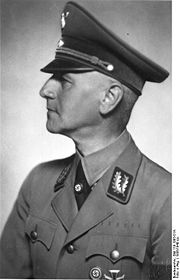
(National Leader). The Gauleiters were now heads of the Gauleitung, which were Nazi political regions set up to mirror the German states. it was also at this time that Gauleiters adopted the two leaf collar insignia which is most often historically associated with the rank.
In theory, a Gauleiter was merely a representative of the Nazi Party who served to coordinate regional Nazi Party events and also served to "advise" the local government. In practice, Gauleiters were the unquestioned rulers of their particular areas of responsibility. The legal governmental establishment merely existed as a rubber stamp
Rubber stamp (politics)
A rubber stamp, as a political metaphor, refers to a person or institution with considerable de jure power but little de facto power; one that rarely disagrees with more powerful organs....
for the Gauleiter. Party control over the civil administration was institutionalized, as in many cases Gauleiters also held the supreme civil administrative posts in their areas (Reichsstatthalter
Reichsstatthalter
The term Reichsstatthalter was used twice for different offices, in the imperial Hohenzollern dynasty's German Empire and the single-party Nazi Third Reich.- "Statthalter des Reiches" 1879-1918 in Alsace-Lorraine :...
or Oberpräsident). However, since Party Gau boundaries and provincial/state boundaries were rarely the same, this arrangement led to mutually overlapping jurisdictions and added to the administrative chaos typical of Nazi Germany.
Within each Gau were a number of Kreis (districts or counties), followed by the Ort (municipal) level, which was the lowest in the Nazi Party organization. There were also two additional lower local levels (Block and Zelle), describing Party Cells and local Neighborhood Blocks. By this point, all political leaders wore official uniforms, with the piping and background color of the uniform collar tabs indicating which level of the Party (Local, County, Regional, or National) within which a Political Leader served.
Insignia
All political leaders working at Gau level had rhomboid collar tabs with red facings (not brown), with a dark wine-red (burgundy) colored piping around the outer edges*.
Reich level collar tabs had a bright crimson facing, with gold piping; Kreis level tabs had a dark chocolate brown facing, with white piping, while Ort level tabs had a light brown facing with light blue piping. The political leader collar-tab system was quite complicated and underwent four changes (complexity increasing with each change); the final (fourth) pattern as described above, was introduced around the end of 1938—by this time, with many more job positions within each level; this made the fourth pattern collar tab rank system by far the most complicated of all. The Gaulieter had authority over the district leaders (kreisleiter), who in turn directed chapter leaders (Ortsgruppenleiter). An Ortsgruppe (chapter) encompassed 1500 households--usually a city suburb or a few villages. Chapter leaders directed cell leaders (Zellenleiter), responsible for 160 to 480 households. Zellenleiter had control over the lowest local leaders, Blockleiter, who had charge of one block consisting of 40 to 60 households. The cell and block leaders at the bottom of the hierarchy gave the party a strong hold on the civilian populace