
Encyclopedia
North Carolina is a
state in the
Southeastern United States. It was one of the original
Thirteen Colonies, and the home of the
first English colony in the
Americas. It was also the location of the first successful heavier than air flight by the
Wright brothers at
Kill Devil Hills near
Kitty Hawk in 1903. Today, it is a fast-growing state with an increasingly diverse economy and population.
North Carolina Nicknames
- The Tar Heel State
- Cackalacky or North Cackalacky
- Old North State
- The Goodliest Land
- The Rip Van Winkle State
Geography
North Carolina is bordered by
South Carolina on the south;
Georgia on the southwest;
Tennessee on the west;
Virginia on the north; and the
Atlantic Ocean on the east. The
United States Census Bureau classifies North Carolina as a
Southern state in the subcategory of being one of the
South Atlantic States.
North Carolina consists of three main geographic sections: the coastal plain, which occupies the eastern 45% of the state; the
Piedmont region, which contains the middle 35%; and the
Appalachian Mountains and foothills, which take up the remaining 20% of the state in the west.
The coastal plain begins in the east as a chain of narrow, sandy barrier islands known as the "
Outer Banks". The Outer Banks encompass two sounds —
Albemarle Sound in the north and
Pamlico Sound in the south; they are the two largest landlocked sounds in the United States. Inland the coastal plain is relatively flat, with rich soils which grow
tobacco,
soybeans, and
cotton. The major rivers of this section, the
Neuse River, Tar River, Pamlico River,
Cape Fear River, and Roanoke River, tend to be slow-moving and wide.
The coastal plain turns into the Piedmont region along the "fall line," a line which marks the elevation at which waterfalls first appear on streams and rivers. The Piedmont region of central North Carolina is the state's most urbanized and densely-populated section - all five of the state's largest cities are located in the Piedmont. It consists of gently rolling countryside frequently broken by hills or low isolated mountain ridges. Many small, deeply eroded mountain ranges and peaks are located in the Piedmont, including the Saura Mountains, Pilot Mountain, the Uwharrie Mountains, Crowder's Mountain, King's Pinnacle, the Brushy Mountains, and the South Mountains. The Piedmont ranges from about 300-400
feet elevation in the east to over 1,000 feet in the west. The major rivers of the Piedmont, such as the
Yadkin and
Catawba, tend to be fast-flowing, shallow, and narrow.
The western section of the state is part of the
Appalachian Mountain range. Among the subranges of the Appalachians located in the state are the
Great Smoky Mountains,
Blue Ridge Mountains, Balsams, Pisgahs, and the Black Mountains. The Black Mountains are the highest mountains in the Eastern United States, and culminate in Mount Mitchell at 6,684 feet . It is the highest point east of the
Mississippi River. Due to the higher altitude in the mountains, the climate often differs starkly from the rest of the state. Winters in western NC typically feature significant snowfall and subfreezing temperatures more akin to a northern state than a southern one.
Areas under the management of the
National Park Service include:
Ecology
Main Article: Wildlife of North CarolinaHistory
Main Article: History of North CarolinaIndians and Lost Colony
North Carolina was originally inhabited by many different native peoples, including the
Cherokee, Tuscarora, Cheraw,
Pamlico, Meherrin, Coree, Machapunga, Cape Fear Indians, Waxhaw, Saponi, Tutelo, Waccamaw, Lumbee, Coharie, and Catawba. North Carolina was the first American territory the
British attempted to colonize.
Sir Walter Raleigh, for whom the state capital is named, chartered two colonies on the North Carolina coast in the late 1580s, both ending in failure. The demise of one, the "
Lost Colony" of
Roanoke Island, remains one of the great mysteries of American history.
Virginia Dare, the first English child to be born in North America, was born in North Carolina. Dare County is named for her.
Colonial period and Revolutionary War
The first permanent European settlers of North Carolina were British colonists who migrated south from
Virginia, following a rapid growth of the colony and the subsequent shortage of available farmland. Nathaniel Batts was documented as one of the first of these Virginian immigrants. He settled south of the Chowan River and east of the
Great Dismal Swamp in 1655. By 1663, this northeastern area of the
Province of Carolina was experiencing full-scale British settlement.
During the same period, the English monarch
Charles II gave the province to the Lords Proprietors, a group of noblemen who had helped restore Charles to the throne in 1660. The new province of "Carolina" was named in honor and memory of King
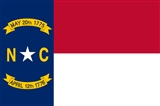
Charles I . In 1712, North Carolina became a separate colony. With the exception of the Earl Granville's holdings, it became a royal colony seventeen years later. On April 12 1776, the colony became the first to instruct its delegates to the Continental Congress to vote for independence from the British crown. The dates of both of these independence-related events are memorialized on the state flag and state seal. On May 20 1775, Mecklenburg County became the first North Carolina county to declare its independence from Great Britain with the issuance of the Mecklenberg Declaration.
The road to Yorktown and America's independence from England led through North Carolina. As the British army moved north from victories in Charleston and Camden,
South Carolina, the Southern Division of the
Continental Army and local militia prepared to meet them. Following General
Daniel Morgan's victory over the British
Banastre Tarleton at Cowpens on January 17, 1781, Southern Commander
Nathanael Greene led British Lord
Charles Cornwallis across the heartland of North Carolina, and away from Cornwallis' base of supply in Charleston, a campaign known as "The Race to the Dan" or "The Race for the River Crossings."
Greene and Cornwallis finally met at the
Battle of Guilford Courthouse in present Greensboro on March 15, 1781. Although the
British troops held the field, their casualties at the hands of the superior 4,400 American force were crippling.
On November 21, 1789, North Carolina ratified the Constitution to become the twelfth state in the Union. The North Carolina delegation's reluctance to sign the Constitution was instrumental in creating the
United States Bill of Rights. The state refused to ratify the constitution until some sort of declaration of the peoples rights was added. The North Carolina Government received a letter from
Continental Army General
George Washington stating that this was a wonderful idea. Thus, the Bill of Rights was added to the
United States Constitution. North Carolina worked to establish its state and local governments. In 1840, it completed the
state capitol building in
Raleigh, still standing today. In mid-century the state's rural and commercial areas were connected by construction of a 129 mile wooden plank road, known as a "farmer's railroad," from
Fayetteville in the east to
Bethania .
Civil War
In 1860, North Carolina was a slave state. However, it refused to join the
Confederacy until President
Abraham Lincoln called on it to invade its sister-state,
South Carolina. The state was the site of few battles, but in the
Civil War it provided at least 125,000 troops to the Confederacy— more than any other Confederate state. Approximately 40,000 of those troops never returned home, dead of battlefield wounds, disease and privation. Governor
Zebulon Baird Vance, elected in 1862, tried to maintain state autonomy against Confederate President
Jefferson Davis in Richmond. Even after secession some North Carolinians refused to support the Confederacy; this was particularly true of non-slaveowning farmers in the state's mountains and western Piedmont region. Some of these farmers remained neutral during the war, while others covertly supported the Union cause during the conflict. Even so, Confederate troops from North Carolina served in virtually all the major battles of the
Army of Northern Virginia, the Confederacy's largest and most famous army. The largest battle fought in North Carolina was at
Bentonville, which was a futile attempt by Confederate General
Joseph Johnston to slow Union General
William Tecumseh Sherman's advance through the Carolinas in the spring of 1865. In March of 1865, Sherman was able to capture his chief North Carolina objective when he took
Goldsboro; at the time it was the main railroad junction in North Carolina. Johnston surrendered one of the largest Confederate armies at
Bennett Place, a farm house in what is now
Durham, in late April 1865, weeks after General
Robert E. Lee's surrender at
Appomattox. A small, integrated
guerrilla force of white and
Cherokee Confederates under William Holland Thomas continued fighting in the mountains until May 10. This unit, called the "Thomas Legion," was North Carolina's sole legion and was never actually defeated by Union troops. On May 6, 1865, Thomas' Legion fired "The Last Shot" of the Civil War east of the Mississippi River in White Sulphur Springs, North Carolina. It had the distinction of capturing a city then voluntarily ceasing from hostilities. North Carolina's port city of Wilmington was the last Confederate port to fall to the Union. It fell in the spring of 1865 after the nearby
Second Battle of Fort Fisher. The first Confederate soldier to be killed in the Civil War was a North Carolinian, Private Henry Wyatt, at the
Battle of Big Bethel in 1861. At the
Battle of Gettysburg in July 1863, the 26th North Carolina Regiment participated in
Pickett's Charge and advanced the farthest into the Northern lines of any Confederate regiment. At
Appomattox Court House in Virginia in April 1865, the 75th North Carolina Regiment, a cavalry unit, fired the last shots of the Confederate
Army of Northern Virginia in the Civil War. For many years North Carolinians proudly boasted that they had been "First at Bethel, Farthest at Gettysburg, and Last at Appomattox."...
Demographics
| Historical populations |
|---|
Census year | Population |
|---|
|
| 1790 | 393,751 |
| 1800 | 478,103 |
| 1810 | 556,526 |
| 1820 | 638,829 |
| 1830 | 737,987 |
| 1840 | 753,419 |
| 1850 | 869,039 |
| 1860 | 992,622 |
| 1870 | 1,071,361 |
| 1880 | 1,399,750 |
| 1890 | 1,617,949 |
| 1900 | 1,893,810 |
| 1910 | 2,206,287 |
| 1920 | 2,559,123 |
| 1930 | 3,170,276 |
| 1940 | 3,571,623 |
| 1950 | 4,061,929 |
| 1960 | 4,556,155 |
| 1970 | 5,082,059 |
| 1980 | 5,881,766 |
| 1990 | 6,628,637 |
| 2000 | 8,049,313 |
| 2005 | 8,683,242 Est |
According to the
U.S. Census Bureau, as of 2005, North Carolina has an estimated population of 8,683,242, which is an increase of 142,774, or 1.7%, from the prior year and an increase of 636,751, or 7.9%, since the year 2000. This exceeds the rate of growth for the United States as a whole. The growth comprises a natural increase since the last census of 248,097 people and an increase due to net migration of 390,672 people into the state. Immigration from outside the United States resulted in a net increase of 158,224 people, and migration within the country produced a net increase of 232,448 people.
North Carolina has 4 Metropolitan Combined Statistical Areas with a population over 1 million:
...
:
Greensboro/Winston-Salem/High Point - population of 1,473,679
- The Triangle: Raleigh/Durham/Cary - population of 1,467,434
The five largest ancestry groups in North Carolina are:
African American ,
Scots &
Scots-Irish , English ,
German ,
Irish . North Carolina has one of the largest
Native American populations in the
United States. North Carolina has the second largest Laotian American population in the country.
African-Americans
African-Americans are concentrated in the state's eastern Coastal Plain and in parts of the Piedmont Plateau where plantation agriculture was most dominant. Until the mid 1860s, North Carolina had more small farms and fewer plantations than adjacent South Carolina and Virginia. These "yeoman" farmers were non-slave holding, private land owners of tracts of approximately 500 acres .
European-Americans
North Carolinians of
Scots-Irish,
Scottish and
English ancestry are concentrated in the western mountains, coastal areas, and rural areas of the central Piedmont. Descendents of
German ancestry, often of subsequent migration from Pennsylvania, can also be found in smaller numbers throughout the Piedmont. In the
Winston-Salem area, there is a substantial population of Czech ancestry from the migration of Moravians during the
18th century.
Native Americans
Estimated population figures for
Native American in North Carolina as of 2004 is 110,198, or 1.3% of the total North Carolina population. Only five states have a larger Native American population than North Carolina. The total Native American and Alaska Native population in the
United States is 2,824,751, or 0.95% of total U.S. population.
To date, North Carolina recognizes eight Native American tribal nations within its state borders:
- The Lumbee are the largest Native American tribe east of the Mississippi River and the ninth largest tribal nation in the U.S. The Lumbee comprise roughly one-half the state of North Carolina's indigenous population of 84,000 with a population of 52,614, and live in Robeson, Hoke, Scotland, and Cumberland counties. The Lumbee received state recognition in 1885, and have maintained a relationship with the federal government since 1888, but were not federally recognized until very recently. As of August 2006, they obtained federal recognition .
- The Eastern Band of Cherokee Indians were federally recognized in 1868 and received state recognition in 1889. The Eastern Cherokee live in western Swain County, as well as Graham and Jackson counties, and have roughly 13,400 enrolled members, most of whom live on a reservation properly called the Qualla Boundary. The Reservation is slightly more than 56,000 acres, and is held in trust by the federal government specifically for the Eastern Band of Cherokee Indians.
- The Haliwa-Saponi Tribe of Native Americans received state recognition in 1965. The tribe is comprised of a little more than 3,800 enrolled members who reside in northeastern North Carolina's Halifax and Warren counties.
- The almost 2,000 members of the Waccamaw Siouan Indian Tribe are located in the southeastern North Carolina counties of Bladen and Columbus and received state recognition in 1971.
- The Coharie Tribe of Native Americans are located in Sampson and Harnett counties, and have a population of 1,781 enrolled members. The Coharie received state recognition in 1911. North Carolina rescinded recognition in 1913 but reinstated it in 1971.
- The Sappony Indians of Person County received state recognition in 1911 and have 850 enrolled members.
- The Occaneechi Band of the Saponi Nation have a population of 800 members who reside in Orange and Alamance counties and received state recognition in 2002.
- The Meherrin are an Iroquoian-descent Native American tribe located primarily in rural northeastern Hertford, Bertie, and Gates counties, with a population of 557 enrolled members.
Asian-Americans
The state has one of the fastest growing Asian populations in the country; the populations have nearly quintupled and tripled respectively between 1990 and 2002. Most 2006 estimates claim Asians to be at least 3.2%.
6.7% of North Carolina's population were reported as under 5, 24.4% under 18, and 12.0% were 65 or older. Females made up approximately 51% of the population.
Religion
North Carolina, like other
Southern states, has traditionally been overwhelmingly Protestant, with the largest Protestant denomination being the Baptists. However, the rapid influx of
Northerners and immigrants from Latin America is steadily increasing the number of Roman Catholics in the state, and the numerical dominance of the Baptist Church is beginning to decline.This is especially evident in the urban areas of the state, where the population is more culturally diverse than the rural and small-town population. The fastest growing non-Christian religion is Hinduism, mainly because of steady migration from Guyana, but more so from the rapidly increasing Indian and Sri Lankan populations. The current religious affiliations of the people of North Carolina are shown below:
- Christian – 88%
- Protestant – 77%
- Roman Catholic – 10%
- Other Christian – 1%
- Non-Religious – 11%
- Other Religions – 1%
Economy
According to the Bureau of Economic Analysis, the state's 2004 total gross state product was $336 billion. Its 2003 per capita personal income was $28,071, 38
th in the nation. North Carolina's agricultural outputs include
poultry and eggs,
tobacco, hogs,
milk, nursery stock,
cattle,
sweet potatoes, and
soybeans. However, North Carolina is the state most affected by outsourcing; one in five North Carolina manufacturing jobs has been lost to overseas competition.
Over the past century, North Carolina has grown to become a national leader in
agriculture,
financial services, and
industry. The state's industrial output—mainly
textiles,
chemicals, electrical equipment,
paper and
pulp/paper products—ranked eighth in the nation in the early
1990s. The textile industry, which was once a mainstay of the state's economy, has been steadily losing jobs to markets in Latin America and Asia for the past 25 years. Over the past few years another important Carolina industry, furniture production, has also been hard-hit by jobs moving to Asia .
Tobacco, one of North Carolina's earliest sources of revenue, remains vital to the local economy, although concerns about whether the federal government will continue to support subsidies for tobacco farmers has led some growers to switch to other crops or leave farming altogether. Recently, technology, research, and banking have been on the rise, especially with the creation of the Research Triangle Park between <