

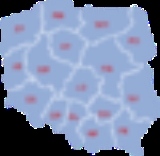
Voivodeships of Poland

Encyclopedia
The voivodeship
, or province
, called in Polish województwo w (plural województwa), has been a high-level administrative subdivision of Poland
since the 14th century.
The Polish local government reforms adopted in 1998, which went into effect on 1 January 1999, created sixteen new voivodeships. These replaced the 49 former voivodeships that had existed from 1 July 1975.
Today's voivodeships are mostly named after historical and geographical regions, while those prior to 1998 generally took their names from the cities on which they were centered. The new units range in area from under 10000 km² (3,861 sq mi) (Opole Voivodeship
) to over 35000 km² (13,513.6 sq mi) (Masovian Voivodeship
), and in population from one million (Lubusz Voivodeship
) to over five million (Masovian Voivodeship).
Administrative authority at voivodeship level is shared between a government-appointed governor called a voivode (Polish wojewoda), an elected assembly called a sejmik
, and an executive chosen by that assembly. The leader of that executive is called the marszałek województwa (voivodeship marshal). Voivodeships are further divided into powiat
s (counties) and gmina
s (communes or municipalities): see Administrative division of Poland.
(regional assembly) and the executive. In most cases these institutions are all based in one city, but in Kuyavian-Pomeranian
and Lubusz Voivodeship
the voivode's offices are in a different city from those of the executive and the sejmik. Voivodeship capitals are listed in the table below.
The voivode is appointed by the Prime Minister and is the regional representative of the central government. The voivode acts as the head of central government institutions at regional level (such as the police and fire services, passport offices, and various inspectorates), manages central government property in the region, oversees the functioning of local government, coordinates actions in the field of public safety and environment protection, and exercises special powers in emergencies. The voivode's offices collectively are known as the urząd wojewódzki.
The sejmik is elected every four years, at the same time as the local authorities at powiat
and gmina
level. It passes bylaw
s, including the voivodeship's development strategies and budget. It also elects the marszałek and other members of the executive, and holds them to account.
The executive (zarząd województwa), headed by the marszałek, drafts the budget and development strategies, implements the resolutions of the sejmik, manages the voivodeship's property, and deals with many aspects of regional policy, including management of European Union
funding. Its offices collectively are known as the urząd marszałkowski.
See also:
 Administrative division of Poland between 1979 and 1998 included 49 voivodeships upheld after the establishment of the Third Polish Republic in 1989 for another decade. This reorganization of administrative division of Poland was mainly a result of local government reform acts of 1973–1975. In place of the three-level administrative division (voivodeship, county, commune), a new two-level administrative division was introduced (49 small voivodeships, and communes). The three smallest voivodeships – Warsaw
, Kraków
and Łódź – had the special status of municipal voivodeship; the city president (mayor) was also provincial governor.
 After World War II, the new administrative division of the country within the new national borders was based on the prewar one and included 14 (+2) voivodeships, then 17 (+5). The voivodeships in the east that had not been annexed by the Soviet Union
had their borders left almost unchanged. The newly acquired territories
in the west and north were organized into the new voivodeships of Szczecin
, Wrocław and Olsztyn
, and partly joined to Gdańsk
, Katowice
and Poznań
voivodeships. Two cities were granted voivodeship status: Warsaw
and Łódź.
In 1950, new voivodeships were created: Koszalin
(previously part of Szczecin
), Opole
(previously part of Katowice
), and Zielona Góra
(previously part of Poznań
, Wrocław and Szczecin
voivodeships). In addition, three more cities were granted voivodeship status: Wrocław, Kraków
and Poznań
.
Congress Poland
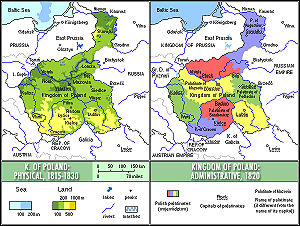
From 1816 to 1837 there were 8 voivodeships in Congress Poland
.
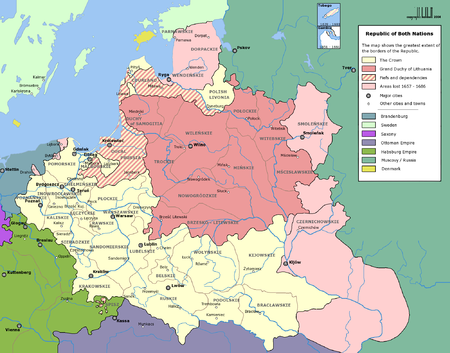
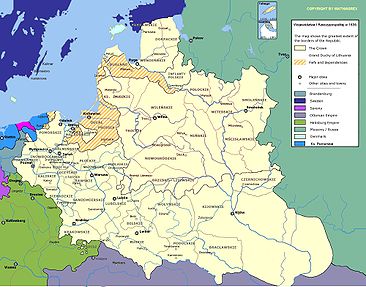
Greater Poland
Lesser Poland
Grand Duchy of Lithuania
Here the first name given is English, then in brackets Lithuanian, and then Polish.
Duchy of Livonia
s" rather than "voivodeships"; the former term traces back to the Latin
palatinus ("palatine"). More commonly used now is "voivodeship", a loanword
-calque
hybrid
formed on the Polish "województwo". Other sources refer instead to "province
s" (Polish singular: "prowincja"), though in pre-1795 contexts this may be confusing because the cognate
Polish "prowincyja
" (as it was then spelled) was idiosyncratically applied, until the last of the three Partitions of the Polish–Lithuanian Commonwealth
, in 1795, to each of the three main Regions (Greater Poland
, Lesser Poland
, and Lithuania
) of the Polish–Lithuanian Commonwealth, each of those Regions in turn comprising a number of województwa (plural of "województwo").
The Polish
"województwo", designating a second-tier Polish or Polish–Lithuanian administrative unit, derives from "wojewoda" (etymologically, a "war leader" or "leader of warriors", but now simply the governor
of a województwo) and the suffix "-stwo" (a "state or condition").
The English "voivodeship", which is a hybrid
of the loanword
"voivode" and "-ship" (the latter a suffix
, likewise meaning a "state or condition", that calque
s the Polish "-stwo"), has never been much used and is absent from many dictionaries. According to the Oxford English Dictionary
, it first appeared in 1792, spelled "woiwodship", in the sense of "the district or province governed by a voivode." The word subsequently also appeared in 1886 in the sense of "the office or dignity of a voivode."
An official Polish body, the Commission on Standardization of Geographic Names outside the Republic of Poland, recommends the spelling "voivodship", without the e. This is consistently reflected in publications and in the international arena, e.g., at the United Nations
.
Voivodeship
Voivodship is a term denoting the position of, or more commonly the area administered by, a voivod. Voivodeships have existed since medieval times in Poland, Romania, Hungary, Lithuania, Latvia, Russia and Serbia....
, or province
Province
A province is a territorial unit, almost always an administrative division, within a country or state.-Etymology:The English word "province" is attested since about 1330 and derives from the 13th-century Old French "province," which itself comes from the Latin word "provincia," which referred to...
, called in Polish województwo w (plural województwa), has been a high-level administrative subdivision of Poland
Poland
Poland , officially the Republic of Poland , is a country in Central Europe bordered by Germany to the west; the Czech Republic and Slovakia to the south; Ukraine, Belarus and Lithuania to the east; and the Baltic Sea and Kaliningrad Oblast, a Russian exclave, to the north...
since the 14th century.
The Polish local government reforms adopted in 1998, which went into effect on 1 January 1999, created sixteen new voivodeships. These replaced the 49 former voivodeships that had existed from 1 July 1975.
Today's voivodeships are mostly named after historical and geographical regions, while those prior to 1998 generally took their names from the cities on which they were centered. The new units range in area from under 10000 km² (3,861 sq mi) (Opole Voivodeship
Opole Voivodeship
- Administrative division :Opole Voivodeship is divided into 12 counties : 1 city county and 11 land counties. These are further divided into 71 gminas.The counties are listed in the following table .- Economy :...
) to over 35000 km² (13,513.6 sq mi) (Masovian Voivodeship
Masovian Voivodeship
-Administrative division:Masovian Voivodeship is divided into 42 counties : 5 city counties and 37 "land counties"...
), and in population from one million (Lubusz Voivodeship
Lubusz Voivodeship
- Administrative division :Lubusz Voivodeship is divided into 14 counties : 2 city counties and 12 land counties. These are further divided into 83 gminas....
) to over five million (Masovian Voivodeship).
Administrative authority at voivodeship level is shared between a government-appointed governor called a voivode (Polish wojewoda), an elected assembly called a sejmik
Voivodeship sejmik
A voivodeship sejmik is a provincial-level elected assembly for each of the 16 voivodeships of Poland. Sejmiks are elected to four-year terms, decided during nationwide local elections...
, and an executive chosen by that assembly. The leader of that executive is called the marszałek województwa (voivodeship marshal). Voivodeships are further divided into powiat
Powiat
A powiat is the second-level unit of local government and administration in Poland, equivalent to a county, district or prefecture in other countries. The term powiat is most often translated into English as "county", although other terms are also sometimes used...
s (counties) and gmina
Gmina
The gmina is the principal unit of administrative division of Poland at its lowest uniform level. It is often translated as "commune" or "municipality." As of 2010 there were 2,479 gminas throughout the country...
s (communes or municipalities): see Administrative division of Poland.
Administrative powers
Competences and powers at voivodeship level are shared between the voivode (governor), the sejmikVoivodeship sejmik
A voivodeship sejmik is a provincial-level elected assembly for each of the 16 voivodeships of Poland. Sejmiks are elected to four-year terms, decided during nationwide local elections...
(regional assembly) and the executive. In most cases these institutions are all based in one city, but in Kuyavian-Pomeranian
Kuyavian-Pomeranian Voivodeship
-Transportation:Transportation infrastructure is of critical importance to the voivodeship's economy. Kuyavia-Pomerania is a major node point in the Polish transportation system. Railway lines from the South and East pass through Bydgoszcz in order to reach the major ports on the Baltic Sea...
and Lubusz Voivodeship
Lubusz Voivodeship
- Administrative division :Lubusz Voivodeship is divided into 14 counties : 2 city counties and 12 land counties. These are further divided into 83 gminas....
the voivode's offices are in a different city from those of the executive and the sejmik. Voivodeship capitals are listed in the table below.
The voivode is appointed by the Prime Minister and is the regional representative of the central government. The voivode acts as the head of central government institutions at regional level (such as the police and fire services, passport offices, and various inspectorates), manages central government property in the region, oversees the functioning of local government, coordinates actions in the field of public safety and environment protection, and exercises special powers in emergencies. The voivode's offices collectively are known as the urząd wojewódzki.
The sejmik is elected every four years, at the same time as the local authorities at powiat
Powiat
A powiat is the second-level unit of local government and administration in Poland, equivalent to a county, district or prefecture in other countries. The term powiat is most often translated into English as "county", although other terms are also sometimes used...
and gmina
Gmina
The gmina is the principal unit of administrative division of Poland at its lowest uniform level. It is often translated as "commune" or "municipality." As of 2010 there were 2,479 gminas throughout the country...
level. It passes bylaw
Bylaw
By-law can refer to a law of local or limited application passed under the authority of a higher law specifying what things may be regulated by the by-law...
s, including the voivodeship's development strategies and budget. It also elects the marszałek and other members of the executive, and holds them to account.
The executive (zarząd województwa), headed by the marszałek, drafts the budget and development strategies, implements the resolutions of the sejmik, manages the voivodeship's property, and deals with many aspects of regional policy, including management of European Union
European Union
The European Union is an economic and political union of 27 independent member states which are located primarily in Europe. The EU traces its origins from the European Coal and Steel Community and the European Economic Community , formed by six countries in 1958...
funding. Its offices collectively are known as the urząd marszałkowski.
Map and table of voivodeships
| Abbreviation | Coat of arms |
code | car plates Polish car number plates In common with many countries, Polish car number plates indicate the region of registration of the vehicle encoded in the number plate.-General:... |
Voivodeship | Capital | Area km² | Population (December 31, 2003) |
Population (June 30, 2004) |
|---|---|---|---|---|---|---|---|---|
| DS |  |
02 | D | Lower Silesian Lower Silesian Voivodeship Lower Silesian Voivodeship, or Lower Silesia Province , is one of the 16 voivodeships into which Poland is currently divided. It lies in southwestern Poland... (dolnośląskie) |
Wrocław | 19 947.76 | 2 898 313 | 2 895 729 |
| KP |  |
04 | C | Kuyavian-Pomeranian Kuyavian-Pomeranian Voivodeship -Transportation:Transportation infrastructure is of critical importance to the voivodeship's economy. Kuyavia-Pomerania is a major node point in the Polish transportation system. Railway lines from the South and East pass through Bydgoszcz in order to reach the major ports on the Baltic Sea... (kujawsko-pomorskie) |
Bydgoszcz¹ Toruń Torun Toruń is an ancient city in northern Poland, on the Vistula River. Its population is more than 205,934 as of June 2009. Toruń is one of the oldest cities in Poland. The medieval old town of Toruń is the birthplace of the astronomer Nicolaus Copernicus.... ² |
17 969.72 | 2 068 142 | 2 067 548 |
| LU |  |
06 | L | Lublin Lublin Voivodeship - Administrative division :Lublin Voivodeship is divided into 24 counties : 4 city counties and 20 land counties. These are further divided into 213 gminas.... (lubelskie) |
Lublin Lublin Lublin is the ninth largest city in Poland. It is the capital of Lublin Voivodeship with a population of 350,392 . Lublin is also the largest Polish city east of the Vistula river... |
25 114.48 | 2 191 172 | 2 187 918 |
| LB |  |
08 | F | Lubusz Lubusz Voivodeship - Administrative division :Lubusz Voivodeship is divided into 14 counties : 2 city counties and 12 land counties. These are further divided into 83 gminas.... (lubuskie) |
Gorzów Wielkopolski Gorzów Wielkopolski Gorzów Wielkopolski is a city in western Poland, on the Warta river. It is the biggest city in the Lubusz Voivodeship with 125,149 inhabitants... ¹ Zielona Góra Zielona Góra Zielona Góra is a city in Lubusz Voivodeship, in western Poland, with 117,557 inhabitants within the city limits and 294,000 inhabitants within the metropolitan area, including three neighbouring counties .... ² |
13 984.44 | 1 008 786 | 1 009 177 |
| LD | 10 | E | Łódź (łódzkie) | Łódź | 18 219.11 | 2 597 094 | 2 592 568 | |
| MP | 12 | K | Lesser Poland Lesser Poland Voivodeship Małopolska Voivodeship , or Lesser Poland Voivodeship, is a voivodeship, in southern Poland... (małopolskie) |
Kraków Kraków Kraków also Krakow, or Cracow , is the second largest and one of the oldest cities in Poland. Situated on the Vistula River in the Lesser Poland region, the city dates back to the 7th century. Kraków has traditionally been one of the leading centres of Polish academic, cultural, and artistic life... |
15 144.10 | 3 252 949 | 3 256 171 | |
| MA |  |
14 | W | Masovian Masovian Voivodeship -Administrative division:Masovian Voivodeship is divided into 42 counties : 5 city counties and 37 "land counties"... (mazowieckie) |
Warsaw Warsaw Warsaw is the capital and largest city of Poland. It is located on the Vistula River, roughly from the Baltic Sea and from the Carpathian Mountains. Its population in 2010 was estimated at 1,716,855 residents with a greater metropolitan area of 2,631,902 residents, making Warsaw the 10th most... |
35 597.80 | 5 135 732 | 5 139 545 |
| OP |  |
16 | O | Opolskie Opole Voivodeship - Administrative division :Opole Voivodeship is divided into 12 counties : 1 city county and 11 land counties. These are further divided into 71 gminas.The counties are listed in the following table .- Economy :... |
Opole Opole Opole is a city in southern Poland on the Oder River . It has a population of 125,992 and is the capital of the Upper Silesia, Opole Voivodeship and, also the seat of Opole County... |
9 412.47 | 1 055 667 | 1 053 723 |
| PK |  |
18 | R | Podkarpackie | Rzeszów Rzeszów Rzeszów is a city in southeastern Poland with a population of 179,455 in 2010. It is located on both sides of the Wisłok River, in the heartland of the Sandomierska Valley... |
17 926.28 | 2 097 248 | 2 097 325 |
| PD |  |
20 | B | Podlaskie Podlaskie Voivodeship Podlaskie Voivodeship , is a voivodeship in northeastern Poland. It borders on Masovian Voivodeship to the west, Warmian-Masurian Voivodeship to the northwest, Lublin Voivodeship to the south, the Belarusssian Voblasts of Grodno and Brest to the east, the Lithuanian Counties of Alytus and... (podlaskie) |
Białystok | 20 179.58 | 1 205 117 | 1 204 036 |
| PM |  |
22 | G | Pomeranian Pomeranian Voivodeship Pomeranian Voivodeship, or Pomerania Province , is a voivodeship, or province, in north-central Poland. It comprises most of Pomerelia , as well as an area east of the Vistula River... (pomorskie) |
Gdańsk Gdansk Gdańsk is a Polish city on the Baltic coast, at the centre of the country's fourth-largest metropolitan area.The city lies on the southern edge of Gdańsk Bay , in a conurbation with the city of Gdynia, spa town of Sopot, and suburban communities, which together form a metropolitan area called the... |
18 292.88 | 2 188 918 | 2 192 404 |
| SL | 24 | S | Silesian Silesian Voivodeship Silesian Voivodeship, or Silesia Province , is a voivodeship, or province, in southern Poland, centering on the historic region known as Upper Silesia... (śląskie) |
Katowice Katowice Katowice is a city in Silesia in southern Poland, on the Kłodnica and Rawa rivers . Katowice is located in the Silesian Highlands, about north of the Silesian Beskids and about southeast of the Sudetes Mountains.It is the central district of the Upper Silesian Metropolis, with a population of 2... |
12 294.04 | 4 714 982 | 4 707 825 | |
| SW | 26 | T | Świętokrzyskie Swietokrzyskie Voivodeship Świętokrzyskie Voivodeship, or Świętokrzyskie Province , is one of the 16 voivodeships into which Poland is presently divided. It is situated in central Poland, in the historical province of Lesser Poland, and takes its name from the Świętokrzyskie mountain range... |
Kielce Kielce Kielce ) is a city in central Poland with 204,891 inhabitants . It is also the capital city of the Świętokrzyskie Voivodeship since 1999, previously in Kielce Voivodeship... |
11 672.34 | 1 291 598 | 1 290 176 | |
| WM |  |
28 | N | Warmian-Masurian Warmian-Masurian Voivodeship Warmian-Masurian Voivodeship, or Warmia-Masuria Province , is a voivodeship in northeastern Poland. Its capital and largest city is Olsztyn... (warmińsko-mazurskie) |
Olsztyn Olsztyn Olsztyn is a city in northeastern Poland, on the Łyna River. Olsztyn has been the capital of the Warmian-Masurian Voivodeship since 1999. It was previously in the Olsztyn Voivodeship... |
24 202.95 | 1 428 885 | 1 428 385 |
| WP |  |
30 | P | Greater Poland Greater Poland Voivodeship Wielkopolska Voivodeship , or Greater Poland Voivodeship, is a voivodeship, or province, in west-central Poland. It was created on 1 January 1999 out of the former Poznań, Kalisz, Konin, Piła and Leszno Voivodeships, pursuant to the Polish local government reforms adopted in 1998... (wielkopolskie) |
Poznań Poznan Poznań is a city on the Warta river in west-central Poland, with a population of 556,022 in June 2009. It is among the oldest cities in Poland, and was one of the most important centres in the early Polish state, whose first rulers were buried at Poznań's cathedral. It is sometimes claimed to be... |
29 825.59 | 3 359 932 | 3 362 011 |
| ZP |  |
32 | Z | West Pomeranian West Pomeranian Voivodeship West Pomeranian Voivodeship, , is a voivodeship in northwestern Poland. It borders on Pomeranian Voivodeship to the east, Greater Poland Voivodeship to the southeast, Lubusz Voivodeship to the south, the German federal-state of Mecklenburg-West Pomerania to the west, and the Baltic Sea to the north... (zachodniopomorskie) |
Szczecin Szczecin Szczecin , is the capital city of the West Pomeranian Voivodeship in Poland. It is the country's seventh-largest city and the largest seaport in Poland on the Baltic Sea. As of June 2009 the population was 406,427.... |
22 901.48 | 1 696 073 | 1 695 708 |
| (¹) seat of voivode, (²) seat of sejmik and marszałek | ||||||||

See also:
- Map of Polish Regions
- Administrative division of Poland (from Commission on Standardization of Geographical Names Outside Poland website, in English)
- Official map by Head Office of Geodesy and Cartography


Poland's voivodeships 1975–1998
Warsaw
Warsaw is the capital and largest city of Poland. It is located on the Vistula River, roughly from the Baltic Sea and from the Carpathian Mountains. Its population in 2010 was estimated at 1,716,855 residents with a greater metropolitan area of 2,631,902 residents, making Warsaw the 10th most...
, Kraków
Kraków
Kraków also Krakow, or Cracow , is the second largest and one of the oldest cities in Poland. Situated on the Vistula River in the Lesser Poland region, the city dates back to the 7th century. Kraków has traditionally been one of the leading centres of Polish academic, cultural, and artistic life...
and Łódź – had the special status of municipal voivodeship; the city president (mayor) was also provincial governor.
| Polish voivodeships and separate cities 1975-1998 | |||||||
| Abbreviation | Voivodeship | Polish name | Capital | Area km² (1998) |
Population (1980) |
No. of cities | No. of communes |
|---|---|---|---|---|---|---|---|
| bp | Biała Podlaska Voivodeship | bialskopodlaskie | Biała Podlaska | 5 348 | 286 400 | 6 | 35 |
| bk | Białystok Voivodeship | białostockie | Białystok | 10 055 | 641 100 | 17 | 49 |
| bb | Bielsko-Biała Voivodeship | bielskie | Bielsko-Biała Bielsko-Biała -Economy and Industry:Nowadays Bielsko-Biała is one of the best-developed parts of Poland. It was ranked 2nd best city for business in that country by Forbes. About 5% of people are unemployed . Bielsko-Biała is famous for its textile, machine-building, and especially automotive industry... |
3 704 | 829 900 | 18 | 47 |
| by | Bydgoszcz Voivodeship Bydgoszcz Voivodeship Bydgoszcz Voivodeship was a unit of administrative division and local government in Poland in the years 1975–1998, superseded by Kuyavian-Pomeranian Voivodeship. Capital city: Bydgoszcz Area: Statistics : Population: inhabitants... |
bydgoskie | Bydgoszcz | 10 349 | 1 036 000 | 27 | 55 |
| ch | Chełm Voivodeship | chełmskie | Chełm | 3 865 | 230 900 | 4 | 25 |
| ci | Ciechanów Voivodeship Ciechanów Voivodeship Ciechanów Voivodeship was a unit of administrative division and local government in Poland in years 1975–1998, superseded by the Masovian Voivodeship. Its capital city was Ciechanów.-Major cities and towns :* Ciechanów... |
ciechanowskie | Ciechanów Ciechanów Ciechanów is a town in north-central Poland with 45,900 inhabitants . It is situated in Masovian Voivodeship . It was previously the capital of Ciechanów Voivodeship.-History:The grad numbered approximately 3,000 armed men.... |
6 362 | 405 400 | 9 | 45 |
| cz | Częstochowa Voivodeship Czestochowa Voivodeship Częstochowa Voivodeship was a unit of administrative division and local government in Poland in years 1975–1998, superseded mainly by Silesian Voivodeship, with a few eastern gminas attached to the freshly created Świętokrzyskie Voivodeship... |
częstochowskie | Częstochowa Czestochowa Częstochowa is a city in south Poland on the Warta River with 240,027 inhabitants . It has been situated in the Silesian Voivodeship since 1999, and was previously the capital of Częstochowa Voivodeship... |
6 182 | 747 900 | 17 | 49 |
| el | Elbląg Voivodeship Elblag Voivodeship Elbląg Voivodeship was a unit of administrative division and local government in Poland from 1975 to 1998, superseded by the Pomeranian Voivodeship and the Warmian-Masurian Voivodeship. Its capital city was Elbląg.... |
elbląskie | Elbląg Elblag Elbląg is a city in northern Poland with 127,892 inhabitants . It is the capital of Elbląg County and has been assigned to the Warmian-Masurian Voivodeship since 1999. Before then it was the capital of Elbląg Voivodeship and a county seat in Gdańsk Voivodeship... |
6 103 | 441 500 | 15 | 37 |
| gd | Gdańsk Voivodeship Gdansk Voivodeship The name Gdańsk Voivodeship has been used twice to designate local governments in Poland.----Gdańsk Voivodeship was a unit of administrative division and local government in Poland in the years 1975–98, superseded by Pomeranian Voivodeship... |
gdańskie | Gdańsk Gdansk Gdańsk is a Polish city on the Baltic coast, at the centre of the country's fourth-largest metropolitan area.The city lies on the southern edge of Gdańsk Bay , in a conurbation with the city of Gdynia, spa town of Sopot, and suburban communities, which together form a metropolitan area called the... |
7 394 | 1 333 800 | 19 | 43 |
| go | Gorzów Voivodeship Gorzów Voivodeship Gorzów Wielkopolski Voivodeship was a unit of administrative division and local government in Poland in years 1975-1998, superseded by Lubusz Voivodeship... |
gorzowskie | Gorzów Wielkopolski Gorzów Wielkopolski Gorzów Wielkopolski is a city in western Poland, on the Warta river. It is the biggest city in the Lubusz Voivodeship with 125,149 inhabitants... |
8 484 | 455 400 | 21 | 38 |
| jg | Jelenia Góra Voivodeship Jelenia Góra Voivodeship Jelenia Gora Voivodeship was a unit of administrative division and local government in Poland in the years 1975–1998, superseded by the Lower Silesian Voivodeship... |
jeleniogórskie | Jelenia Góra Jelenia Góra ----Jelenia Góra is a city in Lower Silesia, south-western Poland. The name of the city means "deer mountain" in Polish, Czech and German. It is close to the Krkonoše mountain range running along the Polish-Czech border – ski resorts such as Karpacz and Szklarska Poręba can be found... |
4 378 | 492 600 | 24 | 28 |
| kl | Kalisz Voivodeship Kalisz Voivodeship -Kalisz Voivodeship 1975–1998:Kalisz Voivodeship 1975–1998 was a unit of administrative division and local government in Poland in years 1975–1998, superseded by Greater Poland Voivodeship.Capital city: Kalisz... |
kaliskie | Kalisz Kalisz Kalisz is a city in central Poland with 106,857 inhabitants , the capital city of the Kalisz Region. Situated on the Prosna river in the southeastern part of the Greater Poland Voivodeship, the city forms a conurbation with the nearby towns of Ostrów Wielkopolski and Nowe Skalmierzyce... |
6 512 | 668 000 | 20 | 53 |
| ka | Katowice Voivodeship Katowice Voivodeship Katowice Voivodeship was a unit of administrative division and local government in Poland in the years 1975–1998, superseded by the Silesian Voivodeship... |
katowickie | Katowice Katowice Katowice is a city in Silesia in southern Poland, on the Kłodnica and Rawa rivers . Katowice is located in the Silesian Highlands, about north of the Silesian Beskids and about southeast of the Sudetes Mountains.It is the central district of the Upper Silesian Metropolis, with a population of 2... |
6 650 | 3 733 900 | 43 | 46 |
| ki | Kielce Voivodeship Kielce Voivodeship Kielce Voivodeship is a former unit of administrative division and local government in Poland.-1921-1938:Kielce Voivodeship was a unit of administrative division and local government in Poland in years 1921-1939. Back then, it covered a large chunk of central part of the country, including such... |
kieleckie | Kielce Kielce Kielce ) is a city in central Poland with 204,891 inhabitants . It is also the capital city of the Świętokrzyskie Voivodeship since 1999, previously in Kielce Voivodeship... |
9 211 | 1 068 700 | 17 | 69 |
| kn | Konin Voivodeship Konin Voivodeship Konin Voivodeship - a unit of administrative division and local government in Poland from 1975 to 1998, superseded by Greater Poland Voivodeship. Its capital city was Konin.-Major cities and towns :* Konin * Turek... |
konińskie | Konin Konin Konin is a city in central Poland.Konin may also refer to:*Emperor Kōnin , emperor of Japan who reigned 770–781**Kōnin , a Japanese era name for the years 810–824... |
5 139 | 441 200 | 18 | 43 |
| ko | Koszalin Voivodeship Koszalin Voivodeship Koszalin Voivodeship – a unit of administrative division and local government in Poland in the years 1975–98, superseded by West Pomeranian Voivodeship. Capital city: Koszalin Area: 8.500 km² Statistics :... |
koszalińskie | Koszalin Koszalin Koszalin ; is the largest city of Middle Pomerania in north-western Poland. It is located 12 km south of the Baltic Sea coast. Koszalin is also a county-status city and capital of Koszalin County of West Pomeranian Voivodeship since 1999... |
8 470 | 462 200 | 17 | 35 |
| kr | Kraków Voivodeship Kraków Voivodeship Kraków Voivodeship, refers to several historical Voivodeships of Poland in the surrounding regions, with the city of Kraków as its capital.- Kraków Voivodeship 1975-1998 :... |
krakowskie | Kraków Kraków Kraków also Krakow, or Cracow , is the second largest and one of the oldest cities in Poland. Situated on the Vistula River in the Lesser Poland region, the city dates back to the 7th century. Kraków has traditionally been one of the leading centres of Polish academic, cultural, and artistic life... |
3 254 | 1 167 500 | 10 | 38 |
| ks | Krosno Voivodeship Krosno Voivodeship Krosno Voivodeship was a unit of administrative division and local government in Poland in years 1975–1998, superseded by Subcarpathian Voivodeship . Its capital city was Krosno.... |
krośnieńskie | Krosno Krosno Krosno is a town and county in Subcarpathian Voivodeship, Poland with 47,455 inhabitants, as of 2 June 2009.Notably Krosno is the site of the first oil well in the world.... |
5 702 | 448 200 | 12 | 37 |
| lg | Legnica Voivodeship Legnica Voivodeship Legnica Voivodeship was a unit of administrative division and local government in Poland in the years 1975–1998, superseded by Lower Silesian Voivodeship. Its capital city was Legnica.-Major cities and towns :* Legnica... |
legnickie | Legnica Legnica Legnica is a town in south-western Poland, in Silesia, in the central part of Lower Silesia, on the plain of Legnica, riverside: Kaczawa and Czarna Woda. Between 1 June 1975 and 31 December 1998 Legnica was the capital of the Legnica Voivodeship. It is currently the seat of the county... |
4 037 | 458 900 | 11 | 31 |
| le | Leszno Voivodeship Leszno Voivodeship Leszno Voivodeship was a unit of administrative division and local government in Poland from 1975 to 1998, superseded by Greater Poland Voivodeship. Its capital city was Leszno.-Major cities and towns :* Leszno... |
leszczyńskie | Leszno Leszno Leszno is a town in central Poland with 63,955 inhabitants . Situated in the southern part of the Greater Poland Voivodeship since 1999, it was previously the capital of the Leszno Voivodeship . The town has county status.-History:... |
4 254 | 357 600 | 19 | 28 |
| lu | Lublin Voivodeship Lublin Voivodeship - Administrative division :Lublin Voivodeship is divided into 24 counties : 4 city counties and 20 land counties. These are further divided into 213 gminas.... |
lubelskie | Lublin Lublin Lublin is the ninth largest city in Poland. It is the capital of Lublin Voivodeship with a population of 350,392 . Lublin is also the largest Polish city east of the Vistula river... |
6 793 | 935 200 | 16 | 62 |
| lo | Łomża Voivodeship | łomżyńskie | Łomża | 6 684 | 325 800 | 12 | 39 |
| ld | Łódź Voivodeship | łódzkie | Łódź | 1523 | 1 127 800 | 8 | 11 |
| ns | Nowy Sącz Voivodeship Nowy Sacz Voivodeship Nowy Sacz Voivodeship was a unit of administrative division and local government, located in southern Poland in the years 1975–1998, superseded by Lesser Poland Voivodeship... |
nowosądeckie | Nowy Sącz Nowy Sacz Nowy Sącz is a town in the Lesser Poland Voivodeship in southern Poland. It is the district capital of Nowy Sącz County, but is not included within the powiat.-Names:... |
5 576 | 628 800 | 14 | 41 |
| ol | Olsztyn Voivodeship Olsztyn Voivodeship Olsztyn Voivodeship was an administrative division and unit of local government in Poland in the years 1745-75, and a new territorial division between 1975–1998, superseded by Warmian-Masurian Voivodeship... |
olsztyńskie | Olsztyn Olsztyn Olsztyn is a city in northeastern Poland, on the Łyna River. Olsztyn has been the capital of the Warmian-Masurian Voivodeship since 1999. It was previously in the Olsztyn Voivodeship... |
12 327 | 681 400 | 21 | 48 |
| op | Opole Voivodeship Opole Voivodeship - Administrative division :Opole Voivodeship is divided into 12 counties : 1 city county and 11 land counties. These are further divided into 71 gminas.The counties are listed in the following table .- Economy :... |
opolskie | Opole Opole Opole is a city in southern Poland on the Oder River . It has a population of 125,992 and is the capital of the Upper Silesia, Opole Voivodeship and, also the seat of Opole County... |
8 535 | 975 000 | 29 | 61 |
| os | Ostrołęka Voivodeship | ostrołęckie | Ostrołęka | 6 498 | 371 400 | 9 | 38 |
| pi | Piła Voivodeship | pilskie | Piła | 8 205 | 437 100 | 24 | 35 |
| pt | Piotrków Voivodeship Piotrków Voivodeship Piotrków Voivodeship was a voivodeship, or unit of administrative division and local government, in Poland from 1975 to 1998, superseded by Łódź Voivodeship... |
piotrkowskie | Piotrków Trybunalski Piotrków Trybunalski Piotrków Trybunalski is a city in central Poland with 80,738 inhabitants . It is situated in the Łódź Voivodeship , and previously was the capital of Piotrków Voivodeship... |
6 266 | 604 200 | 10 | 51 |
| pl | Płock Voivodeship | płockie | Płock | 5 117 | 496 100 | 9 | 44 |
| po | Poznań Voivodeship Poznan Voivodeship -1975 to 1998:From 1975 to 1998, Poznań Voivodeship was a unit of administrative division and local government in Poland, superseded by Greater Poland Voivodeship.Capital city: Poznań.Major cities and towns :... |
poznańskie | Poznań Poznan Poznań is a city on the Warta river in west-central Poland, with a population of 556,022 in June 2009. It is among the oldest cities in Poland, and was one of the most important centres in the early Polish state, whose first rulers were buried at Poznań's cathedral. It is sometimes claimed to be... |
8 151 | 1 237 800 | 33 | 57 |
| pr | Przemyśl Voivodeship Przemysl Voivodeship Przemyśl Voivodeship was a unit of administrative division and local government in Poland in the years 1975–1998, superseded by the Podkarpackie Voivodeship. Its capital city was Przemyśl.-See also:* Voivodeships of Poland... |
przemyskie | Przemyśl Przemysl Przemyśl is a city in south-eastern Poland with 66,756 inhabitants, as of June 2009. In 1999, it became part of the Podkarpackie Voivodeship; it was previously the capital of Przemyśl Voivodeship.... |
4 437 | 380 000 | 9 | 35 |
| ra | Radom Voivodeship Radom Voivodeship Radom Voivodeship was a unit of administrative division and local government in Poland in years 1975–1998, superseded by Masovian Voivodeship... |
radomskie | Radom Radom Radom is a city in central Poland with 223,397 inhabitants . It is located on the Mleczna River in the Masovian Voivodeship , having previously been the capital of Radom Voivodeship ; 100 km south of Poland's capital, Warsaw.It is home to the biennial Radom Air Show, the largest and... |
7 295 | 702 300 | 15 | 61 |
| rz | Rzeszów Voivodeship Rzeszów Voivodeship Rzeszów Voivodeship can refer to one of two political entities in Poland:Rzeszów Voivodeship was a unit of administrative division and local government from 1975 to 1998, superseded by Podkarpackie Voivodeship... |
rzeszowskie | Rzeszów Rzeszów Rzeszów is a city in southeastern Poland with a population of 179,455 in 2010. It is located on both sides of the Wisłok River, in the heartland of the Sandomierska Valley... |
4 397 | 648 900 | 13 | 41 |
| se | Siedlce Voivodeship Siedlce Voivodeship Siedlce Voivodeship was a unit of administrative division and local government in Poland in years 1975–1998, superseded by Masovian Voivodeship and Lublin Voivodeship. Its capital city was Siedlce.-Major cities and towns :... |
siedleckie | Siedlce Siedlce Siedlce ) is a city in eastern Poland with 77,392 inhabitants . Situated in the Masovian Voivodeship , previously the city was the capital of a separate Siedlce Voivodeship .... |
8 499 | 616 300 | 12 | 66 |
| si | Sieradz Voivodeship Sieradz Voivodeship Sieradz Voivodeship was a unit of administrative division and local government in Poland in the years 1975–1998, superseded by Łódź Voivodeship.-1975-1998:Capital city: SieradzMajor cities and towns: :* Zduńska Wola ;... |
sieradzkie | Sieradz Sieradz Sieradz is a town on the Warta river in central Poland with 44,326 inhabitants . It is situated in the Łódź Voivodship , but was previously the eponymous capital of the Sieradz Voivodship , and historically one of the minor duchies in Greater Poland.It is one of the oldest towns in Poland,... |
4 869 | 392 300 | 9 | 40 |
| sk | Skierniewice Voivodeship Skierniewice Voivodeship Skierniewice Voivodeship was a unit of administrative division and local government in Poland from 1975 to 1998, superseded by Łódź Voivodeship and Masovian Voivodeship. Its capital city was Skierniewice.-Major cities and towns :... |
skierniewickie | Skierniewice Skierniewice Skierniewice is a town in central Poland with 49,132 inhabitants , situated in the Łódź Voivodship , previously capital of Skierniewice Voivodship . It is the capital of Skierniewice County. The town is situated almost exactly half-way between Łódź and Warsaw.Skierniewice gained municipal rights... |
3 959 | 396 900 | 8 | 36 |
| sl | Słupsk Voivodeship | słupskie | Słupsk | 7 453 | 369 800 | 11 | 31 |
| su | Suwałki Voivodeship | suwalskie | Suwałki | 10 490 | 422 600 | 14 | 42 |
| sz | Szczecin Voivodeship Szczecin Voivodeship Szczecin Voivodeship was a unit of administrative division and local government in Poland in the years 1975–1998, superseded by West Pomeranian Voivodeship.----Statistics :*Area: 10.000 km²... |
szczecińskie | Szczecin Szczecin Szczecin , is the capital city of the West Pomeranian Voivodeship in Poland. It is the country's seventh-largest city and the largest seaport in Poland on the Baltic Sea. As of June 2009 the population was 406,427.... |
9 981 | 897 900 | 29 | 50 |
| tg | Tarnobrzeg Voivodeship Tarnobrzeg Voivodeship Tarnobrzeg Voivodeship was a unit of administrative division and local government in Poland in years 1975-1998, superseded in parts by Subcarpathian Voivodeship, Swietokrzyskie Voivodeship and Lublin Voivodeship. Its capital city was Tarnobrzeg.... |
tarnobrzeskie | Tarnobrzeg Tarnobrzeg Tarnobrzeg is a city in south-eastern Poland, on the east bank of the river Vistula, with 49,419 inhabitants, as of December 31, 2009. Situated in the Subcarpathian Voivodeship since 1999, it had previously been the capital of Tarnobrzeg Voivodeship... |
6 283 | 556 300 | 14 | 46 |
| ta | Tarnów Voivodeship Tarnów Voivodeship Tarnów Voivodeship was a unit of administrative division and local government in Poland in years 1975–1998, superseded by Lesser Poland Voivodeship. Its capital city was Tarnów. Located in southeastern part of the country, its area was 4,151 km2.... |
tarnowskie | Tarnów Tarnów Tarnów is a city in southeastern Poland with 115,341 inhabitants as of June 2009. The city has been situated in the Lesser Poland Voivodeship since 1999, but from 1975 to 1998 it was the capital of the Tarnów Voivodeship. It is a major rail junction, located on the strategic east-west connection... |
4 151 | 607 000 | 9 | 41 |
| to | Toruń Voivodeship Torun Voivodeship Toruń Voivodeship was a unit of administrative division and local government in Poland in the years 1975–1998, superseded by the Kuyavian-Pomeranian Voivodeship. Its capital city was Toruń.-Major cities and towns :... |
toruńskie | Toruń Torun Toruń is an ancient city in northern Poland, on the Vistula River. Its population is more than 205,934 as of June 2009. Toruń is one of the oldest cities in Poland. The medieval old town of Toruń is the birthplace of the astronomer Nicolaus Copernicus.... |
5 348 | 610 800 | 13 | 41 |
| wb | Wałbrzych Voivodeship | wałbrzyskie | Wałbrzych | 4 168 | 716 100 | 31 | 30 |
| wa | Warsaw Voivodeship Warsaw Voivodeship Warszawa Voivodeship was a unit of administrative division and local government in Poland in years 1975–1998, superseded by Masovian Voivodeship.Capital city: WarsawMajor cities and towns: :* Warsaw ;... |
warszawskie | Warsaw Warsaw Warsaw is the capital and largest city of Poland. It is located on the Vistula River, roughly from the Baltic Sea and from the Carpathian Mountains. Its population in 2010 was estimated at 1,716,855 residents with a greater metropolitan area of 2,631,902 residents, making Warsaw the 10th most... |
3 788 | 2 319 100 | 27 | 32 |
| wl | Włocławek Voivodeship | włocławskie | Włocławek | 4 402 | 413 400 | 14 | 30 |
| wr | Wrocław Voivodeship | wrocławskie | Wrocław | 6 287 | 1 076 200 | 16 | 33 |
| za | Zamość Voivodeship Zamosc Voivodeship Zamość Voivodeship was a unit of administrative division and local government in Poland in years 1975–1998, superseded by Lublin Voivodeship.Capital city: ZamośćMajor cities and towns :* Zamość * Biłgoraj... |
zamojskie | Zamość Zamosc Zamość ukr. Замостя is a town in southeastern Poland with 66,633 inhabitants , situated in the south-western part of Lublin Voivodeship , about from Lublin, from Warsaw and from the border with Ukraine... |
6 980 | 472 100 | 5 | 47 |
| zg | Zielona Góra Voivodeship Zielona Góra Voivodeship Zielona Góra Voivodeship was a unit of administrative division and local government in Poland in years 1950–1998, superseded by Lubusz Voivodeship. Its capital city was Zielona Góra.-Major cities and towns :... |
zielonogórskie | Zielona Góra Zielona Góra Zielona Góra is a city in Lubusz Voivodeship, in western Poland, with 117,557 inhabitants within the city limits and 294,000 inhabitants within the metropolitan area, including three neighbouring counties .... |
8 868 | 609 200 | 26 | 50 |
Poland's voivodeships 1945–1975
Polish areas annexed by the Soviet Union
Immediately after the German invasion of Poland in 1939, which marked the beginning of World War II, the Soviet Union invaded the eastern regions of the Second Polish Republic, which Poles referred to as the "Kresy," and annexed territories totaling 201,015 km² with a population of 13,299,000...
had their borders left almost unchanged. The newly acquired territories
Recovered Territories
Recovered or Regained Territories was an official term used by the People's Republic of Poland to describe those parts of pre-war Germany that became part of Poland after World War II...
in the west and north were organized into the new voivodeships of Szczecin
Szczecin Voivodeship
Szczecin Voivodeship was a unit of administrative division and local government in Poland in the years 1975–1998, superseded by West Pomeranian Voivodeship.----Statistics :*Area: 10.000 km²...
, Wrocław and Olsztyn
Olsztyn Voivodeship
Olsztyn Voivodeship was an administrative division and unit of local government in Poland in the years 1745-75, and a new territorial division between 1975–1998, superseded by Warmian-Masurian Voivodeship...
, and partly joined to Gdańsk
Gdansk Voivodeship
The name Gdańsk Voivodeship has been used twice to designate local governments in Poland.----Gdańsk Voivodeship was a unit of administrative division and local government in Poland in the years 1975–98, superseded by Pomeranian Voivodeship...
, Katowice
Katowice Voivodeship
Katowice Voivodeship was a unit of administrative division and local government in Poland in the years 1975–1998, superseded by the Silesian Voivodeship...
and Poznań
Poznan Voivodeship
-1975 to 1998:From 1975 to 1998, Poznań Voivodeship was a unit of administrative division and local government in Poland, superseded by Greater Poland Voivodeship.Capital city: Poznań.Major cities and towns :...
voivodeships. Two cities were granted voivodeship status: Warsaw
Warsaw
Warsaw is the capital and largest city of Poland. It is located on the Vistula River, roughly from the Baltic Sea and from the Carpathian Mountains. Its population in 2010 was estimated at 1,716,855 residents with a greater metropolitan area of 2,631,902 residents, making Warsaw the 10th most...
and Łódź.
In 1950, new voivodeships were created: Koszalin
Koszalin Voivodeship
Koszalin Voivodeship – a unit of administrative division and local government in Poland in the years 1975–98, superseded by West Pomeranian Voivodeship. Capital city: Koszalin Area: 8.500 km² Statistics :...
(previously part of Szczecin
Szczecin Voivodeship
Szczecin Voivodeship was a unit of administrative division and local government in Poland in the years 1975–1998, superseded by West Pomeranian Voivodeship.----Statistics :*Area: 10.000 km²...
), Opole
Opole Voivodeship
- Administrative division :Opole Voivodeship is divided into 12 counties : 1 city county and 11 land counties. These are further divided into 71 gminas.The counties are listed in the following table .- Economy :...
(previously part of Katowice
Katowice Voivodeship
Katowice Voivodeship was a unit of administrative division and local government in Poland in the years 1975–1998, superseded by the Silesian Voivodeship...
), and Zielona Góra
Zielona Góra Voivodeship
Zielona Góra Voivodeship was a unit of administrative division and local government in Poland in years 1950–1998, superseded by Lubusz Voivodeship. Its capital city was Zielona Góra.-Major cities and towns :...
(previously part of Poznań
Poznan Voivodeship
-1975 to 1998:From 1975 to 1998, Poznań Voivodeship was a unit of administrative division and local government in Poland, superseded by Greater Poland Voivodeship.Capital city: Poznań.Major cities and towns :...
, Wrocław and Szczecin
Szczecin Voivodeship
Szczecin Voivodeship was a unit of administrative division and local government in Poland in the years 1975–1998, superseded by West Pomeranian Voivodeship.----Statistics :*Area: 10.000 km²...
voivodeships). In addition, three more cities were granted voivodeship status: Wrocław, Kraków
Kraków
Kraków also Krakow, or Cracow , is the second largest and one of the oldest cities in Poland. Situated on the Vistula River in the Lesser Poland region, the city dates back to the 7th century. Kraków has traditionally been one of the leading centres of Polish academic, cultural, and artistic life...
and Poznań
Poznan
Poznań is a city on the Warta river in west-central Poland, with a population of 556,022 in June 2009. It is among the oldest cities in Poland, and was one of the most important centres in the early Polish state, whose first rulers were buried at Poznań's cathedral. It is sometimes claimed to be...
.
| Polish administrative division 1945-1975 | ||||
| Car plates (since 1956) |
Voivodeship | Capital | Area km² (1965) |
Population (1965) |
|---|---|---|---|---|
| A | białostockie | Białystok | 23 136 | 1 160 400 |
| B | bydgoskie Bydgoszcz Voivodeship Bydgoszcz Voivodeship was a unit of administrative division and local government in Poland in the years 1975–1998, superseded by Kuyavian-Pomeranian Voivodeship. Capital city: Bydgoszcz Area: Statistics : Population: inhabitants... |
Bydgoszcz | 20 794 | 1 837 100 |
| G | gdańskie Gdansk Voivodeship The name Gdańsk Voivodeship has been used twice to designate local governments in Poland.----Gdańsk Voivodeship was a unit of administrative division and local government in Poland in the years 1975–98, superseded by Pomeranian Voivodeship... |
Gdańsk Gdansk Gdańsk is a Polish city on the Baltic coast, at the centre of the country's fourth-largest metropolitan area.The city lies on the southern edge of Gdańsk Bay , in a conurbation with the city of Gdynia, spa town of Sopot, and suburban communities, which together form a metropolitan area called the... |
10 984 | 1 352 800 |
| S | katowickie Katowice Voivodeship Katowice Voivodeship was a unit of administrative division and local government in Poland in the years 1975–1998, superseded by the Silesian Voivodeship... |
Katowice Katowice Katowice is a city in Silesia in southern Poland, on the Kłodnica and Rawa rivers . Katowice is located in the Silesian Highlands, about north of the Silesian Beskids and about southeast of the Sudetes Mountains.It is the central district of the Upper Silesian Metropolis, with a population of 2... |
9 518 | 3 524 300 |
| C | kieleckie Kielce Voivodeship Kielce Voivodeship is a former unit of administrative division and local government in Poland.-1921-1938:Kielce Voivodeship was a unit of administrative division and local government in Poland in years 1921-1939. Back then, it covered a large chunk of central part of the country, including such... |
Kielce Kielce Kielce ) is a city in central Poland with 204,891 inhabitants . It is also the capital city of the Świętokrzyskie Voivodeship since 1999, previously in Kielce Voivodeship... |
19 498 | 1 899 100 |
| E | koszalińskie Koszalin Voivodeship Koszalin Voivodeship – a unit of administrative division and local government in Poland in the years 1975–98, superseded by West Pomeranian Voivodeship. Capital city: Koszalin Area: 8.500 km² Statistics :... ¹ |
Koszalin Koszalin Koszalin ; is the largest city of Middle Pomerania in north-western Poland. It is located 12 km south of the Baltic Sea coast. Koszalin is also a county-status city and capital of Koszalin County of West Pomeranian Voivodeship since 1999... |
17 974 | 755 100 |
| K | krakowskie Kraków Voivodeship Kraków Voivodeship, refers to several historical Voivodeships of Poland in the surrounding regions, with the city of Kraków as its capital.- Kraków Voivodeship 1975-1998 :... |
Kraków Kraków Kraków also Krakow, or Cracow , is the second largest and one of the oldest cities in Poland. Situated on the Vistula River in the Lesser Poland region, the city dates back to the 7th century. Kraków has traditionally been one of the leading centres of Polish academic, cultural, and artistic life... |
15 350 | 2 127 600 |
| F | Łódzkie | Łódź | 17 064 | 1 665 200 |
| L | lubelskie Lublin Voivodeship - Administrative division :Lublin Voivodeship is divided into 24 counties : 4 city counties and 20 land counties. These are further divided into 213 gminas.... |
Lublin Lublin Lublin is the ninth largest city in Poland. It is the capital of Lublin Voivodeship with a population of 350,392 . Lublin is also the largest Polish city east of the Vistula river... |
24 829 | 1 900 500 |
| O | olsztyńskie Olsztyn Voivodeship Olsztyn Voivodeship was an administrative division and unit of local government in Poland in the years 1745-75, and a new territorial division between 1975–1998, superseded by Warmian-Masurian Voivodeship... |
Olsztyn Olsztyn Olsztyn is a city in northeastern Poland, on the Łyna River. Olsztyn has been the capital of the Warmian-Masurian Voivodeship since 1999. It was previously in the Olsztyn Voivodeship... |
20 994 | 956 600 |
| H | opolskie Opole Voivodeship - Administrative division :Opole Voivodeship is divided into 12 counties : 1 city county and 11 land counties. These are further divided into 71 gminas.The counties are listed in the following table .- Economy :... ¹ |
Opole Opole Opole is a city in southern Poland on the Oder River . It has a population of 125,992 and is the capital of the Upper Silesia, Opole Voivodeship and, also the seat of Opole County... |
9 506 | 1 009 200 |
| P | poznańskie Poznan Voivodeship -1975 to 1998:From 1975 to 1998, Poznań Voivodeship was a unit of administrative division and local government in Poland, superseded by Greater Poland Voivodeship.Capital city: Poznań.Major cities and towns :... |
Poznań Poznan Poznań is a city on the Warta river in west-central Poland, with a population of 556,022 in June 2009. It is among the oldest cities in Poland, and was one of the most important centres in the early Polish state, whose first rulers were buried at Poznań's cathedral. It is sometimes claimed to be... |
26 723 | 2 126 300 |
| R | rzeszowskie Rzeszów Voivodeship Rzeszów Voivodeship can refer to one of two political entities in Poland:Rzeszów Voivodeship was a unit of administrative division and local government from 1975 to 1998, superseded by Podkarpackie Voivodeship... |
Rzeszów Rzeszów Rzeszów is a city in southeastern Poland with a population of 179,455 in 2010. It is located on both sides of the Wisłok River, in the heartland of the Sandomierska Valley... |
18 658 | 1 692 800 |
| M | szczecińskie Szczecin Voivodeship Szczecin Voivodeship was a unit of administrative division and local government in Poland in the years 1975–1998, superseded by West Pomeranian Voivodeship.----Statistics :*Area: 10.000 km²... |
Szczecin Szczecin Szczecin , is the capital city of the West Pomeranian Voivodeship in Poland. It is the country's seventh-largest city and the largest seaport in Poland on the Baltic Sea. As of June 2009 the population was 406,427.... |
12 677 | 847 600 |
| T | warszawskie Warsaw Voivodeship Warszawa Voivodeship was a unit of administrative division and local government in Poland in years 1975–1998, superseded by Masovian Voivodeship.Capital city: WarsawMajor cities and towns: :* Warsaw ;... |
Warsaw Warsaw Warsaw is the capital and largest city of Poland. It is located on the Vistula River, roughly from the Baltic Sea and from the Carpathian Mountains. Its population in 2010 was estimated at 1,716,855 residents with a greater metropolitan area of 2,631,902 residents, making Warsaw the 10th most... |
29 369 | 2 453 000 |
| X | wrocławskie | Wrocław | 18 827 | 1 967 000 |
| Z | zielonogórskie Zielona Góra Voivodeship Zielona Góra Voivodeship was a unit of administrative division and local government in Poland in years 1950–1998, superseded by Lubusz Voivodeship. Its capital city was Zielona Góra.-Major cities and towns :... ¹ |
Zielona Góra Zielona Góra Zielona Góra is a city in Lubusz Voivodeship, in western Poland, with 117,557 inhabitants within the city limits and 294,000 inhabitants within the metropolitan area, including three neighbouring counties .... |
14 514 | 847 200 |
| car plates (since 1956) |
Separate city | Area km² (1965) |
Population (1965) |
|
| I | Łódź | 214 | 744 100 | |
| W | Warsaw Warsaw Warsaw is the capital and largest city of Poland. It is located on the Vistula River, roughly from the Baltic Sea and from the Carpathian Mountains. Its population in 2010 was estimated at 1,716,855 residents with a greater metropolitan area of 2,631,902 residents, making Warsaw the 10th most... |
446 | 1 252 600 | |
| ? | Kraków Kraków Kraków also Krakow, or Cracow , is the second largest and one of the oldest cities in Poland. Situated on the Vistula River in the Lesser Poland region, the city dates back to the 7th century. Kraków has traditionally been one of the leading centres of Polish academic, cultural, and artistic life... ² |
230 | 520 100 | |
| ? | Poznań Poznan Poznań is a city on the Warta river in west-central Poland, with a population of 556,022 in June 2009. It is among the oldest cities in Poland, and was one of the most important centres in the early Polish state, whose first rulers were buried at Poznań's cathedral. It is sometimes claimed to be... ² |
220 | 438 200 | |
| ? | Wrocław ² | 225 | 474 200 | |
| ¹ new voivodeships created in 1950; ² cities separated in 1957 | ||||
Poland's voivodeships 1921–1939
The administrative division of Poland in the interwar period included 16 voivodeships and Warsaw (with voivodeship rights).| Polish voivodeships in the interbellum (data as per April 1, 1937) |
||||||
| car plates (since 1937) |
Voivodeship Separate city |
Capital | Area in 1000 km² (1930) |
Population in 1000 (1931) |
Map | |
|---|---|---|---|---|---|---|
| 00-19 | City of Warsaw Warsaw Warsaw is the capital and largest city of Poland. It is located on the Vistula River, roughly from the Baltic Sea and from the Carpathian Mountains. Its population in 2010 was estimated at 1,716,855 residents with a greater metropolitan area of 2,631,902 residents, making Warsaw the 10th most... |
Warsaw | 0.14 | 1179.5 | 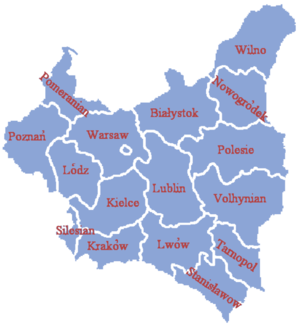 |
|
| 85-89 | warszawskie Warsaw Voivodeship (1919-1939) Warsaw Voivodeship was a voivodeship of Poland in the years 1919–1939. Its capital and biggest city was Warsaw.-Location and area:In the years 1919–1939, Warsaw Voivodeship covered north-central part of Poland, bordering East Prussia to the north, Pomorze Voivodeship and Łódź Voivodeship to the... |
Warsaw Warsaw Warsaw is the capital and largest city of Poland. It is located on the Vistula River, roughly from the Baltic Sea and from the Carpathian Mountains. Its population in 2010 was estimated at 1,716,855 residents with a greater metropolitan area of 2,631,902 residents, making Warsaw the 10th most... |
31.7 | 2460.9 | ||
| 20-24 | białostockie | Białystok | 26.0 | 1263.3 | ||
| 25-29 | kieleckie Kielce Voivodeship (1919-1939) Kielce Voivodeship - a unit of administrative division and local government in Poland in years 1921–1939. Back then, it covered a large chunk of central part of the country, including such cities as Radom, Częstochowa and Sosnowiec. On April 1, 1938 its borders changed, see: Territorial changes of... |
Kielce Kielce Kielce ) is a city in central Poland with 204,891 inhabitants . It is also the capital city of the Świętokrzyskie Voivodeship since 1999, previously in Kielce Voivodeship... |
22.2 | 2671.0 | ||
| 30-34 | krakowskie Kraków Voivodeship (1919-1939) Kraków Voivodeship - a unit of administrative division and local government in Poland in years 1919–1939. Back then, it covered a big chunk of southern part of the country, including such cities as Kraków, Jaworzno and Tarnów. Capital city: Kraków.... |
Kraków Kraków Kraków also Krakow, or Cracow , is the second largest and one of the oldest cities in Poland. Situated on the Vistula River in the Lesser Poland region, the city dates back to the 7th century. Kraków has traditionally been one of the leading centres of Polish academic, cultural, and artistic life... |
17.6 | 2300.1 | ||
| 35-39 | lubelskie Lublin Voivodeship (1919-1939) Lublin Voivodeship was a unit of administrative division of the Second Polish Republic, in the years 1919–1939. Its capital and biggest city was Lublin.-Location and area:... |
Lublin Lublin Lublin is the ninth largest city in Poland. It is the capital of Lublin Voivodeship with a population of 350,392 . Lublin is also the largest Polish city east of the Vistula river... |
26.6 | 2116.2 | ||
| 40-44 | lwowskie Lwów Voivodeship Lwów Voivodeship was an administrative unit of interwar Poland . According to Nazis and Soviets it ceased to exist in September 1939, following German and Soviet aggression on Poland . The Polish underground administration existed till August 1944.-Population:Its capital, biggest and most... |
Lwów | 28.4 | 3126.3 | ||
| 45-49 | łódzkie | Łódź | 20.4 | 2650.1 | ||
| 50-54 | nowogródzkie Nowogródek Voivodeship (1919-1939) Nowogródek Voivodeship was a unit of administrative division of the Second Polish Republic between 1919 and 1939, with the capital in Nowogródek . Following German and Soviet Invasion of Poland of September 1939, Poland's borders were redrawn in accordance with the Molotov–Ribbentrop Pact... |
Nowogródek | 23.0 | 1057.2 | ||
| 55-59 | poleskie Polesie Voivodeship Polesie Voivodeship was an administrative unit of interwar Poland . It ceased to exist in September 1939, following German and Soviet aggression on Poland .-Population:... |
Brześć nad Bugiem | 36.7 | 1132.2 | ||
| 60-64 | pomorskie Pomeranian Voivodeship (1919-1939) Pomeranian Voivodeship or Pomorskie Voivodeship was an administrative unit of inter-war Poland . It ceased to exist in September 1939, following German and Soviet aggression on Poland... |
Toruń Torun Toruń is an ancient city in northern Poland, on the Vistula River. Its population is more than 205,934 as of June 2009. Toruń is one of the oldest cities in Poland. The medieval old town of Toruń is the birthplace of the astronomer Nicolaus Copernicus.... |
25.7 | 1884.4 | ||
| 65-69 | poznańskie Poznan Voivodeship (1921-1939) Poznań Voivodeship was a unit of administrative division and local government in Poland in the years 1921–1939, created after World War I from the Prussian-German province of Poznań... |
Poznań Poznan Poznań is a city on the Warta river in west-central Poland, with a population of 556,022 in June 2009. It is among the oldest cities in Poland, and was one of the most important centres in the early Polish state, whose first rulers were buried at Poznań's cathedral. It is sometimes claimed to be... |
28.1 | 2339.6 | ||
| 70-74 | stanisławowskie | Stanisławów Ivano-Frankivsk Ivano-Frankivsk is a historic city located in the western Ukraine. It is the administrative centre of the Ivano-Frankivsk Oblast , and is designated as its own separate raion within the oblast, municipality.... |
16.9 | 1480.3 | ||
| 75-79 ? | śląskie | Katowice Katowice Katowice is a city in Silesia in southern Poland, on the Kłodnica and Rawa rivers . Katowice is located in the Silesian Highlands, about north of the Silesian Beskids and about southeast of the Sudetes Mountains.It is the central district of the Upper Silesian Metropolis, with a population of 2... |
5.1 | 1533.5 | ||
| 80-84 | tarnopolskie Tarnopol Voivodeship Tarnopol Voivodeship was an administrative region of interwar Poland with an area of 16,500 km², 17 counties, and capital in Tarnopol... |
Tarnopol | 16.5 | 1600.4 | ||
| 90-94 | wileńskie Wilno Voivodeship The Wilno Voivodeship was one of Voivodeships in the Second Polish Republic, with the capital in Wilno. It was created in 1926 and populated predominantly by Poles with notable minorities of Belarusians, Jews, and Lithuanians.... |
Wilno | 29.0 | 1276.0 | ||
| 95-99 | wołyńskie | Łuck Lutsk Lutsk is a city located by the Styr River in northwestern Ukraine. It is the administrative center of the Volyn Oblast and the administrative center of the surrounding Lutskyi Raion within the oblast... |
35.7 | 2085.6 | ||
Congress PolandCongress PolandThe Kingdom of Poland , informally known as Congress Poland , created in 1815 by the Congress of Vienna, was a personal union of the Russian parcel of Poland with the Russian Empire...
1816–1837
From 1816 to 1837 there were 8 voivodeships in Congress Poland
Congress Poland
The Kingdom of Poland , informally known as Congress Poland , created in 1815 by the Congress of Vienna, was a personal union of the Russian parcel of Poland with the Russian Empire...
.
- Augustów VoivodeshipAugustów VoivodeshipAugustów Voivodeship was created in 1816 from the Łomża Department. Its capital was in Łomża until 1818, when it was transferred to Suwałki. In 1837 it was transformed into Augustów Governorate.-Administrative divisions:It was divided into 7 counties:...
- Kalisz VoivodeshipKalisz Voivodeship-Kalisz Voivodeship 1975–1998:Kalisz Voivodeship 1975–1998 was a unit of administrative division and local government in Poland in years 1975–1998, superseded by Greater Poland Voivodeship.Capital city: Kalisz...
- Kraków VoivodeshipKraków VoivodeshipKraków Voivodeship, refers to several historical Voivodeships of Poland in the surrounding regions, with the city of Kraków as its capital.- Kraków Voivodeship 1975-1998 :...
- Lublin VoivodeshipLublin Voivodeship- Administrative division :Lublin Voivodeship is divided into 24 counties : 4 city counties and 20 land counties. These are further divided into 213 gminas....
- Mazowsze Voivodeship
- Płock Voivodeship
- Podlasie VoivodeshipPodlasie VoivodeshipAdministrative subdivision of Congress PolandIt was created in 1816 from the Siedlce Department.Its capital was in Siedlce.-References:* Geographical Dictionary of the Kingdom of Poland...
- Sandomierz VoivodeshipSandomierz VoivodeshipSandomierz Voivodeship was a unit of administration and local government in Poland from the 14th century to the partitions of Poland in 1772–1795. It was part of the Little Poland region. Originally Sandomierz Voivodeship also covered the area around Lublin, but in 1474 its three eastern counties...
Polish–Lithuanian Commonwealth 1569–1795
Greater PolandGreater PolandGreater Poland or Great Poland, often known by its Polish name Wielkopolska is a historical region of west-central Poland. Its chief city is Poznań.The boundaries of Greater Poland have varied somewhat throughout history...
(Wielkopolska)
- Poznań VoivodeshipPoznan Voivodeship-1975 to 1998:From 1975 to 1998, Poznań Voivodeship was a unit of administrative division and local government in Poland, superseded by Greater Poland Voivodeship.Capital city: Poznań.Major cities and towns :...
(województwo poznańskie, PoznańPoznanPoznań is a city on the Warta river in west-central Poland, with a population of 556,022 in June 2009. It is among the oldest cities in Poland, and was one of the most important centres in the early Polish state, whose first rulers were buried at Poznań's cathedral. It is sometimes claimed to be...
) - Kalisz VoivodeshipKalisz Voivodeship-Kalisz Voivodeship 1975–1998:Kalisz Voivodeship 1975–1998 was a unit of administrative division and local government in Poland in years 1975–1998, superseded by Greater Poland Voivodeship.Capital city: Kalisz...
(województwo kaliskie, KaliszKaliszKalisz is a city in central Poland with 106,857 inhabitants , the capital city of the Kalisz Region. Situated on the Prosna river in the southeastern part of the Greater Poland Voivodeship, the city forms a conurbation with the nearby towns of Ostrów Wielkopolski and Nowe Skalmierzyce...
) - Gniezno VoivodeshipGniezno VoivodeshipGniezno Voivodeship was a unit of administrative division and local government in Poland for a short time from 1768, when it was cut from the Kalisz Voivodeship, to the Second Partition of Poland in 1793...
(województwo gnieźnieńskie, GnieznoGnieznoGniezno is a city in central-western Poland, some 50 km east of Poznań, inhabited by about 70,000 people. One of the Piasts' chief cities, it was mentioned by 10th century A.D. sources as the capital of Piast Poland however the first capital of Piast realm was most likely Giecz built around...
) from 1768 - Sieradz VoivodeshipSieradz VoivodeshipSieradz Voivodeship was a unit of administrative division and local government in Poland in the years 1975–1998, superseded by Łódź Voivodeship.-1975-1998:Capital city: SieradzMajor cities and towns: :* Zduńska Wola ;...
(województwo sieradzkie, SieradzSieradzSieradz is a town on the Warta river in central Poland with 44,326 inhabitants . It is situated in the Łódź Voivodship , but was previously the eponymous capital of the Sieradz Voivodship , and historically one of the minor duchies in Greater Poland.It is one of the oldest towns in Poland,...
) - Łęczyca VoivodeshipŁęczyca VoivodeshipŁęczyca Voivodeship was a unit of administrative division and local government in Poland from the 14th century until the partitions of Poland in 1772-1795...
(województwo łęczyckie, Łęczyca) - Brześć Kujawski VoivodeshipBrzesc Kujawski VoivodeshipBrześć Kujawski Voivodeship was a unit of administrative division and local government in Poland from 14th century to the partitions of Poland in 1772–1795...
(województwo brzesko-kujawskie, Brześć KujawskiBrzesc KujawskiBrześć Kujawski is a town in the Kuyavian-Pomeranian Voivodeship, Population - 4,521 , Poland.It has been the seat of one of two small duchies into which Kuyavia has been temporarily divided....
) - Inowrocław Voivodeship (województwo inowrocławskie, Inowrocław)
- Chełmno Voivodeship (województwo chełmińskie, Chełmno)
- Malbork VoivodeshipMalbork VoivodeshipThe Malbork Voivodeship was a unit of administrative division and local government in the Kingdom of Poland from 1454/1466 until the partitions in 1772-1795. Together with the Pomeranian and Chełmno Voivodeships and the Prince-Bishopric of Warmia it formed the historical province of Royal Prussia...
(województwo malborskie, MalborkMalborkMalbork is a town in northern Poland in the Żuławy region , with 38,478 inhabitants . Situated in the Pomeranian Voivodeship since 1999, it was previously assigned to Elbląg Voivodeship...
) - Pomeranian VoivodeshipPomeranian VoivodeshipPomeranian Voivodeship, or Pomerania Province , is a voivodeship, or province, in north-central Poland. It comprises most of Pomerelia , as well as an area east of the Vistula River...
(województwo pomorskie, GdańskGdanskGdańsk is a Polish city on the Baltic coast, at the centre of the country's fourth-largest metropolitan area.The city lies on the southern edge of Gdańsk Bay , in a conurbation with the city of Gdynia, spa town of Sopot, and suburban communities, which together form a metropolitan area called the...
) - Duchy of WarmiaWarmiaWarmia or Ermland is a region between Pomerelia and Masuria in northeastern Poland. Together with Masuria, it forms the Warmian-Masurian Voivodeship....
(Księstwo Warmińskie, Lidzbark WarmińskiLidzbark WarminskiLidzbark Warmiński is a town in the Warmian-Masurian Voivodeship in Poland. It is the capital of Lidzbark County.- History :The town was originally an Old Prussian settlement known as Lecbarg until being conquered in 1240 by the Teutonic Knights, who called it Heilsberg...
) - Duchy of Prussia (Księstwo Pruskie, Lidzbark WarmińskiLidzbark WarminskiLidzbark Warmiński is a town in the Warmian-Masurian Voivodeship in Poland. It is the capital of Lidzbark County.- History :The town was originally an Old Prussian settlement known as Lecbarg until being conquered in 1240 by the Teutonic Knights, who called it Heilsberg...
) - Płock Voivodeship (województwo płockie, Płock)
- Rawa VoivodeshipRawa VoivodeshipRawa Voivodeship was a unit of administrative division and local government in the Kingdom of Poland since 15th century till the partitions of Poland in 1795. It was part of the Greater Polish prowincja...
(województwo rawskie, Rawa MazowieckaRawa MazowieckaRawa Mazowiecka is a town in central Poland, with 17,765 inhabitants . It lies in the Łódź Voivodeship and is the capital of Rawa County.First mentioned in 1288, it received city rights in 1321....
) - Masovian VoivodeshipMasovian Voivodeship-Administrative division:Masovian Voivodeship is divided into 42 counties : 5 city counties and 37 "land counties"...
(województwo mazowieckie, WarszawaWarsawWarsaw is the capital and largest city of Poland. It is located on the Vistula River, roughly from the Baltic Sea and from the Carpathian Mountains. Its population in 2010 was estimated at 1,716,855 residents with a greater metropolitan area of 2,631,902 residents, making Warsaw the 10th most...
)
Lesser PolandLesser PolandLesser Poland is one of the historical regions of Poland, with its capital in the city of Kraków. It forms the southeastern corner of the country, and should not be confused with the modern Lesser Poland Voivodeship, which covers only a small, southern part of Lesser Poland...
(Małopolska)
- Kraków VoivodeshipKraków VoivodeshipKraków Voivodeship, refers to several historical Voivodeships of Poland in the surrounding regions, with the city of Kraków as its capital.- Kraków Voivodeship 1975-1998 :...
(województwo krakowskie, KrakówKrakówKraków also Krakow, or Cracow , is the second largest and one of the oldest cities in Poland. Situated on the Vistula River in the Lesser Poland region, the city dates back to the 7th century. Kraków has traditionally been one of the leading centres of Polish academic, cultural, and artistic life...
) - Sandomierz VoivodeshipSandomierz VoivodeshipSandomierz Voivodeship was a unit of administration and local government in Poland from the 14th century to the partitions of Poland in 1772–1795. It was part of the Little Poland region. Originally Sandomierz Voivodeship also covered the area around Lublin, but in 1474 its three eastern counties...
(województwo sandomierskie, SandomierzSandomierzSandomierz is a city in south-eastern Poland with 25,714 inhabitants . Situated in the Świętokrzyskie Voivodeship , previously in Tarnobrzeg Voivodeship . It is the capital of Sandomierz County . Sandomierz is known for its Old Town, a major tourist attraction...
) - Lublin VoivodeshipLublin Voivodeship- Administrative division :Lublin Voivodeship is divided into 24 counties : 4 city counties and 20 land counties. These are further divided into 213 gminas....
(województwo lubelskie, LublinLublinLublin is the ninth largest city in Poland. It is the capital of Lublin Voivodeship with a population of 350,392 . Lublin is also the largest Polish city east of the Vistula river...
) - Podlaskie VoivodeshipPodlaskie Voivodeship (1513–1795)The Podlaskie Voivodeship was formed in 1513 by Sigismund I the Old as a voivodeship in the Grand Duchy of Lithuania, from a split off part of the Trakai Voivodeship....
(województwo podlaskie, DrohiczynDrohiczynDrohiczyn is a small historic town in Siemiatycze County, Podlaskie Voivodeship, Poland. The town with population 2,110 is situated on a bank of the Bug River.- History :...
) - Ruthenian VoivodeshipRuthenian VoivodeshipRuthenia Voivodeship was an administrative division of the Kingdom of Poland . Together with Bełz Voivodeship, it formed Lesser Poland Province with its capital city in Kraków. Part of Lesser Poland region...
(województwo ruskie, Lwów) - Bełz Voivodeship (województwo belzkie, Bełz)
- Volhynian Voivodeship (województwo wołyńskie, Łuck)
- Podole VoivodeshipPodole VoivodeshipThe Podole Voivodeship was a unit of administrative division and local government in the Kingdom of Poland, since the 14th century till 1793/1795, except for a short period of Ottoman Empire administration as Podolia Eyalet. Together with the Bracław Voivodeship it formed the historical province...
(województwo podolskie, Kamieniec Podolski) - Bracław Voivodeship (województwo bracławskie, Bracław)
- Kijów VoivodeshipKijów VoivodeshipThe Kiev Voivodeship was a unit of administrative division and local government in the Grand Duchy of Lithuania from 1471 until 1569 and of the Crown of the Kingdom of Poland from 1569 until 1793 as part of Lesser Poland Province of the Polish Crown....
(województwo kijowskie, KijówKijówKijów may refer to:*Polish name for Kiev, the capital of Ukraine*Kijów, Silesian Voivodeship *Kijów, Lubusz Voivodeship *Kijów, Opole Voivodeship...
) - Czernihów VoivodeshipCzernihów VoivodeshipChernihiv Voivodeship was a unit of administrative division and local government in the Kingdom of Poland from 1635 until Khmelnytsky Uprising in 1648...
(województwo czernichowskie, CzernihówChernihivChernihiv or Chernigov is a historic city in northern Ukraine. It is the administrative center of the Chernihiv Oblast , as well as of the surrounding Chernihivskyi Raion within the oblast...
)
Grand Duchy of LithuaniaGrand Duchy of LithuaniaThe Grand Duchy of Lithuania was a European state from the 12th /13th century until 1569 and then as a constituent part of Polish-Lithuanian Commonwealth until 1791 when Constitution of May 3, 1791 abolished it in favor of unitary state. It was founded by the Lithuanians, one of the polytheistic...
Here the first name given is English, then in brackets Lithuanian, and then Polish.
- Wilno VoivodeshipWilno VoivodeshipThe Wilno Voivodeship was one of Voivodeships in the Second Polish Republic, with the capital in Wilno. It was created in 1926 and populated predominantly by Poles with notable minorities of Belarusians, Jews, and Lithuanians....
(Vilniaus vaivadija, województwo wileńskie, VilniusVilniusVilnius is the capital of Lithuania, and its largest city, with a population of 560,190 as of 2010. It is the seat of the Vilnius city municipality and of the Vilnius district municipality. It is also the capital of Vilnius County...
) - Troki Voivodeship (Trakų vaivadija, województwo trockie, TrakaiTrakaiTrakai is a historic city and lake resort in Lithuania. It lies 28 km west of Vilnius, the capital of Lithuania. Because of its proximity to Vilnius, Trakai is a popular tourist destination. Trakai is the administrative centre of Trakai district municipality. The town covers 11.52 km2 of...
) - Nowogródek Voivodeship (Naugarduko vaivadija, województwo nowogrodzkie, Nowogródek)
- Brest-Litovsk Voivodeship (Lietuvos Brastos vaivadija, województwo brzesko-litewskie, Brześć Litewski)
- Minsk VoivodeshipMinsk VoivodeshipMinsk Voivodeship was a unit of administrative division and local government in Grand Duchy of Lithuania since 1413 and later in Polish-Lithuanian Commonwealth till the partitions of the Commonwealth in 1795...
(Minsko vaivadija, województwo mińskie, MińskMinsk- Ecological situation :The ecological situation is monitored by Republican Center of Radioactive and Environmental Control .During 2003–2008 the overall weight of contaminants increased from 186,000 to 247,400 tons. The change of gas as industrial fuel to mazut for financial reasons has worsened...
) - Mścisław Voivodeship (Mstslavlio vaivadija, województwo mścisławskie, Mscislaw)
- Smolensk VoivodeshipSmolensk VoivodeshipSmolensk Voivodeship was a unit of administrative division and local government in the Grand Duchy of Lithuania and later the Polish–Lithuanian Commonwealth....
(Smolensko vaivadija, województwo smoleńskie, SmoleńskSmolenskSmolensk is a city and the administrative center of Smolensk Oblast, Russia, located on the Dnieper River. Situated west-southwest of Moscow, this walled city was destroyed several times throughout its long history since it was on the invasion routes of both Napoleon and Hitler. Today, Smolensk...
) - Vitebsk Voivodeship (Vitebsko vaivadija, województwo witebskie, Witebsk)
- Połock Voivodeship (Polocko vaivadija, województwo połockie, PołockPolatskPolotsk , is a historical city in Belarus, situated on the Dvina river. It is the center of Polotsk district in Vitsebsk Voblast. Its population is more than 80,000 people...
) - Duchy of SamogitaEldership of SamogitiaThe Duchy of Samogitia had been the administrative unit of the Grand Duchy of Lithuania from 1422 . Between 1422 to 1441 it was known as the Eldership of Samogitia...
(Žemaičių seniūnija, księstwo żmudzkie, Medininkai-Varniai)
Duchy of LivoniaDuchy of LivoniaThe Duchy of Livonia was a territory of the Grand Duchy of Lithuania — and later the Polish–Lithuanian Commonwealth — that existed from 1561 to 1621...
- Wenden VoivodeshipWenden VoivodeshipWenden Voivodeship was a unit of administrative division and local government in the Duchy of Livonia, part of the Polish-Lithuanian Commonwealth, since it was formed in 1598 till the Swedish conquest of Livonia in the 1620s...
(województwo wendeńskie, WendenCesisCēsis , is a town in Latvia located in the northern part of the Central Vidzeme Upland. Cēsis is on the Gauja River valley, and is built on a series of ridges above the river overlooking the woods below...
) since 1598 till the 1620s - Dorpat VoivodeshipDorpat VoivodeshipThe Dorpat Voivodeship was a unit of administrative division and local government in the Duchy of Livonia, part of the Polish-Lithuanian Commonwealth, from 1598 till the Swedish conquest of Livonia in the 1620s.The seat of the voivode was Dorpat...
(województwo dorpackie, DorpatTartuTartu is the second largest city of Estonia. In contrast to Estonia's political and financial capital Tallinn, Tartu is often considered the intellectual and cultural hub, especially since it is home to Estonia's oldest and most renowned university. Situated 186 km southeast of Tallinn, the...
) since 1598 till the 1620s - Parnawa VoivodeshipParnawa VoivodeshipThe Parnawa Voivodeship was a unit of administrative division and local government in the Duchy of Livonia, part of the Polish-Lithuanian Commonwealth, since it was formed in 1598 till the Swedish conquest of Livonia in the 1620s....
(województwo parnawskie, ParnawaPärnuPärnu is a city in southwestern Estonia on the coast of Pärnu Bay, an inlet of the Gulf of Riga in the Baltic Sea. It is a popular summer vacation resort with many hotels, restaurants, and large beaches. The Pärnu River flows through the city and drains into the Gulf of Riga...
) since 1598 till the 1620s - Inflanty Voivodeship (województwo inflanckie, Dyneburg) since the 1620s
- Duchy of Courland and SemigaliaCourlandCourland is one of the historical and cultural regions of Latvia. The regions of Semigallia and Selonia are sometimes considered as part of Courland.- Geography and climate :...
(księstwo Kurlandii i Semigalii, MitawaJelgava-Sports:The city's main football team, FK Jelgava, plays in the Latvian Higher League and won the 2009/2010 Latvian Football Cup.- Notable people :*August Johann Gottfried Bielenstein - linguist, folklorist, ethnographer...
)
Etymology and use of "voivodeship"
Some English-language sources, in historic contexts, speak of "palatinateCount palatine
Count palatine is a high noble title, used to render several comital styles, in some cases also shortened to Palatine, which can have other meanings as well.-Comes palatinus:...
s" rather than "voivodeships"; the former term traces back to the Latin
Latin
Latin is an Italic language originally spoken in Latium and Ancient Rome. It, along with most European languages, is a descendant of the ancient Proto-Indo-European language. Although it is considered a dead language, a number of scholars and members of the Christian clergy speak it fluently, and...
palatinus ("palatine"). More commonly used now is "voivodeship", a loanword
Loanword
A loanword is a word borrowed from a donor language and incorporated into a recipient language. By contrast, a calque or loan translation is a related concept where the meaning or idiom is borrowed rather than the lexical item itself. The word loanword is itself a calque of the German Lehnwort,...
-calque
Calque
In linguistics, a calque or loan translation is a word or phrase borrowed from another language by literal, word-for-word or root-for-root translation.-Calque:...
hybrid
Hybrid word
A hybrid word is a word which etymologically has one part derived from one language and another part derived from a different language.-Common hybrids:The most common form of hybrid word in English is one which combines etymologically Latin and Greek parts...
formed on the Polish "województwo". Other sources refer instead to "province
Province
A province is a territorial unit, almost always an administrative division, within a country or state.-Etymology:The English word "province" is attested since about 1330 and derives from the 13th-century Old French "province," which itself comes from the Latin word "provincia," which referred to...
s" (Polish singular: "prowincja"), though in pre-1795 contexts this may be confusing because the cognate
Cognate
In linguistics, cognates are words that have a common etymological origin. This learned term derives from the Latin cognatus . Cognates within the same language are called doublets. Strictly speaking, loanwords from another language are usually not meant by the term, e.g...
Polish "prowincyja
Prowincja
A prowincja , or Region, was the largest territorial subdivision in medieval and Renaissance-era Poland, and later in the Polish-Lithuanian Commonwealth...
" (as it was then spelled) was idiosyncratically applied, until the last of the three Partitions of the Polish–Lithuanian Commonwealth
Partitions of Poland
The Partitions of Poland or Partitions of the Polish–Lithuanian Commonwealth took place in the second half of the 18th century and ended the existence of the Polish–Lithuanian Commonwealth, resulting in the elimination of sovereign Poland for 123 years...
, in 1795, to each of the three main Regions (Greater Poland
Greater Poland
Greater Poland or Great Poland, often known by its Polish name Wielkopolska is a historical region of west-central Poland. Its chief city is Poznań.The boundaries of Greater Poland have varied somewhat throughout history...
, Lesser Poland
Lesser Poland
Lesser Poland is one of the historical regions of Poland, with its capital in the city of Kraków. It forms the southeastern corner of the country, and should not be confused with the modern Lesser Poland Voivodeship, which covers only a small, southern part of Lesser Poland...
, and Lithuania
Lithuania
Lithuania , officially the Republic of Lithuania is a country in Northern Europe, the biggest of the three Baltic states. It is situated along the southeastern shore of the Baltic Sea, whereby to the west lie Sweden and Denmark...
) of the Polish–Lithuanian Commonwealth, each of those Regions in turn comprising a number of województwa (plural of "województwo").
The Polish
Poland
Poland , officially the Republic of Poland , is a country in Central Europe bordered by Germany to the west; the Czech Republic and Slovakia to the south; Ukraine, Belarus and Lithuania to the east; and the Baltic Sea and Kaliningrad Oblast, a Russian exclave, to the north...
"województwo", designating a second-tier Polish or Polish–Lithuanian administrative unit, derives from "wojewoda" (etymologically, a "war leader" or "leader of warriors", but now simply the governor
Governor
A governor is a governing official, usually the executive of a non-sovereign level of government, ranking under the head of state...
of a województwo) and the suffix "-stwo" (a "state or condition").
The English "voivodeship", which is a hybrid
Hybrid word
A hybrid word is a word which etymologically has one part derived from one language and another part derived from a different language.-Common hybrids:The most common form of hybrid word in English is one which combines etymologically Latin and Greek parts...
of the loanword
Loanword
A loanword is a word borrowed from a donor language and incorporated into a recipient language. By contrast, a calque or loan translation is a related concept where the meaning or idiom is borrowed rather than the lexical item itself. The word loanword is itself a calque of the German Lehnwort,...
"voivode" and "-ship" (the latter a suffix
Suffix
In linguistics, a suffix is an affix which is placed after the stem of a word. Common examples are case endings, which indicate the grammatical case of nouns or adjectives, and verb endings, which form the conjugation of verbs...
, likewise meaning a "state or condition", that calque
Calque
In linguistics, a calque or loan translation is a word or phrase borrowed from another language by literal, word-for-word or root-for-root translation.-Calque:...
s the Polish "-stwo"), has never been much used and is absent from many dictionaries. According to the Oxford English Dictionary
Oxford English Dictionary
The Oxford English Dictionary , published by the Oxford University Press, is the self-styled premier dictionary of the English language. Two fully bound print editions of the OED have been published under its current name, in 1928 and 1989. The first edition was published in twelve volumes , and...
, it first appeared in 1792, spelled "woiwodship", in the sense of "the district or province governed by a voivode." The word subsequently also appeared in 1886 in the sense of "the office or dignity of a voivode."
An official Polish body, the Commission on Standardization of Geographic Names outside the Republic of Poland, recommends the spelling "voivodship", without the e. This is consistently reflected in publications and in the international arena, e.g., at the United Nations
United Nations
The United Nations is an international organization whose stated aims are facilitating cooperation in international law, international security, economic development, social progress, human rights, and achievement of world peace...
.
See also
- Voivodeships of Poland (1975–1998)
- Administrative division of the Polish–Lithuanian Commonwealth
- Coats of arms of Polish voivodeshipsCoats of arms of Polish voivodeshipsThis is a list of coats of arms of the voivodeships of Poland....
- Flags of Polish voivodeshipsFlags of Polish voivodeshipsThis is a list of flags of the voivodeships of Poland.- See also :* List of Polish flags* Coats of arms of Polish voivodeships...
- ISO 3166-2:PLISO 3166-2:PLISO 3166-2:PL is the entry for Poland in ISO 3166-2, part of the ISO 3166 standard published by the International Organization for Standardization , which defines codes for the names of the principal subdivisions of all countries coded in ISO 3166-1.Currently for Poland, ISO 3166-2 codes are...
- ProwincjaProwincjaA prowincja , or Region, was the largest territorial subdivision in medieval and Renaissance-era Poland, and later in the Polish-Lithuanian Commonwealth...
- Regions of PolandPolish historical regionsPolish historic regions are regions that were related to a former Polish state, or are within present-day Poland without being identified in its administrative division....
- VoivodeshipVoivodeshipVoivodship is a term denoting the position of, or more commonly the area administered by, a voivod. Voivodeships have existed since medieval times in Poland, Romania, Hungary, Lithuania, Latvia, Russia and Serbia....
External links
- Regions of Poland
- Toponymic Guidelines Of Poland for Map Editors and Other Users Head Office Of Geodesy And Cartography, 2002
- CIA World Factbook --> "Poland --> Administrative divisions"