


Congress of Gniezno

Encyclopedia

Otto III, Holy Roman Emperor
Otto III , a King of Germany, was the fourth ruler of the Saxon or Ottonian dynasty of the Holy Roman Empire. He was elected King in 983 on the death of his father Otto II and was crowned Holy Roman Emperor in 996.-Early reign:...
, which took place at Gniezno
Gniezno
Gniezno is a city in central-western Poland, some 50 km east of Poznań, inhabited by about 70,000 people. One of the Piasts' chief cities, it was mentioned by 10th century A.D. sources as the capital of Piast Poland however the first capital of Piast realm was most likely Giecz built around...
on March 11, 1000. Scholars disagree over the details of the decisions made at the convention, especially whether the ruler of Poland was pledged the king's crown or not.
Background

Adalbert of Prague
This article is about St Adalbert of Prague. For other uses, see Adalbert .Saint Adalbert, Czech: ; , , Czech Roman Catholic saint, a Bishop of Prague and a missionary, was martyred in his efforts to convert the Baltic Prussians. He evangelized Poles and Hungarians. St...
was soon canonized
Canonization
Canonization is the act by which a Christian church declares a deceased person to be a saint, upon which declaration the person is included in the canon, or list, of recognized saints. Originally, individuals were recognized as saints without any formal process...
by the common effort of Duke Bolesław I and Emperor Otto III. Thus, Adalbert was the first Slavic bishop who became a saint. His body, bought by Bolesław for its weight in gold, was put into a tomb at Gniezno Cathedral
Gniezno Cathedral
Cathedral Basilica of the Assumption of the Blessed Virgin Mary and St. Adalbert is a Gothic cathedral in Gniezno, Poland. The Cathedral is known for its twelfth-century , two-winged bronze doors decorated with scenes of martyrdom of St. Wojciech and a silver relic coffin of that saint...
, which became the ecclesiastical center of Poland.
According to the chronicles by Thietmar of Merseburg
Thietmar of Merseburg
Thietmar of Merseburg was a German chronicler who was also bishop of Merseburg.-Life:...
, Otto III, who had been a friend of Adalbert, committed to a pilgrimage
Pilgrimage
A pilgrimage is a journey or search of great moral or spiritual significance. Typically, it is a journey to a shrine or other location of importance to a person's beliefs and faith...
from Italy
Kingdom of Italy (medieval)
The Kingdom of Italy was a political entity under control of Carolingian dynasty of Francia first, after the defeat of the Lombards in 774. It was finally incorporated as a part of the Holy Roman Empire in 962....
to St. Adalbert's tomb in Gniezno; in his attempt to extend the influence of Christianity
Christianity
Christianity is a monotheistic religion based on the life and teachings of Jesus as presented in canonical gospels and other New Testament writings...
in Eastern Europe, and to renew the Holy Roman Empire
Holy Roman Empire
The Holy Roman Empire was a realm that existed from 962 to 1806 in Central Europe.It was ruled by the Holy Roman Emperor. Its character changed during the Middle Ages and the Early Modern period, when the power of the emperor gradually weakened in favour of the princes...
based on a federal concept ("renovatio Imperii Romanorum") with the Polish and Hungarian
Kingdom of Hungary
The Kingdom of Hungary comprised present-day Hungary, Slovakia and Croatia , Transylvania , Carpatho Ruthenia , Vojvodina , Burgenland , and other smaller territories surrounding present-day Hungary's borders...
duchies upgraded to eastern federati of the empire. As part of this policy he also invested Grand Prince Stephen I of Hungary with the king's crown (the Crown of Saint Stephen).
The Polish Piast dynasty
Piast dynasty
The Piast dynasty was the first historical ruling dynasty of Poland. It began with the semi-legendary Piast Kołodziej . The first historical ruler was Duke Mieszko I . The Piasts' royal rule in Poland ended in 1370 with the death of king Casimir the Great...
under Miezsko I
Mieszko I of Poland
Mieszko I , was a Duke of the Polans from about 960 until his death. A member of the Piast dynasty, he was son of Siemomysł; grandchild of Lestek; father of Bolesław I the Brave, the first crowned King of Poland; likely father of Świętosława , a Nordic Queen; and grandfather of her son, Cnut the...
had extended their domains beyond the Oder
Oder
The Oder is a river in Central Europe. It rises in the Czech Republic and flows through western Poland, later forming of the border between Poland and Germany, part of the Oder-Neisse line...
river, where their claims to power collided with the interests of the Saxon
Duchy of Saxony
The medieval Duchy of Saxony was a late Early Middle Ages "Carolingian stem duchy" covering the greater part of Northern Germany. It covered the area of the modern German states of Bremen, Hamburg, Lower Saxony, North Rhine-Westphalia, and Saxony-Anhalt and most of Schleswig-Holstein...
margrave Gero
Gero
Gero I , called the Great , ruled an initially modest march centred on Merseburg, which he expanded into a vast territory named after him: the marca Geronis. During the mid-10th century, he was the leader of the Saxon Drang nach Osten.-Succession and early conflicts:Gero was the son of Count...
. After his defeat by Gero's troops in 963, Mieszko I decided to come to terms with Emperor Otto I
Otto I, Holy Roman Emperor
Otto I the Great , son of Henry I the Fowler and Matilda of Ringelheim, was Duke of Saxony, King of Germany, King of Italy, and "the first of the Germans to be called the emperor of Italy" according to Arnulf of Milan...
and agreed to pay tribute for parts of his lands. In turn he managed to gain the title of amicus imperatoris ("Friend of the Emperor") and the acknowledgement of his position as Dux
Dux
Dux is Latin for leader and later for Duke and its variant forms ....
of Poland. He continued his policy of convergence by marrying Oda, daughter of the Saxon margrave Dietrich of Haldensleben
Dietrich of Haldensleben
Dietrich of Haldensleben was the first margrave of the Northern March from 965 until his deposition in 983...
, in 978 and by marrying his son Bolesław I to a daughter of Margrave Rikdag
Rikdag
Rikdag, Ricdag, Riddag, or Rihdag was the Margrave of Meissen from 979 until his death. In 982, he acquired the marches of Merseburg and Zeitz. In 985, he was made count in the Schwabengau. He temporarily reunited all of the southern marca Geronis under his command...
of Meissen. As a precaution however, shortly before his death in 992 he placed his realm (Civitas Schinesghe
Civitas Schinesghe
Civitas Schinesghe is the first officially written down name of Poland originating from 991–992. The original deed is missing, but mentioned in an 11th-century papal regesta called Dagome iudex, according to which the Piast duke Mieszko I of Poland had given the guidance of unam civitatem in...
) under the protection of Pope John XV
Pope John XV
Pope John XV , Pope from 985 to 996, succeeding Boniface VII . He was said to have been Pope after another Pope John that reigned four months after Pope John XIV and was named "Papa Ioannes XIV Bis" or "Pope John XIVb"...
according to the dagome iudex
Dagome iudex
"Dagome iudex" is one of the earliest historical documents relating to Poland. Poland is not mentioned by name, but reference is made to Dagome and Ote and their sons in 991, placing their land under the protection of the Apostolic See...
regest.
When his son Bolesław succeeded him, Poland remained an ally of the Empire in the campaigns against the Polabian Lutici
Lutici
The Lutici were a federation of West Slavic Polabian tribes, who between the 10th and 12th centuries lived in what is now northeastern Germany. Four tribes made up the core of the federation: the Redarians , Circipanians , Kessinians and Tollensians...
tribes. Emperor Otto II, father of Otto III, had died at age 28 in 983 and his widow Theophanu
Theophanu
Theophanu , also spelled Theophania, Theophana or Theophano, was born in Constantinople, and was the wife of Otto II, Holy Roman Emperor.-Family:...
and grandmother had reigned for the child-king Otto III. In 996 he was crowned Holy Roman Emperor
Holy Roman Emperor
The Holy Roman Emperor is a term used by historians to denote a medieval ruler who, as German King, had also received the title of "Emperor of the Romans" from the Pope...
at Rome
Rome
Rome is the capital of Italy and the country's largest and most populated city and comune, with over 2.7 million residents in . The city is located in the central-western portion of the Italian Peninsula, on the Tiber River within the Lazio region of Italy.Rome's history spans two and a half...
and by the year 1000 at Gniezno was 20-years old.
The act
Emperor Otto III on his pilgrimage was received by Duke Bolesław at the Polish border on the BóbrBóbr
Bóbr is a river which runs through the north of the Czech Republic and the southwest of Poland, a left tributary of the Oder River, with a length of and a basin area of .The Bóbr originates in the Rýchory mountains in the southeast of the Karkonosze range, where the source is...
river near Małomice, whereafter Bishop Unger of Poznań conducted him to Gniezno. In the week of 7 to 15 March 1000 Emperor Otto III invested Duke Bolesław with the titles frater et cooperator Imperii ("Brother and Partner of the Empire") and populi Romani amicus et socius as rendered in the 1115 Gesta principum Polonorum by the Kraków
Kraków
Kraków also Krakow, or Cracow , is the second largest and one of the oldest cities in Poland. Situated on the Vistula River in the Lesser Poland region, the city dates back to the 7th century. Kraków has traditionally been one of the leading centres of Polish academic, cultural, and artistic life...
chronicler Gallus Anonymus
Gallus Anonymus
Gallus Anonymus is the name traditionally given to the anonymous author of Gesta principum Polonorum , composed in Latin about 1115....
, the first author of Polish history. If the act implemented an elevation of Bolesław to a Polish king at the mercy of the Emperor has not been conlusively established. In any case, Bolesław had himself crowned King of Poland at Gniezno Cathedral in 1025.
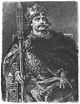
Poppo
Poppo can mean:*Several bishops of Würzburg who were named Poppo*Poppo , a king of Friesland*Poppo , an early ninth-century ancestor of the Babenbergs*Poppo, Duke of Thuringia , a margrave...
), the Bishopric of Wrocław (assigned to Bishop Jan
Jan (bishop of Wrocław)
Jan was the first bishop of Wrocław. He took power over the diocese of Wrocław at the time of its establishment in the year 1000.-References:...
) and the short-lived Bishopric of Kołobrzeg in Pomerania
Pomerania
Pomerania is a historical region on the south shore of the Baltic Sea. Divided between Germany and Poland, it stretches roughly from the Recknitz River near Stralsund in the West, via the Oder River delta near Szczecin, to the mouth of the Vistula River near Gdańsk in the East...
(assigned to bishop Reinbern
Reinbern
Reinbern was the only bishop of the short-lived Diocese of Kolberg) .Reinbern was born in the Hassegau area of the medieval Duchy of Saxony. When Holy Roman Emperor Otto III met with his friend, the Polish duke Boleslaw I in the Congress of Gniezno , the Archbishopric of Gniezno was founded...
). St. Adalbert's brother Radzim Gaudenty became the first archbishop of Gniezno. Otto III gave Bolesław a replica of his Holy Lance
Holy Lance
The Holy Lance is the name given to the lance that pierced Jesus' side as he hung on the cross in John's account of the Crucifixion.-Biblical references:The lance is mentioned only in the Gospel of John and not in any of the...
, part of the Imperial Regalia
Imperial Regalia
The Imperial Regalia, insignia, or crown jewels are the regalia of the Emperors and Kings of the Holy Roman Empire. The most important parts are the Imperial Crown, the Holy Lance and the Imperial Sword...
, and Bolesław presented the Emperor with a relic
Relic
In religion, a relic is a part of the body of a saint or a venerated person, or else another type of ancient religious object, carefully preserved for purposes of veneration or as a tangible memorial...
, an arm of St. Adalbert in exchange.
The status of the Bishopric of Poznań of Bishop Unger, whose diocese had also comprised Gniezno before and who had not supported the creation of a separate archdiocese in Gniezno, is also subject to historical debate. One view holds that it stayed independent and with Unger as a missionary bishop directly subordinate to the pope while another one holds that it was attached to the Archbishopric of Magdeburg
Archbishopric of Magdeburg
The Archbishopric of Magdeburg was a Roman Catholic archdiocese and Prince-Bishopric of the Holy Roman Empire centered on the city of Magdeburg on the Elbe River....
, the nearest German ecclesiastical province. However, generally, the congress is seen as having established complete ecclasiastical independence of the Polish church from Magdeburg.
Bolesław subsequently accompanied Otto III on his way back to Germany. Both proceeded to the grave of Charlemagne
Charlemagne
Charlemagne was King of the Franks from 768 and Emperor of the Romans from 800 to his death in 814. He expanded the Frankish kingdom into an empire that incorporated much of Western and Central Europe. During his reign, he conquered Italy and was crowned by Pope Leo III on 25 December 800...
at Aachen Cathedral
Aachen Cathedral
Aachen Cathedral, frequently referred to as the "Imperial Cathedral" , is a Roman Catholic church in Aachen, Germany. The church is the oldest cathedral in northern Europe and was known as the "Royal Church of St. Mary at Aachen" during the Middle Ages...
, where Bolesław received the throne chair as a gift. Both arranged the betrothal of Bolesław's son Mieszko II Lambert
Mieszko II Lambert
Mieszko II Lambert was King of Poland during 1025–1031, and Duke from 1032 until his death.He was the second son of Bolesław I the Brave, but the eldest born from his third wife Emmilda, daughter of Dobromir, possible ruler of Lusatia. He was probably named after his paternal grandfather, Mieszko I...
with the Emperor's niece Richeza of Lotharingia.
Aftermath
Due to Otto's early death in 1002, his renovatio policies were not fully applied. King Henry IIHenry II, Holy Roman Emperor
Henry II , also referred to as Saint Henry, Obl.S.B., was the fifth and last Holy Roman Emperor of the Ottonian dynasty, from his coronation in Rome in 1014 until his death a decade later. He was crowned King of the Germans in 1002 and King of Italy in 1004...
, Otto's successor, changed the empire's policies, while Bolesław had supported Henry's rival Margrave Eckard I of Meissen
Eckard I, Margrave of Meissen
Eckard I was Margrave of Meissen from 985 until his death, the first margrave of the Ekkehardinger family that dominated Meissen until the extinction of the line in 1046.-Life:...
, expanded his realm into the March of Lusatia and the Milceni
Milceni
The Milceni or Milzeni were a West Slavic tribe, who settled in the present-day Upper Lusatia region. They were first mentioned in the middle of the 9th century AD by the Bavarian Geographer, who wrote of 30 civitates which possibly had fortifications. They were gradually conquered by Germans...
lands, and also took the Bohemia
Bohemia
Bohemia is a historical region in central Europe, occupying the western two-thirds of the traditional Czech Lands. It is located in the contemporary Czech Republic with its capital in Prague...
n throne at Prague
Prague
Prague is the capital and largest city of the Czech Republic. Situated in the north-west of the country on the Vltava river, the city is home to about 1.3 million people, while its metropolitan area is estimated to have a population of over 2.3 million...
, interflicting with the Empire's interests. On a meeting with Henry II in Merseburg
Merseburg
Merseburg is a town in the south of the German state of Saxony-Anhalt on the river Saale, approx. 14 km south of Halle . It is the capital of the Saalekreis district. It had a diocese founded by Archbishop Adalbert of Magdeburg....
, Bolesław was raided and narrowly escaped. As a consequence, the excellent relations between the Empire and Poland marked by the Congress of Gniezno turned into a state of hostility that soon emerged into a German-Polish War
German-Polish War (1002–1018)
The German-Polish War which took place from 1002 to 1018 consisted of a series of struggles between the Ottonian Henry II and the Polish Piast ruler Boleslaw Chrobry. The locus of conflict was the control of Lusatia, Upper Lusatia, as well as Bohemia, Moravia and Slovakia...
ended with the 1018 Peace of Bautzen
Peace of Bautzen
The Peace of Bautzen or the Peace of Budziszyn was a treaty concluded on January 30, 1018 between the Ottonian Holy Roman Emperor Henry II and the Piast ruler of Poland Boleslaw I which ended a series of Polish-German wars over the control of Lusatia and Upper Lusatia as well as Bohemia,...
.
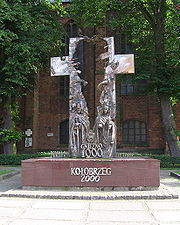
Duchy of Pomerania
The Duchy of Pomerania was a duchy in Pomerania on the southern coast of the Baltic Sea, ruled by dukes of the House of Pomerania ....
, and stayed outside the empire. The Pomeranian diocese of Kołobrzeg, founded as a consequence of the Congress of Gniezno, was overthrown by the Pomeranians already in ~1007, bishop Reinbern
Reinbern
Reinbern was the only bishop of the short-lived Diocese of Kolberg) .Reinbern was born in the Hassegau area of the medieval Duchy of Saxony. When Holy Roman Emperor Otto III met with his friend, the Polish duke Boleslaw I in the Congress of Gniezno , the Archbishopric of Gniezno was founded...
returned to Boleslaw's court.
Creating the separate Archdiocese of Gniezno directly subordinate to the Holy see
Holy See
The Holy See is the episcopal jurisdiction of the Catholic Church in Rome, in which its Bishop is commonly known as the Pope. It is the preeminent episcopal see of the Catholic Church, forming the central government of the Church. As such, diplomatically, and in other spheres the Holy See acts and...
resulted in keeping Poland independent from the Holy Roman Empire through the Middle Ages
Middle Ages
The Middle Ages is a periodization of European history from the 5th century to the 15th century. The Middle Ages follows the fall of the Western Roman Empire in 476 and precedes the Early Modern Era. It is the middle period of a three-period division of Western history: Classic, Medieval and Modern...
. About 1075 the Bishopric of Poznań became a suffragan diocese
Suffragan Diocese
A suffragan diocese is a diocese in the Catholic Church that is overseen not only by its own diocesan bishop but also by a metropolitan bishop. The metropolitan is always an archbishop who governs his own archdiocese...
of Gniezno. The archdiocese then comprised the whole Piast realm as confirmed by the papal Bull of Gniezno
Bull of Gniezno
The Bull of Gniezno was a papal bull issued on July 7, 1136 by Pope Innocent II. The bull split Archbishop of Magdeburg from the rest of the Polish church. From a historical perspective, the bull is especially important as it contains the earliest written record of the Polish language...
in 1136.