

Breda

Encyclopedia
Breda (ˈbreːdˈa:) is a municipality
and a city in the southern part of the Netherlands
. The name Breda derived from brede Aa ('wide Aa') and refers to the confluence of the rivers Mark
and Aa. As a fortified city
, the city was of strategic military and political significance. Although a direct Fiefdom
of the Holy Roman Emperor
, the city obtained a municipal charter; the acquisition of Breda, through marriage, by the house of Nassau
ensured that Breda would be at the center of political and social life in the Low Countries
.
Breda's urban area is home to an estimated 316,000 people (2008).
of the Holy Roman Emperor
, its earliest known lord being Henry of Brunesheim (1080–1125). The city of Breda obtained a municipal charter in 1252. After that Breda had the rights to build fortifications. The city constructed brick walls and Roman-style gates.
In 1327 Adelheid of Gaveren Breda sold Breda to John III, Duke of Brabant
. In 1350, the fief was resold to John II of Wassenaar (d. 1377). In 1403 the heiress of his line, Johanna of Polanen (1392–1445), married Engelbert I of Nassau
(1370–1442). Through her, the city came into the possession of the house of Nassau
, where it remained until 1795, passing to William I of Orange
(1533–1584), stadtholder
of Holland, Zeeland
and Utrecht
and leader of the Dutch revolt
. Thus the baron of Breda was also count
of Nassau
, Germany, Prince of Orange
and stadtholder
of the Dutch Republic
(from 1572–1650, 1672–1702, 1747–1795). Breda remained part of the barony Breda until it was taken by French revolutionary forces
in 1795.
for the first Dutch prince, was the first renaissance style
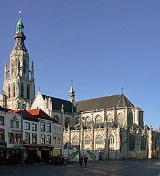
built palace north of the Alps. In the 15th century the city's physical, economic and strategic importance expanded rapidly. A great church was built in Brabantine Gothic
style with a gallant 97 metres (318 ft) high tower, called Grote Kerk (main church) or also Onze Lieve Vrouwe Kerk (Church of Our Lady). In 1534 Henry III of Nassau-Breda
rebuilt the modest medieval fortifications in impressive style.
In 1534 a fire destroyed over 90 percent of the city, close to 1300 houses, churches and chapels and the town hall. Only 150 houses and the main church remained. In 1581, during the Eighty Years' War Breda was captured
by surprise by Spanish troops under the command of Claude de Berlaymont
, also known as Haultpenne. Although the city had surrendered upon the condition that it would not be plundered, the troops vented their fury on the inhabitants; in the resulting mayhem, known as Haultpenne's Fury, over 500 citizens were killed. In 1590 it fell again into the hands of Maurice of Nassau
, as 68 hand-picked men, concealed under the turf in a peat-boat, contrived to enter the town
in a daring plan devised by Adriaen van Bergen
. The so-called Spaniards Hole marks the spot where the peat-boat allegedly lay, although this is not historically proven.
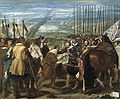 After a ten-month siege in 1624–25, the city surrendered to the Spaniards under Spinola; the event was immortalized by Diego Velázquez
. In 1637 Breda was recaptured by Frederick Henry of Orange
after a four-month siege, and in 1648 it was finally ceded to the Dutch Republic
by the Treaty of Westphalia
.
resided in Breda during most of his exile during the Cromwellian
Commonwealth and Protectorate
, thanks to the proximity of Charles's sister Mary, Princess Royal
, the widow of Prince William II of Orange
.
Based mostly on suggestions by Parliamentarian General George Monck
, Charles II's Declaration of Breda
(1660) made known the conditions of his acceptance of the crown of England which he was to accept/resume later in the same year.
The Treaty of Breda was signed in the city, July 31, 1667, bringing to an end the Second Anglo-Dutch War
in which the Dutch faced the same Charles II who had been their guest. Between 1746 and 1748 it was the site of the Congress of Breda
a series of talks between Britain and France aimed at bringing an end to the War of the Austrian Succession
, which ultimately led to the signing of the Treaty of Aix-la-Chapelle
.
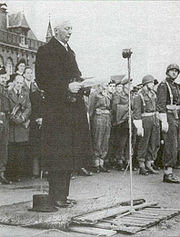
occupation. It was liberated following a successful outflanking manoeuvre planned and performed by forces of 1st Polish Armoured Division of Gen. Maczek on October 29, 1944. Each year during Liberation Day
festivities, Breda is visited by a large Polish contingent and the city of Breda reserves a special portion of the festivities for the fallen Polish soldiers. A museum and a monument honoring General Stanisław Maczek and the Polish 1st Armoured Division stands at the city center. General Maczek and soldiers of his division are buried in a nearby Polish military
cemetery.
Breda was the site of one of the first panopticon
prison establishments. This prison housed the only German war criminals ever to be imprisoned in the Netherlands for their war crime
s during the Second World War
. They were known as the 'Breda Four (and later three)'. They were Willy Paul Franz Lages
who was released in 1966 due to serious illness, Joseph Johann Kotälla who died in prison in 1979, Ferdinand Hugo aus der Fünten and Franz Fischer who both were released in 1989.
(Mentos
), De Faam (liquorice) and Kwatta (chocolate) are famous throughout Western Europe
. Breda also had a sugar
factory, supplying its best-known products. BREDA beer is a world renowned drink that is made in this region.
Breda formerly housed the largest brewery in the Netherlands (Oranjeboom
). Interbrew
, the Belgian owner of the brewery, closed the brewery in 2004. The decline of industrial activity did not harm the city's economy. The main economic activities now are business and trade. When the new Central Station is built circa 2011, Breda will be connected by high-speed trains
to the main European cities. After 2009, a high-speed shuttle connects Breda to Rotterdam – The Hague
/ Amsterdam and Antwerp – Brussels
, on the HSL-Zuid
line.
, Breda
and Breda-Prinsenbeek
, providing connections with Zuid-Holland
(Dordrecht
– Rotterdam
– Den Haag
) and Tilburg
– Eindhoven, and from station Breda also to Roosendaal with connection to Vlissingen
and Antwerp. In addition, trains also head north from Breda to Amsterdam
and east to Den Bosch – Nijmegen.
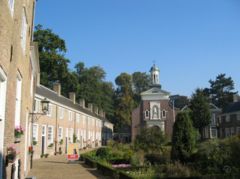
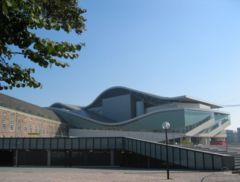 The city center contains old buildings and portions of the singels (moat
s). Various historic buildings, especially the Beguinage
, Grote Kerk (Large Church) or Onze Lieve Vrouwe Kerk (Church of Our Lady) offer examples of Renaissance and Baroque architecture and Park Valkenberg.
Breda hosts the following museums:
Redheadday
is a festival that takes place each first weekend of September. The two-day festival is a gathering of people with natural red hair, but is also focused on art related to the colour red. Activities during the festival are lectures, workshops and demonstrations. The festival attracts attendance from 20 countries and is free due to sponsorship of the local government.
, NAC Breda
, plays in the highest Dutch league, the Eredivisie
. Breda's athletics club
, A.V. Sprint, is the largest club of its kind in the Netherlands.
with: Wrocław in Poland
Brussels
in Belgium
Orange
in France
Municipality
A municipality is essentially an urban administrative division having corporate status and usually powers of self-government. It can also be used to mean the governing body of a municipality. A municipality is a general-purpose administrative subdivision, as opposed to a special-purpose district...
and a city in the southern part of the Netherlands
Netherlands
The Netherlands is a constituent country of the Kingdom of the Netherlands, located mainly in North-West Europe and with several islands in the Caribbean. Mainland Netherlands borders the North Sea to the north and west, Belgium to the south, and Germany to the east, and shares maritime borders...
. The name Breda derived from brede Aa ('wide Aa') and refers to the confluence of the rivers Mark
Mark (Dintel)
The Mark is a river in Belgium and the Netherlands. It rises north of Turnhout, Belgium. It passes through Hoogstraten before crossing the border with the Netherlands. In the city centre of Breda it receives its main tributary Aa of Weerijs. Below Oudenbosch the Mark is known under the name Dintel....
and Aa. As a fortified city
Defensive wall
A defensive wall is a fortification used to protect a city or settlement from potential aggressors. In ancient to modern times, they were used to enclose settlements...
, the city was of strategic military and political significance. Although a direct Fiefdom
Fiefdom
A fee was the central element of feudalism and consisted of heritable lands granted under one of several varieties of feudal tenure by an overlord to a vassal who held it in fealty in return for a form of feudal allegiance and service, usually given by the...
of the Holy Roman Emperor
Holy Roman Emperor
The Holy Roman Emperor is a term used by historians to denote a medieval ruler who, as German King, had also received the title of "Emperor of the Romans" from the Pope...
, the city obtained a municipal charter; the acquisition of Breda, through marriage, by the house of Nassau
House of Orange-Nassau
The House of Orange-Nassau , a branch of the European House of Nassau, has played a central role in the political life of the Netherlands — and at times in Europe — since William I of Orange organized the Dutch revolt against Spanish rule, which after the Eighty Years' War...
ensured that Breda would be at the center of political and social life in the Low Countries
Low Countries
The Low Countries are the historical lands around the low-lying delta of the Rhine, Scheldt, and Meuse rivers, including the modern countries of Belgium, the Netherlands, Luxembourg and parts of northern France and western Germany....
.
Breda's urban area is home to an estimated 316,000 people (2008).
History
In the 11th century, Breda was a direct fiefFiefdom
A fee was the central element of feudalism and consisted of heritable lands granted under one of several varieties of feudal tenure by an overlord to a vassal who held it in fealty in return for a form of feudal allegiance and service, usually given by the...
of the Holy Roman Emperor
Holy Roman Emperor
The Holy Roman Emperor is a term used by historians to denote a medieval ruler who, as German King, had also received the title of "Emperor of the Romans" from the Pope...
, its earliest known lord being Henry of Brunesheim (1080–1125). The city of Breda obtained a municipal charter in 1252. After that Breda had the rights to build fortifications. The city constructed brick walls and Roman-style gates.
In 1327 Adelheid of Gaveren Breda sold Breda to John III, Duke of Brabant
John III, Duke of Brabant
Jan III van Brabant , also called John III, the Triumphant , was Duke of Brabant, Lothier, and Limburg...
. In 1350, the fief was resold to John II of Wassenaar (d. 1377). In 1403 the heiress of his line, Johanna of Polanen (1392–1445), married Engelbert I of Nassau
Engelbert I of Nassau
Engelbert I of Nassau was a son of Count Johan I of Nassau and Margaretha, Countess van der Marck, daughter of Count Adolf II van der Marck.-Early years:...
(1370–1442). Through her, the city came into the possession of the house of Nassau
House of Orange-Nassau
The House of Orange-Nassau , a branch of the European House of Nassau, has played a central role in the political life of the Netherlands — and at times in Europe — since William I of Orange organized the Dutch revolt against Spanish rule, which after the Eighty Years' War...
, where it remained until 1795, passing to William I of Orange
William the Silent
William I, Prince of Orange , also widely known as William the Silent , or simply William of Orange , was the main leader of the Dutch revolt against the Spanish that set off the Eighty Years' War and resulted in the formal independence of the United Provinces in 1648. He was born in the House of...
(1533–1584), stadtholder
Stadtholder
A Stadtholder A Stadtholder A Stadtholder (Dutch: stadhouder [], "steward" or "lieutenant", literally place holder, holding someones place, possibly a calque of German Statthalter, French lieutenant, or Middle Latin locum tenens...
of Holland, Zeeland
Zeeland
Zeeland , also called Zealand in English, is the westernmost province of the Netherlands. The province, located in the south-west of the country, consists of a number of islands and a strip bordering Belgium. Its capital is Middelburg. With a population of about 380,000, its area is about...
and Utrecht
Utrecht (province)
Utrecht is the smallest province of the Netherlands in terms of area, and is located in the centre of the country. It is bordered by the Eemmeer in the north, Gelderland in the east, the river Rhine in the south, South Holland in the west, and North Holland in the northwest...
and leader of the Dutch revolt
Dutch Revolt
The Dutch Revolt or the Revolt of the Netherlands This article adopts 1568 as the starting date of the war, as this was the year of the first battles between armies. However, since there is a long period of Protestant vs...
. Thus the baron of Breda was also count
Count
A count or countess is an aristocratic nobleman in European countries. The word count came into English from the French comte, itself from Latin comes—in its accusative comitem—meaning "companion", and later "companion of the emperor, delegate of the emperor". The adjective form of the word is...
of Nassau
Nassau (state)
Nassau was a German state within the Holy Roman Empire and later in the German Confederation. Its ruling dynasty, now extinct in male line, was the House of Nassau.-Origins:...
, Germany, Prince of Orange
Prince of Orange
Prince of Orange is a title of nobility, originally associated with the Principality of Orange, in what is now southern France. In French it is la Principauté d'Orange....
and stadtholder
Stadtholder
A Stadtholder A Stadtholder A Stadtholder (Dutch: stadhouder [], "steward" or "lieutenant", literally place holder, holding someones place, possibly a calque of German Statthalter, French lieutenant, or Middle Latin locum tenens...
of the Dutch Republic
Dutch Republic
The Dutch Republic — officially known as the Republic of the Seven United Netherlands , the Republic of the United Netherlands, or the Republic of the Seven United Provinces — was a republic in Europe existing from 1581 to 1795, preceding the Batavian Republic and ultimately...
(from 1572–1650, 1672–1702, 1747–1795). Breda remained part of the barony Breda until it was taken by French revolutionary forces
French Revolutionary Army
The French Revolutionary Army is the term used to refer to the military of France during the period between the fall of the ancien regime under Louis XVI in 1792 and the formation of the First French Empire under Napoleon Bonaparte in 1804. These armies were characterised by their revolutionary...
in 1795.
Residence city
The acquisition of the city by the House of Orange-Nassau marked its emergence as a residenzstadt (residence city). The presence of the Orange-Nassau family attracted other nobles, who built palatial residences in the old quarters of the city. The most impressive one, built by the Italian architect Thomas Vincidor de BolognaTommaso Vincidor
Tommaso di Andrea Vincidor was an Italian Renaissance painter and architect who trained with Raphael and spent most of his career in the Netherlands. He was also called Tommaso Vincitore, Tommaso da Bologna and Thomas Polonais .He was the pupil of Raphael, whom he helped in the execution of the...
for the first Dutch prince, was the first renaissance style
Renaissance architecture
Renaissance architecture is the architecture of the period between the early 15th and early 17th centuries in different regions of Europe, demonstrating a conscious revival and development of certain elements of ancient Greek and Roman thought and material culture. Stylistically, Renaissance...
built palace north of the Alps. In the 15th century the city's physical, economic and strategic importance expanded rapidly. A great church was built in Brabantine Gothic
Gothic architecture
Gothic architecture is a style of architecture that flourished during the high and late medieval period. It evolved from Romanesque architecture and was succeeded by Renaissance architecture....
style with a gallant 97 metres (318 ft) high tower, called Grote Kerk (main church) or also Onze Lieve Vrouwe Kerk (Church of Our Lady). In 1534 Henry III of Nassau-Breda
Henry III of Nassau-Breda
Count Henry III of Nassau-Dillenburg-Dietz , Lord of Breda, Lord of the Lek, of Diest, etc. was a count of the House of Nassau....
rebuilt the modest medieval fortifications in impressive style.
In 1534 a fire destroyed over 90 percent of the city, close to 1300 houses, churches and chapels and the town hall. Only 150 houses and the main church remained. In 1581, during the Eighty Years' War Breda was captured
Siege of Breda (1581)
In 1581 Spanish troops under the command of Claude de Berlaymont, lord of Haultepenne, took Breda by surprise after a sentry was bribed by a follower of the king, Charles de Gavre, who was kept a prisoner at the castle...
by surprise by Spanish troops under the command of Claude de Berlaymont
Claude de Berlaymont
Claude de Berlaymont , lord of Haultpenne was a Flemish military commander in Spain's Army of Flanders during the Eighty Years' War.-Family:...
, also known as Haultpenne. Although the city had surrendered upon the condition that it would not be plundered, the troops vented their fury on the inhabitants; in the resulting mayhem, known as Haultpenne's Fury, over 500 citizens were killed. In 1590 it fell again into the hands of Maurice of Nassau
Maurice of Nassau, Prince of Orange
Maurice of Nassau, Prince of Orange was sovereign Prince of Orange from 1618, on the death of his eldest half brother, Philip William, Prince of Orange,...
, as 68 hand-picked men, concealed under the turf in a peat-boat, contrived to enter the town
Siege of Breda (1590)
The Siege of Breda was an extremely short battle of the Eighty Years' War during which a Dutch army led by Maurice of Nassau captured the heavily protected city of Breda by a clever tactic reminiscent of the Trojan horse. The Dutch commander was informed that a ship carrying peat to the city was...
in a daring plan devised by Adriaen van Bergen
Adriaen van Bergen
A Dutch skipper from Leur, Adriaen van Bergen devised the plot to recapture the city of Breda from the Spanish during the Eighty Years' War. In February of 1590, he approached Prince Maurice with a Trojan horse type plan....
. The so-called Spaniards Hole marks the spot where the peat-boat allegedly lay, although this is not historically proven.
Diego Velázquez
Diego Rodríguez de Silva y Velázquez was a Spanish painter who was the leading artist in the court of King Philip IV. He was an individualistic artist of the contemporary Baroque period, important as a portrait artist...
. In 1637 Breda was recaptured by Frederick Henry of Orange
Frederick Henry, Prince of Orange
Frederick Henry, or Frederik Hendrik in Dutch , was the sovereign Prince of Orange and stadtholder of Holland, Zeeland, Utrecht, Guelders, and Overijssel from 1625 to 1647.-Early life:...
after a four-month siege, and in 1648 it was finally ceded to the Dutch Republic
Dutch Republic
The Dutch Republic — officially known as the Republic of the Seven United Netherlands , the Republic of the United Netherlands, or the Republic of the Seven United Provinces — was a republic in Europe existing from 1581 to 1795, preceding the Batavian Republic and ultimately...
by the Treaty of Westphalia
Peace of Westphalia
The Peace of Westphalia was a series of peace treaties signed between May and October of 1648 in Osnabrück and Münster. These treaties ended the Thirty Years' War in the Holy Roman Empire, and the Eighty Years' War between Spain and the Dutch Republic, with Spain formally recognizing the...
.
Stuart exiles
The exiled Stuart pretender Charles II of EnglandCharles II of England
Charles II was monarch of the three kingdoms of England, Scotland, and Ireland.Charles II's father, King Charles I, was executed at Whitehall on 30 January 1649, at the climax of the English Civil War...
resided in Breda during most of his exile during the Cromwellian
Oliver Cromwell
Oliver Cromwell was an English military and political leader who overthrew the English monarchy and temporarily turned England into a republican Commonwealth, and served as Lord Protector of England, Scotland, and Ireland....
Commonwealth and Protectorate
Protectorate
In history, the term protectorate has two different meanings. In its earliest inception, which has been adopted by modern international law, it is an autonomous territory that is protected diplomatically or militarily against third parties by a stronger state or entity...
, thanks to the proximity of Charles's sister Mary, Princess Royal
Mary, Princess Royal and Princess of Orange
Mary, Princess Royal, Princess of Orange and Countess of Nassau was the eldest daughter of King Charles I of England, Scotland, and Ireland and his queen, Henrietta Maria of France...
, the widow of Prince William II of Orange
William II, Prince of Orange
William II, Prince of Orange was sovereign Prince of Orange and stadtholder of the United Provinces of the Netherlands from 14 March 1647 until his death three years later.-Biography:...
.
Based mostly on suggestions by Parliamentarian General George Monck
George Monck, 1st Duke of Albemarle
George Monck, 1st Duke of Albemarle, KG was an English soldier and politician and a key figure in the restoration of Charles II.-Early life and career:...
, Charles II's Declaration of Breda
Declaration of Breda
The Declaration of Breda was a proclamation by Charles II of England in which he promised a general pardon for crimes committed during the English Civil War and the Interregnum for all those who recognised Charles as the lawful king; the retention by the current owners of property purchased during...
(1660) made known the conditions of his acceptance of the crown of England which he was to accept/resume later in the same year.
The Treaty of Breda was signed in the city, July 31, 1667, bringing to an end the Second Anglo-Dutch War
Second Anglo-Dutch War
The Second Anglo–Dutch War was part of a series of four Anglo–Dutch Wars fought between the English and the Dutch in the 17th and 18th centuries for control over the seas and trade routes....
in which the Dutch faced the same Charles II who had been their guest. Between 1746 and 1748 it was the site of the Congress of Breda
Congress of Breda
The Congress of Breda often also known as the Breda peace talks were a series of negotiations between representatives of Great Britain and France in the Dutch city of Breda that took place between 1746 and 1748. They were designed to bring an end to the Austrian War of Succession and laid the...
a series of talks between Britain and France aimed at bringing an end to the War of the Austrian Succession
War of the Austrian Succession
The War of the Austrian Succession – including King George's War in North America, the Anglo-Spanish War of Jenkins' Ear, and two of the three Silesian wars – involved most of the powers of Europe over the question of Maria Theresa's succession to the realms of the House of Habsburg.The...
, which ultimately led to the signing of the Treaty of Aix-la-Chapelle
Treaty of Aix-la-Chapelle (1748)
The Treaty of Aix-la-Chapelle of 1748 ended the War of the Austrian Succession following a congress assembled at the Imperial Free City of Aachen—Aix-la-Chapelle in French—in the west of the Holy Roman Empire, on 24 April 1748...
.
World War II
During World War II the city was under GermanGermany
Germany , officially the Federal Republic of Germany , is a federal parliamentary republic in Europe. The country consists of 16 states while the capital and largest city is Berlin. Germany covers an area of 357,021 km2 and has a largely temperate seasonal climate...
occupation. It was liberated following a successful outflanking manoeuvre planned and performed by forces of 1st Polish Armoured Division of Gen. Maczek on October 29, 1944. Each year during Liberation Day
Liberation Day
Liberation Day is a day, often a public holiday, that marks the liberation of a place, similar to an independence day. Liberation marks the date of either a revolution, as in Cuba, or the end of an occupation by another state, thereby differing from independence in the meaning of secession from...
festivities, Breda is visited by a large Polish contingent and the city of Breda reserves a special portion of the festivities for the fallen Polish soldiers. A museum and a monument honoring General Stanisław Maczek and the Polish 1st Armoured Division stands at the city center. General Maczek and soldiers of his division are buried in a nearby Polish military
Polish Armed Forces
Siły Zbrojne Rzeczypospolitej Polskiej are the national defense forces of Poland...
cemetery.
Breda was the site of one of the first panopticon
Panopticon
The Panopticon is a type of building designed by English philosopher and social theorist Jeremy Bentham in the late eighteenth century. The concept of the design is to allow an observer to observe all inmates of an institution without them being able to tell whether or not they are being watched...
prison establishments. This prison housed the only German war criminals ever to be imprisoned in the Netherlands for their war crime
War crime
War crimes are serious violations of the laws applicable in armed conflict giving rise to individual criminal responsibility...
s during the Second World War
World War II
World War II, or the Second World War , was a global conflict lasting from 1939 to 1945, involving most of the world's nations—including all of the great powers—eventually forming two opposing military alliances: the Allies and the Axis...
. They were known as the 'Breda Four (and later three)'. They were Willy Paul Franz Lages
Willy Lages
Willy Paul Franz Lages was the German chief of the Sicherheitsdienst in Amsterdam during the Second World War. From March 1941 he led the so-called Zentralstelle für jüdische Auswanderung...
who was released in 1966 due to serious illness, Joseph Johann Kotälla who died in prison in 1979, Ferdinand Hugo aus der Fünten and Franz Fischer who both were released in 1989.
Administration
- Breda (city) (~170,000)
- Ginneken (former village absorbed by city agglomeration)
- PrincenhagePrincenhagePrincenhage is a neighbourhood in the southwest of the city Breda in the Dutch province of North Brabant.Until 1942, Princenhage was a separate municipality. The original name of the municipality was "Haage", which was changed to "Princenhage" in 1819....
(former village absorbed by city agglomeration)
- PrinsenbeekPrinsenbeekPrinsenbeek is a village and a former municipality in the Dutch province North Brabant. The village is situated west of the motorway A16 and the TGV-line Amsterdam - Paris. Prinsenbeek is a part of the municipality Breda, and it has 11,419 inhabitants . There is a train station on the line...
(~11,500) (added at the municipal reorganization in 1997) - BavelBavel (Netherlands)Bavel is a village in the southern Netherlands. It is located in the Dutch province of North Brabant, largely within the municipality of Breda with some rural areas in the municipality of Alphen-Chaam....
(~7,000) (added at the municipal reorganization in 1997) - TeteringenTeteringenTeteringen is a village in the Dutch province of North Brabant. It is located in the municipality of Breda, about 4 km north of the city centre.Teteringen was a separate municipality until 1997, when it became part of Breda....
(~6,500) (added at the municipal reorganization in 1997) - UlvenhoutUlvenhoutUlvenhout is a village in the Dutch province of North Brabant. It is located in the municipality of Breda. The part south of the A58 motorway came to the municipality of Alphen-Chaam and is called Ulvenhout AC...
(~4,700) (added at the municipal reorganization in 1997)
Administration
The city of Breda is divided in 7 city sectors:- Breda Centrum (Centre)
- Breda West (West)
- Breda Noord-West (Haagse Beemden) (Northwest)
- Breda Noord ( North)
- Breda Oost (East)
- Breda Zuid-Oost (Southeast)
- Breda Zuid (South)
Economy
Economic activities were mainly industrial. Breda was a center of the food- and drinking industry. Companies like Hero (lemonade), Van MellePerfetti Van Melle
Perfetti Van Melle is a privately held Italian global manufacturer of confectionery and gum. It was formed in 2001 with the acquisition of Van Melle of the Netherlands, by the Italian group Perfetti of Italy and having its corporate headquarters in Lainate , Italy.Perfetti Van Melle bills itself...
(Mentos
Mentos
Mentos is a brand of mints, of the "scotch mint" type, sold in many markets across the world by the Perfetti Van Melle corporation. Mentos was first produced in the Netherlands during the 1950s. The mints are small oblate spheroids, with a slightly hard exterior and a soft, chewy interior...
), De Faam (liquorice) and Kwatta (chocolate) are famous throughout Western Europe
Western Europe
Western Europe is a loose term for the collection of countries in the western most region of the European continents, though this definition is context-dependent and carries cultural and political connotations. One definition describes Western Europe as a geographic entity—the region lying in the...
. Breda also had a sugar
Sugar
Sugar is a class of edible crystalline carbohydrates, mainly sucrose, lactose, and fructose, characterized by a sweet flavor.Sucrose in its refined form primarily comes from sugar cane and sugar beet...
factory, supplying its best-known products. BREDA beer is a world renowned drink that is made in this region.
Breda formerly housed the largest brewery in the Netherlands (Oranjeboom
Oranjeboom
Oranjeboom is a Dutch lager brand owned by United Dutch Breweries BV. The main beer produced under the brand name is Oranjeboom Premium Pilsner - a 5% ABV lager...
). Interbrew
Interbrew
Interbrew was a large Belgium-based brewing company which owned many internationally known beers, as well as some smaller local beers. In 2004 Interbrew merged with Brazilian brewer AmBev to form InBev, which is the now largest brewer in the world by volume, with a 13% global market share now...
, the Belgian owner of the brewery, closed the brewery in 2004. The decline of industrial activity did not harm the city's economy. The main economic activities now are business and trade. When the new Central Station is built circa 2011, Breda will be connected by high-speed trains
High-speed rail
High-speed rail is a type of passenger rail transport that operates significantly faster than the normal speed of rail traffic. Specific definitions by the European Union include for upgraded track and or faster for new track, whilst in the United States, the U.S...
to the main European cities. After 2009, a high-speed shuttle connects Breda to Rotterdam – The Hague
The Hague
The Hague is the capital city of the province of South Holland in the Netherlands. With a population of 500,000 inhabitants , it is the third largest city of the Netherlands, after Amsterdam and Rotterdam...
/ Amsterdam and Antwerp – Brussels
Brussels
Brussels , officially the Brussels Region or Brussels-Capital Region , is the capital of Belgium and the de facto capital of the European Union...
, on the HSL-Zuid
HSL-Zuid
HSL-Zuid , is a 125 km-long high-speed railway line in the Netherlands to the Belgian border, with a branch to Breda. Together with the Belgian HSL 4 it forms the Schiphol–Antwerp high-speed railway...
line.
Transportation
Breda has two railway stationsBreda railway station
Breda is a railway station in Breda, the Netherlands. It is situated on the Breda–Rotterdam railway, the Roosendaal–Breda railway and the Breda–Eindhoven railway.-History:...
, Breda
Breda railway station
Breda is a railway station in Breda, the Netherlands. It is situated on the Breda–Rotterdam railway, the Roosendaal–Breda railway and the Breda–Eindhoven railway.-History:...
and Breda-Prinsenbeek
Breda-Prinsenbeek railway station
Breda-Prinsenbeek is a railway station located in Prinsenbeek near Breda, The Netherlands. The station was opened in 1988 and is located on the Breda–Rotterdam railway...
, providing connections with Zuid-Holland
South Holland
South Holland is a province situated on the North Sea in the western part of the Netherlands. The provincial capital is The Hague and its largest city is Rotterdam.South Holland is one of the most densely populated and industrialised areas in the world...
(Dordrecht
Dordrecht
Dordrecht , colloquially Dordt, historically in English named Dort, is a city and municipality in the western Netherlands, located in the province of South Holland. It is the fourth largest city of the province, having a population of 118,601 in 2009...
– Rotterdam
Rotterdam
Rotterdam is the second-largest city in the Netherlands and one of the largest ports in the world. Starting as a dam on the Rotte river, Rotterdam has grown into a major international commercial centre...
– Den Haag
The Hague
The Hague is the capital city of the province of South Holland in the Netherlands. With a population of 500,000 inhabitants , it is the third largest city of the Netherlands, after Amsterdam and Rotterdam...
) and Tilburg
Tilburg
Tilburg is a landlocked municipality and a city in the Netherlands, located in the southern province of Noord-Brabant.Tilburg municipality also includes the villages of Berkel-Enschot and Udenhout....
– Eindhoven, and from station Breda also to Roosendaal with connection to Vlissingen
Flushing, Netherlands
Vlissingen is a municipality and a city in the southwestern Netherlands on the former island of Walcheren. With its strategic location between the Scheldt river and the North Sea, Vlissingen has been an important harbour for centuries. It was granted city rights in 1315. In the 17th century...
and Antwerp. In addition, trains also head north from Breda to Amsterdam
Amsterdam
Amsterdam is the largest city and the capital of the Netherlands. The current position of Amsterdam as capital city of the Kingdom of the Netherlands is governed by the constitution of August 24, 1815 and its successors. Amsterdam has a population of 783,364 within city limits, an urban population...
and east to Den Bosch – Nijmegen.
Main sights
Moat
A moat is a deep, broad ditch, either dry or filled with water, that surrounds a castle, other building or town, historically to provide it with a preliminary line of defence. In some places moats evolved into more extensive water defences, including natural or artificial lakes, dams and sluices...
s). Various historic buildings, especially the Beguinage
Béguinage
A béguinage or begijnhof is a collection of small buildings used by Beguines. These were various lay sisterhoods of the Roman Catholic Church, founded in the 13th century in the Low Countries, comprising religious women who sought to serve God without retiring from the world.-Description:A...
, Grote Kerk (Large Church) or Onze Lieve Vrouwe Kerk (Church of Our Lady) offer examples of Renaissance and Baroque architecture and Park Valkenberg.
Breda hosts the following museums:
- Breda's Museum
- Begijnhof Breda Museum
- Generaal Maczek Museum
- Bier Reclame Museum
- Museum Of The Image before the Graphic Design Museum
- NAC Museum
- Heemkundig Museum Paulus van Daesdonck
- Museum Oorlog & Vrede [War and Peace Museum]
- Stichting Princenhaags Museum
Culture
For the numerous music events is the Chasse Theater.Redheadday
Redheadday
Redhead Day is the name of a Dutch summer festival that takes place each first weekend of September in the city of Breda, in the Netherlands. The two-day festival is a gathering of people with natural red hair, but is also focused on art related to the colour red...
is a festival that takes place each first weekend of September. The two-day festival is a gathering of people with natural red hair, but is also focused on art related to the colour red. Activities during the festival are lectures, workshops and demonstrations. The festival attracts attendance from 20 countries and is free due to sponsorship of the local government.
Sport
Breda's Football clubFootball team
A football team is the collective name given to a group of players selected together in the various team sports known as football.Such teams could be selected to play in an against an opposing team, to represent a football club, group, state or nation, an All-star team or even selected as a...
, NAC Breda
NAC Breda
NAC Breda , simply often known as NAC, is a Dutch professional football club, based in Breda, Netherlands. NAC Breda play in the Rat Verlegh Stadium, named after their most important player, Antoon 'Rat' Verlegh. They play in the Dutch Eredivisie and are known by the fierce and fanatic support of...
, plays in the highest Dutch league, the Eredivisie
Eredivisie
The Eredivisie is the highest football league in the Netherlands. The league was founded in 1956 two years after the start of professional football in the Netherlands. It is currently ranked the ninth best league in Europe by UEFA....
. Breda's athletics club
Sports club
A sports club or sport club, sometimes athletics club or sports association is a club for the purpose of playing one or more sports...
, A.V. Sprint, is the largest club of its kind in the Netherlands.
Notable residents
- "Colonel" Thomas ParkerColonel Tom Parker"Colonel" Thomas Andrew "Tom" Parker born Andreas Cornelis van Kuijk, was a Dutch-born entertainment impresario known best as the manager of Elvis Presley...
, the manager of Elvis PresleyElvis PresleyElvis Aaron Presley was one of the most popular American singers of the 20th century. A cultural icon, he is widely known by the single name Elvis. He is often referred to as the "King of Rock and Roll" or simply "the King"....
, was born in Breda as Andreas Cornelius van Kuijk. - Breda is also home to TiëstoTiëstoTijs Michiel Verwest, , known as Tiësto , is a Dutch musician, DJ and record producer of electronic dance music. Although he has used many aliases in the past, he is best known for his work as DJ Tiësto...
, an international trance musicTrance musicTrance is a genre of electronic dance music that developed in the 1990s.:251 It is generally characterized by a tempo of between 125 and 150 bpm,:252 repeating melodic synthesizer phrases, and a musical form that builds up and breaks down throughout a track...
artist. The title of his track 'Zero 76' featuring DJ Hardwell is derived from the dialing code of Breda. - Breda is the birthplace of former Olympic swimmer Karin BrienesseKarin BrienesseKarin Brienesse is a former freestyle and butterfly swimmer from The Netherlands, who competed in three consequentive Summer Olympics for her native country, starting in 1988. There she won the silver medal with the Dutch 4×100 m freestyle relay team, behind East Germany...
and former field hockeyField hockeyField Hockey, or Hockey, is a team sport in which a team of players attempts to score goals by hitting, pushing or flicking a ball into an opposing team's goal using sticks...
player Remco van WijkRemco van WijkRemco van Wijk is a former Dutch field hockey player, who played 242 international matches for The Netherlands, in which he scored 63 goals. The striker made his debut for the Dutch on May 5, 1993 in a friendly match against Ireland...
, who twice won the gold medal at the Summer OlympicsSummer Olympic GamesThe Summer Olympic Games or the Games of the Olympiad are an international multi-sport event, occurring every four years, organized by the International Olympic Committee. Medals are awarded in each event, with gold medals for first place, silver for second and bronze for third, a tradition that...
with the Dutch National Team: 1996 and 2000. - Breda is the city where the Dutch composers Daan MannekeDaan MannekeDaan Manneke is a Dutch composer and organist.Manneke studied organ and composition from 1963 to 1967 at the Brabant Conservatory in Tilburg, under H. Houët and Louis Toebosch and Jan van Dijk then studied organ with Belgian organist Kamiel d’Hooghe in Brussels, followed by composition with Ton...
and Kristoffer ZegersKristoffer ZegersKristoffer Zegers is a Dutch composer.Taught by Gilius van Bergeijk, Jan Boerman, Martijn Padding, Clarence Barlow, Diderik Wagenaar at the Royal Conservatory in Den Haag.In Zegers' music microtonal clusters are the main object...
live. - The Dutch football international Pierre van HooijdonkPierre van HooijdonkPetrus Ferdinandus Johannes "Pierre" van Hooijdonk is a retired Dutch football player who played as a striker. His last spell was at Feyenoord Rotterdam. Van Hooijdonk was capped 46 times for the Dutch national team, scoring 21 goals, and played in the 1998 FIFA World Cup, Euro 2000 and Euro 2004...
played in Breda. Other formerly international Dutch football players from NAC Breda were Antoon (Rat) Verlegh, Kees RijversKees RijversKees Rijvers is a retired Dutch footballer who was active as a midfielder. Rijvers made his debut at NAC Breda and also played for AS Saint-Étienne, Stade Français and Feijenoord....
, Kees Kuijs, Leo Canjels, Daan Schrijvers, Frans Bouwmeester, Nico Rijnders, Ad Brouwers, Bertus Quaars, Martin Vreysen and Ton LokhoffTon LokhoffAntonius Johannes Jacobus Lokhoff is a Dutch former football midfielder, who was the head coach of Excelsior since the summer of 2006, when he succeeded Mario Been. He is nicknamed Mister NAC. Lokhoff's contract at Excelsior expired in the spring of 2009...
.
Twin towns – Sister cities
Breda is twinnedTown twinning
Twin towns and sister cities are two of many terms used to describe the cooperative agreements between towns, cities, and even counties in geographically and politically distinct areas to promote cultural and commercial ties.- Terminology :...
with: Wrocław in Poland
Poland
Poland , officially the Republic of Poland , is a country in Central Europe bordered by Germany to the west; the Czech Republic and Slovakia to the south; Ukraine, Belarus and Lithuania to the east; and the Baltic Sea and Kaliningrad Oblast, a Russian exclave, to the north...
Brussels
Brussels
Brussels , officially the Brussels Region or Brussels-Capital Region , is the capital of Belgium and the de facto capital of the European Union...
in Belgium
Belgium
Belgium , officially the Kingdom of Belgium, is a federal state in Western Europe. It is a founding member of the European Union and hosts the EU's headquarters, and those of several other major international organisations such as NATO.Belgium is also a member of, or affiliated to, many...
Orange
Orange, Vaucluse
Orange is a commune in the Vaucluse department in the Provence-Alpes-Côte d'Azur region in southeastern France.It has a primarily agricultural economy...
in France
France
The French Republic , The French Republic , The French Republic , (commonly known as France , is a unitary semi-presidential republic in Western Europe with several overseas territories and islands located on other continents and in the Indian, Pacific, and Atlantic oceans. Metropolitan France...