


Porcupine

Encyclopedia
Porcupines are rodents with a coat of sharp spines
, or quills, that defend or camouflage them from predators. They are indigenous to the Americas, southern Asia, and Africa. Porcupines are the third largest of the rodents, behind the capybara
and the beaver
. Most porcupines are about 25–36 in (63.5–91.4 cm) long, with an 8–10 in (20.3–25.4 cm) long tail. Weighing between 12 pound, they are rounded, large and slow. Porcupines come in various shades of brown, grey, and the unusual white. Porcupines' spiny protection resembles that of the unrelated erinaceomorph hedgehog
s and monotreme
echidna
s.
The common porcupine is an herbivore
. It eats leaves, herbs,twigs and green plants like skunk cabbage and clover and in the winter it may eat bark. The North American porcupine often climbs trees to find food. The African porcupine is not a climber and forages on the ground. It is mostly nocturnal, but will sometimes forage for food in the day. Porcupines have become a pest in Kenya
and are eaten as a delicacy.
The name porcupine comes from Middle French
porc espin (spined pig). A regional American name for the animal is quill pig.
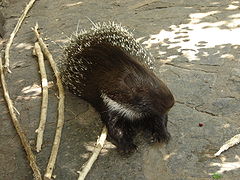 A porcupine is any of 29 species of rodent
belonging to the families Erethizontidae (genera: Coendou, Sphiggurus
, Erethizon, Echinoprocta, and Chaetomys) or Hystricidae (genera: Atherurus, Hystrix
, and Trichys). Porcupines vary in size considerably: Rothschild's Porcupine
of South America
weighs less than a kilogram (2.2 lb (0.997903214 kg)); the Crested porcupine
found in Italy
, Sicily
, North Africa
and sub-Saharan Africa
can grow to well over 27 kg (59.5 lb). The two families of porcupines are quite different, and, although both belong to the Hystricognathi
branch of the vast order Rodent
ia, they are not closely related.
The eleven Old World porcupine
s tend to be fairly big, and have spikes that are grouped in clusters.
The two subfamilies of New World porcupine
s are mostly smaller (although the North American Porcupine
reaches about 85 cm (33.5 in) in length and 18 kg (39.7 lb)), have their quills attached singly rather than grouped in clusters, and are excellent climbers, spending much of their time in trees. The New World porcupines evolved their spines independently (through convergent evolution
) and are more closely related to several other families of rodent than they are to the Old World porcupines.
Porcupines have a relatively high longevity
and had held the record for being the longest-living rodent, which was recently broken by the Naked Mole Rat (Heterocephalus glaber).
, take on various forms, depending on the species, but all are modified hairs coated with thick plates of keratin
, and they are embedded in the skin
musculature. Old World porcupines (Hystricidae) have quills embedded in clusters, whereas in New World porcupines (Erethizontidae), single quills are interspersed with bristles, underfur and hair.
Quills are released by contact with them, or they may drop out when the porcupine shakes its body, but cannot be projected at attackers. New quills grow to replace lost ones. From ancient times, it was believed that porcupines could throw their quills at an enemy, but this has long been refuted.
"porky roach"
headdress.
, Southern Europe
, Africa
, and North
and South America
. Porcupines live in forests, deserts, rocky outcrops and hillsides. Some New World porcupines live in trees, but Old World porcupines stay on the rocks. Porcupines can be found on rocky areas up to 3700 m (12,139.1 ft) high. Porcupines are generally nocturnal but are occasionally active during daylight.
sometimes enter human habitats, eating plywood
cured with sodium nitrate
, certain paints, tool handles, doors, tables, houses, footwear, clothes and other items that have been coated in salty sweat. Porcupines are attracted to roads in areas where rock salt is used to melt ice and snow and are known to gnaw on vehicle tires or wiring coated in road salt. Salt licks placed nearby can prevent porcupines from injuring themselves.
Natural sources of salt consumed by porcupines include varieties of salt-rich plants (such as yellow water lily
and aquatic liverwort), fresh animal bones, outer tree bark, mud in salt-rich soils, and objects imbued with urine
.
ia
Spine (zoology)
A spine is a hard, thorny or needle-like structure which occurs on various animals. Animals such as porcupines and sea urchins grow spines as a self-defense mechanism. Spines are often formed of keratin...
, or quills, that defend or camouflage them from predators. They are indigenous to the Americas, southern Asia, and Africa. Porcupines are the third largest of the rodents, behind the capybara
Capybara
The capybara , also known as capivara in Portuguese, and capibara, chigüire in Venezuela, Colombia, and Ecuador ronsoco in Peru, chigüiro, and carpincho in Spanish, is the largest living rodent in the world. Its closest relatives are agouti, chinchillas, coyphillas, and guinea pigs...
and the beaver
Beaver
The beaver is a primarily nocturnal, large, semi-aquatic rodent. Castor includes two extant species, North American Beaver and Eurasian Beaver . Beavers are known for building dams, canals, and lodges . They are the second-largest rodent in the world...
. Most porcupines are about 25–36 in (63.5–91.4 cm) long, with an 8–10 in (20.3–25.4 cm) long tail. Weighing between 12 pound, they are rounded, large and slow. Porcupines come in various shades of brown, grey, and the unusual white. Porcupines' spiny protection resembles that of the unrelated erinaceomorph hedgehog
Hedgehog
A hedgehog is any of the spiny mammals of the subfamily Erinaceinae and the order Erinaceomorpha. There are 17 species of hedgehog in five genera, found through parts of Europe, Asia, Africa, and New Zealand . There are no hedgehogs native to Australia, and no living species native to the Americas...
s and monotreme
Monotreme
Monotremes are mammals that lay eggs instead of giving birth to live young like marsupials and placental mammals...
echidna
Echidna
Echidnas , also known as spiny anteaters, belong to the family Tachyglossidae in the monotreme order of egg-laying mammals. There are four extant species, which, together with the platypus, are the only surviving members of that order and are the only extant mammals that lay eggs...
s.
The common porcupine is an herbivore
Herbivore
Herbivores are organisms that are anatomically and physiologically adapted to eat plant-based foods. Herbivory is a form of consumption in which an organism principally eats autotrophs such as plants, algae and photosynthesizing bacteria. More generally, organisms that feed on autotrophs in...
. It eats leaves, herbs,twigs and green plants like skunk cabbage and clover and in the winter it may eat bark. The North American porcupine often climbs trees to find food. The African porcupine is not a climber and forages on the ground. It is mostly nocturnal, but will sometimes forage for food in the day. Porcupines have become a pest in Kenya
Kenya
Kenya , officially known as the Republic of Kenya, is a country in East Africa that lies on the equator, with the Indian Ocean to its south-east...
and are eaten as a delicacy.
The name porcupine comes from Middle French
Middle French
Middle French is a historical division of the French language that covers the period from 1340 to 1611. It is a period of transition during which:...
porc espin (spined pig). A regional American name for the animal is quill pig.
Species
Rodent
Rodentia is an order of mammals also known as rodents, characterised by two continuously growing incisors in the upper and lower jaws which must be kept short by gnawing....
belonging to the families Erethizontidae (genera: Coendou, Sphiggurus
Sphiggurus
Sphiggurus is a genus of New World porcupine. It contains the following species:*Sphiggurus ichillus - Streaked Dwarf Porcupine*Sphiggurus insidiosus - Bahia Porcupine*Sphiggurus melanurus - Black-tailed Hairy Dwarf Porcupine...
, Erethizon, Echinoprocta, and Chaetomys) or Hystricidae (genera: Atherurus, Hystrix
Hystrix
Hystrix is a genus of porcupine that contains what are the best known and most distinctive of the Old World porcupines.-Species:*Genus Hystrix**Subgenus Thecurus***Hystrix crassispinis - Thick-spined Porcupine...
, and Trichys). Porcupines vary in size considerably: Rothschild's Porcupine
Rothschild's Porcupine
Rothschild's Porcupine, Coendou rothschildi, is a species of rodent in the family Erethizontidae.It is usually considered endemic to Panama. A population in western Ecuador belongs either to this species or to Coendou bicolor....
of South America
South America
South America is a continent situated in the Western Hemisphere, mostly in the Southern Hemisphere, with a relatively small portion in the Northern Hemisphere. The continent is also considered a subcontinent of the Americas. It is bordered on the west by the Pacific Ocean and on the north and east...
weighs less than a kilogram (2.2 lb (0.997903214 kg)); the Crested porcupine
Crested Porcupine
The crested porcupine is a species of rodent in the Hystricidae family.It is extant in mainland Italy, Sicily, North Africa and sub-Saharan Africa.-Physical Attributes:...
found in Italy
Italy
Italy , officially the Italian Republic languages]] under the European Charter for Regional or Minority Languages. In each of these, Italy's official name is as follows:;;;;;;;;), is a unitary parliamentary republic in South-Central Europe. To the north it borders France, Switzerland, Austria and...
, Sicily
Sicily
Sicily is a region of Italy, and is the largest island in the Mediterranean Sea. Along with the surrounding minor islands, it constitutes an autonomous region of Italy, the Regione Autonoma Siciliana Sicily has a rich and unique culture, especially with regard to the arts, music, literature,...
, North Africa
North Africa
North Africa or Northern Africa is the northernmost region of the African continent, linked by the Sahara to Sub-Saharan Africa. Geopolitically, the United Nations definition of Northern Africa includes eight countries or territories; Algeria, Egypt, Libya, Morocco, South Sudan, Sudan, Tunisia, and...
and sub-Saharan Africa
Sub-Saharan Africa
Sub-Saharan Africa as a geographical term refers to the area of the African continent which lies south of the Sahara. A political definition of Sub-Saharan Africa, instead, covers all African countries which are fully or partially located south of the Sahara...
can grow to well over 27 kg (59.5 lb). The two families of porcupines are quite different, and, although both belong to the Hystricognathi
Hystricognathi
Hystricognathi is an infraorder of rodents. Hystricognaths are distinguished from other rodents by the bone structure of their skulls. The masseter medialis passes partially through the infraorbital foramen and connects to the bone on the opposite side...
branch of the vast order Rodent
Rodent
Rodentia is an order of mammals also known as rodents, characterised by two continuously growing incisors in the upper and lower jaws which must be kept short by gnawing....
ia, they are not closely related.
The eleven Old World porcupine
Old World porcupine
The Old World porcupines, or Hystricidae, are large terrestrial rodents, distinguished by the spiny covering from which they take their name. They range over the south of Europe, most of Africa, India, and the Maritime Southeast Asia as far east as Borneo...
s tend to be fairly big, and have spikes that are grouped in clusters.
The two subfamilies of New World porcupine
New World porcupine
The New World porcupines, or Erethizontidae, are large arboreal rodents, distinguished by the spiny covering from which they take their name. They inhabit forests and wooded regions across North America, and into northern South America...
s are mostly smaller (although the North American Porcupine
North American Porcupine
The North American Porcupine , also known as Canadian Porcupine or Common Porcupine, is a large rodent in the New World porcupine family. The Beaver is the only rodent larger than the North American Porcupine found in North America...
reaches about 85 cm (33.5 in) in length and 18 kg (39.7 lb)), have their quills attached singly rather than grouped in clusters, and are excellent climbers, spending much of their time in trees. The New World porcupines evolved their spines independently (through convergent evolution
Convergent evolution
Convergent evolution describes the acquisition of the same biological trait in unrelated lineages.The wing is a classic example of convergent evolution in action. Although their last common ancestor did not have wings, both birds and bats do, and are capable of powered flight. The wings are...
) and are more closely related to several other families of rodent than they are to the Old World porcupines.
Porcupines have a relatively high longevity
Longevity
The word "longevity" is sometimes used as a synonym for "life expectancy" in demography or known as "long life", especially when it concerns someone or something lasting longer than expected ....
and had held the record for being the longest-living rodent, which was recently broken by the Naked Mole Rat (Heterocephalus glaber).
Quills
Porcupines' quills, or spinesSpine (zoology)
A spine is a hard, thorny or needle-like structure which occurs on various animals. Animals such as porcupines and sea urchins grow spines as a self-defense mechanism. Spines are often formed of keratin...
, take on various forms, depending on the species, but all are modified hairs coated with thick plates of keratin
Keratin
Keratin refers to a family of fibrous structural proteins. Keratin is the key of structural material making up the outer layer of human skin. It is also the key structural component of hair and nails...
, and they are embedded in the skin
Skin
-Dermis:The dermis is the layer of skin beneath the epidermis that consists of connective tissue and cushions the body from stress and strain. The dermis is tightly connected to the epidermis by a basement membrane. It also harbors many Mechanoreceptors that provide the sense of touch and heat...
musculature. Old World porcupines (Hystricidae) have quills embedded in clusters, whereas in New World porcupines (Erethizontidae), single quills are interspersed with bristles, underfur and hair.
Quills are released by contact with them, or they may drop out when the porcupine shakes its body, but cannot be projected at attackers. New quills grow to replace lost ones. From ancient times, it was believed that porcupines could throw their quills at an enemy, but this has long been refuted.
Uses
Porcupines are occasionally eaten by humans, although they are not a large or popular source of food. More commonly, their quills and guardhairs are used for traditional decorative clothing. For example, their guardhairs are used in the creation of the Native AmericanIndigenous peoples of the Americas
The indigenous peoples of the Americas are the pre-Columbian inhabitants of North and South America, their descendants and other ethnic groups who are identified with those peoples. Indigenous peoples are known in Canada as Aboriginal peoples, and in the United States as Native Americans...
"porky roach"
Roach (headdress)
Porcupine hair roaches are a traditional headdress of a number of Native American tribes in what is now present-day New England, the Great Lakes and Missouri River regions, including the Potawatomi who lived where Chicago now stands and the Mohawk tribes. They were and still are most often worn at...
headdress.
Habitat
Porcupines occupy a short range of habitats in tropical and temperate parts of AsiaAsia
Asia is the world's largest and most populous continent, located primarily in the eastern and northern hemispheres. It covers 8.7% of the Earth's total surface area and with approximately 3.879 billion people, it hosts 60% of the world's current human population...
, Southern Europe
Southern Europe
The term Southern Europe, at its most general definition, is used to mean "all countries in the south of Europe". However, the concept, at different times, has had different meanings, providing additional political, linguistic and cultural context to the definition in addition to the typical...
, Africa
Africa
Africa is the world's second largest and second most populous continent, after Asia. At about 30.2 million km² including adjacent islands, it covers 6% of the Earth's total surface area and 20.4% of the total land area...
, and North
North America
North America is a continent wholly within the Northern Hemisphere and almost wholly within the Western Hemisphere. It is also considered a northern subcontinent of the Americas...
and South America
South America
South America is a continent situated in the Western Hemisphere, mostly in the Southern Hemisphere, with a relatively small portion in the Northern Hemisphere. The continent is also considered a subcontinent of the Americas. It is bordered on the west by the Pacific Ocean and on the north and east...
. Porcupines live in forests, deserts, rocky outcrops and hillsides. Some New World porcupines live in trees, but Old World porcupines stay on the rocks. Porcupines can be found on rocky areas up to 3700 m (12,139.1 ft) high. Porcupines are generally nocturnal but are occasionally active during daylight.
Salt licks
Porcupines in search of saltSodium chloride
Sodium chloride, also known as salt, common salt, table salt or halite, is an inorganic compound with the formula NaCl. Sodium chloride is the salt most responsible for the salinity of the ocean and of the extracellular fluid of many multicellular organisms...
sometimes enter human habitats, eating plywood
Plywood
Plywood is a type of manufactured timber made from thin sheets of wood veneer. It is one of the most widely used wood products. It is flexible, inexpensive, workable, re-usable, and can usually be locally manufactured...
cured with sodium nitrate
Sodium nitrate
Sodium nitrate is the chemical compound with the formula NaNO3. This salt, also known as Chile saltpeter or Peru saltpeter to distinguish it from ordinary saltpeter, potassium nitrate, is a white solid which is very soluble in water...
, certain paints, tool handles, doors, tables, houses, footwear, clothes and other items that have been coated in salty sweat. Porcupines are attracted to roads in areas where rock salt is used to melt ice and snow and are known to gnaw on vehicle tires or wiring coated in road salt. Salt licks placed nearby can prevent porcupines from injuring themselves.
Natural sources of salt consumed by porcupines include varieties of salt-rich plants (such as yellow water lily
Nymphaea mexicana
Nymphaea mexicana is a species of aquatic plant that is native to the Southern United States and Mexico as far south as Michoacan. Common names include Yellow Waterlily, Mexican Waterlily and Banana Waterlily. It is perhaps best known as a noxious weed in wetlands outside of its native range, such...
and aquatic liverwort), fresh animal bones, outer tree bark, mud in salt-rich soils, and objects imbued with urine
Urine
Urine is a typically sterile liquid by-product of the body that is secreted by the kidneys through a process called urination and excreted through the urethra. Cellular metabolism generates numerous by-products, many rich in nitrogen, that require elimination from the bloodstream...
.
Classification
Order RodentRodent
Rodentia is an order of mammals also known as rodents, characterised by two continuously growing incisors in the upper and lower jaws which must be kept short by gnawing....
ia
- Suborder HystricomorphaHystricomorphaThe term Hystricomorpha has had many definitions throughout its history. In the broadest sense it refers to any rodent with a hystricomorphous zygomasseteric system. This includes the Hystricognathi, Ctenodactylidae, Anomaluridae, and Pedetidae...
- Infraorder HystricognathiHystricognathiHystricognathi is an infraorder of rodents. Hystricognaths are distinguished from other rodents by the bone structure of their skulls. The masseter medialis passes partially through the infraorbital foramen and connects to the bone on the opposite side...
- Family Hystricidae: Old World porcupines
- African Brush-tailed PorcupineAfrican Brush-tailed PorcupineThe African Brush-Tailed Porcupine is a species of rat-like Old World porcupine called "brush-tailed porcupines". The brush-tailed porcupines live in forests, usually at high elevations. They are nocturnal and during the day they sleep in caves and burrows...
, Atherurus africanus - Asiatic Brush-tailed PorcupineAsiatic Brush-tailed PorcupineThe Asiatic Brush-tailed Porcupine, Atherurus macrourus, is a species of rodent in the Hystricidae family.It is found in China, India, Laos, Malaysia, Myanmar, Thailand, and Vietnam....
, Atherurus macrourus - Crested PorcupineCrested PorcupineThe crested porcupine is a species of rodent in the Hystricidae family.It is extant in mainland Italy, Sicily, North Africa and sub-Saharan Africa.-Physical Attributes:...
, Hystrix cristata - Cape PorcupineCape PorcupineThe Cape Porcupine or South African Porcupine, Hystrix africaeaustralis, is a species of Old World porcupine. Contrary to its name, this porcupine species inhabits much of Sub-Saharan Africa, excluding the southwestern deserts of the continent. This rodent is nocturnal and inhabits rocky outcrops...
, Hystrix africaeaustralis - Indian PorcupineIndian PorcupineThe Indian Crested Porcupine , or Indian Porcupine, is a member of the Old World porcupines. It is quite an adaptable rodent, found throughout southern Asia and the Middle East. It is tolerant of several different habitats: mountains, tropical and subtropical grasslands, scrublands, and forests...
, Hystrix indicus - Malayan PorcupineMalayan PorcupineThe Malayan Porcupine or Himalayan Porcupine is a species of rodent in the family Hystricidae. Three subspecies are extant in South and South-east Asia.-Geographical distribution:...
, Hystrix brachyura- Himalayan Porcupine, Hystrix (brachyura) hodgsoni
- Sunda PorcupineSunda PorcupineThe Sunda Porcupine is a species of rodent in the Hystricidae family. It is endemic to Indonesia....
, Hystrix javanica - Sumatran PorcupineSumatran PorcupineThe Sumatran Porcupine is a species of rodent in the Hystricidae family. It is endemic to the Indonesian island of Sumatra....
, Hystrix (Thecurus) sumatrae - Bornean Porcupine, Hystric (Thecurus) crassispinis
- Philippine Porcupine, Hystrix (Thecurus) pumilis
- Long-tailed PorcupineLong-tailed PorcupineThe Long-tailed Porcupine is a species of rodent in the Hystricidae family. It is monotypic within the genus Trichys. It is found in Brunei, Indonesia, and Malaysia.-References:...
, Trichys fasciculata
- African Brush-tailed Porcupine
- Family Thryonomyidae: cane rats
- Family Petromuridae: Dassie Rat
- Family Bathyergidae: African mole-rats
- Family Hydrochaeridae: capybara
- Family CaviidaeCaviidaeThe cavy family is a family of rodents native to South America, and including the domestic guinea pig, wild cavies, and the capybara, among other animals...
: cavies - Family DasyproctidaeDasyproctidaeDasyproctidae is a family of large South American rodents, comprising the agoutis and acouchis. Their fur is a reddish or dark colour above, with a paler underside. They are herbivorous, often feeding on ripe fruit that falls from trees...
: agoutis and acouchis - Family Erethizontidae: New World porcupines
- Brazilian PorcupineBrazilian PorcupineThe Brazilian Porcupine is a porcupine found in Brazil, Argentina, Venezuela, the Guyanas, Bolivia and Trinidad, with a single record from Ecuador. It inhabits tropical forests at elevations up to 1500 m....
, Coendou prehensilis - Bicolor-spined Porcupine, Coendou bicolor
- Andean PorcupineAndean porcupineThe Andean porcupine is a species of rodent in the family Erethizontidae. It is known from the Andes of Ecuador as well as from the Cordillera Oriental of northeastern Colombia near San Vicente de Chucurí. Although it is morphologically distinctive, it has sometimes been described as a subspecies...
, Coendou quichua - Black Dwarf (Koopman's) Porcupine, Coendou nycthemera (koopmani)
- Rothschild's PorcupineRothschild's PorcupineRothschild's Porcupine, Coendou rothschildi, is a species of rodent in the family Erethizontidae.It is usually considered endemic to Panama. A population in western Ecuador belongs either to this species or to Coendou bicolor....
, Coendou rothschildi - Santa Marta PorcupineSanta Marta porcupineThe Santa Marta porcupine is a species of rodent in the family Erethizontidae. It is known from dry forests on the lower slopes of the Sierra Nevada de Santa Marta and Serranía del Perijá mountains of northern Colombia, at altitudes below 500 and 1100 m, respectively, and intervening lowlands, and...
, Coendou sanctemartae - Mexican Tree Porcupine, Sphiggurus mexicanus
- South American Tree PorcupineSouth American Tree PorcupineThe Paraguaian Hairy Dwarf Porcupine, Sphiggurus spinosus, is a South American porcupine species from the family Erethizontidae. It is found in Argentina, Brazil, Paraguay and Uruguay....
, Sphiggurus spinosus - Bahia Hairy Dwarf PorcupineBahia Hairy Dwarf PorcupineThe Bahia Porcupine, Sphiggurus insidiosus, is a New World porcupine species in the genus Sphiggurus endemic to the Atlantic Forest of southeastern Brazil. Sphiggurus pallidus, formerly considered a separate species but known from two young specimens only, is a synonym of this species....
, Sphiggurus insidiosus - Brown Hairy Dwarf PorcupineBrown Hairy Dwarf PorcupineThe Brown Hairy Dwarf Porcupine is a species of rodent in the family Erethizontidae. It is found in Colombia and Venezuela. Its natural habitat is subtropical or tropical moist lowland forests....
, Sphiggurus vestitus - Orange-spined Hairy Dwarf PorcupineOrange-spined Hairy Dwarf PorcupineThe Orange-spined Hairy Dwarf Porcupine, Sphiggurus villosus, is a porcupine species from the family Erethizontidae endemic to southern Brazil....
, Sphiggurus villosus - Streaked Dwarf PorcupineStreaked dwarf porcupineThe streaked dwarf porcupine, Sphiggurus ichillus, is a porcupine species in the family Erethizontidae. It is known from the lowlands of eastern Ecuador, and may be present in Peru as well. It appears to be nocturnal and arboreal in its habits....
, Sphiggurus ichillus - Black-tailed Hairy Dwarf PorcupineBlack-tailed Hairy Dwarf PorcupineThe Black-tailed Hairy Dwarf Porcupine, Sphiggurus melanurus, is a South American porcupine species from the family Erethizontidae. It is found in Brazil, Colombia, Ecuador, French Guiana, Guyana, Suriname and Venezuela.-References:*...
, Sphiggurus melanurus - Roosmalen's Dwarf Porcupine, Sphiggurus roosmalenorum
- Frosted Hairy Dwarf PorcupineFrosted hairy dwarf porcupineThe frosted hairy dwarf porcupine, Sphiggurus pruinosus, is a porcupine species in the family Erethizontidae. It is endemic to Colombia and northern and eastern Venezuela. It lives in lowland tropical rainforest and cloud forest at elevations from ....
, Sphiggurus pruinosus - North American PorcupineNorth American PorcupineThe North American Porcupine , also known as Canadian Porcupine or Common Porcupine, is a large rodent in the New World porcupine family. The Beaver is the only rodent larger than the North American Porcupine found in North America...
, Erethizon dorsatum - Stump-tailed PorcupineStump-tailed PorcupineThe Stump-tailed Porcupine is a species of rodent in the Erethizontidae family. It is monotypic within the genus Echinoprocta.Stump-tailed porcupines are found mainly in Colombia, with a couple of records from Ecuador....
, Echinoprocta rufescens - Bristle-spined PorcupineBristle-spined PorcupineThe Bristle-spined Rat, Chaetomys subspinosus, is an arboreal rodent from Brazil. Also known as the Bristle-spined Porcupine or Thin-spined Porcupine, it is the only member of the genus Chaetomys and the subfamily Chaetomyinae...
, Chaetomys subspinosus (sometimes considered an echymid)
- Brazilian Porcupine
- Family ChinchillidaeChinchillidaeThe family Chinchillidae contains the chinchillas, viscachas, and their fossil relatives. They are restricted to southern and western South America, often in association with the Andes. They are large rodents, weighing from to , with strong hind legs and large ears...
: chinchillas and allies - Family Ctenomyidae: tuco-tucoTuco-tucoThe tuco-tucos are members of a group of rodents that belong to the family Ctenomyidae. The tuco-tucos belong to a single genus: Ctenomys, but they include some 60 different species. The relationships among the species are debated by taxonomists. Their closest relatives are degus and other...
s - Family Myocastoridae: Coypu
- Family OctodontidaeOctodontidaeThe Octodontidae are a family of rodents, restricted to south-western South America. Thirteen species of octodontid are recognised, arranged in nine genera. The best known species is the Degu, Octodon degus....
: octodonts - Family Ctenodactylidae: gundis
- Family Hystricidae: Old World porcupines
- Infraorder Hystricognathi
External links
- Porcupines: Wildlife summary from the African Wildlife Foundation
- "Resource Cards: What About Porcupines?" Pacific Northwest National Laboratory
- Porcupine control in the western states hosted by the UNT Government Documents Department
- Porcupine Tracks: How to identify porcupine tracks in the wild