
Encyclopedia
A
bridge is a structure built to span a
gorge,
valley,
road,
railroad track,
river, body of
water, or any other physical obstacle. Designs may be built higher than otherwise needed in order to allow other traffic beneath.
The purpose of a bridge is to allow people or cargo easy passage over an obstacle by providing a route that would otherwise be uneven or impossible.
History
The first bridges were spans made of wooden
logs or planks and eventually stones, using a simple support and crossbeam arrangement.
The
arch was first used by the
Roman Empire for bridges and
aqueducts, some of which still stand today. The Romans also used
cement, which reduced the variation of strength found in natural stone.
Brick and mortar bridges were built after the Roman era, as the technology for cement was lost then later rediscovered.
Rope bridges, a simple type of suspension bridge, were used by the
Inca civilization in the
Andes mountains of
South America, just prior to European colonization in the 1500s.
During the
18th century there were many innovations in the design of
timber bridges by Hans Ulrich, Johannes Grubenmann, and others. The first engineering book on building bridges was written by Hubert Gautier in 1716.
With the
Industrial Revolution in the
19th century,
truss systems of
wrought iron were developed for larger bridges, but
iron did not have the tensile strength to support large loads. With the advent of
steel, which has a high tensile strength, much larger bridges were built, many using the ideas of
Gustave Eiffel.
Etymology
The
Oxford English Dictionary traces the origin of the word
bridge to an
Old English word
brycg, of the same meaning, derived from a hypothetical
Proto-Germanic root
brugjo. There are cognates in other
Germanic languages .
Pontiff
The word for the Pope, pontiff, comes from the word for bridge builder.
Types of bridges
There are four main types of bridges:
beam bridges,
cantilever bridges,
arch bridges and
suspension bridges.
By use
A bridge is designed for
trains,
pedestrian or
road traffic, a
pipeline or waterway for water transport or barge traffic. In some cases there may be restrictions in use. For example, it may be a bridge carrying a
highway and forbidden for
pedestrians and
bicycles, or a pedestrian bridge, possibly also for bicycles.
An
aqueduct is a bridge that carries water, resembling a
viaduct, which is a bridge that connects points of equal height.
Decorative and ceremonial bridges
To create a beautiful image, some bridges are built much taller than necessary. This type, often found in east-asian style gardens, is called a
Moon bridge, evoking a rising full moon.
Other garden bridges may cross only a dry bed of stream washed pebbles, intended only to convey an impression of a stream.
Often in palaces a bridge will be built over an artificial waterway as symbolic of a passage to an important place or state of mind. A set of five bridges cross a sinuous waterway in an important courtyard of the
Forbidden City in
Beijing,
China. The central bridge was reserved exclusively for the use of the Emperor, Empress, and their attendants.
Index to types of bridges
Index to bridge related topics
Bridge structural and evolutionary taxonomy
Bridges may be classified by how the four forces of tension, compression,
bending and shear are distributed through their structure. Most bridges will employ all of the principle forces to some degree, but only a few will predominate. The separation of forces may be quite clear. In a suspension or cable-stayed span, the elements in tension are distinct in shape and placement. In other cases the forces may be distributed among a large number of members, as in a truss, or not clearly discernible to a casual observer as in a box beam. Bridges can also be classified by their lineage, which is shown as the vertical axis on the diagram to the right.
Efficiency
A bridge's
structural efficiency may be considered to be the ratio of load carried to bridge weight, given a specific set of material types. In one common challenge students are divided into groups and given a quantity of wood sticks, a distance to span, and glue, and then asked to construct a bridge that will be tested to destruction by the progressive addition of load at the center of the span. The bridge taking the greatest load is by this test the most
structurally efficient. A more refined measure for this exercise is to weigh the completed bridge rather than measure against a fixed quantity of materials provided and determine the multiple of this weight that the bridge can carry, a test that emphasizes economy of materials and efficient glue joints .
A bridge's
economic efficiency will be site and traffic dependent, the ratio of savings by having a bridge compared to its cost. The lifetime cost is composed of materials, labor, machinery, engineering, cost of money, insurance, maintenance, refurbishment, and ultimately, demolition and associated disposal, recycling, and reuse. Bridges employing only compression are relatively inefficient structurally, but may be highly cost efficient where suitable materials are available near the site. For medium spans, trusses or box beams are usually most economical, while in some cases, the appearance of the bridge may be more important than its cost efficiency. The longest spans usually require suspension bridges.
Notable bridges
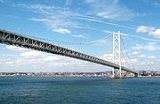
- Akashi-Kaikyo Bridge - Japan, with the longest section span of 1.9 km.
- Bosphorus Bridge - Turkey, connects Asia and Europe
- Brooklyn Bridge - connecting the New York City boroughs of Manhattan and Brooklyn.
- Charles Bridge - Czech Republic, famous 14th century bridge in Prague
- Chicago Skyway - USA, a 7.8-mile toll bridge bypassing much of the the southwest of Chicago
- Confederation Bridge - Canada, world's longest bridge over waters that freeze.
- Forth Railway Bridge - Scotland, one of the most famous cantilever bridges in the world.
- Golden Gate Bridge - USA, one of the most famous suspension bridges in the world.
- Great Belt Fixed Link, Eastern Bridge - Denmark, second longest section span of 1.6 km
- Hercilio Luz Bridge - Florianopolis, Brazil, longest brazilian suspension bridge, one of the 100 largest suspension bridges of the world and one of the oldest hanging bridges in the world.
- The Iron Bridge - England, the world's first iron bridge.
- Jamuna Bridge- Bangladesh, longest rail-road bridge in south asia , 2nd longest in world.
- Lake Pontchartrain Causeway - USA, spanning Lake Pontchartrain in south Louisiana
...
, it is the longest bridge in the world at 23.87
miles .
Mahatma Gandhi Setu is a bridge [i] over the river Ganges [i] connecting Patna [i] i ...
-
India, the longest river bridge in the world.
...
, longest bridge in
Southeast Asia.
Greece lies at the juncture of Europe [i], Asia [i], and Africa [i]. ...
, the longest
cable-stayed bridge in the world.
- Rio-Niterói Bridge - Brazil, highest central span in the world.
- San Francisco-Oakland Bay Bridge - USA, especially for seismic retrofit and eastern span replacement.
- Sundial Bridge - USA, a dramatic single cantilever spar cable stayed span for pedestrians.
- Sunshine Skyway Bridge - USA, longest cable-stayed concrete bridge in the world. Replaced a cantilever truss structure which partially collapsed in 1980 as a result of collision by a freighter.
- Sydney Harbour Bridge - Australia, arguably the best-known suspended-deck compression arch bridge, also the world's widest long span bridge .
- Tacoma Narrows Bridge - USA, famous for its collapse due to aerodynamic effects.
- Tatara Bridge - Japan, largest span cable-stayed bridge.
- Tower Bridge - London, England, and a symbol of this city.
- Trajan's bridge - Romania, ancient Roman bridge over the river Danube
...
, only fragments visible.
Special Installations
Some bridges carry special installations such as the tower of
Nový Most bridge in Bratislava which carries a restaurant. On other suspension bridge towers transmission antennas are installed.
A bridge can carry overhead powerlines as the
Storstrøm Bridge.
Catastrophic collapses
| Bridge | Town | Country | Date | Construction type, use of bridge | Reason | Number death/injuries | Damage | Remarks |
|---|
| Stirling Bridge | Stirling | Scotland | September 1297 | Beam and trestle over the River Forth | Overload by attackers during the Battle of Stirling Bridge | Unknown, attacking forces defeated | Bridge rendered unusable | Collapse may have been assisted by defending forces. |
| Bridge of Angers | Angers | France | April 16 1850 | Suspension bridge over Maine river | Resonance of soldiers led to collapse | 226/? | Bridge total damage | Marching columns now break step when crossing bridges. |
| Yarmouth Bridge | Great Yarmouth | England | May 2 1845 | Suspension | People had crowded onto the bridge to see a circus clown go down the river in a barrel pulled by geese. The weight of people shifted as the barrel passed underneath, the suspension chains on the south side snapped and the bridge deck tipped over. | 79 people drowned, mainly children. | Suspension chains snapped due to overload. | |
| Tay Rail Bridge | Dundee | Scotland | December 28 1879 | Continuous girder bridge, steel framework on cast iron columns, railway bridge | Insufficient consideration of the wind load, inadequate construction, collapsed because of the stresses caused by a storm | 75/0 | Bridge unusable, piers partly reused, train heavily damaged | Locomotive was saved from the Tay and was still in use 19 years later known as "The Diver". |
| Québec Bridge | Quebec | Canada | August 29 1907 | Cantilever bridge, steel framework, railway bridge | Collapsed during construction | 74/11 | Bridge completely destroyed | |
| Theodor-Heuss-Rhine River Bridge | Ludwigshafen | Germany | March 1940 | Bridge of concrete, Motorway bridge | Collapsed during construction | ?/? | Bridge totally destroyed | Resulted in delay in completion of the motorway crossing of the Rhine until 1953 |
| Tacoma Narrows Bridge | Tacoma, WA | USA | November 7 1940 | Road bridge, cable suspension with plate girder deck | Aerodynamically poor form resulted in resonance | No | Bridge partially destroyed, one car lost, and one dog killed | Became known as "Galloping Gertie", in the first 4 months after opening up until its collapse under a previously unseen resonant mode. Since that time all new bridges have been modelled in wind tunnels. |
| The bridge at Remagen | Remagen | Germany | March 17 1945 | Truss railroad and pedestrian bridge | Collapse due to previous battle damage incurred March 7th, 1945 | 28 U.S. soldiers | Total destruction | Capture of intact bridge offered significant short term tactical advangage to Allied forces. Collapse was not strategically significant due to placement of parallel floating bridges during the previous week |
| Harrow and Wealdstone rail crash | Harrow Weald | England | October 8 1952 | Pedestrian footbridge | Collapse due to collision with train | 112 dead 340 injured | Total destruction | It is not recorded how many casualties were due to the bridge collapse
|
| Tangiwai railway bridge | Tangiwai | New Zealand | December 24 1953 | Railway bridge | Damaged by lahar minutes before passenger train passed over it. | 134/151 | Bridge destroyed |
|
| General Rafael Urdaneta Bridge | Maracaibo | Venezuela | April 6 1964 | Road bridge | Ship collision | 7 | 2 section collapsed | Currently in Operation |
| Silver Bridge | | USA | 15 December 1967 | Road bridge, chain link suspension | Material fault and Corrosion | 46/9 | Bridge and 37 vehicles destroyed | |
| West Gate Bridge | Melbourne | Australia | October 15, 1970 | Road Bridge | Collapse during construction | 35 | 112 metre span between piers 10 and 11 collapsed | Section sprung back and collapse during attempts to remove a buckle cause by a difference in camber of 4.5 inches | |
| South Bridge Koblenz | Koblenz | Germany | 10 November 1971 | Road bridge | Bridge bent into Rhine | 13/? | Bridge completely destroyed | |
| Reichsbrücke | Vienna | Austria | August 1, 1976 | Road bridge with Tram | Column fractured | 1/0 | Bridge, one bus and a lorry destroyed, ships damaged | Concrete of the column had never been examined, was internally totally destroyed; "higher force" |
| Tasman Bridge | Hobart | Tasmania, Australia | January 5, 1975 | Bridge of concrete, Motorway bridge | Ore freighter Lake Illawarra collided with pylons. Section of bridge collapsed onto frieghter. Four cars fell into the river. | 7 ship crewman and 5 motorists killed | 2 pylons and three sections of bridge collapsed, ore freighter sank, 5 cars fell into river | City of Hobart was split in two. Residents living in the east were forced to make a 50km trip to the CBD via the next bridge up north. Bridge was reconstructed and reopened on October 8, 1977 |
| Almö Bridge | Stenungsund | Sweden | January 18, 1980 | Bridge with bow built of concrete | Ship collision | 8/? | Bridge and several cars destroyed | |
| Sunshine Skyway Bridge | | USA | 1980 | Steel Cantilever Bridge | Ship collision | 35/? | 1200 ft. of southbound span, several cars and a bus destroyed | Demolished and replaced with cable-stayed bridge |
| Aschaffenburg Main River Freeway Bridge | Aschaffenburg | Germany | 1988 | Bridge of Motorway A 3 over River Main | Error in construction | 1/0 | Bridge total damage | Partial collapse at Repetitive sliding |
| Bridge over railway line at Eschede | Eschede | Germany | June 3, 1998 | Road bridge | Train disaster | 101/105 | | Destruction by train crashing on pillar, killed and injured people were train passengers |
| Motorway bridge at Almuñecar, Province of Granada, Spain | Almuñecar | Spain | November 7 2005 | Motorway bridge | Construction, accident, reason unknown | 6/3 | | A 60 metre long part fell 50 metre deep |
| Viaducto No.1 Caracas - La Guaira motorway Tacagua, Venezuela | Tacagua | Venezuela | January 8 2006 | Motorway bridge | Various factors | 0/0 | Bridge rendered unusable | Demolished, it will be replaced with a new one |
See also
External links
- - International Database and Gallery of Structures with over 10 000 Bridges.