


Shah Jahan

Encyclopedia
Shah Jahan (January 5, 1592 – January 22, 1666) (Full title: His Imperial Majesty Al-Sultan al-'Azam wal Khaqan al-Mukarram, Malik-ul-Sultanat, Ala Hazrat Abu'l-Muzaffar Shahab ud-din Muhammad Shah Jahan I, Sahib-i-Qiran-i-Sani, Padshah Ghazi Zillu'llah, Firdaus-Ashiyani, Shahanshah—E--Sultanant Ul Hindiya Wal Mughaliya, Emperor of India ) was the emperor of the Mughal Empire
in the Indian Subcontinent
from 1628 until 1658. The name Shah Jahan comes from Persian meaning "King of the World." He was the fifth Mughal emperor after Babur
, Humayun
, Akbar, and Jahangir
. While young, he was favourite of his legendary grandfather Akbar the Great. He is also called Shahjahan the Magnificent. Besides being a descendant of Genghis Khan
, Emperor of Mongol Empire and Tamerlane, he is also a descendant of Emperor Charlemagne
, the King of the Franks, King of the Lombards and the Emperor of the Romans
.
Even while very young, he was chosen as successor to the Mughal
throne after the death of Emperor Jahangir. He succeeded to the throne upon his father's death in 1627. He is considered to be one of the greatest Mughals and his reign has been called the Golden Age of the Mughals and one of the most prosperous ages of the Indian civilization. Like Akbar, he too was eager to expand his vast empire. In 1658 he fell ill, and was confined by his son Emperor Aurangzeb in the Citadel of Agra
until his death in 1666. On the eve of his death in 1666, he was one of the most powerful personalities on the earth and his Mughal Empire
spanned almost 750000000 acres (3,035,145 km²) and he had in his empire the largest and most prosperous capital as well as some of the most spectacular architectural masterpieces in the world.
The period of his reign was the golden age of Mughal architecture
. Shahanshah Shah Jahan erected many splendid monuments, the most famous of which is the legendary Taj Mahal
at Agra built as a tomb for his wife, Empress Mumtaz Mahal
. The Pearl Mosque
and many other buildings in Agra, the Red Fort and the Jama Masjid Mosque
in Delhi, mosques in Lahore, extensions to Lahore Fort
and a mosque in Thatta
also commemorate him. The famous Takht-e-Taus or the Peacock Throne
, said to be worth millions of dollars by modern estimates, also dates from his reign. He was also the founder of the new imperial capital called Shahjahanabad, now known as Old Delhi. Other important buildings of Shah Jahan's rule were the Diwan-i-Am and Diwan-i-Khas in the Red Fort Complex in Delhi and the Pearl Mosque
in the Lahore Fort. It is pointed out that the Palace
of Delhi
is the most magnificent in the East. Shah Jahan is also believed to have the most refined of the tastes in arts and architecture and is credited to have commissioned about 777 gardens in Kashmir, his favourite summer residence. Surprisingly, a few of these gardens survive even till date and attracts thousands of tourists every year.
from his Rajput wife Gossaini. The name Khurram - Persian for 'joyful' - was given by his grandfather Akbar. His early years saw him receive a cultured, broad education and he distinguished himself in the martial arts and as a military commander while leading his father's armies in numerous campaigns - Mewar
(1615 CE, 1024 AH), the Deccan (1617 and 1621 CE, 1026 and 1030 AH), Kangra
(1618 CE, 1027AH). He was responsible for most of the territorial gains during his father's reign. He also demonstrated a precocious talent for building, impressing his father at the age of 16 when he built his quarters within his great grandfather Emperor Babur's Kabul fort and redesigned buildings within Agra fort. He also carries the universally famous titles like "The builder of marvels ".
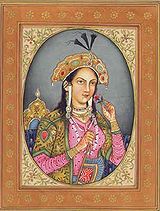 In 1607 CE (1025 AH), at the age of fifteen, Khurram married Arjumand Banu Begum, the grand daughter of a Persian
noble, who was 14 years old at the time.She was also the niece of the famous queen of Jehangir-Nur Mahal After their wedding celebrations, Khurram "finding her in appearance and character elect among all the women of the time," gave her the title Mumtaz Mahal
(Jewel of the Palace).
Mumtaz Mahal
had 14 children. Despite her frequent pregnancies, she travelled with Shah Jahan's entourage throughout his earlier military campaigns and the subsequent rebellion against his father. Mumtaz Mahal was utterly devoted — she was his constant companion and trusted confidante and their relationship was intense. She is portrayed by Shah Jahan's chroniclers as the perfect wife with no aspirations to political power. This is in direct opposition to how Nur Jahan had been perceived. She died an accidental death, while giving birth to her 14th child. When Shah Jahan travelled to Balapur fort, Burhanpur, mother of Mirza Azam and elder daughter of Shahzada Badi uz-Zaman Mirza, alias Shah Nawaz Khan of the Safawi dynasty Dilrus Banu, wife of Auranzeb along with Mumtaz and cousin/brother Shah Beg Khan, along with military personnel - stayed three nights near Argaon at Hiwarkhed, before the birth of their fourteenth child. Mumtaz died in Burhanpur in 1631 AD (1040 AH), while giving birth to their fourteenth child. She had been accompanying her husband while he was fighting a campaign in the Deccan Plateau. Her body was temporarily buried at Burhanpur in a walled pleasure garden known as Zainabad originally constructed by Shah Jahan's uncle Daniyal on the bank of the Tapti River..
The intervening years had seen Khurrum take two other wives known as Akbarabadi Mahal (d.1677 CE, 1088 AH), and Kandahari Mahal (b. c1594 CE, c1002 AH), (m.1609 CE, 1018 AH).
According to the official court chronicler Qazwini, the relationship with his other wives "had nothing more than the status of marriage. The intimacy, deep affection, attention and favor which His Majesty had for the Cradle of Excellence [Mumtaz Mahal] exceeded by a thousand times what he felt for any other." Several European chroniclers suggested that Shah Jahan had an incestuous relationship with his daughter Jahanara Begum. The French traveller Francois Bernier wrote, "Begum Sahib, the elder daughter of Shah Jahan was very beautiful... but Lal pointed out that Aurangzeb may have been involved in "magnifying a rumour into a full-fledged scandal", and wrote: "Aurangzeb had disobeyed Shahjahan, he had incarcerated him for years, but if he really helped give a twist to Shahjahan's paternal love for Jahan Ara by turning it into a scandal, it was the unkindest cut of all his unfilial acts." But no authentic proof says that the great mughal had any such relationship.
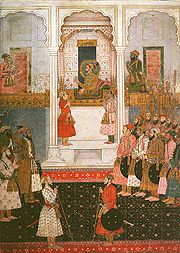 Inheritance of power and wealth in the Mughal empire was not determined through primogeniture
, but by princely sons competing to achieve military successes and consolidating their power at court. This often led to rebellions and wars of succession. As a result, a complex political climate surrounded the Mughal court in Shahzada Khurram's formative years. In 1611 his father married Nur Jahan, the widowed daughter of an Afghan Noble. She rapidly became an important member of EmperorJahangir's court and, together with her brother Asaf Khan, wielded considerable influence. Arjumand was Asaf Khan's daughter and her marriage to Prince Khurrum consolidated Nur Jahan and Asaf Khan's positions at court.
Khurram's intense military successes of 1617 CE (1026 AH) against the Lodi in the Deccan effectively secured the southern border of the empire and his grateful father rewarded him with the prestigious title 'Shah Jahan Bahadur' (Brave King of the World) which implicitly sealed his inheritance. Court intrigues, however, including Nur Jahan's decision to have her daughter from her first marriage wed Shah Jahan's youngest brother
and her support for his claim to the throne led Khurram, supported by Muhabbat Khan, into open revolt against his father in 1622.
The rebellion was quelled by Jahangir's forces in 1626 and Khurram was forced to submit unconditionally. Upon the death of Jahangir in 1627, Prince Khurram succeeded to the Mughal throne as Shah Jahan, King of the World, the latter title alluding to his pride in his Timurid roots and his ambitious the history. Shahanshah Shah Jahan's first act as ruler was to execute his chief rivals and imprison his step mother Nur Jahan. This is allowed Shan Jahan to rule without contention.
in Bengal
, capturing the Rajput
kingdoms of Baglana, Mewar
and Bundelkhand
to the west and the northwest beyond the Khyber Pass
. He then chose his 16 year old son Aurangzeb
to serve in his place and subdue the rebellion by the Bundela
Rajput
s led by the renegade Jhujhar Singh. The Mughal Emperor Shah Jahan then chose his son Aurangzeb
to become the Subedar
of Deccan and ordered the annexation of Ahmednagar and the overthrow of the Nizam Shahi dynasty.
Shah Jahan and his sons captured the city of Kandahar
in 1638 from the Safavids, prompting the retaliation of the Persians led by their powerful ruler Abbas II of Persia
, who recaptured it in 1649, the Mughal armies were unable to recapture it despite repeated sieges during the Mughal–Safavid War
.
Evidence from the reign of Shah Jahan in the year 1648 states that the army consisted of 440,000 infantry, musket
eers, and artillery
men, and 185,000 Sowar
s commanded by princes and nobles. During his reign the Marwari horse
was introduced becoming Shah Jahan's favorite and various Mughal
Cannons were mass produced in the Jaigarh Fort
. Under his rule, the empire became a huge military machine and the nobles and their contingents multiplied almost fourfold, as did the demands for more revenue from the peasantry. But due to his measures in the financial and commercial fields, it was a period of general stability — the administration was centralised and court affairs systematized.
The Mughal Empire
continued to expand moderately during his reign as his sons commanded large armies on different fronts. Above all it is obligatory to mention here that India became the richest centre of the arts, crafts and architecture and some of the best of the architects, artisians, craftsmens, painters and writers of the world resided in his empire, it is believed that the Mughal Empire
had the highest gross domestic produce in the world.
The Mughal Emperor Shah Jahan had exchanged ambassadors and documents with the Ottoman
Sultan
Murad IV
, it was through these exchanges led by the Mughal ambassador Sayyid Muhiuddin and his counterpart the Ottoman ambassador Arsalan Agha, that Mughal Emperor Shah Jahan received Isa Muhammad Effendi
and Ismail Effendi, two Turkish
architect
s and students of the famous Koca Mimar Sinan Agha. Both of them later comprised among the Mughal
team that would design and build the Taj Mahal
.
under Shah Jahan was higher than any other Mughal ruler. The magnificence of Shah Jahan’s court was commented upon by several the European travelers and ambassadors from other parts of the world, including Francois Bernier
and Thomas Roe
. His famous Peacock Throne
, with its trail blazing in the shifting natural colors of rubies, sapphire
s, and emerald
s, was valued by the jeweler Tavernier at 6½ million pounds sterling.
His political efforts encouraged the emergence of large centres of commerce and crafts — such as Lahore
, Delhi
, Agra
, and Ahmedabad
— linked by roads and waterways to distant places and ports. He moved the capital from Agra
to Delhi
.
Under Shah Jahan's rule, Mughal artistic and architectural achievements reached their zenith. Shah Jahan was a prolific builder with a highly refined aesthetic sense. Among his surviving buildings are the Red Fort
and Jama Masjid
in Delhi, the Shalimar Gardens of Lahore
, sections of the Lahore Fort
(such as Sheesh Mahal, and Naulakha pavilion
), and his father's mausoleum
.
Legend has it that Shah Jahan wanted to build a black Taj Mahal
for himself. There is no reputable scholarship to support this hypothesis, however, nor for other horrific legends that Shah Jahan maimed, blinded, or killed those responsible for designing and building the Taj Mahal
.
, Viceroy of Gujarat, declared their independence, and marched upon Agra in order to claim their riches. Aurangzeb
, the third son, and ablest and most virile of the brothers, gathered a well trained army and became its in chief commander, he faced his elder brother and heir apparent Dara Shikoh
's army close to Agra and completely defeated him during the Battle of Samugarh
. Although Shah Jahan fully recovered from his illness, Aurangzeb
declared him incompetent to rule and put him under house arrest
in Agra Fort
.
Jahanara Begum Sahib, Jahan's first daughter, voluntarily shared his 8-year confinement and nursed him in his dotage. In January 1666 CE (1076 AH), Shah Jahan fell ill with strangury
and dysentery
. Confined to bed, he became progressively weaker until, on 22 January, he commanded the ladies of the imperial court, particularly his consort of later years Akbarabadi Mahal, to the care of Jahanara. After reciting the Kalima and verses from the Qu'ran, he died. Jahanara planned a state funeral which was to include a procession with Shah Jahan's body carried by eminent nobles followed by the notable citizens of Agra and officials scattering coins for the poor and needy. Aurangzeb refused to accommodate such ostentation and the body was washed in accordance with Islamic rites, taken by river in a sandalwood coffin to the Taj Mahal and was interred there next to the body of his beloved wife Mumtaz Mahal. It is also said that he died of a very high dosage of aphrodisiac and carried an entire harem with him during his confinement period.
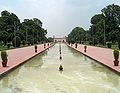 Shah Jahan left behind a grand legacy of structures constructed during his reign. He was a patron of architecture. His most famous building was the Taj Mahal
, now a wonder of the world, which he built out of love for Mumtaz Mahal
. Its structure was drawn with great care and architects from all over the world were called for this purpose. The building took twenty years to complete and was constructed from white marble underlaid with brick.People believe that Shah Jahan cut off the worker's hands who built it so it can not be repeated. Upon his death, his son Aurangazeb had him interred in it next to Mumtaz Mahal. Among his other constructions are Delhi Fort
also called the Red Fort or Lal Qila (Urdu) in Delhi
, large sections of Agra Fort
, the Jama Masjid
(Grand Mosque), Delhi, the Wazir Khan Mosque
, Lahore
, Pakistan
, the Moti Masjid
(Pearl Mosque), Lahore, the Shalimar Gardens
in Lahore, sections of the Lahore Fort
, Lahore, the Jahangir mausoleum
— his father's tomb, the construction of which was overseen by his stepmother Nur Jahan and the Shahjahan Mosque
, Thatta
, Pakistan. He also had the Peacock Throne, Takht e Taus, made to celebrate his rule.
A famous Seamless celestial globe was produced in 1659-1660 AD (1070 AH), by the Sindhi
Astronomer Muhammad Salih Tahtawi of Thatta
with Arabic and Persian
inscriptions.
on the tombs and on the Agra Fort quranic Calligraphy and persian poem in Nastaʿlīqinscription.
shah jahan cenotaph is bigger than his wife's, but reflects the same elements: a larger casket on a slightly taller base, again decorated with astonishing precision with lapidary and calligraphy that identifies him.
The pen box and writing tablet were traditional Persian funerary icons decorating the caskets of men and women respectively. The Ninety Nine Names of God are found as calligraphic inscriptions in Persian nastNastaʿlīqinscription style of calligraphic on the sides of the actual tomb of Mumtaz Mahal, in the crypt including "O Noble, O Magnificent, O Majestic, O Unique, O Eternal, O Glorious... ". The tomb of Shah Jahan bears a calligraphic inscription that reads; "He traveled from this world to the banquet-hall of Eternity on the night of the twenty-sixth of the month of Rajab
, in the year 1076 Hijri
."
written in Persian:
مرقد منور ارجمندبانو بیگم مخاطب بممتاز محل توفی سنه...
the bright tomb of arjmand banou beegom famous as Mumtaz mahal(the best of the rigion) died year..
مرقد مطهر اعلیحضرت فردوس آشیانی صاحبقران ثانی شاه جهان طاب ثراه سنه 1076 ق)
the purified shrine of his majesty resident of paradise the highness Shahjahan the Magnificent rest his soul in peace. year1076 H.G.
Shah Jahan was very interested in Persian inscription and a Persian poet who requested a famous Persian calligrapher to decorate his palace and castles.
wrote that "it would seem as if the only thing Shahjahan cared for was the search for women to serve his pleasure" and "for this end he established a fair
at his court. No one was allowed to enter except women of all ranks that is to say, great and small, rich and poor, but all beautiful". When he was detained in the Agra Fort, Aurangzeb permitted him to retain "the whole of his female establishment, including the singing and dancing women."
Mughal Empire
The Mughal Empire , or Mogul Empire in traditional English usage, was an imperial power from the Indian Subcontinent. The Mughal emperors were descendants of the Timurids...
in the Indian Subcontinent
Indian subcontinent
The Indian subcontinent, also Indian Subcontinent, Indo-Pak Subcontinent or South Asian Subcontinent is a region of the Asian continent on the Indian tectonic plate from the Hindu Kush or Hindu Koh, Himalayas and including the Kuen Lun and Karakoram ranges, forming a land mass which extends...
from 1628 until 1658. The name Shah Jahan comes from Persian meaning "King of the World." He was the fifth Mughal emperor after Babur
Babur
Babur was a Muslim conqueror from Central Asia who, following a series of setbacks, finally succeeded in laying the basis for the Mughal dynasty of South Asia. He was a direct descendant of Timur through his father, and a descendant also of Genghis Khan through his mother...
, Humayun
Humayun
Nasir ud-din Muhammad Humayun was the second Mughal Emperor who ruled present day Afghanistan, Pakistan, and parts of northern India from 1530–1540 and again from 1555–1556. Like his father, Babur, he lost his kingdom early, but with Persian aid, he eventually regained an even larger one...
, Akbar, and Jahangir
Jahangir
Jahangir was the ruler of the Mughal Empire from 1605 until his death. The name Jahangir is from Persian جهانگیر,meaning "Conqueror of the World"...
. While young, he was favourite of his legendary grandfather Akbar the Great. He is also called Shahjahan the Magnificent. Besides being a descendant of Genghis Khan
Genghis Khan
Genghis Khan , born Temujin and occasionally known by his temple name Taizu , was the founder and Great Khan of the Mongol Empire, which became the largest contiguous empire in history after his death....
, Emperor of Mongol Empire and Tamerlane, he is also a descendant of Emperor Charlemagne
Charlemagne
Charlemagne was King of the Franks from 768 and Emperor of the Romans from 800 to his death in 814. He expanded the Frankish kingdom into an empire that incorporated much of Western and Central Europe. During his reign, he conquered Italy and was crowned by Pope Leo III on 25 December 800...
, the King of the Franks, King of the Lombards and the Emperor of the Romans
Holy Roman Emperor
The Holy Roman Emperor is a term used by historians to denote a medieval ruler who, as German King, had also received the title of "Emperor of the Romans" from the Pope...
.
Even while very young, he was chosen as successor to the Mughal
Mughal Empire
The Mughal Empire , or Mogul Empire in traditional English usage, was an imperial power from the Indian Subcontinent. The Mughal emperors were descendants of the Timurids...
throne after the death of Emperor Jahangir. He succeeded to the throne upon his father's death in 1627. He is considered to be one of the greatest Mughals and his reign has been called the Golden Age of the Mughals and one of the most prosperous ages of the Indian civilization. Like Akbar, he too was eager to expand his vast empire. In 1658 he fell ill, and was confined by his son Emperor Aurangzeb in the Citadel of Agra
Agra Fort
Agra Fort, is a monument situated at Agra, is a UNESCO World Heritage site located in Agra, Uttar Pradesh, India. It is about 2.5 km northwest of its more famous sister monument, the Taj Mahal...
until his death in 1666. On the eve of his death in 1666, he was one of the most powerful personalities on the earth and his Mughal Empire
Mughal Empire
The Mughal Empire , or Mogul Empire in traditional English usage, was an imperial power from the Indian Subcontinent. The Mughal emperors were descendants of the Timurids...
spanned almost 750000000 acres (3,035,145 km²) and he had in his empire the largest and most prosperous capital as well as some of the most spectacular architectural masterpieces in the world.
The period of his reign was the golden age of Mughal architecture
Mughal architecture
Mughal architecture, an amalgam of Islamic, Persian, Turkish and Indian architecture, is the distinctive style developed by the Mughals in the 16th, 17th and 18th centuries in what is now India, Pakistan, Bangladesh and Afghanistan. It is symmetrical and decorative in style.The Mughal dynasty was...
. Shahanshah Shah Jahan erected many splendid monuments, the most famous of which is the legendary Taj Mahal
Taj Mahal
The Taj Mahal is a white Marble mausoleum located in Agra, India. It was built by Mughal emperor Shah Jahan in memory of his third wife, Mumtaz Mahal...
at Agra built as a tomb for his wife, Empress Mumtaz Mahal
Mumtaz Mahal
Mumtaz Mahal born as Arjumand Banu Begum was a Mughal Empress and chief consort of emperor Shah Jahan...
. The Pearl Mosque
Moti Masjid, Agra
The Moti Masjid in Agra was built by Shah Jahan. During the rule of Shah Jahan the Mughal emperor, numerous architectural wonders were built. Most famous of them being the Taj Mahal. Moti Masjid earned the epithet Pearl Mosque for it shined like a pearl...
and many other buildings in Agra, the Red Fort and the Jama Masjid Mosque
Jama Masjid, Delhi
The Masjid-i Jahān-Numā , commonly known as the Jama Masjid of Delhi, is the principal mosque of Old Delhi in India. Commissioned by the Mughal Emperor Shah Jahan, builder of the Taj Mahal,in the year 1644 CE and completed in the year 1658 AD, it is the largest and best-known mosque in India...
in Delhi, mosques in Lahore, extensions to Lahore Fort
Lahore Fort
The Lahore Fort, locally referred to as Shahi Qila is citadel of the city of Lahore, Punjab, Pakistan. It is located in the northwestern corner of the Walled City of Lahore...
and a mosque in Thatta
Shahjahan Mosque
The Shah Jahan Mosque was built in the reign of Mughal emperor Shah Jahan. It is located in Thatta, Sindh province, Pakistan. It has been on the tentative UNESCO World Heritage list since 1993....
also commemorate him. The famous Takht-e-Taus or the Peacock Throne
Peacock Throne
The Peacock Throne, called Takht-e Tâvus in Persian, is the name originally given to a Mughal throne of India, which was later adopted and used to describe the thrones of the Persian emperors from Nader Shah Afshari and erroneously to Mohammad Reza Shah Pahlavi whose throne was a reconstruction of...
, said to be worth millions of dollars by modern estimates, also dates from his reign. He was also the founder of the new imperial capital called Shahjahanabad, now known as Old Delhi. Other important buildings of Shah Jahan's rule were the Diwan-i-Am and Diwan-i-Khas in the Red Fort Complex in Delhi and the Pearl Mosque
Moti Masjid (Lahore)
Moti Masjid , one of the "Pearl Mosques", is a 17th century religious building located inside the Lahore Fort. It is a small, white marble structure built by Mughal emperor Shah Jahan, and is among his prominent extensions to the Lahore Fort Complex...
in the Lahore Fort. It is pointed out that the Palace
Palace
A palace is a grand residence, especially a royal residence or the home of a head of state or some other high-ranking dignitary, such as a bishop or archbishop. The word itself is derived from the Latin name Palātium, for Palatine Hill, one of the seven hills in Rome. In many parts of Europe, the...
of Delhi
Delhi
Delhi , officially National Capital Territory of Delhi , is the largest metropolis by area and the second-largest by population in India, next to Mumbai. It is the eighth largest metropolis in the world by population with 16,753,265 inhabitants in the Territory at the 2011 Census...
is the most magnificent in the East. Shah Jahan is also believed to have the most refined of the tastes in arts and architecture and is credited to have commissioned about 777 gardens in Kashmir, his favourite summer residence. Surprisingly, a few of these gardens survive even till date and attracts thousands of tourists every year.
Biography
Baadshah Shah Jahan was born as Prince Shihab-ud-din Muhammad Khurram, on January 5, 1592 in Lahore, Pakistan as the third and favorite son of the emperor JahangirJahangir
Jahangir was the ruler of the Mughal Empire from 1605 until his death. The name Jahangir is from Persian جهانگیر,meaning "Conqueror of the World"...
from his Rajput wife Gossaini. The name Khurram - Persian for 'joyful' - was given by his grandfather Akbar. His early years saw him receive a cultured, broad education and he distinguished himself in the martial arts and as a military commander while leading his father's armies in numerous campaigns - Mewar
Mewar
Mewar is a region of south-central Rajasthan state in western India. It includes the present-day districts of Pratapgarh, Bhilwara, Chittorgarh, Rajsamand, Udaipur, Dungarpur, Banswara and some of the part of Gujarat and Madhya Pradesh. The region was for centuries a Rajput kingdom that later...
(1615 CE, 1024 AH), the Deccan (1617 and 1621 CE, 1026 and 1030 AH), Kangra
Kangra Fort
The Kangra Fort , , is located 20 kilometers from the town of Dharamsala on the outskirts of the town of Kangra, India. The fort was first mentioned in Alexander the Great's war records, referring to the 4th century BC.-History:...
(1618 CE, 1027AH). He was responsible for most of the territorial gains during his father's reign. He also demonstrated a precocious talent for building, impressing his father at the age of 16 when he built his quarters within his great grandfather Emperor Babur's Kabul fort and redesigned buildings within Agra fort. He also carries the universally famous titles like "The builder of marvels ".
Marriage
Persian people
The Persian people are part of the Iranian peoples who speak the modern Persian language and closely akin Iranian dialects and languages. The origin of the ethnic Iranian/Persian peoples are traced to the Ancient Iranian peoples, who were part of the ancient Indo-Iranians and themselves part of...
noble, who was 14 years old at the time.She was also the niece of the famous queen of Jehangir-Nur Mahal After their wedding celebrations, Khurram "finding her in appearance and character elect among all the women of the time," gave her the title Mumtaz Mahal
Mumtaz Mahal
Mumtaz Mahal born as Arjumand Banu Begum was a Mughal Empress and chief consort of emperor Shah Jahan...
(Jewel of the Palace).
Mumtaz Mahal
Mumtaz Mahal
Mumtaz Mahal born as Arjumand Banu Begum was a Mughal Empress and chief consort of emperor Shah Jahan...
had 14 children. Despite her frequent pregnancies, she travelled with Shah Jahan's entourage throughout his earlier military campaigns and the subsequent rebellion against his father. Mumtaz Mahal was utterly devoted — she was his constant companion and trusted confidante and their relationship was intense. She is portrayed by Shah Jahan's chroniclers as the perfect wife with no aspirations to political power. This is in direct opposition to how Nur Jahan had been perceived. She died an accidental death, while giving birth to her 14th child. When Shah Jahan travelled to Balapur fort, Burhanpur, mother of Mirza Azam and elder daughter of Shahzada Badi uz-Zaman Mirza, alias Shah Nawaz Khan of the Safawi dynasty Dilrus Banu, wife of Auranzeb along with Mumtaz and cousin/brother Shah Beg Khan, along with military personnel - stayed three nights near Argaon at Hiwarkhed, before the birth of their fourteenth child. Mumtaz died in Burhanpur in 1631 AD (1040 AH), while giving birth to their fourteenth child. She had been accompanying her husband while he was fighting a campaign in the Deccan Plateau. Her body was temporarily buried at Burhanpur in a walled pleasure garden known as Zainabad originally constructed by Shah Jahan's uncle Daniyal on the bank of the Tapti River..
The intervening years had seen Khurrum take two other wives known as Akbarabadi Mahal (d.1677 CE, 1088 AH), and Kandahari Mahal (b. c1594 CE, c1002 AH), (m.1609 CE, 1018 AH).
According to the official court chronicler Qazwini, the relationship with his other wives "had nothing more than the status of marriage. The intimacy, deep affection, attention and favor which His Majesty had for the Cradle of Excellence [Mumtaz Mahal] exceeded by a thousand times what he felt for any other." Several European chroniclers suggested that Shah Jahan had an incestuous relationship with his daughter Jahanara Begum. The French traveller Francois Bernier wrote, "Begum Sahib, the elder daughter of Shah Jahan was very beautiful... but Lal pointed out that Aurangzeb may have been involved in "magnifying a rumour into a full-fledged scandal", and wrote: "Aurangzeb had disobeyed Shahjahan, he had incarcerated him for years, but if he really helped give a twist to Shahjahan's paternal love for Jahan Ara by turning it into a scandal, it was the unkindest cut of all his unfilial acts." But no authentic proof says that the great mughal had any such relationship.
Accession
Primogeniture
Primogeniture is the right, by law or custom, of the firstborn to inherit the entire estate, to the exclusion of younger siblings . Historically, the term implied male primogeniture, to the exclusion of females...
, but by princely sons competing to achieve military successes and consolidating their power at court. This often led to rebellions and wars of succession. As a result, a complex political climate surrounded the Mughal court in Shahzada Khurram's formative years. In 1611 his father married Nur Jahan, the widowed daughter of an Afghan Noble. She rapidly became an important member of EmperorJahangir's court and, together with her brother Asaf Khan, wielded considerable influence. Arjumand was Asaf Khan's daughter and her marriage to Prince Khurrum consolidated Nur Jahan and Asaf Khan's positions at court.
Khurram's intense military successes of 1617 CE (1026 AH) against the Lodi in the Deccan effectively secured the southern border of the empire and his grateful father rewarded him with the prestigious title 'Shah Jahan Bahadur' (Brave King of the World) which implicitly sealed his inheritance. Court intrigues, however, including Nur Jahan's decision to have her daughter from her first marriage wed Shah Jahan's youngest brother
Shahryar (mughal prince)
Prince Sheharyar was the youngest son of Jahangir by one of his wives. He was the stepson and son-in-law of Jahangir's empress, Nur Jahan by his marriage to Ladli Begum...
and her support for his claim to the throne led Khurram, supported by Muhabbat Khan, into open revolt against his father in 1622.
The rebellion was quelled by Jahangir's forces in 1626 and Khurram was forced to submit unconditionally. Upon the death of Jahangir in 1627, Prince Khurram succeeded to the Mughal throne as Shah Jahan, King of the World, the latter title alluding to his pride in his Timurid roots and his ambitious the history. Shahanshah Shah Jahan's first act as ruler was to execute his chief rivals and imprison his step mother Nur Jahan. This is allowed Shan Jahan to rule without contention.
Administration of the Mughal Empire
Although his father's rule was generally peaceful, the empire was experiencing challenges by the end of his reign. In 1628, immediately after becoming Mughal Emperor, Shah Jahan's forces were ambushed by Sikh rebels, the Emperor organized an assault, which caused almost all the Sikhs, including Guru Hargobind and his mercenaries to flee. Shah Jahan repulsed the PortuguesePortugal
Portugal , officially the Portuguese Republic is a country situated in southwestern Europe on the Iberian Peninsula. Portugal is the westernmost country of Europe, and is bordered by the Atlantic Ocean to the West and South and by Spain to the North and East. The Atlantic archipelagos of the...
in Bengal
Bengal
Bengal is a historical and geographical region in the northeast region of the Indian Subcontinent at the apex of the Bay of Bengal. Today, it is mainly divided between the sovereign land of People's Republic of Bangladesh and the Indian state of West Bengal, although some regions of the previous...
, capturing the Rajput
Rajput
A Rajput is a member of one of the patrilineal clans of western, central, northern India and in some parts of Pakistan. Rajputs are descendants of one of the major ruling warrior classes in the Indian subcontinent, particularly North India...
kingdoms of Baglana, Mewar
Mewar
Mewar is a region of south-central Rajasthan state in western India. It includes the present-day districts of Pratapgarh, Bhilwara, Chittorgarh, Rajsamand, Udaipur, Dungarpur, Banswara and some of the part of Gujarat and Madhya Pradesh. The region was for centuries a Rajput kingdom that later...
and Bundelkhand
Bundelkhand
Bundelkhand anciently known as Chedi Kingdom is a geographic region of central India...
to the west and the northwest beyond the Khyber Pass
Khyber Pass
The Khyber Pass, is a mountain pass linking Pakistan and Afghanistan.The Pass was an integral part of the ancient Silk Road. It is mentioned in the Bible as the "Pesh Habor," and it is one of the oldest known passes in the world....
. He then chose his 16 year old son Aurangzeb
Aurangzeb
Abul Muzaffar Muhy-ud-Din Muhammad Aurangzeb Alamgir , more commonly known as Aurangzeb or by his chosen imperial title Alamgir , was the sixth Mughal Emperor of India, whose reign lasted from 1658 until his death in 1707.Badshah Aurangzeb, having ruled most of the Indian subcontinent for nearly...
to serve in his place and subdue the rebellion by the Bundela
Bundela
The Bundelas are a Rajput clan of Chattari lineage who ruled several states in central India, in Bundelkhand region from the 16th century.The Bundelas are the most prominent Rajputs hailing from Central India...
Rajput
Rajput
A Rajput is a member of one of the patrilineal clans of western, central, northern India and in some parts of Pakistan. Rajputs are descendants of one of the major ruling warrior classes in the Indian subcontinent, particularly North India...
s led by the renegade Jhujhar Singh. The Mughal Emperor Shah Jahan then chose his son Aurangzeb
Aurangzeb
Abul Muzaffar Muhy-ud-Din Muhammad Aurangzeb Alamgir , more commonly known as Aurangzeb or by his chosen imperial title Alamgir , was the sixth Mughal Emperor of India, whose reign lasted from 1658 until his death in 1707.Badshah Aurangzeb, having ruled most of the Indian subcontinent for nearly...
to become the Subedar
Subedar
Subedar is a historical rank in the Indian Army, ranking below British commissioned officers and above non-commissioned officers. The rank was otherwise equivalent to a British lieutenant and was introduced in the East India Company's presidency armies, to make it easier for British officers to...
of Deccan and ordered the annexation of Ahmednagar and the overthrow of the Nizam Shahi dynasty.
Shah Jahan and his sons captured the city of Kandahar
Kandahar
Kandahar is the second largest city in Afghanistan, with a population of about 512,200 as of 2011. It is the capital of Kandahar Province, located in the south of the country at about 1,005 m above sea level...
in 1638 from the Safavids, prompting the retaliation of the Persians led by their powerful ruler Abbas II of Persia
Abbas II of Persia
Shah Abbas II was Shah of Iran from 1642 to 1666. He was the seventh Shah of the Safavid Dynasty. He was the son of Shah Safi I and a Circassian, Anna Khanum, and originally bore the name Sultan Muhammed Mirza before his coronation on May 15, 1642...
, who recaptured it in 1649, the Mughal armies were unable to recapture it despite repeated sieges during the Mughal–Safavid War
Mughal–Safavid War (1649–1653)
The Mughal–Safavid War of 1649-1653 was fought between the Mughal and Safavid Empires in the territory of modern Afghanistan. The war started after a Persian army, while the Mughals were at war with the Janid Uzbeks, captured the fortress city of Kandahar and other strategic cities that controlled...
.
Evidence from the reign of Shah Jahan in the year 1648 states that the army consisted of 440,000 infantry, musket
Musket
A musket is a muzzle-loaded, smooth bore long gun, fired from the shoulder. Muskets were designed for use by infantry. A soldier armed with a musket had the designation musketman or musketeer....
eers, and artillery
Artillery
Originally applied to any group of infantry primarily armed with projectile weapons, artillery has over time become limited in meaning to refer only to those engines of war that operate by projection of munitions far beyond the range of effect of personal weapons...
men, and 185,000 Sowar
Sowar
Sowar , meaning 'The one who rides' in Persian, was originally a rank during the Mughal period. Later during the British Raj it was the name in Anglo-Indian usage for a horse-soldier belonging to the cavalry troops of the native armies of British India and the feudal states...
s commanded by princes and nobles. During his reign the Marwari horse
Marwari horse
The Marwari or Malani is a rare breed of horse from the Marwar region of India. Known for its inward-turning ear tips, it comes in all equine colours, although pinto patterns tend to be the most popular with buyers and breeders. It is known for its hardiness, and is quite similar to the...
was introduced becoming Shah Jahan's favorite and various Mughal
Mughal Empire
The Mughal Empire , or Mogul Empire in traditional English usage, was an imperial power from the Indian Subcontinent. The Mughal emperors were descendants of the Timurids...
Cannons were mass produced in the Jaigarh Fort
Jaigarh Fort
Jaigarh Fort is situated on the premonitory called the Cheel ka Teela of the Aravalli hill ranges; it overlooks the Amber Fort and the Moata Lake, near Amber in Jaipur, Rajasthan, India...
. Under his rule, the empire became a huge military machine and the nobles and their contingents multiplied almost fourfold, as did the demands for more revenue from the peasantry. But due to his measures in the financial and commercial fields, it was a period of general stability — the administration was centralised and court affairs systematized.
The Mughal Empire
Mughal Empire
The Mughal Empire , or Mogul Empire in traditional English usage, was an imperial power from the Indian Subcontinent. The Mughal emperors were descendants of the Timurids...
continued to expand moderately during his reign as his sons commanded large armies on different fronts. Above all it is obligatory to mention here that India became the richest centre of the arts, crafts and architecture and some of the best of the architects, artisians, craftsmens, painters and writers of the world resided in his empire, it is believed that the Mughal Empire
Mughal Empire
The Mughal Empire , or Mogul Empire in traditional English usage, was an imperial power from the Indian Subcontinent. The Mughal emperors were descendants of the Timurids...
had the highest gross domestic produce in the world.
The Mughal Emperor Shah Jahan had exchanged ambassadors and documents with the Ottoman
Ottoman Empire
The Ottoman EmpireIt was usually referred to as the "Ottoman Empire", the "Turkish Empire", the "Ottoman Caliphate" or more commonly "Turkey" by its contemporaries...
Sultan
Sultan
Sultan is a title with several historical meanings. Originally, it was an Arabic language abstract noun meaning "strength", "authority", "rulership", and "dictatorship", derived from the masdar سلطة , meaning "authority" or "power". Later, it came to be used as the title of certain rulers who...
Murad IV
Murad IV
Murad IV Ghazi was the Sultan of the Ottoman Empire from 1623 to 1640, known both for restoring the authority of the state and for the brutality of his methods...
, it was through these exchanges led by the Mughal ambassador Sayyid Muhiuddin and his counterpart the Ottoman ambassador Arsalan Agha, that Mughal Emperor Shah Jahan received Isa Muhammad Effendi
Ustad Isa
Isa Muhammad Effendi, Ustad Isa ) was a Turkish architect from Istanbul he and his colleague Ismail Effendi entered the service of the Mughal Emperor Shah Jahan after the Ottoman Sultan Murad IV and the Mughals exchanged ambassadors...
and Ismail Effendi, two Turkish
Turkish people
Turkish people, also known as the "Turks" , are an ethnic group primarily living in Turkey and in the former lands of the Ottoman Empire where Turkish minorities had been established in Bulgaria, Cyprus, Bosnia and Herzegovina, Georgia, Greece, Kosovo, Macedonia, and Romania...
architect
Architect
An architect is a person trained in the planning, design and oversight of the construction of buildings. To practice architecture means to offer or render services in connection with the design and construction of a building, or group of buildings and the space within the site surrounding the...
s and students of the famous Koca Mimar Sinan Agha. Both of them later comprised among the Mughal
Mughal Empire
The Mughal Empire , or Mogul Empire in traditional English usage, was an imperial power from the Indian Subcontinent. The Mughal emperors were descendants of the Timurids...
team that would design and build the Taj Mahal
Taj Mahal
The Taj Mahal is a white Marble mausoleum located in Agra, India. It was built by Mughal emperor Shah Jahan in memory of his third wife, Mumtaz Mahal...
.
Patronage of the Arts
Under the Mughal Emperor Shah Jahan the Mughal Empire attained its highest union of strength with magnificence. His reign saw some of India's most well-known architectural and artistic accomplishments. The land revenue of the Mughal EmpireMughal Empire
The Mughal Empire , or Mogul Empire in traditional English usage, was an imperial power from the Indian Subcontinent. The Mughal emperors were descendants of the Timurids...
under Shah Jahan was higher than any other Mughal ruler. The magnificence of Shah Jahan’s court was commented upon by several the European travelers and ambassadors from other parts of the world, including Francois Bernier
François Bernier
François Bernier was a French physician and traveller. He was born at Joué-Etiau in Anjou. He was the personal physician of the Mughal emperor Aurangzeb for around 12 years during his stay in India....
and Thomas Roe
Thomas Roe
Sir Thomas Roe was an English diplomat of the Elizabethan and Jacobean periods. Roe was an accomplished scholar and a patron of learning.-Life:...
. His famous Peacock Throne
Peacock Throne
The Peacock Throne, called Takht-e Tâvus in Persian, is the name originally given to a Mughal throne of India, which was later adopted and used to describe the thrones of the Persian emperors from Nader Shah Afshari and erroneously to Mohammad Reza Shah Pahlavi whose throne was a reconstruction of...
, with its trail blazing in the shifting natural colors of rubies, sapphire
Sapphire
Sapphire is a gemstone variety of the mineral corundum, an aluminium oxide , when it is a color other than red or dark pink; in which case the gem would instead be called a ruby, considered to be a different gemstone. Trace amounts of other elements such as iron, titanium, or chromium can give...
s, and emerald
Emerald
Emerald is a variety of the mineral beryl colored green by trace amounts of chromium and sometimes vanadium. Beryl has a hardness of 7.5–8 on the 10 point Mohs scale of mineral hardness...
s, was valued by the jeweler Tavernier at 6½ million pounds sterling.
His political efforts encouraged the emergence of large centres of commerce and crafts — such as Lahore
Lahore
Lahore is the capital of the Pakistani province of Punjab and the second largest city in the country. With a rich and fabulous history dating back to over a thousand years ago, Lahore is no doubt Pakistan's cultural capital. One of the most densely populated cities in the world, Lahore remains a...
, Delhi
Delhi
Delhi , officially National Capital Territory of Delhi , is the largest metropolis by area and the second-largest by population in India, next to Mumbai. It is the eighth largest metropolis in the world by population with 16,753,265 inhabitants in the Territory at the 2011 Census...
, Agra
Agra
Agra a.k.a. Akbarabad is a city on the banks of the river Yamuna in the northern state of Uttar Pradesh, India, west of state capital, Lucknow and south from national capital New Delhi. With a population of 1,686,976 , it is one of the most populous cities in Uttar Pradesh and the 19th most...
, and Ahmedabad
Ahmedabad
Ahmedabad also known as Karnavati is the largest city in Gujarat, India. It is the former capital of Gujarat and is also the judicial capital of Gujarat as the Gujarat High Court has its seat in Ahmedabad...
— linked by roads and waterways to distant places and ports. He moved the capital from Agra
Agra
Agra a.k.a. Akbarabad is a city on the banks of the river Yamuna in the northern state of Uttar Pradesh, India, west of state capital, Lucknow and south from national capital New Delhi. With a population of 1,686,976 , it is one of the most populous cities in Uttar Pradesh and the 19th most...
to Delhi
Delhi
Delhi , officially National Capital Territory of Delhi , is the largest metropolis by area and the second-largest by population in India, next to Mumbai. It is the eighth largest metropolis in the world by population with 16,753,265 inhabitants in the Territory at the 2011 Census...
.
Under Shah Jahan's rule, Mughal artistic and architectural achievements reached their zenith. Shah Jahan was a prolific builder with a highly refined aesthetic sense. Among his surviving buildings are the Red Fort
Delhi Fort
The Red Fort is a 17th century fort complex constructed by the Mughal emperor Shah Jahan in the walled city of Old Delhi that served as the residence of the Mughal Emperors. It also served as the capital of the Mughals until 1857, when Mughal emperor Bahadur Shah Zafar was exiled by the British...
and Jama Masjid
Jama Masjid, Delhi
The Masjid-i Jahān-Numā , commonly known as the Jama Masjid of Delhi, is the principal mosque of Old Delhi in India. Commissioned by the Mughal Emperor Shah Jahan, builder of the Taj Mahal,in the year 1644 CE and completed in the year 1658 AD, it is the largest and best-known mosque in India...
in Delhi, the Shalimar Gardens of Lahore
Shalimar Gardens (Lahore)
The Shalimar Gardens , sometimes written Shalamar Gardens, is a Persian garden and it was built by the Mughal emperor Shah Jahan in Lahore, modern day Pakistan. Construction began in 1641 CE and was completed the following year...
, sections of the Lahore Fort
Lahore Fort
The Lahore Fort, locally referred to as Shahi Qila is citadel of the city of Lahore, Punjab, Pakistan. It is located in the northwestern corner of the Walled City of Lahore...
(such as Sheesh Mahal, and Naulakha pavilion
Naulakha Pavilion
The Naulakha Pavilion is a prominent white marble personal chamber with curvilinear roof, located besides the Sheesh Mahal courtyard, in the northern section of Lahore Fort in Lahore, Pakistan. The structure was originally inlaid with precious and semi-precious stones and overlooked the Ravi river...
), and his father's mausoleum
Tomb of Jahangir
Tomb of Jahangir, is the mausoleum built for the Mughal Emperor Jahangir who ruled from 1605 to 1627. The mausoleum is located near the town of Shahdara Bagh in Lahore, Pakistan. His son Shah Jahan built the mausoleum 10 years after his father's death. It is sited in an attractive walled garden....
.
Legend has it that Shah Jahan wanted to build a black Taj Mahal
Taj Mahal
The Taj Mahal is a white Marble mausoleum located in Agra, India. It was built by Mughal emperor Shah Jahan in memory of his third wife, Mumtaz Mahal...
for himself. There is no reputable scholarship to support this hypothesis, however, nor for other horrific legends that Shah Jahan maimed, blinded, or killed those responsible for designing and building the Taj Mahal
Taj Mahal
The Taj Mahal is a white Marble mausoleum located in Agra, India. It was built by Mughal emperor Shah Jahan in memory of his third wife, Mumtaz Mahal...
.
Fate
When Shah Jahan became ill in 1658 CE (1067 AH), Dara (Mumtaz Mahal's eldest son) assumed the role of regent in his father's stead, which swiftly incurred the animosity of his brothers. Upon learning of his assumption of the regency, his younger brothers, Shuja, Viceroy of Bengal, and Murad BakshMurad Baksh
Murad Baksh was the youngest son of Mughal emperor Shah Jahan and empress Mumtaz Mahal, he was the Subedar of Balkh until he was replaced by his brother Aurangzeb in the year 1647....
, Viceroy of Gujarat, declared their independence, and marched upon Agra in order to claim their riches. Aurangzeb
Aurangzeb
Abul Muzaffar Muhy-ud-Din Muhammad Aurangzeb Alamgir , more commonly known as Aurangzeb or by his chosen imperial title Alamgir , was the sixth Mughal Emperor of India, whose reign lasted from 1658 until his death in 1707.Badshah Aurangzeb, having ruled most of the Indian subcontinent for nearly...
, the third son, and ablest and most virile of the brothers, gathered a well trained army and became its in chief commander, he faced his elder brother and heir apparent Dara Shikoh
Dara Shikoh
His Highness, The Imperial Prince Dara Shikoh was the eldest son and the heir apparent of Mughal Emperor Shah Jahan and his wife Mumtaz Mahal. His name دارا شكوه in Persian means "Darius the Magnificent"...
's army close to Agra and completely defeated him during the Battle of Samugarh
Battle of Samugarh
Battle of Samugarh, Jang-e-Samugarh, , was a decisive struggle in for the throne Mughal war of succession 1658-1659 between the sons of the Mughal Emperor Shah Jahan after the emperor's serious illness in September 1657...
. Although Shah Jahan fully recovered from his illness, Aurangzeb
Aurangzeb
Abul Muzaffar Muhy-ud-Din Muhammad Aurangzeb Alamgir , more commonly known as Aurangzeb or by his chosen imperial title Alamgir , was the sixth Mughal Emperor of India, whose reign lasted from 1658 until his death in 1707.Badshah Aurangzeb, having ruled most of the Indian subcontinent for nearly...
declared him incompetent to rule and put him under house arrest
House arrest
In justice and law, house arrest is a measure by which a person is confined by the authorities to his or her residence. Travel is usually restricted, if allowed at all...
in Agra Fort
Agra Fort
Agra Fort, is a monument situated at Agra, is a UNESCO World Heritage site located in Agra, Uttar Pradesh, India. It is about 2.5 km northwest of its more famous sister monument, the Taj Mahal...
.
Jahanara Begum Sahib, Jahan's first daughter, voluntarily shared his 8-year confinement and nursed him in his dotage. In January 1666 CE (1076 AH), Shah Jahan fell ill with strangury
Strangury
Strangury is the symptom of painful, frequent urination of small volumes that are expelled slowly only by straining and despite a severe sense of urgency, usually with the residual feeling of incomplete emptying. These 'drops' of urine are 'squeezed out' in what sufferers describe as painful...
and dysentery
Dysentery
Dysentery is an inflammatory disorder of the intestine, especially of the colon, that results in severe diarrhea containing mucus and/or blood in the faeces with fever and abdominal pain. If left untreated, dysentery can be fatal.There are differences between dysentery and normal bloody diarrhoea...
. Confined to bed, he became progressively weaker until, on 22 January, he commanded the ladies of the imperial court, particularly his consort of later years Akbarabadi Mahal, to the care of Jahanara. After reciting the Kalima and verses from the Qu'ran, he died. Jahanara planned a state funeral which was to include a procession with Shah Jahan's body carried by eminent nobles followed by the notable citizens of Agra and officials scattering coins for the poor and needy. Aurangzeb refused to accommodate such ostentation and the body was washed in accordance with Islamic rites, taken by river in a sandalwood coffin to the Taj Mahal and was interred there next to the body of his beloved wife Mumtaz Mahal. It is also said that he died of a very high dosage of aphrodisiac and carried an entire harem with him during his confinement period.
Taj Mahal
Taj Mahal
The Taj Mahal is a white Marble mausoleum located in Agra, India. It was built by Mughal emperor Shah Jahan in memory of his third wife, Mumtaz Mahal...
, now a wonder of the world, which he built out of love for Mumtaz Mahal
Mumtaz Mahal
Mumtaz Mahal born as Arjumand Banu Begum was a Mughal Empress and chief consort of emperor Shah Jahan...
. Its structure was drawn with great care and architects from all over the world were called for this purpose. The building took twenty years to complete and was constructed from white marble underlaid with brick.People believe that Shah Jahan cut off the worker's hands who built it so it can not be repeated. Upon his death, his son Aurangazeb had him interred in it next to Mumtaz Mahal. Among his other constructions are Delhi Fort
Delhi Fort
The Red Fort is a 17th century fort complex constructed by the Mughal emperor Shah Jahan in the walled city of Old Delhi that served as the residence of the Mughal Emperors. It also served as the capital of the Mughals until 1857, when Mughal emperor Bahadur Shah Zafar was exiled by the British...
also called the Red Fort or Lal Qila (Urdu) in Delhi
Delhi
Delhi , officially National Capital Territory of Delhi , is the largest metropolis by area and the second-largest by population in India, next to Mumbai. It is the eighth largest metropolis in the world by population with 16,753,265 inhabitants in the Territory at the 2011 Census...
, large sections of Agra Fort
Agra Fort
Agra Fort, is a monument situated at Agra, is a UNESCO World Heritage site located in Agra, Uttar Pradesh, India. It is about 2.5 km northwest of its more famous sister monument, the Taj Mahal...
, the Jama Masjid
Jama Masjid, Delhi
The Masjid-i Jahān-Numā , commonly known as the Jama Masjid of Delhi, is the principal mosque of Old Delhi in India. Commissioned by the Mughal Emperor Shah Jahan, builder of the Taj Mahal,in the year 1644 CE and completed in the year 1658 AD, it is the largest and best-known mosque in India...
(Grand Mosque), Delhi, the Wazir Khan Mosque
Wazir Khan Mosque
The Wazir Khan Mosque in Lahore, Pakistan, is famous for its extensive faience tile work. It has been described as ' a mole on the cheek of Lahore'. It was built in seven years, starting around 1634-1635 AD, during the reign of the Mughal Emperor Shah Jehan...
, Lahore
Lahore
Lahore is the capital of the Pakistani province of Punjab and the second largest city in the country. With a rich and fabulous history dating back to over a thousand years ago, Lahore is no doubt Pakistan's cultural capital. One of the most densely populated cities in the world, Lahore remains a...
, Pakistan
Pakistan
Pakistan , officially the Islamic Republic of Pakistan is a sovereign state in South Asia. It has a coastline along the Arabian Sea and the Gulf of Oman in the south and is bordered by Afghanistan and Iran in the west, India in the east and China in the far northeast. In the north, Tajikistan...
, the Moti Masjid
Moti Masjid (Lahore)
Moti Masjid , one of the "Pearl Mosques", is a 17th century religious building located inside the Lahore Fort. It is a small, white marble structure built by Mughal emperor Shah Jahan, and is among his prominent extensions to the Lahore Fort Complex...
(Pearl Mosque), Lahore, the Shalimar Gardens
Shalimar Gardens (Lahore)
The Shalimar Gardens , sometimes written Shalamar Gardens, is a Persian garden and it was built by the Mughal emperor Shah Jahan in Lahore, modern day Pakistan. Construction began in 1641 CE and was completed the following year...
in Lahore, sections of the Lahore Fort
Lahore Fort
The Lahore Fort, locally referred to as Shahi Qila is citadel of the city of Lahore, Punjab, Pakistan. It is located in the northwestern corner of the Walled City of Lahore...
, Lahore, the Jahangir mausoleum
Tomb of Jahangir
Tomb of Jahangir, is the mausoleum built for the Mughal Emperor Jahangir who ruled from 1605 to 1627. The mausoleum is located near the town of Shahdara Bagh in Lahore, Pakistan. His son Shah Jahan built the mausoleum 10 years after his father's death. It is sited in an attractive walled garden....
— his father's tomb, the construction of which was overseen by his stepmother Nur Jahan and the Shahjahan Mosque
Shahjahan Mosque
The Shah Jahan Mosque was built in the reign of Mughal emperor Shah Jahan. It is located in Thatta, Sindh province, Pakistan. It has been on the tentative UNESCO World Heritage list since 1993....
, Thatta
Thatta
Thatta is a historic town of 220,000 inhabitants in the Sindh province of Pakistan, near Lake Keenjhar, the largest freshwater lake in the country. Thatta's major monuments especially its necropolis at Makli are listed among the World Heritage Sites. The Shah Jahan Mosque is also listed...
, Pakistan. He also had the Peacock Throne, Takht e Taus, made to celebrate his rule.
A famous Seamless celestial globe was produced in 1659-1660 AD (1070 AH), by the Sindhi
Sindhi people
Sindhis are a Sindhi speaking socio-ethnic group of people originating from Sindh, a province Formerly of British India, now in Pakistan. Today Sindhis that live in Pakistan belong to various religious denominations including Islam, Zoroastrianism, Hinduism, Sikhism and Christianity...
Astronomer Muhammad Salih Tahtawi of Thatta
Thatta
Thatta is a historic town of 220,000 inhabitants in the Sindh province of Pakistan, near Lake Keenjhar, the largest freshwater lake in the country. Thatta's major monuments especially its necropolis at Makli are listed among the World Heritage Sites. The Shah Jahan Mosque is also listed...
with Arabic and Persian
Persian language
Persian is an Iranian language within the Indo-Iranian branch of the Indo-European languages. It is primarily spoken in Iran, Afghanistan, Tajikistan and countries which historically came under Persian influence...
inscriptions.
Calligraphy on the tombs
all the written of the Taj mahal tombs of both shah jahan and his wife are in Persian CalligraphyPersian calligraphy
Persian Calligraphy is the calligraphy of Persian writing system. It has been one of the most revered arts throughout Persian history. It is considered to be one of the most eye catching and fascinating manifestations of Persian culture.-History:...
on the tombs and on the Agra Fort quranic Calligraphy and persian poem in Nastaʿlīqinscription.
shah jahan cenotaph is bigger than his wife's, but reflects the same elements: a larger casket on a slightly taller base, again decorated with astonishing precision with lapidary and calligraphy that identifies him.
The pen box and writing tablet were traditional Persian funerary icons decorating the caskets of men and women respectively. The Ninety Nine Names of God are found as calligraphic inscriptions in Persian nastNastaʿlīqinscription style of calligraphic on the sides of the actual tomb of Mumtaz Mahal, in the crypt including "O Noble, O Magnificent, O Majestic, O Unique, O Eternal, O Glorious... ". The tomb of Shah Jahan bears a calligraphic inscription that reads; "He traveled from this world to the banquet-hall of Eternity on the night of the twenty-sixth of the month of Rajab
Rajab
Rajab is the seventh month of the Islamic calendar. The lexical definition of Rajaba is "to respect", of which Rajab is a derivative.This month is regarded as one of the four sacred months in Islam in which battles are prohibited...
, in the year 1076 Hijri
Islamic calendar
The Hijri calendar , also known as the Muslim calendar or Islamic calendar , is a lunar calendar consisting of 12 lunar months in a year of 354 or 355 days. It is used to date events in many Muslim countries , and used by Muslims everywhere to determine the proper day on which to celebrate Islamic...
."
written in Persian:
مرقد منور ارجمندبانو بیگم مخاطب بممتاز محل توفی سنه...
the bright tomb of arjmand banou beegom famous as Mumtaz mahal(the best of the rigion) died year..
مرقد مطهر اعلیحضرت فردوس آشیانی صاحبقران ثانی شاه جهان طاب ثراه سنه 1076 ق)
the purified shrine of his majesty resident of paradise the highness Shahjahan the Magnificent rest his soul in peace. year1076 H.G.
Shah Jahan was very interested in Persian inscription and a Persian poet who requested a famous Persian calligrapher to decorate his palace and castles.
European accounts of Shah Jahan's personal life
Numerous accounts of Shah Jahan's personal life were recounted by contemporary European writers.Shah Jahan's family
Like all his ancestors, Shah Jahan's court included his wives, concubines, and dancing girls. Several European chroniclers noted this. Niccolao ManucciNiccolao Manucci
Niccolao Manucci was an Italian writer and traveller. He worked in the Mughal court. He worked in the service of Dara Shikoh, Shah Alam, Raja Jai Singh and Kirat Singh.- Storia do Mogor :...
wrote that "it would seem as if the only thing Shahjahan cared for was the search for women to serve his pleasure" and "for this end he established a fair
Fair
A fair or fayre is a gathering of people to display or trade produce or other goods, to parade or display animals and often to enjoy associated carnival or funfair entertainment. It is normally of the essence of a fair that it is temporary; some last only an afternoon while others may ten weeks. ...
at his court. No one was allowed to enter except women of all ranks that is to say, great and small, rich and poor, but all beautiful". When he was detained in the Agra Fort, Aurangzeb permitted him to retain "the whole of his female establishment, including the singing and dancing women."
See also
- AgraAgraAgra a.k.a. Akbarabad is a city on the banks of the river Yamuna in the northern state of Uttar Pradesh, India, west of state capital, Lucknow and south from national capital New Delhi. With a population of 1,686,976 , it is one of the most populous cities in Uttar Pradesh and the 19th most...
- DelhiDelhiDelhi , officially National Capital Territory of Delhi , is the largest metropolis by area and the second-largest by population in India, next to Mumbai. It is the eighth largest metropolis in the world by population with 16,753,265 inhabitants in the Territory at the 2011 Census...
- Nur Jahan
- LahoreLahoreLahore is the capital of the Pakistani province of Punjab and the second largest city in the country. With a rich and fabulous history dating back to over a thousand years ago, Lahore is no doubt Pakistan's cultural capital. One of the most densely populated cities in the world, Lahore remains a...
- Mughal architectureMughal architectureMughal architecture, an amalgam of Islamic, Persian, Turkish and Indian architecture, is the distinctive style developed by the Mughals in the 16th, 17th and 18th centuries in what is now India, Pakistan, Bangladesh and Afghanistan. It is symmetrical and decorative in style.The Mughal dynasty was...
- Muhammad Saleh KambohMuhammad Saleh KambohMuhammad Saleh Kamboh Lahori was a noted Calligraphist and official biographer of Emperor Shah Jahan and the teacher of Mughal Emperor Aurangzeb. Though a widely read person, little is known of the life of Muhammad Saleh Kamboh other than the works he composed. He was son of Mir Abdu-lla, Mushkin...
- Mumtaj Mahal
- Shah Jahan MosqueShah Jahan MosqueThe Shah Jahan Mosque is the first purpose-built mosque in Britain built 1889 in Woking, 30 miles south-west of London in Oriental Road.-Construction:...
- Shaikh Inayat Allah KambohShaikh Inayat Allah KambohShaikh Inayat-Allah Kamboh was a scholar, writer and historian. He was son of Mir Abdu-lla, Mushkin Kalam, whose title shows him to also have been a fine writer...
- Taj MahalTaj MahalThe Taj Mahal is a white Marble mausoleum located in Agra, India. It was built by Mughal emperor Shah Jahan in memory of his third wife, Mumtaz Mahal...
External links
- Shah Jehan in Christian Art
- Shah Jahan's 353rd death anniversary observed at Taj Mahal at TwoCircles.net
- History of Islam in India at IndiaNest.com
- A Handbook to Agra and the Taj - Sikandra, Fatehpur-Sikri and the Neighbourhood by E. B. Havel (Project Gutenberg)
- Indian & Mughal History Discussions at History Forum
- 'The Man Of Marble' - Outlook India
- http://www.gutenberg.org/catalog/world/readfile?fk_files=55696