
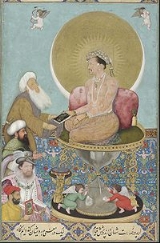
Jahangir (full title:
Al-Sultan al-'Azam wal Khaqan al-Mukarram, Khushru-i-Giti Panah, Abu'l-Fath Nur-ud-din Muhammad Jahangir Padshah Ghazi [Jannat-Makaani]) (20 September 1569 – 8 November 1627) was the ruler of the
Mughal EmpireThe Mughal Empire , or Mogul Empire in traditional English usage, was an imperial power from the Indian Subcontinent. The Mughal emperors were descendants of the Timurids...
from 1605 until his death. The name Jahangir is from
PersianPersian is an Iranian language within the Indo-Iranian branch of the Indo-European languages. It is primarily spoken in Iran, Afghanistan, Tajikistan and countries which historically came under Persian influence...
جهانگیر,meaning "Conqueror of the World". Nur-ud-din or Nur al-Din is an Arabic name which means " Light of the Faith." Born as Prince Muhammad Salim, he was the third and eldest surviving son of Mogul Emperor Akbar. Akbar's twin sons, Hasan and Hussain, died in infancy. His mother was the
RajputA Rajput is a member of one of the patrilineal clans of western, central, northern India and in some parts of Pakistan. Rajputs are descendants of one of the major ruling warrior classes in the Indian subcontinent, particularly North India...
Princess of Amber,
Jodhabai Mariam uz-Zamani Begum Sahiba , née Rajkumari Hira Kunwari, alias Harkha Bai was a Rajput princess who became the Mughal Empress, after her marriage to Mughal Emperor Akbar...
(born Rajkumari Hira Kunwari, eldest daughter of Raja Bihar Mal or Bharmal, Raja of Amber, India).
Jahangir was a child of many prayers.
It is said to be by the blessing of Shaikh Salim Chishti (one of the revered sages of his times) that Akbar's first surviving child, the future Jahangir, was born. The child was named Salim after the dervish and was affectionately addressed by Akbar as Sheikhu Baba.
Akbar developed an emotional attachment with the village Sikri (abode of Chishti). Therefore, he developed the town of Sikri and shifted his imperial court and residence from Agra to Sikri, later renamed as Fatehpur Sikri. Shaikh Salim Chishti's daughter was Jahangir's foster mother, this was gesture of respect and gratitude to the Shaikh. Jahangir's foster brother Nawab Kutb-ud-din Khan was private secretary to the emperor Jahangir and afterwards governor of Bengal. Nawab Kutb-ud-din Khan's son Nawab Mohtashim Khan was granted by Jahangir 4,000 bigas of land in Badaun District (United Provinces) where he built a small fort named
Sheikhupur, Badaun-Location:The town of Sautbad, known as Sheikhupur is located at a distance of about 4 km. from the centre of Badaun city across the river Saut. In real it is just 1 km away from Budaun, it will be the part of the city in one year...
after Jahangir, who was called Sheikhu-baba in his childhood.
Revolt
In 1600, when Akbar was away from the capital on an expedition, Salim broke into an open rebellion, and declared himself Emperor. Akbar had to hastily return to
AgraAgra a.k.a. Akbarabad is a city on the banks of the river Yamuna in the northern state of Uttar Pradesh, India, west of state capital, Lucknow and south from national capital New Delhi. With a population of 1,686,976 , it is one of the most populous cities in Uttar Pradesh and the 19th most...
and restore order. There was a time when Akbar thought of putting his eldest grandson
Khusrau MirzaKhusrau Mirza was the eldest son of the Mughal emperor Jahangir. His mother Manbai or Shah Begam was a Kachhwaha princess and the daughter of Raja Bhagwant Das. Prince Khusrau was born in Lahore on August 16, 1587...
on the throne instead of Salim. Prince Salim forcefully succeeded to the throne on 3 November 1605, eight days after his father's death. Salim ascended to the throne with the title of Nur-ud-din Muhammad Jahangir Badshah Ghazi, and thus began his 22-year reign at the age of 36. Jahangir soon after had to fend off his son, Prince
Khusrau MirzaKhusrau Mirza was the eldest son of the Mughal emperor Jahangir. His mother Manbai or Shah Begam was a Kachhwaha princess and the daughter of Raja Bhagwant Das. Prince Khusrau was born in Lahore on August 16, 1587...
, when he attempted to claim the throne based on Akbar's will to become his next heir. Khusrau Mirza was defeated in 1606 and confined in the fort of
AgraAgra a.k.a. Akbarabad is a city on the banks of the river Yamuna in the northern state of Uttar Pradesh, India, west of state capital, Lucknow and south from national capital New Delhi. With a population of 1,686,976 , it is one of the most populous cities in Uttar Pradesh and the 19th most...
. As punishment Khusrau Mirza was blinded, and the
SikhA Sikh is a follower of Sikhism. It primarily originated in the 15th century in the Punjab region of South Asia. The term "Sikh" has its origin in Sanskrit term शिष्य , meaning "disciple, student" or शिक्ष , meaning "instruction"...
Guru Arjan (the religious fifth guru) tortured for five days until he had disappeared while taking a bath in a river—for giving the then fugitive Khusrau Mirza money when he visited Guru Arjan. Jahangir's rule was characterized by the same religious tolerance as his father Akbar, with the exception of his hostility with the Sikhs, which was forged so early on in his rule.
In 1622, Khurram (
Shah Jahan Shah Jahan Shah Jahan (also spelled Shah Jehan, Shahjehan, , Persian: شاه جهان) (January 5, 1592 – January 22, 1666) Shah Jahan (also spelled Shah Jehan, Shahjehan, , Persian: شاه جهان) (January 5, 1592 – January 22, 1666) (Full title: His Imperial Majesty Al-Sultan al-'Azam wal Khaqan...
), younger brother of Khusrau Mirza, had Khusrau murdered in a conspiracy to eliminate all possible contenders to the throne. Taking advantage of this internal conflict, the Persians seized the city of
KandaharKandahar is the second largest city in Afghanistan, with a population of about 512,200 as of 2011. It is the capital of Kandahar Province, located in the south of the country at about 1,005 m above sea level...
and as a result of this loss, the Mughals lost control over the trade routes to Afghanistan, Persian and Central Asia and also exposed India to invasions from the north-west.
Reign
An aesthete, Jahangir decided to start his reign with a grand display of "Justice", as he saw it. To this end, he enacted Twelve Decrees that are remarkable for their liberalism and foresight. During his reign, there was a significant increase in the size of the Mughal Empire, half a dozen rebellions were crushed, prisoners of war were released, and the work of his father, Akbar, continued to flourish. Much like his father, Jahangir was dedicated to the expansion of Mughal held territory through conquest. During this regime he would target the peoples of Assam near the eastern frontier and bring a series of territories controlled by independent rajas in the Himalayan foothills from Kashmir to Bengal. Jahangir would challenge the hegemonic claim over
AfghanistanAfghanistan , officially the Islamic Republic of Afghanistan, is a landlocked country located in the centre of Asia, forming South Asia, Central Asia and the Middle East. With a population of about 29 million, it has an area of , making it the 42nd most populous and 41st largest nation in the world...
by the Safavid rulers with an eye on Kabul, Peshawar and Kandahar which were important centers of the central Asian trade system that northern India operated within. In 1622 Jahangir would send his son Prince Khurram against the combined forces of
Ahmednagar,
BijapurThe Adil Shahi or Adilshahi dynasty ruled the Sultanate of Bijapur in the Western area of the Deccan region of Southern India from 1490 to 1686. Bijapur had been a province of the Bahmani Sultanate , before its political decline in the last quarter of the 15th century and eventual break-up in 1518...
and
GolcondaGolconda may be:Places:* Golkonda, ruined city and fortress in India* Golconda, Illinois, town in the United States* Golconda, Nevada, former town in the United StatesOther:* Golconda...
. After his victory Khurram would turn against his father and make a bid for power. As with the insurrection of his eldest son Khusraw, Jahangir was able to defeat the challenge from within his family and retain power.
Jahangir promised to protect Islam and granted general amnesty to his opponents. He was also notable for his patronage of the arts, especially of painting. During his reign the distinctive style of Mughal painting expanded and blossomed. Jahangir supported a flourishing culture of court painters.
Jahangir is most famous for his golden "chain of justice." The chain was setup as a link between his people and Jahangir himself. Standing outside the castle of Agra with sixty bells, anyone was capable of pulling the chain and having a personal hearing from Jahangir himself.
Furthermore, Jahangir preserved the Mughal tradition of having a highly centralized form of government. The son of a
HinduHindu refers to an identity associated with the philosophical, religious and cultural systems that are indigenous to the Indian subcontinent. As used in the Constitution of India, the word "Hindu" is also attributed to all persons professing any Indian religion...
Rajput mother who converted to Islam, Jahangir made the precepts of
Sunni IslamSunni Islam is the largest branch of Islam. Sunni Muslims are referred to in Arabic as ʾAhl ūs-Sunnah wa āl-Ǧamāʿah or ʾAhl ūs-Sunnah for short; in English, they are known as Sunni Muslims, Sunnis or Sunnites....
the cornerstone of his state policies. A faithful Muslim, as evidenced by his memoirs, he expressed his gratitude to Allah for his many victories. Jahangir, as a devout Muslim, did not let his personal beliefs dictate his state policies. Sovereignty, according to Jahangir, was a "gift of God" not necessarily given to enforce God's law but rather to "ensure the contentment of the world." In civil cases, Islamic law applied to Muslims, Hindu law applied to Hindus, while criminal law was the same for both Muslims and Hindus. In matters like marriage and inheritance, both communities had their own laws that Jahangir respected. Thus Jahangir was able to deliver justice to people in accordance of their beliefs, and also keep his hold on empire by unified criminal law. In the Mughal state, therefore, defiance of imperial authority, whether coming from a prince or anyone else aspiring to political power, or a Muslim or a Hindu, was crushed in the name of law and order.
Jahangir's relationship with other rulers of the time is one that was well documented by Sir Thomas Roe, especially his relationship with the Persian King, Shah Abbas. Though conquest was one of Jahangir's many goals, he was a naturalist and lover of the arts and did not have quite the same warrior ambition of the Persian king. This led to a mutual enmity that, while diplomatically hidden, was very clear to observers within Jahangir's court. Furthermore, Abbas had, for many years, been trying to recover the city of Kandahar, which Jahangir was not keen to part with, especially to this king whom he did not particularly care for, despite seeing him as an equal.
In this state, Jahangir was also open to the influence of his wives, a weakness exploited by many. Because of this constant inebriated state, Nur Jahan, the favourite wife of Jahangir, became the actual power behind the throne.
Marriage
Salim was made a
MansabdarMansabdar was the generic term for the military -type grading of all imperial officials of the Mughal Empire. The mansabdars governed the empire and commanded its armies in the emperor's name...
of ten thousand (Das-Hazari), the highest military rank of the empire, after the emperor. He independently commanded a regiment in the
KabulKabul , spelt Caubul in some classic literatures, is the capital and largest city of Afghanistan. It is also the capital of the Kabul Province, located in the eastern section of Afghanistan...
campaign of 1581, when he was barely twelve. His Mansab was raised to Twelve Thousand, in 1585, at the time of his betrothal to his cousin Manbhawati Bai, daughter of Bhagwan Das of
Amber. Raja Bhagwant Das, was the son of
Raja BharmalRaja Bharmal or Biharimal was a Kachwaha ruler of Amber which was later known as Jaipur in the present day Rajasthan state of India. Bharmal is more known for marrying his daughter, Heera Kunwar or Mariam-us-Zamani to the Mughal emperor Akbar in 1562...
and the brother of Akbar's wife Rajkumari Hira Kunwari, also known as Mariam Zamani.
The marriage with Manbhawati Bai took place on 13 February 1585. Manbhawati gave birth to
Khusrau MirzaKhusrau Mirza was the eldest son of the Mughal emperor Jahangir. His mother Manbai or Shah Begam was a Kachhwaha princess and the daughter of Raja Bhagwant Das. Prince Khusrau was born in Lahore on August 16, 1587...
. Thereafter, Salim was allowed to marry, in quick succession, a number of accomplished girls from the aristocratic Mughal and Rajput families. One of his favourite wives was a Rajput Princess, known as Jagat Gosain and
Princess ManmatiPrincess Manmati, Taj Bibi Bilqis Makani Begum Sahiba Jodh Bai, née Rajkumari Shri Manavati Baiji Lall Sahiba was a lady of Rajput birth who became the wife of Mughal Emperor Jahangir and mother of Mughal Emperor Shah Jahan.Manmati was born the daughter of Raja Shri Udai Singhji Sahib Bahadur ,...
, who gave birth to Prince Khurram, the future
Shah Jahan Shah Jahan Shah Jahan (also spelled Shah Jehan, Shahjehan, , Persian: شاه جهان) (January 5, 1592 – January 22, 1666) Shah Jahan (also spelled Shah Jehan, Shahjehan, , Persian: شاه جهان) (January 5, 1592 – January 22, 1666) (Full title: His Imperial Majesty Al-Sultan al-'Azam wal Khaqan...
, Jahangir's successor to the throne. The total number of wives in his harem was more than eight hundred.
Jahangir married the extremely beautiful and intelligent Mehr-ul-Nisa (better known by her subsequent title of Nur Jahan), in May 1611. She was the widow of Sher Afghan. She was witty, intelligent and beautiful, which was what attracted Jahangir to her. Before being awarded the title of Nur Jahan ('Light of the World'), she was called Nur Mahal ('Light of the Palace'). Her abilities are said to range from fashion designing to hunting. There is also a myth that she had once killed four tigers with six bullets.
Nur Jahan
The story of Nur Jahan occupies an important place in the history of Jahangir. She was the widow of a rebel officer, Sher Afghan, of Mughals. The governor of
BengalBengal is a historical and geographical region in the northeast region of the Indian Subcontinent at the apex of the Bay of Bengal. Today, it is mainly divided between the sovereign land of People's Republic of Bangladesh and the Indian state of West Bengal, although some regions of the previous...
was killed by him and consequently he suffered the same fate at the hands of the guards of the Governor. His widow, Mehr-un-Nisaa, was brought to Agra and placed in—or refused to be placed in—the Royal harem in 1607. Jahangir married her in 1611 and gave her the title of Nur Jahan or "Light of the World". Jahangir was rumored to have had a hand in the death of her husband. But there is no evidence to prove that he was guilty of that crime; in fact most travelers' reports say that he met her after Sher Afghan's death. (See Ellison Banks Findly's scholarly biography for a full discussion.)
According to poet and author Vidya Dhar Mahajan, Nur Jahan had a piercing intelligence, a versatile temper and sound common sense. She possessed great physical strength and courage. She went on hunting tours with her husband, and on more than one occasion shot and killed ferocious tigers. She was devoted to Jahangir and he forgot all about the world and entrusted all the work of the government to her.
The loss of Kandahar was due to Prince Khurram's refusal to obey her orders. When the Persians besieged Kandahar, Nur Jahan was at the helm of affairs. She ordered Prince Khurram to march for Kandahar, but the latter refused to do so. There is no doubt that the refusal of the prince was due to her behaviour towards him. She was favouring her son-in-law, Shahryar, at the expense of Khurram. Khurram suspected that in his absence, Shahryar might be given promotion and he might die on the battlefield. It was this fear which forced Khurram to rebel against his father rather than fight against the Persians and thereby Kandahar was lost to the Persians.
Nur Jahan struck coins in her own name during the last years of Jahangir's reign when he was taken ill.
Conquests
In the year 1594 Jahangir's was dispatched by his father the Mughal Emperor Akbar, alongside
Abdul Hasan Asaf KhanAbdul Hasan Asaf Khan was the father of Arjumand Banu Begum, also known as Mumtaz Mahal, who was the wife of the Mughal Emperor Shah Jahan, the Emperor of India. Asaf Khan was also the elder brother of Mehrunissa, , the empress of Shah Jahan's father, Jahangir. Many scholars have been researching...
and
Abu'l-Fazl ibn MubarakShaikh Abu al-Fazl ibn Mubarak also known as Abu'l-Fazl, Abu'l Fadl and Abu'l-Fadl 'Allami was the vizier of the great Mughal emperor Akbar, and author of the Akbarnama, the official history of Akbar's reign in three volumes, and a Persian translation of the Bible...
to defeat the renegade
Vir Singh DeoVir Singh Deo was a Bundela Rajput chief and the ruler of the kingdom of Orchha during Jahangir's reign as the Mughal emperor of India. He was an ally of Jahangir's in the latter's struggles against his father, Akbar. Vir Singh killed Abu'l-Fazl ibn Mubarak, an adviser of Akbar's in 1602....
of
BandelaBandelє is a village Garwula District, Grand Cape Mount, in north-west Liberia.As of January, 2006, the population was approximately 1,165. The area was settled by the Bande clan of the Mende people. Residents speak a dialect of the Mende language called Bandi...
and capture the city of
OrchhaOrchha is a town in Tikamgarh district of Madhya Pradesh state, India. The town was established by Maharaja Rudra Pratap Singh in 1501, as the seat of an eponymous former princely state of central India, in the Bundelkhand region. Orchha lies on the Betwa River , 80 km from Tikamgarh &...
, which was considered the center of the revolt. Jahangir arrived with a force of 12,000 after many ferocious encounters and the Battle of Orchha, Jahangir finally subdued the
BandelaBandelє is a village Garwula District, Grand Cape Mount, in north-west Liberia.As of January, 2006, the population was approximately 1,165. The area was settled by the Bande clan of the Mende people. Residents speak a dialect of the Mende language called Bandi...
and ordered
Vir Singh DeoVir Singh Deo was a Bundela Rajput chief and the ruler of the kingdom of Orchha during Jahangir's reign as the Mughal emperor of India. He was an ally of Jahangir's in the latter's struggles against his father, Akbar. Vir Singh killed Abu'l-Fazl ibn Mubarak, an adviser of Akbar's in 1602....
to surrender. After tremendous casualties and the start of negotiations between the two, Vir Singh Deo handed over 5000 Bundela infantry and 1000 cavalry but he feared
MughalThe Mughal Empire , or Mogul Empire in traditional English usage, was an imperial power from the Indian Subcontinent. The Mughal emperors were descendants of the Timurids...
retaliation and remained a fugitive until his death. The victorious Jahangir Only 16 years of age, ordered the completion of the
Jahangir MahalJahangir Mahal, Citadel of Jahangir, Orchha Palace, Mahal-e-Jahangir Orchha, Jahangir Citadel; the Jahangir Mahal is a citadel and garrison located Orchha, it was completed in the year 1598 by the victorious Mughal Prince Salem after defeating Vir Singh Deo of Bundela a sworn enemy of the Mughals,...
a famous
MughalThe Mughal Empire , or Mogul Empire in traditional English usage, was an imperial power from the Indian Subcontinent. The Mughal emperors were descendants of the Timurids...
citadel in
OrchhaOrchha is a town in Tikamgarh district of Madhya Pradesh state, India. The town was established by Maharaja Rudra Pratap Singh in 1501, as the seat of an eponymous former princely state of central India, in the Bundelkhand region. Orchha lies on the Betwa River , 80 km from Tikamgarh &...
to commemorate and honor his victory.
In the year 1613 the
PortuguesePortuguese is an adjective referring to matters related to Portugal. It may refer to:* Portuguese language, natively spoken in Portugal, Brazil, Angola, Mozambique, Cape Verde, East Timor and other countries**including Portuguese dialects...
, seized the
MughalMughal, a word related to the Mongols, may refer to the:* Mughal Empire of South Asia* Mughal emperors* Mughal , the central Asian tribe from which the rulers of the Mughal Empire hailed* Mughal architecture* Mughal painting* Mughlai cuisine...
ship
Rahimi, which had set out from
SuratSurat , also known as Suryapur, is the commercial capital city of the Indian state of Gujarat. Surat is India's Eighth most populous city and Ninth-most populous urban agglomeration. It is also administrative capital of Surat district and one of the fastest growing cities in India. The city proper...
on its way with a large cargo of 100,000 rupees and Pilgrims, who were on their way to
MeccaMecca is a city in the Hijaz and the capital of Makkah province in Saudi Arabia. The city is located inland from Jeddah in a narrow valley at a height of above sea level...
and
MedinaMedina , or ; also transliterated as Madinah, or madinat al-nabi "the city of the prophet") is a city in the Hejaz region of western Saudi Arabia, and serves as the capital of the Al Madinah Province. It is the second holiest city in Islam, and the burial place of the Islamic Prophet Muhammad, and...
in order to attend the annual
HajjThe Hajj is the pilgrimage to Mecca, Saudi Arabia. It is one of the largest pilgrimages in the world, and is the fifth pillar of Islam, a religious duty that must be carried out at least once in their lifetime by every able-bodied Muslim who can afford to do so...
. Jahangir was outraged by the capture of the ship and the captivity of its crew and guests. The Mughal Emperor Jahangir, ordered the apprehension of all
PortuguesePortuguese is an adjective referring to matters related to Portugal. It may refer to:* Portuguese language, natively spoken in Portugal, Brazil, Angola, Mozambique, Cape Verde, East Timor and other countries**including Portuguese dialects...
within the
Mughal EmpireThe Mughal Empire , or Mogul Empire in traditional English usage, was an imperial power from the Indian Subcontinent. The Mughal emperors were descendants of the Timurids...
, he further confiscated
ChurchIn the Christian religion, a church building is a building or structure whose primary purpose is to facilitate the meeting of a church. Originally, Jewish Christians met in synagogues, such as the Cenacle, and in one another's homes, known as house churches...
es that belonged to the Jesuits.
Jahangir was responsible for ending a century long struggle with the state of
MewarMewar is a region of south-central Rajasthan state in western India. It includes the present-day districts of Pratapgarh, Bhilwara, Chittorgarh, Rajsamand, Udaipur, Dungarpur, Banswara and some of the part of Gujarat and Madhya Pradesh. The region was for centuries a Rajput kingdom that later...
. The campaign against the
RajputA Rajput is a member of one of the patrilineal clans of western, central, northern India and in some parts of Pakistan. Rajputs are descendants of one of the major ruling warrior classes in the Indian subcontinent, particularly North India...
s was pushed so extensively that the latter were made to submit and that too with a great loss of life and property. Jahangir also thought of capturing
Kangra FortThe Kangra Fort , , is located 20 kilometers from the town of Dharamsala on the outskirts of the town of Kangra, India. The fort was first mentioned in Alexander the Great's war records, referring to the 4th century BC.-History:...
, which Akbar had failed to do. Consequently a siege was laid, which lasted for fourteen months, and the fort was taken in 1620.
The district of Kistwar, in the state of
KashmirKashmir is the northwestern region of the Indian subcontinent. Until the mid-19th century, the term Kashmir geographically denoted only the valley between the Great Himalayas and the Pir Panjal mountain range...
, was also conquered.
Death
He was trying to restore it by visiting Kashmir and
KabulKabul , spelt Caubul in some classic literatures, is the capital and largest city of Afghanistan. It is also the capital of the Kabul Province, located in the eastern section of Afghanistan...
. He went from Kabul to Kashmir but returned to Lahore on account of a severe cold.
Jahangir died on the way back from Kashmir near Sarai Saadabad in 1627. To preserve his body, the entrails were removed and buried in the Chingus Fort, Kashmir. The body was then transferred to Lahore to be buried in
Shahdara BaghShahdara Bagh, is a northern suburb of Lahore, Pakistan. It is situated on the northern side of the Ravi River.Shahdara means Shah and dara means the way of kings. In the 15th century it was the gate entrance of the Lahore and Mughal Emperor...
, a suburb of
LahoreLahore is the capital of the Pakistani province of Punjab and the second largest city in the country. With a rich and fabulous history dating back to over a thousand years ago, Lahore is no doubt Pakistan's cultural capital. One of the most densely populated cities in the world, Lahore remains a...
,
PunjabPunjab is the most populous province of Pakistan, with approximately 45% of the country's total population. Forming most of the Punjab region, the province is bordered by Kashmir to the north-east, the Indian states of Punjab and Rajasthan to the east, the Pakistani province of Sindh to the...
. He was succeeded by his third son, Prince Khurram who took the title of
Shah Jahan Shah Jahan Shah Jahan (also spelled Shah Jehan, Shahjehan, , Persian: شاه جهان) (January 5, 1592 – January 22, 1666) Shah Jahan (also spelled Shah Jehan, Shahjehan, , Persian: شاه جهان) (January 5, 1592 – January 22, 1666) (Full title: His Imperial Majesty Al-Sultan al-'Azam wal Khaqan...
. Jahangir's elegant
mausoleumTomb of Jahangir, is the mausoleum built for the Mughal Emperor Jahangir who ruled from 1605 to 1627. The mausoleum is located near the town of Shahdara Bagh in Lahore, Pakistan. His son Shah Jahan built the mausoleum 10 years after his father's death. It is sited in an attractive walled garden....
is located in the Shahdara locale of Lahore and is a popular tourist attraction in Lahore.
Religion
While Sunni Islam was the state religion, there was not widespread pressure to convert; indeed, Jahangir specifically warned his nobles that they "should not force Islam on anyone.” In the first century of Islamic expansion this attitude was taken partially because of concerns that an absence of non-Muslims would deprive the state of a valuable source of revenue. However, as the jizya was not imposed by Jahangir, there might have been more behind this policy of toleration than mere economic reasoning. Jahangir was certainly willing to engage with other religions, and Edward Terry, an English chaplain in India at the time, saw a ruler under which "all Religions are tolerated and their Priests [held] in good esteem." Brahmins on the banks of the Ganges received gifts from the emperor, while following a meeting with Jadrup, a Hindu ascetic, Jahangir felt compelled to comment that "association with him is a great privilege." He enjoyed debating theological subtleties with Brahmins, especially about the possible existence of avatars. Both Sunnis and Shias were welcome at court, and members of both sects gained high office. When drunk, Jahangir swore to Sir Thomas Roe, England's first ambassador to the Mughal court, that he would protect all the peoples of the book.
But relations between the did turn tense in the year 1617 when
SirSir is an honorific used as a title , or as a courtesy title to address a man without using his given or family name in many English speaking cultures...
Thomas RoeSir Thomas Roe was an English diplomat of the Elizabethan and Jacobean periods. Roe was an accomplished scholar and a patron of learning.-Life:...
the Elizabethan
diplomatA diplomat is a person appointed by a state to conduct diplomacy with another state or international organization. The main functions of diplomats revolve around the representation and protection of the interests and nationals of the sending state, as well as the promotion of information and...
warned the Mughal Emperor Jahangir that if the young and charismatic son Prince
Shah Jahan Shah Jahan Shah Jahan (also spelled Shah Jehan, Shahjehan, , Persian: شاه جهان) (January 5, 1592 – January 22, 1666) Shah Jahan (also spelled Shah Jehan, Shahjehan, , Persian: شاه جهان) (January 5, 1592 – January 22, 1666) (Full title: His Imperial Majesty Al-Sultan al-'Azam wal Khaqan...
, the newly instated as the
SubedarSubedar is a historical rank in the Indian Army, ranking below British commissioned officers and above non-commissioned officers. The rank was otherwise equivalent to a British lieutenant and was introduced in the East India Company's presidency armies, to make it easier for British officers to...
of
Gujarat had turned the
EnglishEngland is a country that is part of the United Kingdom. It shares land borders with Scotland to the north and Wales to the west; the Irish Sea is to the north west, the Celtic Sea to the south west, with the North Sea to the east and the English Channel to the south separating it from continental...
out of the province,
"then he must expect we would do our justice upon the seas". Fearing the worst
Shah Jahan Shah Jahan Shah Jahan (also spelled Shah Jehan, Shahjehan, , Persian: شاه جهان) (January 5, 1592 – January 22, 1666) Shah Jahan (also spelled Shah Jehan, Shahjehan, , Persian: شاه جهان) (January 5, 1592 – January 22, 1666) (Full title: His Imperial Majesty Al-Sultan al-'Azam wal Khaqan...
sealed an official
FirmanA firman is a royal mandate or decree issued by a sovereign in certain historical Islamic states, including the Ottoman Empire, Mughal Empire, State of Hyderabad, and Iran under Shah Mohammed Reza Pahlavi. The word firman comes from the meaning "decree" or "order"...
allowing the English to trade in
Gujarat in the year 1618.
Many contemporary chroniclers were not even sure quite how to describe his personal belief structure.
RoeSir Thomas Roe was an English diplomat of the Elizabethan and Jacobean periods. Roe was an accomplished scholar and a patron of learning.-Life:...
labelled him an atheist, and although most others shied away from that term, they did not feel as though they could call him an orthodox Sunni. He relied greatly on astrologers (though that was not seen as unusual for a ruler at the time), even to the extent that he required that they work out the most auspicious time for the imperial camp to enter a city. Roe believed Jahangir's religion to be of his own making, "for he envies [the Prophet]Mahomett, and wisely sees no reason why he should not bee as great a prophet as he, and therefore professed himself so … he hath found many disciples that flatter or follow him." At this time, one of those disciples happened to be the current English ambassador, though his initiation into Jahangir's inner circle of disciples was devoid of religious significance for Roe, as he did not understand the full extent of what he was doing: Jahangir hung "a picture of him self set in gold hanging at a wire gold chain” round Roe's neck. Roe thought it "an especial favour, for that all the great men that wear the Kings image (which none may do but to whom it is given) receive no other then a medal of gold as big as six pence."
Had Roe intentionally converted, it would have caused quite a scandal in London. But since there was no intent, there was no resultant problem. Such disciples were an elite group of imperial servants, with one of them being promoted to Chief Justice. However, it is not clear that any of those who became disciples renounced their previous religion, so it is probable to see this as a way in which the emperor strengthened the bond between himself and his nobles. Despite Roe's somewhat casual use of the term 'atheist', he could not quite put his finger on Jahangir's real beliefs. Roe lamented that the emperor was either "the most impossible man in the world to be converted, or the most easy; for he loves to hear, and hath so little religion yet, that he can well abide to have any derided." Jahangir had continued his father’s fusion of aspects from a number of religions, while remaining as a Muslim. Akbar had given himself the right to make the final decision on all doctrinal matters, and began to establish his own religion, Din Ilahi (‘Divine Faith’). Broad toleration for other religions made little sense to Europeans forged in the heat of religious conflict, while the lifestyle and pretensions Jahangir afforded himself meant that it was difficult to see him as a devout Muslim. Sri Ram Sharma argues though that contemporaries and some historians have been too disparaging about Jahangir's beliefs, simply because he did not persecute non-believers and enforce his views on others.
This should not imply that the multi-confessional state appealed to all, or that all Muslims were happy with the situation in
IndiaIndia , officially the Republic of India , is a country in South Asia. It is the seventh-largest country by geographical area, the second-most populous country with over 1.2 billion people, and the most populous democracy in the world...
. In a book written on statecraft for Jahangir, the author advised him to direct "all his energies to understanding the counsel of the sages and to comprehending the intimations of the 'ulama." At the start of his regime many staunch Sunnis were hopeful, because he seemed less tolerant to other faiths than his father had been. At the time of his accession and the elimination of Abu'l Fazl, his father's chief minister and architect of his eclectic religious stance, a powerful group of orthodox noblemen had gained increased power in the Mughal court. Jahangir did not always benevolently regard some
HinduHindu refers to an identity associated with the philosophical, religious and cultural systems that are indigenous to the Indian subcontinent. As used in the Constitution of India, the word "Hindu" is also attributed to all persons professing any Indian religion...
customs and rituals. On visiting a
HinduHindu refers to an identity associated with the philosophical, religious and cultural systems that are indigenous to the Indian subcontinent. As used in the Constitution of India, the word "Hindu" is also attributed to all persons professing any Indian religion...
temple, he found a statue of a man with a pig's head, which was supposed to represent God, so he "ordered them to break that hideous form and throw it in the tank." If the Tuzuk is reliable on this subject (and there is no reason to suspect that it is not), then this was an isolated case.
J. F. Richards argues that "Jahangir seems to have been persistently hostile to popularly venerated religious figures,” which is debatable. Hindu ascetics like Jadrup were treated with respect, and it was only those who upset the order of the state that were seen as a threat to the state, with their popularity making them even more dangerous. A Muslim extremist, Ahmed Faruk-i Sirhindi, who had gained large followers by preaching that a more extreme form of Islam should be practiced, by, was imprisoned in Gwalior Fort.
Most notorious was the execution of the Sikh Guru Arjun Dev Ji. It is unclear that Jahangir even understood what a Sikh was, referring to Guru Arjun as a Hindu, who had "captured many of the simple-hearted of the Hindus, and even of the ignorant and foolish followers of Islam, by his ways and manners … for three or four generations (of spiritual successors) they had kept this shop warm." The trigger for Guru Arjun's execution was his support for Jahangir's rebel son Khusrau Mirza,yet it is clear from Jahangir's own memoirs that he disliked Guru Arjun before then: "many times it occurred to me to put a stop to this vain affair or bring him into the assembly of the people of Islam." Jahangir ordered his execution, but it is unlikely that he also ordered Guru Arjun to be tortured and converted, for two reasons; one, because we have no other examples from Jahangir's generally tolerant reign to support the idea that he forced people to convert to Islam, and two, because Jahangir makes no note of Guru Arjun's torture, yet cheerfully describes the torture of two other rebels, as well as Guru Arjun's execution. Jahangir maintained his hostility towards the Sikhs, imprisoning Guru Hargobind, the successor of Guru Arjun, for several years.
A rana was described as an infidel, but only because he was fighting against the Mughals, and infidel was used as an everyday phrase to describe all non-Muslims anyway. Admittedly Muslims were discouraged from performing most Hindu rites, with Jahangir lamenting that many Muslims prayed at a temple dedicated to
DurgaFor the 1985 Hindi Film of Rajesh Khanna see DurgaaIn Hinduism, Durga ; ; meaning "the inaccessible" or "the invincible"; , durga) or Maa Durga "one who can redeem in situations of utmost distress" is a form of Devi, the supremely radiant goddess, depicted as having eighteen arms, riding a lion...
, and worshipped at a black stone. With Jahangir himself occasionally taking part in
HinduHindu refers to an identity associated with the philosophical, religious and cultural systems that are indigenous to the Indian subcontinent. As used in the Constitution of India, the word "Hindu" is also attributed to all persons professing any Indian religion...
ceremonies, the aforementioned example was probably one way of showing support for the idea that
MuslimA Muslim, also spelled Moslem, is an adherent of Islam, a monotheistic, Abrahamic religion based on the Quran, which Muslims consider the verbatim word of God as revealed to prophet Muhammad. "Muslim" is the Arabic term for "submitter" .Muslims believe that God is one and incomparable...
and Hindus should not mix their rituals. His attitude to religion in his domain was relaxed yet diligent. He saw himself as doing
AllahAllah is a word for God used in the context of Islam. In Arabic, the word means simply "God". It is used primarily by Muslims and Bahá'ís, and often, albeit not exclusively, used by Arabic-speaking Eastern Catholic Christians, Maltese Roman Catholics, Eastern Orthodox Christians, Mizrahi Jews and...
's bidding, yet he was inquisitive enough to explore new ideas about religion, intelligent enough to understand that Hindus were in the majority and grand enough in his pretensions not to need to obey every line of the
Qur'anThe Quran , also transliterated Qur'an, Koran, Alcoran, Qur’ān, Coran, Kuran, and al-Qur’ān, is the central religious text of Islam, which Muslims consider the verbatim word of God . It is regarded widely as the finest piece of literature in the Arabic language...
.
Such a religious situation allowed the more recently arrived form of
ChristianityChristianity is a monotheistic religion based on the life and teachings of Jesus as presented in canonical gospels and other New Testament writings...
to have opportunity to grow. Jahangir did not seem to have anything against
ChristianityChristianity is a monotheistic religion based on the life and teachings of Jesus as presented in canonical gospels and other New Testament writings...
. He wrote fondly of Akbar's reign, when "Sunnis and Shias met in one mosque, and Franks and Jews in one church, and observed their own forms of worship." Roe noted that "of Christ he never utters any word unreverently." His prayer room in
AgraAgra a.k.a. Akbarabad is a city on the banks of the river Yamuna in the northern state of Uttar Pradesh, India, west of state capital, Lucknow and south from national capital New Delhi. With a population of 1,686,976 , it is one of the most populous cities in Uttar Pradesh and the 19th most...
contained pictures of "our Lady and Christ." In the imperial palace in
LahoreLahore is the capital of the Pakistani province of Punjab and the second largest city in the country. With a rich and fabulous history dating back to over a thousand years ago, Lahore is no doubt Pakistan's cultural capital. One of the most densely populated cities in the world, Lahore remains a...
, over one of the doors, according to William Finch, a merchant, was "the Picture of our Saviour," with an image of the Virgin Mary facing it. Elsewhere, the emperor had pictures of angels and demons, with the demons having a "most ugly shape, with long hornes, staring eyes … with such horrible difformity and deformity, that I wonder the poore women are not frightened therewith."
It is possible that Jahangir might have seen these images in their Islamic persona, as the
Qur'anThe Quran , also transliterated Qur'an, Koran, Alcoran, Qur’ān, Coran, Kuran, and al-Qur’ān, is the central religious text of Islam, which Muslims consider the verbatim word of God . It is regarded widely as the finest piece of literature in the Arabic language...
features such creatures, yet depiction of living things was haraam (forbidden), so the images could well have been created by a
ChristianA Christian is a person who adheres to Christianity, an Abrahamic, monotheistic religion based on the life and teachings of Jesus of Nazareth as recorded in the Canonical gospels and the letters of the New Testament...
artist. However, as
MughalThe Mughal Empire , or Mogul Empire in traditional English usage, was an imperial power from the Indian Subcontinent. The Mughal emperors were descendants of the Timurids...
art was still heavily Persian-influenced, images of living beings were allowed, and widespread, so perhaps the otherworldly images had nothing to do with
ChristianityChristianity is a monotheistic religion based on the life and teachings of Jesus as presented in canonical gospels and other New Testament writings...
at all; they nonetheless caught Finch's eye. Muqarrab Khan sent to Jahangir "a European curtain (tapestry) the like of which in beauty no other work of the Frank [European] painters has ever been seen." One of his audience halls was "adorned with European screens."
ChristianA Christian is a person who adheres to Christianity, an Abrahamic, monotheistic religion based on the life and teachings of Jesus of Nazareth as recorded in the Canonical gospels and the letters of the New Testament...
themes attracted Jahangir, and even merited a mention in the Tuzuk. One of his slaves gave him a piece of ivory into which had been carved four scenes. In the last scene "there is a tree, below which the figure of the revered (hazrat) Jesus is shown. One person has placed his head at Jesus' feet, and an old man is conversing with Jesus and four others are standing by." Though Jahangir believed it to be the work of the slave who presented it to him, Sayyid Ahmad and Henry Beveridge suggest that it was of European origin, and possibly showed the
TransfigurationThe Transfiguration of Jesus is an event reported in the New Testament in which Jesus is transfigured and becomes radiant upon a mountain. The Synoptic Gospels describe it, and 2 Peter 1:16-18 refers to it....
. Wherever it came from, and whatever it represented, it was clear that a European style had come to influence Mughal art, otherwise the slave would not have claimed it as his own design, nor would he have been believed by Jahangir.
There was even some baseless suggestion that Jahangir had converted to Christianity. Thrown by the religious tolerance of Akbar and Jahangir's rule, the Jesuits had long thought that they were always on the verge of conversion. Finch recounted how there "was much stirred with the King about Christianity, he affirming before his Nobles, that it was the soundest faith, and that of Mahomet lies and fables." This is an extremely implausible story, yet the fact that Finch told it at all shows the extent to which Christianity was evident in the Mughal court. Jahangir apparently allowed a Jesuit to teach some Indian boys Portuguese and elements of Christian doctrine, and the Jesuits were also allowed to open churches in Ahmedabad and Hooghly. Christians were allowed to openly celebrate Christmas, Easter and other such festivals, and the Jesuits were even given an allowance and gifts to carry on with their work, with a few Indians converting to Christianity. Given the toleration of Hinduism, such imperial leeway was not shocking. Christianity occupied a special place in Islamic canon, as did Isa (Jesus), who was considered to be amongst the greatest prophets.
What did surprise some observers was the forcible conversion of three sons of Jahangir's brother, Prince Daniyal, to Christianity, followed by a parade to celebrate their conversions. This was seen by the Jesuits as a gigantic step forward, but the English and the locals knew better. Hawkins dryly commented that Jahangir made his nephews Christian "not for any zeal he had to Christianity, as the [Jesuit] Fathers, and all Christians thought; but upon the prophecies of certain learned Gentiles [Hindus], who told him that the sons of his should be disinherited, and the children of his brother should reign. And therefore he did it, to make these children hateful to all Moores [Muslims]." This highlighted the effective limits of Christianity in India. Its inhabitants already had mono- and poly-theistic religions from which to choose, and the European Christians had done little to demonstrate the attractiveness of conversion. A few did convert, though Terry believed that this was only for Jesuit money, as they did not appear to know anything about their new religion, and Roe agreed on this matter. Even Jahangir's nephews were allowed to return to the Islamic fold, because "the King of Portugal sent them no presents nor wives." Christianity was tolerated because it posed no real threat. It certainly had an effect on the arts, but it is difficult to discern any other lasting impact on Mughal India.
Art
Jahangir was fascinated with art and architecture. Jahangir himself is far from modest in his autobiography when he states his prowess at being able to determine the artist of any portrait by simply looking at a painting . As he said:
-
-
- "…my liking for painting and my practice in judging it have arrived at such point when any work is brought before me, either of deceased artists or of those of the present day, without the names being told me, I say on the spur of the moment that is the work of such and such a man. And if there be a picture containing many portraits, and each face is the work of a different master, I can discover which face is the work of each of them. If any other person has put in the eye and eyebrow of a face, I can perceive whose work the original face is, and who has painted the eye and eyebrow."
Jahangir took his connoisseurship of art very seriously. Paintings created under his reign were closely catalogued, dated and even signed, providing scholars with fairly accurate ideas as to when and in what context many of the pieces were created, in addition to their aesthetic qualities.
He was not only an admirer of
ChristianA Christian is a person who adheres to Christianity, an Abrahamic, monotheistic religion based on the life and teachings of Jesus of Nazareth as recorded in the Canonical gospels and the letters of the New Testament...
artwork but also a purveyor of it. This was largely due to earlier Jesuit missions during his father's reign. Jesuits had brought with them various books, engravings, and paintings and, when they saw the delight Akbar held for them, sent for more and more of the same to be given to the Mughals, as they felt they were on the "verge of conversion," a notion which proved to be very false. Instead, both Akbar and Jahangir studied this artwork very closely and replicated and adapted it, adopting much of the early iconographic features and later the pictorial realism for which
RenaissanceThe Renaissance was a cultural movement that spanned roughly the 14th to the 17th century, beginning in Italy in the Late Middle Ages and later spreading to the rest of Europe. The term is also used more loosely to refer to the historical era, but since the changes of the Renaissance were not...
art was known. Jahangir was notable for his pride in the ability of his court painters. A classic example of this is described in Sir Thomas Roe's diaries, in which the Emperor had his painters copy a European miniature several times creating a total of five miniatures. Jahangir then challenged Roe to pick out the original from the copies, a feat Sir Thomas Roe could not do, to the delight of Jahangir.
Jahangir was also revolutionary in his adaptation of
EuropeEurope is, by convention, one of the world's seven continents. Comprising the westernmost peninsula of Eurasia, Europe is generally 'divided' from Asia to its east by the watershed divides of the Ural and Caucasus Mountains, the Ural River, the Caspian and Black Seas, and the waterways connecting...
an styles. A collection at the
British MuseumThe British Museum is a museum of human history and culture in London. Its collections, which number more than seven million objects, are amongst the largest and most comprehensive in the world and originate from all continents, illustrating and documenting the story of human culture from its...
in
LondonLondon is the capital city of :England and the :United Kingdom, the largest metropolitan area in the United Kingdom, and the largest urban zone in the European Union by most measures. Located on the River Thames, London has been a major settlement for two millennia, its history going back to its...
contains seventy-four drawings of Indian portraits dating from the time of Jahangir, including a portrait of the emperor himself. These portraits are a unique example of art during Jahangir's reign because before, and for sometime after, faces were not drawn full, head-on and including the shoulders as well as the head as these drawings are.
During his time, Jahangir also pioneered several ornate genealogies illustrated with portraits of each family member in the style of Italian
RenaissanceThe Renaissance was a cultural movement that spanned roughly the 14th to the 17th century, beginning in Italy in the Late Middle Ages and later spreading to the rest of Europe. The term is also used more loosely to refer to the historical era, but since the changes of the Renaissance were not...
painters. Jahangir's love for hunting met his love for art as he commissioned artists on multiple occasions to paint him while hunting and would even paint scenes himself, from time to time. Jahangir was also known for his vast collection of illuminated Persian albums that contained writings as well as paintings.
Science
Jahangir was a naturalist as well; he was not only a known birdwatcher or ornithologist but a keen observer of plants and animals as well. Tuzuk-i-Jahangiri (Memoirs of Jahangir) has his recorded observations. Even until the mid-nineteenth century zoologists were unaware of the
gestation periodFor mammals the gestation period is the time in which a fetus develops, beginning with fertilization and ending at birth. The duration of this period varies between species.-Duration:...
of elephants but Jahangir on the other hand had accurately estimated the gestation period of elephants to be 18 to 19 months in the early-seventeenth century itself. He gave the details of the pairing of sarus cranes and detailed descriptions of many Indian birds such as the hawk-cuckoo and animals such as the polecat. Once he was presented with a
DodoThe dodo was a flightless bird endemic to the Indian Ocean island of Mauritius. Related to pigeons and doves, it stood about a meter tall, weighing about , living on fruit, and nesting on the ground....
which was then depicted in a painting by his court painter. Also he used to record solar and lunar eclipses and the length of a comet's tail. He was also responsible for the cultivation of high-altitude trees on the plains. Once he conducted an experiment to show that the soil in Mahmudabad was healthier than in Ahmedabad (both in Gujarat). It was due to the efforts of Dr.
Salim AliSálim Moizuddin Abdul Ali was an Indian ornithologist and naturalist. Known as the "birdman of India", Salim Ali was among the first Indians to conduct systematic bird surveys across India and his bird books helped develop ornithology...
that these contributions of Jahangir were rediscovered.
In media
Nur-ud-din Salim Jahangir, his father
Akbar the GreatAkbar , also known as Shahanshah Akbar-e-Azam or Akbar the Great , was the third Mughal Emperor. He was of Timurid descent; the son of Emperor Humayun, and the grandson of the Mughal Emperor Zaheeruddin Muhammad Babur, the ruler who founded the Mughal dynasty in India...
and
AnarkaliAnarkali ; Anārkalī ) was a legendary slave girl from Lahore, Punjab . During the Mughal period, she was supposedly ordered to be buried alive between two walls by Mughal emperor Akbar for having an illicit relationship with the Prince Nuruddin Saleem later to become Emperor Jahangir...
, were portrayed in the
HindiStandard Hindi, or more precisely Modern Standard Hindi, also known as Manak Hindi , High Hindi, Nagari Hindi, and Literary Hindi, is a standardized and sanskritized register of the Hindustani language derived from the Khariboli dialect of Delhi...
film
Mughal-e-AzamMughal-E-Azam is a 1960 Indian historical epic film produced under the banner of Sterling Investment Corporation Pvt Ltd, and directed by K. Asif. With its unmatched production, K. Asif's magnum opus took nine years and $3 million to complete this movie. This was when a typical Bollywood film...
, in which Jahangir was played by
Dilip KumarDilip Kumar , is an Indian actor and a former Member of Parliament.He lives in Pali Hill, Bandra in Mumbai, India. He is commonly known as "Tragedy King",and is described as "the ultimate method actor" by Satyajit Ray....
.
Jalal AghaJalal Agha was an Indian actor and director in Bollywood films. Son of the popular comedian Agha, Jalal studied acting at the Film and Television Institute of India, Pune.-Career:...
also played the younger Jahangir at the start of the film.
See also
- Jahangirnama
- Anarkali
Anarkali ; Anārkalī ) was a legendary slave girl from Lahore, Punjab . During the Mughal period, she was supposedly ordered to be buried alive between two walls by Mughal emperor Akbar for having an illicit relationship with the Prince Nuruddin Saleem later to become Emperor Jahangir...
- Hiran Minar
Hiran Minar; Urdu: ہرن مینار is set in peaceful environs near Lahore in Sheikhupura, Pakistan. It was constructed by Emperor Jahangir as a monument to Mansraj, one of his pet deer....
- Tomb of Jahangir
Tomb of Jahangir, is the mausoleum built for the Mughal Emperor Jahangir who ruled from 1605 to 1627. The mausoleum is located near the town of Shahdara Bagh in Lahore, Pakistan. His son Shah Jahan built the mausoleum 10 years after his father's death. It is sited in an attractive walled garden....
- Sheikhupur, Badaun
-Location:The town of Sautbad, known as Sheikhupur is located at a distance of about 4 km. from the centre of Badaun city across the river Saut. In real it is just 1 km away from Budaun, it will be the part of the city in one year...
External links