
All Topics  
Sindhi language


   Email Print
   Bookmark   Link


Sindhi language


Sindhi (Arabic script: ????, Devanagari script: ??????, Sindhi) is the language of the Sindh
Sindh

Sindh is one of the four Subdivisions of Pakistan of Pakistan and historically is home to the Sindhi people. Different cultural and ethnic groups also reside in Sindh including Urdu-speaking Muslim refugees who migrated to Pakistan from India upon independence as well as the people migrated from other provinces after independence....
 region of Pakistan
Pakistan

Pakistan , officially the Islamic Republic of Pakistan, is a country located in South Asia and borders Central Asia and the Middle East. It has a 1,046 kilometre coastline along the Arabian Sea and Gulf of Oman in the south, and is bordered by Afghanistan and Iran in the west, India in the east and People's Republic of China in th...
. It is spoken by approximately 41 million people in Pakistan
Pakistan

Pakistan , officially the Islamic Republic of Pakistan, is a country located in South Asia and borders Central Asia and the Middle East. It has a 1,046 kilometre coastline along the Arabian Sea and Gulf of Oman in the south, and is bordered by Afghanistan and Iran in the west, India in the east and People's Republic of China in th...
, and is also spoken by a minority 12 million in India
India

India, officially the Republic of India , is a country in South Asia. It is the List of countries and outlying territories by total area country by geographical area, the List of countries by population country, and the most populous liberal democracy in the world....
; it is the third most spoken language of Pakistan, and the official language of Sindh in Pakistan. It has also been made an official language of India. The Government of Pakistan
Government of Pakistan

The Government of Pakistan is a federal parliamentary system, with an Indirect election President of Pakistan as the Head of State and Commander in Chief of the Military of Pakistan, and an indirectly-elected Prime Minister of Pakistan as the Head of Government....
 issues National Identity Cards to its citizens only in two languages, i.e.


Discussion
Ask a question about 'Sindhi language'
Start a new discussion about 'Sindhi language'
Answer questions from other users
Full Discussion Forum


Encyclopedia


Sindhi (Arabic script: ????, Devanagari script: ??????, Sindhi) is the language of the Sindh
Sindh

Sindh is one of the four Subdivisions of Pakistan of Pakistan and historically is home to the Sindhi people. Different cultural and ethnic groups also reside in Sindh including Urdu-speaking Muslim refugees who migrated to Pakistan from India upon independence as well as the people migrated from other provinces after independence....
 region of Pakistan
Pakistan

Pakistan , officially the Islamic Republic of Pakistan, is a country located in South Asia and borders Central Asia and the Middle East. It has a 1,046 kilometre coastline along the Arabian Sea and Gulf of Oman in the south, and is bordered by Afghanistan and Iran in the west, India in the east and People's Republic of China in th...
. It is spoken by approximately 41 million people in Pakistan
Pakistan

Pakistan , officially the Islamic Republic of Pakistan, is a country located in South Asia and borders Central Asia and the Middle East. It has a 1,046 kilometre coastline along the Arabian Sea and Gulf of Oman in the south, and is bordered by Afghanistan and Iran in the west, India in the east and People's Republic of China in th...
, and is also spoken by a minority 12 million in India
India

India, officially the Republic of India , is a country in South Asia. It is the List of countries and outlying territories by total area country by geographical area, the List of countries by population country, and the most populous liberal democracy in the world....
; it is the third most spoken language of Pakistan, and the official language of Sindh in Pakistan. It has also been made an official language of India. The Government of Pakistan
Government of Pakistan

The Government of Pakistan is a federal parliamentary system, with an Indirect election President of Pakistan as the Head of State and Commander in Chief of the Military of Pakistan, and an indirectly-elected Prime Minister of Pakistan as the Head of Government....
 issues National Identity Cards to its citizens only in two languages, i.e. Sindhi and Urdu
Urdu

Urdu is a Central_Indo-Aryan_languages#Central_Zone_.28Madhya_or_Hindi.29 Indo-Aryan languages of the Indo-Iranian languages, belonging to the Indo-European languages family of languages....
. Genealogically it is an Indo-Aryan language, though it also shows signs of heavy Dravidian
Dravidian

Dravidian may refer to the following about southern South Asia:* Dravidian languages, a language family comprising about 21 languages including the four literary languages spoken mainly in South India and North-Eastern Sri Lanka...
 influence. Most Sindhi speakers in Pakistan
Pakistan

Pakistan , officially the Islamic Republic of Pakistan, is a country located in South Asia and borders Central Asia and the Middle East. It has a 1,046 kilometre coastline along the Arabian Sea and Gulf of Oman in the south, and is bordered by Afghanistan and Iran in the west, India in the east and People's Republic of China in th...
 are concentrated in the Sindh
Sindh

Sindh is one of the four Subdivisions of Pakistan of Pakistan and historically is home to the Sindhi people. Different cultural and ethnic groups also reside in Sindh including Urdu-speaking Muslim refugees who migrated to Pakistan from India upon independence as well as the people migrated from other provinces after independence....
 province. The remaining speakers are found in India and amongst the Sindhi diaspora community which are scattered throughout the world. The Sindhi language has spread as the Hindu Sindhis left Sindh
Sindh

Sindh is one of the four Subdivisions of Pakistan of Pakistan and historically is home to the Sindhi people. Different cultural and ethnic groups also reside in Sindh including Urdu-speaking Muslim refugees who migrated to Pakistan from India upon independence as well as the people migrated from other provinces after independence....
 to migrate to the Hindu-majority India, during the Independence of Pakistan in 1947. The language is written in Devanagari
Devanagari

, or 'Nagari', is an abugida alphabet of India and Nepal. It is written from left to right, lacks distinct letter cases, and is recognizable by a distinctive horizontal line running along the tops of the letters that links them together....
 script by Sindhi Hindus; however, with the conversion of most Sindhis to Islam
Islam

Islam is a Monotheism, Abrahamic religion originating with the teachings of the Prophets of Islam Muhammad, a 7th century Arab religious and political figure....
, a modified Arabic
Arabic language

Arabic is a Central Semitic language, thus related to and classified alongside other Semitic languages languages such as Hebrew language and Aramaic language....
 script was produced. After the independence of both Pakistan and India from British rule
British Raj

British Raj primarily refers to the British rule in the Indian subcontinent between 1858 and 1947; it can also refer to the period of dominion, and even the region under the rule....
, the Government of India introduced Devanagari
Devanagari

, or 'Nagari', is an abugida alphabet of India and Nepal. It is written from left to right, lacks distinct letter cases, and is recognizable by a distinctive horizontal line running along the tops of the letters that links them together....
, alongside the official Arabic
Arabic language

Arabic is a Central Semitic language, thus related to and classified alongside other Semitic languages languages such as Hebrew language and Aramaic language....
 script, for writing Sindhi.

Geographical distribution

Sindhi is taught as a first language in the schools of Sindh and second language in Balochistan
Balochistan (Pakistan)

Balochistan, or Baluchistan, is a Subdivisions of Pakistan in Pakistan, the largest in the country by geographical area; it is slightly smaller than Norway....
 in Pakistan. In India, especially in the states of Maharashtra
Maharashtra

Maharashtra is a States and territories of India located on the western coast of India. Maharashtra is a part of Western India. It is India's List of states of India by area and List of states of India by population....
 & Gujarat
Gujarat

Gujarat is a States and territories of India in western India. Gujarat borders Pakistan to the north west and the state of Rajasthan to the north and northeast, Madhya Pradesh to the east, Maharashtra and the Union territory of Diu, Daman District, India, Dadra and Nagar Haveli to the south....
, many educational institutions managed by Sindhi community and in the schools of such society Sindhi is taught either as the medium of instruction or as a subject. Sindhi has a vast vocabulary; this has made it a favourite of many writers and consequently much literature and poetry have been written in Sindhi. Dialects of Sindhi are spoken in southern Punjab
Punjab (Pakistan)

The Punjab...
, Balochistan
Balochistan (Pakistan)

Balochistan, or Baluchistan, is a Subdivisions of Pakistan in Pakistan, the largest in the country by geographical area; it is slightly smaller than Norway....
, Northwest province of Pakistan (NWFP), and also Gujarat
Gujarat

Gujarat is a States and territories of India in western India. Gujarat borders Pakistan to the north west and the state of Rajasthan to the north and northeast, Madhya Pradesh to the east, Maharashtra and the Union territory of Diu, Daman District, India, Dadra and Nagar Haveli to the south....
, as well as in India (in the Rajasthan
Rajasthan

Rajasthan is the largest States and territories of India of the Republic of India in terms of area. It encompasses most of the area of the large, inhospitable Great Indian Desert , which has an edge paralleling the Sutlej-Indus river valley along its border with Pakistan....
 state).

History

The immediate predecessor of Sindhi was an Apabhramsha
Apabhramsha

Apabhra?sa is a terminology used by Sanskrit grammarians since Pata?jali to refer to dialects of North India that deviate from the norm of Sanskrit grammar....
 Prakrit
Prakrit

Prakrit refers to the broad family of the Indic languages and dialects spoken in ancient India. The Prakrits became literary languages, generally patronized by kings identified with the Kshatriya caste, but were regarded as illegitimate by the Brahmin orthodoxy....
 named Vrachada. Arab and Persian travellers, specifically Abu-Rayhan Biruni in his book 'Mal al-Hind', had declared that even before the advent of Islam in Sindh (711 A.D.), the language was prevalent in the region. It was not only widely spoken but written in three different scripts -- Ardhanagari, Saindhu and Malwari, all variations of Devanagari
Devanagari

, or 'Nagari', is an abugida alphabet of India and Nepal. It is written from left to right, lacks distinct letter cases, and is recognizable by a distinctive horizontal line running along the tops of the letters that links them together....
. Biruni has described many Sindhi words leading to the conclusion that the Sindhi language was widely spoken and rich in vocabulary in his time.

Sindhi was a very popular literary language between the 14th and 18th centuries. This is when sufis such as Shah Abdul Latif, Sachal Sarmast
Sachal Sarmast

Sachal Sarmast was a renowned Sindhi people Sufi poet during the Kalhora era. Abdul Wahab was his real name and "Sachal" was the name he used in his own poetry....
,Lal Shahbaz Qalandar (as well as numerous others) narrated their theosophical poetry depicting the relationship between humans and God.

During the British period, traders and common people -- including Khoja
Khoja

The Khwajahs or officially Khojas are an ethno-religious community that are mainly concentrated in South Asia, but due to migrations over the centuries have spread to many parts of the globe....
s and Memon
Memon

Memon an ethnic group tracing their roots largely to Sindh, Kutch and Kathiawar and are sometimes seen as transitional between the two regions....
s -- were using Devanagari, Modi or Vanika scripts, without any vowels for writing Sindhi, while government employees used some kind of Arabic script.

In 1849 the first English-Sindhi dictionary was written in the Devanagari script.

Basic Phrases

  • Keeyen aahyo?- "how are you?" (general greeting)
  • Aaon/Maa theek aahiyan - "Very well".
  • Tawhanjo naalo cha aahaye - "What is your name?"
  • Munhenjo naalo ______ aahaye. - "My name is _____."
  • Tawhan ker aahayo - "Who are you?"


  • Meherbani - "Thank you"
  • Meherbani karay - "Please"
  • Ha - "Yes"
  • Na - "No"
  • Keeyen ahyo/Kehra haal aahin - "How are you?"
  • Aaon/Maa teekh ahyaan - "I'm fine"
  • Allah wahi - "Goodbye" (used to end a conversation by Muslim Sindhis)
  • Theekh aahe- "Okay" (used to end a conversation by Hindu Sindhis)
  • Hik - "One"
  • Ba - "Two"
  • Tey - "Three"
  • Aaon/Maa Sindh jo aahya/ Aaon/Maa Sindh man ahyaa - "I am from Sindh"
  • Aaon/Maa musulman aahyan / hindhu aahyan - "I am Muslim / Hindu"
  • Aaon/Maa Sindhi aahya / Assin Sindhi aahyon - "I am Sindhi" / "We are Sindhis"
  • Allah Hafiz - "God bless you"
  • Ma thoke hik vado chamaat deendhus! - "I will give you a big slap"
  • Jeay Sindh- "Long Live Sindh"


Sounds

Sindhi has a large sound inventory. It has 46 distinctive consonant
Consonant

In articulatory phonetics, a consonant is a speech sound that is articulated with complete or partial closure of the upper vocal tract, the upper vocal tract being defined as that part of the vocal tract that lies above the larynx....
 phoneme
Phoneme

In human language, a phoneme is the smallest posited linguistically distinctive unit of sound. Phonemes carry no semantic content themselves. In theoretical terms, phonemes are not the physical segment s themselves, but cognitive abstractions or categorizations of them....
s (more than all the phonemes of English
English language

English is a West Germanic language that originated in Anglo-Saxon England and has lingua franca status in many parts of the world as a result of the military, economic, scientific, political and cultural influence of the British Empire in the 18th, 19th and early 20th centuries and that of the United States from the mid 20th century onwa...
 combined) and a further 16 vowel
Vowel

In phonetics, a vowel is a sound in spoken language, such as English ah! or oh! , pronounced with an open vocal tract so that there is no build-up of air pressure at any point above the glottis....
s. All plosives, affricates, nasals
Nasal consonant

A nasal consonant is produced with a lowered soft palate in the mouth, allowing air to escape freely through the nose. The oral cavity still acts as a resonance chamber for the sound, but the air does not escape through the mouth as it is blocked by the tongue....
, the retroflex flap
Retroflex flap

The retroflex flap is a type of consonantal sound, used in some Speech communication languages. The symbol in the International Phonetic Alphabet that represents this sound is , and the equivalent X-SAMPA symbol is r`....
 and the lateral approximant /l/ have aspirated
Aspiration (phonetics)

In phonetics, aspiration is the strong burst of Earth's atmosphere that accompanies either the release or, in the case of preaspiration, the closure of some obstruents....
 or breathy voice
Breathy voice

Breathy voice is a phonation in which the vocal cords vibrate, as they do in normal voicing, but are held further apart, so that a larger volume of air escapes between them....
d counterparts. The language also features four separate implosives.

Consonants

Labial
Labial consonant

Labials are consonants articulated either with both lips or with the lower lip and the upper teeth . English is a bilabial nasal consonant sonorant, and are bilabial stop consonant , and are labiodental fricative consonant....
(Denti-)
Alveolar
Alveolar consonant

Alveolar consonants are articulated with the tongue against or close to the superior alveolar ridge, which is called that because it contains the Dental alveolus of the superior teeth....
Retroflex
Retroflex consonant

In phonetics, retroflex consonants are consonant sounds used in some languages. The tongue is placed behind the alveolar ridge, and may even be curled back to touch the palate: that is, they are articulated in the postalveolar consonant to palatal consonant region of the mouth....
Palatoalveolar
/ Palatal
Palatal consonant

Palatal consonants are consonants articulated with the body of the tongue raised against the hard palate . Consonants with the tip of the tongue curled back against the palate are called retroflex consonant....
Velar
Velar consonant

Velars are consonants articulated with the back part of the tongue against the soft palate, the back part of the roof of the mouth, known also as the Soft palate)....
Glottal
Glottal consonant

Glottal consonants are consonants articulated with the glottis. Many phoneticians consider them, or at least the so-called fricatives, to be transitional states of the glottis without a point of articulation as other consonants have; in fact, some do not consider them to be consonants at all....
Nasal
Nasal consonant

A nasal consonant is produced with a lowered soft palate in the mouth, allowing air to escape freely through the nose. The oral cavity still acts as a resonance chamber for the sound, but the air does not escape through the mouth as it is blocked by the tongue....
m
m?
n
n?
?
??
? ? 
Plosives and
affricates
Affricate consonant

Affricate consonants begin as stop consonants but release as a fricative consonant rather than directly into the following vowel....
p
p?
b
b?
t?
t??
d?
d??
?
??
?
??
t??
t???
d??
d???
k
k?
g
g?
 
Implosives
Implosive consonant

Implosive consonants are stop consonant with a mixed glottalic ingressive and pulmonic egressive airstream mechanism. That is, the airstream is controlled by moving the glottis downward in addition to expelling air from the lungs....
  ?  ?     ? ~ j?  ? 
Fricatives
Fricative consonant

Fricatives are consonants produced by forcing air through a narrow channel made by placing two Place of articulation close together. These may be the lower lip against the upper teeth, in the case of ; the back of the tongue against the soft palate, in the case of German language , the final consonant of Bach; or the side of the tongue ag...
f   s z ?   x ?  
Taps  r ?
??
   
Approximants
Approximant consonant

Approximants are speech sounds that could be regarded as intermediate between vowels and "typical" consonants. In the articulation of approximants, articulatory organs produce a narrowing of the vocal tract, but leave enough space for air to flow without much audible turbulence....
? l?
l??
  j  


The retroflex consonants are apical postalveolar, as they are throughout northern India, and so could be transcribed . The affricates are laminal post-alveolars with a relatively short release. It is not clear if is similar, or truly palatal. is realized as labiovelar or labiodental in free variation
Free variation

Free variation in linguistics is the phenomenon of two sounds or forms appearing in the same environment without a change in meaning and without being considered incorrect by native speakers....
. occurs, but is not common, except before a stop ( etc).

Vowels

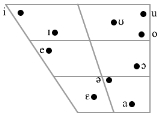
Sindhi Vowel Chart
The vowels are modal length and short . (Note are imprecisely transcribed as in the chart.) Consonants following short vowels are lengthened: 'leaf' vs. 'worn'.

Writing system


Arabic Script

In Pakistan
Pakistan

Pakistan , officially the Islamic Republic of Pakistan, is a country located in South Asia and borders Central Asia and the Middle East. It has a 1,046 kilometre coastline along the Arabian Sea and Gulf of Oman in the south, and is bordered by Afghanistan and Iran in the west, India in the east and People's Republic of China in th...
, Sindhi is written in a variant of the Persian alphabet, which was adopted under the encouragement of the British when Sindh fell to them in the 19th century. It has a total of 52 letters, augmenting the Persian with digraph
Digraph

Digraph may refer to:* Digraph , a pair of characters used to write one phoneme or a sequence of phonemes that does not correspond to the normal values of the two characters combined...
s and eighteen new letters, ? ,? ,? ,? ,? ,? ,? ,? ,? ,? ,? ,? ,? ,? ,? ,? ,? ,? for sounds particular to Sindhi and other Indo-Aryan languages. Some letters that are distinguished in Arabic or Persian are homophones in Sindhi.

?? ? ? ? ? ? ? ? ? ? ? ? ?
*
? ? ? ? ? ? ? ? ? ? ? ? ?
? ? ? ? ? ? ? ? ? ? ? ? ??
? ? ? ? ? ? ? ? ?? ? ? ? ?
* *


Devanagari Script

In India
India

India, officially the Republic of India , is a country in South Asia. It is the List of countries and outlying territories by total area country by geographical area, the List of countries by population country, and the most populous liberal democracy in the world....
, the Devanagari
Devanagari

, or 'Nagari', is an abugida alphabet of India and Nepal. It is written from left to right, lacks distinct letter cases, and is recognizable by a distinctive horizontal line running along the tops of the letters that links them together....
 script is used. It was re-introduced by the Government of India in 1948; however, it did not gain full acceptance, so both the Sindhi-Arabic and Devanagari scripts are used . Diacritic
Diacritic

A diacritic is a small sign added to a letter to alter pronunciation or to distinguish between similar words. The term derives from the Greek language d?a???t???? ....
al bars below the letter are used to mark implosive consonants, and dots
Dot (diacritic)

When used as a diacritic mark, the term dot is usually reserved for the Interpunct , or to the glyphs 'combining dot above' and 'combining dot below' which may be combined with some Letter s of the extended Latin alphabets in use in Central European languages and Vietnamese language....
 called nukta
Nukta

Nukta is a generic term for the diacritic mark in several Brahmic scripts, like Devanagari that is used to represent sounds from other languages by being applied to an existing character....
 are used to form other additional consonants.
? ? ? ? ? ? ? ? ? ?
? a i u? e o
? ? ?? ? ?? ?? ? ?
  
? ? ? ?? ?? ? ?
   
? ? ? ?? ?? ? ?? ?
  
? ? ? ? ?
   
? ? ?? ? ?? ? ?
  
? ? ? ?
? ? ? ?


See also

  • Sindhology
    Sindhology

    Sindhology is a field of study and academic research that covers the History of Sindh, Sindhi people, Sindh#Cultural heritage, and Sindhi literature of Sindh....
  • Institute of Sindhology
    Institute of Sindhology

    Institute of Sindhology is one of the major resource on history of Sindh. It was the first research institution of its discipline that brought Sindhology to the forefront of international research....
  • List of Sindhi-language films
    List of Sindhi-language films

    List of films produced in Sindhi cinema in Pakistan....
  • Languages of Pakistan
    Languages of Pakistan

    English language is the official language of Pakistan while Urdu language is the national language despite not being a native language or being the mother tongue of any native group in the country....
  • Provincial languages of Pakistan
    Provincial languages of Pakistan

    The Provincial languages of Pakistan are a set of languages that are spoken and used in the four Provinces of Pakistan, which are Punjab , Sindh, NWFP and Balochistan respectively....
  • Languages of India
    Languages of India

    The languages of India belong to several major Language family, the two largest being the Indo-European languages---Indo-Aryan languages and the Dravidian languages, ....
  • List of national languages of India
    List of national languages of India

    The Official languages of the Union of India are Hindi and English language; States in India can legislate their own official languages. Neither the Constitution of India, nor any Indian law defines any national language....
  • List of Indian languages by total speakers
    List of Indian languages by total speakers

    India is home to several hundred Languages of India. Most languages spoken in India belong either to the Indo-European languages , the Dravidian languages , the Austroasiatic languages , or the Tibeto-Burman languages families, with some languages of the Himalayas still unclassified....


External links

  • , Pakistan
  • Complete Sindhi Tipno, Patrika, Almanac, listing festivities, rituals related to Hindu Sindhi Culture


Sources

  • International Phonetic Association (1999) Handbook of the International Phonetic Association ISBN 0-521-63751-1*
  • with Devanagari equivalents
  • Trumpp P., Grammar of the Sindhi Language, Biblio Verlag, Osnabrück, Reprinted in 1970 (original edition 1872)