

Samma

Encyclopedia
The Samma Dynasty ruled in Sindh
and parts of Punjab
and Balochistan
from 1335-1520 AD, with their capital at Thatta
in modern Pakistan
before being replaced by the Arghun Dynasty
. The Samma dynasty has left its mark in Sindh with magnificent structures including the necropolis of kings and royalties in Thatta and many more ruins. stock.
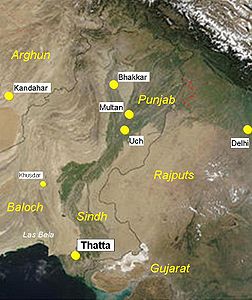
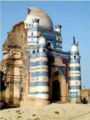 The Sindh is a fertile valley with a sub-tropical climate watered by the Indus river, the location of some of the oldest civilizations in the world, with settlements dating back to 7000 BCE. Always a prize possession, it has been controlled by many different empires, alternating with periods of independence. Before the Samma dynasty took control, the Sindh was ruled by the Soomra
, first as nominal vassals of the Fatimid Caliphate of Cairo
, later as vassals of the Delhi Sultanate
, which reached its greatest extent under Muhammad bin Tughluq
(c.1300–1351), but began to break up towards the end of his reign.
The Sammas, a Rajput tribe, gained control of Thatta
in the southern Sindh from the Sumras around 1335, and expanded their territory northward to Bhakkar
and beyond. Throughout the period of the Samma dynasty, Turkic
groups were pushing down from the northwest, including those led by Timur
(Tamerlane) who sacked Delhi in 1398, and later the Mughals who finally conquered Delhi under Babur
in 1526. The Sammas fought off these invaders until they were finally defeated by the Arghun Dynasty
, who had been displaced from Kandahar
in Afghanistan
by Babur, in 1519-1520 AD.
founder of the dynasty, Unar. The Sammas overthrew the Soomras soon after 1335 AD and the last Soomra ruler took shelter with the governor of Gujarat, under the protection of Muhammad bin Tughluq
, the sultan of Delhi. Mohammad bin Tughlaq made an expedition against Sindh in 1351 AD and died at Sondha, possibly in an attempt to restore the Soomras. With this, the Sammas became independent. The next sultan, Firuz Shah Tughlaq attacked Sindh in 1365 and 1367, unsuccessfully, but with reinforcements from Delhi he later obtained Banbhiniyo's surrender. The Samma dynasty overtook the Sumra dynasty and ruled Sindh during 1365-1521. Around that time, the Sindhi Swarankar community
returned from Kutch to their home towns in Sindh, and some settled empty land on the banks of Sindhu River near Dadu, Sindh. By the end of year 1500 AD, nearly the entire Sindhi Swarankar community had returned to Sindh. This period marks the beginning of Sufistic thought and teachings in Sindh.
For a period the Sammas were therefore subject to Delhi again. Later as the Sultanate of Delhi collapsed they became fully independent. During most of period of Samma rule, the Sindh was politically and economically tied to the Gujarat Sultanate
, with occasional periods of friction. Coins struck by the Samma dynasty show the titles "Sultan" and "Shah" as well as "Jam", the Jadeja
rulers of western gujrat also part of samma tribe and directly descended from Jam Unar, the first Samma sultan of sindh..
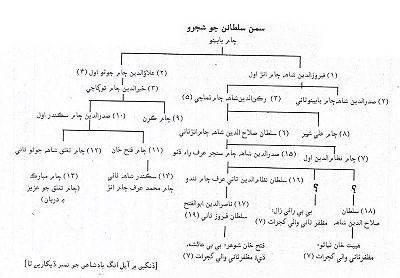 The Samma dynasty took the title "Jam", the equivalent of "King" or "Sultan", because they claimed to be descended from Jamshid
. This is almost certainly fictitious.
and Mir Ma'sum, all lacking in detail, and with conflicting information. A plausible reconstruction of the chronology is given in the History of Delhi Sultanate by M.H. Syed:
in 1003-4 AH/1595-6 CE, and continued until the beginning of Jahangir
’s reign, returning to his hometown in 1015 AH/1606-7 CE. He died shortly thereafter.
, the famous traveller from North Africa
(Ibn Battuta visited Sindh in 1333 AD, and saw Samma’s rebellion against Delhi government). Jam Unar, the Samma chief, taking advantage of the strained relation between the Soomra
and the Sultanate of Delhi, defeated the last Sumra ruler, son of Dodo, and established Sammatt rule.
About this time, Mirza
Pir Muhammad
one of Amir Timur
’s grandsons came to Multan
and conquered that town and Uch
. As he made a long stay there, most of the horses with him died of a disease and his horsemen were obliged to move about as foot-soldiers. When Amir Timur heard of this, he sent 30,000 horses from his own stables to his grandson to enable him to extend his conquests. Pir Muhammad, being thus equipped, attacked those of the zamindar
s who had threatened to do him harm and destroyed their household property. He then sent a messenger to Bakhar calling the chief men of the place to come and pay respects to him. But these men fearing his vengeance left the place in a body and went to Jesalmer. Only one solitary person, Sayyed Abulghais, one of the pious Sayyeds of the place, went to visit the Mirzá. He interceded for his town-people in the name of his great grandfather, the Prophet, and the Mirzá accepted his intercession.
Mirzá Pír Muhammad soon went to Delhi
, which place he took and where he was crowned as king. Multan
remained in the hands of Langáhs, and Sind in those of the Sammah rulers as before.
h to prevent any future rebellion of the kind. He died after a reign of 28 years.
Before long, however, his cousins, very ungratefully made a conspiracy among themselves and stealthily coming to the capital attempted to seize him. But Jám Saláhuddín learning their intention in time, left the place at the dead of night with a handful of men and made his escape to Gujrat
. In the morning, men were sent after him, but before any information could be brought about him, the people summoned Alísher, son of Jám Tamáchí, who was living in obscurity, and raised him to the throne. Meanwhile Jám Nizámuddín also died in his flight and his cousins too being disappointed in every thing, lived roving lives.
Jám Sanjar ruled the country very wisely. Under no ruler before this had the people of Sind enjoyed such ease of mind. He was very fond of the company of the learned and the pious. Every Friday he used to distribute charities and had fixed periodical allowances for those who deserved the same. He increased the pay of responsible officers. One Kází Maarúf, who had been appointed by the late rulers to be the Kází of Bakhar, was in the habit of receiving bribes from the plaintiffs as well as from the defendants. When this fact came to the notice of Jám Sanjar, he sent for the Kází and asked him about it. The Kází admitted the whole thing. “Yes” said he “I do demand something from the plaintiffs as well as the defendants, and I am anxious to get something from the witnesses too, but before the case closes, they go away and I am disappointed in that.” Jám Sanjar could not help laughing at this. The Kází continued “I work in the court for the whole day and my wife and children die of hunger at home, because I get very little pay.” Jám Sanjar increased his pay and issued general orders for the increase of every government post of importance.
in modern Pakistan. The Samma Sultanate reached the height of its power during the reign of Jam Nizamuddin II, who is still recalled as a hero, and his rule as a golden age.
Shortly after his accession, he went with a large force to Bhakkar
, where he spent about a year, during which time he extirpated the freebooters and robbers who annoyed the people in that part of the country. After that, for a period of forty-eight years he reigned at Tatta with absolute power.
In the last part of Jám Nindó’s reign, after 1490 CE, a Mughul army under Shah Beg Arghun came from Kandahar
and fell upon many villages of Chundooha and Sideejuh, invading the town of Ágrí, Ohándukah, Sibi Sindichah and Kót Máchián. Jám Nindó sent a large army under his Vazier Darya Khan[1], which, arriving at the village known by the name of Duruh-i-Kureeb, also known as Joolow Geer or Halúkhar near Sibi, defeated the Mughuls in a pitched battle. Sháh Beg Arghun’s brother Abú Muhammad Mirzá was killed in the battle, and the Mughuls fled back to Kandahár, never to return during the reign of Jám Nizámuddín[2].
Jam Nizamuddin's death was followed by a war of succession between the cousins Jam Feroz and Jam Salahuddin.
As a precautionary measure he enlisted in his service Kíbak Arghún and a large number of men belonging to the tribes of Mughuls, who had during his reign, left Sháhbeg Arghún and came to Tattá. Jám Feróz gave them the quarter of the town, called Mughal-Wárah to live in. He secretly flattered himself for his policy in securing the services of intrepid men to check Daryá Khán, but he never for a minute imagined what ruin these very men were destined to bring on him. For, it was through some of these men that Sháhbeg Arghún was induced to invade and conquer Sind in 926 AH (1519 AD) at the Battle of Fatehpur (1519)
, which resulted in the displacement of the Sammah dynasty of rulers by that of Arghún.
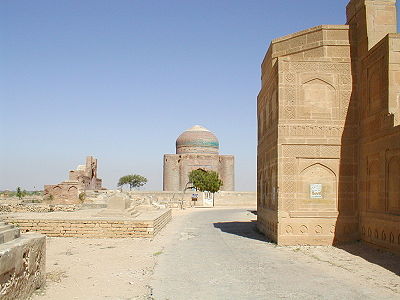 The rise of Thatta as an important commercial and cultural centre was directly related to Jam Ninda's patronage and policies. At the time the Portuguese took control
of the trading centre of Hormuz
in 1514 CE, trade from the Sindh accounted for nearly 10% of their customs revenue, and they described Thatta as one of the richest cities in the world. Thatta's prosperity was based partly on its own high-quality cotton and silk textile industry, partly on export of goods from further inland in the Punjab and northern India. However, the trade declined when the Mughals took over. Later, due to silting of the main Indus channel, Thatta no longer functioned as a port.
The Samma civilization contributed significantly to the evolution of the "Sindhi-Islamic" architectural style. Thatta is famous for its necropolis, which covers 10 square km on the Makli Hill
. It assumed its quasi-sacred character during Jam Ninda's rule. Every year thousands perform pilgrimage to this site to commemorate the saints buried here. The graves testify to a long period when Thatta was a thriving center of trade, religion and scholarly pursuits.
 Kalan Kot Fort (Urdu
: كلاں كوٹ قلعه, Old name Tughlikabad: جام تغلق آباد) was built probably in 14th century along with Thatta. Sámúí deserves notice from the attempt which has been made to establish it as the celebrated Minnagara of the ancient geographers. It was the capital of the Jáms of the Samma Dynasty, and, according to the Tuhfatu-l Kirám, it was founded by Jám Pániya,* under the Makli Hill
, about three miles north-west of Thatta
.
Subsequently, the fort of Tughlikábád was built by Jám Taghúr or Tughlik, on the site of the older Kalá-kot, about two miles south of Thatta; but that, as well as its predecessor, was left unfinished by its founder (p. 272). By a strange vicissitude, the name of Tughlikábád is now comparatively forgotten, and that of Kalá-kot erroneously called Kalán-kot (the great fort), though for a time superseded, has restored the just claims of Rájá Kalá, and still attracts the attention of the traveller. Lt. Burton calls it Kallián-kot. I fear to differ from so good a local authority, but believe Kalá-kot to be more strictly correct.
The ruins of Sámúí, Samúiya, or Samma-nagar, “the city of the Sammas,” are to be traced near Thatta; and, under the wrong and deceptive spelling of Sa-minagar, have induced Col. Tod, Sir A. Burnes, and many who have too readily followed them—including even Ritter, who considers the question settled “incontestably,”— to recognise in that name the more ancient and more famous Minna-gara. The easy, but totally unwarrantable, elision of the first and only important syllable has led to this fanciful identification.
. For a period of three years between 3 October 1952 and 14 October 1955, Las Bela was part of the Baluchistan States Union
but retained internal autonomy. In 1955, Las Bela was incorporated into the new province of West Pakistan
and became part of Kalat division
. In 1962, the area of Las Bela was detached from Kalat division and merged with the former Federal Capital Territory to form the division of Karachi-Bela
. When the provincial system was changed in 1970, Las Bela became part of the new province of Balochistan
.
After the demise of the Samma dynasty the Nawab
migrated along with his brothers and tribal members leaving their once thriving land of Nagar-Samma to parts of India
and settled in Gujrat
. A vast Village in Gujrat is now settled by the descendants of the 4 tribal leaders who were also blood brothers.
One of the brothers is recorded to have migrated back to Sindh and settled the lands on the outskirts of Thatta
known as Sikhaat - famous for its rose farms. The village in Gujrat Known also Nagar-Samma consists of many thousand of acres of cultivatable and non cultivatable land an accurate size is not known.
and parts of Punjab
and Balochistan
from 1335-1520 AD, with their capital at Thatta
in modern Pakistan
before being replaced by the Arghun Dynasty
. The Samma dynasty has left its mark in Sindh with magnificent structures including the necropolis of kings and royalties in Thatta and many more ruins. stock.
The Sindh is a fertile valley with a sub-tropical climate watered by the Indus river, the location of some of the oldest civilizations in the world, with settlements dating back to 7000 BCE. Always a prize possession, it has been controlled by many different empires, alternating with periods of independence. Before the Samma dynasty took control, the Sindh was ruled by the Soomra
, first as nominal vassals of the Fatimid Caliphate of Cairo
, later as vassals of the Delhi Sultanate
, which reached its greatest extent under Muhammad bin Tughluq
(c.1300–1351), but began to break up towards the end of his reign.
The Sammas, a Rajput tribe, gained control of Thatta
in the southern Sindh from the Sumras around 1335, and expanded their territory northward to Bhakkar
and beyond. Throughout the period of the Samma dynasty, Turkic
groups were pushing down from the northwest, including those led by Timur
(Tamerlane) who sacked Delhi in 1398, and later the Mughals who finally conquered Delhi under Babur
in 1526. The Sammas fought off these invaders until they were finally defeated by the Arghun Dynasty
, who had been displaced from Kandahar
in Afghanistan
by Babur, in 1519-1520 AD.
founder of the dynasty, Unar. The Sammas overthrew the Soomras soon after 1335 AD and the last Soomra ruler took shelter with the governor of Gujarat, under the protection of Muhammad bin Tughluq
, the sultan of Delhi. Mohammad bin Tughlaq made an expedition against Sindh in 1351 AD and died at Sondha, possibly in an attempt to restore the Soomras. With this, the Sammas became independent. The next sultan, Firuz Shah Tughlaq attacked Sindh in 1365 and 1367, unsuccessfully, but with reinforcements from Delhi he later obtained Banbhiniyo's surrender. The Samma dynasty overtook the Sumra dynasty and ruled Sindh during 1365-1521. Around that time, the Sindhi Swarankar community
returned from Kutch to their home towns in Sindh, and some settled empty land on the banks of Sindhu River near Dadu, Sindh. By the end of year 1500 AD, nearly the entire Sindhi Swarankar community had returned to Sindh. This period marks the beginning of Sufistic thought and teachings in Sindh.
For a period the Sammas were therefore subject to Delhi again. Later as the Sultanate of Delhi collapsed they became fully independent. During most of period of Samma rule, the Sindh was politically and economically tied to the Gujarat Sultanate
, with occasional periods of friction. Coins struck by the Samma dynasty show the titles "Sultan" and "Shah" as well as "Jam", the Jadeja
rulers of western gujrat also part of samma tribe and directly descended from Jam Unar, the first Samma sultan of sindh..
The Samma dynasty took the title "Jam", the equivalent of "King" or "Sultan", because they claimed to be descended from Jamshid
. This is almost certainly fictitious.
and Mir Ma'sum, all lacking in detail, and with conflicting information. A plausible reconstruction of the chronology is given in the History of Delhi Sultanate by M.H. Syed:
in 1003-4 AH/1595-6 CE, and continued until the beginning of Jahangir
’s reign, returning to his hometown in 1015 AH/1606-7 CE. He died shortly thereafter.
, the famous traveller from North Africa
(Ibn Battuta visited Sindh in 1333 AD, and saw Samma’s rebellion against Delhi government). Jam Unar, the Samma chief, taking advantage of the strained relation between the Soomra
and the Sultanate of Delhi, defeated the last Sumra ruler, son of Dodo, and established Sammatt rule.
About this time, Mirza
Pir Muhammad
one of Amir Timur
’s grandsons came to Multan
and conquered that town and Uch
. As he made a long stay there, most of the horses with him died of a disease and his horsemen were obliged to move about as foot-soldiers. When Amir Timur heard of this, he sent 30,000 horses from his own stables to his grandson to enable him to extend his conquests. Pir Muhammad, being thus equipped, attacked those of the zamindar
s who had threatened to do him harm and destroyed their household property. He then sent a messenger to Bakhar calling the chief men of the place to come and pay respects to him. But these men fearing his vengeance left the place in a body and went to Jesalmer. Only one solitary person, Sayyed Abulghais, one of the pious Sayyeds of the place, went to visit the Mirzá. He interceded for his town-people in the name of his great grandfather, the Prophet, and the Mirzá accepted his intercession.
Mirzá Pír Muhammad soon went to Delhi
, which place he took and where he was crowned as king. Multan
remained in the hands of Langáhs, and Sind in those of the Sammah rulers as before.
h to prevent any future rebellion of the kind. He died after a reign of 28 years.
Before long, however, his cousins, very ungratefully made a conspiracy among themselves and stealthily coming to the capital attempted to seize him. But Jám Saláhuddín learning their intention in time, left the place at the dead of night with a handful of men and made his escape to Gujrat
. In the morning, men were sent after him, but before any information could be brought about him, the people summoned Alísher, son of Jám Tamáchí, who was living in obscurity, and raised him to the throne. Meanwhile Jám Nizámuddín also died in his flight and his cousins too being disappointed in every thing, lived roving lives.
Jám Sanjar ruled the country very wisely. Under no ruler before this had the people of Sind enjoyed such ease of mind. He was very fond of the company of the learned and the pious. Every Friday he used to distribute charities and had fixed periodical allowances for those who deserved the same. He increased the pay of responsible officers. One Kází Maarúf, who had been appointed by the late rulers to be the Kází of Bakhar, was in the habit of receiving bribes from the plaintiffs as well as from the defendants. When this fact came to the notice of Jám Sanjar, he sent for the Kází and asked him about it. The Kází admitted the whole thing. “Yes” said he “I do demand something from the plaintiffs as well as the defendants, and I am anxious to get something from the witnesses too, but before the case closes, they go away and I am disappointed in that.” Jám Sanjar could not help laughing at this. The Kází continued “I work in the court for the whole day and my wife and children die of hunger at home, because I get very little pay.” Jám Sanjar increased his pay and issued general orders for the increase of every government post of importance.
in modern Pakistan. The Samma Sultanate reached the height of its power during the reign of Jam Nizamuddin II, who is still recalled as a hero, and his rule as a golden age.
Shortly after his accession, he went with a large force to Bhakkar
, where he spent about a year, during which time he extirpated the freebooters and robbers who annoyed the people in that part of the country. After that, for a period of forty-eight years he reigned at Tatta with absolute power.
In the last part of Jám Nindó’s reign, after 1490 CE, a Mughul army under Shah Beg Arghun came from Kandahar
and fell upon many villages of Chundooha and Sideejuh, invading the town of Ágrí, Ohándukah, Sibi Sindichah and Kót Máchián. Jám Nindó sent a large army under his Vazier Darya Khan[1], which, arriving at the village known by the name of Duruh-i-Kureeb, also known as Joolow Geer or Halúkhar near Sibi, defeated the Mughuls in a pitched battle. Sháh Beg Arghun’s brother Abú Muhammad Mirzá was killed in the battle, and the Mughuls fled back to Kandahár, never to return during the reign of Jám Nizámuddín[2].
Jam Nizamuddin's death was followed by a war of succession between the cousins Jam Feroz and Jam Salahuddin.
As a precautionary measure he enlisted in his service Kíbak Arghún and a large number of men belonging to the tribes of Mughuls, who had during his reign, left Sháhbeg Arghún and came to Tattá. Jám Feróz gave them the quarter of the town, called Mughal-Wárah to live in. He secretly flattered himself for his policy in securing the services of intrepid men to check Daryá Khán, but he never for a minute imagined what ruin these very men were destined to bring on him. For, it was through some of these men that Sháhbeg Arghún was induced to invade and conquer Sind in 926 AH (1519 AD) at the Battle of Fatehpur (1519)
, which resulted in the displacement of the Sammah dynasty of rulers by that of Arghún.
The rise of Thatta as an important commercial and cultural centre was directly related to Jam Ninda's patronage and policies. At the time the Portuguese took control
of the trading centre of Hormuz
in 1514 CE, trade from the Sindh accounted for nearly 10% of their customs revenue, and they described Thatta as one of the richest cities in the world. Thatta's prosperity was based partly on its own high-quality cotton and silk textile industry, partly on export of goods from further inland in the Punjab and northern India. However, the trade declined when the Mughals took over. Later, due to silting of the main Indus channel, Thatta no longer functioned as a port.
The Samma civilization contributed significantly to the evolution of the "Sindhi-Islamic" architectural style. Thatta is famous for its necropolis, which covers 10 square km on the Makli Hill
. It assumed its quasi-sacred character during Jam Ninda's rule. Every year thousands perform pilgrimage to this site to commemorate the saints buried here. The graves testify to a long period when Thatta was a thriving center of trade, religion and scholarly pursuits.
Kalan Kot Fort (Urdu
: كلاں كوٹ قلعه, Old name Tughlikabad: جام تغلق آباد) was built probably in 14th century along with Thatta. Sámúí deserves notice from the attempt which has been made to establish it as the celebrated Minnagara of the ancient geographers. It was the capital of the Jáms of the Samma Dynasty, and, according to the Tuhfatu-l Kirám, it was founded by Jám Pániya,* under the Makli Hill
, about three miles north-west of Thatta
.
Subsequently, the fort of Tughlikábád was built by Jám Taghúr or Tughlik, on the site of the older Kalá-kot, about two miles south of Thatta; but that, as well as its predecessor, was left unfinished by its founder (p. 272). By a strange vicissitude, the name of Tughlikábád is now comparatively forgotten, and that of Kalá-kot erroneously called Kalán-kot (the great fort), though for a time superseded, has restored the just claims of Rájá Kalá, and still attracts the attention of the traveller. Lt. Burton calls it Kallián-kot. I fear to differ from so good a local authority, but believe Kalá-kot to be more strictly correct.
The ruins of Sámúí, Samúiya, or Samma-nagar, “the city of the Sammas,” are to be traced near Thatta; and, under the wrong and deceptive spelling of Sa-minagar, have induced Col. Tod, Sir A. Burnes, and many who have too readily followed them—including even Ritter, who considers the question settled “incontestably,”— to recognise in that name the more ancient and more famous Minna-gara. The easy, but totally unwarrantable, elision of the first and only important syllable has led to this fanciful identification.
. For a period of three years between 3 October 1952 and 14 October 1955, Las Bela was part of the Baluchistan States Union
but retained internal autonomy. In 1955, Las Bela was incorporated into the new province of West Pakistan
and became part of Kalat division
. In 1962, the area of Las Bela was detached from Kalat division and merged with the former Federal Capital Territory to form the division of Karachi-Bela
. When the provincial system was changed in 1970, Las Bela became part of the new province of Balochistan
.
After the demise of the Samma dynasty the Nawab
migrated along with his brothers and tribal members leaving their once thriving land of Nagar-Samma to parts of India
and settled in Gujrat
. A vast Village in Gujrat is now settled by the descendants of the 4 tribal leaders who were also blood brothers.
One of the brothers is recorded to have migrated back to Sindh and settled the lands on the outskirts of Thatta
known as Sikhaat - famous for its rose farms. The village in Gujrat Known also Nagar-Samma consists of many thousand of acres of cultivatable and non cultivatable land an accurate size is not known.
and parts of Punjab
and Balochistan
from 1335-1520 AD, with their capital at Thatta
in modern Pakistan
before being replaced by the Arghun Dynasty
. The Samma dynasty has left its mark in Sindh with magnificent structures including the necropolis of kings and royalties in Thatta and many more ruins. stock.
The Sindh is a fertile valley with a sub-tropical climate watered by the Indus river, the location of some of the oldest civilizations in the world, with settlements dating back to 7000 BCE. Always a prize possession, it has been controlled by many different empires, alternating with periods of independence. Before the Samma dynasty took control, the Sindh was ruled by the Soomra
, first as nominal vassals of the Fatimid Caliphate of Cairo
, later as vassals of the Delhi Sultanate
, which reached its greatest extent under Muhammad bin Tughluq
(c.1300–1351), but began to break up towards the end of his reign.
The Sammas, a Rajput tribe, gained control of Thatta
in the southern Sindh from the Sumras around 1335, and expanded their territory northward to Bhakkar
and beyond. Throughout the period of the Samma dynasty, Turkic
groups were pushing down from the northwest, including those led by Timur
(Tamerlane) who sacked Delhi in 1398, and later the Mughals who finally conquered Delhi under Babur
in 1526. The Sammas fought off these invaders until they were finally defeated by the Arghun Dynasty
, who had been displaced from Kandahar
in Afghanistan
by Babur, in 1519-1520 AD.
founder of the dynasty, Unar. The Sammas overthrew the Soomras soon after 1335 AD and the last Soomra ruler took shelter with the governor of Gujarat, under the protection of Muhammad bin Tughluq
, the sultan of Delhi. Mohammad bin Tughlaq made an expedition against Sindh in 1351 AD and died at Sondha, possibly in an attempt to restore the Soomras. With this, the Sammas became independent. The next sultan, Firuz Shah Tughlaq attacked Sindh in 1365 and 1367, unsuccessfully, but with reinforcements from Delhi he later obtained Banbhiniyo's surrender. The Samma dynasty overtook the Sumra dynasty and ruled Sindh during 1365-1521. Around that time, the Sindhi Swarankar community
returned from Kutch to their home towns in Sindh, and some settled empty land on the banks of Sindhu River near Dadu, Sindh. By the end of year 1500 AD, nearly the entire Sindhi Swarankar community had returned to Sindh. This period marks the beginning of Sufistic thought and teachings in Sindh.
For a period the Sammas were therefore subject to Delhi again. Later as the Sultanate of Delhi collapsed they became fully independent. During most of period of Samma rule, the Sindh was politically and economically tied to the Gujarat Sultanate
, with occasional periods of friction. Coins struck by the Samma dynasty show the titles "Sultan" and "Shah" as well as "Jam", the Jadeja
rulers of western gujrat also part of samma tribe and directly descended from Jam Unar, the first Samma sultan of sindh..
The Samma dynasty took the title "Jam", the equivalent of "King" or "Sultan", because they claimed to be descended from Jamshid
. This is almost certainly fictitious.
and Mir Ma'sum, all lacking in detail, and with conflicting information. A plausible reconstruction of the chronology is given in the History of Delhi Sultanate by M.H. Syed:
in 1003-4 AH/1595-6 CE, and continued until the beginning of Jahangir
’s reign, returning to his hometown in 1015 AH/1606-7 CE. He died shortly thereafter.
, the famous traveller from North Africa
(Ibn Battuta visited Sindh in 1333 AD, and saw Samma’s rebellion against Delhi government). Jam Unar, the Samma chief, taking advantage of the strained relation between the Soomra
and the Sultanate of Delhi, defeated the last Sumra ruler, son of Dodo, and established Sammatt rule.
About this time, Mirza
Pir Muhammad
one of Amir Timur
’s grandsons came to Multan
and conquered that town and Uch
. As he made a long stay there, most of the horses with him died of a disease and his horsemen were obliged to move about as foot-soldiers. When Amir Timur heard of this, he sent 30,000 horses from his own stables to his grandson to enable him to extend his conquests. Pir Muhammad, being thus equipped, attacked those of the zamindar
s who had threatened to do him harm and destroyed their household property. He then sent a messenger to Bakhar calling the chief men of the place to come and pay respects to him. But these men fearing his vengeance left the place in a body and went to Jesalmer. Only one solitary person, Sayyed Abulghais, one of the pious Sayyeds of the place, went to visit the Mirzá. He interceded for his town-people in the name of his great grandfather, the Prophet, and the Mirzá accepted his intercession.
Mirzá Pír Muhammad soon went to Delhi
, which place he took and where he was crowned as king. Multan
remained in the hands of Langáhs, and Sind in those of the Sammah rulers as before.
h to prevent any future rebellion of the kind. He died after a reign of 28 years.
Before long, however, his cousins, very ungratefully made a conspiracy among themselves and stealthily coming to the capital attempted to seize him. But Jám Saláhuddín learning their intention in time, left the place at the dead of night with a handful of men and made his escape to Gujrat
. In the morning, men were sent after him, but before any information could be brought about him, the people summoned Alísher, son of Jám Tamáchí, who was living in obscurity, and raised him to the throne. Meanwhile Jám Nizámuddín also died in his flight and his cousins too being disappointed in every thing, lived roving lives.
Jám Sanjar ruled the country very wisely. Under no ruler before this had the people of Sind enjoyed such ease of mind. He was very fond of the company of the learned and the pious. Every Friday he used to distribute charities and had fixed periodical allowances for those who deserved the same. He increased the pay of responsible officers. One Kází Maarúf, who had been appointed by the late rulers to be the Kází of Bakhar, was in the habit of receiving bribes from the plaintiffs as well as from the defendants. When this fact came to the notice of Jám Sanjar, he sent for the Kází and asked him about it. The Kází admitted the whole thing. “Yes” said he “I do demand something from the plaintiffs as well as the defendants, and I am anxious to get something from the witnesses too, but before the case closes, they go away and I am disappointed in that.” Jám Sanjar could not help laughing at this. The Kází continued “I work in the court for the whole day and my wife and children die of hunger at home, because I get very little pay.” Jám Sanjar increased his pay and issued general orders for the increase of every government post of importance.
in modern Pakistan. The Samma Sultanate reached the height of its power during the reign of Jam Nizamuddin II, who is still recalled as a hero, and his rule as a golden age.
Shortly after his accession, he went with a large force to Bhakkar
, where he spent about a year, during which time he extirpated the freebooters and robbers who annoyed the people in that part of the country. After that, for a period of forty-eight years he reigned at Tatta with absolute power.
In the last part of Jám Nindó’s reign, after 1490 CE, a Mughul army under Shah Beg Arghun came from Kandahar
and fell upon many villages of Chundooha and Sideejuh, invading the town of Ágrí, Ohándukah, Sibi Sindichah and Kót Máchián. Jám Nindó sent a large army under his Vazier Darya Khan[1], which, arriving at the village known by the name of Duruh-i-Kureeb, also known as Joolow Geer or Halúkhar near Sibi, defeated the Mughuls in a pitched battle. Sháh Beg Arghun’s brother Abú Muhammad Mirzá was killed in the battle, and the Mughuls fled back to Kandahár, never to return during the reign of Jám Nizámuddín[2].
Jam Nizamuddin's death was followed by a war of succession between the cousins Jam Feroz and Jam Salahuddin.
As a precautionary measure he enlisted in his service Kíbak Arghún and a large number of men belonging to the tribes of Mughuls, who had during his reign, left Sháhbeg Arghún and came to Tattá. Jám Feróz gave them the quarter of the town, called Mughal-Wárah to live in. He secretly flattered himself for his policy in securing the services of intrepid men to check Daryá Khán, but he never for a minute imagined what ruin these very men were destined to bring on him. For, it was through some of these men that Sháhbeg Arghún was induced to invade and conquer Sind in 926 AH (1519 AD) at the Battle of Fatehpur (1519)
, which resulted in the displacement of the Sammah dynasty of rulers by that of Arghún.
The rise of Thatta as an important commercial and cultural centre was directly related to Jam Ninda's patronage and policies. At the time the Portuguese took control
of the trading centre of Hormuz
in 1514 CE, trade from the Sindh accounted for nearly 10% of their customs revenue, and they described Thatta as one of the richest cities in the world. Thatta's prosperity was based partly on its own high-quality cotton and silk textile industry, partly on export of goods from further inland in the Punjab and northern India. However, the trade declined when the Mughals took over. Later, due to silting of the main Indus channel, Thatta no longer functioned as a port.
The Samma civilization contributed significantly to the evolution of the "Sindhi-Islamic" architectural style. Thatta is famous for its necropolis, which covers 10 square km on the Makli Hill
. It assumed its quasi-sacred character during Jam Ninda's rule. Every year thousands perform pilgrimage to this site to commemorate the saints buried here. The graves testify to a long period when Thatta was a thriving center of trade, religion and scholarly pursuits.
Kalan Kot Fort (Urdu
: كلاں كوٹ قلعه, Old name Tughlikabad: جام تغلق آباد) was built probably in 14th century along with Thatta. Sámúí deserves notice from the attempt which has been made to establish it as the celebrated Minnagara of the ancient geographers. It was the capital of the Jáms of the Samma Dynasty, and, according to the Tuhfatu-l Kirám, it was founded by Jám Pániya,* under the Makli Hill
, about three miles north-west of Thatta
.
Subsequently, the fort of Tughlikábád was built by Jám Taghúr or Tughlik, on the site of the older Kalá-kot, about two miles south of Thatta; but that, as well as its predecessor, was left unfinished by its founder (p. 272). By a strange vicissitude, the name of Tughlikábád is now comparatively forgotten, and that of Kalá-kot erroneously called Kalán-kot (the great fort), though for a time superseded, has restored the just claims of Rájá Kalá, and still attracts the attention of the traveller. Lt. Burton calls it Kallián-kot. I fear to differ from so good a local authority, but believe Kalá-kot to be more strictly correct.
The ruins of Sámúí, Samúiya, or Samma-nagar, “the city of the Sammas,” are to be traced near Thatta; and, under the wrong and deceptive spelling of Sa-minagar, have induced Col. Tod, Sir A. Burnes, and many who have too readily followed them—including even Ritter, who considers the question settled “incontestably,”— to recognise in that name the more ancient and more famous Minna-gara. The easy, but totally unwarrantable, elision of the first and only important syllable has led to this fanciful identification.
. For a period of three years between 3 October 1952 and 14 October 1955, Las Bela was part of the Baluchistan States Union
but retained internal autonomy. In 1955, Las Bela was incorporated into the new province of West Pakistan
and became part of Kalat division
. In 1962, the area of Las Bela was detached from Kalat division and merged with the former Federal Capital Territory to form the division of Karachi-Bela
. When the provincial system was changed in 1970, Las Bela became part of the new province of Balochistan
.
After the demise of the Samma dynasty the Nawab
migrated along with his brothers and tribal members leaving their once thriving land of Nagar-Samma to parts of India
and settled in Gujrat
. A vast Village in Gujrat is now settled by the descendants of the 4 tribal leaders who were also blood brothers.
One of the brothers is recorded to have migrated back to Sindh and settled the lands on the outskirts of Thatta
known as Sikhaat - famous for its rose farms. The village in Gujrat Known also Nagar-Samma consists of many thousand of acres of cultivatable and non cultivatable land an accurate size is not known.
Islamic culture - Page 429, by Islamic Culture Board
A History of India Under the Two First Sovereigns of the House of Taimur, by William Erskine
The History and culture of the Indian people - Page 224, by Bharatiya Vidya Bhavan, Bhāratīya Itihāsa Samiti
The Ṭabaqāt-i-Akbarī of K̲h̲wājah Nizāmuddīn Ahmad: a history of India, by Niẓām al-Dīn Aḥmad ibn Muḥammad Muqīm, Brajendranath De, Baini Prashad
Bibliotheca Indica - Page 778, by Royal Asiatic Society of Bengal, Asiatic Society (Calcutta, India)
Searchlights on Baloches and Balochistan, by Mir Khuda Bakhsh Marri
The Delhi Sultanate, by Kanaiyalal Maneklal Munshi, Ramesh Chandra Majumdar, Asoke Kumar Majumdar, A. D. Pusalker
Babar, by Radhey Shyam
Indo-Arab relations: an English rendering of Arab oʾ Hind ke taʾllugat, by Syed Sulaiman Nadvi, Sayyid Sulaimān Nadvī, M. Salahuddin
The History of India, as Told by Its Own Historians: The Muhammadan Period, by Henry Miers Elliot, John Dowson
Muslim Kingship in India, by Nagendra Kumar Singh
The Indus Delta country: a memoir, chiefly on its ancient geography and history, by Malcolm Robert Haig
The Samma kingdom of Sindh: historical studies, by G̲h̲ulāmu Muḥammadu Lākho, University of Sind. Institute of Sindology
Imperial Gazetteer of India, by William Wilson Hunter, James Sutherland Cotton, Richard Burn, William Stevenson Meyer, Great Britain. India Office, John George Bartholomew
Presently Sama's are settled all over Sindh, including Thatta, Hyderabad, Sanghar, Mirpurkhas, Thar and Umerkot.
Sindh
Sindh historically referred to as Ba'ab-ul-Islam , is one of the four provinces of Pakistan and historically is home to the Sindhi people. It is also locally known as the "Mehran". Though Muslims form the largest religious group in Sindh, a good number of Christians, Zoroastrians and Hindus can...
and parts of Punjab
Punjab region
The Punjab , also spelled Panjab |water]]s"), is a geographical region straddling the border between Pakistan and India which includes Punjab province in Pakistan and the states of the Punjab, Haryana, Himachal Pradesh, Chandigarh and some northern parts of the National Capital Territory of Delhi...
and Balochistan
Balochistan (region)
Balochistan or Baluchistan is an arid, mountainous region in the Iranian plateau in Southwest Asia; it includes part of southeastern Iran, western Pakistan, and southwestern Afghanistan. The area is named after the numerous Baloch tribes, Iranian peoples who moved into the area from the west...
from 1335-1520 AD, with their capital at Thatta
Thatta
Thatta is a historic town of 220,000 inhabitants in the Sindh province of Pakistan, near Lake Keenjhar, the largest freshwater lake in the country. Thatta's major monuments especially its necropolis at Makli are listed among the World Heritage Sites. The Shah Jahan Mosque is also listed...
in modern Pakistan
Pakistan
Pakistan , officially the Islamic Republic of Pakistan is a sovereign state in South Asia. It has a coastline along the Arabian Sea and the Gulf of Oman in the south and is bordered by Afghanistan and Iran in the west, India in the east and China in the far northeast. In the north, Tajikistan...
before being replaced by the Arghun Dynasty
Arghun Dynasty
The Arghun Dynasty was a dynasty of either Mongol, Turkish or Turko-Mongol ethnicity that ruled parts of Afghanistan and Pakistan in the late 15th and early 16th centuries, and would later be focused around the region of Sindh in south east Pakistan for most of the 16th century...
. The Samma dynasty has left its mark in Sindh with magnificent structures including the necropolis of kings and royalties in Thatta and many more ruins. stock.
Background
Soomro
Soomro or Soomra is a Sindhi tribe in Sindh, Punjab and Balochistan, Pakistan.- History and origin :The Soomra Dynasty was established by the Soomro tribe of Sindh. The Soomra ruled Sindh from 750-1351. Following the 985 CE expulsion of the Qarmatian Muslim sect from Iraq and Egypt, the...
, first as nominal vassals of the Fatimid Caliphate of Cairo
Cairo
Cairo , is the capital of Egypt and the largest city in the Arab world and Africa, and the 16th largest metropolitan area in the world. Nicknamed "The City of a Thousand Minarets" for its preponderance of Islamic architecture, Cairo has long been a centre of the region's political and cultural life...
, later as vassals of the Delhi Sultanate
Delhi Sultanate
The Delhi Sultanate is a term used to cover five short-lived, Delhi based kingdoms or sultanates, of Turkic origin in medieval India. The sultanates ruled from Delhi between 1206 and 1526, when the last was replaced by the Mughal dynasty...
, which reached its greatest extent under Muhammad bin Tughluq
Muhammad bin Tughluq
Muhammad bin Tughluq was the Turkic Sultan of Delhi from 1325 to 1351. He was the eldest son of Ghiyas-ud-din Tughlaq.He was born in Kotla Tolay Khan in Multan. His wife was daughter of the raja of Dipalpur...
(c.1300–1351), but began to break up towards the end of his reign.
The Sammas, a Rajput tribe, gained control of Thatta
Thatta
Thatta is a historic town of 220,000 inhabitants in the Sindh province of Pakistan, near Lake Keenjhar, the largest freshwater lake in the country. Thatta's major monuments especially its necropolis at Makli are listed among the World Heritage Sites. The Shah Jahan Mosque is also listed...
in the southern Sindh from the Sumras around 1335, and expanded their territory northward to Bhakkar
Bhakkar
Bhakkar is the principal city of Bhakkar District, Punjab, Pakistan. It lies on the left bank of the Indus river. It has a population of almost 300,000 and was given status of district in 1981.-Administration:...
and beyond. Throughout the period of the Samma dynasty, Turkic
Turkic peoples
The Turkic peoples are peoples residing in northern, central and western Asia, southern Siberia and northwestern China and parts of eastern Europe. They speak languages belonging to the Turkic language family. They share, to varying degrees, certain cultural traits and historical backgrounds...
groups were pushing down from the northwest, including those led by Timur
Timur
Timur , historically known as Tamerlane in English , was a 14th-century conqueror of West, South and Central Asia, and the founder of the Timurid dynasty in Central Asia, and great-great-grandfather of Babur, the founder of the Mughal Dynasty, which survived as the Mughal Empire in India until...
(Tamerlane) who sacked Delhi in 1398, and later the Mughals who finally conquered Delhi under Babur
Babur
Babur was a Muslim conqueror from Central Asia who, following a series of setbacks, finally succeeded in laying the basis for the Mughal dynasty of South Asia. He was a direct descendant of Timur through his father, and a descendant also of Genghis Khan through his mother...
in 1526. The Sammas fought off these invaders until they were finally defeated by the Arghun Dynasty
Arghun Dynasty
The Arghun Dynasty was a dynasty of either Mongol, Turkish or Turko-Mongol ethnicity that ruled parts of Afghanistan and Pakistan in the late 15th and early 16th centuries, and would later be focused around the region of Sindh in south east Pakistan for most of the 16th century...
, who had been displaced from Kandahar
Kandahar
Kandahar is the second largest city in Afghanistan, with a population of about 512,200 as of 2011. It is the capital of Kandahar Province, located in the south of the country at about 1,005 m above sea level...
in Afghanistan
Afghanistan
Afghanistan , officially the Islamic Republic of Afghanistan, is a landlocked country located in the centre of Asia, forming South Asia, Central Asia and the Middle East. With a population of about 29 million, it has an area of , making it the 42nd most populous and 41st largest nation in the world...
by Babur, in 1519-1520 AD.
Beginnings
Information about the early years of the Samma dynasty is very sketchy. We know from Ibn Battuta that in 1333 AD the Sammas were in rebellion, led by the RajputRajput
A Rajput is a member of one of the patrilineal clans of western, central, northern India and in some parts of Pakistan. Rajputs are descendants of one of the major ruling warrior classes in the Indian subcontinent, particularly North India...
founder of the dynasty, Unar. The Sammas overthrew the Soomras soon after 1335 AD and the last Soomra ruler took shelter with the governor of Gujarat, under the protection of Muhammad bin Tughluq
Muhammad bin Tughluq
Muhammad bin Tughluq was the Turkic Sultan of Delhi from 1325 to 1351. He was the eldest son of Ghiyas-ud-din Tughlaq.He was born in Kotla Tolay Khan in Multan. His wife was daughter of the raja of Dipalpur...
, the sultan of Delhi. Mohammad bin Tughlaq made an expedition against Sindh in 1351 AD and died at Sondha, possibly in an attempt to restore the Soomras. With this, the Sammas became independent. The next sultan, Firuz Shah Tughlaq attacked Sindh in 1365 and 1367, unsuccessfully, but with reinforcements from Delhi he later obtained Banbhiniyo's surrender. The Samma dynasty overtook the Sumra dynasty and ruled Sindh during 1365-1521. Around that time, the Sindhi Swarankar community
Khudabadi Sindhi Swarankar
The Khudabadi Sindhi Swarankar is a Kshatriya Hindu cultural group of India, historically associated with the city of Khudabad as well as city of Hyderabad of Sindh region of modern Pakistan prior to the Partition of India...
returned from Kutch to their home towns in Sindh, and some settled empty land on the banks of Sindhu River near Dadu, Sindh. By the end of year 1500 AD, nearly the entire Sindhi Swarankar community had returned to Sindh. This period marks the beginning of Sufistic thought and teachings in Sindh.
For a period the Sammas were therefore subject to Delhi again. Later as the Sultanate of Delhi collapsed they became fully independent. During most of period of Samma rule, the Sindh was politically and economically tied to the Gujarat Sultanate
Gujarat Sultanate
The Gujarat Sultanate was an independent kingdom established in the early 15th century in Gujarat. The founder of the ruling Muzaffarid dynasty, Zafar Khan was appointed as governor of Gujarat by Nasir-ud-Din Muhammad bin Tughluq IV in 1391, the ruler of the principal state in north India at the...
, with occasional periods of friction. Coins struck by the Samma dynasty show the titles "Sultan" and "Shah" as well as "Jam", the Jadeja
Jadeja
Jadeja belong to the Yaduvanshi rajputs or Chandravanshi rajputs. They are one of the 36 royal dynasties of old tracing their origins to Lord Krishna...
rulers of western gujrat also part of samma tribe and directly descended from Jam Unar, the first Samma sultan of sindh..
Rulers
Jamshid
Jamshid is a mythological figure of Greater Iranian culture and tradition.In tradition and folklore, Jamshid is described as having been the fourth and greatest king of the epigraphically unattested Pishdadian dynasty . This role is already alluded to in Zoroastrian scripture Jamshid (Middle-...
. This is almost certainly fictitious.
Chronology
The main sources of information on the Samma Dynasty are Nizammud-din, Abu-'l-Fazl, FirishtaFirishta
Firishta or Ferishta, full name Muhammad Qasim Hindu Shah , was born in 1560 and died in 1620 and he was a Persian historian. The name Firishta means angel or one who is sent in Persian.-Life:...
and Mir Ma'sum, all lacking in detail, and with conflicting information. A plausible reconstruction of the chronology is given in the History of Delhi Sultanate by M.H. Syed:
| Rule (CE) | Jam | aka | Descent |
|---|---|---|---|
| 1335-1339 | 'Unar | Founder of dynasty | |
| 1339–1352 | Junan | Junan | Brother of 'Unar |
| 1352–1367 | Banhbina | Babinho Sadr al-Din | Son of 'Unar |
| 1367–1379 | Tamachi | Tamachi Rukn al-Din | |
| 1379–1389 | Salah-ud-din | Saláhuddín | Son of Tamachi (usurper) |
| 1389–1391 | Nizam-ud-din | Nizámuddín | Son of Salah-ud-din |
| 1391–1398 | Ali Sher | Son of Tamachi | |
| 1398 | Karn | Karan | |
| 1398–1414 | Fath Khan | Fateh Khán bin Sikandar | Nephew of Karn |
| 1414–1442 | Tughluq | Taghlak bin Sikandar | Brother of Fath Khan |
| 1442 | Mubarak | (usurper) | |
| 1442–1444 | Sikandar | Son of Tughluq | |
| 1444–1453 | Raidhan | ||
| 1453–1461 | Sanjar | Sanjar (Radhan) Sadr al-Din | |
| 1461–1508 | Nanda | Nizámuddín | |
| 1508–1527 | Firuz | Son of Nanda |
Short Biographies
Thumbnail sketches of the Jams follow. Except where otherwise referenced, these sketches are mainly based on A History of Sind Volume II, Translated from Persian Books by Mirza Kalichbeg Fredunbeg. The author of the History of the Sind (Tārīḫ-i Sind, also referred to as Tārīḫ-i Maʿsūmī) was Muḥammad Maʿṣūm, who used the name "Nāmī" in his poetical works. He entered the service of Mughal ruler Akbar the GreatAkbar the Great
Akbar , also known as Shahanshah Akbar-e-Azam or Akbar the Great , was the third Mughal Emperor. He was of Timurid descent; the son of Emperor Humayun, and the grandson of the Mughal Emperor Zaheeruddin Muhammad Babur, the ruler who founded the Mughal dynasty in India...
in 1003-4 AH/1595-6 CE, and continued until the beginning of Jahangir
Jahangir
Jahangir was the ruler of the Mughal Empire from 1605 until his death. The name Jahangir is from Persian جهانگیر,meaning "Conqueror of the World"...
’s reign, returning to his hometown in 1015 AH/1606-7 CE. He died shortly thereafter.
Jam Unar
Jam Unar was the founder of Samma Dynasty mentioned by Ibn BattutaIbn Battuta
Abu Abdullah Muhammad Ibn Battuta , or simply Ibn Battuta, also known as Shams ad–Din , was a Muslim Moroccan Berber explorer, known for his extensive travels published in the Rihla...
, the famous traveller from North Africa
North Africa
North Africa or Northern Africa is the northernmost region of the African continent, linked by the Sahara to Sub-Saharan Africa. Geopolitically, the United Nations definition of Northern Africa includes eight countries or territories; Algeria, Egypt, Libya, Morocco, South Sudan, Sudan, Tunisia, and...
(Ibn Battuta visited Sindh in 1333 AD, and saw Samma’s rebellion against Delhi government). Jam Unar, the Samma chief, taking advantage of the strained relation between the Soomra
Soomro
Soomro or Soomra is a Sindhi tribe in Sindh, Punjab and Balochistan, Pakistan.- History and origin :The Soomra Dynasty was established by the Soomro tribe of Sindh. The Soomra ruled Sindh from 750-1351. Following the 985 CE expulsion of the Qarmatian Muslim sect from Iraq and Egypt, the...
and the Sultanate of Delhi, defeated the last Sumra ruler, son of Dodo, and established Sammatt rule.
Jam Salahuddin
Jám Saláhuddìn bin Jám Tamáchí was the successor of his father Jám Tamáchí. He put down revolts in some parts of the country, by sending forces in those directions and punished the ringleaders. Some of these unruly bands fled to Kachh, to which place Jám Saláhuddín pursued them, and in every engagement that took place he defeated them and ultimately subjugated them. After a reign of 11 years and some months, he departed from this world.Jam Ali Sher
Jám Alí Sher bin Jám Tamáchí was a wise man and a brave soldier. He ruled the country very discreetly and in his time the people were all at ease in their minds. This prince is said to have been very fond of going about on moonlight nights. Tamáchí’s other sons Sikandar and Karn, and Fateh Khán son of Sikandar, who had brought ruin on the last Jám, were now conspiring against Jám Alísher. They were therefore looking for an opportunity to fall upon him while he was out enjoying the moonlight as usual. They spent their time in the forests in the vicinity of the town. One Friday night, on the 13th of the lunar month, they took a band of cut-throats with them, and with naked swords attacked Jám Alísher who had come out in a boat to enjoy the moonlight on the quiet surface of the river and was returning home. They killed him, and red-handed they ran to the city, where the people had no help for it but to place one of them, Karan, on the vacant throne. The reign of Jám Alí Sher lasted for 7 year.Jam Fateh Khan bin Jam Sikandar
Jám Karan was succeeded by his nephew Jám Fateh Khán bin Sikandar. He ruled quietly for some time and gave satisfaction to the people in general.About this time, Mirza
Mirza
Mirza , is of Persian origin, denoting the rank of a high nobleman or Prince. It is usually translated into English as a royal or imperial Prince of the Blood...
Pir Muhammad
Pir Muhammad
Pir Muhammad was a grandson and appointed successor of Timur. He was the son of Jahangir.In 1392 he received the governorship of Qandahar. His territory extended from the lands west of the Hindu Kush to the Indus River...
one of Amir Timur
Timur
Timur , historically known as Tamerlane in English , was a 14th-century conqueror of West, South and Central Asia, and the founder of the Timurid dynasty in Central Asia, and great-great-grandfather of Babur, the founder of the Mughal Dynasty, which survived as the Mughal Empire in India until...
’s grandsons came to Multan
Multan
Multan , is a city in the Punjab Province of Pakistan and capital of Multan District. It is located in the southern part of the province on the east bank of the Chenab River, more or less in the geographic centre of the country and about from Islamabad, from Lahore and from Karachi...
and conquered that town and Uch
Uch
Uch or Uch Sharif ) is located in 75 km from Bahawalpur in Bahawalpur District, South Punjab, Pakistan Uch is an important historical city, being founded by Alexander the Great. Formerly located at the confluence of the Indus and Chenab rivers, it is now removed to Mithankot, some 100 km...
. As he made a long stay there, most of the horses with him died of a disease and his horsemen were obliged to move about as foot-soldiers. When Amir Timur heard of this, he sent 30,000 horses from his own stables to his grandson to enable him to extend his conquests. Pir Muhammad, being thus equipped, attacked those of the zamindar
Zamindar
A Zamindar or zemindar , was an aristocrat, typically hereditary, who held enormous tracts of land and ruled over and taxed the bhikaaris who lived on batavaslam. Over time, they took princely and royal titles such as Maharaja , Raja , Nawab , and Mirza , Chowdhury , among others...
s who had threatened to do him harm and destroyed their household property. He then sent a messenger to Bakhar calling the chief men of the place to come and pay respects to him. But these men fearing his vengeance left the place in a body and went to Jesalmer. Only one solitary person, Sayyed Abulghais, one of the pious Sayyeds of the place, went to visit the Mirzá. He interceded for his town-people in the name of his great grandfather, the Prophet, and the Mirzá accepted his intercession.
Mirzá Pír Muhammad soon went to Delhi
Delhi
Delhi , officially National Capital Territory of Delhi , is the largest metropolis by area and the second-largest by population in India, next to Mumbai. It is the eighth largest metropolis in the world by population with 16,753,265 inhabitants in the Territory at the 2011 Census...
, which place he took and where he was crowned as king. Multan
Multan
Multan , is a city in the Punjab Province of Pakistan and capital of Multan District. It is located in the southern part of the province on the east bank of the Chenab River, more or less in the geographic centre of the country and about from Islamabad, from Lahore and from Karachi...
remained in the hands of Langáhs, and Sind in those of the Sammah rulers as before.
Jam Taghlak
Jám Taghlak was fond of hunting and left his brothers to administer the affairs of state at Sehwán and Bakhar. In his reign some Balóch raised the standard of revolt in the outskirts of Bakhar, but Jám Taghlak marched in the direction and punished their ring-leaders and appointed an outpost in each parganaPargana
A pargana is a former administrative unit of the Indian subcontinent, used primarily, but not exclusively, by the Muslim kingdoms.Parganas were introduced by the Delhi Sultanate, and the word is of Persian origin. As a revenue unit, a pargana consists of several mouzas, which are the smallest...
h to prevent any future rebellion of the kind. He died after a reign of 28 years.
Jam Sikandar
Jám Sikandar bin Jám Taghlak was a minor when he succeeded his father to the throne. The governors of Sehwán and Bakhar shook off their yoke, and prepared to take offensive steps. Jám Sikandar was obliged to march out from Tattá to Bakhar. When he came as far as Nasarpúr, a man by name Mubárak, who during the last Jám’s reign had made himself celebrated for acts of bravery, proclaimed himself king under the name of Jám Mubárak. But as the people were not in league with him, he was driven away within 3 days and information sent to Jám Sikandar, who made peace with his opponents and hastened to Tattá. After a year and a half, he died.Jam Nizamuddin I
After Jam Salahuddin’s death, the nobles of the state put his son Jám Nizámuddín I bin Jám Saláhuddín on the throne. Jam Nizamuddin ruled for only a few months. His first act of kindness was the release of his cousins Sikandar, Karn and Baháuddín and Ámar, who had been placed in captivity by the advice of the ministers. He appointed every one of them as an officer to discharge administrative duties in different places, while he himself remained in the capital, superintending the work done by them and other officials in different quarters of the country.Before long, however, his cousins, very ungratefully made a conspiracy among themselves and stealthily coming to the capital attempted to seize him. But Jám Saláhuddín learning their intention in time, left the place at the dead of night with a handful of men and made his escape to Gujrat
Gujrat
Gujrat is a city in Pakistan. It is the capital of Gujrat District and the Gujrat Tehsil subdivision in the Punjab Province. People living in Gujrat refer to themselves as Gujratis, which sometimes leads to confusion with people from the Indian state of Gujarat which adjoins Pakistan...
. In the morning, men were sent after him, but before any information could be brought about him, the people summoned Alísher, son of Jám Tamáchí, who was living in obscurity, and raised him to the throne. Meanwhile Jám Nizámuddín also died in his flight and his cousins too being disappointed in every thing, lived roving lives.
Jam Sanjar
On Ráinah’s death, Sanjar (Radhan) Sadr al-Din became the Jám of Sind. He is said to have been a very handsome person, and on that account was constantly attended by a large number of persons, who took pleasure in remaining in his company. It is believed that before his coming to the throne, a pious fakír had been very fond of him; that one day Sanjar informed him that he had a very strong desire to become the king of Tattá though it should be for not more than 8 days; and that the fakír had given him his blessings, telling him that he would be the king of the place for 8 years.Jám Sanjar ruled the country very wisely. Under no ruler before this had the people of Sind enjoyed such ease of mind. He was very fond of the company of the learned and the pious. Every Friday he used to distribute charities and had fixed periodical allowances for those who deserved the same. He increased the pay of responsible officers. One Kází Maarúf, who had been appointed by the late rulers to be the Kází of Bakhar, was in the habit of receiving bribes from the plaintiffs as well as from the defendants. When this fact came to the notice of Jám Sanjar, he sent for the Kází and asked him about it. The Kází admitted the whole thing. “Yes” said he “I do demand something from the plaintiffs as well as the defendants, and I am anxious to get something from the witnesses too, but before the case closes, they go away and I am disappointed in that.” Jám Sanjar could not help laughing at this. The Kází continued “I work in the court for the whole day and my wife and children die of hunger at home, because I get very little pay.” Jám Sanjar increased his pay and issued general orders for the increase of every government post of importance.
Jam Nizamuddin II
Jám Nizámuddín II (866–914AH, 1461–1508AD) was the most famous Sultan of the Samma or Jamot dynasty, which ruled in Sindh and parts of Punjab and Balochistan (region) from 1351-1551 CE. He was known by the nickname of Jám Nindó. His capital was at ThattaThatta
Thatta is a historic town of 220,000 inhabitants in the Sindh province of Pakistan, near Lake Keenjhar, the largest freshwater lake in the country. Thatta's major monuments especially its necropolis at Makli are listed among the World Heritage Sites. The Shah Jahan Mosque is also listed...
in modern Pakistan. The Samma Sultanate reached the height of its power during the reign of Jam Nizamuddin II, who is still recalled as a hero, and his rule as a golden age.
Shortly after his accession, he went with a large force to Bhakkar
Bhakkar
Bhakkar is the principal city of Bhakkar District, Punjab, Pakistan. It lies on the left bank of the Indus river. It has a population of almost 300,000 and was given status of district in 1981.-Administration:...
, where he spent about a year, during which time he extirpated the freebooters and robbers who annoyed the people in that part of the country. After that, for a period of forty-eight years he reigned at Tatta with absolute power.
In the last part of Jám Nindó’s reign, after 1490 CE, a Mughul army under Shah Beg Arghun came from Kandahar
Kandahar
Kandahar is the second largest city in Afghanistan, with a population of about 512,200 as of 2011. It is the capital of Kandahar Province, located in the south of the country at about 1,005 m above sea level...
and fell upon many villages of Chundooha and Sideejuh, invading the town of Ágrí, Ohándukah, Sibi Sindichah and Kót Máchián. Jám Nindó sent a large army under his Vazier Darya Khan[1], which, arriving at the village known by the name of Duruh-i-Kureeb, also known as Joolow Geer or Halúkhar near Sibi, defeated the Mughuls in a pitched battle. Sháh Beg Arghun’s brother Abú Muhammad Mirzá was killed in the battle, and the Mughuls fled back to Kandahár, never to return during the reign of Jám Nizámuddín[2].
Jam Nizamuddin's death was followed by a war of succession between the cousins Jam Feroz and Jam Salahuddin.
Jam Feruzudin
Jam Feruz bin Jam Nizam was the last ruler of the Samma dynasty of Sindh. Jám Feróz succeeded his father Jám Nizámuddín at a minor age. Jám Feróz was a young man, and as from the commencement the management of the state affairs was in the hands of his guardian he spent his time in his harem and seldom went out. But he was fearful of his ministers.As a precautionary measure he enlisted in his service Kíbak Arghún and a large number of men belonging to the tribes of Mughuls, who had during his reign, left Sháhbeg Arghún and came to Tattá. Jám Feróz gave them the quarter of the town, called Mughal-Wárah to live in. He secretly flattered himself for his policy in securing the services of intrepid men to check Daryá Khán, but he never for a minute imagined what ruin these very men were destined to bring on him. For, it was through some of these men that Sháhbeg Arghún was induced to invade and conquer Sind in 926 AH (1519 AD) at the Battle of Fatehpur (1519)
Battle of Fatehpur (1519)
The Battle of Fatehpur was a key episode in the dissolution of the Samma Dynasty of Sindh and its replacement by the Arghun Dynasty. The account that follows is largely derived from the History of the Sind by Muḥammad Maʿṣūm, translated by Mirza Kalichbeg Fredunbeg. in 1799. The conflict between...
, which resulted in the displacement of the Sammah dynasty of rulers by that of Arghún.
Legacy
Portuguese Empire
The Portuguese Empire , also known as the Portuguese Overseas Empire or the Portuguese Colonial Empire , was the first global empire in history...
of the trading centre of Hormuz
Hormuz Island
Hormuz Island , also spelled Hormoz, is an Iranian island in the Persian Gulf. It is located in the Strait of Hormuz and is part of the Hormozgān Province.-Geography:...
in 1514 CE, trade from the Sindh accounted for nearly 10% of their customs revenue, and they described Thatta as one of the richest cities in the world. Thatta's prosperity was based partly on its own high-quality cotton and silk textile industry, partly on export of goods from further inland in the Punjab and northern India. However, the trade declined when the Mughals took over. Later, due to silting of the main Indus channel, Thatta no longer functioned as a port.
The Samma civilization contributed significantly to the evolution of the "Sindhi-Islamic" architectural style. Thatta is famous for its necropolis, which covers 10 square km on the Makli Hill
Makli Hill
One of the largest necropolises in the world, with a diameter of approximately 8 kilometers, Makli Hill is supposed to be the burial place of some 125,000 local rulers, Sufi saints and others. It is located on the outskirts of Thatta, the capital of lower Sind until the seventeenth century, in what...
. It assumed its quasi-sacred character during Jam Ninda's rule. Every year thousands perform pilgrimage to this site to commemorate the saints buried here. The graves testify to a long period when Thatta was a thriving center of trade, religion and scholarly pursuits.
Kalan Kot Fort
Urdu
Urdu is a register of the Hindustani language that is identified with Muslims in South Asia. It belongs to the Indo-European family. Urdu is the national language and lingua franca of Pakistan. It is also widely spoken in some regions of India, where it is one of the 22 scheduled languages and an...
: كلاں كوٹ قلعه, Old name Tughlikabad: جام تغلق آباد) was built probably in 14th century along with Thatta. Sámúí deserves notice from the attempt which has been made to establish it as the celebrated Minnagara of the ancient geographers. It was the capital of the Jáms of the Samma Dynasty, and, according to the Tuhfatu-l Kirám, it was founded by Jám Pániya,* under the Makli Hill
Makli Hill
One of the largest necropolises in the world, with a diameter of approximately 8 kilometers, Makli Hill is supposed to be the burial place of some 125,000 local rulers, Sufi saints and others. It is located on the outskirts of Thatta, the capital of lower Sind until the seventeenth century, in what...
, about three miles north-west of Thatta
Thatta
Thatta is a historic town of 220,000 inhabitants in the Sindh province of Pakistan, near Lake Keenjhar, the largest freshwater lake in the country. Thatta's major monuments especially its necropolis at Makli are listed among the World Heritage Sites. The Shah Jahan Mosque is also listed...
.
Subsequently, the fort of Tughlikábád was built by Jám Taghúr or Tughlik, on the site of the older Kalá-kot, about two miles south of Thatta; but that, as well as its predecessor, was left unfinished by its founder (p. 272). By a strange vicissitude, the name of Tughlikábád is now comparatively forgotten, and that of Kalá-kot erroneously called Kalán-kot (the great fort), though for a time superseded, has restored the just claims of Rájá Kalá, and still attracts the attention of the traveller. Lt. Burton calls it Kallián-kot. I fear to differ from so good a local authority, but believe Kalá-kot to be more strictly correct.
The ruins of Sámúí, Samúiya, or Samma-nagar, “the city of the Sammas,” are to be traced near Thatta; and, under the wrong and deceptive spelling of Sa-minagar, have induced Col. Tod, Sir A. Burnes, and many who have too readily followed them—including even Ritter, who considers the question settled “incontestably,”— to recognise in that name the more ancient and more famous Minna-gara. The easy, but totally unwarrantable, elision of the first and only important syllable has led to this fanciful identification.
Later History
The State of Las Bela was founded in 1742 by Ali Khan I. His descendants ruled Las Bela until 1955 when the state became part of West PakistanWest Pakistan
West Pakistan , common name West-Pakistan , in the period between its establishment on 22 November 1955 to disintegration on December 16, 1971. This period, during which, Pakistan was divided, ended when East-Pakistan was disintegrated and succeeded to become which is now what is known as Bangladesh...
. For a period of three years between 3 October 1952 and 14 October 1955, Las Bela was part of the Baluchistan States Union
Baluchistan States Union
The Baluchistan States Union existed between 3 October 1952 and 14 October 1955 in southwest Pakistan. It was formed by the states of Kalat, Kharan, Las Bela and Makran with the capital at the town of Kalat. The area of the Union was roughly the western half of the modern province of Balochistan...
but retained internal autonomy. In 1955, Las Bela was incorporated into the new province of West Pakistan
West Pakistan
West Pakistan , common name West-Pakistan , in the period between its establishment on 22 November 1955 to disintegration on December 16, 1971. This period, during which, Pakistan was divided, ended when East-Pakistan was disintegrated and succeeded to become which is now what is known as Bangladesh...
and became part of Kalat division
Kalat District
Kalat or Qalat is a district in Balochistan, Pakistan. It is one of 26 in that province, and encompasses an area of 6,621 km². The population of the district is estimated to be over 400,000 in 2005. The district is governed from the city of Kalat....
. In 1962, the area of Las Bela was detached from Kalat division and merged with the former Federal Capital Territory to form the division of Karachi-Bela
Karachi Division
Karachi Division was an administrative division of the Sindh Province of Pakistan, until the reforms of 2000 abolished the third tier of government. It contained five districts.Today the area is covered by the Karachi City District.-Districts:...
. When the provincial system was changed in 1970, Las Bela became part of the new province of Balochistan
Balochistan (Pakistan)
Balochistan is one of the four provinces or federating units of Pakistan. With an area of 134,051 mi2 or , it is the largest province of Pakistan, constituting approximately 44% of the total land mass of Pakistan. According to the 1998 population census, Balochistan had a population of...
.
After the demise of the Samma dynasty the Nawab
Nawab
A Nawab or Nawaab is an honorific title given to Muslim rulers of princely states in South Asia. It is the Muslim equivalent of the term "maharaja" that was granted to Hindu rulers....
migrated along with his brothers and tribal members leaving their once thriving land of Nagar-Samma to parts of India
India
India , officially the Republic of India , is a country in South Asia. It is the seventh-largest country by geographical area, the second-most populous country with over 1.2 billion people, and the most populous democracy in the world...
and settled in Gujrat
Gujrat
Gujrat is a city in Pakistan. It is the capital of Gujrat District and the Gujrat Tehsil subdivision in the Punjab Province. People living in Gujrat refer to themselves as Gujratis, which sometimes leads to confusion with people from the Indian state of Gujarat which adjoins Pakistan...
. A vast Village in Gujrat is now settled by the descendants of the 4 tribal leaders who were also blood brothers.
One of the brothers is recorded to have migrated back to Sindh and settled the lands on the outskirts of Thatta
Thatta
Thatta is a historic town of 220,000 inhabitants in the Sindh province of Pakistan, near Lake Keenjhar, the largest freshwater lake in the country. Thatta's major monuments especially its necropolis at Makli are listed among the World Heritage Sites. The Shah Jahan Mosque is also listed...
known as Sikhaat - famous for its rose farms. The village in Gujrat Known also Nagar-Samma consists of many thousand of acres of cultivatable and non cultivatable land an accurate size is not known.
External references
The Samma Dynasty ruled in SindhSindh
Sindh historically referred to as Ba'ab-ul-Islam , is one of the four provinces of Pakistan and historically is home to the Sindhi people. It is also locally known as the "Mehran". Though Muslims form the largest religious group in Sindh, a good number of Christians, Zoroastrians and Hindus can...
and parts of Punjab
Punjab region
The Punjab , also spelled Panjab |water]]s"), is a geographical region straddling the border between Pakistan and India which includes Punjab province in Pakistan and the states of the Punjab, Haryana, Himachal Pradesh, Chandigarh and some northern parts of the National Capital Territory of Delhi...
and Balochistan
Balochistan (region)
Balochistan or Baluchistan is an arid, mountainous region in the Iranian plateau in Southwest Asia; it includes part of southeastern Iran, western Pakistan, and southwestern Afghanistan. The area is named after the numerous Baloch tribes, Iranian peoples who moved into the area from the west...
from 1335-1520 AD, with their capital at Thatta
Thatta
Thatta is a historic town of 220,000 inhabitants in the Sindh province of Pakistan, near Lake Keenjhar, the largest freshwater lake in the country. Thatta's major monuments especially its necropolis at Makli are listed among the World Heritage Sites. The Shah Jahan Mosque is also listed...
in modern Pakistan
Pakistan
Pakistan , officially the Islamic Republic of Pakistan is a sovereign state in South Asia. It has a coastline along the Arabian Sea and the Gulf of Oman in the south and is bordered by Afghanistan and Iran in the west, India in the east and China in the far northeast. In the north, Tajikistan...
before being replaced by the Arghun Dynasty
Arghun Dynasty
The Arghun Dynasty was a dynasty of either Mongol, Turkish or Turko-Mongol ethnicity that ruled parts of Afghanistan and Pakistan in the late 15th and early 16th centuries, and would later be focused around the region of Sindh in south east Pakistan for most of the 16th century...
. The Samma dynasty has left its mark in Sindh with magnificent structures including the necropolis of kings and royalties in Thatta and many more ruins. stock.
Background
Soomro
Soomro or Soomra is a Sindhi tribe in Sindh, Punjab and Balochistan, Pakistan.- History and origin :The Soomra Dynasty was established by the Soomro tribe of Sindh. The Soomra ruled Sindh from 750-1351. Following the 985 CE expulsion of the Qarmatian Muslim sect from Iraq and Egypt, the...
, first as nominal vassals of the Fatimid Caliphate of Cairo
Cairo
Cairo , is the capital of Egypt and the largest city in the Arab world and Africa, and the 16th largest metropolitan area in the world. Nicknamed "The City of a Thousand Minarets" for its preponderance of Islamic architecture, Cairo has long been a centre of the region's political and cultural life...
, later as vassals of the Delhi Sultanate
Delhi Sultanate
The Delhi Sultanate is a term used to cover five short-lived, Delhi based kingdoms or sultanates, of Turkic origin in medieval India. The sultanates ruled from Delhi between 1206 and 1526, when the last was replaced by the Mughal dynasty...
, which reached its greatest extent under Muhammad bin Tughluq
Muhammad bin Tughluq
Muhammad bin Tughluq was the Turkic Sultan of Delhi from 1325 to 1351. He was the eldest son of Ghiyas-ud-din Tughlaq.He was born in Kotla Tolay Khan in Multan. His wife was daughter of the raja of Dipalpur...
(c.1300–1351), but began to break up towards the end of his reign.
The Sammas, a Rajput tribe, gained control of Thatta
Thatta
Thatta is a historic town of 220,000 inhabitants in the Sindh province of Pakistan, near Lake Keenjhar, the largest freshwater lake in the country. Thatta's major monuments especially its necropolis at Makli are listed among the World Heritage Sites. The Shah Jahan Mosque is also listed...
in the southern Sindh from the Sumras around 1335, and expanded their territory northward to Bhakkar
Bhakkar
Bhakkar is the principal city of Bhakkar District, Punjab, Pakistan. It lies on the left bank of the Indus river. It has a population of almost 300,000 and was given status of district in 1981.-Administration:...
and beyond. Throughout the period of the Samma dynasty, Turkic
Turkic peoples
The Turkic peoples are peoples residing in northern, central and western Asia, southern Siberia and northwestern China and parts of eastern Europe. They speak languages belonging to the Turkic language family. They share, to varying degrees, certain cultural traits and historical backgrounds...
groups were pushing down from the northwest, including those led by Timur
Timur
Timur , historically known as Tamerlane in English , was a 14th-century conqueror of West, South and Central Asia, and the founder of the Timurid dynasty in Central Asia, and great-great-grandfather of Babur, the founder of the Mughal Dynasty, which survived as the Mughal Empire in India until...
(Tamerlane) who sacked Delhi in 1398, and later the Mughals who finally conquered Delhi under Babur
Babur
Babur was a Muslim conqueror from Central Asia who, following a series of setbacks, finally succeeded in laying the basis for the Mughal dynasty of South Asia. He was a direct descendant of Timur through his father, and a descendant also of Genghis Khan through his mother...
in 1526. The Sammas fought off these invaders until they were finally defeated by the Arghun Dynasty
Arghun Dynasty
The Arghun Dynasty was a dynasty of either Mongol, Turkish or Turko-Mongol ethnicity that ruled parts of Afghanistan and Pakistan in the late 15th and early 16th centuries, and would later be focused around the region of Sindh in south east Pakistan for most of the 16th century...
, who had been displaced from Kandahar
Kandahar
Kandahar is the second largest city in Afghanistan, with a population of about 512,200 as of 2011. It is the capital of Kandahar Province, located in the south of the country at about 1,005 m above sea level...
in Afghanistan
Afghanistan
Afghanistan , officially the Islamic Republic of Afghanistan, is a landlocked country located in the centre of Asia, forming South Asia, Central Asia and the Middle East. With a population of about 29 million, it has an area of , making it the 42nd most populous and 41st largest nation in the world...
by Babur, in 1519-1520 AD.
Beginnings
Information about the early years of the Samma dynasty is very sketchy. We know from Ibn Battuta that in 1333 AD the Sammas were in rebellion, led by the RajputRajput
A Rajput is a member of one of the patrilineal clans of western, central, northern India and in some parts of Pakistan. Rajputs are descendants of one of the major ruling warrior classes in the Indian subcontinent, particularly North India...
founder of the dynasty, Unar. The Sammas overthrew the Soomras soon after 1335 AD and the last Soomra ruler took shelter with the governor of Gujarat, under the protection of Muhammad bin Tughluq
Muhammad bin Tughluq
Muhammad bin Tughluq was the Turkic Sultan of Delhi from 1325 to 1351. He was the eldest son of Ghiyas-ud-din Tughlaq.He was born in Kotla Tolay Khan in Multan. His wife was daughter of the raja of Dipalpur...
, the sultan of Delhi. Mohammad bin Tughlaq made an expedition against Sindh in 1351 AD and died at Sondha, possibly in an attempt to restore the Soomras. With this, the Sammas became independent. The next sultan, Firuz Shah Tughlaq attacked Sindh in 1365 and 1367, unsuccessfully, but with reinforcements from Delhi he later obtained Banbhiniyo's surrender. The Samma dynasty overtook the Sumra dynasty and ruled Sindh during 1365-1521. Around that time, the Sindhi Swarankar community
Khudabadi Sindhi Swarankar
The Khudabadi Sindhi Swarankar is a Kshatriya Hindu cultural group of India, historically associated with the city of Khudabad as well as city of Hyderabad of Sindh region of modern Pakistan prior to the Partition of India...
returned from Kutch to their home towns in Sindh, and some settled empty land on the banks of Sindhu River near Dadu, Sindh. By the end of year 1500 AD, nearly the entire Sindhi Swarankar community had returned to Sindh. This period marks the beginning of Sufistic thought and teachings in Sindh.
For a period the Sammas were therefore subject to Delhi again. Later as the Sultanate of Delhi collapsed they became fully independent. During most of period of Samma rule, the Sindh was politically and economically tied to the Gujarat Sultanate
Gujarat Sultanate
The Gujarat Sultanate was an independent kingdom established in the early 15th century in Gujarat. The founder of the ruling Muzaffarid dynasty, Zafar Khan was appointed as governor of Gujarat by Nasir-ud-Din Muhammad bin Tughluq IV in 1391, the ruler of the principal state in north India at the...
, with occasional periods of friction. Coins struck by the Samma dynasty show the titles "Sultan" and "Shah" as well as "Jam", the Jadeja
Jadeja
Jadeja belong to the Yaduvanshi rajputs or Chandravanshi rajputs. They are one of the 36 royal dynasties of old tracing their origins to Lord Krishna...
rulers of western gujrat also part of samma tribe and directly descended from Jam Unar, the first Samma sultan of sindh..
Rulers
Jamshid
Jamshid is a mythological figure of Greater Iranian culture and tradition.In tradition and folklore, Jamshid is described as having been the fourth and greatest king of the epigraphically unattested Pishdadian dynasty . This role is already alluded to in Zoroastrian scripture Jamshid (Middle-...
. This is almost certainly fictitious.
Chronology
The main sources of information on the Samma Dynasty are Nizammud-din, Abu-'l-Fazl, FirishtaFirishta
Firishta or Ferishta, full name Muhammad Qasim Hindu Shah , was born in 1560 and died in 1620 and he was a Persian historian. The name Firishta means angel or one who is sent in Persian.-Life:...
and Mir Ma'sum, all lacking in detail, and with conflicting information. A plausible reconstruction of the chronology is given in the History of Delhi Sultanate by M.H. Syed:
| Rule (CE) | Jam | aka | Descent |
|---|---|---|---|
| 1335-1339 | 'Unar | Founder of dynasty | |
| 1339–1352 | Junan | Junan | Brother of 'Unar |
| 1352–1367 | Banhbina | Babinho Sadr al-Din | Son of 'Unar |
| 1367–1379 | Tamachi | Tamachi Rukn al-Din | |
| 1379–1389 | Salah-ud-din | Saláhuddín | Son of Tamachi (usurper) |
| 1389–1391 | Nizam-ud-din | Nizámuddín | Son of Salah-ud-din |
| 1391–1398 | Ali Sher | Son of Tamachi | |
| 1398 | Karn | Karan | |
| 1398–1414 | Fath Khan | Fateh Khán bin Sikandar | Nephew of Karn |
| 1414–1442 | Tughluq | Taghlak bin Sikandar | Brother of Fath Khan |
| 1442 | Mubarak | (usurper) | |
| 1442–1444 | Sikandar | Son of Tughluq | |
| 1444–1453 | Raidhan | ||
| 1453–1461 | Sanjar | Sanjar (Radhan) Sadr al-Din | |
| 1461–1508 | Nanda | Nizámuddín | |
| 1508–1527 | Firuz | Son of Nanda |
Short Biographies
Thumbnail sketches of the Jams follow. Except where otherwise referenced, these sketches are mainly based on A History of Sind Volume II, Translated from Persian Books by Mirza Kalichbeg Fredunbeg. The author of the History of the Sind (Tārīḫ-i Sind, also referred to as Tārīḫ-i Maʿsūmī) was Muḥammad Maʿṣūm, who used the name "Nāmī" in his poetical works. He entered the service of Mughal ruler Akbar the GreatAkbar the Great
Akbar , also known as Shahanshah Akbar-e-Azam or Akbar the Great , was the third Mughal Emperor. He was of Timurid descent; the son of Emperor Humayun, and the grandson of the Mughal Emperor Zaheeruddin Muhammad Babur, the ruler who founded the Mughal dynasty in India...
in 1003-4 AH/1595-6 CE, and continued until the beginning of Jahangir
Jahangir
Jahangir was the ruler of the Mughal Empire from 1605 until his death. The name Jahangir is from Persian جهانگیر,meaning "Conqueror of the World"...
’s reign, returning to his hometown in 1015 AH/1606-7 CE. He died shortly thereafter.
Jam Unar
Jam Unar was the founder of Samma Dynasty mentioned by Ibn BattutaIbn Battuta
Abu Abdullah Muhammad Ibn Battuta , or simply Ibn Battuta, also known as Shams ad–Din , was a Muslim Moroccan Berber explorer, known for his extensive travels published in the Rihla...
, the famous traveller from North Africa
North Africa
North Africa or Northern Africa is the northernmost region of the African continent, linked by the Sahara to Sub-Saharan Africa. Geopolitically, the United Nations definition of Northern Africa includes eight countries or territories; Algeria, Egypt, Libya, Morocco, South Sudan, Sudan, Tunisia, and...
(Ibn Battuta visited Sindh in 1333 AD, and saw Samma’s rebellion against Delhi government). Jam Unar, the Samma chief, taking advantage of the strained relation between the Soomra
Soomro
Soomro or Soomra is a Sindhi tribe in Sindh, Punjab and Balochistan, Pakistan.- History and origin :The Soomra Dynasty was established by the Soomro tribe of Sindh. The Soomra ruled Sindh from 750-1351. Following the 985 CE expulsion of the Qarmatian Muslim sect from Iraq and Egypt, the...
and the Sultanate of Delhi, defeated the last Sumra ruler, son of Dodo, and established Sammatt rule.
Jam Salahuddin
Jám Saláhuddìn bin Jám Tamáchí was the successor of his father Jám Tamáchí. He put down revolts in some parts of the country, by sending forces in those directions and punished the ringleaders. Some of these unruly bands fled to Kachh, to which place Jám Saláhuddín pursued them, and in every engagement that took place he defeated them and ultimately subjugated them. After a reign of 11 years and some months, he departed from this world.Jam Ali Sher
Jám Alí Sher bin Jám Tamáchí was a wise man and a brave soldier. He ruled the country very discreetly and in his time the people were all at ease in their minds. This prince is said to have been very fond of going about on moonlight nights. Tamáchí’s other sons Sikandar and Karn, and Fateh Khán son of Sikandar, who had brought ruin on the last Jám, were now conspiring against Jám Alísher. They were therefore looking for an opportunity to fall upon him while he was out enjoying the moonlight as usual. They spent their time in the forests in the vicinity of the town. One Friday night, on the 13th of the lunar month, they took a band of cut-throats with them, and with naked swords attacked Jám Alísher who had come out in a boat to enjoy the moonlight on the quiet surface of the river and was returning home. They killed him, and red-handed they ran to the city, where the people had no help for it but to place one of them, Karan, on the vacant throne. The reign of Jám Alí Sher lasted for 7 year.Jam Fateh Khan bin Jam Sikandar
Jám Karan was succeeded by his nephew Jám Fateh Khán bin Sikandar. He ruled quietly for some time and gave satisfaction to the people in general.About this time, Mirza
Mirza
Mirza , is of Persian origin, denoting the rank of a high nobleman or Prince. It is usually translated into English as a royal or imperial Prince of the Blood...
Pir Muhammad
Pir Muhammad
Pir Muhammad was a grandson and appointed successor of Timur. He was the son of Jahangir.In 1392 he received the governorship of Qandahar. His territory extended from the lands west of the Hindu Kush to the Indus River...
one of Amir Timur
Timur
Timur , historically known as Tamerlane in English , was a 14th-century conqueror of West, South and Central Asia, and the founder of the Timurid dynasty in Central Asia, and great-great-grandfather of Babur, the founder of the Mughal Dynasty, which survived as the Mughal Empire in India until...
’s grandsons came to Multan
Multan
Multan , is a city in the Punjab Province of Pakistan and capital of Multan District. It is located in the southern part of the province on the east bank of the Chenab River, more or less in the geographic centre of the country and about from Islamabad, from Lahore and from Karachi...
and conquered that town and Uch
Uch
Uch or Uch Sharif ) is located in 75 km from Bahawalpur in Bahawalpur District, South Punjab, Pakistan Uch is an important historical city, being founded by Alexander the Great. Formerly located at the confluence of the Indus and Chenab rivers, it is now removed to Mithankot, some 100 km...
. As he made a long stay there, most of the horses with him died of a disease and his horsemen were obliged to move about as foot-soldiers. When Amir Timur heard of this, he sent 30,000 horses from his own stables to his grandson to enable him to extend his conquests. Pir Muhammad, being thus equipped, attacked those of the zamindar
Zamindar
A Zamindar or zemindar , was an aristocrat, typically hereditary, who held enormous tracts of land and ruled over and taxed the bhikaaris who lived on batavaslam. Over time, they took princely and royal titles such as Maharaja , Raja , Nawab , and Mirza , Chowdhury , among others...
s who had threatened to do him harm and destroyed their household property. He then sent a messenger to Bakhar calling the chief men of the place to come and pay respects to him. But these men fearing his vengeance left the place in a body and went to Jesalmer. Only one solitary person, Sayyed Abulghais, one of the pious Sayyeds of the place, went to visit the Mirzá. He interceded for his town-people in the name of his great grandfather, the Prophet, and the Mirzá accepted his intercession.
Mirzá Pír Muhammad soon went to Delhi
Delhi
Delhi , officially National Capital Territory of Delhi , is the largest metropolis by area and the second-largest by population in India, next to Mumbai. It is the eighth largest metropolis in the world by population with 16,753,265 inhabitants in the Territory at the 2011 Census...
, which place he took and where he was crowned as king. Multan
Multan
Multan , is a city in the Punjab Province of Pakistan and capital of Multan District. It is located in the southern part of the province on the east bank of the Chenab River, more or less in the geographic centre of the country and about from Islamabad, from Lahore and from Karachi...
remained in the hands of Langáhs, and Sind in those of the Sammah rulers as before.
Jam Taghlak
Jám Taghlak was fond of hunting and left his brothers to administer the affairs of state at Sehwán and Bakhar. In his reign some Balóch raised the standard of revolt in the outskirts of Bakhar, but Jám Taghlak marched in the direction and punished their ring-leaders and appointed an outpost in each parganaPargana
A pargana is a former administrative unit of the Indian subcontinent, used primarily, but not exclusively, by the Muslim kingdoms.Parganas were introduced by the Delhi Sultanate, and the word is of Persian origin. As a revenue unit, a pargana consists of several mouzas, which are the smallest...
h to prevent any future rebellion of the kind. He died after a reign of 28 years.
Jam Sikandar
Jám Sikandar bin Jám Taghlak was a minor when he succeeded his father to the throne. The governors of Sehwán and Bakhar shook off their yoke, and prepared to take offensive steps. Jám Sikandar was obliged to march out from Tattá to Bakhar. When he came as far as Nasarpúr, a man by name Mubárak, who during the last Jám’s reign had made himself celebrated for acts of bravery, proclaimed himself king under the name of Jám Mubárak. But as the people were not in league with him, he was driven away within 3 days and information sent to Jám Sikandar, who made peace with his opponents and hastened to Tattá. After a year and a half, he died.Jam Nizamuddin I
After Jam Salahuddin’s death, the nobles of the state put his son Jám Nizámuddín I bin Jám Saláhuddín on the throne. Jam Nizamuddin ruled for only a few months. His first act of kindness was the release of his cousins Sikandar, Karn and Baháuddín and Ámar, who had been placed in captivity by the advice of the ministers. He appointed every one of them as an officer to discharge administrative duties in different places, while he himself remained in the capital, superintending the work done by them and other officials in different quarters of the country.Before long, however, his cousins, very ungratefully made a conspiracy among themselves and stealthily coming to the capital attempted to seize him. But Jám Saláhuddín learning their intention in time, left the place at the dead of night with a handful of men and made his escape to Gujrat
Gujrat
Gujrat is a city in Pakistan. It is the capital of Gujrat District and the Gujrat Tehsil subdivision in the Punjab Province. People living in Gujrat refer to themselves as Gujratis, which sometimes leads to confusion with people from the Indian state of Gujarat which adjoins Pakistan...
. In the morning, men were sent after him, but before any information could be brought about him, the people summoned Alísher, son of Jám Tamáchí, who was living in obscurity, and raised him to the throne. Meanwhile Jám Nizámuddín also died in his flight and his cousins too being disappointed in every thing, lived roving lives.
Jam Sanjar
On Ráinah’s death, Sanjar (Radhan) Sadr al-Din became the Jám of Sind. He is said to have been a very handsome person, and on that account was constantly attended by a large number of persons, who took pleasure in remaining in his company. It is believed that before his coming to the throne, a pious fakír had been very fond of him; that one day Sanjar informed him that he had a very strong desire to become the king of Tattá though it should be for not more than 8 days; and that the fakír had given him his blessings, telling him that he would be the king of the place for 8 years.Jám Sanjar ruled the country very wisely. Under no ruler before this had the people of Sind enjoyed such ease of mind. He was very fond of the company of the learned and the pious. Every Friday he used to distribute charities and had fixed periodical allowances for those who deserved the same. He increased the pay of responsible officers. One Kází Maarúf, who had been appointed by the late rulers to be the Kází of Bakhar, was in the habit of receiving bribes from the plaintiffs as well as from the defendants. When this fact came to the notice of Jám Sanjar, he sent for the Kází and asked him about it. The Kází admitted the whole thing. “Yes” said he “I do demand something from the plaintiffs as well as the defendants, and I am anxious to get something from the witnesses too, but before the case closes, they go away and I am disappointed in that.” Jám Sanjar could not help laughing at this. The Kází continued “I work in the court for the whole day and my wife and children die of hunger at home, because I get very little pay.” Jám Sanjar increased his pay and issued general orders for the increase of every government post of importance.
Jam Nizamuddin II
Jám Nizámuddín II (866–914AH, 1461–1508AD) was the most famous Sultan of the Samma or Jamot dynasty, which ruled in Sindh and parts of Punjab and Balochistan (region) from 1351-1551 CE. He was known by the nickname of Jám Nindó. His capital was at ThattaThatta
Thatta is a historic town of 220,000 inhabitants in the Sindh province of Pakistan, near Lake Keenjhar, the largest freshwater lake in the country. Thatta's major monuments especially its necropolis at Makli are listed among the World Heritage Sites. The Shah Jahan Mosque is also listed...
in modern Pakistan. The Samma Sultanate reached the height of its power during the reign of Jam Nizamuddin II, who is still recalled as a hero, and his rule as a golden age.
Shortly after his accession, he went with a large force to Bhakkar
Bhakkar
Bhakkar is the principal city of Bhakkar District, Punjab, Pakistan. It lies on the left bank of the Indus river. It has a population of almost 300,000 and was given status of district in 1981.-Administration:...
, where he spent about a year, during which time he extirpated the freebooters and robbers who annoyed the people in that part of the country. After that, for a period of forty-eight years he reigned at Tatta with absolute power.
In the last part of Jám Nindó’s reign, after 1490 CE, a Mughul army under Shah Beg Arghun came from Kandahar
Kandahar
Kandahar is the second largest city in Afghanistan, with a population of about 512,200 as of 2011. It is the capital of Kandahar Province, located in the south of the country at about 1,005 m above sea level...
and fell upon many villages of Chundooha and Sideejuh, invading the town of Ágrí, Ohándukah, Sibi Sindichah and Kót Máchián. Jám Nindó sent a large army under his Vazier Darya Khan[1], which, arriving at the village known by the name of Duruh-i-Kureeb, also known as Joolow Geer or Halúkhar near Sibi, defeated the Mughuls in a pitched battle. Sháh Beg Arghun’s brother Abú Muhammad Mirzá was killed in the battle, and the Mughuls fled back to Kandahár, never to return during the reign of Jám Nizámuddín[2].
Jam Nizamuddin's death was followed by a war of succession between the cousins Jam Feroz and Jam Salahuddin.
Jam Feruzudin
Jam Feruz bin Jam Nizam was the last ruler of the Samma dynasty of Sindh. Jám Feróz succeeded his father Jám Nizámuddín at a minor age. Jám Feróz was a young man, and as from the commencement the management of the state affairs was in the hands of his guardian he spent his time in his harem and seldom went out. But he was fearful of his ministers.As a precautionary measure he enlisted in his service Kíbak Arghún and a large number of men belonging to the tribes of Mughuls, who had during his reign, left Sháhbeg Arghún and came to Tattá. Jám Feróz gave them the quarter of the town, called Mughal-Wárah to live in. He secretly flattered himself for his policy in securing the services of intrepid men to check Daryá Khán, but he never for a minute imagined what ruin these very men were destined to bring on him. For, it was through some of these men that Sháhbeg Arghún was induced to invade and conquer Sind in 926 AH (1519 AD) at the Battle of Fatehpur (1519)
Battle of Fatehpur (1519)
The Battle of Fatehpur was a key episode in the dissolution of the Samma Dynasty of Sindh and its replacement by the Arghun Dynasty. The account that follows is largely derived from the History of the Sind by Muḥammad Maʿṣūm, translated by Mirza Kalichbeg Fredunbeg. in 1799. The conflict between...
, which resulted in the displacement of the Sammah dynasty of rulers by that of Arghún.
Legacy
Portuguese Empire
The Portuguese Empire , also known as the Portuguese Overseas Empire or the Portuguese Colonial Empire , was the first global empire in history...
of the trading centre of Hormuz
Hormuz Island
Hormuz Island , also spelled Hormoz, is an Iranian island in the Persian Gulf. It is located in the Strait of Hormuz and is part of the Hormozgān Province.-Geography:...
in 1514 CE, trade from the Sindh accounted for nearly 10% of their customs revenue, and they described Thatta as one of the richest cities in the world. Thatta's prosperity was based partly on its own high-quality cotton and silk textile industry, partly on export of goods from further inland in the Punjab and northern India. However, the trade declined when the Mughals took over. Later, due to silting of the main Indus channel, Thatta no longer functioned as a port.
The Samma civilization contributed significantly to the evolution of the "Sindhi-Islamic" architectural style. Thatta is famous for its necropolis, which covers 10 square km on the Makli Hill
Makli Hill
One of the largest necropolises in the world, with a diameter of approximately 8 kilometers, Makli Hill is supposed to be the burial place of some 125,000 local rulers, Sufi saints and others. It is located on the outskirts of Thatta, the capital of lower Sind until the seventeenth century, in what...
. It assumed its quasi-sacred character during Jam Ninda's rule. Every year thousands perform pilgrimage to this site to commemorate the saints buried here. The graves testify to a long period when Thatta was a thriving center of trade, religion and scholarly pursuits.
Kalan Kot Fort
Urdu
Urdu is a register of the Hindustani language that is identified with Muslims in South Asia. It belongs to the Indo-European family. Urdu is the national language and lingua franca of Pakistan. It is also widely spoken in some regions of India, where it is one of the 22 scheduled languages and an...
: كلاں كوٹ قلعه, Old name Tughlikabad: جام تغلق آباد) was built probably in 14th century along with Thatta. Sámúí deserves notice from the attempt which has been made to establish it as the celebrated Minnagara of the ancient geographers. It was the capital of the Jáms of the Samma Dynasty, and, according to the Tuhfatu-l Kirám, it was founded by Jám Pániya,* under the Makli Hill
Makli Hill
One of the largest necropolises in the world, with a diameter of approximately 8 kilometers, Makli Hill is supposed to be the burial place of some 125,000 local rulers, Sufi saints and others. It is located on the outskirts of Thatta, the capital of lower Sind until the seventeenth century, in what...
, about three miles north-west of Thatta
Thatta
Thatta is a historic town of 220,000 inhabitants in the Sindh province of Pakistan, near Lake Keenjhar, the largest freshwater lake in the country. Thatta's major monuments especially its necropolis at Makli are listed among the World Heritage Sites. The Shah Jahan Mosque is also listed...
.
Subsequently, the fort of Tughlikábád was built by Jám Taghúr or Tughlik, on the site of the older Kalá-kot, about two miles south of Thatta; but that, as well as its predecessor, was left unfinished by its founder (p. 272). By a strange vicissitude, the name of Tughlikábád is now comparatively forgotten, and that of Kalá-kot erroneously called Kalán-kot (the great fort), though for a time superseded, has restored the just claims of Rájá Kalá, and still attracts the attention of the traveller. Lt. Burton calls it Kallián-kot. I fear to differ from so good a local authority, but believe Kalá-kot to be more strictly correct.
The ruins of Sámúí, Samúiya, or Samma-nagar, “the city of the Sammas,” are to be traced near Thatta; and, under the wrong and deceptive spelling of Sa-minagar, have induced Col. Tod, Sir A. Burnes, and many who have too readily followed them—including even Ritter, who considers the question settled “incontestably,”— to recognise in that name the more ancient and more famous Minna-gara. The easy, but totally unwarrantable, elision of the first and only important syllable has led to this fanciful identification.
Later History
The State of Las Bela was founded in 1742 by Ali Khan I. His descendants ruled Las Bela until 1955 when the state became part of West PakistanWest Pakistan
West Pakistan , common name West-Pakistan , in the period between its establishment on 22 November 1955 to disintegration on December 16, 1971. This period, during which, Pakistan was divided, ended when East-Pakistan was disintegrated and succeeded to become which is now what is known as Bangladesh...
. For a period of three years between 3 October 1952 and 14 October 1955, Las Bela was part of the Baluchistan States Union
Baluchistan States Union
The Baluchistan States Union existed between 3 October 1952 and 14 October 1955 in southwest Pakistan. It was formed by the states of Kalat, Kharan, Las Bela and Makran with the capital at the town of Kalat. The area of the Union was roughly the western half of the modern province of Balochistan...
but retained internal autonomy. In 1955, Las Bela was incorporated into the new province of West Pakistan
West Pakistan
West Pakistan , common name West-Pakistan , in the period between its establishment on 22 November 1955 to disintegration on December 16, 1971. This period, during which, Pakistan was divided, ended when East-Pakistan was disintegrated and succeeded to become which is now what is known as Bangladesh...
and became part of Kalat division
Kalat District
Kalat or Qalat is a district in Balochistan, Pakistan. It is one of 26 in that province, and encompasses an area of 6,621 km². The population of the district is estimated to be over 400,000 in 2005. The district is governed from the city of Kalat....
. In 1962, the area of Las Bela was detached from Kalat division and merged with the former Federal Capital Territory to form the division of Karachi-Bela
Karachi Division
Karachi Division was an administrative division of the Sindh Province of Pakistan, until the reforms of 2000 abolished the third tier of government. It contained five districts.Today the area is covered by the Karachi City District.-Districts:...
. When the provincial system was changed in 1970, Las Bela became part of the new province of Balochistan
Balochistan (Pakistan)
Balochistan is one of the four provinces or federating units of Pakistan. With an area of 134,051 mi2 or , it is the largest province of Pakistan, constituting approximately 44% of the total land mass of Pakistan. According to the 1998 population census, Balochistan had a population of...
.
After the demise of the Samma dynasty the Nawab
Nawab
A Nawab or Nawaab is an honorific title given to Muslim rulers of princely states in South Asia. It is the Muslim equivalent of the term "maharaja" that was granted to Hindu rulers....
migrated along with his brothers and tribal members leaving their once thriving land of Nagar-Samma to parts of India
India
India , officially the Republic of India , is a country in South Asia. It is the seventh-largest country by geographical area, the second-most populous country with over 1.2 billion people, and the most populous democracy in the world...
and settled in Gujrat
Gujrat
Gujrat is a city in Pakistan. It is the capital of Gujrat District and the Gujrat Tehsil subdivision in the Punjab Province. People living in Gujrat refer to themselves as Gujratis, which sometimes leads to confusion with people from the Indian state of Gujarat which adjoins Pakistan...
. A vast Village in Gujrat is now settled by the descendants of the 4 tribal leaders who were also blood brothers.
One of the brothers is recorded to have migrated back to Sindh and settled the lands on the outskirts of Thatta
Thatta
Thatta is a historic town of 220,000 inhabitants in the Sindh province of Pakistan, near Lake Keenjhar, the largest freshwater lake in the country. Thatta's major monuments especially its necropolis at Makli are listed among the World Heritage Sites. The Shah Jahan Mosque is also listed...
known as Sikhaat - famous for its rose farms. The village in Gujrat Known also Nagar-Samma consists of many thousand of acres of cultivatable and non cultivatable land an accurate size is not known.
External references
The Samma Dynasty ruled in SindhSindh
Sindh historically referred to as Ba'ab-ul-Islam , is one of the four provinces of Pakistan and historically is home to the Sindhi people. It is also locally known as the "Mehran". Though Muslims form the largest religious group in Sindh, a good number of Christians, Zoroastrians and Hindus can...
and parts of Punjab
Punjab region
The Punjab , also spelled Panjab |water]]s"), is a geographical region straddling the border between Pakistan and India which includes Punjab province in Pakistan and the states of the Punjab, Haryana, Himachal Pradesh, Chandigarh and some northern parts of the National Capital Territory of Delhi...
and Balochistan
Balochistan (region)
Balochistan or Baluchistan is an arid, mountainous region in the Iranian plateau in Southwest Asia; it includes part of southeastern Iran, western Pakistan, and southwestern Afghanistan. The area is named after the numerous Baloch tribes, Iranian peoples who moved into the area from the west...
from 1335-1520 AD, with their capital at Thatta
Thatta
Thatta is a historic town of 220,000 inhabitants in the Sindh province of Pakistan, near Lake Keenjhar, the largest freshwater lake in the country. Thatta's major monuments especially its necropolis at Makli are listed among the World Heritage Sites. The Shah Jahan Mosque is also listed...
in modern Pakistan
Pakistan
Pakistan , officially the Islamic Republic of Pakistan is a sovereign state in South Asia. It has a coastline along the Arabian Sea and the Gulf of Oman in the south and is bordered by Afghanistan and Iran in the west, India in the east and China in the far northeast. In the north, Tajikistan...
before being replaced by the Arghun Dynasty
Arghun Dynasty
The Arghun Dynasty was a dynasty of either Mongol, Turkish or Turko-Mongol ethnicity that ruled parts of Afghanistan and Pakistan in the late 15th and early 16th centuries, and would later be focused around the region of Sindh in south east Pakistan for most of the 16th century...
. The Samma dynasty has left its mark in Sindh with magnificent structures including the necropolis of kings and royalties in Thatta and many more ruins. stock.
Background
Soomro
Soomro or Soomra is a Sindhi tribe in Sindh, Punjab and Balochistan, Pakistan.- History and origin :The Soomra Dynasty was established by the Soomro tribe of Sindh. The Soomra ruled Sindh from 750-1351. Following the 985 CE expulsion of the Qarmatian Muslim sect from Iraq and Egypt, the...
, first as nominal vassals of the Fatimid Caliphate of Cairo
Cairo
Cairo , is the capital of Egypt and the largest city in the Arab world and Africa, and the 16th largest metropolitan area in the world. Nicknamed "The City of a Thousand Minarets" for its preponderance of Islamic architecture, Cairo has long been a centre of the region's political and cultural life...
, later as vassals of the Delhi Sultanate
Delhi Sultanate
The Delhi Sultanate is a term used to cover five short-lived, Delhi based kingdoms or sultanates, of Turkic origin in medieval India. The sultanates ruled from Delhi between 1206 and 1526, when the last was replaced by the Mughal dynasty...
, which reached its greatest extent under Muhammad bin Tughluq
Muhammad bin Tughluq
Muhammad bin Tughluq was the Turkic Sultan of Delhi from 1325 to 1351. He was the eldest son of Ghiyas-ud-din Tughlaq.He was born in Kotla Tolay Khan in Multan. His wife was daughter of the raja of Dipalpur...
(c.1300–1351), but began to break up towards the end of his reign.
The Sammas, a Rajput tribe, gained control of Thatta
Thatta
Thatta is a historic town of 220,000 inhabitants in the Sindh province of Pakistan, near Lake Keenjhar, the largest freshwater lake in the country. Thatta's major monuments especially its necropolis at Makli are listed among the World Heritage Sites. The Shah Jahan Mosque is also listed...
in the southern Sindh from the Sumras around 1335, and expanded their territory northward to Bhakkar
Bhakkar
Bhakkar is the principal city of Bhakkar District, Punjab, Pakistan. It lies on the left bank of the Indus river. It has a population of almost 300,000 and was given status of district in 1981.-Administration:...
and beyond. Throughout the period of the Samma dynasty, Turkic
Turkic peoples
The Turkic peoples are peoples residing in northern, central and western Asia, southern Siberia and northwestern China and parts of eastern Europe. They speak languages belonging to the Turkic language family. They share, to varying degrees, certain cultural traits and historical backgrounds...
groups were pushing down from the northwest, including those led by Timur
Timur
Timur , historically known as Tamerlane in English , was a 14th-century conqueror of West, South and Central Asia, and the founder of the Timurid dynasty in Central Asia, and great-great-grandfather of Babur, the founder of the Mughal Dynasty, which survived as the Mughal Empire in India until...
(Tamerlane) who sacked Delhi in 1398, and later the Mughals who finally conquered Delhi under Babur
Babur
Babur was a Muslim conqueror from Central Asia who, following a series of setbacks, finally succeeded in laying the basis for the Mughal dynasty of South Asia. He was a direct descendant of Timur through his father, and a descendant also of Genghis Khan through his mother...
in 1526. The Sammas fought off these invaders until they were finally defeated by the Arghun Dynasty
Arghun Dynasty
The Arghun Dynasty was a dynasty of either Mongol, Turkish or Turko-Mongol ethnicity that ruled parts of Afghanistan and Pakistan in the late 15th and early 16th centuries, and would later be focused around the region of Sindh in south east Pakistan for most of the 16th century...
, who had been displaced from Kandahar
Kandahar
Kandahar is the second largest city in Afghanistan, with a population of about 512,200 as of 2011. It is the capital of Kandahar Province, located in the south of the country at about 1,005 m above sea level...
in Afghanistan
Afghanistan
Afghanistan , officially the Islamic Republic of Afghanistan, is a landlocked country located in the centre of Asia, forming South Asia, Central Asia and the Middle East. With a population of about 29 million, it has an area of , making it the 42nd most populous and 41st largest nation in the world...
by Babur, in 1519-1520 AD.
Beginnings
Information about the early years of the Samma dynasty is very sketchy. We know from Ibn Battuta that in 1333 AD the Sammas were in rebellion, led by the RajputRajput
A Rajput is a member of one of the patrilineal clans of western, central, northern India and in some parts of Pakistan. Rajputs are descendants of one of the major ruling warrior classes in the Indian subcontinent, particularly North India...
founder of the dynasty, Unar. The Sammas overthrew the Soomras soon after 1335 AD and the last Soomra ruler took shelter with the governor of Gujarat, under the protection of Muhammad bin Tughluq
Muhammad bin Tughluq
Muhammad bin Tughluq was the Turkic Sultan of Delhi from 1325 to 1351. He was the eldest son of Ghiyas-ud-din Tughlaq.He was born in Kotla Tolay Khan in Multan. His wife was daughter of the raja of Dipalpur...
, the sultan of Delhi. Mohammad bin Tughlaq made an expedition against Sindh in 1351 AD and died at Sondha, possibly in an attempt to restore the Soomras. With this, the Sammas became independent. The next sultan, Firuz Shah Tughlaq attacked Sindh in 1365 and 1367, unsuccessfully, but with reinforcements from Delhi he later obtained Banbhiniyo's surrender. The Samma dynasty overtook the Sumra dynasty and ruled Sindh during 1365-1521. Around that time, the Sindhi Swarankar community
Khudabadi Sindhi Swarankar
The Khudabadi Sindhi Swarankar is a Kshatriya Hindu cultural group of India, historically associated with the city of Khudabad as well as city of Hyderabad of Sindh region of modern Pakistan prior to the Partition of India...
returned from Kutch to their home towns in Sindh, and some settled empty land on the banks of Sindhu River near Dadu, Sindh. By the end of year 1500 AD, nearly the entire Sindhi Swarankar community had returned to Sindh. This period marks the beginning of Sufistic thought and teachings in Sindh.
For a period the Sammas were therefore subject to Delhi again. Later as the Sultanate of Delhi collapsed they became fully independent. During most of period of Samma rule, the Sindh was politically and economically tied to the Gujarat Sultanate
Gujarat Sultanate
The Gujarat Sultanate was an independent kingdom established in the early 15th century in Gujarat. The founder of the ruling Muzaffarid dynasty, Zafar Khan was appointed as governor of Gujarat by Nasir-ud-Din Muhammad bin Tughluq IV in 1391, the ruler of the principal state in north India at the...
, with occasional periods of friction. Coins struck by the Samma dynasty show the titles "Sultan" and "Shah" as well as "Jam", the Jadeja
Jadeja
Jadeja belong to the Yaduvanshi rajputs or Chandravanshi rajputs. They are one of the 36 royal dynasties of old tracing their origins to Lord Krishna...
rulers of western gujrat also part of samma tribe and directly descended from Jam Unar, the first Samma sultan of sindh..
Rulers
Jamshid
Jamshid is a mythological figure of Greater Iranian culture and tradition.In tradition and folklore, Jamshid is described as having been the fourth and greatest king of the epigraphically unattested Pishdadian dynasty . This role is already alluded to in Zoroastrian scripture Jamshid (Middle-...
. This is almost certainly fictitious.
Chronology
The main sources of information on the Samma Dynasty are Nizammud-din, Abu-'l-Fazl, FirishtaFirishta
Firishta or Ferishta, full name Muhammad Qasim Hindu Shah , was born in 1560 and died in 1620 and he was a Persian historian. The name Firishta means angel or one who is sent in Persian.-Life:...
and Mir Ma'sum, all lacking in detail, and with conflicting information. A plausible reconstruction of the chronology is given in the History of Delhi Sultanate by M.H. Syed:
| Rule (CE) | Jam | aka | Descent |
|---|---|---|---|
| 1335-1339 | 'Unar | Founder of dynasty | |
| 1339–1352 | Junan | Junan | Brother of 'Unar |
| 1352–1367 | Banhbina | Babinho Sadr al-Din | Son of 'Unar |
| 1367–1379 | Tamachi | Tamachi Rukn al-Din | |
| 1379–1389 | Salah-ud-din | Saláhuddín | Son of Tamachi (usurper) |
| 1389–1391 | Nizam-ud-din | Nizámuddín | Son of Salah-ud-din |
| 1391–1398 | Ali Sher | Son of Tamachi | |
| 1398 | Karn | Karan | |
| 1398–1414 | Fath Khan | Fateh Khán bin Sikandar | Nephew of Karn |
| 1414–1442 | Tughluq | Taghlak bin Sikandar | Brother of Fath Khan |
| 1442 | Mubarak | (usurper) | |
| 1442–1444 | Sikandar | Son of Tughluq | |
| 1444–1453 | Raidhan | ||
| 1453–1461 | Sanjar | Sanjar (Radhan) Sadr al-Din | |
| 1461–1508 | Nanda | Nizámuddín | |
| 1508–1527 | Firuz | Son of Nanda |
Short Biographies
Thumbnail sketches of the Jams follow. Except where otherwise referenced, these sketches are mainly based on A History of Sind Volume II, Translated from Persian Books by Mirza Kalichbeg Fredunbeg. The author of the History of the Sind (Tārīḫ-i Sind, also referred to as Tārīḫ-i Maʿsūmī) was Muḥammad Maʿṣūm, who used the name "Nāmī" in his poetical works. He entered the service of Mughal ruler Akbar the GreatAkbar the Great
Akbar , also known as Shahanshah Akbar-e-Azam or Akbar the Great , was the third Mughal Emperor. He was of Timurid descent; the son of Emperor Humayun, and the grandson of the Mughal Emperor Zaheeruddin Muhammad Babur, the ruler who founded the Mughal dynasty in India...
in 1003-4 AH/1595-6 CE, and continued until the beginning of Jahangir
Jahangir
Jahangir was the ruler of the Mughal Empire from 1605 until his death. The name Jahangir is from Persian جهانگیر,meaning "Conqueror of the World"...
’s reign, returning to his hometown in 1015 AH/1606-7 CE. He died shortly thereafter.
Jam Unar
Jam Unar was the founder of Samma Dynasty mentioned by Ibn BattutaIbn Battuta
Abu Abdullah Muhammad Ibn Battuta , or simply Ibn Battuta, also known as Shams ad–Din , was a Muslim Moroccan Berber explorer, known for his extensive travels published in the Rihla...
, the famous traveller from North Africa
North Africa
North Africa or Northern Africa is the northernmost region of the African continent, linked by the Sahara to Sub-Saharan Africa. Geopolitically, the United Nations definition of Northern Africa includes eight countries or territories; Algeria, Egypt, Libya, Morocco, South Sudan, Sudan, Tunisia, and...
(Ibn Battuta visited Sindh in 1333 AD, and saw Samma’s rebellion against Delhi government). Jam Unar, the Samma chief, taking advantage of the strained relation between the Soomra
Soomro
Soomro or Soomra is a Sindhi tribe in Sindh, Punjab and Balochistan, Pakistan.- History and origin :The Soomra Dynasty was established by the Soomro tribe of Sindh. The Soomra ruled Sindh from 750-1351. Following the 985 CE expulsion of the Qarmatian Muslim sect from Iraq and Egypt, the...
and the Sultanate of Delhi, defeated the last Sumra ruler, son of Dodo, and established Sammatt rule.
Jam Salahuddin
Jám Saláhuddìn bin Jám Tamáchí was the successor of his father Jám Tamáchí. He put down revolts in some parts of the country, by sending forces in those directions and punished the ringleaders. Some of these unruly bands fled to Kachh, to which place Jám Saláhuddín pursued them, and in every engagement that took place he defeated them and ultimately subjugated them. After a reign of 11 years and some months, he departed from this world.Jam Ali Sher
Jám Alí Sher bin Jám Tamáchí was a wise man and a brave soldier. He ruled the country very discreetly and in his time the people were all at ease in their minds. This prince is said to have been very fond of going about on moonlight nights. Tamáchí’s other sons Sikandar and Karn, and Fateh Khán son of Sikandar, who had brought ruin on the last Jám, were now conspiring against Jám Alísher. They were therefore looking for an opportunity to fall upon him while he was out enjoying the moonlight as usual. They spent their time in the forests in the vicinity of the town. One Friday night, on the 13th of the lunar month, they took a band of cut-throats with them, and with naked swords attacked Jám Alísher who had come out in a boat to enjoy the moonlight on the quiet surface of the river and was returning home. They killed him, and red-handed they ran to the city, where the people had no help for it but to place one of them, Karan, on the vacant throne. The reign of Jám Alí Sher lasted for 7 year.Jam Fateh Khan bin Jam Sikandar
Jám Karan was succeeded by his nephew Jám Fateh Khán bin Sikandar. He ruled quietly for some time and gave satisfaction to the people in general.About this time, Mirza
Mirza
Mirza , is of Persian origin, denoting the rank of a high nobleman or Prince. It is usually translated into English as a royal or imperial Prince of the Blood...
Pir Muhammad
Pir Muhammad
Pir Muhammad was a grandson and appointed successor of Timur. He was the son of Jahangir.In 1392 he received the governorship of Qandahar. His territory extended from the lands west of the Hindu Kush to the Indus River...
one of Amir Timur
Timur
Timur , historically known as Tamerlane in English , was a 14th-century conqueror of West, South and Central Asia, and the founder of the Timurid dynasty in Central Asia, and great-great-grandfather of Babur, the founder of the Mughal Dynasty, which survived as the Mughal Empire in India until...
’s grandsons came to Multan
Multan
Multan , is a city in the Punjab Province of Pakistan and capital of Multan District. It is located in the southern part of the province on the east bank of the Chenab River, more or less in the geographic centre of the country and about from Islamabad, from Lahore and from Karachi...
and conquered that town and Uch
Uch
Uch or Uch Sharif ) is located in 75 km from Bahawalpur in Bahawalpur District, South Punjab, Pakistan Uch is an important historical city, being founded by Alexander the Great. Formerly located at the confluence of the Indus and Chenab rivers, it is now removed to Mithankot, some 100 km...
. As he made a long stay there, most of the horses with him died of a disease and his horsemen were obliged to move about as foot-soldiers. When Amir Timur heard of this, he sent 30,000 horses from his own stables to his grandson to enable him to extend his conquests. Pir Muhammad, being thus equipped, attacked those of the zamindar
Zamindar
A Zamindar or zemindar , was an aristocrat, typically hereditary, who held enormous tracts of land and ruled over and taxed the bhikaaris who lived on batavaslam. Over time, they took princely and royal titles such as Maharaja , Raja , Nawab , and Mirza , Chowdhury , among others...
s who had threatened to do him harm and destroyed their household property. He then sent a messenger to Bakhar calling the chief men of the place to come and pay respects to him. But these men fearing his vengeance left the place in a body and went to Jesalmer. Only one solitary person, Sayyed Abulghais, one of the pious Sayyeds of the place, went to visit the Mirzá. He interceded for his town-people in the name of his great grandfather, the Prophet, and the Mirzá accepted his intercession.
Mirzá Pír Muhammad soon went to Delhi
Delhi
Delhi , officially National Capital Territory of Delhi , is the largest metropolis by area and the second-largest by population in India, next to Mumbai. It is the eighth largest metropolis in the world by population with 16,753,265 inhabitants in the Territory at the 2011 Census...
, which place he took and where he was crowned as king. Multan
Multan
Multan , is a city in the Punjab Province of Pakistan and capital of Multan District. It is located in the southern part of the province on the east bank of the Chenab River, more or less in the geographic centre of the country and about from Islamabad, from Lahore and from Karachi...
remained in the hands of Langáhs, and Sind in those of the Sammah rulers as before.
Jam Taghlak
Jám Taghlak was fond of hunting and left his brothers to administer the affairs of state at Sehwán and Bakhar. In his reign some Balóch raised the standard of revolt in the outskirts of Bakhar, but Jám Taghlak marched in the direction and punished their ring-leaders and appointed an outpost in each parganaPargana
A pargana is a former administrative unit of the Indian subcontinent, used primarily, but not exclusively, by the Muslim kingdoms.Parganas were introduced by the Delhi Sultanate, and the word is of Persian origin. As a revenue unit, a pargana consists of several mouzas, which are the smallest...
h to prevent any future rebellion of the kind. He died after a reign of 28 years.
Jam Sikandar
Jám Sikandar bin Jám Taghlak was a minor when he succeeded his father to the throne. The governors of Sehwán and Bakhar shook off their yoke, and prepared to take offensive steps. Jám Sikandar was obliged to march out from Tattá to Bakhar. When he came as far as Nasarpúr, a man by name Mubárak, who during the last Jám’s reign had made himself celebrated for acts of bravery, proclaimed himself king under the name of Jám Mubárak. But as the people were not in league with him, he was driven away within 3 days and information sent to Jám Sikandar, who made peace with his opponents and hastened to Tattá. After a year and a half, he died.Jam Nizamuddin I
After Jam Salahuddin’s death, the nobles of the state put his son Jám Nizámuddín I bin Jám Saláhuddín on the throne. Jam Nizamuddin ruled for only a few months. His first act of kindness was the release of his cousins Sikandar, Karn and Baháuddín and Ámar, who had been placed in captivity by the advice of the ministers. He appointed every one of them as an officer to discharge administrative duties in different places, while he himself remained in the capital, superintending the work done by them and other officials in different quarters of the country.Before long, however, his cousins, very ungratefully made a conspiracy among themselves and stealthily coming to the capital attempted to seize him. But Jám Saláhuddín learning their intention in time, left the place at the dead of night with a handful of men and made his escape to Gujrat
Gujrat
Gujrat is a city in Pakistan. It is the capital of Gujrat District and the Gujrat Tehsil subdivision in the Punjab Province. People living in Gujrat refer to themselves as Gujratis, which sometimes leads to confusion with people from the Indian state of Gujarat which adjoins Pakistan...
. In the morning, men were sent after him, but before any information could be brought about him, the people summoned Alísher, son of Jám Tamáchí, who was living in obscurity, and raised him to the throne. Meanwhile Jám Nizámuddín also died in his flight and his cousins too being disappointed in every thing, lived roving lives.
Jam Sanjar
On Ráinah’s death, Sanjar (Radhan) Sadr al-Din became the Jám of Sind. He is said to have been a very handsome person, and on that account was constantly attended by a large number of persons, who took pleasure in remaining in his company. It is believed that before his coming to the throne, a pious fakír had been very fond of him; that one day Sanjar informed him that he had a very strong desire to become the king of Tattá though it should be for not more than 8 days; and that the fakír had given him his blessings, telling him that he would be the king of the place for 8 years.Jám Sanjar ruled the country very wisely. Under no ruler before this had the people of Sind enjoyed such ease of mind. He was very fond of the company of the learned and the pious. Every Friday he used to distribute charities and had fixed periodical allowances for those who deserved the same. He increased the pay of responsible officers. One Kází Maarúf, who had been appointed by the late rulers to be the Kází of Bakhar, was in the habit of receiving bribes from the plaintiffs as well as from the defendants. When this fact came to the notice of Jám Sanjar, he sent for the Kází and asked him about it. The Kází admitted the whole thing. “Yes” said he “I do demand something from the plaintiffs as well as the defendants, and I am anxious to get something from the witnesses too, but before the case closes, they go away and I am disappointed in that.” Jám Sanjar could not help laughing at this. The Kází continued “I work in the court for the whole day and my wife and children die of hunger at home, because I get very little pay.” Jám Sanjar increased his pay and issued general orders for the increase of every government post of importance.
Jam Nizamuddin II
Jám Nizámuddín II (866–914AH, 1461–1508AD) was the most famous Sultan of the Samma or Jamot dynasty, which ruled in Sindh and parts of Punjab and Balochistan (region) from 1351-1551 CE. He was known by the nickname of Jám Nindó. His capital was at ThattaThatta
Thatta is a historic town of 220,000 inhabitants in the Sindh province of Pakistan, near Lake Keenjhar, the largest freshwater lake in the country. Thatta's major monuments especially its necropolis at Makli are listed among the World Heritage Sites. The Shah Jahan Mosque is also listed...
in modern Pakistan. The Samma Sultanate reached the height of its power during the reign of Jam Nizamuddin II, who is still recalled as a hero, and his rule as a golden age.
Shortly after his accession, he went with a large force to Bhakkar
Bhakkar
Bhakkar is the principal city of Bhakkar District, Punjab, Pakistan. It lies on the left bank of the Indus river. It has a population of almost 300,000 and was given status of district in 1981.-Administration:...
, where he spent about a year, during which time he extirpated the freebooters and robbers who annoyed the people in that part of the country. After that, for a period of forty-eight years he reigned at Tatta with absolute power.
In the last part of Jám Nindó’s reign, after 1490 CE, a Mughul army under Shah Beg Arghun came from Kandahar
Kandahar
Kandahar is the second largest city in Afghanistan, with a population of about 512,200 as of 2011. It is the capital of Kandahar Province, located in the south of the country at about 1,005 m above sea level...
and fell upon many villages of Chundooha and Sideejuh, invading the town of Ágrí, Ohándukah, Sibi Sindichah and Kót Máchián. Jám Nindó sent a large army under his Vazier Darya Khan[1], which, arriving at the village known by the name of Duruh-i-Kureeb, also known as Joolow Geer or Halúkhar near Sibi, defeated the Mughuls in a pitched battle. Sháh Beg Arghun’s brother Abú Muhammad Mirzá was killed in the battle, and the Mughuls fled back to Kandahár, never to return during the reign of Jám Nizámuddín[2].
Jam Nizamuddin's death was followed by a war of succession between the cousins Jam Feroz and Jam Salahuddin.
Jam Feruzudin
Jam Feruz bin Jam Nizam was the last ruler of the Samma dynasty of Sindh. Jám Feróz succeeded his father Jám Nizámuddín at a minor age. Jám Feróz was a young man, and as from the commencement the management of the state affairs was in the hands of his guardian he spent his time in his harem and seldom went out. But he was fearful of his ministers.As a precautionary measure he enlisted in his service Kíbak Arghún and a large number of men belonging to the tribes of Mughuls, who had during his reign, left Sháhbeg Arghún and came to Tattá. Jám Feróz gave them the quarter of the town, called Mughal-Wárah to live in. He secretly flattered himself for his policy in securing the services of intrepid men to check Daryá Khán, but he never for a minute imagined what ruin these very men were destined to bring on him. For, it was through some of these men that Sháhbeg Arghún was induced to invade and conquer Sind in 926 AH (1519 AD) at the Battle of Fatehpur (1519)
Battle of Fatehpur (1519)
The Battle of Fatehpur was a key episode in the dissolution of the Samma Dynasty of Sindh and its replacement by the Arghun Dynasty. The account that follows is largely derived from the History of the Sind by Muḥammad Maʿṣūm, translated by Mirza Kalichbeg Fredunbeg. in 1799. The conflict between...
, which resulted in the displacement of the Sammah dynasty of rulers by that of Arghún.
Legacy
Portuguese Empire
The Portuguese Empire , also known as the Portuguese Overseas Empire or the Portuguese Colonial Empire , was the first global empire in history...
of the trading centre of Hormuz
Hormuz Island
Hormuz Island , also spelled Hormoz, is an Iranian island in the Persian Gulf. It is located in the Strait of Hormuz and is part of the Hormozgān Province.-Geography:...
in 1514 CE, trade from the Sindh accounted for nearly 10% of their customs revenue, and they described Thatta as one of the richest cities in the world. Thatta's prosperity was based partly on its own high-quality cotton and silk textile industry, partly on export of goods from further inland in the Punjab and northern India. However, the trade declined when the Mughals took over. Later, due to silting of the main Indus channel, Thatta no longer functioned as a port.
The Samma civilization contributed significantly to the evolution of the "Sindhi-Islamic" architectural style. Thatta is famous for its necropolis, which covers 10 square km on the Makli Hill
Makli Hill
One of the largest necropolises in the world, with a diameter of approximately 8 kilometers, Makli Hill is supposed to be the burial place of some 125,000 local rulers, Sufi saints and others. It is located on the outskirts of Thatta, the capital of lower Sind until the seventeenth century, in what...
. It assumed its quasi-sacred character during Jam Ninda's rule. Every year thousands perform pilgrimage to this site to commemorate the saints buried here. The graves testify to a long period when Thatta was a thriving center of trade, religion and scholarly pursuits.
Kalan Kot Fort
Urdu
Urdu is a register of the Hindustani language that is identified with Muslims in South Asia. It belongs to the Indo-European family. Urdu is the national language and lingua franca of Pakistan. It is also widely spoken in some regions of India, where it is one of the 22 scheduled languages and an...
: كلاں كوٹ قلعه, Old name Tughlikabad: جام تغلق آباد) was built probably in 14th century along with Thatta. Sámúí deserves notice from the attempt which has been made to establish it as the celebrated Minnagara of the ancient geographers. It was the capital of the Jáms of the Samma Dynasty, and, according to the Tuhfatu-l Kirám, it was founded by Jám Pániya,* under the Makli Hill
Makli Hill
One of the largest necropolises in the world, with a diameter of approximately 8 kilometers, Makli Hill is supposed to be the burial place of some 125,000 local rulers, Sufi saints and others. It is located on the outskirts of Thatta, the capital of lower Sind until the seventeenth century, in what...
, about three miles north-west of Thatta
Thatta
Thatta is a historic town of 220,000 inhabitants in the Sindh province of Pakistan, near Lake Keenjhar, the largest freshwater lake in the country. Thatta's major monuments especially its necropolis at Makli are listed among the World Heritage Sites. The Shah Jahan Mosque is also listed...
.
Subsequently, the fort of Tughlikábád was built by Jám Taghúr or Tughlik, on the site of the older Kalá-kot, about two miles south of Thatta; but that, as well as its predecessor, was left unfinished by its founder (p. 272). By a strange vicissitude, the name of Tughlikábád is now comparatively forgotten, and that of Kalá-kot erroneously called Kalán-kot (the great fort), though for a time superseded, has restored the just claims of Rájá Kalá, and still attracts the attention of the traveller. Lt. Burton calls it Kallián-kot. I fear to differ from so good a local authority, but believe Kalá-kot to be more strictly correct.
The ruins of Sámúí, Samúiya, or Samma-nagar, “the city of the Sammas,” are to be traced near Thatta; and, under the wrong and deceptive spelling of Sa-minagar, have induced Col. Tod, Sir A. Burnes, and many who have too readily followed them—including even Ritter, who considers the question settled “incontestably,”— to recognise in that name the more ancient and more famous Minna-gara. The easy, but totally unwarrantable, elision of the first and only important syllable has led to this fanciful identification.
Later History
The State of Las Bela was founded in 1742 by Ali Khan I. His descendants ruled Las Bela until 1955 when the state became part of West PakistanWest Pakistan
West Pakistan , common name West-Pakistan , in the period between its establishment on 22 November 1955 to disintegration on December 16, 1971. This period, during which, Pakistan was divided, ended when East-Pakistan was disintegrated and succeeded to become which is now what is known as Bangladesh...
. For a period of three years between 3 October 1952 and 14 October 1955, Las Bela was part of the Baluchistan States Union
Baluchistan States Union
The Baluchistan States Union existed between 3 October 1952 and 14 October 1955 in southwest Pakistan. It was formed by the states of Kalat, Kharan, Las Bela and Makran with the capital at the town of Kalat. The area of the Union was roughly the western half of the modern province of Balochistan...
but retained internal autonomy. In 1955, Las Bela was incorporated into the new province of West Pakistan
West Pakistan
West Pakistan , common name West-Pakistan , in the period between its establishment on 22 November 1955 to disintegration on December 16, 1971. This period, during which, Pakistan was divided, ended when East-Pakistan was disintegrated and succeeded to become which is now what is known as Bangladesh...
and became part of Kalat division
Kalat District
Kalat or Qalat is a district in Balochistan, Pakistan. It is one of 26 in that province, and encompasses an area of 6,621 km². The population of the district is estimated to be over 400,000 in 2005. The district is governed from the city of Kalat....
. In 1962, the area of Las Bela was detached from Kalat division and merged with the former Federal Capital Territory to form the division of Karachi-Bela
Karachi Division
Karachi Division was an administrative division of the Sindh Province of Pakistan, until the reforms of 2000 abolished the third tier of government. It contained five districts.Today the area is covered by the Karachi City District.-Districts:...
. When the provincial system was changed in 1970, Las Bela became part of the new province of Balochistan
Balochistan (Pakistan)
Balochistan is one of the four provinces or federating units of Pakistan. With an area of 134,051 mi2 or , it is the largest province of Pakistan, constituting approximately 44% of the total land mass of Pakistan. According to the 1998 population census, Balochistan had a population of...
.
After the demise of the Samma dynasty the Nawab
Nawab
A Nawab or Nawaab is an honorific title given to Muslim rulers of princely states in South Asia. It is the Muslim equivalent of the term "maharaja" that was granted to Hindu rulers....
migrated along with his brothers and tribal members leaving their once thriving land of Nagar-Samma to parts of India
India
India , officially the Republic of India , is a country in South Asia. It is the seventh-largest country by geographical area, the second-most populous country with over 1.2 billion people, and the most populous democracy in the world...
and settled in Gujrat
Gujrat
Gujrat is a city in Pakistan. It is the capital of Gujrat District and the Gujrat Tehsil subdivision in the Punjab Province. People living in Gujrat refer to themselves as Gujratis, which sometimes leads to confusion with people from the Indian state of Gujarat which adjoins Pakistan...
. A vast Village in Gujrat is now settled by the descendants of the 4 tribal leaders who were also blood brothers.
One of the brothers is recorded to have migrated back to Sindh and settled the lands on the outskirts of Thatta
Thatta
Thatta is a historic town of 220,000 inhabitants in the Sindh province of Pakistan, near Lake Keenjhar, the largest freshwater lake in the country. Thatta's major monuments especially its necropolis at Makli are listed among the World Heritage Sites. The Shah Jahan Mosque is also listed...
known as Sikhaat - famous for its rose farms. The village in Gujrat Known also Nagar-Samma consists of many thousand of acres of cultivatable and non cultivatable land an accurate size is not known.
External references
Islamic culture - Page 429, by Islamic Culture Board
A History of India Under the Two First Sovereigns of the House of Taimur, by William Erskine
The History and culture of the Indian people - Page 224, by Bharatiya Vidya Bhavan, Bhāratīya Itihāsa Samiti
The Ṭabaqāt-i-Akbarī of K̲h̲wājah Nizāmuddīn Ahmad: a history of India, by Niẓām al-Dīn Aḥmad ibn Muḥammad Muqīm, Brajendranath De, Baini Prashad
Bibliotheca Indica - Page 778, by Royal Asiatic Society of Bengal, Asiatic Society (Calcutta, India)
Searchlights on Baloches and Balochistan, by Mir Khuda Bakhsh Marri
The Delhi Sultanate, by Kanaiyalal Maneklal Munshi, Ramesh Chandra Majumdar, Asoke Kumar Majumdar, A. D. Pusalker
Babar, by Radhey Shyam
Indo-Arab relations: an English rendering of Arab oʾ Hind ke taʾllugat, by Syed Sulaiman Nadvi, Sayyid Sulaimān Nadvī, M. Salahuddin
The History of India, as Told by Its Own Historians: The Muhammadan Period, by Henry Miers Elliot, John Dowson
Muslim Kingship in India, by Nagendra Kumar Singh
The Indus Delta country: a memoir, chiefly on its ancient geography and history, by Malcolm Robert Haig
The Samma kingdom of Sindh: historical studies, by G̲h̲ulāmu Muḥammadu Lākho, University of Sind. Institute of Sindology
Imperial Gazetteer of India, by William Wilson Hunter, James Sutherland Cotton, Richard Burn, William Stevenson Meyer, Great Britain. India Office, John George Bartholomew
Presently Sama's are settled all over Sindh, including Thatta, Hyderabad, Sanghar, Mirpurkhas, Thar and Umerkot.
