
All Topics  
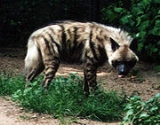
Striped Hyena

 
Striped Hyena

   Email Print
   Bookmark   Link


Striped Hyena


The Striped Hyena (Hyaena hyaena) is an omnivorous
Omnivore

Omnivores are species that eating both plants and animals as their primary food source. They are opportunistic, general feeders not specifically adapted to eat and digest either meat or plant material exclusively....
 mammal
Mammal

Mammals are a class of vertebrate animals whose name is derived from their distinctive feature, mammary glands, with which they feed their young....
 of the family hyaenidae. It lives in Africa
Africa

Africa is the world's second-largest and second most-populous continent, after Asia. At about 30.2 million km? including adjacent islands, it covers 6% of the Earth's total surface area and 20.4% of the total land area....
, the Middle East
Middle East

File:GreaterMiddleEast1.pngThe Middle East is a region that spans southwestern Asia, western Asia, and northeastern Africa. It has no clear boundaries, often used as a synonym to Near East, in opposition to Far East....
, Pakistan
Pakistan

Pakistan , officially the Islamic Republic of Pakistan, is a country located in South Asia and borders Central Asia and the Middle East. It has a 1,046 kilometre coastline along the Arabian Sea and Gulf of Oman in the south, and is bordered by Afghanistan and Iran in the west, India in the east and People's Republic of China in th...
 and western India
India

India, officially the Republic of India , is a country in South Asia. It is the List of countries and outlying territories by total area country by geographical area, the List of countries by population country, and the most populous liberal democracy in the world....
. It is extinct in Europe
Europe

Europe is, conventionally, one of the world's seven continents. Comprising the westernmost peninsula of Eurasia, Europe is generally divided from Asia to its east by the water divide of the Ural Mountains, the Ural , the Caspian Sea, and by the Caucasus Mountains to the southeast....
, but can occasionally be spotted in Anatolia
Anatolia

Anatolia or Asia Minor is a region of Western Asia, comprising most of the modern Republic of Turkey. It is a geographic region bounded by the Black Sea to the north, the Caucasus to the northeast, the Aegean Sea to the west, the Mediterranean Sea to the south, and the Iranian plateau to the east and southeast....
. Striped Hyenas are largely scavengers, but will also eat small animals, fruit and insects. Larger subspecies are known to hunt animals as large as wild boar. They are nomadic, moving from water hole to water hole, but never straying more than 6 miles (10 km) from one.


Discussion
Ask a question about 'Striped Hyena'
Start a new discussion about 'Striped Hyena'
Answer questions from other users
Full Discussion Forum


Encyclopedia


The Striped Hyena (Hyaena hyaena) is an omnivorous
Omnivore

Omnivores are species that eating both plants and animals as their primary food source. They are opportunistic, general feeders not specifically adapted to eat and digest either meat or plant material exclusively....
 mammal
Mammal

Mammals are a class of vertebrate animals whose name is derived from their distinctive feature, mammary glands, with which they feed their young....
 of the family hyaenidae. It lives in Africa
Africa

Africa is the world's second-largest and second most-populous continent, after Asia. At about 30.2 million km? including adjacent islands, it covers 6% of the Earth's total surface area and 20.4% of the total land area....
, the Middle East
Middle East

File:GreaterMiddleEast1.pngThe Middle East is a region that spans southwestern Asia, western Asia, and northeastern Africa. It has no clear boundaries, often used as a synonym to Near East, in opposition to Far East....
, Pakistan
Pakistan

Pakistan , officially the Islamic Republic of Pakistan, is a country located in South Asia and borders Central Asia and the Middle East. It has a 1,046 kilometre coastline along the Arabian Sea and Gulf of Oman in the south, and is bordered by Afghanistan and Iran in the west, India in the east and People's Republic of China in th...
 and western India
India

India, officially the Republic of India , is a country in South Asia. It is the List of countries and outlying territories by total area country by geographical area, the List of countries by population country, and the most populous liberal democracy in the world....
. It is extinct in Europe
Europe

Europe is, conventionally, one of the world's seven continents. Comprising the westernmost peninsula of Eurasia, Europe is generally divided from Asia to its east by the water divide of the Ural Mountains, the Ural , the Caspian Sea, and by the Caucasus Mountains to the southeast....
, but can occasionally be spotted in Anatolia
Anatolia

Anatolia or Asia Minor is a region of Western Asia, comprising most of the modern Republic of Turkey. It is a geographic region bounded by the Black Sea to the north, the Caucasus to the northeast, the Aegean Sea to the west, the Mediterranean Sea to the south, and the Iranian plateau to the east and southeast....
. Striped Hyenas are largely scavengers, but will also eat small animals, fruit and insects. Larger subspecies are known to hunt animals as large as wild boar. They are nomadic, moving from water hole to water hole, but never straying more than 6 miles (10 km) from one. Striped hyenas hunt in solitude but do congregate in small family groups. Like many other animals of hot climates, their ears radiate heat.

The striped hyena is generally considered solitary, but has some social organization. It forages individually and is rarely seen in groups. It does, however, associate in small family groups at the den. The striped hyena live in the tropical savanna, grasslands, semi-desert, scrub forest, and woodland.

Physiology


Physical description

The striped hyena is the second largest hyena species, being intermediate in size to the spotted hyena
Spotted Hyena

The Spotted Hyena, or Laughing Hyena, is a Carnivora mammal of the family hyaenidae. It is the largest of the hyenas, and is native to sub-Saharan Africa, save for the Congo basin....
 and the brown hyena
Brown Hyena

The Brown Hyena is a hyena living mainly in the Kalahari Desert and Namib Desert deserts of southern Africa....
. Its skull is not as large as that of the brown hyena, and its dentition less robust, indicating more generalised dietary adaptations. It is a medium sized animal with a downward sloping back and a roundish head with a pointed muzzle and pointed ears. It is generally pale grey or beige in colour with a black patch on the throat. It sports 5–9 distinct vertical stripes on the flanks, with clearer black transverse and horizontal stripes on the legs. A seasonal dimorphism in pelt colour is noticeable; the stripes of the summer coat are much blacker and more well defined than in the winter coat. The mid-dorsal line has a mane which can be held erect, making it appear 38% bigger, which it does when it feels threatened. The mane serves as a signalling device during social interactions. It has a long, bushy tail which is black and white in colour, with long, coarse hair. Four toes with short, blunt, non-retractable claws are present on the feet. Males weigh between 26–41 kilogram
Kilogram

The kilogram or kilogrammeThe spelling kilogram is used by the International Committee for Weights and Measures and the U.S....
s (57–90 pound
Pound (mass)

The pound or pound-mass is a Units of measurement of massused in the Imperial unit, United States customary units and other systems of measurement....
s), while females weigh 26–34 kg (57–75 lb). Excluding the tail, total body length varies between 1.0 and 1.15 m. Shoulder height is between 0.66 and 0.75 m. Striped hyenas have scent glands resembling fairly large, hairless pouches which are located at the opening of the anus.

Reproduction

Litter sizes in the wild vary from 1–4 throughout the year with an average of 3. In captivity, average litter size is 1–5. Intensive digging behaviour by the female precedes parturition, and is often followed by a day of postnatal
Postnatal

Postnatal is the period beginning immediately after the childbirth of a child and extending for about six weeks. The period is sometimes incorrectly called the postpartum period, which refers to the mother and, less commonly, puerperium....
 oestrus three weeks later. The cubs are born blind, with closed ear canals. Fur colour at this stage ranges from white to grey with clear black stripes. The cubs open their eyes after 7–8 days, while the teeth will erupt after 3 weeks. Solid food is ingested after a month. Weaning ages vary from eight weeks to 12 months. Both the male and female partake in feeding the cubs. The age of sexual maturity has been reported to be inconsistent. In Tashkent zoo, a female was four years old when she gave birth to her first litter, while 15 month old wild individuals in Israel were reported to bare three large embryos.

Caves are the striped hyena's preferred dens sites. Den entrances are fairly narrow and may be hidden by large boulders. A width of 0.67 m and 0.72 m for the entrance was reported from measurements of two dens in the Karakum desert. The Karakum dens lead 3 m and 2.5 m downward, while extending over a distance of 4.15 m and 5 m. There were no lateral extensions or special chambers, contrasting greatly with more elaborate designs discovered in Israel exceeding 27 m in length.

Behaviour


Social behaviour

Striped hyenas are more solitary than spotted and brown hyenas, having smaller home ranges. In all subspecies, typical group sizes are 1–2, although groups of seven have been reported in Libya. Hyenas in Israel are generally solitary, though they may occasionally be seen congregating at carcasses. Central Asian striped hyenas are reported to be monogamous. Unlike the spotted hyena, there is little evidence of territorial behaviour. In the Serengeti, the home range sizes of two individuals were 44 km² and 72 km² (17 and 28 mi²) respectively, while a home-range size for a single female in the Negev desert was reported to be approximately 61 km² (24 mi²).

Striped hyenas investigate and lick the mid-back region where the mid-dorsal crest is situated during meetings. Striped hyenas greet conspecifics by sniffing each others noses and extruded anal pouches, and repeated pawing of each other's throats. During aggressive interactions, the black patch near the thoracic and lumbar vertebrae is erected. When fighting, striped hyenas bite at the throat and legs, though they will avoid the mane. The striped hyena marks its territory through scent marks from secretions from the anal pouch. Grass stalks, stones, tree trunks and other objects are the most commonly marked. The striped hyena has a lower range of vocalizations than the spotted hyena.

Dietary habits

Unlike the spotted hyena, the striped hyena is primarily a scavenger, and will readily consume carrion and the remains of kills of other predators, using its powerful jaws to gnaw and crush bones. It does occasionally feed on live prey, though it has been suggested that only individuals from the three larger subspecies present in Northwest Africa, the Middle East and India kill large prey animals. There is no evidence that the smaller subspecies present in east Africa and the Arabian peninsula attack large herbivores. Striped hyenas in Turkmenistan
Turkmenistan

Turkmenistan is a Turkic peoples country in Central Asia. Until 1991, it was a constituent republic of the Soviet Union, the Turkmen Soviet Socialist Republic ....
 have been recorded to feed on large numbers of tortoises, though they have also been observed hunting wild boar, kulan
Kulan

Khulan was an empress of Genghis Khan and head of the second Court of Genghis Khan. Her status in the Mongol Empire was second only to Grand Empress Borte....
 and porcupine
Porcupine

Porcupines are rodents with a coat of sharp Spine , or quills, that defend them from predators. They are endemic in both the Old World and the New World....
. In the Caucasus
Caucasus

The Caucasus or Caucas is a geopolitical region located between Europe, Asia, and the Middle East. It is home to Europe's highest mountain ....
, grasshopper
Grasshopper

Grasshoppers are insects of the suborder Caelifera in the order Orthoptera. To distinguish them from Tettigoniidae, they are sometimes referred to as short-horned grasshoppers....
s are their primary food source.

Striped hyenas will supplement their carnivorous diet with vegetation. Seasonal abundance of oil willow fruits is an important contribution to their diet in Uzbekistan
Uzbekistan

Uzbekistan, officially the Republic of Uzbekistan , is a Landlocked_country#Doubly_landlocked_country country in Central Asia, formerly part of the Soviet Union....
 and Tajikistan
Tajikistan

Tajikistan , officially the Republic of Tajikistan , is a mountainous landlocked country in Central Asia. Afghanistan borders to the south, Uzbekistan to the west, Kyrgyzstan to the north, and People's Republic of China to the east....
. In Israel hyenas feed on fruits, particularly dates and melons. Striped hyena are able to drink varying qualities of water, from fresh water
Fresh Water

Fresh Water is the debut album by Australian rock and blues singer Alison McCallum, released in 1972. Rare for an Australian artist at the time, it came in a gatefold sleeve....
, soda
Soda

Soda refers to:* a chemical compound containing sodium**Sodium carbonate, washing soda or soda ash**Sodium bicarbonate, baking soda**Sodium hydroxide, caustic soda...
 and salt water
Salt water

Salt water or saltwater may refer to:* Saline water, water containing dissolved salts* Brine, water saturated or nearly saturated with salt...
. A diet of melons may also fulfill its liquid requirements. Striped hyenas have been observed feeding at landfill
Landfill

File:Wysypisko.jpgFile:Landfill face.JPGFile:Landfill.jpg A landfill, also known as a dump , is a site for the disposal of waste materials by burial and is the oldest form of list of solid waste treatment technologies....
s.

Interspecific predatory relationships

The striped hyenas habit of feasting on the kills of other predators inevitably results in some form of confrontation, ranging from threatening posturing to downright violence. In Africa
Africa

Africa is the world's second-largest and second most-populous continent, after Asia. At about 30.2 million km? including adjacent islands, it covers 6% of the Earth's total surface area and 20.4% of the total land area....
 the striped hyena is invariably dominated in feeding disputes against the larger apex carnivores such as lion
Lion

The lion is a member of the family Felidae and one of four big cats in the genus Panthera. With exceptionally large males exceeding 250 kg in weight, it is the second-largest living cat after the tiger....
s and spotted hyena
Spotted Hyena

The Spotted Hyena, or Laughing Hyena, is a Carnivora mammal of the family hyaenidae. It is the largest of the hyenas, and is native to sub-Saharan Africa, save for the Congo basin....
 (though hyena biologist Hans Kruuk has stated that there does appear to be some form of 'attraction' between the two hyenid species). Disputes against lone predators such as leopard
Leopard

The leopard is a member of the Felidae biological family and the smallest of the four "Panthera" in the genus Panthera; the other three are the tiger, lion and jaguar....
s and cheetah
Cheetah

The cheetah is an atypical member of the cat family that is unique in its speed, while lacking climbing abilities. Therefore it is placed in its own genus, Acinonyx....
s are more difficult to predict, the outcome usually depending on who intimidates who first. In India and the Middle East, the striped hyena will sometimes enter into conflict with wolves. Though individually stronger, the hyena's solitary nature puts it at a disadvantage against the more social wolf. Striped hyenas in India
India

India, officially the Republic of India , is a country in South Asia. It is the List of countries and outlying territories by total area country by geographical area, the List of countries by population country, and the most populous liberal democracy in the world....
 may dominate very young tiger
Tiger

The tiger is a member of the Felidae family; the largest of the four "big cats" in the genus Panthera. Native to much of eastern and southern Asia, the tiger is an apex predator and an Carnivore#Obligate carnivores....
s, but generally wait until an adult is gone to scavenge from their kills. Hyena remains have been found in the stomachs of mugger crocodile
Mugger Crocodile

The mugger crocodile , also called the Iranian, marsh, muggar or Persian crocodile , is found throughout the Indian subcontinent and the surrounding countries ....
s.

Subspecies

Five subspecies, differentiated by pelage
Pelage

In mammals, pelage is the hair, fur, or wool that covers the animal. In many mammals, the pelage is made up of more than one type of hair. Some of the most prominent types of hair that make up the pelage include guard hairs , bristles , and the underfur, which traps in air to maintain temperature....
 and morphometric differences have been identified.

  • Hyaena hyaena syriaca; Middle East
  • Hyaena hyaena sultana; Arabian Peninsula
    Arabian Peninsula

    The Arabian Peninsula , Arabia, Arabistan, and the Arabian subcontinent is a peninsula in Southwest Asia at the junction of Africa and Asia. The area is an important part of the Middle East and plays a critically important geopolitics role because of its vast reserves of petroleum and natural gas....
  • Hyaena hyaena dubbah; Northeast Africa
  • Hyaena hyaena barbara (de Blainville, 1844); Northwest Africa
  • Hyaena hyaena hyaena (Linnaeus, 1758); India


Relationship with humans


In folklore and superstition

Striped hyenas are frequently referenced in Middle Eastern literature and folklore, typically as symbols of treachery and stupidity. In the Near and Middle East, striped hyenas are generally regarded as physical incarnations of jinn
Genie

In Islam and Arabian mythology, a genie is a supernatural fiery creature which possesses free will. Genies are mentioned in the Qur'an, wherein a whole Sura is named after them ....
s. Arab writer Al-Quazweeni (1204–1283) spoke of a tribe of people called Al-Dabeyoun meaning "hyena people". In his book Aajeb Al-Makhlouqat he wrote that should one of this tribe be in a group of 1000 people, a hyena could pick him out and eat him. A Persian medical treatise written in 1376 tells how to cure cannibalistic people known as kaftar, who are said to “half-man, half-hyena”. Al-Doumairy in his writings in Hawayan Al-Koubra (1406) wrote that striped hyenas were vampiric creatures that attacked people at night and sucked the blood from their necks. He also wrote that hyenas only attacked brave people. Arab folklore tells of how hyenas can mesmerise victims with their eyes or sometimes with their pheromones. In a similar vein to Al-Doumairy, the Greeks, until the end of the 19th century, believed that the bodies of werewolves
Werewolf

Werewolves, also known as lycanthropes from the Greek ????????p??, ????? and ?????p?? , are Mythology or folklore humans with the ability to shape shifting into Gray Wolf or anthropomorphism wolf-like creatures, either purposely, by being bitten by another werewolf, or after being placed under a curse....
, if not destroyed, would haunt battlefields as vampiric hyenas which drank the blood of dying soldiers. The image of striped hyenas in Afghanistan, India and Palestine is more varied. Though feared, striped hyenas were also symbolic for love and fertility, leading to numerous varieties of love medicine derived from hyena body parts. Among the Baluch
Baluch

Baluch may refer to:*The Baloch people and Balochistan region of South Asia and southwest Asia Asia.*Nargis Baluch, Pakistani newspaper editor...
 and in northern India, witches or magicians are said to ride striped hyenas at night.

Cultural perspectives

The Arab word for striped hyenas, dhubba, is alluded in a valley in Palestine known as Shaqq-ud-Diba (meaning "cleft of the hyenas") and Wadi-Abu-Diba (meaning "valley of the hyenas"). Both places have been interpreted by some scholars as being the Biblical Valley of Zeboim mentioned in 1 Samuel 13:18.

Striped hyenas are mentioned three times in the Bible
Bible

The Bible is the central religious text of Judaism and Christianity. The exact Books of the Bible is dependent on the religious traditions of specific denominations....
;

Isaiah
Isaiah

Isaiah is the main figure in the Biblical Book of Isaiah, and is traditionally considered to be its author. He was an 8th-century Before Christ Judean prophet who declared that all the world belonged to God and that God will destroy it....
 13:22: Hyenas will howl in her strongholds, jackals in her luxurious palaces. Her time is at hand, and her days will not be prolonged.

Isaiah 34:14: Desert creatures will meet with hyenas, and wild goats will bleat to each other; there the night creatures will also repose and find for themselves places of rest.

Jeremiah
Jeremiah

Jeremiah was one of the 'greater prophet' of the Hebrew Bible. He was the son of Hilkiah, a priest of Anathoth.His writings are put together in the Book of Jeremiah and, according to tradition, the Book of Lamentations....
 50:39: So desert creatures and hyenas will live there, and there the owl will dwell. It will never again be inhabited or lived in from generation to generation.

The Hebrew language
Hebrew language

Hebrew is a Semitic languages of the Afro-Asiatic languages. Modern Hebrew is spoken by more than seven million people in Israel and Classical Hebrew is used for prayer or study in Jews communities around the world....
 word for hyena is tzebua or zevoa, which literally means "howling creature". Though the Authorized King James Version of the Bible interprets the word appearing in Jeremiah 12:9 as referring to a "speckled bird", Henry Baker Tristram
Henry Baker Tristram

This article is about Henry Baker Tristram. For the Knight of the Round Table, see Tristan.The Reverend Henry Baker Tristram FRS was an England clergyman, Biblical scholar, traveller and ornithologist....
 argued that it was most likely a hyena being mentioned.

Livestock and crop damage

The effects striped hyenas have on livestock vary according to region. Lebanon reports very few attacks, with some accounts describing how hyenas crossed through pastures without even spooking the grazing herds, while reports from Turkmenistan
Turkmenistan

Turkmenistan is a Turkic peoples country in Central Asia. Until 1991, it was a constituent republic of the Soviet Union, the Turkmen Soviet Socialist Republic ....
 indicate that striped hyenas are more serious livestock predators than wolves. Surveys indicate that goats, sheep
Sheep

#REDIRECT Domestic sheep...
, dog
Dog

The dog is a domesticated subspecies of the Gray Wolf, a member of the Canidae family of the order Carnivora. The term is used for both feral and pet varieties....
s, and poultry
Poultry

Poultry is the category of domesticated birds which some people keep for the purpose of collecting their egg , or kill for their meat and/or feathers....
 are the most commonly recorded livestock killed by striped hyenas. There are records of hyenas eating larger animals, though it is unclear if said cases were truly kills or scavenging mistakenly identified as kills. The age and health of targeted individuals of larger livestock animals are unclear, though records suggest that attacks typically occur at low frequencies. Livestock damage reputedly occurs in greater frequencies in Egypt, Ethiopia, India, Iraq, and possibly Morocco. Dogs are the most commonly targeted animals in Turkmenistan
Turkmenistan

Turkmenistan is a Turkic peoples country in Central Asia. Until 1991, it was a constituent republic of the Soviet Union, the Turkmen Soviet Socialist Republic ....
 and India, whereas dogs, sheep and other small domestic animals are reportedly killed in the Caucasus region. Reports from the 1950s in Iraq
Iraq

Iraq , officially the Republic of Iraq , is a country in Western Asia spanning most of the northwestern end of the Zagros Mountains, the eastern part of the Syrian Desert and the northern part of the Arabian Desert....
 indicate that horse
Horse

The horse is a hoofed mammal, a subspecies of one of seven extant species of the family Equidae. The horse has evolution of the horse over the past 45 to 55 million years from a small multi-toed creature into the large, odd-toed ungulate animal of today....
s and donkey
Donkey

The 'donkey' or 'ass', Equus africanus asinus, is a Domestication member of the Equidae or horse family, and an Odd-toed ungulates. The wild ancestor of the donkey is the Wild Ass, E....
s may be attacked. Dogs, sheep and goats are occasionally at risk in Africa.

Melon
Melon

Melon is a name given to various members of the Cucurbitaceae family with fleshy fruit. Melon can refer to either the plant or the fruit, which is a Epigynous berry....
 fields and date palm plantations in Israel and Egypt are occasionally raided by striped hyenas, while watermelon
Watermelon

Watermelon refers to both fruit and plant of a vine-like herb originally from southern Africa and one of the most common types of melon. This flowering plant produces a special type of fruit known by botany as a Epigynous berry, which has a thick Peel and fleshy center ; pepos are derived from an inferior ovary and are characteristic of...
 and honeydew
Honeydew (melon)

File:Honeydew Leaf 2150px.jpgHoneydew is a cultivar group of the muskmelon, Cucumis melo Inodorus group, which includes crenshaw, casaba, Persian, winter, and other mixed melons....
 plantations are often targeted in in Turkmenistan.

Persecution

Striped hyenas readily accept strychnine
Strychnine

Strychnine is a very toxic , colorless crystalline alkaloid used as a pesticide, particularly for killing small vertebrates such as birds and rodents....
-poisoned bait, though in many cases the bait is laid out for other, more abundant carnivores such as wolves, leopards or jackals. In Algeria
Algeria

Algeria , officially the People's Democratic Republic of Algeria, is a country located in North Africa. It is the largest country of the Mediterranean sea, second largest in the Arab World, and the second largest on the African continent and the eleventh-largest country in the world in terms of land area....
, a bounty system in the 1880s caused a decline in striped hyena populations; 196 individuals were killed in 1881 and 1882 alone. A similar campaign occurred at roughly the same time in the borders of Imperial Russia. The government paid a substantial bounty (100 ruble
Ruble

File:Banknote 5000 rubles front.jpgFile:100000 rubles Belarus 2000 obverse.jpgFile:Transnistria rubla 2000.jpgThe ruble or rouble is a unit of currency....
s) for every hyena killed. The striped hyena was unintentionally exterminated in Israel by strychnine poisoning during the British government's rabies
Rabies

Rabies is a virus zoonotic neurotropic virus disease that causes acute encephalitis in mammals. It is most commonly caused by a bite from an infected animal, but occasionally by other forms of contact....
 eradication campaign against golden jackal
Golden Jackal

The Golden Jackal , also called the Asiatic, Oriental or Common Jackal is a species of jackal native to north and east Africa, southeastern Europe and South Asia to Burma....
s. Further large-scale Israeli poisoning campaigns occurred between 1950 and 1970. Strychnine poisoning currently threatens striped hyenas throughout Niger. Though rarely hunted for their fur save for within the Caucasus, they have on occasion been caught in traps set for other fur-bearing species. The striped hyena was not considered a fur species in Russia, but was advertised as "minor quality wolf and fox". A total of 200 hyena skins were bought by the Russian government in the 1930s within the borders of what are now the Commonwealth of Independent States
Commonwealth of Independent States

The Commonwealth of Independent States is a regional organization whose participating countries are former Soviet Republics.The CIS is comparable to a confederation similar to the original European Community....
. Less than 100 hyena skins were bought in the 1950s, and none have been bought since 1970. Between 1931-1937 up to 130 hyena skins were annually offered by trappers in Turkmenistan alone. Since 1948 this number has been reduced to a few dozen and since 1970 none have been offered. Some hunters in southern Punjab, Kandahar
Kandahar

Kandahar, also spelled Qandahar, is the third largest city in Afghanistan, with a population of 324,800 . It is the capital of Kandahar province, located in the south of the country at about 1,005 m above sea level....
 and Quetta
Quetta

Quetta is the largest city and the Subdivisions of Pakistan capital of the Balochistan Province of Pakistan. It is an important marketing and communications centre for Pakistan with neighbouring Iran and Afghanistan....
, catch striped hyenas to use them in hyena-baiting
Hyena-baiting

Hyena-baiting is a blood sport involving the animal-baiting of hyenas....
. The hyenas are pitted against specially trained dogs, and are restrained with ropes in order to pull them away from the dogs if necessary. In Kandahar, hunters locally called payloch (naked foot) hunt striped hyenas by entering their dens naked with a noose in hand. When the hyena is cornered at the end of its lair, the hunter murmurs the magic formula “turn into dust, turn into stone,” which causes the animal to enter a hypnotic state of total submission, by which point the hunter can slip a noose over its forelegs and, finally, drag it out of the cave.

Striped hyenas as food and medicine

The 6th dynasty
Sixth dynasty of Egypt

The Third, Fourth, Fifth and Sixth Dynasties of History of Egypt are often combined under the title "Old Kingdom"....
 mastaba
Mastaba

A mastaba was a kind of Ancient Egyptian tomb in the form of a flat-roofed, rectangular with outward sloping sides that marked the burial site of many eminent Egyptians of Egypt's History of Egypt....
s of Mereruka and Kagemni at Saqqara
Saqqara

Saqqara or Sakkara, Saqqarah is a vast, ancient burial ground in Egypt, serving as the necropolis for the Ancient Egyptian capital, Memphis, Egypt....
 depict two keepers struggling to hold a striped hyena down on its back whilst stuffing pieces of meat and poultry into its muzzle. The most ferocious specimens had to have their hind legs tied together first. Though it is generally thought by archeologists that this was done to fatten hyenas for food, some writers believe the intention was to train hyenas for taking part in hunts. The Ancient Greeks and Romans
Ancient Rome

Ancient Rome was a civilization that grew out of a small agricultural community founded on the Italian Peninsula as early as the 10th century BC....
 used the blood, excrement, rectum, genitalia, eyes, tongue, hair, skin, and fat, as well as the ash of different parts of the striped hyenas body, as effective means to ward off evil and to ensure love and fertility. The Greeks and Romans believed that the genitalia of a hyena “would hold a couple peaceably together” and that a hyena anus worn as an amulet on the upper arm would make its male possessor irresistible to women. In the Muslim
Muslim

:A Muslim , , is an adherent of the religion of Islam. The feminine form is Muslimah . Literally, the word means "one who submits "....
 nations of Sistan
Sistan

Modern Sistan is a border region in southeastern Iran and southwestern Afghanistan . In ancient times the area was known as Arachosia; it became known as 'Sakastan' in the 1st century BC, after it was conquered by the Saka tribes....
, Kohat
Kohat

Kohat is a medium sized town in North West Frontier Province of Pakistan. It is located at 33?35'13N 71?26'29E with an altitude of 489 metres and is the capital of Kohat District....
, Bannu
Bannu

Bannu , the principal city of Bannu District in the North-West Frontier Province of Pakistan, is an important road junction and market city. Bannu is a very old city, founded in the same time period as Dera Ismail Khan and Dera Ghazi Khan; however, the present location of the downtown Bannu was founded by Herbert Benjamin Edwardes in 18...
, and Cholistan, striped hyena meat is considered halal
Halal

Halal is an Arabic term designating any object or an action which is permissible to use or engage in, according to Islamic law and custom. It is the opposite of haraam....
 and can therefore be consumed. This represents an exception to the rule that predatory animals are not to be eaten, due to their being haraam
Haraam

Haraam is an Arabic term meaning "forbidden". In Islam it is used to refer to anything that is prohibited by the faith. Its antonym is halaal....
. This stems from the fact that the striped hyena is an omnivore, rather than a purely carnivorous animal. Among the Bedouin
Bedouin

The Bedouin, , are predominantly Muslim, desert-dwelling Arab nomadic pastoralist, or previously nomadic group, found throughout most of the desert belt extending from the Atlantic coast of the Sahara via the Western Desert , Sinai Peninsula, and Negev to the Arabian Desert....
 of Arabia, the striped hyena is permitted for human consumption, though hyena meat is generally considered more as a medicine than as food. In West and South Asia, hyena body parts apparently play an important role in love magic and in the making of amulets. In Iranian folklore, it is mentioned that a stone found in the hyenas body can serve as a charm of protection for whoever wears it on his upper arm. In the Pakistani province of Sind hang, the local Muslims place the tooth of a striped hyena over churns in order not to lose the milk's baraka
Baraka

Baraka may refer to:* baraka, also berakhah, in Judaism, a blessing usually recited during a ceremony* baraka, also barakah, in Arabic language, Islam and Arab-influenced languages such as Swahili, Urdu, Persian, Turkish, meaning spiritual wisdom and blessing transmitted from God; or in a Sufi context, "breath of life."...
. In Iran, a dried striped hyena pelt is considered a potent charm which forces all to succumb to the possessors attraction. In Afghanistan and Pakistan striped hyena hair is used either in love magic or as a charm in sickness. Hyena blood has been held in high regard in northern India as potent medicine, and the eating of the tongue helps fight tumor
Tumor

A tumor or tumour is the name for a swelling or lesion formed by an abnormal growth of cells . Tumor is not synonymous with cancer. A tumor can be Benign neoplasm, Carcinoma in situ or malignant, whereas cancer is by definition malignant....
s. In the Khyber
Khyber

Khyber may refer to:* Khyber Pass* Khyber Agency, Pakistani administrative area...
 area, burned striped hyena fat
Fat

Fats consist of a wide group of compounds that are generally soluble in organic solvents and largely insoluble in water. Chemistry, fats are generally ester of glycerol and fatty acids....
 is applied to a mans genitals or sometimes taken orally to ensure virility, while in India the fat serves as a cure for rheumatism
Rheumatism

Rheumatism or Rheumatic disorder is a non-specific term for medical problems affecting the heart, bones, joints, kidney, skin and lung. The study of, and therapeutic interventions in, such disorders is called rheumatology....
. In Afghanistan, some mullah
Mullah

Mullah is a Muslim man, educated in Islamic theology and sacred law. The title, given to some Islamic clergy, is derived from the Arabic word mawla, meaning both 'vicar' and 'guardian.'...
s wear the vulva (kus) of a female striped hyena wrapped in silk under their armpits for a week. If a man peers through the vulva at the woman of his desire, he will invariably get hold of her. This has led to the proverbial expression in Dari of kus-e kaftar bay, as well as in Pashto of kus-e kaftar which literally mean "it happens as smoothly as if you would look through the vulva of a female striped hyena". In the North-West Frontier Province
North-West Frontier Province

File:Makra Peak by Khalid Mahmood.jpgThe North-West Frontier Province is the smallest of the Subdivisions of Pakistan of Pakistan. The NWFP is home to the majority Pashtuns as well as other smaller ethnic groups....
 and Baluchistan, the Pakhtun keep the vulva in vermilion
Vermilion

Vermilion, sometimes spelled vermillion, when found naturally occurring, is an opaque Orange ish red pigment, used since antiquity, originally derived from the powdered mineral cinnabar....
 powder, itself having aphrodesic connotations. The rectum of a freshly killed striped hyena is likewise used by homosexuals and bisexuals to attract young men. This has lead to the expression “to possess the anus of a [striped] hyena” which denotes somebody who is attractive and has many lovers. A striped hyena’s penis kept in a small box filled with sandur can be used for the same reasons.

Attacks on humans

The striped hyena was historically feared and held responsible for the disappearance of unattended small children in the Caucasus and in Central Asia. In the district of Yerevan
Yerevan

Yerevan is the capital and largest city of Armenia. It is situated on the Hrazdan River, and is the administrative, cultural, and industrial center of the country....
 in the Caucasus in the 1880s, hyenas were thought to be responsible for the disappearance or injuring of 25 children and three adults who slept outdoors. Further incidents in that area of striped hyenas killing children were reported in the 1890s and 1900s, as well as in Azerbaidjan in the 1930s and 1940s. In British India, striped hyena attacks rarely caused much uproar, as they were not considered as dangerous as wolves, which were responsible for numerous deaths in the latter half of the 19th century. In modern India however, killings of wolves and striped hyenas are still organised by the government in areas where carnivores are suspected of child lifting, even in conservation areas. In 1962, nine children were thought to have been taken by hyenas in the town of Bhagalpur
Bhagalpur

Bhagalpur is a city and municipal corporation in the Bihar States and territories of India of Eastern India. Bhagalpur is one of the oldest districts of Bihar located in the Southern region....
 in the Bihar
Bihar

Bihar is a States and territories of India in East India. Bihar is the 12th largest state in terms of geographical size 38,202 square mile and 3rd largest by population....
 State in a six week period. In Karnataka
Karnataka

Karnataka is a States and territories of India in the southern part of India. It was Unification of Karnataka on November 1, 1956, with the passing of the States Reorganisation Act....
, Bihar state, attacks on children have been reported as recently as 1974 when 19 children up to the age of four years were reported killed at night. On March 13th 2005, a hyena injured 70 persons in six villages of Sonsor tehsil, five of them critically. The Kikuyu
Kikuyu

The Kikuyu are Kenya's most populous ethnic group. 'Kikuyu' is the anglicised form of the proper name and pronunciation of Gikuyu although they refer to themselves as the Agikuyu people....
 of Kenya
Kenya

The Republic of Kenya is a country in East Africa. It is bordered by Ethiopia to the north, Somalia to the northeast, Tanzania to the south, Uganda to the west, and Sudan to the northwest, with the Indian Ocean running along the southeast border....
 generally do not fear striped hyenas as they do spotted hyenas. A consensus on wild animal attacks during a five year period in the Indian state of Madhya Pradesh showed that hyenas had only attacked three people, the lowest figure when compared to deaths caused by wolves
Indian Wolf

Recent genetic research suggests that the Indian Wolf, originally considered only as a subpopulation of the Iranian Wolf , may represent a distinct species ....
, gaur
Gaur

The gaur is a large, dark-coated bovine animal of South Asia and Southeast Asia. The biggest populations are found today in India. The gaur is the largest species of wild cattle, bigger than the African Buffalo, Wild Asian Water Buffalo and bison....
, boar
Boar

The wild boar , or colloquially simply called the boar, is an omnivorous, wikt:gregarious mammal of the family Suidae. It is native across much of Central Europe, the Mediterranean Basin and much of Asia as far south as Indonesia, and has been introduced elsewhere....
, elephants
Asian Elephant

The Asian or Asiatic Elephant , sometimes known by the name of one of its subspecies – the Indian Elephant, is one of the three living species of elephant, and the only living species of the genus Elephas....
, tigers
Bengal Tiger

The Bengal tiger, or Royal bengal tiger , is a subspecies of tiger primarily found in India and Bangladesh. They are also found in Nepal, Pakistan, Bhutan, Myanmar and southern Tibet....
, leopards
Indian Leopard

The Indian leopard is a leopard subspecies native to the Indian subcontinent....
 and sloth bear
Sloth Bear

The Sloth Bear , also known as the Lip Bear, is a mammal of the biological family Ursidae which is native to the lowland forests of India, Nepal,Pakistan, Bhutan, Bangladesh, and Sri Lanka....
s.

Though attacks on live humans are rare, striped hyenas will scavenge on human corpses. In Turkey, stones are placed on graves to stop hyenas digging the bodies out. In World War I
World War I

World War I, or the First World War , was a global military conflict which involved the Great powers, organized into two opposing military alliances: the Allies of World War I and the Central Powers....
, the Turks imposed conscription (safar barlek) on mount Lebanon. People escaping from the conscription fled north, where many died and were subsequently eaten by hyenas.

Conservation status

The striped hyena is listed as "near threatened". Although it seems to be rather compatible with human populations, the large predators whose kills it relies on for scavenging are not. It is often hunted or poisoned throughout its range, and although it has a fairly large population, it is scattered over a wide area and often isolated from other populations.

External links