
All Topics  
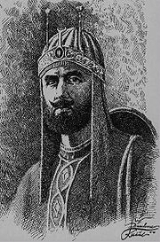
Sher Shah Suri

 
Sher Shah Suri

   Email Print
   Bookmark   Link


Sher Shah Suri


Sher Shah Suri (1486, Sasaram
Sasaram

Sasaram is the administrative headquarters of Rohtas district in the Indian States and territories of India of Bihar....
–May 22, 1545 Kalinjar
Kalinjar

Kalinjar is a fortress-city in the Bundelkhand region of central India. Kalinjar is located in Banda District of Uttar Pradesh state, near the temple-city and World Heritage Site of Khajuraho....
) (Pashto: ??? ??? ???? - Šir Šah Suri), also known as Farid Khan or Sher Khan (The Tiger King or The Lion King), was a powerful medieval India
India

India, officially the Republic of India , is a country in South Asia. It is the List of countries and outlying territories by total area country by geographical area, the List of countries by population country, and the most populous liberal democracy in the world....
n emperor (1540–45) from Sasaram
Sasaram

Sasaram is the administrative headquarters of Rohtas district in the Indian States and territories of India of Bihar....
, Bihar
Bihar

Bihar is a States and territories of India in East India. Bihar is the 12th largest state in terms of geographical size 38,202 square mile and 3rd largest by population....
, India. Sher Shah was of Pashtun (Afghan)
Pashtun people

Pashtuns , also called Pathans , ethnic Afghans, are an Eastern Iranian ethno-linguistic group with populations primarily in Afghanistan and in the North-West Frontier Province, Federally Administered Tribal Areas and Balochistan provinces of western Pakistan....
  descent who founded the dynasty known as Sur Dynasty
Sur Dynasty

The Suri Dynasty was founded by the powerful medieval Indian conqueror of Pashtun people descent Sher Shah Suri, after he defeated Mughal Empire Emperor Humayun in the 1539 Battle of Chausa....
 in 1540 in North India
North India

Northern India is a loosely defined region in the northern part of India. The exact meaning of the term varies by usage. The dominant geographical features of northern India are the Indo-Gangetic Plain and the Himalayas, which demarcate the region from Tibet and Central Asia....
. He drove out the Mughal dynasty in Agra and his rule marked the beginning of the short lived Suri Dynasty in India.

Khan was born in Sasaram
Sasaram

Sasaram is the administrative headquarters of Rohtas district in the Indian States and territories of India of Bihar....
, Bihar
Bihar

Bihar is a States and territories of India in East India. Bihar is the 12th largest state in terms of geographical size 38,202 square mile and 3rd largest by population....
.


Discussion
Ask a question about 'Sher Shah Suri'
Start a new discussion about 'Sher Shah Suri'
Answer questions from other users
Full Discussion Forum


Recent Posts


Encyclopedia


Sher Shah Suri (1486, Sasaram
Sasaram

Sasaram is the administrative headquarters of Rohtas district in the Indian States and territories of India of Bihar....
–May 22, 1545 Kalinjar
Kalinjar

Kalinjar is a fortress-city in the Bundelkhand region of central India. Kalinjar is located in Banda District of Uttar Pradesh state, near the temple-city and World Heritage Site of Khajuraho....
) (Pashto: ??? ??? ???? - Šir Šah Suri), also known as Farid Khan or Sher Khan (The Tiger King or The Lion King), was a powerful medieval India
India

India, officially the Republic of India , is a country in South Asia. It is the List of countries and outlying territories by total area country by geographical area, the List of countries by population country, and the most populous liberal democracy in the world....
n emperor (1540–45) from Sasaram
Sasaram

Sasaram is the administrative headquarters of Rohtas district in the Indian States and territories of India of Bihar....
, Bihar
Bihar

Bihar is a States and territories of India in East India. Bihar is the 12th largest state in terms of geographical size 38,202 square mile and 3rd largest by population....
, India. Sher Shah was of Pashtun (Afghan)
Pashtun people

Pashtuns , also called Pathans , ethnic Afghans, are an Eastern Iranian ethno-linguistic group with populations primarily in Afghanistan and in the North-West Frontier Province, Federally Administered Tribal Areas and Balochistan provinces of western Pakistan....
  descent who founded the dynasty known as Sur Dynasty
Sur Dynasty

The Suri Dynasty was founded by the powerful medieval Indian conqueror of Pashtun people descent Sher Shah Suri, after he defeated Mughal Empire Emperor Humayun in the 1539 Battle of Chausa....
 in 1540 in North India
North India

Northern India is a loosely defined region in the northern part of India. The exact meaning of the term varies by usage. The dominant geographical features of northern India are the Indo-Gangetic Plain and the Himalayas, which demarcate the region from Tibet and Central Asia....
. He drove out the Mughal dynasty in Agra and his rule marked the beginning of the short lived Suri Dynasty in India.

Early life

Sher Khan was born in Sasaram
Sasaram

Sasaram is the administrative headquarters of Rohtas district in the Indian States and territories of India of Bihar....
, Bihar
Bihar

Bihar is a States and territories of India in East India. Bihar is the 12th largest state in terms of geographical size 38,202 square mile and 3rd largest by population....
. He was of Pashtun (known as Afghan in historical Persian
Persian language

name=Persian|nativename=|pronunciation=[f??r'si]|image=|caption=Farsi in Perso-Arabic script |states= Iran, Afghanistan, Tajikistan, Uzbekistan, and Bahrain....
 sources) origin and descended from an Pashtun adventurer recruited much earlier by Sultan Bahlul Lodi of Delhi during his long contest with the Sharqi Sultans of Jaunpur. The Shah's personal name was Farid, the title of Sher (“Tiger”) being conferred when he killed a tiger as a young man. His original name was Farid-ud-din Abul Muzaffar, but was mostly called Farid. One of eight or 10 (in some sources it is claimed also of 12) sons of Hasan Khan Sur, a vassal of Sasaram and a horse breeder, Farid rebelled against his father and left home to enlist as a soldier in the service of Jamal Khan, the governor of Jaunpur (Uttar Pradesh
Uttar Pradesh

Uttar Pradesh , [often referred to as U.P.] is a States and territories of India located in the northern part of India. With a population of over 190 million people,...
).

Political career

In Jaunpur, Farid Khan became a private. Later he worked for the province ruler of Bihar, Bahâr Khân, who rewarded him for bravery with the Persian title Sher Khan (The King of Tigers) when he killed a tiger as a young man. Before he came back to Bihar he was working for the royal court of Mughals where he became educated and well taught over the Arabic and Persian language and the armed force nature. Short after he became official and minister of the court and some later also the educator of the Mughal prince he became a rebel. As a rebel he wanted to obtain the control of the Pahtun sub-kingdoms of Bihar and Bengal. He returned back to Bihar where he retook his old place as minister. Because the king of Bihar had conflicts with Bengal he send Sher Shah to handle that for him. In early 1539 he conquered Bengal and, through clever deception, the Rohtas stronghold southwest of Bengal. Nevertheless, the battle demanded ca. 15000 and more slaughtered civilian lives beside of the hostile soldiers. At the Battle of Chausa on June 26, 1539, he faced and he defeated the Mughal emperor Humayun and assumed the royal title of Farud-din Sher Shah. Humayun's rule began badly with his invasion of the Hindu principality of Kalinjar in Bundelkhand, which he failed to subdue. Next he became entangled in a quarrel with Sher Khan by unsuccessfully besieging the fortress of Chunar (1532). Thereafter he conquered Malwa and Gujarat, but he could not hold them. Leaving the fortress of Chunar unconquered on the way, Humayun proceeded back to assist Sultan Mahmud of that province against Sher Khan. He lost touch with Delhi and Agra, and, because his brother Hindal began to openly behave like an independent ruler at Agra, he was obliged to leave Gaur
Gaur, West Bengal

Gaur, or Gour , as it is spelt mostly in modern times, or Lakhnauti is a ruined city, in the Malda district of West Bengal, India, on the west bank of the Ganges, 40 kilometers downstream from Rajmahal....
, the capital of Bengal
Bengal

Bengal , is a historical and geographical region in the northeast of South Asia. Today it is mainly divided between the independent sovereign nation of the Bangladesh and the state of West Bengal in India, although some regions of the previous kingdoms of Bengal are now part of the neighboring Indian states of Bihar, Assam, Tripura and Oris...
. Negotiations with Sher Khan fell through, and the latter forced Humayun to fight a battle at Chausa, 10 miles southwest of Baksar, in which Humayun was defeated. Humayun had no answer to the political and military skill of Sher Shah and had to fight simultaneously on the southern borders to check the sultan of Gujarat, a refuge of the rebel Mughals. Humayun's failure, however, was attributable to inherent flaws in the early Mughal political organization. The armed clans of his nobility owed their first allegiance to their respective chiefs. These chiefs, together with almost all the male members of the royal family, had a claim to sovereignty. There was thus always a lurking fear of the emergence of another centre of power, at least under one or the other of his brothers. Humayun had also to fight against the heavy odds of his opponents' rapport with the locality.

Rise of Sher Khan

After Sher Khan defeated the Bengali and Hamayun's army with his own Bihari army and some Pashtun tribes men, he returned strengthened and self-assuredly through his successful action back to Bihar where he was rebelling against his own Sahib (pers.: Master) by taking the power. In 1537 he ransacked Gaur. In May 1540 at Kannauj he had again to face Mughal Emperor Humayun and defeated him and had driven his foes from Bengal, Bihar and the Punjab and at the same time also suppressed the Baluchs and their chiefs on the northwestern frontier. Intent on expanding the sultanate of Delhi, he captured Gwalior and Malwa but was killed during the siege of Kalinjar by a shoot on a barrel of gunpowder very next to him. Sher Shah ruled the whole of North India's Islamic belt for five years, reannexing and defeating the Rajputs. Sher Khan built also the Rohtas Fort
Rohtas Fort

Rohtas Fort is a garrison fort built by the great Afghan king Sher Shah Suri. This fort is about 4 km in circumference and the first example of the successful amalgamation of Pukhtun and Hindu architecture in the sub-continent....
 in 1541-43 to crush the Gakhars
Gakhars

File:Hazara.gifThe Gakhars were a fiercely independent and warlike clan now located in Rawalpindi, Islamabad, Jhelum District, Kashmir, Gilgit Valley, Baltistan, Chitral, Khanpur and Mirpur, Pakistan regions in modern day Pakistan....
, who were loyal to Humayun, to whom the fort was finally surrendered by a treacherous commander 10 years after Sher Khan's death. Ironically, Rohtas Fort
Rohtas Fort

Rohtas Fort is a garrison fort built by the great Afghan king Sher Shah Suri. This fort is about 4 km in circumference and the first example of the successful amalgamation of Pukhtun and Hindu architecture in the sub-continent....
 became the capital of the very people it was designed to crush, the Gakhars
Gakhars

File:Hazara.gifThe Gakhars were a fiercely independent and warlike clan now located in Rawalpindi, Islamabad, Jhelum District, Kashmir, Gilgit Valley, Baltistan, Chitral, Khanpur and Mirpur, Pakistan regions in modern day Pakistan....
.

Expansion and victories


Sher Khan continued to expand his empire, subjugating Bengal, Malwa, Raisen
Raisen

Raisen is a town and a municipality in Raisen district in the Indian States and territories of India of Madhya Pradesh. It is the administrative headquarters of Raisen District....
, Sindh
Sindh

Sindh is one of the four Subdivisions of Pakistan of Pakistan and historically is home to the Sindhi people. Different cultural and ethnic groups also reside in Sindh including Urdu-speaking Muslim refugees who migrated to Pakistan from India upon independence as well as the people migrated from other provinces after independence....
 and Multan
Multan

is a city in the Punjab of Pakistan and capital of Multan District. It is located in the southern part of the province. Multan District has a population of over 3.8 million and the city itself is the sixth largest within the boundaries of Pakistan....
. In the Battle of Raisen, Sher Khan attacked the fort of the Rajput
Rajput

A Rajput is a member of one of the major Hindu Kshatriya groups of Indian subcontinent. The Rajputs trace their roots to Rajputana. They enjoy a reputation as formidable soldiers and it is common to find many of them serving in the Indian Armed Forces....
 ruler Puran Mal. After it became apparent that defending the fort would be too tough, Puran Mal agreed to surrender the fort on the condition that his troops, their wives and children, be allowed to leave unmolested. Sher Khan agreed. But as Puran Mal and his family were leaving the fort they were attacked by Sher Khan's Pashtun tribe's men. In a very short time, Sher Khan had extended his kingdom from the Indus
Indus River

File:Indian subcontinent CIA.pngThe Indus River is the longest river in Pakistan and the twenty-first largest river in the world, in terms of annual flow, on the Indian Subcontinent....
 in the west to Bengal in the east.

Death and succession


Sher was the last Delhi Sultan to oppose serious resistance to the Mughals on their advance to the south, and his death in battle cleared the path to the return of Mughal emperor Humayun. Sher Shah Suri was succeeded by his son, Jalal Khan who took the title of Islam Shah Suri
Islam Shah Suri

Islam Shah Suri was the second ruler of Sur dynasty. Islam Shah Suri's real name was Jalal Khan and he was son of Sher Shah Suri. Islam Shah Suri ruled for seven years ....
.

Government and administration

Sher Shah rose from the rank of private to be emperor, reorganized the administration efficiently and the army and tax collections, built roads and Travellers' inns, rest houses(sarais) and wells, improved the jurisdiction, founded refuges and hospitals, established free kitchens and organized a mail services and the police. At their return, Mughals could build on his measures.

Mirza-Aziz-Koka, probably Akbar's closest friend and one the most important mansabdar's of the Mughal
Mughal

Mughal may refer to:* Mughal , a Central Asian tribe* Mughal gardens, a style of gardens* Mughal architecture, a style of architecture* Mughal painting, a style of painting...
 Empire
Empire

Empire derives from the Latin word imperium, denoting ?military command? in Roman. Politically, an empire is a geographically extensive group of states and peoples united and ruled either by a monarch or an oligarchy....
, wrote this to Emperor Jahangir
Jahangir

Nur-ud-din Salim Jahangir Born as Prince Muhammad Salim, he was the third and eldest surviving son of Mughal Empire Emperor Akbar. Akbar's twin sons, Hasan and Hussain, died in infancy....
 in one of his personal letters to him.

Specially Sher Khan was not an angel (malak) but a king (malik). In six years he gave such stability to the structure (of the kingdom) that foundation still survives. He had made Hindustan
Hindustan

Hindustan is one of the popular names of India. Though the meaning of Hindustan has evolved over the years, after the Partition of India it primarily refers to modern India....
 flourishing in such a way that the king of Persia and Turan
Turan

Turan is the ancient Iranian languages name for Central Asia, literally meaning "the land of the Tur". As described below, the original Turanians are the...
 appreciate it, and have a desire to look at it. Hazrat Arsh Ashiyani (Akbar) followed his administrative manual (zawabit) for fifty years and did not discontinue them. In the same Hindustan due to able administration of the well wishers of the court, nothing is left except rabble and jungles.


Additional reading

  • Tarikh-e-Afghani
  • Tarikh-i-Sher Shahi
    Tarikh-i-Sher Shahi

    The Tarikh-i-Sher Shahi is an historic document detailing the rule of emperor Sher Shah Suri.The book was commissioned by emperor Akbar to provide detailed documentation about Sher Shah's administration - Akbar's father Humayun had been defeated by Sher Shah....
  • Tarikh-i Shahi
  • Tarikh-i Khan Jahani wa Makhzan-i Afghani
  • Edward Thomas
    Edward Thomas

    Edward Thomas may refer to:*Edward Thomas , fallen English wartime-volunteer soldier*Edward Thomas , British non-commissioned officer completing about 9 years' peace- and war-time service...
     (1871) The Chronicles of the Pathan Kings of Delhi
  • Kalkar Nijan, Sher Shah And His Times
  • Sir Olaf Caroe, The Pathans
  • Syed Bahadur Shah Zafar Kakakhel, Pashtoon
  • Article of Ahmad Yar Khan Kakar about Kakar tribe and Sher shah Suri in Wikipedia.org


External links