
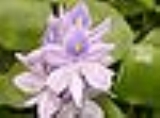
The seven species of
water hyacinth comprise the genus
Eichhornia. Water hyacinth are a free-floating perennial
aquatic plantAquatic plants are plants that have adapted to living in aquatic environments. They are also referred to as hydrophytes or aquatic macrophytes. These plants require special adaptations for living submerged in water, or at the water's surface. Aquatic plants can only grow in water or in soil that is...
native to tropical and sub-tropical
South AmericaSouth America is a continent situated in the Western Hemisphere, mostly in the Southern Hemisphere, with a relatively small portion in the Northern Hemisphere. The continent is also considered a subcontinent of the Americas. It is bordered on the west by the Pacific Ocean and on the north and east...
. With broad, thick, glossy, ovate leaves, water hyacinth may rise above the surface of the water as much as 1 meter in height. The
leavesA leaf is an organ of a vascular plant, as defined in botanical terms, and in particular in plant morphology. Foliage is a mass noun that refers to leaves as a feature of plants....
are 10–20 cm across, and float above the water surface. They have long, spongy and bulbous stalks. The feathery, freely hanging roots are purple-black. An erect stalk supports a single spike of 8-15 conspicuously attractive
flowerA flower, sometimes known as a bloom or blossom, is the reproductive structure found in flowering plants . The biological function of a flower is to effect reproduction, usually by providing a mechanism for the union of sperm with eggs...
s, mostly lavender to pink in colour with six petals. When not in bloom, water hyacinth may be mistaken for frog's-bit (
Limnobium spongia).
One of the fastest growing plants known, water hyacinth reproduces primarily by way of runners or
stolonIn biology, stolons are horizontal connections between organisms. They may be part of the organism, or of its skeleton; typically, animal stolons are external skeletons.-In botany:...
s, which eventually form daughter plants. It also produces large quantities of seeds, and these are viable up to thirty years. The common water hyacinth (
Eichhornia crassipes) are vigorous growers known to double their population in two weeks.
In
AssameseAssamese is the easternmost Indo-Aryan language. It is used mainly in the state of Assam in North-East India. It is also the official language of Assam. It is also spoken in parts of Arunachal Pradesh and other northeast Indian states. Nagamese, an Assamese-based Creole language is widely used in...
they are known as
Meteka. In Sinhala they are known as
Japan Jabara (ජපන් ජබර) due to their use in
World War IIWorld War II, or the Second World War , was a global conflict lasting from 1939 to 1945, involving most of the world's nations—including all of the great powers—eventually forming two opposing military alliances: the Allies and the Axis...
to fool Japanese pilots into thinking lakes were fields usable to land their aircraft, leading to crashes. In
BurmeseThe Burmese language is the official language of Burma. Although the constitution officially recognizes it as the Myanmar language, most English speakers continue to refer to the language as Burmese. Burmese is the native language of the Bamar and related sub-ethnic groups of the Bamar, as well as...
they are known as
Baydar.
In Southern Pakistan, they are the provincial flower of
SindhSindh historically referred to as Ba'ab-ul-Islam , is one of the four provinces of Pakistan and historically is home to the Sindhi people. It is also locally known as the "Mehran". Though Muslims form the largest religious group in Sindh, a good number of Christians, Zoroastrians and Hindus can...
.
In the Philippines, they use some of the water hyacinth's stems and dry it to take its fibers and take them to form strands of string each.
These pieces of string are woven or interlinked together to form a braid or cord used for making bags, footwear, wreaths, hats, vases, Christmas lanterns, and more decorative materials. Because water hyacinth are prolific to the point of being a nuisance, this lets the people earn money by selling these products for a living while cleaning up the overpopulated bodies of water that are full of water hyacinths.
Invasiveness as an exotic plant
Water hyacinth has been widely introduced throughout
North AmericaNorth America is a continent wholly within the Northern Hemisphere and almost wholly within the Western Hemisphere. It is also considered a northern subcontinent of the Americas...
,
AsiaAsia is the world's largest and most populous continent, located primarily in the eastern and northern hemispheres. It covers 8.7% of the Earth's total surface area and with approximately 3.879 billion people, it hosts 60% of the world's current human population...
,
AustraliaAustralia , officially the Commonwealth of Australia, is a country in the Southern Hemisphere comprising the mainland of the Australian continent, the island of Tasmania, and numerous smaller islands in the Indian and Pacific Oceans. It is the world's sixth-largest country by total area...
and
AfricaAfrica is the world's second largest and second most populous continent, after Asia. At about 30.2 million km² including adjacent islands, it covers 6% of the Earth's total surface area and 20.4% of the total land area...
. They can be found in large water areas such as Louisiana, or in the
Kerala BackwatersThe Kerala backwaters are a chain of brackish lagoons and lakes lying parallel to the Arabian Sea coast of Kerala state in southern India. The network includes five large lakes linked by canals, both manmade and natural, fed by 38 rivers, and extending virtually half the length of Kerala state...
in
IndiaIndia , officially the Republic of India , is a country in South Asia. It is the seventh-largest country by geographical area, the second-most populous country with over 1.2 billion people, and the most populous democracy in the world...
. In many areas it, particularly
E. crassipes, is an important and pernicious
invasive species"Invasive species", or invasive exotics, is a nomenclature term and categorization phrase used for flora and fauna, and for specific restoration-preservation processes in native habitats, with several definitions....
. First introduced to North America in 1884, an estimated 50 kilograms per square metre of hyacinth once choked
FloridaFlorida is a state in the southeastern United States, located on the nation's Atlantic and Gulf coasts. It is bordered to the west by the Gulf of Mexico, to the north by Alabama and Georgia and to the east by the Atlantic Ocean. With a population of 18,801,310 as measured by the 2010 census, it...
's waterways, although the problem there has since been mitigated.
When not controlled, water hyacinth will cover lakes and ponds entirely; this dramatically impacts water flow, blocks sunlight from reaching native aquatic plants, and starves the water of
oxygenOxygen is the element with atomic number 8 and represented by the symbol O. Its name derives from the Greek roots ὀξύς and -γενής , because at the time of naming, it was mistakenly thought that all acids required oxygen in their composition...
, often killing fish (or turtles). The plants also create a prime habitat for
mosquitoMosquitoes are members of a family of nematocerid flies: the Culicidae . The word Mosquito is from the Spanish and Portuguese for little fly...
s, the classic vectors of disease, and a species of
snailSnail is a common name applied to most of the members of the molluscan class Gastropoda that have coiled shells in the adult stage. When the word is used in its most general sense, it includes sea snails, land snails and freshwater snails. The word snail without any qualifier is however more often...
known to host a parasitic
flatwormThe flatworms, known in scientific literature as Platyhelminthes or Plathelminthes are a phylum of relatively simple bilaterian, unsegmented, soft-bodied invertebrate animals...
which causes
schistosomiasisSchistosomiasis is a parasitic disease caused by several species of trematodes , a parasitic worm of the genus Schistosoma. Snails often act as an intermediary agent for the infectious diseases until a new human host is found...
(snail fever). Directly blamed for starving subsistence farmers in
Papua New GuineaPapua New Guinea , officially the Independent State of Papua New Guinea, is a country in Oceania, occupying the eastern half of the island of New Guinea and numerous offshore islands...
, water hyacinth remains a major problem where effective control programs are not in place. Water hyacinth is often problematic in man-made ponds if uncontrolled, but can also provide a food source for gold fish, keep water clean and help to provide oxygen to man-made ponds.
Water hyacinth often invades bodies of water that have been impacted by human activities. For example, the plants can unbalance natural lifecycles in artificial reservoirs or in
eutrophiedEutrophication or more precisely hypertrophication, is the movement of a body of water′s trophic status in the direction of increasing plant biomass, by the addition of artificial or natural substances, such as nitrates and phosphates, through fertilizers or sewage, to an aquatic system...
lakes that receive large amounts of nutrients.
There are other uses being found for the abundant plants, such as for
cattleCattle are the most common type of large domesticated ungulates. They are a prominent modern member of the subfamily Bovinae, are the most widespread species of the genus Bos, and are most commonly classified collectively as Bos primigenius...
food and in
biogasBiogas typically refers to a gas produced by the biological breakdown of organic matter in the absence of oxygen. Organic waste such as dead plant and animal material, animal dung, and kitchen waste can be converted into a gaseous fuel called biogas...
production. Recently, they have also begun to be used in wastewater treatment due to their fast growth and ability to tolerate high levels of pollution. Parts of the plant are also used in the production of traditional handicrafts in Southeast Asia. In Bangladesh, farmers have started producing fertilizer using Water Hyacinth or Kochuripana as it is known there locally.
As chemical and mechanical removal is often too expensive and ineffective, researchers have turned to
biological controlBiological control of pests in agriculture is a method of controlling pests that relies on predation, parasitism, herbivory, or other natural mechanisms...
agents to deal with water hyacinth. The effort began in the 1970s when
USDAThe United States Department of Agriculture is the United States federal executive department responsible for developing and executing U.S. federal government policy on farming, agriculture, and food...
researchers released three species of
weevilA weevil is any beetle from the Curculionoidea superfamily. They are usually small, less than , and herbivorous. There are over 60,000 species in several families, mostly in the family Curculionidae...
known to feed on water hyacinth into the
United StatesThe United States of America is a federal constitutional republic comprising fifty states and a federal district...
,
Neochetina bruchi,
N. eichhorniae, and the water hyacinth borer
Sameodes albiguttalis. Although meeting with limited success, the weevils have since been released in more than 20 other countries. However, the most effective control method remains the control of excessive nutrients and prevention of the spread of this species.
May 2010 the USDA’s
Agricultural Research ServiceThe Agricultural Research Service is the principal in-house research agency of the United States Department of Agriculture . ARS is one of four agencies in USDA's Research, Education and Economics mission area...
released
Megamelus scutellaris as a biological control insect for the invasive waterhyacinth species.
Megamelus scutellaris is a small
planthopperA planthopper is any insect in the infraorder Fulgoromorpha within the Hemiptera. The name comes from their remarkable resemblance to leaves and other plants of their environment and from the fact that they often "hop" for quick transportation in a similar way to that of grasshoppers. However,...
insect native to Argentina. Researchers have been studying the effects of the biological control agent in extensive host-range studies since 2006 and concluded that the insect is highly host-specific and will not pose a threat to any other plant population other than the targeted water hyacinth. Researchers also hope that the biological control will be more resilient than existing biological controls to the herbicides that are already in place to combat the invasive water hyacinth.
http://www.ars.usda.gov/is/pr/2010/100518.htm
Water hyacinth in Lake Victoria, Africa

Botanists and gardeners carry plants with them in their travels, and experts suspect that this is how the water hyacinth came to East Africa in the 1980s. Its flowers are beautiful; it was probably brought over as an ornamental for garden ponds (United Nations News, 2000). The consensus is that Water Hyacinth entered Lake Victoria from Rwanda via the river Kagera (Ambrose 1997). The exact time and place of introduction has been debated, but the plant is native to South America, and therefore reached Lake Victoria due to human activity. It has spread prolifically, due to lack of natural enemies, an abundance of space, agreeable temperature conditions, and abundant nutrients (Opande et al., 2004). It increased rapidly between 1992–1998, was greatly reduced by 2001, and has since resurged to a lesser degree. Management techniques include (hyacinth-eating) insect controls and manual beach cleanup efforts (Kateregga/Sterner 2007). A water hyacinth infestation is seldom totally eradicated. Instead, it is a situation that must be continually managed (LVEMP, 2004 ) (United Nations News, 2000)).
Water Hyacinth affects the Lake Victorian population in many negative ways. There are economic impacts when the weed blocks boat access. The effects on transportation and fishing are immediately felt. Where the weed is prolific, there is a general increase in several diseases, as the weed creates excellent breeding areas for mosquitoes and other insects. There are increased incidents of skin rash, cough, malaria, encephalitis, bilharzias, gastro intestinal disorders, and schistosomiasis. Water hyacinth also interferes with water treatment, irrigation, and water supply (Opande et al., 2004)). It can smother aquatic life by deoxygenating the water, and it reduces nutrients for young fish in sheltered bays. It has blocked supply intakes for the hydroelectric plant, interrupting electrical power for entire cities. The weed also interrupts local subsistence fishing, blocking access to the beaches (LVEMP, 2004).
Industrial utilization
Since the plant has abundant nitrogen content, it can be used a substrate for biogas production and the sludge obtained from the biogas. However, due to easy accumulation of toxins, the plant is prone to get contaminated when used as feed.
Exogenous
The plant is extremely tolerant of, and has a high capacity for, the uptake of heavy metals, including Cd, Cr, Co, Ni, Pb and Hg, which could make it suitable for the biocleaning of industrial wastewater
, , ,. In addition to heavy metals,
Eichhornia crassipes can also remove other toxins, such as
cyanideA cyanide is a chemical compound that contains the cyano group, -C≡N, which consists of a carbon atom triple-bonded to a nitrogen atom. Cyanides most commonly refer to salts of the anion CN−. Most cyanides are highly toxic....
, which is environmentally beneficial in areas that have endured gold mining operations.
Water hyacinth removes arsenic from arsenic contaminated drinking water. It may be a useful tool in removing arsenic from tube well water in
BangladeshBangladesh , officially the People's Republic of Bangladesh is a sovereign state located in South Asia. It is bordered by India on all sides except for a small border with Burma to the far southeast and by the Bay of Bengal to the south...
.
Water hyacinth is also observed to enhance nitrification in waste water treatment cells of living technology. Their root zones are superb micro-sites for bacterial communities.
External links