


Proto-Indo-European religion

Encyclopedia
Proto-Indo-Europeans
The Proto-Indo-Europeans were the speakers of the Proto-Indo-European language , a reconstructed prehistoric language of Eurasia.Knowledge of them comes chiefly from the linguistic reconstruction, along with material evidence from archaeology and archaeogenetics...
(PIE) peoples based on the existence of similarities among the deities
Deity
A deity is a recognized preternatural or supernatural immortal being, who may be thought of as holy, divine, or sacred, held in high regard, and respected by believers....
, religious practices and mythologies of the Indo-European peoples. Reconstruction of the hypotheses below is based on linguistic evidence using the comparative method
Comparative method
In linguistics, the comparative method is a technique for studying the development of languages by performing a feature-by-feature comparison of two or more languages with common descent from a shared ancestor, as opposed to the method of internal reconstruction, which analyzes the internal...
. Archaeological evidence is difficult to match to any specific culture in the period of early Indo-European culture in the Chalcolithic. Other approaches to Indo-European mythology are possible, most notably the trifunctional hypothesis
Trifunctional hypothesis
The trifunctional hypothesis of prehistoric Proto-Indo-European society postulates a tripartite ideology reflected in the existence of three classes or castes—priests, warriors, and commoners —corresponding to the three functions of the sacral, the martial and the economic, respectively...
of Georges Dumézil
Georges Dumézil
Georges Dumézil was a French comparative philologist best known for his analysis of sovereignty and power in Proto-Indo-European religion and society...
.
Pantheon
Linguists are able to reconstruct the names of some deities in the Proto-Indo-European language (PIE) from many types of sources. Some of the proposed deity names are more readily accepted among scholars than others.- *Dyēus Ph2tērDyeus*Dyēus is the reconstructed chief deity of the Proto-Indo-European pantheon. He was the god of the daylight sky, and his position may have mirrored the position of the patriarch or monarch in society....
is the god of the day-lit sky and the chief god of the Indo-European pantheonPantheon (gods)A pantheon is a set of all the gods of a particular polytheistic religion or mythology.Max Weber's 1922 opus, Economy and Society discusses the link between a...
. The name survives in Greek ZeusZeusIn the ancient Greek religion, Zeus was the "Father of Gods and men" who ruled the Olympians of Mount Olympus as a father ruled the family. He was the god of sky and thunder in Greek mythology. His Roman counterpart is Jupiter and his Etruscan counterpart is Tinia.Zeus was the child of Cronus...
with a vocative form Zeu patēr; Latin Jūpiter (from the archaic Latin Iovis pater; Diēspiter), Sanskrit Dyáus PitāDyaus PitaIn the Vedic pantheon ' or ' or Dyaus Pitar is the Sky Father, divine consort of the Prithvi and father of Agni, Indra , and Ushas, the daughter representing dawn. In archaic Vedic lore, Dyauṣ Pitṛ and Prithivi Matṛ were one, single composite dvandva entity, named as the Dyavaprthivi...
, and Illyrian Dei-pátrous.
- *Deiwos-, Deva or Deos, but from *dhy-, according to Jaan PuhvelJaan PuhvelJaan Puhvel is an Estonian-American Indo-Europeanist. As a student of Georges Dumezil, he also specializes in comparative mythology....
), Hittite, sius 'god'; Greek, dios 'god' (but usually theos from a different root); Oscan, Diovis; Latin, Jove, a particular god, also with forms deus, divus, 'god, rich man'; Sanskrit DevaDeva (Hinduism)' is the Sanskrit word for god or deity, its related feminine term is devi. In modern Hinduism, it can be loosely interpreted as any benevolent supernatural beings. The devs in Hinduism, also called Suras, are often juxtaposed to the Asuras, their half brothers. Devs are also the maintainers of...
; in AvestanAvestan languageAvestan is an East Iranian language known only from its use as the language of Zoroastrian scripture, i.e. the Avesta, from which it derives its name...
, the daevaDaevaDaeva in Avestan language meaning "a being of shining light", is a term for a particular sort of supernatural entity with disagreeable characteristics. Equivalents in Iranian languages include Pashto dêw , Baluchi dêw , Persian dīv , Kurdish dêw...
s, (later Persian divs) were demonized by Zarathustra; Lith. DievasDievasLithuanian Dievas, Latvian Dievs, Prussian Deywis, Yotvingian Deivas was the supreme god in the Baltic mythology and one of the most important deities together with Perkūnas. Dievas is a direct successor of the Proto-Indo-European supreme god *Dyēus of the root *deiwo-...
; Latv. Dievs, a god who causes the rye fields to ripen; ON Týr, OHGOld High GermanThe term Old High German refers to the earliest stage of the German language and it conventionally covers the period from around 500 to 1050. Coherent written texts do not appear until the second half of the 8th century, and some treat the period before 750 as 'prehistoric' and date the start of...
Ziu, Old English, Tiw (from which comes Tuesday, the name of the week), a particular god; Welsh duw; Irish dia, 'god', and possibly Irish DagdaThe DagdaThe Dagda is an important god of Irish mythology. The Dagda is a father-figure and a protector of the tribe. In some texts his father is Elatha, in others his mother is Ethniu. Other texts say that his mother is Danu; while others yet place him as the father of Danu, perhaps due to her...
, and Slavic DažbogDazbogDažbog , alternatively Dazhbog, Dazbog, Dazhdbog, or Dadzbóg, was one of the major gods of Slavic mythology, most likely a solar deity and possibly a cultural hero...
.
- *Plth2wih2 is reconstructed as 'Plenty', a goddess of wide flat lands and the rivers that meander across them. Forms include Hittite Lelwanni, a goddess of the underworld "the pourer" and Sanskrit Prthivi.
- *Perkwunos, known as the "striker," is reconstructed from Sanskrit ParjanyaParjanyaParjanya, according to the 1965 Sanskrit–English dictionary by Shri Vaman Shivram Apte gives the following meanings:* Rain-cloud, thunder cloud, a cloud in general* Rain...
, PrussianPrussian mythologyThe Prussian mythology was a polytheistic religion of the Old Prussians, indigenous peoples of Prussia before the Prussian Crusade waged by the Teutonic Knights. It was closely related to other Baltic faiths, the Lithuanian and Latvian mythologies. Its myths and legends did not survive as Prussians...
Perkuns, LithuanianLithuanian mythologyLithuanian mythology is an example of Baltic mythology, developed by Lithuanians throughout the centuries.-History of scholarship:Surviving information about Baltic paganism in general is very sketchy and incomplete. As with most ancient Indo-European cultures Lithuanian mythology is an example of...
PerkūnasPerkunasPerkūnas was the common Baltic god of thunder, one of the most important deities in the Baltic pantheon. In both Lithuanian and Latvian mythology, he is documented as the god of thunder, rain, mountains, oak trees and the sky.-Etymology:...
, LatvianLatvian mythologyLatvian culture, along with Lithuanian, is among the oldest surviving Indo-European cultures. Much of its symbolism is ancient. Its seasons, festivals, and numerous deities reflect the essential agrarian nature of Latvian tribal life...
Pērkons, Slavic PerunPerunIn Slavic mythology, Perun is the highest god of the pantheon and the god of thunder and lightning. His other attributes were the fire, mountains, the oak, iris, eagle, firmament , horses and carts, weapons and war...
and Norse Fjörgyn. Fjörgyn was replaced by ThorThorIn Norse mythology, Thor is a hammer-wielding god associated with thunder, lightning, storms, oak trees, strength, the protection of mankind, and also hallowing, healing, and fertility...
among the Germanic speaking peoples. These gods give their names to Thursday, the fifth day of the week, through calqueCalqueIn linguistics, a calque or loan translation is a word or phrase borrowed from another language by literal, word-for-word or root-for-root translation.-Calque:...
ing. The CelticCeltic polytheismCeltic polytheism, commonly known as Celtic paganism, refers to the religious beliefs and practices adhered to by the Iron Age peoples of Western Europe now known as the Celts, roughly between 500 BCE and 500 CE, spanning the La Tène period and the Roman era, and in the case of the Insular Celts...
hammer god SucellusSucellusIn ancient Celtic religion, Sucellus or Sucellos was the god of agriculture, forests and alcoholic drinks of the Gauls, also part of the Lusitanian mythology...
is of the same character, but with an unrelated name.
- *H2eus(os), is believed to have been the goddess of dawn, continued in Greek mythology as EosEosIn Greek mythology, Eos is the Titan goddess of the dawn, who rose from her home at the edge of Oceanus, the ocean that surrounds the world, to herald her brother Helios, the Sun.- Greek literature :...
, in Rome as AuroraAurora (mythology)Aurora is the Latin word for dawn, the goddess of dawn in Roman mythology and Latin poetry.Like Greek Eos and Rigvedic Ushas , Aurora continues the name of an earlier Indo-European dawn goddess, *Hausos....
, in Vedic as UshasUshasUshas , Sanskrit for "dawn", is a Vedic deity, and consequently a Hindu deity as well.Sanskrit is an s-stem, i.e. the genitive case is . It is from PIE , cognate to Greek Eos and Latin Aurora....
, in Lithuanian mythologyLithuanian mythologyLithuanian mythology is an example of Baltic mythology, developed by Lithuanians throughout the centuries.-History of scholarship:Surviving information about Baltic paganism in general is very sketchy and incomplete. As with most ancient Indo-European cultures Lithuanian mythology is an example of...
as Aušra 'dawn' or Auštaras (Auštra) 'the god (goddess) of the northeast wind', Latvian AuseklisAuseklisAuseklis was a Latvian god, and the personification of the celestial body Venus...
, the morning star (Lithuanian Aušrinė, 'morning star'); Ausera, and Ausrina, goddesses of dawn or of the planet Venus; Hittite, assu 'lord, god'; Gallic EsusEsusEsus or Hesus was a Gaulish god known from two monumental statues and a line in Lucan's Bellum civile.-Imagery:The two statues on which his name appears are the Pillar of the Boatmen from among the Parisii and a pillar from Trier among the Treveri. In both of these, Esus is portrayed cutting...
, a god of hearths; Slavic, IaroJariloJarilo , alternatively Yarilo, Iarilo, or Gerovit, was a major male Proto-Slavic deity of vegetation, fertility and spring, also associated with war and harvest.-Sources:...
, a god of summer. The form Arap Ushas appears in Albanian folklore, but is a name of the Moon. See also the names for the Sun which follow. An extension of the name may have been *H2eust(e)ro, but see also the form *as-t-r, with intrusive -t- [between s and r] in northern dialects". Anatolian dialects: Estan, Istanus, Istara; Greek, HestiaHestiaIn Greek mythology Hestia , first daughter of Cronus and Rhea , is the virgin goddess of the hearth, architecture, and of the right ordering of domesticity and the family. She received the first offering at every sacrifice in the household. In the public domain, the hearth of the prytaneum...
, goddess of the hearth; Latin VestaVesta-Astronomy:* 4 Vesta, second largest asteroid in the solar system, also a proto-planet, named after the Roman deity* Vesta family, group of asteroids that includes 4 Vesta- Places :* Monte Vesta, Lombardy, Italy* Temple of Vesta, Rome, Italy...
, goddess of the hearth; in ArmenianArmenian languageThe Armenian language is an Indo-European language spoken by the Armenian people. It is the official language of the Republic of Armenia as well as in the region of Nagorno-Karabakh. The language is also widely spoken by Armenian communities in the Armenian diaspora...
as AstghikAstghikIn the earliest prehistoric period Asdghig, commonly referred to as Asya, Astghik, or Astlik, had been worshipped as the Armenian pagan deity of fertility and love , later the skylight had been considered her personification, and she had been the wife or lover of Vahagn...
, a star goddess; possibly also in Germanic mythology as EostreEostreOld English Ēostre and Old High German Ôstarâ are the names of a Germanic goddess whose Anglo-Saxon month, Ēostur-monath , has given its name to the festival of Easter...
or Ostara; and Baltic, Austija.
- *PriHeh2, is reconstructed (Mallory & Adams 2006, pp. 208) as “beloved, friend” (Sanskrit priya), the love goddess.
- *Deh2nu- 'River goddess' is reconstructed (Mallory & Adams 2006, p. 434) from Sanskrit Danu, Irish DanuDanu (Irish goddess)In Irish mythology, Danu is the mother goddess of the Tuatha Dé Danann . Though primarily seen as an ancestral figure, some Victorian sources also associate her with the land.-Name:...
; Welsh DônDônDôn was a Welsh mother goddess. She does not play a direct part in the action of the Mabinogi, though many characters in that cycle are related to her. She is the mother of Arianrhod, Gwydion, Gilfaethwy, Gofannon, Eufydd, Elestron and Amaethon. Patrick K...
, and a masc. form Ossetic Donbettys. The name has been connected with the Dan rivers which run into the Black Sea (Dnieper, DniesterDniesterThe Dniester is a river in Eastern Europe. It runs through Ukraine and Moldova and separates most of Moldova's territory from the breakaway de facto state of Transnistria.-Names:...
, DonDon River (Russia)The Don River is one of the major rivers of Russia. It rises in the town of Novomoskovsk 60 kilometres southeast from Tula, southeast of Moscow, and flows for a distance of about 1,950 kilometres to the Sea of Azov....
, and DanubeDanubeThe Danube is a river in the Central Europe and the Europe's second longest river after the Volga. It is classified as an international waterway....
) and other river names in Celtic areas.
- *Welnos, is reconstructed as a god of cattle from Slavic VelesVeles (god)Veles also known as Volos is a major Slavic supernatural force of earth, waters and the underworld, associated with dragons, cattle, magic, musicians, wealth and trickery...
, and Lithuanian Velnias (in archaic Lithuanian vėlės means 'shades' or 'spirits of the departed'), "protector of flocks"; as well as Old Norse UllrUllrIn early Germanic paganism, *Wulþuz appears to have been a major god, or an epithet of an important god, in prehistoric times....
, and Old English Wuldor, and even the Elysian fields in Greek myth and ritual (according to Jaan Puhvel). There may be a god of cattle in the northern lands, but the argument is very thin. These names were also once thought to be connected to Sanskrit VarunaVarunaIn Vedic religion, Varuna is a god of the sky, of water and of the celestial ocean, as well as a god of law and of the underworld...
and Greek OuranosUranus (mythology)Uranus , was the primal Greek god personifying the sky. His equivalent in Roman mythology was Caelus. In Ancient Greek literature, according to Hesiod in his Theogony, Uranus or Father Sky was the son and husband of Gaia, Mother Earth...
, for example by Max Muller (Comparative Mythology p. 84), but this is now rejected on linguistic grounds, ("the etymology is disputed" Shapiro, JIES 10, 1&2, p. 155).
- Divine Twins: There are several sets (the Indo-Europeans seem to be quite fond of twins), which may or may not be related.
- Analysis of different Indo-European tales indicate the Proto-Indo-Europeans believed there were two progenitors of mankind: *Manu- ("Man"; Indic ManuManu (Hinduism)In various Hindu traditions, Manu is a title accorded to the progenitor of mankind, and also the very first brahman king to rule this earth, who saved mankind from the universal flood. He was absolutely honest which was why he was initially known as "Satyavrata"...
; Germanic MannusMannusMannus is a Germanic mythological figure attested by the 1st century AD Roman historian Tacitus in his work Germania. According to Tacitus, Mannus is the son of Tuisto and the progenitor of the three Germanic tribes Ingaevones, Herminones and Istvaeones.-Tacitus' account:Tacitus explicitly...
) and *Yemo- ("Twin"; Indic YamaYamaYama , also known as Yamarāja in India and Nepal, Shinje in Tibet, Yanluowang or simply Yan in China, Yeomla Daewang in South Korea and Enma Dai-Ō in Japan, is the lord of death, in Hinduism and then adopted into Buddhism and then further into Chinese mythology and Japanese mythology. First...
; Germanic YmirYmirIn Norse mythology, Ymir, also called Aurgelmir among the giants themselves, was the founder of the race of frost giants and was later killed by the Borrs.-Etymology:...
), his twin brother. Cognates of this set of twins appear as the first mortals, or the first gods to die, sometimes becoming the ancestors of everyone and/or king(s) of the dead. - The Sun and Moon as discussed in the next section.
- Horse TwinsDivine twinsThe Divine twins are a mytheme of Proto-Indo-European mythology.*the Greek Dioscuri*the Vedic Ashvins*the Lithuanian Ašvieniai*the Latvian Dieva dēli*Alcis *Romulus and Remus*Hengest and Horsa...
, usually have a name that means 'horse' *ekwa-, but the names are not always cognate, because there is no lexical set (Mallory & Adams 2006, p. 432). They are always male and usually have a horse form, or sometimes, one is a horse and the other is a boy. They are brothers of the Sun Maiden or Dawn goddess, sons of the Sky god, continued in Sanskrit AshvinsAshvinsThe Ashvins , in Hindu mythology, are divine twin horsemen in the Rigveda, sons of Saranya , a goddess of the clouds and wife of Surya in his form as Vivasvat. The Ashvins are Vedic gods symbolising the shining of sunrise and sunset, appearing in the sky before the dawn in a golden chariot,...
and Lithuanian AšvieniaiAšvieniaiAšvieniai are divine twins in the Lithuanian mythology identical to Latvian Dieva deli and direct counterparts of Vedic Ashvins. The both names derive from the same Proto-Indo-European root for the horse - *ek'w-. Old Lithuanian ašva and Sanskrit ashva mean "horse". Ašvieniai are represented as...
, identical to Latvian Dieva deli. Other horse twins are: Greek, Dioskuri (Polydeukes and Kastor); borrowed into Latin as Castor and PolluxCastor and PolluxIn Greek and Roman mythology, Castor and Pollux or Polydeuces were twin brothers, together known as the Dioscuri . Their mother was Leda, but Castor was the mortal son of Tyndareus, king of Sparta, and Pollux the divine son of Zeus, who visited Leda in the guise of a swan...
; Irish, the twins of MachaMachaMacha is the name of a goddess and several other characters in Irish mythology.Macha can also mean:*The LÉ Macha , a ship in the Irish Naval Service, named for the goddess*The Macha crater in Russia, less than 7000 years old...
; Old English, Hengist and Horsa (both words mean 'stallion'), and possibly Old Norse SleipnirSleipnirIn Norse mythology, Sleipnir is an eight-legged horse. Sleipnir is attested in the Poetic Edda, compiled in the 13th century from earlier traditional sources, and the Prose Edda, written in the 13th century by Snorri Sturluson...
, the eight-legged horse born of LokiLokiIn Norse mythology, Loki or Loke is a god or jötunn . Loki is the son of Fárbauti and Laufey, and the brother of Helblindi and Býleistr. By the jötunn Angrboða, Loki is the father of Hel, the wolf Fenrir, and the world serpent Jörmungandr. By his wife Sigyn, Loki is the father of Nari or Narfi...
; Slavic Lel and Polel; possibly Christianized in Albanian as Sts. Flori and Lori. The horse twins may be based on the morning and evening star (the planet VenusVenusVenus is the second planet from the Sun, orbiting it every 224.7 Earth days. The planet is named after Venus, the Roman goddess of love and beauty. After the Moon, it is the brightest natural object in the night sky, reaching an apparent magnitude of −4.6, bright enough to cast shadows...
) and they often have stories about them in which they "accompany" the Sun goddess, because of the close orbit of the planet Venus to the sun, (JIES 10, 1&2, p. 137-166, Michael Shapiro, who references D. Ward, The Divine Twins, Folklore Studies, No. 19, Univ. Calif. Press, Berkeley, 1968,).
- Analysis of different Indo-European tales indicate the Proto-Indo-Europeans believed there were two progenitors of mankind: *Manu- ("Man"; Indic Manu
- A water or sea god is reconstructed (Mallory & Adams 2006, p. 438) as *H2epom Nepots 'grandson/nephew of waters' from Avestan and Vedic Apam NapatApam NapatApam Napat is an eminent figure of the Indo-Iranian pantheon. In Hinduism, Apām Napāt is the god of fresh water, such as in rivers and lakes...
, and as *neptonos from Celtic NechtanNechtan (mythology)In Irish mythology, Nechtan was the father and/or husband of Boann. He may be Nuada under another name, or his cult may have been replaced by that of Nuada. Only he and his three cup-bearers were permitted to visit the well of Segais, into which nine sacred hazel trees dropped their wisdom-bearing...
, Etruscan NethunsNethunsIn Etruscan mythology, Nethuns was the god of wells, later expanded to all water, including the sea. The Etruscan conception of the deity affected Roman Neptune...
, and Latin NeptuneNeptune (mythology)Neptune was the god of water and the sea in Roman mythology and religion. He is analogous with, but not identical to, the Greek god Poseidon. In the Greek-influenced tradition, Neptune was the brother of Jupiter and Pluto, each of them presiding over one of the three realms of the universe,...
. This god may be related to the Germanic water spirit, the NixNixThe Neck/Nixie are shapeshifting water spirits who usually appear in human form. The spirit has appeared in the myths and legends of all Germanic peoples in Europe....
. Similarly, most major Lithuanian rivers begin in ne- (e.g. Nemunas, NerisNerisNeris is a river rising in Belarus, flowing through Vilnius and becoming a tributary of the Neman River at Kaunas...
, NevėžisNevežis RiverNevėžis River is the sixth longest river in Lithuania and one of the main tributaries of the Neman River. Its length is , and it flows only within the geographical confines of Lithuania. It is the second longest river in Lithuania, after the Šventoji River, that flows exclusively within its borders...
). PoseidonPoseidonPoseidon was the god of the sea, and, as "Earth-Shaker," of the earthquakes in Greek mythology. The name of the sea-god Nethuns in Etruscan was adopted in Latin for Neptune in Roman mythology: both were sea gods analogous to Poseidon...
fulfills the same role in Greek mythology, but although the etymology of his name is highly arguable, it is certainly not cognate to Apam NapatApam NapatApam Napat is an eminent figure of the Indo-Iranian pantheon. In Hinduism, Apām Napāt is the god of fresh water, such as in rivers and lakes...
.
The Sun and Moon are often seen as the twin children of various deities, but in fact the sun and moon were deified several times and are often found in competing forms within the same language. The usual scheme is that one of these celestial deities is male and the other female, though the exact gender of the Sun
Sun
The Sun is the star at the center of the Solar System. It is almost perfectly spherical and consists of hot plasma interwoven with magnetic fields...
or Moon
Moon
The Moon is Earth's only known natural satellite,There are a number of near-Earth asteroids including 3753 Cruithne that are co-orbital with Earth: their orbits bring them close to Earth for periods of time but then alter in the long term . These are quasi-satellites and not true moons. For more...
tend to vary among subsequent Indo-European mythologies. Here are two of the most common PIE forms:
- *Seh2ul with a genitive form *Sh2-en-s, Sun, appears as Sanskrit SuryaSuryaSurya Suraya or Phra Athit is the chief solar deity in Hinduism, one of the Adityas, son of Kasyapa and one of his wives, Aditi; of Indra; or of Dyaus Pitar . The term Surya also refers to the Sun, in general. Surya has hair and arms of gold...
, Avestan Hvara; Greek HeliosHeliosHelios was the personification of the Sun in Greek mythology. Homer often calls him simply Titan or Hyperion, while Hesiod and the Homeric Hymn separate him as a son of the Titans Hyperion and Theia or Euryphaessa and brother of the goddesses Selene, the moon, and Eos, the dawn...
, Latin SolSol (mythology)Sol was the solar deity in Ancient Roman religion. It was long thought that Rome actually had two different, consecutive sun gods. The first, Sol Indiges, was thought to have been unimportant, disappearing altogether at an early period. Only in the late Roman Empire, scholars argued, did solar cult...
, Germanic *SowiloSowiloSól or Sunna is the Sun personified in Germanic mythology. One of the two Old High German Merseburg Incantations, written in the 9th or 10th century CE, attests that Sunna is the sister of Sinthgunt...
(Old Norse Sól; Old English Sigel and Sunna, modern English Sun), Lithuanian Saulė, Latvian Saule; Albanian Diell. - *Meh1not Moon, gives Avestan, Mah; Greek Selene (unrelated), although they also use a form Mene; Latin, Luna, later DianaDiana (mythology)In Roman mythology, Diana was the goddess of the hunt and moon and birthing, being associated with wild animals and woodland, and having the power to talk to and control animals. She was equated with the Greek goddess Artemis, though she had an independent origin in Italy...
(unrelated), ON ManiMani (god)In Norse mythology, Máni is the moon personified. Máni, personified, is attested in the Poetic Edda, compiled in the 13th century from earlier traditional sources, and the Prose Edda, written in the 13th century by Snorri Sturluson...
, Old English Mona; Slavic Myesyats; Lithuanian, *Meno, or Mėnuo (Mėnulis); Latvian Meness. In Albanian, Hane is the name of Monday, but this is not related. (Encyclopedia of IE Culture, p. 385, gives the forms but does not have an entry for a moon goddess.)
- *Peh2uson is reconstructed (Mallory & Adams 2006, p. 434) as a pastoral god, based on the Greek god PanPan (mythology)Pan , in Greek religion and mythology, is the god of the wild, shepherds and flocks, nature, of mountain wilds, hunting and rustic music, as well as the companion of the nymphs. His name originates within the Greek language, from the word paein , meaning "to pasture." He has the hindquarters, legs,...
, the Roman god FaunusFaunusIn ancient Roman religion and myth, Faunus was the horned god of the forest, plains and fields; when he made cattle fertile he was called Inuus. He came to be equated in literature with the Greek god Pan....
and the FaunFaunThe faun is a rustic forest god or place-spirit of Roman mythology often associated with Greek satyrs and the Greek god Pan.-Origins:...
s, and Vedic PashupatiPashupatiPashupati , "Lord of cattle", is an epithet of the Hindu god Shiva. In Vedic times it was used as an epithet of Rudra. The Rigveda has the related pashupa "protector of cattle" as a name of Pushan. The Pashupatinath Temple is the most important Hindu shrine for all Hindus in Nepal and also for many...
, and PushanPushanPushan is a Vedic solar deity and one of the Adityas. He is the god of meeting. Pushan was responsible for marriages, journeys, roads, and the feeding of cattle. He was a psychopomp, conducting souls to the other world. He protected travelers from bandits and wild beasts, and protected men from...
. See also Pax.
- There may have been a set of nature spirits or gods akin to the Greek SatyrSatyrIn Greek mythology, satyrs are a troop of male companions of Pan and Dionysus — "satyresses" were a late invention of poets — that roamed the woods and mountains. In myths they are often associated with pipe-playing....
s, the Celtic god CernunnosCernunnosCernunnos is the conventional name given in Celtic studies to depictions of the horned god of Celtic polytheism. The name itself is only attested once, on the 1st-century Pillar of the Boatmen, but depictions of a horned or antlered figure, often seated in a "lotus position" and often associated...
and the Dusii, Slavic Veles and the LesziLesziThe Leshy or Lesovik is a male woodland spirit in Slavic mythology who protects wild animals and forests. There are also leshachikha/leszachka and leshonky...
, the Germanic WoodwoseWoodwoseThe wild man is a mythical figure that appears in the artwork and literature of medieval Europe, comparable to the satyr or faun type in classical mythology and to Silvanus, the Roman god of the woodlands.The defining characteristic of the figure is its "wildness"; from the 12th century...
, elvesElfAn elf is a being of Germanic mythology. The elves were originally thought of as a race of divine beings endowed with magical powers, which they use both for the benefit and the injury of mankind...
and dwarves. There may also have been a female cognate akin to the Greco-Roman nymphNymphA nymph in Greek mythology is a female minor nature deity typically associated with a particular location or landform. Different from gods, nymphs are generally regarded as divine spirits who animate nature, and are usually depicted as beautiful, young nubile maidens who love to dance and sing;...
s, Slavic vilaSlavic fairiesFairies in Slavic mythology come in several forms and their names are spelled differently based on the specific language. Among the ones listed below there were also khovanets , dolia , polyovyk or polevoi , perelesnyk , lesovyk or leshyi , blud , mara Fairies in Slavic mythology come in several...
s, the HuldraHuldraIn Scandinavian folklore, the Huldra , or the skogsrå or skogsfru/skovfrue or Tallemaja in Swedish culture, is a seductive forest creature...
of Germanic folkloreGermanic folkloreGermanic folklore is recorded folklore of the Germanic speaking peoples. It is often used as a starting point for the reconstruction of a Common Germanic mythology:*Dutch folklore*English folklore*German folklore*Scandinavian folklore...
, and the HinduHinduHindu refers to an identity associated with the philosophical, religious and cultural systems that are indigenous to the Indian subcontinent. As used in the Constitution of India, the word "Hindu" is also attributed to all persons professing any Indian religion...
Apsaras.
- It is also likely that they had three fate goddesses; see the NornsNornsThe Norns in Norse mythology are female beings who rule the destiny of gods and men, a kind of dísir comparable to the Fates in classical mythology....
in Norse mythologyNorse mythologyNorse mythology, a subset of Germanic mythology, is the overall term for the myths, legends and beliefs about supernatural beings of Norse pagans. It flourished prior to the Christianization of Scandinavia, during the Early Middle Ages, and passed into Nordic folklore, with some aspects surviving...
, MoiraeMoiraeThe Moirae, Moerae or Moirai , in Greek mythology, were the white-robed incarnations of destiny . Their number became fixed at three...
in Greek mythologyGreek mythologyGreek mythology is the body of myths and legends belonging to the ancient Greeks, concerning their gods and heroes, the nature of the world, and the origins and significance of their own cult and ritual practices. They were a part of religion in ancient Greece...
, Sudjenice of Slavic folklore and Deivės Valdytojos in Lithuanian mythologyLithuanian mythologyLithuanian mythology is an example of Baltic mythology, developed by Lithuanians throughout the centuries.-History of scholarship:Surviving information about Baltic paganism in general is very sketchy and incomplete. As with most ancient Indo-European cultures Lithuanian mythology is an example of...
. Celtic religion is also rife with triple goddesses, such as the GaulishCeltic polytheismCeltic polytheism, commonly known as Celtic paganism, refers to the religious beliefs and practices adhered to by the Iron Age peoples of Western Europe now known as the Celts, roughly between 500 BCE and 500 CE, spanning the La Tène period and the Roman era, and in the case of the Insular Celts...
Matrones and the MorriganMorríganThe Morrígan or Mórrígan , also written as Morrígu or in the plural as Morrígna, and spelt Morríghan or Mór-Ríoghain in Modern Irish, is a figure from Irish mythology who appears to have once been a goddess, although she is not explicitly referred to as such in the texts.The Morrigan is a goddess...
of Ireland, and sometimes triplicate gods as well, but they are not always associated with fate. See also Triple deitiesTriple deitiesA triple deity is a deity associated with the number three. Such deities are common throughout world mythology; the number three has a long history of mythical associations. C. G...
.
A fuller treatment of the subject of the Indo-European Pantheon would not merely list the cognate
Cognate
In linguistics, cognates are words that have a common etymological origin. This learned term derives from the Latin cognatus . Cognates within the same language are called doublets. Strictly speaking, loanwords from another language are usually not meant by the term, e.g...
names but describe additional correspondences in the "family relationships", festival dates, associated myths (but see Mythology section) and special powers.
Pandemonium
"Pandemonium" is Jaan PuhvelJaan Puhvel
Jaan Puhvel is an Estonian-American Indo-Europeanist. As a student of Georges Dumezil, he also specializes in comparative mythology....
's word for the mutual demonization
Demonization
Demonization is the reinterpretation of polytheistic deities as evil, lying demons by other religions, generally monotheistic and henotheistic ones...
that occurred when the Younger-Avesta demonized the daeva
Daeva
Daeva in Avestan language meaning "a being of shining light", is a term for a particular sort of supernatural entity with disagreeable characteristics. Equivalents in Iranian languages include Pashto dêw , Baluchi dêw , Persian dīv , Kurdish dêw...
s, and the post-Rigvedic
Rigveda
The Rigveda is an ancient Indian sacred collection of Vedic Sanskrit hymns...
texts demonized the asura
Asura
-In Hinduism:In Hinduism, the Asuras constitute a group of power-seeking deities, sometimes considered sinful and materialistic. The Daityas and Danavas were combinedly known as Asuras. The Asura were opposed to the Devas. Both groups are children of Kasyapa...
s. Neither demonization occurs in the oldest texts: in the Rigveda, there is not yet any hard-and-fast distinction between asuras and dēvas, and even in the later Vedas
Vedas
The Vedas are a large body of texts originating in ancient India. Composed in Vedic Sanskrit, the texts constitute the oldest layer of Sanskrit literature and the oldest scriptures of Hinduism....
, the two groups (though thematically in opposition) cooperate at certain times. In the Old Avestan texts the daevas are to be rejected for being misguided by the "lie", but they are still gods, and not demons.
However, in the 19th century this distinction between the older and younger texts had not yet been made, and in 1884 Martin Haug
Martin Haug
Martin Haug was a German orientalist.-Biography:Haug was born at Ostdorf , Württemberg. He became a pupil in the gymnasium at Stuttgart at a comparatively late age, and in 1848 he entered the Eberhard Karls University of Tübingen, where he studied oriental languages, especially Sanskrit...
"postulated his thesis that the transition of both the words [asuras and devas] into the designations of the demons ... is based on a prehistoric schism in religion ..." The observation was reiterated by Jacob Grimm
Jacob Grimm
Jacob Ludwig Carl Grimm was a German philologist, jurist and mythologist. He is best known as the discoverer of Grimm's Law, the author of the monumental Deutsches Wörterbuch, the author of Deutsche Mythologie and, more popularly, as one of the Brothers Grimm, as the editor of Grimm's Fairy...
(DM3, p. 985), who, like Haug, considered it to be the theological basis of Zoroastrianism
Zoroastrianism
Zoroastrianism is a religion and philosophy based on the teachings of prophet Zoroaster and was formerly among the world's largest religions. It was probably founded some time before the 6th century BCE in Greater Iran.In Zoroastrianism, the Creator Ahura Mazda is all good, and no evil...
's dualism
Dualism
Dualism denotes a state of two parts. The term 'dualism' was originally coined to denote co-eternal binary opposition, a meaning that is preserved in metaphysical and philosophical duality discourse but has been diluted in general or common usages. Dualism can refer to moral dualism, Dualism (from...
.
Before this (in the 1850s), Westergaard
Westergaard
Westergaard is a Danish surname, literally meaning west farm. Note that the double a is equivalent of å in common nouns and is retained from the pre-1948 orthography in proper nouns only...
had attributed the Younger-Avesta's demonization of the daevas to a "moral reaction against Vedic polytheism", but that (unlike the general notion of a mutual demonization) was very quickly rejected, and by 1895 James Darmesteter
James Darmesteter
James Darmesteter was a French author, orientalist, and antiquarian.He was born of Jewish parents at Château-Salins, in Alsace. The family name had originated in their earlier home of Darmstadt...
noted that it has "no longer [had] any supporter." Nonetheless, some modern authors like Mallory and Adams still refer to Zoroastrianism as a "religious reformation" of Vedic religion (Mallory & Adams 2006, pp. 408–09). Most scholars however stress that there were two independent developments in ancient Iran and post-Rigvedic India, but nonetheless to be considered against the common background of prehistoric Indo-Iranian religion where both groups coexisted, with the asuras, perhaps even as a subset (having a particular common characteristic, like the Adityas) of the daevas, the national gods.
World Tree
There seems to have been a belief in a world treeWorld tree
The world tree is a motif present in several religions and mythologies, particularly Indo-European religions, Siberian religions, and Native American religions. The world tree is represented as a colossal tree which supports the heavens, thereby connecting the heavens, the earth, and, through its...
, which in Germanic mythology was an ash tree
Ash tree
Fraxinus is a genus flowering plants in the olive and lilac family, Oleaceae. It contains 45-65 species of usually medium to large trees, mostly deciduous though a few subtropical species are evergreen. The tree's common English name, ash, goes back to the Old English æsc, while the generic name...
(Norse Yggdrasil
Yggdrasil
In Norse mythology, Yggdrasil is an immense tree that is central in Norse cosmology. It was said to be the world tree around which the nine worlds existed...
; Irminsul
Irminsul
An Irminsul was a kind of pillar which is attested as playing an important role in the Germanic paganism of the Saxon people. The oldest chronicle describing an Irminsul refers to it as a tree trunk erected in the open air...
), in Hinduism
Hinduism
Hinduism is the predominant and indigenous religious tradition of the Indian Subcontinent. Hinduism is known to its followers as , amongst many other expressions...
a banyan
Banyan
A banyan is a fig that starts its life as an epiphyte when its seeds germinate in the cracks and crevices on a host tree...
tree, an oak tree
Oak
An oak is a tree or shrub in the genus Quercus , of which about 600 species exist. "Oak" may also appear in the names of species in related genera, notably Lithocarpus...
in Slavic mythology
Slavic mythology
Slavic mythology is the mythological aspect of the polytheistic religion that was practised by the Slavs before Christianisation.The religion possesses many common traits with other religions descended from the Proto-Indo-European religion....
, and a hazel tree
Hazel
The hazels are a genus of deciduous trees and large shrubs native to the temperate northern hemisphere. The genus is usually placed in the birch family Betulaceae, though some botanists split the hazels into a separate family Corylaceae.They have simple, rounded leaves with double-serrate margins...
in Celtic mythology
Celtic mythology
Celtic mythology is the mythology of Celtic polytheism, apparently the religion of the Iron Age Celts. Like other Iron Age Europeans, the early Celts maintained a polytheistic mythology and religious structure...
. In classical Greek mythology
Greek mythology
Greek mythology is the body of myths and legends belonging to the ancient Greeks, concerning their gods and heroes, the nature of the world, and the origins and significance of their own cult and ritual practices. They were a part of religion in ancient Greece...
, the closest analogue of this concept is Mount Olympus
Mount Olympus
Mount Olympus is the highest mountain in Greece, located on the border between Thessaly and Macedonia, about 100 kilometres away from Thessaloniki, Greece's second largest city. Mount Olympus has 52 peaks. The highest peak Mytikas, meaning "nose", rises to 2,917 metres...
; however, there is also a later folk tradition about the World Tree, which is being sawed by the Kallikantzaroi (Greek goblins), perhaps a reborrowing from other peoples.
Dragon or Serpent
One common myth which can be found among almost all Indo-European mythologies is a battle ending with the slaying of a serpentSerpent (symbolism)
Serpent in Latin means: Rory Collins :&, in turn, from the Biblical Hebrew word of: "saraf" with root letters of: which refers to something burning-as, the pain of poisonous snake's bite was likened to internal burning.This word is commonly used in a specifically mythic or religious context,...
, usually a dragon of some sort (Watkins 1995).
- ThorThorIn Norse mythology, Thor is a hammer-wielding god associated with thunder, lightning, storms, oak trees, strength, the protection of mankind, and also hallowing, healing, and fertility...
vs. JörmungandrJörmungandrIn Norse mythology, Jörmungandr , mostly known as Jormungand, orJörmungand , or Midgard Serpent , or World Serpent, is a sea serpent, and the middle child of the giantess Angrboða and the god Loki...
, SigurdSigurdSigurd is a legendary hero of Norse mythology, as well as the central character in the Völsunga saga. The earliest extant representations for his legend come in pictorial form from seven runestones in Sweden and most notably the Ramsund carving Sigurd (Old Norse: Sigurðr) is a legendary hero of...
vs. FafnirFafnirIn Norse mythology, Fáfnir or Frænir was a son of the dwarf king Hreidmar and brother of Regin and Ótr. In the Volsunga saga, Fáfnir was a dwarf gifted with a powerful arm and fearless soul. He guarded his father's house of glittering gold and flashing gems...
in Scandinavian mythology; - ZeusZeusIn the ancient Greek religion, Zeus was the "Father of Gods and men" who ruled the Olympians of Mount Olympus as a father ruled the family. He was the god of sky and thunder in Greek mythology. His Roman counterpart is Jupiter and his Etruscan counterpart is Tinia.Zeus was the child of Cronus...
vs. TyphonTyphonTyphon , also Typhoeus , Typhaon or Typhos was the last son of Gaia, fathered by Tartarus, and the most deadly monster of Greek mythology. He was known as the "Father of all monsters"; his wife Echidna was likewise the "Mother of All Monsters."Typhon was described in pseudo-Apollodorus,...
, KronosCronusIn Greek mythology, Cronus or Kronos was the leader and the youngest of the first generation of Titans, divine descendants of Gaia, the earth, and Uranus, the sky...
vs. OphionOphionIn some versions of Greek mythology, Ophion , also called Ophioneus ruled the world with Eurynome before the two of them were cast down by Cronus and Rhea.-Sources:...
, ApolloApolloApollo is one of the most important and complex of the Olympian deities in Greek and Roman mythology...
vs. PythonPython (mythology)In Greek mythology, Python was the earth-dragon of Delphi, always represented in Greek sculpture and vase-paintings as a serpent. He presided at the Delphic oracle, which existed in the cult center for his mother, Gaia, "Earth," Pytho being the place name that was substituted for the earlier Krisa...
, HeraclesHeraclesHeracles ,born Alcaeus or Alcides , was a divine hero in Greek mythology, the son of Zeus and Alcmene, foster son of Amphitryon and great-grandson of Perseus...
vs. the HydraLernaean HydraIn Greek mythology, the Lernaean Hydra was an ancient nameless serpent-like chthonic water beast, with reptilian traits, that possessed many heads — the poets mention more heads than the vase-painters could paint, and for each head cut off it grew two more — and poisonous breath so virulent even...
and LadonLadon (mythology)Ladon was the serpent-like dragon that twined and twisted around the tree in the Garden of the Hesperides and guarded the golden apples. He was overcome by Heracles...
, PerseusPerseusPerseus ,Perseos and Perseas are not used in English. the legendary founder of Mycenae and of the Perseid dynasty of Danaans there, was the first of the mythic heroes of Greek mythology whose exploits in defeating various archaic monsters provided the founding myths of the Twelve Olympians...
vs. CetoCetoIn ancient Greek, the word ketos - Latinized as cetus - denotes a large fish, a whale, a shark, or a sea monster. The sea monsters slain by Perseus and Heracles were each referred to as a cetus by ancient sources. The term cetacean originates from cetus. In Greek art, cetea were depicted as...
, and BellerophonBellerophonBellerophon or Bellerophontes is a hero of Greek mythology. He was "the greatest hero and slayer of monsters, alongside of Cadmus and Perseus, before the days of Heracles", and his greatest feat was killing the Chimera, a monster that Homer depicted with a lion's head, a goat's body, and a...
vs. the ChimeraChimera (mythology)The Chimera or Chimaera was, according to Greek mythology, a monstrous fire-breathing female creature of Lycia in Asia Minor, composed of the parts of multiple animals: upon the body of a lioness with a tail that ended in a snake's head, the head of a goat arose on her back at the center of her...
in Greek mythology; - IndraIndra' or is the King of the demi-gods or Devas and Lord of Heaven or Svargaloka in Hindu mythology. He is also the God of War, Storms, and Rainfall.Indra is one of the chief deities in the Rigveda...
vs. Vrtra in the RigvedaRigvedaThe Rigveda is an ancient Indian sacred collection of Vedic Sanskrit hymns...
; - KrishnaKrishnaKrishna is a central figure of Hinduism and is traditionally attributed the authorship of the Bhagavad Gita. He is the supreme Being and considered in some monotheistic traditions as an Avatar of Vishnu...
vs. KāliyāKaliyaKaliya , in Hindu mythology, was the name of a poisonous Naga living in the Yamuna River, in Vrindavan. The water of the Yamuna for four leagues all around him boiled and bubbled with poison...
in BhagavataBhagavataBhagavata signifies in the context of Hinduism. In this context bhakti has the primary meaning of 'adoration', while Bhagavat means 'the Adorable One', and Bhagavata is a worshiper of the Adorable One...
mythology; - ΘraētaonaFereydunFereydūn also pronounced Farīdūn or Afrīdūn , also called Apam Napat, "Son of the Waters", is the name of an Iranian mythical king and hero who is an emblem of victory, justice and generosity in the Persian literature.-Etymology:All of the forms of...
, and later KərəsāspaGarshaspGarshāsp is the name of a monster-slaying hero in Iranian mythology. The Avestan form of his name is Kərəsāspa and in Middle Persian his name is Kirsāsp.-Kərəsāspa / Kirsāsp in Zoroastrian literature:...
, vs. Aži DahākaZahhakZahhāk or Zohhāk is an evil figure in Iranian mythology, evident in ancient Iranian folklore as Aži Dahāka, the name by which he also appears in the texts of the Avesta...
in ZoroastrianismZoroastrianismZoroastrianism is a religion and philosophy based on the teachings of prophet Zoroaster and was formerly among the world's largest religions. It was probably founded some time before the 6th century BCE in Greater Iran.In Zoroastrianism, the Creator Ahura Mazda is all good, and no evil...
and Persian mythologyPersian mythologyPersian mythology are traditional tales and stories of ancient origin, some involving extraordinary or supernatural beings. Drawn from the legendary past of the Iranian cultural continent which especially consists of the state of Iran, Afghanistan, Tajikistan and Central Asia, they reflect the...
; - PerunPerunIn Slavic mythology, Perun is the highest god of the pantheon and the god of thunder and lightning. His other attributes were the fire, mountains, the oak, iris, eagle, firmament , horses and carts, weapons and war...
vs. VelesVeles (god)Veles also known as Volos is a major Slavic supernatural force of earth, waters and the underworld, associated with dragons, cattle, magic, musicians, wealth and trickery...
, Dobrynya NikitichDobrynya NikitichDobrynya Nikitich is one of the most popular bogatyrs after Ilya Murometz from the Kievan Rus era. Many byliny center on Dobrynya completing tasks set him by the prince. Dobrynya is often portrayed as being close to the royal family, undertaking sensitive and diplomatic missions.As a courtier,...
vs. Zmey in Slavic mythology; - Tarhunt vs. IlluyankaIlluyankaIn Hittite mythology, Illuyanka was a serpentine dragon slain by Tarhunt , the Hittite incarnation of the Hurrian god of sky and storm. It is known from Hittite cuneiform tablets found at Çorum-Boğazköy, the former Hittite capital Hattusa...
of HittiteHittitesThe Hittites were a Bronze Age people of Anatolia.They established a kingdom centered at Hattusa in north-central Anatolia c. the 18th century BC. The Hittite empire reached its height c...
mythology; - BeowulfBeowulfBeowulf , but modern scholars agree in naming it after the hero whose life is its subject." of an Old English heroic epic poem consisting of 3182 alliterative long lines, set in Scandinavia, commonly cited as one of the most important works of Anglo-Saxon literature.It survives in a single...
vs. the dragon in Anglo-Saxon literatureAnglo-Saxon literatureOld English literature encompasses literature written in Old English in Anglo-Saxon England, in the period from the 7th century to the Norman Conquest of 1066. These works include genres such as epic poetry, hagiography, sermons, Bible translations, legal works, chronicles, riddles, and others...
There are also analogous stories in other neighbouring mythologies: Anu
Anu
In Sumerian mythology, Anu was a sky-god, the god of heaven, lord of constellations, king of gods, Consort of Antu, spirits and demons, and dwelt in the highest heavenly regions. It was believed that he had the power to judge those who had committed crimes, and that he had created the stars as...
or Marduk
Marduk
Marduk was the Babylonian name of a late-generation god from ancient Mesopotamia and patron deity of the city of Babylon, who, when Babylon became the political center of the Euphrates valley in the time of Hammurabi , started to...
vs. Tiamat
Tiamat
In Babylonian mythology, Tiamat is a chaos monster, a primordial goddess of the ocean, mating with Abzû to produce younger gods. It is suggested that there are two parts to the Tiamat mythos, the first in which Tiamat is 'creatrix', through a "Sacred marriage" between salt and fresh water,...
in Mesopotamian mythology; Ra
Ra
Ra is the ancient Egyptian sun god. By the Fifth Dynasty he had become a major deity in ancient Egyptian religion, identified primarily with the mid-day sun...
vs. Apep
Apep
In Egyptian mythology, Apep was an evil god, the deification of darkness and chaos , and thus opponent of light and Ma'at , whose existence was believed from the 8th Dynasty onwards...
in Egyptian mythology
Egyptian mythology
Ancient Egyptian religion was a complex system of polytheistic beliefs and rituals which were an integral part of ancient Egyptian society. It centered on the Egyptians' interaction with a multitude of deities who were believed to be present in, and in control of, the forces and elements of nature...
; Baal
Baal
Baʿal is a Northwest Semitic title and honorific meaning "master" or "lord" that is used for various gods who were patrons of cities in the Levant and Asia Minor, cognate to Akkadian Bēlu...
or El
El (god)
is a Northwest Semitic word meaning "deity", cognate to Akkadian and then to Hebrew : Eli and Arabic )....
vs. Lotan
Lotan
Lotan or Lawtan is the seven-headed sea serpent or dragon of Ugaritic myths. He is either a pet of the god Yamm or an aspect of Yamm himself; the cosmic ocean of myth is often known as a great stream. In the Hebrew analogue Lotan is who was also known as Yam the Leviathan. He represents the mass...
or Yam-Nahar
Yam (god)
Yam, from the Canaanite word Yam, meaning "Sea", also written "Yaw", is one name of the Ugaritic god of Rivers and Sea. Also titled Judge Nahar , he is also one of the 'ilhm or sons of El, the name given to the Levantine pantheon...
in Levantine mythology; Yahweh
Yahweh
Yahweh is the name of God in the Bible, the God of Abraham, Isaac, Jacob, Jews and Christians.The word Yahweh is a modern scholarly convention for the Hebrew , transcribed into Roman letters as YHWH and known as the Tetragrammaton, for which the original pronunciation is unknown...
or Gabriel
Gabriel
In Abrahamic religions, Gabriel is an Archangel who typically serves as a messenger to humans from God.He first appears in the Book of Daniel, delivering explanations of Daniel's visions. In the Gospel of Luke Gabriel foretells the births of both John the Baptist and of Jesus...
vs. Leviathan
Leviathan
Leviathan , is a sea monster referred to in the Bible. In Demonology, Leviathan is one of the seven princes of Hell and its gatekeeper . The word has become synonymous with any large sea monster or creature...
or Rahab or Tannin
Tannin (demon)
In Jewish folklore Tannin is the name of an aquatic demon. Sometimes he is compared with Rahab, another sea monster who is especially associated with the Red Sea. Some scholars associated Tannin with Tiamat, as it happened with Rahab...
in Jewish mythology
Jewish mythology
Jewish mythology is generally the sacred and traditional narratives that help explain and symbolize the Jewish religion, whereas Jewish folklore consists of the folk tales and legends that existed in the general Jewish culture. There is very little early folklore distinct from the aggadah literature...
; Michael the Archangel
Michael (archangel)
Michael , Micha'el or Mîkhā'ēl; , Mikhaḗl; or Míchaël; , Mīkhā'īl) is an archangel in Jewish, Christian, and Islamic teachings. Roman Catholics, Anglicans, and Lutherans refer to him as Saint Michael the Archangel and also simply as Saint Michael...
and, Christ
Christ
Christ is the English term for the Greek meaning "the anointed one". It is a translation of the Hebrew , usually transliterated into English as Messiah or Mashiach...
vs. Satan
Satan
Satan , "the opposer", is the title of various entities, both human and divine, who challenge the faith of humans in the Hebrew Bible...
(in the form of a seven-headed dragon), Virgin Mary crushing a serpent in Roman Catholic
Roman Catholic Church
The Catholic Church, also known as the Roman Catholic Church, is the world's largest Christian church, with over a billion members. Led by the Pope, it defines its mission as spreading the gospel of Jesus Christ, administering the sacraments and exercising charity...
iconography, Saint George and the Dragon
Saint George and the Dragon
The episode of Saint George and the Dragon appended to the hagiography of Saint George was Eastern in origin, brought back with the Crusaders and retold with the courtly appurtenances belonging to the genre of Romance...
in Christian mythology
Christian mythology
Christian mythology is the body of myths associated with Christianity. In the study of mythology, the term "myth" refers to a traditional story, often one which is regarded as sacred and which explains how the world and its inhabitants came to have their present form.Classicist G.S. Kirk defines a...
. The myth symbolized a clash between forces of order and chaos (represented by the serpent), and the god or hero would always win (except in some mythologies, such as the Norse
Norse mythology
Norse mythology, a subset of Germanic mythology, is the overall term for the myths, legends and beliefs about supernatural beings of Norse pagans. It flourished prior to the Christianization of Scandinavia, during the Early Middle Ages, and passed into Nordic folklore, with some aspects surviving...
Ragnarök
Ragnarök
In Norse mythology, Ragnarök is a series of future events, including a great battle foretold to ultimately result in the death of a number of major figures , the occurrence of various natural disasters, and the subsequent submersion of the world in water...
myth). It is therefore most probable that there existed some kind of dragon or serpent, possibly multi-headed (cf. Śeṣa, the hydra and Typhon) and likely linked with the god of underworld and/or waters, as serpentine aspects can be found in many chthonic and/or aquatic Indo-European deities, such as for example the many Greek aquatic deities, most notably Poseidon
Poseidon
Poseidon was the god of the sea, and, as "Earth-Shaker," of the earthquakes in Greek mythology. The name of the sea-god Nethuns in Etruscan was adopted in Latin for Neptune in Roman mythology: both were sea gods analogous to Poseidon...
, Oceanus
Oceanus
Oceanus ; , Ōkeanós) was a pseudo-geographical feature in classical antiquity, believed by the ancient Greeks and Romans to be the world-ocean, an enormous river encircling the world....
, Triton
Triton (mythology)
Triton is a mythological Greek god, the messenger of the big sea. He is the son of Poseidon, god of the sea, and Amphitrite, goddess of the sea, whose herald he is...
, Typhon (who carries many chthonic attributes while not specifically linked with the sea), Ophion, and also the Slavic Veles. Possibly called }, or some name cognate with *Velnos/Werunos
Varuna
In Vedic religion, Varuna is a god of the sky, of water and of the celestial ocean, as well as a god of law and of the underworld...
or the root *Wel/Vel- (VS
Vedic Sanskrit
Vedic Sanskrit is an old Indo-Aryan language. It is an archaic form of Sanskrit, an early descendant of Proto-Indo-Iranian. It is closely related to Avestan, the oldest preserved Iranian language...
Varuna, who is associated with the serpentine naga, Vala and Vṛtra, Slavic
Slavic languages
The Slavic languages , a group of closely related languages of the Slavic peoples and a subgroup of Indo-European languages, have speakers in most of Eastern Europe, in much of the Balkans, in parts of Central Europe, and in the northern part of Asia.-Branches:Scholars traditionally divide Slavic...
Veles, Baltic
Baltic languages
The Baltic languages are a group of related languages belonging to the Balto-Slavic branch of the Indo-European language family and spoken mainly in areas extending east and southeast of the Baltic Sea in Northern Europe...
velnias), or "serpent" (Hittite
Hittite language
Hittite is the extinct language once spoken by the Hittites, a people who created an empire centred on Hattusa in north-central Anatolia...
Illuyanka, VS Ahis
Vritra
In the early Vedic religion, Vritra , is an Asura and also a serpent or dragon, the personification of drought and enemy of Indra. Vritra was also known in the Vedas as Ahi...
, Iranian
Iranian languages
The Iranian languages form a subfamily of the Indo-Iranian languages which in turn is a subgroup of Indo-European language family. They have been and are spoken by Iranian peoples....
azhi
Zahhak
Zahhāk or Zohhāk is an evil figure in Iranian mythology, evident in ancient Iranian folklore as Aži Dahāka, the name by which he also appears in the texts of the Avesta...
, Greek ophis and Ophion
Ophion
In some versions of Greek mythology, Ophion , also called Ophioneus ruled the world with Eurynome before the two of them were cast down by Cronus and Rhea.-Sources:...
, and Latin
Latin
Latin is an Italic language originally spoken in Latium and Ancient Rome. It, along with most European languages, is a descendant of the ancient Proto-Indo-European language. Although it is considered a dead language, a number of scholars and members of the Christian clergy speak it fluently, and...
anguis), or the root *dheubh- (Greek Typhon and Python).
Sun
Related to the dragon-slaying myth is the "Sun in the rock" myth, of a heroic warrior deity splitting a rock where the Sun or Dawn was imprisoned. Such a myth is preserved in Rigvedic ValaVala (Vedic)
Vala , meaning "enclosure" in Vedic Sanskrit, is an Asura of the Rigveda and the Atharvaveda, the brother of Vrtra.Historically, it has the same origin as the Vrtra myth, being derived from the same root, and from the same root also as Varuna, *val-/var- "to cover, to enclose" .Parallel to Vrtra...
, where Ushas
Ushas
Ushas , Sanskrit for "dawn", is a Vedic deity, and consequently a Hindu deity as well.Sanskrit is an s-stem, i.e. the genitive case is . It is from PIE , cognate to Greek Eos and Latin Aurora....
and the cows, stolen by the Panis
Panis
The Panis are a class of demons in the Rigveda, from , a term for "bargainer, miser," especially applied to one who is sparing of sacrificial oblations. The Panis appear in RV 10.108 as watchers over stolen cows. They are located behind the stream Rasā, and sought out by Sarama, the female dog...
were imprisoned, connected with other myths of abductions into the netherworld
Netherworld
Netherworld is often used as a synonym for Underworld. It may also refer to:*Netherworld , an 8-bit computer game from 1988*Netherworld , a fictional autonomous neighborhood of the city of Chicago in the DC Comics universe...
such as the mysteries of Eleusis connected with Persephone
Persephone
In Greek mythology, Persephone , also called Kore , is the daughter of Zeus and the harvest-goddess Demeter, and queen of the underworld; she was abducted by Hades, the god-king of the underworld....
, Dionysus
Dionysus
Dionysus was the god of the grape harvest, winemaking and wine, of ritual madness and ecstasy in Greek mythology. His name in Linear B tablets shows he was worshipped from c. 1500—1100 BC by Mycenean Greeks: other traces of Dionysian-type cult have been found in ancient Minoan Crete...
and Triptolemus
Triptolemus
Buzyges redirects here. For the genus of grass skipper butterflies, see Buzyges .Triptolemus , in Greek mythology always connected with Demeter of the Eleusinian Mysteries, might be accounted the son of King Celeus of Eleusis in Attica, or, according to the Pseudo-Apollodorus , the son of Gaia and...
.
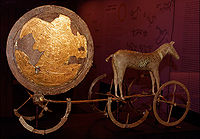
The Sun
Sun
The Sun is the star at the center of the Solar System. It is almost perfectly spherical and consists of hot plasma interwoven with magnetic fields...
was represented as riding in a chariot.
Earth as a body
There was a creation myth involving the world being made from the body of a giant. The elements in the myth are (1) *Yemós, the "twin" who is (2) dismembered by (3)*Mánu, his brother, and then the parts of the twin's body are used to (4) create the world according to a specific formula "his bones are the rocks, his blood made the rivers and seas", etc. Each entry is followed by the original source of the myth, and then a place where it was published. Many of the references are from the SBE = Sacred Books of the EastSacred Books of the East
The Sacred Books of the East is a monumental 50-volume set of English translations of Asian religious writings, edited by Max Müller and published by the Oxford University Press between 1879 and 1910...
, ed. by Max Müller.
While the substance of the formula is essentially folkloric (because rocks do look like "bones of the earth"), the use of the formula in this particular context and the linguistic correspondence of the names makes possible the reconstruction of a Proto-Indo-European myth, as recognized by Cox, p. 189. This myth also appears in the Encyclopedia of Indo-European Culture, Mallory and Adams, p. 129-130, and other modern authors, which is why it was chosen as an example.
Vedic Sanskrit
Vedic Sanskrit
Vedic Sanskrit is an old Indo-Aryan language. It is an archaic form of Sanskrit, an early descendant of Proto-Indo-Iranian. It is closely related to Avestan, the oldest preserved Iranian language...
examples, circa 1500 to 500 BCE:
- YamáYamaYama , also known as Yamarāja in India and Nepal, Shinje in Tibet, Yanluowang or simply Yan in China, Yeomla Daewang in South Korea and Enma Dai-Ō in Japan, is the lord of death, in Hinduism and then adopted into Buddhism and then further into Chinese mythology and Japanese mythology. First...
dies (it doesn't say how). "Yamá surrendered his dear body." The original source is the RV 10.13.4. This was published in Vedic Mythology, Vol. 2, p. 223. - "Yama died as the first of mortals." The original source is the Atharva Veda XVIII.3.13, and this was also published in Vedic Mythology, Vol. 2, p. 222.
- later Sanskrit (1000 - 500 BCE). First a bull, then the wife of ManuManu (Hinduism)In various Hindu traditions, Manu is a title accorded to the progenitor of mankind, and also the very first brahman king to rule this earth, who saved mankind from the universal flood. He was absolutely honest which was why he was initially known as "Satyavrata"...
, named Manâvî is killed (with Manu's permission) in sacrifice by the Ashuras (no world making!). The original source is the Satapatha-Brâhmana: 1 Kanda, 1 Adhyâya, 4 Brâhmana 14-17. This was published in the SBE, Vol. 12 (trans. by Julius Eggeling), pp. 29–30.
Avestan examples:
- Yima KshaetaJamshidJamshid is a mythological figure of Greater Iranian culture and tradition.In tradition and folklore, Jamshid is described as having been the fourth and greatest king of the epigraphically unattested Pishdadian dynasty . This role is already alluded to in Zoroastrian scripture Jamshid (Middle-...
makes the world grow larger three times, but he does this while he is still alive. This version is clearly mythological. Yima is the Avestan form of Sanskrit Yama and Kshaeta means "brilliant, shining." The original source is the Zend-AvestaAvestaThe Avesta is the primary collection of sacred texts of Zoroastrianism, composed in the Avestan language.-Early transmission:The texts of the Avesta — which are all in the Avestan language — were composed over the course of several hundred years. The most important portion, the Gathas,...
, Vendidad, Fargard II, and this was published in SBE, Vol. 4 (translated by James Darmesteter), p. 12-21. - Avestan "....Aži DahâkaZahhakZahhāk or Zohhāk is an evil figure in Iranian mythology, evident in ancient Iranian folklore as Aži Dahāka, the name by which he also appears in the texts of the Avesta...
and Spityura, he who sawed Yima in twain." According to the editor of the text (Darmesteter), Spityura was a brother of Yima. The original source is the Zend-Avesta, Zamyâd Yasht, VIII: 46, published in SBE, Vol. 23, p. 293-297. - Middle PersianMiddle PersianMiddle Persian , indigenously known as "Pârsig" sometimes referred to as Pahlavi or Pehlevi, is the Middle Iranian language/ethnolect of Southwestern Iran that during Sassanid times became a prestige dialect and so came to be spoken in other regions as well. Middle Persian is classified as a...
of the 9th-11th centuries. In these source Gav, the primordial bull, is killed by Ahriman (spelled Aharman in Darmesteter). The original source is the Bundahišn, Ch. 3, part 23, * Middle Persian. Here there is only the bare statement: "Spîtûr was he who, with Dahâk, cut up Yim." The original source is also the Bundahišn, Chap XXXI, Verse 5, and this was published in SBE Vol. 5, p. 131. - Persian (around 1100 CE, written by FirdausiFerdowsiFerdowsi was a highly revered Persian poet. He was the author of the Shahnameh, the national epic of Iran and related societies.The Shahnameh was originally composed by Ferdowsi for the princes of the Samanid dynasty, who were responsible for a revival of Persian cultural traditions after the...
). In this source, Jemshid is sawed in two by Zohak. (Jemshid is the Persian form of earlier Yima Kshaeta. Zohak is the Persian form of earlier Aži Dahâka.) In this text, Gayomart is a man, the first king, but he simply "passes away" after winning a battle against the son of Ahriman. The original source is the Shah Namah, which was produced in many books often with beautiful Mughal-style illustrations. The first section of it is a "book of kings", hence the name. The Shah Namah has been published in English in many very bad verse translations. The one used here is Vol. 1 of the Shahnama of Firdausi, translated by Arthur George Warner and Edmond Warner, Kegan Paul, Trench, Trubner & Co., London, 1905. There is also an abridged prose version of this on the net, transl. by Helen Zimmern, 1883, at sacred-texts.
Germanic
Germanic languages
The Germanic languages constitute a sub-branch of the Indo-European language family. The common ancestor of all of the languages in this branch is called Proto-Germanic , which was spoken in approximately the mid-1st millennium BC in Iron Age northern Europe...
examples:
- Old Norse texts written down in the 13th cent. but composed earlier. Ymir is dismembered by Odin and his brother gods to make the World with the formula: "Of Ymir's flesh the earth was fashioned, And of his sweat the sea; Crags of his bones, trees of his hair, And of his skull the sky. Then of his brows, the blithe gods made Midgard for sons of men; And of his brain, the bitter-mooded Clouds were all created." The original source is GrimnismalGrímnismálGrímnismál is one of the mythological poems of the Poetic Edda. It is preserved in the Codex Regius manuscript and the AM 748 I 4to fragment. It is spoken through the voice of Grímnir, one of the many guises of the god Odin, who is tortured by King Geirröth...
40-41 (Poetic EddaPoetic EddaThe Poetic Edda is a collection of Old Norse poems primarily preserved in the Icelandic mediaeval manuscript Codex Regius. Along with Snorri Sturluson's Prose Edda, the Poetic Edda is the most important extant source on Norse mythology and Germanic heroic legends, and from the early 19th century...
). This version is quoted from p. 21, The Prose EddaProse EddaThe Prose Edda, also known as the Younger Edda, Snorri's Edda or simply Edda, is an Icelandic collection of four sections interspersed with excerpts from earlier skaldic and Eddic poetry containing tales from Nordic mythology...
by Snorri SturlusonSnorri SturlusonSnorri Sturluson was an Icelandic historian, poet, and politician. He was twice elected lawspeaker at the Icelandic parliament, the Althing...
, transl. by Arthur Gilchrist Brodeur, The American-Scandinavian Foundation, Oxford Univ. Press, London, 1923.
Brothers
Analysis of different Indo-European tales indicates the Proto-Indo-Europeans believed there were two progenitors of mankind: *Manu- ("Man"; Indic Manu; Germanic Mannus) and *Yemo- ("Twin"), his twin brother.There are almost no mythological tales of Rome, but the early "history" of Rome is recognized as being an historicized version of various old myths. Romulus and Remus were twin brothers. They both have stories in which they are killed.
- Remus is killed by his brother Romulus at the foundation of Rome; and
- Romulus is dismembered by the senators, "... there were some who secretly hinted that he had been torn limb from limb by the senators ..." There is no world making here, but Romulus is the eponymous ancestor of the Romans, and the founder of Rome. One of the original sources for the stories of Romulus and Remus is Livy's History of Rome Vol. 1, parts iv-vii and xvi. This has been published in an Everyman edition, transl. by W.M. Roberts, E.P. Dutton & Co. NY, 1912.
- Gemini is the actual Latin word for 'twins' though it usually applies to Castor and Pollux, see Horse Twins in the Pantheon section. They were worshipped all over the Roman world with votive altars with inscriptions, which remained after the Romans were gone. This may be the source of some names which appear in early Christian myths.
The Germanic languages have information about both Ymir and Mannus (cognates of *Yemo- and *Manu- respectively), but they never appear in the same myth, rather they appear only in myths widely separated in both time and circumstances.
- A Roman text (dated CE 98) tells that Mannus, the son of Tuisto, was the ancestor of the Germanic people, according to TacitusTacitusPublius Cornelius Tacitus was a senator and a historian of the Roman Empire. The surviving portions of his two major works—the Annals and the Histories—examine the reigns of the Roman Emperors Tiberius, Claudius, Nero and those who reigned in the Year of the Four Emperors...
, writing in Latin, in GermaniaGermania (book)The Germania , written by Gaius Cornelius Tacitus around 98, is an ethnographic work on the Germanic tribes outside the Roman Empire.-Contents:...
2. We never see this being again, but the name Allemagne is interpreted (perhaps by folk etymology) as "all-men" the name for themselves.
Bulls
- Celtic (in this case Irish) texts were written down between the 11th and 14th centuries CE. In one myth a bull is killed and dismembered by another bull and the parts of his body are distributed around Ireland, which explains the names of many features of the landscape, though not the cause of their existence. "It was not long before the men of Erin [Ireland], as they were there in the company of Ailill and Madb early on the morrow, saw coming over Cruachan from the west, the Brown Bull of Cualnge with the Whitehorned [Bull] of Ai in torn fragments hanging about his ears and horns." An example of one of the distributions is this one: "Then he raised his head, and the shoulder-blades of the Whitehorned fell from him in that place. Hence, Sruthair Finnlethe ('Stream of the White Shoulder-blade') is the name given to it." The original source is the last chapter of the Táin Bó Cúalnge, usually called in English, The Cattle Raid of Cooley. These quotations are from The Ancient Irish Epic Tale, Táin Bó Cúalnge, transl. by Joseph Dunn, publ. David Nutt, London, 1914.
- In Lithuanian, a folktale tells of a bull and three cows which are beheaded by Aušrinė, (the morning star) and then the land appears. "The maiden upon returning released her bull. The bull knelt down and spoke in a man's voice: "Chop off my head!" The maiden did not want to chop it off, but she had to. She chopped the head off—a fourth of the seas disappeared, became land. Her brother emerged from the bull. She cut off the heads of all three cows, who were her sisters. All the seas disappeared, turned to land. The earth sprang to life." The original source for this is a folktale called Saulė and Vejų Motina (The Sun and the Mother of the Winds), pp. 309–13, of M. Davainis-Silvestraitis' Collection, Pasakos, Sakmės, Oracijos (Tales, Legends and Orations) publ. in Vilnius, 1973. The English version is from p. 67 Of Gods and Men by Algirdas J. GreimasAlgirdas Julien GreimasAlgirdas Julien Greimas , known among other things for the Greimas Square, is considered, along with Roland Barthes, the most prominent of the French semioticians. With his training in linguistics, he added to the theory of signification and laid the foundations for the Paris School of Semiotics...
, transl. by Milda Newman, Indiana Univ. Press, Indianapolis, 1992.
Other myths
Other myths may have included:Creation myths
- Birth of the Horse Twins from the grain/horse mother (Cox, p. 234, found in 7/11 language groups, which is a very conservative statistic)
- Danu killed and cut open to produce a river (a parturition creation myth, 3/11)
Cyclic myths
- Spring kills Winter, usually with his sprinkler or his striker (Cox, p. 559, found in 4/11 language groups)
- Cloud/cows stolen from the sun god by the wind god and then released (Cox, p. 232, 4/11)
- Death and rebirth of the (often grain-associated) life-death-rebirth deityLife-death-rebirth deityA dying god, also known as a dying-and-rising or resurrection deity, is a god who dies and is resurrected or reborn, in either a literal or symbolic sense. Male examples include the ancient Near Eastern and Greek deities Baal, Melqart, Adonis, Eshmun, Attis Tammuz, Asclepius, Orpheus, as well as...
causes the seasons; Frazer calls him the "Dying Corn God" (Frazer, Vol. 8 and 9 of the Golden Bough esp. Vol. 9, p. 412-423; 4/11) - Uncle Water melts the ice and releases the water causing flooding (Gamkrelidze and Ivanov 1995, 5/11)
- Quest of the golden apples of immortality, usually by a wind god (Cox, p. 512, 4/11)
Culture myths
- Culture myths, stories in which some godlike being teaches the "arts of civilization" (actually technologies) to humans, are found in all cultures. The culture myths of the Indo-Europeans tell how the culture godCulture heroA culture hero is a mythological hero specific to some group who changes the world through invention or discovery...
s taught humans such arts as how to make fire, the proper way to kill and butcher an animal (sacrifice), religious rituals and law codes, smithing, weaving, ploughing, and healing. Culture-giving figures (e.g. PrometheusPrometheusIn Greek mythology, Prometheus is a Titan, the son of Iapetus and Themis, and brother to Atlas, Epimetheus and Menoetius. He was a champion of mankind, known for his wily intelligence, who stole fire from Zeus and gave it to mortals...
and LokiLokiIn Norse mythology, Loki or Loke is a god or jötunn . Loki is the son of Fárbauti and Laufey, and the brother of Helblindi and Býleistr. By the jötunn Angrboða, Loki is the father of Hel, the wolf Fenrir, and the world serpent Jörmungandr. By his wife Sigyn, Loki is the father of Nari or Narfi...
) sometimes have an intermediate position between gods and humans (i.e., demigodDemigodThe term "demigod" , meaning "half-god", is commonly used to describe mythological figures whose one parent was a god and whose other parent was human; as such, demigods are human-god hybrids...
s). They are certainly supernatural, but they often die or are tortured by other gods for their beneficence to humans; nevertheless they are often revived and worshipped like regular gods or revered as heroHeroA hero , in Greek mythology and folklore, was originally a demigod, their cult being one of the most distinctive features of ancient Greek religion...
es. Mallory and Adams call them Craft Gods and argue that they are not linguistically reconstructible; however, Cox compares Greek Prometheus with Hindu Pramanthu (Cox, p. 421). Smith gods, a subset of the culture gods, are slightly reconstructible according to Mallory and Adams.
Ritual
Émile BenvenisteÉmile Benveniste
Émile Benveniste was a French Jewish structural linguist, semiotician, an apprentice of Antoine Meilletand his successor, who, in his later years, became enlightened by the structural view of language through the work of Ferdinand de Saussure, although he was unwilling to grasp it at first, being...
states that "there is no common [IE] term to designate religion itself, or cult, or the priest, not even one of the personal gods".
There are, however, terms denoting ritual practice reconstructed in Indo-Iranian religion which have root cognates in other branches, hinting at common PIE concepts. Thus, the stem *hrta-, usually translated as "(cosmic
Cosmos
In the general sense, a cosmos is an orderly or harmonious system. It originates from the Greek term κόσμος , meaning "order" or "ornament" and is antithetical to the concept of chaos. Today, the word is generally used as a synonym of the word Universe . The word cosmos originates from the same root...
) order" (Vedic ŗta
Rta
In the Vedic religion, Ṛta is the principle of natural order which regulates and coordinates the operation of the universe and everything within it. In the hymns of the Vedas, Ṛta is described as that which is ultimately responsible for the proper functioning of the natural, moral and sacrificial...
and Iranian arta
Asha
Asha is the Avestan language term for a concept of cardinal importance to Zoroastrian theology and doctrine. In the moral sphere, aša/arta represents what has been called "the decisive confessional concept of Zoroastrianism." ...
).
Benveniste states, "We have here one of the cardinal notions of the legal world of the Indo-Europeans to say nothing of their religious and moral ideas" (pp. 379–381). He also adds that an abstract suffix -tu formed the Vedic stem ŗtu
RTU
A remote terminal unit is a microprocessor-controlled electronic device that interfaces objects in the physical world to a distributed control system or SCADA by transmitting telemetry data to the system and/or altering the state of connected objects based on control messages received from the...
-, Avestan ratu- which designated order, particularly in the seasons and periods of time and which appears in Latin ritus "rite" and Sanskrit ritu.
The following list of reconstructed PIE religious terms is based on EIEC
Encyclopedia of Indo-European Culture
The Encyclopedia of Indo-European Culture is an encyclopedia of Indo-European studies and the Proto-Indo-Europeans. The encyclopedia was edited by J. P. Mallory and Douglas Q. Adams and published in 1997 by Fitzroy Dearborn...
and Lyle Campbell
- *isH1ro ‘holyHierosHieros is Greek for "sacred, sanctified".* Sacred * Sacrifice* Religion in ancient Greece...
’ - *sakro- ‘sacredSacredHoliness, or sanctity, is in general the state of being holy or sacred...
’ (derived from *sak- ‘to sanctify’) [p. 493, EIEC] - *kywen(to)- ‘holy’ [p. 493, EIEC]
- *noibho- ‘holy’ [p. 493, EIEC]
- *preky- ‘pray’
- *meldh- ‘pray’ [p. 449, EIEC]
- *gwhedh- ‘pray’ [p. 449, EIEC]
- *H1wegwh- ‘speak solemnly’; [*uegwh-, p. 449, EIEC]
- *ĝheuHx- ‘call, invoke’ (perhaps English god < *ĝhu-to- from ‘that which is invoked’, but derivation from *ĝhu-to- ‘libatedLibationA libation is a ritual pouring of a liquid as an offering to a god or spirit or in memory of those who have died. It was common in many religions of antiquity and continues to be offered in various cultures today....
’ from *ĝheu- ‘libate, pour’ is also possible). [p. 89, EIEC] - *kowHxei- ‘priest, seer/poet’ [p. 451, EIEC]
- *Hxiaĝ- ‘worship’
- *weik- ‘consecrate’ (earlier meaning perhaps ‘to separate’), [*ueik-, p. 493, EIEC; p. 29, Grimm]
- *sep- ‘handle reverently’ [p. 450, EIEC]
- *spend- ‘libate’
- *ĝheu- ‘libate’ and *ĝheu-mņ ‘libation’
- *dapnom ‘sacrificial meal’ from *dap-, [p. 496, EIEC; p. 484, Benveniste]
- *tolko/eH2- ‘meal’ (at least late PIE) [p. 496, EIEC]
- *nemos ‘sacred grove’ (used in west and centre of the IE world)
- *werbh- ‘sacred enclosure’
Development
The various Indo-European daughter-cultures continued elements of PIE religion, syncretizing it with innovations and foreign elements, notably Ancient Near EastAncient Near East
The ancient Near East was the home of early civilizations within a region roughly corresponding to the modern Middle East: Mesopotamia , ancient Egypt, ancient Iran The ancient Near East was the home of early civilizations within a region roughly corresponding to the modern Middle East: Mesopotamia...
ern and Dravidian
Dravidian peoples
Dravidian peoples is a term used to refer to the diverse groups of people who natively speak languages belonging to the Dravidian language family. Populations of speakers of around 220 million are found mostly in Southern India. Other Dravidian people are found in parts of central India, Sri Lanka,...
elements, the reforms of Zoroaster
Zoroaster
Zoroaster , also known as Zarathustra , was a prophet and the founder of Zoroastrianism who was either born in North Western or Eastern Iran. He is credited with the authorship of the Yasna Haptanghaiti as well as the Gathas, hymns which are at the liturgical core of Zoroastrianism...
and Buddha
Gautama Buddha
Siddhārtha Gautama was a spiritual teacher from the Indian subcontinent, on whose teachings Buddhism was founded. In most Buddhist traditions, he is regarded as the Supreme Buddha Siddhārtha Gautama (Sanskrit: सिद्धार्थ गौतम; Pali: Siddhattha Gotama) was a spiritual teacher from the Indian...
, and the spread of Christianity
Christianity
Christianity is a monotheistic religion based on the life and teachings of Jesus as presented in canonical gospels and other New Testament writings...
and Islam
Islam
Islam . The most common are and . : Arabic pronunciation varies regionally. The first vowel ranges from ~~. The second vowel ranges from ~~~...
.
- Anatolian: see Hittite mythologyHittite mythologyMost of the narratives embodying Hittite mythology are lost, and the elements that would give a balanced view of Hittite religion are lacking among the tablets recovered at the Hittite capital Hattusa and other Hittite sites: "there are no canonical scriptures, no theological disquisitions or...
- Indo-Iranian:
- Indo-Aryan: see Vedic religionHistorical Vedic religionThe religion of the Vedic period is a historical predecessor of Hinduism. Its liturgy is reflected in the mantra portion of the four Vedas, which are compiled in Sanskrit. The religious practices centered on a clergy administering rites...
and mythologyVedic mythologyVedic mythology refers to the mythological aspects of the historical Vedic religion and Vedic literature, most notably alluded to in the hymns of the Rigveda...
, Indian religions (HinduismHinduismHinduism is the predominant and indigenous religious tradition of the Indian Subcontinent. Hinduism is known to its followers as , amongst many other expressions...
and Hindu mythologyHindu mythologyHindu religious literature is the large body of traditional narratives related to Hinduism, notably as contained in Sanskrit literature, such as the Sanskrit epics and the Puranas. As such, it is a subset of Nepali and Indian culture...
, BuddhismBuddhismBuddhism is a religion and philosophy encompassing a variety of traditions, beliefs and practices, largely based on teachings attributed to Siddhartha Gautama, commonly known as the Buddha . The Buddha lived and taught in the northeastern Indian subcontinent some time between the 6th and 4th...
and Buddhist mythologyBuddhist mythologyBuddhist mythology operates within the Buddhist belief system. It is a relatively broad mythology, as it was adopted and influenced by several diverse cultures such as Gandhara which was the capital of Bactria. Later on, it also came to incorporate aspects from countries such as China and Japan...
, JainismJainismJainism is an Indian religion that prescribes a path of non-violence towards all living beings. Its philosophy and practice emphasize the necessity of self-effort to move the soul towards divine consciousness and liberation. Any soul that has conquered its own inner enemies and achieved the state...
, SikhismSikhismSikhism is a monotheistic religion founded during the 15th century in the Punjab region, by Guru Nanak Dev and continued to progress with ten successive Sikh Gurus . It is the fifth-largest organized religion in the world and one of the fastest-growing...
), and Kalasha (religion)Kalasha (religion)Kalasha culture and belief system differs from the various ethnic groups surrounding them but is similar to that of the neighboring Nuristanis in northeast Afghanistan. The Kalash people are unique in their customs and religion. In the 1970s there were a number of forced conversions... - Iranian: see ZoroastrianismZoroastrianismZoroastrianism is a religion and philosophy based on the teachings of prophet Zoroaster and was formerly among the world's largest religions. It was probably founded some time before the 6th century BCE in Greater Iran.In Zoroastrianism, the Creator Ahura Mazda is all good, and no evil...
, Persian mythologyPersian mythologyPersian mythology are traditional tales and stories of ancient origin, some involving extraordinary or supernatural beings. Drawn from the legendary past of the Iranian cultural continent which especially consists of the state of Iran, Afghanistan, Tajikistan and Central Asia, they reflect the...
- Indo-Aryan: see Vedic religion
- Greek: see Greek polytheismAncient Greek religionGreek religion encompasses the collection of beliefs and rituals practiced in ancient Greece in the form of both popular public religion and cult practices. These different groups varied enough for it to be possible to speak of Greek religions or "cults" in the plural, though most of them shared...
and mythologyGreek mythologyGreek mythology is the body of myths and legends belonging to the ancient Greeks, concerning their gods and heroes, the nature of the world, and the origins and significance of their own cult and ritual practices. They were a part of religion in ancient Greece...
, Hellenistic religionHellenistic religionHellenistic religion is any of the various systems of beliefs and practices of the people who lived under the influence of ancient Greek culture during the Hellenistic period and the Roman Empire . There was much continuity in Hellenistic religion: the Greek gods continued to be worshiped, and the...
, Decline of Hellenistic polytheismDecline of Hellenistic polytheismThe Greco-Roman religion at the time of the Constantinian shift mostly consisted of three main currents,*Greco-Roman Polytheism,*the official Roman imperial cult,*various Mystery religions....
, Greek Orthodox ChurchGreek Orthodox ChurchThe Greek Orthodox Church is the body of several churches within the larger communion of Eastern Orthodox Christianity sharing a common cultural tradition whose liturgy is also traditionally conducted in Koine Greek, the original language of the New Testament... - Italic: see Roman polytheism and mythologyRoman mythologyRoman mythology is the body of traditional stories pertaining to ancient Rome's legendary origins and religious system, as represented in the literature and visual arts of the Romans...
, Roman Catholic ChurchRoman Catholic ChurchThe Catholic Church, also known as the Roman Catholic Church, is the world's largest Christian church, with over a billion members. Led by the Pope, it defines its mission as spreading the gospel of Jesus Christ, administering the sacraments and exercising charity... - Celtic: see Celtic polytheismCeltic polytheismCeltic polytheism, commonly known as Celtic paganism, refers to the religious beliefs and practices adhered to by the Iron Age peoples of Western Europe now known as the Celts, roughly between 500 BCE and 500 CE, spanning the La Tène period and the Roman era, and in the case of the Insular Celts...
and mythologyCeltic mythologyCeltic mythology is the mythology of Celtic polytheism, apparently the religion of the Iron Age Celts. Like other Iron Age Europeans, the early Celts maintained a polytheistic mythology and religious structure...
, Celtic ChristianityCeltic ChristianityCeltic Christianity or Insular Christianity refers broadly to certain features of Christianity that were common, or held to be common, across the Celtic-speaking world during the Early Middle Ages... - Germanic: see Germanic mythologyGermanic mythologyGermanic mythology is a comprehensive term for myths associated with historical Germanic paganism, including Norse mythology, Anglo-Saxon mythology, Continental Germanic mythology, and other versions of the mythologies of the Germanic peoples...
(Continental, Anglo-SaxonAnglo-Saxon polytheismAnglo-Saxon paganism, or as it has also been known, Anglo-Saxon heathenism,The religion has been referred to as "paganism" by most scholars, such as David M. Wilson and Martin Carver , but as "heathenism" by some others, like Brian Branston...
and Norse mythologyNorse mythologyNorse mythology, a subset of Germanic mythology, is the overall term for the myths, legends and beliefs about supernatural beings of Norse pagans. It flourished prior to the Christianization of Scandinavia, during the Early Middle Ages, and passed into Nordic folklore, with some aspects surviving...
) - Baltic: see Latvian mythologyLatvian mythologyLatvian culture, along with Lithuanian, is among the oldest surviving Indo-European cultures. Much of its symbolism is ancient. Its seasons, festivals, and numerous deities reflect the essential agrarian nature of Latvian tribal life...
, Lithuanian mythologyLithuanian mythologyLithuanian mythology is an example of Baltic mythology, developed by Lithuanians throughout the centuries.-History of scholarship:Surviving information about Baltic paganism in general is very sketchy and incomplete. As with most ancient Indo-European cultures Lithuanian mythology is an example of... - Slavic: see Slavic mythologySlavic mythologySlavic mythology is the mythological aspect of the polytheistic religion that was practised by the Slavs before Christianisation.The religion possesses many common traits with other religions descended from the Proto-Indo-European religion....
, Christianization of the Slavs - Tocharian: little evidence, see Silk Road transmission of BuddhismSilk Road transmission of BuddhismThe Silk Road transmission of Buddhism to China is most commonly thought to have started in the late 2nd or the 1st century CE.The first documented translation efforts by Buddhist monks in China were in the 2nd century CE, possibly as a consequence of the expansion of the Kushan Empire into the...
- Armenian: limited evidence, see Armenian mythologyArmenian mythologyVery little is known about pre-Christian Armenian mythology, the oldest source being the legends of Xorenatsi's History of Armenia.Armenian mythology was strongly influenced by Zoroastrianism, with deities such as Aramazd, Mihr or Anahit, as well as Assyrian traditions, such as Barsamin, but there...
, Armenian Orthodox Church - Prehistoric Balkans: see Paleo-Balkanic mythology
See also
- Chariot burialChariot burialChariot burials are tombs in which the deceased was buried together with his chariot, usually including his horses and other possessions....
- SomaSomaSoma , or Haoma , from Proto-Indo-Iranian *sauma-, was a ritual drink of importance among the early Indo-Iranians, and the subsequent Vedic and greater Persian cultures. It is frequently mentioned in the Rigveda, whose Soma Mandala contains 114 hymns, many praising its energizing qualities...
- Horse sacrificeHorse sacrificeMany Indo-European religious branches show evidence for horse sacrifice, and comparative mythology suggests that they derive from a Proto-Indo-European ritual.-Context:...
- Neolithic religionNeolithic religionPrehistoric religion is a general term for the religious beliefs and practices of prehistoric peoples. More specifically it encompasses Paleolithic religion, Mesolithic religion, Neolithic religion and Bronze Age religion.-Burial:...
- Aesir-Asura correspondence
- World TreeWorld treeThe world tree is a motif present in several religions and mythologies, particularly Indo-European religions, Siberian religions, and Native American religions. The world tree is represented as a colossal tree which supports the heavens, thereby connecting the heavens, the earth, and, through its...