


Norns

Encyclopedia


Norse mythology
Norse mythology, a subset of Germanic mythology, is the overall term for the myths, legends and beliefs about supernatural beings of Norse pagans. It flourished prior to the Christianization of Scandinavia, during the Early Middle Ages, and passed into Nordic folklore, with some aspects surviving...
are female beings who rule the destiny
Destiny
Destiny or fate refers to a predetermined course of events. It may be conceived as a predetermined future, whether in general or of an individual...
of gods and men, a kind of dísir
Dísir
In Norse mythology, a dís is a ghost, spirit or deity associated with fate who can be both benevolent and antagonistic towards mortal people. Dísir may act as protective spirits of Norse clans...
comparable to the Fates
Moirae
The Moirae, Moerae or Moirai , in Greek mythology, were the white-robed incarnations of destiny . Their number became fixed at three...
in classical mythology.
According to Snorri Sturluson
Snorri Sturluson
Snorri Sturluson was an Icelandic historian, poet, and politician. He was twice elected lawspeaker at the Icelandic parliament, the Althing...
's interpretation of the Völuspá
Völuspá
Völuspá is the first and best known poem of the Poetic Edda. It tells the story of the creation of the world and its coming end related by a völva addressing Odin...
, the three most important norns, Urðr
Urðr
Urðr is one of the Norns in Norse mythology. Along with Verðandi and Skuld , Urðr makes up a trio of Norns that are described as deciding the fates of people...
(Wyrd), Verðandi and Skuld
Skuld (Norn)
Skuld is a Norn in Norse mythology. Along with Urðr and Verðandi , Skuld makes up a trio of Norns that are described as deciding the fates of people...
come out from a hall standing at the Well of Urðr (well of fate) and they draw water from the well and take sand that lies around it, which they pour over Yggdrasill so that its branches will not rot. These norns are described as three powerful maiden giantesses (Jotuns) whose arrival from Jötunheimr
Jötunheimr
Jötunheimr is one of the Nine Worlds and the homeland of the Giants of Norse Mythology — Rock Giants and Frost Giants.-Legend:...
ended the golden age of the gods. They may be the same as the maidens of Mögþrasir who are described in Vafþrúðnismál
Vafþrúðnismál
In Norse mythology, Vafþrúðnismál is the third poem in the Poetic Edda. It is a conversation in verse form conducted initially between the Æsir Odin and Frigg, and subsequently between Odin and the giant Vafþrúðnir...
(see below).
Beside these three norns, there are many other norns who arrive when a person is born in order to determine his or her future. There were both malevolent and benevolent norns, and the former caused all the malevolent and tragic events in the world while the latter were kind and protective goddesses. Recent research has discussed the relation between the myths associated with norns and valkyrie
Valkyrie
In Norse mythology, a valkyrie is one of a host of female figures who decides who dies in battle. Selecting among half of those who die in battle , the valkyries bring their chosen to the afterlife hall of the slain, Valhalla, ruled over by the god Odin...
s and the actual travelling Völva
Völva
A vǫlva or völva is a shamanic seeress in Norse paganism, and a recurring motif in Norse mythology....
s (seiðr-workers), women who visited newborn children in the pre-Christian Norse societies.
Etymology
Whereas the origin of the name norn is uncertain, it may derive from a word meaning "to twine" and which would refer to their twining the thread of fate.The name Urðr
Urðr
Urðr is one of the Norns in Norse mythology. Along with Verðandi and Skuld , Urðr makes up a trio of Norns that are described as deciding the fates of people...
(Wyrd
Wyrd
Wyrd is a concept in Anglo-Saxon culture roughly corresponding to fate or personal destiny. The word is ancestral to Modern English weird, which retains its original meaning only dialectally....
, Weird) means "fate". Both Urðr and Verðandi are derived from the Old Norse verb verða, "to be". While Urðr derives from the past tense ("that which became or happened"), Verðandi derives from the present tense of verða ("that which is happening"). Skuld
Skuld
Skuld may refer to:* Skuld, one of a group of three norns in Norse mythology* Skuld , a princess in Norse mythology* 1130 Skuld, an asteroid discovered on 2 September 1929 and named after the Norn...
is derived from the Old Norse verb skole/skulle, "need/ought to be/shall be"; its meaning is "that which should become, or that needs to occur".
Relation to other Germanic female deities
There is no clear distinction between norns, fylgjaFylgja
In Norse mythology, a fylgja is a supernatural being or creature which accompanies a person in connection to their fate or fortune...
s, hamingja
Hamingja
In Norse mythology, hamingja refers to two concepts; the personification of the good fortune or luck of an individual or family, and, secondly, refers to the altered appearance of shape-shifters. Both Andy Orchard and Rudolf Simek note parallels between the concept of the hamingja and the...
s and valkyrie
Valkyrie
In Norse mythology, a valkyrie is one of a host of female figures who decides who dies in battle. Selecting among half of those who die in battle , the valkyries bring their chosen to the afterlife hall of the slain, Valhalla, ruled over by the god Odin...
s, nor with the generic term dísir
Dísir
In Norse mythology, a dís is a ghost, spirit or deity associated with fate who can be both benevolent and antagonistic towards mortal people. Dísir may act as protective spirits of Norse clans...
. Moreover, artistic license
Artistic license
Artistic licence is a colloquial term, sometimes euphemism, used to denote the distortion of fact, alteration of the conventions of grammar or language, or rewording of pre-existing text made by an artist to improve a piece of...
permitted such terms to be used for mortal women in Old Norse poetry
Old Norse poetry
Old Norse poetry encompasses a range of verse forms written in Old Norse, during the period from the 8th century to as late as the far end of the 13th century...
, or to quote Snorri Sturluson
Snorri Sturluson
Snorri Sturluson was an Icelandic historian, poet, and politician. He was twice elected lawspeaker at the Icelandic parliament, the Althing...
's Skáldskaparmál
Skáldskaparmál
The second part of Snorri Sturluson's Prose Edda the Skáldskaparmál or "language of poetry" is effectively a dialogue between the Norse god of the sea, Ægir and Bragi, the god of poetry, in which both Norse mythology and discourse on the nature of poetry are intertwined...
on the various names used for women:
- Woman is also metaphorically called by the names of the Asynjur or the Valkyrs or Norns or women of supernatural kind.
Attestations
_by_h._e._freund.jpg)
Prose Edda
The Prose Edda, also known as the Younger Edda, Snorri's Edda or simply Edda, is an Icelandic collection of four sections interspersed with excerpts from earlier skaldic and Eddic poetry containing tales from Nordic mythology...
and the Poetic Edda
Poetic Edda
The Poetic Edda is a collection of Old Norse poems primarily preserved in the Icelandic mediaeval manuscript Codex Regius. Along with Snorri Sturluson's Prose Edda, the Poetic Edda is the most important extant source on Norse mythology and Germanic heroic legends, and from the early 19th century...
. The latter contains pagan poetry where the norns are frequently referred to, while the former contains, in addition to pagan poetry, retellings, descriptions and commentaries by the 12th and 13th century Icelandic chieftain and scholar Snorri Sturluson
Snorri Sturluson
Snorri Sturluson was an Icelandic historian, poet, and politician. He was twice elected lawspeaker at the Icelandic parliament, the Althing...
.
Poetic Edda
The Poetic EddaPoetic Edda
The Poetic Edda is a collection of Old Norse poems primarily preserved in the Icelandic mediaeval manuscript Codex Regius. Along with Snorri Sturluson's Prose Edda, the Poetic Edda is the most important extant source on Norse mythology and Germanic heroic legends, and from the early 19th century...
is valuable in representing older material in poetry from which Snorri tapped information in the Prose Edda
Prose Edda
The Prose Edda, also known as the Younger Edda, Snorri's Edda or simply Edda, is an Icelandic collection of four sections interspersed with excerpts from earlier skaldic and Eddic poetry containing tales from Nordic mythology...
. Like, Gylfaginning, the Poetic Edda mentions the existence of many lesser norns beside the three main norns. Moreover, it also agrees with Gylfaginning by telling that they were of several races and that the dwarven norns were the daughters of Dvalin
Dvalin
In Norse mythology, Dvalin is a dwarf who appears in several Old Norse tales and kennings. The name translates as "the dormant one" or "the one slumbering"...
. It also suggests that the three main norns were giantesses (female Jotuns).
Fáfnismál
Fáfnismál
Fáfnismál is an Eddic poem, found in the Codex Regius manuscript. The poem is unnamed in the manuscript, where it follows Reginsmál and precedes Sigrdrífumál, but modern scholars regard it as a separate poem and have assigned it a name for convenience.The poem forms a more coherent whole than...
contains a discussion between the hero Sigurd
Sigurd
Sigurd is a legendary hero of Norse mythology, as well as the central character in the Völsunga saga. The earliest extant representations for his legend come in pictorial form from seven runestones in Sweden and most notably the Ramsund carving Sigurd (Old Norse: Sigurðr) is a legendary hero of...
and the dragon Fafnir
Fafnir
In Norse mythology, Fáfnir or Frænir was a son of the dwarf king Hreidmar and brother of Regin and Ótr. In the Volsunga saga, Fáfnir was a dwarf gifted with a powerful arm and fearless soul. He guarded his father's house of glittering gold and flashing gems...
who is dying from a mortal wound from Sigurd. The hero asks Fafnir of many things, among them the nature of the norns. Fafnir explains that they are many and from several races:
|
|
It appears from Völuspá
Völuspá
Völuspá is the first and best known poem of the Poetic Edda. It tells the story of the creation of the world and its coming end related by a völva addressing Odin...
and Vafþrúðnismál
Vafþrúðnismál
In Norse mythology, Vafþrúðnismál is the third poem in the Poetic Edda. It is a conversation in verse form conducted initially between the Æsir Odin and Frigg, and subsequently between Odin and the giant Vafþrúðnir...
that the three main norns were not originally goddesses but giantesses (Jotuns), and that their arrival ended the early days of bliss for the gods, but that they come for the good of mankind.
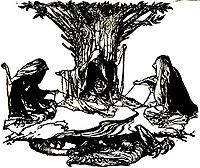
Völuspá relates that three giantesses of huge might are reported to have arrived to the gods from Jotunheim:
|
|
Vafþrúðnismál
Vafþrúðnismál
In Norse mythology, Vafþrúðnismál is the third poem in the Poetic Edda. It is a conversation in verse form conducted initially between the Æsir Odin and Frigg, and subsequently between Odin and the giant Vafþrúðnir...
probably refers to the norns when it talks of maiden giantesses who arrive to protect the people of earth as protective spirits (hamingja
Hamingja
In Norse mythology, hamingja refers to two concepts; the personification of the good fortune or luck of an individual or family, and, secondly, refers to the altered appearance of shape-shifters. Both Andy Orchard and Rudolf Simek note parallels between the concept of the hamingja and the...
s):
|
Hamingja In Norse mythology, hamingja refers to two concepts; the personification of the good fortune or luck of an individual or family, and, secondly, refers to the altered appearance of shape-shifters. Both Andy Orchard and Rudolf Simek note parallels between the concept of the hamingja and the... |
The Völuspá
Völuspá
Völuspá is the first and best known poem of the Poetic Edda. It tells the story of the creation of the world and its coming end related by a völva addressing Odin...
contains the names of the three main Norns referring to them as maidens like Vafþrúðnismál probably does:
|
|
Helgakviða Hundingsbana I
The norns visited each newly born child to allot his or her future, and in Helgakviða Hundingsbana IHelgakviða Hundingsbana I
Völsungakviða, Helgakviða Hundingsbana I or the First Lay of Helgi Hundingsbane is an Old Norse poem found in the Poetic Edda...
, the hero Helgi Hundingsbane
Helgi Hundingsbane
Helgi Hundingsbane is a hero in Norse sagas. Helgi appears in Volsunga saga and in two lays in the Poetic Edda named Helgakviða Hundingsbana I and Helgakviða Hundingsbana II. The Poetic Edda relates that Helgi and his mistress Sigrún were Helgi Hjörvarðsson and Sváva of the Helgakviða...
has just been born and norns arrive at the homestead:
|
|
Helgakviða Hundingsbana II
In Helgakviða Hundingsbana IIHelgakviða Hundingsbana II
Völsungakviða in forna, Helgakviða Hundingsbana II or the Second Lay of Helgi Hundingsbane is an Old Norse poem found in the Poetic Edda...
, Helgi Hundingsbane
Helgi Hundingsbane
Helgi Hundingsbane is a hero in Norse sagas. Helgi appears in Volsunga saga and in two lays in the Poetic Edda named Helgakviða Hundingsbana I and Helgakviða Hundingsbana II. The Poetic Edda relates that Helgi and his mistress Sigrún were Helgi Hjörvarðsson and Sváva of the Helgakviða...
blames the norns for the fact that he had to kill Sigrún's father Högni and brother Bragi in order to wed her:
|
|
Reginsmál
Like Snorri Sturluson stated in Gylfaginning, people's fate depended on the benevolence or the malevolence of particular norns. In ReginsmálReginsmál
Reginsmál or Sigurðarkviða Fáfnisbana II is an Eddic poem, found in the Codex Regius manuscript...
, the water dwelling dwarf Andvari
Andvari
In Norse mythology, Andvari is a dwarf who lives underneath a waterfall and has the power to change himself into a fish at will. Andvari had a magical ring Andvarinaut, which helped him become wealthy....
blames his plight on an evil norn, presumably one of the daughters of Dvalin:
|
|
Sigurðarkviða hin skamma
Another instance of Norns being blamed for an undesirable situation appears in Sigurðarkviða hin skammaSigurðarkviða hin skamma
Sigurðarkviða hin skamma or the Short Lay of Sigurd is an Old Norse poem belonging to the heroic poetry of the Poetic Edda. It is one of the longest eddic poems and its name derives from the fact that there was once a longer Sigurðarkviða, but this poem only survives as the fragment Brot af...
, where the valkyrie
Valkyrie
In Norse mythology, a valkyrie is one of a host of female figures who decides who dies in battle. Selecting among half of those who die in battle , the valkyries bring their chosen to the afterlife hall of the slain, Valhalla, ruled over by the god Odin...
Brynhild blames malevolent norns for her long yearning for the embrace of Sigurd
Sigurd
Sigurd is a legendary hero of Norse mythology, as well as the central character in the Völsunga saga. The earliest extant representations for his legend come in pictorial form from seven runestones in Sweden and most notably the Ramsund carving Sigurd (Old Norse: Sigurðr) is a legendary hero of...
:
|
Gudrun Gudrun is a major figure in the early Germanic literature centered on the hero Sigurd, son of Sigmund. She appears as Kriemhild in the Nibelungenlied and as Gutrune in Wagner's Der Ring des Nibelungen.-Norse mythology:... , Gunther Gunther is the German name of a semi-legendary king of Burgundy of the early 5th century... 's am I; |
Guðrúnarkviða II
Brynhild's solution was to have Gunnarr and his brothers, the lords of the BurgundiansBurgundians
The Burgundians were an East Germanic tribe which may have emigrated from mainland Scandinavia to the island of Bornholm, whose old form in Old Norse still was Burgundarholmr , and from there to mainland Europe...
, kill Sigurd and afterwards to commit suicide in order to join Sigurd in the afterlife. Her brother Atli
Atli
-Characters:* Atli, one of the names of the Norse god Thor* Atli in the Völsunga saga, believed to be a romanticized version of Attila the Hun* Atli Buðlason* Atli Hringsson* Atli Iðmundsson* Atli the Slender, a 9th-century earl of Sogn, Norway-Poetry:...
(Attila the Hun
Attila the Hun
Attila , more frequently referred to as Attila the Hun, was the ruler of the Huns from 434 until his death in 453. He was leader of the Hunnic Empire, which stretched from the Ural River to the Rhine River and from the Danube River to the Baltic Sea. During his reign he was one of the most feared...
) avenged her death by killing the lords of the Burgundians, but since he was married to their sister Guðrún
Gudrun
Gudrun is a major figure in the early Germanic literature centered on the hero Sigurd, son of Sigmund. She appears as Kriemhild in the Nibelungenlied and as Gutrune in Wagner's Der Ring des Nibelungen.-Norse mythology:...
, Atli would soon be killed by her. In Guðrúnarkviða II
Guðrúnarkviða II
Guðrúnarkviða II, The Second Lay of Gudrún, or Guðrúnarkviða hin forna, The Old Lay of Gudrún is probably the oldest poem of the Sigurd cycle, according to Henry Adams Bellows....
, the Norns actively enter the series of events by informing Atli in a dream that his wife would kill him. The description of the dream begins with this stanza:
|
|
Guðrúnarhvöt
After having killed both her husband Atli and their sons, Guðrún blames the Norns for her misfortunes, as in GuðrúnarhvötGuðrúnarhvöt
Guðrúnarhvöt is one of the heroic poems of the Poetic Edda. Gudrun had been married to the hero Sigurd and with him she had the daughter Svanhild. Svanhild had married the Gothic king Ermanaric , but betrayed him with the king's son, Randver...
, where Guðrún talks of trying to escaping the wrath of the norns by trying to kill herself:
|
|
Hamðismál
Svanhild
Svanhild is the beautiful daughter of Sigurd and Gudrun in Germanic mythology, whose grisly death at the hands of her jealous royal husband Ermanaric was told in many northern European stories, including the Icelandic Poetic Edda , Prose Edda and the Volsunga Saga; the Norwegian Ragnarsdrápa; the...
. In Hamðismál
Hamðismál
The Hamðismál is a poem which ends the heroic poetry of the Poetic Edda, and thereby the whole collection.Gudrun had been the wife of the hero Sigurd, whom her brothers had killed. With Sigurd she had had the daughter Svanhild, who had married to the Goth king Ermanaric...
, her sons' expedition to the Gothic king Ermanaric
Ermanaric
Ermanaric was a Greuthungian Gothic King who before the Hunnic invasion evidently ruled an enormous area north of the Black Sea. Contemporary historian Ammianus Marcellinus recounts him as a "most warlike man" who "ruled over extensively wide and fertile regions"...
to exact vengeance is fateful. Knowing that he is about to die at the hands of the Goths, her son Sörli talks of the cruelty of the norns:
|
|
Sigrdrífumál
Since the norns were beings of ultimate power who were working in the dark, it should be no surprise that they could be referred to in charms, as they are by Sigrdrífa in SigrdrífumálSigrdrífumál
Sigrdrífumál is the conventional title given to a section of the Poetic Edda text in Codex Regius....
:
|
Gungnir In Norse mythology, Gungnir is the spear of the god Odin.-Poetic Edda:In the Poetic Edda poem Völuspá, the Æsir-Vanir War is described as officially starting when Odin throws a spear over the heads of an assembly of Vanir gods. Whether or not this was specifically Gungnir is, however, unstated... 's point, Grani In Norse mythology, Grani is a horse owned by the hero Sigurd. He is the horse that Sigurd receives through advice from an old man . Grani is a descendant of Odin's own steed, Sleipnir.-Attestations:... 's breast, |
Prose Edda
In the part of Snorri Sturluson's Prose EddaProse Edda
The Prose Edda, also known as the Younger Edda, Snorri's Edda or simply Edda, is an Icelandic collection of four sections interspersed with excerpts from earlier skaldic and Eddic poetry containing tales from Nordic mythology...
which is called Gylfaginning
Gylfaginning
Gylfaginning, or the Tricking of Gylfi , is the first part of Snorri Sturluson's Prose Edda after Prologue. The Gylfaginning deals with the creation and destruction of the world of the Norse gods, and many other aspects of Norse mythology...
, Gylfi
Gylfi
In Norse mythology, Gylfi, Gylfe, Gylvi, or Gylve was the earliest king in Scandinavia recorded. The traditions on Gylfi deal with how he was tricked by the gods and his relations with the goddess Gefjon.-The creation of Zealand:...
, the king of Sweden, has arrived at Valhalla
Valhalla
In Norse mythology, Valhalla is a majestic, enormous hall located in Asgard, ruled over by the god Odin. Chosen by Odin, half of those that die in combat travel to Valhalla upon death, led by valkyries, while the other half go to the goddess Freyja's field Fólkvangr...
calling himself Gangleri
Gangleri
Gangleri may refer to:* one of Odin's many nicknames meaning "the wanderer" or "Wayweary"* the name of the ancient Swedish king Gylfi, given while in disguise, as described in the book Gylfaginning collected in the Prose Edda...
. There, he receives an education in Norse mythology
Norse mythology
Norse mythology, a subset of Germanic mythology, is the overall term for the myths, legends and beliefs about supernatural beings of Norse pagans. It flourished prior to the Christianization of Scandinavia, during the Early Middle Ages, and passed into Nordic folklore, with some aspects surviving...
from what is Odin
Odin
Odin is a major god in Norse mythology and the ruler of Asgard. Homologous with the Anglo-Saxon "Wōden" and the Old High German "Wotan", the name is descended from Proto-Germanic "*Wodanaz" or "*Wōđanaz"....
in the shape of three men. They explain to Gylfi that there are three main norns, but also many others of various races, æsir
Æsir
In Old Norse, áss is the term denoting a member of the principal pantheon in Norse paganism. This pantheon includes Odin, Frigg, Thor, Baldr and Tyr. The second pantheon comprises the Vanir...
, elves and dwarves:
-
- A hall stands there, fair, under the ashYggdrasilIn Norse mythology, Yggdrasil is an immense tree that is central in Norse cosmology. It was said to be the world tree around which the nine worlds existed...
by the well, and out of that hall come three maids, who are called thus: Urdr, Verdandi, Skuld; these maids determine the period of men's lives: we call them Norns; but there are many norns: those who come to each child that is born, to appoint his life; these are of the race of the gods, but the second are of the ElfElfAn elf is a being of Germanic mythology. The elves were originally thought of as a race of divine beings endowed with magical powers, which they use both for the benefit and the injury of mankind...
-people, and the third are of the kindred of the dwarves, as it is said here:
- A hall stands there, fair, under the ash
-
-
- Most sundered in birth
- I say the Norns are;
- They claim no common kin:
- Some are of Æsir-kin,
- some are of Elf-kind,
- Some are Dvalinn's daughters."
-
-
- Then said Gangleri: "If the Norns determine the weirds of men, then they apportion exceeding unevenly, seeing that some have a pleasant and luxurious life, but others have little worldly goods or fame; some have long life, others short." Hárr said: "Good norns and of honorable race appoint good life; but those men that suffer evil fortunes are governed by evil norns."
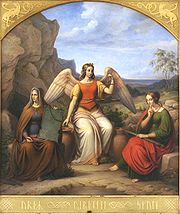
The three main norns take water out of the well of Urd and water Yggdrasil:
-
- It is further said that these Norns who dwell by the Well of Urdr take water of the well every day, and with it that clay which lies about the well, and sprinkle it over the Ash, to the end that its limbs shall not wither nor rot; for that water is so holy that all things which come there into the well become as white as the film which lies within the egg-shell,--as is here said:
- I know an Ash standing
- called Yggdrasill,
- A high tree sprinkled
- with snow-white clay;
- Thence come the dews
- in the dale that fall--
- It stands ever green
- above Urdr's Well.
- That dew which falls from it onto the earth is called by men honey-dew, and thereon are bees nourished. Two fowls are fed in Urdr's Well: they are called Swans, and from those fowls has come the race of birds which is so called."
- It is further said that these Norns who dwell by the Well of Urdr take water of the well every day, and with it that clay which lies about the well, and sprinkle it over the Ash, to the end that its limbs shall not wither nor rot; for that water is so holy that all things which come there into the well become as white as the film which lies within the egg-shell,--as is here said:

Valkyrie
In Norse mythology, a valkyrie is one of a host of female figures who decides who dies in battle. Selecting among half of those who die in battle , the valkyries bring their chosen to the afterlife hall of the slain, Valhalla, ruled over by the god Odin...
, taking part in the selection of warriors from the slain:
-
- These are called Valkyrs: them Odin sends to every battle; they determine men's feyness and award victory. GudrGunnrGunnar or Gunner is a valkyrie in Norse mythology. Her name means "battle" and is cognate with the English word "gun". She rode a wolf and took part in selecting the dead warriors together with two other Valkyries in order to bring them to Valhalla....
and RótaRótaIn Norse mythology, Róta is a valkyrie. Róta is attested in chapter 36 of the Prose Edda book Gylfaginning, where she is mentioned alongside the valkyries Gunnr and Skuld, and the three are described as "always [riding] to choose who shall be slain and to govern the killings." Otherwise, Róta...
and the youngest Norn, she who is called Skuld, ride ever to take the slain and decide fights.
- These are called Valkyrs: them Odin sends to every battle; they determine men's feyness and award victory. Gudr
Legendary sagas
Some of the legendary sagaLegendary saga
A Legendary saga or Fornaldarsaga is a Norse saga that, unlike the Icelanders' sagas, takes place before the colonization of Iceland. There are some exceptions, such as Yngvars saga víðförla, which takes place in the 11th century...
s also contain references to the norns. The Hervarar saga
Hervarar saga
Hervarar saga ok Heiðreks is a legendary saga from the 13th century combining matter from several older sagas. It is a valuable saga for several different reasons beside its literary qualities. It contains traditions of wars between Goths and Huns, from the 4th century, and the last part is used as...
contains a poem named Hlöðskviða
Hlöðskviða
Hlöðskviða or The Battle of the Goths and Huns is sometimes counted among the Eddic Poems. It has been preserved as separate stanzas interspersed among the text in Hervarar saga ok Heiðreks . It is generally agreed that it was originally a poetic whole...
, where the Gothic king Angantyr
Angantyr
Angantyr was the name of three characters from the same line in Norse mythology, and who appear in Hervarar saga, in Gesta Danorum and Faroese ballads....
defeats a Hunnish invasion led by his Hunnish half-brother Hlöðr
Hlöd
Hlod or Hlöd was the illegitimate son of Heidrek, the king of the Goths.He appears in the Hervarar saga and probably also as Hlith in Widsith, line 115, together with his father Heiðrekr , half-brother Angantyr , and his mother Sifka .-Claiming his inheritance:Hlöd had grown up with his grandfather...
. Knowing that his sister, the shieldmaiden
Shieldmaiden
A shieldmaiden was a woman who had chosen to fight as a warrior in Scandinavian folklore and mythology. They are often mentioned in sagas such as Hervarar saga and in Gesta Danorum. Shieldmaidens also appear in stories of other Germanic nations: Goths, Cimbri, and Marcomanni. The mythical Valkyries...
Hervor
Hervor
Hervor is the name of two female characters in the cycle of the magic sword Tyrfing, presented in Hervarar saga with parts found in the Poetic Edda. The first Hervor was the daughter of Angantyr...
, is one of the casualties, Angantyr looks at his dead brother and laments the cruelty of the norns:
|
|
In younger legendary sagas, such as Norna-Gests þáttr
Norna-Gests þáttr
Norna-Gests þáttr or the Story of Norna-Gest is a legendary saga about the Norse hero Norna-Gest.-Summary:Norna-Gest was the son of a Danish man named Thord of Thinghusbit, who once dwelt on the estate of Grøning in Denmark. When he was born, three Norns arrived and had foretold the child's...
and Hrólfs saga kraka
Hrólfs saga kraka
Hrólfs saga kraka, the Saga of King Hrolf kraki, is a late legendary saga on the adventures of Hrólfr Kraki and his clan, the Skjöldungs. The events can be dated to the late 5th century and the 6th century. It is believed to have been written in the period c. 1230 - c. 1450...
, the norns appear to have been synonymous with völva
Völva
A vǫlva or völva is a shamanic seeress in Norse paganism, and a recurring motif in Norse mythology....
s (witches, female shamans). In Norna-Gests þáttr, where they arrive at the birth of the hero to shape his destiny, the norns are not described as weaving the web of fate, instead Norna appears plainly as a synonym of vala (völva).
One of the last legendary sagas to be written down, the Hrólfs saga kraka talks of the norns simply as evil witches. When the evil half-elven
Half-elf
In Norse mythology, a half-elf is the offspring of an elf and a human.Notable examples include the Danish princess Skuld of Hrólf Kraki's saga, and the hero Högni of the Thidrekssaga , and the royal line of Alfheim, which was related to the elves and more beautiful than other people, according to...
princess Skuld
Skuld (princess)
Skuld was a princess of Scandinavian legend who married Heoroweard and encouraged him to kill Hroðulf . The accounts of her vary greatly from source to source.-Hrólfr Kraki's saga:...
assembles her army to attack Hrólfr Kraki, it contains in addition to undead warriors, elves
Elf
An elf is a being of Germanic mythology. The elves were originally thought of as a race of divine beings endowed with magical powers, which they use both for the benefit and the injury of mankind...
and norns.
Runic inscription N 351 M
The belief in the norns as bringers of both gain and loss would last beyond ChristianizationChristianization of Scandinavia
The Christianization of Scandinavia took place between the 8th and the 12th century. The realms of Scandinavia proper, Denmark, Norway and Sweden, established their own Archdioceses, responsible directly to the Pope, in 1104, 1154 and 1164, respectively...
, as testifies the runic inscription N 351 M from the Borgund stave church
Borgund stave church
Borgund Stave Church is a stave church located in Borgund, Lærdal, Norway. It is classified as a triple nave stave church of the so-called Sogn-type. This is also the best preserved of Norway's 28 extant stave churches.-Construction:...
:
- Þórir carved these runes on the eve of OlausOlaf II of NorwayOlaf II Haraldsson was King of Norway from 1015 to 1028. He was posthumously given the title Rex Perpetuus Norvegiae and canonised in Nidaros by Bishop Grimkell, one year after his death in the Battle of Stiklestad on 29 July 1030. Enshrined in Nidaros Cathedral...
-mass, when he travelled past here. The norns did both good and evil, great toil ... they created for me.
Franks Casket
Three women carved on the right panel of Franks CasketFranks Casket
The Franks Casket is a small Anglo-Saxon whalebone chest from the seventh century, now in the British Museum. The casket is densely decorated with knife-cut narrative scenes in flat two-dimensional low-relief and with inscriptions mostly in Anglo-Saxon runes...
, an Anglo-Saxon whalebone chest from the eighth century, have been identified by some scholars as being three norns.
Matres and Matrones
The Germanic Matres and Matrones, female deitiesDeity
A deity is a recognized preternatural or supernatural immortal being, who may be thought of as holy, divine, or sacred, held in high regard, and respected by believers....
venerated in North-West Europe
North-West Europe
North-West Europe is a term that refers to a northern area of Western Europe, although the exact area or countries it comprises varies.-Geographic definition:...
from the 1st to the 5th century AD depicted on votive objects and altar
Altar
An altar is any structure upon which offerings such as sacrifices are made for religious purposes. Altars are usually found at shrines, and they can be located in temples, churches and other places of worship...
s almost entirely in groups of three from the first to the fifth century AD have been proposed as connected with the later Germanic dísir
Dísir
In Norse mythology, a dís is a ghost, spirit or deity associated with fate who can be both benevolent and antagonistic towards mortal people. Dísir may act as protective spirits of Norse clans...
, valkyrie
Valkyrie
In Norse mythology, a valkyrie is one of a host of female figures who decides who dies in battle. Selecting among half of those who die in battle , the valkyries bring their chosen to the afterlife hall of the slain, Valhalla, ruled over by the god Odin...
s, and norns, potentially stemming from them.
Three norns
Theories have been proposed that there is no foundation in Norse mythology for the notion that the three main norns should each be associated exclusively with the past, the present, and the future; rather, all three represent destiny as it is twined with the flow of time. Moreoever, theories have been proposed that the idea that there are three main norns may be due to a late influence from Greek and Roman mythology, where there are also spinning fate goddesses (MoiraeMoirae
The Moirae, Moerae or Moirai , in Greek mythology, were the white-robed incarnations of destiny . Their number became fixed at three...
and Parcae
Parcae
thumb|#00px|Early 16th-century [[millefleur tapestry]] depicting the Three Fates under their Greek namesIn Roman mythology, the Parcae were the personifications of destiny, often called The Fates in English. Their Greek equivalent were the Moirae. They controlled the metaphorical thread of life of...
).
See also
- MoiraeMoiraeThe Moirae, Moerae or Moirai , in Greek mythology, were the white-robed incarnations of destiny . Their number became fixed at three...
(The Greek Fates) - Weird sisters (Anglo-Saxon Fates or prophetesses)
- Valkyries
- Matrones
- ParcaeParcaethumb|#00px|Early 16th-century [[millefleur tapestry]] depicting the Three Fates under their Greek namesIn Roman mythology, the Parcae were the personifications of destiny, often called The Fates in English. Their Greek equivalent were the Moirae. They controlled the metaphorical thread of life of...
(The Roman Fates)