


Eostre

Encyclopedia
Old High German
The term Old High German refers to the earliest stage of the German language and it conventionally covers the period from around 500 to 1050. Coherent written texts do not appear until the second half of the 8th century, and some treat the period before 750 as 'prehistoric' and date the start of...
Ôstarâ are the names of a Germanic goddess whose Anglo-Saxon month
Germanic calendar
The Germanic calendars were the regional calendars used amongst the early Germanic peoples, prior to the adoption of the Julian calendar in the Early Middle Ages....
, Ēostur-monath (Old English "Easter month"), has given its name to the festival of Easter
Easter
Easter is the central feast in the Christian liturgical year. According to the Canonical gospels, Jesus rose from the dead on the third day after his crucifixion. His resurrection is celebrated on Easter Day or Easter Sunday...
. Ostarmanoth is attested as the month-name equivalent to April that was decreed by Charlemagne, but the goddess Eostre is attested only by Bede
Bede
Bede , also referred to as Saint Bede or the Venerable Bede , was a monk at the Northumbrian monastery of Saint Peter at Monkwearmouth, today part of Sunderland, England, and of its companion monastery, Saint Paul's, in modern Jarrow , both in the Kingdom of Northumbria...
, in his 8th century work De temporum ratione
De temporum ratione
The Reckoning of Time is an Anglo-Saxon era treatise written in Latin by the Northumbrian monk Bede in 725. The treatise includes an introduction to the traditional ancient and medieval view of the cosmos, including an explanation of how the spherical earth influenced the changing length of...
, where he states that Ēostur-monath was the equivalent to the month of April, and that feasts held in her honour during Ēostur-monath had died out by the time of his writing, replaced by the "Paschal month". The possibility of a Common Germanic goddess called *Austrōn- was examined in detail in 19th century Germanic philology
Germanic philology
Germanic philology is the philological study of the Germanic languages particularly from a comparative or historical perspective.The beginnings of research into the Germanic languages began in the 16th century, with the discovery of literary texts in the earlier phases of the languages. Early...
, by Jacob Grimm
Jacob Grimm
Jacob Ludwig Carl Grimm was a German philologist, jurist and mythologist. He is best known as the discoverer of Grimm's Law, the author of the monumental Deutsches Wörterbuch, the author of Deutsche Mythologie and, more popularly, as one of the Brothers Grimm, as the editor of Grimm's Fairy...
and others, without coming to a definite conclusion.
Linguists have identified the goddess as a Germanic form of the reconstructed
Linguistic reconstruction
Linguistic reconstruction is the practice of establishing the features of the unattested ancestor of one or more given languages. There are two kinds of reconstruction. Internal reconstruction uses irregularities in a single language to make inferences about an earlier stage of that language...
Proto-Indo-European
Proto-Indo-European language
The Proto-Indo-European language is the reconstructed common ancestor of the Indo-European languages, spoken by the Proto-Indo-Europeans...
goddess of the dawn, *Hausos
Hausos
One of the most important goddesses of reconstructed Proto-Indo-European religion is the dawn goddess. Her name is reconstructed as Ausōs , besides numerous epithets....
. Some scholars have debated whether or not Eostre is an invention of Bede's, and theories connecting Eostre with records of Germanic Easter customs (including hares and eggs) have been proposed. Eostre or Ostara are sometimes referenced in modern popular culture, and venerated in some forms of Germanic Neopaganism
Germanic Neopaganism
Germanic neopaganism is the contemporary revival of historical Germanic paganism. Precursor movements appeared in the early 20th century in Germany and Austria. A second wave of revival began in the early 1970s...
.
Etymology
Ēostre derives from Proto-Germanic *austrō, ultimately from a PIEPie
A pie is a baked dish which is usually made of a pastry dough casing that covers or completely contains a filling of various sweet or savoury ingredients....
root *au̯es-, "to shine" and closely related to a conjectural name of Hausos, the dawn goddess
Hausos
One of the most important goddesses of reconstructed Proto-Indo-European religion is the dawn goddess. Her name is reconstructed as Ausōs , besides numerous epithets....
, , which would account for Greek Eos
Eos
In Greek mythology, Eos is the Titan goddess of the dawn, who rose from her home at the edge of Oceanus, the ocean that surrounds the world, to herald her brother Helios, the Sun.- Greek literature :...
, Roman Aurora
Aurora (mythology)
Aurora is the Latin word for dawn, the goddess of dawn in Roman mythology and Latin poetry.Like Greek Eos and Rigvedic Ushas , Aurora continues the name of an earlier Indo-European dawn goddess, *Hausos....
and Indian Ushas
Ushas
Ushas , Sanskrit for "dawn", is a Vedic deity, and consequently a Hindu deity as well.Sanskrit is an s-stem, i.e. the genitive case is . It is from PIE , cognate to Greek Eos and Latin Aurora....
.
The modern English term Easter
Easter
Easter is the central feast in the Christian liturgical year. According to the Canonical gospels, Jesus rose from the dead on the third day after his crucifixion. His resurrection is celebrated on Easter Day or Easter Sunday...
is the direct continuation of Old English
Old English language
Old English or Anglo-Saxon is an early form of the English language that was spoken and written by the Anglo-Saxons and their descendants in parts of what are now England and southeastern Scotland between at least the mid-5th century and the mid-12th century...
Ēastre, which is attested solely by Bede in the 8th century. Ēostre is the Northumbrian form while Ēastre is West Saxon
West Saxon (Old English)
West Saxon, primarily spoken in Wessex, was one of four distinct dialects of Old English. The three others were Kentish, Mercian and Northumbrian ....
.
Bede states that the name refers to a goddess
Goddess
A goddess is a female deity. In some cultures goddesses are associated with Earth, motherhood, love, and the household. In other cultures, goddesses also rule over war, death, and destruction as well as healing....
named Ēostre who was celebrated at Eosturmonath, one of the months of the Anglo-Saxon calendar. In the 19th century Hans Grimm cited Bede when he proposed the existence of an Old High German
Old High German
The term Old High German refers to the earliest stage of the German language and it conventionally covers the period from around 500 to 1050. Coherent written texts do not appear until the second half of the 8th century, and some treat the period before 750 as 'prehistoric' and date the start of...
equivalent named ōstarūn, plural, "Easter" (modern German language
German language
German is a West Germanic language, related to and classified alongside English and Dutch. With an estimated 90 – 98 million native speakers, German is one of the world's major languages and is the most widely-spoken first language in the European Union....
Ostern). There is no certain parallel to Ēostre in North Germanic languages
North Germanic languages
The North Germanic languages or Scandinavian languages, the languages of Scandinavians, make up one of the three branches of the Germanic languages, a sub-family of the Indo-European languages, along with the West Germanic languages and the extinct East Germanic languages...
though Grimm speculates that the east wind, "a spirit of light" named Austri
Norðri, Suðri, Austri and Vestri
In Norse mythology, Norðri, Suðri, Austri and Vestri are four dwarves in the Prose Edda book Gylfaginning who each support one of the four cardinal points. Together, they uphold the heavenly dome, created from the skull of the jötunn Ymir...
found in the 13th century Icelandic Prose Edda
Prose Edda
The Prose Edda, also known as the Younger Edda, Snorri's Edda or simply Edda, is an Icelandic collection of four sections interspersed with excerpts from earlier skaldic and Eddic poetry containing tales from Nordic mythology...
book Gylfaginning
Gylfaginning
Gylfaginning, or the Tricking of Gylfi , is the first part of Snorri Sturluson's Prose Edda after Prologue. The Gylfaginning deals with the creation and destruction of the world of the Norse gods, and many other aspects of Norse mythology...
, might be related.
Bede's account
Hretha
Hrêðe is a goddess in Anglo-Saxon paganism connected with the month Hrēdmōnath. Hrêðe is attested solely by Bede in his 8th century work De temporum ratione...
during the Anglo-Saxon month of Hrethmonath, Bede writes about Eosturmonath, the month of the goddess Eostre:
Original Latin:
- Eostur-monath, qui nunc Paschalis mensis interpretatur, quondam a Dea illorum quæ Eostre vocabatur, et cui in illo festa celebrabant nomen habuit: a cujus nomine nunc Paschale tempus cognominant, consueto antiquæ observationis vocabulo gaudia novæ solemnitatis vocantes.
Modern English translation: Eosturmonath has a name which is now translated "Paschal month", and which was once called after a goddess of theirs named Eostre, in whose honour feasts were celebrated in that month. Now they designate that Paschal season by her name, calling the joys of the new rite by the time-honoured name of the old observance."
Writing in the late 20th century, Rudolf Simek
Rudolf Simek
Rudolf Simek is an Austrian Germanist and Philologian.Simek studied German literature, philosophy and Catholic theology in the University of Vienna, before becoming a librarian and a docent at the institution. He taught among others in the universities of Edinburgh, Tromsø and Sydney...
comments that, despite doubts, Bede's account of Eostre should not be completely disregarded, and that a "Spring-like fertility goddess" must be assumed rather than a "goddess of sunrise" regardless of the name, reasoning that "otherwise the Germanic goddesses (and matrons) are mostly connected with prosperity and growth." Simek points to a comparison with the goddess Hretha
Hretha
Hrêðe is a goddess in Anglo-Saxon paganism connected with the month Hrēdmōnath. Hrêðe is attested solely by Bede in his 8th century work De temporum ratione...
, also attested by Bede.
Writing in the late 19th century, Charles J. Billson
Charles J. Billson
Charles James Billson was a translator, lawyer, and collector of folklore.Billson was born in Leicester, graduated from Oxford University, and died in Surrey.His works include a translation of Virgil's Aeneid, and a noted paper on the Easter Hare...
notes that scholars prior to his writing were divided about the existence of Bede's account of Ēostre, stating that "among authorities who have no doubt as to her existence are W. Grimm
Wilhelm Grimm
Wilhelm Carl Grimm was a German author, the younger of the Brothers Grimm.-Life and work:...
, Wackernagel, Sinrock
Karl Joseph Simrock
Karl Joseph Simrock , was a German poet and writer. He is primarily known for his translation of the Nibelungenlied into modern German.- Life :He was born in Bonn, where his father was a music publisher...
[sic], and Wolf. On the other hand, Weinhold rejects the idea on philological grounds, and so do Heinrich Leo and Hermann Oesre. Kuhn says, 'The Anglo-Saxon Eostre looks like an invention of Bede;' and Mannhardt
Wilhelm Mannhardt
Wilhelm Mannhardt was a German scholar and folklorist. He is known for his work on Baltic mythology, as a collector, and for his championing of the solar theory....
also dismisses her as an etymological dea ex machina
Deus ex machina
A deus ex machina is a plot device whereby a seemingly inextricable problem is suddenly and abruptly solved with the contrived and unexpected intervention of some new event, character, ability, or object.-Linguistic considerations:...
." Billson says that "the whole question turns [...], upon Bede's credibility", and that "one is inclined to agree with Grimm, that it would be uncritical to saddle this eminent Father of the Church, who keeps Heathendom at arms' length and tells us less of than he knows, with the invention of this goddess." Billson points out that the Christianization
Christianization
The historical phenomenon of Christianization is the conversion of individuals to Christianity or the conversion of entire peoples at once...
of England started at the end of the sixth century, and, by the seventh, was completed. Billson argues that, as Bede was born in 672, Bede must have had opportunities to learn the names of the native goddesses of the Anglo-Saxons, "who were hardly extinct in his lifetime."
Jacob Grimm, Ostara, and German Easter customs
In his 1835 Deutsche MythologieDeutsche Mythologie
Deutsche Mythologie is a seminal treatise on Germanic mythology by Jacob Grimm. First published in Germany in 1835, the work is an exhaustive treatment of the subject, tracing the mythology and beliefs of the Ancient Germanic peoples from their earliest attestations to their survivals in modern...
, Jacob Grimm
Jacob Grimm
Jacob Ludwig Carl Grimm was a German philologist, jurist and mythologist. He is best known as the discoverer of Grimm's Law, the author of the monumental Deutsches Wörterbuch, the author of Deutsche Mythologie and, more popularly, as one of the Brothers Grimm, as the editor of Grimm's Fairy...
cites comparative evidence to reconstruct a potential continental Germanic goddess whose name would have been preserved in the Old High German
Old High German
The term Old High German refers to the earliest stage of the German language and it conventionally covers the period from around 500 to 1050. Coherent written texts do not appear until the second half of the 8th century, and some treat the period before 750 as 'prehistoric' and date the start of...
name of Easter, Ôstarâ.
Grimm is willing to take Bede's accounts of three pagan goddesses at face value, stating, "There is nothing improbable in them, nay the first of them is justified by clear traces in the vocabularies of Germanic tribes."
Specifically regarding Eostra, Grimm continues that:
- We Germans to this day call April ostermonat, and ôstarmânoth is found as early as Eginhart
EinhardEinhard was a Frankish scholar and courtier. Einhard was a dedicated servant of Charlemagne and his son Louis the Pious; his main work is a biography of Charlemagne, the Vita Karoli Magni, "one of the most precious literary bequests of the early Middle Ages."-Public life:Einhard was from the eastern...
(temp. Car. Mag.Vita Karoli MagniVita Karoli Magni is a biography of Charlemagne, King of the Franks and Holy Roman Emperor, written by Einhard.-Literary context:...
). The great christian festival, which usually falls in April or the end of March, bears in the oldest of OHG. remains the name ôstarâ [...], it is mostly found in the plural, because two days [...] were kept at Easter. This Ostarâ, like the [Anglo-Saxon] Eástre, must in heathen religion have denoted a higher being, whose worship was so firmly rooted, that the christian teachers tolerated the name, and applied it to one of their own grandest anniversaries.
Grimm notes that "all of the nations bordering on us have retained the Biblical 'pascha'; even Ulphilas
Ulfilas
Ulfilas, or Gothic Wulfila , bishop, missionary, and Bible translator, was a Goth or half-Goth and half-Greek from Cappadocia who had spent time inside the Roman Empire at the peak of the Arian controversy. Ulfilas was ordained a bishop by Eusebius of Nicomedia and returned to his people to work...
writes paska, not áustrô, though he must have known the word [...]." Grimm details that the Old High German adverb ôstar "expresses movement towards the rising sun", as did the Old Norse term austr, and potentially also Anglo-Saxon eástor and Gothic áustr. Grimm compares these terms to the identical Latin term auster. Grimm says that the cult of the goddess may have worshiped an Old Norse form, Austra, or that her cult may have already been extinct by the time of Christianization.
Grimm notes that in the Old Norse
Old Norse
Old Norse is a North Germanic language that was spoken by inhabitants of Scandinavia and inhabitants of their overseas settlements during the Viking Age, until about 1300....
Prose Edda
Prose Edda
The Prose Edda, also known as the Younger Edda, Snorri's Edda or simply Edda, is an Icelandic collection of four sections interspersed with excerpts from earlier skaldic and Eddic poetry containing tales from Nordic mythology...
book Gylfaginning
Gylfaginning
Gylfaginning, or the Tricking of Gylfi , is the first part of Snorri Sturluson's Prose Edda after Prologue. The Gylfaginning deals with the creation and destruction of the world of the Norse gods, and many other aspects of Norse mythology...
, a male being by the name of Austri
Norðri, Suðri, Austri and Vestri
In Norse mythology, Norðri, Suðri, Austri and Vestri are four dwarves in the Prose Edda book Gylfaginning who each support one of the four cardinal points. Together, they uphold the heavenly dome, created from the skull of the jötunn Ymir...
is attested, who Grimm describes as a "spirit of light." Grimm comments that a female version would have been Austra, yet that the High German and Saxon tribes seem to have only formed Ostarâ and Eástre, feminine, and not Ostaro and Eástra, masculine. Grimm additionally speculates on the nature of the goddess and surviving folk customs that may have been associated with her in Germany:
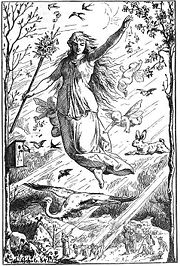
- Ostara, Eástre seems therefore to have been the divinity of the radiant dawn, of upspringing light, a spectacle that brings joy and blessing, whose meaning could be easily adapted by the resurrection-day of the christian's God. Bonfires were lighted at Easter and according to popular belief of long standing, the moment the sun rises on Easter Sunday morning, he gives three joyful leaps, he dances for joy [...]. Water drawn on the Easter morning is, like that at Christmas, holy and healing [...]; here also heathen notions seems to have grafted themselves on great christian festivals. Maidens clothed in white, who at Easter, at the season of returning spring, show themselves in clefts of the rock and on mountains, are suggestive of the ancient goddess [...].
In the second volume of Deutsche Mythologie, Grimm picks up the subject of Ostara again, connecting the goddess to various German Easter festivities, including Easter eggs:
- But if we admit, goddesses, then, in addition to Nerthus
NerthusIn Germanic paganism, Nerthus is a goddess associated with fertility. Nerthus is attested by Tacitus, the first century AD Roman historian, in his Germania. Various theories exist regarding the goddess and her potential later traces amongst the Germanic tribes...
, Ostara has the strongest claim to consideration. To what we said on p. 290 I can add some significant facts. The heathen Easter had much in common with May-feast and the reception of spring, particularly in matter of bonfires. Then, through long ages there seem to have lingered among the people Easter-games so-called, which the church itself had to tolerate : I allude especially to the custom of Easter eggs, and to the Easter tale which preachers told from the pulpit for the people's amusement, connecting it with Christian reminiscences.
Grimm comments on further Easter time customs, including unique sword dances and particular baked goods ("pastry of heathenish form"). In addition, Grimm weights a potential connection to the Slavic
Slavic peoples
The Slavic people are an Indo-European panethnicity living in Eastern Europe, Southeast Europe, North Asia and Central Asia. The term Slavic represents a broad ethno-linguistic group of people, who speak languages belonging to the Slavic language family and share, to varying degrees, certain...
spring goddess Vesna
Vesna
The vesna or vesnas were mythological female characters associated with youth and springtime in early Slavic mythology, particularly within Croatia, Serbia and Slovenia. Along with her male companion Vesnik, she was associated with rituals conducted in rural areas during springtime...
and the Lithuanian Vasara
Vasara
Vasara can refer to:*Vasara, Estonia, village in Viiratsi Parish, Viljandi County, Estonia*Vesa Vasara, a Finnish football player*Vasara , a 2000 videogame...
.
Hares and Freyja
In Northern Europe, Easter imagery often involves hares and rabbitsEaster Bunny
The Easter Bunny or Easter Rabbit is a character depicted as a rabbit bringing Easter eggs, who sometimes is depicted with clothes...
. Citing folk Easter customs
Easter customs
As with other Christian festivals, the celebration of Easter extends beyond the church. Since its origins, it has been a time of celebration and feasting and many Traditional Easter games and customs developed, such as egg rolling, egg tapping, Pace egging and egg decorating...
in Leicestershire
Leicestershire
Leicestershire is a landlocked county in the English Midlands. It takes its name from the heavily populated City of Leicester, traditionally its administrative centre, although the City of Leicester unitary authority is today administered separately from the rest of Leicestershire...
, England where "the profits of the land called Harecrop Leys were applied to providing a meal which was thrown on the ground at the 'Hare-pie Bank'", late 19th century scholar Charles Isaac Elton
Charles Isaac Elton
Charles Isaac Elton, QC was an English lawyer, antiquary, and politician.He was born in Southampton. Educated at Cheltenham and Balliol College, Oxford, he was elected a fellow of Queen's College in 1862. He was called to the bar at Lincoln's Inn in 1865...
theorizes a connection between these customs and the worship of Ēostre. In his late 19th century study of the hare in folk custom and mythology, Charles J. Billson cites numerous incidents of folk custom involving the hare around the period of Easter in Northern Europe. Billson says that "whether there was a goddess named Eostre, or not, and whatever connection the hare may have had with the ritual of Saxon or British worship, there are good grounds for believing that the sacredness of this animal reaches back into an age still more remote, where it is probably a very important part of the great Spring Festival of the prehistoric inhabitants of this island."
Some scholars have linked customs and imagery involving hares to Ēostre and the Norse goddess Freyja. Writing in 1972, John Andrew Boyle cites commentary contained within an etymology dictionary by A. Ernout and A. Meillet, where the authors write that "Little else [...] is known about [Ēostre], but it has been suggested that her lights, as goddess of the dawn, were carried by hares. And she certainly represented spring fecundity, and love and carnal pleasure that leads to fecundity." Boyle responds that nothing is known about Ēostre outside of Bede's single passage, that the authors had seemingly accepted the identification of Ēostre with the Norse goddess Freyja, yet that the hare is not associated with Freyja either. Boyle writes that "her carriage, we are told by Snorri
Snorri Sturluson
Snorri Sturluson was an Icelandic historian, poet, and politician. He was twice elected lawspeaker at the Icelandic parliament, the Althing...
, was drawn by a pair of cats — animals, it is true, which like hares were the familiars of witches, with whom Freyja seems to have much in common." However, Boyle adds that "on the other hand, when the authors speak of the hare as the 'companion of Aphrodite
Aphrodite
Aphrodite is the Greek goddess of love, beauty, pleasure, and procreation.Her Roman equivalent is the goddess .Historically, her cult in Greece was imported from, or influenced by, the cult of Astarte in Phoenicia....
and of satyr
Satyr
In Greek mythology, satyrs are a troop of male companions of Pan and Dionysus — "satyresses" were a late invention of poets — that roamed the woods and mountains. In myths they are often associated with pipe-playing....
s and cupid
Cupid
In Roman mythology, Cupid is the god of desire, affection and erotic love. He is the son of the goddess Venus and the god Mars. His Greek counterpart is Eros...
s' and point out that 'in the Middle Age
Middle age
Middle age is the period of age beyond young adulthood but before the onset of old age. Various attempts have been made to define this age, which is around the third quarter of the average life span of human beings....
s it appears beside the figure of Luxuria
Luxuria
Luxuria was a British pop music band made up of vocalist Howard Devoto and instrumentalist Norman Fisher-Jones, aka "Noko." The band was active in the 1980s and early 1990s....
', they are on much surer ground and can adduce the evidence of their illustrations."
Modern popular culture and modern veneration
Jacob Grimm's reconstructed *Ostara has had some influence in popular culture since. The name has been adapted as an asteroidAsteroid
Asteroids are a class of small Solar System bodies in orbit around the Sun. They have also been called planetoids, especially the larger ones...
(343 Ostara
343 Ostara
343 Ostara is a typical Main belt asteroid.It was discovered by Max Wolf on November 15, 1892 in Heidelberg....
, 1892 by Max Wolf
Max Wolf
Maximilian Franz Joseph Cornelius Wolf was a German astronomer and a pioneer in the field of astrophotography...
), a Mödling
Mödling
Mödling is the capital of the Austrian district of the same name located approximately 14 km south of Vienna.The settlement dates back to the Neolithic. In medieval times, the town was the residence of a branch of the Babenberger family, as a result of which it received the nickname...
, Austria-based German nationalist
Pan-Germanism
Pan-Germanism is a pan-nationalist political idea. Pan-Germanists originally sought to unify the German-speaking populations of Europe in a single nation-state known as Großdeutschland , where "German-speaking" was taken to include the Low German, Frisian and Dutch-speaking populations of the Low...
book series and publishing house (1905, Ostara
Ostara (magazine)
Ostara or Ostara, Briefbücherei der Blonden und Mannesrechtler was a German nationalist magazine founded in 1905 by the occultist Lanz von Liebenfels in Vienna, Austria....
), and a date on the Wicca
Wicca
Wicca , is a modern Pagan religious movement. Developing in England in the first half of the 20th century, Wicca was popularised in the 1950s and early 1960s by a Wiccan High Priest named Gerald Gardner, who at the time called it the "witch cult" and "witchcraft," and its adherents "the Wica."...
n Wheel of the Year
Wheel of the Year
The Wheel of the Year is a Neopagan term for the annual cycle of the Earth's seasons. It consists of eight festivals, spaced at approximately even intervals throughout the year. These festivals are referred to as Sabbats...
(Ostara, 21 March). In music, the name Ostara has been adopted as a name by the musical group Ostara
Ostara (band)
Ostara is a British folk music music group, "described in the musical press as a neo-folk / pop music hybrid", founded by Richard Leviathan and Timothy Jenn, as a change of name and stylistic direction from their previous band, Strength Through Joy. Jenn left the band in 2001...
, and as the names of albums by :zoviet*france:
Zoviet France
Zoviet France is a prolific music group from Newcastle upon Tyne in north east England. While often dissonant and made of industrial textures, their music also falls into the ambient music category...
(Eostre, 1984) and The Wishing Tree
The Wishing Tree
The Wishing Tree is an acoustic music project by Marillion's guitarist Steve Rothery and British vocalist Hannah Stobart. Their debut album, Carnival of Souls, was released in 1996 and a second album, Ostara, was released 23 March 2009.-History:...
(Ostara
Ostara (The Wishing Tree album)
Ostara is the title of the second album by The Wishing Tree, a project by Marillion's guitarist Steve Rothery and singer Hannah Stobart. The album was produced and engineered by Rothery and mixed by Michael Hunter, who also produced the two most recent Marillion albums. Hunter also contributed...
, 2009).
In some forms of Germanic Neopaganism
Germanic Neopaganism
Germanic neopaganism is the contemporary revival of historical Germanic paganism. Precursor movements appeared in the early 20th century in Germany and Austria. A second wave of revival began in the early 1970s...
, Eostre (or Ostara) is venerated. Regarding this veneration, Carole M. Cusack comments that, among adherents, Eostre is "associated with the coming of spring and the dawn, and her festival is celebrated at the spring equinox. Because she brings renewal, rebirth from the death of winter, some Heathens associate Eostre with Idunn
Iðunn
In Norse mythology, Iðunn is a goddess associated with apples and youth. Iðunn is attested in the Poetic Edda, compiled in the 13th century from earlier traditional sources, and the Prose Edda, written in the 13th century by Snorri Sturluson...
, keeper of the apples of youth in Scandinavian mythology
Norse mythology
Norse mythology, a subset of Germanic mythology, is the overall term for the myths, legends and beliefs about supernatural beings of Norse pagans. It flourished prior to the Christianization of Scandinavia, during the Early Middle Ages, and passed into Nordic folklore, with some aspects surviving...
".
See also
- MōdranihtModranihtMōdraniht was an event held at New Years Day by the heathen Angles where a sacrifice was made. The event is attested by the medieval English historian Bede in his 8th century Latin work De temporum ratione...
, the Anglo-Saxon "Mothers night," also attested by Bede - Old High German lullabyOld High German lullabyThe discovery of an Old High German lullaby was announced in 1859 by Georg Zappert of Vienna, a private scholar and collector of medieval literature....
, a lullaby in Old High German that mentions Ostara, generally held to be a literary forgery - AurvandilAurvandilThe names Aurvandil or Earendel are cognate Germanic personal names, continuing a Proto-Germanic reconstructed compound *Auziwandilaz "luminous wanderer", in origin probably the name of a star or planet, potentially the morning star ....
, a Germanic being associated with stars, the first element of whose name is cognate to Ēostre