
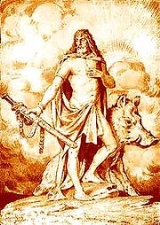
An
elf is a being of
Germanic mythologyGermanic mythology is a comprehensive term for myths associated with historical Germanic paganism, including Norse mythology, Anglo-Saxon mythology, Continental Germanic mythology, and other versions of the mythologies of the Germanic peoples...
. The elves were originally thought of as a race of divine beings (
wightWight is a Middle English word, from Old English wiht, and used to describe a creature or living sentient being. It is akin to Old High German wiht, meaning a creature or thing.In its original usage the word wight described a living human being...
s,
vættirVættir or wights are nature spirits in the Norse religion. These nature spirits divide up into 'families', including the Álfar , Dvergar , Jötnar , and even gods, the Æsir and Vanir, who are understood to be prominent families among them. The term 'families' is often translated as 'clans' or...
) endowed with
magical powersMagic is the claimed art of manipulating aspects of reality either by supernatural means or through knowledge of occult laws unknown to science. It is in contrast to science, in that science does not accept anything not subject to either direct or indirect observation, and subject to logical...
, which they use both for the benefit and the injury of mankind. In medieval
Norse mythologyNorse mythology, a subset of Germanic mythology, is the overall term for the myths, legends and beliefs about supernatural beings of Norse pagans. It flourished prior to the Christianization of Scandinavia, during the Early Middle Ages, and passed into Nordic folklore, with some aspects surviving...
, they appear to have been divided into light elves and dark elves, difficult to delineate from the
ÆsirIn Old Norse, áss is the term denoting a member of the principal pantheon in Norse paganism. This pantheon includes Odin, Frigg, Thor, Baldr and Tyr. The second pantheon comprises the Vanir...
(gods) on one hand and the dvergar (dwarves) on the other.
In early modern and modern folklore, they become associated with the fairies of Romance folklore and assume a diminutive size, often living mainly in forests but also underground in hills or rocks, or in wells and springs. 19th-century
RomanticismRomanticism was an artistic, literary and intellectual movement that originated in the second half of the 18th century in Europe, and gained strength in reaction to the Industrial Revolution...
attempted to restore them to full stature, making them men and women of great beauty, often depicted as very young.
From their depiction in Romanticism, elves entered the 20th-century
high fantasyHigh fantasy or epic fantasy is a subgenre of fantasy that is set in invented or parallel worlds. High fantasy was brought to fruition through the work of authors such as J. R. R. Tolkien and C. S. Lewis, whose major fantasy works were published in the 1950s...
genre in the wake of the published work of
J. R. R. TolkienJohn Ronald Reuel Tolkien, CBE was an English writer, poet, philologist, and university professor, best known as the author of the classic high fantasy works The Hobbit, The Lord of the Rings, and The Silmarillion.Tolkien was Rawlinson and Bosworth Professor of Anglo-Saxon at Pembroke College,...
(especially the posthumous publication of his
Silmarillion where Tolkien's
treatmentIn J. R. R. Tolkien's legendarium, Elves are one of the races that inhabit a fictional Earth, often called Middle-earth, and set in the remote past. They appear in The Hobbit and in The Lord of the Rings, but their complex history is described more fully in The Silmarillion...
of the relation of light elves, dark elves and dwarves is made explicit).
The "
Christmas elvesA Christmas elf is a diminutive creature that lives with Santa Claus in the North Pole and acts as his helper. Christmas elves are often depicted as green or red clad with pointy ears, long noses, and pointy hats. Santa's elves are often to make the toys in Santa's workshop and take care of...
" of contemporary popular culture were popularized during the 1870s in the
United StatesThe United States of America is a federal constitutional republic comprising fifty states and a federal district...
, in publications such as
Godey's Lady's BookGodey's Lady's Book, alternatively known as Godey's Magazine and Lady's Book, was a United States magazine which was published in Philadelphia. It was the most widely circulated magazine in the period before the Civil War. Its circulation rose from 70,000 in the 1840s to 150,000 in 1860...
.
Name
The English word
elf is from the Old English
ælf or
elf, in reference to a midget, themselves from the Proto-Germanic
*albiz which also resulted in
Old NorseOld Norse is a North Germanic language that was spoken by inhabitants of Scandinavia and inhabitants of their overseas settlements during the Viking Age, until about 1300....
álfr,
Middle High GermanMiddle High German , abbreviated MHG , is the term used for the period in the history of the German language between 1050 and 1350. It is preceded by Old High German and followed by Early New High German...
elbe.
*Albiz may be from the
Proto-Indo-EuropeanThe Proto-Indo-European language is the reconstructed common ancestor of the Indo-European languages, spoken by the Proto-Indo-Europeans...
root
*albh- meaning "white", from which also stems the Latin
albus "white". Alternatively, a connection to the
RbhusThe Ribhus are three semi-divine beings of the Rigveda and the Atharvaveda, Ribhu, Vaja and Vibhvan, collectively called by the name of their leader. In later Hindu mythology , Ribhu is a son of Brahma....
, semi-divine craftsmen in Indian mythology, has also been suggested(OED).
Originally
ælf/
elf and its plural
ælfe were the
masculineGrammatical gender is defined linguistically as a system of classes of nouns which trigger specific types of inflections in associated words, such as adjectives, verbs and others. For a system of noun classes to be a gender system, every noun must belong to one of the classes and there should be...
forms, while the corresponding feminine form (first found in eighth century glosses) was
ælfen or
elfen (with a possible feminine plural
-ælfa, found in
dunælfa) which became the
Middle EnglishMiddle English is the stage in the history of the English language during the High and Late Middle Ages, or roughly during the four centuries between the late 11th and the late 15th century....
elven, using the feminine suffix
-en from the earlier
-inn which derives from the Proto-Germanic
*-innja). The fact that cognates exist (such as the German
elbinne) could suggest a West Germanic
*alb(i)innjo, but this is uncertain, as the examples may be simply a transference to the weak declension common in
SouthernSouthern England, the South and the South of England are imprecise terms used to refer to the southern counties of England bordering the English Midlands. It has a number of different interpretations of its geographic extents. The South is considered by many to be a cultural region with a distinct...
and
WesternThe West Country is an informal term for the area of south western England roughly corresponding to the modern South West England government region. It is often defined to encompass the historic counties of Cornwall, Devon, Dorset and Somerset and the City of Bristol, while the counties of...
forms of Middle English. The Middle English forms with this weak declension were
aluen(e) and
eluen(e). By the earlier eleventh century
ælf could denote a female.
The Modern German
Elf (m),
Elfe (f),
Elfen is a loan from English. A masculine
Elb is reconstructed from the plural by
Jacob GrimmJacob Ludwig Carl Grimm was a German philologist, jurist and mythologist. He is best known as the discoverer of Grimm's Law, the author of the monumental Deutsches Wörterbuch, the author of Deutsche Mythologie and, more popularly, as one of the Brothers Grimm, as the editor of Grimm's Fairy...
,
Deutsches WörterbuchDas Deutsche Wörterbuch / Deutsches Wörterbuch is one of the most important dictionaries of the German language...
, who rejects
Elfe as a (then, in the 1830s) recent anglicism.
Elb (m, plural
Elbe or
Elben) is a reconstructed term, while
Elbe (f) is attested in
Middle High GermanMiddle High German , abbreviated MHG , is the term used for the period in the history of the German language between 1050 and 1350. It is preceded by Old High German and followed by Early New High German...
.
Alb,
Alp (m), plural
Alpe has the meaning of "
incubusAn incubus is a demon in male form who, according to a number of mythological and legendary traditions, lies upon sleepers, especially women, in order to have intercourse with them. Its female counterpart is the succubus...
" (
Old High GermanThe term Old High German refers to the earliest stage of the German language and it conventionally covers the period from around 500 to 1050. Coherent written texts do not appear until the second half of the 8th century, and some treat the period before 750 as 'prehistoric' and date the start of...
alp, plural
*alpî or
*elpî).
GothicGothic is an extinct Germanic language that was spoken by the Goths. It is known primarily from the Codex Argenteus, a 6th-century copy of a 4th-century Bible translation, and is the only East Germanic language with a sizable Text corpus...
has no direct testimony of
*albs, plural
*albeis, but
ProcopiusProcopius of Caesarea was a prominent Byzantine scholar from Palestine. Accompanying the general Belisarius in the wars of the Emperor Justinian I, he became the principal historian of the 6th century, writing the Wars of Justinian, the Buildings of Justinian and the celebrated Secret History...
has the personal name
Albila.
Germanic mythology
Jacob GrimmJacob Ludwig Carl Grimm was a German philologist, jurist and mythologist. He is best known as the discoverer of Grimm's Law, the author of the monumental Deutsches Wörterbuch, the author of Deutsche Mythologie and, more popularly, as one of the Brothers Grimm, as the editor of Grimm's Fairy...
discusses "Wights and Elves" comparatively in chapter 17 of his
Teutonic MythologyDeutsche Mythologie is a seminal treatise on Germanic mythology by Jacob Grimm. First published in Germany in 1835, the work is an exhaustive treatment of the subject, tracing the mythology and beliefs of the Ancient Germanic peoples from their earliest attestations to their survivals in modern...
.
He notes that the Elder Edda couples the
ÆsirIn Old Norse, áss is the term denoting a member of the principal pantheon in Norse paganism. This pantheon includes Odin, Frigg, Thor, Baldr and Tyr. The second pantheon comprises the Vanir...
and the álfar, a conjunction that recurs in Old English
ês and
ylfe, clearly grouping the elves as a divine or supernatural class of beings, sometimes extended by the
VanirIn Norse mythology, the Vanir are a group of gods associated with fertility, wisdom and the ability to see the future. The Vanir are one of two groups of gods and are the namesake of the location Vanaheimr . After the Æsir–Vanir War, the Vanir became a subgroup of the Æsir...
as a third class: The Hrafnagaldr states
Alföðr orkar, álfar skilja, vanir vita "The Allfather [i.e.
the ássOdin is a major god in Norse mythology and the ruler of Asgard. Homologous with the Anglo-Saxon "Wōden" and the Old High German "Wotan", the name is descended from Proto-Germanic "*Wodanaz" or "*Wōđanaz"....
] has power, the álfar have skill, and vanir knowledge".
A notable crux in the Old Norse mythology is the distinction of álfar and dvergar. They appear as separate races in extended lists such as the one in
AlvíssmálAlvíssmál is poem collected in the Poetic Edda, probably dating to the 11th century, that relates a conversation between Thor and a Dvergr called Alvíss .-Plot:...
, listing
ÆsirIn Old Norse, áss is the term denoting a member of the principal pantheon in Norse paganism. This pantheon includes Odin, Frigg, Thor, Baldr and Tyr. The second pantheon comprises the Vanir...
, álfar,
VanirIn Norse mythology, the Vanir are a group of gods associated with fertility, wisdom and the ability to see the future. The Vanir are one of two groups of gods and are the namesake of the location Vanaheimr . After the Æsir–Vanir War, the Vanir became a subgroup of the Æsir...
, goð (gods), męnn (humans), ginregin, jǫtnar, dvergar and denizens of Hęl. Middle High German tradition asgma separates the
elbe from
getwerc.
On the other hand, there is a close kinship between elves and dwarves, evident already because many dwarves have elvish names, including simple
Álfr "elf", and
AlberichAlberich was a legendary sorcerer who originated in the mythology or epic sagas of the Frankish Merovingian Dynasty of the 5th to 8th century AD, and whose name means king of the elves , who possessed the ability to become invisible...
"king of elves".
LokiIn Norse mythology, Loki or Loke is a god or jötunn . Loki is the son of Fárbauti and Laufey, and the brother of Helblindi and Býleistr. By the jötunn Angrboða, Loki is the father of Hel, the wolf Fenrir, and the world serpent Jörmungandr. By his wife Sigyn, Loki is the father of Nari or Narfi...
is particularly difficult to classify; he is usually called an áss, but is really of jǫtunn origin, and is nevertheless also addressed as álfr. The conclusion of Grimm is that the classification "elf" can be considered to "shrink and stretch by turns". The etymology connecting
*alboz with
albus "white" suggests an original dichotomy of "white" vs. "black" genii, corresponding to the elves vs. the dwarves which was subsequently confused.
Thus the "white" elves proper are named
ljósálfar "light elves", contrasting with
døckálfar "dark elves".
Snorri in the
Prose EddaThe Prose Edda, also known as the Younger Edda, Snorri's Edda or simply Edda, is an Icelandic collection of four sections interspersed with excerpts from earlier skaldic and Eddic poetry containing tales from Nordic mythology...
states that the light elves dwell in
ÁlfheimAlfheim is one of the Nine Worlds and home of the Light Elves in Norse mythology and appears also in Anglo-Scottish ballads under the form Elfhame as a fairyland, sometimes modernized as Elfland .-In Old Norse texts:Álfheim as an abode of the Elves is mentioned only twice in Old Norse texts.The...
while the dark elves dwell underground. Confusion arises from the introduction of the additional term
svartálfar "black elves", which at first appears synonymous to the "dark elves"; Snorri identifies with the dvergar and has them reside in Svartálfaheim. This prompts Grimm to assume a tripartite division of light elves, dark elves and black elves, of which only the latter are identical with dwarves, while the dark elves are an intermediate class, "not so much downright black, as dim, dingy". In support of such an intermediate class between light elves, or "elves proper", on one hand, and black elves or dwarves on the other, Grimm adduces the evidence of the Scottish
browniesA brownie/brounie or urisk or brùnaidh, ùruisg, or gruagach is a legendary creature popular in folklore around Scotland and England...
and other traditions of dwarves wearing grey or brown clothing.
Old Norse
The earliest preserved descriptions of elves comes from
Norse mythologyNorse mythology, a subset of Germanic mythology, is the overall term for the myths, legends and beliefs about supernatural beings of Norse pagans. It flourished prior to the Christianization of Scandinavia, during the Early Middle Ages, and passed into Nordic folklore, with some aspects surviving...
. In Old Norse they are called
álfar (
nominative singularOld Norse has three categories of verb and two categories of noun . Conjugation and declension are carried out by a mix of inflection and two nonconcatenative morphological processes: umlaut, a backness-based alteration to the root vowel; and ablaut, a replacement of the root vowel, in...
álfr).
Men could be elevated to the rank of elves after death, such as the petty king Olaf Geirstad-Elf. The smith hero Völundr is identified as 'Ruler of Elves' (
vísi álfa) and 'One among the Elven Folk' (
álfa ljóði), in the poem
VölundarkviðaVölundarkviða is one of the mythological poems of the Poetic Edda...
, whose later prose introduction also identifies him as the son of a king of 'Finnar', an Arctic people respected for their shamanic magic (most likely, the
samiThe Sami people, also spelled Sámi, or Saami, are the arctic indigenous people inhabiting Sápmi, which today encompasses parts of far northern Sweden, Norway, Finland, the Kola Peninsula of Russia, and the border area between south and middle Sweden and Norway. The Sámi are Europe’s northernmost...
). In the
Thidrek's Saga a human queen is surprised to learn that the lover who has made her pregnant is an elf and not a man. In
the saga of Hrolf Kraki a king named
HelgiHalga, Helgi, Helghe or Helgo was a legendary Danish king living in the early 6th century. His name would in his own language have been *Hailaga ....
rapes and impregnates an elf-woman clad in silk who is the most beautiful woman he has ever seen.
Crossbreeding was possible between elves and humans in the Old Norse belief. The human queen who had an elvish lover bore the hero
HögniHagen or Högni is a Burgundian warrior in tales about the Burgundian kingdom at Worms. Hagen is often identified as a brother or half-brother of King Gunther .In the Nibelungenlied, he is called Hagen of Tronje...
, and the elf-woman who was raped by Helgi bore
SkuldSkuld was a princess of Scandinavian legend who married Heoroweard and encouraged him to kill Hroðulf . The accounts of her vary greatly from source to source.-Hrólfr Kraki's saga:...
, who married
HjörvardHeoroweard is a character who appears in Beowulf and also in Norse legends, where he is named Hjörvarðr or Hiartuar. If he existed in real life, his name would have been Proto-Norse *Heruwarduz....
, Hrólfr Kraki's killer.
The saga of Hrolf Kraki adds that since Skuld was
half-elvenIn Norse mythology, a half-elf is the offspring of an elf and a human.Notable examples include the Danish princess Skuld of Hrólf Kraki's saga, and the hero Högni of the Thidrekssaga , and the royal line of Alfheim, which was related to the elves and more beautiful than other people, according to...
, she was very skilled in witchcraft (
seiðrSeid or seiðr is an Old Norse term for a type of sorcery or witchcraft which was practiced by the pre-Christian Norse. Sometimes anglicized as "seidhr," "seidh," "seidr," "seithr," or "seith," the term is also used to refer to modern Neopagan reconstructions or emulations of the...
), and this to the point that she was almost invincible in battle. When her warriors fell, she made them rise again to continue fighting. The only way to defeat her was to capture her before she could summon her armies, which included elvish warriors.
They are also found in the
HeimskringlaHeimskringla is the best known of the Old Norse kings' sagas. It was written in Old Norse in Iceland by the poet and historian Snorri Sturluson ca. 1230...
and in
The Saga of Thorstein, Viking's SonÞorsteins saga Víkingssonar or The Saga of Thorstein, Viking's Son is a legendary saga taking place in the 7th century and it is about the father of Frithjof the Bold. It begins in Norway and Sweden but continues into exotic places such as India. It is not one of the more famous sagas, but it is...
accounts of a line of local kings who ruled over
ÁlfheimAlfheim is one of the Nine Worlds and home of the Light Elves in Norse mythology and appears also in Anglo-Scottish ballads under the form Elfhame as a fairyland, sometimes modernized as Elfland .-In Old Norse texts:Álfheim as an abode of the Elves is mentioned only twice in Old Norse texts.The...
, and since they had elven blood they were said to be more beautiful than most men.
- The land governed by King Alf was called Alfheim, and all his offspring are related to the elves. They were fairer than any other people...
In addition to these human aspects, they are commonly described as semi-divine beings associated with fertility and the cult of the ancestors and ancestor worship. The notion of elves thus appears similar to the
animisticAnimism refers to the belief that non-human entities are spiritual beings, or at least embody some kind of life-principle....
belief in spirits of nature and of the deceased, common to nearly all human religions; this is also true for the Old Norse belief in
dís- Academic institutions :* DIS – Danish Institute for Study Abroad, an English language study abroad program located in Copenhagen, Denmark* Dili International School, DIS an International School in Dili, Timor Leste - Companies :...
ir,
fylgjurIn Norse mythology, a fylgja is a supernatural being or creature which accompanies a person in connection to their fate or fortune...
and
vörðarIn Norse mythology, a vörðr is a warden spirit, believed to follow from birth to death the soul of every person. In Old Swedish, the corresponding word is varþer; in modern Swedish vård, and the belief in them remained strong in Scandinavian folklore up until the last centuries...
("follower" and "warden" spirits, respectively). Like spirits, the elves were not bound by physical limitations and could pass through walls and doors in the manner of ghosts, which happens in
Norna-Gests þáttrNorna-Gests þáttr or the Story of Norna-Gest is a legendary saga about the Norse hero Norna-Gest.-Summary:Norna-Gest was the son of a Danish man named Thord of Thinghusbit, who once dwelt on the estate of Grøning in Denmark. When he was born, three Norns arrived and had foretold the child's...
.
The Icelandic mythographer and historian
Snorri SturlusonSnorri Sturluson was an Icelandic historian, poet, and politician. He was twice elected lawspeaker at the Icelandic parliament, the Althing...
referred to dwarves (
dvergar) as "dark-elves" (
dökkálfar) or "black-elves" (
svartálfarIn Norse mythology, svartálfar are beings who dwell in Svartálfaheimr . Both the svartálfar and Svartálfaheimr are solely attested in the Prose Edda, written in the 13th century by Snorri Sturluson...
). He referred to other elves as "light-elves" (
ljósálfar), which has often been associated with elves' connection with
FreyrFreyr is one of the most important gods of Norse paganism. Freyr was highly associated with farming, weather and, as a phallic fertility god, Freyr "bestows peace and pleasure on mortals"...
, the god of fertility (according to
GrímnismálGrímnismál is one of the mythological poems of the Poetic Edda. It is preserved in the Codex Regius manuscript and the AM 748 I 4to fragment. It is spoken through the voice of Grímnir, one of the many guises of the god Odin, who is tortured by King Geirröth...
, Poetic Edda). Snorri describes the elf differences as follows:
- "There is one place there that is called the Elf Home (Álfheimr which is the elven city). People live there that are named the light elves (Ljósálfar). But the dark elves (Dökkálfar) live below in earth,in caves and the dark forest and they are unlike them in appearance – and more unlike them in reality. The Light Elves are brighter than the sun in appearance, but the Dark Elves are blacker than pitch." (Snorri, Gylfaginning
Gylfaginning, or the Tricking of Gylfi , is the first part of Snorri Sturluson's Prose Edda after Prologue. The Gylfaginning deals with the creation and destruction of the world of the Norse gods, and many other aspects of Norse mythology...
17, Prose Edda)
- "Sá er einn staðr þar, er kallaðr er Álfheimr. Þar byggvir fólk þat, er Ljósálfar heita, en Dökkálfar búa niðri í jörðu, ok eru þeir ólíkir þeim sýnum ok miklu ólíkari reyndum. Ljósálfar eru fegri en sól sýnum, en Dökkálfar eru svartari en bik."
Further evidence for elves in Norse mythology comes from Skaldic poetry, the
Poetic EddaThe Poetic Edda is a collection of Old Norse poems primarily preserved in the Icelandic mediaeval manuscript Codex Regius. Along with Snorri Sturluson's Prose Edda, the Poetic Edda is the most important extant source on Norse mythology and Germanic heroic legends, and from the early 19th century...
and
legendary sagaA Legendary saga or Fornaldarsaga is a Norse saga that, unlike the Icelanders' sagas, takes place before the colonization of Iceland. There are some exceptions, such as Yngvars saga víðförla, which takes place in the 11th century...
s. In these elves are linked to the
ÆsirIn Old Norse, áss is the term denoting a member of the principal pantheon in Norse paganism. This pantheon includes Odin, Frigg, Thor, Baldr and Tyr. The second pantheon comprises the Vanir...
, particularly by the common phrase "Æsir and the elves". In the
AlvíssmálAlvíssmál is poem collected in the Poetic Edda, probably dating to the 11th century, that relates a conversation between Thor and a Dvergr called Alvíss .-Plot:...
("The Sayings of All-Wise"), elves are considered distinct from both the
ÆsirIn Old Norse, áss is the term denoting a member of the principal pantheon in Norse paganism. This pantheon includes Odin, Frigg, Thor, Baldr and Tyr. The second pantheon comprises the Vanir...
and the
VanirIn Norse mythology, the Vanir are a group of gods associated with fertility, wisdom and the ability to see the future. The Vanir are one of two groups of gods and are the namesake of the location Vanaheimr . After the Æsir–Vanir War, the Vanir became a subgroup of the Æsir...
.
GrímnismálGrímnismál is one of the mythological poems of the Poetic Edda. It is preserved in the Codex Regius manuscript and the AM 748 I 4to fragment. It is spoken through the voice of Grímnir, one of the many guises of the god Odin, who is tortured by King Geirröth...
relates that the Van
FreyFreyr is one of the most important gods of Norse paganism. Freyr was highly associated with farming, weather and, as a phallic fertility god, Freyr "bestows peace and pleasure on mortals"...
was the lord of
ÁlfheimAlfheim is one of the Nine Worlds and home of the Light Elves in Norse mythology and appears also in Anglo-Scottish ballads under the form Elfhame as a fairyland, sometimes modernized as Elfland .-In Old Norse texts:Álfheim as an abode of the Elves is mentioned only twice in Old Norse texts.The...
r (meaning "elf-world"), the home of the light-elves.
LokasennaLokasenna is one of the poems of the Poetic Edda. The poem presents flyting between the gods and Loki....
relates that a large group of Æsir and elves had assembled at
ÆgirÆgir is a sea giant, god of the ocean and king of the sea creatures in Norse mythology. He is also known for hosting elaborate parties for the gods.Ægir's servants are Fimafeng and Eldir.- Description :...
's court for a banquet.
A poem from around 1020, the
Austrfaravísur ('Eastern-journey verses') of
Sigvat ThordarsonSigvatr Þórðarson or Sigvat the Skald was an Icelandic skald. He was a court poet to King Olaf II of Norway, as well as Canute the Great, Magnus the Good and Anund Jacob, by whose reigns his floruit can be dated to the earlier eleventh century.Sigvatr was the best known of the court skalds of...
, mentions that, as a Christian, he was refused board in a heathen household, in
SwedenSweden , officially the Kingdom of Sweden , is a Nordic country on the Scandinavian Peninsula in Northern Europe. Sweden borders with Norway and Finland and is connected to Denmark by a bridge-tunnel across the Öresund....
, because an
álfablótThe Álfablót or the Elven sacrifice was a pagan Scandinavian sacrifice to the elves towards the end of autumn, when the crops had been harvested and the animals were most fat. Unlike the great blóts at Uppsala and Mære, the álfablót was a local celebration at the homesteads and they were mainly...
("elves' sacrifice") was being conducted there.
From the time of year (close to the autumnal equinox) and the elves' association with fertility and the ancestors, it might be assumed that it had to do with the ancestor cult and the life force of the family.
In addition to this,
Kormáks sagaKormáks saga is one of the Icelanders' sagas. It tells of the tenth-century Icelandic poet, Kormákr Ögmundarson, and Steingerðr, the love of his life. The saga preserves a significant amount of poetry attributed to Kormákr, much of it dealing with his love for Steingerðr. Though the saga is...
accounts for how a sacrifice to elves was apparently believed able to heal a severe battle wound:
- Þorvarð healed but slowly; and when he could get on his feet he went to see Þorðís, and asked her what was best to help his healing.
- "A hill there is," answered she, "not far away from here, where elves have their haunt. Now get you the bull that Kormák killed, and redden the outer side of the hill with its blood, and make a feast for the elves with its flesh. Then thou wilt be healed."
Old English
The
Old EnglishOld English or Anglo-Saxon is an early form of the English language that was spoken and written by the Anglo-Saxons and their descendants in parts of what are now England and southeastern Scotland between at least the mid-5th century and the mid-12th century...
form of the word is
ælf (pl.
ælfe, with regional and chronological variants such as
ylfe and
ælfen). Words for the nymphs of the
GreekGreek mythology is the body of myths and legends belonging to the ancient Greeks, concerning their gods and heroes, the nature of the world, and the origins and significance of their own cult and ritual practices. They were a part of religion in ancient Greece...
and
Roman mythosRoman mythology is the body of traditional stories pertaining to ancient Rome's legendary origins and religious system, as represented in the literature and visual arts of the Romans...
were translated by Anglo-Saxon scholars with
ælf and variants on it.
Old English tradition preserves the
ylfe exclusively as mischievous, harmful beings.
The 10th century
Metrical CharmTwelve Metrical Charms survive in Old English, in two medieval manuscripts, Bald's Leechbook and Lacnunga . They are:*Æcerbot*Against a Dwarf*Against a Wen*A Journey Charm*For a Swarm of Bees...
"Against A Sudden Stitch" (
Wið færsticeWið færstice is an Old English medical text composed in, surviving in the collection known now as Lacnunga. Wið færstice means 'against a sudden/violent stabbing pain'; scholars have often sought to identify this as rheumatism, but other possibilities should not be excluded. The remedy describes...
) offers remedy against sudden pain (such as
rheumatismRheumatism or rheumatic disorder is a non-specific term for medical problems affecting the joints and connective tissue. The study of, and therapeutic interventions in, such disorders is called rheumatology.-Terminology:...
) caused by projectiles of either
ése or
ylfe or witches (
gif hit wære esa gescot oððe hit wære ylfa gescot oððe hit wære hægtessan gescot "be it
Ése-shot or Elf-shot or witch-shot").
In relation the beauty of the Norse elves, some further evidence is given by old English words such as
ælfsciene ("elf-beautiful"), used of seductively beautiful Biblical women in the Old English poems
JudithThe Old English poem "Judith" describes the beheading of Assyrian general Holofernes by Israelite Judith of Bethulia. Various other versions of the Holofernes-Judith tale exist. These include the Book of Judith, still present in the Roman Catholic Bible, and Abbot Ælfric's homily of the tale...
and
Genesis A.
Although elves could be considered to be beautiful and potentially helpful beings in some sections of English-speaking society throughout its history, Old English evidence also attests to alignments of elves with demons, as for example in line 112 of
BeowulfBeowulf , but modern scholars agree in naming it after the hero whose life is its subject." of an Old English heroic epic poem consisting of 3182 alliterative long lines, set in Scandinavia, commonly cited as one of the most important works of Anglo-Saxon literature.It survives in a single...
. On the other hand,
oaf is simply a variant of the word
elf, presumably originally referring to a changeling or to someone stupefied by elvish
enchantEnchant may refer to:*Enchant , a progressive rock band*Enchant , a 2003 album by Emilie Autumn*Enchant , a spell-checker...
ment.
Elf-shot (or
elf-bolt or
elf-arrow) is a word found in Scotland and Northern England, first attested in a manuscript of about the last quarter of the 16th century. Although first attested in the sense 'sharp pain caused by elves', it is later attested denoting
NeolithicThe Neolithic Age, Era, or Period, or New Stone Age, was a period in the development of human technology, beginning about 9500 BC in some parts of the Middle East, and later in other parts of the world. It is traditionally considered as the last part of the Stone Age...
flintFlint is a hard, sedimentary cryptocrystalline form of the mineral quartz, categorized as a variety of chert. It occurs chiefly as nodules and masses in sedimentary rocks, such as chalks and limestones. Inside the nodule, flint is usually dark grey, black, green, white, or brown in colour, and...
arrow-heads, which by the 17th century seem to have been attributed in the region to elvish folk, and which were used in healing rituals, and alleged to be used by witches (and perhaps elves) to injure people and cattle. So too a tangle in the hair was called an
elf-lock, as being caused by the mischief of the elves (or especially by
Queen MabQueen Mab is a fairy referred to in Shakespeare's play Romeo and Juliet. She also appears in other 17th century literature, and in various guises in later poetry, drama and cinema...
), and sudden paralysis was sometimes attributed to
elf-stroke. Compare with the following excerpt from an 1750 ode by
Willam CollinsWilliam Collins was an English poet. Second in influence only to Thomas Gray, he was an important poet of the middle decades of the 18th century...
:
- There every herd, by sad experience, knows
- How, winged with fate, their elf-shot arrows fly,
- When the sick ewe her summer food forgoes,
- Or, stretched on earth, the heart-smit heifers lie.
German
Very little material concerning elves or
elben survives in
Old High GermanThe term Old High German refers to the earliest stage of the German language and it conventionally covers the period from around 500 to 1050. Coherent written texts do not appear until the second half of the 8th century, and some treat the period before 750 as 'prehistoric' and date the start of...
beyond the mere noun form
alp, plural
alpî, elpî.
Middle High GermanMiddle High German , abbreviated MHG , is the term used for the period in the history of the German language between 1050 and 1350. It is preceded by Old High German and followed by Early New High German...
has a feminine singular
elbe and a plural
elbe,
elber, but the word becomes very rare, mostly surviving in the adjective
elbisch, and is replaced by the English form
elf, elfen via 18th century German translations of Shakespeare's
A Midsummernight's Dream.
The masculine
alp survives in German with a shifted meaning of "
nightmareA nightmare is an unpleasant dream that can cause a strong negative emotional response from the mind, typically fear or horror, but also despair, anxiety and great sadness. The dream may contain situations of danger, discomfort, psychological or physical terror...
".
Jacob GrimmJacob Ludwig Carl Grimm was a German philologist, jurist and mythologist. He is best known as the discoverer of Grimm's Law, the author of the monumental Deutsches Wörterbuch, the author of Deutsche Mythologie and, more popularly, as one of the Brothers Grimm, as the editor of Grimm's Fairy...
in his
Deutsches WörterbuchDas Deutsche Wörterbuch / Deutsches Wörterbuch is one of the most important dictionaries of the German language...
deplored the "unhochdeutsch" form
Elf, borrowed "unthinkingly" from the English, and Tolkien was inspired by Grimm to recommend reviving the genuinely German form in his
Guide to the Names in The Lord of the Rings (1967) and
Elb, Elben was consequently reintroduced in the 1972 German translation of
The Lord of the Rings.
In Christian folklore, the
elber began to be described as mischievous pranksters that could cause disease to cattle and people, and bring bad dreams to sleepers. The German word for
nightmareA nightmare is an unpleasant dream that can cause a strong negative emotional response from the mind, typically fear or horror, but also despair, anxiety and great sadness. The dream may contain situations of danger, discomfort, psychological or physical terror...
,
Alptraum, means "elf dream". The archaic form
Alpdruck means "elf pressure"; it was believed that nightmares are a result of an elf sitting on the dreamer's chest (
incubiAn incubus is a demon in male form who, according to a number of mythological and legendary traditions, lies upon sleepers, especially women, in order to have intercourse with them. Its female counterpart is the succubus...
). This aspect of German elf-belief largely corresponds to the Scandinavian belief in the
maraA mare or nightmare is a spirit or goblin in Germanic folklore which rides on people's chests while they sleep, bringing on bad dreams . The mare is attested as early as in the Norse Ynglinga saga from the 13th century, but the belief itself is likely to be considerably older...
.
Scandinavian
In
Scandinavian folkloreScandinavian folklore is the folklore of Sweden, Norway, Denmark, Iceland, the Faroe Islands, and the Swedish speaking parts of Finland.Collecting folklore began when Gustavus Adolphus of Sweden sent out instructions to all of the priests in all of the parishes to collect the folklore of their area...
, which is a later blend of Norse mythology and elements of
Christian mythologyChristian mythology is the body of myths associated with Christianity. In the study of mythology, the term "myth" refers to a traditional story, often one which is regarded as sacred and which explains how the world and its inhabitants came to have their present form.Classicist G.S. Kirk defines a...
, an
elf is called
elver in
DanishDanish is a North Germanic language spoken by around six million people, principally in the country of Denmark. It is also spoken by 50,000 Germans of Danish ethnicity in the northern parts of Schleswig-Holstein, Germany, where it holds the status of minority language...
,
alv in
NorwegianNorwegian is a North Germanic language spoken primarily in Norway, where it is the official language. Together with Swedish and Danish, Norwegian forms a continuum of more or less mutually intelligible local and regional variants .These Scandinavian languages together with the Faroese language...
, and
alv or
älva in
SwedishSwedish is a North Germanic language, spoken by approximately 10 million people, predominantly in Sweden and parts of Finland, especially along its coast and on the Åland islands. It is largely mutually intelligible with Norwegian and Danish...
(the first is masculine, the second feminine). The Norwegian expressions seldom appear in genuine folklore, and when they do, they are always used synonymous to
huldrefolk or
vetterVetter may refer to:* Vetter Fairing Company, a manufacturer of motorcycle accessories* Vetter Pharma, a German pharmaceutical company* a variation of Vættir, a supernatural beingFamily name:* Craig Vetter, the founder of the Vetter Fairing Company...
, a category of earth-dwelling beings generally held to be more related to Norse dwarves than elves which is comparable to the Icelandic
huldufólk (hidden people).
In Denmark and Sweden, the elves appear as beings distinct from the vetter, even though the border between them is diffuse. The insect-winged fairies in
British folkloreBritish folklore refers to the folklore of any of the home countries of the United Kingdom. For more information see :*English folklore*Scottish folklore*Welsh mythology*Irish mythologyOr :...
are often called "älvor" in modern Swedish or "alfer" in Danish, although the correct translation is "feer". In a similar vein, the
alf found in the fairy tale
The Elf of the Rose by Danish author
H. C. AndersenHans Christian Andersen was a Danish author, fairy tale writer, and poet noted for his children's stories. These include "The Steadfast Tin Soldier," "The Snow Queen," "The Little Mermaid," "Thumbelina," "The Little Match Girl," and "The Ugly Duckling."...
is so tiny that he can have a rose blossom for home, and has "wings that reached from his shoulders to his feet". Yet, Andersen also wrote about
elvere in
The Elfin Hill. The elves in this story are more alike those of traditional Danish folklore, who were beautiful females, living in hills and boulders, capable of dancing a man to
deathDeath is the permanent termination of the biological functions that sustain a living organism. Phenomena which commonly bring about death include old age, predation, malnutrition, disease, and accidents or trauma resulting in terminal injury....
. Like the
huldraIn Scandinavian folklore, the Huldra , or the skogsrå or skogsfru/skovfrue or Tallemaja in Swedish culture, is a seductive forest creature...
in Norway and Sweden, they are hollow when seen from the back.
The elves of Norse mythology have survived into folklore mainly as females, living in hills and mounds of stones. The Swedish
älvor. (sing.
älva) were stunningly beautiful girls who lived in the forest with an elven king. They were long-lived and light-hearted in nature. The elves are typically pictured as fair-haired, white-clad, and (like most creatures in the Scandinavian folklore) nasty when offended. In the stories, they often play the role of disease-spirits. The most common, though also most harmless case was various irritating skin rashes, which were called
älvablåst (elven blow) and could be cured by a forceful counter-blow (a handy pair of
bellowsA bellows is a device for delivering pressurized air in a controlled quantity to a controlled location.Basically, a bellows is a deformable container which has an outlet nozzle. When the volume of the bellows is decreased, the air escapes through the outlet...
was most useful for this purpose).
Skålgropar, a particular kind of
petroglyphPetroglyphs are pictogram and logogram images created by removing part of a rock surface by incising, picking, carving, and abrading. Outside North America, scholars often use terms such as "carving", "engraving", or other descriptions of the technique to refer to such images...
found in Scandinavia, were known in older times as
älvkvarnar (elven mills), pointing to their believed usage. One could appease the elves by offering them a treat (preferably
butterButter is a dairy product made by churning fresh or fermented cream or milk. It is generally used as a spread and a condiment, as well as in cooking applications, such as baking, sauce making, and pan frying...
) placed into an elven mill – perhaps a custom with roots in the Old Norse
álfablót.
In order to protect themselves against malevolent elves, Scandinavians could use a so-called Elf cross (
Alfkors,
Älvkors or
Ellakors), which was carved into buildings or other objects. It existed in two shapes, one was a
pentagramA pentagram is the shape of a five-pointed star drawn with five straight strokes...
and it was still frequently used in early 20th century
SwedenSweden , officially the Kingdom of Sweden , is a Nordic country on the Scandinavian Peninsula in Northern Europe. Sweden borders with Norway and Finland and is connected to Denmark by a bridge-tunnel across the Öresund....
as painted or carved onto doors, walls and household utensils in order to protect against elves. As the name suggests, the elves were perceived as a potential danger against people and livestock. The second form was an ordinary cross carved onto a round or oblong silver plate. This second kind of elf cross one was worn as a pendant in a necklace and in order to have sufficient magic it had to be forged during three evenings with silver from nine different sources of inherited silver. In some locations it also had to be on the altar of a church during three consecutive Sundays.
The elves could be seen dancing over meadows, particularly at night and on misty mornings. They left a kind of circle where they had danced, which were called
älvdanser (elf dances) or
älvringar (elf circles), and to urinate in one was thought to cause venereal diseases. Typically, elf circles were fairy rings consisting of a ring of small
mushroomA mushroom is the fleshy, spore-bearing fruiting body of a fungus, typically produced above ground on soil or on its food source. The standard for the name "mushroom" is the cultivated white button mushroom, Agaricus bisporus; hence the word "mushroom" is most often applied to those fungi that...
s, but there was also another kind of elf circle:
- On lake shores, where the forest met the lake, you could find elf circles. They were round places where the grass had been flattened like a floor. Elves had danced there. By Lake Tisaren, I have seen one of those. It could be dangerous and one could become ill if one had trodden over such a place or if one destroyed anything there.
If a human watched the dance of the elves, he would discover that even though only a few hours seemed to have passed, many years had passed in the real world. (This time phenomenon is retold in
Tolkien'sJohn Ronald Reuel Tolkien, CBE was an English writer, poet, philologist, and university professor, best known as the author of the classic high fantasy works The Hobbit, The Lord of the Rings, and The Silmarillion.Tolkien was Rawlinson and Bosworth Professor of Anglo-Saxon at Pembroke College,...
The Lord of the RingsThe Lord of the Rings is a high fantasy epic written by English philologist and University of Oxford professor J. R. R. Tolkien. The story began as a sequel to Tolkien's earlier, less complex children's fantasy novel The Hobbit , but eventually developed into a much larger work. It was written in...
when the Fellowship pass into both
RivendellRivendell is an Elven outpost in Middle-earth, a fictional realm created by J. R. R. Tolkien. It was established and ruled by Elrond in the Second Age of Middle-earth...
and Lothlórien, where time seems almost to stand still. It also has a remote parallel in the
IrishIreland is an island to the northwest of continental Europe. It is the third-largest island in Europe and the twentieth-largest island on Earth...
sídheThe aos sí are a supernatural race in Irish mythology and Scottish mythology are comparable to the fairies or elves. They are said to live underground in the fairy mounds, across the western sea, or in an invisible world that coexists with the world of humans...
.) In a song from the late
Middle AgesThe Middle Ages is a periodization of European history from the 5th century to the 15th century. The Middle Ages follows the fall of the Western Roman Empire in 476 and precedes the Early Modern Era. It is the middle period of a three-period division of Western history: Classic, Medieval and Modern...
about Olaf Liljekrans, the elven queen invites him to dance. He refuses, he knows what will happen if he joins the dance and he is on his way home to his own wedding. The queen offers him gifts, but he declines. She threatens to kill him if he does not join, but he rides off and dies of the disease she sent upon him, and his young bride dies of a broken heart.
However, the elves were not exclusively young and beautiful. In the Swedish folktale
Little Rosa and Long Leda, an elvish woman (
älvakvinna) arrives in the end and saves the heroine, Little Rose, on condition that the king's cattle no longer graze on her hill. She is described as a beautiful old woman and by her aspect people saw that she belonged to the
subterraneans.
Icelandic
Expression of belief in
huldufólkHuldufólk are elves in Icelandic folklore. Building projects in Iceland are sometimes altered to prevent damaging the rocks where they are believed to live. According to these Icelandic folk beliefs, one should never throw stones because of the possibility of hitting the huldufólk...
or "hidden folk", the elves that dwell in rock formations, is common in Iceland. If the natives do not explicitly express their belief, they are often reluctant to express disbelief. A 2006 and 2007 study on
superstitionSuperstition is a belief in supernatural causality: that one event leads to the cause of another without any process in the physical world linking the two events....
by the University of Iceland’s Faculty of Social Sciences supervised by Terry Gunnell (associate folklore professor), reveal that natives would not rule out the existence of elves and ghosts (similar results of a 1974 survey by Professor
Erlendur HaraldssonErlendur Haraldsson is a Professor emeritus of psychology at the Faculty of social science at the University of Iceland who, despite having retired from his former post at the University of Iceland, continues to be an active academic. He has published work in various parapsychology journals, and...
, Fréttabladid reports). Gunnell stated: "Icelanders seem much more open to phenomena like dreaming the future, forebodings, ghosts and elves than other nations." His results were consistent with a similar study conducted in 1974.
German
An elven king occasionally appears among the predominantly female elves as in
DenmarkDenmark is a Scandinavian country in Northern Europe. The countries of Denmark and Greenland, as well as the Faroe Islands, constitute the Kingdom of Denmark . It is the southernmost of the Nordic countries, southwest of Sweden and south of Norway, and bordered to the south by Germany. Denmark...
and
SwedenSweden , officially the Kingdom of Sweden , is a Nordic country on the Scandinavian Peninsula in Northern Europe. Sweden borders with Norway and Finland and is connected to Denmark by a bridge-tunnel across the Öresund....
. In the German middle-age epic the
NibelungenliedThe Nibelungenlied, translated as The Song of the Nibelungs, is an epic poem in Middle High German. The story tells of dragon-slayer Siegfried at the court of the Burgundians, how he was murdered, and of his wife Kriemhild's revenge....
, a dwarf named
AlberichAlberich was a legendary sorcerer who originated in the mythology or epic sagas of the Frankish Merovingian Dynasty of the 5th to 8th century AD, and whose name means king of the elves , who possessed the ability to become invisible...
plays an important role.
Alberich literally translates as "elf-sovereign", further contributing to the elf–dwarf confusion observed already in the Younger Edda. Via the French
Alberon, the same name has entered English as
Oberon – king of elves and fairies in Shakespeare's
A Midsummer Night's DreamA Midsummer Night's Dream is a play that was written by William Shakespeare. It is believed to have been written between 1590 and 1596. It portrays the events surrounding the marriage of the Duke of Athens, Theseus, and the Queen of the Amazons, Hippolyta...
(see below).
The
legendA legend is a narrative of human actions that are perceived both by teller and listeners to take place within human history and to possess certain qualities that give the tale verisimilitude...
of
Der ErlkönigDer Erlkönig is a poem by Johann Wolfgang von Goethe. It depicts the death of a child assailed by a supernatural being, the Erlking or "Erlkönig"...
appears to have originated in fairly recent times in
DenmarkDenmark is a Scandinavian country in Northern Europe. The countries of Denmark and Greenland, as well as the Faroe Islands, constitute the Kingdom of Denmark . It is the southernmost of the Nordic countries, southwest of Sweden and south of Norway, and bordered to the south by Germany. Denmark...
and Goethe based his poem on "Erlkönigs Tochter" ("Erlkönig's Daughter"), a Danish work translated into German by
Johann Gottfried HerderJohann Gottfried von Herder was a German philosopher, theologian, poet, and literary critic. He is associated with the periods of Enlightenment, Sturm und Drang, and Weimar Classicism.-Biography:...
.
The Erlkönig's nature has been the subject of some debate. The name translates literally from the German as "
AlderAlder is the common name of a genus of flowering plants belonging to the birch family . The genus comprises about 30 species of monoecious trees and shrubs, few reaching large size, distributed throughout the North Temperate Zone and in the Americas along the Andes southwards to...
King" rather than its common English translation, "Elf King" (which would be rendered as
Elfenkönig in German). It has often been suggested that
Erlkönig is a mistranslation from the original
DanishDanish is a North Germanic language spoken by around six million people, principally in the country of Denmark. It is also spoken by 50,000 Germans of Danish ethnicity in the northern parts of Schleswig-Holstein, Germany, where it holds the status of minority language...
ellerkonge or
elverkonge, which
does mean "elf king".
According to German and Danish folklore, the Erlkönig appears as an omen of death, much like the
bansheeThe banshee , from the Irish bean sí is a feminine spirit in Irish mythology, usually seen as an omen of death and a messenger from the Otherworld....
in
Irish mythologyThe mythology of pre-Christian Ireland did not entirely survive the conversion to Christianity, but much of it was preserved, shorn of its religious meanings, in medieval Irish literature, which represents the most extensive and best preserved of all the branch and the Historical Cycle. There are...
. Unlike the banshee, however, the Erlkönig will appear only to the person about to die. His form and expression also tell the person what sort of death they will have: a pained expression means a painful death, a peaceful expression means a peaceful death. This aspect of the legend was immortalised by Goethe in his poem
Der ErlkönigDer Erlkönig is a poem by Johann Wolfgang von Goethe. It depicts the death of a child assailed by a supernatural being, the Erlking or "Erlkönig"...
, later set to music by
SchubertFranz Peter Schubert was an Austrian composer.Although he died at an early age, Schubert was tremendously prolific. He wrote some 600 Lieder, nine symphonies , liturgical music, operas, some incidental music, and a large body of chamber and solo piano music...
.
In the first story of the
Brothers GrimmThe Brothers Grimm , Jacob Grimm and Wilhelm Grimm , were German academics, linguists, cultural researchers, and authors who collected folklore and published several collections of it as Grimm's Fairy Tales, which became very popular...
fairy tale
Die Wichtelmänner, the title protagonists are two naked mannequins, which help a shoemaker in his work. When he rewards their work with little clothes, they are so delighted, that they run away and are never seen again. Even though
Wichtelmänner are akin to beings such as kobolds, dwarves and
browniesA brownie/brounie or urisk or brùnaidh, ùruisg, or gruagach is a legendary creature popular in folklore around Scotland and England...
, the tale has been translated into English as
The Elves and the ShoemakerThe Elves and the Cobbler or The Shoemaker and the Elves is an often copied and re-made story about a poor shoemaker who receives much-needed help from elves....
, and is echoed in
J. K. RowlingJoanne "Jo" Rowling, OBE , better known as J. K. Rowling, is the British author of the Harry Potter fantasy series...
's
Harry PotterHarry Potter is a series of seven fantasy novels written by the British author J. K. Rowling. The books chronicle the adventures of the adolescent wizard Harry Potter and his best friends Ron Weasley and Hermione Granger, all of whom are students at Hogwarts School of Witchcraft and Wizardry...
stories (see House-elf).
Variations of the German elf in folklore include the
moss peopleThe moss people or moss-folk , also referred to as the wood people or wood-folk or forest-folk , are a class of fairy-folk, variously compared to dwarves, elves, or spirits, described in the folklore of Germany as having an intimate connection to trees and the forest...
and the
weisse frauenIn German folklore, the Weisse Frauen are elven-like spirits that may have derived from Germanic paganism in the form of legends of light elves . They are described as beautiful and enchanted creatures who appear at noon and can be seen sitting in the sunshine brushing their hair or bathing in a...
("white women"). On the latter
Jacob GrimmJacob Ludwig Carl Grimm was a German philologist, jurist and mythologist. He is best known as the discoverer of Grimm's Law, the author of the monumental Deutsches Wörterbuch, the author of Deutsche Mythologie and, more popularly, as one of the Brothers Grimm, as the editor of Grimm's Fairy...
does not make a direct association to the elves, but other researchers see a possible connection to the shining light elves of Old Norse.
English and Lowland Scottish
The elf makes many appearances in ballads of English and Scottish origin, as well as folk tales, many involving trips to Elphame or Elfland (the
Álfheim of Norse mythology), a mystical realm which is sometimes an eerie and unpleasant place. The elf is occasionally portrayed in a positive light, such as the Queen of Elphame in the ballad
Thomas the RhymerThomas Learmonth , better known as Thomas the Rhymer or True Thomas, was a 13th century Scottish laird and reputed prophet from Earlston . He is also the protagonist of the ballad "Thomas the Rhymer"...
, but many examples exist of elves of sinister character, frequently bent on rape and murder, as in the
Tale of Childe Rowland"Childe Rowland" is a fairy tale, the most popular version being by Joseph Jacobs in his English Folk and Fairy Tales, published in 1892, and written partly in verse and part in prose.-Synopsis:...
, or the ballad
Lady Isabel and the Elf-Knight, in which the Elf-Knight bears away Isabel to murder her. Most instances of elves in ballads are male; the only commonly encountered female elf is the Queen of Elfland, who appears in
Thomas the RhymerThomas Learmonth , better known as Thomas the Rhymer or True Thomas, was a 13th century Scottish laird and reputed prophet from Earlston . He is also the protagonist of the ballad "Thomas the Rhymer"...
and
The Queen of Elfland's Nourice, in which a woman is abducted to be a wet-nurse to the queen's baby, but promised that she may return home once the child is weaned. In none of these cases is the elf a
spritelyThe term sprite is a broad term referring to a number of preternatural legendary creatures. The term is generally used in reference to elf-like creatures, including fairies, and similar beings , but can also signify various spiritual beings, including ghosts. In Eoin Colfer's Artemis Fowl books,...
character with
pixiePixies are mythical creatures of folklore, considered to be particularly concentrated in the areas around Devon and Cornwall, suggesting some Celtic origin for the belief and name.They are usually depicted with pointed ears, and often wearing a green outfit and pointed...
-like qualities.
English folktales of the
early modern periodIn history, the early modern period of modern history follows the late Middle Ages. Although the chronological limits of the period are open to debate, the timeframe spans the period after the late portion of the Middle Ages through the beginning of the Age of Revolutions...
commonly portray elves as small, elusive people with mischievous personalities. They are often portrayed as children with
Williams syndromeWilliams syndrome is a rare neurodevelopmental disorder characterized by a distinctive, "elfin" facial appearance, along with a low nasal bridge; an unusually cheerful demeanor and ease with strangers; developmental delay coupled with strong language skills; and cardiovascular problems, such as...
(which was not recognised as a medical condition but some specialist believe that people were enchanted with their character and appearance that they believed to be magical), usually with fair hair. They are not evil but might annoy humans or interfere in their affairs. They are sometimes said to be invisible. In this tradition, elves became similar to the concept of
fairiesA fairy is a type of mythical being or legendary creature, a form of spirit, often described as metaphysical, supernatural or preternatural.Fairies resemble various beings of other mythologies, though even folklore that uses the term...
. As people from the English countryside immigrated to America, they brought elements of English folklore with them, and this particular depiction of elves then evolved in America into the Christmas elves of pop culture.
Successively, the word
elf, as well as literary term
fairy, evolved to a general denotation of various nature spirits like
PuckIn English folklore, Puck is a mythological fairy or mischievous nature sprite. Puck is also a generalised personification of land spirits. In more recent times, the figure of Robin Goodfellow is identified as a puck.-Etymology:...
,
hobgoblins,
Robin Goodfellow, the English and Scots
brownieA brownie/brounie or urisk or brùnaidh, ùruisg, or gruagach is a legendary creature popular in folklore around Scotland and England...
, the Northumbrian English
hobA hob is a type of small mythological household spirit found in the north and midlands of England, but especially on the Anglo-Scottish border, according to traditional folklore of those regions. They could live inside the house or outdoors. They are said to work in farmyards and thus could be...
and so forth. These terms, like their relatives in other European languages, are no longer clearly distinguished in popular
folkloreFolklore consists of legends, music, oral history, proverbs, jokes, popular beliefs, fairy tales and customs that are the traditions of a culture, subculture, or group. It is also the set of practices through which those expressive genres are shared. The study of folklore is sometimes called...
.
Significant for the distancing of the concept of elves from its mythological origins was the influence from literature. In Elizabethan England,
William ShakespeareWilliam Shakespeare was an English poet and playwright, widely regarded as the greatest writer in the English language and the world's pre-eminent dramatist. He is often called England's national poet and the "Bard of Avon"...
imagined elves as little people. He apparently considered elves and fairies to be the same race. In
Henry IV, part 1Henry IV, Part 1 is a history play by William Shakespeare, believed to have been written no later than 1597. It is the second play in Shakespeare's tetralogy dealing with the successive reigns of Richard II, Henry IV , and Henry V...
, act II, scene iv, he has
FalstaffSir John Falstaff is a fictional character who appears in three plays by William Shakespeare. In the two Henry IV plays, he is a companion to Prince Hal, the future King Henry V. A fat, vain, boastful, and cowardly knight, Falstaff leads the apparently wayward Prince Hal into trouble, and is...
call
Prince HenryHenry V was King of England from 1413 until his death at the age of 35 in 1422. He was the second monarch belonging to the House of Lancaster....
, "you starveling, you elfskin!", and in his
A Midsummer Night's DreamA Midsummer Night's Dream is a play that was written by William Shakespeare. It is believed to have been written between 1590 and 1596. It portrays the events surrounding the marriage of the Duke of Athens, Theseus, and the Queen of the Amazons, Hippolyta...
, his elves are almost as small as
insectInsects are a class of living creatures within the arthropods that have a chitinous exoskeleton, a three-part body , three pairs of jointed legs, compound eyes, and two antennae...
s. On the other hand,
Edmund SpenserEdmund Spenser was an English poet best known for The Faerie Queene, an epic poem and fantastical allegory celebrating the Tudor dynasty and Elizabeth I. He is recognised as one of the premier craftsmen of Modern English verse in its infancy, and one of the greatest poets in the English...
applies
elf to full-sized beings in
The Faerie QueeneThe Faerie Queene is an incomplete English epic poem by Edmund Spenser. The first half was published in 1590, and a second installment was published in 1596. The Faerie Queene is notable for its form: it was the first work written in Spenserian stanza and is one of the longest poems in the English...
.
The influence of Shakespeare and
Michael DraytonMichael Drayton was an English poet who came to prominence in the Elizabethan era.-Early life:He was born at Hartshill, near Nuneaton, Warwickshire, England. Almost nothing is known about his early life, beyond the fact that in 1580 he was in the service of Thomas Goodere of Collingham,...
made the use of
elf and
fairyA fairy is a type of mythical being or legendary creature, a form of spirit, often described as metaphysical, supernatural or preternatural.Fairies resemble various beings of other mythologies, though even folklore that uses the term...
for very small beings the norm. In
VictorianThe Victorian era of British history was the period of Queen Victoria's reign from 20 June 1837 until her death on 22 January 1901. It was a long period of peace, prosperity, refined sensibilities and national self-confidence...
literature, elves usually appeared in illustrations as tiny men and women with pointed ears and stocking caps. An example is
Andrew LangAndrew Lang was a Scots poet, novelist, literary critic, and contributor to the field of anthropology. He is best known as a collector of folk and fairy tales. The Andrew Lang lectures at the University of St Andrews are named after him.- Biography :Lang was born in Selkirk...
's fairy tale
Princess Nobody (1884), illustrated by
Richard DoyleRichard "Dickie" Doyle was a notable illustrator of the Victorian era. His work frequently appeared, amongst other places, in Punch magazine; he drew the cover of the first issue, and designed the magazine's masthead, a design that was used for over a century.Born at 17 Cambridge Terrace, London,...
, where fairies are tiny people with
butterflyA butterfly is a mainly day-flying insect of the order Lepidoptera, which includes the butterflies and moths. Like other holometabolous insects, the butterfly's life cycle consists of four parts: egg, larva, pupa and adult. Most species are diurnal. Butterflies have large, often brightly coloured...
wings, whereas elves are tiny people with red stocking caps. There were exceptions to this rule however, such as the full-sized elves who appear in
Lord DunsanyEdward John Moreton Drax Plunkett, 18th Baron of Dunsany was an Irish writer and dramatist, notable for his work, mostly in fantasy, published under the name Lord Dunsany...
's
The King of Elfland's DaughterThe King of Elfland's Daughter is a 1924 fantasy novel written by Lord Dunsany. Written before the genre was named, it is considered to be among the pioneering works of modern fantasy. Its importance was recognized in its later revival in paperback by Ballantine Books as the second volume of the...
as well as
Northern EnglishNorthern English is a group of dialects of the English language. It includes the North East England dialects, which are similar in some respects to Scots....
and
Scottish LowlandsThe Scottish Lowlands is a name given to the Southern half of Scotland.The area is called a' Ghalldachd in Scottish Gaelic, and the Lawlands ....
folkloreFolklore consists of legends, music, oral history, proverbs, jokes, popular beliefs, fairy tales and customs that are the traditions of a culture, subculture, or group. It is also the set of practices through which those expressive genres are shared. The study of folklore is sometimes called...
(as seen in such tales as
The Queen of Elfan's Nourice"The Queen of Elfan's Nourice" or "The Queen of Elfland's Nourice" is Child ballad number 40, although fragmentary in form.-Synopsis:A mortal woman laments being taken from her four-day-old son. The Queen of Elfland promises that if she nurses the queen's child, she will be returned...
and other local variants).
American Christmas Elf
In the
United StatesThe United States of America is a federal constitutional republic comprising fifty states and a federal district...
,
CanadaCanada is a North American country consisting of ten provinces and three territories. Located in the northern part of the continent, it extends from the Atlantic Ocean in the east to the Pacific Ocean in the west, and northward into the Arctic Ocean...
, the
United KingdomThe United Kingdom of Great Britain and Northern IrelandIn the United Kingdom and Dependencies, other languages have been officially recognised as legitimate autochthonous languages under the European Charter for Regional or Minority Languages...
, and
IrelandIreland is an island to the northwest of continental Europe. It is the third-largest island in Europe and the twentieth-largest island on Earth...
the modern children's
folkloreFolklore consists of legends, music, oral history, proverbs, jokes, popular beliefs, fairy tales and customs that are the traditions of a culture, subculture, or group. It is also the set of practices through which those expressive genres are shared. The study of folklore is sometimes called...
of
Santa ClausSanta Claus is a folklore figure in various cultures who distributes gifts to children, normally on Christmas Eve. Each name is a variation of Saint Nicholas, but refers to Santa Claus...
typically includes elves at Christmas; green-clad elves with pointy ears, long noses, and pointy hats as Santa's helpers or hired workers. They make the toys in a workshop located in the
North PoleThe North Pole, also known as the Geographic North Pole or Terrestrial North Pole, is, subject to the caveats explained below, defined as the point in the northern hemisphere where the Earth's axis of rotation meets its surface...
. In this portrayal, elves slightly resemble nimble and delicate versions of the dwarves of Norse mythology as well as the elves in English folktakes in the Victorian period from which they could have derived.
The vision of the small but crafty Christmas elf (possibly derived from the elves of English fairytales of the Victorian period) has come to influence modern popular conception of elves, and sits side by side with the fantasy elves following Tolkien's work (see below). The American cookie company Keebler has long advertised that its cookies are made by elves in a hollow tree, and Kellogg's, who happens to now be the owner of Keebler, uses the elves of Snap, Crackle, and Pop as mascots of
Rice KrispiesRice Krispies is a breakfast cereal that was created by Clayton Rindlisbacher for the Kellogg company, and later marketed by Kellogg's in 1927 and released to the public in 1928...
cereal, and the role of elves as Santa's helpers has continued to be popular, as evidenced by the success of the popular Christmas movie
ElfElf is a 2003 comedy film directed by Jon Favreau, written by David Berenbaum and starring Will Ferrell, James Caan, and Zooey Deschanel. It was released in the United States on November 7, 2003 and grossed over $220,400,000 worldwide.-Plot:A baby crawls into Santa Claus' sack while he is...
. It should be noted that these elves are referred to as elfish or elfin as opposed to elven.
Fantasy fiction
The
fantasyFantasy is a genre of fiction that commonly uses magic and other supernatural phenomena as a primary element of plot, theme, or setting. Many works within the genre take place in imaginary worlds where magic is common...
genre in the 20th century grows out of 19th century
RomanticismRomanticism was an artistic, literary and intellectual movement that originated in the second half of the 18th century in Europe, and gained strength in reaction to the Industrial Revolution...
.
19th century scholars such as
Andrew LangAndrew Lang was a Scots poet, novelist, literary critic, and contributor to the field of anthropology. He is best known as a collector of folk and fairy tales. The Andrew Lang lectures at the University of St Andrews are named after him.- Biography :Lang was born in Selkirk...
and the Grimm brothers collected "fairy-stories" from popular folklore and in some cases retold them freely.
A pioneering work of the genre that would come to be known as "fantasy" was
The King of Elfland's DaughterThe King of Elfland's Daughter is a 1924 fantasy novel written by Lord Dunsany. Written before the genre was named, it is considered to be among the pioneering works of modern fantasy. Its importance was recognized in its later revival in paperback by Ballantine Books as the second volume of the...
, a 1924 novel by Lord Dunsany.
The HobbitThe Hobbit, or There and Back Again, better known by its abbreviated title The Hobbit, is a fantasy novel and children's book by J. R. R. Tolkien. It was published on 21 September 1937 to wide critical acclaim, being nominated for the Carnegie Medal and awarded a prize from the New York Herald...
by
J. R. R. TolkienJohn Ronald Reuel Tolkien, CBE was an English writer, poet, philologist, and university professor, best known as the author of the classic high fantasy works The Hobbit, The Lord of the Rings, and The Silmarillion.Tolkien was Rawlinson and Bosworth Professor of Anglo-Saxon at Pembroke College,...
(1937) is seminal, predating the lecture
On Fairy-Stories"On Fairy-Stories" is an essay by J. R. R. Tolkien which discusses the fairy-story as a literary form. It was initially written for presentation by Tolkien as the Andrew Lang lecture at the University of St Andrews, Scotland, in 1939. It first appeared in print, with some enhancement, in 1947, in...
by the same author by a few years. In the 1939 lecture, Tolkien introduced the term "Fantasy" in a sense of "higher form of Art, indeed the most nearly pure form, and so (when achieved) the most potent". Elves played a central role in
Tolkien's legendariumThe phrase Tolkien's legendarium is used in the literary discipline of Tolkien studiesto refer to the part of J. R. R. Tolkien's high fantasy fiction being concerned with his Elven legends; that is, historic events that have become legendary from the perspective of the characters of The Lord of the...
, notably
The SilmarillionThe Silmarillion is a collection of J. R. R. Tolkien's mythopoeic works, edited and published posthumously by his son Christopher Tolkien in 1977, with assistance from Guy Gavriel Kay, who later became a noted fantasy writer. The Silmarillion, along with J. R. R...
. Tolkien's writing has such popularity that in the 1960s and afterwards, Elves speaking an Elvish language similar to those in Tolkien's novels (like
QuenyaQuenya is a fictional language devised by J. R. R. Tolkien, and used in his Secondary world, often called Middle-earth.Quenya is one of the many Elvish languages spoken by the immortal Elves, called Quendi in Quenya. The tongue actually called Quenya was in origin the speech of two clans of Elves...
, and
SindarinSindarin is a fictional language devised by J. R. R. Tolkien, and used in his secondary world, often called Middle-earth.Sindarin is one of the many languages spoken by the immortal Elves, called the Eledhrim or Edhellim in Sindarin....
) became staple non-human characters in
high fantasyHigh fantasy or epic fantasy is a subgenre of fantasy that is set in invented or parallel worlds. High fantasy was brought to fruition through the work of authors such as J. R. R. Tolkien and C. S. Lewis, whose major fantasy works were published in the 1950s...
works and in fantasy
role-playing gameA role-playing game is a game in which players assume the roles of characters in a fictional setting. Players take responsibility for acting out these roles within a narrative, either through literal acting, or through a process of structured decision-making or character development...
s.
Post-Tolkien fantasy elves (popularized by the
Dungeons & DragonsDungeons & Dragons is a fantasy role-playing game originally designed by Gary Gygax and Dave Arneson, and first published in 1974 by Tactical Studies Rules, Inc. . The game has been published by Wizards of the Coast since 1997...
role-playing gameA role-playing game is a game in which players assume the roles of characters in a fictional setting. Players take responsibility for acting out these roles within a narrative, either through literal acting, or through a process of structured decision-making or character development...
) tend to be more beautiful and wiser than humans, with sharper senses and perceptions. They are said to be gifted in
magicMagic in fiction is the endowing of fictional characters or objects with magical powers.Such magic often serves as a plot device, the source of magical artifacts and their quests...
and mentally sharp and are characterized as lovers of nature, art, and song. Often, they are skilled archers. A hallmark of fantasy elves is their long and pointed
earThe ear is the organ that detects sound. It not only receives sound, but also aids in balance and body position. The ear is part of the auditory system....
s (a convention begun with a note of Tolkien's that the ears of elves were "leaf-shaped").
Film
- Marianne
Marianne is a 2011 Swedish horror film, directed by Filip Tegstedt, that premiered at the 2011 Fantasia International Film Festival on 2 August 2011....
- The Lord of the Rings Trilogy
The Lord of the Rings is an epic film trilogy consisting of three fantasy adventure films based on the three-volume book of the same name by English author J. R. R. Tolkien. The films are The Fellowship of the Ring , The Two Towers and The Return of the King .The films were directed by Peter...
- The Troll Hunter
The Troll Hunter is a 2010 Norwegian dark fantasy film, made in the form of a "found footage" mockumentary. It is written and directed by André Øvredal, and features a mixed cast of relatively unknown actors and well-known Norwegian comedians, including Otto Jespersen. The Troll Hunter received...
External links
- Wikisource:Prose Edda/Gylfaginning (The Fooling Of Gylfe) by Sturluson, Snorri, 13th century Edda, in English. Accessed Apr. 16, 2007
- Anderson, H. C.
Hans Christian Andersen was a Danish author, fairy tale writer, and poet noted for his children's stories. These include "The Steadfast Tin Soldier," "The Snow Queen," "The Little Mermaid," "Thumbelina," "The Little Match Girl," and "The Ugly Duckling."...
. 1842. The Elf of the Rose (Danish original: Rosen-Alfen).
- Anderson, H. C. 1845. The Elfin Hill (Danish original: Elverhøi).