


Ferdowsi

Encyclopedia
Ferdowsi was a highly revered Persian
poet. He was the author of the Shahnameh
, the national epic
of Iran
and related societies
.
The Shahnameh was originally composed by Ferdowsi for the princes of the Samanid dynasty, who were responsible for a revival of Persian cultural traditions after the Arab invasion of the seventh century. The Shahnameh chronicles the legendary history of the pre-Islamic kings of Iran from Keyumars to Yazdegerd III. Ferdowsi continued work on the poem after the Samanids were conquered by the Ghaznavids. The new ruler Mahmud of Ghazni
, a Turk, may have lacked the interest in Ferdowsi's work shown by the Samanids, resulting in him losing favor with the royal court. In later passages of his poem, Ferdowsi complains about poverty and the ravages of old age. Ferdowsi spent over three decades (from 977 to 1010) working on the Shahnameh, which became one of the most influential works of Persian literature
.
. Ferdowsi was a Shi'a Muslim, which is attested by the Shahnameh and also confirmed by early accounts. Little is known about Ferdowsi's early life, even his precise name is in doubt. According to the 13th-century Arab translator of the Shahnameh, Bondari, the poet's full name was "al-Amīr al-Ḥakīm Abu’l-Qāsem Manṣūr ibn al-Ḥasan al-Ferdowsī al-Ṭūsī". It is not known when or why he adopted the pen name "Ferdowsi" ("man of paradise"). The poet had a wife, who was probably literate and came from the same dehqan class. He had a son, who died aged 37, and was mourned by the poet in an elegy which he inserted into the Shahnameh.
(the last pre-Islamic dynasty to rule Iran) and whose power, though diminished, had survived into the Islamic era which followed the Arab conquests of the seventh century. The dehqans were intensely patriotic (so much so that dehqan is sometimes used as a synonym for "Iranian" in the Shahnameh) and saw it as their task to preserve the cultural traditions of Iran, including the legendary tales about its kings.
The Muslim conquests of the seventh century had been a watershed in Iranian history, bringing the new religion of Islam, submitting Iranians to the rule of the Arab caliphate and promoting Arabic culture and language at the expense of Persian. By the late 9th century, the power of the caliphate had weakened and local Iranian dynasties emerged. Ferdowsi grew up in Tus, a city under the control of one of these dynasties, the Samanids, who claimed descent from the Sassanid general Bahram Chobin
(whose story Ferdowsi recounts in one of the later sections of the Shahnameh). The Samanid bureaucracy used the New Persian language rather than Arabic and the Samanid elite had a great interest in pre-Islamic Iran and its traditions and commissioned translations of Pahlavi (Middle Persian
) texts into New Persian. Abu Mansur ʿAbd-al-Razzāq , a dehqan and governor of Tus, had several local scholars compile a prose Shahnameh ("Book of Kings"), which was completed in 957. Although it no longer survivers, Ferdowsi used it as one of the sources of his epic. Samanid rulers were patrons of such important Persian poets as Rudaki
and Daqiqi. Ferdowsi followed in the footsteps of these writers.
Details about Ferdowsi's education are lacking. Judging by the Shahnameh, there is no evidence he knew either Arabic or Pahlavi.
Although New Persian was permeated by Arabic vocabulary by Ferdowsi's time, there are relatively few Arabic loan words in the Shahnameh. This may have been a deliberate strategy by the poet.
and has now become the equivalent of a national shrine.
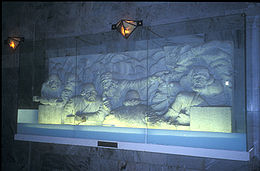 Ferdowsi's Shahnameh
is the most popular and influential national epic
in Iran
and other Persian-speaking nations. The Shahnameh is the only surviving work by Ferdowsi regarded as indisputably genuine. He may have written poems earlier in his life but they no longer exist. A narrative poem, Yūsof o Zolaykā (Joseph and Zuleika), was once attributed to him but scholarly consensus now rejects the idea it is his. There has also been speculation about the satire Ferdowsi allegedly wrote about Mahmud of Ghazni after the sultan failed to reward him sufficiently. Nezami Aruzi, Ferdowsi's early biographer, claimed that all but six lines had been destroyed by a well-wisher who had paid Ferdowsi a thousand dirham
s for the poem. Introductions to some manuscripts of the Shahnameh include verses purporting to be the satire. Some scholars have viewed them as fabricated, others are more inclined to believe in their authenticity.
 Ferdowsi is one of the undisputed giants of the Persian literature. After Ferdowsi's Shahnameh a number of other works similar in nature surfaced over the centuries within the cultural sphere of the Persian language. Without exception, all such works were based in style and method on Ferdowsi's Shahnameh, but none of them could quite achieve the same degree of fame and popularity as Ferdowsi's masterpiece.
Ferdowsi has a unique place in Persian history because of the strides he made in reviving and regenerating the Persian language and cultural traditions. His works are cited as a crucial component in the persistence of the Persian language, as those works allowed much of the tongue to remain codified and intact. In this respect, Ferdowsi surpasses Nizami, Khayyam
, Asadi Tusi
, and other seminal Persian literary figures in his impact on Persian culture and language. Many modern Iranians see him as the father of the modern Persian language.
Ferdowsi in fact was a motivation behind many future Persian figures. One such notable figure was Reza Shah
Pahlavi who established an "Academy of Culture" in Iran, in order to attempt to remove Arabic and Turkish words from the Persian language, replacing them with suitable Persian alternatives. In 1934, Reza Shah set up a ceremony in Mashad, Khorasan celebrating a thousand years of Persian literature since the time of Ferdowsi, titled "Ferdowsi's Millenary Celebration
" inviting notable European as well as Iranian scholars. Ferdowsi University of Mashhad, is a university established in 1949 that also takes its name from Ferdowsi.
Ferdowsi's influence in the Persian culture is explained by the Encyclopaedia Britannica:
Persian people
The Persian people are part of the Iranian peoples who speak the modern Persian language and closely akin Iranian dialects and languages. The origin of the ethnic Iranian/Persian peoples are traced to the Ancient Iranian peoples, who were part of the ancient Indo-Iranians and themselves part of...
poet. He was the author of the Shahnameh
Shahnameh
The Shahnameh or Shah-nama is a long epic poem written by the Persian poet Ferdowsi between c.977 and 1010 AD and is the national epic of Iran and related societies...
, the national epic
National epic
A national epic is an epic poem or a literary work of epic scope which seeks or is believed to capture and express the essence or spirit of a particular nation; not necessarily a nation-state, but at least an ethnic or linguistic group with aspirations to independence or autonomy...
of Iran
Iran
Iran , officially the Islamic Republic of Iran , is a country in Southern and Western Asia. The name "Iran" has been in use natively since the Sassanian era and came into use internationally in 1935, before which the country was known to the Western world as Persia...
and related societies
Greater Iran
Greater Iran refers to the regions that have significant Iranian cultural influence. It roughly corresponds to the territory on the Iranian plateau and its bordering plains, stretching from Iraq, the Caucasus, and Turkey in the west to the Indus River in the east...
.
The Shahnameh was originally composed by Ferdowsi for the princes of the Samanid dynasty, who were responsible for a revival of Persian cultural traditions after the Arab invasion of the seventh century. The Shahnameh chronicles the legendary history of the pre-Islamic kings of Iran from Keyumars to Yazdegerd III. Ferdowsi continued work on the poem after the Samanids were conquered by the Ghaznavids. The new ruler Mahmud of Ghazni
Mahmud of Ghazni
Mahmud of Ghazni , actually ', was the most prominent ruler of the Ghaznavid dynasty who ruled from 997 until his death in 1030 in the eastern Iranian lands. Mahmud turned the former provincial city of Ghazni into the wealthy capital of an extensive empire which covered most of today's Iran,...
, a Turk, may have lacked the interest in Ferdowsi's work shown by the Samanids, resulting in him losing favor with the royal court. In later passages of his poem, Ferdowsi complains about poverty and the ravages of old age. Ferdowsi spent over three decades (from 977 to 1010) working on the Shahnameh, which became one of the most influential works of Persian literature
Persian literature
Persian literature spans two-and-a-half millennia, though much of the pre-Islamic material has been lost. Its sources have been within historical Persia including present-day Iran as well as regions of Central Asia where the Persian language has historically been the national language...
.
Family
Ferdowsi was born into a family of Iranian landowners (dehqans) in 940 C.E. in the village of Paj, near the city of Tus in the province of Khorasan, in northeastern IranIran
Iran , officially the Islamic Republic of Iran , is a country in Southern and Western Asia. The name "Iran" has been in use natively since the Sassanian era and came into use internationally in 1935, before which the country was known to the Western world as Persia...
. Ferdowsi was a Shi'a Muslim, which is attested by the Shahnameh and also confirmed by early accounts. Little is known about Ferdowsi's early life, even his precise name is in doubt. According to the 13th-century Arab translator of the Shahnameh, Bondari, the poet's full name was "al-Amīr al-Ḥakīm Abu’l-Qāsem Manṣūr ibn al-Ḥasan al-Ferdowsī al-Ṭūsī". It is not known when or why he adopted the pen name "Ferdowsi" ("man of paradise"). The poet had a wife, who was probably literate and came from the same dehqan class. He had a son, who died aged 37, and was mourned by the poet in an elegy which he inserted into the Shahnameh.
Background
Ferdowsi belonged to the class of dehqans. These were landowning Iranian aristocrats who had flourished under the Sassanid dynastySassanid Empire
The Sassanid Empire , known to its inhabitants as Ērānshahr and Ērān in Middle Persian and resulting in the New Persian terms Iranshahr and Iran , was the last pre-Islamic Persian Empire, ruled by the Sasanian Dynasty from 224 to 651...
(the last pre-Islamic dynasty to rule Iran) and whose power, though diminished, had survived into the Islamic era which followed the Arab conquests of the seventh century. The dehqans were intensely patriotic (so much so that dehqan is sometimes used as a synonym for "Iranian" in the Shahnameh) and saw it as their task to preserve the cultural traditions of Iran, including the legendary tales about its kings.
The Muslim conquests of the seventh century had been a watershed in Iranian history, bringing the new religion of Islam, submitting Iranians to the rule of the Arab caliphate and promoting Arabic culture and language at the expense of Persian. By the late 9th century, the power of the caliphate had weakened and local Iranian dynasties emerged. Ferdowsi grew up in Tus, a city under the control of one of these dynasties, the Samanids, who claimed descent from the Sassanid general Bahram Chobin
Bahram Chobin
General Bahrām Chobin was a famous Eran spahbod during the late 6th century in Persia, usurping the Sassanid throne for a year as Bahram VI .- Life :...
(whose story Ferdowsi recounts in one of the later sections of the Shahnameh). The Samanid bureaucracy used the New Persian language rather than Arabic and the Samanid elite had a great interest in pre-Islamic Iran and its traditions and commissioned translations of Pahlavi (Middle Persian
Middle Persian
Middle Persian , indigenously known as "Pârsig" sometimes referred to as Pahlavi or Pehlevi, is the Middle Iranian language/ethnolect of Southwestern Iran that during Sassanid times became a prestige dialect and so came to be spoken in other regions as well. Middle Persian is classified as a...
) texts into New Persian. Abu Mansur ʿAbd-al-Razzāq , a dehqan and governor of Tus, had several local scholars compile a prose Shahnameh ("Book of Kings"), which was completed in 957. Although it no longer survivers, Ferdowsi used it as one of the sources of his epic. Samanid rulers were patrons of such important Persian poets as Rudaki
Rudaki
Abu Abdollah Jafar ibn Mohammad Rudaki , also written as Rudagi , was a Persian poet, and is regarded as the first great literary genius of the Modern Persian, who composed poems in the "New Persian" alphabet. Rudaki is considered as a founder of Persian classical literature.He was born in 858 in...
and Daqiqi. Ferdowsi followed in the footsteps of these writers.
Details about Ferdowsi's education are lacking. Judging by the Shahnameh, there is no evidence he knew either Arabic or Pahlavi.
Although New Persian was permeated by Arabic vocabulary by Ferdowsi's time, there are relatively few Arabic loan words in the Shahnameh. This may have been a deliberate strategy by the poet.
Life as a poet
It is possible that Ferdowsi wrote some early poems which have not survived. He began work on the Shahnameh around 977, intending it as a continuation of the work of his fellow poet Daqiqi, who had been assassinated by a slave. Like Daqiqi, Ferdowsi employed the prose Shahnameh of ʿAbd-al-Razzāq as a source. He received generous patronage from the Samanid prince Mansur and completed the first version of the Shahnameh in 994. When the Turkic Ghaznavids overthrew the Samanids in the late 990s, Ferdowsi continued to work on the poem, rewriting sections to praise the Ghaznavid Sultan Mahmud. Mahmud's attitude to Ferdowsi and how well he rewarded the poet are matters which have long been subject to dispute and have formed the basis of legends about the poet and his patron (see below). The Turkic Mahmud may have been less interested in tales from Iranian history than the Samanids. The later sections of the Shahnameh have passages which reveal Ferdowsi's fluctuating moods: in some he complains about old age, poverty, illness and the death of his son; in others, he appears happier. Ferdowsi finally completed his epic on 8 March 1010. Virtually nothing is known for sure about the last decade of his life.Tomb
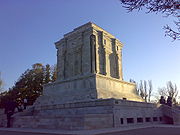
Ferdowsi was buried in his own garden, burial in the Muslim cemetery of Tus having been forbidden by a local cleric. A Ghaznavid governor of Khorasan constructed a mausoleum over the grave and it became a revered site. The tomb, which had fallen into decay, was rebuilt between 1928 and 1934 on the orders of Reza ShahReza Shah
Rezā Shāh, also known as Rezā Shāh Pahlavi and Rezā Shāh Kabir , , was the Shah of the Imperial State of Iran from December 15, 1925, until he was forced to abdicate by the Anglo-Soviet invasion of Iran on September 16, 1941.In 1925, Reza Shah overthrew Ahmad Shah Qajar, the last Shah of the Qajar...
and has now become the equivalent of a national shrine.
Legend
According to legend, Sultan Mahmud of Ghazni offered Ferdowsi a gold piece for every couplet of the Shahnameh he wrote. The poet agreed to receive the money as a lump sum when he had completed the epic. He planned to use it to rebuild the dykes in his native Tus. After thirty years of work, Ferdowsi finished his masterpiece. The sultan prepared to give him 60,000 gold pieces, one for every couplet, as agreed. However, the courtier Mahmud had entrusted with the money despised Ferdowsi, regarding him as a heretic, and he replaced the gold coins with silver. Ferdowsi was in the bath house when he received the reward. Finding it was silver not gold, he gave the money away to the bathkeeper, a refreshment seller and the slave who had carried the coins. When the courtier told the sultan about Ferdowsi's behaviour, he was furious and threatened to execute him. Ferdowsi fled Khorasan, having first written a satire on Mahmud, and spent most of the remainder of his life in exile. Mahmud eventually learned the truth about the courtier's deception and had him either banished or executed. By this time, the aged Ferdowsi had returned to Tus. The sultan sent him a new gift of 60,000 gold pieces but as the caravan bearing the money arrived in Tus it met a funeral procession: the poet had died from a heart attack.Works
Shahnameh
The Shahnameh or Shah-nama is a long epic poem written by the Persian poet Ferdowsi between c.977 and 1010 AD and is the national epic of Iran and related societies...
is the most popular and influential national epic
National epic
A national epic is an epic poem or a literary work of epic scope which seeks or is believed to capture and express the essence or spirit of a particular nation; not necessarily a nation-state, but at least an ethnic or linguistic group with aspirations to independence or autonomy...
in Iran
Iran
Iran , officially the Islamic Republic of Iran , is a country in Southern and Western Asia. The name "Iran" has been in use natively since the Sassanian era and came into use internationally in 1935, before which the country was known to the Western world as Persia...
and other Persian-speaking nations. The Shahnameh is the only surviving work by Ferdowsi regarded as indisputably genuine. He may have written poems earlier in his life but they no longer exist. A narrative poem, Yūsof o Zolaykā (Joseph and Zuleika), was once attributed to him but scholarly consensus now rejects the idea it is his. There has also been speculation about the satire Ferdowsi allegedly wrote about Mahmud of Ghazni after the sultan failed to reward him sufficiently. Nezami Aruzi, Ferdowsi's early biographer, claimed that all but six lines had been destroyed by a well-wisher who had paid Ferdowsi a thousand dirham
Dirham
Dirham or dirhem is a unit of currency in several Arab or Berber nations, and formerly the related unit of mass in the Ottoman Empire and Persian states...
s for the poem. Introductions to some manuscripts of the Shahnameh include verses purporting to be the satire. Some scholars have viewed them as fabricated, others are more inclined to believe in their authenticity.
Influence
Ferdowsi has a unique place in Persian history because of the strides he made in reviving and regenerating the Persian language and cultural traditions. His works are cited as a crucial component in the persistence of the Persian language, as those works allowed much of the tongue to remain codified and intact. In this respect, Ferdowsi surpasses Nizami, Khayyam
Khayyam
Omar Khayyam was a Persian poet, mathematician, philosopher and astronomer.Omar Khayyam or Khayyam or may also refer to:* Khayyam, Iran* Mohammed Zahur Khayyam , commonly credited as 'Khayaam', Indian music composer...
, Asadi Tusi
Asadi Tusi
Abu Mansur Ali ibn Ahmad Asadi Tusi is arguably the second most important Persian poet of the Iranian national epics, after Ferdowsi who also happens to come from the same town of Tus. He was a poet, a linguist and copyist of ancient manuscripts.- Life :The information on Asadi's lifetime is scant...
, and other seminal Persian literary figures in his impact on Persian culture and language. Many modern Iranians see him as the father of the modern Persian language.
Ferdowsi in fact was a motivation behind many future Persian figures. One such notable figure was Reza Shah
Reza Shah
Rezā Shāh, also known as Rezā Shāh Pahlavi and Rezā Shāh Kabir , , was the Shah of the Imperial State of Iran from December 15, 1925, until he was forced to abdicate by the Anglo-Soviet invasion of Iran on September 16, 1941.In 1925, Reza Shah overthrew Ahmad Shah Qajar, the last Shah of the Qajar...
Pahlavi who established an "Academy of Culture" in Iran, in order to attempt to remove Arabic and Turkish words from the Persian language, replacing them with suitable Persian alternatives. In 1934, Reza Shah set up a ceremony in Mashad, Khorasan celebrating a thousand years of Persian literature since the time of Ferdowsi, titled "Ferdowsi's Millenary Celebration
Ferdowsi Millenary Celebration
Ferdowsi Millenary Celebration , was a series of celebrations and scholarly events in the year 1934 to commemorate the thousandth anniversary of Ferdowsi's birth. the Ferdowsi Millenary was announced at the beginning of the year by the government of Iran...
" inviting notable European as well as Iranian scholars. Ferdowsi University of Mashhad, is a university established in 1949 that also takes its name from Ferdowsi.
Ferdowsi's influence in the Persian culture is explained by the Encyclopaedia Britannica:
- The Persians regard Ferdowsi as the greatest of their poets. For nearly a thousand years they have continued to read and to listen to recitations from his masterwork, the Shah-nameh, in which the Persian national epic found its final and enduring form. Though written about 1,000 years ago, this work is as intelligible to the average, modern Iranian as the King James version of the Bible is to a modern English-speaker. The language, based as the poem is on a Dari original, is pure Persian with only the slightest admixture of Arabic.
See also
- Iranian StudiesIranian StudiesIranian studies , is an interdisciplinary field dealing with the study of history, literature, art and culture of the Iranian people. It is a part of the wider field of Oriental studies....
- Ferdowsi Millenary CelebrationFerdowsi Millenary CelebrationFerdowsi Millenary Celebration , was a series of celebrations and scholarly events in the year 1934 to commemorate the thousandth anniversary of Ferdowsi's birth. the Ferdowsi Millenary was announced at the beginning of the year by the government of Iran...
- Ferdowsi University of Mashhad
- List of Persian poets and authors
- Persian literaturePersian literaturePersian literature spans two-and-a-half millennia, though much of the pre-Islamic material has been lost. Its sources have been within historical Persia including present-day Iran as well as regions of Central Asia where the Persian language has historically been the national language...
- Sassanid empireSassanid EmpireThe Sassanid Empire , known to its inhabitants as Ērānshahr and Ērān in Middle Persian and resulting in the New Persian terms Iranshahr and Iran , was the last pre-Islamic Persian Empire, ruled by the Sasanian Dynasty from 224 to 651...
- List of mausoleums
- Jerry ClintonJerry ClintonJerome Wright Clinton was a Ferdowsi scholar and Professor of Persian language and literature at Princeton University...
External links
- Khosrow Nāghed, In the Workshop of Thought and Imagination of the Master of Tūs (Dar Kargāh-e Andisheh va Khiāl-e Ostād-e Tūs), in Persian, Radio Zamāneh, 5 August 2008.
- Ferdowsi: Poems Ferdowsi's poems in English
- Iraj Bashiri, The Shahname of Firdowsi
- Ferdowsi Museum photos
- Ferdowsi Tomb photos