


Silk Road transmission of Buddhism

Encyclopedia
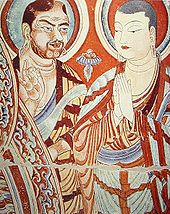
The Silk Road transmission of Buddhism to China
China
Chinese civilization may refer to:* China for more general discussion of the country.* Chinese culture* Greater China, the transnational community of ethnic Chinese.* History of China* Sinosphere, the area historically affected by Chinese culture...
is most commonly thought to have started in the late 2nd or the 1st century CE.
The first documented translation efforts by Buddhist monks in China (all foreigners) were in the 2nd century CE, possibly as a consequence of the expansion of the Kushan Empire
Kushan Empire
The Kushan Empire originally formed in the early 1st century AD under Kujula Kadphises in the territories of ancient Bactria on either side of the middle course of the Oxus in what is now northern Afghanistan, Pakistan, and southern Tajikistan and Uzbekistan.During the 1st and early 2nd centuries...
into the Chinese territory of the Tarim Basin
Tarim Basin
The Tarim Basin is a large endorheic basin occupying an area of about . It is located in the Xinjiang Uyghur Autonomous Region in China's far west. Its northern boundary is the Tian Shan mountain range and its southern is the Kunlun Mountains on the northern edge of the Tibetan Plateau. The...
.
From the 4th century onward, with Faxian
Faxian
Faxian was a Chinese Buddhist monk who traveled to India, Sri Lanka and Kapilavastu in today's Nepal between 399 and 412 to acquire Buddhist scriptures...
's pilgrimage to India (395–414), and later Xuanzang
Xuanzang
Xuanzang was a famous Chinese Buddhist monk, scholar, traveler, and translator who described the interaction between China and India in the early Tang period...
(629–644), Chinese pilgrims too started to travel by themselves to northern India
India
India , officially the Republic of India , is a country in South Asia. It is the seventh-largest country by geographical area, the second-most populous country with over 1.2 billion people, and the most populous democracy in the world...
, their source of Buddhism
Buddhism
Buddhism is a religion and philosophy encompassing a variety of traditions, beliefs and practices, largely based on teachings attributed to Siddhartha Gautama, commonly known as the Buddha . The Buddha lived and taught in the northeastern Indian subcontinent some time between the 6th and 4th...
, in order to get improved access to original scriptures. The Silk Road
Silk Road
The Silk Road or Silk Route refers to a historical network of interlinking trade routes across the Afro-Eurasian landmass that connected East, South, and Western Asia with the Mediterranean and European world, as well as parts of North and East Africa...
transmission of Buddhism began to decline around the 7th century with the rise of Islam in Central Asia.
First contacts
Although the early Chinese Twenty-Four HistoriesTwenty-Four Histories
The Twenty-Four Histories is a collection of Chinese historical books covering a period from 3000 BC to the Ming Dynasty in the 17th century. The whole set contains 3213 volumes and about 40 million words...
rarely mention Buddhism, Michael Loewe
Michael Loewe
Michael Loewe , also known as M. A. N. Loewe, is a British academic and renowned sinologist who has authored dozens of books, articles, and other publications in the fields of Classical Chinese and ancient Chinese history....
writes, "It may be assumed that travelers or pilgrims brought Buddhism along the Silk Roads, but whether this first occurred from the earliest period when those roads were open, ca. 100 BC, must remain open to question. The earliest direct references to Buddhism concern the 1st century AD, but they include hagiographical elements and are not necessarily reliable or accurate.
Buddhism in the Book of Later Han
The (5th century) Book of the Later Han, compiled by Fan YeFan Ye
Fan Ye |Liu Xuan]] and Russian gymnast Svetlana Khorkina for the longevity of their involvement in the sport.Fan Ye is best known for her work on the balance beam. Her biggest accomplishment in gymnastics is winning the 2003 World Balance Beam Title...
(398-446 CE), documented early Chinese Buddhism. This history records that around 65 CE, Buddhism was practiced in the courts of both Emperor Ming of Han
Emperor Ming of Han
Emperor Ming of Han, , was second emperor of the Chinese Eastern Han Dynasty.He was the second son of Emperor Guangwu. It was during Emperor Ming's reign that Buddhism began to spread into China. One night, he is said to have dreamed of a golden man or golden men...
(r. 58-75 CE) at Luoyang
Luoyang
Luoyang is a prefecture-level city in western Henan province of Central China. It borders the provincial capital of Zhengzhou to the east, Pingdingshan to the southeast, Nanyang to the south, Sanmenxia to the west, Jiyuan to the north, and Jiaozuo to the northeast.Situated on the central plain of...
(modern Henan
Henan
Henan , is a province of the People's Republic of China, located in the central part of the country. Its one-character abbreviation is "豫" , named after Yuzhou , a Han Dynasty state that included parts of Henan...
) and, his half-brother, King Ying
Liu Ying
Liu Ying was a son of Emperor Guangwu of Han, and half-brother of Emperor Ming. After becoming Prince of Chu, he was a known supporter of many religions...
(r. 41-70 CE) of Chu
Chu (state)
The State of Chu was a Zhou Dynasty vassal state in present-day central and southern China during the Spring and Autumn period and Warring States Period . Its ruling house had the surname Nai , and clan name Yan , later evolved to surname Mi , and clan name Xiong...
at Pengcheng (modern Jiangsu
Jiangsu
' is a province of the People's Republic of China, located along the east coast of the country. The name comes from jiang, short for the city of Jiangning , and su, for the city of Suzhou. The abbreviation for this province is "苏" , the second character of its name...
).
Fan Ye's Commentary noted that neither of the Former Han histories – the (109-91 BCE) Records or the Grand Historian (which records Zhang Qian
Zhang Qian
Zhang Qian was an imperial envoy to the world outside of China in the 2nd century BCE, during the time of the Han Dynasty...
visiting Central Asia
Central Asia
Central Asia is a core region of the Asian continent from the Caspian Sea in the west, China in the east, Afghanistan in the south, and Russia in the north...
) and (111 CE) Book of Han
Book of Han
The Book of Han, Hanshu or History of the Former Han Dynasty |Fan Ye]] . Various scholars have estimated that the earliest material covered in the book dates back to between 206 and 202 BCE...
(compiled by Ban Yong
Ban Yong
Ban Yong ) was the youngest son of the famous Chinese General, Ban Chao , and the nephew of the illustrious historian, Ban Gu who compiled the Hanshu, the dynastic history of the Former Han dynasty.- Ban Yong's family :...
) – described Buddhism originating in India.
Zhang Qian noted only that: 'this country is hot and humid. The people ride elephants into battle.' Although Ban Yong explained that they revere the Buddha, and neither kill nor fight, he has recording nothing about the excellent texts, virtuous Law, and meritorious teachings and guidance. As for myself, here is what I have heard: This kingdom is even more flourishing than China. The seasons are in harmony. Saintly beings descend and congregate there. Great Worthies arise there. Strange and extraordinary marvels occur such that human reason is suspended. By examining and exposing the emotions, one can reach beyond the highest heavens.
In the Book of Later Han, "The Kingdom of Tianzhu" (天竺, Northwest India
India
India , officially the Republic of India , is a country in South Asia. It is the seventh-largest country by geographical area, the second-most populous country with over 1.2 billion people, and the most populous democracy in the world...
) section of "The Chronicle of the Western Regions" summarizes the origins of Buddhism in China. After noting Tianzhu envoys coming by sea through Rinan (日南, Central Vietnam
Vietnam
Vietnam – sometimes spelled Viet Nam , officially the Socialist Republic of Vietnam – is the easternmost country on the Indochina Peninsula in Southeast Asia. It is bordered by China to the north, Laos to the northwest, Cambodia to the southwest, and the South China Sea –...
) and presenting tribute to Emperor He of Han
Emperor He of Han
Emperor He of Han, ch. 漢和帝, py. hàn hé dì, wg. Han Ho-ti, was an emperor of the Chinese Han Dynasty who ruled from 88 to 105. He was the 4th emperor of the Eastern Han dynasty....
(r. 89-105 CE) and Emperor Huan of Han
Emperor Huan of Han
Emperor Huan of Han, ch. 漢桓帝, py. hàn húan dì, wg. Han Huan-ti, was an emperor of the Chinese Han Dynasty. He was a great-grandson of Emperor Zhang....
(r. 147-167 CE), it summarizes the first "hard evidence" about Prince Ying and "official" story about Emperor Ming.
There is a current tradition that Emperor Ming dreamed that he saw a tall golden man the top of whose head was glowing. He questioned his group of advisors and one of them said: “In the West there is a god called Buddha. His body is sixteen chi high (3.7 metres or 12 feet), and is the colour of true gold.” The Emperor, to discover the true doctrine, sent an envoy to Tianzhu (Northwestern India) to inquire about the Buddha’s doctrine, after which paintings and statues [of the Buddha] appeared in the Middle Kingdom.
Then Ying, the king of Chu [a dependent kingdom which he ruled 41-71 CE], began to believe in this Practice, following which quite a few people in the Middle Kingdom began following this Path. Later on, Emperor Huan [147-167 CE] devoted himself to sacred things and often made sacrifices to the Buddha and Laozi. People gradually began to accept [Buddhism] and, later, they became numerous.
First, the Book of the Later Han biography of Liu Ying
Liu Ying
Liu Ying was a son of Emperor Guangwu of Han, and half-brother of Emperor Ming. After becoming Prince of Chu, he was a known supporter of many religions...
, the King of Chu, gives the oldest reference to Buddhism in Chinese historical literature. It says Ying was both deeply interested in Huang-Lao
Huang-Lao
Huang-Lao or Huanglao was the most influential Chinese school of thought in the early 2nd-century BCE Han Dynasty, and is generally interpreted as encompassing Daoism and Legalism...
黄老 (from Yellow Emperor
Yellow Emperor
The Yellow Emperor or Huangdi1 is a legendary Chinese sovereign and culture hero, included among the Three Sovereigns and Five Emperors. Tradition holds that he reigned from 2697–2597 or 2696–2598 BC...
and Laozi
Laozi
Laozi was a mystic philosopher of ancient China, best known as the author of the Tao Te Ching . His association with the Tao Te Ching has led him to be traditionally considered the founder of Taoism...
) Daoism and "observed fasting and performed sacrifices to the Buddha." Huang-Lao or Huanglaozi 黄老子 is the deification of Laozi, and was associated with fangshi
Fangshi
Fangshi was a category of Chinese technical specialists that flourished from the third century BCE to the fifth century CE. English translations of fangshi encompass alchemist, astrologer, diviner, exorcist, geomancer, doctor, magician, mountebank, monk, mystic, necromancer, occultist,...
"technician; magician; alchemist" methods and xian "transcendent; immortal" techniques. "To Liu Ying and the Chinese devotees at his court the "Buddhist" ceremonies of fasting and sacrifices were probably no more than a variation of existing Daoist practices; this peculiar mixture of Buddhist and Daoist elements remains characteristic of Han Buddhism as a whole."
In 65 CE, Emperor Ming decreed that anyone suspected of capital crimes would be given an opportunity for redemption, and King Ying sent thirty rolls of silk. The biography quotes Ming's edict praising his younger brother.
The king of Chu recites the subtle words of Huanglao, and respectfully performs the gentle sacrifices to the Buddha. After three months of purification and fasting, he has made a solemn covenant (or: a vow 誓) with the spirits. What dislike or suspicion (from Our part) could there be, that he must repent (of his sins)? Let (the silk which he sent for) redemption be sent back, in order thereby to contribute to the lavish entertainment of the upāsakas (yipusai 伊蒲塞) and śramaṇa (sangmen 桑門).
"These two Sanskrit terms, given in the Chinese text in phonetic transcription, refer to lay adepts and to Buddhist monks, respectively"; and show detailed knowledge of Buddhist terminology.
In 70 CE, King Ying was implicated in rebellion and sentenced to death, but Ming instead exiled him and his courtiers south to Danyang (Anhui
Anhui
Anhui is a province in the People's Republic of China. Located in eastern China across the basins of the Yangtze River and the Huai River, it borders Jiangsu to the east, Zhejiang to the southeast, Jiangxi to the south, Hubei to the southwest, Henan to the northwest, and Shandong for a tiny...
), where Ying committed suicide in 71 CE. The Buddhist community at Pencheng survived, and around 193 CE, the warlord Zhai Rong built a huge Buddhist temple, "which could contain more than three thousand people, who all studied and read Buddhist scriptures."
Second, Fan Ye's Book of Later Han quotes a "current" (5th-century) tradition that Emperor Ming prophetically dreamed about a "golden man" Buddha. While "The Kingdom of Tianzhu" section (above) recorded his famous dream, the "Annals of Emperor Ming" history did not. Apocryphal texts give divergent accounts about the imperial envoys sent to India, their return with two Buddhist monks, Sanskrit
Sanskrit
Sanskrit , is a historical Indo-Aryan language and the primary liturgical language of Hinduism, Jainism and Buddhism.Buddhism: besides Pali, see Buddhist Hybrid Sanskrit Today, it is listed as one of the 22 scheduled languages of India and is an official language of the state of Uttarakhand...
sutras (including Sutra of Forty-two Chapters
Sutra of Forty-two Chapters
The Sutra of Forty-two Chapters is the earliest surviving Buddhist sutra translated into Chinese. It was translated by two ordained Yuezhi monks, Kasyapa-Matanga and Dharmaraksha , in 67 CE...
) carried by white horses, and establishing the White Horse Temple
White Horse Temple
White Horse Temple is, according to tradition, the first Buddhist temple in China, established in 68 AD under the patronage of Emperor Ming in the Eastern Han capital Luoyang. Today the site is located just outside the walls of the ancient Eastern Han capital, some east of Luoyang in Henan...
.
Since the Book of Later Han present two accounts of how Buddhism entered Han China, generations of scholars have debated whether monks first arrived via the maritime or overland routes of the Silk Road
Silk Road
The Silk Road or Silk Route refers to a historical network of interlinking trade routes across the Afro-Eurasian landmass that connected East, South, and Western Asia with the Mediterranean and European world, as well as parts of North and East Africa...
. The maritime route hypothesis, favored by Liang Qichao
Liang Qichao
Liang Qichao |Styled]] Zhuoru, ; Pseudonym: Rengong) was a Chinese scholar, journalist, philosopher and reformist during the Qing Dynasty , who inspired Chinese scholars with his writings and reform movements...
and Paul Pelliot
Paul Pelliot
Paul Pelliot was a French sinologist and explorer of Central Asia. Initially intending to enter the foreign service, Pelliot took up the study of Chinese and became a pupil of Sylvain Lévi and Édouard Chavannes....
, proposed that Buddhism was originally introduced in southern China, the Yangtze River
Yangtze River
The Yangtze, Yangzi or Cháng Jiāng is the longest river in Asia, and the third-longest in the world. It flows for from the glaciers on the Tibetan Plateau in Qinghai eastward across southwest, central and eastern China before emptying into the East China Sea at Shanghai. It is also one of the...
and Huai River
Huai River
The Huai River is a major river in China. The Huai River is located about mid-way between the Yellow River and Yangtze River, the two largest rivers in China, and like them runs from west to east...
region, where King Ying of Chu was worshipping Laozi and Buddha c. 65 CE. The overland route hypothesis, favored by Tang Yongtong, proposed that Buddhism disseminated eastward through Yuezhi
Yuezhi
The Yuezhi, or Rouzhi , also known as the Da Yuezhi or Da Rouzhi , were an ancient Central Asian people....
and was originally practiced in western China, at the Han capital Luoyang where Emperor Ming established the White Horse Temple c. 68 CE. The historian Rong Xinjiang reexamined the overland and maritime hypotheses through a multi-disciplinary review of recent discoveries and research, including the Gandhāran Buddhist Texts
Gandharan Buddhist Texts
The Gandhāran Buddhist Texts are the oldest Buddhist manuscripts yet discovered, dating from about the 1st century CE. They are written in Gāndhārī, and are possibly the oldest extant Indic texts altogether. They were sold to European and Japanese institutions and individuals, and are currently...
, and concluded.
The view that Buddhism was transmitted to China by the sea route comparatively lacks convincing and supporting materials, and some arguments are not sufficiently rigorous. ... the most plausible theory is that Buddhism started from the Greater Yuezhi of northwest India (present-day Afghanistan and Pakistan) and took the land roads to reach Han China. After entering into China, Buddhism blended with early Daoism and Chinese traditional esoteric arts and its iconography received blind worship.
Buddhism in apocryphal traditions

Qin Dynasty
The Qin Dynasty was the first imperial dynasty of China, lasting from 221 to 207 BC. The Qin state derived its name from its heartland of Qin, in modern-day Shaanxi. The strength of the Qin state was greatly increased by the legalist reforms of Shang Yang in the 4th century BC, during the Warring...
(221-206 BCE) or Former Han Dynasty (208 BCE-9 CE).
One apocryphal story, first appearing in the (597 CE) Lidai sanbao ji 歷代三寶紀, concerns a group of Buddhist priests who supposedly arrived in 217 BCE at the capital of Qin Shi Huang
Qin Shi Huang
Qin Shi Huang , personal name Ying Zheng , was king of the Chinese State of Qin from 246 BC to 221 BC during the Warring States Period. He became the first emperor of a unified China in 221 BC...
in Xianyang
Xianyang
Xianyang is a former capital of China in Shaanxi province, on the Wei River, a few kilometers upstream from Xi'an. It has an area of...
(near Xi'an
Xi'an
Xi'an is the capital of the Shaanxi province, and a sub-provincial city in the People's Republic of China. One of the oldest cities in China, with more than 3,100 years of history, the city was known as Chang'an before the Ming Dynasty...
). The monks, led by the shramana
Shramana
A shramana is a wandering monk in certain ascetic traditions of ancient India including Jainism, Buddhism, and Ājīvikism. Famous śramaṇas include Mahavira and Gautama Buddha....
Shilifang 室李防, presented sutras to the First Emperor, who had them put in jail; "But at night the prison was broken open by a Golden Man, sixteen feet high, who released them. Moved by this miracle, the emperor bowed his head to the ground and excused himself." The (668 CE) Fayuan Zhulin Buddhist encyclopedia elaborates this legend with Mauryan
Maurya Empire
The Maurya Empire was a geographically extensive Iron Age historical power in ancient India, ruled by the Mauryan dynasty from 321 to 185 BC...
emperor Ashoka the Great sending Shilifang to China; with the exception of Liang Qichao
Liang Qichao
Liang Qichao |Styled]] Zhuoru, ; Pseudonym: Rengong) was a Chinese scholar, journalist, philosopher and reformist during the Qing Dynasty , who inspired Chinese scholars with his writings and reform movements...
, most modern sinologists dismiss this Shilifang story. Some western historians believe Emperor Ashoka sent Buddhist missionaries to China, citing the (ca. 265) 13th Rock Edict
Edicts of Ashoka
The Edicts of Ashoka are a collection of 33 inscriptions on the Pillars of Ashoka, as well as boulders and cave walls, made by the Emperor Ashoka of the Mauryan dynasty during his reign from 269 BCE to 231 BCE. These inscriptions are dispersed throughout the areas of modern-day Bangladesh, India,...
that records missions to Greece
Greece
Greece , officially the Hellenic Republic , and historically Hellas or the Republic of Greece in English, is a country in southeastern Europe....
, Sri Lanka
Sri Lanka
Sri Lanka, officially the Democratic Socialist Republic of Sri Lanka is a country off the southern coast of the Indian subcontinent. Known until 1972 as Ceylon , Sri Lanka is an island surrounded by the Indian Ocean, the Gulf of Mannar and the Palk Strait, and lies in the vicinity of India and the...
, and Nepal
Nepal
Nepal , officially the Federal Democratic Republic of Nepal, is a landlocked sovereign state located in South Asia. It is located in the Himalayas and bordered to the north by the People's Republic of China, and to the south, east, and west by the Republic of India...
. Others disagree, "As far as we can gather from the inscriptions he [Ashoka] was ignorant of the very existence of China."
There is a Chinese tradition that in 2 BCE, a Yuezhi
Yuezhi
The Yuezhi, or Rouzhi , also known as the Da Yuezhi or Da Rouzhi , were an ancient Central Asian people....
envoy to the court of Emperor Ai of Han
Emperor Ai of Han
Emperor Ai of Han was an emperor of the Chinese Han Dynasty. He ascended the throne when he was 20, having been made heir by his uncle Emperor Cheng, who was childless, and he reigned from 7 BC to 1 BC....
transmitted one or more Buddhist sutras to a Chinese scholar. The earliest version derives from the lost (mid-3rd century) Weilüe
Weilüe
The Weilüe written by Yu Huan between CE 239, the end of Emperor Ming’s reign, and 265 CE, the end of the Cao Wei . Although not an "official historian," Yu Huan has always been held in high regard amongst Chinese scholars....
, quoted in Pei Songzhi
Pei Songzhi
Pei Songzhi was commissioned by Emperor Wen of Liu Song to write a commentary on Chen Shou's Records of Three Kingdoms, providing additional detail omitted from the original work. His commentary, completed in 429, became integral to later editions of the Records, making the joint work three times...
's commentary to the (429 CE) Records of Three Kingdoms
Records of Three Kingdoms
Records of Three Kingdoms , is regarded as the official and authoritative historical text on the Three Kingdoms period of Chinese history covering the years 184-280 CE. Written by Chen Shou in the 3rd century, the work combines the smaller histories of the rival states of Cao Wei , Shu Han and...
: "the student at the imperial academy Jing Lu 景盧 received from Yicun 伊存, the envoy of the king of the Great Yuezhi oral instruction in (a) Buddhist sutra(s)." Since Han histories do not mention Emperor Ai having contacts with the Yuezhi, scholars disagree whether this tradition "deserves serious consideration", or can be "reliable material for historical research".
Many apocryphal sources recount the "pious legend" of Emperor Ming dreaming about Buddha, sending envoys to Yuezhi (on a date variously given as 60, 61, 64 or 68 CE), and their return (3 or 11 years later) with sacred texts and the first Buddhist missionaries, Kāśyapa Mātanga
Kasyapa Matanga
Kasyapa Matanga was an Indian Buddhist monk who is believed to have introduced Buddhism to China in the 1st century CE....
(Shemoteng 攝摩騰 or Jiashemoteng 迦葉摩騰) and Dharmaratna (Zhu Falan 竺法蘭). They translated the "Sutra in Forty-two Sections" into Chinese, traditionally dated 67 CE but probably later than 100, the emperor built the White Horse Temple (Baimasi 白馬寺) in their honor, and Chinese Buddhism began. All accounts of Emperor Ming's dream and Yuezhi embassy derive from the anonymous (middle 3rd-century) introduction to the Sutra of Forty-two Chapters
Sutra of Forty-two Chapters
The Sutra of Forty-two Chapters is the earliest surviving Buddhist sutra translated into Chinese. It was translated by two ordained Yuezhi monks, Kasyapa-Matanga and Dharmaraksha , in 67 CE...
. For example, the (late 3rd to early 5th-century) Lihuo lun 理惑論 by Mouzi 牟子says,
In olden days emperor Ming saw in a dream a god whose body had the brilliance of the sun and who flew before his palace; and he rejoiced exceedingly at this. The next day he asked his officials: "What god is this?" the scholar Fu Yi said: "Your subject has heard it said that in India there is somebody who has attained the Tao and who is called Buddha; he flies in the air, his body had the brilliance of the sun; this must be that god."
Academics disagree over the historicity of Emperor Ming's dream; Tang Yongtong sees a possible nucleus of fact behind the tradition, and Henri Maspero
Henri Maspero
Henri Maspero was a French sinologist, today particularly remembered for his pioneering works on Taoism.-Biography:...
rejects it as propagandistic fiction.
Exemplifying how traditional accounts of Chinese Buddhism sometimes combined history and legend, the Records of the Grand Historian notes that in 120 BCE, Han general Huo Qubing
Huo Qubing
Huo Qubing , born in Linfen, Shanxi, was a general of the western Han dynasty under Emperor Wu. Being the illegitimate son of Wei Shaoer, he was the nephew of Wei Qing and Empress Wei Zifu....
captured a Xiongnu
Xiongnu
The Xiongnu were ancient nomadic-based people that formed a state or confederation north of the agriculture-based empire of the Han Dynasty. Most of the information on the Xiongnu comes from Chinese sources...
king with a "golden man" sacrificial image, later assumed to be Buddhist. The (c. 6th century) A New Account of the Tales of the World
A New Account of the Tales of the World
A New Account of the Tales of the World is a book of anecdotes and character sketches, dates back to the Southern and Northern Dynasties...
claims this golden man was more than ten feet high, and Emperor Wu of Han
Emperor Wu of Han
Emperor Wu of Han , , personal name Liu Che , was the seventh emperor of the Han Dynasty of China, ruling from 141 BC to 87 BC. Emperor Wu is best remembered for the vast territorial expansion that occurred under his reign, as well as the strong and centralized Confucian state he organized...
(r. 141-87 BCE) sacrificed to it in the Ganquan 甘泉 palace, which "is how Buddhism gradually spread into (China)." Note the (8th century) fresco discovered in the Mogao caves
Mogao Caves
The Mogao Caves or Mogao Grottoes , also known as the Caves of the Thousand Buddhas , form a system of 492 temples southeast of the center of Dunhuang, an oasis strategically located at a religious and cultural crossroads on the Silk Road, in Gansu province, China...
(near Dunhuang
Dunhuang
Dunhuang is a city in northwestern Gansu province, Western China. It was a major stop on the ancient Silk Road. It was also known at times as Shāzhōu , or 'City of Sands', a name still used today...
in the Tarim Basin
Tarim Basin
The Tarim Basin is a large endorheic basin occupying an area of about . It is located in the Xinjiang Uyghur Autonomous Region in China's far west. Its northern boundary is the Tian Shan mountain range and its southern is the Kunlun Mountains on the northern edge of the Tibetan Plateau. The...
) that depicts Emperor Wu worshipping two Buddhist statues, "identified as 'golden men' obtained in 120 BCE by a great Han general during his campaigns against the nomads". Although Emperor Wu did establish the Dunhuang commandery, "he never worshipped the Buddha."
Early translations
The first documented translation of Buddhist scriptures into Chinese occurs in 148 CE with the arrival of the ParthianParthian Empire
The Parthian Empire , also known as the Arsacid Empire , was a major Iranian political and cultural power in ancient Persia...
prince-turned-monk, An Shigao (Ch. 安世高). He worked to establish Buddhist temples in Loyang and organized the translation of Buddhist scriptures into Chinese, testifying to the beginning of a wave of Central Asian Buddhist proselytism that was to last several centuries. An Shigao translated Buddhist texts on basic doctrines, meditation
Buddhist meditation
Buddhist meditation refers to the meditative practices associated with the religion and philosophy of Buddhism.Core meditation techniques have been preserved in ancient Buddhist texts and have proliferated and diversified through teacher-student transmissions. Buddhists pursue meditation as part of...
and abhidharma
Abhidharma
Abhidharma or Abhidhamma are ancient Buddhist texts which contain detailed scholastic and scientific reworkings of doctrinal material appearing in the Buddhist Sutras, according to schematic classifications...
. An Xuan
An Xuan
An Xuan was a Parthian layman accredited with working alongside 安世高 in the translation of early Buddhist texts in Luoyang during the Later Han Dynasty....
(Ch. 安玄), a Parthian layman who worked alongside An Shigao, also translated an early Mahāyāna Buddhist text on the bodhisattva
Bodhisattva
In Buddhism, a bodhisattva is either an enlightened existence or an enlightenment-being or, given the variant Sanskrit spelling satva rather than sattva, "heroic-minded one for enlightenment ." The Pali term has sometimes been translated as "wisdom-being," although in modern publications, and...
path.
Mahāyāna
Mahayana
Mahāyāna is one of the two main existing branches of Buddhism and a term for classification of Buddhist philosophies and practice...
Buddhism was first widely propagated in China by the Kushan monk Lokakṣema
Lokaksema
Lokakṣema , born around 147 CE, was the earliest known Buddhist monk to have translated Mahayana sutras into the Chinese language and as such was an important figure in Buddhism in China. The name Lokakṣema means 'welfare of the world' in Sanskrit.-Origins:Lokaksema was a Kushan of Yuezhi ethnicity...
(Ch. 支婁迦讖, active ca. 164–186 CE), who came from the ancient Buddhist kingdom of Gandhāra
Gandhara
Gandhāra , is the name of an ancient kingdom , located in northern Pakistan and eastern Afghanistan. Gandhara was located mainly in the vale of Peshawar, the Potohar plateau and on the Kabul River...
. Lokakṣema translated important Mahāyāna sūtras such as the Aṣṭasāhasrikā Prajñāpāramitā Sūtra, as well as rare, early Mahāyāna sūtras on topics such as samādhi
Samadhi
Samadhi in Hinduism, Buddhism,Jainism, Sikhism and yogic schools is a higher level of concentrated meditation, or dhyāna. In the yoga tradition, it is the eighth and final limb identified in the Yoga Sūtras of Patañjali....
and meditation on the buddha Akṣobhya
Akshobhya
In Vajrayana Buddhism, Akṣobhya is one of the Five Wisdom Buddhas, a product of the Adibuddha, who represents consciousness as an aspect of reality...
. These translations from Lokakṣema continue to give insight into the early period of Mahāyāna Buddhism.
Central Asian missionaries
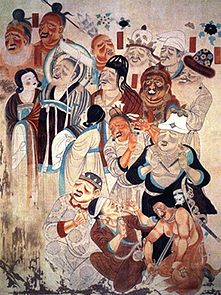
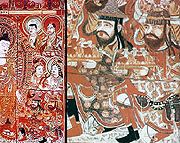
Kanishka
Kanishka ) was an emperor of the Kushan Empire, ruling an empire extending from Bactria to large parts of northern India in the 2nd century of the common era, and famous for his military, political, and spiritual achievements...
expanded into Central Asia and went as far as taking control of Kashgar
Kashgar
Kashgar or Kashi is an oasis city with approximately 350,000 residents in the western part of the Xinjiang Uyghur Autonomous Region of the People's Republic of China. Kashgar is the administrative centre of Kashgar Prefecture which has an area of 162,000 km² and a population of approximately...
, Khotan
Khotan
Hotan , or Hetian , also spelled Khotan, is the seat of the Hotan Prefecture in Xinjiang, China. It was previously known in Chinese as 于窴/於窴 and to 19th-century European explorers as Ilchi....
and Yarkand, in the Tarim Basin
Tarim Basin
The Tarim Basin is a large endorheic basin occupying an area of about . It is located in the Xinjiang Uyghur Autonomous Region in China's far west. Its northern boundary is the Tian Shan mountain range and its southern is the Kunlun Mountains on the northern edge of the Tibetan Plateau. The...
, modern Xinjiang
Xinjiang
Xinjiang is an autonomous region of the People's Republic of China. It is the largest Chinese administrative division and spans over 1.6 million km2...
. As a consequence, cultural exchanges greatly increased, and Central Asian Buddhist missionaries became active shortly after in the Chinese capital cities of Loyang and sometimes Nanjing
Nanjing
' is the capital of Jiangsu province in China and has a prominent place in Chinese history and culture, having been the capital of China on several occasions...
, where they particularly distinguished themselves by their translation work. They promoted both Hīnayāna and Mahāyāna scriptures. Thirty-seven of these early translators of Buddhist texts are known.
- An Shih KaoAn Shih KaoAn Shigao was a prince of Parthia, nicknamed the "Parthian Marquis", who renounced his claim to the royal throne of Parthia in order to serve as a Buddhist missionary monk in China.The prefix An in An Shigao's name is an abbreviation of Anxi, the Chinese name given to the regions ruled by the...
, a ParthiaParthiaParthia is a region of north-eastern Iran, best known for having been the political and cultural base of the Arsacid dynasty, rulers of the Parthian Empire....
n prince who made the first known translations of HīnayānaHinayanaHīnayāna is a Sanskrit and Pāli term literally meaning: the "Inferior Vehicle", "Deficient Vehicle", the "Abandoned Vehicle", or the "Defective Vehicle". The term appeared around the 1st or 2nd century....
Buddhist texts into Chinese (148–170) - LokakṣemaLokaksemaLokakṣema , born around 147 CE, was the earliest known Buddhist monk to have translated Mahayana sutras into the Chinese language and as such was an important figure in Buddhism in China. The name Lokakṣema means 'welfare of the world' in Sanskrit.-Origins:Lokaksema was a Kushan of Yuezhi ethnicity...
, a Kushan and the first to translate MahāyānaMahayanaMahāyāna is one of the two main existing branches of Buddhism and a term for classification of Buddhist philosophies and practice...
scriptures into Chinese (167–186) - An Hsuan, a Parthian merchant who became a monk in China in 181
- Zhi YaoZhi YaoZhi Yao was a Kushan Buddhist monk from modern day Kabul, Afghanistan of Yuezhi ethnicity. He was involved with the translation of Buddhist texts into Chinese around 185 CE. His origin is described in his adopted Chinese surname Zhi, abbreviation of Yuezhi.Zhi Yao was a student of Lokaksema...
(c. 185), a Kushan monk in the second generation of translators after Lokakṣema. - Kang Meng-hsiang (194–207), the first translator from KangjuKangjuKangju was the name of an ancient people and kingdom in Central Asia. It was a nomadic federation of unknown ethnic and linguistic origin which became for a couple of centuries the second greatest power in Transoxiana after the Yuezhi....
- Zhi QianZhi QianZhi Qian was a Chinese Buddhist layman of Yuezhi ancestry who translated a wide range of Indian Buddhist scriptures into Chinese. He was the grandson of an immigrant from the country of the Great Yuezhi, an area that overlapped to at least some extent with the territory of the Kushan Empire...
(220–252), a Kushan monk whose grandfather had settled in China during 168–190 - Zhi Yueh (c.230), a Kushan monk who worked at Nanjing
- Kang Senghui (247–280), born in JiaozhiJiaozhiJiaozhi was the name of all or part of Vietnam's territory, from the Hùng Vương era to the middle of the Third Chinese domination, and during the Fourth Chinese domination.-Giao Chỉ in the Văn Lang era:...
(or Chiao-chih) close to modern HanoiHanoiHanoi , is the capital of Vietnam and the country's second largest city. Its population in 2009 was estimated at 2.6 million for urban districts, 6.5 million for the metropolitan jurisdiction. From 1010 until 1802, it was the most important political centre of Vietnam...
in what was then the extreme south of the Chinese empire, and a son of a Sogdian merchant - Tan-ti (c.254), a Parthian monk
- Po Yen (c.259), a Kuchean prince
- DharmaraksaDharmaraksa' was one a translators of Mahayana Buddhist scriptures into Chinese. Scriptural catalogues describe him as of Yuezhi origin. His family lived at Dunhuang, where he was born around 230 CE...
(265–313), a Kushan whose family had lived for generations at Dunhuang - An Fachiin (281–306), a monk of Parthian origins
- Po Srimitra (317–322), a Kuchean prince
- KumarajivaKumarajivaKumārajīva; was a Kuchean Buddhist monk, scholar, and translator. He first studied teachings of the Sarvastivada schools, later studied under Buddhasvāmin, and finally became a Mahāyāna adherent, studying the Madhyamaka doctrine of Nagarjuna. Kumārajīva settled in Chang'an, which was the imperial...
(c. 401), a Kuchean monk and one of the most important translators - Fo T'u-teng (4th century), a Central Asian monk who became a counselor to the Chinese court
- BodhidharmaBodhidharmaBodhidharma was a Buddhist monk who lived during the 5th/6th century AD. He is traditionally credited as the transmitter of Ch'an to China, and regarded as the first Chinese patriarch...
(440–528), according to Yang XuanzhiYang XuanzhiYang Xuanzhi was a Chinese writer and translator of Mahayana Buddhist texts into the Chinese language, during the 6th century, under the Northern Wei Dynasty....
, a monk of Central Asian origin whom he met around 520 at Loyang. Bodhidharma was the founder of the ChanZenZen is a school of Mahāyāna Buddhism founded by the Buddhist monk Bodhidharma. The word Zen is from the Japanese pronunciation of the Chinese word Chán , which in turn is derived from the Sanskrit word dhyāna, which can be approximately translated as "meditation" or "meditative state."Zen...
(ZenZenZen is a school of Mahāyāna Buddhism founded by the Buddhist monk Bodhidharma. The word Zen is from the Japanese pronunciation of the Chinese word Chán , which in turn is derived from the Sanskrit word dhyāna, which can be approximately translated as "meditation" or "meditative state."Zen...
) school of Buddhism. - Five monks from Gandhāra who traveled in 485 CE to the country of FusangFusangFusang or Fousang refers to several different entities in ancient Chinese literature, often either a mythological tree or a mysterious land to the East....
("the country of the extreme east" beyond the sea, probably JapanJapanJapan is an island nation in East Asia. Located in the Pacific Ocean, it lies to the east of the Sea of Japan, China, North Korea, South Korea and Russia, stretching from the Sea of Okhotsk in the north to the East China Sea and Taiwan in the south...
), where they introduced Buddhism:
-
- In former times, the people of FusangFusangFusang or Fousang refers to several different entities in ancient Chinese literature, often either a mythological tree or a mysterious land to the East....
knew nothing of the Buddhist religion, but in the second year of Da Ming of the Song dynastySong DynastyThe Song Dynasty was a ruling dynasty in China between 960 and 1279; it succeeded the Five Dynasties and Ten Kingdoms Period, and was followed by the Yuan Dynasty. It was the first government in world history to issue banknotes or paper money, and the first Chinese government to establish a...
(485 CE), five monks from Kipin (KabulKabulKabul , spelt Caubul in some classic literatures, is the capital and largest city of Afghanistan. It is also the capital of the Kabul Province, located in the eastern section of Afghanistan...
region of Gandhara) traveled by ship to that country. They propagated Buddhist doctrine, circulated scriptures and drawings, and advised the people to relinquish worldly attachments. As a results the customs of Fusang changed. - (Ch: "其俗舊無佛法,宋大明二年,罽賓國嘗有比丘五人游行至其國,流通佛法,經像,教令出家,風 俗遂改.", Liang Shu "History of the Liang Dynasty, 7th century CE).
- JnanaguptaJnanaguptaJñānagupta was an Afghan Buddhist monkJñānagupta was an Afghan Buddhist monkJñānagupta was an Afghan Buddhist monkKalhan's Rajtarangini The Saga of the Kings of Kashmir translation by R S Pandit Published by Sahitya Akademi ,Appendix D page 731 , ISBN:81-260-1236-6 from Gandhara who travelled...
(561–592), a monk and translator from Gandhāra - Shikshananda (652–710 CE), a monk and translator from Udyāna, Gandhāra
- PrajnaPrajna (Buddhist Monk)Prajñā , was an important 9th century Buddhist monk from Gandhara, born in the area of modern Kabul, Afghanistan.He visited China during the Tang dynasty, and contributed several important translations of Sanskrit sutras into Chinese...
(c. 810), a monk and translator from KabulKabulKabul , spelt Caubul in some classic literatures, is the capital and largest city of Afghanistan. It is also the capital of the Kabul Province, located in the eastern section of Afghanistan...
who educated the Japanese KūkaiKukaiKūkai , also known posthumously as , 774–835, was a Japanese monk, civil servant, scholar, poet, and artist, founder of the Shingon or "True Word" school of Buddhism. Shingon followers usually refer to him by the honorific titles of and ....
in Sanskrit texts
- Jnanagupta
- In former times, the people of Fusang
Artistic influences
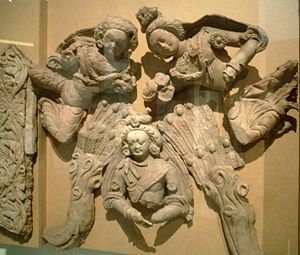
Serindian art
Serindian art is the art that developed from the 2nd through the 11th century C.E. in Serindia or Xinjiang, the western region of China that forms part of Central Asia....
from the 2nd to the 11th century CE in the Tarim Basin
Tarim Basin
The Tarim Basin is a large endorheic basin occupying an area of about . It is located in the Xinjiang Uyghur Autonomous Region in China's far west. Its northern boundary is the Tian Shan mountain range and its southern is the Kunlun Mountains on the northern edge of the Tibetan Plateau. The...
, modern Xinjiang
Xinjiang
Xinjiang is an autonomous region of the People's Republic of China. It is the largest Chinese administrative division and spans over 1.6 million km2...
.
Serindian art often derives from the Greco-Buddhist art of the Gandhāra
Gandhara
Gandhāra , is the name of an ancient kingdom , located in northern Pakistan and eastern Afghanistan. Gandhara was located mainly in the vale of Peshawar, the Potohar plateau and on the Kabul River...
district of what is now Pakistan
Pakistan
Pakistan , officially the Islamic Republic of Pakistan is a sovereign state in South Asia. It has a coastline along the Arabian Sea and the Gulf of Oman in the south and is bordered by Afghanistan and Iran in the west, India in the east and China in the far northeast. In the north, Tajikistan...
, combining Indian, Greek and Roman influences.
Highly sinicized forms of this syncretism can also be found on the eastern portions of the Tarim Basin, such as in Dunhuang
Dunhuang
Dunhuang is a city in northwestern Gansu province, Western China. It was a major stop on the ancient Silk Road. It was also known at times as Shāzhōu , or 'City of Sands', a name still used today...
.
Silk Road artistic influences can be found as far as Japan to this day, in architectural motifs or representations of Japanese gods (see Greco-Buddhist art
Greco-Buddhist art
Greco-Buddhist art is the artistic manifestation of Greco-Buddhism, a cultural syncretism between the Classical Greek culture and Buddhism, which developed over a period of close to 1000 years in Central Asia, between the conquests of Alexander the Great in the 4th century BCE, and the Islamic...
).
Chinese pilgrims to India
According to Chinese sources, the first Chinese to be ordained was Zhu ZixingZhu Zixing
In Chinese Buddhism Zhu Zixing is described as the first Chinese to be ordained and become Buddhist via Silk Road transmission. Zhu Zixing first went to Central Asia in 260 to seek out Buddhism and it was much before the other Chinese monks and travelers reached India to study Buddhism....
, after he went to Central Asia in 260 to seek out Buddhism. It is only from the 4th century CE that Chinese Buddhist monks started to travel to India
India
India , officially the Republic of India , is a country in South Asia. It is the seventh-largest country by geographical area, the second-most populous country with over 1.2 billion people, and the most populous democracy in the world...
to discover Buddhism first-hand. Faxian
Faxian
Faxian was a Chinese Buddhist monk who traveled to India, Sri Lanka and Kapilavastu in today's Nepal between 399 and 412 to acquire Buddhist scriptures...
's pilgrimage to India (395–414) is said to have been the first significant one. He left along the Silk Road, stayed six years in India, and then returned by the sea route.
Tens of Chinese monks, possibly hundreds of them, visited India during that period.
The most famous of the Chinese pilgrims is Xuanzang
Xuanzang
Xuanzang was a famous Chinese Buddhist monk, scholar, traveler, and translator who described the interaction between China and India in the early Tang period...
(629–644), whose large and precise translation work defines a “new translation period”, in contrast with older Central Asian works. He also left a detailed account of his travels in Central Asia and India.
Decline
Buddhism in Central Asia began to decline in the 7th century following the incursion of the Muslim CaliphateCaliphate
The term caliphate, "dominion of a caliph " , refers to the first system of government established in Islam and represented the political unity of the Muslim Ummah...
. The vigorous Chinese culture progressively absorbed Buddhist teachings until a strongly Chinese particularism developed.
Central Asian Buddhist monks from the Tarim Basin
Tarim Basin
The Tarim Basin is a large endorheic basin occupying an area of about . It is located in the Xinjiang Uyghur Autonomous Region in China's far west. Its northern boundary is the Tian Shan mountain range and its southern is the Kunlun Mountains on the northern edge of the Tibetan Plateau. The...
and East Asian Buddhist monks appear to have maintained strong exchanges until around the 10th century, as shown by frescoes from the Tarim Basin.
Further reading
- China's Holy Mountain: An Illustrated Journey into the Heart of Buddhism by Christoph Baumer. I.B.Tauris, London 2011. www.ibtauris.com ISBN 9781848857001
- Religions of the Silk Road, Richard FoltzRichard FoltzRichard Foltz is a Canadian scholar of American origin. He is a specialist in the history of Iran and the history of religions, particularly Islam and Zoroastrianism...
, Palgrave Macmillan, 2nd edition, 2010, ISBN 978-0-230-62125-1 - The Silk Road Journey with Xuanzang, Sally Hovey Wriggins, Westview Press, 2004, ISBN 0-8133-6599-6