

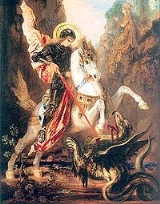
Saint George and the Dragon

Encyclopedia
Hagiography
Hagiography is the study of saints.From the Greek and , it refers literally to writings on the subject of such holy people, and specifically to the biographies of saints and ecclesiastical leaders. The term hagiology, the study of hagiography, is also current in English, though less common...
of Saint George
Saint George
Saint George was, according to tradition, a Roman soldier from Syria Palaestina and a priest in the Guard of Diocletian, who is venerated as a Christian martyr. In hagiography Saint George is one of the most venerated saints in the Catholic , Anglican, Eastern Orthodox, and the Oriental Orthodox...
was Eastern in origin, brought back with the Crusaders
Crusaders
The Crusaders are a New Zealand professional rugby union team based in Christchurch that competes in the Super Rugby competition. They are the most successful team in Super Rugby history with seven titles...
and retold with the courtly appurtenance
Appurtenance
Appurtenances is a term for what belongs to and goes with something else, with the appurtenance being less significant than what it belongs to. The word ultimately derives from Latin appertinere, "to appertain"....
s belonging to the genre of Romance
Romance (genre)
As a literary genre of high culture, romance or chivalric romance is a style of heroic prose and verse narrative that was popular in the aristocratic circles of High Medieval and Early Modern Europe. They were fantastic stories about marvel-filled adventures, often of a knight errant portrayed as...
. The earliest known depictions of the motif are from tenth- or eleventh-century Cappadocia
Cappadocia
Cappadocia is a historical region in Central Anatolia, largely in Nevşehir Province.In the time of Herodotus, the Cappadocians were reported as occupying the whole region from Mount Taurus to the vicinity of the Euxine...
and eleventh-century Georgia
Georgia (country)
Georgia is a sovereign state in the Caucasus region of Eurasia. Located at the crossroads of Western Asia and Eastern Europe, it is bounded to the west by the Black Sea, to the north by Russia, to the southwest by Turkey, to the south by Armenia, and to the southeast by Azerbaijan. The capital of...
; previously, in the iconography
Iconography
Iconography is the branch of art history which studies the identification, description, and the interpretation of the content of images. The word iconography literally means "image writing", and comes from the Greek "image" and "to write". A secondary meaning is the painting of icons in the...
of Eastern Orthodoxy, George had been depicted as a soldier
Soldier
A soldier is a member of the land component of national armed forces; whereas a soldier hired for service in a foreign army would be termed a mercenary...
since at least the seventh century. The earliest known surviving narrative of the dragon episode is an eleventh-century Georgian text.
William Shakespeare
William Shakespeare
William Shakespeare was an English poet and playwright, widely regarded as the greatest writer in the English language and the world's pre-eminent dramatist. He is often called England's national poet and the "Bard of Avon"...
refers to St. George and the Dragon in Richard III
Richard III (play)
Richard III is a history play by William Shakespeare, believed to have been written in approximately 1591. It depicts the Machiavellian rise to power and subsequent short reign of Richard III of England. The play is grouped among the histories in the First Folio and is most often classified...
; act v, also in King Lear
King Lear
King Lear is a tragedy by William Shakespeare. The title character descends into madness after foolishly disposing of his estate between two of his three daughters based on their flattery, bringing tragic consequences for all. The play is based on the legend of Leir of Britain, a mythological...
; act I.
The dragon
Dragon
A dragon is a legendary creature, typically with serpentine or reptilian traits, that feature in the myths of many cultures. There are two distinct cultural traditions of dragons: the European dragon, derived from European folk traditions and ultimately related to Greek and Middle Eastern...
motif was first combined with the already standardised Passio Georgii in Vincent of Beauvais
Vincent of Beauvais
The Dominican friar Vincent of Beauvais wrote the Speculum Maius, the main encyclopedia that was used in the Middle Ages.-Early life:...
' encyclopedic Speculum Historiale, and then Jacobus de Voragine
Jacobus de Voragine
Blessed Jacobus de Varagine or Voragine was an Italian chronicler and archbishop of Genoa. He was the author, or more accurately the compiler, of Legenda Aurea, the Golden Legend, a collection of the legendary lives of the greater saints of the medieval church that was one of the most popular...
's Golden Legend
Golden Legend
The Golden Legend is a collection of hagiographies by Jacobus de Voragine that became a late medieval bestseller. More than a thousand manuscripts of the text have survived, compared to twenty or so of its nearest rivals...
(ca 1260) guaranteed its popularity in the later Middle Ages as a literary and pictorial subject. The legend gradually became part of the Christian traditions relating to Saint George
Saint George: Devotions, traditions and prayers
Saint George is one of Christianity's most popular saints, and is highly honored by both the Western and Eastern Churches. A wide range of devotions, traditions, and prayers to honor the saint have emerged throughout the centuries. He has for long been distinguished by the title of "The Great...
and was used in many festivals thereafter.
The legends
.jpg)
Golden Legend
The Golden Legend is a collection of hagiographies by Jacobus de Voragine that became a late medieval bestseller. More than a thousand manuscripts of the text have survived, compared to twenty or so of its nearest rivals...
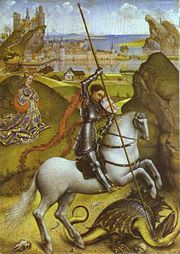
the narrative episode of Saint George and the Dragon took place in a place he called "Silene," in Libya
Libya
Libya is an African country in the Maghreb region of North Africa bordered by the Mediterranean Sea to the north, Egypt to the east, Sudan to the southeast, Chad and Niger to the south, and Algeria and Tunisia to the west....
; the Golden Legend is the first to place this legend in Libya as a sufficiently exotic locale, where a dragon might be imagined. In the tenth-century Georgian narrative, the place is the fictional city of Lasia, and it is the godless Emperor who is Selinus.
The town had a pond, as large as a lake
Lake
A lake is a body of relatively still fresh or salt water of considerable size, localized in a basin, that is surrounded by land. Lakes are inland and not part of the ocean and therefore are distinct from lagoons, and are larger and deeper than ponds. Lakes can be contrasted with rivers or streams,...
, where a plague
Bubonic plague
Plague is a deadly infectious disease that is caused by the enterobacteria Yersinia pestis, named after the French-Swiss bacteriologist Alexandre Yersin. Primarily carried by rodents and spread to humans via fleas, the disease is notorious throughout history, due to the unrivaled scale of death...
-bearing dragon
European dragon
European dragons are legendary creatures in folklore and mythology among the overlapping cultures of Europe.In European folklore, a dragon is a serpentine legendary creature. The Latin word draco, as in constellation Draco, comes directly from Greek δράκων,...
dwelled that envenomed
Venom
Venom is the general term referring to any variety of toxins used by certain types of animals that inject it into their victims by the means of a bite or a sting...
all the countryside. To appease the dragon, the people of Silene used to feed it two sheep
Domestic sheep
Sheep are quadrupedal, ruminant mammals typically kept as livestock. Like all ruminants, sheep are members of the order Artiodactyla, the even-toed ungulates. Although the name "sheep" applies to many species in the genus Ovis, in everyday usage it almost always refers to Ovis aries...
every day, and when the sheep failed, they fed it their children, chosen by lottery
Lottery
A lottery is a form of gambling which involves the drawing of lots for a prize.Lottery is outlawed by some governments, while others endorse it to the extent of organizing a national or state lottery. It is common to find some degree of regulation of lottery by governments...
. It happened that the lot fell on the king's daughter, who is in some versions of the story called Sabra. The king, distraught with grief, told the people they could have all his gold
Gold
Gold is a chemical element with the symbol Au and an atomic number of 79. Gold is a dense, soft, shiny, malleable and ductile metal. Pure gold has a bright yellow color and luster traditionally considered attractive, which it maintains without oxidizing in air or water. Chemically, gold is a...
and silver
Silver
Silver is a metallic chemical element with the chemical symbol Ag and atomic number 47. A soft, white, lustrous transition metal, it has the highest electrical conductivity of any element and the highest thermal conductivity of any metal...
and half of his kingdom if his daughter were spared; the people refused. The daughter was sent out to the lake, decked out as a bride
Bride
A bride is a woman about to be married or newlywed.The word may come from the Proto-Germanic verb root *brū-, meaning 'to cook, brew, or make a broth' which was the role of the daughter-in-law in primitive families...
, to be fed to the dragon.
Saint George
Saint George
Saint George was, according to tradition, a Roman soldier from Syria Palaestina and a priest in the Guard of Diocletian, who is venerated as a Christian martyr. In hagiography Saint George is one of the most venerated saints in the Catholic , Anglican, Eastern Orthodox, and the Oriental Orthodox...
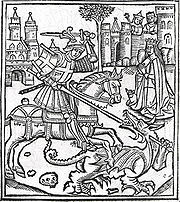
by chance rode past the lake. The princess, trembling, sought to send him away, but George vowed to remain. The dragon reared out of the lake while they were conversing. Saint George fortified himself with the Sign of the Cross
Sign of the cross
The Sign of the Cross , or crossing oneself, is a ritual hand motion made by members of many branches of Christianity, often accompanied by spoken or mental recitation of a trinitarian formula....
, charged it on horseback with his lance and gave it a grievous wound. Then he called to the princess to throw him her girdle, and he put it around the dragon's neck. When she did so, the dragon followed the girl like a meek beast on a leash.
She and Saint George led the dragon back to the city of Silene, where it terrified the people at its approach. But Saint George called out to them, saying that if they consented to become Christians and be baptised, he would slay the dragon before them. The king and the people of Silene converted to Christianity
Christianization
The historical phenomenon of Christianization is the conversion of individuals to Christianity or the conversion of entire peoples at once...
, George slew the dragon, and the body was carted out of the city on four ox-carts. "Fifteen thousand men baptized, without women and children." On the site where the dragon died, the king built a church to the Blessed Virgin Mary and Saint George, and from its altar a spring arose whose waters cured all disease
Panacea (medicine)
The panacea , named after the Greek goddess of healing, Panacea, also known as panchrest, was supposed to be a remedy that would cure all diseases and prolong life indefinitely...
.
Traditionally, the sword with which St. George slew the dragon was called Ascalon, a name recalling the city of Ashkelon
Ashkelon
Ashkelon is a coastal city in the South District of Israel on the Mediterranean coast, south of Tel Aviv, and north of the border with the Gaza Strip. The ancient seaport of Ashkelon dates back to the Neolithic Age...
, Israel
Israel
The State of Israel is a parliamentary republic located in the Middle East, along the eastern shore of the Mediterranean Sea...
. From this tradition, the name Ascalon was used by Winston Churchill
Winston Churchill
Sir Winston Leonard Spencer-Churchill, was a predominantly Conservative British politician and statesman known for his leadership of the United Kingdom during the Second World War. He is widely regarded as one of the greatest wartime leaders of the century and served as Prime Minister twice...
for his personal aircraft during World War II
World War II
World War II, or the Second World War , was a global conflict lasting from 1939 to 1945, involving most of the world's nations—including all of the great powers—eventually forming two opposing military alliances: the Allies and the Axis...
(records at Bletchley Park
Bletchley Park
Bletchley Park is an estate located in the town of Bletchley, in Buckinghamshire, England, which currently houses the National Museum of Computing...
), since St. George is the Patron Saint of England.
Origins
Dragonslayers
Dragonslayers are people who slay dragons for various reasons. Dragonslayers and the creatures they hunt have been seen in many popular books and films. They also are generally portrayed as heroes. Most common among Dragonslayers would be the knights of Middle Ages fiction, who slew dragons to save...
figures in the founding myth of Delphi
Delphi
Delphi is both an archaeological site and a modern town in Greece on the south-western spur of Mount Parnassus in the valley of Phocis.In Greek mythology, Delphi was the site of the Delphic oracle, the most important oracle in the classical Greek world, and a major site for the worship of the god...
, where Apollo
Apollo
Apollo is one of the most important and complex of the Olympian deities in Greek and Roman mythology...
slays the drakon Pytho, and has ancient Near Eastern roots as old as Mesopotamian Labbu
Labbu
In Mesopotamian myth Labbu was a lion-serpent sea-dragon, that was killed by the god-king Tishpak, "warrior of the gods". The myth recounting the predations and defeat of this supernatural adversary figure, of which the most familiar is Satan, has Canaanite origins; it appears in two very...
. A dragon is also an enemy figure in the Book of Revelation
Book of Revelation
The Book of Revelation is the final book of the New Testament. The title came into usage from the first word of the book in Koine Greek: apokalupsis, meaning "unveiling" or "revelation"...
(chapter 12 onwards) and in the saintly legend of Margaret the Virgin
Margaret the Virgin
Margaret the Virgin, also known as Margaret of Antioch , virgin and martyr, is celebrated as a saint by the Roman Catholic and Anglican Churches on July 20; and on July 17 in the Orthodox Church. Her historical existence has been questioned; she was declared apocryphal by Pope Gelasius I in 494,...
.
The region had long venerated other religious figures. These historians deem it likely that certain elements of their ancient worship could have passed to their Christian successors. Notable among these ancient deities was Sabazios
Sabazios
Sabazios is the nomadic horseman and sky father god of the Phrygians and Thracians. In Indo-European languages, such as Phrygian, the -zios element in his name derives from dyeus, the common precursor of Latin deus and Greek Zeus...
, the Sky
Sky
The sky is the part of the atmosphere or outer space visible from the surface of any astronomical object. It is difficult to define precisely for several reasons. During daylight, the sky of Earth has the appearance of a pale blue surface because the air scatters the sunlight. The sky is sometimes...
Father
Father
A father, Pop, Dad, or Papa, is defined as a male parent of any type of offspring. The adjective "paternal" refers to father, parallel to "maternal" for mother...
of the Phrygia
Phrygia
In antiquity, Phrygia was a kingdom in the west central part of Anatolia, in what is now modern-day Turkey. The Phrygians initially lived in the southern Balkans; according to Herodotus, under the name of Bryges , changing it to Phruges after their final migration to Anatolia, via the...
ns and known as Sabazius to the Romans. This god was traditionally depicted riding on horseback.
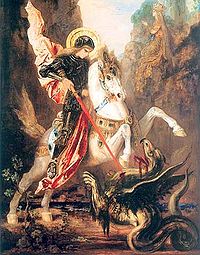
The iconic image of St. George on horseback trampling the serpent-dragon
European dragon
European dragons are legendary creatures in folklore and mythology among the overlapping cultures of Europe.In European folklore, a dragon is a serpentine legendary creature. The Latin word draco, as in constellation Draco, comes directly from Greek δράκων,...
beneath him is considered to be similar to these pre-Christian representations of Sabazios
Sabazios
Sabazios is the nomadic horseman and sky father god of the Phrygians and Thracians. In Indo-European languages, such as Phrygian, the -zios element in his name derives from dyeus, the common precursor of Latin deus and Greek Zeus...
, the mounted god of Phrygia
Phrygia
In antiquity, Phrygia was a kingdom in the west central part of Anatolia, in what is now modern-day Turkey. The Phrygians initially lived in the southern Balkans; according to Herodotus, under the name of Bryges , changing it to Phruges after their final migration to Anatolia, via the...
and Thrace
Thrace
Thrace is a historical and geographic area in southeast Europe. As a geographical concept, Thrace designates a region bounded by the Balkan Mountains on the north, Rhodope Mountains and the Aegean Sea on the south, and by the Black Sea and the Sea of Marmara on the east...
.
According to Christopher Booker
Christopher Booker
Christopher John Penrice Booker is an English journalist and author. In 1961, he was one of the founders of the magazine Private Eye, and has contributed to it for over four decades. He has been a columnist for the Sunday Telegraph since 1990...
it is more likely, however, that the "George and the Dragon" story is a medieval adaptation of the ancient Greek myth of Perseus
Perseus
Perseus ,Perseos and Perseas are not used in English. the legendary founder of Mycenae and of the Perseid dynasty of Danaans there, was the first of the mythic heroes of Greek mythology whose exploits in defeating various archaic monsters provided the founding myths of the Twelve Olympians...
and Andromeda
Andromeda (mythology)
Andromeda is a princess from Greek mythology who, as divine punishment for her mother's bragging, the Boast of Cassiopeia, was chained to a rock as a sacrifice to a sea monster. She was saved from death by Perseus, her future husband. Her name is the Latinized form of the Greek Ἀνδρομέδη...
—evidence for which can be seen in the similarity of events and locale in both stories. In this connection, the Perseus and Andromeda myth was known throughout the Middle Ages from the influence of Ovid
Ovid
Publius Ovidius Naso , known as Ovid in the English-speaking world, was a Roman poet who is best known as the author of the three major collections of erotic poetry: Heroides, Amores, and Ars Amatoria...
. In imagery, other Greek myths also played a role. "Medieval artists used the Greco-Roman image of Bellerophon
Bellerophon
Bellerophon or Bellerophontes is a hero of Greek mythology. He was "the greatest hero and slayer of monsters, alongside of Cadmus and Perseus, before the days of Heracles", and his greatest feat was killing the Chimera, a monster that Homer depicted with a lion's head, a goat's body, and a...
and the Chimaera
Chimaera
Chimaeras are cartilaginous fish in the order Chimaeriformes, known informally as ghost sharks, ratfish , spookfish , or rabbitfishes...
as the template for representations of Saint George and the Dragon."
These myths in turn may derive from an earlier Hittite
Hittite mythology
Most of the narratives embodying Hittite mythology are lost, and the elements that would give a balanced view of Hittite religion are lacking among the tablets recovered at the Hittite capital Hattusa and other Hittite sites: "there are no canonical scriptures, no theological disquisitions or...
myth concerning the battle between the Storm God Tarhun
Teshub
Teshub was the Hurrian god of sky and storm. He was derived from the Hattian Taru. His Hittite and Luwian name was Tarhun , although this name is from the Hittite root *tarh- to defeat, conquer.- Depiction and myths :He is depicted holding a triple...
and the dragon Illuyankas. Such stories also have counterparts in other Indo-European mythologies
Proto-Indo-European religion
Proto-Indo-European religion is the hypothesized religion of the Proto-Indo-European peoples based on the existence of similarities among the deities, religious practices and mythologies of the Indo-European peoples. Reconstruction of the hypotheses below is based on linguistic evidence using the...
: the slaying of the serpent Vritra
Vritra
In the early Vedic religion, Vritra , is an Asura and also a serpent or dragon, the personification of drought and enemy of Indra. Vritra was also known in the Vedas as Ahi...
by Indra
Indra
' or is the King of the demi-gods or Devas and Lord of Heaven or Svargaloka in Hindu mythology. He is also the God of War, Storms, and Rainfall.Indra is one of the chief deities in the Rigveda...
in Vedic religion
Vedic mythology
Vedic mythology refers to the mythological aspects of the historical Vedic religion and Vedic literature, most notably alluded to in the hymns of the Rigveda...
, the battle between Thor
Thor
In Norse mythology, Thor is a hammer-wielding god associated with thunder, lightning, storms, oak trees, strength, the protection of mankind, and also hallowing, healing, and fertility...
and Jörmungandr
Jörmungandr
In Norse mythology, Jörmungandr , mostly known as Jormungand, orJörmungand , or Midgard Serpent , or World Serpent, is a sea serpent, and the middle child of the giantess Angrboða and the god Loki...
in the Norse
Norse mythology
Norse mythology, a subset of Germanic mythology, is the overall term for the myths, legends and beliefs about supernatural beings of Norse pagans. It flourished prior to the Christianization of Scandinavia, during the Early Middle Ages, and passed into Nordic folklore, with some aspects surviving...
story of Ragnarok
Ragnarök
In Norse mythology, Ragnarök is a series of future events, including a great battle foretold to ultimately result in the death of a number of major figures , the occurrence of various natural disasters, and the subsequent submersion of the world in water...
, the Greek
Greek mythology
Greek mythology is the body of myths and legends belonging to the ancient Greeks, concerning their gods and heroes, the nature of the world, and the origins and significance of their own cult and ritual practices. They were a part of religion in ancient Greece...
account of the defeat of the Titan
Titan (mythology)
In Greek mythology, the Titans were a race of powerful deities, descendants of Gaia and Uranus, that ruled during the legendary Golden Age....
Typhon
Typhon
Typhon , also Typhoeus , Typhaon or Typhos was the last son of Gaia, fathered by Tartarus, and the most deadly monster of Greek mythology. He was known as the "Father of all monsters"; his wife Echidna was likewise the "Mother of All Monsters."Typhon was described in pseudo-Apollodorus,...
by Zeus
Zeus
In the ancient Greek religion, Zeus was the "Father of Gods and men" who ruled the Olympians of Mount Olympus as a father ruled the family. He was the god of sky and thunder in Greek mythology. His Roman counterpart is Jupiter and his Etruscan counterpart is Tinia.Zeus was the child of Cronus...
.
Parallels also exist outside of Indo-European mythology, for example the Babylonian myths of Marduk
Marduk
Marduk was the Babylonian name of a late-generation god from ancient Mesopotamia and patron deity of the city of Babylon, who, when Babylon became the political center of the Euphrates valley in the time of Hammurabi , started to...
slaying the dragon Tiamat
Tiamat
In Babylonian mythology, Tiamat is a chaos monster, a primordial goddess of the ocean, mating with Abzû to produce younger gods. It is suggested that there are two parts to the Tiamat mythos, the first in which Tiamat is 'creatrix', through a "Sacred marriage" between salt and fresh water,...
. The book of Job
Book of Job
The Book of Job , commonly referred to simply as Job, is one of the books of the Hebrew Bible. It relates the story of Job, his trials at the hands of Satan, his discussions with friends on the origins and nature of his suffering, his challenge to God, and finally a response from God. The book is a...
41:21 speaks of a creature whose "breath kindleth coals, and a flame goeth out of his mouth."
In Italy
Italy
Italy , officially the Italian Republic languages]] under the European Charter for Regional or Minority Languages. In each of these, Italy's official name is as follows:;;;;;;;;), is a unitary parliamentary republic in South-Central Europe. To the north it borders France, Switzerland, Austria and...
, Saint Mercurialis
Saint Mercurialis
Mercurialis was the Christian bishop of Forlì, in Romagna. The historical figure known as Mercurialis attended the Council of Rimini in 359 and died around 406. He was a zealous opponent of paganism and Arianism....
, first bishop of the city of Forlì
Forlì
Forlì is a comune and city in Emilia-Romagna, Italy, and is the capital of the province of Forlì-Cesena. The city is situated along the Via Emilia, to the right of the Montone river, and is an important agricultural centre...
, is also depicted slaying a dragon. Saint Julian of Le Mans, Saint Veran, Saint Bienheuré, Saint Crescentinus, Saint Margaret of Antioch, Saint Clement of Metz
Clement of Metz
Saint Clement of Metz is venerated as the first Bishop of Metz. According to tradition, he was sent by Saint Peter to Metz during the 1st century, with two disciples: Celestius and Felix , who are listed as his successors in that see...
, Saint Martha
Martha
Martha of Bethany is a biblical figure described in the Gospels of Luke and John. Together with her siblings Lazarus and Mary, she is described as living in the village of Bethany near Jerusalem...
, Saint Quirinus of Malmedy, Saint Donatus of Arezzo, and Saint Leonard of Noblac were also venerated as dragon-slayers.
Others trace the origin of Saint George and the Dragon to Palestine,where the supposed dragon was controlled by Satan. The creature blocked the city's water supply and would only move if given a virgin sacrifice. Over time, all of the virgins were sacrificed except for the noble's daughter, and even she was sent to quench the castle's thirst. However, Saint George (or Mar Jiryis ) arrived at the last moment on his white horse, striking down the dragon with a spear between its eyes.
Treatment by artists
Paintings- Paolo UccelloPaolo UccelloPaolo Uccello , born Paolo di Dono, was an Italian painter and a mathematician who was notable for his pioneering work on visual perspective in art. Giorgio Vasari in his book Lives of the Artists wrote that Uccello was obsessed by his interest in perspective and would stay up all night in his...
, Saint George and the DragonSaint George and the Dragon (Uccello)Saint George and the Dragon is a painting by Paolo Uccello dating from around 1470. It is on display in the National Gallery, London, England. It was formerly housed in the Palais Lanckoroński in Vienna, belonging to Count Lanckoroński and sold by his son and heir Anton in 1959 through Mr Farago...
, c. 1470. National Gallery, LondonNational Gallery, LondonThe National Gallery is an art museum on Trafalgar Square, London, United Kingdom. Founded in 1824, it houses a collection of over 2,300 paintings dating from the mid-13th century to 1900. The gallery is an exempt charity, and a non-departmental public body of the Department for Culture, Media...
. - Giovanni BelliniGiovanni BelliniGiovanni Bellini was an Italian Renaissance painter, probably the best known of the Bellini family of Venetian painters. His father was Jacopo Bellini, his brother was Gentile Bellini, and his brother-in-law was Andrea Mantegna. He is considered to have revolutionized Venetian painting, moving it...
, Saint George Fighting the Dragon, c. 1471. Pesaro altarpiece. - RaphaelRaphaelRaffaello Sanzio da Urbino , better known simply as Raphael, was an Italian painter and architect of the High Renaissance. His work is admired for its clarity of form and ease of composition and for its visual achievement of the Neoplatonic ideal of human grandeur...
(Raffaello Santi), St. GeorgeSt. George (Raphael)St. George or St. George and the Dragon is a small painting by the Italian Renaissance artist Raphael. It is housed in the Louvre in Paris. A later version of the same subject is the St...
, 1504. Oil on wood. LouvreLouvreThe Musée du Louvre – in English, the Louvre Museum or simply the Louvre – is one of the world's largest museums, the most visited art museum in the world and a historic monument. A central landmark of Paris, it is located on the Right Bank of the Seine in the 1st arrondissement...
, ParisParisParis is the capital and largest city in France, situated on the river Seine, in northern France, at the heart of the Île-de-France region...
, France. - Raphael (Raffaello Santi), St. George and the DragonSaint George and the Dragon (Raphael)St. George and the Dragon is a small cabinet painting by the Italian High Renaissance master Raphael, 1504-1506.The painting used to be a highlight of the Pierre Crozat collection which was acquired through Diderot's mediation by Catherine II of Russia in 1772. For a century and a half, the panel...
, 1504–1506. Oil on wood. National Gallery of ArtNational Gallery of ArtThe National Gallery of Art and its Sculpture Garden is a national art museum, located on the National Mall between 3rd and 9th Streets at Constitution Avenue NW, in Washington, DC...
, Washington, D.C.Washington, D.C.Washington, D.C., formally the District of Columbia and commonly referred to as Washington, "the District", or simply D.C., is the capital of the United States. On July 16, 1790, the United States Congress approved the creation of a permanent national capital as permitted by the U.S. Constitution....
, United States - TintorettoTintorettoTintoretto , real name Jacopo Comin, was a Venetian painter and a notable exponent of the Renaissance school. For his phenomenal energy in painting he was termed Il Furioso...
(Jacopo Robusti), St. George and the Dragon, 1555. - Peter Paul Rubens, Saint George and the DragonSaint George and the Dragon (Rubens)Saint George and the Dragon is a painting by Peter Paul Rubens , based upon the motif with the same name. It is housed in the Museo del Prado of Madrid....
, 1620. - Edward Burne-JonesEdward Burne-JonesSir Edward Coley Burne-Jones, 1st Baronet was a British artist and designer closely associated with the later phase of the Pre-Raphaelite movement, who worked closely with William Morris on a wide range of decorative arts as a founding partner in Morris, Marshall, Faulkner, and Company...
, St. George and the Dragon, 1866. - Gustave MoreauGustave MoreauGustave Moreau was a French Symbolist painter whose main emphasis was the illustration of biblical and mythological figures. As a painter of literary ideas, Moreau appealed to the imaginations of some Symbolist writers and artists.- Biography :Moreau was born in Paris. His father, Louis Jean Marie...
, St. George and the Dragon, c. 1870. Oil on canvas. The National Gallery, London. - Briton RivièreBriton RivièreBriton Rivière was an artist born in London, England, of Hugenout descent.His father, William Rivière, was for some years drawing-master at Cheltenham College, and afterwards an art teacher at Oxford University. He was educated at Cheltenham College and at Oxford, where he took his degree in 1867...
, St. George and the Dragon, c. 1914.
Sculptures
- Bernt NotkeBernt Notke' was the most important German painter and sculptor in Northern Europe in his times....
, wood, Storkyrkan in Stockholm, ca. 1484–1489. - Salvador DalíSalvador DalíSalvador Domènec Felip Jacint Dalí i Domènech, Marquis de Púbol , commonly known as Salvador Dalí , was a prominent Spanish Catalan surrealist painter born in Figueres,Spain....
, Saint George and the Dragon, ca. 1977–1984 - Landmark Loews Movie Palace Statue, Saint George and the dragon at The Landmark Loews Movie Palace in Jersey City, NJ, US. 2010.
Mosaic
- Edward PoynterEdward PoynterSir Edward John Poynter, 1st Baronet, PRA was an English painter, designer, and draughtsman who served as President of the Royal Academy.-Life:...
, Saint George for England, 1869. Central Lobby in the Palace of WestminsterPalace of WestminsterThe Palace of Westminster, also known as the Houses of Parliament or Westminster Palace, is the meeting place of the two houses of the Parliament of the United Kingdom—the House of Lords and the House of Commons...
.
Engravings
- Benedetto PistrucciBenedetto PistrucciBenedetto Pistrucci was a distinguished Italian Gem-engraver, medallist and coin-engraver who became Chief-medallist at the Royal Mint in England.-Early life, training and career:...
, engraving for coin dies, 1817.
Other
- Edward ElgarEdward ElgarSir Edward William Elgar, 1st Baronet OM, GCVO was an English composer, many of whose works have entered the British and international classical concert repertoire. Among his best-known compositions are orchestral works including the Enigma Variations, the Pomp and Circumstance Marches, concertos...
, The Banner of St George: a ballad for chorus and orchestra, words by Shapcott WensleyShapcott WensleyShapcott Wensley was the pseudonym of the English author and poet Henry Shapcott Bunce .- Life :He was born in Bristol in the summer of 1854. He died in Bristol on 1 June 1917. He married a singer, Alice Mary Wensley, and they had one daughter, Gertrude.By profession he was a clerk in a soap works...
, 1879.
Contemporary retelling
- The 1898 Dream Days by Kenneth GrahameKenneth GrahameKenneth Grahame was a Scottish writer, most famous for The Wind in the Willows , one of the classics of children's literature. He also wrote The Reluctant Dragon; both books were later adapted into Disney films....
includes a chapter entitled The Reluctant DragonThe Reluctant DragonThe Reluctant Dragon is an 1898 children's story by Kenneth Grahame , which served as the key element to the 1941 feature film with the same name from Walt Disney Productions. The story has also been set to music as a children's operetta by John Rutter, with words by David Grant...
, in which an elderly St. George and a benign dragon stage a mock battle to satisfy the townsfolk and get the dragon introduced into society. Later made into a film by Walt Disney Productions, and set to music by John RutterJohn RutterJohn Milford Rutter CBE is a British composer, conductor, editor, arranger and record producer, mainly of choral music.-Biography:Born in London, Rutter was educated at Highgate School, where a fellow pupil was John Tavener. He read music at Clare College, Cambridge, where he was a member of the...
as a children's operettaOperettaOperetta is a genre of light opera, light in terms both of music and subject matter. It is also closely related, in English-language works, to forms of musical theatre.-Origins:...
. - In 1935 Stanley HollowayStanley HollowayStanley Augustus Holloway, OBE was an English stage and film actor, comedian, singer, poet and monologist. He was famous for his comic and character roles on stage and screen, especially that of Alfred P. Doolittle in My Fair Lady...
recorded a humorous retelling of the tale as St. George and the Dragon written by Weston and Lee - The Dragon KnightDragon KnightThe Dragon Knight is a series of fantasy novels by Gordon R. Dickson . The first book informed the 1982 animated movie The Flight of Dragons by Rankin/Bass, but was previously published as a short story, St. Dragon and the George...
, a series of books by Gordon R. DicksonGordon R. DicksonGordon Rupert Dickson was an American science fiction author.- Biography :Dickson was born in Edmonton, Alberta, in 1923. After the death of his father, he moved with his mother to Minneapolis, Minnesota, in 1937...
, adopted this story as a past event into its canon, significant in that dragons had since referred to humans as 'georges.' The story of St. George and the Dragon is referred to on occasion, but never told. The first book in the series, The Dragon and the George, is a retelling of a previous short storyShort storyA short story is a work of fiction that is usually written in prose, often in narrative format. This format tends to be more pointed than longer works of fiction, such as novellas and novels. Short story definitions based on length differ somewhat, even among professional writers, in part because...
by the same author, "St. Dragon and the George". - In the 1950s, Stan FrebergStan FrebergStanley Victor "Stan" Freberg is an American author, recording artist, animation voice actor, comedian, radio personality, puppeteer, and advertising creative director whose career began in 1944...
and Daws ButlerDaws ButlerCharles Dawson "Daws" Butler was a voice actor originally from Toledo, Ohio. He worked mostly for Hanna-Barbera and originated the voices of many famous animated cartoon characters, including Yogi Bear, Quick Draw McGraw, Snagglepuss, and Huckleberry Hound.Daws Butler trained many working actors...
wrote and performed St. George and the Dragon-NetSt. George and the Dragonet"St. George and the Dragonet" is a short audio satire recorded August 26, 1953 by Stan Freberg for Capitol Records. It was released September 21, 1953 as a 45 rpm single ....
(a spoofSatireSatire is primarily a literary genre or form, although in practice it can also be found in the graphic and performing arts. In satire, vices, follies, abuses, and shortcomings are held up to ridicule, ideally with the intent of shaming individuals, and society itself, into improvement...
of the tale and of Dragnet) for Freberg's radio show. The story's recording became the first comedy album to sell over 1 million copies. - A 1975 episode of "Space: 1999Space: 1999Space: 1999 is a British science-fiction television series that ran for two seasons and originally aired from 1975 to 1977. In the opening episode, nuclear waste from Earth stored on the Moon's far side explodes in a catastrophic accident on 13 September 1999, knocking the Moon out of orbit and...
" titled "Dragon's Domain" made reference to the legend of St. George and the Dragon. A crewman from the space station heroically kills a dragon-like creature after it has consumed other astronauts. The main character played by Barbara BainBarbara BainMillicent Fogel , known professionally as Barbara Bain, is an American actress.-Early life:Bain was born in Chicago. She graduated from the University of Illinois with a bachelor's degree in sociology. She moved to New York City, where she was a dancer and high fashion model. Bain studied with...
eventually concludes that the crewman's story will create new mythology similar to the legend of St. George. - The 1981 Paramount PicturesParamount PicturesParamount Pictures Corporation is an American film production and distribution company, located at 5555 Melrose Avenue in Hollywood. Founded in 1912 and currently owned by media conglomerate Viacom, it is America's oldest existing film studio; it is also the last major film studio still...
/Disney film DragonslayerDragonslayerDragonslayer is a 1981 fantasy movie set in a fictional medieval kingdom, following a young wizard who experiences danger and opposition as he attempts to defeat a dragon....
was loosely based on the tale. - EC ComicsEC ComicsEntertaining Comics, more commonly known as EC Comics, was an American publisher of comic books specializing in horror fiction, crime fiction, satire, military fiction and science fiction from the 1940s through the mid-1950s, notably the Tales from the Crypt series...
published a comic called "By George!!" in Weird FantasyWeird FantasyWeird Fantasy is a science fiction anthology comic that was part of the EC Comics line in the early 1950s. The companion comic for Weird Fantasy was Weird Science...
#15. The story revealed that the 'dragon' was in fact a lost, misunderstood alien child who didn't mean any harm. - Margaret HodgesMargaret HodgesMargaret "Peggy" Hodges was an American writer of books for children.She was born Sarah Margaret Moore in Indianapolis, Indiana to Arthur Carlisle and Annie Marie Moore. She enrolled at Tudor Hall, a college preparatory school for girls. A 1932 graduate of Vassar College, she arrived in...
retold the legend in a 1984 children's book (Saint George and the DragonSaint George and the Dragon (book)Saint George and the Dragon is a book written by Margaret Hodges and illustrated by Trina Schart Hyman. Released by Little, Brown, it was the recipient of the Caldecott Medal for illustration in 1985. The text is adapted from Edmund Spenser's epic poem The Faerie Queene....
) with Caldecott MedalCaldecott MedalThe Caldecott Medal is awarded annually by the Association for Library Service to Children , a division of the American Library Association, to the artist of the most distinguished American picture book for children published that year. The award was named in honor of nineteenth-century English...
-winning illustrations by Trina Schart HymanTrina Schart HymanTrina Schart Hyman was an American illustrator of children's books. She illustrated over 150 books, including fairy tales and Arthurian legends, and was the recipient of three Caldecott Honors and one Caldecott Medal....
. - American artist Butt Johnson uses the theme in a drawing entitled "Mario, Patron Saint of Brooklyn" portraying characters from the video game Super Mario Bros.Super Mario Bros.is a 1985 platform video game developed by Nintendo, published for the Nintendo Entertainment System as a sequel to the 1983 game Mario Bros. In Super Mario Bros., the player controls Mario as he travels through the Mushroom Kingdom in order to rescue Princess Toadstool from the antagonist...
, and featuring MarioMariois a fictional character in his video game series, created by Japanese video game designer Shigeru Miyamoto. Serving as Nintendo's mascot and the main protagonist of the series, Mario has appeared in over 200 video games since his creation...
in the role of Saint George – slaying the "dragon" (King Koopa). - The poem "Fairy Tale" by Yury Zhivago–the main character from Boris PasternakBoris PasternakBoris Leonidovich Pasternak was a Russian language poet, novelist, and literary translator. In his native Russia, Pasternak's anthology My Sister Life, is one of the most influential collections ever published in the Russian language...
's novel "Doctor ZhivagoDoctor Zhivago-Original creation:*Doctor Zhivago, by Boris Pasternak, published in 1957**Yuri Andreyevich Zhivago, a fictional character and the main protagonist of the book Doctor Zhivago-Adaptations:There are several adaptations based on the Doctor Zhivago book:...
"–relates a modified account of this legend; Yury's poem differs in that it is nonreligious and makes no mention of the village. - In Elizabeth KostovaElizabeth KostovaElizabeth Johnson Kostova is an American author best known for her debut novel The Historian.-Early life:Elizabeth Z. Johnson was born in New London, Connecticut and raised in Knoxville, Tennessee where she graduated from the Webb School of Knoxville...
's The HistorianThe HistorianThe Historian interweaves the history and folklore of Vlad Ţepeş, a 15th-century prince of Wallachia known as "Vlad the Impaler", and his fictional equivalent Count Dracula together with the story of Paul, a professor; his 16-year-old daughter; and their quest for Vlad's tomb...
, Saint George is chronicled as being the saint who killed Vlad Tepesh (also known as DraculaDraculaDracula is an 1897 novel by Irish author Bram Stoker.Famous for introducing the character of the vampire Count Dracula, the novel tells the story of Dracula's attempt to relocate from Transylvania to England, and the battle between Dracula and a small group of men and women led by Professor...
, which means "son of the dragon" or "son of the devil"). - In Graham McNeill'sGraham McNeillGraham McNeill is a British novelist. He is best known for his Warhammer Fantasy and Warhammer 40,000 novels, and his previous role as games designer for Games Workshop.-Biography:...
book Mechanicum, part of the Horus HeresyHorus HeresyIn the fictional Warhammer 40,000 universe, the Horus Heresy was a galaxy-spanning civil war that marked the end of the Great Crusade which took place in the 31st millennium. First described in the 1988 Games Workshop book Realm of Chaos: Slaves to Darkness, it was used as the background for the...
series, the story is retold and St. George is revealed to be the future Emperor of mankindImperium (Warhammer 40,000)The Imperium of Man is a fictional galactic empire of over a million planets that contains the vast majority of humans in the forty-first millennium, set in the Warhammer 40,000 universe created by Games Workshop....
.
Alternative legends
The village of WormingfordWormingford
Wormingford is a parish in Essex, England.The ancient parish of Wormingford on the south bank of the River Stour, north- west of Colchester and south-east of Sudbury, Suffolk, covered 2,322 acres . The Stour forms the northern boundary, and the eastern, southern, and western ones follow mainly...
in Essex
Essex
Essex is a ceremonial and non-metropolitan county in the East region of England, and one of the home counties. It is located to the northeast of Greater London. It borders with Cambridgeshire and Suffolk to the north, Hertfordshire to the west, Kent to the South and London to the south west...
, England also lays claim to the George and the Dragon legend. A dragon, now believed to have been a crocodile that escaped from Richard I, was slain in the River Stour
River Stour, Suffolk
The River Stour is a river in East Anglia, England. It is 76 km long and forms most of the county boundary between Suffolk to the north, and Essex to the south. It rises in eastern Cambridgeshire, passes to the east of Haverhill, through Cavendish, Sudbury and the Dedham Vale, and joins the...
. There are differing accounts, including different dragon slayers, however one popular account tells how Sir George Marney (of Layer de la Haye) killed the dragon with his lance
Lance
A Lance is a pole weapon or spear designed to be used by a mounted warrior. The lance is longer, stout and heavier than an infantry spear, and unsuited for throwing, or for rapid thrusting. Lances did not have tips designed to intentionally break off or bend, unlike many throwing weapons of the...
. The church in Wormingford
Wormingford
Wormingford is a parish in Essex, England.The ancient parish of Wormingford on the south bank of the River Stour, north- west of Colchester and south-east of Sudbury, Suffolk, covered 2,322 acres . The Stour forms the northern boundary, and the eastern, southern, and western ones follow mainly...
(which is dedicated to St Andrew) has a stained glass window depicting this scene.
One version of the tale tells St. George as losing the battle with the dragon early on in the encounter. St. George retreats, and wanders down to the river. He prays over his challenges, and removes his armor to melt it down. He takes the melted metal and forges it into a metal box. He places his fears, doubts, and lack of faith inside the box, and goes out to face the dragon again, without armor. St. George instantly slays the dragon. Some scholars interpret the moral of this story is that our fears and doubts are all that prevent us from overcoming seemingly impossible obstacles.
Gallery
See also
- Saint GeorgeSaint GeorgeSaint George was, according to tradition, a Roman soldier from Syria Palaestina and a priest in the Guard of Diocletian, who is venerated as a Christian martyr. In hagiography Saint George is one of the most venerated saints in the Catholic , Anglican, Eastern Orthodox, and the Oriental Orthodox...
- Saint George: Devotions, traditions and prayersSaint George: Devotions, traditions and prayersSaint George is one of Christianity's most popular saints, and is highly honored by both the Western and Eastern Churches. A wide range of devotions, traditions, and prayers to honor the saint have emerged throughout the centuries. He has for long been distinguished by the title of "The Great...
- Princess and dragonPrincess and dragonPrincess and dragon is a generic premise common to many legends and fairy tales. It is not a fairy tale itself, but along with Prince Charming, is a repeated cliché...