


Typhon

Encyclopedia
Gaia (mythology)
Gaia was the primordial Earth-goddess in ancient Greek religion. Gaia was the great mother of all: the heavenly gods and Titans were descended from her union with Uranus , the sea-gods from her union with Pontus , the Giants from her mating with Tartarus and mortal creatures were sprung or born...
, fathered by Tartarus
Tartarus
In classic mythology, below Uranus , Gaia , and Pontus is Tartarus, or Tartaros . It is a deep, gloomy place, a pit, or an abyss used as a dungeon of torment and suffering that resides beneath the underworld. In the Gorgias, Plato In classic mythology, below Uranus (sky), Gaia (earth), and Pontus...
, and the most deadly monster of Greek mythology
Greek mythology
Greek mythology is the body of myths and legends belonging to the ancient Greeks, concerning their gods and heroes, the nature of the world, and the origins and significance of their own cult and ritual practices. They were a part of religion in ancient Greece...
. He was known as the "Father of all monsters"; his wife Echidna
Echidna (mythology)
In Greek mythology, Echidna was half woman half snake, known as the "Mother of All Monsters" because most of the monsters in Greek myth were mothered by her...
was likewise the "Mother of All Monsters."
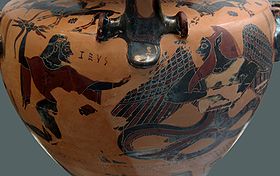
Typhon was described in pseudo-Apollodorus, Bibliotheke, as one of the largest and most fearsome of all creatures. His human upper half reached as high as the stars. His hands reached east and west and, instead of a human head, he had a hundred dragon heads; some however depict him as having a human head and the dragon heads being attached to his hands instead of fingers. He was feared even by the mighty gods. His bottom half was gigantic viper coils that could reach the top of his head when stretched out and made a hissing noise. His whole body was covered in wings, and fire flashed from his eyes.
Typhon attempts to destroy Zeus
Zeus
In the ancient Greek religion, Zeus was the "Father of Gods and men" who ruled the Olympians of Mount Olympus as a father ruled the family. He was the god of sky and thunder in Greek mythology. His Roman counterpart is Jupiter and his Etruscan counterpart is Tinia.Zeus was the child of Cronus...
at the will of Gaia, because Zeus had imprisoned the Titans
Titan (mythology)
In Greek mythology, the Titans were a race of powerful deities, descendants of Gaia and Uranus, that ruled during the legendary Golden Age....
. Typhon initially overcame Zeus in their first battle, and tore out Zeus' sinews. However, Hermes
Hermes
Hermes is the great messenger of the gods in Greek mythology and a guide to the Underworld. Hermes was born on Mount Kyllini in Arcadia. An Olympian god, he is also the patron of boundaries and of the travelers who cross them, of shepherds and cowherds, of the cunning of thieves, of orators and...
recovered the sinews and restored them to Zeus. Typhon was finally defeated by Zeus, who trapped him underneath Mount Etna
Mount Etna
Mount Etna is an active stratovolcano on the east coast of Sicily, close to Messina and Catania. It is the tallest active volcano in Europe, currently standing high, though this varies with summit eruptions; the mountain is 21 m higher than it was in 1981.. It is the highest mountain in...
.
Accounts
HesiodHesiod
Hesiod was a Greek oral poet generally thought by scholars to have been active between 750 and 650 BC, around the same time as Homer. His is the first European poetry in which the poet regards himself as a topic, an individual with a distinctive role to play. Ancient authors credited him and...
narrates Typhon's birth in this poem:
- But when Zeus had driven the TitansTitan (mythology)In Greek mythology, the Titans were a race of powerful deities, descendants of Gaia and Uranus, that ruled during the legendary Golden Age....
from Olympus, - mother Earth bare her youngest child Typhoeus of the love of
- Tartarus, by the aid of golden AphroditeAphroditeAphrodite is the Greek goddess of love, beauty, pleasure, and procreation.Her Roman equivalent is the goddess .Historically, her cult in Greece was imported from, or influenced by, the cult of Astarte in Phoenicia....
.- —Hesiod, TheogonyTheogonyThe Theogony is a poem by Hesiod describing the origins and genealogies of the gods of the ancient Greeks, composed circa 700 BC...
820–822.
- —Hesiod, Theogony
In the alternative account of the origin of Typhon (Typhoeus), the Homeric Hymn to Apollo
Apollo
Apollo is one of the most important and complex of the Olympian deities in Greek and Roman mythology...
makes the monster Typhaon at Delphi
Delphi
Delphi is both an archaeological site and a modern town in Greece on the south-western spur of Mount Parnassus in the valley of Phocis.In Greek mythology, Delphi was the site of the Delphic oracle, the most important oracle in the classical Greek world, and a major site for the worship of the god...
a son of archaic Hera
Hera
Hera was the wife and one of three sisters of Zeus in the Olympian pantheon of Greek mythology and religion. Her chief function was as the goddess of women and marriage. Her counterpart in the religion of ancient Rome was Juno. The cow and the peacock were sacred to her...
in her Minoan form
Eteocretan language
The Minoan language was spoken in ancient Crete before it was replaced with the language of the mainland; the relationship between Minoan and Greek is unknown. While attempts have been made to connect it to other languages, Minoan must be considered unclassified until a linguistic affiliation can...
, produced out of herself, like a monstrous version of Hephaestus
Hephaestus
Hephaestus was a Greek god whose Roman equivalent was Vulcan. He is the son of Zeus and Hera, the King and Queen of the Gods - or else, according to some accounts, of Hera alone. He was the god of technology, blacksmiths, craftsmen, artisans, sculptors, metals, metallurgy, fire and volcanoes...
or Mars
Mars (mythology)
Mars was the Roman god of war and also an agricultural guardian, a combination characteristic of early Rome. He was second in importance only to Jupiter, and he was the most prominent of the military gods worshipped by the Roman legions...
, and whelped in a cave in Cilicia
Cilicia
In antiquity, Cilicia was the south coastal region of Asia Minor, south of the central Anatolian plateau. It existed as a political entity from Hittite times into the Byzantine empire...
and confined there in the enigmatic Arima, or land of the Arimoi
Arima, couch of Typhoeus
Arima, couch of Typhoeus, as Homer expresses it, is a hard-to-place site in Greek mythology, said to be where Zeus defeated Typhon and where Echidna dwells....
, en Arimois (Iliad
Iliad
The Iliad is an epic poem in dactylic hexameters, traditionally attributed to Homer. Set during the Trojan War, the ten-year siege of the city of Troy by a coalition of Greek states, it tells of the battles and events during the weeks of a quarrel between King Agamemnon and the warrior Achilles...
, ii. 781–783). It was in Cilicia that Zeus battled with the ancient monster and overcame him, in a more complicated story: It was not an easy battle, and Typhon temporarily overcame Zeus, cut the "sinews" from him and left him in the "leather sack", the korukos that is the etymological origin of the korukion andron, the Korykian or Corycian Cave
Corycian Cave
The Corycian Cave is located on the slopes of Mount Parnassus, in Greece. In the mythology of the area, it is named after the nymph Corycia; however, its name etymologically derives from korykos, "knapsack". A modern name for the cave in some references is Sarantavli, meaning "forty rooms"...
in which Zeus suffers temporary eclipse as if in the Land of the Dead. The region of Cilicia in southeastern Anatolia
Anatolia
Anatolia is a geographic and historical term denoting the westernmost protrusion of Asia, comprising the majority of the Republic of Turkey...
had many opportunities for coastal Hellenes' connection with the Hittites
Hittites
The Hittites were a Bronze Age people of Anatolia.They established a kingdom centered at Hattusa in north-central Anatolia c. the 18th century BC. The Hittite empire reached its height c...
to the north. From its first reappearance, the Hittite myth of Illuyankas has been seen as a prototype of the battle of Zeus and Typhon. Walter Burkert
Walter Burkert
Walter Burkert is a German scholar of Greek mythology and cult.An emeritus professor of classics at the University of Zurich, Switzerland, he also has taught in the United Kingdom and the United States...
and Calvert Watkins
Calvert Watkins
Calvert Watkins is a professor Emeritus of linguistics and the classics at Harvard University and professor-in-residence at UCLA.His doctoral dissertation, Indo-European Origins of the Celtic Verb I...
each note the close agreements. Watkins' How to Kill a Dragon: Aspects of Indo-European Poetics (Oxford University Press) 1995, reconstructs in disciplined detail the flexible Indo-European
Indo-European languages
The Indo-European languages are a family of several hundred related languages and dialects, including most major current languages of Europe, the Iranian plateau, and South Asia and also historically predominant in Anatolia...
poetic formula that underlies myth, epic and magical charm texts of the lashing and binding of Typhon.
Typhon was known to be a large humanoid beast. He was taller than Mount Olympus and during the second battle of the Pelyponnese, he owerthrew the gods. Each god was slewn and Zeus was tortured and cast in Tartarus. Afterwards, the Titans regained power and destroyed the modern war.
Typhon was the last child of Gaia. After the defeat of his brothers, the Gigantes, Gaia urged him to avenge them, as well as his other brothers, the Titans.
Offspring
Typhon fathered several children by his niece, EchidnaEchidna (mythology)
In Greek mythology, Echidna was half woman half snake, known as the "Mother of All Monsters" because most of the monsters in Greek myth were mothered by her...
, daughter of Phorcys
Phorcys
In Greek mythology, Phorcys , a primordial sea god, generally cited as the son of Pontus and Gaia. According to the Orphic hymns, Phorcys, Cronus and Rhea were the eldest offspring of Oceanus and Tethys. Classical scholar Karl Kerenyi conflated Phorcys with the similar sea gods Nereus and Proteus...
and Ceto
Ceto
In ancient Greek, the word ketos - Latinized as cetus - denotes a large fish, a whale, a shark, or a sea monster. The sea monsters slain by Perseus and Heracles were each referred to as a cetus by ancient sources. The term cetacean originates from cetus. In Greek art, cetea were depicted as...
:
- OrthrusOrthrusIn Greek mythology, Orthrus or Orthus was a two-headed dog and a doublet of Cerberus, both whelped by the chthonic monsters Echidna and Typhon.He was owned by the three-bodied giant, Geryon...
, a fearsome two-headed hound. Theogony, 306ff. Orthrus, and his master, EurytionEurytionIn Greek mythology Eurytion , "widely-honoured", was a name attributed to six individuals....
, son of AresAresAres is the Greek god of war. He is one of the Twelve Olympians, and the son of Zeus and Hera. In Greek literature, he often represents the physical or violent aspect of war, in contrast to the armored Athena, whose functions as a goddess of intelligence include military strategy and...
and the HesperidHesperidesIn Greek mythology, the Hesperides are nymphs who tend a blissful garden in a far western corner of the world, located near the Atlas mountains in North Africa at the edge of the encircling Oceanus, the world-ocean....
Erytheia, guarded the fabulous red cattle of Geryon. Both were slain, along with Geryon, when Heracles stole the red cattle.
- The SphinxSphinxA sphinx is a mythical creature with a lion's body and a human head or a cat head.The sphinx, in Greek tradition, has the haunches of a lion, the wings of a great bird, and the face of a woman. She is mythicised as treacherous and merciless...
was sent by HeraHeraHera was the wife and one of three sisters of Zeus in the Olympian pantheon of Greek mythology and religion. Her chief function was as the goddess of women and marriage. Her counterpart in the religion of ancient Rome was Juno. The cow and the peacock were sacred to her...
to plague the city of ThebesThebes, GreeceThebes is a city in Greece, situated to the north of the Cithaeron range, which divides Boeotia from Attica, and on the southern edge of the Boeotian plain. It played an important role in Greek myth, as the site of the stories of Cadmus, Oedipus, Dionysus and others...
. She was the most brilliant of Typhon's children, and would slay anyone who could not answer her riddles (possibly by strangling them). When OedipusOedipusOedipus was a mythical Greek king of Thebes. He fulfilled a prophecy that said he would kill his father and marry his mother, and thus brought disaster on his city and family...
finally answered her riddle, she threw herself into the ocean in a fit of fury and drowned.
- The Nemean LionNemean LionThe Nemean lion was a vicious monster in Greek mythology that lived at Nemea. It was eventually killed by Heracles. It could not be killed with mortal weapons because its golden fur was impervious to attack...
was a gigantic lion with impenetrable skin. Selene, the moon goddess, adored the beast. HeraclesHeraclesHeracles ,born Alcaeus or Alcides , was a divine hero in Greek mythology, the son of Zeus and Alcmene, foster son of Amphitryon and great-grandson of Perseus...
was commanded to slay the Lion as the first of his Twelve Labors. First, he attempted to shoot arrows at it, then he used his great club, and was eventually forced to strangle the beast. He would then use the Lion's own claws to skin it, whereupon he wore its invulnerable hide as armor.
- CerberusCerberusCerberus , or Kerberos, in Greek and Roman mythology, is a multi-headed hound which guards the gates of the Underworld, to prevent those who have crossed the river Styx from ever escaping...
, another one of Typhon's sons was a three-headed dog that was employed by HadesHadesHades , Hadēs, originally , Haidēs or , Aidēs , meaning "the unseen") was the ancient Greek god of the underworld. The genitive , Haidou, was an elision to denote locality: "[the house/dominion] of Hades". Eventually, the nominative came to designate the abode of the dead.In Greek mythology, Hades...
as the guardian of the passage way to and from the Underworld. According to Hesiod, he was the son of Orthrus and Echidna.
- LadonLadon (mythology)Ladon was the serpent-like dragon that twined and twisted around the tree in the Garden of the Hesperides and guarded the golden apples. He was overcome by Heracles...
was a serpentine dragonDragonA dragon is a legendary creature, typically with serpentine or reptilian traits, that feature in the myths of many cultures. There are two distinct cultural traditions of dragons: the European dragon, derived from European folk traditions and ultimately related to Greek and Middle Eastern...
, known as a drakon. According to Hesiod, Ladon was the son of PhorcysPhorcysIn Greek mythology, Phorcys , a primordial sea god, generally cited as the son of Pontus and Gaia. According to the Orphic hymns, Phorcys, Cronus and Rhea were the eldest offspring of Oceanus and Tethys. Classical scholar Karl Kerenyi conflated Phorcys with the similar sea gods Nereus and Proteus...
and CetoCetoIn ancient Greek, the word ketos - Latinized as cetus - denotes a large fish, a whale, a shark, or a sea monster. The sea monsters slain by Perseus and Heracles were each referred to as a cetus by ancient sources. The term cetacean originates from cetus. In Greek art, cetea were depicted as...
, instead of Typhon and Echidna. Regardless of his parentage, Ladon entwined himself around the tree in the Garden of the HesperidesHesperidesIn Greek mythology, the Hesperides are nymphs who tend a blissful garden in a far western corner of the world, located near the Atlas mountains in North Africa at the edge of the encircling Oceanus, the world-ocean....
at the behest of Hera, who appointed him the garden's guardian. He was eventually killed by HeraclesHeraclesHeracles ,born Alcaeus or Alcides , was a divine hero in Greek mythology, the son of Zeus and Alcmene, foster son of Amphitryon and great-grandson of Perseus...
.
- The Lernaean HydraLernaean HydraIn Greek mythology, the Lernaean Hydra was an ancient nameless serpent-like chthonic water beast, with reptilian traits, that possessed many heads — the poets mention more heads than the vase-painters could paint, and for each head cut off it grew two more — and poisonous breath so virulent even...
, another one of Typhon's daughters, terrorized a spring at the lake of Lerna, near ArgosArgosArgos is a city and a former municipality in Argolis, Peloponnese, Greece. Since the 2011 local government reform it is part of the municipality Argos-Mykines, of which it is a municipal unit. It is 11 kilometres from Nafplion, which was its historic harbour...
, slaying anyone and anything that approached her lair with her noxious venom, save for a monstrous crab that was her companion. She was originally thought to have nine heads, and any neck, if severed,would give rise to two more heads, her ninth head was immortal. She and her crab were slain by Heracles as the second of his Twelve Labors - he cut off her heads and burnt the neck so that she could not regenerate,and crushed her ninth head under a rock, (the crab being accidentally crushed underneath Heracles' heel).
- Typhon's last child was his daughter, ChimeraChimera (mythology)The Chimera or Chimaera was, according to Greek mythology, a monstrous fire-breathing female creature of Lycia in Asia Minor, composed of the parts of multiple animals: upon the body of a lioness with a tail that ended in a snake's head, the head of a goat arose on her back at the center of her...
. Chimera resembled a tremendous, fire-breathing lioness with a goat's head emerging from the middle of her back, and had a snake for a tail. She roamed the ancient kingdom of LyciaLyciaLycia Lycian: Trm̃mis; ) was a region in Anatolia in what are now the provinces of Antalya and Muğla on the southern coast of Turkey. It was a federation of ancient cities in the region and later a province of the Roman Empire...
, particularly around Mount Chimaera (possibly near YanartaşYanartasYanartaş is the Turkish name of a geographical feature near the Olympos valley and national park in Antalya Province in southwestern Turkey. The location is 80km southwest of Antalya, near the town of Çıralı. It is generally believed to be the ancient Mount Chimaera...
), bringing bad omens and destruction in her wake, until she was slain by BellerophonBellerophonBellerophon or Bellerophontes is a hero of Greek mythology. He was "the greatest hero and slayer of monsters, alongside of Cadmus and Perseus, before the days of Heracles", and his greatest feat was killing the Chimera, a monster that Homer depicted with a lion's head, a goat's body, and a...
and PegasusPegasusPegasus is one of the best known fantastical as well as mythological creatures in Greek mythology. He is a winged divine horse, usually white in color. He was sired by Poseidon, in his role as horse-god, and foaled by the Gorgon Medusa. He was the brother of Chrysaor, born at a single birthing...
at the behest of IobatesIobatesIn Greek mythology, Iobates , a.k.a. Jobates, was a Lycian king, the father of Antea and Philonoe. Bellerophon was sent into exile to the land of King Iobates. Proetus, King of Tiryns, wanted Iobates to kill Bellerophon, but Iobates feared the wrath of the gods if he murdered a guest...
.
Battle with Zeus
Typhon started destroying cities and hurling mountains in a fit of rage. All of the gods of Olympus fled to their home. Only Zeus stood firm, and the battle raged, ending when Zeus threw Mount EtnaMount Etna
Mount Etna is an active stratovolcano on the east coast of Sicily, close to Messina and Catania. It is the tallest active volcano in Europe, currently standing high, though this varies with summit eruptions; the mountain is 21 m higher than it was in 1981.. It is the highest mountain in...
on top of Typhon, trapping him.
The inveterate enemy of the Olympian gods
Twelve Olympians
The Twelve Olympians, also known as the Dodekatheon , in Greek mythology, were the principal deities of the Greek pantheon, residing atop Mount Olympus. Zeus, Hera, Poseidon, Demeter, Hestia, and Hades were siblings. Ares, Hermes, Hephaestus, Athena, Apollo, and Artemis were children of Zeus...
is described in detail by Hesiod as a vast grisly monster with a hundred serpent heads "with dark flickering tongues" flashing fire from their eyes and a din of voices and a hundred serpents
Serpent (symbolism)
Serpent in Latin means: Rory Collins :&, in turn, from the Biblical Hebrew word of: "saraf" with root letters of: which refers to something burning-as, the pain of poisonous snake's bite was likened to internal burning.This word is commonly used in a specifically mythic or religious context,...
legs, a feature shared by many primal monsters of Greek myth that extend in serpentine or scaly coils from the waist down. The titanic struggle created earthquakes and tsunami
Tsunami
A tsunami is a series of water waves caused by the displacement of a large volume of a body of water, typically an ocean or a large lake...
. Once conquered by Zeus
Zeus
In the ancient Greek religion, Zeus was the "Father of Gods and men" who ruled the Olympians of Mount Olympus as a father ruled the family. He was the god of sky and thunder in Greek mythology. His Roman counterpart is Jupiter and his Etruscan counterpart is Tinia.Zeus was the child of Cronus...
' thunderbolts, Typhon was cast into Tartarus, the common destiny of many such archaic adversaries, or he was confined beneath Mount Aetna
Mount Etna
Mount Etna is an active stratovolcano on the east coast of Sicily, close to Messina and Catania. It is the tallest active volcano in Europe, currently standing high, though this varies with summit eruptions; the mountain is 21 m higher than it was in 1981.. It is the highest mountain in...
(Pindar
Pindar
Pindar , was an Ancient Greek lyric poet. Of the canonical nine lyric poets of ancient Greece, his work is the best preserved. Quintilian described him as "by far the greatest of the nine lyric poets, in virtue of his inspired magnificence, the beauty of his thoughts and figures, the rich...
, Pythian Ode 1.19–20; Aeschylus
Aeschylus
Aeschylus was the first of the three ancient Greek tragedians whose work has survived, the others being Sophocles and Euripides, and is often described as the father of tragedy. His name derives from the Greek word aiskhos , meaning "shame"...
, Prometheus Bound 370), where "his bed scratches and goads the whole length of his back stretched out against it", or in other volcanic
Volcano
2. Bedrock3. Conduit 4. Base5. Sill6. Dike7. Layers of ash emitted by the volcano8. Flank| 9. Layers of lava emitted by the volcano10. Throat11. Parasitic cone12. Lava flow13. Vent14. Crater15...
regions, where he is the cause of eruptions. Typhon is thus the chthonic
Chthonic
Chthonic designates, or pertains to, deities or spirits of the underworld, especially in relation to Greek religion. The Greek word khthon is one of several for "earth"; it typically refers to the interior of the soil, rather than the living surface of the land or the land as territory...
figuration of volcanic forces, as Hephaestus (Roman Vulcan) is their "civilized" Olympian manifestation.
Typhon is also the father of hot dangerous storm winds
Anemoi
In Greek mythology, the Anemoi were Greek wind gods who were each ascribed a cardinal direction from which their respective winds came , and were each associated with various seasons and weather conditions...
which issue forth from the stormy pit of Tartarus, according to Hesiod. Likewise, the rumblings of Typhon emitted from deepest Tartarus could be clearly heard within the underground torrent near Seleuceia, now in Turkey, until his presence was neutralized by the building of a Byzantine church nearby.
Origin of name
Typhon may be derived from the GreekGreek language
Greek is an independent branch of the Indo-European family of languages. Native to the southern Balkans, it has the longest documented history of any Indo-European language, spanning 34 centuries of written records. Its writing system has been the Greek alphabet for the majority of its history;...
τύφειν (typhein), to smoke, hence it is considered to be a possible etymology
Etymology
Etymology is the study of the history of words, their origins, and how their form and meaning have changed over time.For languages with a long written history, etymologists make use of texts in these languages and texts about the languages to gather knowledge about how words were used during...
for the word typhoon, supposedly borrowed by the Persians
Persian people
The Persian people are part of the Iranian peoples who speak the modern Persian language and closely akin Iranian dialects and languages. The origin of the ethnic Iranian/Persian peoples are traced to the Ancient Iranian peoples, who were part of the ancient Indo-Iranians and themselves part of...
(as طوفان Tufân) and Arab
Arab
Arab people, also known as Arabs , are a panethnicity primarily living in the Arab world, which is located in Western Asia and North Africa. They are identified as such on one or more of genealogical, linguistic, or cultural grounds, with tribal affiliations, and intra-tribal relationships playing...
s to describe the cyclonic storms
Cyclone
In meteorology, a cyclone is an area of closed, circular fluid motion rotating in the same direction as the Earth. This is usually characterized by inward spiraling winds that rotate anticlockwise in the Northern Hemisphere and clockwise in the Southern Hemisphere of the Earth. Most large-scale...
of the Indian Ocean
Indian Ocean
The Indian Ocean is the third largest of the world's oceanic divisions, covering approximately 20% of the water on the Earth's surface. It is bounded on the north by the Indian Subcontinent and Arabian Peninsula ; on the west by eastern Africa; on the east by Indochina, the Sunda Islands, and...
. The Greeks also frequently represented him as a storm-demon, especially in the version where he stole Zeus's thunderbolts and wrecked the earth with storms (cf. Hesiod, Theogony; Nonnus, Dionysiaca).
Related concepts and myths
Since HerodotusHerodotus
Herodotus was an ancient Greek historian who was born in Halicarnassus, Caria and lived in the 5th century BC . He has been called the "Father of History", and was the first historian known to collect his materials systematically, test their accuracy to a certain extent and arrange them in a...
, Typhon has been identified by some scholars with the Egyptian Set
Set (mythology)
Set was in Ancient Egyptian religion, a god of the desert, storms, and foreigners. In later myths he was also the god of darkness, and chaos...
. In the Orphic tradition, Typhon leads the Titans when they attack and kill Dionysus
Dionysus
Dionysus was the god of the grape harvest, winemaking and wine, of ritual madness and ecstasy in Greek mythology. His name in Linear B tablets shows he was worshipped from c. 1500—1100 BC by Mycenean Greeks: other traces of Dionysian-type cult have been found in ancient Minoan Crete...
, just as Set is responsible for the murder of Osiris
Osiris
Osiris is an Egyptian god, usually identified as the god of the afterlife, the underworld and the dead. He is classically depicted as a green-skinned man with a pharaoh's beard, partially mummy-wrapped at the legs, wearing a distinctive crown with two large ostrich feathers at either side, and...
. Furthermore, the slaying of Typhon by Zeus bears similarities to the killing of Vritra
Vritra
In the early Vedic religion, Vritra , is an Asura and also a serpent or dragon, the personification of drought and enemy of Indra. Vritra was also known in the Vedas as Ahi...
by Indra
Indra
' or is the King of the demi-gods or Devas and Lord of Heaven or Svargaloka in Hindu mythology. He is also the God of War, Storms, and Rainfall.Indra is one of the chief deities in the Rigveda...
(a deity also associated with lightning and storms), and possibly the two stories are ultimately derived from a common Indo-European source. Similarities can be found in the battle between Thor
Thor
In Norse mythology, Thor is a hammer-wielding god associated with thunder, lightning, storms, oak trees, strength, the protection of mankind, and also hallowing, healing, and fertility...
and Jormungand from Norse myths, as well as (perhaps) an incident in the Irish Metrical Dindsenchas
Dindsenchas
Dindsenchas or Dindshenchas , meaning "lore of places" is a class of onomastic text in early Irish literature, recounting the origins of place-names and traditions concerning events and characters associates with the places in question...
in which the Dagda
Dagda
The Dagda is an important god of Irish mythology.Dagda can also refer to:*Dagda, Latvia, a city in eastern Latvia*Dagda , an Irish New Age band...
fights a giant octopus. Mythologist Joseph Campbell
Joseph Campbell
Joseph John Campbell was an American mythologist, writer and lecturer, best known for his work in comparative mythology and comparative religion. His work is vast, covering many aspects of the human experience...
also makes parallels to the slaying of Leviathan
Leviathan
Leviathan , is a sea monster referred to in the Bible. In Demonology, Leviathan is one of the seven princes of Hell and its gatekeeper . The word has become synonymous with any large sea monster or creature...
by YHWH, about which YHWH boasts to Job
Comparisons can also be drawn with the Mesopotamian monster Tiamat
Tiamat
In Babylonian mythology, Tiamat is a chaos monster, a primordial goddess of the ocean, mating with Abzû to produce younger gods. It is suggested that there are two parts to the Tiamat mythos, the first in which Tiamat is 'creatrix', through a "Sacred marriage" between salt and fresh water,...
and its slaying by Babylonian chief god Marduk
Marduk
Marduk was the Babylonian name of a late-generation god from ancient Mesopotamia and patron deity of the city of Babylon, who, when Babylon became the political center of the Euphrates valley in the time of Hammurabi , started to...
. The similarities between the Greek myth and its earlier Mesopotamian counterpart do not seem to be merely accidental. A number of west semitic (Ras Shamra) and Hittite
Hittites
The Hittites were a Bronze Age people of Anatolia.They established a kingdom centered at Hattusa in north-central Anatolia c. the 18th century BC. The Hittite empire reached its height c...
sources appear to corroborate the theory of a genetic relationship between the two myths.
Popular culture
- Typhon was referenced in Dante AlighieriDante AlighieriDurante degli Alighieri, mononymously referred to as Dante , was an Italian poet, prose writer, literary theorist, moral philosopher, and political thinker. He is best known for the monumental epic poem La commedia, later named La divina commedia ...
's InfernoInferno (Dante)Inferno is the first part of Dante Alighieri's 14th-century epic poem Divine Comedy. It is followed by Purgatorio and Paradiso. It is an allegory telling of the journey of Dante through what is largely the medieval concept of Hell, guided by the Roman poet Virgil. In the poem, Hell is depicted as...
. He is mentioned to be among the biblical and mythological giants that are frozen onto the rings outside of Hell's Circle of Treachery. Dante and Virgil threatened to go to Tityos and Typhon if Antaeus doesn't lower them into the Circle of Treachery. - Typhon was featured in Hercules: The Legendary JourneysHercules: The Legendary JourneysHercules: The Legendary Journeys is a television series, filmed in New Zealand and the United States. It was produced from 1995, and was very loosely based on the tales of the classical Greek culture hero Heracles...
portrayed by Glenn ShadixGlenn ShadixWilliam Glenn Shadix Scott , born William Glenn Shadix, was an American actor, known for his role as Otho Fenlock in Tim Burton's horror/comedy film Beetlejuice and the voice of the Mayor of Halloween Town in The Nightmare Before Christmas.-Early life and education:Shadix was born in Bessemer,...
. He is portrayed as a giant who was trapped in a rock by Hera so that she can use Echidna's children in her plots. Hercules managed to free Typhon and reunite him with Echidna. - Typhon appeared in "The Last OlympianThe Last OlympianThe Last Olympian is a fantasy-adventure novel based on Greek mythology by Rick Riordan, published on May 5, 2009. It is the fifth and final novel in the Percy Jackson & the Olympians series and serves as the direct sequel to The Battle of the Labyrinth...
" by Rick RiordanRick RiordanRichard Russell "Rick" Riordan, Jr. is an American author best known for writing the Percy Jackson & the Olympians series. He also wrote the Tres Navarre mystery series for adults and helped to edit Demigods and Monsters, a collection of essays on the topic of his Percy Jackson series...
. He exploded out of the mountain and mortals thought he was a freak storm. Eventually he was subdued, with the help of Poseidon and an army of Cylops. He was captured before he had the chance to make it to Olympus, saving the gods from destruction. - Typhon is the final boss in the hack-and-slash game Titan QuestTitan QuestTitan Quest is an action RPG developed by Iron Lore Entertainment. It was released worldwide by THQ on June 26, 2006. The game was released on Steam, along with the expansion Titan Quest: Immortal Throne, on July 17, 2007...
. - Typhon is one of the gods or superhumans in Roger ZelaznyRoger ZelaznyRoger Joseph Zelazny was an American writer of fantasy and science fiction short stories and novels, best known for his The Chronicles of Amber series...
's Creatures of Light and DarknessCreatures of Light and DarknessCreatures of Light and Darkness is a 1969 science fiction novel by Roger Zelazny. Long out of print, it was reissued in April 2010.-Plot introduction:...
, where he appears with and is related to various Egyptian deities. - Typhon is the final boss in the greek levels in the game Age of Empires: Mythologies for the Nintendo DS
External links
- Typhoeus at Theoi compiled sources of myth in classical literature
- http://www.gods-heros-myth.com