
All Topics  
Marduk

 
Marduk

   Email Print
   Bookmark   Link


Marduk


Marduk (Sumerian
Sumerian language

Sumerian was the language of ancient Sumer, spoken in Southern Mesopotamia since at least the 4th millennium BC. It was gradually replaced by Akkadian language as a spoken language somewhere around the turn of the 3rd and the 2nd millennium BC , but continued to be used as a sacred, ceremonial, literary and scientific language in Mesopotamia...
 spelling in Akkadian
Akkadian language

Akkadian or Assyrian-Babylonian is a Semitic language that was spoken in ancient Mesopotamia. The earliest attested Semitic language, it used the cuneiform writing system derived ultimately from ancient Sumerian language, an unrelated language isolate....
: AMAR.UTU "solar calf"; perhaps from MERI.DUG; Biblical Hebrew Merodach; Greek
Greek language

Greek is an Indo-European languages native to the southern Balkan peninsula, the language of the Greek people. It forms an independent branch within Indo-European....
 , Mardochaios) was the Babylonian name of a late-generation god from ancient Mesopotamia
Mesopotamia

Mesopotamia is the area of the Tigris-Euphrates river system, along the Tigris and Euphrates rivers, largely corresponding to modern Iraq, as well as some parts of northeastern Syria, some parts of southeastern Turkey, and some parts of the Khuzestan Province of southwestern Iran....
 and patron deity of the city of Babylon
Babylon

Babylon was a city-state of ancient Mesopotamia, sometimes considered an empire, the remains of which can be found in present-day Al Hillah, Babil Governorate, Iraq, about 85 kilometers south of Baghdad....
, who, when Babylon permanently became the political center of the Euphrates
Euphrates

The Euphrates is the western of the two great rivers that define Mesopotamia which flows from Anatolia....
 valley in the time of Hammurabi
Hammurabi

Hammurabi Hammurabi is known for the set of laws called Code of Hammurabi, one of the first written Civil code in recorded history. These laws were written on a stone tablet standing over six feet tall that was found in 1901....
 (18th century BC), started to slowly rise to the position of the head of the Babylonian pantheon, a position he fully acquired by the second half of the second millennium BC.

Nibiru
Nibiru

Nibiru may refer to* Nibiru, in the Babylonian poem Enuma Elish, associated with the god Marduk, generally accepted as referring to the planet Jupiter....
, to the Babylonians, was the celestial body or region sometimes associated with the god Marduk.

uk's original character is obscure but he was later on connected with water, vegetation, judgment, and magic.


Discussion
Ask a question about 'Marduk'
Start a new discussion about 'Marduk'
Answer questions from other users
Full Discussion Forum


Recent Posts


Encyclopedia


Marduk (Sumerian
Sumerian language

Sumerian was the language of ancient Sumer, spoken in Southern Mesopotamia since at least the 4th millennium BC. It was gradually replaced by Akkadian language as a spoken language somewhere around the turn of the 3rd and the 2nd millennium BC , but continued to be used as a sacred, ceremonial, literary and scientific language in Mesopotamia...
 spelling in Akkadian
Akkadian language

Akkadian or Assyrian-Babylonian is a Semitic language that was spoken in ancient Mesopotamia. The earliest attested Semitic language, it used the cuneiform writing system derived ultimately from ancient Sumerian language, an unrelated language isolate....
: AMAR.UTU "solar calf"; perhaps from MERI.DUG; Biblical Hebrew Merodach; Greek
Greek language

Greek is an Indo-European languages native to the southern Balkan peninsula, the language of the Greek people. It forms an independent branch within Indo-European....
 , Mardochaios) was the Babylonian name of a late-generation god from ancient Mesopotamia
Mesopotamia

Mesopotamia is the area of the Tigris-Euphrates river system, along the Tigris and Euphrates rivers, largely corresponding to modern Iraq, as well as some parts of northeastern Syria, some parts of southeastern Turkey, and some parts of the Khuzestan Province of southwestern Iran....
 and patron deity of the city of Babylon
Babylon

Babylon was a city-state of ancient Mesopotamia, sometimes considered an empire, the remains of which can be found in present-day Al Hillah, Babil Governorate, Iraq, about 85 kilometers south of Baghdad....
, who, when Babylon permanently became the political center of the Euphrates
Euphrates

The Euphrates is the western of the two great rivers that define Mesopotamia which flows from Anatolia....
 valley in the time of Hammurabi
Hammurabi

Hammurabi Hammurabi is known for the set of laws called Code of Hammurabi, one of the first written Civil code in recorded history. These laws were written on a stone tablet standing over six feet tall that was found in 1901....
 (18th century BC), started to slowly rise to the position of the head of the Babylonian pantheon, a position he fully acquired by the second half of the second millennium BC.

Nibiru
Nibiru

Nibiru may refer to* Nibiru, in the Babylonian poem Enuma Elish, associated with the god Marduk, generally accepted as referring to the planet Jupiter....
, to the Babylonians, was the celestial body or region sometimes associated with the god Marduk.

History

Marduk and Pet
Marduk's original character is obscure but he was later on connected with water, vegetation, judgment, and magic. He was also regarded as the son of Ea
Enki

Enki was a deity in Mesopotamian mythology, later known as Ea in Babylonian mythology. He was originally chief god of the city of Eridu, but later the influence of his cult spread throughout Mesopotamia and also to Hittite and Hurrian areas....
 (Sumerian Enki
Enki

Enki was a deity in Mesopotamian mythology, later known as Ea in Babylonian mythology. He was originally chief god of the city of Eridu, but later the influence of his cult spread throughout Mesopotamia and also to Hittite and Hurrian areas....
) and Damkina
Damgalnuna

Damgalnuna was a mother goddess in Mesopotamian mythology. She first appears as a consort of Enlil in Sumerian mythology times and, as Mesopotamian traditions progress, becomes the Akkadian Damkina consort of Enki and mother of the god Marduk...
 and the heir of Anu, but whatever special traits Marduk may have had were overshadowed by the political development through which the Euphrates valley passed and which led to imbuing him with traits belonging to gods who at an earlier period were recognized as the heads of the pantheon. There are particularly two gods—Ea and Enlil
Enlil

Enlil , was the name of a chief deity listed and written about in ancient Sumerian, Akkadian, Hittite, Canaanite and other Mesopotamian clay and stone tablets....
—whose powers and attributes pass over to Marduk. In the case of Ea, the transfer proceeded pacifically and without effacing the older god. Marduk took over the identity of Asarluhi, the son of Ea and god of magic, so that Marduk was integrated in the pantheon of Eridu
Eridu

Eridu , from the Sumerian for 'mighty place', is modern Tell Abu Shahrain, Iraq. Eridu was the earliest city in southern Mesopotamia, founded c 5400 BCE....
 where both Ea and Asarluhi originally came from. Father Ea voluntarily recognized the superiority of the son and hands over to him the control of humanity. This association of Marduk and Ea, while indicating primarily the passing of the supremacy once enjoyed by Eridu to Babylon as a religious and political centre, may also reflect an early dependence of Babylon upon Eridu, not necessarily of a political character but, in view of the spread of culture in the Euphrates valley from the south to the north, the recognition of Eridu as the older centre on the part of the younger one.

While the relationship between Ea and Marduk is marked by harmony and an amicable abdication on the part of the father in favour of his son, Marduk's absorption of the power and prerogatives of Enlil of Nippur
Nippur

Nippur , from the Sumerian for 'lord wind' , is modern Nuffar in Afak Al Qadisyah Governorate, Iraq. Nippur was one of the most ancient of all the Sumerian cities....
 was at the expense of the latter's prestige. After the days of Hammurabi
Hammurabi

Hammurabi Hammurabi is known for the set of laws called Code of Hammurabi, one of the first written Civil code in recorded history. These laws were written on a stone tablet standing over six feet tall that was found in 1901....
, the cult of Marduk eclipsed that of Enlil; although Nippur and the cult of Enlil enjoyed a period of renaissance during the four centuries of Kassite
Kassites

The Kassites were an ancient Near Eastern tribe who gained control of Babylonia after the fall of the Old Babylonian Empire after ca. 1531 BC to ca....
 control in Babylonia (c. 1570 BC–1157 BC), the definite and permanent triumph of Marduk over Enlil became felt within the Babylonian empire. The only serious rival to Marduk after ca. 1000 BC was Aššur in Assyria
Assyria

Assyria was a political state centered on the Upper Tigris river, in Mesopotamia , that came to rule regional empires a number of times in history....
. In the south, Marduk reigned supreme. He is normally referred to as Bel
Bel (mythology)

Bel , signifying "lord" or "master", is a title rather than a genuine name, applied to various gods in Babylonian religion. The feminine form is B?lit 'Lady, Mistress'....
 "Lord", also bel rabim "great lord", bêl bêlim "lord of lords", ab-kal ilâni bêl terêti "leader of the gods", aklu bêl terieti "the wise, lord of oracles", muballit mîte "reviver of the dead", etc.

When Babylon became the capital of Mesopotamia, the patron deity of Babylon was elevated to the level of supreme god. In order to explain how Marduk seized power, Enûma Elish
Enûma Elish

The is the Babylonian mythology creation myth . It was recovered by Henry Layard in 1849 in the ruined library of Ashurbanipal at Nineveh , and published by George Smith in 1876....
 was written, which tells the story of Marduk's birth, heroic deeds and becoming the ruler of the gods. This can be viewed as a form of Mesopotamian apologetics
Apologetics

Apologists are authors, Personal journals, editors of Action research or Peer-reviews, and Reformism known for taking on the points in arguments, conflicts or positions that are either placed under popular scrutiny or viewed under Persecution examinations....
. Also included in this document are the fifty names of Marduk.

In Enûma Elish, a civil war between the gods was growing to a climactic battle. The Anunnaki
Anunnaki

The Anunnaki are a group of Sumerian mythology and Akkadian mythology deity related to, and in some cases overlapping with, the Annuna and the Igigi ....
 gods gathered together to find one god who could defeat the gods rising against them. Marduk, a very young god, answered the call and was promised the position of head god.

When he killed his enemy, he "wrested from him the Tablets of Destiny
Tablets of Destiny

In Mesopotamian mythology, the Tablet of Destinies was envisaged as a clay tablet inscribed with cuneiform writing, also impressed with cylinder seals, which, as a permanent legal document, conferred upon the god Enlil his supreme authority as ruler of the universe....
, wrongfully his" and assumed his new position. Under his reign humans were created to bear the burdens of life so the gods could be at leisure.

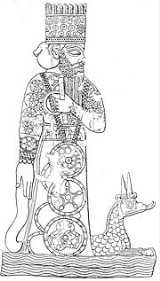
Marduk was depicted as a human, often with his symbol the snake-dragon which he had taken over from the god Tishpak
Tishpak

Tishpak is an Akkadian mythology god, the tutelary deity of the city of Eshnunna .Likely, identical with the Hurrian god ?Teshup?....
. Another symbol that stood for Marduk was the spade.

People were named after Marduk. For example, some scholars speculate that the Biblical
Bible

The Bible is the central religious text of Judaism and Christianity. The exact Books of the Bible is dependent on the religious traditions of specific denominations....
 character of Mordechai (Book of Esther
Book of Esther

The Book of Esther is one of the books of the Ketuvim of the Tanakh and of the Historical Books of the Old Testament. The Book of Esther or the Megillah is the basis for the Jewish celebration of Purim....
) used this Persian
Persian people

Persian identity, at least in terms of language, is traced to the ancient Indo-Iranians , who arrived in parts of Greater Iran circa 2000-1500 BCE....
 name to replace his original Hebrew
Hebrew language

Hebrew is a Semitic languages of the Afro-Asiatic languages. Modern Hebrew is spoken by more than seven million people in Israel and Classical Hebrew is used for prayer or study in Jews communities around the world....
 name, Bilshan.

Babylonian texts talk of the creation of Eridu by the god Marduk as the first city, "the holy city, the dwelling of their [the other gods] delight".

Nabu
Nabu

Nabu is the Babylonian god of wisdom and writing, worshipped by Babylonians as the son of Marduk and his consort, Sarpanitum, and as the grandson of Ea ....
, god of wisdom, is a son of Marduk.

See also

  • Assyro-Babylonian religion
    Assyro-Babylonian religion

    The religions of Babylonia and Assyria are the earliest attestation of Ancient Semitic religion, in particular Mesopotamian mythology. As with other ancient cultures in Mesopotamia and elsewhere, the predominant religious model in the area was polytheism, a belief in many gods....
  • Ashur (god)
    Ashur (god)

    A??ur was the head of the Assyrian pantheon. His origins are unknown but he is one of the Mesopotamian city gods, namely of the city Assur , once the capital of the Old Assyrian kingdom....
  • Bull of Heaven
  • Chaldean mythology
  • Etemenanki
    Etemenanki

    Etemenanki was the name of a ziggurat dedicated to Marduk in the city of Babylon of the 6th century BCE Neo-Babylonian dynasty. Originally seven stories in height, little remains of it now save ruins....


External links


  • (article about Marduk)