


Castor and Pollux

Encyclopedia
In Greek
and Roman mythology
, Castor (icon; ; , Kastōr, "beaver") and Pollux (icon; ) or Polydeuces (icon; , Poludeukēs, "much sweet wine") were twin brothers, together known as the Dioscuri (icon; ; , Dioskouroi, "sons of Zeus"). Their mother was Leda
, but Castor was the mortal son of Tyndareus
, king of Sparta, and Pollux the divine son of Zeus
, who visited Leda in the guise of a swan. Though accounts of their birth are varied, they are sometimes said to have been born from an egg, along with their twin sisters Helen of Troy and Clytemnestra
.
In Latin the twins are also known as the Gemini (icon; "twins") or Castores (icon). When Castor was killed, Pollux asked Zeus to let him share his own immortality with his twin to keep them together, and they were transformed into the constellation Gemini
. The pair were regarded as the patrons of sailors, to whom they appeared as St. Elmo's fire
, and were also associated with horsemanship.
They are sometimes called the Tyndaridae or Tyndarids (icon or ˈ; Τυνδαρίδαι, Tundaridai), later seen as a reference to their father and stepfather Tyndareus
.
 The best-known story of the twins' birth is that Zeus
disguised himself as a swan and raped Leda
. Thus Leda's children are frequently said to have hatched from two eggs that she then produced. The Dioscuri can be recognized in vase-paintings by the skull-cap
they wear, the pilos, which was explained in antiquity as the remnants of the egg from which they hatched. Tyndareus, Leda's mortal husband, is then father or foster-father to the children. Whether the children are thus mortal and which half-immortal is not consistent among accounts, nor is whether the twins hatched together from one egg. In some accounts, only Polydeuces was fathered by Zeus, while Leda and her husband Tyndareus
conceived Castor. This explains why they were granted an alternate immortality. It is a common belief that one would live among the gods, while the other was among the dead. The figure of Tyndareus may have entered their tradition to explain their archaic name Tindaridai in Spartan inscriptions or in literature Tyndaridai, in turn occasioning incompatible accounts of their parentage.
Castor and Polydeuces are sometimes both mortal, sometimes both divine. One consistent point is that if only one of them is immortal, it is Polydeuces. In Homer's Iliad
, Helen looks down from the walls of Troy and wonders why she does not see her brothers among the Achaeans. The narrator remarks that they are both already dead and buried back in their homeland of Lacedaemon, thus suggesting that at least in some early traditions, both were mortal. Their death and shared immortality offered by Zeus was material of the lost Cypria in the Epic cycle.
The Dioscuri were regarded as helpers of mankind and held to be patrons of travellers and of sailors in particular, who invoked them to seek favourable winds. Their role as horsemen and boxers also led to them being regarded as the patrons of athletes and athletic contests. They characteristically intervened at the moment of crisis, aiding those who honoured or trusted them.
portrays them initially as ordinary mortals, treating them as dead in the Iliad
, but in the Odyssey
they are treated as alive even though "the corn-bearing earth holds them." The author describes them as "having honour equal to gods," living on alternate days due to the intervention of Zeus. In both the Odyssey and in Hesiod
, they are described as the sons of Tyndareus and Leda. In Pindar
, Pollux is the son of Zeus while Castor is the son of the mortal Tyndareus. The theme of ambiguous parentage is not unique to Castor and Pollux; similar characterisations appear in the stories of Hercules
and Theseus
. The Dioscuri are also invoked in Alcaeus' Fragment 34a, though whether this poem antedates the Homeric Hymn to the twins is unknown. They make an appearance together in two plays by Euripides
, Helen
and Elektra
.
Cicero
tells the story of how Simonides of Ceos
was rebuked by Scopas, his patron, for devoting too much space to praising Castor and Pollux in an ode celebrating Scopas' victory in a chariot race. Shortly afterwards, Simonides was told that two young men wished to speak to him; after he had left the banqueting room, the roof fell in and crushed Scopas and his guests.
and later joined the crew of Jason
's ship, the Argo
.
, Pollux took part in a boxing contest and defeated King Amycus
of the Bebryces
, a savage mythical people in Bithynia
. After returning from the voyage, the Dioskouroi helped Jason and Peleus
to destroy the city of Iolcus in revenge for the treachery of its king Pelias
.
, they invaded his kingdom of Attica
to rescue her, abducting Theseus' mother Aethra
in revenge and carrying her off to Sparta while setting a rival, Menestheus
, on the throne of Athens. Aethra was forced to become Helen's slave but was eventually returned to her home by her grandsons Demophon
and Acamas
following the fall of Troy
.
, whose father was a brother of Leucippus
("white horse"). Although both women were already betrothed to counterpart twin brothers of Thebes, Lynceus
and Idas
, sons of Aphareus
, Castor and Pollux carried them off to Sparta
, where Phoebe bore Mnesileos to Pollux and Hilaeira bore Anogon to Castor. This began a feud among the four cousins.
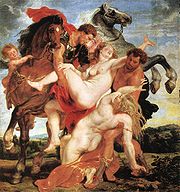 The cousins carried out a cattle-raid in Arcadia
together but fell out over the division of the meat. After stealing the herd, but before dividing it, the cousins butchered, quartered, and roasted a calf. As they prepared to eat, the gigantic Idas suggested that the herd be divided into two parts instead of four, based on which pair of cousins finished their meal first. Castor and Pollux agreed. Idas quickly ate both his portion and Lynceus' portion. Castor and Pollux had been duped. They allowed their cousins to take the entire herd, but vowed to someday take revenge.
Some time later, Idas and Lynceus visited their uncle's home in Sparta. The uncle was on his way to Crete, so he left Helen in charge of entertaining the guests, which included both sets of cousins, as well as Paris, prince of Troy. Castor and Pollux recognized the opportunity to exact revenge, made an excuse that justified leaving the feast, and set out to steal their cousins' herd. Idas and Lynceus eventually set out for home, leaving Helen alone with Paris, who then kidnapped Helen. Thus, the four cousins helped set into motion the events that gave rise to the Trojan War.
Meanwhile, Castor and Pollux had reached their destination. Castor climbed a tree to keep a watch as Pollux began to free the cattle. Far away, Idas and Lynceus approached. Lynceus, named for the lynx because he could see in the dark, spied Castor hiding in the tree. Idas and Lynceus immediately understood what was happening. Idas, furious, ambushed Castor, fatally wounding him with a blow from his spear—but not before Castor called out to warn Pollux. In the ensuing brawl, Pollux killed Lynceus. As Idas was about to kill Pollux, Zeus, who had been watching from Mt. Olympus, hurled a thunderbolt, killing Idas and saving his son.
Returning to the dying Castor, Pollux was given the choice by Zeus of spending all his time on Mount Olympus
or giving half his immortality to his mortal brother. He opted for the latter (so giving half his immortality to Castor), enabling the twins to alternate between Olympus and Hades
. The brothers became the two brightest stars in the constellation Gemini
("the twins"): Castor
(Alpha Geminorum) and Pollux
(Beta Geminorum). As emblems of immortality and death, the Dioscuri, like Heracles
, were said to have been initiated into the Eleusinian mysteries
.
manuscript depicts the brothers hunting, both on horseback and on foot.
On votive reliefs they are depicted with a variety of symbols representing the concept of twinhood, such as the dokana (δόκανα - two upright piece of wood connected by two cross-beams), a pair of amphora
e, a pair of shields, or a pair of snakes. They are also often shown wearing felt caps, above which stars may be depicted. They are depicted on metope
s from Delphi
showing them on the voyage of the Argo (Ἀργώ) and rustling cattle with Idas. Greek vases
regularly show them in the rape of the Leucippides, as Argonauts
, in religious ceremonies and at the delivery to Leda
of the egg containing Helen. They can be recognized in some vase-paintings by the skull-cap
they wear, the pilos (πῖλος), which was already explained in antiquity as the remnants of the egg from which they hatched.
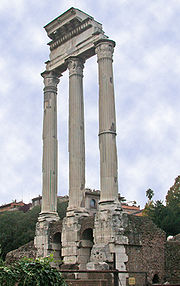 The Dioskouroi were worshipped by the Greeks and Romans alike; there were temples to the twins in Athens
and Rome
as well as shrines in many other locations in the ancient world.
The Dioscuri and their sisters having grown up in Sparta
, in the royal household of Tyndareus
, they were particularly important to the Sparta
ns, who associated them with the Spartan tradition of dual kingship and appreciated that two princes of their ruling house were elevated to immortality. Their connection there was very ancient: a uniquely Spartan aniconic representation of the Tyndaridai was as two upright posts joined by a cross-bar; as the protectors of the Spartan army the "beam figure" or dókana was carried in front of the army on campaign. Sparta's unique dual kingship reflects the divine influence of the Dioscuri. When the Spartan army marched to war, one king remained behind at home, accompanied by one of the Twins. "In this way the real political order is secured in the realm of the Gods" (Burkert 1985:212).
Their herōon or grave-shrine was on a mountain top at Therapne across the Eurotas
from Sparta, at a shrine known as the Meneláeion where Helen, Melelaus, Castor and Pollux were all said to be buried. Castor himself was also venerated in the region of Kastoria
in northern Greece.
They were commemorated both as gods on Olympus worthy of burnt sacrifice
, and as deceased mortals in Hades, whose spirits had to be propitiated by libation
s. Lesser shrines to Castor, Pollux and Helen were also established at a number of other locations around Sparta. The pear
tree was regarded by the Spartans as sacred to Castor and Pollux, and images of the twins were hung in its branches. The standard Spartan oath was to swear "by the two gods" (in Doric Greek
: νά τώ θεὼ, ná tō theō, in the Dual number).
The rite of theoxenia (θεοξενία), "god-entertaining", was particularly associated with Castor and Pollux. The two deities were summoned to a table laid with food, whether at individuals' own homes or in the public hearths or equivalent places controlled by states. They are sometimes shown arriving at a gallop over a food-laden table. Although such "table offerings" were a fairly common feature of Greek cult rituals, they were normally made in the shrines of the gods or heroes concerned. The domestic setting of the theoxenia was a characteristic distinction accorded to the Dioskouroi.
The image of the twins attending a goddess are widespread and link the Dioscuri with the male societies of initiates under the aegis of the Anatolian Great Goddess
and the great gods of Samothrace
. The Dioscuri are the inventors of war dances, which characterize the Kuretes.
tradition as the effulgent Vedic
brother-horsemen the Ashvins
, the Lithuanian
Ašvieniai
, and the Germanic Alcis.
in southern Italy. An archaic Latin inscription of the sixth or fifth century BC found at Lavinium
, which reads Castorei Podlouqueique qurois ("To Castor and Pollux, the Dioskouroi"), suggests a direct transmission from the Greeks; the word "qurois" is virtually a transliteration
of the Greek word κούροις, while "Podlouquei" is effectively a transliteration of the Greek Πολυδεύκης. The construction of the Temple of Castor and Pollux
, located in the Roman Forum
at the heart of their city, was undertaken to fulfil a vow (votum
) made by Aulus Postumius Albus Regillensis
in gratitude at the Roman victory in the Battle of Lake Regillus
in 495 BC. The establishing of the temple may also be a form of evocatio, the transferral of a tutelary deity from a defeated town to Rome, where cult would be offered in exchange for favor. According to legend, the twins fought at the head of the Roman army and subsequently brought news of the victory back to Rome. The Locri
ans of Magna Graecia
had attributed their success at a legendary battle on the banks of the Sagras to the intervention of the Twins. The Roman legend may in fact have had its origins in the Locrian account and possibly supplies further evidence of cultural transmission between Rome and Magna Graecia.
The Romans believed that the twins aided them on the battlefield. Their role as horsemen made them particularly attractive to the Roman equites and cavalry. Each year on July 15, the feast day of the Dioskouroi, the 1,800 equestrians would parade through the streets of Rome in an elaborate spectacle in which each rider wore full military attire and whatever decorations he had earned.
In the comedies of Plautus
, women swear by Castor, and men by Pollux.
," the Etruscan counterpart of Zeus. They were often portrayed on Etruscan mirrors. As was the fashion in Greece, they could also be portrayed symbolically; one example can be seen in the Tomba del Letto Funebre at Tarquinia
where a lectisternium
for them is painted. They are symbolised in the painting by the presence of two pointed caps crowned with laurel, referring to the Phrygian cap
s which they were often depicted as wearing.
records counterparts of the Dioscuri among the Atlantic Celts:
Diodorus cites Timaeus
(3rd century BC) as his source, so the passage is usually regarded as a description of an authentic Celtic tradition rather than an adoption from the Romans as a result of the conquest
. The divine twins among the Celts would be analogous in the Indo-European tradition to the Vedic Aśvins, or to the Germanic twins mentioned by Tacitus
. Their Celtic names are unknown; the conjecture Divanno and Dinomogetimarus, based on an inscription from Hérault
naming a pair of young warrior gods (Martes
), has not found wide support. The 19th-century Celticist Marie Henri d'Arbois de Jubainville
equated Cernunnos
with Castor and Smertullos
with Pollux, and conjectured that Cúchulainn
and Conall Cernach
were later equivalents: "on the whole, the theory is more ingenious than convincing." The Pillar of the Boatmen
depicts the twins among Celtic figures such as Cernunnos and Esus
, as well as Roman deities such as Jupiter and Vulcan. The Dioscuri are widely portrayed in Gallo-Roman art, and references to them are more numerous in Gaul than in any other part of the Roman Empire.
, the Dioskouroi continued to be venerated. The fifth-century pope Gelasius I attested to the presence of a "cult of Castores" that the people did not want to abandon. In some instances, the twins appear to have simply been absorbed into a Christian framework; thus fourth-century AD pottery and carvings from North Africa depict the Dioskouroi alongside the Twelve Apostles, the Raising of Lazarus
or with Saint Peter
. The church took an ambivalent attitude, rejecting the immortality of the Dioskouroi but seeking to replace them with equivalent Christian pairs. Saints Peter and Paul were thus adopted in place of the Dioskouroi as patrons of travellers, and Saints Cosmas and Damian
took over their function as healers. Some have also associated Saints Speusippus, Eleusippus, and Melapsippus
with the Dioskouroi.
was the title of a 1737 opera by Jean-Philippe Rameau
(libretto by Bernard), modified in 1754. The latter version became quite popular. The Italian composer Francesco Bianchi wrote another version called Castore e Polluce
, first performed in 1779, and there was yet another opera by the same title by Georg Joseph Vogler
in 1787.
In 1842 Lord Macaulay wrote a series of poems about Ancient Rome (the Lays of Ancient Rome
). The second poem is about the Battle of Lake Regillus
and describes the intervention of Castor and Pollux. They are referred to as the "Great Twin Brethren" in the poem. http://www.theotherpages.org/poems/regillus.html
Castor and Pollux (elephants)
were killed and eaten during the 1870 Prussian siege of Paris.
There are at least four sets of twin summits named after Castor and Pollux. In Yellowstone National Park
in Wyoming
, USA, the peaks are found close to the headwaters of the Lamar River
in the Absaroka Range
. Another pair
is located in the Pennine Alps
at the Swiss-Italian border. A third is in Glacier National Park
of western Canada
, within the Selkirk mountains
. The fourth is in Mount Aspiring National Park
of New Zealand
, named by the explorer Charlie Douglas.
Castor and Pollux are characters that appear in a few of Robert A. Heinlein's
books.
Castor Troy and Pollux Troy are villains (brothers) that appear in the 1997 film Face/Off
.
Also, in the Percy Jackson & the Olympians
fantasy series of novels series, Dionysus' twin sons are named Castor and Pollux. In the fourth book of the series Castor is killed in the battle, thus following the story of one passing and the other living.
The character Sollux Captor's name of Andrew Hussie's Homestuck was based off of Castor and Pollux, mostly due to the fact that the two stars with the same name are in the constellation Gemini.
Greek mythology
Greek mythology is the body of myths and legends belonging to the ancient Greeks, concerning their gods and heroes, the nature of the world, and the origins and significance of their own cult and ritual practices. They were a part of religion in ancient Greece...
and Roman mythology
Roman mythology
Roman mythology is the body of traditional stories pertaining to ancient Rome's legendary origins and religious system, as represented in the literature and visual arts of the Romans...
, Castor (icon; ; , Kastōr, "beaver") and Pollux (icon; ) or Polydeuces (icon; , Poludeukēs, "much sweet wine") were twin brothers, together known as the Dioscuri (icon; ; , Dioskouroi, "sons of Zeus"). Their mother was Leda
Leda (mythology)
In Greek mythology, Leda was daughter of the Aetolian king Thestius, and wife of the king Tyndareus , of Sparta. Her myth gave rise to the popular motif in Renaissance and later art of Leda and the Swan...
, but Castor was the mortal son of Tyndareus
Tyndareus
In Greek mythology, Tyndareus or Tyndareos was a Spartan king, son of Oebalus and Gorgophone , husband of Leda and father of Helen, Castor and Polydeuces, Clytemnestra, Timandra, Phoebe and Philonoe.Tyndareus had a brother named Hippocoon , who seized power and exiled Tyndareus...
, king of Sparta, and Pollux the divine son of Zeus
Zeus
In the ancient Greek religion, Zeus was the "Father of Gods and men" who ruled the Olympians of Mount Olympus as a father ruled the family. He was the god of sky and thunder in Greek mythology. His Roman counterpart is Jupiter and his Etruscan counterpart is Tinia.Zeus was the child of Cronus...
, who visited Leda in the guise of a swan. Though accounts of their birth are varied, they are sometimes said to have been born from an egg, along with their twin sisters Helen of Troy and Clytemnestra
Clytemnestra
Clytemnestra or Clytaemnestra , in ancient Greek legend, was the wife of Agamemnon, king of the Ancient Greek kingdom of Mycenae or Argos. In the Oresteia by Aeschylus, she was a femme fatale who murdered her husband, Agamemnon – said by Euripides to be her second husband – and the Trojan princess...
.
In Latin the twins are also known as the Gemini (icon; "twins") or Castores (icon). When Castor was killed, Pollux asked Zeus to let him share his own immortality with his twin to keep them together, and they were transformed into the constellation Gemini
Gemini (constellation)
Gemini is one of the constellations of the zodiac. It was one of the 48 constellations described by the 2nd century astronomer Ptolemy and it remains one of the 88 modern constellations today. Its name is Latin for "twins", and it is associated with the twins Castor and Pollux in Greek mythology...
. The pair were regarded as the patrons of sailors, to whom they appeared as St. Elmo's fire
St. Elmo's fire
St. Elmo's fire is a weather phenomenon in which luminous plasma is created by a coronal discharge from a grounded object in an electric field in the atmosphere St. Elmo's fire is named after St. Erasmus of Formiae St. Elmo's fire (also St. Elmo's light) is a weather phenomenon in which luminous...
, and were also associated with horsemanship.
They are sometimes called the Tyndaridae or Tyndarids (icon or ˈ; Τυνδαρίδαι, Tundaridai), later seen as a reference to their father and stepfather Tyndareus
Tyndareus
In Greek mythology, Tyndareus or Tyndareos was a Spartan king, son of Oebalus and Gorgophone , husband of Leda and father of Helen, Castor and Polydeuces, Clytemnestra, Timandra, Phoebe and Philonoe.Tyndareus had a brother named Hippocoon , who seized power and exiled Tyndareus...
.
Birth and functions
Zeus
In the ancient Greek religion, Zeus was the "Father of Gods and men" who ruled the Olympians of Mount Olympus as a father ruled the family. He was the god of sky and thunder in Greek mythology. His Roman counterpart is Jupiter and his Etruscan counterpart is Tinia.Zeus was the child of Cronus...
disguised himself as a swan and raped Leda
Leda (mythology)
In Greek mythology, Leda was daughter of the Aetolian king Thestius, and wife of the king Tyndareus , of Sparta. Her myth gave rise to the popular motif in Renaissance and later art of Leda and the Swan...
. Thus Leda's children are frequently said to have hatched from two eggs that she then produced. The Dioscuri can be recognized in vase-paintings by the skull-cap
Phrygian cap
The Phrygian cap is a soft conical cap with the top pulled forward, associated in antiquity with the inhabitants of Phrygia, a region of central Anatolia. In the western provinces of the Roman Empire it came to signify freedom and the pursuit of liberty, perhaps through a confusion with the pileus,...
they wear, the pilos, which was explained in antiquity as the remnants of the egg from which they hatched. Tyndareus, Leda's mortal husband, is then father or foster-father to the children. Whether the children are thus mortal and which half-immortal is not consistent among accounts, nor is whether the twins hatched together from one egg. In some accounts, only Polydeuces was fathered by Zeus, while Leda and her husband Tyndareus
Tyndareus
In Greek mythology, Tyndareus or Tyndareos was a Spartan king, son of Oebalus and Gorgophone , husband of Leda and father of Helen, Castor and Polydeuces, Clytemnestra, Timandra, Phoebe and Philonoe.Tyndareus had a brother named Hippocoon , who seized power and exiled Tyndareus...
conceived Castor. This explains why they were granted an alternate immortality. It is a common belief that one would live among the gods, while the other was among the dead. The figure of Tyndareus may have entered their tradition to explain their archaic name Tindaridai in Spartan inscriptions or in literature Tyndaridai, in turn occasioning incompatible accounts of their parentage.
Castor and Polydeuces are sometimes both mortal, sometimes both divine. One consistent point is that if only one of them is immortal, it is Polydeuces. In Homer's Iliad
Iliad
The Iliad is an epic poem in dactylic hexameters, traditionally attributed to Homer. Set during the Trojan War, the ten-year siege of the city of Troy by a coalition of Greek states, it tells of the battles and events during the weeks of a quarrel between King Agamemnon and the warrior Achilles...
, Helen looks down from the walls of Troy and wonders why she does not see her brothers among the Achaeans. The narrator remarks that they are both already dead and buried back in their homeland of Lacedaemon, thus suggesting that at least in some early traditions, both were mortal. Their death and shared immortality offered by Zeus was material of the lost Cypria in the Epic cycle.
The Dioscuri were regarded as helpers of mankind and held to be patrons of travellers and of sailors in particular, who invoked them to seek favourable winds. Their role as horsemen and boxers also led to them being regarded as the patrons of athletes and athletic contests. They characteristically intervened at the moment of crisis, aiding those who honoured or trusted them.
Classical sources
Ancient Greek authors tell a number of versions of the story of Castor and Pollux. HomerHomer
In the Western classical tradition Homer , is the author of the Iliad and the Odyssey, and is revered as the greatest ancient Greek epic poet. These epics lie at the beginning of the Western canon of literature, and have had an enormous influence on the history of literature.When he lived is...
portrays them initially as ordinary mortals, treating them as dead in the Iliad
Iliad
The Iliad is an epic poem in dactylic hexameters, traditionally attributed to Homer. Set during the Trojan War, the ten-year siege of the city of Troy by a coalition of Greek states, it tells of the battles and events during the weeks of a quarrel between King Agamemnon and the warrior Achilles...
, but in the Odyssey
Odyssey
The Odyssey is one of two major ancient Greek epic poems attributed to Homer. It is, in part, a sequel to the Iliad, the other work ascribed to Homer. The poem is fundamental to the modern Western canon, and is the second—the Iliad being the first—extant work of Western literature...
they are treated as alive even though "the corn-bearing earth holds them." The author describes them as "having honour equal to gods," living on alternate days due to the intervention of Zeus. In both the Odyssey and in Hesiod
Hesiod
Hesiod was a Greek oral poet generally thought by scholars to have been active between 750 and 650 BC, around the same time as Homer. His is the first European poetry in which the poet regards himself as a topic, an individual with a distinctive role to play. Ancient authors credited him and...
, they are described as the sons of Tyndareus and Leda. In Pindar
Pindar
Pindar , was an Ancient Greek lyric poet. Of the canonical nine lyric poets of ancient Greece, his work is the best preserved. Quintilian described him as "by far the greatest of the nine lyric poets, in virtue of his inspired magnificence, the beauty of his thoughts and figures, the rich...
, Pollux is the son of Zeus while Castor is the son of the mortal Tyndareus. The theme of ambiguous parentage is not unique to Castor and Pollux; similar characterisations appear in the stories of Hercules
Hercules
Hercules is the Roman name for Greek demigod Heracles, son of Zeus , and the mortal Alcmene...
and Theseus
Theseus
For other uses, see Theseus Theseus was the mythical founder-king of Athens, son of Aethra, and fathered by Aegeus and Poseidon, both of whom Aethra had slept with in one night. Theseus was a founder-hero, like Perseus, Cadmus, or Heracles, all of whom battled and overcame foes that were...
. The Dioscuri are also invoked in Alcaeus' Fragment 34a, though whether this poem antedates the Homeric Hymn to the twins is unknown. They make an appearance together in two plays by Euripides
Euripides
Euripides was one of the three great tragedians of classical Athens, the other two being Aeschylus and Sophocles. Some ancient scholars attributed ninety-five plays to him but according to the Suda it was ninety-two at most...
, Helen
Helen (play)
Helen is a drama by Euripides, probably first produced in 412 BC for the Dionysia. The play shares much in common with another of Euripides' works, Iphigenia in Tauris.-Background:...
and Elektra
Electra (Euripides)
Euripides' Electra was a play probably written in the mid 410s BC, likely after 413 BC. It is unclear whether it was first produced before or after Sophocles' version of the Electra story.-Background:...
.
Cicero
Cicero
Marcus Tullius Cicero , was a Roman philosopher, statesman, lawyer, political theorist, and Roman constitutionalist. He came from a wealthy municipal family of the equestrian order, and is widely considered one of Rome's greatest orators and prose stylists.He introduced the Romans to the chief...
tells the story of how Simonides of Ceos
Simonides of Ceos
Simonides of Ceos was a Greek lyric poet, born at Ioulis on Kea. The scholars of Hellenistic Alexandria included him in the canonical list of nine lyric poets, along with Bacchylides and Pindar...
was rebuked by Scopas, his patron, for devoting too much space to praising Castor and Pollux in an ode celebrating Scopas' victory in a chariot race. Shortly afterwards, Simonides was told that two young men wished to speak to him; after he had left the banqueting room, the roof fell in and crushed Scopas and his guests.
Adventures
Both Dioscuri were excellent horsemen and hunters who participated in the hunting of the Calydonian BoarCalydonian Boar
The Calydonian Boar is one of the monsters of Greek mythology that had to be overcome by heroes of the Olympian age. Sent by Artemis to ravage the region of Calydon in Aetolia because its king failed to honor her in his rites to the gods, it was killed in the Calydonian Hunt, in which many male...
and later joined the crew of Jason
Jason
Jason was a late ancient Greek mythological hero from the late 10th Century BC, famous as the leader of the Argonauts and their quest for the Golden Fleece. He was the son of Aeson, the rightful king of Iolcus...
's ship, the Argo
Argo
In Greek mythology, the Argo was the ship on which Jason and the Argonauts sailed from Iolcos to retrieve the Golden Fleece. It was named after its builder, Argus.-Legend:...
.
As Argonauts
During the expedition of the ArgonautsArgonauts
The Argonauts ) were a band of heroes in Greek mythology who, in the years before the Trojan War, accompanied Jason to Colchis in his quest to find the Golden Fleece. Their name comes from their ship, the Argo, which was named after its builder, Argus. "Argonauts", therefore, literally means...
, Pollux took part in a boxing contest and defeated King Amycus
Amycus
In Greek mythology, Amycus was the son of Poseidon and Melia. He was a boxer and King of the Bebryces, a mythical people in Bithynia. Polydeuces beat him in a boxing match when the Argonauts passed through Bithynia. He was also a prominent Trojan during the Trojan War. He married Theona and had...
of the Bebryces
Bebryces
The Bebryces were a tribe of people who lived in Bithynia. According to Strabo they were one of the many Thracian tribes that had crossed from Europe into Asia....
, a savage mythical people in Bithynia
Bithynia
Bithynia was an ancient region, kingdom and Roman province in the northwest of Asia Minor, adjoining the Propontis, the Thracian Bosporus and the Euxine .-Description:...
. After returning from the voyage, the Dioskouroi helped Jason and Peleus
Peleus
In Greek mythology, Pēleus was a hero whose myth was already known to the hearers of Homer in the late 8th century BCE. Peleus was the son of Aeacus, king of the island of Aegina, and Endeïs, the oread of Mount Pelion in Thessaly; he was the father of Achilles...
to destroy the city of Iolcus in revenge for the treachery of its king Pelias
Pelias
Pelias was king of Iolcus in Greek mythology, the son of Tyro and Poseidon. His wife is recorded as either Anaxibia, daughter of Bias, or Phylomache, daughter of Amphion. He was the father of Acastus, Pisidice, Alcestis, Pelopia, Hippothoe, Asteropia, and Antinoe.Tyro was married to Cretheus...
.
Rescuing Helen
When their sister Helen was abducted by the legendary Greek king TheseusTheseus
For other uses, see Theseus Theseus was the mythical founder-king of Athens, son of Aethra, and fathered by Aegeus and Poseidon, both of whom Aethra had slept with in one night. Theseus was a founder-hero, like Perseus, Cadmus, or Heracles, all of whom battled and overcame foes that were...
, they invaded his kingdom of Attica
Attica
Attica is a historical region of Greece, containing Athens, the current capital of Greece. The historical region is centered on the Attic peninsula, which projects into the Aegean Sea...
to rescue her, abducting Theseus' mother Aethra
Aethra
In Greek mythology, Aethra or Aithra was a name applied to four different individuals:-Mother of Theseus:...
in revenge and carrying her off to Sparta while setting a rival, Menestheus
Menestheus
Menestheus , the son of Peteus, son of Orneus, son of Erechtheus, was a legendary King of Athens during the Trojan War. He was set up as king by the Dioscuri when Theseus travelled to the underworld, and at his return Menestheus exiled him from the city.Menestheus was one of the suitors of Helen of...
, on the throne of Athens. Aethra was forced to become Helen's slave but was eventually returned to her home by her grandsons Demophon
Demophon
In Greek mythology, Demophon referred to two men:*Demophon of Athens*Demophon of Eleusis...
and Acamas
Acamas
Acamas was a name attributed to several characters in Greek mythology. The following three all fought in the Trojan War, and only the first was not mentioned by Homer....
following the fall of Troy
Troy
Troy was a city, both factual and legendary, located in northwest Anatolia in what is now Turkey, southeast of the Dardanelles and beside Mount Ida...
.
The Leucippides, Lynceus and death
Castor and Pollux aspired to marry the Leucippides ("daughters of the white horse"), Phoebe and HilaeiraHilaeira
In Greek mythology, Hilaeira was a daughter of Leucippus and Philodice. She and her sister Phoebe are commonly referred to as Leucippides ....
, whose father was a brother of Leucippus
Leucippus (mythology)
In Greek mythology, Leucippus, son of Gorgophone and Perieres, was the father of Phoebe and Hilaeira, and also of Arsinoe, mother of Asclepius, by his wife Philodice, daughter of Inachus....
("white horse"). Although both women were already betrothed to counterpart twin brothers of Thebes, Lynceus
Lynceus
In Greek mythology, Lynceus was a king of Argos, succeeding Danaus. He is named as a descendant of Belus through his father Aegyptus, who was the twin brother of Danaus. Danaus had fifty daughters, the Danaides, while Aegyptus had fifty sons including Lynceus, whose name when translated means "wolf"...
and Idas
Idas
In Greek mythology, Idas was a son of Aphareus and Arene and brother of Lynceus. He and Lynceus loved Hilaeira and Phoebe and fought with their rival suitors, Castor and Polydeuces, killing the mortal brother Castor. He was also one of the Argonauts and a participant in the hunt for the Calydonian...
, sons of Aphareus
Aphareus
In Greek mythology, Aphareus , son of Gorgophone and Perieres, was the husband of Arene, daughter of Oebalus, and father of Lynceus, Idas and Peisus, though some report that Idas' actual father was Poseidon. Some call his wife Polydora or Laocoosa...
, Castor and Pollux carried them off to Sparta
Sparta
Sparta or Lacedaemon, was a prominent city-state in ancient Greece, situated on the banks of the River Eurotas in Laconia, in south-eastern Peloponnese. It emerged as a political entity around the 10th century BC, when the invading Dorians subjugated the local, non-Dorian population. From c...
, where Phoebe bore Mnesileos to Pollux and Hilaeira bore Anogon to Castor. This began a feud among the four cousins.
Arcadia
Arcadia is one of the regional units of Greece. It is part of the administrative region of Peloponnese. It is situated in the central and eastern part of the Peloponnese peninsula. It takes its name from the mythological character Arcas. In Greek mythology, it was the home of the god Pan...
together but fell out over the division of the meat. After stealing the herd, but before dividing it, the cousins butchered, quartered, and roasted a calf. As they prepared to eat, the gigantic Idas suggested that the herd be divided into two parts instead of four, based on which pair of cousins finished their meal first. Castor and Pollux agreed. Idas quickly ate both his portion and Lynceus' portion. Castor and Pollux had been duped. They allowed their cousins to take the entire herd, but vowed to someday take revenge.
Some time later, Idas and Lynceus visited their uncle's home in Sparta. The uncle was on his way to Crete, so he left Helen in charge of entertaining the guests, which included both sets of cousins, as well as Paris, prince of Troy. Castor and Pollux recognized the opportunity to exact revenge, made an excuse that justified leaving the feast, and set out to steal their cousins' herd. Idas and Lynceus eventually set out for home, leaving Helen alone with Paris, who then kidnapped Helen. Thus, the four cousins helped set into motion the events that gave rise to the Trojan War.
Meanwhile, Castor and Pollux had reached their destination. Castor climbed a tree to keep a watch as Pollux began to free the cattle. Far away, Idas and Lynceus approached. Lynceus, named for the lynx because he could see in the dark, spied Castor hiding in the tree. Idas and Lynceus immediately understood what was happening. Idas, furious, ambushed Castor, fatally wounding him with a blow from his spear—but not before Castor called out to warn Pollux. In the ensuing brawl, Pollux killed Lynceus. As Idas was about to kill Pollux, Zeus, who had been watching from Mt. Olympus, hurled a thunderbolt, killing Idas and saving his son.
Returning to the dying Castor, Pollux was given the choice by Zeus of spending all his time on Mount Olympus
Mount Olympus
Mount Olympus is the highest mountain in Greece, located on the border between Thessaly and Macedonia, about 100 kilometres away from Thessaloniki, Greece's second largest city. Mount Olympus has 52 peaks. The highest peak Mytikas, meaning "nose", rises to 2,917 metres...
or giving half his immortality to his mortal brother. He opted for the latter (so giving half his immortality to Castor), enabling the twins to alternate between Olympus and Hades
Greek underworld
The Greek underworld was made up of various realms believed to lie beneath the earth or at its farthest reaches.This includes:* The great pit of Tartarus, originally the exclusive prison of the old Titan gods, it later came to be the dungeon home of damned souls.* The land of the dead ruled by the...
. The brothers became the two brightest stars in the constellation Gemini
Gemini (constellation)
Gemini is one of the constellations of the zodiac. It was one of the 48 constellations described by the 2nd century astronomer Ptolemy and it remains one of the 88 modern constellations today. Its name is Latin for "twins", and it is associated with the twins Castor and Pollux in Greek mythology...
("the twins"): Castor
Castor (star)
Castor is the second brightest star in the constellation Gemini and one of the brightest stars in the night sky. Although it has the Bayer designation "alpha", it is actually fainter than Beta Geminorum...
(Alpha Geminorum) and Pollux
Pollux (star)
Pollux is an orange giant star approximately 34 light-years from the Earth in the constellation of Gemini . Pollux is the brightest star in the constellation, brighter than Castor...
(Beta Geminorum). As emblems of immortality and death, the Dioscuri, like Heracles
Heracles
Heracles ,born Alcaeus or Alcides , was a divine hero in Greek mythology, the son of Zeus and Alcmene, foster son of Amphitryon and great-grandson of Perseus...
, were said to have been initiated into the Eleusinian mysteries
Eleusinian Mysteries
The Eleusinian Mysteries were initiation ceremonies held every year for the cult of Demeter and Persephone based at Eleusis in ancient Greece. Of all the mysteries celebrated in ancient times, these were held to be the ones of greatest importance...
.
Iconography
Castor and Pollux are consistently associated with horses in art and literature. They are widely depicted as helmeted horsemen carrying spears. The Pseudo-OppianOppian
Oppian or Oppianus was the name of the authors of two didactic poems in Greek hexameters, formerly identified, but now generally regarded as two different persons: Oppian of Corycus in Cilicia; and Oppian of Apamea in Syria.-Oppian of Corycus:Oppian of Corycus in Cilicia, who flourished in the...
manuscript depicts the brothers hunting, both on horseback and on foot.
On votive reliefs they are depicted with a variety of symbols representing the concept of twinhood, such as the dokana (δόκανα - two upright piece of wood connected by two cross-beams), a pair of amphora
Amphora
An amphora is a type of vase-shaped, usually ceramic container with two handles and a long neck narrower than the body...
e, a pair of shields, or a pair of snakes. They are also often shown wearing felt caps, above which stars may be depicted. They are depicted on metope
Metope (architecture)
In classical architecture, a metope is a rectangular architectural element that fills the space between two triglyphs in a Doric frieze, which is a decorative band of alternating triglyphs and metopes above the architrave of a building of the Doric order...
s from Delphi
Delphi
Delphi is both an archaeological site and a modern town in Greece on the south-western spur of Mount Parnassus in the valley of Phocis.In Greek mythology, Delphi was the site of the Delphic oracle, the most important oracle in the classical Greek world, and a major site for the worship of the god...
showing them on the voyage of the Argo (Ἀργώ) and rustling cattle with Idas. Greek vases
Pottery of Ancient Greece
As the result of its relative durability, pottery is a large part of the archaeological record of Ancient Greece, and because there is so much of it it has exerted a disproportionately large influence on our understanding of Greek society...
regularly show them in the rape of the Leucippides, as Argonauts
Argonauts
The Argonauts ) were a band of heroes in Greek mythology who, in the years before the Trojan War, accompanied Jason to Colchis in his quest to find the Golden Fleece. Their name comes from their ship, the Argo, which was named after its builder, Argus. "Argonauts", therefore, literally means...
, in religious ceremonies and at the delivery to Leda
Leda (mythology)
In Greek mythology, Leda was daughter of the Aetolian king Thestius, and wife of the king Tyndareus , of Sparta. Her myth gave rise to the popular motif in Renaissance and later art of Leda and the Swan...
of the egg containing Helen. They can be recognized in some vase-paintings by the skull-cap
Phrygian cap
The Phrygian cap is a soft conical cap with the top pulled forward, associated in antiquity with the inhabitants of Phrygia, a region of central Anatolia. In the western provinces of the Roman Empire it came to signify freedom and the pursuit of liberty, perhaps through a confusion with the pileus,...
they wear, the pilos (πῖλος), which was already explained in antiquity as the remnants of the egg from which they hatched.
Shrines and rites
Athens
Athens , is the capital and largest city of Greece. Athens dominates the Attica region and is one of the world's oldest cities, as its recorded history spans around 3,400 years. Classical Athens was a powerful city-state...
and Rome
Rome
Rome is the capital of Italy and the country's largest and most populated city and comune, with over 2.7 million residents in . The city is located in the central-western portion of the Italian Peninsula, on the Tiber River within the Lazio region of Italy.Rome's history spans two and a half...
as well as shrines in many other locations in the ancient world.
The Dioscuri and their sisters having grown up in Sparta
Sparta
Sparta or Lacedaemon, was a prominent city-state in ancient Greece, situated on the banks of the River Eurotas in Laconia, in south-eastern Peloponnese. It emerged as a political entity around the 10th century BC, when the invading Dorians subjugated the local, non-Dorian population. From c...
, in the royal household of Tyndareus
Tyndareus
In Greek mythology, Tyndareus or Tyndareos was a Spartan king, son of Oebalus and Gorgophone , husband of Leda and father of Helen, Castor and Polydeuces, Clytemnestra, Timandra, Phoebe and Philonoe.Tyndareus had a brother named Hippocoon , who seized power and exiled Tyndareus...
, they were particularly important to the Sparta
Sparta
Sparta or Lacedaemon, was a prominent city-state in ancient Greece, situated on the banks of the River Eurotas in Laconia, in south-eastern Peloponnese. It emerged as a political entity around the 10th century BC, when the invading Dorians subjugated the local, non-Dorian population. From c...
ns, who associated them with the Spartan tradition of dual kingship and appreciated that two princes of their ruling house were elevated to immortality. Their connection there was very ancient: a uniquely Spartan aniconic representation of the Tyndaridai was as two upright posts joined by a cross-bar; as the protectors of the Spartan army the "beam figure" or dókana was carried in front of the army on campaign. Sparta's unique dual kingship reflects the divine influence of the Dioscuri. When the Spartan army marched to war, one king remained behind at home, accompanied by one of the Twins. "In this way the real political order is secured in the realm of the Gods" (Burkert 1985:212).
Their herōon or grave-shrine was on a mountain top at Therapne across the Eurotas
Eurotas
In Greek mythology, Eurotas was a son of Myles and grandson of Lelex, eponymous ancestor of the Leleges, the pre-Greek people residing, in the myth, in the Eurotas Valley. He had no male heir, but he did have a daughter, Sparta. Eurotas bequeathed the kingdom to her husband, Lacedaemon, the son of...
from Sparta, at a shrine known as the Meneláeion where Helen, Melelaus, Castor and Pollux were all said to be buried. Castor himself was also venerated in the region of Kastoria
Kastoria
Kastoria is a city in northern Greece in the periphery of West Macedonia. It is the capital of Kastoria peripheral unit. It is situated on a promontory on the western shore of Lake Orestiada, in a valley surrounded by limestone mountains...
in northern Greece.
They were commemorated both as gods on Olympus worthy of burnt sacrifice
Holocaust (sacrifice)
A holocaust is a religious animal sacrifice that is completely consumed by fire. The word derives from the Ancient Greek holocaustos , which is used solely for one of the major forms of sacrifice....
, and as deceased mortals in Hades, whose spirits had to be propitiated by libation
Libation
A libation is a ritual pouring of a liquid as an offering to a god or spirit or in memory of those who have died. It was common in many religions of antiquity and continues to be offered in various cultures today....
s. Lesser shrines to Castor, Pollux and Helen were also established at a number of other locations around Sparta. The pear
Pear
The pear is any of several tree species of genus Pyrus and also the name of the pomaceous fruit of these trees. Several species of pear are valued by humans for their edible fruit, but the fruit of other species is small, hard, and astringent....
tree was regarded by the Spartans as sacred to Castor and Pollux, and images of the twins were hung in its branches. The standard Spartan oath was to swear "by the two gods" (in Doric Greek
Doric Greek
Doric or Dorian was a dialect of ancient Greek. Its variants were spoken in the southern and eastern Peloponnese, Crete, Rhodes, some islands in the southern Aegean Sea, some cities on the coasts of Asia Minor, Southern Italy, Sicily, Epirus and Macedon. Together with Northwest Greek, it forms the...
: νά τώ θεὼ, ná tō theō, in the Dual number).
The rite of theoxenia (θεοξενία), "god-entertaining", was particularly associated with Castor and Pollux. The two deities were summoned to a table laid with food, whether at individuals' own homes or in the public hearths or equivalent places controlled by states. They are sometimes shown arriving at a gallop over a food-laden table. Although such "table offerings" were a fairly common feature of Greek cult rituals, they were normally made in the shrines of the gods or heroes concerned. The domestic setting of the theoxenia was a characteristic distinction accorded to the Dioskouroi.
The image of the twins attending a goddess are widespread and link the Dioscuri with the male societies of initiates under the aegis of the Anatolian Great Goddess
Cybele
Cybele , was a Phrygian form of the Earth Mother or Great Mother. As with Greek Gaia , her Minoan equivalent Rhea and some aspects of Demeter, Cybele embodies the fertile Earth...
and the great gods of Samothrace
Samothrace
Samothrace is a Greek island in the northern Aegean Sea. It is a self-governing municipality within the Evros peripheral unit of Thrace. The island is long and is in size and has a population of 2,723 . Its main industries are fishing and tourism. Resources on the island includes granite and...
. The Dioscuri are the inventors of war dances, which characterize the Kuretes.
Indo-European analogues
The heavenly twins appear also in the Indo-EuropeanProto-Indo-Europeans
The Proto-Indo-Europeans were the speakers of the Proto-Indo-European language , a reconstructed prehistoric language of Eurasia.Knowledge of them comes chiefly from the linguistic reconstruction, along with material evidence from archaeology and archaeogenetics...
tradition as the effulgent Vedic
Vedic period
The Vedic period was a period in history during which the Vedas, the oldest scriptures of Hinduism, were composed. The time span of the period is uncertain. Philological and linguistic evidence indicates that the Rigveda, the oldest of the Vedas, was composed roughly between 1700–1100 BCE, also...
brother-horsemen the Ashvins
Ashvins
The Ashvins , in Hindu mythology, are divine twin horsemen in the Rigveda, sons of Saranya , a goddess of the clouds and wife of Surya in his form as Vivasvat. The Ashvins are Vedic gods symbolising the shining of sunrise and sunset, appearing in the sky before the dawn in a golden chariot,...
, the Lithuanian
Lithuanian mythology
Lithuanian mythology is an example of Baltic mythology, developed by Lithuanians throughout the centuries.-History of scholarship:Surviving information about Baltic paganism in general is very sketchy and incomplete. As with most ancient Indo-European cultures Lithuanian mythology is an example of...
Ašvieniai
Ašvieniai
Ašvieniai are divine twins in the Lithuanian mythology identical to Latvian Dieva deli and direct counterparts of Vedic Ashvins. The both names derive from the same Proto-Indo-European root for the horse - *ek'w-. Old Lithuanian ašva and Sanskrit ashva mean "horse". Ašvieniai are represented as...
, and the Germanic Alcis.
Italy and the Roman Empire
From the fifth century BC onwards, the brothers were revered by the Romans, probably as the result of cultural transmission via the Greek colonies of Magna GraeciaMagna Graecia
Magna Græcia is the name of the coastal areas of Southern Italy on the Tarentine Gulf that were extensively colonized by Greek settlers; particularly the Achaean colonies of Tarentum, Crotone, and Sybaris, but also, more loosely, the cities of Cumae and Neapolis to the north...
in southern Italy. An archaic Latin inscription of the sixth or fifth century BC found at Lavinium
Lavinium
Lavinium was a port city of Latium, to the south of Rome, at a median distance between the Tiber river at Ostia and Anzio. The coastline then, as now, was a long strip of beach. Lavinium was on a hill at the southernmost edge of the Silva Laurentina, a dense laurel forest, and the northernmost...
, which reads Castorei Podlouqueique qurois ("To Castor and Pollux, the Dioskouroi"), suggests a direct transmission from the Greeks; the word "qurois" is virtually a transliteration
Transliteration
Transliteration is a subset of the science of hermeneutics. It is a form of translation, and is the practice of converting a text from one script into another...
of the Greek word κούροις, while "Podlouquei" is effectively a transliteration of the Greek Πολυδεύκης. The construction of the Temple of Castor and Pollux
Temple of Castor and Pollux
The Temple of Castor and Pollux is an ancient edifice in the Roman Forum, Rome, central Italy. It was originally built in gratitude for victory at the Battle of Lake Regillus . Castor and Pollux were the Dioscuri, the "twins" of Gemini, the twin sons of Zeus and Leda...
, located in the Roman Forum
Roman Forum
The Roman Forum is a rectangular forum surrounded by the ruins of several important ancient government buildings at the center of the city of Rome. Citizens of the ancient city referred to this space, originally a marketplace, as the Forum Magnum, or simply the Forum...
at the heart of their city, was undertaken to fulfil a vow (votum
Votum
In ancient Roman religion, a votum, plural vota, is a vow or promise made to a deity. The word comes from the past participle of the Latin verb voveo, vovere, "vow, promise." As the result of this verbal action, a votum is also that which fulfills a vow, that is, the thing promised, such as...
) made by Aulus Postumius Albus Regillensis
Aulus Postumius Albus Regillensis
Aulus Postumius Albus Regillensis was an ancient Roman who, according to Livy, was dictator in 498 BC, when he conquered the Latins in the great Battle of Lake Regillus. Many of the coins of the Albini commemorate this victory of their ancestor, as in the one pictured...
in gratitude at the Roman victory in the Battle of Lake Regillus
Battle of Lake Regillus
The Battle of Lake Regillus was a legendary early Roman victory, won over the Latin League led by the expelled Etruscan former king of Rome. It is usually said to have occurred in 498 BC, but other dates have been proposed, including 499 BC, 496 BC and 493 BC.The battle may be entirely legendary,...
in 495 BC. The establishing of the temple may also be a form of evocatio, the transferral of a tutelary deity from a defeated town to Rome, where cult would be offered in exchange for favor. According to legend, the twins fought at the head of the Roman army and subsequently brought news of the victory back to Rome. The Locri
Locri
Locri is a town and comune in the province of Reggio Calabria, Calabria, southern Italy. The name derives from the ancient Greek town Locris.-History:...
ans of Magna Graecia
Magna Graecia
Magna Græcia is the name of the coastal areas of Southern Italy on the Tarentine Gulf that were extensively colonized by Greek settlers; particularly the Achaean colonies of Tarentum, Crotone, and Sybaris, but also, more loosely, the cities of Cumae and Neapolis to the north...
had attributed their success at a legendary battle on the banks of the Sagras to the intervention of the Twins. The Roman legend may in fact have had its origins in the Locrian account and possibly supplies further evidence of cultural transmission between Rome and Magna Graecia.
The Romans believed that the twins aided them on the battlefield. Their role as horsemen made them particularly attractive to the Roman equites and cavalry. Each year on July 15, the feast day of the Dioskouroi, the 1,800 equestrians would parade through the streets of Rome in an elaborate spectacle in which each rider wore full military attire and whatever decorations he had earned.
In the comedies of Plautus
Plautus
Titus Maccius Plautus , commonly known as "Plautus", was a Roman playwright of the Old Latin period. His comedies are the earliest surviving intact works in Latin literature. He wrote Palliata comoedia, the genre devised by the innovator of Latin literature, Livius Andronicus...
, women swear by Castor, and men by Pollux.
Etruscan Kastur and Pultuce
The Etruscans venerated the twins as Kastur and Pultuce, collectively the tinas cliniiaras, "sons of TiniaTinia
Tinia was the god of the sky and the highest god in Etruscan mythology, equivalent to the Roman Jupiter and the Greek Zeus. He was the husband of Thalna or Uni and the father of Heracle....
," the Etruscan counterpart of Zeus. They were often portrayed on Etruscan mirrors. As was the fashion in Greece, they could also be portrayed symbolically; one example can be seen in the Tomba del Letto Funebre at Tarquinia
Tarquinia
Tarquinia, formerly Corneto and in Antiquity Tarquinii, is an ancient city in the province of Viterbo, Lazio, Italy.- History :Tarquinii is said to have been already a flourishing city when Demaratus of Corinth brought in Greek workmen...
where a lectisternium
Lectisternium
In ancient Roman religion, the lectisternium was a propitiatory ceremony, consisting of a meal offered to gods and goddesses. The word derives from lectum sternere, "to spread a couch." The deities were represented by their busts or statues, or by portable figures of wood, with heads of bronze,...
for them is painted. They are symbolised in the painting by the presence of two pointed caps crowned with laurel, referring to the Phrygian cap
Phrygian cap
The Phrygian cap is a soft conical cap with the top pulled forward, associated in antiquity with the inhabitants of Phrygia, a region of central Anatolia. In the western provinces of the Roman Empire it came to signify freedom and the pursuit of liberty, perhaps through a confusion with the pileus,...
s which they were often depicted as wearing.
Celtic Dioscuri
The 1st-century BC historian Diodorus SiculusDiodorus Siculus
Diodorus Siculus was a Greek historian who flourished between 60 and 30 BC. According to Diodorus' own work, he was born at Agyrium in Sicily . With one exception, antiquity affords no further information about Diodorus' life and doings beyond what is to be found in his own work, Bibliotheca...
records counterparts of the Dioscuri among the Atlantic Celts:
The Celts who dwell along the ocean venerate gods who resemble our Dioscuri above any of the gods, since they have a tradition handed down from ancient times that these gods came among them from the ocean. Moreover, there are on the ocean shore, they say, many names which are derived from the Argonauts and the Dioscuri.
Diodorus cites Timaeus
Timaeus (historian)
Timaeus , ancient Greek historian, was born at Tauromenium in Sicily. Driven out of Sicily by Agathocles, he migrated to Athens, where he studied rhetoric under a pupil of Isocrates and lived for fifty years...
(3rd century BC) as his source, so the passage is usually regarded as a description of an authentic Celtic tradition rather than an adoption from the Romans as a result of the conquest
Gallic Wars
The Gallic Wars were a series of military campaigns waged by the Roman proconsul Julius Caesar against several Gallic tribes. They lasted from 58 BC to 51 BC. The Gallic Wars culminated in the decisive Battle of Alesia in 52 BC, in which a complete Roman victory resulted in the expansion of the...
. The divine twins among the Celts would be analogous in the Indo-European tradition to the Vedic Aśvins, or to the Germanic twins mentioned by Tacitus
Tacitus
Publius Cornelius Tacitus was a senator and a historian of the Roman Empire. The surviving portions of his two major works—the Annals and the Histories—examine the reigns of the Roman Emperors Tiberius, Claudius, Nero and those who reigned in the Year of the Four Emperors...
. Their Celtic names are unknown; the conjecture Divanno and Dinomogetimarus, based on an inscription from Hérault
Hérault
Hérault is a department in the south of France named after the Hérault river.-History:Hérault is one of the original 83 departments created during the French Revolution on 4 March 1790...
naming a pair of young warrior gods (Martes
Mars (mythology)
Mars was the Roman god of war and also an agricultural guardian, a combination characteristic of early Rome. He was second in importance only to Jupiter, and he was the most prominent of the military gods worshipped by the Roman legions...
), has not found wide support. The 19th-century Celticist Marie Henri d'Arbois de Jubainville
Marie Henri d'Arbois de Jubainville
Marie Henri d'Arbois de Jubainville , was a French historian and philologist.He was born at Nancy. In 1851 he left the École des Chartes with the degree of palaeographic archivist...
equated Cernunnos
Cernunnos
Cernunnos is the conventional name given in Celtic studies to depictions of the horned god of Celtic polytheism. The name itself is only attested once, on the 1st-century Pillar of the Boatmen, but depictions of a horned or antlered figure, often seated in a "lotus position" and often associated...
with Castor and Smertullos
Smertrios
In Gallo-Roman religion, Smertrios or Smertrius was a god of war worshipped in Gaul and Noricum. In Roman times he was equated with Mars. His name contains the same root as that of the goddess Rosmerta and may mean "The Purveyor" or "The Provider", a title rather than a true name...
with Pollux, and conjectured that Cúchulainn
Cúchulainn
Cú Chulainn or Cúchulainn , and sometimes known in English as Cuhullin , is an Irish mythological hero who appears in the stories of the Ulster Cycle, as well as in Scottish and Manx folklore...
and Conall Cernach
Conall Cernach
Conall Cernach is a hero of the Ulaidh in the Ulster Cycle of Irish mythology. He is said to have always slept with the head of a Connachtman under his knee. His epithet is normally translated as "victorious" or "triumphant", although it is an obscure word, and some texts struggle to explain it...
were later equivalents: "on the whole, the theory is more ingenious than convincing." The Pillar of the Boatmen
Pillar of the Boatmen
The Pillar of the Boatmen is a square-section stone bas-relief with depictions of several deities, both Gaulish and Roman...
depicts the twins among Celtic figures such as Cernunnos and Esus
Esus
Esus or Hesus was a Gaulish god known from two monumental statues and a line in Lucan's Bellum civile.-Imagery:The two statues on which his name appears are the Pillar of the Boatmen from among the Parisii and a pillar from Trier among the Treveri. In both of these, Esus is portrayed cutting...
, as well as Roman deities such as Jupiter and Vulcan. The Dioscuri are widely portrayed in Gallo-Roman art, and references to them are more numerous in Gaul than in any other part of the Roman Empire.
Christianization
Even after the rise of ChristianityChristianity
Christianity is a monotheistic religion based on the life and teachings of Jesus as presented in canonical gospels and other New Testament writings...
, the Dioskouroi continued to be venerated. The fifth-century pope Gelasius I attested to the presence of a "cult of Castores" that the people did not want to abandon. In some instances, the twins appear to have simply been absorbed into a Christian framework; thus fourth-century AD pottery and carvings from North Africa depict the Dioskouroi alongside the Twelve Apostles, the Raising of Lazarus
Raising of Lazarus
The Raising of Lazarus or the Resurrection of Lazarus is one of the miracles of Jesus in the Gospels in which Jesus brings Lazarus of Bethany back to life four days after his burial....
or with Saint Peter
Saint Peter
Saint Peter or Simon Peter was an early Christian leader, who is featured prominently in the New Testament Gospels and the Acts of the Apostles. The son of John or of Jonah and from the village of Bethsaida in the province of Galilee, his brother Andrew was also an apostle...
. The church took an ambivalent attitude, rejecting the immortality of the Dioskouroi but seeking to replace them with equivalent Christian pairs. Saints Peter and Paul were thus adopted in place of the Dioskouroi as patrons of travellers, and Saints Cosmas and Damian
Saints Cosmas and Damian
Saints Cosmas and Damian were twin brothers, physicians, and early Christian martyrs born in Cilicia, part of today's Turkey. They practiced their profession in the seaport of Ayas, Adana, then in the Roman province of Syria...
took over their function as healers. Some have also associated Saints Speusippus, Eleusippus, and Melapsippus
Speusippus, Eleusippus, and Melapsippus
Saints Speusippus, Eleusippus, and Melapsippus are venerated as Christian martyrs. Their legend states that Speusippus, Eleusippus, and Melapsippus were Cappadocian triplets who were martyred under Marcus Aurelius...
with the Dioskouroi.
In culture
Castor et PolluxCastor et Pollux
Castor et Pollux is an opera by Jean-Philippe Rameau, first performed on 24 October 1737 at the Académie royale de musique in Paris. The librettist was Pierre-Joseph-Justin Bernard, whose reputation as a salon poet it made. This was the third opera by Rameau and his second in the form of the...
was the title of a 1737 opera by Jean-Philippe Rameau
Jean-Philippe Rameau
Jean-Philippe Rameau was one of the most important French composers and music theorists of the Baroque era. He replaced Jean-Baptiste Lully as the dominant composer of French opera and is also considered the leading French composer for the harpsichord of his time, alongside François...
(libretto by Bernard), modified in 1754. The latter version became quite popular. The Italian composer Francesco Bianchi wrote another version called Castore e Polluce
Castore e Polluce
Castore e Polluce is an opera seria by Francesco Bianchi. The libretto was one translated by Carlo Innocenzo Frugoni, from Pierre-Joseph-Justin Bernard's French text for Rameau's Castor et Pollux....
, first performed in 1779, and there was yet another opera by the same title by Georg Joseph Vogler
Georg Joseph Vogler
Georg Joseph Vogler, also known as Abbé Vogler , was a German composer, organist, teacher and theorist.Vogler was born at Pleichach in Würzburg...
in 1787.
In 1842 Lord Macaulay wrote a series of poems about Ancient Rome (the Lays of Ancient Rome
Lays of Ancient Rome
The Lays of Ancient Rome is a once-famous collection of four lays by Thomas Babington Macaulay describing semi-mythical heroic episodes in Roman history with strong dramatic and tragic themes...
). The second poem is about the Battle of Lake Regillus
Battle of Lake Regillus
The Battle of Lake Regillus was a legendary early Roman victory, won over the Latin League led by the expelled Etruscan former king of Rome. It is usually said to have occurred in 498 BC, but other dates have been proposed, including 499 BC, 496 BC and 493 BC.The battle may be entirely legendary,...
and describes the intervention of Castor and Pollux. They are referred to as the "Great Twin Brethren" in the poem. http://www.theotherpages.org/poems/regillus.html
Castor and Pollux (elephants)
Castor and Pollux (elephants)
Castor and Pollux were two elephants kept at the zoo Jardin des Plantes in Paris. They were killed and eaten, along with many other animals from the zoo, in late 1870 during the siege of Paris...
were killed and eaten during the 1870 Prussian siege of Paris.
There are at least four sets of twin summits named after Castor and Pollux. In Yellowstone National Park
Yellowstone National Park
Yellowstone National Park, established by the U.S. Congress and signed into law by President Ulysses S. Grant on March 1, 1872, is a national park located primarily in the U.S. state of Wyoming, although it also extends into Montana and Idaho...
in Wyoming
Wyoming
Wyoming is a state in the mountain region of the Western United States. The western two thirds of the state is covered mostly with the mountain ranges and rangelands in the foothills of the Eastern Rocky Mountains, while the eastern third of the state is high elevation prairie known as the High...
, USA, the peaks are found close to the headwaters of the Lamar River
Lamar River
The Lamar River is a tributary of the Yellowstone River, approximately 40 miles long, in northwestern Wyoming in the United States. The river is located entirely within Yellowstone National Park.-History:...
in the Absaroka Range
Absaroka Range
The Absaroka Range is a sub-range of the Rocky Mountains in the United States. The range stretches about 150 mi across the Montana-Wyoming border, forming the eastern boundary of Yellowstone National Park and the western side of the Bighorn Basin. The range borders the Beartooth Mountains...
. Another pair
Pollux (mountain)
Pollux is a mountain in the Pennine Alps on the border between Valais, Switzerland and the Aosta Valley in Italy. It is the lower of a pair of twin peaks , the other being Castor, named after the Gemini twins of Roman mythology...
is located in the Pennine Alps
Pennine Alps
The Pennine Alps are a mountain range in the western part of the Alps. They are located in Switzerland and Italy...
at the Swiss-Italian border. A third is in Glacier National Park
Glacier National Park (Canada)
Glacier National Park is one of seven national parks in British Columbia, and is part of a system of 43 parks and park reserves across Canada. It protects a portion of the Columbia Mountains. It also contains the Rogers Pass National Historic Site, designated for its importance in the construction...
of western Canada
Canada
Canada is a North American country consisting of ten provinces and three territories. Located in the northern part of the continent, it extends from the Atlantic Ocean in the east to the Pacific Ocean in the west, and northward into the Arctic Ocean...
, within the Selkirk mountains
Selkirk Mountains
The Selkirk Mountains are a mountain range spanning the northern portion of the Idaho Panhandle, eastern Washington, and southeastern British Columbia. They begin at Mica Peak near Coeur d'Alene, Idaho and extend approximately 320 km north from the border. The range is bounded on its west,...
. The fourth is in Mount Aspiring National Park
Mount Aspiring National Park
Mount Aspiring National Park is located in the Southern Alps of the South Island of New Zealand, north of Fiordland National Park, and between Otago and south Westland. The park forms part of the Te Wahipounamu World Heritage site.-Geography:...
of New Zealand
New Zealand
New Zealand is an island country in the south-western Pacific Ocean comprising two main landmasses and numerous smaller islands. The country is situated some east of Australia across the Tasman Sea, and roughly south of the Pacific island nations of New Caledonia, Fiji, and Tonga...
, named by the explorer Charlie Douglas.
Castor and Pollux are characters that appear in a few of Robert A. Heinlein's
Robert A. Heinlein
Robert Anson Heinlein was an American science fiction writer. Often called the "dean of science fiction writers", he was one of the most influential and controversial authors of the genre. He set a standard for science and engineering plausibility and helped to raise the genre's standards of...
books.
Castor Troy and Pollux Troy are villains (brothers) that appear in the 1997 film Face/Off
Face/Off
Face/Off is a 1997 action thriller film directed by John Woo, starring John Travolta and Nicolas Cage. The two both play an FBI agent and a terrorist, sworn enemies who assume the physical appearance of one another....
.
Also, in the Percy Jackson & the Olympians
Percy Jackson & the Olympians
Percy Jackson & the Olympians is a pentalogy of adventure and fantasy fiction books authored by Rick Riordan. The series consists of five books, as well as spin-off titles such as The Demigod Files and Demigods and Monsters. Set in the United States, the books are predominantly based on Greek...
fantasy series of novels series, Dionysus' twin sons are named Castor and Pollux. In the fourth book of the series Castor is killed in the battle, thus following the story of one passing and the other living.
The character Sollux Captor's name of Andrew Hussie's Homestuck was based off of Castor and Pollux, mostly due to the fact that the two stars with the same name are in the constellation Gemini.
Sources
- http://www.arsdisputandi.org/index.html?http://www.arsdisputandi.org/publish/articles/000063/index.htmlRingleben, Joachim, "An Interpretation of the 10th Nemean Ode", Ars DisputandiArs DisputandiArs Disputandi is an online peer-reviewed academic journal of the philosophy of religion that was established in 2001 and is published by Utrecht University's Igitur, Utrecht Publishing & Archiving Services....
]. Translated by Douglas Hedley and Russell Manning. PindarPindarPindar , was an Ancient Greek lyric poet. Of the canonical nine lyric poets of ancient Greece, his work is the best preserved. Quintilian described him as "by far the greatest of the nine lyric poets, in virtue of his inspired magnificence, the beauty of his thoughts and figures, the rich...
's themes of the unequal brothers and faithfulness and salvation, with the Christian parallels in the dual nature of Christ. - Burkert, WalterWalter BurkertWalter Burkert is a German scholar of Greek mythology and cult.An emeritus professor of classics at the University of Zurich, Switzerland, he also has taught in the United Kingdom and the United States...
, 1985. Greek Religion (Cambridge: Harvard University Press), pp. 212–13. - Kerenyi, KarlKarl KerényiKároly Kerényi was a Hungarian scholar in classical philology, one of the founders of modern studies in Greek mythology.- Hungary 1897–1943 :...
, 1959. The Heroes of the Greeks (Thames and Hundson), pp 105–112 et passim. - PindarPindarPindar , was an Ancient Greek lyric poet. Of the canonical nine lyric poets of ancient Greece, his work is the best preserved. Quintilian described him as "by far the greatest of the nine lyric poets, in virtue of his inspired magnificence, the beauty of his thoughts and figures, the rich...
, Tenth Nemean Ode. - Theoi Project: Dioskouroi Excerpts in English of classical sources.