

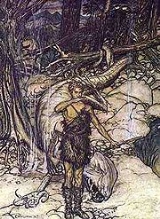
Sigurd

Encyclopedia
Norse mythology
Norse mythology, a subset of Germanic mythology, is the overall term for the myths, legends and beliefs about supernatural beings of Norse pagans. It flourished prior to the Christianization of Scandinavia, during the Early Middle Ages, and passed into Nordic folklore, with some aspects surviving...
, as well as the central character in the Völsunga saga
Volsunga saga
The Völsungasaga is a legendary saga, a late 13th century Icelandic prose rendition of the origin and decline of the Völsung clan . It is largely based on epic poetry...
. The earliest extant representations for his legend come in pictorial form from seven runestones in Sweden
Sweden
Sweden , officially the Kingdom of Sweden , is a Nordic country on the Scandinavian Peninsula in Northern Europe. Sweden borders with Norway and Finland and is connected to Denmark by a bridge-tunnel across the Öresund....
and most notably the Ramsund carving (c. 1000) and the Gök Runestone (11th century).
As Siegfried, he is one of the heroes in the German Nibelungenlied
Nibelungenlied
The Nibelungenlied, translated as The Song of the Nibelungs, is an epic poem in Middle High German. The story tells of dragon-slayer Siegfried at the court of the Burgundians, how he was murdered, and of his wife Kriemhild's revenge....
, and Richard Wagner
Richard Wagner
Wilhelm Richard Wagner was a German composer, conductor, theatre director, philosopher, music theorist, poet, essayist and writer primarily known for his operas...
's operas Siegfried
Siegfried (opera)
Siegfried is the third of the four operas that constitute Der Ring des Nibelungen , by Richard Wagner. It received its premiere at the Bayreuth Festspielhaus on 16 August 1876, as part of the first complete performance of The Ring...
and Götterdämmerung
Götterdämmerung
is the last in Richard Wagner's cycle of four operas titled Der Ring des Nibelungen...
.
As Sivard Snarensven(d) he was the hero of several medieval Scandinavian ballads
The Types of the Scandinavian Medieval Ballad
The Types of the Scandinavian Medieval Ballad classifies all "types" of traditional ballader known in one of more of the Scandinavian languages .In its turn, the list of types is divided into six groups , as infra...
.
The name Sigurðr is not the same name as the German Siegfried. The Old Norse
Old Norse
Old Norse is a North Germanic language that was spoken by inhabitants of Scandinavia and inhabitants of their overseas settlements during the Viking Age, until about 1300....
form would have been Sigruþr, a form which appears in the Ramsund carving that depicts the legend. Sivard is another variant name of Sigurðr; these name forms all share the first element Sig-, which means victory.
Völsunga saga
In the Völsunga sagaVolsunga saga
The Völsungasaga is a legendary saga, a late 13th century Icelandic prose rendition of the origin and decline of the Völsung clan . It is largely based on epic poetry...
, Sigurd was supposedly the posthumous son of Sigmund
Sigmund
This article is about the mythological hero Sigmund; for other meanings see: Sigmund .In Norse mythology, Sigmund is a hero whose story is told in the Völsunga saga. He and his sister, Signý, are the children of Völsung and his wife Hljod...
and his second wife, Hiordis. Sigmund dies in battle when he attacks Odin
Odin
Odin is a major god in Norse mythology and the ruler of Asgard. Homologous with the Anglo-Saxon "Wōden" and the Old High German "Wotan", the name is descended from Proto-Germanic "*Wodanaz" or "*Wōđanaz"....
(who is in disguise), and Odin shatters Sigmund's sword. Dying, Sigmund tells Hiordis of her pregnancy and bequeaths the fragments of his sword to his unborn son.
Hiordis marries King Alf
Yngvi and Alf
Yngvi and Alf were two legendary Swedish kings of the House of Yngling.According to Ynglingatal, Historia Norwegiae and Ynglinga saga, Yngvi and Alf were the sons of Alrik....
, and then Alf decides to send Sigurd to Regin
Regin
Reginn, often Anglicized as Regin, in Norse mythology, was the son of Hreiðmarr and foster father of Sigurd. His brothers are Fafnir and Ótr. When Loki mistakenly kills Ótr, Hreiðmarr demands to be repaid with the amount of gold it takes to fill Ótr's skin and cover the outside. Loki takes this...
as a foster. Regin
Regin
Reginn, often Anglicized as Regin, in Norse mythology, was the son of Hreiðmarr and foster father of Sigurd. His brothers are Fafnir and Ótr. When Loki mistakenly kills Ótr, Hreiðmarr demands to be repaid with the amount of gold it takes to fill Ótr's skin and cover the outside. Loki takes this...
tempts Sigurd to greed and violence by first asking Sigurd if he has control over Sigmund's gold. When Sigurd says that Alf and his family control the gold and will give him anything he desires, Regin asks Sigurd why he consents to a lowly position at court. Sigurd replies that he is treated as an equal by the kings and can get anything he desires. Then Regin asks Sigurd why he acts as stableboy to the kings and has no horse of his own. Sigurd then goes to get a horse. An old man (Odin in disguise) advises Sigurd on choice of horse, and in this way Sigurd gets Grani
Grani
In Norse mythology, Grani is a horse owned by the hero Sigurd. He is the horse that Sigurd receives through advice from an old man . Grani is a descendant of Odin's own steed, Sleipnir.-Attestations:...
, a horse derived from Odin's own Sleipnir
Sleipnir
In Norse mythology, Sleipnir is an eight-legged horse. Sleipnir is attested in the Poetic Edda, compiled in the 13th century from earlier traditional sources, and the Prose Edda, written in the 13th century by Snorri Sturluson...
.
Finally, Regin
Regin
Reginn, often Anglicized as Regin, in Norse mythology, was the son of Hreiðmarr and foster father of Sigurd. His brothers are Fafnir and Ótr. When Loki mistakenly kills Ótr, Hreiðmarr demands to be repaid with the amount of gold it takes to fill Ótr's skin and cover the outside. Loki takes this...
tries to tempt Sigurd by telling him the story of the Otter's Gold. Regin's father was Hreidmar
Hreidmar
In Norse mythology, Hreiðmarr is the avaricious king of the Dwarves, who captured three gods with his unbreakable chains. He was father of Fafnir, Ótr and Regin. He owned a house of glittering gold and flashing gems built by Regin and guarded by Fafnir. After Otr was accidentally killed by Loki,...
, and his two brothers were Ótr
Ótr
In Norse mythology, Ótr is a dwarf. He is the son of the king Hreidmar and the brother of Fafnir and Regin....
and Fafnir
Fafnir
In Norse mythology, Fáfnir or Frænir was a son of the dwarf king Hreidmar and brother of Regin and Ótr. In the Volsunga saga, Fáfnir was a dwarf gifted with a powerful arm and fearless soul. He guarded his father's house of glittering gold and flashing gems...
. Regin was a natural at smithing, and Ótr was natural at swimming. Ótr used to swim at Andvari's waterfall, where the dwarf Andvari
Andvari
In Norse mythology, Andvari is a dwarf who lives underneath a waterfall and has the power to change himself into a fish at will. Andvari had a magical ring Andvarinaut, which helped him become wealthy....
lived. Andvari often assumed the form of a pike and swam in the pool.
One day, the Æsir
Æsir
In Old Norse, áss is the term denoting a member of the principal pantheon in Norse paganism. This pantheon includes Odin, Frigg, Thor, Baldr and Tyr. The second pantheon comprises the Vanir...
saw Ótr
Ótr
In Norse mythology, Ótr is a dwarf. He is the son of the king Hreidmar and the brother of Fafnir and Regin....
with a fish on the banks, thought him an otter
Otter
The Otters are twelve species of semi-aquatic mammals which feed on fish and shellfish, and also other invertebrates, amphibians, birds and small mammals....
, and Loki
Loki
In Norse mythology, Loki or Loke is a god or jötunn . Loki is the son of Fárbauti and Laufey, and the brother of Helblindi and Býleistr. By the jötunn Angrboða, Loki is the father of Hel, the wolf Fenrir, and the world serpent Jörmungandr. By his wife Sigyn, Loki is the father of Nari or Narfi...
killed him. They took the carcass to the nearby home of Hreidmar
Hreidmar
In Norse mythology, Hreiðmarr is the avaricious king of the Dwarves, who captured three gods with his unbreakable chains. He was father of Fafnir, Ótr and Regin. He owned a house of glittering gold and flashing gems built by Regin and guarded by Fafnir. After Otr was accidentally killed by Loki,...
to display their catch. Hreidmar
Hreidmar
In Norse mythology, Hreiðmarr is the avaricious king of the Dwarves, who captured three gods with his unbreakable chains. He was father of Fafnir, Ótr and Regin. He owned a house of glittering gold and flashing gems built by Regin and guarded by Fafnir. After Otr was accidentally killed by Loki,...
, Fafnir
Fafnir
In Norse mythology, Fáfnir or Frænir was a son of the dwarf king Hreidmar and brother of Regin and Ótr. In the Volsunga saga, Fáfnir was a dwarf gifted with a powerful arm and fearless soul. He guarded his father's house of glittering gold and flashing gems...
, and Regin seized the Æsir and demanded compensation for the death of Ótr. The compensation was to stuff the body with gold and cover the skin with fine treasures. Loki got the net from the sea giantess Rán
Rán
In Norse mythology, Rán is a sea goddess. According to Snorri Sturluson's Prose Edda book Skáldskaparmál, in his retelling of the Poetic Edda poem Lokasenna, she is married to Ægir and they have nine daughters together...
, caught Andvari (as a pike), and demanded all of the dwarf's gold. Andvari gave the gold, except for a ring. Loki took this ring, too, although it carried a curse of death on its bearer. The Æsir used this gold to stuff Ótr's body with, and covered his skin in gold. They then covered the last exposed place (a whisker) with the ring of Andvari. Afterwards, Fafnir killed Hreidmar and took the gold.
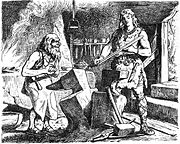
Sigurd agrees to kill Fafnir, who has turned himself into a dragon in order to be better able to guard the gold. Sigurd has Regin make him a sword, which he tests by striking the anvil. The sword shatters, so he has Regin make another. This also shatters. Finally, Sigurd has Regin make a sword out of the fragments that had been left to him by Sigmund
Sigmund
This article is about the mythological hero Sigmund; for other meanings see: Sigmund .In Norse mythology, Sigmund is a hero whose story is told in the Völsunga saga. He and his sister, Signý, are the children of Völsung and his wife Hljod...
. The resulting sword, Gram
Gram (mythology)
In Norse mythology, Gram is the name of the sword that Sigurd used to kill the dragon Fafnir.It was forged by Wayland the Smith and originally belonged to his father, Sigmund, who received it in the hall of the Volsung after pulling it out of the tree Barnstokk into which Odin had stuck...
, cuts through the anvil. To kill Fafnir the dragon, Regin advises him to dig a pit, wait for Fafnir to walk over it, and then stab the dragon. Odin, posing as an old man, advises Sigurd to dig trenches also to drain the blood, and to bathe in it after killing the dragon; bathing in Fafnir's blood confers invulnerability. Sigurd does so and kills Fafnir; Sigurd then bathes in the dragon's blood, which touches all of his body except for one of his shoulders where a leaf was stuck. Regin then asked Sigurd to give him Fafnir's heart for himself. Sigurd drinks some of Fafnir's blood and gains the ability to understand the language of birds
Language of the birds
In mythology, medieval literature and occultism, the language of the birds is postulated as a mystical, perfect divine language, green language, adamic language, enochian language, angelic language or a mythical or magical language used by birds to communicate with the initiated.-History:In...
. Birds advise him to kill Regin, since Regin is plotting Sigurd's death. Sigurd beheads Regin, roasts Fafnir's heart and consumes part of it. This gives him the gift of "wisdom" (prophecy).
Sigurd met Brynhildr
Brynhildr
Brynhildr is a shieldmaiden and a valkyrie in Norse mythology, where she appears as a main character in the Völsunga saga and some Eddic poems treating the same events. Under the name Brünnhilde she appears in the Nibelungenlied and therefore also in Richard Wagner's opera cycle Der Ring des...
, a "shieldmaiden
Shieldmaiden
A shieldmaiden was a woman who had chosen to fight as a warrior in Scandinavian folklore and mythology. They are often mentioned in sagas such as Hervarar saga and in Gesta Danorum. Shieldmaidens also appear in stories of other Germanic nations: Goths, Cimbri, and Marcomanni. The mythical Valkyries...
," after killing Fafnir. She pledges herself to him but also prophesies his doom and marriage to another. (In Völsunga saga, it is not clear that Brynhild is a Valkyrie
Valkyrie
In Norse mythology, a valkyrie is one of a host of female figures who decides who dies in battle. Selecting among half of those who die in battle , the valkyries bring their chosen to the afterlife hall of the slain, Valhalla, ruled over by the god Odin...
or in any way supernatural.)
Sigurd went to the court of Heimar, who was married to Bekkhild, sister of Brynhild, and then to the court of Gjúki
Gjúki
Gjúki was the King of the Burgundians in the late 4th century until his death in or around 407. He was the father of Gundomar I, Giselher, and Gunther....
, where he came to live. Gjuki had three sons and one daughter by his wife, Grimhild
Grimhild
In Norse mythology, Grimhild was a beautiful but evil woman. She was married to king ],] kind of southern Rhine, Burgundy. She had three sons named; Gunnar, Hogni, Guttorm, and a daughter Gudrun. She is the sorceress who gave Sigurd a magic potion that makes him forget that he ever married his...
. The sons were Gunnar
Gunther
Gunther is the German name of a semi-legendary king of Burgundy of the early 5th century...
, Hogni and Guttorm, and the daughter was Gudrun
Gudrun
Gudrun is a major figure in the early Germanic literature centered on the hero Sigurd, son of Sigmund. She appears as Kriemhild in the Nibelungenlied and as Gutrune in Wagner's Der Ring des Nibelungen.-Norse mythology:...
. Grimhild made an "Ale of Forgetfulness" to force Sigurd to forget Brynhild, so he could marry Gudrun. Later, Gunnar wanted to court Brynhild. Brynhild's bower was surrounded by flames, and she promised herself only to the man daring enough to go through them. Only Grani, Sigurd's horse, would do it, and only with Sigurd on it. Sigurd exchanged shapes with Gunnar, rode through the flames, and won Brynhild for Gunnar.
Some time later, Brynhild taunted Gudrun for having a better husband, and Gudrun explained all that had passed to Brynhild and explained the deception. For having been deceived and cheated of the husband she had desired, Brynhild plots revenge. First, she refuses to speak to anyone and withdraws. Eventually, Sigurd was sent by Gunnar to see what was wrong, and Brynhild accuses Sigurd of taking liberties with her. Gunnar and Hogni plot Sigurd's death and enchant their brother, Guttorm, to a frenzy to accomplish the deed. Guttorm kills Sigurd in bed, and Brynhild kills Sigurd's three year old son Sigmund (named for Sigurd's father). Brynhild then wills herself to die, and builds a funeral pyre for Sigurd, Sigurd's son, Guttorm (killed by Sigurd) and herself. Sigurd and Brynhild had the daughter Aslaug
Aslaug
Aslaug, Aslög, Kraka, Kráka or Randalin, was a queen of Scandinavian mythology who appears in Snorri's Edda, the Völsunga saga and the saga of Ragnar Lodbrok.-The Legendary Aslaug:...
who married Ragnar Lodbrok
Ragnar Lodbrok
Ragnar Lodbrok was a Norse legendary hero from the Viking Age who was thoroughly reshaped in Old Norse poetry and legendary sagas.-Life as recorded in the sagas:...
.
Sigurd and Gudrun are parents to the twins Sigmund (named after Sigurd's father) and Svanhild
Svanhild
Svanhild is the beautiful daughter of Sigurd and Gudrun in Germanic mythology, whose grisly death at the hands of her jealous royal husband Ermanaric was told in many northern European stories, including the Icelandic Poetic Edda , Prose Edda and the Volsunga Saga; the Norwegian Ragnarsdrápa; the...
.
Þiðrekssaga
The Old Norse Þiðrekssaga (chapters 152-168) relates a slightly different tale, with ReginRegin
Reginn, often Anglicized as Regin, in Norse mythology, was the son of Hreiðmarr and foster father of Sigurd. His brothers are Fafnir and Ótr. When Loki mistakenly kills Ótr, Hreiðmarr demands to be repaid with the amount of gold it takes to fill Ótr's skin and cover the outside. Loki takes this...
as the dragon and Mimir
Mímir
Mímir or Mim is a figure in Norse mythology renowned for his knowledge and wisdom who is beheaded during the Æsir-Vanir War...
as Regin's brother and foster-father to Sigurd. In this version, King Sigmund returns home from travel and hears that his wife Sisibe has been accused of illicit relations with a thrall. Although the accusation is a lie told by two of his noblemen whose lustful advances Sisibe rejected, Sigmund believes it and orders the noblemen to take her into the forest and kill her. One is moved by pity for her, and the two fight. As they fight, Sisibe gives birth to a child (Sigmund's) and places it in a crystal vessel, which is kicked into a river and travels downstream. Sisibe dies; the vessel is found by a doe, which nurses the infant. Later, the young child is found by a wise smith of the forest, Mimir
Mímir
Mímir or Mim is a figure in Norse mythology renowned for his knowledge and wisdom who is beheaded during the Æsir-Vanir War...
who names him Sigurd (although a few times the saga calls him Sigfred) and takes him as his own. When the child grows large and willful, Mimir asks his brother, Regin
Regin
Reginn, often Anglicized as Regin, in Norse mythology, was the son of Hreiðmarr and foster father of Sigurd. His brothers are Fafnir and Ótr. When Loki mistakenly kills Ótr, Hreiðmarr demands to be repaid with the amount of gold it takes to fill Ótr's skin and cover the outside. Loki takes this...
, a dragon, to kill Sigurd. But Sigurd slays the dragon and then kills his disloyal foster-father.
In chapters 225-230, Sigurd marries Gunnar's sister Grimhild, despite having promised to marry Brynhild. Later, Gunnar marries Brynhild, but she resists his attempts to consummate the marriage because she loves only Sigurd. As a favor to his brother-in-law, Sigurd sleeps with Brynhild, who is thereafter unable to resist Gunnar, as her strength came from her virginity.
Nibelungenlied
In the Middle High German NibelungenliedNibelungenlied
The Nibelungenlied, translated as The Song of the Nibelungs, is an epic poem in Middle High German. The story tells of dragon-slayer Siegfried at the court of the Burgundians, how he was murdered, and of his wife Kriemhild's revenge....
, Sîfrit (Siegfried) is a prince of Xanten
Xanten
Xanten is a historic town in the North Rhine-Westphalia state of Germany, located in the district of Wesel.Xanten is known for the Archaeological Park or archaeological open air museum , its medieval picturesque city centre with Xanten Cathedral and many museums, its large man-made lake for...
who is later revealed to have a heroic background including killing a dragon and winning lands and an immense fortune from a pair of brothers. From bathing in the dragon's blood, he is invulnerable except for a spot on his back where a leaf adhered to his skin. Determined to marry Kriemhild, the sister of King Gunther
Gunther
Gunther is the German name of a semi-legendary king of Burgundy of the early 5th century...
of the Burgundians
Burgundians
The Burgundians were an East Germanic tribe which may have emigrated from mainland Scandinavia to the island of Bornholm, whose old form in Old Norse still was Burgundarholmr , and from there to mainland Europe...
, he assists Gunther in wooing Brünhild, queen of Iceland
Iceland
Iceland , described as the Republic of Iceland, is a Nordic and European island country in the North Atlantic Ocean, on the Mid-Atlantic Ridge. Iceland also refers to the main island of the country, which contains almost all the population and almost all the land area. The country has a population...
, using his cloak of invisibility to enable Gunther to beat the phenomenally strong queen at javelin throwing, boulder tossing, and the long jump. He also single-handedly conquers Nibelungenland to provide troops in case Brünhild tries to kill Gunther and his kin. Finally married to Kriemhild, he then wrestles Brünhild into submission, again invisible, so that Gunther can consummate his marriage. He gives Kriemhilt Brünhild's ring and belt. After some years, the two queens quarrel over precedence and Kriemhild shows Brünhild the ring and belt and calls her Siegfried's concubine. Siegfried and Gunther make peace but Gunther's courtier Hagen von Tronje
Hagen (legend)
Hagen or Högni is a Burgundian warrior in tales about the Burgundian kingdom at Worms. Hagen is often identified as a brother or half-brother of King Gunther .In the Nibelungenlied, he is called Hagen of Tronje...
plots to kill Siegfried and Gunther and his brothers go along with the plan. Hagen has Kriemhild place a cross on the spot on Siegfried's back where he is vulnerable, and spears him when he is drinking from a stream on a hunting trip, thus fulfilling a prophecy that whomever Kriemhild marries will die violently. He throws Siegfried's treasure into the Rhine so that Kriemhild cannot raise an army. The second half of the epic concerns her revenge.
Archaeological record


- how Sigurd is sitting naked in front of the fire preparing the dragon heart, from FafnirFafnirIn Norse mythology, Fáfnir or Frænir was a son of the dwarf king Hreidmar and brother of Regin and Ótr. In the Volsunga saga, Fáfnir was a dwarf gifted with a powerful arm and fearless soul. He guarded his father's house of glittering gold and flashing gems...
, for his foster-father ReginReginReginn, often Anglicized as Regin, in Norse mythology, was the son of Hreiðmarr and foster father of Sigurd. His brothers are Fafnir and Ótr. When Loki mistakenly kills Ótr, Hreiðmarr demands to be repaid with the amount of gold it takes to fill Ótr's skin and cover the outside. Loki takes this...
, who is FafnirFafnirIn Norse mythology, Fáfnir or Frænir was a son of the dwarf king Hreidmar and brother of Regin and Ótr. In the Volsunga saga, Fáfnir was a dwarf gifted with a powerful arm and fearless soul. He guarded his father's house of glittering gold and flashing gems...
's brother. The heart is not yet fully roasted, and when Sigurd touches it, he burns himself and sticks his finger into his mouth. As he has tasted dragon blood (some blood was on the heart), he starts to understand the birds' song. - The birds say that Regin will not keep his promise of reconciliation and will try to kill Sigurd, which causes Sigurd to cut off Regin's head.
- Regin is dead beside his own head, his smithing tools with which he reforged Sigurd's sword GramGram (mythology)In Norse mythology, Gram is the name of the sword that Sigurd used to kill the dragon Fafnir.It was forged by Wayland the Smith and originally belonged to his father, Sigmund, who received it in the hall of the Volsung after pulling it out of the tree Barnstokk into which Odin had stuck...
are scattered around him, and - Regin's horse is laden with the dragon's treasure.
- is the previous event when Sigurd killed Fafnir, and
- ÓtrÓtrIn Norse mythology, Ótr is a dwarf. He is the son of the king Hreidmar and the brother of Fafnir and Regin....
from the saga's beginning.
Other aspects of the legend are shown on the various Sigurd stones
Sigurd stones
The Sigurd stones form a group of seven or eight runestones and one image stone that depict imagery from the legend of Sigurd the dragon slayer...
and the door portals from the Hylestad stave church
Hylestad stave church
The Hylestad stave church was a stave church located in Setesdal, Norway. The church was estimated to have been built in the late 12th to early 13th century and was demolished in the 17th century. Some of the intricate wood carvings from the church doorway were saved and incorporated into other...
.
Parallels in other legends
There are parallels in several European myths and legends.The sword Sigmund draws from Barnstock is similar to the sword
Excalibur
Excalibur is the legendary sword of King Arthur, sometimes attributed with magical powers or associated with the rightful sovereignty of Great Britain. Sometimes Excalibur and the Sword in the Stone are said to be the same weapon, but in most versions they are considered separate. The sword was...
drawn by King Arthur
King Arthur
King Arthur is a legendary British leader of the late 5th and early 6th centuries, who, according to Medieval histories and romances, led the defence of Britain against Saxon invaders in the early 6th century. The details of Arthur's story are mainly composed of folklore and literary invention, and...
from the stone.
The story of Sigurd eating the heart of the dragon is very similar to the Irish story of Fionn mac Cumhail eating the Salmon of Wisdom
Salmon of Wisdom
The Salmon of Knowledge is a creature figuring in the Fenian Cycle of Irish mythology. This salmon was sometimes called Fintan, or Finntan, in ancient times and is sometimes confused with Fintan mac Bóchra who was also known as, "The Wise" and once transformed into a salmon...
he had been preparing for his mentor, Finn Eces
Finn Eces
Finn Eces is a legendary Irish poet and sage, according to the Fenian Cycle of Irish mythology. He is the teacher of Fionn mac Cumhaill, according to the tale The Boyhood Deeds of Fionn. For years he tries to catch the Salmon of Wisdom, a fish that will grant all the world's knowledge to whoever...
.
Sigurd's invulnerability and his weak point (in the Nibelungenlied
Nibelungenlied
The Nibelungenlied, translated as The Song of the Nibelungs, is an epic poem in Middle High German. The story tells of dragon-slayer Siegfried at the court of the Burgundians, how he was murdered, and of his wife Kriemhild's revenge....
) are similar to those of the Greek hero Achilles
Achilles
In Greek mythology, Achilles was a Greek hero of the Trojan War, the central character and the greatest warrior of Homer's Iliad.Plato named Achilles the handsomest of the heroes assembled against Troy....
, the Persian
Persian people
The Persian people are part of the Iranian peoples who speak the modern Persian language and closely akin Iranian dialects and languages. The origin of the ethnic Iranian/Persian peoples are traced to the Ancient Iranian peoples, who were part of the ancient Indo-Iranians and themselves part of...
hero Esfandyar, and the Duryodhana
Duryodhana
In the Hindu epic the Mahābhārata, Duryodhana is the eldest son of the blind king Dhritarashtra by Queen Gandhari, the eldest of the one hundred Kaurava brothers, Emperor of the world at that time which means Emperor of India or Bharatvarsha as it was known at that time, cousin and the chief...
story of India
India
India , officially the Republic of India , is a country in South Asia. It is the seventh-largest country by geographical area, the second-most populous country with over 1.2 billion people, and the most populous democracy in the world...
's Mahabharata
Mahabharata
The Mahabharata is one of the two major Sanskrit epics of ancient India and Nepal, the other being the Ramayana. The epic is part of itihasa....
epic.
Cultural impact
Because dragons were seen as symbols of SatanSatan
Satan , "the opposer", is the title of various entities, both human and divine, who challenge the faith of humans in the Hebrew Bible...
in medieval typologies, the story of Sigurd slaying Fafnir was often depicted in Christian churches in Scandinavia
Scandinavia
Scandinavia is a cultural, historical and ethno-linguistic region in northern Europe that includes the three kingdoms of Denmark, Norway and Sweden, characterized by their common ethno-cultural heritage and language. Modern Norway and Sweden proper are situated on the Scandinavian Peninsula,...
.
Adaptations of the legend
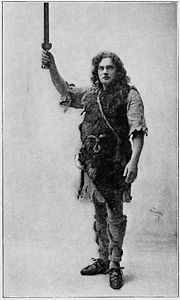
- The best-known adaptation of the Sigurd legend is Richard WagnerRichard WagnerWilhelm Richard Wagner was a German composer, conductor, theatre director, philosopher, music theorist, poet, essayist and writer primarily known for his operas...
's cycle of music dramas Der Ring des NibelungenDer Ring des NibelungenDer Ring des Nibelungen is a cycle of four epic operas by the German composer Richard Wagner . The works are based loosely on characters from the Norse sagas and the Nibelungenlied...
(written between 1848 and 1874). The Sigurd legend is the basis of SiegfriedSiegfried (opera)Siegfried is the third of the four operas that constitute Der Ring des Nibelungen , by Richard Wagner. It received its premiere at the Bayreuth Festspielhaus on 16 August 1876, as part of the first complete performance of The Ring...
and contributes the stories of Die WalküreDie WalküreDie Walküre , WWV 86B, is the second of the four operas that form the cycle Der Ring des Nibelungen , by Richard Wagner...
and GötterdämmerungGötterdämmerungis the last in Richard Wagner's cycle of four operas titled Der Ring des Nibelungen...
. - William MorrisWilliam MorrisWilliam Morris 24 March 18343 October 1896 was an English textile designer, artist, writer, and socialist associated with the Pre-Raphaelite Brotherhood and the English Arts and Crafts Movement...
's epic poem Sigurd the VolsungThe Story of Sigurd the Volsung and the Fall of the NiblungsThe Story of Sigurd the Volsung and the Fall of the Niblungs is an epic poem by William Morris, telling the tragic story of the Norse hero Sigmund, his son Sigurd and Sigurd's wife Gudrun...
(1876) is a major retelling of the story in English verse. - In 1884 the French composer Ernest ReyerErnest ReyerErnest Reyer, the adopted name of Louis Étienne Ernest Rey, was a French opera composer and music critic .- Biography :...
wrote the lesser-known opera SigurdSigurd (opera)Sigurd is an opera in four acts and nine scenes by the French composer Ernest Reyer on a libretto by Camille du Locle and Alfred Blau. Like Wagner's Ring of the Nibelung, the story is based on the Niebelungenlied and the Eddas, with some crucial differences from the better known Wagnerian version...
, which has the benefit of condensing the story into one evening, with equally stirring music. - The illustrator Arthur RackhamArthur RackhamArthur Rackham was an English book illustrator.-Biography:Rackham was born in London as one of 12 children. At the age of 18, he worked as a clerk at the Westminster Fire Office and began studying part-time at the Lambeth School of Art.In 1892 he left his job and started working for The...
drew 70 vibrant renderings of the story for the book Siegfried & The Twilight of the Gods, translated by Margaret Armour (1910). - Arthur Peterson published a translation of the myth of Sigurd titled Andvari's Ring, in 1916.
- Fritz LangFritz LangFriedrich Christian Anton "Fritz" Lang was an Austrian-American filmmaker, screenwriter, and occasional film producer and actor. One of the best known émigrés from Germany's school of Expressionism, he was dubbed the "Master of Darkness" by the British Film Institute...
and his then-wife Thea von HarbouThea von HarbouThea Gabriele von Harbou was a German actress, author and film director of Prussian aristocratic origin. She was born in Tauperlitz in the Kingdom of Bavaria.-Early work:...
adapted the story of Sigurd (called Siegfried) for the first part of their 1924 pair of silent films Die NibelungenDie NibelungenDie Nibelungen is a series of two silent fantasy films created by Austrian director Fritz Lang in 1924: Die Nibelungen: Siegfried and Die Nibelungen: Kriemhild's Revenge....
. - This legend was also adapted into a movie, Dark Kingdom: The Dragon KingDark Kingdom: The Dragon KingDark Kingdom: The Dragon King is a fantasy film and mini-series based on the Norse mythology story Völsungasaga and the German epic poem Nibelungenlied, which tells the mythological story of Siegfried the Dragon-Slayer...
(2004) (SyFy miniseries in 2006). - Fantasy author Diana L. PaxsonDiana L. PaxsonDiana L. Paxson is an author, primarily in the fields of Paganism and Heathenism. Her published works include fantasy and historical fiction novels, as well as numerous short stories...
retold the story in her trilogy Wodan's Children: The Wolf and the Raven (1993), The Dragons of the Rhine (1995), and The Lord of Horses (1996). - Stephan GrundyStephan GrundyStephan Grundy is an American author best known for his modern adaptations of legendary sagas and also a non-fiction writer on Germanic mythology, Germanic paganism, and Germanic neopaganism, often under the pseudonym Kveldulf Gundarsson .Grundy grew up mainly in Dallas in the U.S...
retold the story in his novel Rhinegold (1995). - The Faroese vikingViking metalViking metal is a subgenre of heavy metal music characterized by its galloping pace, keyboard-rich anthemic sound, bleakness and dramatic emphasis on lyrical themes of Norse mythology, Norse paganism, and the Viking Age...
/ folk metalFolk metalFolk metal is a sub-genre of heavy metal music that developed in Europe during the 1990s. As the name suggests, the genre is a fusion of heavy metal with traditional folk music...
band TýrTýr (band)Týr, , is a folk metal band from the Faroe Islands. Their subject matter revolves almost entirely around old Nordic lore, mythology, and history, taking their name from a Norse god of war. They signed a worldwide deal with Austria's Napalm Records in early 2006, while signed to the Faroese record...
, has a song named "Regin Smiður", which is based on the a Faroese kvæði in three parts, Sjúrðarkvæðið, which chronicles the life of Sigurd . - An adaptation of the legend written in verse by Oxford philology professor and fantasy author J.R.R. Tolkien, The Legend of Sigurd and GudrúnThe Legend of Sigurd and GudrúnThe Legend of Sigurd and Gudrún is a narrative poem composed by J. R. R. Tolkien. The book was released worldwide on May 5, 2009 by Houghton Mifflin Harcourt and HarperCollins....
, was released in May, 2009. - In the Soul CaliburSoul Caliburis a 3D, weapons-based fighting game developed by Project Soul and produced by Namco. It is the second game in the Soul series, preceeded by Soul Edge. It was released in arcades in 1998, and it ran on the Namco System 12 hardware. In 1999 it was ported to the Dreamcast with improved graphics and...
series, a character named Siegfried Schtauffen is the main protagonist of the games. The sword GramGram (mythology)In Norse mythology, Gram is the name of the sword that Sigurd used to kill the dragon Fafnir.It was forged by Wayland the Smith and originally belonged to his father, Sigmund, who received it in the hall of the Volsung after pulling it out of the tree Barnstokk into which Odin had stuck...
(mistranslated as "Glam") is one of his many selectable weapons. - The Japanese animated series Saint SeiyaSaint Seiya, also known as Saint Seiya: Knights of the Zodiac or simply Knights of the Zodiac, is a Japanese manga series written and illustrated by Masami Kurumada and serialized in Weekly Shōnen Jump from 1986 to 1991, and adapted into an anime TV series by Toei Animation from 1986 to 1989.The story follows...
presented an arc based on Norse mythology. The main character, Seiya, must fight against Siegfried, a knight whose background story is very similar to that of Sigurd—He killed the dragon Fafnir with a spear, but he did not eat his heart, instead, he was completely showered by its blood making him essentially immortal, except for a spot in his back, which was covered by a leaf, making it his only weak point. This arc was not present in the Manga version of Saint Seiya. - Sigurd is a recurring character in various songs of the album Buch der Balladen by the German pagan folk band FaunFaun (band)Faun is a German band formed in 2002 who play pagan folk, darkwave and medieval music. The originality of their music style is that they fall back to "old" instruments, and the singing is always the center of attention. The vocals are performed in a variety of languages, including German, Latin,...
. - The game Infinite UndiscoveryInfinite Undiscoveryis an action role-playing video game developed by tri-Ace and published by Square Enix exclusively for the Xbox 360. The game was released during September 2008 in Europe, Japan, and North America.-Gameplay:...
has this character as the father of the protaganist. - In the Assassin's CreedAssassin's CreedAssassin's Creed is an award-winning historical third person, stealth action-adventure video game developed by Ubisoft for PlayStation 3, Xbox 360 and Microsoft Windows. The bulk of the game takes place during the Third Crusade, with the plot revolving around a sect known as the Secret Order of...
game series, it is revealed that the sword in Sigfried's possession is in fact a Piece of Eden.
See also
- ArminiusArminiusArminius , also known as Armin or Hermann was a chieftain of the Germanic Cherusci who defeated a Roman army in the Battle of the Teutoburg Forest...
- Sigebert ISigebert ISigebert I was the king of Austrasia from the death of his father in 561 to his own death. He was the third surviving son out of four of Clotaire I and Ingund...
- Siegfried (opera)Siegfried (opera)Siegfried is the third of the four operas that constitute Der Ring des Nibelungen , by Richard Wagner. It received its premiere at the Bayreuth Festspielhaus on 16 August 1876, as part of the first complete performance of The Ring...
- Sigurd (opera)Sigurd (opera)Sigurd is an opera in four acts and nine scenes by the French composer Ernest Reyer on a libretto by Camille du Locle and Alfred Blau. Like Wagner's Ring of the Nibelung, the story is based on the Niebelungenlied and the Eddas, with some crucial differences from the better known Wagnerian version...