


Hellenistic religion

Encyclopedia
Hellenistic religion is any of the various systems of beliefs and practices of the people who lived under the influence of ancient Greek
culture during the Hellenistic period
and the Roman Empire
(c. 300 BCE to 300 CE). There was much continuity in Hellenistic religion: the Greek gods continued to be worshiped, and the same rites were practiced as before. Change came from the addition of new religions from other countries, such as including the Egypt
ian god(esse)s of Isis
and Serapis
, and the Syria
n gods of Atargatis
and of Hadad
, which provided a new outlet for people seeking fulfillment in both the present life and the afterlife
. The worship of Hellenistic rulers was also a feature of this period, most notably in Egypt, where the Ptolemies
adopted earlier pharaonic practice, and established themselves as god-kings. Elsewhere rulers might receive divine status without the full status of a god.
Magic
was practiced widely, and these too, were a continuation from earlier times. Throughout the Hellenistic world, people would consult oracle
s, and use charms
and figurines to deter misfortune or to cast spells. Also developed in this era was the complex system of astrology
, which sought to determine a person's character and future in the movements of the sun
, moon
, and planets. The systems of Hellenistic philosophy
, such as Stoicism
and Epicureanism
, offered an alternative to traditional religion, even if their impact was largely limited to the educated elite.
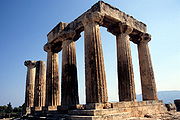 Central to Greek religion in classical times were the twelve Olympian deities
headed by Zeus
. Each god was honored with stone temples
and statues
, and sanctuaries (sacred enclosures) were founded, which, although dedicated to a specific deity, often contained statues commemorating other gods. The city-states would conduct various festivals and rituals throughout the year, with particular emphasis directed towards the patron god of the city, such as Athena
at Athens
, or Apollo
at Corinth
. Religious practice would also involve the worship of heroes
, people who were regarded as semi-divine. Such heroes ranged from the mythical figures in the epics of Homer
to historical people such as the founder of a city. At the local level, the landscape was filled with sacred spots and monuments; for example, many statues of Nymphs were found near and around springs
, and the stylized figures of Hermes
could often be found on street corners. Magic
was a central part of Greek religion and oracle
s would allow people to determine divine will in the rustle of leaves; the shape of flame and smoke on an altar; the flight of birds; the noises made by a spring; or in the entrails of an animal. Also long established were the Eleusinian Mysteries
, associated with Demeter
and Persephone
. People were indoctrinated into mystery religions through initiation ceremonies, which were traditionally kept secret.These religions often had a goal of personal improvement, which would also extend to the afterlife
.
and Egypt
. The most significant changes to impact on Greek religion were the loss of independence of the Greek city-states to Macedon
ian rulers; the importation of foreign deities; and the development of new philosophical systems
. Older surveys of Hellenistic religion tended to depict the era as one of religious decline, discerning a rise in scepticism
, agnosticism
and atheism
, as well as an increase in superstition
, mysticism
, and astrology
. There is, however, no reason to suppose that there was a decline in the traditional religion. There is plenty of documentary evidence that the Greeks continued to worship the same gods with the same sacrifices, dedications, and festivals as in the classical period. New religions did appear in this period, but not to the exclusion of the local deities, and only a minority of Greeks were attracted to them.
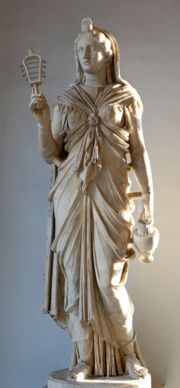 The Egyptian religion which follows Isis
was the most famous of the new religions. The religion was introduced to Greece by Egyptian priests, initially for the small Egyptian communities in the port cities of the Greek world. Although the Egyptian religion found only a small audience among the Greeks themselves, her popularity spread under the Roman empire
, and Diodorus Siculus
wrote that the religion was known throughout almost the whole inhabited world. Almost as famous was Serapis
, a Greek religion despite the Egyptian name, which was created in Egypt under the Ptolemaic dynasty
. Serapis was patronized by the Greeks who had settled in Egypt. This religion involved initiation rites like the Eleusinian Mysteries. Strabo
wrote of the Serapeion
at Canopus
near Alexandria
as being patronized by the most reputable men. The religion of Atargatis
(related to the Babylonian and Assyrian Ishtar
and Phoenician Astarte
), a fertility goddess from Syria
, was also popular. By the 3rd century BCE her worship had spread from Syria to Egypt and Greece, and eventually reached Italy
and the west. The religion following Cybele
(or the Great Mother) came from Phrygia
to Greece and then to Egypt and Italy, where in 204 BCE the Roman Senate
permitted her worship. She was a healing and protecting goddess, and a guardian of fertility and wild nature. Another mystery religion was focused around Dionysus
. Although rare in mainland Greece, it was common on the islands and in Anatolia
. The members were known as Bacchants, and the rites had an orgiastic
character.
These newly introduced religions and gods only had a limited impact within Greece itself; the main exception was at Delos
, which was a major port and trading center. The island was sacred as the birthplace of Apollo
and Artemis
, and by the 2nd century BCE was also home to the native Greek religions that follow Zeus, Athena, Dionysus, Hermes, Pan
, and Asclepius
. But there were also cult centers for the Egyptian Sarapis and Isis, and of the Syrian Atargatis and Hadad
. By the 1st century BCE there were additional religions that followed Ba'al and Astarte, a Jewish Synagogue
and Romans who followed the original Roman religions of gods like Apollo and Neptune.
under Ptolemy I Soter
, we find Alexander being honored as a god. Ptolemy's son Ptolemy II Philadelphus
proclaimed his late father a god, and made himself a living god. By doing so, the Ptolemies were adapting earlier Egyptian ideas in pharaonic
worship. Elsewhere, practice varied; a ruler might receive divine status without the full status of a god, as occurred in Athens
in 307 BCE, when Antigonus I Monophthalmus
and Demetrius I Poliorcetes were honored as saviors (soteres) for liberating the city, and, as a result, an altar was erected; an annual festival was founded; and an office of the "priest of the Saviours" was introduced. Temples dedicated to rulers were rare, but their statues were often erected in other temples, and the kings would be worshiped as "temple-sharing gods."
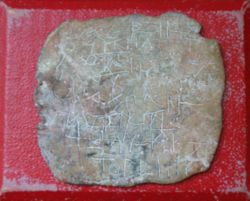 There is ample evidence for the use of magic in this period. Oracular shrines and sanctuaries were still popular. There is also much evidence for the use of charms
and curse
s. Symbols would be placed on the doors of houses to bring good luck or deter misfortune for the occupants within. Charms, often cut in precious or semi-precious stone, had protective power. Figurines, manufactured from bronze, lead, or terracotta, were pierced with pins or nails, and used to cast spells. Curse tablet
s made from marble or metal (especially lead
) were used for curses.
Astrology
- the belief that stars and planets influence a person's future - arose in Babylonia
, where it was originally only applied to the king or nation. The Greeks, in the Hellenistic era, elaborated it into the fantastically complex system of Hellenistic astrology
familiar to later times. Interest in astrology grew rapidly from the 1st century BCE onwards.
, which taught that life should be lived according to the rational order which the Stoics believed governed the universe; human-beings had to accept their fate
as according to divine will, and virtuous acts should be performed for their own intrinsic value. Its principal rival was Epicureanism
, which taught that the universe was subject to the random movements of atoms, and life should be lived to achieve psychological contentment and the absence of pain. Other philosophers such as the Cynics, who expressed contempt for convention and material possessions, and the Academics
and Peripatetics, who studied the works of Plato
and Aristotle
, also flourished. All of these philosophies, to a greater or lesser extent, sought to accommodate traditional Greek religion, but the philosophers, and those who studied under them, remained a small select group, limited largely to the educated elite.
Ancient Greece
Ancient Greece is a civilization belonging to a period of Greek history that lasted from the Archaic period of the 8th to 6th centuries BC to the end of antiquity. Immediately following this period was the beginning of the Early Middle Ages and the Byzantine era. Included in Ancient Greece is the...
culture during the Hellenistic period
Hellenistic period
The Hellenistic period or Hellenistic era describes the time which followed the conquests of Alexander the Great. It was so named by the historian J. G. Droysen. During this time, Greek cultural influence and power was at its zenith in Europe and Asia...
and the Roman Empire
Roman Empire
The Roman Empire was the post-Republican period of the ancient Roman civilization, characterised by an autocratic form of government and large territorial holdings in Europe and around the Mediterranean....
(c. 300 BCE to 300 CE). There was much continuity in Hellenistic religion: the Greek gods continued to be worshiped, and the same rites were practiced as before. Change came from the addition of new religions from other countries, such as including the Egypt
Ancient Egypt
Ancient Egypt was an ancient civilization of Northeastern Africa, concentrated along the lower reaches of the Nile River in what is now the modern country of Egypt. Egyptian civilization coalesced around 3150 BC with the political unification of Upper and Lower Egypt under the first pharaoh...
ian god(esse)s of Isis
Isis
Isis or in original more likely Aset is a goddess in Ancient Egyptian religious beliefs, whose worship spread throughout the Greco-Roman world. She was worshipped as the ideal mother and wife as well as the matron of nature and magic...
and Serapis
Serapis
Serapis or Sarapis is a Graeco-Egyptian name of God. Serapis was devised during the 3rd century BC on the orders of Ptolemy I of Egypt as a means to unify the Greeks and Egyptians in his realm. The god was depicted as Greek in appearance, but with Egyptian trappings, and combined iconography...
, and the Syria
Greater Syria
Greater Syria , also known simply as Syria, is a term that denotes a region in the Near East bordering the Eastern Mediterranean Sea or the Levant....
n gods of Atargatis
Atargatis
Atargatis, in Aramaic ‘Atar‘atah, was a Syrian deity, " great goddess of northern Syria" ,"the great mistress of the North Syrian lands" Rostovtseff called her, commonly known to the ancient Greeks by a shortened form of the name, Aphrodite Derceto or Derketo and as Dea Syria, "Goddess of Syria"...
and of Hadad
Hadad
Haddad was a northwest Semitic storm and rain god, cognate in name and origin with the Akkadian god Adad. Hadad was often called simply Ba‘al , but this title was also used for other gods. The bull was the symbolic animal of Hadad. He appeared as a bearded deity, often shown as holding a club and...
, which provided a new outlet for people seeking fulfillment in both the present life and the afterlife
Afterlife
The afterlife is the belief that a part of, or essence of, or soul of an individual, which carries with it and confers personal identity, survives the death of the body of this world and this lifetime, by natural or supernatural means, in contrast to the belief in eternal...
. The worship of Hellenistic rulers was also a feature of this period, most notably in Egypt, where the Ptolemies
Ptolemaic dynasty
The Ptolemaic dynasty, was a Macedonian Greek royal family which ruled the Ptolemaic Empire in Egypt during the Hellenistic period. Their rule lasted for 275 years, from 305 BC to 30 BC...
adopted earlier pharaonic practice, and established themselves as god-kings. Elsewhere rulers might receive divine status without the full status of a god.
Magic
Magic in the Greco-Roman world
The study of magic in the Greco-Roman world is a branch of the disciplines of classics, ancient history and religious studies. In the ancient post-hellenistic world of the Greeks and Romans , the public and private rituals associated with religion are accepted by historians and archaeologists to...
was practiced widely, and these too, were a continuation from earlier times. Throughout the Hellenistic world, people would consult oracle
Oracle
In Classical Antiquity, an oracle was a person or agency considered to be a source of wise counsel or prophetic predictions or precognition of the future, inspired by the gods. As such it is a form of divination....
s, and use charms
Amulet
An amulet, similar to a talisman , is any object intended to bring good luck or protection to its owner.Potential amulets include gems, especially engraved gems, statues, coins, drawings, pendants, rings, plants and animals; even words said in certain occasions—for example: vade retro satana—, to...
and figurines to deter misfortune or to cast spells. Also developed in this era was the complex system of astrology
Hellenistic astrology
Hellenistic astrology is a tradition of horoscopic astrology that was developed and practiced in Hellenistic Egypt and the Mediterranean, whose texts were written in Greek , mainly around the late 2nd or early 1st century B.C.E...
, which sought to determine a person's character and future in the movements of the sun
Sun
The Sun is the star at the center of the Solar System. It is almost perfectly spherical and consists of hot plasma interwoven with magnetic fields...
, moon
Moon
The Moon is Earth's only known natural satellite,There are a number of near-Earth asteroids including 3753 Cruithne that are co-orbital with Earth: their orbits bring them close to Earth for periods of time but then alter in the long term . These are quasi-satellites and not true moons. For more...
, and planets. The systems of Hellenistic philosophy
Hellenistic philosophy
Hellenistic philosophy is the period of Western philosophy that was developed in the Hellenistic civilization following Aristotle and ending with the beginning of Neoplatonism.-Pythagoreanism:...
, such as Stoicism
Stoicism
Stoicism is a school of Hellenistic philosophy founded in Athens by Zeno of Citium in the early . The Stoics taught that destructive emotions resulted from errors in judgment, and that a sage, or person of "moral and intellectual perfection," would not suffer such emotions.Stoics were concerned...
and Epicureanism
Epicureanism
Epicureanism is a system of philosophy based upon the teachings of Epicurus, founded around 307 BC. Epicurus was an atomic materialist, following in the steps of Democritus. His materialism led him to a general attack on superstition and divine intervention. Following Aristippus—about whom...
, offered an alternative to traditional religion, even if their impact was largely limited to the educated elite.
Classical Greek religion
Twelve Olympians
The Twelve Olympians, also known as the Dodekatheon , in Greek mythology, were the principal deities of the Greek pantheon, residing atop Mount Olympus. Zeus, Hera, Poseidon, Demeter, Hestia, and Hades were siblings. Ares, Hermes, Hephaestus, Athena, Apollo, and Artemis were children of Zeus...
headed by Zeus
Zeus
In the ancient Greek religion, Zeus was the "Father of Gods and men" who ruled the Olympians of Mount Olympus as a father ruled the family. He was the god of sky and thunder in Greek mythology. His Roman counterpart is Jupiter and his Etruscan counterpart is Tinia.Zeus was the child of Cronus...
. Each god was honored with stone temples
Greek temple
Greek temples were structures built to house deity statues within Greek sanctuaries in Greek paganism. The temples themselves did usually not directly serve a cult purpose, since the sacrifices and rituals dedicated to the respective deity took place outside them...
and statues
Ancient Greek sculpture
Ancient Greek sculpture is the sculpture of Ancient Greece. Modern scholarship identifies three major stages. They were used to depict the battles, mythology, and rulers of the land known as Ancient Greece.-Geometric:...
, and sanctuaries (sacred enclosures) were founded, which, although dedicated to a specific deity, often contained statues commemorating other gods. The city-states would conduct various festivals and rituals throughout the year, with particular emphasis directed towards the patron god of the city, such as Athena
Athena
In Greek mythology, Athena, Athenê, or Athene , also referred to as Pallas Athena/Athene , is the goddess of wisdom, courage, inspiration, civilization, warfare, strength, strategy, the arts, crafts, justice, and skill. Minerva, Athena's Roman incarnation, embodies similar attributes. Athena is...
at Athens
Athens
Athens , is the capital and largest city of Greece. Athens dominates the Attica region and is one of the world's oldest cities, as its recorded history spans around 3,400 years. Classical Athens was a powerful city-state...
, or Apollo
Apollo
Apollo is one of the most important and complex of the Olympian deities in Greek and Roman mythology...
at Corinth
Corinth
Corinth is a city and former municipality in Corinthia, Peloponnese, Greece. Since the 2011 local government reform it is part of the municipality Corinth, of which it is the seat and a municipal unit...
. Religious practice would also involve the worship of heroes
Greek hero cult
Hero cults were one of the most distinctive features of ancient Greek religion. In Homeric Greek, "hero" refers to a man who was fighting on either side during the Trojan War...
, people who were regarded as semi-divine. Such heroes ranged from the mythical figures in the epics of Homer
Homer
In the Western classical tradition Homer , is the author of the Iliad and the Odyssey, and is revered as the greatest ancient Greek epic poet. These epics lie at the beginning of the Western canon of literature, and have had an enormous influence on the history of literature.When he lived is...
to historical people such as the founder of a city. At the local level, the landscape was filled with sacred spots and monuments; for example, many statues of Nymphs were found near and around springs
Spring (hydrosphere)
A spring—also known as a rising or resurgence—is a component of the hydrosphere. Specifically, it is any natural situation where water flows to the surface of the earth from underground...
, and the stylized figures of Hermes
Hermes
Hermes is the great messenger of the gods in Greek mythology and a guide to the Underworld. Hermes was born on Mount Kyllini in Arcadia. An Olympian god, he is also the patron of boundaries and of the travelers who cross them, of shepherds and cowherds, of the cunning of thieves, of orators and...
could often be found on street corners. Magic
Magic in the Greco-Roman world
The study of magic in the Greco-Roman world is a branch of the disciplines of classics, ancient history and religious studies. In the ancient post-hellenistic world of the Greeks and Romans , the public and private rituals associated with religion are accepted by historians and archaeologists to...
was a central part of Greek religion and oracle
Oracle
In Classical Antiquity, an oracle was a person or agency considered to be a source of wise counsel or prophetic predictions or precognition of the future, inspired by the gods. As such it is a form of divination....
s would allow people to determine divine will in the rustle of leaves; the shape of flame and smoke on an altar; the flight of birds; the noises made by a spring; or in the entrails of an animal. Also long established were the Eleusinian Mysteries
Eleusinian Mysteries
The Eleusinian Mysteries were initiation ceremonies held every year for the cult of Demeter and Persephone based at Eleusis in ancient Greece. Of all the mysteries celebrated in ancient times, these were held to be the ones of greatest importance...
, associated with Demeter
Demeter
In Greek mythology, Demeter is the goddess of the harvest, who presided over grains, the fertility of the earth, and the seasons . Her common surnames are Sito as the giver of food or corn/grain and Thesmophoros as a mark of the civilized existence of agricultural society...
and Persephone
Persephone
In Greek mythology, Persephone , also called Kore , is the daughter of Zeus and the harvest-goddess Demeter, and queen of the underworld; she was abducted by Hades, the god-king of the underworld....
. People were indoctrinated into mystery religions through initiation ceremonies, which were traditionally kept secret.These religions often had a goal of personal improvement, which would also extend to the afterlife
Afterlife
The afterlife is the belief that a part of, or essence of, or soul of an individual, which carries with it and confers personal identity, survives the death of the body of this world and this lifetime, by natural or supernatural means, in contrast to the belief in eternal...
.
Hellenistic religion
In the aftermath of the conquests of Alexander the Great, Greek culture spread widely and came into much closer contact with the civilizations of the Near EastNear East
The Near East is a geographical term that covers different countries for geographers, archeologists, and historians, on the one hand, and for political scientists, economists, and journalists, on the other...
and Egypt
Egypt
Egypt , officially the Arab Republic of Egypt, Arabic: , is a country mainly in North Africa, with the Sinai Peninsula forming a land bridge in Southwest Asia. Egypt is thus a transcontinental country, and a major power in Africa, the Mediterranean Basin, the Middle East and the Muslim world...
. The most significant changes to impact on Greek religion were the loss of independence of the Greek city-states to Macedon
Macedon
Macedonia or Macedon was an ancient kingdom, centered in the northeastern part of the Greek peninsula, bordered by Epirus to the west, Paeonia to the north, the region of Thrace to the east and Thessaly to the south....
ian rulers; the importation of foreign deities; and the development of new philosophical systems
Hellenistic philosophy
Hellenistic philosophy is the period of Western philosophy that was developed in the Hellenistic civilization following Aristotle and ending with the beginning of Neoplatonism.-Pythagoreanism:...
. Older surveys of Hellenistic religion tended to depict the era as one of religious decline, discerning a rise in scepticism
Religious skepticism
Religious skepticism is a type of skepticism relating to religion, but should not be confused with atheism. Religious skeptics question religious authority and are not necessarily anti-religious but are those skeptical of a specific or all religious beliefs or practices. Some are deists, believing...
, agnosticism
Agnosticism
Agnosticism is the view that the truth value of certain claims—especially claims about the existence or non-existence of any deity, but also other religious and metaphysical claims—is unknown or unknowable....
and atheism
Atheism
Atheism is, in a broad sense, the rejection of belief in the existence of deities. In a narrower sense, atheism is specifically the position that there are no deities...
, as well as an increase in superstition
Superstition
Superstition is a belief in supernatural causality: that one event leads to the cause of another without any process in the physical world linking the two events....
, mysticism
Mysticism
Mysticism is the knowledge of, and especially the personal experience of, states of consciousness, i.e. levels of being, beyond normal human perception, including experience and even communion with a supreme being.-Classical origins:...
, and astrology
Astrology
Astrology consists of a number of belief systems which hold that there is a relationship between astronomical phenomena and events in the human world...
. There is, however, no reason to suppose that there was a decline in the traditional religion. There is plenty of documentary evidence that the Greeks continued to worship the same gods with the same sacrifices, dedications, and festivals as in the classical period. New religions did appear in this period, but not to the exclusion of the local deities, and only a minority of Greeks were attracted to them.
New religions of the period
Isis
Isis or in original more likely Aset is a goddess in Ancient Egyptian religious beliefs, whose worship spread throughout the Greco-Roman world. She was worshipped as the ideal mother and wife as well as the matron of nature and magic...
was the most famous of the new religions. The religion was introduced to Greece by Egyptian priests, initially for the small Egyptian communities in the port cities of the Greek world. Although the Egyptian religion found only a small audience among the Greeks themselves, her popularity spread under the Roman empire
Roman Empire
The Roman Empire was the post-Republican period of the ancient Roman civilization, characterised by an autocratic form of government and large territorial holdings in Europe and around the Mediterranean....
, and Diodorus Siculus
Diodorus Siculus
Diodorus Siculus was a Greek historian who flourished between 60 and 30 BC. According to Diodorus' own work, he was born at Agyrium in Sicily . With one exception, antiquity affords no further information about Diodorus' life and doings beyond what is to be found in his own work, Bibliotheca...
wrote that the religion was known throughout almost the whole inhabited world. Almost as famous was Serapis
Serapis
Serapis or Sarapis is a Graeco-Egyptian name of God. Serapis was devised during the 3rd century BC on the orders of Ptolemy I of Egypt as a means to unify the Greeks and Egyptians in his realm. The god was depicted as Greek in appearance, but with Egyptian trappings, and combined iconography...
, a Greek religion despite the Egyptian name, which was created in Egypt under the Ptolemaic dynasty
Ptolemaic dynasty
The Ptolemaic dynasty, was a Macedonian Greek royal family which ruled the Ptolemaic Empire in Egypt during the Hellenistic period. Their rule lasted for 275 years, from 305 BC to 30 BC...
. Serapis was patronized by the Greeks who had settled in Egypt. This religion involved initiation rites like the Eleusinian Mysteries. Strabo
Strabo
Strabo, also written Strabon was a Greek historian, geographer and philosopher.-Life:Strabo was born to an affluent family from Amaseia in Pontus , a city which he said was situated the approximate equivalent of 75 km from the Black Sea...
wrote of the Serapeion
Serapeum
A serapeum is a temple or other religious institution dedicated to the syncretic Hellenistic-Egyptian god Serapis, who combined aspects of Osiris and Apis in a humanized form that was accepted by the Ptolemaic Greeks of Alexandria...
at Canopus
Canopus, Egypt
Canopus was an Ancient Egyptian coastal town, located in the Nile Delta. Its site is in the eastern outskirts of modern-day Alexandria, around 25 kilometres from the centre of that city....
near Alexandria
Alexandria
Alexandria is the second-largest city of Egypt, with a population of 4.1 million, extending about along the coast of the Mediterranean Sea in the north central part of the country; it is also the largest city lying directly on the Mediterranean coast. It is Egypt's largest seaport, serving...
as being patronized by the most reputable men. The religion of Atargatis
Atargatis
Atargatis, in Aramaic ‘Atar‘atah, was a Syrian deity, " great goddess of northern Syria" ,"the great mistress of the North Syrian lands" Rostovtseff called her, commonly known to the ancient Greeks by a shortened form of the name, Aphrodite Derceto or Derketo and as Dea Syria, "Goddess of Syria"...
(related to the Babylonian and Assyrian Ishtar
Ishtar
Ishtar is the Assyrian and Babylonian goddess of fertility, love, war, and sex. She is the counterpart to the Sumerian Inanna and to the cognate north-west Semitic goddess Astarte.-Characteristics:...
and Phoenician Astarte
Astarte
Astarte is the Greek name of a goddess known throughout the Eastern Mediterranean from the Bronze Age to Classical times...
), a fertility goddess from Syria
Greater Syria
Greater Syria , also known simply as Syria, is a term that denotes a region in the Near East bordering the Eastern Mediterranean Sea or the Levant....
, was also popular. By the 3rd century BCE her worship had spread from Syria to Egypt and Greece, and eventually reached Italy
Italy
Italy , officially the Italian Republic languages]] under the European Charter for Regional or Minority Languages. In each of these, Italy's official name is as follows:;;;;;;;;), is a unitary parliamentary republic in South-Central Europe. To the north it borders France, Switzerland, Austria and...
and the west. The religion following Cybele
Cybele
Cybele , was a Phrygian form of the Earth Mother or Great Mother. As with Greek Gaia , her Minoan equivalent Rhea and some aspects of Demeter, Cybele embodies the fertile Earth...
(or the Great Mother) came from Phrygia
Phrygia
In antiquity, Phrygia was a kingdom in the west central part of Anatolia, in what is now modern-day Turkey. The Phrygians initially lived in the southern Balkans; according to Herodotus, under the name of Bryges , changing it to Phruges after their final migration to Anatolia, via the...
to Greece and then to Egypt and Italy, where in 204 BCE the Roman Senate
Roman Senate
The Senate of the Roman Republic was a political institution in the ancient Roman Republic, however, it was not an elected body, but one whose members were appointed by the consuls, and later by the censors. After a magistrate served his term in office, it usually was followed with automatic...
permitted her worship. She was a healing and protecting goddess, and a guardian of fertility and wild nature. Another mystery religion was focused around Dionysus
Dionysus
Dionysus was the god of the grape harvest, winemaking and wine, of ritual madness and ecstasy in Greek mythology. His name in Linear B tablets shows he was worshipped from c. 1500—1100 BC by Mycenean Greeks: other traces of Dionysian-type cult have been found in ancient Minoan Crete...
. Although rare in mainland Greece, it was common on the islands and in Anatolia
Anatolia
Anatolia is a geographic and historical term denoting the westernmost protrusion of Asia, comprising the majority of the Republic of Turkey...
. The members were known as Bacchants, and the rites had an orgiastic
Orgy
In modern usage, an orgy is a sex party where guests engage in promiscuous or multifarious sexual activity or group sex. An orgy is similar to debauchery, which refers to excessive indulgence in sensual pleasures....
character.
These newly introduced religions and gods only had a limited impact within Greece itself; the main exception was at Delos
Delos
The island of Delos , isolated in the centre of the roughly circular ring of islands called the Cyclades, near Mykonos, is one of the most important mythological, historical and archaeological sites in Greece...
, which was a major port and trading center. The island was sacred as the birthplace of Apollo
Apollo
Apollo is one of the most important and complex of the Olympian deities in Greek and Roman mythology...
and Artemis
Artemis
Artemis was one of the most widely venerated of the Ancient Greek deities. Her Roman equivalent is Diana. Some scholars believe that the name and indeed the goddess herself was originally pre-Greek. Homer refers to her as Artemis Agrotera, Potnia Theron: "Artemis of the wildland, Mistress of Animals"...
, and by the 2nd century BCE was also home to the native Greek religions that follow Zeus, Athena, Dionysus, Hermes, Pan
Pan (mythology)
Pan , in Greek religion and mythology, is the god of the wild, shepherds and flocks, nature, of mountain wilds, hunting and rustic music, as well as the companion of the nymphs. His name originates within the Greek language, from the word paein , meaning "to pasture." He has the hindquarters, legs,...
, and Asclepius
Asclepius
Asclepius is the God of Medicine and Healing in ancient Greek religion. Asclepius represents the healing aspect of the medical arts; his daughters are Hygieia , Iaso , Aceso , Aglæa/Ægle , and Panacea...
. But there were also cult centers for the Egyptian Sarapis and Isis, and of the Syrian Atargatis and Hadad
Hadad
Haddad was a northwest Semitic storm and rain god, cognate in name and origin with the Akkadian god Adad. Hadad was often called simply Ba‘al , but this title was also used for other gods. The bull was the symbolic animal of Hadad. He appeared as a bearded deity, often shown as holding a club and...
. By the 1st century BCE there were additional religions that followed Ba'al and Astarte, a Jewish Synagogue
Synagogue
A synagogue is a Jewish house of prayer. This use of the Greek term synagogue originates in the Septuagint where it sometimes translates the Hebrew word for assembly, kahal...
and Romans who followed the original Roman religions of gods like Apollo and Neptune.
Ruler cults
Another innovation in the Hellenistic period was the institution of cults dedicated to the rulers of the Hellenistic kingdoms. The first of these was established under Alexander, whose conquests, power, and status had elevated him to a degree that required special recognition. His successors continued his worship to the point where in EgyptEgypt
Egypt , officially the Arab Republic of Egypt, Arabic: , is a country mainly in North Africa, with the Sinai Peninsula forming a land bridge in Southwest Asia. Egypt is thus a transcontinental country, and a major power in Africa, the Mediterranean Basin, the Middle East and the Muslim world...
under Ptolemy I Soter
Ptolemy I Soter
Ptolemy I Soter I , also known as Ptolemy Lagides, c. 367 BC – c. 283 BC, was a Macedonian general under Alexander the Great, who became ruler of Egypt and founder of both the Ptolemaic Kingdom and the Ptolemaic Dynasty...
, we find Alexander being honored as a god. Ptolemy's son Ptolemy II Philadelphus
Ptolemy II Philadelphus
Ptolemy II Philadelphus was the king of Ptolemaic Egypt from 283 BCE to 246 BCE. He was the son of the founder of the Ptolemaic kingdom Ptolemy I Soter and Berenice, and was educated by Philitas of Cos...
proclaimed his late father a god, and made himself a living god. By doing so, the Ptolemies were adapting earlier Egyptian ideas in pharaonic
Pharaoh
Pharaoh is a title used in many modern discussions of the ancient Egyptian rulers of all periods. The title originates in the term "pr-aa" which means "great house" and describes the royal palace...
worship. Elsewhere, practice varied; a ruler might receive divine status without the full status of a god, as occurred in Athens
Athens
Athens , is the capital and largest city of Greece. Athens dominates the Attica region and is one of the world's oldest cities, as its recorded history spans around 3,400 years. Classical Athens was a powerful city-state...
in 307 BCE, when Antigonus I Monophthalmus
Antigonus I Monophthalmus
Antigonus I Monophthalmus , son of Philip from Elimeia, was a Macedonian nobleman, general, and satrap under Alexander the Great. During his early life he served under Philip II, and he was a major figure in the Wars of the Diadochi after Alexander's death, declaring himself king in 306 BC and...
and Demetrius I Poliorcetes were honored as saviors (soteres) for liberating the city, and, as a result, an altar was erected; an annual festival was founded; and an office of the "priest of the Saviours" was introduced. Temples dedicated to rulers were rare, but their statues were often erected in other temples, and the kings would be worshiped as "temple-sharing gods."
Astrology and magic
Amulet
An amulet, similar to a talisman , is any object intended to bring good luck or protection to its owner.Potential amulets include gems, especially engraved gems, statues, coins, drawings, pendants, rings, plants and animals; even words said in certain occasions—for example: vade retro satana—, to...
and curse
Curse
A curse is any expressed wish that some form of adversity or misfortune will befall or attach to some other entity—one or more persons, a place, or an object...
s. Symbols would be placed on the doors of houses to bring good luck or deter misfortune for the occupants within. Charms, often cut in precious or semi-precious stone, had protective power. Figurines, manufactured from bronze, lead, or terracotta, were pierced with pins or nails, and used to cast spells. Curse tablet
Curse tablet
A curse tablet or binding spell is a type of curse found throughout the Graeco-Roman world, in which someone would ask the gods to do harm to others.-Description:...
s made from marble or metal (especially lead
Lead
Lead is a main-group element in the carbon group with the symbol Pb and atomic number 82. Lead is a soft, malleable poor metal. It is also counted as one of the heavy metals. Metallic lead has a bluish-white color after being freshly cut, but it soon tarnishes to a dull grayish color when exposed...
) were used for curses.
Astrology
Astrology
Astrology consists of a number of belief systems which hold that there is a relationship between astronomical phenomena and events in the human world...
- the belief that stars and planets influence a person's future - arose in Babylonia
Babylonia
Babylonia was an ancient cultural region in central-southern Mesopotamia , with Babylon as its capital. Babylonia emerged as a major power when Hammurabi Babylonia was an ancient cultural region in central-southern Mesopotamia (present-day Iraq), with Babylon as its capital. Babylonia emerged as...
, where it was originally only applied to the king or nation. The Greeks, in the Hellenistic era, elaborated it into the fantastically complex system of Hellenistic astrology
Hellenistic astrology
Hellenistic astrology is a tradition of horoscopic astrology that was developed and practiced in Hellenistic Egypt and the Mediterranean, whose texts were written in Greek , mainly around the late 2nd or early 1st century B.C.E...
familiar to later times. Interest in astrology grew rapidly from the 1st century BCE onwards.
Hellenistic philosophy
An alternative to traditional religion was offered by Hellenistic philosophy. The most widespread of these systems was StoicismStoicism
Stoicism is a school of Hellenistic philosophy founded in Athens by Zeno of Citium in the early . The Stoics taught that destructive emotions resulted from errors in judgment, and that a sage, or person of "moral and intellectual perfection," would not suffer such emotions.Stoics were concerned...
, which taught that life should be lived according to the rational order which the Stoics believed governed the universe; human-beings had to accept their fate
Destiny
Destiny or fate refers to a predetermined course of events. It may be conceived as a predetermined future, whether in general or of an individual...
as according to divine will, and virtuous acts should be performed for their own intrinsic value. Its principal rival was Epicureanism
Epicureanism
Epicureanism is a system of philosophy based upon the teachings of Epicurus, founded around 307 BC. Epicurus was an atomic materialist, following in the steps of Democritus. His materialism led him to a general attack on superstition and divine intervention. Following Aristippus—about whom...
, which taught that the universe was subject to the random movements of atoms, and life should be lived to achieve psychological contentment and the absence of pain. Other philosophers such as the Cynics, who expressed contempt for convention and material possessions, and the Academics
Platonic Academy
The Academy was founded by Plato in ca. 387 BC in Athens. Aristotle studied there for twenty years before founding his own school, the Lyceum. The Academy persisted throughout the Hellenistic period as a skeptical school, until coming to an end after the death of Philo of Larissa in 83 BC...
and Peripatetics, who studied the works of Plato
Plato
Plato , was a Classical Greek philosopher, mathematician, student of Socrates, writer of philosophical dialogues, and founder of the Academy in Athens, the first institution of higher learning in the Western world. Along with his mentor, Socrates, and his student, Aristotle, Plato helped to lay the...
and Aristotle
Aristotle
Aristotle was a Greek philosopher and polymath, a student of Plato and teacher of Alexander the Great. His writings cover many subjects, including physics, metaphysics, poetry, theater, music, logic, rhetoric, linguistics, politics, government, ethics, biology, and zoology...
, also flourished. All of these philosophies, to a greater or lesser extent, sought to accommodate traditional Greek religion, but the philosophers, and those who studied under them, remained a small select group, limited largely to the educated elite.
See also
- Christianity and PaganismChristianity and PaganismEarly Christianity developed in an era of the Roman Empire during which many religions were practiced, that are, due to the lack of a better term, labeled paganism."Paganism", in spite of its etymological meaning of "rural", has a number of distinct meanings...
- Decline of Hellenistic polytheismDecline of Hellenistic polytheismThe Greco-Roman religion at the time of the Constantinian shift mostly consisted of three main currents,*Greco-Roman Polytheism,*the official Roman imperial cult,*various Mystery religions....
- Early ChristianityEarly ChristianityEarly Christianity is generally considered as Christianity before 325. The New Testament's Book of Acts and Epistle to the Galatians records that the first Christian community was centered in Jerusalem and its leaders included James, Peter and John....
- GnosticismGnosticismGnosticism is a scholarly term for a set of religious beliefs and spiritual practices common to early Christianity, Hellenistic Judaism, Greco-Roman mystery religions, Zoroastrianism , and Neoplatonism.A common characteristic of some of these groups was the teaching that the realisation of Gnosis...
- Greco-Roman mysteriesGreco-Roman mysteriesMystery religions, sacred Mysteries or simply mysteries, were religious cults of the Greco-Roman world, participation in which was reserved to initiates....
- Hellenistic JudaismHellenistic JudaismHellenistic Judaism was a movement which existed in the Jewish diaspora that sought to establish a Hebraic-Jewish religious tradition within the culture and language of Hellenism...
- HermeticismHermeticismHermeticism or the Western Hermetic Tradition is a set of philosophical and religious beliefs based primarily upon the pseudepigraphical writings attributed to Hermes Trismegistus...
- Magic in the Greco-Roman worldMagic in the Greco-Roman worldThe study of magic in the Greco-Roman world is a branch of the disciplines of classics, ancient history and religious studies. In the ancient post-hellenistic world of the Greeks and Romans , the public and private rituals associated with religion are accepted by historians and archaeologists to...
- NeoplatonismNeoplatonismNeoplatonism , is the modern term for a school of religious and mystical philosophy that took shape in the 3rd century AD, based on the teachings of Plato and earlier Platonists, with its earliest contributor believed to be Plotinus, and his teacher Ammonius Saccas...
- Religion in ancient RomeReligion in ancient RomeReligion in ancient Rome encompassed the religious beliefs and cult practices regarded by the Romans as indigenous and central to their identity as a people, as well as the various and many cults imported from other peoples brought under Roman rule. Romans thus offered cult to innumerable deities...