

Ceto

Encyclopedia
Ancient Greek
Ancient Greek is the stage of the Greek language in the periods spanning the times c. 9th–6th centuries BC, , c. 5th–4th centuries BC , and the c. 3rd century BC – 6th century AD of ancient Greece and the ancient world; being predated in the 2nd millennium BC by Mycenaean Greek...
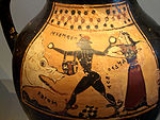
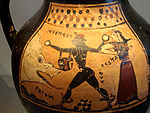
, the word ketos - Latinized as cetus - denotes a large fish, a whale, a shark, or a sea monster. The sea monsters slain by Perseus
Perseus
Perseus ,Perseos and Perseas are not used in English. the legendary founder of Mycenae and of the Perseid dynasty of Danaans there, was the first of the mythic heroes of Greek mythology whose exploits in defeating various archaic monsters provided the founding myths of the Twelve Olympians...
and Heracles
Heracles
Heracles ,born Alcaeus or Alcides , was a divine hero in Greek mythology, the son of Zeus and Alcmene, foster son of Amphitryon and great-grandson of Perseus...
were each referred to as a cetus by ancient sources. The term cetacean originates from cetus. In Greek art
Greek art
Greek art began in the Cycladic and Minoan prehistorical civilization, and gave birth to Western classical art in the ancient period...
, cetea were depicted as serpentine fish. The name of the mythological figure Ceto is derived from ketos. The name of the constellation Cetus
Cetus
Cetus is a constellation. Its name refers to Cetus, a sea monster in Greek mythology, although it is often called 'the whale' today. Cetus is located in the region of the sky that contains other water-related constellations such as Aquarius, Pisces, and Eridanus.-Ecliptic:Although Cetus is not...
also derives from this word.
In the Bible
In JonahJonah
Jonah is the name given in the Hebrew Bible to a prophet of the northern kingdom of Israel in about the 8th century BC, the eponymous central character in the Book of Jonah, famous for being swallowed by a fish or a whale, depending on translation...
2:1 (1:17 in English translation), the Hebrew text reads dag gadol (דג גדול), which literally means "great fish." The Septuagint translates this phrase into Greek as mega ketos (μέγα κῆτος). The term ketos alone means "huge fish," and in Greek mythology the term was closely associated with sea monsters. Jerome
Jerome
Saint Jerome was a Roman Christian priest, confessor, theologian and historian, and who became a Doctor of the Church. He was the son of Eusebius, of the city of Stridon, which was on the border of Dalmatia and Pannonia...
later translated this phrase as piscis grandis in his Latin Vulgate
Vulgate
The Vulgate is a late 4th-century Latin translation of the Bible. It was largely the work of St. Jerome, who was commissioned by Pope Damasus I in 382 to make a revision of the old Latin translations...
. However, he translated the Greek word kētos as cetus in Gospel of Matthew
Gospel of Matthew
The Gospel According to Matthew is one of the four canonical gospels, one of the three synoptic gospels, and the first book of the New Testament. It tells of the life, ministry, death, and resurrection of Jesus of Nazareth...
12:40.