
All Topics  
Krishna

 
Krishna

   Email Print
   Bookmark   Link


Krishna


Krishna (????? in Devanagari, in IAST
IAST

The International Alphabet of Sanskrit Transliteration is a popular transliteration scheme that allows a lossless romanization of Brahmic family....
, in classical Sanskrit) is a deity worshiped across many traditions in Hinduism
Hinduism

'Hinduism' is the predominant religion of the Indian subcontinent. Hinduism is often referred to as , a Sanskrit phrase meaning "the eternal dharma", by its practitioners....
 in a variety of different perspectives. While many Vaishnava groups recognize him as an avatar
Avatar

Avatar or Avatara , often translated into English as incarnation, literally means descent and usually implies a deliberate descent from higher spiritual realms to lower realms of existence for special purposes....
 of Vishnu
Vishnu

Vishnu , , is the Supreme God in Vaishnavite tradition of Hinduism. Smarta followers of Adi Shankara, among others, venerate Vishnu as one of panchadeva, and his supreme status is declared in the Hindu sacred texts like Yajurveda, the Rigveda and the Bhagavad Gita....
, other traditions within Krishnaism
Krishnaism

File:Krishna Holding Mount Govardhan - Crop.jpgKrishnaism, is a term that is often used to describe a number of Hindu religious traditions, that are among the Hindu denominations centered on devotion to Radha Krishna or other forms of Krishna, or Vishnu in a sentiment of Krishna....
 consider Krishna to be svayam bhagavan
Svayam Bhagavan

Svayam Bhagavan , "The Lord" or Lord Himself, is a Sanskrit theological term. The term refers to the concept of absolute representation of the monotheistic God as Bhagavan within Hinduism....
, or the supreme being.

Krishna is often depicted as an infant, as a young boy playing a flute
Bansuri

The bansuri ; is a transverse alto flute of India, Pakistan, Bangladesh and Nepal, made of a single length of bamboo with six or seven open finger holes....
 as in the Bhagavata Purana
Bhagavata purana

The Bhagavata Purana is one of the "Maha" Puranic texts of Hinduism literature, and is Sanskrit for "The Book of God". Its primary focus is the process of bhakti yoga, which is Sanskrit for "Union with God through devotion for Him", in which Krishna is unequivocally declared to be Svayam Bhagavan....
, or as a youthful prince giving direction and guidance as in the Bhagavad Gita
Bhagavad Gita

The Bhagavad Gita is an important Sanskrit Hindu scripture. It is revered as a sacred scripture of Hinduism, and considered as one of the most important religious classics of the world....
.


Discussion
Ask a question about 'Krishna'
Start a new discussion about 'Krishna'
Answer questions from other users
Full Discussion Forum


Quotations


Be not the destroyers of yourselves. Arise to your true Being, and then you will have nothing to fear.

Children, look at the flowers at your feet; do not trample upon them. Look at the love in your midst and do not repudiate it.

I tarry awhile from the turmoil and strife of the world. I will beautify and quicken thy life with love and with joy, for the light of the soul is Love. Where Love is, there is contentment and peace, and where there is contentment and peace, there am I, also, in their midst.

Pitiful and foolish is the man who seeks what he already has, and does not know that he has it. Yes, Pitiful and foolish is he who does not know the bliss of love which surrounds him and which I have given him.

O ye who sit in bondage and continually seek and pant for freedom, seek only for love. Love is peace in itself and peace which gives complete satisfaction. I am the key that opens the portal to the rarely discovered land where contentment alone is found.

Children, look upwards with your beclouded eyes, and a world full of joy and love will disclose itself to you, a rational world made by My wisdom, the only real world. Then you will know what love has done with you, what love has bestowed upon you, what love demands from you.


Encyclopedia


Krishna (????? in Devanagari, in IAST
IAST

The International Alphabet of Sanskrit Transliteration is a popular transliteration scheme that allows a lossless romanization of Brahmic family....
, in classical Sanskrit) is a deity worshiped across many traditions in Hinduism
Hinduism

'Hinduism' is the predominant religion of the Indian subcontinent. Hinduism is often referred to as , a Sanskrit phrase meaning "the eternal dharma", by its practitioners....
 in a variety of different perspectives. While many Vaishnava groups recognize him as an avatar
Avatar

Avatar or Avatara , often translated into English as incarnation, literally means descent and usually implies a deliberate descent from higher spiritual realms to lower realms of existence for special purposes....
 of Vishnu
Vishnu

Vishnu , , is the Supreme God in Vaishnavite tradition of Hinduism. Smarta followers of Adi Shankara, among others, venerate Vishnu as one of panchadeva, and his supreme status is declared in the Hindu sacred texts like Yajurveda, the Rigveda and the Bhagavad Gita....
, other traditions within Krishnaism
Krishnaism

File:Krishna Holding Mount Govardhan - Crop.jpgKrishnaism, is a term that is often used to describe a number of Hindu religious traditions, that are among the Hindu denominations centered on devotion to Radha Krishna or other forms of Krishna, or Vishnu in a sentiment of Krishna....
 consider Krishna to be svayam bhagavan
Svayam Bhagavan

Svayam Bhagavan , "The Lord" or Lord Himself, is a Sanskrit theological term. The term refers to the concept of absolute representation of the monotheistic God as Bhagavan within Hinduism....
, or the supreme being.

Krishna is often depicted as an infant, as a young boy playing a flute
Bansuri

The bansuri ; is a transverse alto flute of India, Pakistan, Bangladesh and Nepal, made of a single length of bamboo with six or seven open finger holes....
 as in the Bhagavata Purana
Bhagavata purana

The Bhagavata Purana is one of the "Maha" Puranic texts of Hinduism literature, and is Sanskrit for "The Book of God". Its primary focus is the process of bhakti yoga, which is Sanskrit for "Union with God through devotion for Him", in which Krishna is unequivocally declared to be Svayam Bhagavan....
, or as a youthful prince giving direction and guidance as in the Bhagavad Gita
Bhagavad Gita

The Bhagavad Gita is an important Sanskrit Hindu scripture. It is revered as a sacred scripture of Hinduism, and considered as one of the most important religious classics of the world....
. The stories of Krishna appear across a broad spectrum of Hindu philosophical
Hindu philosophy

Hindu philosophy is divided into six Sanskrit nastika schools of thought, or darshanas :#Sankhya, a strongly dualist theoretical exposition of mind and matter....
 and theological traditions. They portray him in various roles: a god-child, a prankster, a model lover, a divine hero and the Supreme Being. The principal scriptures discussing Krishna's legends are the Mahabharata
Mahabharata

The is one of the two major Sanskrit Indian epic poetrys of History of India, the other being the '. The epic is part of the Hindu itihasa , and forms an important part of Hindu mythology....
, the Harivamsa
Harivamsa

The Harivamsha is an important work of Sanskrit literature, containing 16,374 shloka, mostly in metre. The text is also known as . This text is believed as a khila to the Mahabharata and traditionally ascribed to Vyasa....
, the Bhagavata Purana
Bhagavata purana

The Bhagavata Purana is one of the "Maha" Puranic texts of Hinduism literature, and is Sanskrit for "The Book of God". Its primary focus is the process of bhakti yoga, which is Sanskrit for "Union with God through devotion for Him", in which Krishna is unequivocally declared to be Svayam Bhagavan....
 and the Vishnu Purana
Vishnu Purana

The Vishnu Purana is a religious Hindu text and one of eighteen Puranas. It is considered one of the most important Puranas and has been given the name Puranaratna ....
.

The various groups dedicated to different manifestations of Krishna such as Vasudeva, Bala Krishna
Bala Krishna

Bala Krishna sometimes translated to "Divine Child Krishna", is historically one of the early forms of worship in Krishnaism and an element of the history of Krishna worship in antiquity....
 and Gopala, existed as early as 4th century BCE. The Krishna-Bhakti
Bhakti yoga

Bhakti Yoga is a term within Hinduism which denotes the spiritual practice of fostering loving devotion to God, called bhakti. Traditionally there are nine forms of bhakti-yoga....
 Movement spread to southern India by the 9th century CE, while in northern India Krishnaism
Krishnaism

File:Krishna Holding Mount Govardhan - Crop.jpgKrishnaism, is a term that is often used to describe a number of Hindu religious traditions, that are among the Hindu denominations centered on devotion to Radha Krishna or other forms of Krishna, or Vishnu in a sentiment of Krishna....
 schools were well established by 11th century CE. From the 10th century CE, with the growing Bhakti movement, Krishna became a favourite subject of performing arts. The regional forms of Krishna such as Jaganatha of Orissa
Orissa

Orissa , is a states and territories of India located on the east coast of India, by the Bay of Bengal. It was established on 1 April 1936 as a province in British India, and consists, predominantly of Oriya language speakers....
, Vithoba
Vithoba

Vithoba , also known as Vitthala and Panduranga , is a Hinduism god, worshipped predominantly in the Indian states of Maharashtra, Karnataka and Andhra Pradesh....
 of Maharashtra
Maharashtra

Maharashtra is a States and territories of India located on the western coast of India. Maharashtra is a part of Western India. It is India's List of states of India by area and List of states of India by population....
 and Shrinathji
Shrinathji

Shrinathji is a deity form of Krishna situated in the temple town of Nathdwara near Udaipur, Rajasthan in Rajasthan, and is the presiding central deity of the Vaishnava sect known as Pushti Marg or Shuddhadvaita, established by Sri Vallabhacharya....
 in Rajasthan
Rajasthan

Rajasthan is the largest States and territories of India of the Republic of India in terms of area. It encompasses most of the area of the large, inhospitable Great Indian Desert , which has an edge paralleling the Sutlej-Indus river valley along its border with Pakistan....
 were developed. Since 1966, the Krishna-bhakti movement spread in the West, with the International Society for Krishna Consciousness
International Society for Krishna Consciousness

The International Society for Krishna Consciousness , also known as 'the Hare Krishna' movement, is one of the Hindu Vaishnava groups. It was founded in 1966 in New York City by A....
 (ISKCON). Devotion to Krishna is widely diffused and extends to Jains, Buddhists, Bahá'ís and beyond India.

Etymology and names

The Sanskrit
Sanskrit

Sanskrit is a historical Indo-Aryan language, one of the liturgical languages of Hinduism and Buddhism, and one of the 22 official languages of India....
 word has the literal meaning of "black", "dark" or "dark-blue" and is used as a name to describe someone with dark skin. Krishna is often depicted in murti
Murti

In Hinduism, a murti typically refers to an image, a deity, in which a Divine Spirit is expressed . Hindus consider a murti worthy of worship after the divine is invoked in it for the purpose of offering worship....
s (images) as black, and is generally shown in paintings with a blue skin.

Some Hindu traditions often ascribe varying interpretations and powers to the names. The Mahabharata
Mahabharata

The is one of the two major Sanskrit Indian epic poetrys of History of India, the other being the '. The epic is part of the Hindu itihasa , and forms an important part of Hindu mythology....
s Udyoga-parva (Mbh 5.71.4) divides
into elements and , (a verbal root meaning "to plough, drag") being taken as expressing "being; earth" and being taken as expressing "bliss". In the of the Vallabha sampradaya
Pushtimarg

Pushtimarg is a sect of the Hindu religion, founded by Shrimad Vallabhacharya Shri Vallabhacharya is one of the five main Acharyas of the Hindu Religion....
, the syllables of the name
Krishna are assigned the power to destroy sin relating to material, self and divine causes. Mahabharata verse 5.71.4 is also quoted in Chaitanya Charitamrita
Chaitanya Charitamrita

The Chaitanya Charitamrita is one of the primary biographies detailing the life and teachings of Chaitanya Mahaprabhu , who is Shri Krishna the supreme personality of Godhead himselbut in the mood of RadhaRani therefore golden complexion.One of the reasons He manifest his pastimes in the material world is to expound Vaishnavism saint, and...
 and Prabhupada in his commentary, translates the
as "attractive existence", thus Krishna is also interpreted as meaning "all-attractive one". This quality of Krishna is stated in the atmarama verse of Bhagavatam 1.7.10.

The name Krishna is also the 57th name in the
Vishnu Sahasranama
Vishnu sahasranama

The Vishnu Sahasranama is a list of 1,000 names for Vishnu, one of the main forms of God in Hinduism and the personal supreme God for Vaishnavism ....
and means the Existence of Bliss, according to Adi Sankara's interpretation. Krishna is also known by various other names, epithets and titles
List of titles and names of Krishna

Popular Names of Lord Krishna with their Meanings kanhaiya modified kanhaKrishna has been given many names and titles by his devotees....
, which reflect his many associations and attributes. Among the most common names are
Govinda
Govinda

' and ' are names of Krishna, referring to his youthful occupation as a cowherd.Both names translate to "cowherd". Sanskrit go means "cow"; pala and vinda form tatpurusha compounds, literally translating to "finder of cows" and "protector of cows", respectively....
, "finder of cows", or Gopala, "protector of cows", which refer to Krishna's childhood in Vraja. Some of the distinct names may be regionally important; for instance, Jagannatha (literally "Lord of the Universe") in eastern India.

Iconography

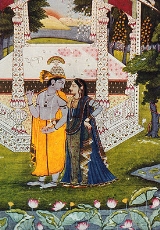
Krishna is easily recognized by his representations. Though his skin colour may be depicted as black or dark in some representations, particularly in murti
Murti

In Hinduism, a murti typically refers to an image, a deity, in which a Divine Spirit is expressed . Hindus consider a murti worthy of worship after the divine is invoked in it for the purpose of offering worship....
s, in other images such as modern pictorial representations, Krishna is usually shown with blue skin. He is often shown wearing a yellow silk dhoti
Dhoti

The dhoti or doti in Hindi, called suriya in Assamese language, pancha in Telugu language, Laacha in Punjabi language, mundu in Malayalam, dhuti in Bangla, veshti in Tamil language, dhotar in Marathi and panche in Kannada, is the traditional garment of men's wear in India....
 and peacock feather headgear. Common depictions show him as a little boy, or as a young man in a characteristic relaxed pose, playing the flute
Bansuri

The bansuri ; is a transverse alto flute of India, Pakistan, Bangladesh and Nepal, made of a single length of bamboo with six or seven open finger holes....
. In this form, he usually stands with one leg bent in front of the other and raises a flute to his lips, accompanied by cows, emphasising his position as the divine herdsman,
Govinda, or with the gopi
Gopi

Gopi is a word of Sanskrit origin meaning 'cow-herd girl'. In Hinduism specifically the name gopi is used more commonly to refer to the group of cow herding girls famous within Vaishnava Theology for their unconditional devotion to Krishna as described in the stories of Bhagavata Purana and other Puranas literatures....
s (milkmaids).

The scene on the battlefield of Kurukshetra
Kurukshetra

This article is about a place. For the Malayalam film on Kargil war see Kurukshetra Kurukshetra is a district in Haryana state of India....
, notably where he addresses Arjuna
Arjuna

Arjuna, Arjun or Arjunaa is one of the heroes of the Hindu epic Mahabharata, whose name means 'bright', 'shining', 'white' or 'silver' ....
 in the Bhagavad Gita
Bhagavad Gita

The Bhagavad Gita is an important Sanskrit Hindu scripture. It is revered as a sacred scripture of Hinduism, and considered as one of the most important religious classics of the world....
, is another common subject for representation. In these depictions, he is shown as a man, often shown with typical god-like characteristics of Hindu religious art, such as multiple arms or heads, denoting power, and with attributes of Vishnu, such as the chakra
Chakra

Chakra is a Sanskrit word that translates as wheel or disc.Chakra is a concept referring to wheel-like vortices which, according to traditional Indian medicine, are believed to exist in the surface of the etheric double of man....
 or in his two-armed form as a charioteer.

Representations in temples often show Krishna as a man standing in an upright, formal pose. He may be alone, or with associated figures: his brother Balarama
Balarama

Balarama , also known as Baladeva, Baldau, Balabhadra and Halayudha, is the elder brother of the divine being, Krishna in Hinduism....
 and sister Subhadra
Subhadra

Subhadra is an important character in the Mahabharata. She is the half-sister of Krishna, wife of Arjuna, and mother of Abhimanyu. She was the partial incarnation of Shatarupa....
, or his main queens Rukmini
Rukmini

In Hinduism, Rukmini is the principal wife and queen of Krishna at his city of Dwarka. Krishna heroically kidnaps her from an un-wanted marriage at her request ....
 and Satyabhama
Satyabhama

Satyabhama is the third wife of Lord Krishna, known for her strong will and tantrums.She is believed to an Avatar of Bhudevi....
.

Often, Krishna is pictured with his gopi-consort Radha
Radha

Radha is the principal consort of Krishna in the Srimad Bhagavatam, and the Gita Govinda of the Hinduism religion. Radha is almost always depicted alongside Krishna and features prominently within the theology of today's Gaudiya Vaishnava religion, which regards Radha as the original Goddess or Shakti....
. Manipuri Vaishnavas do not worship Krishna alone, but as Radha Krishna
Radha Krishna

Radha Krishna is a Hindu deity. Krishna is often referred as svayam bhagavan in Gaudiya Vaishnavism theology and Radha is a young woman, a gopi who is Krishna's supreme beloved....
, a combined image of Krishna and Radha. This is also a characteristic of the schools Rudra
Rudra Sampradaya

In Hinduism, the Rudra Sampradaya is one of four Vaishnava sampradayas, a tradition of disciplic succession in the religion. Vaishnavism is distinguished from other schools of Hinduism by its primary worship of deities Vishnu and/or Krishna and their avatars as the Supreme forms of God....
 and Nimbarka sampradaya
Nimbarka Sampradaya

The 'Nimbarka Sampradaya' , also known as the 'Hamsa Sampradaya', 'Kumara Sampradaya', and 'Sanakadi Sampradaya', is one of the four authorised Vaisnava#the four vaishnava sampradayas Sampradaya as according to the Padma Purana, one of the eighteen main Purana....
, as well as that of Swaminarayan faith
Swaminarayan Faith

Swaminarayan Faith or Swaminarayan Sect is a modern tradition of Hinduism, in which followers offer devotion and worship Swaminarayan as the final manifestation of God....
. Gaudiya Vaishnavas celebrate Radharamana image, who is viewed as a form of Radha Krishna by members of the sect.

Krishna is also depicted and worshipped as a small child (
bala k???a
Bala Krishna

Bala Krishna sometimes translated to "Divine Child Krishna", is historically one of the early forms of worship in Krishnaism and an element of the history of Krishna worship in antiquity....
, the child Krishna), crawling on his hands and knees or dancing, often with butter in his hand. Regional variations in the iconography of Krishna are seen in his different forms, such as Jaganatha of Orissa
Orissa

Orissa , is a states and territories of India located on the east coast of India, by the Bay of Bengal. It was established on 1 April 1936 as a province in British India, and consists, predominantly of Oriya language speakers....
, Vithoba
Vithoba

Vithoba , also known as Vitthala and Panduranga , is a Hinduism god, worshipped predominantly in the Indian states of Maharashtra, Karnataka and Andhra Pradesh....
 of Maharashtra
Maharashtra

Maharashtra is a States and territories of India located on the western coast of India. Maharashtra is a part of Western India. It is India's List of states of India by area and List of states of India by population....
 and Shrinathji
Shrinathji

Shrinathji is a deity form of Krishna situated in the temple town of Nathdwara near Udaipur, Rajasthan in Rajasthan, and is the presiding central deity of the Vaishnava sect known as Pushti Marg or Shuddhadvaita, established by Sri Vallabhacharya....
 in Rajasthan
Rajasthan

Rajasthan is the largest States and territories of India of the Republic of India in terms of area. It encompasses most of the area of the large, inhospitable Great Indian Desert , which has an edge paralleling the Sutlej-Indus river valley along its border with Pakistan....
.

Literary sources

The earliest text to explicitly provide detailed descriptions of Krishna as a personality is the epic Mahabharata
Mahabharata

The is one of the two major Sanskrit Indian epic poetrys of History of India, the other being the '. The epic is part of the Hindu itihasa , and forms an important part of Hindu mythology....
 which depicts Krishna as an incarnation of Vishnu
Vishnu

Vishnu , , is the Supreme God in Vaishnavite tradition of Hinduism. Smarta followers of Adi Shankara, among others, venerate Vishnu as one of panchadeva, and his supreme status is declared in the Hindu sacred texts like Yajurveda, the Rigveda and the Bhagavad Gita....
. Krishna is central to many of the main stories of the epic. The eighteen chapters of the sixth book (
Bhishma Parva) of the epic that constitute the Bhagavad Gita
Bhagavad Gita

The Bhagavad Gita is an important Sanskrit Hindu scripture. It is revered as a sacred scripture of Hinduism, and considered as one of the most important religious classics of the world....
contain the advice of Krishna to the warrior-hero Arjuna
Arjuna

Arjuna, Arjun or Arjunaa is one of the heroes of the Hindu epic Mahabharata, whose name means 'bright', 'shining', 'white' or 'silver' ....
, on the battlefield. Krishna is already an adult in the epic, although there are allusions to his earlier exploits. The
Harivamsa
Harivamsa

The Harivamsha is an important work of Sanskrit literature, containing 16,374 shloka, mostly in metre. The text is also known as . This text is believed as a khila to the Mahabharata and traditionally ascribed to Vyasa....
, a later appendix to this epic, contains the earliest detailed version of Krishna's childhood and youth.

Many Puranas
Puranas

The Puranas are a group of important Hindu religious texts, notably consisting of narratives of the history of the Universe from creation to destruction, genealogies of the kings, heroes, sages, and demigods, and descriptions of Hindu cosmology, philosophy, and geography....
 tells Krishna's life-story or some highlights from it. Two Puranas, the
Bhagavata Purana
Bhagavata purana

The Bhagavata Purana is one of the "Maha" Puranic texts of Hinduism literature, and is Sanskrit for "The Book of God". Its primary focus is the process of bhakti yoga, which is Sanskrit for "Union with God through devotion for Him", in which Krishna is unequivocally declared to be Svayam Bhagavan....
and the Vishnu Purana
Vishnu Purana

The Vishnu Purana is a religious Hindu text and one of eighteen Puranas. It is considered one of the most important Puranas and has been given the name Puranaratna ....
, that contain the most elaborate telling of Krishna’s story and teachings are the most theologically venerated by the Gaudiya Vaishnava schools. Roughly one quarter of the Bhagavata Purana is spent extolling his life
Life

Life is a characteristic of organisms that exhibit certain biological processes such as chemical reactions or other events that results in a transformation....
 and philosophy
Philosophy

Philosophy is the study of general problems concerning matters such as existence, knowledge, truth, beauty, justice, validity, mind, and language....
.

Yaska
Yaska

, was a Sanskrit grammarian who preceded Panini. His famous text is Nirukta, which deals with etymology, lexical category and the semantics of words....
's
Nirukta
Nirukta

Nirukta is one of the six Vedanga disciplines of Hinduism, treating etymology, particularly of obscure words, especially those occurring in the Vedas....
, an etymological dictionary around the 5th century BCE, contains a reference to the Shyamantaka jewel in the possession of Akrura, a motif from well known Puranic story about Krishna.Satha-patha-brahmana and Aitareya-Aranyaka, associate Krishna with his Vrishni origins. In early texts, such as Rig Veda, there are no obvious references to Krishna, however some, like Ramakrishna Gopal Bhandarkar
Ramakrishna Gopal Bhandarkar

Ramakrishna Gopal Bhandarkar, also spelt Ramkrishna Gopal Bhandarkar, and known as R.G. Bhandarkar , was a scholar, orientalist and social reformer....
 attempted to show that "the very same Krishna" made an appearance, e.g as the
drapsa ... krishna "black drop" of RV 8.96.13.

Life

This summary is based on details from the
Mahabharata
Mahabharata

The is one of the two major Sanskrit Indian epic poetrys of History of India, the other being the '. The epic is part of the Hindu itihasa , and forms an important part of Hindu mythology....
, the Harivamsa
Harivamsa

The Harivamsha is an important work of Sanskrit literature, containing 16,374 shloka, mostly in metre. The text is also known as . This text is believed as a khila to the Mahabharata and traditionally ascribed to Vyasa....
, the Bhagavata Purana
Bhagavata purana

The Bhagavata Purana is one of the "Maha" Puranic texts of Hinduism literature, and is Sanskrit for "The Book of God". Its primary focus is the process of bhakti yoga, which is Sanskrit for "Union with God through devotion for Him", in which Krishna is unequivocally declared to be Svayam Bhagavan....
and the Vishnu Purana
Vishnu Purana

The Vishnu Purana is a religious Hindu text and one of eighteen Puranas. It is considered one of the most important Puranas and has been given the name Puranaratna ....
. The scenes from the narrative are set in north India
India

India, officially the Republic of India , is a country in South Asia. It is the List of countries and outlying territories by total area country by geographical area, the List of countries by population country, and the most populous liberal democracy in the world....
, mostly in the present states of Uttar Pradesh
Uttar Pradesh

Uttar Pradesh , [often referred to as U.P.] is a States and territories of India located in the northern part of India. With a population of over 190 million people,...
, Bihar
Bihar

Bihar is a States and territories of India in East India. Bihar is the 12th largest state in terms of geographical size 38,202 square mile and 3rd largest by population....
, Haryana
Haryana

Haryana is a States and territories of India in the Punjab region of northern India. It is bordered by Punjab and Himachal Pradesh to the north, and by Rajasthan to the west and south....
, Delhi
Delhi

Delhi , sometimes referred to as Dilli , is the List of most populous cities in India metropolis in India and, with over 11 million residents, the List of metropolitan areas by population....
 and Gujarat
Gujarat

Gujarat is a States and territories of India in western India. Gujarat borders Pakistan to the north west and the state of Rajasthan to the north and northeast, Madhya Pradesh to the east, Maharashtra and the Union territory of Diu, Daman District, India, Dadra and Nagar Haveli to the south....
.

Birth

Traditional belief based on scriptural details and astrological calculations
Jyotisha

is the Hindu system of astrology .Traditionally, it has three branches:* 'Siddhanta': , which is traditional Indian astronomy.* 'Samhita': also known as Medini Jyotisha , predicting important events based on analysis of astrological dynamics in a country's horoscope or general transit events such as war, earthquakes, poli...
 gives the date of Krishna's birth, known as Janmashtami, as either 18 or 21 July 3228 BCE. Krishna belonged to the royal family of Mathura
Mathura

Mathura is a holy city in the Indian States and territories of India of Uttar Pradesh. It is located approximately 50 km north of Agra, and 150 km south of Delhi; about twenty kilometers from holy Vrindavana....
, and was the eighth son born to the princess Devaki
Devaki

In Hinduism, Devaki is the wife of Vasudeva and mother of Krishna and Balarama.She was the daughter of Devaka, the younger brother of King Ugrasena of Mathura....
, and her husband Vasudeva
Vasudeva

File:Krishna carried over river yamuna.jpgIn Hindu mythology, Vasudeva is the father of Krishna, the son of , of the Yadava dynasty. His sister Kunti was married to Pandu....
. Mathura was the capital of the Yadavas (also called the Surasena
Surasena

Surasena was the kingdom around the modern Brajabhumi. The etymology of the name is not clear. Some say it was named after a famed Yadav king Sursain, while others see it as an extension of Surabhir ....
s), to which Krishna's parents Vasudeva and Devaki belonged. The king Kamsa
Kamsa

In Hinduism, Kamsa or Kansa , often known as Kans in Hindi, is the cousin of Devaki, and ruler of the Vrishni kingdom with its capital at Mathura....
, Devaki's brother, had ascended the throne by imprisoning his father, King Ugrasena
Ugrasena

Ugrasena was the King of Mathura, a kingdom that was established after the various factions of Yadava, Vrishni and Bhoja clans decided that the dividing states would unite as one and that the Kingship would not be subject to heredity and if decided not to be so, the succeeding leader would be chosen by a simple majority, therefore, a semi-de...
. Afraid of a prophecy
Prophecy

Prophecy, generally, describes the disclosing of information that is not known to the prophet by any ordinary means. In religion, this is thought to be a divinely inspired revelation or interpretation....
 that predicted his death at the hands of Devaki
Devaki

In Hinduism, Devaki is the wife of Vasudeva and mother of Krishna and Balarama.She was the daughter of Devaka, the younger brother of King Ugrasena of Mathura....
's eighth son, he had locked the couple into a prison cell. After killing the first six children, and Devaki's apparent miscarriage of the seventh, being transferred to Rohini as Balarama
Balarama

Balarama , also known as Baladeva, Baldau, Balabhadra and Halayudha, is the elder brother of the divine being, Krishna in Hinduism....
, Krishna took birth.

Since Vasudeva believed Krishna's life was in danger, Krishna was secretly taken out of the prison cell to be raised by his foster parents, Yasoda
Yasoda

Yasoda was wife of Nanda within the Puranic texts of Hinduism. Within the Bhagavata Purana it is describe that Yasoda later became the foster-mother to Krishna, who was born to Devaki but was given to Yashoda and Nanda in Gokul, by Krishna's father Vasudeva on the night of his birth, for his protection from Devaki's brother, the king of M...
  and Nanda
Nanda (mythology)

According to Puranas, Nanda was head of a tribe of cowherds referred as Holy Gwals. On the night of Krishna's appearance or birth, Vasudeva brought Krishna to Nanda for Krishna's childhood years....
 in Gokul
Gokul

Gokul was the place where Krishna was brought up under the care of Nanda and Yashoda, the first family of the village. Since Kamsa, Krishna's uncle, used to kill every baby born to Devaki, Nanda exchanged his own new born daughter with Vasudeva in order to smuggle Krishna away without raising Kamsa's suspicion....
a. Two of his other siblings also survived, Balarama
Balarama

Balarama , also known as Baladeva, Baldau, Balabhadra and Halayudha, is the elder brother of the divine being, Krishna in Hinduism....
 (Devaki's seventh child, transferred to the womb of Rohini
Rohini

Rohini may refer to:* Rohini , a lunar mansion in Indian astronomy corresponding to Aldebaran* Rohini Devi, in Hindu mythology a consort of Vasudeva and mother of Balarama and Subhadra...
, Vasudeva's first wife) and Subhadra
Subhadra

Subhadra is an important character in the Mahabharata. She is the half-sister of Krishna, wife of Arjuna, and mother of Abhimanyu. She was the partial incarnation of Shatarupa....
 (daughter of Vasudeva and Rohini, born much later than Balarama and Krishna). According to Bhagavata Purana
Bhagavata purana

The Bhagavata Purana is one of the "Maha" Puranic texts of Hinduism literature, and is Sanskrit for "The Book of God". Its primary focus is the process of bhakti yoga, which is Sanskrit for "Union with God through devotion for Him", in which Krishna is unequivocally declared to be Svayam Bhagavan....
 some believe that Krishna was born without a sexual union, by "mental transmission" from the mind of Vasudeva into the womb of Devaki.

Childhood and youth

Nanda was the head of a community of cow-herders, and he settled in Vrindavana. The stories of Krishna's childhood and youth tell of his mischievous pranks as
Makhan Chor (butter thief), his foiling of attempts to take his life, and his role as a protector of the people of Vrindavana. Krishna is said to have killed the demons like Putana, sent by Kamsa for Krishna's life. He tamed the serpent Kaliya
Kaliya

Kaliya , in Hindu mythology, was the name of a poisonous Naga living in the Yamuna River, in Vrindavan. The water of the Yamuna for four leagues all around him boiled and bubbled with poison....
, who previously poisoned the waters of Yamuna
Yamuna

The Yamuna is a major tributary river of the Ganges in northern India. With a total length of around , it is the largest tributary of the Ganges....
 river, thus leading to the death of the cowherds. In Hindu art, Krishna is often depicted dancing on the multi-hooded Kaliya. Krishna is believed to have lifted the Govardhana hill and defeated Indra
Indra

Indra is the god of War and Weather, also the King of the gods or Deva and Lord of Heaven or Swarga in Hinduism. Mentioned first as the chief deity in the sacred Hindu text of Rig Veda, Indra is bestowed with a heroic and almost brash and amorous character....
—the kings of the devas
Deva (Hinduism)

Deva is the Sanskrit word for "god, deity". It can be variously interpreted as a god, spirit, demi-god, Celestial, deity or any supernatural being of high excellence....
 and rain—to protect native people of Vrindavana from prosecution by Indra and prevent the devastation of the pasture land of Govardhan. In the view of some, the spiritual movement started by Krishna had something in it which went against the orthodox forms of worship of the Vedic
Vedas

The Vedas are a large body of texts originating in History of India. They form the oldest layer of Sanskrit literature and the oldest Hindu scripture of Hinduism....
 gods such as Indra.

The stories of his play with the gopi
Gopi

Gopi is a word of Sanskrit origin meaning 'cow-herd girl'. In Hinduism specifically the name gopi is used more commonly to refer to the group of cow herding girls famous within Vaishnava Theology for their unconditional devotion to Krishna as described in the stories of Bhagavata Purana and other Puranas literatures....
s (milkmaids) of Vrindavana became known as the
Rasa lila
Rasa lila

The Rasa lila or Rasa dance is part of the traditional story of Krishna described in Hindu scriptures such as the Bhagavata Purana and literature such as the Gita Govinda, where he dances with Radha and her sakhis....
and were romanticised in the poetry of Jayadeva
Jayadeva

Jayadeva was a Sanskrit poet, who lived in Orissa, circa 1200 AD. He is most known for his composition, the epic poem Gita Govinda, which depicts the divine love of the Hindu deity Krishna and his consort, Radha, and is considered an important text in the Bhakti movement of Hinduism .He was born in an Utkala Brahmin family....
, author of the Gita Govinda
Gita Govinda

The Gita Govinda is a work composed in the 12th century by the great poet Jayadeva, who was the court poet to King Lakshman Sen of Bengal. It describes the relationship between Krishna and the gopis of Vrindavana, and in particular one gopi named Radha....
. These became important as part of the development of the Krishna bhakti
Bhakti

Bhakti is a word of Sanskrit origin meaning devotion. Within Vaishnavism bhakti is only used in conjunction with Vishnu, Krishna or of the associated avatar, who are the source of attractiveness....
 traditions worshiping Radha Krishna
Radha Krishna

Radha Krishna is a Hindu deity. Krishna is often referred as svayam bhagavan in Gaudiya Vaishnavism theology and Radha is a young woman, a gopi who is Krishna's supreme beloved....
.

The prince

On his return to Mathura as a young man, Krishna overthrew and killed his uncle Kamsa after avoiding several assassination attempts from Kamsa's followers. He reinstated Kamsa's father, Ugrasena
Ugrasena

Ugrasena was the King of Mathura, a kingdom that was established after the various factions of Yadava, Vrishni and Bhoja clans decided that the dividing states would unite as one and that the Kingship would not be subject to heredity and if decided not to be so, the succeeding leader would be chosen by a simple majority, therefore, a semi-de...
, as the king of the Yadavas and became a leading prince at the court. During this period, he became a friend of Arjuna
Arjuna

Arjuna, Arjun or Arjunaa is one of the heroes of the Hindu epic Mahabharata, whose name means 'bright', 'shining', 'white' or 'silver' ....
 and the other Pandava
Pandava

In the Hinduism epic Mahabharata, the Pandava brothers are the five acknowledged sons of Pandu , by his two wives Kunti and Madri. Their names are Yudhishtira, Bhima, Arjuna, Nakula and Sahadeva....
 princes of the Kuru kingdom, who were his cousins. Later, he took his Yadava subjects to the city of Dwaraka (in modern Gujarat
Gujarat

Gujarat is a States and territories of India in western India. Gujarat borders Pakistan to the north west and the state of Rajasthan to the north and northeast, Madhya Pradesh to the east, Maharashtra and the Union territory of Diu, Daman District, India, Dadra and Nagar Haveli to the south....
) and established his own kingdom there.

Krishna married Rukmini
Rukmini

In Hinduism, Rukmini is the principal wife and queen of Krishna at his city of Dwarka. Krishna heroically kidnaps her from an un-wanted marriage at her request ....
, the princess of Vidarbha
Vidarbha

Vidarbha is the eastern region of Maharashtra state made up of Nagpur Division and Amravati Division. It occupies 31.6% of total area and holds 21.3% of total population of Maharashtra....
, by abducting her from her wedding. According to some texts, Krishna had 16,108 wives, of which eight were chief—including Rukmini, Satyabhama
Satyabhama

Satyabhama is the third wife of Lord Krishna, known for her strong will and tantrums.She is believed to an Avatar of Bhudevi....
, Jambavati
Jambavati

Jambavati is the only daughter of the king-bear Jambavana. Her story is told in the tenth book of the Bhagavata Purana. She received the famous "Syamantaka Jewel" as a gift from her father and she married to Lord Krishna and occupied the third most prominent position of his eight principal queens in Dwaraka....
; Krishna subsequently married 16,100 maidens who were being held in captivity by demon
Asura

Sorry, no overview for this topic
 Narakasura
Narakasura

In Hindu mythology, Narakasura or Naraka is the asura son of the earth goddess Bhudevi and Lord Vishnu in his Varaha avatar . In other sources, he is the son of the asura Hiranyaksha....
, to save their honor. Krishna killed the demon and released them all. According to strict social custom of the time all of the captive women were degraded, and would be unable to marry, as they had been under the control of Narakasura, however Krishna decided to marry them to reinstate their status in the society. In Vaishnava traditions, Krishna's wives are believed to be forms of the goddess Lakshmi
Lakshmi

Lakshmi is the Hindu goddess of wealth, prosperity, purity, and generosity; and the embodiment of beauty, grace and charm. Representations of Lakshmi are found also in Jainism and Buddhist monuments, with the earliest archeological representation found in Buddhist monuments....
—consort of Vishnu or special souls
Jiva

In Hinduism and Jainism, a jiva is a living being, or more specifically the immortal essence of a living being which survives physical death....
 attained this qualification after many lifetimes of austerity, while his primary queen Satyabhama, is an expansion of Radha
Radha

Radha is the principal consort of Krishna in the Srimad Bhagavatam, and the Gita Govinda of the Hinduism religion. Radha is almost always depicted alongside Krishna and features prominently within the theology of today's Gaudiya Vaishnava religion, which regards Radha as the original Goddess or Shakti....
.

Kurukshetra War and Bhagavad Gita


Krishna was a cousin of the Pandava
Pandava

In the Hinduism epic Mahabharata, the Pandava brothers are the five acknowledged sons of Pandu , by his two wives Kunti and Madri. Their names are Yudhishtira, Bhima, Arjuna, Nakula and Sahadeva....
s, one of the two parties in the Kurukshetra War
Kurukshetra war

The Kurukshetra War is the war between the kauravas and pandavas. It forms an essential component of the Indian epic poetry Mahabharata. According to Mahabharata, a dynastic struggle between sibling clans of Kauravas and the Pandavas for the throne of Hastinapura resulted in a battle in which a number of ancient kingdoms participated...
 of the Mahabharat. Once battle seemed inevitable, Krishna offered both sides the opportunity to choose between having either his army or simply himself alone, but on the condition that he personally would not raise any weapon. Arjuna, on behalf of the Pandavas, chose to have Krishna on their side, and Duryodhana
Duryodhana

In the Hindu Indian epic poetry the Mahabharata, Duryodhana is the eldest son of the blind king Dhritarashtra by Queen Gandhari , the eldest of the one hundred Kaurava brothers, and the chief antagonist of the Pandavas....
, chief of the Kauravas, chose Krishna's army. At the time of the great battle, Krishna acted as Arjuna's charioteer, since it was a position that did not require the wielding of weapons.

Upon arriving at the battlefield, and seeing that the enemies he would soon fight against were people close to him prior to the battle, Arjuna becomes doubtful about fighting. Krishna then advises him about the battle, with the conversation soon extending into a discourse which was later compiled as the Bhagavad Gita
Bhagavad Gita

The Bhagavad Gita is an important Sanskrit Hindu scripture. It is revered as a sacred scripture of Hinduism, and considered as one of the most important religious classics of the world....
.

Later life

Following the war Krishna lived at Dwaraka for thirty-six years. Then at a festival, a fight broke out between the Yadavas who exterminated each other. His elder brother Balarama
Balarama

Balarama , also known as Baladeva, Baldau, Balabhadra and Halayudha, is the elder brother of the divine being, Krishna in Hinduism....
 then gave up his body using Yoga
Yoga

Yoga refers to traditional physical and mental disciplines originating in India. The word is associated with meditative practices in both Buddhism and Hinduism....
. Krishna retired into the forest and sat under a tree in meditation. While Vyasa's Mahabharata says that Shri Krishna ascended to heaven, Sarala's Mahabharata narrates the story that a hunter mistook his partly visible left foot for a deer and shot an arrow wounding him mortally. Bhagavad Gita, which is part of Mahabharata, mentions Krishna implying that he is beyond a material body and death.

According to Puranic sources, Krishna's disappearance marks the end of Dvapara Yuga
Dvapara Yuga

Dvapara Yuga or Dwapara Yuga is the third out of four yugas, or ages, described in the scriptures of Hinduism. This yuga comes after Treta Yuga and is followed by Kali Yuga....
 and the start of Kali Yuga
Kali Yuga

Kali Yuga , is one of the four stages of development that the world goes through as part of the cycle of Yugas, as described in Indian scriptures, the others being Satya Yuga, Treta Yuga and Dvapara Yuga....
, which is dated to February 17/18, 3102 BCE. Vaishnava teachers such as Ramanujacharya and Gaudiya Vaishnavas held the view that the body of Krishna is completely spiritual and never decays as this appears to be the perspective of the Bhagavata Purana
Bhagavata purana

The Bhagavata Purana is one of the "Maha" Puranic texts of Hinduism literature, and is Sanskrit for "The Book of God". Its primary focus is the process of bhakti yoga, which is Sanskrit for "Union with God through devotion for Him", in which Krishna is unequivocally declared to be Svayam Bhagavan....
. Krishna never appears to grow old or age at all in the historical depictions of the Puranas
Puranas

The Puranas are a group of important Hindu religious texts, notably consisting of narratives of the history of the Universe from creation to destruction, genealogies of the kings, heroes, sages, and demigods, and descriptions of Hindu cosmology, philosophy, and geography....
 despite passing of several decades, but there are grounds for a debate whether this indicates that he has no material body, since battles and other descriptions of the Mahabharata epic show clear indications that he seems to be subject to the limitations of nature. While battles apparently seem to indicate limitations, Mahabharatha also shows in many places where Krishna is not subject to any limitations as through episodes Duryodhana trying to arrest Krishna where His body burst into fire showing all creation within Him. Krishna is also explicitly told to be without deterioration elsewhere.

Early historical references


One of the earliest recorded instances of a Krishna who could potentially be identified with the deity can be found in the
Chandogya Upanishad
Chandogya Upanishad

The Chandogya Upanishad is one of the "primary" Upanishads. Together with the Jaiminiya Upanishad Brahmana and the Brihadaranyaka Upanishad it ranks among the oldest Upanishads, dating to the Vedas Brahmana period ....
, where he is mentioned as the son of Devaki, and to whom Ghora Angirasa was a teacher. The Upanishads, namely and , specifically regard Krishna as a god and associate him with Vishnu.

References to Vasudeva also occur in early Sanskrit literature. Taittiriya Aranyaka (X,i,6) identifies him with
Narayana and Vishnu. Panini, ca. 4th century BCE, in his Ashtadhyayi explains the word "Vasudevaka" as a Bhakta (devotee) of Vasudeva. This, along with the mention of Arjuna
Arjuna

Arjuna, Arjun or Arjunaa is one of the heroes of the Hindu epic Mahabharata, whose name means 'bright', 'shining', 'white' or 'silver' ....
 in the same context, indicates that the Vasudeva
Vasudeva

File:Krishna carried over river yamuna.jpgIn Hindu mythology, Vasudeva is the father of Krishna, the son of , of the Yadava dynasty. His sister Kunti was married to Pandu....
 here is Krishna. At some stage during the Vedic period, Vasudeva and Krishna became one deity, and by the time of composition of the redaction of Mahabharata
Mahabharata

The is one of the two major Sanskrit Indian epic poetrys of History of India, the other being the '. The epic is part of the Hindu itihasa , and forms an important part of Hindu mythology....
 that survives till today, Krishna (Vasudeva) was generally acknowledged as an
avatar of Vishnu and often as the Supreme God.

In the 4th century BCE, Megasthenes
Megasthenes

Megasthenes was a Ancient Greece traveller and geographer. He was born in Asia Minor and became an ambassador of Seleucus I of Syria to the court of Sandrocottus of India, in Pataliputra....
 the Greek ambassador to the court of Chandragupta Maurya
Chandragupta Maurya

Chandragupta Maurya , sometimes known simply as Chandragupta , was the founder of the Maurya Empire. Chandragupta succeeded in bringing together most of the Indian subcontinent....
 says that the Sourasenoi (Surasena
Surasena

Surasena was the kingdom around the modern Brajabhumi. The etymology of the name is not clear. Some say it was named after a famed Yadav king Sursain, while others see it as an extension of Surabhir ....
), who lived in the region of Mathura worshipped Herakles. This Herakles is usually identified with Krishna due to the regions mentioned by Megasthenes as well as similarities between some of the herioc acts of the two. The Greco-Bactrian ruler Agathocles
Agathocles

Agathocles , , was tyrant of Syracuse, Sicily and king of Sicily ....
 issued coins bearing the images of Krishna and Balarama in around 180–165 BCE.

Three inscriptions from Hathibada and one from Ghosundi (near Nagari, Chittorgarh district
Chittorgarh district

Chittorgarh District is a districts of Rajasthan of Rajasthan States and territories of India in West India India. The historic city of Chittorgarh is the administrative headquarters of the district....
) from the 2nd century BCE, record the building of a
puja-sila-prakar (stone enclosure for worship) in Narayana-vata (park of Narayana) by king for the worship of the gods Sankarshana (Balarama) and Vasudeva (Krishna). From the same century,the cave (Maharashtra
Maharashtra

Maharashtra is a States and territories of India located on the western coast of India. Maharashtra is a part of Western India. It is India's List of states of India by area and List of states of India by population....
) inscription of the Satavahana
Satavahana

The Satavahanas also known as Andhras , were a dynasty which ruled from Junnar , Prathisthan in Maharashtra and Amaravati, Andhra Pradesh in Andhra Pradesh over Southern and Central India from around 230 BCE onward....
 queen begins with an invocation to various gods including Sankarshana and Vasudeva.

In the 1st century BCE, Heliodorus from Greece erected the Heliodorus pillar
Heliodorus pillar

The Heliodorus pillar is a stone column that was erected around 110 BCE in central India in Vidisha near modern Besnagar, by Heliodorus , a Greek ambassador of the Indo-Greek king Antialcidas to the court of the Sunga king Bhagabhadra....
 at Besnagar near Bhilsa with the inscription: "This Garuda
Garuda

The Garuda is a large mythical bird or bird-like creature that appears in both Hinduism and Buddhism mythology.Garuda is the Hindu name for the constellation Aquila and the Brahminy kite is considered to be the contemporary representation of Garuda...
-column of Vasudeva the god of gods was erected here by Heliodorus, a worshipper of the Lord Bhagavata
Bhagavata

Bhagavata, with the literal meaning of that which comes from Bhagavan or the Lord, signifies in the context of Hinduism. In this context bhakti has the primary meaning of 'adoration', while Bhagavat means 'the Adorable One', and Bhagavata is a worshiper of the Adorable One....
, the son of Diya Greek Dion and an inhabitant of Taxila
Taxila

Taxila is an important archaeological site in the Punjab province of Pakistan. It dates back to the Ancient Indian period and contains the ruins of the Gandhara city of Takshashila an important Vedanta/Hinduism and Buddhist centre of learning from the 6th century BCE...
, who came as ambassador of the Greeks from the Great King Amtalikita [Greek Antialcidas] to King Kasiputra Bhagabhadra the saviour, who was flourishing in the fourteenth year of his reign [...] three immortal steps [...] when practiced, lead to heaven—self-control, charity, and diligence."

Another inscription from Besnagar, from the same period, records the setting up of a Garuda pillar in a
(excellent temple) in the twelfth regnal year of a king called , usually identified as a Sunga king. A 1st century BCE inscription from Mathura records the building of a part of a sanctuary to Vasudeva by the great satrap
Satrap

Satrap was the name given to the governors of the provinces of ancient Medes and Persian Empire empires, including the Achaemenid Empire and in several of their heirs, such as the Sassanid Empire and the Hellenistic civilization empires....
Sodasa
Sodasa

Sodasa was an Indo-Scythian, and the son of the Great Satrap of Mathura Rajuvula. He is mentioned in the Mathura lion capital.Sodasa reigned during the 1st century CE, and also took the title of Great Satrap, probably in the area of Mathura as well, but apparently under the suzerainty of the Indo-Parthian king Gondophares....
.

The renowned grammar scholar Patanjali
Patañjali

Pata?jali is the compiler of the Yoga Sutras, an important collection of aphorisms on Yoga practice, and also the author of the Mahabha?ya, a major commentary on Panini Ashtadhyayi....
, who wrote his commentary on Panini's grammar rules around 150 BCE (known as the
Mahabhashya), quotes a verse: "May the might of Krishna accompanied by Samkarshana increase!" Other verses are mentioned. One verse speaks of "Janardana with himself as fourth" (Krishna with three companions, the three possibly being Samkarshana, Pradyumna, and Aniruddha). Another verse mentions musical instruments being played at meetings in the temples of Rama (Balarama
Balarama

Balarama , also known as Baladeva, Baldau, Balabhadra and Halayudha, is the elder brother of the divine being, Krishna in Hinduism....
) and Kesava (Krishna). Patanjali also describes dramatic and mimetic performances (Krishna-Kamsopacharam) representing the killing of Kamsa by Vasudeva.

Also in the 1st century BCE, there seems to be evidence for a worship of five Vrishni heroes (Balarama, Krishna, Pradyumna
Pradyumna

Pradyumna is lord Keshava himself. He is one in 24 Keshava Namas , praised in all pujas.Pradyumna is also a character in Hindu mythology....
, Aniruddha
Aniruddha

Aniruddha means "uncontrolled" or "without obstacles". Aniruddha was the son of Pradyumna and the grandson of Krishna. He is said to have been very much like his grandfather....
 and Samba
Samba

Samba is a Brazilian musical genre derived from African and European roots. It is worldwide recognized as a symbol of Brazil and Brazilian Carnival....
) for an inscription has been found at Mora
Mora

Mora may refer to:...
 near Mathura, which apparently mentions a son of the great
satrap Rajuvula
Rajuvula

Rajuvula was an Indo-Scythian Great Satrap who ruled in the area of Mathura in northern India in the years around 10 CE. In central India, the Indo-Scythians conquered the area of Mathura over Indian kings around 60 BCE....
, probably the
satrap Sodasa, and an image of Vrishni, "probably Vasudeva, and of the "Five Warriors". Brahmi inscription on the Mora stone slab, now in the Mathura Museum. Many inscriptions and references to worship of Krishna can be found from the early centuries of the Common Era
Common Era

Common Era, abbreviated as CE, is a designation for the calendar system most commonly used in the Western world, and also internationally, for numbering the year part of the calendar date....
.

Worship


Vaishnavism

The worship of Krishna is part of Vaishnavism, which regards Vishnu
Vishnu

Vishnu , , is the Supreme God in Vaishnavite tradition of Hinduism. Smarta followers of Adi Shankara, among others, venerate Vishnu as one of panchadeva, and his supreme status is declared in the Hindu sacred texts like Yajurveda, the Rigveda and the Bhagavad Gita....
 as the Supreme God and venerates his associated avatars, their consorts, and related saints and teachers. Krishna is especially looked upon as a full manifestation of Vishnu, and as one with Vishnu himself. However the exact relationship between Krishna and Vishnu is complex and diverse, where Krishna is sometimes considered an independent deity, supreme in his own right. Out of many deities Krishna is particularly important, and traditions of Vaishnava lines are generally centered either on Vishnu or on Krishna, as supreme. The term Krishnaism has been used to describe the sects of Krishna, reserving term "Vaishnavism" for sects focusing on Vishnu in which Krishna is an avatar
Avatar

Avatar or Avatara , often translated into English as incarnation, literally means descent and usually implies a deliberate descent from higher spiritual realms to lower realms of existence for special purposes....
, rather than a transcended being.

All Vaishnava traditions recognise Krishna as an avatar of Vishnu; others identify Krishna with Vishnu; while traditions, such as Gaudiya Vaishnavism
Gaudiya Vaishnavism

Gaudiya Vaishnavism is a Vaishnavism religious movement founded by Chaitanya Mahaprabhu in India in the 16th century. "Gaudiya" refers to Gauda with Vaishnavism meaning the worship of Vishnu....
, Vallabha Sampradaya and the Nimbarka Sampradaya
Nimbarka Sampradaya

The 'Nimbarka Sampradaya' , also known as the 'Hamsa Sampradaya', 'Kumara Sampradaya', and 'Sanakadi Sampradaya', is one of the four authorised Vaisnava#the four vaishnava sampradayas Sampradaya as according to the Padma Purana, one of the eighteen main Purana....
, regard Krishna as the
svayam bhagavan
Svayam Bhagavan

Svayam Bhagavan , "The Lord" or Lord Himself, is a Sanskrit theological term. The term refers to the concept of absolute representation of the monotheistic God as Bhagavan within Hinduism....
, original form of God, or the Lord himself. Swaminarayan, the founder of the Swaminarayan Sampraday
Swaminarayan Sampraday

Swaminarayan Sampraday , known previously as the Uddhav Sampraday, is a Hindu sect established by Bhagwan Swaminarayan . Bhagwan Swaminarayan was handed the leadership of the Uddhav Sampraday from his Guru Ramanand Swami, to continue and to propagate the teachings and philosophy of Vishishtadvaita, which originates from the Sri samprada...
 also worshipped Krishna as god himself. "Greater Krishnaism" corresponds to the second and dominant phase of Vaishnavism, revolving around the cults of the Vasudeva
Vasudeva

File:Krishna carried over river yamuna.jpgIn Hindu mythology, Vasudeva is the father of Krishna, the son of , of the Yadava dynasty. His sister Kunti was married to Pandu....
, Krishna, and Gopala of late Vedic period
Vedic period

The Vedic Period is the period during which the Vedas, the oldest sacred texts of Indo-Iranians, were being composed. Scholars place the Vedic period in the 2nd millennium BCE and 1st millennium BCE millennia BCE continuing up to the 6th century BCE based on literary evidence....
. Today the faith has a significant following outside of India as well.

Early traditions

The deity
Krishna-Vasudeva ( "Krishna, the son of Vasudeva
Vasudeva

File:Krishna carried over river yamuna.jpgIn Hindu mythology, Vasudeva is the father of Krishna, the son of , of the Yadava dynasty. His sister Kunti was married to Pandu....
") is historically one of the earliest forms of worship in Krishnaism
Krishnaism

File:Krishna Holding Mount Govardhan - Crop.jpgKrishnaism, is a term that is often used to describe a number of Hindu religious traditions, that are among the Hindu denominations centered on devotion to Radha Krishna or other forms of Krishna, or Vishnu in a sentiment of Krishna....
 and Vaishnavism
Vaishnavism

Vaishnavism is a tradition of Hinduism, distinguished from other schools by its worship of Vishnu or his associated avatars, principally as Rama and Krishna, as the original and supreme God....
. It is believed to be a significant tradition of the early history of the worship of Krishna in antiquity. This tradition is considered as earliest to other traditions that led to amalgamation
Amalgamation

Amalgamation, meaning to combine or unite into one form, has several uses:* Patio process, the process of separation of precious metals from ore...
 at a later stage of the historical development. Other traditions are Bhagavatism and the cult of Gopala, that along with the cult of Bala Krishna
Bala Krishna

Bala Krishna sometimes translated to "Divine Child Krishna", is historically one of the early forms of worship in Krishnaism and an element of the history of Krishna worship in antiquity....
 form the basis of current tradition of monotheistic religion of Krishna. Some early scholars would equate it with Bhagavatism, and the founder of this religious tradition is believed to be Krishna, who is the son of Vasudeva, thus his name is
Vasudeva, he is belonged to be historically part of the Satvata tribe, and according to them his followers called themselves Bhagavatas and this religion had formed by the 2nd century BCE (the time of Patanjali
Patañjali

Pata?jali is the compiler of the Yoga Sutras, an important collection of aphorisms on Yoga practice, and also the author of the Mahabha?ya, a major commentary on Panini Ashtadhyayi....
), or as early as the 4th century BCE according to evidence in Megasthenes
Megasthenes

Megasthenes was a Ancient Greece traveller and geographer. He was born in Asia Minor and became an ambassador of Seleucus I of Syria to the court of Sandrocottus of India, in Pataliputra....
 and in the Arthasastra of Kautilya, when
Vasudeva was worshiped as supreme deity in a strongly monotheistic format, where the supreme being was perfect, eternal and full of grace. In many sources outside of the cult, devotee or bhakta is defined as Vasudevaka. The Harivamsa
Harivamsa

The Harivamsha is an important work of Sanskrit literature, containing 16,374 shloka, mostly in metre. The text is also known as . This text is believed as a khila to the Mahabharata and traditionally ascribed to Vyasa....
 describes intricate relationships between Krishna Vasudeva, Sankarsana, Pradyumna and Aniruddha that would later form a Vaishnava concept of primary quadrupled expansion, or avatara.

Bhakti tradition

Bhakti, meaning devotion, is not confined to any one deity. However Krishna is an important and popular focus of the devotional and ecstatic aspects of Hindu religion, particularly among the Vaishnava sects. Devotees of Krishna subscribe to the concept of
lila
Lila

Lila , or Leela is a concept within Hinduism literally meaning "pastime", "sport" or "play". It is common to both monistic and dualistic Hindu philosophy schools, but has a markedly different significance in each....
, meaning 'divine play', as the central principle of the universe
Universe

The universe is defined as everything that physically exists: the entirety of space and time, all forms of matter, energy and momentum, and the physical laws and physical constants that govern them....
. The
lilas of Krishna, with their expressions of personal love that transcend the boundaries of formal reverence, serve as a counterpoint to the actions of another avatar of Vishnu: Rama
RAMA

Rama is a first-person adventure game developed and published by Sierra Entertainment in 1996. The game is based on Arthur C. Clarke's books Rendezvous with Rama and Rama II and supports both DOS and Microsoft Windows 95....
, "He of the straight and narrow path of
maryada, or rules and regulations."

The Bhakti movements devoted to Krishna became prominent in southern India in the 7th to 9th centuries CE. The earliest works included those of the Alvar
Alvars

The Alvars were Tamil poet saints of south India who lived between sixth and ninth centuries and espoused ?emotional devotion? or bhakti to Visnu-Krishna in...
 saints of the Tamil
Tamil language

Tamil is a Dravidian language spoken predominantly by Tamil people of the Indian subcontinent. It has Official language in India, Sri Lanka and Singapore....
 country. A major collection of their works is the
Divya Prabandham. The Alvar Andal
Andal

Aandaal is a 10th century Tamil people saint and one of the twelve Alvars and the only woman Alvar of Vaishnavism. She is credited with the great Tamil language works of Thirupavai and Nachiar Tirumozhi that are still recited by devotees during the Winter festival season of Margazhi#The_Months_of_a_Tamil_Calendar....
's popular collection of songs Tiruppavai, in which she conceives of herself as a gopi, is the most famous of the oldest works in this genre. Kulasekaraazhvaar's Mukundamala
Mukundamala

Mukundamala is a poem in Sanskrit written by Kulashekhara, one of the last kings of the Chera dynasty in Kerala, and the 9th Alvars c.1100CE. It is written in the style of Bhakti saints and asks Mukunda, another name for Krishna, to give the unworthy author freedom from Samsara....
 was another notable work of this early stage.

Spread of the Krishna-Bhakti Movement

The movement spread rapidly from northern India into the south, with the Sanskrit
Sanskrit

Sanskrit is a historical Indo-Aryan language, one of the liturgical languages of Hinduism and Buddhism, and one of the 22 official languages of India....
 poem
Gita Govinda
Gita Govinda

The Gita Govinda is a work composed in the 12th century by the great poet Jayadeva, who was the court poet to King Lakshman Sen of Bengal. It describes the relationship between Krishna and the gopis of Vrindavana, and in particular one gopi named Radha....
of Jayadeva
Jayadeva

Jayadeva was a Sanskrit poet, who lived in Orissa, circa 1200 AD. He is most known for his composition, the epic poem Gita Govinda, which depicts the divine love of the Hindu deity Krishna and his consort, Radha, and is considered an important text in the Bhakti movement of Hinduism .He was born in an Utkala Brahmin family....
 (12th century CE) becoming a landmark of devotional, Krishna-based literature. It elaborated a part of the Krishna legend—his love for one particular gopi
Gopi

Gopi is a word of Sanskrit origin meaning 'cow-herd girl'. In Hinduism specifically the name gopi is used more commonly to refer to the group of cow herding girls famous within Vaishnava Theology for their unconditional devotion to Krishna as described in the stories of Bhagavata Purana and other Puranas literatures....
, called Radha
Radha

Radha is the principal consort of Krishna in the Srimad Bhagavatam, and the Gita Govinda of the Hinduism religion. Radha is almost always depicted alongside Krishna and features prominently within the theology of today's Gaudiya Vaishnava religion, which regards Radha as the original Goddess or Shakti....
, a minor character in
Bhagavata Purana
Bhagavata purana

The Bhagavata Purana is one of the "Maha" Puranic texts of Hinduism literature, and is Sanskrit for "The Book of God". Its primary focus is the process of bhakti yoga, which is Sanskrit for "Union with God through devotion for Him", in which Krishna is unequivocally declared to be Svayam Bhagavan....
but a major one in other texts like Brahma Vaivarta Purana
Brahma Vaivarta Purana

Brahma Vaivarta Purana, one of the major eighteen Puranas, a Hindu religious text, is divided into four parts. First part describes the creation of the universe and all beings, the second part relates to description and histories of different Hindu Goddess....
. By the influence of Gita Govinda, Radha became inseparable from devotion to Krishna.

While the learned sections of the society well versed in Sanskrit could enjoy works like
Gita Govinda or Bilvamangala's Krishna-Karnamritam, the masses sang the songs of the devotee-poets, who composed in the regional languages of India. These songs expressing intense personal devotion were written by devotees from all walks of life. The songs of Mirabai
Mirabai

Mirabai was a Hindu mystical poetess whose compositions are popular throughout India. Mirabai is held to have been a disciple of Ravidas. Mirabai composed between 200 to 1300 prayerful songs called bhajans....
 and Surdas
Surdas

Surdas was a blind Hindu devotional poet, singer, and a saint , who followed the Shuddhadvaita school of Brahmavada. He was a disciple of Mahaprabhu Shri Vallabhacharya....
 became epitomes of Krishna-devotion in north India.

These devotee-poets, like the Alvars before them, were aligned to specific theological schools only loosely, if at all. But by the 11th century CE, Vaishnava Bhakti schools with elaborate theological frameworks around the worship of Krishna were established in north India. Nimbarka
Nimbarka

Nimbarka , is known for propagating the Vaishnava Theology of Dvaitadvaita, duality in unity. According to scholars headed by Prof. Roma Bose, he lived in the 13th Century, though she bases this on the assumption that Sri Nimbarkacarya was the author of the work Madhvamukhamardana, which is erroneous as the said work is the product of lat...
 (11th century CE), Vallabhacharya (15th century CE) and Chaitanya Mahaprabhu
Chaitanya Mahaprabhu

Chaitanya Mahaprabhu , was a monk and social reformer of the 16th century Bengal, and Orissa in India. Sri Krishna Chaitanya was a notable proponent for the Vaishnava school of Bhakti yoga based on the philosophy of the Bhagavata Purana and Bhagavad Gita....
 (16th century CE) were the founders of the most influential schools. These schools, namely Nimbarka Sampradaya
Nimbarka Sampradaya

The 'Nimbarka Sampradaya' , also known as the 'Hamsa Sampradaya', 'Kumara Sampradaya', and 'Sanakadi Sampradaya', is one of the four authorised Vaisnava#the four vaishnava sampradayas Sampradaya as according to the Padma Purana, one of the eighteen main Purana....
, Vallabha Sampradaya and Gaudiya Vaishnavism
Gaudiya Vaishnavism

Gaudiya Vaishnavism is a Vaishnavism religious movement founded by Chaitanya Mahaprabhu in India in the 16th century. "Gaudiya" refers to Gauda with Vaishnavism meaning the worship of Vishnu....
 respectively, see Krishna as the supreme god, rather than an avatar, as generally seen.

In the Deccan, particularly in Maharashtra
Maharashtra

Maharashtra is a States and territories of India located on the western coast of India. Maharashtra is a part of Western India. It is India's List of states of India by area and List of states of India by population....
, saint poets of the Varkari
Varkari

Varkari is a religious movement within the bhakti spiritual tradition of Hinduism. It is geographically associated with the Indian states of Maharashtra and northern Karnataka....
 sect such as Dnyaneshwar
Dnyaneshwar

Sant J?aneshwar / Sant Dnyaneshwar was a 13th century marathi saint, poet, philosopher and a yogi of Nath tradition. His works Bhavartha deepika teeka , and Amrutanubhav are considered to be milestones in marathi literature....
, Namdev
Namdev

Namdev was a prominent religious poet of Maharashtra, India in the Hindu tradition, and was one the earliest writers in the Marathi language. He also wrote some hymns in the Hindi and the Punjabi language languages....
, Janabai
Janabai

Janabai was a Marathi religious poetess in the Hindu tradition in India, who was born likely in the seventh or the eighth decade of the 13th century....
, Eknath
Eknath

Eknath was a prominent Marathi religious poet in the Hindu tradition in India.Eknath was born and lived most of his life in Paithan in Maharashtra, India.He was a Kulkarni of that Village....
 and Tukaram
Tukaram

Tukaram was a prominent Marathi Sant and religious poet in the Hindu tradition in India.He was born and lived most of his life in Dehu, a town close to Pune city in Maharashtra, India....
 promoted the worship of Vithoba
Vithoba

Vithoba , also known as Vitthala and Panduranga , is a Hinduism god, worshipped predominantly in the Indian states of Maharashtra, Karnataka and Andhra Pradesh....
, a local form of Krishna, from the beginning of the 13th century until the late 18th century. In southern India, Purandara Dasa
Purandara Dasa

Purandara Haridasa was one of the most prominent composers of Carnatic music and is widely regarded as the "father of Carnatic Music". Purandara Dasa addressed social issues in addition to worship in his compositions, a practice emulated by his younger contemporary, Kanaka Dasa....
 and Kanakadasa of Karnataka
Karnataka

Karnataka is a States and territories of India in the southern part of India. It was Unification of Karnataka on November 1, 1956, with the passing of the States Reorganisation Act....
 composed songs devoted to the Krishna image of Udupi
Udupi

Udupi is a city and the headquarters of the Udupi District in the States of India of Karnataka. Udupi is famous for the Krishna temple located here....
. Rupa Goswami
Rupa Goswami

Rupa Goswami is a devotional teacher, poet, and philosopher from the Gaudiya Vaishnavism tradition of Hinduism. Alongside Sanatana Goswami he was considered the leader of the Six Goswamis of Vrindavan - a highly influential group of devotees made up from a number of disciples of the Vaishnava saint, Chaitanya Mahaprabhu....
 of Gaudiya Vaishnavism, has compiled a comprehensive summary of bhakti named Bhakti-rasamrita-sindhu.

In the West

Radhakrishna Manor
Since 1966, the Krishna
bhakti movement has also spread outside India. This is largely due to the evangelistic Hare Krishna
Hare Krishna

The Hare Krishna mantra, also referred to reverentially as the Maha Mantra , is a sixteen-word Vaishnava mantra made well known outside of India by the International Society for Krishna Consciousness ....
movement, the largest part of which is the International Society for Krishna Consciousness
International Society for Krishna Consciousness

The International Society for Krishna Consciousness , also known as 'the Hare Krishna' movement, is one of the Hindu Vaishnava groups. It was founded in 1966 in New York City by A....
 (ISKCON). The movement was founded by Prabhupada, who was instructed by his guru
Guru

A guru is a person who is regarded as having great knowledge, wisdom and authority in a certain area, and who uses these abilities to guide others....
, Bhaktisiddhanta Sarasvati Thakura
Bhaktisiddhanta Sarasvati Thakura

Srila Bhaktisiddhanta Sarasvati Thakur Prabhupada , was a highly influential preacher of Gaudiya Vaishnavism throughout India in the late 19th and early 20th Century....
, to write about Krishna in English and to share the Gaudiya Vaishnava philosophy with people in the Western world.

In the performing arts

While discussing the origin of Indian theatre, Horwitz talks about the mention of the Krishna story in Patanjali
Patañjali

Pata?jali is the compiler of the Yoga Sutras, an important collection of aphorisms on Yoga practice, and also the author of the Mahabha?ya, a major commentary on Panini Ashtadhyayi....
's Mahabhashya (c. 150 BCE), where the episodes of slaying of Kamsa (Kamsa Vadha) and "Binding of the heaven storming titan" (Bali Bandha) are described. Bhasa
Bhasa

Bhasa is one of the earliest and most celebrated Theatre in India in Sanskrit. However, very little is known about him.Kalidasa in the introduction to his first play Malavikagnimitram writes -...
's
Balacharitam and Dutavakyam (c. 400 BCE) are the only Sanskrit
Sanskrit

Sanskrit is a historical Indo-Aryan language, one of the liturgical languages of Hinduism and Buddhism, and one of the 22 official languages of India....
 plays centered on Krishna written by a major classical dramatist. The former dwells only on his childhood exploits and the latter is a one-act play based on a single episode from the
Mahabharata when Krishna tries to make peace between the warring cousins.

From the 10th century CE, with the growing Bhakti movement, Krishna became a favourite subject of the arts. The songs of the
Gita Govinda
Gita Govinda

The Gita Govinda is a work composed in the 12th century by the great poet Jayadeva, who was the court poet to King Lakshman Sen of Bengal. It describes the relationship between Krishna and the gopis of Vrindavana, and in particular one gopi named Radha....
became popular across India, and had many imitations. The songs composed by the Bhakti poets added to the repository of both folk and classical singing.

performer as Krishna.]] The classical dances of India, especially Odissi
Odissi

Odissi is one of the Classical_Indian_dance of India. It is one of the eight Indian classical dance forms, and originates from the state of Orissa, in eastern India....
 and Manipuri
Manipuri dance

Manipuri dance is one of the major Classical Indian dance. It originates from Manipur, a state in north-eastern India on the border with Myanmar ....
, draw heavily on the story. The 'Rasa lila
Rasa lila

The Rasa lila or Rasa dance is part of the traditional story of Krishna described in Hindu scriptures such as the Bhagavata Purana and literature such as the Gita Govinda, where he dances with Radha and her sakhis....
' dances performed in Vrindavana shares elements with Kathak
Kathak

Kathak is one of the eight forms of Classical Indian dance, originated from North India. This dance form traces its origins to the the nomadic bards of ancient northern India, known as Kathaks, or story tellers....
, and the Krisnattam, with some cycles, such as Krishnattam, traditionally restricted to the Guruvayur temple
Guruvayur Temple

The Guruvayur Shri Krishna Temple is one of the most famous temples in India. It is located in the town of Guruvayur in Thrissur district of Kerala....
, the precursor of Kathakali
Kathakali

File:Kathakali of kerala.jpgKathakali is a highly stylised classical Indian dance-drama noted for its attractive make-up of characters, their elaborate costumes, detailed gestures and well-defined body movements presented in tune with the anchor playback music and complementary percussion....
. The Sattriya dance, founded by the Assam
Assam

Assam ) is a North-East India state of India with its capital at Dispur, in the outskirts of the city Guwahati. Located south of the eastern Himalayas, Assam comprises the Brahmaputra and the Barak River river valleys and the Karbi Anglong District and the North Cachar Hills with an area of 30,285 square miles ....
ese Vaishnava saint Sankardeva
Srimanta Sankardeva

Mahapurusha Srimanta Sankardeva , saint-scholar, playwright, social-religious reformer, is a colossal figure in the cultural and religious history of Assam, India....
, extols the virtues of Krishna. Medieval Maharashtra
Maharashtra

Maharashtra is a States and territories of India located on the western coast of India. Maharashtra is a part of Western India. It is India's List of states of India by area and List of states of India by population....
 gave birth to a form of storytelling known as the
Hari-Katha, that told Vaishnava tales and teachings through music, dance, and narrative sequences, and the story of Krishna one of them. This tradition spread to Tamil Nadu
Tamil Nadu

Tamil Nadu is one of the 28 States and territories of India of India. Its capital and largest city is Chennai . Tamil Nadu lies in the southern most part of the Indian Peninsula and is bordered by Puducherry , Kerala, Karnataka and Andhra Pradesh....
 and other southern states, and is now popular in many places throughout India.

Narayana Tirtha's (17th century CE)
Krishna-Lila-Tarangini provided material for the musical plays of the Bhagavata-Mela by telling the tale of Krishna from birth until his marriage to Rukmini
Rukmini

In Hinduism, Rukmini is the principal wife and queen of Krishna at his city of Dwarka. Krishna heroically kidnaps her from an un-wanted marriage at her request ....
. Tyagaraja
Tyagaraja

Tyagaraja was a composer of Carnatic music, who along with his contemporaries Muttusvami Dikshitar and Syama Sastri forms the Trinity of Carnatic music composers....
 (18th century CE) wrote a similar piece about Krishna called
Nauka-Charitam. The narratives of Krishna from the Puranas are performed in Yakshagana
Yakshagana

Yakshagana is a dance drama popular in the state of Karnataka. It is believed to have evolved from pre classical music form and theatrical arts ....
, a performance style native to Karnataka
Karnataka

Karnataka is a States and territories of India in the southern part of India. It was Unification of Karnataka on November 1, 1956, with the passing of the States Reorganisation Act....
's coastal districts. Many movies in all Indian languages have been made based on these stories. These are of varying quality and usually add various songs, melodrama, and special effects.

In other religions


Jainism

The most exalted figures in Jainism are the twenty-four Tirthankaras. Krishna, when he was incorporated into the Jain list of heroic figures presented a problem with his activities which are not pacifist or non-violent. The concept of Baladeva, Vasudeva and Prati-Vasudeva was used to solve it. The Jain list of sixty-three Shalakapurshas or notable figures includes amongst others, the twenty-four Tirthankaras and nine sets of this triad. One of these triads is Krishna as the Vasudeva, Balarama as the Baladeva and Jarasandha as the Prati-Vasudeva. He was a cousin of the twenty-second Tirthankara, Neminatha. The stories of these triads can be found in the
Harivamsha of Jinasena (not be confused with its namesake, the addendum to Mahabharata) and the Trishashti-shalakapurusha-charita of Hemachandra.

In each age of the Jain cyclic time is born a Vasudeva with an elder brother termed the Baladeva. The villain is the Prati-vasudeva. Baladeva is the upholder of the Jain principle of non-violence. However, Vasudeva has to forsake this principle to kill the Prati-Vasudeva and save the world. The Vasudeva then descends to hell as a punishment for this violent act. Having undergone the punishment he is then reborn as a Tirthankara.

Buddhism

The story of Krishna occurs in the Jataka
Jataka

The Jataka Tales also known in other languages refer to a voluminous body of folklore-like literature native to India concerning the previous births of the Gotama Buddha....
 tales in Buddhism
Buddhism

Buddhism is a family of beliefs and practices considered by most to be a religionand is based on the teachings attributed to Siddhartha Gautama, commonly known as "The Buddha" , who was born in what is today Nepal....
, in the Ghatapandita Jataka as a prince and legendary conqueror and king of India. In the Buddhist version, Krishna is called
Vasudeva, Kanha and Keshava
Keshava

Keshava is a name of Krishna from within Hindu tradition. . Keshava appears as the 23rd and 648th names in the Vishnu sahasranama. Lord Keshava is venerated by those persons wanting to avert bad luck, or ill omens....
, and Balarama
Balarama

Balarama , also known as Baladeva, Baldau, Balabhadra and Halayudha, is the elder brother of the divine being, Krishna in Hinduism....
 is his younger brother, Baladeva. These details resemble that of the story given in the Bhagavata Purana
Bhagavata purana

The Bhagavata Purana is one of the "Maha" Puranic texts of Hinduism literature, and is Sanskrit for "The Book of God". Its primary focus is the process of bhakti yoga, which is Sanskrit for "Union with God through devotion for Him", in which Krishna is unequivocally declared to be Svayam Bhagavan....
. Vasudeva, along with his nine other brothers (each son a powerful wrestler) and one elder sister (Anjana) capture all of Jambudvipa
Jambudvipa

Jambudvipa is the name of the dvipa of the terrestrial world as envisioned in the cosmologies of Hinduism, Buddhism, and Jainism where ordinary human beings live....
 (many consider this to be India) after beheading their evil uncle, King Kamsa
Kamsa

In Hinduism, Kamsa or Kansa , often known as Kans in Hindi, is the cousin of Devaki, and ruler of the Vrishni kingdom with its capital at Mathura....
, and later all other kings of Jambudvipa with his Sudarshana Chakra
Sudarshana Chakra

Sudarshana Chakra is a spinning disc like weapon with very sharp edge, which serves as an emblem of the Hindu God Vishnu. Lord Vishnu, also called Narayana, is portrayed with four hands, holding a Shankha , the Sudarshana, a Gada and a Padma ....
. Much of the story involving the defeat of Kamsa
Kamsa

In Hinduism, Kamsa or Kansa , often known as Kans in Hindi, is the cousin of Devaki, and ruler of the Vrishni kingdom with its capital at Mathura....
 follows the story given in the Bhagavata Purana
Bhagavata purana

The Bhagavata Purana is one of the "Maha" Puranic texts of Hinduism literature, and is Sanskrit for "The Book of God". Its primary focus is the process of bhakti yoga, which is Sanskrit for "Union with God through devotion for Him", in which Krishna is unequivocally declared to be Svayam Bhagavan....
.

As depicted in the Mahabharata
Mahabharata

The is one of the two major Sanskrit Indian epic poetrys of History of India, the other being the '. The epic is part of the Hindu itihasa , and forms an important part of Hindu mythology....
, all of the sons are eventually killed due to a curse of sage Kanhadipayana (Veda Vyasa, also known as Krishna Dwaipayana). Krishna himself is eventually speared by a hunter in the foot by mistake, leaving the sole survivor of their family being their sister, Anjanadevi of whom no further mention is made.

Since Jataka tales are given from the perspective of Buddha
Gautama Buddha

Siddhartha Gautama was a Spirituality teacher in the northern region of the Indian subcontinent who founded Buddhism. He is generally seen by Buddhists as the Supreme Buddhahood of our age....
's previous lives (as well as the previous lives of many of Buddha's followers), Krishna appears as one of the lives of Sariputra
Sariputra

Sariputra or Sariputta was one of two principal sravaka of the Buddha. He became an Arhat renowned for his wisdom and is depicted in the Theravada tradition as one of the most important disciples of the Buddha....
, one of Buddha's foremost disciples and the "Dhammasenapati" or "Chief General of the Dharma" and is usually shown being Buddha's "right hand man" in Buddhist art and iconography. The Bodhisattva
Bodhisattva

In the Buddhist context, a bodhisattva means either "enlightened existence " or "enlightenment-being" or, given the variant Sanskrit spelling satva rather than sattva, "heroic-minded one for enlightenment "....
, is born in this tale as one of his youngest brothers named Ghatapandita, and saves Krishna from the grief of losing his son. The 'divine boy' Krishna as an embodiment of wisdom and endearing prankster is forming a part of worshipable pantheon in Japanese Buddhism.

Bahá'í Faith

Bahá'ís believe that Krishna was a "Manifestation of God
Manifestation of God

The Manifestation of God is a concept in the Bah?'? Faith that refers to what are commonly called prophets. The Manifestations of God are a series of personages who reflect the attributes of the divine into the human world for the progress and advancement of human morals and civilization....
," or one in a line of prophets who have revealed the Word of God progressively for a gradually maturing humanity. In this way, Krishna shares an exalted station with Buddha
Gautama Buddha

Siddhartha Gautama was a Spirituality teacher in the northern region of the Indian subcontinent who founded Buddhism. He is generally seen by Buddhists as the Supreme Buddhahood of our age....
, Zoroaster
Zoroaster

Zoroaster or Zarathushtra , also referred to as Zartosht , was an ancient Iranian peoples prophet and religious poet. The hymns attributed to him, the Gathas, are at the liturgical core of Zoroastrianism....
, the Báb
BAB

BAB may refer to:* Barbara Ann Brennan, an American author and spiritual healer* Back-arc basin, a geologic feature which submarine basin associated with island arc and subduction zone...
, and the founder of the Bahá'í Faith
Bahá'í Faith

The 'Bah?'? Faith' is a monotheism religion founded by Bah?'u'll?h in nineteenth-century Persian Empire#Persia and Europe , emphasizing the spiritual unity of all humankind....
, Bahá'u'lláh
Bahá'u'lláh

Bah?'u'll?h , born M?rz? usayn-`Al? Nuri , was the founder of the Bah?'? Faith. He claimed to be the prophetic fulfilment of B?bism, a 19th-century outgrowth of Shia Islam, but in a broader sense claimed to be a Manifestation of God referring to the fulfilment of the eschatology expectations of Islam, Christianity, and other major rel...
.

Ahmadiyya Islam

Members of the Ahmadiyya Muslim Community
Ahmadiyya Muslim Community

file:Liwa-e-ahmadiyya 1-2.pngfile:Baitul Futuh.jpgThe Ahmadiyya Muslim Community is the larger community of the two arising from the Ahmadiyya founded in 1889 by Mirza Ghulam Ahmad of Qadian ....
 believe Krishna to be a great prophet of God as described by their founder, Mirza Ghulam Ahmad
Mirza Ghulam Ahmad

Mirza Ghulam Ahmad was a controversial Indian religious figure and founder of the Ahmadiyya. He claimed to be the Mujaddid of the 14th Islamic calendar, the Promised Messiah , the Mahdi awaited by the Muslims in the latter-days, and a "Prophethood ", with some qualifications....
:

Let it be clear that Lord Krishna, according to what has been revealed to me, was such a truly great man that it is hard to find his like among the rishis and avatars of the Hindus. He was an avatar (i.e. a prophet) of his time upon whom the Holy Spirit would descend from God. He was from God, victorious and prosperous. He cleansed the land of the Arya
Arya

Arya is an ethnic epithet in the Achaemenid inscriptions and in the Zoroastrian Avestan tradition.Outside the Iranian world there is also evidence of non-single term "arya-"....
 from sin and was in fact the prophet of his age. He was full of love for God, a friend of virtue and an enemy of evil.


Other

Krishna worship or reverence has been adopted by several new religious movements since the 19th century, and he is sometimes a member of an eclectic pantheon in occult
Occult

The word occult comes from the Latin word occultus , referring to "knowledge of the hidden". In the medical sense it is used to refer to a structure or process that is hidden, e.g....
 texts, along with Greek
Greek mythology

Greek mythology is the body of myths and legends belonging to the Ancient Greece concerning their List of Greek mythological figures#Immortals and Greek hero cult, Cosmology#Metaphysical cosmology, and the origins and significance of their own cult and ritual practices....
, Buddhist, Biblical
Bible

The Bible is the central religious text of Judaism and Christianity. The exact Books of the Bible is dependent on the religious traditions of specific denominations....
 and even historical figures. For instance, Édouard Schuré
Édouard Schuré

Eduard Schur? , French philosopher, poet, writer, musical critic and Advertising of esoteric literature. He is known by being the author of "The Great Initiated" in which he describes the path followed by some of the ancient philosophers in search for profound esoteric knowledge, so often called the "mysticism", as describing the process of...
, an influential figure in perennial philosophy
Perennial philosophy

Perennial philosophy is the notion of the universal recurrence of philosophical insight independent of epoch or culture, including universal truths on the nature of reality, humanity or consciousness ....
 and occult movements, considered Krishna a
Great Initiate; while Theosophists regard him as one of the Masters, a spiritual teacher for humanity. Krishna was canonized by Aleister Crowley
Aleister Crowley

Aleister Crowley, born Edward Alexander Crowley , , was a United Kingdom occultist, writer, mountaineering, poet, and yogi. He was an influential member of several occult organizations, including the Hermetic Order of the Golden Dawn, the A?A?, and Ordo Templi Orientis , and is best known today for his Works of Aleister Crowley, especi...
 and is recognized as a saint
Saints of Ecclesia Gnostica Catholica

The Gnostic Saints of Ecclesia Gnostica Catholica are a series of historical and mythological figures revered in the religion of Thelema. They are listed in Liber XV, also known as the Gnostic Mass, which is the central rite of Ordo Templi Orientis and its ecclesiastical arm, Ecclesia Gnostica Catholica....
 in the Gnostic Mass
Gnostic Mass

A Gnostic Mass is a religious Mass administered by a Gnosticism. Several such churches exist, each with its own Gnostic version of the Mass. Some of these are:...
 of Ordo Templi Orientis
Ordo Templi Orientis

Ordo Templi Orientis is an international Fraternal organization and religious organization founded at the beginning of the 20th century.Originally it was intended to be modelled after and associated with Freemasonry, but under the leadership of Aleister Crowley, O.T.O....
.

Krishnology

Vaishnava theology has been a subject of study for many devotees, philosophers and scholars within India
India

India, officially the Republic of India , is a country in South Asia. It is the List of countries and outlying territories by total area country by geographical area, the List of countries by population country, and the most populous liberal democracy in the world....
 for centuries. In recent decades this study called
Krishnology
Krishnology

Category:KrishnaKrishnology is an academic neologism. It is a scholastic vehicle for placing theology discourse concerning the Hindu deity Krishna, within the context of Vaishnava theology "Krishnaism"....
, has also been taken on by a number of academic institutions in Europe, such as the Oxford Centre for Hindu Studies
Oxford Centre for Hindu Studies

The Oxford Centre for Hindu Studies, founded in 1997, is an independent academy for the study of Hindu culture, religion, languages, literature, philosophy, history, arts and society....
 and Bhaktivedanta College
Bhaktivedanta College

Bhaktivedanta College, located in the rural Ardennes region of Belgium, is a Vaishnava college administered by ISKCON. The current and central programme at Bhaktivedanta College is the study of Vaishnavism....
. The Vaishnava scholars instrumental in this western discourse include Tamala Krishna Goswami, Hridayananda dasa Goswami, Graham Schweig
Graham Schweig

Graham M. Schweig is Associate Professor of Religious Studies and Director of the Indic Studies Program at Christopher Newport University. He was also Visiting Associate Professor of Sanskrit at the University of Virginia....
, Kenneth R. Valpey
Kenneth R. Valpey

Kenneth R. Valpey is a Gaudiya Vaishnava Theology who studied at Oxford University, St Cross College, Oxford . While there, he conducted his research at the Oxford Centre for Hindu Studies....
, Ravindra Svarupa dasa
Ravindra Svarupa dasa

Ravindra Svarupa Das, sometimes spelled Ravindra Swarupa dasa is a religious leader of the International Society for Krishna Consciousness ....
, Sivarama Swami
Sivarama Swami

Sivarama Swami is a religious leader, and guru of the International Society for Krishna Consciousness....
, Satyaraja Dasa
Satyaraja Dasa

Satyaraja Dasa , birth name Steven J. Rosen, is an initiated disciple of A. C. Bhaktivedanta Swami Prabhupada. He is the founding editor of The Journal of Vaishnava Studies....
, and Guy Beck
Guy Beck

Dr. Guy L. Beck is a member of the Religious Studies faculty at Tulane University. He has a Ph.D. in Religion, South Asia from Syracuse University, a graduate degree in Musicology from Syracuse University and an M.A....
, among others.

See also


Footnotes


External links

  • (veda.harekrsna.cz)
  • (stephen-knapp.com)
  • (http://www.hinduwisdom.info/Dwaraka.htm)
  • (gosai.com)
  • (timesofindia.indiatimes.com)