


Cronus

Encyclopedia
In Greek mythology
, Cronus or Kronos (Ancient Greek
: Κρόνος, Krónos) was the leader and the youngest of the first generation of Titans
, divine descendants of Gaia
, the earth, and Uranus
, the sky. He overthrew his father and ruled during the mythological Golden Age
, until he was overthrown by his own son, Zeus
and imprisoned in Tartarus
.
Cronus was usually depicted with a sickle
or scythe
, which was also the weapon he used to castrate and depose Uranus
, his father. In Athens, on the twelfth day of the Attic month of Hekatombaion
, a festival called Kronia
was held in honor of Cronus to celebrate the harvest, suggesting that, as a result of his association with the virtuous Golden Age, Cronus continued to preside as a patron of harvest
. Cronus was also identified in classical antiquity
with the Roman deity
Saturn
.
's Theogony
, Cronus envied the power of his father, the ruler of the universe, Uranus. Uranus drew the enmity of Cronus' mother, Gaia
, when he hid the gigantic youngest children of Gaia, the hundred-armed Hecatonchires and one-eyed Cyclopes
, in Tartarus
, so that they would not see the light. Gaia created a great stone sickle and gathered together Cronus and his brothers to persuade them to castrate Uranus. Only Cronus was willing to do the deed, so Gaia gave him the sickle and placed him in ambush. When Uranus met with Gaia, Cronus attacked him with the sickle castrating
him and casting his testicles into the sea. From the blood
(or, by a few accounts, semen
) that spilled out from Uranus and fell upon the earth, the Gigantes
, Erinyes
, and Meliae
were produced. The testicles produced a white foam from which Aphrodite
emerged. For this, Uranus threatened vengeance and called his sons titenes (according to Hesiod meaning "straining ones," the source of the word "titan", but this etymology is disputed) for overstepping their boundaries and daring to commit such an act.
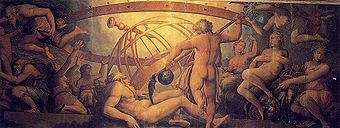 In an alternate version of this myth, a more benevolent Cronus overthrew the wicked serpentine Titan Ophion
. In doing so, he released the world from bondage and for a time ruled it justly.
After dispatching Uranus, Cronus re-imprisoned the Hecatonchires, the Gigantes
, and the Cyclopes
and set the dragon Campe
to guard them. He and his sister Rhea
took the throne of the world as king and queen. The period in which Cronus ruled was called the Golden Age
, as the people of the time had no need for laws or rules; everyone did the right thing, and immorality was absent.
Cronus learned from Gaia and Uranus that he was destined to be overcome by his own sons, just as he had overthrown his father. As a result, although he sired the gods Demeter
, Hestia
, Hera
, Hades
and Poseidon
by Rhea, he devoured them all as soon as they were born, to preempt the prophecy. When the sixth child, Zeus
, was born Rhea sought Gaia to devise a plan to save them and to eventually get retribution on Cronus for his acts against his father and children. Other children Cronus is reputed to have fathered include Chiron
, by Philyra.
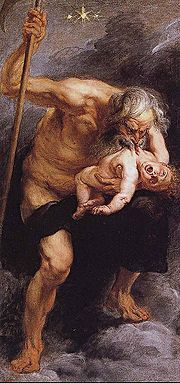 Rhea secretly gave birth to Zeus in Crete
, and handed Cronus a stone wrapped in swaddling clothes, also known as the Omphalos
Stone, which he promptly swallowed, thinking that it was his son.
Rhea kept Zeus hidden in a cave on Mount Ida, Crete
. According to some versions of the story, he was then raised by a goat named Amalthea
, while a company of Kouretes
, armored male dancers, shouted and clapped their hands to make enough noise to mask the baby's cries from Cronus. Other versions of the myth have Zeus raised by the nymph
Adamanthea
, who hid Zeus by dangling him by a rope from a tree so that he was suspended between the earth, the sea, and the sky, all of which were ruled by his father, Cronus. Still other versions of the tale say that Zeus was raised by his grandmother, Gaia.
Once he had grown up, Zeus used an emetic given to him by Gaia to force Cronus to disgorge the contents of his stomach in reverse order: first the stone, which was set down at Pytho under the glens of Mount Parnassus
to be a sign to mortal men, then the goat, and then his two brothers and three sisters. In other versions of the tale, Metis
gave Cronus an emetic to force him to disgorge the children, or Zeus cut Cronus' stomach open. After freeing his siblings, Zeus released the Gigantes, the Hecatonchires, and the Cyclopes, who forged for him his thunderbolts, Poseidon's trident and Hades' helm of darkness. In a vast war called the Titanomachy
, Zeus and his brothers and sisters, with the help of the Gigantes, Hecatonchires, and Cyclopes, overthrew Cronus and the other Titans. Afterwards, many of the Titans were confined in Tartarus
. Some Titans were not banished to Tartarus
. Atlas, Epimetheus, Menoetius, Oceanus and Prometheus are examples of Titans who were not imprisoned in Tartarus following the Titanomachy
. Gaia bore the monster Typhon
to claim revenge for the imprisoned Titans, though Zeus was victorious.
Accounts of the fate of Cronus after the Titanomachy differ. In Homer
ic and other texts he is imprisoned with the other Titans in Tartarus. In Orphic poems, he is imprisoned for eternity in the cave of Nyx. Pindar describes his release from Tartarus, where he is made King of Elysium
by Zeus. In another version, the Titans released the Cyclopes from Tartarus, and Cronus was awarded the kingship among them, beginning a Golden Age
. In Virgil
's Aeneid
, it is Latium
to which Saturn (Cronus) escapes and ascends as king and lawgiver, following his defeat by his son Jupiter (Zeus).
One other account referred by Robert Graves
(who claims to be following the account of the byzantine mythographer Tzetzes) it is said that Cronus was castrated by his son Zeus just like he had done with his father Uranus before. However the subject of a son castrating his own father, or simply castration in general, was so repudiated by the Greek mythographers of that time that they suppressed it from their accounts until the christian era (when Tzetzes wrote). The same happened with the Genesis revisers who erased from the Bible the castration of Noah by his grandson Canaan (see Gen. 9 20-28 where it is possible to feel the gap in the narration). The full account can be found on other versions of the myth (ex. Tanhuma Buber Genesis 48-49).
(1st c. BC), Cronus or Saturn, son of Uranus and Titea, is said to have reigned over Italy, Sicily, and Northern Africa. He cites as evidence the heights in Sicily that were in his time known as Cronia. Cronus, joined by the Titans, makes war against and eventually defeats his brother Jupiter, who reigns in Crete, and his brother-in-law Hammon, who reigns at Nysa
, an island on the river Triton
, somewhere in Africa. Cronus takes his sister Rhea from Hammon, to be his own wife. Cronus in turn is defeated by Hammon's son Bacchus
or Dionysus
, who appoints Cronus' and Rhea's son, Jupiter Olympus, as governor over Egypt. Bacchus and Jupiter Olympus then join their forces to defeat the remaining Titans in Crete, and on the death of Bacchus, Jupiter Olympus inherits all the kingdoms, becoming lord of the world. (Diodorus, Book III)
, particularly book three, which makes Cronus, 'Titan' and Iapetus
, the three sons of Uranus and Gaia, each to receive a third division of the Earth, and Cronus is made king over all. After the death of Uranus, Titan's sons attempt to destroy Cronus' and Rhea's male offspring as soon as they are born, but at Dodona
, Rhea secretly bears her sons Zeus, Poseidon and Hades and sends them to Phrygia
to be raised in the care of three Cretans. Upon learning this, sixty of Titan's men then imprison Cronus and Rhea, causing the sons of Cronus to declare and fight the first of all wars against them. This account mentions nothing about Cronus either killing his father or attempting to kill any of his children.
, A Handbook of Greek Mythology (1928), observed that attempts to give Kronos a Greek etymology
have failed.
Recently, Janda (2010) offers a genuinely Indo-European etymology of "the cutter", from the root *(s)ker- "to cut" (Greek κείρω, c.f. English shear), motivated by Cronus' characteristic act of "cutting the sky" (or the genitals of anthropomorphic Uranus).
The Indo-Iranian reflex of the root is kar, generally meaning "to make, create" (whence karma
), but Janda argues that the original meaning "to cut" in a cosmogonic sense is still preserved in some verses of the Rigveda
pertaining to Indra
's heroic "cutting", like that of Cronus resulting in creation:
This may point to an older Indo-European mytheme reconstructed as "by means of a cut he created the loftiness of the sky".
The myth of Cronus castrating Uranus parallels the Song of Kumarbi, where Anu (the heavens) is castrated by Kumarbi. In the Song of Ullikummi, Teshub
uses the "sickle with which heaven and earth had once been separated" to defeat the monster Ullikummi, establishing that the "castration" of the heavens by means of a sickle as part of a creation myth, in origin a cut creating an opening or gap
between heaven (imagined as a dome of stone
) and earth enabling the beginning of time (Chronos
) and human history.
Cronus had been conflated with the name of Chronos
, the personification of time in Classical Antiquity. In the Renaissance
, the combination of Cronus and Chronos give rise to "Father Time
" wielding the harvesting scythe.
A theory debated in the 19th century, and sometimes still offered somewhat apologetically, holds that Kronos is related to "horned", assuming a Semitic derivation from qrn.
Andrew Lang
's objection, that Cronus was never represented horned in Hellenic art, was addressed by Robert Brown, arguing that in Semitic usage, as in the Hebrew Bible
qeren was a signifier of "power". When Greek writers encountered the Levantine deity El
, they rendered his name as Kronos.
, by interpretatio graeca
, with Cronus. The association was recorded ca. AD 100 by Philo of Byblos
' Phoenician history, as reported in Eusebius
' Præparatio Evangelica I.10.16. Philo's account, ascribed by Eusebius to the semi-legendary pre-Trojan War
Phoenicia
n historian Sanchuniathon
, indicates that Cronus was originally a Canaan
ite ruler who founded Byblos
and was subsequently deified. This version gives his alternate name as Elus or Ilus, and states that in the 32nd year of his reign, he emasculated, slew and deified his father Epigeius or Autochthon "whom they afterwards called Uranus". It further states that after ships were invented, Cronus, visiting the 'inhabitable world', bequeathed Attica
to his own daughter Athena
, and Egypt
to Thoth
the son of Misor
and inventor of writing.
with Cronus. Consequently, while the Greeks considered Cronus merely an intermediary stage between Uranus and Zeus, he was a larger aspect of Roman religion
. The Saturnalia
was a festival dedicated in his honor, and at least one temple to Saturn
already existed in the archaic Roman Kingdom
.
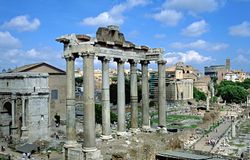 His association with the "Saturnian" Golden Age eventually caused him to become the god of "time", i.e., calendars, seasons, and harvests — not now confused with Chronos
, the unrelated embodiment of time in general; nevertheless, among Hellenistic
scholars in Alexandria and during the Renaissance
, Cronus was conflated with the name of Chronos
, the personification of "Father Time
", wielding the harvesting scythe.
As a result of Cronus' importance to the Romans, his Roman variant, Saturn, has had a large influence on Western culture
. The seventh day of the Judaeo-Christian week is called in Latin
Dies Saturni ("Day of Saturn"), which in turn was adapted and became the source of the English
word Saturday. In astronomy
, the planet Saturn
is named after the Roman deity. It is the outermost of the Classical planets (those that that are visible with the naked eye).
Greek mythology
Greek mythology is the body of myths and legends belonging to the ancient Greeks, concerning their gods and heroes, the nature of the world, and the origins and significance of their own cult and ritual practices. They were a part of religion in ancient Greece...
, Cronus or Kronos (Ancient Greek
Ancient Greek
Ancient Greek is the stage of the Greek language in the periods spanning the times c. 9th–6th centuries BC, , c. 5th–4th centuries BC , and the c. 3rd century BC – 6th century AD of ancient Greece and the ancient world; being predated in the 2nd millennium BC by Mycenaean Greek...
: Κρόνος, Krónos) was the leader and the youngest of the first generation of Titans
Titan (mythology)
In Greek mythology, the Titans were a race of powerful deities, descendants of Gaia and Uranus, that ruled during the legendary Golden Age....
, divine descendants of Gaia
Gaia (mythology)
Gaia was the primordial Earth-goddess in ancient Greek religion. Gaia was the great mother of all: the heavenly gods and Titans were descended from her union with Uranus , the sea-gods from her union with Pontus , the Giants from her mating with Tartarus and mortal creatures were sprung or born...
, the earth, and Uranus
Uranus (mythology)
Uranus , was the primal Greek god personifying the sky. His equivalent in Roman mythology was Caelus. In Ancient Greek literature, according to Hesiod in his Theogony, Uranus or Father Sky was the son and husband of Gaia, Mother Earth...
, the sky. He overthrew his father and ruled during the mythological Golden Age
Golden Age
The term Golden Age comes from Greek mythology and legend and refers to the first in a sequence of four or five Ages of Man, in which the Golden Age is first, followed in sequence, by the Silver, Bronze, and Iron Ages, and then the present, a period of decline...
, until he was overthrown by his own son, Zeus
Zeus
In the ancient Greek religion, Zeus was the "Father of Gods and men" who ruled the Olympians of Mount Olympus as a father ruled the family. He was the god of sky and thunder in Greek mythology. His Roman counterpart is Jupiter and his Etruscan counterpart is Tinia.Zeus was the child of Cronus...
and imprisoned in Tartarus
Tartarus
In classic mythology, below Uranus , Gaia , and Pontus is Tartarus, or Tartaros . It is a deep, gloomy place, a pit, or an abyss used as a dungeon of torment and suffering that resides beneath the underworld. In the Gorgias, Plato In classic mythology, below Uranus (sky), Gaia (earth), and Pontus...
.
Cronus was usually depicted with a sickle
Sickle
A sickle is a hand-held agricultural tool with a variously curved blade typically used for harvesting grain crops or cutting succulent forage chiefly for feeding livestock . Sickles have also been used as weapons, either in their original form or in various derivations.The diversity of sickles that...
or scythe
Scythe
A scythe is an agricultural hand tool for mowing grass, or reaping crops. It was largely replaced by horse-drawn and then tractor machinery, but is still used in some areas of Europe and Asia. The Grim Reaper is often depicted carrying or wielding a scythe...
, which was also the weapon he used to castrate and depose Uranus
Uranus (mythology)
Uranus , was the primal Greek god personifying the sky. His equivalent in Roman mythology was Caelus. In Ancient Greek literature, according to Hesiod in his Theogony, Uranus or Father Sky was the son and husband of Gaia, Mother Earth...
, his father. In Athens, on the twelfth day of the Attic month of Hekatombaion
Attic calendar
The Attic calendar is a hellenic calendar that was in use in ancient Attica, the ancestral territory of the Athenian polis. This article focuses on the 5th and 4th centuries BC, the classical period that produced some of the most significant works of ancient Greek literature. Because of the...
, a festival called Kronia
Kronia
In Athens, on the twelfth day of the month of Hekatombaion, a festival called Kronia was held in honour of Cronus, a god of agriculture, and to celebrate the harvest....
was held in honor of Cronus to celebrate the harvest, suggesting that, as a result of his association with the virtuous Golden Age, Cronus continued to preside as a patron of harvest
Harvest
Harvest is the process of gathering mature crops from the fields. Reaping is the cutting of grain or pulse for harvest, typically using a scythe, sickle, or reaper...
. Cronus was also identified in classical antiquity
Classical antiquity
Classical antiquity is a broad term for a long period of cultural history centered on the Mediterranean Sea, comprising the interlocking civilizations of ancient Greece and ancient Rome, collectively known as the Greco-Roman world...
with the Roman deity
Roman mythology
Roman mythology is the body of traditional stories pertaining to ancient Rome's legendary origins and religious system, as represented in the literature and visual arts of the Romans...
Saturn
Saturn (mythology)
In ancient Roman religion and myth, Saturn was a major god presiding over agriculture and the harvest time. His reign was depicted as a Golden Age of abundance and peace by many Roman authors. In medieval times he was known as the Roman god of agriculture, justice and strength. He held a sickle in...
.
Greek mythology and early myths
In ancient myth recorded by HesiodHesiod
Hesiod was a Greek oral poet generally thought by scholars to have been active between 750 and 650 BC, around the same time as Homer. His is the first European poetry in which the poet regards himself as a topic, an individual with a distinctive role to play. Ancient authors credited him and...
's Theogony
Theogony
The Theogony is a poem by Hesiod describing the origins and genealogies of the gods of the ancient Greeks, composed circa 700 BC...
, Cronus envied the power of his father, the ruler of the universe, Uranus. Uranus drew the enmity of Cronus' mother, Gaia
Gaia (mythology)
Gaia was the primordial Earth-goddess in ancient Greek religion. Gaia was the great mother of all: the heavenly gods and Titans were descended from her union with Uranus , the sea-gods from her union with Pontus , the Giants from her mating with Tartarus and mortal creatures were sprung or born...
, when he hid the gigantic youngest children of Gaia, the hundred-armed Hecatonchires and one-eyed Cyclopes
Cyclops
A cyclops , in Greek mythology and later Roman mythology, was a member of a primordial race of giants, each with a single eye in the middle of his forehead...
, in Tartarus
Tartarus
In classic mythology, below Uranus , Gaia , and Pontus is Tartarus, or Tartaros . It is a deep, gloomy place, a pit, or an abyss used as a dungeon of torment and suffering that resides beneath the underworld. In the Gorgias, Plato In classic mythology, below Uranus (sky), Gaia (earth), and Pontus...
, so that they would not see the light. Gaia created a great stone sickle and gathered together Cronus and his brothers to persuade them to castrate Uranus. Only Cronus was willing to do the deed, so Gaia gave him the sickle and placed him in ambush. When Uranus met with Gaia, Cronus attacked him with the sickle castrating
Castration
Castration is any action, surgical, chemical, or otherwise, by which a male loses the functions of the testicles or a female loses the functions of the ovaries.-Humans:...
him and casting his testicles into the sea. From the blood
Blood
Blood is a specialized bodily fluid in animals that delivers necessary substances such as nutrients and oxygen to the cells and transports metabolic waste products away from those same cells....
(or, by a few accounts, semen
Semen
Semen is an organic fluid, also known as seminal fluid, that may contain spermatozoa. It is secreted by the gonads and other sexual organs of male or hermaphroditic animals and can fertilize female ova...
) that spilled out from Uranus and fell upon the earth, the Gigantes
Gigantes
In Greek mythology, the Giants were the children of Gaia, who was fertilized by the blood of Uranus, after Uranus was castrated by his son Cronus...
, Erinyes
Erinyes
In Greek mythology the Erinyes from Greek ἐρίνειν " pursue, persecute"--sometimes referred to as "infernal goddesses" -- were female chthonic deities of vengeance. A formulaic oath in the Iliad invokes them as "those who beneath the earth punish whosoever has sworn a false oath"...
, and Meliae
Meliae
In Greek mythology, the Meliae or Meliai were nymphs of the ash tree, whose name they shared. They appeared from the drops of blood spilled when Cronus castrated Uranus, according to Hesiod, Theogony 187. From the same blood sprang the Erinyes, suggesting that the ash-tree nymphs represented the...
were produced. The testicles produced a white foam from which Aphrodite
Aphrodite
Aphrodite is the Greek goddess of love, beauty, pleasure, and procreation.Her Roman equivalent is the goddess .Historically, her cult in Greece was imported from, or influenced by, the cult of Astarte in Phoenicia....
emerged. For this, Uranus threatened vengeance and called his sons titenes (according to Hesiod meaning "straining ones," the source of the word "titan", but this etymology is disputed) for overstepping their boundaries and daring to commit such an act.
Ophion
In some versions of Greek mythology, Ophion , also called Ophioneus ruled the world with Eurynome before the two of them were cast down by Cronus and Rhea.-Sources:...
. In doing so, he released the world from bondage and for a time ruled it justly.
After dispatching Uranus, Cronus re-imprisoned the Hecatonchires, the Gigantes
Gigantes
In Greek mythology, the Giants were the children of Gaia, who was fertilized by the blood of Uranus, after Uranus was castrated by his son Cronus...
, and the Cyclopes
Cyclops
A cyclops , in Greek mythology and later Roman mythology, was a member of a primordial race of giants, each with a single eye in the middle of his forehead...
and set the dragon Campe
Campe
In Greek mythology, Campe or Kampê is the name of a chthonic female monster .-Mythology:Campe was a dragon with a woman's head and torso and a scorpion-like tail. Nonnus, in Dionysiaca gives the most elaborated description of her...
to guard them. He and his sister Rhea
Rhea (mythology)
Rhea was the Titaness daughter of Uranus, the sky, and Gaia, the earth, in Greek mythology. She was known as "the mother of gods". In earlier traditions, she was strongly associated with Gaia and Cybele, the Great Goddess, and was later seen by the classical Greeks as the mother of the Olympian...
took the throne of the world as king and queen. The period in which Cronus ruled was called the Golden Age
Golden Age
The term Golden Age comes from Greek mythology and legend and refers to the first in a sequence of four or five Ages of Man, in which the Golden Age is first, followed in sequence, by the Silver, Bronze, and Iron Ages, and then the present, a period of decline...
, as the people of the time had no need for laws or rules; everyone did the right thing, and immorality was absent.
Cronus learned from Gaia and Uranus that he was destined to be overcome by his own sons, just as he had overthrown his father. As a result, although he sired the gods Demeter
Demeter
In Greek mythology, Demeter is the goddess of the harvest, who presided over grains, the fertility of the earth, and the seasons . Her common surnames are Sito as the giver of food or corn/grain and Thesmophoros as a mark of the civilized existence of agricultural society...
, Hestia
Hestia
In Greek mythology Hestia , first daughter of Cronus and Rhea , is the virgin goddess of the hearth, architecture, and of the right ordering of domesticity and the family. She received the first offering at every sacrifice in the household. In the public domain, the hearth of the prytaneum...
, Hera
Hera
Hera was the wife and one of three sisters of Zeus in the Olympian pantheon of Greek mythology and religion. Her chief function was as the goddess of women and marriage. Her counterpart in the religion of ancient Rome was Juno. The cow and the peacock were sacred to her...
, Hades
Hades
Hades , Hadēs, originally , Haidēs or , Aidēs , meaning "the unseen") was the ancient Greek god of the underworld. The genitive , Haidou, was an elision to denote locality: "[the house/dominion] of Hades". Eventually, the nominative came to designate the abode of the dead.In Greek mythology, Hades...
and Poseidon
Poseidon
Poseidon was the god of the sea, and, as "Earth-Shaker," of the earthquakes in Greek mythology. The name of the sea-god Nethuns in Etruscan was adopted in Latin for Neptune in Roman mythology: both were sea gods analogous to Poseidon...
by Rhea, he devoured them all as soon as they were born, to preempt the prophecy. When the sixth child, Zeus
Zeus
In the ancient Greek religion, Zeus was the "Father of Gods and men" who ruled the Olympians of Mount Olympus as a father ruled the family. He was the god of sky and thunder in Greek mythology. His Roman counterpart is Jupiter and his Etruscan counterpart is Tinia.Zeus was the child of Cronus...
, was born Rhea sought Gaia to devise a plan to save them and to eventually get retribution on Cronus for his acts against his father and children. Other children Cronus is reputed to have fathered include Chiron
Chiron
In Greek mythology, Chiron was held to be the superlative centaur among his brethren.-History:Like the satyrs, centaurs were notorious for being wild and lusty, overly indulgent drinkers and carousers, given to violence when intoxicated, and generally uncultured delinquents...
, by Philyra.
Crete
Crete is the largest and most populous of the Greek islands, the fifth largest island in the Mediterranean Sea, and one of the thirteen administrative regions of Greece. It forms a significant part of the economy and cultural heritage of Greece while retaining its own local cultural traits...
, and handed Cronus a stone wrapped in swaddling clothes, also known as the Omphalos
Omphalos
An omphalos is an ancient religious stone artifact, or baetylus. In Greek, the word omphalos means "navel" . According to the ancient Greeks, Zeus sent out two eagles to fly across the world to meet at its center, the "navel" of the world...
Stone, which he promptly swallowed, thinking that it was his son.
Rhea kept Zeus hidden in a cave on Mount Ida, Crete
Mount Ida, Crete
Mount Ida, known variously as Idha, Ídhi, Idi, Ita and now Psiloritis , is the highest mountain on Crete. Located in the Rethymno Prefecture, it is sacred to the Greek Titaness Rhea, and on its slopes, according to legend, lies the cave, Idaion Andron, in which Zeus was born...
. According to some versions of the story, he was then raised by a goat named Amalthea
Amalthea (mythology)
In Greek mythology, Amalthea or Amaltheia is the most-frequently mentioned foster-mother of Zeus. Her name in Greek is clearly an epithet, signifying the presence of an earlier nurturing goddess, whom the Hellenes, whose myths we know, knew to be located in Crete, where Minoans may have called...
, while a company of Kouretes
Korybantes
The Corybantes were the armed and crested dancers who worshipped the Phrygian goddess Cybele with drumming and dancing. They are also called the Kurbantes in Phrygia, and Corybants in an older English transcription. The Kuretes were the nine dancers who venerate Rhea, the Cretan counterpart of...
, armored male dancers, shouted and clapped their hands to make enough noise to mask the baby's cries from Cronus. Other versions of the myth have Zeus raised by the nymph
Nymph
A nymph in Greek mythology is a female minor nature deity typically associated with a particular location or landform. Different from gods, nymphs are generally regarded as divine spirits who animate nature, and are usually depicted as beautiful, young nubile maidens who love to dance and sing;...
Adamanthea
Adamanthea
A nymph in Greek mythology, Adamanthea helped raise the infant Zeus to hide him from his father, Cronus. Her name comes from the Greek word αδαμας , meaning "untameable" and θεά, the Greek word for goddess.-Mythology:...
, who hid Zeus by dangling him by a rope from a tree so that he was suspended between the earth, the sea, and the sky, all of which were ruled by his father, Cronus. Still other versions of the tale say that Zeus was raised by his grandmother, Gaia.
Once he had grown up, Zeus used an emetic given to him by Gaia to force Cronus to disgorge the contents of his stomach in reverse order: first the stone, which was set down at Pytho under the glens of Mount Parnassus
Mount Parnassus
Mount Parnassus, also Parnassos , is a mountain of limestone in central Greece that towers above Delphi, north of the Gulf of Corinth, and offers scenic views of the surrounding olive groves and countryside. According to Greek mythology, this mountain was sacred to Apollo and the Corycian nymphs,...
to be a sign to mortal men, then the goat, and then his two brothers and three sisters. In other versions of the tale, Metis
Metis (mythology)
In Greek mythology, Metis was of the Titan generation and, like several primordial figures, an Oceanid, in the sense that Metis was born of Oceanus and Tethys, of an earlier age than Zeus and his siblings...
gave Cronus an emetic to force him to disgorge the children, or Zeus cut Cronus' stomach open. After freeing his siblings, Zeus released the Gigantes, the Hecatonchires, and the Cyclopes, who forged for him his thunderbolts, Poseidon's trident and Hades' helm of darkness. In a vast war called the Titanomachy
Titanomachy
In Greek mythology, the Titanomachy or War of the Titans , was the ten-year series of battles fought in Thessaly between the two camps of deities long before the existence of mankind: the Titans, based on Mount Othrys, and the Olympians, who would come to reign on Mount Olympus...
, Zeus and his brothers and sisters, with the help of the Gigantes, Hecatonchires, and Cyclopes, overthrew Cronus and the other Titans. Afterwards, many of the Titans were confined in Tartarus
Tartarus
In classic mythology, below Uranus , Gaia , and Pontus is Tartarus, or Tartaros . It is a deep, gloomy place, a pit, or an abyss used as a dungeon of torment and suffering that resides beneath the underworld. In the Gorgias, Plato In classic mythology, below Uranus (sky), Gaia (earth), and Pontus...
. Some Titans were not banished to Tartarus
Tartarus
In classic mythology, below Uranus , Gaia , and Pontus is Tartarus, or Tartaros . It is a deep, gloomy place, a pit, or an abyss used as a dungeon of torment and suffering that resides beneath the underworld. In the Gorgias, Plato In classic mythology, below Uranus (sky), Gaia (earth), and Pontus...
. Atlas, Epimetheus, Menoetius, Oceanus and Prometheus are examples of Titans who were not imprisoned in Tartarus following the Titanomachy
Titanomachy
In Greek mythology, the Titanomachy or War of the Titans , was the ten-year series of battles fought in Thessaly between the two camps of deities long before the existence of mankind: the Titans, based on Mount Othrys, and the Olympians, who would come to reign on Mount Olympus...
. Gaia bore the monster Typhon
Typhon
Typhon , also Typhoeus , Typhaon or Typhos was the last son of Gaia, fathered by Tartarus, and the most deadly monster of Greek mythology. He was known as the "Father of all monsters"; his wife Echidna was likewise the "Mother of All Monsters."Typhon was described in pseudo-Apollodorus,...
to claim revenge for the imprisoned Titans, though Zeus was victorious.
Accounts of the fate of Cronus after the Titanomachy differ. In Homer
Homer
In the Western classical tradition Homer , is the author of the Iliad and the Odyssey, and is revered as the greatest ancient Greek epic poet. These epics lie at the beginning of the Western canon of literature, and have had an enormous influence on the history of literature.When he lived is...
ic and other texts he is imprisoned with the other Titans in Tartarus. In Orphic poems, he is imprisoned for eternity in the cave of Nyx. Pindar describes his release from Tartarus, where he is made King of Elysium
Elysium
Elysium is a conception of the afterlife that evolved over time and was maintained by certain Greek religious and philosophical sects, and cults. Initially separate from Hades, admission was initially reserved for mortals related to the gods and other heroes...
by Zeus. In another version, the Titans released the Cyclopes from Tartarus, and Cronus was awarded the kingship among them, beginning a Golden Age
Golden Age
The term Golden Age comes from Greek mythology and legend and refers to the first in a sequence of four or five Ages of Man, in which the Golden Age is first, followed in sequence, by the Silver, Bronze, and Iron Ages, and then the present, a period of decline...
. In Virgil
Virgil
Publius Vergilius Maro, usually called Virgil or Vergil in English , was an ancient Roman poet of the Augustan period. He is known for three major works of Latin literature, the Eclogues , the Georgics, and the epic Aeneid...
's Aeneid
Aeneid
The Aeneid is a Latin epic poem, written by Virgil between 29 and 19 BC, that tells the legendary story of Aeneas, a Trojan who travelled to Italy, where he became the ancestor of the Romans. It is composed of roughly 10,000 lines in dactylic hexameter...
, it is Latium
Latium
Lazio is one of the 20 administrative regions of Italy, situated in the central peninsular section of the country. With about 5.7 million residents and a GDP of more than 170 billion euros, Lazio is the third most populated and the second richest region of Italy...
to which Saturn (Cronus) escapes and ascends as king and lawgiver, following his defeat by his son Jupiter (Zeus).
One other account referred by Robert Graves
Robert Graves
Robert von Ranke Graves 24 July 1895 – 7 December 1985 was an English poet, translator and novelist. During his long life he produced more than 140 works...
(who claims to be following the account of the byzantine mythographer Tzetzes) it is said that Cronus was castrated by his son Zeus just like he had done with his father Uranus before. However the subject of a son castrating his own father, or simply castration in general, was so repudiated by the Greek mythographers of that time that they suppressed it from their accounts until the christian era (when Tzetzes wrote). The same happened with the Genesis revisers who erased from the Bible the castration of Noah by his grandson Canaan (see Gen. 9 20-28 where it is possible to feel the gap in the narration). The full account can be found on other versions of the myth (ex. Tanhuma Buber Genesis 48-49).
Libyan account by Diodorus Siculus
In a Libyan account related by Diodorus SiculusDiodorus Siculus
Diodorus Siculus was a Greek historian who flourished between 60 and 30 BC. According to Diodorus' own work, he was born at Agyrium in Sicily . With one exception, antiquity affords no further information about Diodorus' life and doings beyond what is to be found in his own work, Bibliotheca...
(1st c. BC), Cronus or Saturn, son of Uranus and Titea, is said to have reigned over Italy, Sicily, and Northern Africa. He cites as evidence the heights in Sicily that were in his time known as Cronia. Cronus, joined by the Titans, makes war against and eventually defeats his brother Jupiter, who reigns in Crete, and his brother-in-law Hammon, who reigns at Nysa
Nysa (mythology)
In Greek mythology, the mountainous district of Nysa, variously associated with Ethiopia, Libya, Tribalia, India or Arabia by Greek mythographers, was the traditional place where the rain nymphs, the Hyades, raised the infant god Dionysus, the "Zeus of Nysa"...
, an island on the river Triton
Triton (mythology)
Triton is a mythological Greek god, the messenger of the big sea. He is the son of Poseidon, god of the sea, and Amphitrite, goddess of the sea, whose herald he is...
, somewhere in Africa. Cronus takes his sister Rhea from Hammon, to be his own wife. Cronus in turn is defeated by Hammon's son Bacchus
Dionysus
Dionysus was the god of the grape harvest, winemaking and wine, of ritual madness and ecstasy in Greek mythology. His name in Linear B tablets shows he was worshipped from c. 1500—1100 BC by Mycenean Greeks: other traces of Dionysian-type cult have been found in ancient Minoan Crete...
or Dionysus
Dionysus
Dionysus was the god of the grape harvest, winemaking and wine, of ritual madness and ecstasy in Greek mythology. His name in Linear B tablets shows he was worshipped from c. 1500—1100 BC by Mycenean Greeks: other traces of Dionysian-type cult have been found in ancient Minoan Crete...
, who appoints Cronus' and Rhea's son, Jupiter Olympus, as governor over Egypt. Bacchus and Jupiter Olympus then join their forces to defeat the remaining Titans in Crete, and on the death of Bacchus, Jupiter Olympus inherits all the kingdoms, becoming lord of the world. (Diodorus, Book III)
Sibylline Oracles
Cronus is again mentioned in the Sibylline OraclesSibylline oracles
The Sibylline Oracles are a collection of oracular utterances written in Greek hexameters ascribed to the Sibyls, prophetesses who uttered divine revelations in a frenzied state. Fourteen books and eight fragments of Sibylline Oracles survive...
, particularly book three, which makes Cronus, 'Titan' and Iapetus
Iapetus (mythology)
In Greek mythology, Iapetus , also Iapetos or Japetus , was a Titan, the son of Uranus and Gaia, and father of Atlas, Prometheus, Epimetheus, and Menoetius and through Prometheus, Epimetheus and Atlas an ancestor of the human race...
, the three sons of Uranus and Gaia, each to receive a third division of the Earth, and Cronus is made king over all. After the death of Uranus, Titan's sons attempt to destroy Cronus' and Rhea's male offspring as soon as they are born, but at Dodona
Dodona
Dodona in Epirus in northwestern Greece, was an oracle devoted to a Mother Goddess identified at other sites with Rhea or Gaia, but here called Dione, who was joined and partly supplanted in historical times by the Greek god Zeus.The shrine of Dodona was regarded as the oldest Hellenic oracle,...
, Rhea secretly bears her sons Zeus, Poseidon and Hades and sends them to Phrygia
Phrygia
In antiquity, Phrygia was a kingdom in the west central part of Anatolia, in what is now modern-day Turkey. The Phrygians initially lived in the southern Balkans; according to Herodotus, under the name of Bryges , changing it to Phruges after their final migration to Anatolia, via the...
to be raised in the care of three Cretans. Upon learning this, sixty of Titan's men then imprison Cronus and Rhea, causing the sons of Cronus to declare and fight the first of all wars against them. This account mentions nothing about Cronus either killing his father or attempting to kill any of his children.
Name and comparative mythology
H. J. RoseH. J. Rose
Herbert Jennings Rose is remembered as the author of A Handbook of Greek Mythology, originally published in 1928, which for many years became the standard student reference book on the subject, reaching a sixth edition by 1958...
, A Handbook of Greek Mythology (1928), observed that attempts to give Kronos a Greek etymology
Etymology
Etymology is the study of the history of words, their origins, and how their form and meaning have changed over time.For languages with a long written history, etymologists make use of texts in these languages and texts about the languages to gather knowledge about how words were used during...
have failed.
Recently, Janda (2010) offers a genuinely Indo-European etymology of "the cutter", from the root *(s)ker- "to cut" (Greek κείρω, c.f. English shear), motivated by Cronus' characteristic act of "cutting the sky" (or the genitals of anthropomorphic Uranus).
The Indo-Iranian reflex of the root is kar, generally meaning "to make, create" (whence karma
Karma
Karma in Indian religions is the concept of "action" or "deed", understood as that which causes the entire cycle of cause and effect originating in ancient India and treated in Hindu, Jain, Buddhist and Sikh philosophies....
), but Janda argues that the original meaning "to cut" in a cosmogonic sense is still preserved in some verses of the Rigveda
Rigveda
The Rigveda is an ancient Indian sacred collection of Vedic Sanskrit hymns...
pertaining to Indra
Indra
' or is the King of the demi-gods or Devas and Lord of Heaven or Svargaloka in Hindu mythology. He is also the God of War, Storms, and Rainfall.Indra is one of the chief deities in the Rigveda...
's heroic "cutting", like that of Cronus resulting in creation:
- RV 10.104.10 "he hit Vrtra fatally, cutting [> creating] a free path"
- RV 6.47.4 "he cut [> created] the loftiness of the sky."
This may point to an older Indo-European mytheme reconstructed as "by means of a cut he created the loftiness of the sky".
The myth of Cronus castrating Uranus parallels the Song of Kumarbi, where Anu (the heavens) is castrated by Kumarbi. In the Song of Ullikummi, Teshub
Teshub
Teshub was the Hurrian god of sky and storm. He was derived from the Hattian Taru. His Hittite and Luwian name was Tarhun , although this name is from the Hittite root *tarh- to defeat, conquer.- Depiction and myths :He is depicted holding a triple...
uses the "sickle with which heaven and earth had once been separated" to defeat the monster Ullikummi, establishing that the "castration" of the heavens by means of a sickle as part of a creation myth, in origin a cut creating an opening or gap
Chaos (cosmogony)
Chaos refers to the formless or void state preceding the creation of the universe or cosmos in the Greek creation myths, more specifically the initial "gap" created by the original separation of heaven and earth....
between heaven (imagined as a dome of stone
Firmament
The firmament is the vault or expanse of the sky. According to Genesis, God created the firmament to separate the oceans from other waters above.-Etymology:...
) and earth enabling the beginning of time (Chronos
Chronos
In Greek mythology, Chronos in pre-Socratic philosophical works is said to be the personification of time. His name in Greek means "time" and is alternatively spelled Chronus or Khronos.Chronos was imagined as an incorporeal god, serpentine in form, with three heads—those of a man, a bull, and...
) and human history.
Cronus had been conflated with the name of Chronos
Chronos
In Greek mythology, Chronos in pre-Socratic philosophical works is said to be the personification of time. His name in Greek means "time" and is alternatively spelled Chronus or Khronos.Chronos was imagined as an incorporeal god, serpentine in form, with three heads—those of a man, a bull, and...
, the personification of time in Classical Antiquity. In the Renaissance
Renaissance
The Renaissance was a cultural movement that spanned roughly the 14th to the 17th century, beginning in Italy in the Late Middle Ages and later spreading to the rest of Europe. The term is also used more loosely to refer to the historical era, but since the changes of the Renaissance were not...
, the combination of Cronus and Chronos give rise to "Father Time
Father Time
Father Time is usually depicted as an elderly bearded man, somewhat worse for wear, dressed in a robe, carrying a scythe and an hourglass or other timekeeping device...
" wielding the harvesting scythe.
A theory debated in the 19th century, and sometimes still offered somewhat apologetically, holds that Kronos is related to "horned", assuming a Semitic derivation from qrn.
Andrew Lang
Andrew Lang
Andrew Lang was a Scots poet, novelist, literary critic, and contributor to the field of anthropology. He is best known as a collector of folk and fairy tales. The Andrew Lang lectures at the University of St Andrews are named after him.- Biography :Lang was born in Selkirk...
's objection, that Cronus was never represented horned in Hellenic art, was addressed by Robert Brown, arguing that in Semitic usage, as in the Hebrew Bible
Hebrew Bible
The Hebrew Bible is a term used by biblical scholars outside of Judaism to refer to the Tanakh , a canonical collection of Jewish texts, and the common textual antecedent of the several canonical editions of the Christian Old Testament...
qeren was a signifier of "power". When Greek writers encountered the Levantine deity El
El (god)
is a Northwest Semitic word meaning "deity", cognate to Akkadian and then to Hebrew : Eli and Arabic )....
, they rendered his name as Kronos.
El, the Phoenician Cronus
When Hellenes encountered Phoenicians and, later, Hebrews, they identified the Semitic ElEl (god)
is a Northwest Semitic word meaning "deity", cognate to Akkadian and then to Hebrew : Eli and Arabic )....
, by interpretatio graeca
Interpretatio graeca
Interpretatio graeca is a Latin term for the common tendency of ancient Greek writers to equate foreign divinities to members of their own pantheon. Herodotus, for example, refers to the ancient Egyptian gods Amon, Osiris and Ptah as "Zeus", "Dionysus" and "Hephaestus", respectively.-Roman...
, with Cronus. The association was recorded ca. AD 100 by Philo of Byblos
Philo of Byblos
Philo of Byblos was an antiquarian writer of grammatical, lexical and historical works in Greek. He is chiefly known for his Phoenician history assembled from the writings of Sanchuniathon.-Life:...
' Phoenician history, as reported in Eusebius
Eusebius of Caesarea
Eusebius of Caesarea also called Eusebius Pamphili, was a Roman historian, exegete and Christian polemicist. He became the Bishop of Caesarea in Palestine about the year 314. Together with Pamphilus, he was a scholar of the Biblical canon...
' Præparatio Evangelica I.10.16. Philo's account, ascribed by Eusebius to the semi-legendary pre-Trojan War
Trojan War
In Greek mythology, the Trojan War was waged against the city of Troy by the Achaeans after Paris of Troy took Helen from her husband Menelaus, the king of Sparta. The war is among the most important events in Greek mythology and was narrated in many works of Greek literature, including the Iliad...
Phoenicia
Phoenicia
Phoenicia , was an ancient civilization in Canaan which covered most of the western, coastal part of the Fertile Crescent. Several major Phoenician cities were built on the coastline of the Mediterranean. It was an enterprising maritime trading culture that spread across the Mediterranean from 1550...
n historian Sanchuniathon
Sanchuniathon
Sanchuniathon is the purported Phoenician author of three lost works originally in the Phoenician language, surviving only in partial paraphrase and summary of a Greek translation by Philo of Byblos, according to the Christian bishop Eusebius of Caesarea...
, indicates that Cronus was originally a Canaan
Canaan
Canaan is a historical region roughly corresponding to modern-day Israel, Palestine, Lebanon, and the western parts of Jordan...
ite ruler who founded Byblos
Byblos
Byblos is the Greek name of the Phoenician city Gebal . It is a Mediterranean city in the Mount Lebanon Governorate of present-day Lebanon under the current Arabic name of Jubayl and was also referred to as Gibelet during the Crusades...
and was subsequently deified. This version gives his alternate name as Elus or Ilus, and states that in the 32nd year of his reign, he emasculated, slew and deified his father Epigeius or Autochthon "whom they afterwards called Uranus". It further states that after ships were invented, Cronus, visiting the 'inhabitable world', bequeathed Attica
Attica
Attica is a historical region of Greece, containing Athens, the current capital of Greece. The historical region is centered on the Attic peninsula, which projects into the Aegean Sea...
to his own daughter Athena
Athena
In Greek mythology, Athena, Athenê, or Athene , also referred to as Pallas Athena/Athene , is the goddess of wisdom, courage, inspiration, civilization, warfare, strength, strategy, the arts, crafts, justice, and skill. Minerva, Athena's Roman incarnation, embodies similar attributes. Athena is...
, and Egypt
Egypt
Egypt , officially the Arab Republic of Egypt, Arabic: , is a country mainly in North Africa, with the Sinai Peninsula forming a land bridge in Southwest Asia. Egypt is thus a transcontinental country, and a major power in Africa, the Mediterranean Basin, the Middle East and the Muslim world...
to Thoth
Thoth
Thoth was considered one of the more important deities of the Egyptian pantheon. In art, he was often depicted as a man with the head of an ibis or a baboon, animals sacred to him. His feminine counterpart was Seshat...
the son of Misor
Misor
Misor was the name of a deity appearing in a theogeny provided by Roman era Phoenician writer Philo of Byblos in an account preserved by Eusebius in his Praeparatio Evangelica, and attributed to the still earlier Sanchuniathon. He was one of two children of the deities Amunos and Magos. The other...
and inventor of writing.
Roman mythology and later culture
While the Greeks considered Cronus a cruel and tempestuous force of chaos and disorder, believing the Olympian gods had brought an era of peace and order by seizing power from the crude and malicious Titans, the Romans took a more positive and innocuous view of the deity, by conflating their indigenous deity SaturnSaturn (mythology)
In ancient Roman religion and myth, Saturn was a major god presiding over agriculture and the harvest time. His reign was depicted as a Golden Age of abundance and peace by many Roman authors. In medieval times he was known as the Roman god of agriculture, justice and strength. He held a sickle in...
with Cronus. Consequently, while the Greeks considered Cronus merely an intermediary stage between Uranus and Zeus, he was a larger aspect of Roman religion
Religion in ancient Rome
Religion in ancient Rome encompassed the religious beliefs and cult practices regarded by the Romans as indigenous and central to their identity as a people, as well as the various and many cults imported from other peoples brought under Roman rule. Romans thus offered cult to innumerable deities...
. The Saturnalia
Saturnalia
Saturnalia is an Ancient Roman festival/ celebration held in honour of Saturn , the youngest of the Titans, father of the major gods of the Greeks and Romans, and son of Uranus and Gaia...
was a festival dedicated in his honor, and at least one temple to Saturn
Temple of Saturn
The Temple of Saturn is a monument to the agricultural deity. The Temple of Saturn stands at the foot of the Capitoline Hill in the western end of the Forum Romanum in Rome, Italy.-Archaeology:...
already existed in the archaic Roman Kingdom
Roman Kingdom
The Roman Kingdom was the period of the ancient Roman civilization characterized by a monarchical form of government of the city of Rome and its territories....
.
Chronos
In Greek mythology, Chronos in pre-Socratic philosophical works is said to be the personification of time. His name in Greek means "time" and is alternatively spelled Chronus or Khronos.Chronos was imagined as an incorporeal god, serpentine in form, with three heads—those of a man, a bull, and...
, the unrelated embodiment of time in general; nevertheless, among Hellenistic
Hellenistic civilization
Hellenistic civilization represents the zenith of Greek influence in the ancient world from 323 BCE to about 146 BCE...
scholars in Alexandria and during the Renaissance
Renaissance
The Renaissance was a cultural movement that spanned roughly the 14th to the 17th century, beginning in Italy in the Late Middle Ages and later spreading to the rest of Europe. The term is also used more loosely to refer to the historical era, but since the changes of the Renaissance were not...
, Cronus was conflated with the name of Chronos
Chronos
In Greek mythology, Chronos in pre-Socratic philosophical works is said to be the personification of time. His name in Greek means "time" and is alternatively spelled Chronus or Khronos.Chronos was imagined as an incorporeal god, serpentine in form, with three heads—those of a man, a bull, and...
, the personification of "Father Time
Father Time
Father Time is usually depicted as an elderly bearded man, somewhat worse for wear, dressed in a robe, carrying a scythe and an hourglass or other timekeeping device...
", wielding the harvesting scythe.
As a result of Cronus' importance to the Romans, his Roman variant, Saturn, has had a large influence on Western culture
Western culture
Western culture, sometimes equated with Western civilization or European civilization, refers to cultures of European origin and is used very broadly to refer to a heritage of social norms, ethical values, traditional customs, religious beliefs, political systems, and specific artifacts and...
. The seventh day of the Judaeo-Christian week is called in Latin
Latin
Latin is an Italic language originally spoken in Latium and Ancient Rome. It, along with most European languages, is a descendant of the ancient Proto-Indo-European language. Although it is considered a dead language, a number of scholars and members of the Christian clergy speak it fluently, and...
Dies Saturni ("Day of Saturn"), which in turn was adapted and became the source of the English
English language
English is a West Germanic language that arose in the Anglo-Saxon kingdoms of England and spread into what was to become south-east Scotland under the influence of the Anglian medieval kingdom of Northumbria...
word Saturday. In astronomy
Astronomy
Astronomy is a natural science that deals with the study of celestial objects and phenomena that originate outside the atmosphere of Earth...
, the planet Saturn
Saturn
Saturn is the sixth planet from the Sun and the second largest planet in the Solar System, after Jupiter. Saturn is named after the Roman god Saturn, equated to the Greek Cronus , the Babylonian Ninurta and the Hindu Shani. Saturn's astronomical symbol represents the Roman god's sickle.Saturn,...
is named after the Roman deity. It is the outermost of the Classical planets (those that that are visible with the naked eye).
External links
- TheoiProject: Kronos in classical literature, a collection of translated source texts confirming most of the statements in this article.