

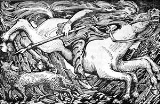
Sleipnir

Encyclopedia
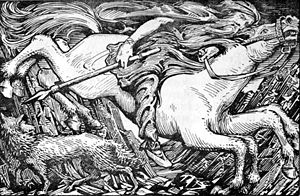
Norse mythology
Norse mythology, a subset of Germanic mythology, is the overall term for the myths, legends and beliefs about supernatural beings of Norse pagans. It flourished prior to the Christianization of Scandinavia, during the Early Middle Ages, and passed into Nordic folklore, with some aspects surviving...
, Sleipnir (Old Norse
Old Norse
Old Norse is a North Germanic language that was spoken by inhabitants of Scandinavia and inhabitants of their overseas settlements during the Viking Age, until about 1300....
"slippy" or "the slipper") is an eight-legged horse
Horse
The horse is one of two extant subspecies of Equus ferus, or the wild horse. It is a single-hooved mammal belonging to the taxonomic family Equidae. The horse has evolved over the past 45 to 55 million years from a small multi-toed creature into the large, single-toed animal of today...
. Sleipnir is attested in the Poetic Edda
Poetic Edda
The Poetic Edda is a collection of Old Norse poems primarily preserved in the Icelandic mediaeval manuscript Codex Regius. Along with Snorri Sturluson's Prose Edda, the Poetic Edda is the most important extant source on Norse mythology and Germanic heroic legends, and from the early 19th century...
, compiled in the 13th century from earlier traditional sources, and the Prose Edda
Prose Edda
The Prose Edda, also known as the Younger Edda, Snorri's Edda or simply Edda, is an Icelandic collection of four sections interspersed with excerpts from earlier skaldic and Eddic poetry containing tales from Nordic mythology...
, written in the 13th century by Snorri Sturluson
Snorri Sturluson
Snorri Sturluson was an Icelandic historian, poet, and politician. He was twice elected lawspeaker at the Icelandic parliament, the Althing...
. In both sources, Sleipnir is Odin
Odin
Odin is a major god in Norse mythology and the ruler of Asgard. Homologous with the Anglo-Saxon "Wōden" and the Old High German "Wotan", the name is descended from Proto-Germanic "*Wodanaz" or "*Wōđanaz"....
's steed
Steed
Steed is a working animal used as a mount . Steed may also refer to:-Surname:*Jake Steed , American actor*Joel Steed , American football player*Maggie Steed , British actress...
, is the child of Loki
Loki
In Norse mythology, Loki or Loke is a god or jötunn . Loki is the son of Fárbauti and Laufey, and the brother of Helblindi and Býleistr. By the jötunn Angrboða, Loki is the father of Hel, the wolf Fenrir, and the world serpent Jörmungandr. By his wife Sigyn, Loki is the father of Nari or Narfi...
and Svaðilfari, is described as the best of all horses, and is sometimes ridden to the location of Hel. The Prose Edda contains extended information regarding the circumstances of Sleipnir's birth, and details that he is gray in color.
Additionally, Sleipnir is mentioned in a riddle found in the 13th century legendary saga
Legendary saga
A Legendary saga or Fornaldarsaga is a Norse saga that, unlike the Icelanders' sagas, takes place before the colonization of Iceland. There are some exceptions, such as Yngvars saga víðförla, which takes place in the 11th century...
Hervarar saga ok Heiðreks, in the 13th century legendary saga Völsunga saga
Volsunga saga
The Völsungasaga is a legendary saga, a late 13th century Icelandic prose rendition of the origin and decline of the Völsung clan . It is largely based on epic poetry...
as the ancestor of the horse Grani
Grani
In Norse mythology, Grani is a horse owned by the hero Sigurd. He is the horse that Sigurd receives through advice from an old man . Grani is a descendant of Odin's own steed, Sleipnir.-Attestations:...
, and book I of Gesta Danorum
Gesta Danorum
Gesta Danorum is a patriotic work of Danish history, by the 12th century author Saxo Grammaticus . It is the most ambitious literary undertaking of medieval Denmark and is an essential source for the nation's early history...
, written in the 12th century by Saxo Grammaticus
Saxo Grammaticus
Saxo Grammaticus also known as Saxo cognomine Longus was a Danish historian, thought to have been a secular clerk or secretary to Absalon, Archbishop of Lund, foremost advisor to Valdemar I of Denmark. He is the author of the first full history of Denmark.- Life :The Jutland Chronicle gives...
, contains an episode considered by many scholars to involve Sleipnir. Sleipnir is generally accepted as depicted on two 8th century Gotland
Gotland
Gotland is a county, province, municipality and diocese of Sweden; it is Sweden's largest island and the largest island in the Baltic Sea. At 3,140 square kilometers in area, the region makes up less than one percent of Sweden's total land area...
ic image stones; the Tjängvide image stone
Tjängvide image stone
The Tjängvide image stone, listed in Rundata as Gotland Runic Inscription 110 or G 110, is a Viking Age image stone from Tjängvide , which is about three kilometers west of Ljugarn, Gotland, Sweden.-Description:...
and the Ardre VIII image stone.
Scholarly theories have been proposed regarding Sleipnir's potential connection to shamanic
Shamanism
Shamanism is an anthropological term referencing a range of beliefs and practices regarding communication with the spiritual world. To quote Eliade: "A first definition of this complex phenomenon, and perhaps the least hazardous, will be: shamanism = technique of ecstasy." Shamanism encompasses the...
practices among the Norse pagans
Norse paganism
Norse paganism is the religious traditions of the Norsemen, a Germanic people living in the Nordic countries. Norse paganism is therefore a subset of Germanic paganism, which was practiced in the lands inhabited by the Germanic tribes across most of Northern and Central Europe in the Viking Age...
. In modern times, Sleipnir appears in Icelandic folklore
Scandinavian folklore
Scandinavian folklore is the folklore of Sweden, Norway, Denmark, Iceland, the Faroe Islands, and the Swedish speaking parts of Finland.Collecting folklore began when Gustavus Adolphus of Sweden sent out instructions to all of the priests in all of the parishes to collect the folklore of their area...
as the creator of Ásbyrgi
Ásbyrgi
thumb|right|200px|The rock "island" in the centre of Ásbyrgi canyonÁsbyrgi canyon lies in the north of Iceland, about two hours' drive to the east from Akureyri. The horseshoe-shaped depression is part of the Jökulsárgljúfur National Park and measures approximately 3.5 km in length and 1.1 km across...
, in works of art, literature, software, and in the names of ships.
Poetic Edda
Grímnismál
Grímnismál is one of the mythological poems of the Poetic Edda. It is preserved in the Codex Regius manuscript and the AM 748 I 4to fragment. It is spoken through the voice of Grímnir, one of the many guises of the god Odin, who is tortured by King Geirröth...
, Sigrdrífumál
Sigrdrífumál
Sigrdrífumál is the conventional title given to a section of the Poetic Edda text in Codex Regius....
, Baldrs draumar
Baldrs draumar
Baldrs draumar or Vegtamskviða is an Eddic poem, contained in the manuscript AM 748 I 4to. It relates information on the myth of Baldr's death in a way consistent with Gylfaginning....
, and Hyndluljóð
Hyndluljóð
Hyndluljóð or Lay of Hyndla is an Old Norse poem often considered a part of the Poetic Edda. It is preserved in its entirety only in Flateyjarbók but some stanzas are also quoted in the Prose Edda where they are said to come from Völuspá hin skamma.In the poem, the goddess Freyja meets the völva...
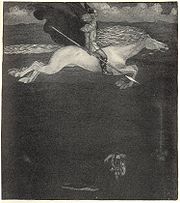
. In Grímnismál, Grimnir (Odin in disguise and not yet having revealed his identity) tells the boy Agnar in verse that Sleipnir is the best of horses ("Odin is the best of the Æsir
Æsir
In Old Norse, áss is the term denoting a member of the principal pantheon in Norse paganism. This pantheon includes Odin, Frigg, Thor, Baldr and Tyr. The second pantheon comprises the Vanir...
, Sleipnir of horses"). In Sigrdrífumál, the valkyrie
Valkyrie
In Norse mythology, a valkyrie is one of a host of female figures who decides who dies in battle. Selecting among half of those who die in battle , the valkyries bring their chosen to the afterlife hall of the slain, Valhalla, ruled over by the god Odin...
Sigrdrífa tells the hero Sigurðr
Sigurd
Sigurd is a legendary hero of Norse mythology, as well as the central character in the Völsunga saga. The earliest extant representations for his legend come in pictorial form from seven runestones in Sweden and most notably the Ramsund carving Sigurd (Old Norse: Sigurðr) is a legendary hero of...
that runes
Runic alphabet
The runic alphabets are a set of related alphabets using letters known as runes to write various Germanic languages before the adoption of the Latin alphabet and for specialized purposes thereafter...
should be cut "on Sleipnir's teeth and on the sledge's strap-bands." In Baldrs draumar
Baldrs draumar
Baldrs draumar or Vegtamskviða is an Eddic poem, contained in the manuscript AM 748 I 4to. It relates information on the myth of Baldr's death in a way consistent with Gylfaginning....
, after the Æsir convene about the god Baldr's bad dreams, Odin places a saddle
Saddle
A saddle is a supportive structure for a rider or other load, fastened to an animal's back by a girth. The most common type is the equestrian saddle designed for a horse, but specialized saddles have been created for camels and other creatures...
on Sleipnir and the two ride to the location of Hel. The Völuspá hin skamma
Völuspá hin skamma
Völuspá hin skamma, Völuspá the Less or the Short Völuspá, is an Old Norse poem which survives as a handful of stanzas in Hyndluljóð, in the Poetic Edda, and as one stanza in the Gylfaginning section of Snorri Sturluson's Prose Edda...
section of Hyndluljóð says that Loki produced "the wolf" with Angrboða, produced Sleipnir with Svaðilfari, and thirdly "one monster that was thought the most baleful, who was descended from Býleistr's brother."
Prose Edda
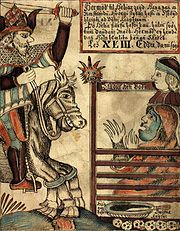
Gylfaginning
Gylfaginning, or the Tricking of Gylfi , is the first part of Snorri Sturluson's Prose Edda after Prologue. The Gylfaginning deals with the creation and destruction of the world of the Norse gods, and many other aspects of Norse mythology...
, Sleipnir is first mentioned in chapter 15 where the ethroned figure of High
High, Just-As-High, and Third
High, Just-As-High, and Third are three men that respond to questions posed by Gangleri in the Prose Edda book Gylfaginning...
says that every day the Æsir ride across the bridge Bifröst
Bifröst
In Norse mythology, Bifrost or Bilröst is a burning rainbow bridge that reaches between Midgard and Asgard, the realm of the gods...
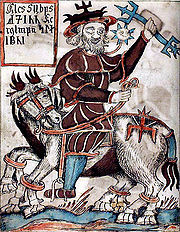
, and provides a list of the Æsir's horses. The list begins with Sleipnir: "best is Sleipnir, he is Odin's, he has eight legs." In chapter 41, High quotes the Grímnismál stanza that mentions Sleipnir.
In chapter 42, Sleipnir's origins are described. Gangleri
Gangleri
Gangleri may refer to:* one of Odin's many nicknames meaning "the wanderer" or "Wayweary"* the name of the ancient Swedish king Gylfi, given while in disguise, as described in the book Gylfaginning collected in the Prose Edda...
(described earlier in the book as King Gylfi
Gylfi
In Norse mythology, Gylfi, Gylfe, Gylvi, or Gylve was the earliest king in Scandinavia recorded. The traditions on Gylfi deal with how he was tricked by the gods and his relations with the goddess Gefjon.-The creation of Zealand:...
in disguise) asks High who the horse Sleipnir belongs to and what there is to tell about it. High expresses surprise in Gangleri's lack of knowledge about Sleipnir and its origin. High tells a story set "right at the beginning of the gods' settlement, when the gods at established Midgard
Midgard
Midgard is one of the Nine Worlds and is an old Germanic name for our world and is the home of Humans, with the literal meaning "middle enclosure".-Etymology:...
and built Val-Hall
Valhalla
In Norse mythology, Valhalla is a majestic, enormous hall located in Asgard, ruled over by the god Odin. Chosen by Odin, half of those that die in combat travel to Valhalla upon death, led by valkyries, while the other half go to the goddess Freyja's field Fólkvangr...
" about an unnamed builder who has offered to build a fortification for the gods in three seasons that will keep out invaders in exchange for the goddess Freyja, the sun, and the moon
Mani
Mani is a name or word occurring in several etymologically unrelated languages and cultures, including:* Maní - a legend of the indigenous tribe Tupi in Brazil.* Mani , the founder of Manichaeism....
. After some debate, the gods agree to this, but place a number of restrictions on the builder, including that he must complete the work within three seasons with the help of no man. The builder makes a single request; that he may have help from his stallion Svaðilfari, and due to Loki's influence, this is allowed. The stallion Svaðilfari performs twice the deeds of strength as the builder, and hauls enormous rocks to the surprise of the gods. The builder, with Svaðilfari, makes fast progress on the wall, and three days before the deadline of summer, the builder was nearly at the entrance to the fortification. The gods convene, and figured out who was responsible, resulting in a unanimous agreement that, along with most trouble, Loki was to blame.
The gods declare that Loki would deserve a horrible death if he could not find a scheme that would cause the builder to forfeit his payment, and threatened to attack him. Loki, afraid, swore oaths that he would devise a scheme to cause the builder to forfeit the payment, whatever it would cost himself. That night, the builder drove out to fetch stone with his stallion Svaðilfari, and out from a wood ran a mare. The mare neighed at Svaðilfari, and "realizing what kind of horse it was," Svaðilfari becomes frantic, neighs, tore apart his tackle, and runs towards the mare. The mare runs to the wood, Svaðilfari follows, and the builder chases after. The two horses run around all night, causing the building work to be held up for the night, and the previous momentum of building work that the builder had been able to maintain was not continued.
When the Æsir realize that the builder is a hrimthurs
Hrimthurs
In Norse mythology, a hrímthurs is any one of the particular tribe of Giants who are made of ice and inhabit Niflheim, a land of eternal cold....
, they disregard their previous oaths with the builder, and call for Thor. Thor arrives, and kills the builder by smashing the builder's skull into shards with the hammer Mjöllnir. However, Loki had "such dealings" with Svaðilfari that "somewhat later" Loki gave birth to a gray foal
Foal
A foal is an equine, particularly a horse, that is one year old or younger. More specific terms are colt for a male foal and filly for a female foal, but these terms are used until the horse is age three or four. When the foal is nursing from its dam , it may also be called a suckling...
with eight legs; the horse Sleipnir, "the best horse among gods and men."
In chapter 49, High describes the death of the god Baldr. Hermóðr
Hermóðr
Hermóðr the Brave is a figure in Norse mythology, the son of god Odin.-Prose Edda:Hermóðr appears distinctly in section 49 of the Prose Edda book Gylfaginning. There, it is described that the gods were speechless and devastated at the death of Baldr, unable to react due to their grief...
agrees to ride to Hel to offer a ransom for Baldr's return, and so "then Odin's horse Sleipnir was fetched and led forward." Hermóðr mounts Sleipnir and rides away. Hermóðr rides for nine nights in deep, dark valleys where Hermóðr can see nothing. The two arrive at the river Gjöll
Gjöll
In Norse mythology, Gjöll is one of the eleven rivers traditionally associated with the Élivágar, according to Gylfaginning, originating from the wellspring Hvergelmir in Niflheim, flowing through Ginnungagap, and thence into the worlds of existence...
and then continue to Gjöll bridge, encountering a maiden guarding the bridge named Móðguðr
Móðguðr
In Norse mythology, Móðguðr was the giantess guardian of the Gjallarbrú. She allowed the newly dead to use the bridge to cross from one side of the river Gjöll to the other if the soul stated his or her name and business. Hermóðr passed by her as he travelled to Hel to attempt to ransom Baldr....
. Some dialogue occurs between Hermóðr and Móðguðr, including that Móðguðr notes that recently there had ridden five battalions of dead men across the bridge that made less sound than he. Sleipnir and Hermóðr continue "downwards and northwards" on the road to Hel, until the two arrive at Hel's gates. Hermóðr dismounts from Sleipnir, tightens Sleipnir's girth
Girth (tack)
A girth, sometimes called a cinch , is a piece of equipment used to keep the saddle in place on a horse or other animal. It passes under the barrel of the equine, usually attached to the saddle on both sides by two or three leather straps called billets...
, mounts him, and spurs Sleipnir on. Sleipnir "jumped so hard and over the gate that it came nowhere near." Hermóðr rides up to the hall, and dismounts from Sleipnir. After Hermóðr's pleas to Hel
Hel (being)
In Norse mythology, Hel is a being who presides over a realm of the same name, where she receives a portion of the dead. Hel is attested in the Poetic Edda, compiled in the 13th century from earlier traditional sources, and the Prose Edda, written in the 13th century by Snorri Sturluson...
to return Baldr are accepted under a condition, Hermóðr and Baldr retrace their path backward and return to Asgard
Asgard
In Norse religion, Asgard is one of the Nine Worlds and is the country or capital city of the Norse Gods surrounded by an incomplete wall attributed to a Hrimthurs riding the stallion Svadilfari, according to Gylfaginning. Valhalla is located within Asgard...
.
In chapter 16 of the book Skáldskaparmál
Skáldskaparmál
The second part of Snorri Sturluson's Prose Edda the Skáldskaparmál or "language of poetry" is effectively a dialogue between the Norse god of the sea, Ægir and Bragi, the god of poetry, in which both Norse mythology and discourse on the nature of poetry are intertwined...
, a kenning
Kenning
A kenning is a type of literary trope, specifically circumlocution, in the form of a compound that employs figurative language in place of a more concrete single-word noun. Kennings are strongly associated with Old Norse and later Icelandic and Anglo-Saxon poetry...
given for Loki is "relative of Sleipnir." In chapter 17, a story is provided in which Odin rides Sleipnir into the land of Jötunheimr
Jötunheimr
Jötunheimr is one of the Nine Worlds and the homeland of the Giants of Norse Mythology — Rock Giants and Frost Giants.-Legend:...
and arrives at the residence of the jötunn Hrungnir
Hrungnir
Hrungnir was a jötunn in Norse mythology, slain by the god Thor with his hammer Mjölnir. The account is documented in the Skáldskaparmál, in the Prose Edda by Snorri Sturluson....
. Hrungnir asks "what sort of person this was" wearing a golden helmet, "riding sky and sea," and says that the stranger "has a marvellously good horse." Odin wagers his head that no horse as good could be found in all of Jötunheimr. Hrungnir admitted that it was a fine horse, yet states that he owns a much longer-paced horse; Gullfaxi
Gullfaxi
Gullfaxi is a horse in Norse mythology. Its name means Golden mane.It was originally owned by Hrungnir, and was later given to Magni by Thor as a reward for helping him in the fight against Hrungnir:...
. Incensed, Hrungnir leaps atop Gullfaxi, intending to attack Odin for Odin's boasting. Odin gallops hard ahead of Hrungnir, and, in his, fury, Hrungnir finds himself having rushed into the gates of Asgard. In chapter 58, Sleipnir is mentioned among a list of horses in Þorgrímsþula: "Hrafn and Sleipnir, splendid horses [...]". In addition, Sleipnir occurs twice in kennings for "ship
Ship
Since the end of the age of sail a ship has been any large buoyant marine vessel. Ships are generally distinguished from boats based on size and cargo or passenger capacity. Ships are used on lakes, seas, and rivers for a variety of activities, such as the transport of people or goods, fishing,...
" (once appearing in chapter 25 in a work by the skald
Skald
The skald was a member of a group of poets, whose courtly poetry is associated with the courts of Scandinavian and Icelandic leaders during the Viking Age, who composed and performed renditions of aspects of what we now characterise as Old Norse poetry .The most prevalent metre of skaldic poetry is...
Refr, and "sea-Sleipnir" appearing in chapter 49 in Húsdrápa
Húsdrápa
Húsdrápa is a skaldic poem partially preserved in the Prose Edda where disjoint stanzas of it are quoted. It is attributed to the skald Úlfr Uggason. The poem describes mythological scenes carved on kitchen panels...
, a work by the 10th century skald Úlfr Uggason
Úlfr Uggason
Úlfr Uggason was an Icelandic skald who lived in the last part of the tenth century.The Laxdæla saga tells how he composed his Húsdrápa for a wedding...
).
Hervarar saga ok Heiðreks
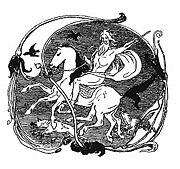
- 36. Gestumblindi
GestumblindiGestumblindi is a character in Norse mythology who appears in Hervarar saga and in Saxo Grammaticus' Gesta Danorum as Gestiblindus. Later, he also appears in several Scandinavian folk tales as Gest Blinde.-Hervarar saga:...
said:- "Who are the twain
- that on ten feet run?
- three eyes they have,
- but only one tail.
- Alright guess now
- this riddle, Heithrek!"
- Heithrek
HeidrekHeidrek or Heiðrekr was one of the main characters in the cycle about the magic sword Tyrfing. He appears in the Hervarar saga, and probably also in Widsith, line 115, as Heathoric together with his sons Angantyr and Hlöð , and Hlöð's mother Sifka...
said:- "Good is thy riddle, Gestumblindi,
- and guessed it is:
- that is Odin riding on Sleipnir."
Völsunga saga
In chapter 13 of Völsunga sagaVolsunga saga
The Völsungasaga is a legendary saga, a late 13th century Icelandic prose rendition of the origin and decline of the Völsung clan . It is largely based on epic poetry...
, the hero Sigurðr
Sigurd
Sigurd is a legendary hero of Norse mythology, as well as the central character in the Völsunga saga. The earliest extant representations for his legend come in pictorial form from seven runestones in Sweden and most notably the Ramsund carving Sigurd (Old Norse: Sigurðr) is a legendary hero of...
is on his way to a wood and he meets a long-bearded old man
Odin
Odin is a major god in Norse mythology and the ruler of Asgard. Homologous with the Anglo-Saxon "Wōden" and the Old High German "Wotan", the name is descended from Proto-Germanic "*Wodanaz" or "*Wōđanaz"....
he had never seen before. Sigurd tells the old man that he is going to choose a horse, and asks the old man to come with him to help him decide. The old man says that they should drive the horses down to the river Busiltjörn. The two drive the horses down into the deeps of Busiltjörn, and all of the horses swim back to land but a large, young, and handsome gray horse that no one had ever mounted. The grey-bearded old man says that the horse is from "Sleipnir's kin" and that "he must be raised carefully, because he will become better than any other horse." The old man vanishes. Sigurd names the horse Grani
Grani
In Norse mythology, Grani is a horse owned by the hero Sigurd. He is the horse that Sigurd receives through advice from an old man . Grani is a descendant of Odin's own steed, Sleipnir.-Attestations:...
, and the narrative adds that the old man was none other than (the god) Odin
Odin
Odin is a major god in Norse mythology and the ruler of Asgard. Homologous with the Anglo-Saxon "Wōden" and the Old High German "Wotan", the name is descended from Proto-Germanic "*Wodanaz" or "*Wōđanaz"....
.
Gesta Danorum

Gesta Danorum
Gesta Danorum is a patriotic work of Danish history, by the 12th century author Saxo Grammaticus . It is the most ambitious literary undertaking of medieval Denmark and is an essential source for the nation's early history...
. In book I, the young Hadingus
Hadingus
Hadingus was one of the earliest legendary Danish kings according to Saxo Grammaticus' Gesta Danorum where he has a detailed biography. Georges Dumézil and others have argued that Gram was partially modelled on the god Njörðr.-Gesta Danorum:...
encounters "a certain man of great age who had lost an eye" who allies him with Liserus. Hadingus and Liserus set out to wage war on Lokerus, ruler of Kurland
Courland
Courland is one of the historical and cultural regions of Latvia. The regions of Semigallia and Selonia are sometimes considered as part of Courland.- Geography and climate :...
. Meeting defeat, the old man takes Hadingus with him onto his horse as they flee to the old man's house, and the two drink an invigorating drought. The old man sings a prophecy, and takes Hadingus back to where he found him on his horse. During the ride back, Hadingus trembles beneath the old man's mantle, and peers out of its holes. Hadingus realizes that he is flying through the air: "and he saw that before the steps of the horse lay the sea; but was told not to steal a glimpse of the forbidden thing, and therefore turned his amazed eyes from the dread spectacle of the roads that he journeyed." Additionally, in book II, Biarco
Bödvar Bjarki
Bödvar Bjarki , meaning 'Warlike Little-Bear', is the hero appearing in tales of Hrólf Kraki in the Saga of Hrólf Kraki, in the Latin epitome to the lost Skjöldunga saga, and as Biarco in Saxo Grammaticus' Gesta Danorum...
mentions Odin and Sleipnir: "If I may look on the awful husband of Frigg
Frigg
Frigg is a major goddess in Norse paganism, a subset of Germanic paganism. She is said to be the wife of Odin, and is the "foremost among the goddesses" and the queen of Asgard. Frigg appears primarily in Norse mythological stories as a wife and a mother. She is also described as having the power...
, howsoever he be covered in his white shield, and guide his tall steed, he shall in no way go safe out of Leire
Lejre
Lejre is a town with a population of 2,343 and a municipality on the island of Zealand in east Denmark. It belongs to Region Sjælland. The town's Old Norse name was Hleiðra. The municipality has an area of 240 km² and a total population of ca. 26,603 . Its mayor is Mette Touborg, representing the...
; it is lawful to lay low in war the war-waging god."
Archaeological record
Two of the 8th century picture stonePicture stone
A picture stone, image stone or figure stone is an ornate slab of stone, usually limestone, which was raised in Germanic Iron Age or Viking Age Scandinavia, and in the greatest number on Gotland. More than four hundred picture stones are known today. All of the stones were probably erected as...
s from the island of Gotland
Gotland
Gotland is a county, province, municipality and diocese of Sweden; it is Sweden's largest island and the largest island in the Baltic Sea. At 3,140 square kilometers in area, the region makes up less than one percent of Sweden's total land area...
, Sweden
Sweden
Sweden , officially the Kingdom of Sweden , is a Nordic country on the Scandinavian Peninsula in Northern Europe. Sweden borders with Norway and Finland and is connected to Denmark by a bridge-tunnel across the Öresund....
depict eight-legged horses, which are thought by most scholars to depict Sleipnir: the Tjängvide image stone
Tjängvide image stone
The Tjängvide image stone, listed in Rundata as Gotland Runic Inscription 110 or G 110, is a Viking Age image stone from Tjängvide , which is about three kilometers west of Ljugarn, Gotland, Sweden.-Description:...
and the Ardre VIII image stone. Both stones feature a rider sitting atop an eight-legged horse, which some scholars view as Odin. Above the rider on the Tjängvide image stone is a horizontal figure holding a spear, which may be a valkyrie
Valkyrie
In Norse mythology, a valkyrie is one of a host of female figures who decides who dies in battle. Selecting among half of those who die in battle , the valkyries bring their chosen to the afterlife hall of the slain, Valhalla, ruled over by the god Odin...
, and a female figure greets the rider with a cup. The scene has been interpreted as a rider arriving at the world of the dead.
Theories
John LindowJohn Lindow
John Lindow is a professor specializing in Scandinavian medieval studies and folklore at the University of California, Berkeley and author. Lindow's works include Norse Mythology: A Guide to the Gods, Rituals, and Beliefs, a handbook for Norse mythology...
theorizes that Sleipnir's "connection to the world of the dead grants a special poignancy to one of the kennings in which Sleipnir turns up as a horse word," referring to the skald Úlfr Uggason's usage of "sea-Sleipnir" in his Húsdrápa, which describes the funeral of Baldr. Lindow continues that "his use of Sleipnir in the kenning may show that Sleipnir's role in the failed recovery of Baldr was known at that time and place in Iceland; it certainly indicates that Sleipnir was an active participant in the mythology of the last decades of paganism." Lindow adds that the eight legs of Sleipnir "have been interpreted as an indication of great speed or as being connected in some unclear way with cult activity."
Hilda Ellis Davidson says that "the eight-legged horse of Odin is the typical steed of the shaman" and that in the shaman's journeys to the heavens or the underworld, a shaman "is usually represented as riding on some bird or animal." Davidson says that while the creature may vary, the horse is fairly common "in the lands where horses are in general use, and Sleipnir's ability to bear the god through the air is typical of the shaman's steed" and cites an example from a study of shamanism by Mircea Eliade
Mircea Eliade
Mircea Eliade was a Romanian historian of religion, fiction writer, philosopher, and professor at the University of Chicago. He was a leading interpreter of religious experience, who established paradigms in religious studies that persist to this day...
of an eight-legged foal from a story of a Buryat
Buryats
The Buryats or Buriyads , numbering approximately 436,000, are the largest ethnic minority group in Siberia and are mainly concentrated in their homeland, the Buryat Republic, a federal subject of Russia...
shaman. Davidson says that while attempts have been made to connect Sleipnir with hobby horse
Hobby horse
The term hobby horse is used, principally by folklorists, to refer to the costumed characters that feature in some traditional seasonal customs, processions and similar observances around the world. They are particularly associated with May Day celebrations, Mummers Plays and the Morris dance in...
s and steeds with more than four feet that appear in carnivals and processions, but that "a more fruitful resemblance seems to be on the bier
Bier
A bier is a stand on which a corpse, coffin or casket containing a corpse, is placed to lie in state or to be carried to the grave.In Christian burial, the bier is often placed in the centre of the nave with candles surrounding it, and remains in place during the funeral.The bier is a flat frame,...
on which a dead man is carried in the funeral procession by four bearers; borne along thus, he may be described as riding on a steed with eight legs." As an example, Davidson cites a funeral dirge
Dirge
A dirge is a somber song expressing mourning or grief, such as would be appropriate for performance at a funeral. A lament. The English word "dirge" is derived from the Latin Dirige, Domine, Deus meus, in conspectu tuo viam meam , the first words of the first antiphon in the Matins of the Office...
from the Gondi people
Gondi people
The Gondi, Goindi or Gond people are people in central India, spread over the states of Madhya Pradesh, eastern Maharashtra , Chhattisgarh, northern Andhra Pradesh, and Western Orissa. With over four million people, they are the largest tribe in Central India.The Gondi language is related to...
in India
India
India , officially the Republic of India , is a country in South Asia. It is the seventh-largest country by geographical area, the second-most populous country with over 1.2 billion people, and the most populous democracy in the world...
as recorded by Verrier Elwin
Verrier Elwin
Verrier Elwin was a self-trained anthropologist, ethnologist and tribal activist, who began his career in India as a Christian missionary...
, stating that "it contains references to Bagri Maro, the horse with eight legs, and it is clear from the song that it is the dead man's bier." Davidson says that the song is sung when a distinguished Muria
Muria
Muria is the name of a village in Darbhanga District of Bihar in India. It is located 12 km from Darbhanga on NH 57.History of Muria Village is not known however, it's said somewhere related to Muraina Ghat, some says that it had a palace of Mauryan Dynasty, There are some signs of presence of a...
dies, and provides a verse:
- What horse is this?
- It is the horse of Bagri Maro.
- What should we say of its legs?
- This horse has eight legs.
- What should we say of its heads?
- This horse has four heads. . . .
- Catch the bridle and mount the horse.
Davidson adds that the representation of Odin's steed as eight-legged could arise naturally out of such an image, and that "this is in accordance with the picture of Sleipnir as a horse that could bear its rider to the land of the dead."
Ulla Loumand cites Sleipnir and the flying horse Hófvarpnir as "prime examples" of horses in Norse mythology as being able to "mediate between earth and sky, between Ásgarðr, Miðgarðr and Útgarðr and between the world of mortal men and the underworld."
The Encyclopedia of Indo-European Culture
Encyclopedia of Indo-European Culture
The Encyclopedia of Indo-European Culture is an encyclopedia of Indo-European studies and the Proto-Indo-Europeans. The encyclopedia was edited by J. P. Mallory and Douglas Q. Adams and published in 1997 by Fitzroy Dearborn...
theorizes that Sleipnir's eight legs may be the remnants of horse-associated divine twins
Divine twins
The Divine twins are a mytheme of Proto-Indo-European mythology.*the Greek Dioscuri*the Vedic Ashvins*the Lithuanian Ašvieniai*the Latvian Dieva dēli*Alcis *Romulus and Remus*Hengest and Horsa...
found in Indo-European
Proto-Indo-Europeans
The Proto-Indo-Europeans were the speakers of the Proto-Indo-European language , a reconstructed prehistoric language of Eurasia.Knowledge of them comes chiefly from the linguistic reconstruction, along with material evidence from archaeology and archaeogenetics...
cultures and ultimately stemming from Proto-Indo-European religion
Proto-Indo-European religion
Proto-Indo-European religion is the hypothesized religion of the Proto-Indo-European peoples based on the existence of similarities among the deities, religious practices and mythologies of the Indo-European peoples. Reconstruction of the hypotheses below is based on linguistic evidence using the...
. The encyclopedia states that "[...] Sleipnir is born with an extra set of legs, thus representing an original pair of horses. Like Freyr
Freyr
Freyr is one of the most important gods of Norse paganism. Freyr was highly associated with farming, weather and, as a phallic fertility god, Freyr "bestows peace and pleasure on mortals"...
and Njörðr, Sleipnir is responsible for carrying the dead to the otherworld." The dictionary cites parallels between the birth of Sleipnir and myths originally pointing to a Celtic
Celtic polytheism
Celtic polytheism, commonly known as Celtic paganism, refers to the religious beliefs and practices adhered to by the Iron Age peoples of Western Europe now known as the Celts, roughly between 500 BCE and 500 CE, spanning the La Tène period and the Roman era, and in the case of the Insular Celts...
goddess who gave birth to the Divine horse twins. These elements include a demand for a goddess by an unwanted suitor (the hrimthurs
Hrimthurs
In Norse mythology, a hrímthurs is any one of the particular tribe of Giants who are made of ice and inhabit Niflheim, a land of eternal cold....
demanding the goddess Freyja) and the seduction of builders.
Modern influence
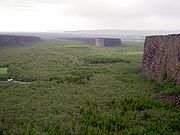
Horseshoe
A horseshoe, is a fabricated product, normally made of metal, although sometimes made partially or wholly of modern synthetic materials, designed to protect a horse's hoof from wear and tear. Shoes are attached on the palmar surface of the hooves, usually nailed through the insensitive hoof wall...
shaped canyon Ásbyrgi
Ásbyrgi
thumb|right|200px|The rock "island" in the centre of Ásbyrgi canyonÁsbyrgi canyon lies in the north of Iceland, about two hours' drive to the east from Akureyri. The horseshoe-shaped depression is part of the Jökulsárgljúfur National Park and measures approximately 3.5 km in length and 1.1 km across...
located in Jökulsárgljúfur National Park
Jökulsárgljúfur National Park
Jökulsárgljúfur National Park was a national park, situated in the north of Iceland around the river Jökulsá á Fjöllum. It lay to the north of the Dettifoss waterfall. On 7 June 2008, it became a part of the larger Vatnajökull National Park....
, northern Iceland
Iceland
Iceland , described as the Republic of Iceland, is a Nordic and European island country in the North Atlantic Ocean, on the Mid-Atlantic Ridge. Iceland also refers to the main island of the country, which contains almost all the population and almost all the land area. The country has a population...
was formed by Sleipnir's hoof. Sleipnir is depicted with Odin on Dagfin Werenskjold's wooden relief "Odin på Sleipnir" (1945–1950) on the exterior of the Oslo City Hall
Oslo City Hall
Oslo City Hall houses the city council, city administration, and art studios and galleries. The construction started in 1931, but was paused by the outbreak of World War II, before the official inauguration in 1950. Its characteristic architecture, artworks and the Nobel Peace Prize ceremony, held...
in Oslo
Oslo
Oslo is a municipality, as well as the capital and most populous city in Norway. As a municipality , it was established on 1 January 1838. Founded around 1048 by King Harald III of Norway, the city was largely destroyed by fire in 1624. The city was moved under the reign of Denmark–Norway's King...
, Norway
Norway
Norway , officially the Kingdom of Norway, is a Nordic unitary constitutional monarchy whose territory comprises the western portion of the Scandinavian Peninsula, Jan Mayen, and the Arctic archipelago of Svalbard and Bouvet Island. Norway has a total area of and a population of about 4.9 million...
. Sleipnir has been and remains a popular name for ships in Northern Europe, and Rudyard Kipling
Rudyard Kipling
Joseph Rudyard Kipling was an English poet, short-story writer, and novelist chiefly remembered for his celebration of British imperialism, tales and poems of British soldiers in India, and his tales for children. Kipling received the 1907 Nobel Prize for Literature...
's short story entitled "Sleipnir," late "Thurinda" (1888) features a horse named "Sleipnir." A statue of Sleipnir (1998) stands in Wednesbury
Wednesbury
Wednesbury is a market town in England's Black Country, part of the Sandwell metropolitan borough in West Midlands, near the source of the River Tame. Similarly to the word Wednesday, it is pronounced .-Pre-Medieval and Medieval times:...
, England
England
England is a country that is part of the United Kingdom. It shares land borders with Scotland to the north and Wales to the west; the Irish Sea is to the north west, the Celtic Sea to the south west, with the North Sea to the east and the English Channel to the south separating it from continental...
, a city which takes its name from the Anglo-Saxon version of Odin, Wōden
Woden
Woden or Wodan is a major deity of Anglo-Saxon and Continental Germanic polytheism. Together with his Norse counterpart Odin, Woden represents a development of the Proto-Germanic god *Wōdanaz....
.