


Anglo-Saxon literature

Encyclopedia
Old English literature (or Anglo-Saxon literature) encompasses literature
written in Old English
(also called Anglo-Saxon) in Anglo-Saxon England, in the period from the 7th century to the Norman Conquest
of 1066. These works include genres such as epic poetry, hagiography
, sermon
s, Bible
translations, legal works, chronicle
s, riddles, and others. In all there are about 400 surviving manuscript
s from the period, a significant corpus of both popular interest and specialist research.
Among the most important works of this period is the poem Beowulf
, which has achieved national epic
status in England
. The Anglo-Saxon Chronicle
otherwise proves significant to study of the era, preserving a chronology of early English history, while the poem Cædmon's Hymn
from the 7th century survives as the oldest extant work of literature in English.
Anglo-Saxon literature has gone through different periods of research—in the 19th and early 20th centuries the focus was on the Germanic roots of English, later the literary merits
were emphasised, and today the focus is upon paleography and the physical manuscripts themselves more generally: scholars debate such issues as dating, place of origin, authorship, and the connections between Anglo-Saxon culture and the rest of Europe in the Middle Ages
.
and the vernacular
. Old English literature began, in written form, as a practical necessity in the aftermath of the Danish invasions
—-church officials were concerned that because of the drop in Latin literacy
no one could read their work. Likewise King Alfred the Great
(849–899), wanting to restore English culture
, lamented the poor state of Latin education: Alfred the Great proposed that students be educated in Old English, and those who excelled would go on to learn Latin. In this way many of the texts that have survived are typical teaching and student-oriented texts.
The bulk of the prose literature is historical or religious in nature. There were considerable losses of manuscripts as a result of the Dissolution of the Monasteries
in the 16th century. Scholarly study of the language began in the reign of Queen Elizabeth I
when Matthew Parker and others obtained whatever manuscripts they could.
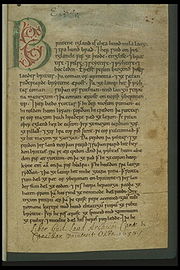 In total there are about 400 surviving manuscripts containing Old English text, 189 of them considered major. These manuscripts have been highly prized by collectors since the 16th century, both for their historic value and for their aesthetic beauty of uniformly spaced letters and decorative elements.
There are four major manuscripts:
Research in the 20th century has focused on dating the manuscripts (19th-century scholars tended to date them older); locating where the manuscripts were created — there were seven major scriptoria from which they originate: Winchester
, Exeter
, Worcester
, Abingdon, Durham
, and two Canterbury
houses, Christ Church
and St. Augustine
's Abbey
; and identifying the regional dialects used: Northumbrian
, Mercian
, Kentish
, West Saxon (the last being the main dialect).
Not all of the texts can be fairly called literature, some are merely lists of names. However those that can present a sizable body of work, listed here in descending order of quantity: sermons and saints' lives, biblical translations; translated Latin works of the early Church Fathers
; Anglo-Saxon chronicles and narrative history works; laws, will
s and other legal works; practical works on grammar
, medicine
, geography
; and poetry
.
Nearly all Anglo-Saxon authors are anonymous.
 Old English poetry falls broadly into two styles or fields of reference, the heroic Germanic and the Christian; these two are as often combined as separate in the poetry, which has survived for the most part in four major manuscripts.
The Anglo-Saxons left behind no poetic rules or explicit system; everything we know about the poetry of the period is based on modern analysis. The first widely accepted theory was constructed by Eduard Sievers
(1885). He distinguished five distinct alliterative
patterns. The theory of John C. Pope (1942), which uses musical notation to track the verse patterns, has been accepted in some quarters, and is hotly debated.
The most popular and well-known understanding of Old English poetry continues to be Sievers' alliterative verse
. The system is based upon accent
, alliteration, the quantity of vowels, and patterns of syllabic accentuation. It consists of five permutations on a base verse scheme; any one of the five types can be used in any verse. The system was inherited from and exists in one form or another in all of the older Germanic languages. Two poetic figures commonly found in Old English poetry are the kenning
, an often formulaic phrase that describes one thing in terms of another (e.g. in Beowulf
, the sea is called the whale's road) and litotes
, a dramatic understatement employed by the author for ironic effect.
Old English poetry was an oral craft, and our understanding of it in written form is incomplete; for example, we know that the poet (referred to as the scop
) could be accompanied by a harp
, and there may be other accompaniment traditions of which we are not aware.
, Alfred the Great
, and Cynewulf
. Of these, only Caedmon, Bede, and Alfred the Great have known biographies.
Caedmon is the best-known and considered the father of Old English poetry. He lived at the abbey of Whitby
in Northumbria in the 7th century. Only a single nine-line poem remains, called Hymn, which is also the oldest surviving text in English:
Aldhelm, bishop of Sherborne
(d. 709), is known through William of Malmesbury
who said he performed secular songs while accompanied by a harp. Much of his Latin prose has survived, but none of his Old English remains.
Cynewulf has proven to be a difficult figure to identify, but recent research suggests he was from the early part of the 9th century to which a number of poems are attributed including The Fates of the Apostles and Elene (both found in the Vercelli Book), and Christ II and Juliana (both found in the Exeter Book).
, which dates from the late 7th or early 8th century (the date is disputed). The verses are inscribed on the casket's front, right and left sides and likely reflect an archaic Anglian dialect, either Northumbrian or Mercian.
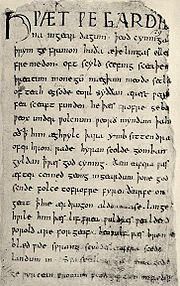 The Old English poetry which has received the most attention deals with the Germanic heroic past. The longest (3,182 lines), and most important, is Beowulf
, which appears in the damaged Nowell Codex
. The poem tells the story of the legendary Geatish hero
Beowulf, who is the title character. The story is set in Scandinavia
, in Sweden
and Denmark
, and the tale likewise probably is of Scandinavian origin. The story is biographical and sets the tone for much of the rest of Old English poetry. It has achieved national epic
status, on the same level as the Iliad
, and is of interest to historians, anthropologists, literary critics, and students the world over.
Other heroic poems besides Beowulf exist. Two have survived in fragments: The Fight at Finnsburh, controversially interpreted by many to be a retelling of one of the battle scenes in Beowulf, and Waldere
, a version of the events of the life of Walter of Aquitaine
. Two other poems mention heroic figures: Widsith
is believed to be very old in parts, dating back to events in the 4th century concerning Eormanric
and the Goths
, and contains a catalogue of names and places associated with valiant deeds. Deor
is a lyric, in the style of Consolation of Philosophy
, applying examples of famous heroes, including Weland
and Eormanric, to the narrator's own case.
The Anglo-Saxon Chronicle
contains various heroic poems inserted throughout. The earliest from 937 is called The Battle of Brunanburh, which celebrates the victory of King Athelstan over the Scots and Norse. There are five shorter poems: capture of the Five Boroughs (942); coronation of King Edgar
(973); death of King Edgar (975); death of Alfred the Great (1036); and death of King Edward the Confessor
(1065).
The 325 line poem The Battle of Maldon
celebrates Earl
Byrhtnoth
and his men who fell in battle against the Viking
s in 991. It is considered one of the finest, but both the beginning and end are missing and the only manuscript was destroyed in a fire in 1731. A well-known speech is near the end of the poem:
Old English heroic poetry was handed down orally from generation to generation. As Christianity began to appear, re-tellers often recast the tales of Christianity into the older heroic stories.
which have come to be described as "elegies" or "wisdom poetry". They are lyrical and Boethian
in their description of the up and down fortunes of life. Gloomy in mood is The Ruin
, which tells of the decay of a once glorious city of Roman Britain
(cities in Britain fell into decline after the Romans departed in the early 5th century, as the early English continued to live their rural life), and The Wanderer
, in which an older man talks about an attack that happened in his youth, where his close friends and kin were all killed; memories of the slaughter have remained with him all his life. He questions the wisdom of the impetuous decision to engage a possibly superior fighting force: the wise man engages in warfare to preserve civil society, and must not rush into battle but seek out allies when the odds may be against him. This poet finds little glory in bravery for bravery's sake. The Seafarer is the story of a somber exile from home on the sea, from which the only hope of redemption is the joy of heaven. Other wisdom poems include Wulf and Eadwacer
, The Wife's Lament
, and The Husband's Message
. Alfred the Great wrote a wisdom poem over the course of his reign based loosely on the neoplatonic philosophy of Boethius
called the Lays of Boethius
.
philosophical texts. The longest is a 10th century translation of Boethius' Consolation of Philosophy
contained in the Cotton manuscript Otho A.vi. Another is The Phoenix
in the Exeter Book, an allegorisation
of the De ave phoenice by Lactantius
.
Other short poems derive from the Latin bestiary
tradition. Some examples include The Panther, The Whale and The Partridge.
. The most famous Anglo-Saxon riddles are found in the Exeter Book
. This book contains secular and religious poems and other writings, along with a collection of 94 riddles, although there is speculation that there may have been closer to 100 riddles in the book. The riddles are written in a similar manner, but "it is unlikely that the whole collection was written by one person." It is more likely that many scribes worked on this collection of riddles. Although the Exeter Book has a unique and extensive collection of Anglo-Saxon riddles, riddles were not uncommon during this era. Riddles were both comical and obscene.
. In Vercelli are Andreas
and Elene and in Exeter are Guthlac and Juliana
.
Andreas is 1,722 lines long and is the closest of the surviving Old English poems to Beowulf in style and tone. It is the story of Saint Andrew
and his journey to rescue Saint Matthew from the Mermedonians. Elene is the story of Saint Helena
(mother of Constantine) and her discovery of the True Cross
. The cult of the True Cross was popular in Anglo-Saxon England and this poem was instrumental.
Guthlac is actually two poems about English Saint Guthlac
(7th century). Juliana is the story of the virgin martyr Juliana of Nicomedia
.
The Nowell Codex contains a Biblical poetic paraphrase, which appears right after Beowulf, called Judith
, a retelling of the story of Judith. This is not to be confused with Ælfric's homily Judith
, which retells the same Biblical story in alliterative prose.
Old English translations of Psalms
51-150 have been preserved, following a prose version of the first 50 Psalms. It is believed there was once a complete psalter based on evidence, but only the first 150 have survived.
There are a number of verse translations of the Gloria in Excelsis, the Lord's Prayer
, and the Apostles' Creed
, as well as a number of hymn
s and proverb
s.
The Exeter Book contains a series of poems entitled Christ, sectioned into Christ I
, Christ II and Christ III
.
Considered one of the most beautiful of all Old English poems is Dream of the Rood
, contained in the Vercelli Book. It is a dream vision of Christ on the cross, with the cross personified, speaking thus:
The dreamer resolves to trust in the cross, and the dream ends with a vision of heaven.
There are a number of religious debate poems. The longest is Christ and Satan in the Junius manuscript, it deals with the conflict between Christ and Satan during the forty days in the desert. Another debate poem is Solomon and Saturn
, surviving in a number of textual fragments, Saturn
is portrayed as a magician debating with the wise king Solomon
.
s, short verses, gnome
s, and mnemonic
poems for remembering long lists of names.
The Exeter Book has a collection of ninety-five riddles. Some of them play on obscene interpretations of the object described. The answers are not supplied; a number of them to this day remain a puzzle.
There are short verses found in the margins of manuscripts which offer practical advice. There are remedies against the loss of cattle, how to deal with a delayed birth, swarms of bees, etc. The longest is called Nine Herbs Charm
and is probably of pagan
origin. Other similar short verses, or charms, include For a Swarm of Bees
, Against a Dwarf
, Wið færstice
, and Against a Wen.
There are a group of mnemonic poems designed to help memorise lists and sequences of names and to keep objects in order. These poems are named Menologium
, The Fates of the Apostles
, The Rune Poem, The Seasons for Fasting, and the Instructions for Christians.
contains at best five similes, and these are of the short variety. This can be contrasted sharply with the strong and extensive dependence that Anglo-Saxon poetry has upon metaphor, particularly that afforded by the use of kennings. The most prominent example of this in The Wanderer
is the reference to battle as a “storm of spears”. This reference to battle gives us an opportunity to see how Anglo-Saxons viewed battle: as unpredictable, chaotic, violent, and perhaps even a function of nature. It is with these stylistic and thematic elements in mind, that one should first approach Anglo-Saxon poetry.
, "Hwaet! We Gar-Dena | in gear-dagum", (meaning "Lo! We ... of the Spear Danes in days of yore"), the stressed words Gar-Dena and gear-dagum alliterate on the consonant "G".
or pause. In addition to setting pace for the line the caesura also grouped each line into two couplets.
and Albert Lord
on the Homeric Question
came to be applied (by Parry and Lord, but also by Francis Magoun) to verse written in Old English. That is, the theory proposes that certain features of at least some of the poetry may be explained by positing oral-formulaic composition
. While Anglo-Saxon
(Old English) epic poetry
may bear some resemblance to Ancient Greek
epics
such as the Iliad
and Odyssey
, the question of if and how Anglo-Saxon poetry was passed down through an oral tradition
remains a subject of debate, and the question for any particular poem unlikely to be answered with perfect certainty.
Parry and Lord had already demonstrated the density of metrical formulas in Ancient Greek
, and observed that the same phenomenon was apparent in the Old English alliterative line:
In addition to verbal formulas, many themes have been shown to appear among the various works of Anglo-Saxon literature. The theory proposes to explain this fact by suggesting that the poetry was composed of formulae and themes from a stock common to the poetic profession, as well as literary passages composed by individual artists in a more modern sense. Larry Benson introduced the concept of "written-formulaic" to describe the status of some Anglo-Saxon poetry which, while demonstrably written, contains evidence of oral influences, including heavy reliance on formulas and themes Frequent oral-formulaic themes in Old English poetry include "Beasts of Battle" and the "Cliff of Death". The former, for example, is characterised by the mention of ravens, eagles, and wolves preceding particularly violent depictions of battle. Among the most thoroughly documented themes is "The Hero on the Beach." D.K. Crowne first proposed this theme, defined by four characteristics:
One example Crowne cites in his article is that which concludes Beowulf's fight with the monsters during his swimming match with Breca:
Those sinful creatures had no fill of rejoicing that they consumed me, assembled at feast at the sea bottom; rather, in the morning, wounded by blades they lay up on the shore, put to sleep by swords, so that never after did they hinder sailors in their course on the sea. The light came from the east, the bright beacon of God.
Crowne drew on examples of the theme's appearance in twelve Anglo-Saxon texts, including one occurrence in Beowulf
. It was also observed in other works of Germanic origin, Middle English poetry, and even an Icelandic prose saga. John Richardson held that the schema was so general as to apply to virtually any character at some point in the narrative, and thought it an instance of the "threshold" feature of Joseph Campbell
's Hero's Journey monomyth
. J.A. Dane, in an article characterised as "polemics without rigour" claimed that the appearance of the theme in Ancient Greek
poetry, a tradition without known connection to the Germanic, invalidated the notion of "an autonomous theme in the baggage of an oral poet." Foley's response was that Dane misunderstood the nature of oral tradition, and that in fact the appearance of the theme in other cultures showed that it was a traditional form.
, who translated several books, many of them religious, from Latin into Old English. These translations include: Gregory the Great
's The Pastoral Care, a manual for priests on how to conduct their duties; The Consolation of Philosophy by Boethius; and The Soliloquies of Saint Augustine. Alfred the Great was also responsible for a translation of fifty Psalms
into Old English.
Other important Old English translations include: Historiae adversum paganos by Orosius, a companion piece for St. Augustine's The City of God; the Dialogues of Gregory the Great; and Bede
's Ecclesiastical History of the English People.
Ælfric of Eynsham
, wrote in the late 10th and early 11th century. He was the greatest and most prolific writer of Anglo-Saxon sermons, which were copied and adapted for use well into the 13th century. He translated the first six books of the Bible (Old English Hexateuch
), and glossed and translated other parts of the Bible. His Lives of Saints in the Julius manuscript contains Seven Sleepers of Ephesus, Saint Mary of Egypt, Saint Eustace
, and Saint Euphrosyne. Ælfric also wrote an Old English work on time-reckoning, and pastoral letters.
In the same category as Aelfric, and a contemporary, was Wulfstan II
, archbishop of York. His sermons
were highly stylistic. His best known work is Sermo Lupi ad Anglos
in which he blames the sins of the English for the Viking invasions. He wrote a number of clerical legal texts Institutes of Polity and Canons of Edgar.
One of the earliest Old English texts in prose is the Martyrology
, information about saints and martyrs according to their anniversaries and feasts in the church calendar. It has survived in six fragments. It is believed to date from the 9th century by an anonymous Mercian author.
The oldest collection of church sermons are the Blickling homilies
in the Vercelli Book
and dates from the 10th century.
There are a number of saint's lives prose works; beyond those written by Aelfric are the prose life of Saint Guthlac (Vercelli Book), the life of Saint Margaret
and the life of Saint Chad. There are four lives in the Julius manuscript: Seven Sleepers of Ephesus, Saint Mary of Egypt, Saint Eustace
and Saint Euphrosyne.
The Wessex Gospels
are a full translation of the four gospels into a West Saxon dialect of Old English, produced about 990. The Old English Gospel of Nicodemus
manuscripts date from the 11th century AD. Other translations include "...the Gospel of Pseudo-Matthew
, Vindicta salvatoris, Vision of Saint Paul and the Apocalypse of Thomas
".
One of the largest bodies of Old English text is found in the legal texts collected and saved by the religious houses. These include many kinds of texts: records of donations by nobles; wills; documents of emancipation; lists of books and relics; court cases; guild rules. All of these texts provide valuable insights into the social history of Anglo-Saxon times, but are also of literary value. For example, some of the court case narratives are interesting for their use of rhetoric.
was probably started in the time of King Alfred the Great and continued for over 300 years as a historical record of Anglo-Saxon history.
A single example of a Classical romance
has survived, it is a fragment of the story of Apollonius of Tyre
, from the 11th century.
A monk who was writing in Old English at the same time as Aelfric and Wulfstan was Byrhtferth of Ramsey, whose books Handboc and Manual were studies of mathematics and rhetoric.
Aelfric wrote two neo-scientific works, Hexameron
and Interrogationes Sigewulfi, dealing with the stories of Creation. He also wrote a grammar and glossary in Old English called Latin, later used by students interested in learning Old French
because it had been glossed in Old French.
There are many surviving rules and calculations for finding feast days, and tables on calculating the tides and the season of the moon.
In the Nowell Codex is the text of The Wonders of the East
which includes a remarkable map of the world, and other illustrations. Also contained in Nowell is Alexander's Letter to Aristotle. Because this is the same manuscript that contains Beowulf, some scholars speculate it may have been a collection of materials on exotic places and creatures.
There are a number of interesting medical works. There is a translation of Apuleius
's Herbarium
with striking illustrations, found together with Medicina de Quadrupedibus. A second collection of texts is Bald's Leechbook
, a 10th century book containing herbal and even some surgical cures. A third collection, known as the Lacnunga
, includes many charms and incantation
s.
Anglo-Saxon legal texts are a large and important part of the overall corpus. By the 12th century they had been arranged into two large collections (see Textus Roffensis
). They include laws of the kings, beginning with those of Aethelbert of Kent, and texts dealing with specific cases and places in the country. An interesting example is Gerefa which outlines the duties of a reeve
on a large manor estate. There is also a large volume of legal documents related to religious houses.
, when monastic libraries were dispersed
, the manuscripts were collected by antiquarian
s and scholars. These included Laurence Nowell
, Matthew Parker
, Robert Bruce Cotton
and Humfrey Wanley
. In the 17th century there began a tradition of Old English literature dictionaries and references. The first was William Somner
's Dictionarium Saxonico-Latino-Anglicum (1659). Lexicographer Joseph Bosworth
began a dictionary in the 19th century which was completed by Thomas Northcote Toller in 1898 called An Anglo-Saxon Dictionary
, which was updated by Alistair Campbell
in 1972.
Because Old English was one of the first vernacular languages to be written down, nineteenth century scholars searching for the roots of European "national culture" (see Romantic Nationalism
) took special interest in studying Anglo-Saxon literature, and Old English became a regular part of university curriculum. Since WWII there has been increasing interest in the manuscripts themselves—Neil Ker, a paleographer, published the groundbreaking Catalogue of Manuscripts Containing Anglo-Saxon in 1957, and by 1980 nearly all Anglo-Saxon manuscript texts were in print. J.R.R. Tolkien is credited with creating a movement to look at Old English as a subject of literary theory
in his seminal lecture Beowulf: The Monsters and the Critics
(1936).
Old English literature has had an influence on modern literature. Some of the best-known translations include William Morris
' translation of Beowulf and Ezra Pound
's translation of The Seafarer. The influence of the poetry can be seen in modern poets T. S. Eliot
, Ezra Pound and W. H. Auden
. Tolkien adapted the subject matter and terminology of heroic poetry for works like The Hobbit
and The Lord of the Rings
.
More recently other notable poets such as Paul Muldoon
, Seamus Heaney
, Denise Levertov
and U. A. Fanthorpe
have all shown an interest in Old English poetry, continuing the visible influence it has had on modern poets. In 1987 Denise Levertov published a translation of Caedmon's Hymn under her title "Caedmon" in the collection Breathing the Water. This was then followed by Seamus Heaney's version of the poem "Whitby-sur-Moyola" in his The Spirit Level (1996) Paul Muldoon's "Caedmon's Hymn" in his Moy Sand and Gravel (2002) and U. A. Fanthorpe's "Caedmon's Song" in her Queuing for the Sun (2003). These translations differ greatly from one another, just as Seamus Heaney's Beowulf (1999) deviates from earlier, similar projects. Heaney uses Irish diction across Beowulf to bring what he calls a "special body and force" to the poem, foregrounding his own Ulster heritage, "in order to render (the poem) ever more 'willable forward/again and again and again.'"
Literature
Literature is the art of written works, and is not bound to published sources...
written in Old English
Old English language
Old English or Anglo-Saxon is an early form of the English language that was spoken and written by the Anglo-Saxons and their descendants in parts of what are now England and southeastern Scotland between at least the mid-5th century and the mid-12th century...
(also called Anglo-Saxon) in Anglo-Saxon England, in the period from the 7th century to the Norman Conquest
Norman conquest of England
The Norman conquest of England began on 28 September 1066 with the invasion of England by William, Duke of Normandy. William became known as William the Conqueror after his victory at the Battle of Hastings on 14 October 1066, defeating King Harold II of England...
of 1066. These works include genres such as epic poetry, hagiography
Hagiography
Hagiography is the study of saints.From the Greek and , it refers literally to writings on the subject of such holy people, and specifically to the biographies of saints and ecclesiastical leaders. The term hagiology, the study of hagiography, is also current in English, though less common...
, sermon
Sermon
A sermon is an oration by a prophet or member of the clergy. Sermons address a Biblical, theological, religious, or moral topic, usually expounding on a type of belief, law or behavior within both past and present contexts...
s, Bible
Bible
The Bible refers to any one of the collections of the primary religious texts of Judaism and Christianity. There is no common version of the Bible, as the individual books , their contents and their order vary among denominations...
translations, legal works, chronicle
Chronicle
Generally a chronicle is a historical account of facts and events ranged in chronological order, as in a time line. Typically, equal weight is given for historically important events and local events, the purpose being the recording of events that occurred, seen from the perspective of the...
s, riddles, and others. In all there are about 400 surviving manuscript
Manuscript
A manuscript or handwrite is written information that has been manually created by someone or some people, such as a hand-written letter, as opposed to being printed or reproduced some other way...
s from the period, a significant corpus of both popular interest and specialist research.
Among the most important works of this period is the poem Beowulf
Beowulf
Beowulf , but modern scholars agree in naming it after the hero whose life is its subject." of an Old English heroic epic poem consisting of 3182 alliterative long lines, set in Scandinavia, commonly cited as one of the most important works of Anglo-Saxon literature.It survives in a single...
, which has achieved national epic
National epic
A national epic is an epic poem or a literary work of epic scope which seeks or is believed to capture and express the essence or spirit of a particular nation; not necessarily a nation-state, but at least an ethnic or linguistic group with aspirations to independence or autonomy...
status in England
England
England is a country that is part of the United Kingdom. It shares land borders with Scotland to the north and Wales to the west; the Irish Sea is to the north west, the Celtic Sea to the south west, with the North Sea to the east and the English Channel to the south separating it from continental...
. The Anglo-Saxon Chronicle
Anglo-Saxon Chronicle
The Anglo-Saxon Chronicle is a collection of annals in Old English chronicling the history of the Anglo-Saxons. The original manuscript of the Chronicle was created late in the 9th century, probably in Wessex, during the reign of Alfred the Great...
otherwise proves significant to study of the era, preserving a chronology of early English history, while the poem Cædmon's Hymn
Cædmon
Cædmon is the earliest English poet whose name is known. An Anglo-Saxon who cared for the animals and was attached to the double monastery of Streonæshalch during the abbacy of St. Hilda , he was originally ignorant of "the art of song" but learned to compose one night in the course of a dream,...
from the 7th century survives as the oldest extant work of literature in English.
Anglo-Saxon literature has gone through different periods of research—in the 19th and early 20th centuries the focus was on the Germanic roots of English, later the literary merits
Literary theory
Literary theory in a strict sense is the systematic study of the nature of literature and of the methods for analyzing literature. However, literary scholarship since the 19th century often includes—in addition to, or even instead of literary theory in the strict sense—considerations of...
were emphasised, and today the focus is upon paleography and the physical manuscripts themselves more generally: scholars debate such issues as dating, place of origin, authorship, and the connections between Anglo-Saxon culture and the rest of Europe in the Middle Ages
Middle Ages
The Middle Ages is a periodization of European history from the 5th century to the 15th century. The Middle Ages follows the fall of the Western Roman Empire in 476 and precedes the Early Modern Era. It is the middle period of a three-period division of Western history: Classic, Medieval and Modern...
.
Overview
A large number of manuscripts remain from the Anglo-Saxon period, with most written during the last 300 years (9th to 11th centuries), in both LatinLatin
Latin is an Italic language originally spoken in Latium and Ancient Rome. It, along with most European languages, is a descendant of the ancient Proto-Indo-European language. Although it is considered a dead language, a number of scholars and members of the Christian clergy speak it fluently, and...
and the vernacular
Vernacular
A vernacular is the native language or native dialect of a specific population, as opposed to a language of wider communication that is not native to the population, such as a national language or lingua franca.- Etymology :The term is not a recent one...
. Old English literature began, in written form, as a practical necessity in the aftermath of the Danish invasions
Danelaw
The Danelaw, as recorded in the Anglo-Saxon Chronicle , is a historical name given to the part of England in which the laws of the "Danes" held sway and dominated those of the Anglo-Saxons. It is contrasted with "West Saxon law" and "Mercian law". The term has been extended by modern historians to...
—-church officials were concerned that because of the drop in Latin literacy
Literacy
Literacy has traditionally been described as the ability to read for knowledge, write coherently and think critically about printed material.Literacy represents the lifelong, intellectual process of gaining meaning from print...
no one could read their work. Likewise King Alfred the Great
Alfred the Great
Alfred the Great was King of Wessex from 871 to 899.Alfred is noted for his defence of the Anglo-Saxon kingdoms of southern England against the Vikings, becoming the only English monarch still to be accorded the epithet "the Great". Alfred was the first King of the West Saxons to style himself...
(849–899), wanting to restore English culture
Culture of England
The culture of England refers to the idiosyncratic cultural norms of England and the English people. Because of England's dominant position within the United Kingdom in terms of population, English culture is often difficult to differentiate from the culture of the United Kingdom as a whole...
, lamented the poor state of Latin education: Alfred the Great proposed that students be educated in Old English, and those who excelled would go on to learn Latin. In this way many of the texts that have survived are typical teaching and student-oriented texts.
The bulk of the prose literature is historical or religious in nature. There were considerable losses of manuscripts as a result of the Dissolution of the Monasteries
Dissolution of the Monasteries
The Dissolution of the Monasteries, sometimes referred to as the Suppression of the Monasteries, was the set of administrative and legal processes between 1536 and 1541 by which Henry VIII disbanded monasteries, priories, convents and friaries in England, Wales and Ireland; appropriated their...
in the 16th century. Scholarly study of the language began in the reign of Queen Elizabeth I
Elizabeth I of England
Elizabeth I was queen regnant of England and Ireland from 17 November 1558 until her death. Sometimes called The Virgin Queen, Gloriana, or Good Queen Bess, Elizabeth was the fifth and last monarch of the Tudor dynasty...
when Matthew Parker and others obtained whatever manuscripts they could.
Extant manuscripts
There are four major manuscripts:
- The Junius manuscript, also known as the Caedmon manuscript, which is an illustrated poetic anthologyAnthologyAn anthology is a collection of literary works chosen by the compiler. It may be a collection of poems, short stories, plays, songs, or excerpts...
. - The Exeter BookExeter BookThe Exeter Book, Exeter Cathedral Library MS 3501, also known as the Codex Exoniensis, is a tenth-century book or codex which is an anthology of Anglo-Saxon poetry. It is one of the four major Anglo-Saxon literature codices. The book was donated to the library of Exeter Cathedral by Leofric, the...
, also an anthology, located in the Exeter CathedralExeter CathedralExeter Cathedral, the Cathedral Church of Saint Peter at Exeter, is an Anglican cathedral, and the seat of the Bishop of Exeter, in the city of Exeter, Devon in South West England....
since it was donated there in the 11th century. - The Vercelli BookVercelli BookThe Vercelli Book is one of the oldest of the four Old English Poetic Codices. It is an anthology of Old English prose and verse that dates back to the late 10th century...
, a mix of poetry and prose; it is not known how it came to be in VercelliVercelliVercelli is a city and comune of about 47,000 inhabitants in the Province of Vercelli, Piedmont, northern Italy. One of the oldest urban sites in northern Italy, it was founded, according to most historians, around the year 600 BC.The city is situated on the river Sesia in the plain of the river...
. - The Nowell CodexNowell CodexCotton Vitellius A. xv is one of the four major Anglo-Saxon literature codices. It is most famous as the manuscript containing the unique copy of the epic poem Beowulf; in addition to this it contains a fragment of The Life of Saint Christopher, and the more complete texts Letters of Alexander to...
, also a mixture of poetry and prose. This is the manuscript that contains BeowulfBeowulfBeowulf , but modern scholars agree in naming it after the hero whose life is its subject." of an Old English heroic epic poem consisting of 3182 alliterative long lines, set in Scandinavia, commonly cited as one of the most important works of Anglo-Saxon literature.It survives in a single...
.
Research in the 20th century has focused on dating the manuscripts (19th-century scholars tended to date them older); locating where the manuscripts were created — there were seven major scriptoria from which they originate: Winchester
Winchester
Winchester is a historic cathedral city and former capital city of England. It is the county town of Hampshire, in South East England. The city lies at the heart of the wider City of Winchester, a local government district, and is located at the western end of the South Downs, along the course of...
, Exeter
Exeter
Exeter is a historic city in Devon, England. It lies within the ceremonial county of Devon, of which it is the county town as well as the home of Devon County Council. Currently the administrative area has the status of a non-metropolitan district, and is therefore under the administration of the...
, Worcester
Worcester
The City of Worcester, commonly known as Worcester, , is a city and county town of Worcestershire in the West Midlands of England. Worcester is situated some southwest of Birmingham and north of Gloucester, and has an approximate population of 94,000 people. The River Severn runs through the...
, Abingdon, Durham
Durham
Durham is a city in north east England. It is within the County Durham local government district, and is the county town of the larger ceremonial county...
, and two Canterbury
Canterbury
Canterbury is a historic English cathedral city, which lies at the heart of the City of Canterbury, a district of Kent in South East England. It lies on the River Stour....
houses, Christ Church
St Martin's Church, Canterbury
The Church of St Martin in Canterbury, England, situated slightly beyond the city centre, is England's oldest parish church in continuous use. Since 1668 St Martin's has been part of the benefice of St Martin & St Paul Canterbury. Both St Martin's and nearby St Paul's churches are used for weekly...
and St. Augustine
Augustine of Canterbury
Augustine of Canterbury was a Benedictine monk who became the first Archbishop of Canterbury in the year 597...
's Abbey
St Augustine's Abbey
St Augustine's Abbey was a Benedictine abbey in Canterbury, Kent, England.-Early history:In 597 Saint Augustine arrived in England, having been sent by Pope Gregory I, on what might nowadays be called a revival mission. The King of Kent at this time was Æthelberht, who happened to be married to a...
; and identifying the regional dialects used: Northumbrian
Northumbrian (Anglo-Saxon)
Northumbrian was a dialect of the Old English language spoken in the Anglian Kingdom of Northumbria. Together with Mercian, Kentish and West Saxon, it forms one of the sub-categories of Old English devised and employed by modern scholars....
, Mercian
Mercian (Anglo-Saxon)
Mercian was a language spoken in the Anglo-Saxon kingdom of Mercia . Together with Northumbrian, it was one of the two Anglian dialects. The other two dialects of Old English were Kentish and West Saxon...
, Kentish
Kentish (Anglo-Saxon)
Kentish was a southern dialect of Old English spoken in the Anglo-Saxon kingdom of Kent. It was one of four dialect-groups of Old English, the other three being Mercian, Northumbrian , and West Saxon....
, West Saxon (the last being the main dialect).
Not all of the texts can be fairly called literature, some are merely lists of names. However those that can present a sizable body of work, listed here in descending order of quantity: sermons and saints' lives, biblical translations; translated Latin works of the early Church Fathers
Church Fathers
The Church Fathers, Early Church Fathers, Christian Fathers, or Fathers of the Church were early and influential theologians, eminent Christian teachers and great bishops. Their scholarly works were used as a precedent for centuries to come...
; Anglo-Saxon chronicles and narrative history works; laws, will
Will (law)
A will or testament is a legal declaration by which a person, the testator, names one or more persons to manage his/her estate and provides for the transfer of his/her property at death...
s and other legal works; practical works on grammar
Grammar
In linguistics, grammar is the set of structural rules that govern the composition of clauses, phrases, and words in any given natural language. The term refers also to the study of such rules, and this field includes morphology, syntax, and phonology, often complemented by phonetics, semantics,...
, medicine
Medieval medicine
Medieval medicine in Western Europe was composed of a mixture of existing ideas from antiquity, spiritual influences and what Claude Lévi-Strauss identifies as the "shamanistic complex" and "social consensus." In this era, there was no tradition of scientific medicine, and observations went...
, geography
Geography
Geography is the science that studies the lands, features, inhabitants, and phenomena of Earth. A literal translation would be "to describe or write about the Earth". The first person to use the word "geography" was Eratosthenes...
; and poetry
Poetry
Poetry is a form of literary art in which language is used for its aesthetic and evocative qualities in addition to, or in lieu of, its apparent meaning...
.
Nearly all Anglo-Saxon authors are anonymous.
Old English poetry
The Anglo-Saxons left behind no poetic rules or explicit system; everything we know about the poetry of the period is based on modern analysis. The first widely accepted theory was constructed by Eduard Sievers
Eduard Sievers
Eduard Sievers was a philologist of the classical and Germanic languages. Sievers was one of the Junggrammatiker of the so-called "Leipzig School"...
(1885). He distinguished five distinct alliterative
Alliteration
In language, alliteration refers to the repetition of a particular sound in the first syllables of Three or more words or phrases. Alliteration has historically developed largely through poetry, in which it more narrowly refers to the repetition of a consonant in any syllables that, according to...
patterns. The theory of John C. Pope (1942), which uses musical notation to track the verse patterns, has been accepted in some quarters, and is hotly debated.
The most popular and well-known understanding of Old English poetry continues to be Sievers' alliterative verse
Alliterative verse
In prosody, alliterative verse is a form of verse that uses alliteration as the principal structuring device to unify lines of poetry, as opposed to other devices such as rhyme. The most commonly studied traditions of alliterative verse are those found in the oldest literature of many Germanic...
. The system is based upon accent
Accentual verse
Accentual verse has a fixed number of stresses per line or stanza regardless of the number of syllables that are present. It is common in languages that are stress-timed, such as English—as opposed to syllabic verse, which is common in syllable-timed languages, such as French.- Children's poetry...
, alliteration, the quantity of vowels, and patterns of syllabic accentuation. It consists of five permutations on a base verse scheme; any one of the five types can be used in any verse. The system was inherited from and exists in one form or another in all of the older Germanic languages. Two poetic figures commonly found in Old English poetry are the kenning
Kenning
A kenning is a type of literary trope, specifically circumlocution, in the form of a compound that employs figurative language in place of a more concrete single-word noun. Kennings are strongly associated with Old Norse and later Icelandic and Anglo-Saxon poetry...
, an often formulaic phrase that describes one thing in terms of another (e.g. in Beowulf
Beowulf
Beowulf , but modern scholars agree in naming it after the hero whose life is its subject." of an Old English heroic epic poem consisting of 3182 alliterative long lines, set in Scandinavia, commonly cited as one of the most important works of Anglo-Saxon literature.It survives in a single...
, the sea is called the whale's road) and litotes
Litotes
In rhetoric, litotes is a figure of speech in which understatement is employed for rhetorical effect when an idea is expressed by a denial of its opposite, principally via double negatives....
, a dramatic understatement employed by the author for ironic effect.
Old English poetry was an oral craft, and our understanding of it in written form is incomplete; for example, we know that the poet (referred to as the scop
Scop
A ' was an Old English poet, the Anglo-Saxon counterpart of the Old Norse .As far as we can tell from what has been preserved, the art of the scop was directed mostly towards epic poetry; the surviving verse in Old English consists of the epic Beowulf, religious verse in epic formats such as the...
) could be accompanied by a harp
Harp
The harp is a multi-stringed instrument which has the plane of its strings positioned perpendicularly to the soundboard. Organologically, it is in the general category of chordophones and has its own sub category . All harps have a neck, resonator and strings...
, and there may be other accompaniment traditions of which we are not aware.
The poets
Most Old English poets are anonymous; twelve are known by name from Medieval sources, but only four of those are known by their vernacular works to us today with any certainty: Caedmon, BedeBede
Bede , also referred to as Saint Bede or the Venerable Bede , was a monk at the Northumbrian monastery of Saint Peter at Monkwearmouth, today part of Sunderland, England, and of its companion monastery, Saint Paul's, in modern Jarrow , both in the Kingdom of Northumbria...
, Alfred the Great
Alfred the Great
Alfred the Great was King of Wessex from 871 to 899.Alfred is noted for his defence of the Anglo-Saxon kingdoms of southern England against the Vikings, becoming the only English monarch still to be accorded the epithet "the Great". Alfred was the first King of the West Saxons to style himself...
, and Cynewulf
Cynewulf
Cynewulf is one of twelve Anglo-Saxon poets known by name today, and one of four whose work survives today. He is famous for his religious compositions, and is regarded as one of the pre-eminent figures of Old English Christian poetry. Posterity knows of his name by means of runic signatures that...
. Of these, only Caedmon, Bede, and Alfred the Great have known biographies.
Caedmon is the best-known and considered the father of Old English poetry. He lived at the abbey of Whitby
Whitby
Whitby is a seaside town, port and civil parish in the Scarborough borough of North Yorkshire, England. Situated on the east coast of Yorkshire at the mouth of the River Esk, Whitby has a combined maritime, mineral and tourist heritage, and is home to the ruins of Whitby Abbey where Caedmon, the...
in Northumbria in the 7th century. Only a single nine-line poem remains, called Hymn, which is also the oldest surviving text in English:
Aldhelm, bishop of Sherborne
Sherborne
Sherborne is a market town in northwest Dorset, England. It is sited on the River Yeo, on the edge of the Blackmore Vale, east of Yeovil. The A30 road, which connects London to Penzance, runs through the town. The population of the town is 9,350 . 27.1% of the population is aged 65 or...
(d. 709), is known through William of Malmesbury
William of Malmesbury
William of Malmesbury was the foremost English historian of the 12th century. C. Warren Hollister so ranks him among the most talented generation of writers of history since Bede, "a gifted historical scholar and an omnivorous reader, impressively well versed in the literature of classical,...
who said he performed secular songs while accompanied by a harp. Much of his Latin prose has survived, but none of his Old English remains.
Cynewulf has proven to be a difficult figure to identify, but recent research suggests he was from the early part of the 9th century to which a number of poems are attributed including The Fates of the Apostles and Elene (both found in the Vercelli Book), and Christ II and Juliana (both found in the Exeter Book).
Epigraphy
Among the oldest lines of Old English poetry are those preserved on the Franks CasketFranks Casket
The Franks Casket is a small Anglo-Saxon whalebone chest from the seventh century, now in the British Museum. The casket is densely decorated with knife-cut narrative scenes in flat two-dimensional low-relief and with inscriptions mostly in Anglo-Saxon runes...
, which dates from the late 7th or early 8th century (the date is disputed). The verses are inscribed on the casket's front, right and left sides and likely reflect an archaic Anglian dialect, either Northumbrian or Mercian.
Heroic poems
Beowulf
Beowulf , but modern scholars agree in naming it after the hero whose life is its subject." of an Old English heroic epic poem consisting of 3182 alliterative long lines, set in Scandinavia, commonly cited as one of the most important works of Anglo-Saxon literature.It survives in a single...
, which appears in the damaged Nowell Codex
Nowell Codex
Cotton Vitellius A. xv is one of the four major Anglo-Saxon literature codices. It is most famous as the manuscript containing the unique copy of the epic poem Beowulf; in addition to this it contains a fragment of The Life of Saint Christopher, and the more complete texts Letters of Alexander to...
. The poem tells the story of the legendary Geatish hero
Hero
A hero , in Greek mythology and folklore, was originally a demigod, their cult being one of the most distinctive features of ancient Greek religion...
Beowulf, who is the title character. The story is set in Scandinavia
Scandinavia
Scandinavia is a cultural, historical and ethno-linguistic region in northern Europe that includes the three kingdoms of Denmark, Norway and Sweden, characterized by their common ethno-cultural heritage and language. Modern Norway and Sweden proper are situated on the Scandinavian Peninsula,...
, in Sweden
Sweden
Sweden , officially the Kingdom of Sweden , is a Nordic country on the Scandinavian Peninsula in Northern Europe. Sweden borders with Norway and Finland and is connected to Denmark by a bridge-tunnel across the Öresund....
and Denmark
Denmark
Denmark is a Scandinavian country in Northern Europe. The countries of Denmark and Greenland, as well as the Faroe Islands, constitute the Kingdom of Denmark . It is the southernmost of the Nordic countries, southwest of Sweden and south of Norway, and bordered to the south by Germany. Denmark...
, and the tale likewise probably is of Scandinavian origin. The story is biographical and sets the tone for much of the rest of Old English poetry. It has achieved national epic
National epic
A national epic is an epic poem or a literary work of epic scope which seeks or is believed to capture and express the essence or spirit of a particular nation; not necessarily a nation-state, but at least an ethnic or linguistic group with aspirations to independence or autonomy...
status, on the same level as the Iliad
Iliad
The Iliad is an epic poem in dactylic hexameters, traditionally attributed to Homer. Set during the Trojan War, the ten-year siege of the city of Troy by a coalition of Greek states, it tells of the battles and events during the weeks of a quarrel between King Agamemnon and the warrior Achilles...
, and is of interest to historians, anthropologists, literary critics, and students the world over.
Other heroic poems besides Beowulf exist. Two have survived in fragments: The Fight at Finnsburh, controversially interpreted by many to be a retelling of one of the battle scenes in Beowulf, and Waldere
Waldere
Waldere or Waldhere is the conventional title given to two Old English fragments from a lost epic poem, discovered in 1860 by E. C. Werlauff, Librarian, in the Danish Royal Library at Copenhagen, where it is still preserved. The parchment pages had been reused as stiffening in the binding of an...
, a version of the events of the life of Walter of Aquitaine
Walter of Aquitaine
Walter of Aquitaine is a legendary king of the Visigoths. He figures in several epic poems and narratives in medieval languages:* Waldere, an Old English fragment* Waltharius, a Latin epic written by the monk Ekkehard I of St Gall...
. Two other poems mention heroic figures: Widsith
Widsith
Widsith is an Old English poem of 144 lines that appears to date from the 9th century, drawing on earlier oral traditions of Anglo-Saxon tale singing. The only text of the fragment is copied in the Exeter Book, a manuscript of Old English poetry compiled in the late 10th century containing...
is believed to be very old in parts, dating back to events in the 4th century concerning Eormanric
Ermanaric
Ermanaric was a Greuthungian Gothic King who before the Hunnic invasion evidently ruled an enormous area north of the Black Sea. Contemporary historian Ammianus Marcellinus recounts him as a "most warlike man" who "ruled over extensively wide and fertile regions"...
and the Goths
Goths
The Goths were an East Germanic tribe of Scandinavian origin whose two branches, the Visigoths and the Ostrogoths, played an important role in the fall of the Roman Empire and the emergence of Medieval Europe....
, and contains a catalogue of names and places associated with valiant deeds. Deor
Deor
"Deor" is an Old English poem found in the late 10th century collection the Exeter Book. The poem consists of the lament of the scop Deor, who lends his name to the poem, which was given no formal title. Modern scholars do not actually believe Deor to be the author of this poem.In the poem, Deor's...
is a lyric, in the style of Consolation of Philosophy
Consolation of Philosophy
Consolation of Philosophy is a philosophical work by Boethius, written around the year 524. It has been described as the single most important and influential work in the West on Medieval and early Renaissance Christianity, and is also the last great Western work that can be called Classical.-...
, applying examples of famous heroes, including Weland
Weyland
In Germanic and Norse mythology, Wayland the Smith is a legendary master blacksmith. In Old Norse sources, Völundr appears in Völundarkviða, a poem in the Poetic Edda, and in Þiðrekssaga, and his legend is also depicted on the Ardre image stone VIII...
and Eormanric, to the narrator's own case.
The Anglo-Saxon Chronicle
Anglo-Saxon Chronicle
The Anglo-Saxon Chronicle is a collection of annals in Old English chronicling the history of the Anglo-Saxons. The original manuscript of the Chronicle was created late in the 9th century, probably in Wessex, during the reign of Alfred the Great...
contains various heroic poems inserted throughout. The earliest from 937 is called The Battle of Brunanburh, which celebrates the victory of King Athelstan over the Scots and Norse. There are five shorter poems: capture of the Five Boroughs (942); coronation of King Edgar
Edgar of England
Edgar the Peaceful, or Edgar I , also called the Peaceable, was a king of England . Edgar was the younger son of Edmund I of England.-Accession:...
(973); death of King Edgar (975); death of Alfred the Great (1036); and death of King Edward the Confessor
Edward the Confessor
Edward the Confessor also known as St. Edward the Confessor , son of Æthelred the Unready and Emma of Normandy, was one of the last Anglo-Saxon kings of England and is usually regarded as the last king of the House of Wessex, ruling from 1042 to 1066....
(1065).
The 325 line poem The Battle of Maldon
The Battle of Maldon
The Battle of Maldon is the name given to an Old English poem of uncertain date celebrating the real Battle of Maldon of 991, at which the Anglo-Saxons failed to prevent a Viking invasion...
celebrates Earl
Earl
An earl is a member of the nobility. The title is Anglo-Saxon, akin to the Scandinavian form jarl, and meant "chieftain", particularly a chieftain set to rule a territory in a king's stead. In Scandinavia, it became obsolete in the Middle Ages and was replaced with duke...
Byrhtnoth
Byrhtnoth
Byrhtnoth was a 10th century Ealdorman of Essex. His name is composed of Old English beorht and noth ....
and his men who fell in battle against the Viking
Viking
The term Viking is customarily used to refer to the Norse explorers, warriors, merchants, and pirates who raided, traded, explored and settled in wide areas of Europe, Asia and the North Atlantic islands from the late 8th to the mid-11th century.These Norsemen used their famed longships to...
s in 991. It is considered one of the finest, but both the beginning and end are missing and the only manuscript was destroyed in a fire in 1731. A well-known speech is near the end of the poem:
Old English heroic poetry was handed down orally from generation to generation. As Christianity began to appear, re-tellers often recast the tales of Christianity into the older heroic stories.
Elegiac poetry
Related to the heroic tales are a number of short poems from the Exeter BookExeter Book
The Exeter Book, Exeter Cathedral Library MS 3501, also known as the Codex Exoniensis, is a tenth-century book or codex which is an anthology of Anglo-Saxon poetry. It is one of the four major Anglo-Saxon literature codices. The book was donated to the library of Exeter Cathedral by Leofric, the...
which have come to be described as "elegies" or "wisdom poetry". They are lyrical and Boethian
Anicius Manlius Severinus Boethius
Anicius Manlius Severinus Boëthius, commonly called Boethius was a philosopher of the early 6th century. He was born in Rome to an ancient and important family which included emperors Petronius Maximus and Olybrius and many consuls. His father, Flavius Manlius Boethius, was consul in 487 after...
in their description of the up and down fortunes of life. Gloomy in mood is The Ruin
The Ruin
"The Ruin" is an 8th-century Old English poem from the Exeter Book by an unknown author. The Exeter Book is a large book of mostly Christian verse, which contains about one-third of the extant Old English poems...
, which tells of the decay of a once glorious city of Roman Britain
Roman Britain
Roman Britain was the part of the island of Great Britain controlled by the Roman Empire from AD 43 until ca. AD 410.The Romans referred to the imperial province as Britannia, which eventually comprised all of the island of Great Britain south of the fluid frontier with Caledonia...
(cities in Britain fell into decline after the Romans departed in the early 5th century, as the early English continued to live their rural life), and The Wanderer
The Wanderer (poem)
The Wanderer is an Old English poem preserved only in an anthology known as the Exeter Book, a manuscript dating from the late 10th century. It counts 115 lines of alliterative verse...
, in which an older man talks about an attack that happened in his youth, where his close friends and kin were all killed; memories of the slaughter have remained with him all his life. He questions the wisdom of the impetuous decision to engage a possibly superior fighting force: the wise man engages in warfare to preserve civil society, and must not rush into battle but seek out allies when the odds may be against him. This poet finds little glory in bravery for bravery's sake. The Seafarer is the story of a somber exile from home on the sea, from which the only hope of redemption is the joy of heaven. Other wisdom poems include Wulf and Eadwacer
Wulf and Eadwacer
Wulf and Eadwacer is an Old English poem of famously difficult interpretation. It has been variously characterised, as an elegy, as a riddle, and as a song or ballad with refrain...
, The Wife's Lament
The Wife's Lament
The Wife's Lament or The Wife's Complaint is an Old English poem of 53 lines found in the Exeter Book and generally treated as an elegy in the manner of the German frauenlied, or woman's song. The poem has been relatively well-preserved and requires few if any emendations to enable an initial reading...
, and The Husband's Message
The Husband's Message
The Husband's Message is an anonymous Old English poem, 54 lines long and found only on folio 123 of the Exeter Book. The poem is cast as the private address of an unknown first-person speaker to a wife, challenging the reader to discover the speaker's identity and the nature of the conversation,...
. Alfred the Great wrote a wisdom poem over the course of his reign based loosely on the neoplatonic philosophy of Boethius
Anicius Manlius Severinus Boethius
Anicius Manlius Severinus Boëthius, commonly called Boethius was a philosopher of the early 6th century. He was born in Rome to an ancient and important family which included emperors Petronius Maximus and Olybrius and many consuls. His father, Flavius Manlius Boethius, was consul in 487 after...
called the Lays of Boethius
Lays of Boethius
The Metres of Boethius are a series of Old English alliterative poems adapted from the Latin metra of the 6th-century Consolation of Philosophy by Boethius. The Metres were produced shortly after King Alfred translated the Consolation of Philosophy in straightforward prose at the end of the 9th...
.
Classical and Latin poetry
Several Old English poems are adaptations of late classicalLate Antiquity
Late Antiquity is a periodization used by historians to describe the time of transition from Classical Antiquity to the Middle Ages, in both mainland Europe and the Mediterranean world. Precise boundaries for the period are a matter of debate, but noted historian of the period Peter Brown proposed...
philosophical texts. The longest is a 10th century translation of Boethius' Consolation of Philosophy
Consolation of Philosophy
Consolation of Philosophy is a philosophical work by Boethius, written around the year 524. It has been described as the single most important and influential work in the West on Medieval and early Renaissance Christianity, and is also the last great Western work that can be called Classical.-...
contained in the Cotton manuscript Otho A.vi. Another is The Phoenix
Phoenix (Old English poem)
The Phoenix is an anonymous Old English poem. It is composed of 677 lines and is for the most part a translation and adaptation of the Latin poem De Ave Phoenice attributed to Lactantius.-Origins:...
in the Exeter Book, an allegorisation
Allegory in the Middle Ages
Allegory in the Middle Ages was a vital element in the synthesis of Biblical and Classical traditions into what would become recognizable as Medieval culture...
of the De ave phoenice by Lactantius
Lactantius
Lucius Caecilius Firmianus Lactantius was an early Christian author who became an advisor to the first Christian Roman emperor, Constantine I, guiding his religious policy as it developed, and tutor to his son.-Biography:...
.
Other short poems derive from the Latin bestiary
Bestiary
A bestiary, or Bestiarum vocabulum is a compendium of beasts. Bestiaries were made popular in the Middle Ages in illustrated volumes that described various animals, birds and even rocks. The natural history and illustration of each beast was usually accompanied by a moral lesson...
tradition. Some examples include The Panther, The Whale and The Partridge.
Riddles
Anglo-Saxon riddles are part of Anglo-Saxon literatureAnglo-Saxon literature
Old English literature encompasses literature written in Old English in Anglo-Saxon England, in the period from the 7th century to the Norman Conquest of 1066. These works include genres such as epic poetry, hagiography, sermons, Bible translations, legal works, chronicles, riddles, and others...
. The most famous Anglo-Saxon riddles are found in the Exeter Book
Exeter Book
The Exeter Book, Exeter Cathedral Library MS 3501, also known as the Codex Exoniensis, is a tenth-century book or codex which is an anthology of Anglo-Saxon poetry. It is one of the four major Anglo-Saxon literature codices. The book was donated to the library of Exeter Cathedral by Leofric, the...
. This book contains secular and religious poems and other writings, along with a collection of 94 riddles, although there is speculation that there may have been closer to 100 riddles in the book. The riddles are written in a similar manner, but "it is unlikely that the whole collection was written by one person." It is more likely that many scribes worked on this collection of riddles. Although the Exeter Book has a unique and extensive collection of Anglo-Saxon riddles, riddles were not uncommon during this era. Riddles were both comical and obscene.
Saints' lives
The Vercelli Book and Exeter Book contain four long narrative poems of saints' lives, or hagiographyHagiography
Hagiography is the study of saints.From the Greek and , it refers literally to writings on the subject of such holy people, and specifically to the biographies of saints and ecclesiastical leaders. The term hagiology, the study of hagiography, is also current in English, though less common...
. In Vercelli are Andreas
Andreas (poem)
Andreas is an Old English poem, which tells the story of St. Andrew the Apostle, while commenting on the literary role of the "hero". It is believed to be a translation of a Latin work, which is originally derived from the Greek story The Acts of Andrew and Matthew in the City of Anthropophagi,...
and Elene and in Exeter are Guthlac and Juliana
Juliana (poem)
Juliana [Exeter Book, fol.65b-76a], is one of the four signed poems ascribed to the mysterious poet, Cynewulf, and is an account of the martyring of St. Juliana of Nicomedia. The one surviving manuscript, dated between 970 and 990, is preserved in the Exeter Book between the poems The Phoenix and...
.
Andreas is 1,722 lines long and is the closest of the surviving Old English poems to Beowulf in style and tone. It is the story of Saint Andrew
Saint Andrew
Saint Andrew , called in the Orthodox tradition Prōtoklētos, or the First-called, is a Christian Apostle and the brother of Saint Peter. The name "Andrew" , like other Greek names, appears to have been common among the Jews from the 3rd or 2nd century BC. No Hebrew or Aramaic name is recorded for him...
and his journey to rescue Saint Matthew from the Mermedonians. Elene is the story of Saint Helena
Saint Helena
Saint Helena , named after St Helena of Constantinople, is an island of volcanic origin in the South Atlantic Ocean. It is part of the British overseas territory of Saint Helena, Ascension and Tristan da Cunha which also includes Ascension Island and the islands of Tristan da Cunha...
(mother of Constantine) and her discovery of the True Cross
True Cross
The True Cross is the name for physical remnants which, by a Christian tradition, are believed to be from the cross upon which Jesus was crucified.According to post-Nicene historians, Socrates Scholasticus and others, the Empress Helena The True Cross is the name for physical remnants which, by a...
. The cult of the True Cross was popular in Anglo-Saxon England and this poem was instrumental.
Guthlac is actually two poems about English Saint Guthlac
Saint Guthlac
Saint Guthlac of Crowland was a Christian saint from Lincolnshire in England. He is particularly venerated in the Fens of eastern England.-Life:...
(7th century). Juliana is the story of the virgin martyr Juliana of Nicomedia
Juliana of Nicomedia
Saint Juliana of Nicomedia is said to have suffered Christian martyrdom during the Diocletian persecution in 304. She was popular in the Middle Ages, especially in the Netherlands, as the patron saint of sickness.-Historical background:...
.
Biblical paraphrases
The Junius manuscript contains three paraphrases of Old Testament texts. These were re-wordings of Biblical passages in Old English, not exact translations, but paraphrasing, sometimes into beautiful poetry in its own right. The first and longest is of Genesis, the second is of Exodus and the third is Daniel. The fourth and last poem, Christ and Satan, which is contained in the second part of the Junius manuscript, does not paraphrase any particular biblical book, but retells a number of episodes from both the Old and New Testament.The Nowell Codex contains a Biblical poetic paraphrase, which appears right after Beowulf, called Judith
Judith (poem)
The Old English poem "Judith" describes the beheading of Assyrian general Holofernes by Israelite Judith of Bethulia. Various other versions of the Holofernes-Judith tale exist. These include the Book of Judith, still present in the Roman Catholic Bible, and Abbot Ælfric's homily of the tale...
, a retelling of the story of Judith. This is not to be confused with Ælfric's homily Judith
Judith (homily)
Judith is a homily written by abbot Ælfric of Eynsham around the year 1000. It is extant in two manuscripts, a fairly complete version being found in Corpus Christi College Cambridge MS 303, and fragments in British Library MS Cotton Otho B.x, which came from the Cotton Library.The homily is...
, which retells the same Biblical story in alliterative prose.
Old English translations of Psalms
Psalter
A psalter is a volume containing the Book of Psalms, often with other devotional material bound in as well, such as a liturgical calendar and litany of the Saints. Until the later medieval emergence of the book of hours, psalters were the books most widely owned by wealthy lay persons and were...
51-150 have been preserved, following a prose version of the first 50 Psalms. It is believed there was once a complete psalter based on evidence, but only the first 150 have survived.
There are a number of verse translations of the Gloria in Excelsis, the Lord's Prayer
Lord's Prayer
The Lord's Prayer is a central prayer in Christianity. In the New Testament of the Christian Bible, it appears in two forms: in the Gospel of Matthew as part of the discourse on ostentation in the Sermon on the Mount, and in the Gospel of Luke, which records Jesus being approached by "one of his...
, and the Apostles' Creed
Apostles' Creed
The Apostles' Creed , sometimes titled Symbol of the Apostles, is an early statement of Christian belief, a creed or "symbol"...
, as well as a number of hymn
Hymn
A hymn is a type of song, usually religious, specifically written for the purpose of praise, adoration or prayer, and typically addressed to a deity or deities, or to a prominent figure or personification...
s and proverb
Proverb
A proverb is a simple and concrete saying popularly known and repeated, which expresses a truth, based on common sense or the practical experience of humanity. They are often metaphorical. A proverb that describes a basic rule of conduct may also be known as a maxim...
s.
Christian poems
In addition to Biblical paraphrases are a number of original religious poems, mostly lyrical (non-narrative).The Exeter Book contains a series of poems entitled Christ, sectioned into Christ I
Christ I
Christ I, also Christ A or Advent Lyrics, is a collection of twelve anonymous Old English poems on the coming of the Lord, preserved in the Exeter Book...
, Christ II and Christ III
Christ III
Christ III is an anonymous Old English religious poem which forms the last part of Christ, a poetic triad found at the beginning of the Exeter Book. Christ III is found on fols. 20b–32a and constitutes lines 867–1664 of Christ in Krapp and Dobbie's edition...
.
Considered one of the most beautiful of all Old English poems is Dream of the Rood
Dream of the Rood
The Dream of the Rood is one of the earliest Christian poems in the corpus of Old English literature and an example of the genre of dream poetry. Like most Old English poetry, it is written in alliterative verse. Rood is from the Old English rod "pole", specifically "crucifix"...
, contained in the Vercelli Book. It is a dream vision of Christ on the cross, with the cross personified, speaking thus:
The dreamer resolves to trust in the cross, and the dream ends with a vision of heaven.
There are a number of religious debate poems. The longest is Christ and Satan in the Junius manuscript, it deals with the conflict between Christ and Satan during the forty days in the desert. Another debate poem is Solomon and Saturn
Solomon and Saturn
Solomon and Saturn is a work in the corpus of Anglo-Saxon literature. The work is cast in the form of a dialogue full of riddles, in which Solomon, the wisest king of the land of Israel, and Saturn, the eldest of the elder gods of Roman mythology, though identified in the poem as a prince of the...
, surviving in a number of textual fragments, Saturn
Saturn (mythology)
In ancient Roman religion and myth, Saturn was a major god presiding over agriculture and the harvest time. His reign was depicted as a Golden Age of abundance and peace by many Roman authors. In medieval times he was known as the Roman god of agriculture, justice and strength. He held a sickle in...
is portrayed as a magician debating with the wise king Solomon
Solomon
Solomon , according to the Book of Kings and the Book of Chronicles, a King of Israel and according to the Talmud one of the 48 prophets, is identified as the son of David, also called Jedidiah in 2 Samuel 12:25, and is described as the third king of the United Monarchy, and the final king before...
.
Other poems
Other poetic forms exist in Old English including riddleRiddle
A riddle is a statement or question or phrase having a double or veiled meaning, put forth as a puzzle to be solved. Riddles are of two types: enigmas, which are problems generally expressed in metaphorical or allegorical language that require ingenuity and careful thinking for their solution, and...
s, short verses, gnome
Gnome (rhetoric)
A gnome is a type of saying, especially an aphorism or a maxim designed to provide instruction in a compact form....
s, and mnemonic
Mnemonic
A mnemonic , or mnemonic device, is any learning technique that aids memory. To improve long term memory, mnemonic systems are used to make memorization easier. Commonly encountered mnemonics are often verbal, such as a very short poem or a special word used to help a person remember something,...
poems for remembering long lists of names.
The Exeter Book has a collection of ninety-five riddles. Some of them play on obscene interpretations of the object described. The answers are not supplied; a number of them to this day remain a puzzle.
There are short verses found in the margins of manuscripts which offer practical advice. There are remedies against the loss of cattle, how to deal with a delayed birth, swarms of bees, etc. The longest is called Nine Herbs Charm
Nine Herbs Charm
The Nine Herbs Charm is an Old English charm recorded in the 10th century Lacnunga manuscript. The charm is intended for treatment of poison and infection through the preparation of nine herbs. The numbers nine and three are mentioned frequently within the charm and are significant numbers in...
and is probably of pagan
Paganism
Paganism is a blanket term, typically used to refer to non-Abrahamic, indigenous polytheistic religious traditions....
origin. Other similar short verses, or charms, include For a Swarm of Bees
For a Swarm of Bees
For a Swarm of Bees is an Anglo-Saxon metrical charm intended to keep honey bees from swarming. Towards the end of For a Swarm of Bees, the swarming bees are referred to as "victory-women" :...
, Against a Dwarf
Against a Dwarf
Against a Dwarf is an Anglo-Saxon metrical charm found in the Lacnunga. The charm was written in alliterative verse in half lines and was used for its assumed curative properties, although what the charm is supposed to be curing is still a matter of debate....
, Wið færstice
Wið færstice
Wið færstice is an Old English medical text composed in, surviving in the collection known now as Lacnunga. Wið færstice means 'against a sudden/violent stabbing pain'; scholars have often sought to identify this as rheumatism, but other possibilities should not be excluded. The remedy describes...
, and Against a Wen.
There are a group of mnemonic poems designed to help memorise lists and sequences of names and to keep objects in order. These poems are named Menologium
Menologium
Menologion , also written menology and menologe, is a service-book used in the Eastern Orthodox Church and those Eastern Catholic Churches which follow the Rite of Constantinople.From its derivation, menologium means "month-set"; in other words, a book arranged according to the months...
, The Fates of the Apostles
The Fates of the Apostles
The Fates of the Apostles is the shortest of Cynewulf’s known canon at 122 lines long. It is a brief martyrology of the Twelve Apostles written in the standard alliterative verse. The Fates recites the key events that subsequently befell each apostle after the Ascension...
, The Rune Poem, The Seasons for Fasting, and the Instructions for Christians.
Simile and metaphor
Anglo-Saxon poetry is marked by the comparative rarity of similes. This is a particular feature of Anglo-Saxon verse style, and is a consequence of both its structure and the rapidity with which images are deployed, to be unable to effectively support the expanded simile. As an example of this, the epic BeowulfBeowulf
Beowulf , but modern scholars agree in naming it after the hero whose life is its subject." of an Old English heroic epic poem consisting of 3182 alliterative long lines, set in Scandinavia, commonly cited as one of the most important works of Anglo-Saxon literature.It survives in a single...
contains at best five similes, and these are of the short variety. This can be contrasted sharply with the strong and extensive dependence that Anglo-Saxon poetry has upon metaphor, particularly that afforded by the use of kennings. The most prominent example of this in The Wanderer
The Wanderer (poem)
The Wanderer is an Old English poem preserved only in an anthology known as the Exeter Book, a manuscript dating from the late 10th century. It counts 115 lines of alliterative verse...
is the reference to battle as a “storm of spears”. This reference to battle gives us an opportunity to see how Anglo-Saxons viewed battle: as unpredictable, chaotic, violent, and perhaps even a function of nature. It is with these stylistic and thematic elements in mind, that one should first approach Anglo-Saxon poetry.
Alliteration
Old English poetry traditionally alliterates, meaning that a sound (usually the initial consonant sound) is repeated throughout a line. For instance, in the first line of BeowulfBeowulf
Beowulf , but modern scholars agree in naming it after the hero whose life is its subject." of an Old English heroic epic poem consisting of 3182 alliterative long lines, set in Scandinavia, commonly cited as one of the most important works of Anglo-Saxon literature.It survives in a single...
, "Hwaet! We Gar-Dena | in gear-dagum", (meaning "Lo! We ... of the Spear Danes in days of yore"), the stressed words Gar-Dena and gear-dagum alliterate on the consonant "G".
Caesura
Old English poetry is also commonly marked by the German caesuraCaesura
thumb|100px|An example of a caesura in modern western music notation.In meter, a caesura is a complete pause in a line of poetry or in a musical composition. The plural form of caesura is caesuras or caesurae...
or pause. In addition to setting pace for the line the caesura also grouped each line into two couplets.
Old English poetry and the oral tradition
The hypotheses of Milman ParryMilman Parry
Milman Parry was a scholar of epic poetry and the founder of the discipline of oral tradition.-Biography:He was born in 1902 and studied at the University of California, Berkeley and at the Sorbonne . A student of the linguist Antoine Meillet at the Sorbonne, Parry revolutionized Homeric studies...
and Albert Lord
Albert Lord
Albert Bates Lord was a professor of Slavic and comparative literature at Harvard University who, after the death of Milman Parry, carried on that scholar's research into epic literature.-Personal life:...
on the Homeric Question
Homeric Question
The Homeric Question concerns the doubts and consequent debate over the identity of Homer, the authorship of the Iliad and Odyssey, and historicity, especially of the Iliad...
came to be applied (by Parry and Lord, but also by Francis Magoun) to verse written in Old English. That is, the theory proposes that certain features of at least some of the poetry may be explained by positing oral-formulaic composition
Oral-Formulaic Composition
The theory of oral-formulaic composition originated in the scholarly study of epic poetry, being developed in the second quarter of the twentieth century...
. While Anglo-Saxon
Old English language
Old English or Anglo-Saxon is an early form of the English language that was spoken and written by the Anglo-Saxons and their descendants in parts of what are now England and southeastern Scotland between at least the mid-5th century and the mid-12th century...
(Old English) epic poetry
Anglo-Saxon literature
Old English literature encompasses literature written in Old English in Anglo-Saxon England, in the period from the 7th century to the Norman Conquest of 1066. These works include genres such as epic poetry, hagiography, sermons, Bible translations, legal works, chronicles, riddles, and others...
may bear some resemblance to Ancient Greek
Ancient Greek
Ancient Greek is the stage of the Greek language in the periods spanning the times c. 9th–6th centuries BC, , c. 5th–4th centuries BC , and the c. 3rd century BC – 6th century AD of ancient Greece and the ancient world; being predated in the 2nd millennium BC by Mycenaean Greek...
epics
Epic poetry
An epic is a lengthy narrative poem, ordinarily concerning a serious subject containing details of heroic deeds and events significant to a culture or nation. Oral poetry may qualify as an epic, and Albert Lord and Milman Parry have argued that classical epics were fundamentally an oral poetic form...
such as the Iliad
Iliad
The Iliad is an epic poem in dactylic hexameters, traditionally attributed to Homer. Set during the Trojan War, the ten-year siege of the city of Troy by a coalition of Greek states, it tells of the battles and events during the weeks of a quarrel between King Agamemnon and the warrior Achilles...
and Odyssey
Odyssey
The Odyssey is one of two major ancient Greek epic poems attributed to Homer. It is, in part, a sequel to the Iliad, the other work ascribed to Homer. The poem is fundamental to the modern Western canon, and is the second—the Iliad being the first—extant work of Western literature...
, the question of if and how Anglo-Saxon poetry was passed down through an oral tradition
Oral tradition
Oral tradition and oral lore is cultural material and traditions transmitted orally from one generation to another. The messages or testimony are verbally transmitted in speech or song and may take the form, for example, of folktales, sayings, ballads, songs, or chants...
remains a subject of debate, and the question for any particular poem unlikely to be answered with perfect certainty.
Parry and Lord had already demonstrated the density of metrical formulas in Ancient Greek
Ancient Greek
Ancient Greek is the stage of the Greek language in the periods spanning the times c. 9th–6th centuries BC, , c. 5th–4th centuries BC , and the c. 3rd century BC – 6th century AD of ancient Greece and the ancient world; being predated in the 2nd millennium BC by Mycenaean Greek...
, and observed that the same phenomenon was apparent in the Old English alliterative line:
- Hrothgar mathelode helm Scildinga ("Hrothgar spoke, protector of the Scildings")
- Beowulf mathelode bearn Ecgtheowes ("Beowulf spoke, son of Ecgtheow")
In addition to verbal formulas, many themes have been shown to appear among the various works of Anglo-Saxon literature. The theory proposes to explain this fact by suggesting that the poetry was composed of formulae and themes from a stock common to the poetic profession, as well as literary passages composed by individual artists in a more modern sense. Larry Benson introduced the concept of "written-formulaic" to describe the status of some Anglo-Saxon poetry which, while demonstrably written, contains evidence of oral influences, including heavy reliance on formulas and themes Frequent oral-formulaic themes in Old English poetry include "Beasts of Battle" and the "Cliff of Death". The former, for example, is characterised by the mention of ravens, eagles, and wolves preceding particularly violent depictions of battle. Among the most thoroughly documented themes is "The Hero on the Beach." D.K. Crowne first proposed this theme, defined by four characteristics:
- A Hero on the Beach.
- Accompanying "Retainers."
- A Flashing Light.
- The Completion or Initiation of a Journey.
One example Crowne cites in his article is that which concludes Beowulf's fight with the monsters during his swimming match with Breca:
Those sinful creatures had no fill of rejoicing that they consumed me, assembled at feast at the sea bottom; rather, in the morning, wounded by blades they lay up on the shore, put to sleep by swords, so that never after did they hinder sailors in their course on the sea. The light came from the east, the bright beacon of God.
- Næs hie ðære fylle gefean hæfdon,
- manfordædlan, þæt hie me þegon,
- symbel ymbsæton sægrunde neah;
- ac on mergenne mecum wunde
- be yðlafe uppe lægon,
- sweordum aswefede, þæt syðþan na
- ymb brontne ford brimliðende
- lade ne letton. Leoht eastan com,
- beorht beacen godes;
-
-
- Beowulf, lines 562-70a
-
Crowne drew on examples of the theme's appearance in twelve Anglo-Saxon texts, including one occurrence in Beowulf
Beowulf
Beowulf , but modern scholars agree in naming it after the hero whose life is its subject." of an Old English heroic epic poem consisting of 3182 alliterative long lines, set in Scandinavia, commonly cited as one of the most important works of Anglo-Saxon literature.It survives in a single...
. It was also observed in other works of Germanic origin, Middle English poetry, and even an Icelandic prose saga. John Richardson held that the schema was so general as to apply to virtually any character at some point in the narrative, and thought it an instance of the "threshold" feature of Joseph Campbell
Joseph Campbell
Joseph John Campbell was an American mythologist, writer and lecturer, best known for his work in comparative mythology and comparative religion. His work is vast, covering many aspects of the human experience...
's Hero's Journey monomyth
Monomyth
Joseph Campbell's term monomyth, also referred to as the hero's journey, is a basic pattern that its proponents argue is found in many narratives from around the world. This widely distributed pattern was described by Campbell in The Hero with a Thousand Faces...
. J.A. Dane, in an article characterised as "polemics without rigour" claimed that the appearance of the theme in Ancient Greek
Ancient Greek
Ancient Greek is the stage of the Greek language in the periods spanning the times c. 9th–6th centuries BC, , c. 5th–4th centuries BC , and the c. 3rd century BC – 6th century AD of ancient Greece and the ancient world; being predated in the 2nd millennium BC by Mycenaean Greek...
poetry, a tradition without known connection to the Germanic, invalidated the notion of "an autonomous theme in the baggage of an oral poet." Foley's response was that Dane misunderstood the nature of oral tradition, and that in fact the appearance of the theme in other cultures showed that it was a traditional form.
Old English prose
The amount of surviving Old English prose is much greater than the amount of poetry. Of the surviving prose, the majority consists of sermons and translations of religious works that were composed in Latin. The division of early medieval written prose works into categories of "Christian" and "secular", as below, is for convenience's sake only, for literacy in Anglo-Saxon England was largely the province of monks, nuns, and ecclesiastics (or of those laypeople to whom they had taught the skills of reading and writing Latin and/or Old English). Old English prose first appears in the 9th century, and continues to be recorded through the 12th century as the last generation of scribes, trained as boys in the standardised West Saxon before the Conquest, died as old men.Christian prose
The most widely known secular author of Old English was King Alfred the GreatAlfred the Great
Alfred the Great was King of Wessex from 871 to 899.Alfred is noted for his defence of the Anglo-Saxon kingdoms of southern England against the Vikings, becoming the only English monarch still to be accorded the epithet "the Great". Alfred was the first King of the West Saxons to style himself...
, who translated several books, many of them religious, from Latin into Old English. These translations include: Gregory the Great
Pope Gregory I
Pope Gregory I , better known in English as Gregory the Great, was pope from 3 September 590 until his death...
's The Pastoral Care, a manual for priests on how to conduct their duties; The Consolation of Philosophy by Boethius; and The Soliloquies of Saint Augustine. Alfred the Great was also responsible for a translation of fifty Psalms
Psalms
The Book of Psalms , commonly referred to simply as Psalms, is a book of the Hebrew Bible and the Christian Bible...
into Old English.
Other important Old English translations include: Historiae adversum paganos by Orosius, a companion piece for St. Augustine's The City of God; the Dialogues of Gregory the Great; and Bede
Bede
Bede , also referred to as Saint Bede or the Venerable Bede , was a monk at the Northumbrian monastery of Saint Peter at Monkwearmouth, today part of Sunderland, England, and of its companion monastery, Saint Paul's, in modern Jarrow , both in the Kingdom of Northumbria...
's Ecclesiastical History of the English People.
Ælfric of Eynsham
Ælfric of Eynsham
Ælfric of Eynsham was an English abbot, as well as a consummate, prolific writer in Old English of hagiography, homilies, biblical commentaries, and other genres. He is also known variously as Ælfric the Grammarian , Ælfric of Cerne, and Ælfric the Homilist...
, wrote in the late 10th and early 11th century. He was the greatest and most prolific writer of Anglo-Saxon sermons, which were copied and adapted for use well into the 13th century. He translated the first six books of the Bible (Old English Hexateuch
Old English Hexateuch
The Old English Hexateuch or Old English Illustrated Hexateuch refers to a richly illuminated manuscript in London - British Library, Cotton MS Claudius B.iv. It contains an Old English translation of the Hexateuch, which is the earliest vernacular translation of the first six books of the Old...
), and glossed and translated other parts of the Bible. His Lives of Saints in the Julius manuscript contains Seven Sleepers of Ephesus, Saint Mary of Egypt, Saint Eustace
Saint Eustace
Saint Eustace, also known as Eustachius or Eustathius, was a legendary Christian martyr who lived in the 2nd century AD. A martyr of that name is venerated as a saint in the Roman Catholic Church, which, however, judges that the legend recounted about him is "completely fabulous." For that reason...
, and Saint Euphrosyne. Ælfric also wrote an Old English work on time-reckoning, and pastoral letters.
In the same category as Aelfric, and a contemporary, was Wulfstan II
Wulfstan II, Archbishop of York
Wulfstan was an English Bishop of London, Bishop of Worcester, and Archbishop of York. He should not be confused with Wulfstan I, Archbishop of York or Wulfstan, Bishop of Worcester. He is thought to have begun his ecclesiastical career as a Benedictine monk. He became the Bishop of London in 996...
, archbishop of York. His sermons
Works of Wulfstan of York
Wulfstan II, Archbishop of York wrote some works in Latin, and numerous works in Old English, then the vernacular. He has also been credited with a few short poems...
were highly stylistic. His best known work is Sermo Lupi ad Anglos
Sermo Lupi ad Anglos
The Sermo Lupi ad Anglos is the title given to a homily composed in England between 1010-1016 by Wulfstan II, Archbishop of York , who commonly styled himself Lupus, or 'wolf' after the first element in his name [wulf-stan = 'wolf-stone']. Though the title is Latin, the work itself is written in...
in which he blames the sins of the English for the Viking invasions. He wrote a number of clerical legal texts Institutes of Polity and Canons of Edgar.
One of the earliest Old English texts in prose is the Martyrology
Martyrology
A martyrology is a catalogue or list of martyrs , arranged in the calendar order of their anniversaries or feasts. Local martyrologies record exclusively the custom of a particular Church. Local lists were enriched by names borrowed from neighbouring churches...
, information about saints and martyrs according to their anniversaries and feasts in the church calendar. It has survived in six fragments. It is believed to date from the 9th century by an anonymous Mercian author.
The oldest collection of church sermons are the Blickling homilies
Blickling homilies
The Blickling Homilies are the second largest collection of anonymous homilies written in Old English. The Blickling Homilies are written in prose and said to have been written down by possibly two different scribes before the end of the 10th century. This might be one of the oldest collection of...
in the Vercelli Book
Vercelli Book
The Vercelli Book is one of the oldest of the four Old English Poetic Codices. It is an anthology of Old English prose and verse that dates back to the late 10th century...
and dates from the 10th century.
There are a number of saint's lives prose works; beyond those written by Aelfric are the prose life of Saint Guthlac (Vercelli Book), the life of Saint Margaret
Saint Margaret
Saint Margaret may refer to:-People:* Saint Margaret the Virgin of Antioch * Saint Margaret of Scotland * Saint Margaret of England * Saint Margaret of Hungary * Saint Margaret of Cortona...
and the life of Saint Chad. There are four lives in the Julius manuscript: Seven Sleepers of Ephesus, Saint Mary of Egypt, Saint Eustace
Saint Eustace
Saint Eustace, also known as Eustachius or Eustathius, was a legendary Christian martyr who lived in the 2nd century AD. A martyr of that name is venerated as a saint in the Roman Catholic Church, which, however, judges that the legend recounted about him is "completely fabulous." For that reason...
and Saint Euphrosyne.
The Wessex Gospels
Wessex Gospels
The Wessex Gospels are a full translation of the four gospels into a West Saxon dialect of Old English. Produced in approximately 990, they are the first translation of all four gospels into English without the Latin text. Seven manuscript copies survive.The text of , the Lord's Prayer, is as...
are a full translation of the four gospels into a West Saxon dialect of Old English, produced about 990. The Old English Gospel of Nicodemus
Old English Gospel of Nicodemus
The Old English Gospel of Nicodemus is an Old English prose translation of the Latin Gospel of Nicodemus. The Old English Gospel of Nicodemus is preserved in two manuscripts , both dating from the 11th century AD...
manuscripts date from the 11th century AD. Other translations include "...the Gospel of Pseudo-Matthew
Gospel of Pseudo-Matthew
The Gospel of Pseudo-Matthew is a part of the New Testament apocrypha, and sometimes goes by the name of The Infancy Gospel of Matthew, but the actual name of the text in antiquity was The Book About the Origin of the Blessed Mary and the Childhood of the Savior...
, Vindicta salvatoris, Vision of Saint Paul and the Apocalypse of Thomas
Apocalypse of Thomas
The Apocalypse of Thomas is a work from the New Testament apocrypha, apparently composed originally in Latin.The vision concerns the end of the world, and appears to be a rendering of the Apocalypse of John, though written in a somewhat less enigmatic or mystical manner.There are two known...
".
One of the largest bodies of Old English text is found in the legal texts collected and saved by the religious houses. These include many kinds of texts: records of donations by nobles; wills; documents of emancipation; lists of books and relics; court cases; guild rules. All of these texts provide valuable insights into the social history of Anglo-Saxon times, but are also of literary value. For example, some of the court case narratives are interesting for their use of rhetoric.
Secular prose
The Anglo-Saxon ChronicleAnglo-Saxon Chronicle
The Anglo-Saxon Chronicle is a collection of annals in Old English chronicling the history of the Anglo-Saxons. The original manuscript of the Chronicle was created late in the 9th century, probably in Wessex, during the reign of Alfred the Great...
was probably started in the time of King Alfred the Great and continued for over 300 years as a historical record of Anglo-Saxon history.
A single example of a Classical romance
Romance (genre)
As a literary genre of high culture, romance or chivalric romance is a style of heroic prose and verse narrative that was popular in the aristocratic circles of High Medieval and Early Modern Europe. They were fantastic stories about marvel-filled adventures, often of a knight errant portrayed as...
has survived, it is a fragment of the story of Apollonius of Tyre
Apollonius of Tyre
Apollonius of Tyre is the subject of an ancient short novella, popular during medieval times. Existing in numerous forms in many languages, the text is thought to be translated from an ancient Greek manuscript, now lost.-Plot summary:...
, from the 11th century.
A monk who was writing in Old English at the same time as Aelfric and Wulfstan was Byrhtferth of Ramsey, whose books Handboc and Manual were studies of mathematics and rhetoric.
Aelfric wrote two neo-scientific works, Hexameron
Hexameron
The term Hexameron refers either to the genre of theological treatise that describes God's work on the six days of creation or to the six days of creation themselves. Most often these theological works take the form of commentaries on Genesis 1...
and Interrogationes Sigewulfi, dealing with the stories of Creation. He also wrote a grammar and glossary in Old English called Latin, later used by students interested in learning Old French
Old French
Old French was the Romance dialect continuum spoken in territories that span roughly the northern half of modern France and parts of modern Belgium and Switzerland from the 9th century to the 14th century...
because it had been glossed in Old French.
There are many surviving rules and calculations for finding feast days, and tables on calculating the tides and the season of the moon.
In the Nowell Codex is the text of The Wonders of the East
Wonders of the East
The Wonders of the East or The Marvels of the East is an Old English prose piece, written around AD 1000. It describes a variety of odd, magical and barbaric creatures that inhabit Eastern regions, such as Babylon, Persia, Egypt, and India...
which includes a remarkable map of the world, and other illustrations. Also contained in Nowell is Alexander's Letter to Aristotle. Because this is the same manuscript that contains Beowulf, some scholars speculate it may have been a collection of materials on exotic places and creatures.
There are a number of interesting medical works. There is a translation of Apuleius
Apuleius
Apuleius was a Latin prose writer. He was a Berber, from Madaurus . He studied Platonist philosophy in Athens; travelled to Italy, Asia Minor and Egypt; and was an initiate in several cults or mysteries. The most famous incident in his life was when he was accused of using magic to gain the...
's Herbarium
Herbarium
In botany, a herbarium – sometimes known by the Anglicized term herbar – is a collection of preserved plant specimens. These specimens may be whole plants or plant parts: these will usually be in a dried form, mounted on a sheet, but depending upon the material may also be kept in...
with striking illustrations, found together with Medicina de Quadrupedibus. A second collection of texts is Bald's Leechbook
Bald's Leechbook
The Leechbook of Bald is an Old English medical text probably compiled in the ninth-century, possibly under the influence of Alfred the Great's educational reforms....
, a 10th century book containing herbal and even some surgical cures. A third collection, known as the Lacnunga
Lacnunga
The Lacnunga is a collection of miscellaneous Anglo-Saxon medical texts and prayers, written mainly in Old English and Latin. It is found, following other medical texts, in London, British Library Manuscript Harley 585, a codex probably compiled in England in the late tenth or early eleventh century...
, includes many charms and incantation
Incantation
An incantation or enchantment is a charm or spell created using words. An incantation may take place during a ritual, either a hymn or prayer, and may invoke or praise a deity. In magic, occultism, witchcraft it may be used with the intention of casting a spell on an object or a person...
s.
Anglo-Saxon legal texts are a large and important part of the overall corpus. By the 12th century they had been arranged into two large collections (see Textus Roffensis
Textus Roffensis
The Textus Roffensis, or in full, Textus de Ecclesia Roffensi per Ernulphum episcopum , refers to a manuscript in which two originally separate manuscripts written about the same time, between 1122 and 1124, are bound together...
). They include laws of the kings, beginning with those of Aethelbert of Kent, and texts dealing with specific cases and places in the country. An interesting example is Gerefa which outlines the duties of a reeve
Reeve (England)
Originally in Anglo-Saxon England the reeve was a senior official with local responsibilities under the Crown e.g. as the chief magistrate of a town or district...
on a large manor estate. There is also a large volume of legal documents related to religious houses.
Reception of Old English
Old English literature did not disappear in 1066 with the Norman Conquest. Many sermons and works continued to be read and used in part or whole up through the 14th century, and were further catalogued and organised. During the ReformationEnglish Reformation
The English Reformation was the series of events in 16th-century England by which the Church of England broke away from the authority of the Pope and the Roman Catholic Church....
, when monastic libraries were dispersed
Dissolution of the Monasteries
The Dissolution of the Monasteries, sometimes referred to as the Suppression of the Monasteries, was the set of administrative and legal processes between 1536 and 1541 by which Henry VIII disbanded monasteries, priories, convents and friaries in England, Wales and Ireland; appropriated their...
, the manuscripts were collected by antiquarian
Antiquarian
An antiquarian or antiquary is an aficionado or student of antiquities or things of the past. More specifically, the term is used for those who study history with particular attention to ancient objects of art or science, archaeological and historic sites, or historic archives and manuscripts...
s and scholars. These included Laurence Nowell
Laurence Nowell
Two sixteenth-century English cousins, one an antiquarian and the other a churchman, were named Laurence Nowell. Their biographies have been confused since the seventeenth century.-Antiquarian:Laurence Nowell Two sixteenth-century English cousins, one an antiquarian and the other a churchman, were...
, Matthew Parker
Matthew Parker
Matthew Parker was Archbishop of Canterbury from 1559 until his death in 1575. He was also an influential theologian and arguably the co-founder of Anglican theological thought....
, Robert Bruce Cotton
Robert Bruce Cotton
Sir Robert Bruce Cotton, 1st Baronet was an English antiquarian and Member of Parliament, founder of the important Cotton library....
and Humfrey Wanley
Humfrey Wanley
Humfrey Wanley was a librarian, palaeographer and scholar of Old English, employed by manuscript collectors such as Robert and Edward Harley. He was the first keeper of the Harlein Library, now the Harleian Collection.-Life:...
. In the 17th century there began a tradition of Old English literature dictionaries and references. The first was William Somner
William Somner
William Somner was an English antiquarian scholar, the author of the first dictionary of the Anglo-Saxon language.-Life:He was baptised in the church of St. Margaret, Canterbury, on 5 November 1598, but according to a statement of his widow and surviving relatives, the date of his birth was 30...
's Dictionarium Saxonico-Latino-Anglicum (1659). Lexicographer Joseph Bosworth
Joseph Bosworth
Joseph Bosworth , English scholar of Anglo-Saxon language and Anglo-Saxon literature, was born in Derbyshire.-Biography:Educated at Repton, whence he proceeded to the University of Aberdeen, he became in 1817 vicar of Little Horwood, Buckinghamshire, and devoted his spare time to literature and...
began a dictionary in the 19th century which was completed by Thomas Northcote Toller in 1898 called An Anglo-Saxon Dictionary
Joseph Bosworth
Joseph Bosworth , English scholar of Anglo-Saxon language and Anglo-Saxon literature, was born in Derbyshire.-Biography:Educated at Repton, whence he proceeded to the University of Aberdeen, he became in 1817 vicar of Little Horwood, Buckinghamshire, and devoted his spare time to literature and...
, which was updated by Alistair Campbell
Alistair Campbell (poet)
Alistair Te Ariki Campbell, ONZM was a New Zealand poet, playwright, and novelist. His father was a New Zealand Scot and his mother a Cook Island Maori from Penrhyn Island.-Biography:...
in 1972.
Because Old English was one of the first vernacular languages to be written down, nineteenth century scholars searching for the roots of European "national culture" (see Romantic Nationalism
Romantic nationalism
Romantic nationalism is the form of nationalism in which the state derives its political legitimacy as an organic consequence of the unity of those it governs...
) took special interest in studying Anglo-Saxon literature, and Old English became a regular part of university curriculum. Since WWII there has been increasing interest in the manuscripts themselves—Neil Ker, a paleographer, published the groundbreaking Catalogue of Manuscripts Containing Anglo-Saxon in 1957, and by 1980 nearly all Anglo-Saxon manuscript texts were in print. J.R.R. Tolkien is credited with creating a movement to look at Old English as a subject of literary theory
Literary theory
Literary theory in a strict sense is the systematic study of the nature of literature and of the methods for analyzing literature. However, literary scholarship since the 19th century often includes—in addition to, or even instead of literary theory in the strict sense—considerations of...
in his seminal lecture Beowulf: The Monsters and the Critics
The Monsters and the Critics
The Monsters and the Critics is a collection of J. R. R. Tolkien's scholarly linguistic essays edited by his son Christopher and published posthumously in 1983.The essays are:* "Beowulf: the Monsters and the Critics" looks at Beowulf....
(1936).
Old English literature has had an influence on modern literature. Some of the best-known translations include William Morris
William Morris
William Morris 24 March 18343 October 1896 was an English textile designer, artist, writer, and socialist associated with the Pre-Raphaelite Brotherhood and the English Arts and Crafts Movement...
' translation of Beowulf and Ezra Pound
Ezra Pound
Ezra Weston Loomis Pound was an American expatriate poet and critic and a major figure in the early modernist movement in poetry...
's translation of The Seafarer. The influence of the poetry can be seen in modern poets T. S. Eliot
T. S. Eliot
Thomas Stearns "T. S." Eliot OM was a playwright, literary critic, and arguably the most important English-language poet of the 20th century. Although he was born an American he moved to the United Kingdom in 1914 and was naturalised as a British subject in 1927 at age 39.The poem that made his...
, Ezra Pound and W. H. Auden
W. H. Auden
Wystan Hugh Auden , who published as W. H. Auden, was an Anglo-American poet,The first definition of "Anglo-American" in the OED is: "Of, belonging to, or involving both England and America." See also the definition "English in origin or birth, American by settlement or citizenship" in See also...
. Tolkien adapted the subject matter and terminology of heroic poetry for works like The Hobbit
The Hobbit
The Hobbit, or There and Back Again, better known by its abbreviated title The Hobbit, is a fantasy novel and children's book by J. R. R. Tolkien. It was published on 21 September 1937 to wide critical acclaim, being nominated for the Carnegie Medal and awarded a prize from the New York Herald...
and The Lord of the Rings
The Lord of the Rings
The Lord of the Rings is a high fantasy epic written by English philologist and University of Oxford professor J. R. R. Tolkien. The story began as a sequel to Tolkien's earlier, less complex children's fantasy novel The Hobbit , but eventually developed into a much larger work. It was written in...
.
More recently other notable poets such as Paul Muldoon
Paul Muldoon
Paul Muldoon is an Irish poet. He has published over thirty collections and won a Pulitzer Prize for Poetry and the T. S. Eliot Prize. He held the post of Oxford Professor of Poetry from 1999 - 2004. At Princeton University he is both the Howard G. B. Clark ’21 Professor in the Humanities and...
, Seamus Heaney
Seamus Heaney
Seamus Heaney is an Irish poet, writer and lecturer. He lives in Dublin. Heaney has received the Nobel Prize in Literature , the Golden Wreath of Poetry , T. S. Eliot Prize and two Whitbread prizes...
, Denise Levertov
Denise Levertov
-Early life and influences:Levertov was born and grew up in Ilford, Essex.Couzyn, Jeni Contemporary Women Poets. Bloodaxe, p74 Her mother, Beatrice Spooner-Jones Levertoff, came from a small mining village in North Wales...
and U. A. Fanthorpe
U. A. Fanthorpe
Ursula Askham Fanthorpe, CBE, FRSL was an English poet. She published as UA Fanthorpe.-Early life:She was educated in Surrey and at St Anne's College, Oxford, where she received a first-class degree in English language and literature, and subsequently taught English at Cheltenham Ladies' College...
have all shown an interest in Old English poetry, continuing the visible influence it has had on modern poets. In 1987 Denise Levertov published a translation of Caedmon's Hymn under her title "Caedmon" in the collection Breathing the Water. This was then followed by Seamus Heaney's version of the poem "Whitby-sur-Moyola" in his The Spirit Level (1996) Paul Muldoon's "Caedmon's Hymn" in his Moy Sand and Gravel (2002) and U. A. Fanthorpe's "Caedmon's Song" in her Queuing for the Sun (2003). These translations differ greatly from one another, just as Seamus Heaney's Beowulf (1999) deviates from earlier, similar projects. Heaney uses Irish diction across Beowulf to bring what he calls a "special body and force" to the poem, foregrounding his own Ulster heritage, "in order to render (the poem) ever more 'willable forward/again and again and again.'"
See also
- History of the Anglo-SaxonsHistory of the Anglo-SaxonsHistory of the Anglo-Saxons is a writing by English historian Sharon Turner written between 1799 and 1805. Under the influence of Thomas Percy's Reliques of Ancient English Poetry he compiled the first edition of the History of the Anglo-Saxons between 1799 and 1805, and became one of the earliest...
- List of illuminated Anglo-Saxon manuscripts
- List of poems
- List of national poetries
- Anglo-Saxon artAnglo-Saxon artAnglo-Saxon art covers art produced within the Anglo-Saxon period of English history, beginning with the Migration period style that the Anglo-Saxons brought with them from the continent in the 5th century, and ending in 1066 with the Norman Conquest of a large Anglo-Saxon nation-state whose...
- Anglo-Saxon architectureAnglo-Saxon architectureAnglo-Saxon architecture was a period in the history of architecture in England, and parts of Wales, from the mid-5th century until the Norman Conquest of 1066. Anglo-Saxon secular buildings in Britain were generally simple, constructed mainly using timber with thatch for roofing...
Further reading
- Fulk, R.D. and Christopher M. Cain. A History of Old English Literature. Malden et al.: Blackwell, 2003.
- Pulsiano, Phillip and Elaine Treharne (eds.). A Companion to Anglo-Saxon Literature. Oxford et al., 2001.
- Crépin, André. Old English Poetics: A Technical Handbook. AMAES, hors série 12. Paris, 2005.
- Godden, Malcolm and Michael Lapidge (eds.). The Cambridge Companion to Old English Literature. Cambridge, 1986.
External links
- An Introduction to Anglo-Saxon Manuscripts a free online seminar by the British LibraryBritish LibraryThe British Library is the national library of the United Kingdom, and is the world's largest library in terms of total number of items. The library is a major research library, holding over 150 million items from every country in the world, in virtually all known languages and in many formats,...
. - Anglo-Saxon Literature, from The Columbia Encyclopedia, Sixth Edition. 2001
- Anglo-Saxon Bibliography
- An Anglo-Saxon Dictionary
- Contemporary Poets read new translations of Anglo-Saxon poems