


Baal

Encyclopedia
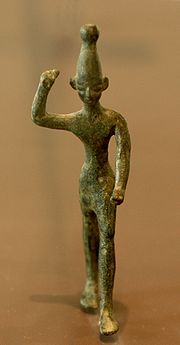
Levant
The Levant or ) is the geographic region and culture zone of the "eastern Mediterranean littoral between Anatolia and Egypt" . The Levant includes most of modern Lebanon, Syria, Jordan, Israel, the Palestinian territories, and sometimes parts of Turkey and Iraq, and corresponds roughly to the...
and Asia Minor
Asia Minor
Asia Minor is a geographical location at the westernmost protrusion of Asia, also called Anatolia, and corresponds to the western two thirds of the Asian part of Turkey...
, cognate to Akkadian Bēlu
Bel (mythology)
Bel , signifying "lord" or "master", is a title rather than a genuine name, applied to various gods in Babylonian religion. The feminine form is Belit 'Lady, Mistress'. Bel is represented in Greek as Belos and in Latin as Belus...
. A Baalist or Baalite means a worshipper of Baal.
"Baʿal" can refer to any god and even to human officials; in some texts it is used as a substitute for Hadad
Hadad
Haddad was a northwest Semitic storm and rain god, cognate in name and origin with the Akkadian god Adad. Hadad was often called simply Ba‘al , but this title was also used for other gods. The bull was the symbolic animal of Hadad. He appeared as a bearded deity, often shown as holding a club and...
, a god of the rain, thunder, fertility and agriculture, and the lord of Heaven. Since only priests were allowed to utter his divine name, Hadad, Ba‛al was commonly used. Nevertheless, few if any Biblical
Bible
The Bible refers to any one of the collections of the primary religious texts of Judaism and Christianity. There is no common version of the Bible, as the individual books , their contents and their order vary among denominations...
uses of "Baʿal" refer to Hadad, the lord over the assembly of gods on the holy mount of Heaven, but rather refer to any number of local spirit-deities worshipped as cult image
Cult image
In the practice of religion, a cult image is a human-made object that is venerated for the deity, spirit or daemon that it embodies or represents...
s, each called baʿal and regarded in the Hebrew Bible
Hebrew Bible
The Hebrew Bible is a term used by biblical scholars outside of Judaism to refer to the Tanakh , a canonical collection of Jewish texts, and the common textual antecedent of the several canonical editions of the Christian Old Testament...
in that context as a false god
False god
A false god is, in Abrahamic doctrines, a deity or object of worship that is either illegitimate or non-functioning in its professed authority or capability...
.
Etymology
, (bāʾ-[[ʿayn]]-lāmLam
-Lam:*Mor lam, an ancient Lao form of song in Laos and Isan*Lam saravane, a music genre*Lam luang, a music genre*Lam, Germany, a town in Bavaria-LAM:*Lactational amenorrhea method, a contraceptive method...
), is a Semitic word signifying "The Lord, master, owner (male), keeper, husband".
Cognates include Standard Hebrew (Bet-Ayin
Ayin
' or ' is the sixteenth letter in many Semitic abjads, including Phoenician, Aramaic, Hebrew and Arabic . It is the twenty-first letter in the new Persian alphabet...
-Lamed; , , Akkadian
Akkadian language
Akkadian is an extinct Semitic language that was spoken in ancient Mesopotamia. The earliest attested Semitic language, it used the cuneiform writing system derived ultimately from ancient Sumerian, an unrelated language isolate...
Bēl
Bel (mythology)
Bel , signifying "lord" or "master", is a title rather than a genuine name, applied to various gods in Babylonian religion. The feminine form is Belit 'Lady, Mistress'. Bel is represented in Greek as Belos and in Latin as Belus...
and Arabic .
The feminine form is (Hebrew , Arabic ) signifying "lady, mistress, owner (female), wife".
The words themselves had no exclusively religious connotation, they are a honorific title for heads of households or master craftsmen, but not for royalty. The meaning of "lord" as a member of royalty or nobility is more accurately translated as Adon
Adon
Adon is the Northwest Semitic for "lord", mostly used of deities.It may also refer to:*in the Tanakh Adon may be used for men and angels as well as to El*Adonai "my lord" in Jewish tradition is used as a euphemism to refer to God...
in Semitic.
Baʿal ul bayt in modern Levantine Arabic is widely used to mean the head of the household, literally 'Master of the House' and has a somewhat jocular, semi-mocking connotation.
In modern Levantine Arabic, the word serves as an adjective describing farming that rely only on rainwater as a source of irrigation. Probably it is the last remnant of the sense of Baal the god in the minds of the people of the region.
In Amharic
Amharic language
Amharic is a Semitic language spoken in Ethiopia. It is the second most-spoken Semitic language in the world, after Arabic, and the official working language of the Federal Democratic Republic of Ethiopia. Thus, it has official status and is used nationwide. Amharic is also the official or working...
, the Semitic word for "owner" or "husband, spouse" survives with the spelling bal.
Deities called Baʿal and Baʿalath
Because more than one god bore the title "Baʿal" and more than one goddess bore the title "Baʿalat" or "Ba``alah," only the context of a text can indicate of which Baʿal 'lord' or Baʿalath 'Lady' a particular inscription or text is speaking.Hadad in Ugarit
In the Bronze Age, HadadHadad
Haddad was a northwest Semitic storm and rain god, cognate in name and origin with the Akkadian god Adad. Hadad was often called simply Ba‘al , but this title was also used for other gods. The bull was the symbolic animal of Hadad. He appeared as a bearded deity, often shown as holding a club and...
(or Haddad or Adad) was especially likely to be called Baʿal; however, Hadad was far from the only god to have that title.
In the Canaanite pantheon as attested in Ugarit
Ugarit
Ugarit was an ancient port city in the eastern Mediterranean at the Ras Shamra headland near Latakia, Syria. It is located near Minet el-Beida in northern Syria. It is some seven miles north of Laodicea ad Mare and approximately fifty miles east of Cyprus...
ic sources, Hadad was the son of El
El (god)
is a Northwest Semitic word meaning "deity", cognate to Akkadian and then to Hebrew : Eli and Arabic )....
, who had once been the primary god of the Canaanite pantheon. El and Baʿal are often associated with the bull in Ugaritic texts, as a symbol both of strength and fertility.
Baʿal of Tyre
MelqartMelqart
Melqart, properly Phoenician Milk-Qart "King of the City", less accurately Melkart, Melkarth or Melgart , Akkadian Milqartu, was tutelary god of the Phoenician city of Tyre as Eshmun protected Sidon. Melqart was often titled Ba‘l Ṣūr "Lord of Tyre", the ancestral king of the royal line...
is the son of El in the Phoenician triad of worship. He was the god of Tyre and was often called the Baʿal of Tyre. relates that Ahab
Ahab
Ahab or Ach'av or Achab in Douay-Rheims was king of Israel and the son and successor of Omri according to the Hebrew Bible. His wife was Jezebel....
, king of Israel
Israel
The State of Israel is a parliamentary republic located in the Middle East, along the eastern shore of the Mediterranean Sea...
, married Jezebel, daughter of Ethba’al
Ithobaal I
Ithobaal I was a king of Tyre who founded a new dynasty. During his reign, Tyre expanded its power on the mainland, making all of Phoenicia its territory as far north as Beirut, including Sidon, and even a part of the island of Cyprus...
, king of the Sidon
Sidon
Sidon or Saïda is the third-largest city in Lebanon. It is located in the South Governorate of Lebanon, on the Mediterranean coast, about 40 km north of Tyre and 40 km south of the capital Beirut. In Genesis, Sidon is the son of Canaan the grandson of Noah...
ians, and then served habba’al ('the Baʿal'.) The cult
Cult
The word cult in current popular usage usually refers to a group whose beliefs or practices are considered abnormal or bizarre. The word originally denoted a system of ritual practices...
of this god was prominent in Israel until the reign of Jehu
Jehu
Jehu was a king of Israel. He was the son of Jehoshaphat, and grandson of Nimshi.William F. Albright has dated his reign to 842-815 BC, while E. R. Thiele offers the dates 841-814 BC...
, who put an end to it :
And they brought out the pillars (massebahs) of the house of the Baʿal and burned them. And they pulled down the pillar (massebah) of the Baʿal and pulled down the house of the Baʿal and turned it into a latrine until this day.
Some scholars claim it is uncertain whether "Baʿal" the Lord in Kings 10:26 refers to Melqart. They point out that Hadad was also worshipped in Tyre. This point of view ignores the possibility that Hadad and Melqart are the same god with different names because of different languages and cultures, Hadad being Canaanite and Melqart being Phoenician. In favor of the latter interpretation, both Hadad and Melqart are described as the son of El, both carrying the same secondary position in the pantheons of each culture.
Josephus
Josephus
Titus Flavius Josephus , also called Joseph ben Matityahu , was a 1st-century Romano-Jewish historian and hagiographer of priestly and royal ancestry who recorded Jewish history, with special emphasis on the 1st century AD and the First Jewish–Roman War, which resulted in the Destruction of...
(Antiquities 8.13.1) states clearly that Jezebel "built a temple to the god of the Tyrians, which they call Belus" which certainly refers to the Baal of Tyre, or Melqart.
Ahab son of Omri did more evil in the eyes of the Lord than any of those before him. He not only considered it trivial to commit the sins of Jeroboam son of Nebat, but he also married Jezebel daughter of Ethbaal king of the Sidonians, and began to serve Baal and worship him. He set up an altar for Baal in the temple of Baal that he built in Samaria. Ahab also made an AsherahAsherahAsherah , in Semitic mythology, is a Semitic mother goddess, who appears in a number of ancient sources including Akkadian writings by the name of Ashratum/Ashratu and in Hittite as Asherdu or Ashertu or Aserdu or Asertu...
(pole) and did more to provoke the Lord, the God of Israel, to anger than did all the kings of Israel before him.
In any case, King Ahab, despite supporting the cult of this Baʿal, had a semblance of worship to Yahweh
Yahweh (Canaanite deity)
The hypothesis of a Canaanite deity named Yahweh or Yahwi is accepted by some Ancient Near Eastern scholars, although no direct evidence from archeology has been found. The name Yahwi may possibly be found in some male Amorite names...
(1 Kings 16-22). Ahab still consulted Yahweh's prophets and cherished Yahweh's protection when he named his sons Ahaziah
Ahaziah of Israel
Ahaziah or Ochozias was king of Israel and the son of Ahab and Jezebel.William F. Albright has dated his reign to 850-849 BC, while E. R. Thiele offers the dates 853-852 BC...
("Yahweh holds") and Jehoram ("Yahweh is high.")
Baʿal of Carthage
The worship of Baʿal Hammon flourished in the PhoeniciaPhoenicia
Phoenicia , was an ancient civilization in Canaan which covered most of the western, coastal part of the Fertile Crescent. Several major Phoenician cities were built on the coastline of the Mediterranean. It was an enterprising maritime trading culture that spread across the Mediterranean from 1550...
n colony of Carthage
Carthage
Carthage , implying it was a 'new Tyre') is a major urban centre that has existed for nearly 3,000 years on the Gulf of Tunis, developing from a Phoenician colony of the 1st millennium BC...
. Baʿal Hammon was the supreme god of the Carthaginians, and is believed that this supremacy dates back to the 5th century BC, apparently after a breaking off of relationships between Carthage and Tyre at the time of the Punic defeat in Himera
Battle of Himera (480 BC)
The Battle of Himera , supposedly fought on the same day as the more famous Battle of Salamis, or on the same day as the Battle of Thermopylae, saw the Greek forces of Gelon, King of Syracuse, and Theron, tyrant of Agrigentum, defeat the Carthaginian force of Hamilcar the Magonid, ending a...
. He is generally identified by modern scholars either with the Northwest Semitic god El
El (god)
is a Northwest Semitic word meaning "deity", cognate to Akkadian and then to Hebrew : Eli and Arabic )....
or with Dagon
Dagon
Dagon was originally an Assyro-Babylonian fertility god who evolved into a major northwest Semitic god, reportedly of grain and fish and/or fishing...
, and generally identified by the Greek
Greek mythology
Greek mythology is the body of myths and legends belonging to the ancient Greeks, concerning their gods and heroes, the nature of the world, and the origins and significance of their own cult and ritual practices. They were a part of religion in ancient Greece...
s, by interpretatio Graeca
Interpretatio graeca
Interpretatio graeca is a Latin term for the common tendency of ancient Greek writers to equate foreign divinities to members of their own pantheon. Herodotus, for example, refers to the ancient Egyptian gods Amon, Osiris and Ptah as "Zeus", "Dionysus" and "Hephaestus", respectively.-Roman...
with Greek Cronus
Cronus
In Greek mythology, Cronus or Kronos was the leader and the youngest of the first generation of Titans, divine descendants of Gaia, the earth, and Uranus, the sky...
and similarly by the Romans
Ancient Rome
Ancient Rome was a thriving civilization that grew on the Italian Peninsula as early as the 8th century BC. Located along the Mediterranean Sea and centered on the city of Rome, it expanded to one of the largest empires in the ancient world....
with Saturn
Saturn (mythology)
In ancient Roman religion and myth, Saturn was a major god presiding over agriculture and the harvest time. His reign was depicted as a Golden Age of abundance and peace by many Roman authors. In medieval times he was known as the Roman god of agriculture, justice and strength. He held a sickle in...
.
The meaning of Hammon or Hamon is unclear. In the 19th century when Ernest Renan
Ernest Renan
Ernest Renan was a French expert of Middle East ancient languages and civilizations, philosopher and writer, devoted to his native province of Brittany...
excavated the ruins of Hammon , the modern Umm between Tyre and Acre
Acre, Israel
Acre , is a city in the Western Galilee region of northern Israel at the northern extremity of Haifa Bay. Acre is one of the oldest continuously inhabited sites in the country....
, he found two Phoenician inscriptions dedicated to El-Hammon. Since El was normally identified with Cronus and Hammon was also identified with Cronus, it seemed possible they could be equated. More often a connection with Hebrew
Hebrew language
Hebrew is a Semitic language of the Afroasiatic language family. Culturally, is it considered by Jews and other religious groups as the language of the Jewish people, though other Jewish languages had originated among diaspora Jews, and the Hebrew language is also used by non-Jewish groups, such...
/Phoenician 'brazier' has been proposed, in the sense of "Baal (lord) of the brazier". He has been therefore identified with a solar deity. Frank Moore Cross argued for a connection to , the Ugaritic
Ugaritic language
The following table shows Proto-Semitic phonemes and their correspondences among Ugaritic, Arabic and Tiberian Hebrew:-Grammar:Ugaritic is an inflected language, and as a Semitic language its grammatical features are highly similar to those found in Classical Arabic and Akkadian...
and Akkadian
Akkadian language
Akkadian is an extinct Semitic language that was spoken in ancient Mesopotamia. The earliest attested Semitic language, it used the cuneiform writing system derived ultimately from ancient Sumerian, an unrelated language isolate...
name for Mount Amanus, the great mountain separating Syria
Syria
Syria , officially the Syrian Arab Republic , is a country in Western Asia, bordering Lebanon and the Mediterranean Sea to the West, Turkey to the north, Iraq to the east, Jordan to the south, and Israel to the southwest....
from Cilicia
Cilicia
In antiquity, Cilicia was the south coastal region of Asia Minor, south of the central Anatolian plateau. It existed as a political entity from Hittite times into the Byzantine empire...
based on the occurrence of an Ugaritic description of El as the one of the Mountain Haman.
Classical sources relate how the Carthaginians burned their children as offerings to Baʿal Hammon. See Moloch
Moloch
Moloch — also rendered as Molech, Molekh, Molok, Molek, Molock, or Moloc — is the name of an ancient Semitic god...
for a discussion of these traditions and conflicting thoughts on the matter. From the attributes of his Roman form, African Saturn, it is possible to conclude that Hammon was a fertility god.
Scholars tend to see Baʿal Hammon as more or less identical with the god El, who was also generally identified with Cronus and Saturn. However, Yigael Yadin
Yigael Yadin
Yigael Yadin on 21 March 1917, died 28 June 1984) was an Israeli archeologist, politician, and the second Chief of Staff of the Israel Defense Forces.-Early life and military career:...
thought him to be a moon god. Edward Lipinski
Edward Lipinski (orientalist)
Edward Lipiński, is a Belgian scholar specializing in Biblical and ancient Near Eastern studies.-Life:His first major work, published in 1965, was a monumental monograph entitled La royauté de Yahwé dans la poésie et le culte de l’ancien Israël. In 1969, he was appointed professor at the Louvain...
identifies him with the god Dagon
Dagon
Dagon was originally an Assyro-Babylonian fertility god who evolved into a major northwest Semitic god, reportedly of grain and fish and/or fishing...
in his Dictionnaire de la civilisation phenicienne et punique (1992: ISBN 2-503-50033-1). Inscriptions about Punic deities tend to be rather uninformative.
In Carthage and North Africa Baʿal Hammon was especially associated with the ram and was worshiped also as Baʿal Qarnaim ("Lord of Two Horns") in an open-air sanctuary at Jebel Bu Kornein ("the two-horned hill") across the bay from Carthage.
Baʿal Hammon's female cult partner was Tanit
Tanit
Tanit was a Phoenician lunar goddess, worshipped as the patron goddess at Carthage. Tanit was worshiped in Punic contexts in the Western Mediterranean, from Malta to Gades into Hellenistic times. From the fifth century BCE onwards Tanit is associated with that of Baal Hammon...
. He was probably not ever identified with Baʿal Melqart
Melqart
Melqart, properly Phoenician Milk-Qart "King of the City", less accurately Melkart, Melkarth or Melgart , Akkadian Milqartu, was tutelary god of the Phoenician city of Tyre as Eshmun protected Sidon. Melqart was often titled Ba‘l Ṣūr "Lord of Tyre", the ancestral king of the royal line...
, although one finds this equation in older scholarship.
Ba`alat Gebal
Ba`alat Gebal
Ba‘alat Gebal, 'Lady of Byblos', was the goddess of the city of Byblos, sometimes known to the Greeks as Baaltis.She was generally identified with the pan-Semitic goddess ‘Ashtart and so equated with the Greek goddess Aphrodite...
("Lady of Byblos") appears to have been generally identified with , although Sanchuniathon
Sanchuniathon
Sanchuniathon is the purported Phoenician author of three lost works originally in the Phoenician language, surviving only in partial paraphrase and summary of a Greek translation by Philo of Byblos, according to the Christian bishop Eusebius of Caesarea...
distinguishes the two.
Priests of Baʿal
The Priests of Baʿal are mentioned in the Hebrew Bible numerous times, including a confrontation with the Prophet Elijah , the burning of incense symbolic of prayer , and rituals followed by priests adorned in special vestments offering sacrifices similar to those given to honor the Hebrew God. The confrontation with the Prophet Elijah is also mentioned in the Qur'an (37:123-125)Baʿal as a divine title in Israel and Judah
-
- At first the name Baʿal was used by the Jews for their God without discrimination, but as the struggle between the two religions developed, the name Baʿal was given up in Judaism as a thing of shame, and even names like Jerubbaʿal were changed to Jerubbosheth: Hebrew bosheth means "shame".
The sense of competition between the priestly forces of Yahweh and of Baʿal in the ninth century is nowhere more directly attested than in , where, Elijah the prophet offering a sacrifice to Yahweh, Baʿal's followers did the same. Baʿal in the Hebrew text did not light his followers' sacrifice, but Yahweh sent heavenly fire to burn Elijah's sacrifice to ashes, even after it had been soaked with water.
Since Baʿal simply means 'master', there is no obvious reason for which it could not be applied to Yahweh as well as other gods. In fact, Hebrews generally referred to Yahweh as Adonai ('my lord') in prayer. The judge Gideon was also called Jerubaʿal, a name which seems to mean 'Baʿal strives', though the Yahwists' explanation in is that the theophoric name was given to mock the god Baʿal, whose shrine Gideon had destroyed, the intention being to imply: "Let Baʿal strive as much as he can ... it will come to nothing."
After Gideon's death, according to , the Israelites went astray and started to worship the Baʿalîm (the Baʿals) especially Baʿal Berith ("Lord of the Covenant.") A few verses later the story turns to all the citizens of Shechem
Shechem
Shechem was a Canaanite city mentioned in the Amarna letters, and is mentioned in the Hebrew Bible as an Israelite city of the tribe of Manasseh and the first capital of the Kingdom of Israel...
— actually kol-ba‘alê šəkem another case of normal use of ba‘al not applied to a deity. These citizens of Shechem support Abimelech
Abimelech
Abimelech was a common name of the Philistine kings.Abimelech was most prominently the name of a king of Gerar who is mentioned in two of the three wife-sister narratives in Genesis...
's attempt to become king by giving him 70 shekels from the House of Ba‘al Berith. It is hard to dissociate this Lord of the Covenant who is worshipped in Shechem from the covenant at Shechem described earlier in , in which the people agree to worship Yahweh. It is especially hard to do so when relates that all "the holders of the tower of Shechem" (kol-ba‘alê midgal-šəkem) enter bêt ’ēl bərît 'the House of El Berith', that is, 'the House of God of the Covenant'. Either "Baʿal" was here a title for El, or the covenant of Shechem perhaps originally did not involve El at all, but some other god who bore the title Baʿal. Whether there were different viewpoints about Yahweh, some seeing him as an aspect of Hadad, some as an aspect of El, some with other perceptions cannot be unambiguously answered.
Baʿal appears in theophoric names. One also finds Eshbaʿal (one of Saul
Saul the King
According to the Bible, Saul was the first king of the united Kingdom of Israel. He was anointed by the prophet Samuel and reigned from Gibeah. He commited suicide to avoid arrest in the battle against the Philistines at Mount Gilboa, during which three of his sons were also killed...
's sons) and Beʿeliada (a son of David
David
David was the second king of the united Kingdom of Israel according to the Hebrew Bible and, according to the Gospels of Matthew and Luke, an ancestor of Jesus Christ through both Saint Joseph and Mary...
). The last name also appears as Eliada. This might show that at some period Baʿal and El were used interchangeably; even in the same name applied to the same person. More likely a later hand has cleaned up the text. Editors did play around with some names, sometimes substituting the form bosheth 'abomination' for ba‘al in names, whence the forms Ishbosheth instead of Eshbaʿal and Mephibosheth which is rendered Meribaʿal in . mentions the name Beʿaliah (more accurately be‘alyâ) meaning "Yahweh is Baʿal."
It is difficult to determine to what extent the 'false worship' which the prophets stigmatize is the worship of Yahweh under a conception and with rite
Rite
A rite is an established, ceremonious, usually religious act. Rites in this sense fall into three major categories:* rites of passage, generally changing an individual's social status, such as marriage, baptism, or graduation....
s, which treated him as a local nature god, or whether particular features of gods more often given the title Ba‘al were consciously recognized to be distinct from Yahwism from the first. Certainly some of the Ugaritic texts and Sanchuniathon
Sanchuniathon
Sanchuniathon is the purported Phoenician author of three lost works originally in the Phoenician language, surviving only in partial paraphrase and summary of a Greek translation by Philo of Byblos, according to the Christian bishop Eusebius of Caesarea...
report hostility between El and Hadad, perhaps representing a cultic and religious differences reflected in Hebrew tradition also, in which Yahweh in the Tanach
Hebrew Bible
The Hebrew Bible is a term used by biblical scholars outside of Judaism to refer to the Tanakh , a canonical collection of Jewish texts, and the common textual antecedent of the several canonical editions of the Christian Old Testament...
is firmly identified with El and might be expected to be somewhat hostile to Baʿal/Hadad and the deities of his circle. But for Jeremiah
Jeremiah
Jeremiah Hebrew:יִרְמְיָה , Modern Hebrew:Yirməyāhū, IPA: jirməˈjaːhu, Tiberian:Yirmĭyahu, Greek:Ἰερεμίας), meaning "Yahweh exalts", or called the "Weeping prophet" was one of the main prophets of the Hebrew Bible...
and the Deuteronomist
Deuteronomy
The Book of Deuteronomy is the fifth book of the Hebrew Bible, and of the Jewish Torah/Pentateuch...
it also appears to be monotheism
Monotheism
Monotheism is the belief in the existence of one and only one god. Monotheism is characteristic of the Baha'i Faith, Christianity, Druzism, Hinduism, Islam, Judaism, Samaritanism, Sikhism and Zoroastrianism.While they profess the existence of only one deity, monotheistic religions may still...
against polytheism
Polytheism
Polytheism is the belief of multiple deities also usually assembled into a pantheon of gods and goddesses, along with their own mythologies and rituals....
:
Then shall the cities of Judah and inhabitants of Jerusalem go and cry to the gods to whom they offer incense: but they shall not save them at all in the time of their trouble. For according to the number of your cities are your gods, O Judah; and according to the number of the streets of Jerusalem you have set up altars to the abominination, altars to burn incense to the Ba‘al.
Multiple Baʿals and ʿAshtarts
One finds in the Tanakh the plural forms bə'ālîm 'Baʿals' or 'Lords' and aštārôt Ashtarts, though such plurals don't appear in Phoenician or Canaanite or independent Aramaic sources.One theory is that the people of each territory or in each wandering clan worshipped their own Baʿal, as the chief deity of each, the source of all the gifts of nature, the mysterious god of their fathers. As the god of fertility
Fertility
Fertility is the natural capability of producing offsprings. As a measure, "fertility rate" is the number of children born per couple, person or population. Fertility differs from fecundity, which is defined as the potential for reproduction...
all the produce of the soil would be his, and his adherents would bring to him their tribute of first-fruits. He would be the patron of all growth and fertility, and, by the use of analogy characteristic of early thought, this Baʿal would be the god of the productive element in its widest sense. Originating perhaps in the observation of the fertilizing effect of rains and streams upon the receptive and reproductive soil, Baʿal worship became identical with nature-worship. Joined with the Baʿals there would naturally be corresponding female figures which might be called ʿAshtarts, embodiments of 'Ashtart. Baʿal Hadad is associated with the goddess "Virgin" Anat
Anat
Anat, also ‘Anat is a major northwest Semitic goddess.-‘Anat in Ugarit:In the Ugaritic Ba‘al/Hadad cycle ‘Anat is a violent war-goddess, a virgin in Ugarit though the sister and lover of the great Ba‘al known as Hadad elsewhere. Ba‘al is usually called the son of Dagon and sometimes the son of El....
, his sister and lover.
Through analogy and through the belief that one can control or aid the powers of nature by the practice of magic
Magic (paranormal)
Magic is the claimed art of manipulating aspects of reality either by supernatural means or through knowledge of occult laws unknown to science. It is in contrast to science, in that science does not accept anything not subject to either direct or indirect observation, and subject to logical...
, particularly sympathetic magic
Sympathetic magic
Sympathetic magic, also known as imitative magic, is a type of magic based on imitation or correspondence.-Similarity and contagion:The theory of sympathetic magic was first developed by Sir James George Frazer in The Golden Bough...
, sexuality might characterize part of the cult of the Baʿals and ʿAshtarts. Post-Exilic allusions to the cult of Baʿal Pe'or suggest that orgies prevailed. On the summits of hills and mountains flourished the cult of the givers of increase, and "under every green tree" was practised the licentiousness which was held to secure abundance of crops. Human sacrifice
Human sacrifice
Human sacrifice is the act of killing one or more human beings as part of a religious ritual . Its typology closely parallels the various practices of ritual slaughter of animals and of religious sacrifice in general. Human sacrifice has been practised in various cultures throughout history...
, the burning of incense
Incense
Incense is composed of aromatic biotic materials, which release fragrant smoke when burned. The term "incense" refers to the substance itself, rather than to the odor that it produces. It is used in religious ceremonies, ritual purification, aromatherapy, meditation, for creating a mood, and for...
, violent and ecstatic exercises, ceremonial acts of bowing and kissing, the preparing of sacred cakes (see also Asherah
Asherah
Asherah , in Semitic mythology, is a Semitic mother goddess, who appears in a number of ancient sources including Akkadian writings by the name of Ashratum/Ashratu and in Hittite as Asherdu or Ashertu or Aserdu or Asertu...
), appear among the offences denounced by the post-Exilic prophets; and show that the cult of Baʿal (and ʿAshtart) included characteristic features of worship which recur in various parts of the Semitic (and non-Semitic) world, although attached to other names. But it is also possible that such rites were performed to a local Baʿal Lord and a local ʿAshtart without much concern as to whether they were the same as that of a nearby community or how they fitted into the national theology of Yahweh who had become a ruling high god of the heavens, increasingly disassociated from such things, at least in the minds of some worshippers.
Another theory is that the references to Baʿals and ʿAshtarts (and Asherahs) are to images or other standard symbols of these deities, statues, and icons of Baʿal Hadad, ʿAshtart, and Asherah set-up in various high places as well as those of other gods, the author listing the most prominent as types for all.
A reminiscence of Baʿal as a title of a local fertility god (or referring to a particular god of subterraneous water) may occur in the Talmud
Talmud
The Talmud is a central text of mainstream Judaism. It takes the form of a record of rabbinic discussions pertaining to Jewish law, ethics, philosophy, customs and history....
ic Hebrew phrases field of the Baʿal and place of the Baʿal and Arabic
Arabic language
Arabic is a name applied to the descendants of the Classical Arabic language of the 6th century AD, used most prominently in the Quran, the Islamic Holy Book...
ba'l used of land fertilised by subterraneous waters rather than by rain.
The identification of Baʿal as a sun-god in historical scholarship came to be abandoned by the end of the 19th century
as it became clear that Baʿal was the title of numerous local gods and not necessarily a single deity in origin.
It also became clear that the "astralizing" (association or identification with heavenly bodies) of Ancient Near Eastern deities was a late (Iron Age) development in no way connected with the origin of religion as theorized by some 19th century schools of thought.
Christian demonology
Until archaeological digs at Ras Shamra
Ugarit
Ugarit was an ancient port city in the eastern Mediterranean at the Ras Shamra headland near Latakia, Syria. It is located near Minet el-Beida in northern Syria. It is some seven miles north of Laodicea ad Mare and approximately fifty miles east of Cyprus...
and Ebla
Ebla
Ebla Idlib Governorate, Syria) was an ancient city about southwest of Aleppo. It was an important city-state in two periods, first in the late third millennium BC, then again between 1800 and 1650 BC....
uncovered texts explaining the Syrian pantheon, the demon Ba‘al Zebûb was frequently confused with various Semitic spirits and deities named Baal, whereas in some Christian writings, it might refer to a high-ranking devil or to Satan
Satan
Satan , "the opposer", is the title of various entities, both human and divine, who challenge the faith of humans in the Hebrew Bible...
himself.
Early demonologists
Demonology
Demonology is the systematic study of demons or beliefs about demons. It is the branch of theology relating to superhuman beings who are not gods. It deals both with benevolent beings that have no circle of worshippers or so limited a circle as to be below the rank of gods, and with malevolent...
, unaware of Hadad
Hadad
Haddad was a northwest Semitic storm and rain god, cognate in name and origin with the Akkadian god Adad. Hadad was often called simply Ba‘al , but this title was also used for other gods. The bull was the symbolic animal of Hadad. He appeared as a bearded deity, often shown as holding a club and...
or that "Baʿal" in the Bible referred to any number of local spirits, came to regard the term as referring to but one personage. Baal was ranked as the first and principal king in Hell
Hell
In many religious traditions, a hell is a place of suffering and punishment in the afterlife. Religions with a linear divine history often depict hells as endless. Religions with a cyclic history often depict a hell as an intermediary period between incarnations...
, ruling over the East. According to some authors Baal is a duke, with 66 legions of demons under his command.
During the English Puritan
Puritan
The Puritans were a significant grouping of English Protestants in the 16th and 17th centuries. Puritanism in this sense was founded by some Marian exiles from the clergy shortly after the accession of Elizabeth I of England in 1558, as an activist movement within the Church of England...
period, Baal was either compared to Satan or considered his main lieutenant. According to Francis Barrett
Francis Barrett (occultist)
Francis Barrett was an English occultist.Barrett, an Englishman, claimed himself to be a student of chemistry, metaphysics, and natural occult philosophy...
, he has the power to make those who invoke him invisible.
John Milton
John Milton
John Milton was an English poet, polemicist, a scholarly man of letters, and a civil servant for the Commonwealth of England under Oliver Cromwell...
in his epic poem Paradise Lost
Paradise Lost
Paradise Lost is an epic poem in blank verse by the 17th-century English poet John Milton. It was originally published in 1667 in ten books, with a total of over ten thousand individual lines of verse...
of 1667 describes Satan
Satan
Satan , "the opposer", is the title of various entities, both human and divine, who challenge the faith of humans in the Hebrew Bible...
's "Legions, Angel Forms" immediately after the fall from heaven
Fallen angel
Fallen angel is a concept developed in Jewish mythology from interpretation of the Book of Enoch. The actual term fallen angel is not found in either the Hebrew Bible or the New Testament. Christians adopted the concept of fallen angels mainly based on their interpretations of the Book of...
collecting themselves and gathering around their "Great Sultan" (Satan). Milton names and describes the most prominent of these whose names in heaven had been "blotted out and ras'd", but who would acquire new names "wandring ore the Earth", being worshipped by man ("Devils to adore for Deities"). In the following section, Milton refers to the plural forms of Baʿal and Astarte
Astarte
Astarte is the Greek name of a goddess known throughout the Eastern Mediterranean from the Bronze Age to Classical times...
[Book 1, lines 419-423]:
With these came they, who from the bordring flood
Of old Euphrates to the Brook that parts
Egypt from Syrian ground, had general Names
Of Baalim and Ashtaroth, those male,
These Feminine.
In grimoire
Grimoire
A grimoire is a textbook of magic. Such books typically include instructions on how to create magical objects like talismans and amulets, how to perform magical spells, charms and divination and also how to summon or invoke supernatural entities such as angels, spirits, and demons...
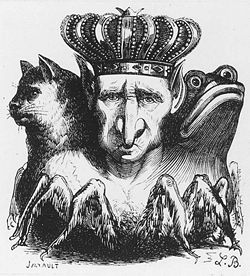
tradition, the demon Bael was said to appear in the forms of a man, cat, toad, or combinations thereof. An illustration in Collin de Plancy
Collin de Plancy
Jacques Albin Simon Collin de Plancy was a French occultist, demonologist and writer; he published several works on occultism and demonology. He was born in 1793 or 1794 in Plancy and died in 1881 in Paris. He was a free-thinker influenced by Voltaire...
's 1818 book Dictionnaire Infernal
Dictionnaire Infernal
The Dictionnaire Infernal is a book on demonology, organised in hellish hierarchies. It was written by Jacques Auguste Simon Collin de Plancy and first published in 1818. There were several editions of the book, but perhaps the most famous is the edition of 1863, in which sixty-nine illustrations...
rather curiously placed the heads of the three creatures onto a set of spider
Spider
Spiders are air-breathing arthropods that have eight legs, and chelicerae with fangs that inject venom. They are the largest order of arachnids and rank seventh in total species diversity among all other groups of organisms...
legs.
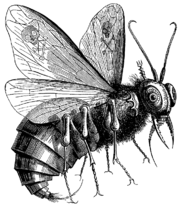
Baʿal Zebûb
New Testament
The New Testament is the second major division of the Christian biblical canon, the first such division being the much longer Old Testament....
as Satan, the "prince of the demons". In Arabic
Arabic language
Arabic is a name applied to the descendants of the Classical Arabic language of the 6th century AD, used most prominently in the Quran, the Islamic Holy Book...
the name is retained as Ba‘al dhubaab / zubaab (بعل الذباب), literally "Lord of the Flies". Biblical scholar Thomas Kelly Cheyne
Thomas Kelly Cheyne
Thomas Kelly Cheyne was an English divine and Biblical critic. He was born in London and educated at Merchant Taylors' School, London, and Oxford University....
suggested that it might be a derogatory corruption of Ba‘al Zəbûl, "Lord of the High Place" (i.e., Heaven) or "High Lord". The word Beelzebub in rabbinical texts is a mockery of the Ba'al religion, which ancient Hebrews considered to be idol (or, false God) worship. Ba'al, meaning "Lord" in Ugaritic, was used in conjunction with a descriptive name of a specific God. Jewish scholars have interpreted the title of "Lord of Flies" as the Hebrew way of calling Ba'al a pile of dung, and comparing Ba'al followers to flies. The Septuagint renders the name as Baalzebub (βααλζεβούβ) and as Baal muian (βααλ μυιαν, "Baal of flies"), but Symmachus the Ebionite
Symmachus the Ebionite
Symmachus was the author of one of the Greek versions of the Old Testament. It was included by Origen in his Hexapla and Tetrapla, which compared various versions of the Old Testament side by side with the Septuagint...
may have reflected a tradition of its offensive ancient name when he rendered it as Beelzeboul.
See also
- Goetic demons in popular cultureGoetic demons in popular cultureThe demons identified in The Lesser Key of Solomon have appeared many times in modern fiction.- The Lesser Key of Solomon :In addition to the individual listings, the Key and every demon within it appear in some form in the PlayStation 2 game Shadow Hearts: Covenant.- Agares :* Agares is one...
- AdonAdonAdon is the Northwest Semitic for "lord", mostly used of deities.It may also refer to:*in the Tanakh Adon may be used for men and angels as well as to El*Adonai "my lord" in Jewish tradition is used as a euphemism to refer to God...
- AdonisAdonisAdonis , in Greek mythology, the god of beauty and desire, is a figure with Northwest Semitic antecedents, where he is a central figure in various mystery religions. The Greek , Adōnis is a variation of the Semitic word Adonai, "lord", which is also one of the names used to refer to God in the Old...
- Ba'al (Stargate)
- Ba‘al Shamîm
- Baal Peor
- BaaltarsBaaltarsBaaltars was a deity of the Persian Empire, the Baal or Zeus of the city of Tarsus. His depiction appears on coins of the Persian kings or satraps of Cilicia at Tarsus before Alexander the Great in the 5th and 4th century BCE, such as Datames, Pharnabazes or Mazaios, or also on coins of the early...
- BeelzebubBeelzebubBeelzebub -Religious meaning:Ba‘al Zəbûb is variously understood to mean "lord of flies", or "lord of the dwelling". Originally the name of a Philistine god, Beelzebub is also identified in the New Testament as Satan, the "prince of the demons". In Arabic the name is retained as Ba‘al dhubaab /...
- BelBel (mythology)Bel , signifying "lord" or "master", is a title rather than a genuine name, applied to various gods in Babylonian religion. The feminine form is Belit 'Lady, Mistress'. Bel is represented in Greek as Belos and in Latin as Belus...
- BelialBelialBelial is one of the four crown princes of Hell and a demon in the Bible, Jewish apocrypha and Christian apocrypha...
- Canaanite religionCanaanite religionCanaanite religion is the name for the group of Ancient Semitic religions practiced by the Canaanites living in the ancient Levant from at least the early Bronze Age through the first centuries of the Common Era....
- El-Gabal
- HadadHadadHaddad was a northwest Semitic storm and rain god, cognate in name and origin with the Akkadian god Adad. Hadad was often called simply Ba‘al , but this title was also used for other gods. The bull was the symbolic animal of Hadad. He appeared as a bearded deity, often shown as holding a club and...
- MelqartMelqartMelqart, properly Phoenician Milk-Qart "King of the City", less accurately Melkart, Melkarth or Melgart , Akkadian Milqartu, was tutelary god of the Phoenician city of Tyre as Eshmun protected Sidon. Melqart was often titled Ba‘l Ṣūr "Lord of Tyre", the ancestral king of the royal line...
- MolochMolochMoloch — also rendered as Molech, Molekh, Molok, Molek, Molock, or Moloc — is the name of an ancient Semitic god...
- SetSet (mythology)Set was in Ancient Egyptian religion, a god of the desert, storms, and foreigners. In later myths he was also the god of darkness, and chaos...
External links
- The Catholic Encyclopedia, entry "Baal, Baalim"
- Jewish Encyclopedia, entries "Ba'al", "Ba'al-worship", "Ba'al-Ha-bayit" etc
- Article Baal (PDF format) by W. Robertson Smith and George F. MooreGeorge Foot MooreGeorge Foot Moore He graduated from Yale University in 1872, where he was a member of Skull and Bones. He was awarded the highest theological qualifiction – the D.D....
in Encyclopædia Biblica, edited T. K. Cheyne and J. Sutherland Black, MacMillan: London, 1899. (Still quite accurate.) - Bartleby: American Heritage Dictionary: Semitic roots: bcl.
- Punic images of Baal Hammon described.
- Iconography of Baal (PDF format)
- Rabbi Meir Baal Haneis