
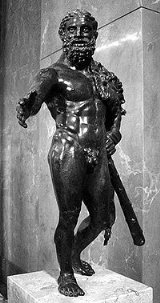
Heracles
born
Alcaeus
(Ἀλκαῖος,
Alkaios) or
Alcides (Ἀλκείδης,
Alkeidēs), was a
divine heroA hero , in Greek mythology and folklore, was originally a demigod, their cult being one of the most distinctive features of ancient Greek religion...
in
Greek mythologyGreek mythology is the body of myths and legends belonging to the ancient Greeks, concerning their gods and heroes, the nature of the world, and the origins and significance of their own cult and ritual practices. They were a part of religion in ancient Greece...
, the son of
ZeusIn the ancient Greek religion, Zeus was the "Father of Gods and men" who ruled the Olympians of Mount Olympus as a father ruled the family. He was the god of sky and thunder in Greek mythology. His Roman counterpart is Jupiter and his Etruscan counterpart is Tinia.Zeus was the child of Cronus...
(Ζεύς) and
AlcmeneIn Greek mythology, Alcmene or Alcmena was the mother of Heracles.-Background:Alcmene was born to Electryon, the son of Perseus and Andromeda, and king of Tiryns and Mycenae or Medea in Argolis. Her mother was Anaxo, daughter of Alcaeus and Astydamia, daughter of Pelops and Hippodameia...
, foster son of
AmphitryonAmphitryon , in Greek mythology, was a son of Alcaeus, king of Tiryns in Argolis.Amphitryon was a Theban general, who was originally from Tiryns in the eastern part of the Peloponnese. He was friends with Panopeus....
and great-grandson (and half-brother) of
PerseusPerseus ,Perseos and Perseas are not used in English. the legendary founder of Mycenae and of the Perseid dynasty of Danaans there, was the first of the mythic heroes of Greek mythology whose exploits in defeating various archaic monsters provided the founding myths of the Twelve Olympians...
(Περσεύς). He was the greatest of the Greek heroes, a paragon of masculinity, the ancestor of royal clans who claimed to be
HeracleidaeIn Greek mythology, the Heracleidae or Heraclids were the numerous descendants of Heracles , especially applied in a narrower sense to the descendants of Hyllus, the eldest of his four sons by Deianira Other Heracleidae included Macaria, Lamos, Manto, Bianor, Tlepolemus, and Telephus...
(Ἡρακλεῖδαι) and a champion of the
Olympian orderThe Twelve Olympians, also known as the Dodekatheon , in Greek mythology, were the principal deities of the Greek pantheon, residing atop Mount Olympus. Zeus, Hera, Poseidon, Demeter, Hestia, and Hades were siblings. Ares, Hermes, Hephaestus, Athena, Apollo, and Artemis were children of Zeus...
against
chthonicChthonic designates, or pertains to, deities or spirits of the underworld, especially in relation to Greek religion. The Greek word khthon is one of several for "earth"; it typically refers to the interior of the soil, rather than the living surface of the land or the land as territory...
monsters. In
RomeRoman mythology is the body of traditional stories pertaining to ancient Rome's legendary origins and religious system, as represented in the literature and visual arts of the Romans...
and the
modernModernity typically refers to a post-traditional, post-medieval historical period, one marked by the move from feudalism toward capitalism, industrialization, secularization, rationalization, the nation-state and its constituent institutions and forms of surveillance...
WestThe Western world, also known as the West and the Occident , is a term referring to the countries of Western Europe , the countries of the Americas, as well all countries of Northern and Central Europe, Australia and New Zealand...
, he is known as
HerculesHercules is the Roman name for Greek demigod Heracles, son of Zeus , and the mortal Alcmene...
, with whom the later
Roman EmperorThe Roman emperor was the ruler of the Roman State during the imperial period . The Romans had no single term for the office although at any given time, a given title was associated with the emperor...
s, in particular
CommodusCommodus , was Roman Emperor from 180 to 192. He also ruled as co-emperor with his father Marcus Aurelius from 177 until his father's death in 180. His name changed throughout his reign; see changes of name for earlier and later forms. His accession as emperor was the first time a son had succeeded...
and
MaximianMaximian was Roman Emperor from 286 to 305. He was Caesar from 285 to 286, then Augustus from 286 to 305. He shared the latter title with his co-emperor and superior, Diocletian, whose political brain complemented Maximian's military brawn. Maximian established his residence at Trier but spent...
, often identified themselves. The Romans adopted the Greek version of his life and works essentially unchanged, but added anecdotal detail of their own, some of it linking the hero with the geography of the Central Mediterranean. Details of his cult were adapted to Rome as well.
Extraordinary strength,
courageCourage is the ability to confront fear, pain, danger, uncertainty, or intimidation...
, ingenuity, and sexual prowess with females were among his characteristic attributes. Although he was not as clever as the likes of
OdysseusOdysseus or Ulysses was a legendary Greek king of Ithaca and the hero of Homer's epic poem the Odyssey. Odysseus also plays a key role in Homer's Iliad and other works in the Epic Cycle....
or
NestorIn Greek mythology, Nestor of Gerenia was the son of Neleus and Chloris and the King of Pylos. He became king after Heracles killed Neleus and all of Nestor's siblings...
, Heracles used his wits on several occasions when his strength did not suffice, such as when laboring for the king
AugeasIn Greek mythology, Augeas , whose name means "bright", was king of Elis and father of Epicaste. Some say that Augeas was one of the Argonauts....
of
ElisElis, or Eleia is an ancient district that corresponds with the modern Elis peripheral unit...
, wrestling the giant
AntaeusAntaeus in Greek and Berber mythology was a half-giant, the son of Poseidon and Gaia, whose wife was Tinjis. Antaeus had a daughter named Alceis or Barce.-Mythology:...
, or tricking
AtlasIn Greek mythology, Atlas was the primordial Titan who supported the heavens. Although associated with various places, he became commonly identified with the Atlas Mountains in north-west Africa...
into taking the sky back onto his shoulders. Together with
HermesHermes is the great messenger of the gods in Greek mythology and a guide to the Underworld. Hermes was born on Mount Kyllini in Arcadia. An Olympian god, he is also the patron of boundaries and of the travelers who cross them, of shepherds and cowherds, of the cunning of thieves, of orators and...
he was the patron and protector of
gymnasiaThe gymnasium in ancient Greece functioned as a training facility for competitors in public games. It was also a place for socializing and engaging in intellectual pursuits. The name comes from the Ancient Greek term gymnós meaning "naked". Athletes competed in the nude, a practice said to...
and
palaestraThe palaestra was the ancient Greek wrestling school. The events that did not require a lot of space, such as boxing and wrestling, were practised there...
e. His iconographic attributes are the
lion skinThe Nemean lion was a vicious monster in Greek mythology that lived at Nemea. It was eventually killed by Heracles. It could not be killed with mortal weapons because its golden fur was impervious to attack...
and the
clubA club is among the simplest of all weapons. A club is essentially a short staff, or stick, usually made of wood, and wielded as a weapon since prehistoric times....
. These qualities did not prevent him from being regarded as a playful figure who used games to relax from his labors and played a great deal with children. By conquering dangerous archaic forces he is said to have "made the world safe for mankind" and to be its benefactor. Heracles was an extremely passionate and emotional individual, capable of doing both great deeds for his friends (such as wrestling with
ThanatosIn Greek mythology, Thanatos was the daemon personification of death. He was a minor figure in Greek mythology, often referred to but rarely appearing in person...
on behalf of Prince
AdmetusIn Greek mythology, Admetus was a king of Pherae in Thessaly, succeeding his father Pheres after whom the city was named. Admetus was one of the Argonauts and took part in the Calydonian Boar hunt. His wife Alcestis offered to substitute her own death for his.-Mythology:Admetus was famed for his...
, who had regaled Heracles with his hospitality, or restoring his friend
TyndareusIn Greek mythology, Tyndareus or Tyndareos was a Spartan king, son of Oebalus and Gorgophone , husband of Leda and father of Helen, Castor and Polydeuces, Clytemnestra, Timandra, Phoebe and Philonoe.Tyndareus had a brother named Hippocoon , who seized power and exiled Tyndareus...
to the throne of
SpartaSparta or Lacedaemon, was a prominent city-state in ancient Greece, situated on the banks of the River Eurotas in Laconia, in south-eastern Peloponnese. It emerged as a political entity around the 10th century BC, when the invading Dorians subjugated the local, non-Dorian population. From c...
after he was overthrown) and being a terrible enemy who would wreak horrible vengeance on those who crossed him, as Augeas,
NeleusNeleus was the son of Poseidon and Tyro and brother of Pelias. Tyro was married to Cretheus but loved Enipeus, a river god. She pursued Enipeus, who refused her advances. One day, Poseidon, filled with lust for Tyro, disguised himself as Enipeus and from their union was born Pelias and Neleus,...
and
LaomedonIn Greek mythology, Laomedon was a Trojan king, son of Ilus, brother of Ganymede and Assaracus, and father of Priam, Astyoche, Lampus, Hicetaon, Clytius, Cilla, Proclia, Aethilla, Medesicaste, Clytodora, and Hesione...
all found out to their cost.
Origin and character
Many popular stories were told of his life, the most famous being The Twelve Labours of Heracles; Alexandrian poets of the Hellenistic age drew his mythology into a high poetic and tragic atmosphere. His figure, which initially drew on Near Eastern motifs such as the lion-fight, was known everywhere: his
EtruscanThe Etruscans were a diachronically continuous population, with a distinct language and culture during the period of earliest European writing, in the Mediterranean Iron Age in the second half of the first millennium BC...
equivalent was
Hercle, a son of
TiniaTinia was the god of the sky and the highest god in Etruscan mythology, equivalent to the Roman Jupiter and the Greek Zeus. He was the husband of Thalna or Uni and the father of Heracle....
and
Uni-Education:*uni, a shortened word for university*University Professors Program, an interdisciplinary program for gifted students at Boston University*University High School *University High School...
.
Heracles was the greatest of Hellenic
chthonicChthonic designates, or pertains to, deities or spirits of the underworld, especially in relation to Greek religion. The Greek word khthon is one of several for "earth"; it typically refers to the interior of the soil, rather than the living surface of the land or the land as territory...
heroes, but unlike other Greek heroes, no tomb was identified as his. Heracles was both hero and god, as
PindarPindar , was an Ancient Greek lyric poet. Of the canonical nine lyric poets of ancient Greece, his work is the best preserved. Quintilian described him as "by far the greatest of the nine lyric poets, in virtue of his inspired magnificence, the beauty of his thoughts and figures, the rich...
says
heroes theos; at the same festival sacrifice was made to him, first as a hero, with a chthonic
libationA libation is a ritual pouring of a liquid as an offering to a god or spirit or in memory of those who have died. It was common in many religions of antiquity and continues to be offered in various cultures today....
, and then as a god, upon an altar: thus he embodies the closest Greek approach to a "demi-god". The core of the story of Heracles has been identified by Walter Burkert as originating in Neolithic hunter culture and traditions of shamanistic crossings into the netherworld.
Hero or god
Heracles' role as a culture hero, whose death could be a subject of mythic telling (see below), was accepted into the
Olympian PantheonThe Twelve Olympians, also known as the Dodekatheon , in Greek mythology, were the principal deities of the Greek pantheon, residing atop Mount Olympus. Zeus, Hera, Poseidon, Demeter, Hestia, and Hades were siblings. Ares, Hermes, Hephaestus, Athena, Apollo, and Artemis were children of Zeus...
during Classical times. This created an awkwardness in the encounter with
OdysseusOdysseus or Ulysses was a legendary Greek king of Ithaca and the hero of Homer's epic poem the Odyssey. Odysseus also plays a key role in Homer's Iliad and other works in the Epic Cycle....
in the episode of
OdysseyThe Odyssey is one of two major ancient Greek epic poems attributed to Homer. It is, in part, a sequel to the Iliad, the other work ascribed to Homer. The poem is fundamental to the modern Western canon, and is the second—the Iliad being the first—extant work of Western literature...
XI, called the Nekuia, where Odysseus encounters Heracles in
HadesHades , Hadēs, originally , Haidēs or , Aidēs , meaning "the unseen") was the ancient Greek god of the underworld. The genitive , Haidou, was an elision to denote locality: "[the house/dominion] of Hades". Eventually, the nominative came to designate the abode of the dead.In Greek mythology, Hades...
:
- And next I caught a glimpse of powerful Heracles—
- His ghost I mean: the man himself delights
- in the grand feasts of the deathless gods on high...
- Around him cries of the dead rang out like cries of birds
- scattering left and right in horror as on he came like night..."
Ancient critics were aware of the problem of the aside that interrupts the vivid and complete description, in which Heracles recognizes Odysseus and hails him, and modern critics find very good reasons for denying that the verses beginning, in Fagles' translation
His ghost I mean... were part of the original composition: "once people knew of Heracles' admission to Olympus, they would not tolerate his presence in the underworld", remarks
Friedrich SolmsenFriedrich W. Solmsen was a philologist and professor of classical studies. His edition of Hesiod is considered definitive. He published nearly 150 books, monographs, scholarly articles, and reviews from the 1930s through the 1980s. Solmsen's work is characterized by a prevailing interest in the...
, noting that the interpolated verses represent a compromise between conflicting representations of Heracles.
It is also said that when Heracles died he shed his mortal skin, which went down to the underworld and he went up to join the gods for being the greatest hero ever known.
Christian dating
In Christian circles a Euhemerist reading of the widespread Heracles cult was attributed to a historical figure who had been offered cult status after his death. Thus
EusebiusEusebius of Caesarea also called Eusebius Pamphili, was a Roman historian, exegete and Christian polemicist. He became the Bishop of Caesarea in Palestine about the year 314. Together with Pamphilus, he was a scholar of the Biblical canon...
,
Preparation of the Gospel (10.12), reported that
ClementTitus Flavius Clemens , known as Clement of Alexandria , was a Christian theologian and the head of the noted Catechetical School of Alexandria. Clement is best remembered as the teacher of Origen...
could offer historical dates for Hercules as a king in Argos: "from the reign of Hercules in
ArgosArgos is a city and a former municipality in Argolis, Peloponnese, Greece. Since the 2011 local government reform it is part of the municipality Argos-Mykines, of which it is a municipal unit. It is 11 kilometres from Nafplion, which was its historic harbour...
to the deification of Hercules himself and of
AsclepiusAsclepius is the God of Medicine and Healing in ancient Greek religion. Asclepius represents the healing aspect of the medical arts; his daughters are Hygieia , Iaso , Aceso , Aglæa/Ægle , and Panacea...
there are comprised thirty-eight years, according to Apollodorus the chronicler: and from that point to the deification of
Castor and PolluxIn Greek and Roman mythology, Castor and Pollux or Polydeuces were twin brothers, together known as the Dioscuri . Their mother was Leda, but Castor was the mortal son of Tyndareus, king of Sparta, and Pollux the divine son of Zeus, who visited Leda in the guise of a swan...
fifty-three years: and somewhere about this time was the capture of
TroyTroy was a city, both factual and legendary, located in northwest Anatolia in what is now Turkey, southeast of the Dardanelles and beside Mount Ida...
."
Readers with a literalist bent, following Clement's reasoning, have asserted from this remark that, since Heracles ruled over
TirynsTiryns is a Mycenaean archaeological site in the prefecture of Argolis in the Peloponnese, some kilometres north of Nauplion.-General information:...
in Argos at the same time that
EurystheusIn Greek mythology, Eurystheus was king of Tiryns, one of three Mycenaean strongholds in the Argolid, although other authors including Homer and Euripides cast him as ruler of Argos: Sthenelus was his father and the "victorious horsewoman" Nicippe his mother, and he was a grandson of the hero...
ruled over
MycenaeMycenae is an archaeological site in Greece, located about 90 km south-west of Athens, in the north-eastern Peloponnese. Argos is 11 km to the south; Corinth, 48 km to the north...
, and since at about this time
LinusIn Greek mythology Linus refers to the musical son of Oeagrus, nominally Apollo, and the Muse Calliope. As the son of Apollo and a Muse, either Calliope or Terpsichore, he is considered the inventor of melody and rhythm. Linus taught music to his brother Orpheus and then to Heracles. Linus went...
was Heracles' teacher, one can conclude, based on
JeromeSaint Jerome was a Roman Christian priest, confessor, theologian and historian, and who became a Doctor of the Church. He was the son of Eusebius, of the city of Stridon, which was on the border of Dalmatia and Pannonia...
's date—in his
universal historyUniversal history is basic to the Western tradition of historiography, especially the Abrahamic wellspring of that tradition. Simply stated, universal history is the presentation of the history of humankind as a whole, as a coherent unit.-Ancient authors:...
, his
Chronicon—given to Linus' notoriety in teaching Heracles in
1264 BC-Events and trends:* One of the three estimated dates of the Birth of Herakles in Thebes, Greece.* c. 1263 BC—Ramses II, king of ancient Egypt, and Hattusilis III, king of the Hittites, sign the earliest known peace treaty....
, that Heracles' death and deification occurred 38 years later, in approximately 1226 BC.
Cult
The ancient Greeks celebrated the festival of the
HerakleiaThe Herakleia were ancient festivals honoring the divine hero Heracles. The ancient Athenians celebrated the festival, which commemorated the death of Heracles, on the second day of the month of Metageitnion , at the Κυνοσαργες gymnasium at the demos Diomeia outside the walls of Athens, in a...
, which commemorated the death of Heracles, on the second day of the month of Metageitnion (which would fall in late July or early August). What is believed to be an
EgyptEgypt , officially the Arab Republic of Egypt, Arabic: , is a country mainly in North Africa, with the Sinai Peninsula forming a land bridge in Southwest Asia. Egypt is thus a transcontinental country, and a major power in Africa, the Mediterranean Basin, the Middle East and the Muslim world...
ian Temple of Heracles in the
Bahariya OasisEl-Wahat el-Bahariya or el-Bahariya is a depression in Egypt. It is approximately 360 km away from Cairo. Located in Giza Governorate, the main economic sectors are agriculture, iron ore mining, and tourism...
dates to 21 BC.
Birth and childhood
A major factor in the well-known tragedies surrounding Heracles is the hatred that the
goddessA goddess is a female deity. In some cultures goddesses are associated with Earth, motherhood, love, and the household. In other cultures, goddesses also rule over war, death, and destruction as well as healing....
HeraHera was the wife and one of three sisters of Zeus in the Olympian pantheon of Greek mythology and religion. Her chief function was as the goddess of women and marriage. Her counterpart in the religion of ancient Rome was Juno. The cow and the peacock were sacred to her...
, wife of
ZeusIn the ancient Greek religion, Zeus was the "Father of Gods and men" who ruled the Olympians of Mount Olympus as a father ruled the family. He was the god of sky and thunder in Greek mythology. His Roman counterpart is Jupiter and his Etruscan counterpart is Tinia.Zeus was the child of Cronus...
, had for him. A full account of Heracles must render it clear why Heracles was so tormented by Hera, when there were many illegitimate offspring sired by Zeus. Heracles was the son of the affair Zeus had with the mortal woman
AlcmeneIn Greek mythology, Alcmene or Alcmena was the mother of Heracles.-Background:Alcmene was born to Electryon, the son of Perseus and Andromeda, and king of Tiryns and Mycenae or Medea in Argolis. Her mother was Anaxo, daughter of Alcaeus and Astydamia, daughter of Pelops and Hippodameia...
.
ZeusIn the ancient Greek religion, Zeus was the "Father of Gods and men" who ruled the Olympians of Mount Olympus as a father ruled the family. He was the god of sky and thunder in Greek mythology. His Roman counterpart is Jupiter and his Etruscan counterpart is Tinia.Zeus was the child of Cronus...
made love to her after disguising himself as her husband,
AmphitryonAmphitryon , in Greek mythology, was a son of Alcaeus, king of Tiryns in Argolis.Amphitryon was a Theban general, who was originally from Tiryns in the eastern part of the Peloponnese. He was friends with Panopeus....
, home early from war (Amphitryon did return later the same night, and Alcmene became pregnant with his son at the same time, a case of heteropaternal
superfecundationSuperfecundation is the fertilization of two or more ova from the same cycle by sperm from separate acts of sexual intercourse. The term superfecundation is derived from fecund, meaning the ability to produce offspring....
, where a woman carries twins sired by different fathers). Thus, Heracles' very existence proved at least one of Zeus' many illicit affairs, and Hera often conspired against Zeus' mortal offspring as revenge for her husband's infidelities. His twin mortal brother, son of Amphitryon, was
IphiclesIn Greek mythology, Iphicles is the name of three different people:*The half-brother of Heracles, being the son of Alcmene and her human husband Amphitryon, whereas Heracles was her son by Zeus. Iphicles was the father of Heracles' charioteer Iolaus by Automedusa, daughter of Alcathous...
, father of Heracles' charioteer
IolausIn Greek mythology, Iolaus was a Theban divine hero, son of Iphicles, Heracles's brother, and Automedusa.He was famed for being Heracles's nephew and for helping with some of his Labors, and also for being one of the Argonauts...
.
On the night the twins Heracles and Iphicles were to be born,
HeraHera was the wife and one of three sisters of Zeus in the Olympian pantheon of Greek mythology and religion. Her chief function was as the goddess of women and marriage. Her counterpart in the religion of ancient Rome was Juno. The cow and the peacock were sacred to her...
, knowing of her husband Zeus' adultery, persuaded Zeus to swear an oath that the child born that night to a member of the House of
PerseusPerseus ,Perseos and Perseas are not used in English. the legendary founder of Mycenae and of the Perseid dynasty of Danaans there, was the first of the mythic heroes of Greek mythology whose exploits in defeating various archaic monsters provided the founding myths of the Twelve Olympians...
would become High King. Hera did this knowing that while Heracles was to be born a descendant of Perseus, so too was
EurystheusIn Greek mythology, Eurystheus was king of Tiryns, one of three Mycenaean strongholds in the Argolid, although other authors including Homer and Euripides cast him as ruler of Argos: Sthenelus was his father and the "victorious horsewoman" Nicippe his mother, and he was a grandson of the hero...
. Once the oath was sworn, Hera hurried to Alcmene's dwelling and slowed the birth of the twins Heracles and Iphicles by forcing
IlithyiaEileithyia or Ilithyia , was the Cretan goddess adopted into ancient Greek religion and myth as the goddess of childbirth and midwifery.-Etymology and cult:...
, goddess of childbirth, to sit crosslegged with her clothing tied in knots, thereby causing the twins to be trapped in the womb. Meanwhile, Hera caused
EurystheusIn Greek mythology, Eurystheus was king of Tiryns, one of three Mycenaean strongholds in the Argolid, although other authors including Homer and Euripides cast him as ruler of Argos: Sthenelus was his father and the "victorious horsewoman" Nicippe his mother, and he was a grandson of the hero...
to be born prematurely, making him High King in place of Heracles. She would have permanently delayed Heracles' birth had she not been fooled by
GalanthisIn Greek mythology, Galanthis , daughter of Proetus, was the red-gold haired servant and playmate of Alcmene, who assisted her during the birth of Heracles. When Alcmene was in labor, she was having difficulty giving birth to a child so large. After seven days she called for assistance from Lucina,...
, Alcmene's servant, who lied to Ilithyia, saying that
AlcmeneIn Greek mythology, Alcmene or Alcmena was the mother of Heracles.-Background:Alcmene was born to Electryon, the son of Perseus and Andromeda, and king of Tiryns and Mycenae or Medea in Argolis. Her mother was Anaxo, daughter of Alcaeus and Astydamia, daughter of Pelops and Hippodameia...
had already delivered the baby. Upon hearing this, she jumped in surprise, loosing the knots and inadvertently allowing
AlcmeneIn Greek mythology, Alcmene or Alcmena was the mother of Heracles.-Background:Alcmene was born to Electryon, the son of Perseus and Andromeda, and king of Tiryns and Mycenae or Medea in Argolis. Her mother was Anaxo, daughter of Alcaeus and Astydamia, daughter of Pelops and Hippodameia...
to give birth to Heracles and Iphicles.
Fear of Hera's revenge led Alcmene to expose the infant Heracles, but he was taken up and brought to Hera by his half-sister
AthenaIn Greek mythology, Athena, Athenê, or Athene , also referred to as Pallas Athena/Athene , is the goddess of wisdom, courage, inspiration, civilization, warfare, strength, strategy, the arts, crafts, justice, and skill. Minerva, Athena's Roman incarnation, embodies similar attributes. Athena is...
, who played an important role as protectress of heroes. Hera did not recognize Heracles and nursed him out of pity. Heracles suckled so strongly that he caused Hera pain, and she pushed him away. Her milk sprayed across the heavens and there formed the Milky Way. But with divine milk, Heracles had acquired supernatural powers. Athena brought the infant back to his mother, and he was subsequently raised by his parents.
The child was originally given the name Alcides by his parents; it was only later that he became known as Heracles. He was renamed Heracles in an unsuccessful attempt to mollify Hera. He and his twin were just eight months old when Hera sent two giant snakes into the children's chamber. Iphicles cried from fear, but his brother grabbed a snake in each hand and strangled them. He was found by his nurse playing with them on his cot as if they were toys. Astonished, Amphitryon sent for the seer
TiresiasIn Greek mythology, Tiresias was a blind prophet of Thebes, famous for clairvoyance and for being transformed into a woman for seven years. He was the son of the shepherd Everes and the nymph Chariclo; Tiresias participated fully in seven generations at Thebes, beginning as advisor to Cadmus...
, who prophesied an unusual future for the boy, saying he would vanquish numerous monsters.
Youth
After killing his music tutor
LinusIn Greek mythology Linus refers to the musical son of Oeagrus, nominally Apollo, and the Muse Calliope. As the son of Apollo and a Muse, either Calliope or Terpsichore, he is considered the inventor of melody and rhythm. Linus taught music to his brother Orpheus and then to Heracles. Linus went...
with a
lyreThe lyre is a stringed musical instrument known for its use in Greek classical antiquity and later. The word comes from the Greek "λύρα" and the earliest reference to the word is the Mycenaean Greek ru-ra-ta-e, meaning "lyrists", written in Linear B syllabic script...
, he was sent to tend cattle on a mountain by his foster father Amphitryon. Here, according to an allegorical
parableA parable is a succinct story, in prose or verse, which illustrates one or more instructive principles, or lessons, or a normative principle. It differs from a fable in that fables use animals, plants, inanimate objects, and forces of nature as characters, while parables generally feature human...
, "The Choice of Heracles", invented by the sophist
ProdicusProdicus of Ceos was a Greek philosopher, and part of the first generation of Sophists. He came to Athens as ambassador from Ceos, and became known as a speaker and a teacher. Plato treats him with greater respect than the other sophists, and in several of the Platonic dialogues Socrates appears...
(c. 400 BC) and reported in
XenophonXenophon , son of Gryllus, of the deme Erchia of Athens, also known as Xenophon of Athens, was a Greek historian, soldier, mercenary, philosopher and a contemporary and admirer of Socrates...
's
MemorabiliaMemorabilia is a collection of Socratic dialogues by Xenophon, a student of Socrates...
2.1.21-34, he was visited by two nymphs—Pleasure and Virtue—who offered him a choice between a pleasant and easy life or a severe but glorious life: he chose the latter. This was part of a pattern of "ethicizing" Heracles over the fifth century BC.
Later in
ThebesThebes is a city in Greece, situated to the north of the Cithaeron range, which divides Boeotia from Attica, and on the southern edge of the Boeotian plain. It played an important role in Greek myth, as the site of the stories of Cadmus, Oedipus, Dionysus and others...
, Heracles married King
Creon-Greek mythology and history:* Creon, King of Thebes in the legend of Oedipus.* Creon, King of Thebes and father of Megara* Creon, King of Corinth and father of Creusa* Creon, son of Heracles* Creon, the third Archon of Athens-Geography:...
's daughter,
MegaraIn Greek mythology, Megara was the oldest daughter of Creon, king of Thebes. In reward for Heracles' defending Thebes from Orchomenus in single-handed battle, Creon offered his daughter Megara to Heracles and he brought her home to the house of Amphitryon...
. In a fit of madness, induced by Hera, Heracles killed his children by Megara. After his madness had been cured with
helleboreCommonly known as hellebores, members of the genus Helleborus comprise approximately 20 species of herbaceous perennial flowering plants in the family Ranunculaceae, within which it gave its name to the tribe of Helleboreae...
by Antikyreus, the founder of
AntikyraAnticyra, or Antikyra the ancient name of a city in Phokis, Greece.-Name and Mycenaean past:Mod. name Antikyra; until the early 20th century it was called "Aspra Spitia", a name given after 1960 to a wholly new adjacent settlement, 3 km to the East; in Phocis, on the bay of Anticyra, in the...
, he realized what he had done and fled to the
Oracle of DelphiDelphi is both an archaeological site and a modern town in Greece on the south-western spur of Mount Parnassus in the valley of Phocis.In Greek mythology, Delphi was the site of the Delphic oracle, the most important oracle in the classical Greek world, and a major site for the worship of the god...
. Unbeknownst to him, the Oracle was guided by Hera. He was directed to serve King
EurystheusIn Greek mythology, Eurystheus was king of Tiryns, one of three Mycenaean strongholds in the Argolid, although other authors including Homer and Euripides cast him as ruler of Argos: Sthenelus was his father and the "victorious horsewoman" Nicippe his mother, and he was a grandson of the hero...
for ten years and perform any task Eurystheus required of him. Eurystheus decided to give Heracles ten labours, but after completing them, Heracles was cheated by Eurystheus when he added two more, resulting in the Twelve Labors of Heracles.
Labours of Heracles
Driven mad by Hera, Heracles slew his own children. To expiate the crime, Heracles was required to carry out ten labors set by his archenemy,
EurystheusIn Greek mythology, Eurystheus was king of Tiryns, one of three Mycenaean strongholds in the Argolid, although other authors including Homer and Euripides cast him as ruler of Argos: Sthenelus was his father and the "victorious horsewoman" Nicippe his mother, and he was a grandson of the hero...
, who had become king in Heracles' place. If he succeeded, he would be purified of his sin and, as myth says, he would be granted immortality. Heracles accomplished these tasks, but Eurystheus did not accept the cleansing of the Augean stables because Heracles was going to accept pay for the labor. Neither did he accept the killing of the Lernaean Hydra as Heracles' nephew, Iolaus, had helped him burn the stumps of the heads. Eurysteus set two more tasks (fetching the Golden Apples of Hesperides and capturing
CerberusCerberus , or Kerberos, in Greek and Roman mythology, is a multi-headed hound which guards the gates of the Underworld, to prevent those who have crossed the river Styx from ever escaping...
), which Heracles performed successfully, bringing the total number of tasks up to twelve.
Not all writers gave the labors in the same order.
ApollodorusApollodorus of Athens son of Asclepiades, was a Greek scholar and grammarian. He was a pupil of Diogenes of Babylon, Panaetius the Stoic, and the grammarian Aristarchus of Samothrace...
(2.5.1-2.5.12) gives the following order:
- To kill the Nemean lion
The Nemean lion was a vicious monster in Greek mythology that lived at Nemea. It was eventually killed by Heracles. It could not be killed with mortal weapons because its golden fur was impervious to attack...
.
- To destroy the Lernaean Hydra
In Greek mythology, the Lernaean Hydra was an ancient nameless serpent-like chthonic water beast, with reptilian traits, that possessed many heads — the poets mention more heads than the vase-painters could paint, and for each head cut off it grew two more — and poisonous breath so virulent even...
.
- To capture the Ceryneian Hind
In Greek mythology, the Ceryneian Hind , also called Cerynitis, was an enormous hind , who lived in Keryneia, Greece. It was sacred to Artemis, the chaste goddess of the hunt, animals and unmarried women. It had golden antlers like a stag and hooves of bronze or brass, and it was said that it could...
.
- To capture the Erymanthian Boar
In Greek mythology, the Erymanthian Boar is remembered in connection with The Twelve Labours, in which Heracles, the enemy of Hera, visited in turn "all the other sites of the Goddess throughout the world, to conquer every conceivable 'monster' of nature and rededicate the primordial world to its...
.
- To clean the Augean Stables.
- To kill the Stymphalian Birds
In Greek mythology, the Stymphalian birds were man-eating birds with beaks of bronze and sharp metallic feathers they could launch at their victims, and were sacred to Ares, the god of war. Furthermore, their dung was highly toxic...
.
- To capture the Cretan Bull
In Greek mythology, the Cretan Bull was either the bull that carried away Europa or the bull Pasiphaë fell in love with, giving birth to the Minotaur.- Origin :...
.
- To round up the Mares of Diomedes
The Mares of Diomedes, also called the Mares of Thrace, were four man-eating horses in Greek mythology. Magnificent, wild, and uncontrollable, they belonged to the giant Diomedes , king of Thrace, a son of Ares and Cyrene who lived on the shores of the Black Sea...
.
- To steal the Girdle of Hippolyte.
- To herd the Cattle of Geryon
In Greek mythology, Geryon , son of Chrysaor and Callirrhoe and grandson of Medusa, was a fearsome giant who dwelt on the island Erytheia of the mythic Hesperides in the far west of the Mediterranean. A more literal-minded later generation of Greeks associated the region with Tartessos in southern...
.
- To fetch the Apples of Hesperides
In Greek mythology, the Hesperides are nymphs who tend a blissful garden in a far western corner of the world, located near the Atlas mountains in North Africa at the edge of the encircling Oceanus, the world-ocean....
.
- To capture Cerberus
Cerberus , or Kerberos, in Greek and Roman mythology, is a multi-headed hound which guards the gates of the Underworld, to prevent those who have crossed the river Styx from ever escaping...
.
Further adventures
After completing these tasks, Heracles joined the
ArgonautsThe Argonauts ) were a band of heroes in Greek mythology who, in the years before the Trojan War, accompanied Jason to Colchis in his quest to find the Golden Fleece. Their name comes from their ship, the Argo, which was named after its builder, Argus. "Argonauts", therefore, literally means...
in a search for the
Golden FleeceIn Greek mythology, the Golden Fleece is the fleece of the gold-haired winged ram, which can be procured in Colchis. It figures in the tale of Jason and his band of Argonauts, who set out on a quest by order of King Pelias for the fleece in order to place Jason rightfully on the throne of Iolcus...
. They rescued heroines, conquered Troy, and helped the gods fight against the Gigantes. He also fell in love with Princess
IoleIn Greek mythology, Iolë was the daughter of Eurytus, king of the city Oechalia. According to the brief epitome by the so-called Apollodorus, Eurytus had a beautiful young daughter named Iole who was eligible for marriage. Iole was claimed by Heracles for a bride, but Eurytus refused her hand in...
of Oechalia. King
EurytusEurytus, Erytus , or Eurytos is the name of eleven characters in Greek mythology, and of at least one historical figure.-King of Oechalia:...
of Oechalia promised his daughter,
IoleIn Greek mythology, Iolë was the daughter of Eurytus, king of the city Oechalia. According to the brief epitome by the so-called Apollodorus, Eurytus had a beautiful young daughter named Iole who was eligible for marriage. Iole was claimed by Heracles for a bride, but Eurytus refused her hand in...
, to whoever could beat his sons in an archery contest. Heracles won but Eurytus abandoned his promise. Heracles' advances were spurned by the king and his sons, except for one: Iole's brother Iphitus. Heracles killed the king and his sons–excluding Iphitus–and abducted Iole. Iphitus became Heracles' best friend. However, once again, Hera drove Heracles mad and he threw Iphitus over the city wall to his death. Once again, Heracles purified himself through three years of servitude — this time to Queen
OmphaleIn Greek mythology, Omphale was a daughter of Iardanus, either a king of Lydia, or a river-god. Omphale was queen of the kingdom of Lydia in Asia Minor; according to Bibliotheke she was the wife of Tmolus, the oak-clad mountain king of Lydia; after he was gored to death by a bull, she continued...
of
LydiaLydia was an Iron Age kingdom of western Asia Minor located generally east of ancient Ionia in the modern Turkish provinces of Manisa and inland İzmir. Its population spoke an Anatolian language known as Lydian....
.
Omphale
OmphaleIn Greek mythology, Omphale was a daughter of Iardanus, either a king of Lydia, or a river-god. Omphale was queen of the kingdom of Lydia in Asia Minor; according to Bibliotheke she was the wife of Tmolus, the oak-clad mountain king of Lydia; after he was gored to death by a bull, she continued...
was a queen or princess of
LydiaLydia was an Iron Age kingdom of western Asia Minor located generally east of ancient Ionia in the modern Turkish provinces of Manisa and inland İzmir. Its population spoke an Anatolian language known as Lydian....
. As penalty for a murder, imposed by
XenocleaXenoclea, who appears as a character in the legend of Hercules, was the Pythia, or priestess and oracle, of the temple of Apollo at Delphi.The Delphic oracle was a historical reality and was established in the 8th century BC.-In legend:...
, the
Delphic OracleThe Pythia , commonly known as the Oracle of Delphi, was the priestess at the Temple of Apollo at Delphi, located on the slopes of Mount Parnassus. The Pythia was widely credited for her prophecies inspired by Apollo. The Delphic oracle was established in the 8th century BC...
, Heracles was to serve as her slave for a year. He was forced to do women's work and to wear women's clothes, while she wore the skin of the
Nemean LionThe Nemean lion was a vicious monster in Greek mythology that lived at Nemea. It was eventually killed by Heracles. It could not be killed with mortal weapons because its golden fur was impervious to attack...
and carried his olive-wood club. After some time, Omphale freed Heracles and married him. Some sources mention a son born to them who is variously named. It was at that time that the
cercopesIn Greek mythology, the Cercopes kerkos "tail") were mischievous forest creatures who lived in Thermopylae or on Euboea but roamed the world and might turn up anywhere mischief was afoot...
, mischievous wood spirits, stole Heracles' weapons. He punished them by tying them to a stick with their faces pointing downward.
Hylas
While walking through the wilderness, Heracles was set upon by the Dryopes. In
Apollonius of RhodesApollonius Rhodius, also known as Apollonius of Rhodes , early 3rd century BCE – after 246 BCE, was a poet, and a librarian at the Library of Alexandria...
'
Argonautica it is recalled that Heracles had mercilessly slain their king, Theiodamas, over one of the latter's bulls, and made war upon the Dryopes "because they gave no heed to justice in their lives". After the death of their king, the Dryopes gave in and offered him Prince
HylasIn Greek mythology, Hylas was the son of King Theiodamas of the Dryopians. Roman sources such as Ovid state that Hylas' father was Hercules and his mother was the nymph Melite, or that his mother was the wife of Theiodamas, whose adulterous affair with Heracles caused the war between him and her...
. He took the youth on as his weapons bearer and beloved. Years later, Heracles and Hylas joined the crew of the
ArgoIn Greek mythology, the Argo was the ship on which Jason and the Argonauts sailed from Iolcos to retrieve the Golden Fleece. It was named after its builder, Argus.-Legend:...
. As Argonauts, they only participated in part of the journey. In
MysiaMysia was a region in the northwest of ancient Asia Minor or Anatolia . It was located on the south coast of the Sea of Marmara. It was bounded by Bithynia on the east, Phrygia on the southeast, Lydia on the south, Aeolis on the southwest, Troad on the west and by the Propontis on the north...
, Hylas was kidnapped by the nymphs of a local spring. Heracles, heartbroken, searched for a long time but Hylas had fallen in love with the nymphs and never showed up again. In other versions, he simply drowned. Either way, the
Argo set sail without them.
Rescue of Prometheus
HesiodHesiod was a Greek oral poet generally thought by scholars to have been active between 750 and 650 BC, around the same time as Homer. His is the first European poetry in which the poet regards himself as a topic, an individual with a distinctive role to play. Ancient authors credited him and...
's
TheogonyThe Theogony is a poem by Hesiod describing the origins and genealogies of the gods of the ancient Greeks, composed circa 700 BC...
and
AeschylusAeschylus was the first of the three ancient Greek tragedians whose work has survived, the others being Sophocles and Euripides, and is often described as the father of tragedy. His name derives from the Greek word aiskhos , meaning "shame"...
'
Prometheus UnboundPrometheus Unbound is a play by the Greek poet Aeschylus, concerned with the torments of the Greek mythological figure Prometheus and his suffering at the hands of Zeus...
both tell that Heracles shot and killed the eagle that tortured
PrometheusIn Greek mythology, Prometheus is a Titan, the son of Iapetus and Themis, and brother to Atlas, Epimetheus and Menoetius. He was a champion of mankind, known for his wily intelligence, who stole fire from Zeus and gave it to mortals...
(which was his punishment by Zeus for stealing fire from the gods and giving it to mortals). Heracles freed the
TitanIn Greek mythology, the Titans were a race of powerful deities, descendants of Gaia and Uranus, that ruled during the legendary Golden Age....
from his chains and his torments. Prometheus then made predictions regarding further deeds of Heracles.
Heracles' Constellation
On his way back to
MycenaeMycenae is an archaeological site in Greece, located about 90 km south-west of Athens, in the north-eastern Peloponnese. Argos is 11 km to the south; Corinth, 48 km to the north...
from
IberiaThe name Iberia refers to three historical regions of the old world:* Iberian Peninsula, in Southwest Europe, location of modern-day Portugal and Spain** Prehistoric Iberia...
, having obtained the Cattle of
GeryonIn Greek mythology, Geryon , son of Chrysaor and Callirrhoe and grandson of Medusa, was a fearsome giant who dwelt on the island Erytheia of the mythic Hesperides in the far west of the Mediterranean. A more literal-minded later generation of Greeks associated the region with Tartessos in southern...
as his tenth labour, Heracles came to
LiguriaLiguria is a coastal region of north-western Italy, the third smallest of the Italian regions. Its capital is Genoa. It is a popular region with tourists for its beautiful beaches, picturesque little towns, and good food.-Geography:...
in North-Western
ItalyItaly , officially the Italian Republic languages]] under the European Charter for Regional or Minority Languages. In each of these, Italy's official name is as follows:;;;;;;;;), is a unitary parliamentary republic in South-Central Europe. To the north it borders France, Switzerland, Austria and...
where he engaged into battle with two giants,
AlbionIn Greek mythology, Alebion or Albion was a son of Poseidon and brother of Bergion who attacked Heracles with Dercynus when he passed through their country, Liguria in North-Western Italy, on his way back to Mycenae from Iberia having obtained the Cattle of Geryon as his tenth labour.The battle...
and
BergionIn Greek mythology, Bergion or Dercynus was a son of Poseidon and brother of Alebion. The two brothers engaged into battle with Heracles at Liguria of North-Western Italy.This version was mentioned in Aeschylus' play Promētheus Lyomenos, now lost....
or Dercynus, sons of
PoseidonPoseidon was the god of the sea, and, as "Earth-Shaker," of the earthquakes in Greek mythology. The name of the sea-god Nethuns in Etruscan was adopted in Latin for Neptune in Roman mythology: both were sea gods analogous to Poseidon...
. The opponents were strong; Hercules was in a difficult position so he prayed to his father
ZeusIn the ancient Greek religion, Zeus was the "Father of Gods and men" who ruled the Olympians of Mount Olympus as a father ruled the family. He was the god of sky and thunder in Greek mythology. His Roman counterpart is Jupiter and his Etruscan counterpart is Tinia.Zeus was the child of Cronus...
for help. Under the aegis of Zeus, Heracles won the battle. It was this kneeling position of Heracles when prayed to his father Zeus that gave the name Engonasin (
"", derived from ), meaning "on his knees" or "the Kneeler"
one constellation known as
Heracles' constellationHercules is a constellation named after Hercules, the Roman mythological hero adapted from the Greek hero Heracles. Hercules was one of the 48 constellations listed by the 2nd century astronomer Ptolemy, and it remains one of the 88 modern constellations today...
. The story, among others, is described by
Dionysius of HalicarnassusDionysius of Halicarnassus was a Greek historian and teacher of rhetoric, who flourished during the reign of Caesar Augustus. His literary style was Attistic — imitating Classical Attic Greek in its prime.-Life:...
.
Laomedon of Troy
Before the
Trojan WarIn Greek mythology, the Trojan War was waged against the city of Troy by the Achaeans after Paris of Troy took Helen from her husband Menelaus, the king of Sparta. The war is among the most important events in Greek mythology and was narrated in many works of Greek literature, including the Iliad...
, Poseidon sent a sea monster to attack
TroyTroy was a city, both factual and legendary, located in northwest Anatolia in what is now Turkey, southeast of the Dardanelles and beside Mount Ida...
. The story is related in several digressions in the
Iliad (7.451-453, 20.145-148, 21.442-457) and is found in Apollodorus'
BibliothekeThe Bibliotheca , in three books, provides a comprehensive summary of traditional Greek mythology and heroic legends, "the most valuable mythographical work that has come down from ancient times," Aubrey Diller observed, whose "stultifying purpose" was neatly expressed in the epigram noted by...
(2.5.9).
LaomedonIn Greek mythology, Laomedon was a Trojan king, son of Ilus, brother of Ganymede and Assaracus, and father of Priam, Astyoche, Lampus, Hicetaon, Clytius, Cilla, Proclia, Aethilla, Medesicaste, Clytodora, and Hesione...
planned on sacrificing his daughter
HesioneIn Greek mythology and later art, the name Hesione refers to various mythological figures, of which the Trojan princess Hesione is known most.-Princess Hesione of Troy:...
to Poseidon in the hope of appeasing him. Heracles happened to arrive (along with
TelamonIn Greek mythology, Telamon , son of the king Aeacus, of Aegina, and Endeis and brother of Peleus, accompanied Jason as one of his Argonauts, and was present at the hunt for the Calydonian Boar. In the Iliad he was the father of Greek heroes Ajax the Great and Teucer the Archer by different...
and
OiclesIn Greek mythology, Oecles was an Argive king, father of Amphiaraus, son of Mantius or Antiphates and grandson of Melampus....
) and agreed to kill the monster if Laomedon would give him the horses received from Zeus as compensation for Zeus' kidnapping
GanymedeIn Greek mythology, Ganymede is a divine hero whose homeland was Troy. Homer describes Ganymede as the most beautiful of mortals. In the best-known myth, he is abducted by Zeus, in the form of an eagle, to serve as cup-bearer in Olympus. Some interpretations of the myth treat it as an allegory of...
. Laomedon agreed. Heracles killed the monster, but Laomedon went back on his word. Accordingly, in a later expedition, Heracles and his followers attacked Troy and sacked it. Then they slew all Laomedon's sons present there save
PodarcesPriam was the king of Troy during the Trojan War and youngest son of Laomedon. Modern scholars derive his name from the Luwian compound Priimuua, which means "exceptionally courageous".- Marriage and issue :...
, who was renamed Priam, who saved his own life by giving Heracles a golden veil Hesione had made. Telamon took Hesione as a war prize; they were married and had a son,
TeucerIn Greek mythology Teucer, also Teucrus or Teucris , was the son of King Telamon of Salamis Island and his second wife Hesione, daughter of King Laomedon of Troy. He fought alongside his half-brother, Ajax, in the Trojan War and is the legendary founder of the city Salamis on Cyprus...
.
Other adventures
Heracles defeated the
BebrycesThe Bebryces were a tribe of people who lived in Bithynia. According to Strabo they were one of the many Thracian tribes that had crossed from Europe into Asia....
(ruled by King
MygdonMygdon may refer to:* Mygdon of Phrygia, in Greek mythology, king who was an ally of King Priam of Troy* Mygdon of Bebryces, in Greek mythology, killed by Heracles, son of Poseidon...
) and gave their land to Prince
LycusLycus or Lykos , a common name for Greek rivers, seems to have originated in the impression made upon the mind of the beholder by a torrent rushing down the side of a hill, which suggested the idea of a wolf rushing at its prey.Lycus or Lykos may refer to:* Lycus , several people in Greek...
of
MysiaMysia was a region in the northwest of ancient Asia Minor or Anatolia . It was located on the south coast of the Sea of Marmara. It was bounded by Bithynia on the east, Phrygia on the southeast, Lydia on the south, Aeolis on the southwest, Troad on the west and by the Propontis on the north...
, son of
DascylusIn Greek mythology, Dascylus or Daskylos is a name that may refer to:*A king who ruled over Mysia or Mariandyne. He is presumably the eponym of the coastal city of Dascylaeum or Dascylium . The wife of Dascylus was Anthemoisia, daughter of Lycus, and he was the father of sons named Lycus,...
.
- He killed the robber Termerus
In Greek mythology, Termerus was a robber who was killed by Heracles. The episode is referenced in Plutarch's Life of Theseus, in description of Theseus' method of slaying his assailants by returning "the same sort of violence that they offered to him," as Heracles killed Termerus by “breaking his...
.
- Heracles visited Evander
In Roman mythology, Evander , also spelled Euander, was a deific culture hero from Arcadia, Greece, who brought the Greek pantheon, laws and alphabet to Italy, where he founded the city of Pallantium on the future site of Rome, sixty years...
with AntorIn Greek mythology, "Antor" was a companion of Heracles. When Heracles visited Evander, Antor stayed behind in Italy.See Virgil X, 779.No more is known about him....
, who then stayed in Italy.
- Heracles killed King Amyntor
Amyntor , was an ancient Greek name attributed to several people both mythological and historical.- Mythological :...
of the Dolopes for not allowing him into his kingdom. He also killed King Emathion- Ethiopian king :Emathion was king of Aethiopia, the son of Tithonus and Eos, and brother of Memnon. Heracles killed him.- Samothracian :Emathion was king of Samothrace, was the son of Zeus and Electra , brother to Dardanus, Iasion, Eetion, and Harmonia...
of Arabia.
- Heracles killed Lityerses
In Greek mythology, Lityerses was a son of Midas. He challenged people to harvesting contests and beheaded those he beat. Heracles won the contest and killed him. He was also known as the reaper of men....
after beating him in a contest of harvesting.
- Heracles killed Periclymenus
In Greek mythology, the name Periclymenus may refer to:*A son of Neleus and Chloris. He was one of the Argonauts. Poseidon gave him the ability to shapeshift into various animals. He was killed by Heracles at Pylos, although he tried to escape in the form of an eagle. His offspring were Erginus...
at PylosPylos , historically known under its Italian name Navarino, is a town and a former municipality in Messenia, Peloponnese, Greece. Since the 2011 local government reform it is part of the municipality Pylos-Nestoras, of which it is the seat and a municipal unit. It was the capital of the former...
.
- Heracles founded the city Tarentum
Taranto is a coastal city in Apulia, Southern Italy. It is the capital of the Province of Taranto and is an important commercial port as well as the main Italian naval base....
(modern TarantoTaranto is a coastal city in Apulia, Southern Italy. It is the capital of the Province of Taranto and is an important commercial port as well as the main Italian naval base....
in Italy).
- Heracles learned music from Linus
In Greek mythology Linus refers to the musical son of Oeagrus, nominally Apollo, and the Muse Calliope. As the son of Apollo and a Muse, either Calliope or Terpsichore, he is considered the inventor of melody and rhythm. Linus taught music to his brother Orpheus and then to Heracles. Linus went...
(and EumolpusIn Greek mythology, Eumolpus was the son of Poseidon and Chione. According to Apollodorus, Chione, daughter of Boreas and Oreithyia, pregnant with Eumolpus by Poseidon, was frightened of her father's reaction so she threw the baby into the ocean...
), but killed him after Linus corrected his mistakes. He learned how to wrestle from AutolycusIn Greek mythology, Autolycus was a son of Hermes and Chione. He was the husband of Neaera, or according to Homer, of Amphithea...
. He killed the famous boxer EryxIn Greek mythology, Eryx was a king of the city of Eryx in Sicily. He was either the son of Poseidon or Aphrodite and King Butes of the Elymian people of Sicily. Eryx was an excellent boxer but died when Heracles beat him in a match....
of SicilySicily is a region of Italy, and is the largest island in the Mediterranean Sea. Along with the surrounding minor islands, it constitutes an autonomous region of Italy, the Regione Autonoma Siciliana Sicily has a rich and unique culture, especially with regard to the arts, music, literature,...
in a match.
- Heracles was an Argonaut
The Argonauts ) were a band of heroes in Greek mythology who, in the years before the Trojan War, accompanied Jason to Colchis in his quest to find the Golden Fleece. Their name comes from their ship, the Argo, which was named after its builder, Argus. "Argonauts", therefore, literally means...
. He killed AlastorAlastor can refer to a number of people and concepts related to Greek mythology:...
and his brothers.

- When Hippocoon
In Greek mythology, the name Hippocoön refers to several characters:*A son of the Spartan King Oebalus and Bateia. His brothers were Tyndareus and Icarius. When their father died, Tyndareus became king. Hippocoön, with the help of his sons, overthrew him, took the throne and expelled his...
overthrew his brother, TyndareusIn Greek mythology, Tyndareus or Tyndareos was a Spartan king, son of Oebalus and Gorgophone , husband of Leda and father of Helen, Castor and Polydeuces, Clytemnestra, Timandra, Phoebe and Philonoe.Tyndareus had a brother named Hippocoon , who seized power and exiled Tyndareus...
, as King of SpartaSparta or Lacedaemon, was a prominent city-state in ancient Greece, situated on the banks of the River Eurotas in Laconia, in south-eastern Peloponnese. It emerged as a political entity around the 10th century BC, when the invading Dorians subjugated the local, non-Dorian population. From c...
, Heracles reinstated the rightful ruler and killed Hippocoon and his sons.
- Heracles slew the giants Cycnus
In Greek mythology, four people were known as Cycnus or Cygnus. Most of them ended up being transformed into swans. The most famous Cycnus however, was the son of Ares.-Son of Ares:Cycnus was sired upon Pelopia or Pyrene...
, PorphyrionIn Greek mythology, Porphyrion was a giant, one of the sons of Uranus and Gaia. After the Olympian gods imprisoned the Titans in Tartarus, Porphyrion was one of twenty-four anguipede giants who made war on Olympus....
and MimasMimas was one of the Gigantes of Greek mythology. Like the other giant sons of Gaia, Mimas had serpents for legs and was born fully armoured. Mimas was slain by Hephaestus during the war against the Olympians by a volley of molten iron.-References:...
. The expedition against Cycnus, in which Iolaus accompanied Heracles, is the ostensible theme of a short epic attributed to HesiodHesiod was a Greek oral poet generally thought by scholars to have been active between 750 and 650 BC, around the same time as Homer. His is the first European poetry in which the poet regards himself as a topic, an individual with a distinctive role to play. Ancient authors credited him and...
, The Shield of Heraclesthumb|An early 5th c. BCE depiction of Heracles fighting Cycnus The Shield of Heracles is an archaic Greek epic poem that was attributed to Hesiod during antiquity...
.
- Heracles killed Antaeus
Antaeus in Greek and Berber mythology was a half-giant, the son of Poseidon and Gaia, whose wife was Tinjis. Antaeus had a daughter named Alceis or Barce.-Mythology:...
the giant who was immortal while touching the earth, by picking him up and holding him in the air while strangling him.
- Heracles went to war with Augeias after he denied him a promised reward for clearing his stables. Augeias remained undefeated due to the skill of his two generals, the Molionides, and after Heracles fell ill, his army was badly beaten. Later, however, he was able to ambush and kill the Molionides, and thus march into Elis, sack it, and kill Augeias and his sons.
- Heracles visited the house of Admetus
In Greek mythology, Admetus was a king of Pherae in Thessaly, succeeding his father Pheres after whom the city was named. Admetus was one of the Argonauts and took part in the Calydonian Boar hunt. His wife Alcestis offered to substitute her own death for his.-Mythology:Admetus was famed for his...
on the day Admetus' wife, AlcestisAlcestis is a princess in Greek mythology, known for her love of her husband. Her story was popularised in Euripides's tragedy Alcestis. She was the daughter of Pelias, king of Iolcus, and either Anaxibia or Phylomache....
, had agreed to die in his place. By hiding beside the grave of Alcestis, Heracles was able to surprise Death when he came to collect her, and by squeezing him tight until he relented, was able to persuade Death to return Alcestis to her husband.
- Heracles challenged wine god Dionysus
Dionysus was the god of the grape harvest, winemaking and wine, of ritual madness and ecstasy in Greek mythology. His name in Linear B tablets shows he was worshipped from c. 1500—1100 BC by Mycenean Greeks: other traces of Dionysian-type cult have been found in ancient Minoan Crete...
to a drinking contest and lost, resulting in his joining the ThiasusIn Greek mythology and religion, the thiasus , was the ecstatic retinue of Dionysus, often pictured as inebriated revelers. Many of the myths of Dionysus are connected with his arrival in the form of a procession...
for a period.
- Heracles also appears in Aristophanes
Aristophanes , son of Philippus, of the deme Cydathenaus, was a comic playwright of ancient Athens. Eleven of his forty plays survive virtually complete...
' The FrogsThe Frogs is a comedy written by the Ancient Greek playwright Aristophanes. It was performed at the Lenaia, one of the Festivals of Dionysus, in 405 BC, and received first place.-Plot:...
, in which Dionysus seeks out the hero to find a way to the underworld. Heracles is greatly amused by Dionysus' appearance and jokingly offers several ways to commit suicide before finally offering his knowledge of how to get to there.
- Heracles appears as the founder of Scythia in Herodotus' text. While Heracles is sleeping out in the wilderness, a half-woman, half-snake creature steals his horses. Heracles eventually finds the creature, but she refuses to return the horses until he has sex with her. After doing so, he takes back his horses, but before leaving, he hands over his belt and bow, and gives instructions as to which of their children should found a new nation in Scythia.
Women
During the course of his life, Heracles married four times. His first marriage was to
MegaraIn Greek mythology, Megara was the oldest daughter of Creon, king of Thebes. In reward for Heracles' defending Thebes from Orchomenus in single-handed battle, Creon offered his daughter Megara to Heracles and he brought her home to the house of Amphitryon...
, whose children he murdered in a fit of madness. Apollodoros (
Bibliotheke) recounts that Megara was unharmed and given in marriage to
IolausIn Greek mythology, Iolaus was a Theban divine hero, son of Iphicles, Heracles's brother, and Automedusa.He was famed for being Heracles's nephew and for helping with some of his Labors, and also for being one of the Argonauts...
, while in
EuripidesEuripides was one of the three great tragedians of classical Athens, the other two being Aeschylus and Sophocles. Some ancient scholars attributed ninety-five plays to him but according to the Suda it was ninety-two at most...
' version Heracles killed Megara, too.
His second wife was
OmphaleIn Greek mythology, Omphale was a daughter of Iardanus, either a king of Lydia, or a river-god. Omphale was queen of the kingdom of Lydia in Asia Minor; according to Bibliotheke she was the wife of Tmolus, the oak-clad mountain king of Lydia; after he was gored to death by a bull, she continued...
, the
LydiaLydia was an Iron Age kingdom of western Asia Minor located generally east of ancient Ionia in the modern Turkish provinces of Manisa and inland İzmir. Its population spoke an Anatolian language known as Lydian....
n queen or princess to whom he was delivered as a slave.
His third marriage was to
DeianiraDeïanira or Dejanira is a figure in Greek mythology, best-known for being Heracles' third wife and, in the late Classical story, unwittingly killing him with the Shirt of Nessus...
, for whom he had to fight the river god
AchelousIn Greek mythology, Achelous was the patron deity of the "silver-swirling" Achelous River, which is the largest river of Greece, and thus the chief of all river deities, every river having its own river spirit. His name is pre-Greek, its meaning unknown...
(upon Achelous' death, Heracles removed one of his horns and gave it to some nymphs who turned it into the
cornucopiaThe cornucopia or horn of plenty is a symbol of abundance and nourishment, commonly a large horn-shaped container overflowing with produce, flowers, nuts, other edibles, or wealth in some form...
.) Soon after they wed, Heracles and Deianira had to cross a river, and a
centaurIn Greek mythology, a centaur or hippocentaur is a member of a composite race of creatures, part human and part horse...
named
NessusIn Greek mythology, Nessus was a famous centaur who was killed by Heracles, and whose tainted blood in turn killed Heracles. He was the son of Centauros. He fought in the battle with the Lapiths. He became a ferryman on the river Euenos....
offered to help Deianira across but then attempted to
rapeRape is a type of sexual assault usually involving sexual intercourse, which is initiated by one or more persons against another person without that person's consent. The act may be carried out by physical force, coercion, abuse of authority or with a person who is incapable of valid consent. The...
her. Enraged, Heracles shot the centaur from the opposite shore with a poisoned arrow (tipped with the Lernaean Hydra's blood) and killed him. As he lay dying, Nessus plotted revenge, told Deianira to gather up his blood and spilled semen and, if she ever wanted to prevent Heracles from having affairs with other women, she should apply them to his vestments. Nessus knew that his blood had become tainted by the poisonous blood of the Hydra, and would burn through the skin of anyone it touched.
Later, when Deianira suspected that Heracles was fond of
IoleIn Greek mythology, Iolë was the daughter of Eurytus, king of the city Oechalia. According to the brief epitome by the so-called Apollodorus, Eurytus had a beautiful young daughter named Iole who was eligible for marriage. Iole was claimed by Heracles for a bride, but Eurytus refused her hand in...
, she soaked a shirt of his in the mixture, creating the
poisoned shirt of NessusThe Shirt of Nessus, Tunic of Nessus, Nessus-robe, or Nessus' shirt in Greek mythology was the poisoned shirt that killed Heracles. It was once a popular reference in literature...
. Heracles' servant,
LichasIn Greek mythology, Lichas was Hercules' servant, who brought the poisoned shirt from Deianira to Hercules because of her jealousy of Iole, killing him...
, brought him the shirt and he put it on. Instantly he was in agony, the cloth burning into him. As he tried to remove it, the flesh ripped from his bones. Heracles chose a voluntary death, asking that a
pyreA pyre , also known as a funeral pyre, is a structure, usually made of wood, for burning a body as part of a funeral rite...
be built for him to end his suffering. After death, the gods transformed him into an immortal, or alternatively, the fire burned away the mortal part of the demigod, so that only the god remained. After his mortal parts had been incinerated, he could become a full god and join his father and the other Olympians on Mount Olympus. He then married
HebeIn Greek mythology, Hēbē is the goddess of youth . She is the daughter of Zeus and Hera. Hebe was the cupbearer for the gods and goddesses of Mount Olympus, serving their nectar and ambrosia, until she was married to Heracles ; her successor was the young Trojan prince Ganymede...
, his fourth and last wife.
Affairs
Another episode of his female affairs that stands out was his stay at the palace of
ThespiusThespius was a legendary founder and king of Thespiae, Boeotia. His life account is considered part of Greek mythology.-Life account:...
king of
ThespiaeThespiae was an ancient Greek city in Boeotia. It stood on level ground commanded by the low range of hills which runs eastward from the foot of Mount Helicon to Thebes, near modern Thespies.-History:...
, who wished him to kill the Lion of Cithaeron. As a reward, the king offered him the chance to make love to his daughters, all fifty of them, in one night. Heracles complied and they all became pregnant and all bore sons. This is sometimes referred to as his Thirteenth Labour. Many of the kings of ancient Greece traced their lines to one or another of these, notably the kings of
SpartaSparta or Lacedaemon, was a prominent city-state in ancient Greece, situated on the banks of the River Eurotas in Laconia, in south-eastern Peloponnese. It emerged as a political entity around the 10th century BC, when the invading Dorians subjugated the local, non-Dorian population. From c...
and
MacedonMacedonia or Macedon was an ancient kingdom, centered in the northeastern part of the Greek peninsula, bordered by Epirus to the west, Paeonia to the north, the region of Thrace to the east and Thessaly to the south....
.
Yet another episode of his female affairs that stands out was when he carried away the oxen of Geryones, he also visited the country of the Scythians. Once while he was asleep there, his horses suddenly disappeared, and when he woke and wandered about in search of them, he came into the country of Hylaea. He there found the monster
EchidnaIn Greek mythology, Echidna was half woman half snake, known as the "Mother of All Monsters" because most of the monsters in Greek myth were mothered by her...
in a cave. When he asked whether she knew anything about his horses, she answered, that they were in her own possession, but that she would not give them up, unless he would consent to stay with her for a time. Heracles accepted the request, and became by her the father of Agathyrsus,
GelonusGelonus, was according to Herodotus, the capital of the Scythian tribe Budini.- Search for Gelonus :In his account of Scythia , Herodotus writes that the Gelonii were formerly Greeks, having settled away from the coastal emporia among the Budini, where they "use a tongue partly Scythian and partly...
, and
ScythesScythes was tyrant or ruler of Zancle in Sicily. He was appointed to that post in about 494 BC by Hippocrates of Gela.The Zanclaeans had contacted Ionian leaders to invite colonists to join them in founding a new city on the Kale Acte , or north shore of Sicily...
. The last of them became king of the Scythians, according to his father's arrangement, because
heScythes was tyrant or ruler of Zancle in Sicily. He was appointed to that post in about 494 BC by Hippocrates of Gela.The Zanclaeans had contacted Ionian leaders to invite colonists to join them in founding a new city on the Kale Acte , or north shore of Sicily...
was the only one among the three brothers that was able to manage the bow which Heracles had left behind, and to use his father's girdle.
Children
TelephusA Greek mythological figure, Telephus or Telephos Telephus was one of the Heraclidae, the sons of Heracles, who were venerated as founders of cities...
is the son of Heracles and
AugeIn Greek mythology, Auge a daughter of Aleus and Neaera and priestess of Athena Alea at Tegea, bore the hero Telephus to Heracles. Her father had been told by an oracle that he would be overthrown by his grandson. She secreted the baby in the temple of Athena...
.
HyllusIn Greek mythology, Hyllus was the son of Heracles and Deianira, husband of Iole, nursed by Abia....
is the son of Heracles and Deianeira or
MeliteMelite was one of the naiads, daughter of the river god Aegaeus, and one of the many loves of Zeus and his son Hercules. Given the choice, she chose Hercules over Zeus who went off in search of other pursuits...
.
The sons of Heracles and
HebeIn Greek mythology, Hēbē is the goddess of youth . She is the daughter of Zeus and Hera. Hebe was the cupbearer for the gods and goddesses of Mount Olympus, serving their nectar and ambrosia, until she was married to Heracles ; her successor was the young Trojan prince Ganymede...
are
Alexiares and AnicetusAlexiares and Anicetus are minor twin gods in Greek Mythology. They are the sons of Heracles and Hebe, and along with their father, the guardians of Mount Olympus. Their names mean "he who wards off war" and "the unconquerable" respectively. They were worshipped the most in Thebes and Rhodes,...
.
There is also, in some versions, reference to an episode where Heracles met and impregnated a half-serpentine woman, known as
EchidnaIn Greek mythology, Echidna was half woman half snake, known as the "Mother of All Monsters" because most of the monsters in Greek myth were mothered by her...
; her children, known as the Dracontidae, were the ancestors of the House of Cadmus.
According to
HerodotusHerodotus was an ancient Greek historian who was born in Halicarnassus, Caria and lived in the 5th century BC . He has been called the "Father of History", and was the first historian known to collect his materials systematically, test their accuracy to a certain extent and arrange them in a...
, a line of 22
Kings of Lydia descended from Hercules and Omphale. The line was called Tylonids after his Lydian name.
Death
This is described in
OvidPublius Ovidius Naso , known as Ovid in the English-speaking world, was a Roman poet who is best known as the author of the three major collections of erotic poetry: Heroides, Amores, and Ars Amatoria...
's
Metamorphoses Book IX. Having wrestled and defeated
AchelousIn Greek mythology, Achelous was the patron deity of the "silver-swirling" Achelous River, which is the largest river of Greece, and thus the chief of all river deities, every river having its own river spirit. His name is pre-Greek, its meaning unknown...
, god of the Acheloos river, Heracles takes
DeianiraDeïanira or Dejanira is a figure in Greek mythology, best-known for being Heracles' third wife and, in the late Classical story, unwittingly killing him with the Shirt of Nessus...
as his wife. Travelling to
TirynsTiryns is a Mycenaean archaeological site in the prefecture of Argolis in the Peloponnese, some kilometres north of Nauplion.-General information:...
, a
centaurIn Greek mythology, a centaur or hippocentaur is a member of a composite race of creatures, part human and part horse...
,
NessusIn Greek mythology, Nessus was a famous centaur who was killed by Heracles, and whose tainted blood in turn killed Heracles. He was the son of Centauros. He fought in the battle with the Lapiths. He became a ferryman on the river Euenos....
, offers to help Deianira across a fast flowing river while Heracles swims it. However, Nessus is true to the archetype of the mischievous centaur and tries to steal Deianira away while Heracles is still in the water. Angry, Heracles shoots him with his arrows dipped in the poisonous blood of the
Lernaean HydraIn Greek mythology, the Lernaean Hydra was an ancient nameless serpent-like chthonic water beast, with reptilian traits, that possessed many heads — the poets mention more heads than the vase-painters could paint, and for each head cut off it grew two more — and poisonous breath so virulent even...
. Thinking of revenge, Nessus gives Deianira his blood-soaked tunic before he dies, telling her it will "excite the love of her husband".
Several years later,
rumorA rumor or rumour is often viewed as "an unverified account or explanation of events circulating from person to person and pertaining to an object, event, or issue in public concern" However, a review of the research on rumor conducted by Pendleton in 1998 found that research across sociology,...
tells Deianira that she has a rival for the love of Heracles. Deianira, remembering Nessus' words, gives Heracles the bloodstained shirt. Lichas, the herald, delivers the shirt to Heracles. However, it is still covered in the Hydra's blood from Heracles' arrows, and this poisons him, tearing his skin and exposing his bones. Before he dies, Heracles throws
LichasIn Greek mythology, Lichas was Hercules' servant, who brought the poisoned shirt from Deianira to Hercules because of her jealousy of Iole, killing him...
into the sea, thinking he was the one who poisoned him (according to several versions, Lichas turns to stone, becoming a rock standing in the sea, named for him). Heracles then uproots several trees and builds a
funeral pyre"Funeral Pyre" is The Jam's thirteenth single released on 6 June 1981. Backed by the B-side "Disguises", a cover of a Who track, it reached #4 in the UK Singles chart....
, which
PoeasIn Greek mythology, Poeas, or Poias was one of the Argonauts and a friend of Heracles.*As an Argonaut, Poeas is identified as the greatest archer of the group. When facing the giant Talos, some accounts say Medea drugged the bronze giant and Poeas shot an arrow to poison him in his heel.*More...
, father of Philoctetes, lights. As his body burns, only his immortal side is left. Through Zeus'
apotheosisApotheosis is the glorification of a subject to divine level. The term has meanings in theology, where it refers to a belief, and in art, where it refers to a genre.In theology, the term apotheosis refers to the idea that an individual has been raised to godlike stature...
, Heracles rises to Olympus as he dies.
No one but Heracles' friend
PhiloctetesPhiloctetes or Philocthetes according to Greek mythology, the son of King Poeas of Meliboea in Thessaly. He was a Greek hero, famed as an archer, and was a participant in the Trojan War. He was the subject of at least two plays by Sophocles, one of which is named after him, and one each by both...
(
PoeasIn Greek mythology, Poeas, or Poias was one of the Argonauts and a friend of Heracles.*As an Argonaut, Poeas is identified as the greatest archer of the group. When facing the giant Talos, some accounts say Medea drugged the bronze giant and Poeas shot an arrow to poison him in his heel.*More...
in some versions) would light his funeral pyre (in an alternate version, it is
IolausIn Greek mythology, Iolaus was a Theban divine hero, son of Iphicles, Heracles's brother, and Automedusa.He was famed for being Heracles's nephew and for helping with some of his Labors, and also for being one of the Argonauts...
who lights the pyre). For this action, Philoctetes or Poeas received Heracles' bow and arrows, which were later needed by the Greeks to defeat Troy in the Trojan War.
Philoctetes confronted
ParisParis , the son of Priam, king of Troy, appears in a number of Greek legends. Probably the best-known was his elopement with Helen, queen of Sparta, this being one of the immediate causes of the Trojan War...
and shot a poisoned arrow at him. The Hydra poison would subsequently lead to the death of
ParisParis , the son of Priam, king of Troy, appears in a number of Greek legends. Probably the best-known was his elopement with Helen, queen of Sparta, this being one of the immediate causes of the Trojan War...
. The Trojan War, however, would continue until the
Trojan HorseThe Trojan Horse is a tale from the Trojan War about the stratagem that allowed the Greeks finally to enter the city of Troy and end the conflict. In the canonical version, after a fruitless 10-year siege, the Greeks constructed a huge wooden horse, and hid a select force of men inside...
was used to defeat
TroyTroy was a city, both factual and legendary, located in northwest Anatolia in what is now Turkey, southeast of the Dardanelles and beside Mount Ida...
.
Hercules in Rome
In Rome, Heracles was honored as
Hercules, and had a number of distinctively Roman myths and practices associated with him under that name.
Heracles in other cultures
Via the Greco-Buddhist culture, Heraclean symbolism was transmitted to the far east. An example remains to this day in the
NioKongōrikishi or Niō are two wrath-filled and muscular guardians of the Buddha, standing today at the entrance of many Buddhist temples in China, Japan and Korea in the form of frightening wrestler-like statues. They are manifestations of the Bodhisattva ' protector deity and are part of the...
guardian deities in front of Japanese Buddhist temples.
HerodotusHerodotus was an ancient Greek historian who was born in Halicarnassus, Caria and lived in the 5th century BC . He has been called the "Father of History", and was the first historian known to collect his materials systematically, test their accuracy to a certain extent and arrange them in a...
connected Heracles both to
PhoeniciaPhoenicia , was an ancient civilization in Canaan which covered most of the western, coastal part of the Fertile Crescent. Several major Phoenician cities were built on the coastline of the Mediterranean. It was an enterprising maritime trading culture that spread across the Mediterranean from 1550...
n god
MelqartMelqart, properly Phoenician Milk-Qart "King of the City", less accurately Melkart, Melkarth or Melgart , Akkadian Milqartu, was tutelary god of the Phoenician city of Tyre as Eshmun protected Sidon. Melqart was often titled Ba‘l Ṣūr "Lord of Tyre", the ancestral king of the royal line...
and to the
EgyptEgypt , officially the Arab Republic of Egypt, Arabic: , is a country mainly in North Africa, with the Sinai Peninsula forming a land bridge in Southwest Asia. Egypt is thus a transcontinental country, and a major power in Africa, the Mediterranean Basin, the Middle East and the Muslim world...
ian god
ShuIn Egyptian mythology, Shu is one of the primordial gods, a personification of air, one of the Ennead of Heliopolis. He was created by Atum, his father and Iusaaset, his mother in the city of Heliopolis. With his sister, Tefnut , he was the father of Nut and Geb...
. Temples dedicated to Heracles abounded all along the Mediterranean coastal countries. For example the temple of
Heracles Monoikos (i.e. the lone dweller), built far from any nearby town upon a promontory in what is now the Côte d'Azur, gave its name to the area's more recent name,
MonacoMonaco , officially the Principality of Monaco , is a sovereign city state on the French Riviera. It is bordered on three sides by its neighbour, France, and its centre is about from Italy. Its area is with a population of 35,986 as of 2011 and is the most densely populated country in the...
.
The gateway to the Mediterranean Sea from the Atlantic Ocean, where the southernmost tip of Spain and the northernmost of Morocco face each other, is, classically speaking, referred to as the Pillars of Hercules/Heracles, owing to the story that he set up two massive spires of stone to stabilise the area and ensure the safety of ships sailing between the two landmasses.
Spoken word myths
Bibliography of reconstruction: HomerIn the Western classical tradition Homer , is the author of the Iliad and the Odyssey, and is revered as the greatest ancient Greek epic poet. These epics lie at the beginning of the Western canon of literature, and have had an enormous influence on the history of literature.When he lived is...
, Odyssey, 12.072 (7th c. BC); TheocritusTheocritus , the creator of ancient Greek bucolic poetry, flourished in the 3rd century BC.-Life:Little is known of Theocritus beyond what can be inferred from his writings. We must, however, handle these with some caution, since some of the poems commonly attributed to him have little claim to...
, Idylls, 13 (350–310 BC); CallimachusCallimachus was a native of the Greek colony of Cyrene, Libya. He was a noted poet, critic and scholar at the Library of Alexandria and enjoyed the patronage of the Egyptian–Greek Pharaohs Ptolemy II Philadelphus and Ptolemy III Euergetes...
, Aetia (Causes), 24. Thiodamas the Dryopian, Fragments, 160. Hymn to Artemis (310–250? BC); Apollonios Rhodios, Argonautika, I. 1175 - 1280 (c. 250 BC); ApollodorusApollodorus of Athens son of Asclepiades, was a Greek scholar and grammarian. He was a pupil of Diogenes of Babylon, Panaetius the Stoic, and the grammarian Aristarchus of Samothrace...
, Library and Epitome 1.9.19, 2.7.7 (140 BC); Sextus PropertiusSextus Aurelius Propertius was a Latin elegiac poet of the Augustan age. He was born around 50–45 BC in Assisium and died shortly after 15 BC.Propertius' surviving work comprises four books of Elegies...
, Elegies, i.20.17ff (50–15 BC); OvidPublius Ovidius Naso , known as Ovid in the English-speaking world, was a Roman poet who is best known as the author of the three major collections of erotic poetry: Heroides, Amores, and Ars Amatoria...
, Ibis, 488 (AD 8–18); Gaius Valerius FlaccusGaius Valerius Flaccus was a Roman poet who flourished in the "Silver Age" under the emperors Vespasian and Titus and wrote a Latin Argonautica that owes a great deal to Apollonius of Rhodes' more famous epic....
, Argonautica, I.110, III.535, 560, IV.1-57 (1st century); HyginusGaius Julius Hyginus was a Latin author, a pupil of the famous Cornelius Alexander Polyhistor, and a freedman of Caesar Augustus. He was by Augustus elected superintendent of the Palatine library according to Suetonius' De Grammaticis, 20...
, Fables, 14. Argonauts Assembled (1st century); Philostratus the Elder, Images, ii.24 Thiodamas (170–245); First Vatican Mythographer, 49. Hercules et Hylas
Ancestry
See also
Other figures in Greek mythology punished by the gods include:
- Medusa
In Greek mythology Medusa , " guardian, protectress") was a Gorgon, a chthonic monster, and a daughter of Phorcys and Ceto. The author Hyginus, interposes a generation and gives Medusa another chthonic pair as parents. Gazing directly upon her would turn onlookers to stone...
- Prometheus
In Greek mythology, Prometheus is a Titan, the son of Iapetus and Themis, and brother to Atlas, Epimetheus and Menoetius. He was a champion of mankind, known for his wily intelligence, who stole fire from Zeus and gave it to mortals...
- Sisyphus
In Greek mythology Sisyphus was a king punished by being compelled to roll an immense boulder up a hill, only to watch it roll back down, and to repeat this throughout eternity...
- Atlas
In Greek mythology, Atlas was the primordial Titan who supported the heavens. Although associated with various places, he became commonly identified with the Atlas Mountains in north-west Africa...
- Tantalus
Tantalus was the ruler of an ancient western Anatolian city called either after his name, as "Tantalís", "the city of Tantalus", or as "Sipylus", in reference to Mount Sipylus, at the foot of which his city was located and whose ruins were reported to be still visible in the beginning of the...
- Ixion
In Greek mythology, Ixion was king of the Lapiths, the most ancient tribe of Thessaly, and a son of Ares, or Leonteus, or Antion and Perimele, or the notorious evildoer Phlegyas, whose name connotes "fiery". Peirithoös was his son...
- The Danaides
Further reading
- Padilla, Mark W. (1998). "Herakles and Animals in the Origins of Comedy and Satyr Drama". In Le Bestiaire d'Héraclès: IIIe Rencontre héracléenne, edited by Corinne Bonnet, Colette Jourdain-Annequin, and Vinciane Pirenne-Delforge, 217-30. Kernos Suppl. 7. Liège: Centre International d'Etude de la Religion Grecque Antique.
- Padilla, Mark W. (1998). "The Myths of Herakles in Ancient Greece: Survey and Profile". Lanham, Maryland: University Press of America.