


Tyr

Encyclopedia
Týr is the god of single combat
, victory and heroic glory in Norse mythology
, portrayed as a one-handed man. Corresponding names in other Germanic languages are Gothic
Teiws, Old English
Tīw and Old High German
Ziu, all from Proto-Germanic } (}).
In the late Icelandic Edda
s, Tyr is portrayed, alternately, as the son of Odin
(Prose Edda
) or of Hymir
(Poetic Edda
), while the origins of his name and his possible relationship to Tuisto (see Tacitus
' Germania) suggest he was once considered the father of the gods and head of the pantheon, since his name is ultimately cognate to that of *Dyeus
(cf. Dyaus), the reconstructed chief deity in Indo-European religion. It is assumed that Tîwaz was overtaken in popularity and in authority by both Odin
and Thor
at some point during the Migration Age
.
Tiw was equated with Mars
in the interpretatio romana. Tuesday
is in fact "Tīw's Day" (also in Alemannic
Zischtig from zîes tag), translating dies Martis.
, "celestial being, god" (whence also Latin
and Sanskrit
).
The oldest records of the word in Germanic are Gothic
} (/tiːws/), attested as tyz (as the name of the Gothic letter ), in the 9th century Codex Vindobonensis 795
and Old High German
}, attested as cyo- in the A Wessobrunn prayer
ms. of 814.
The Negau helmet
inscription (2nd century BC) may actually record the Proto-Germanic form, as teiva, but this interpretation is uncertain.
The Old Norse name Tyr in origin was a generic noun meaning "god" (cf. Hangatyr, the "god of the hanged" as one of Odin's names; probably inherited from Tyr in his role as judge).
The Old Norse name became Norwegian
Ty, Swedish
Tyr, Danish
Tyr, while it remains Týr in Modern Icelandic
and Faroese
.
names the Alamanni
Cyowari (worshipers of Cyo) and their capital Augsburg
Ciesburc.
The Excerptum ex Gallica Historia of Ursberg
(ca. 1135) records a dea Ciza as the patron goddess of Augsburg. According to this account, Cisaria was founded by Swabian tribes as a defence against Roman incursions. This Zisa would be the female consort of Ziu, as Dione
was of Zeus
.
The name of Mars Thingsus (Thincsus) is found in an inscription on an 3rd century altar from the Roman fort and settlement of Vercovicium at Housesteads
in Northumberland
, thought to have been erected by Frisian mercenaries stationed at Hadrian's Wall
. It is interpreted as "Mars of the Thing
". Here is also worth noting what Tacitus stated in his work Germania about capital punishment amongst the Germanic folk; that none could be flogged, imprisoned or executed, not even on order of the warlord, without the consent of the priest; who was himself required to render his judgement in accordance with the will of the god they believe accompanies them to the field of battle In the same source this god is stated being the chief deity.
Tacitus also named the German "Mars", along with the German "Mercury", as the primary deity associated with the Germanic custom of the disposal of the spoils of war; as practiced from the 4th century BCE to the 6th century CE.
In the Old English Rune Poem, the rune that is otherwise named for Tiw in the other rune poems (Abecedarium Nordmanicum, Old Norwegian Rune Rhyme, Old Icelandic Rune Poem), is called tir, meaning "glory". This rune was inscribed on more Anglo-Saxon cremation urns than any other symbol.
There is sketchy evidence of a consort, in German named Zisa
: Tacitus
mentions one Germanic tribe who worshipped "Isis
", and Jacob Grimm
pointed to Cisa/Zisa, the patroness of Augsburg
, in this connection. The name Zisa could be derived from Ziu etymologically.
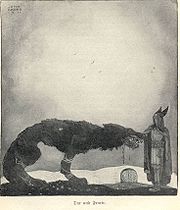 According to the Poetic Edda
and Prose Edda
, at one stage the gods decided to shackle the Fenris wolf (Fenrir), but the beast broke every chain they put upon him. Eventually they had the dwarves make them a magical ribbon called Gleipnir
. It appeared to be only a silken ribbon but was made of six wondrous ingredients: the sound of a cat's footfall, the beard of a woman, the roots of a mountain, bear's sinews (meaning nerves, sensibility), fish's breath and bird's spittle. The creation of Gleipnir is said to be the reason why none of the above exist. Fenrir sensed the gods' deceit and refused to be bound with it unless one of them put his hand in the wolf's mouth.
Tyr, known for his great wisdom and courage, agreed, and the other gods bound the wolf. After Fenrir had been bound by the gods, he struggled to try to break the rope. When the gods saw that Fenrir was bound they all rejoiced, except Tyr, who had his right hand bitten off by the wolf. Fenrir will remain bound until the day of Ragnarök
. As a result of this deed, Tyr is called the "Leavings of the Wolf"; which is to be understood as a poetic kenning
for glory.
According to the Prose version of Ragnarok, Tyr is destined to kill and be killed by Garm
, the guard dog of Hel
. However, in the two poetic versions of Ragnarok, he goes unmentioned; unless one believes that he is the "Mighty One".
In Lokasenna
, Tyr is taunted with cuckold
ry by Loki
, maybe another hint that he had a consort or wife at one time.
In the Hymskvidha, Tyr's father is named as the etin Hymir – the term "Hymir's kin" was used a kenning for etinkind – while his mother goes unnamed, but is otherwise described in terms that befit a goddess. This myth also pairs Tyr with Thor, and draws a comparison between their strength via the lifting of Hymir's cauldron. Thor proves the stronger, but other than Thor's own son, Magni
, Tyr is the only deity whose strength is ever questioned in comparison to the Thunderer's.
The rune was also compared with Mars as in the Icelandic rune poem
:
, one of the most poisonous plants in Europe whose helmet-like shape might suggest a warlike connection) and Týviðr, "Tý's wood", Tiveden
may also be named after Tyr, or reflecting Tyr as a generic word for "god" (i.e., the forest of the gods). In Norway the parish and municipality of Tysnes
are named after the god.
German Dienstag and Dutch dinsdag (Tuesday) might be derived from Mars Thingsus, as mentioned above.
ic male names are derived from Týr. Apart from Týr itself: Angantýr, Bryntýr, Hjálmtýr, Hrafntýr, Sigtýr, Valtýr and Vigtýr. When Týr is used in this way, joined to another name, it takes on a more general meaning of "a god" instead of referring to the god Týr.
For example, Hrafntýr "raven-god" and Valtýr "god of the slain" are Old Norse names of Odin.
Single combat
Single combat is a fight between two single warriors which takes place in the context of a battle between two armies, with the two often considered the champions of their respective sides...
, victory and heroic glory in Norse mythology
Norse mythology
Norse mythology, a subset of Germanic mythology, is the overall term for the myths, legends and beliefs about supernatural beings of Norse pagans. It flourished prior to the Christianization of Scandinavia, during the Early Middle Ages, and passed into Nordic folklore, with some aspects surviving...
, portrayed as a one-handed man. Corresponding names in other Germanic languages are Gothic
Gothic language
Gothic is an extinct Germanic language that was spoken by the Goths. It is known primarily from the Codex Argenteus, a 6th-century copy of a 4th-century Bible translation, and is the only East Germanic language with a sizable Text corpus...
Teiws, Old English
Old English language
Old English or Anglo-Saxon is an early form of the English language that was spoken and written by the Anglo-Saxons and their descendants in parts of what are now England and southeastern Scotland between at least the mid-5th century and the mid-12th century...
Tīw and Old High German
Old High German
The term Old High German refers to the earliest stage of the German language and it conventionally covers the period from around 500 to 1050. Coherent written texts do not appear until the second half of the 8th century, and some treat the period before 750 as 'prehistoric' and date the start of...
Ziu, all from Proto-Germanic } (}).
In the late Icelandic Edda
Edda
The term Edda applies to the Old Norse Poetic Edda and Prose Edda, both of which were written down in Iceland during the 13th century in Icelandic, although they contain material from earlier traditional sources, reaching into the Viking Age...
s, Tyr is portrayed, alternately, as the son of Odin
Odin
Odin is a major god in Norse mythology and the ruler of Asgard. Homologous with the Anglo-Saxon "Wōden" and the Old High German "Wotan", the name is descended from Proto-Germanic "*Wodanaz" or "*Wōđanaz"....
(Prose Edda
Prose Edda
The Prose Edda, also known as the Younger Edda, Snorri's Edda or simply Edda, is an Icelandic collection of four sections interspersed with excerpts from earlier skaldic and Eddic poetry containing tales from Nordic mythology...
) or of Hymir
Hymir
In Norse mythology, Hymir is a giant, husband of the giantess Hroðr and according to the Eddic poem Hymiskviða the father of the god Týr. He is the owner of a mile-wide cauldron which the Æsir wanted to brew beer in; Thor, accompanied by Týr, obtained it from him...
(Poetic Edda
Poetic Edda
The Poetic Edda is a collection of Old Norse poems primarily preserved in the Icelandic mediaeval manuscript Codex Regius. Along with Snorri Sturluson's Prose Edda, the Poetic Edda is the most important extant source on Norse mythology and Germanic heroic legends, and from the early 19th century...
), while the origins of his name and his possible relationship to Tuisto (see Tacitus
Tacitus
Publius Cornelius Tacitus was a senator and a historian of the Roman Empire. The surviving portions of his two major works—the Annals and the Histories—examine the reigns of the Roman Emperors Tiberius, Claudius, Nero and those who reigned in the Year of the Four Emperors...
' Germania) suggest he was once considered the father of the gods and head of the pantheon, since his name is ultimately cognate to that of *Dyeus
Dyeus
*Dyēus is the reconstructed chief deity of the Proto-Indo-European pantheon. He was the god of the daylight sky, and his position may have mirrored the position of the patriarch or monarch in society....
(cf. Dyaus), the reconstructed chief deity in Indo-European religion. It is assumed that Tîwaz was overtaken in popularity and in authority by both Odin
Odin
Odin is a major god in Norse mythology and the ruler of Asgard. Homologous with the Anglo-Saxon "Wōden" and the Old High German "Wotan", the name is descended from Proto-Germanic "*Wodanaz" or "*Wōđanaz"....
and Thor
Thor
In Norse mythology, Thor is a hammer-wielding god associated with thunder, lightning, storms, oak trees, strength, the protection of mankind, and also hallowing, healing, and fertility...
at some point during the Migration Age
Migration Period
The Migration Period, also called the Barbarian Invasions , was a period of intensified human migration in Europe that occurred from c. 400 to 800 CE. This period marked the transition from Late Antiquity to the Early Middle Ages...
.
Tiw was equated with Mars
Mars (mythology)
Mars was the Roman god of war and also an agricultural guardian, a combination characteristic of early Rome. He was second in importance only to Jupiter, and he was the most prominent of the military gods worshipped by the Roman legions...
in the interpretatio romana. Tuesday
Tuesday
Tuesday is a day of the week occurring after Monday and before Wednesday.According to international standard ISO 8601, it is the second day of the week, although in some traditions it is the third....
is in fact "Tīw's Day" (also in Alemannic
Alemannic German
Alemannic is a group of dialects of the Upper German branch of the Germanic language family. It is spoken by approximately ten million people in six countries: Switzerland, Germany, Austria, Liechtenstein, France and Italy...
Zischtig from zîes tag), translating dies Martis.
Name
Proto-Germanic } continues Proto-Indo-EuropeanProto-Indo-European language
The Proto-Indo-European language is the reconstructed common ancestor of the Indo-European languages, spoken by the Proto-Indo-Europeans...
, "celestial being, god" (whence also Latin
Latin
Latin is an Italic language originally spoken in Latium and Ancient Rome. It, along with most European languages, is a descendant of the ancient Proto-Indo-European language. Although it is considered a dead language, a number of scholars and members of the Christian clergy speak it fluently, and...
and Sanskrit
Sanskrit
Sanskrit , is a historical Indo-Aryan language and the primary liturgical language of Hinduism, Jainism and Buddhism.Buddhism: besides Pali, see Buddhist Hybrid Sanskrit Today, it is listed as one of the 22 scheduled languages of India and is an official language of the state of Uttarakhand...
).
The oldest records of the word in Germanic are Gothic
Gothic language
Gothic is an extinct Germanic language that was spoken by the Goths. It is known primarily from the Codex Argenteus, a 6th-century copy of a 4th-century Bible translation, and is the only East Germanic language with a sizable Text corpus...
} (/tiːws/), attested as tyz (as the name of the Gothic letter ), in the 9th century Codex Vindobonensis 795
Codex Vindobonensis 795
The Codex Vindobonensis 795 is a 9th century manuscript.It contains letters and treatises by Alcuin, including a discussion of the Gothic alphabet.It also contains a description of the Anglo-Saxon futhorc....
and Old High German
Old High German
The term Old High German refers to the earliest stage of the German language and it conventionally covers the period from around 500 to 1050. Coherent written texts do not appear until the second half of the 8th century, and some treat the period before 750 as 'prehistoric' and date the start of...
}, attested as cyo- in the A Wessobrunn prayer
Wessobrunn Prayer
The Wessobrunn Prayer, sometimes called the Wessobrunn Creation Poem , believed to date from c790, is among the earliest known poetic works in Old High German.-Origins:...
ms. of 814.
The Negau helmet
Negau helmet
Negau helmet refers to one of 26 bronze helmets dating to ca. 450 till 350 BC, found in 1811 in a cache in Ženjak, near Negau, Duchy of Styria . The helmets are of typical Etruscan 'vetulonic' shape, sometimes described as of the Negau type. They were buried in ca...
inscription (2nd century BC) may actually record the Proto-Germanic form, as teiva, but this interpretation is uncertain.
The Old Norse name Tyr in origin was a generic noun meaning "god" (cf. Hangatyr, the "god of the hanged" as one of Odin's names; probably inherited from Tyr in his role as judge).
The Old Norse name became Norwegian
Norwegian language
Norwegian is a North Germanic language spoken primarily in Norway, where it is the official language. Together with Swedish and Danish, Norwegian forms a continuum of more or less mutually intelligible local and regional variants .These Scandinavian languages together with the Faroese language...
Ty, Swedish
Swedish language
Swedish is a North Germanic language, spoken by approximately 10 million people, predominantly in Sweden and parts of Finland, especially along its coast and on the Åland islands. It is largely mutually intelligible with Norwegian and Danish...
Tyr, Danish
Danish language
Danish is a North Germanic language spoken by around six million people, principally in the country of Denmark. It is also spoken by 50,000 Germans of Danish ethnicity in the northern parts of Schleswig-Holstein, Germany, where it holds the status of minority language...
Tyr, while it remains Týr in Modern Icelandic
Icelandic language
Icelandic is a North Germanic language, the main language of Iceland. Its closest relative is Faroese.Icelandic is an Indo-European language belonging to the North Germanic or Nordic branch of the Germanic languages. Historically, it was the westernmost of the Indo-European languages prior to the...
and Faroese
Faroese language
Faroese , is an Insular Nordic language spoken by 48,000 people in the Faroe Islands and about 25,000 Faroese people in Denmark and elsewhere...
.
West Germanic Ziu / Tiw/Tiwaz
A gloss to the Wessobrunn prayerWessobrunn Prayer
The Wessobrunn Prayer, sometimes called the Wessobrunn Creation Poem , believed to date from c790, is among the earliest known poetic works in Old High German.-Origins:...
names the Alamanni
Alamanni
The Alamanni, Allemanni, or Alemanni were originally an alliance of Germanic tribes located around the upper Rhine river . One of the earliest references to them is the cognomen Alamannicus assumed by Roman Emperor Caracalla, who ruled the Roman Empire from 211 to 217 and claimed thereby to be...
Cyowari (worshipers of Cyo) and their capital Augsburg
Augsburg
Augsburg is a city in the south-west of Bavaria, Germany. It is a university town and home of the Regierungsbezirk Schwaben and the Bezirk Schwaben. Augsburg is an urban district and home to the institutions of the Landkreis Augsburg. It is, as of 2008, the third-largest city in Bavaria with a...
Ciesburc.
The Excerptum ex Gallica Historia of Ursberg
Ursberg Abbey
Ursberg Abbey is a former Premonstratensian monastery, now a convent of the Franciscan St. Joseph's Congregation, situated in the small village of Ursberg in the district of Günzburg, Bavaria.-History:...
(ca. 1135) records a dea Ciza as the patron goddess of Augsburg. According to this account, Cisaria was founded by Swabian tribes as a defence against Roman incursions. This Zisa would be the female consort of Ziu, as Dione
Dione (mythology)
Dione was a Greek goddess primarily known as the mother of Aphrodite in Book V of Homer's Iliad. Aphrodite journeys to Dione's side after she has been wounded in battle protecting her favorite son Aeneas. In this episode, Dione seems to be the equivalent of the earth goddess Gaia, whom Homer also...
was of Zeus
Zeus
In the ancient Greek religion, Zeus was the "Father of Gods and men" who ruled the Olympians of Mount Olympus as a father ruled the family. He was the god of sky and thunder in Greek mythology. His Roman counterpart is Jupiter and his Etruscan counterpart is Tinia.Zeus was the child of Cronus...
.
The name of Mars Thingsus (Thincsus) is found in an inscription on an 3rd century altar from the Roman fort and settlement of Vercovicium at Housesteads
Housesteads
Vercovicium, now known as Housesteads Roman Fort, was an auxiliary fort on Hadrian's Wall, in the Roman province of Britannia. Its ruins are located at Housesteads in the civil parish of Bardon Mill in Northumberland, England, somewhat to the south of Broomlee Lough.-History:In the 2nd century AD,...
in Northumberland
Northumberland
Northumberland is the northernmost ceremonial county and a unitary district in North East England. For Eurostat purposes Northumberland is a NUTS 3 region and is one of three boroughs or unitary districts that comprise the "Northumberland and Tyne and Wear" NUTS 2 region...
, thought to have been erected by Frisian mercenaries stationed at Hadrian's Wall
Hadrian's Wall
Hadrian's Wall was a defensive fortification in Roman Britain. Begun in AD 122, during the rule of emperor Hadrian, it was the first of two fortifications built across Great Britain, the second being the Antonine Wall, lesser known of the two because its physical remains are less evident today.The...
. It is interpreted as "Mars of the Thing
Thing (assembly)
A thing was the governing assembly in Germanic and introduced into some Celtic societies, made up of the free people of the community and presided by lawspeakers, meeting in a place called a thingstead...
". Here is also worth noting what Tacitus stated in his work Germania about capital punishment amongst the Germanic folk; that none could be flogged, imprisoned or executed, not even on order of the warlord, without the consent of the priest; who was himself required to render his judgement in accordance with the will of the god they believe accompanies them to the field of battle In the same source this god is stated being the chief deity.
Tacitus also named the German "Mars", along with the German "Mercury", as the primary deity associated with the Germanic custom of the disposal of the spoils of war; as practiced from the 4th century BCE to the 6th century CE.
In the Old English Rune Poem, the rune that is otherwise named for Tiw in the other rune poems (Abecedarium Nordmanicum, Old Norwegian Rune Rhyme, Old Icelandic Rune Poem), is called tir, meaning "glory". This rune was inscribed on more Anglo-Saxon cremation urns than any other symbol.
There is sketchy evidence of a consort, in German named Zisa
Zisa (goddess)
Zisa or Cisa is a goddess in Germanic paganism associated with the Suevi in the area of Augsburg, Germany. Zisa is mentioned in manuscripts from the 12th to 14th centuries which reference a victory against the Roman Empire attributed to the goddess...
: Tacitus
Tacitus
Publius Cornelius Tacitus was a senator and a historian of the Roman Empire. The surviving portions of his two major works—the Annals and the Histories—examine the reigns of the Roman Emperors Tiberius, Claudius, Nero and those who reigned in the Year of the Four Emperors...
mentions one Germanic tribe who worshipped "Isis
Isis
Isis or in original more likely Aset is a goddess in Ancient Egyptian religious beliefs, whose worship spread throughout the Greco-Roman world. She was worshipped as the ideal mother and wife as well as the matron of nature and magic...
", and Jacob Grimm
Jacob Grimm
Jacob Ludwig Carl Grimm was a German philologist, jurist and mythologist. He is best known as the discoverer of Grimm's Law, the author of the monumental Deutsches Wörterbuch, the author of Deutsche Mythologie and, more popularly, as one of the Brothers Grimm, as the editor of Grimm's Fairy...
pointed to Cisa/Zisa, the patroness of Augsburg
Augsburg
Augsburg is a city in the south-west of Bavaria, Germany. It is a university town and home of the Regierungsbezirk Schwaben and the Bezirk Schwaben. Augsburg is an urban district and home to the institutions of the Landkreis Augsburg. It is, as of 2008, the third-largest city in Bavaria with a...
, in this connection. The name Zisa could be derived from Ziu etymologically.
North Germanic Tyr
Poetic Edda
The Poetic Edda is a collection of Old Norse poems primarily preserved in the Icelandic mediaeval manuscript Codex Regius. Along with Snorri Sturluson's Prose Edda, the Poetic Edda is the most important extant source on Norse mythology and Germanic heroic legends, and from the early 19th century...
and Prose Edda
Prose Edda
The Prose Edda, also known as the Younger Edda, Snorri's Edda or simply Edda, is an Icelandic collection of four sections interspersed with excerpts from earlier skaldic and Eddic poetry containing tales from Nordic mythology...
, at one stage the gods decided to shackle the Fenris wolf (Fenrir), but the beast broke every chain they put upon him. Eventually they had the dwarves make them a magical ribbon called Gleipnir
Gleipnir
In Norse mythology, Gleipnir is the binding that holds the mighty wolf Fenrisulfr . The Gods had attempted to bind Fenrir twice before with huge chains of metal, but Fenrir was able to break free both times. Therefore, they commissioned the dwarves to forge a chain that was impossible to break...
. It appeared to be only a silken ribbon but was made of six wondrous ingredients: the sound of a cat's footfall, the beard of a woman, the roots of a mountain, bear's sinews (meaning nerves, sensibility), fish's breath and bird's spittle. The creation of Gleipnir is said to be the reason why none of the above exist. Fenrir sensed the gods' deceit and refused to be bound with it unless one of them put his hand in the wolf's mouth.
Tyr, known for his great wisdom and courage, agreed, and the other gods bound the wolf. After Fenrir had been bound by the gods, he struggled to try to break the rope. When the gods saw that Fenrir was bound they all rejoiced, except Tyr, who had his right hand bitten off by the wolf. Fenrir will remain bound until the day of Ragnarök
Ragnarök
In Norse mythology, Ragnarök is a series of future events, including a great battle foretold to ultimately result in the death of a number of major figures , the occurrence of various natural disasters, and the subsequent submersion of the world in water...
. As a result of this deed, Tyr is called the "Leavings of the Wolf"; which is to be understood as a poetic kenning
Kenning
A kenning is a type of literary trope, specifically circumlocution, in the form of a compound that employs figurative language in place of a more concrete single-word noun. Kennings are strongly associated with Old Norse and later Icelandic and Anglo-Saxon poetry...
for glory.
According to the Prose version of Ragnarok, Tyr is destined to kill and be killed by Garm
Garm (Norse mythology)
In Norse mythology, Garmr or Garm is a dog associated with Ragnarök, and described as a blood-stained watchdog that guarded Hel's gate.-Poetic Edda:The Poetic Edda poem Grímnismál mentions Garmr:...
, the guard dog of Hel
Hel (realm)
In Norse mythology, Hel, the location, shares a name with Hel, a female figure associated with the location. In late Icelandic sources, varying descriptions of Hel are given and various figures are described as being buried with items that will facilitate their journey to Hel after their death...
. However, in the two poetic versions of Ragnarok, he goes unmentioned; unless one believes that he is the "Mighty One".
In Lokasenna
Lokasenna
Lokasenna is one of the poems of the Poetic Edda. The poem presents flyting between the gods and Loki....
, Tyr is taunted with cuckold
Cuckold
Cuckold is a historically derogatory term for a man who has an unfaithful wife. The word, which has been in recorded use since the 13th century, derives from the cuckoo bird, some varieties of which lay their eggs in other birds' nests...
ry by Loki
Loki
In Norse mythology, Loki or Loke is a god or jötunn . Loki is the son of Fárbauti and Laufey, and the brother of Helblindi and Býleistr. By the jötunn Angrboða, Loki is the father of Hel, the wolf Fenrir, and the world serpent Jörmungandr. By his wife Sigyn, Loki is the father of Nari or Narfi...
, maybe another hint that he had a consort or wife at one time.
In the Hymskvidha, Tyr's father is named as the etin Hymir – the term "Hymir's kin" was used a kenning for etinkind – while his mother goes unnamed, but is otherwise described in terms that befit a goddess. This myth also pairs Tyr with Thor, and draws a comparison between their strength via the lifting of Hymir's cauldron. Thor proves the stronger, but other than Thor's own son, Magni
Móði and Magni
In Norse mythology, Móði and Magni are the sons of Thor. Their names mean "Angry" and "Strong," respectively. Rudolf Simek states that, along with Thor's daughter Þrúðr , they embody their father's features....
, Tyr is the only deity whose strength is ever questioned in comparison to the Thunderer's.
Tiwaz rune
The t-rune is named after Tyr, and was identified with this god; the reconstructed Proto-Germanic name is *Tîwaz. The rune is sometimes also referred to as *Teiwaz, or spelling variants.The rune was also compared with Mars as in the Icelandic rune poem
Rune poem
The Rune Poems are three poems that list the letters of runic alphabets while providing an explanatory poetic stanza for each letter. Three different poems have been preserved: the Anglo-Saxon Rune Poem, the Norwegian Rune Poem, and the Icelandic Rune Poem.The Icelandic and Norwegian poems list 16...
:
Týr er einhendr áss ok ulfs leifar ok hofa hilmir. Mars tiggi. |
Tyr is a one-handed god, and leavings of the wolf and prince of temples. |
Lexical traces
Tyr/Tiw had become relatively unimportant compared to Odin/Woden in both North and West Germanic, and specifically in the sphere of organized warfare. Traces of the god remain, however, in Tuesday (Old English tíwesdæg "Tiw's day"; Old Frisian tîesdei, Old High German zîestag, Alemannic and Swabian dialect in south west Germany (today) Zieschdig/Zeischdig, Old Norse týsdagr), named after Tyr in both the North and the West Germanic languages (corresponding to Martis dies, dedicated to the Roman god of war and the father-god of Rome, Mars) and also in the names of some plants: Old Norse Týsfiola (after the Latin Viola Martis), Týrhialm (AconitumAconitum
Aconitum , known as aconite, monkshood, wolfsbane, leopard's bane, women's bane, Devil's helmet or blue rocket, is a genus of over 250 species of flowering plants belonging to the buttercup family .-Overview:These herbaceous perennial plants are chiefly natives of the mountainous parts of the...
, one of the most poisonous plants in Europe whose helmet-like shape might suggest a warlike connection) and Týviðr, "Tý's wood", Tiveden
Tiveden
Tiveden is a Swedish forest, throughout history notorious for its wilderness and dangers; historically a hiding place for outlaws.Within it, the Tiveden National Park has a designated area of 13.5 km², a comparatively small and arguably the most inaccessible part of the forest...
may also be named after Tyr, or reflecting Tyr as a generic word for "god" (i.e., the forest of the gods). In Norway the parish and municipality of Tysnes
Tysnes
Tysnes is a municipality in the county of Hordaland, Norway. It is located in the traditional district of Sunnhordland. The administrative centre is the village of Uggdal....
are named after the god.
German Dienstag and Dutch dinsdag (Tuesday) might be derived from Mars Thingsus, as mentioned above.
Toponyms
- DewsburyDewsburyDewsbury is a minster town in the Metropolitan Borough of Kirklees, in West Yorkshire, England. It is to the west of Wakefield, east of Huddersfield and south of Leeds...
, EnglandEnglandEngland is a country that is part of the United Kingdom. It shares land borders with Scotland to the north and Wales to the west; the Irish Sea is to the north west, the Celtic Sea to the south west, with the North Sea to the east and the English Channel to the south separating it from continental...
- possibly Tiw's Burg - TuesleyTuesleyTuesley is a village to the south of the town of Godalming, in the county of Surrey in southern England.It lies within the Saxon district of Godalming , Surrey....
, EnglandEnglandEngland is a country that is part of the United Kingdom. It shares land borders with Scotland to the north and Wales to the west; the Irish Sea is to the north west, the Celtic Sea to the south west, with the North Sea to the east and the English Channel to the south separating it from continental...
- Tiw's Clearing - TisvildeTisvildeTisvilde is a small town with a population of 1,531 located on the north coast of the island Zealand in Denmark north of Copenhagen....
, Sjælland, DenmarkDenmarkDenmark is a Scandinavian country in Northern Europe. The countries of Denmark and Greenland, as well as the Faroe Islands, constitute the Kingdom of Denmark . It is the southernmost of the Nordic countries, southwest of Sweden and south of Norway, and bordered to the south by Germany. Denmark...
- Tyr's Spring. - Lake Tissø, near GørlevGørlevGørlev is a town with a population of 2,482 on the west coast of the island of Zealand in Denmark, belonging to Kalundborg Municipality in Region Sjælland...
, Sjælland, DenmarkDenmarkDenmark is a Scandinavian country in Northern Europe. The countries of Denmark and Greenland, as well as the Faroe Islands, constitute the Kingdom of Denmark . It is the southernmost of the Nordic countries, southwest of Sweden and south of Norway, and bordered to the south by Germany. Denmark...
- Tyr's Lake. - ThistedThistedThisted is a town in Thisted municipality of Region Nordjylland, in Denmark. It has a population of 13,005 and is located in Thy, in northwestern Jutland....
, JutlandJutlandJutland , historically also called Cimbria, is the name of the peninsula that juts out in Northern Europe toward the rest of Scandinavia, forming the mainland part of Denmark. It has the North Sea to its west, Kattegat and Skagerrak to its north, the Baltic Sea to its east, and the Danish–German...
, DenmarkDenmarkDenmark is a Scandinavian country in Northern Europe. The countries of Denmark and Greenland, as well as the Faroe Islands, constitute the Kingdom of Denmark . It is the southernmost of the Nordic countries, southwest of Sweden and south of Norway, and bordered to the south by Germany. Denmark...
- Tyr's Stead. - TyrstedTyrstedTyrsted is a parish located 2 miles southeast of Horsens, Jutland, Denmark. Tyrsted is part of the Horsens municipality....
, JutlandJutlandJutland , historically also called Cimbria, is the name of the peninsula that juts out in Northern Europe toward the rest of Scandinavia, forming the mainland part of Denmark. It has the North Sea to its west, Kattegat and Skagerrak to its north, the Baltic Sea to its east, and the Danish–German...
, DenmarkDenmarkDenmark is a Scandinavian country in Northern Europe. The countries of Denmark and Greenland, as well as the Faroe Islands, constitute the Kingdom of Denmark . It is the southernmost of the Nordic countries, southwest of Sweden and south of Norway, and bordered to the south by Germany. Denmark...
- Another form of Tyr's Stead. - Tyrseng ("Tyr's MeadowMeadowA meadow is a field vegetated primarily by grass and other non-woody plants . The term is from Old English mædwe. In agriculture a meadow is grassland which is not grazed by domestic livestock but rather allowed to grow unchecked in order to make hay...
"), VibyViby JViby is a district in the southwestern part of Aarhus with almost 30,000 inhabitants. The "J" stands for Jutland, as there is another town called Viby on the island of Zealand called Viby Sj. It is primarily a working class area, including many immigrants who also live in Viby J...
, Jutland, Denmark. Once a stretch of meadow near a stream called Dødeå ("Stream of the Dead" or "Dead Stream"), where ballgame courts now exist. Viby contained another theonym; Onsholt ("Odin's HoltWoodlandEcologically, a woodland is a low-density forest forming open habitats with plenty of sunlight and limited shade. Woodlands may support an understory of shrubs and herbaceous plants including grasses. Woodland may form a transition to shrubland under drier conditions or during early stages of...
") and religious practices associated with Odin and Tyr may have occurred in these places. A springSpring (hydrosphere)A spring—also known as a rising or resurgence—is a component of the hydrosphere. Specifically, it is any natural situation where water flows to the surface of the earth from underground...
dedicated to Holy Neils that was likely a Christianization of prior indigenous pagan practice also exists in Viby and the city itself may mean "the settlement by the sacred site". Traces of sacrifices going back 2,500 years have been found in Viby. - TivedenTivedenTiveden is a Swedish forest, throughout history notorious for its wilderness and dangers; historically a hiding place for outlaws.Within it, the Tiveden National Park has a designated area of 13.5 km², a comparatively small and arguably the most inaccessible part of the forest...
, SwedenSwedenSweden , officially the Kingdom of Sweden , is a Nordic country on the Scandinavian Peninsula in Northern Europe. Sweden borders with Norway and Finland and is connected to Denmark by a bridge-tunnel across the Öresund....
- Tyr's Woods - TysnesTysnesTysnes is a municipality in the county of Hordaland, Norway. It is located in the traditional district of Sunnhordland. The administrative centre is the village of Uggdal....
, NorwayNorwayNorway , officially the Kingdom of Norway, is a Nordic unitary constitutional monarchy whose territory comprises the western portion of the Scandinavian Peninsula, Jan Mayen, and the Arctic archipelago of Svalbard and Bouvet Island. Norway has a total area of and a population of about 4.9 million...
- Tyr's Headland
Personal names
A number of IcelandIceland
Iceland , described as the Republic of Iceland, is a Nordic and European island country in the North Atlantic Ocean, on the Mid-Atlantic Ridge. Iceland also refers to the main island of the country, which contains almost all the population and almost all the land area. The country has a population...
ic male names are derived from Týr. Apart from Týr itself: Angantýr, Bryntýr, Hjálmtýr, Hrafntýr, Sigtýr, Valtýr and Vigtýr. When Týr is used in this way, joined to another name, it takes on a more general meaning of "a god" instead of referring to the god Týr.
For example, Hrafntýr "raven-god" and Valtýr "god of the slain" are Old Norse names of Odin.