

Wars of the Three Kingdoms

Encyclopedia
The Wars of the Three Kingdoms formed an intertwined series of conflicts that took place in England
, Ireland
, and Scotland
between 1639 and 1651 after these three countries had come under the "Personal Rule
" of the same monarch. The English Civil War
has become the best-known of these conflicts and included the execution of the Three Kingdoms' monarch, Charles I, by the English parliament in 1649. The term, Wars of the Three Kingdoms, is often extended to include the uprisings and conflicts that continued through the 1650s until The English Restoration of the monarchy with Charles II, in 1660 (from which point the Three Kingdoms were once again under a relatively peaceful personal union led by a Stuart monarch
), and sometimes until Venner's
Uprising the following year. The wars were the outcome of tensions between king and subjects over religious and civil issues. Religious disputes centred on whether religion was to be dictated by the monarch or the choice of the subject, the subjects often feeling that they ought to have a direct relationship with God unmediated by any monarch or human intermediary. The related civil questions were to what extent the king's rule was constrained by parliaments — in particular his right to raise taxes and armed forces without consent. Furthermore, the wars also had an element of national conflict, as Ireland and Scotland rebelled against England's primacy within the Three Kingdoms. The victory of the English Parliament — ultimately under Oliver Cromwell
— over the King, the Irish and the Scots helped to determine the future of Great Britain as a constitutional monarchy with political power centred on London. The Wars of the Three Kingdoms also paralleled a number of similar conflicts at the same time in Europe — such as the Fronde
in France and the rebellions of the Netherlands
and Portugal
against Spanish rule.
The Wars included the Bishops' Wars
of 1639 and 1640, the Scottish Civil War of 1644–45; the Irish Rebellion of 1641
, Confederate Ireland
, 1642–49 and the Cromwellian conquest of Ireland
in 1649 (collectively the Eleven years war or Irish Confederate Wars
); and the First
, Second
and Third
English Civil Wars of 1642–46, 1648–49 and 1650–51.
Although the term is not new and was already used by James Heath in his book A Brief Chronicle of all the Chief Actions so fatally Falling out in the three Kingdoms, first published in 1662, recent publications naming of these linked conflicts as the Wars of the Three Kingdoms represents a trend by historians aiming to take a unified overview rather than treating some of the conflicts as mere background to the English Civil War. Some, such as Carlton, Gaunt and Royal have labelled them the British Civil Wars, but this can be misleading, because although the three realms were linked by a personal union
, the three kingdoms did not become a single political entity until the Act of Union 1800
.
(ruled with the assistance of a separate Irish Parliament
), while Wales became more closely integrated into the Kingdom of England
under Henry VIII
. Scotland, the third separate kingdom, was governed by the House of Stewart, and the three kingdoms were united under the same monarch when King James VI of Scotland succeeded Elizabeth to the English throne in 1603. Ruling over these three diverse kingdoms proved difficult for James and his successor Charles I of England
, particularly when they tried to impose religious uniformity on the three kingdoms.
Different religious conditions pertained in each of these jurisdictions. With the English Reformation
, King Henry VIII
made himself head of the Protestant Church of England
and outlawed Catholicism
in England and Wales. In the course of the 16th century Protestantism became intimately associated with national identity
in England: English folk in general saw Catholicism as the national enemy, especially as embodied in France and Spain. However, Catholicism remained the religion of most people in Ireland and was for many a symbol of native resistance to the Tudor conquest of Ireland in the 16th century. In the Kingdom of Scotland
the Protestant Reformation
was a popular movement led by John Knox
. The Scottish Parliament legislated for a National Presbyterian church, the presbyterian Church of Scotland
or "Kirk
", and the Catholic Mary, Queen of Scots, was forced to abdicate in favour of her son James VI of Scotland. He grew up under a regency disputed between Catholic and Protestant factions, then took power and aspired to be a "universal King" favouring the English Episcopalian
system of bishops appointed by the king. In 1584, he introduced bishops, but met vigorous opposition and had to concede that the General Assembly
running the church should continue to do so. Calvinists
reacted against the formal liturgy of the Book of Common Order moving increasingly to extempore prayer, though this was opposed by an Episcopalian faction
.
in 1603 and moved to London. His diplomatic and political skills now concentrated fully in dealing with the English Court and Parliament
at the same time as running Scotland by writing to the Privy Council of Scotland
and controlling the Parliament of Scotland
through the Lords of the Articles. He stopped the Scottish General Assembly from meeting, then increased the number of Scottish bishops, and in 1618, held a General Assembly and pushed through Five Articles of Episcopalian practices which were widely boycotted. In 1625, he was succeeded by his son Charles I
who was less skilful or restrained and was crowned in St Giles Cathedral, Edinburgh
, in 1633 with full Anglican rites. Opposition to his attempts to enforce Anglican practices reached a flashpoint when he introduced a Book of Common Prayer
. Charles' confrontation with the Scots came to a head in 1639, when Charles tried and failed to coerce Scotland by military means.
Charles shared his father's belief in the Divine Right of Kings
, and his assertion of this led to a serious breach between the Crown and the English Parliament. While the Church of England remained dominant, a powerful Puritan
minority, represented by around one third of the members of Parliament, had much in common with the Presbyterian Scots.
The English Parliament also had repeated disputes with the King over such subjects as taxation, military expenditure and the role of parliament in government. While James I had held the same opinions as his son with regard to royal prerogatives
, he had enough charisma to persuade the Parliament to accept his policies. Charles did not have this skill in human management and so, when faced with a crisis in 1639–42, he failed to prevent his Kingdoms from sliding into civil war. When Charles approached the Parliament to pay for a campaign against the Scots, they refused, declared themselves to be permanently in session and put forward a long list of civil and religious grievances that Charles would have to remedy before they approved any new legislation.
(proclaimed such in 1541 but only fully conquered for the Crown in 1603), tensions had also begun to mount. Charles I's Lord Deputy there, Thomas Wentworth, had antagonised the native Irish Catholics by repeated initiatives to confiscate their lands and grant them to English colonists. He had also angered Roman Catholics by enforcing new taxes but denying them full rights as subjects. This situation became explosive in 1639 when Wentworth offered the Irish Catholics the reforms they had desired in return for them raising and paying for an Irish army to put down the Scottish rebellion. Although plans called for an army with Protestant officers, the idea of an Irish Catholic army enforcing what many saw as tyrannical government horrified both the Scottish and the English Parliaments, who in response threatened to invade Ireland.
to a quick end also made other discontented groups feel that force could serve to get what they wanted.
Alienated by English/Protestant domination and frightened by the rhetoric of the English and Scottish Parliaments, a small group of Irish conspirators launched the Irish Rebellion of 1641
, ostensibly in support of the "King's Rights". The rising featured widespread assaults on the Protestant communities in Ireland, sometimes culminating in massacres. Rumours spread in England and Scotland that the killings had the King's sanction and that this foreshadowed their own fate if the Kings' Irish troops landed in Britain. As a result, the English Parliament refused to pay for a royal army to put down the rebellion in Ireland and instead raised their own armed forces. The King did likewise, rallying those Royalists
(some of them members of Parliament) who believed that loyalty to the Legitimate King outweighed other important political principles.
The English Civil War
broke out in 1642. The Scottish Covenanters, as the Presbyterians called themselves, sided with the English Parliament, joined the war in 1643, and played a major role in the English Parliamentary victory. The King's forces found themselves ground down by the efficiency of Parliament's New Model Army
— backed by the financial muscle of the City of London
. In 1646, Charles I surrendered. After he failed to compromise with Parliament, the Parliamentary party had him detained and then executed him in 1649. In Ireland, the rebel Irish Catholics formed their own government — Confederate Ireland
— with the intention of helping the Royalists in return for religious toleration and political autonomy. Troops from England and Scotland fought in Ireland, and Irish Confederate troops mounted an expedition to Scotland in 1644, sparking the Scottish Civil War. In Scotland, the Royalists had a series of victories in 1644–45, but were crushed with the end of the first English Civil War and the return of the main Covenanter armies to Scotland.
After the end of the Second English Civil War
in January 1649 the victorious Parliamentary forces, now commanded by Oliver Cromwell
, invaded Ireland and crushed the Royalist-Confederate alliance there in the Cromwellian conquest of Ireland
in 1649. The English Parliament's alliance with the Scottish Covenanters had broken down, and the Scots crowned Charles II
as king, sparking renewed hostilities with England
. Cromwell embarked on a conquest of Scotland in 1650–51 and on 3 September 1651 defeated Charles II at the Battle of Worcester
after the latter had led a Scottish army south in the hope that a Royalist rising in England would allow him to regain the English throne.
At the end of the wars, the Three Kingdoms emerged as a unitary state
called the English Commonwealth, ostensibly a republic, but having many characteristics of a military dictatorship
.
did achieve a compromise (though a relatively unstable one) between a monarchy and a republic. In practice, Oliver Cromwell exercised political power because of his control over the Parliament's military forces, but his legal position remained unclear, even when he became Lord Protector
. None of the several proposed constitutions ever came into effect. Thus the Commonwealth and the Protectorate
established by the victorious Parliamentarians left little behind it in the way of new forms of government.
Two important legacies remain from this period:
English Protestants experienced religious freedom during the Interregnum
, but not English Roman Catholics. The new authorities abolished the Church of England
and the House of Lords
. Cromwell dismissed the Rump Parliament
and failed to create an acceptable alternative. Nor did Cromwell and his supporters move in the direction of a popular democracy, as the more radical fringes of the Parliamentarians (such as the Levellers
) wanted.
The New Model Army occupied Ireland and Scotland during the Interregnum. In Ireland, the new government confiscated almost all lands belonging to Irish Catholics as punishment for the rebellion of 1641; harsh Penal Laws
also restricted this community. Thousands of Parliamentarian soldiers settled in Ireland on confiscated lands. The Commonwealth abolished the Parliaments of Ireland and Scotland. In theory, these countries had representation in the English Parliament, but since this body never received real powers, such representation remained ineffective. When Cromwell died in 1658 the Commonwealth fell apart without major violence, and Charles II returned as King of England, Scotland and Ireland in 1660.
Under the English Restoration
, the political system returned to the constitutional position of before the wars. The new régime executed or imprisoned for life those responsible for the regicide
of Charles I. Neo-Royalists dug up Cromwell's corpse and gave it a posthumous execution
. Religious and political radicals held responsible for the wars suffered harsh repression. Scotland and Ireland regained their Parliaments, some Irish retrieved confiscated lands and the New Model Army disbanded. However, the issues that had caused the wars — religion, the power of Parliament and the relationship between the three kingdoms — remained unresolved, only postponed to re-emerge as matters fought over again in the Glorious Revolution
of 1688. Only after this point did the features of modern Britain seen in the Civil Wars emerge permanently: a Protestant constitutional monarchy
with England dominant and a strong standing army
.
Kingdom of England
The Kingdom of England was, from 927 to 1707, a sovereign state to the northwest of continental Europe. At its height, the Kingdom of England spanned the southern two-thirds of the island of Great Britain and several smaller outlying islands; what today comprises the legal jurisdiction of England...
, Ireland
Kingdom of Ireland
The Kingdom of Ireland refers to the country of Ireland in the period between the proclamation of Henry VIII as King of Ireland by the Crown of Ireland Act 1542 and the Act of Union in 1800. It replaced the Lordship of Ireland, which had been created in 1171...
, and Scotland
Kingdom of Scotland
The Kingdom of Scotland was a Sovereign state in North-West Europe that existed from 843 until 1707. It occupied the northern third of the island of Great Britain and shared a land border to the south with the Kingdom of England...
between 1639 and 1651 after these three countries had come under the "Personal Rule
Personal Rule
The Personal Rule was the period from 1629 to 1640, when King Charles I of England, Scotland and Ireland ruled without recourse to Parliament...
" of the same monarch. The English Civil War
English Civil War
The English Civil War was a series of armed conflicts and political machinations between Parliamentarians and Royalists...
has become the best-known of these conflicts and included the execution of the Three Kingdoms' monarch, Charles I, by the English parliament in 1649. The term, Wars of the Three Kingdoms, is often extended to include the uprisings and conflicts that continued through the 1650s until The English Restoration of the monarchy with Charles II, in 1660 (from which point the Three Kingdoms were once again under a relatively peaceful personal union led by a Stuart monarch
House of Stuart
The House of Stuart is a European royal house. Founded by Robert II of Scotland, the Stewarts first became monarchs of the Kingdom of Scotland during the late 14th century, and subsequently held the position of the Kings of Great Britain and Ireland...
), and sometimes until Venner's
Thomas Venner
Thomas Venner was a cooper and rebel who became the last leader of the Fifth Monarchy Men, who tried unsuccessfully to overthrow Oliver Cromwell in 1657, and subsequently led a coup in London against the newly-restored government of Charles II...
Uprising the following year. The wars were the outcome of tensions between king and subjects over religious and civil issues. Religious disputes centred on whether religion was to be dictated by the monarch or the choice of the subject, the subjects often feeling that they ought to have a direct relationship with God unmediated by any monarch or human intermediary. The related civil questions were to what extent the king's rule was constrained by parliaments — in particular his right to raise taxes and armed forces without consent. Furthermore, the wars also had an element of national conflict, as Ireland and Scotland rebelled against England's primacy within the Three Kingdoms. The victory of the English Parliament — ultimately under Oliver Cromwell
Oliver Cromwell
Oliver Cromwell was an English military and political leader who overthrew the English monarchy and temporarily turned England into a republican Commonwealth, and served as Lord Protector of England, Scotland, and Ireland....
— over the King, the Irish and the Scots helped to determine the future of Great Britain as a constitutional monarchy with political power centred on London. The Wars of the Three Kingdoms also paralleled a number of similar conflicts at the same time in Europe — such as the Fronde
Fronde
The Fronde was a civil war in France, occurring in the midst of the Franco-Spanish War, which had begun in 1635. The word fronde means sling, which Parisian mobs used to smash the windows of supporters of Cardinal Mazarin....
in France and the rebellions of the Netherlands
Dutch Revolt
The Dutch Revolt or the Revolt of the Netherlands This article adopts 1568 as the starting date of the war, as this was the year of the first battles between armies. However, since there is a long period of Protestant vs...
and Portugal
Portuguese Restoration War
Portuguese Restoration War was the name given by nineteenth-century 'romantic' historians to the war between Portugal and Spain that began with the Portuguese revolution of 1640 and ended with the Treaty of Lisbon . The revolution of 1640 ended the sixty-year period of dual monarchy in Portugal...
against Spanish rule.
The Wars included the Bishops' Wars
Bishops' Wars
The Bishops' Wars , were conflicts, both political and military, which occurred in 1639 and 1640 centred around the nature of the governance of the Church of Scotland, and the rights and powers of the Crown...
of 1639 and 1640, the Scottish Civil War of 1644–45; the Irish Rebellion of 1641
Irish Rebellion of 1641
The Irish Rebellion of 1641 began as an attempted coup d'état by Irish Catholic gentry, who tried to seize control of the English administration in Ireland to force concessions for the Catholics living under English rule...
, Confederate Ireland
Confederate Ireland
Confederate Ireland refers to the period of Irish self-government between the Rebellion of 1641 and the Cromwellian conquest of Ireland in 1649. During this time, two-thirds of Ireland was governed by the Irish Catholic Confederation, also known as the "Confederation of Kilkenny"...
, 1642–49 and the Cromwellian conquest of Ireland
Cromwellian conquest of Ireland
The Cromwellian conquest of Ireland refers to the conquest of Ireland by the forces of the English Parliament, led by Oliver Cromwell during the Wars of the Three Kingdoms. Cromwell landed in Ireland with his New Model Army on behalf of England's Rump Parliament in 1649...
in 1649 (collectively the Eleven years war or Irish Confederate Wars
Irish Confederate Wars
This article is concerned with the military history of Ireland from 1641-53. For the political context of this conflict, see Confederate Ireland....
); and the First
First English Civil War
The First English Civil War began the series of three wars known as the English Civil War . "The English Civil War" was a series of armed conflicts and political machinations that took place between Parliamentarians and Royalists from 1642 until 1651, and includes the Second English Civil War and...
, Second
Second English Civil War
The Second English Civil War was the second of three wars known as the English Civil War which refers to the series of armed conflicts and political machinations which took place between Parliamentarians and Royalists from 1642 until 1652 and also include the First English Civil War and the...
and Third
Third English Civil War
The Third English Civil War was the last of the English Civil Wars , a series of armed conflicts and political machinations between Parliamentarians and Royalists....
English Civil Wars of 1642–46, 1648–49 and 1650–51.
Although the term is not new and was already used by James Heath in his book A Brief Chronicle of all the Chief Actions so fatally Falling out in the three Kingdoms, first published in 1662, recent publications naming of these linked conflicts as the Wars of the Three Kingdoms represents a trend by historians aiming to take a unified overview rather than treating some of the conflicts as mere background to the English Civil War. Some, such as Carlton, Gaunt and Royal have labelled them the British Civil Wars, but this can be misleading, because although the three realms were linked by a personal union
Personal union
A personal union is the combination by which two or more different states have the same monarch while their boundaries, their laws and their interests remain distinct. It should not be confused with a federation which is internationally considered a single state...
, the three kingdoms did not become a single political entity until the Act of Union 1800
Act of Union 1800
The Acts of Union 1800 describe two complementary Acts, namely:* the Union with Ireland Act 1800 , an Act of the Parliament of Great Britain, and...
.
Background
The personal union of the three kingdoms under one monarch came about as a relatively recent development in contemporary 17th-century terms. Since 1541, monarchs of England had also styled their Irish territory as a KingdomKingdom of Ireland
The Kingdom of Ireland refers to the country of Ireland in the period between the proclamation of Henry VIII as King of Ireland by the Crown of Ireland Act 1542 and the Act of Union in 1800. It replaced the Lordship of Ireland, which had been created in 1171...
(ruled with the assistance of a separate Irish Parliament
Parliament of Ireland
The Parliament of Ireland was a legislature that existed in Dublin from 1297 until 1800. In its early mediaeval period during the Lordship of Ireland it consisted of either two or three chambers: the House of Commons, elected by a very restricted suffrage, the House of Lords in which the lords...
), while Wales became more closely integrated into the Kingdom of England
Kingdom of England
The Kingdom of England was, from 927 to 1707, a sovereign state to the northwest of continental Europe. At its height, the Kingdom of England spanned the southern two-thirds of the island of Great Britain and several smaller outlying islands; what today comprises the legal jurisdiction of England...
under Henry VIII
Henry VIII of England
Henry VIII was King of England from 21 April 1509 until his death. He was Lord, and later King, of Ireland, as well as continuing the nominal claim by the English monarchs to the Kingdom of France...
. Scotland, the third separate kingdom, was governed by the House of Stewart, and the three kingdoms were united under the same monarch when King James VI of Scotland succeeded Elizabeth to the English throne in 1603. Ruling over these three diverse kingdoms proved difficult for James and his successor Charles I of England
Charles I of England
Charles I was King of England, King of Scotland, and King of Ireland from 27 March 1625 until his execution in 1649. Charles engaged in a struggle for power with the Parliament of England, attempting to obtain royal revenue whilst Parliament sought to curb his Royal prerogative which Charles...
, particularly when they tried to impose religious uniformity on the three kingdoms.
Different religious conditions pertained in each of these jurisdictions. With the English Reformation
English Reformation
The English Reformation was the series of events in 16th-century England by which the Church of England broke away from the authority of the Pope and the Roman Catholic Church....
, King Henry VIII
Henry VIII of England
Henry VIII was King of England from 21 April 1509 until his death. He was Lord, and later King, of Ireland, as well as continuing the nominal claim by the English monarchs to the Kingdom of France...
made himself head of the Protestant Church of England
Church of England
The Church of England is the officially established Christian church in England and the Mother Church of the worldwide Anglican Communion. The church considers itself within the tradition of Western Christianity and dates its formal establishment principally to the mission to England by St...
and outlawed Catholicism
Catholicism
Catholicism is a broad term for the body of the Catholic faith, its theologies and doctrines, its liturgical, ethical, spiritual, and behavioral characteristics, as well as a religious people as a whole....
in England and Wales. In the course of the 16th century Protestantism became intimately associated with national identity
National identity
National identity is the person's identity and sense of belonging to one state or to one nation, a feeling one shares with a group of people, regardless of one's citizenship status....
in England: English folk in general saw Catholicism as the national enemy, especially as embodied in France and Spain. However, Catholicism remained the religion of most people in Ireland and was for many a symbol of native resistance to the Tudor conquest of Ireland in the 16th century. In the Kingdom of Scotland
Kingdom of Scotland
The Kingdom of Scotland was a Sovereign state in North-West Europe that existed from 843 until 1707. It occupied the northern third of the island of Great Britain and shared a land border to the south with the Kingdom of England...
the Protestant Reformation
Protestant Reformation
The Protestant Reformation was a 16th-century split within Western Christianity initiated by Martin Luther, John Calvin and other early Protestants. The efforts of the self-described "reformers", who objected to the doctrines, rituals and ecclesiastical structure of the Roman Catholic Church, led...
was a popular movement led by John Knox
John Knox
John Knox was a Scottish clergyman and a leader of the Protestant Reformation who brought reformation to the church in Scotland. He was educated at the University of St Andrews or possibly the University of Glasgow and was ordained to the Catholic priesthood in 1536...
. The Scottish Parliament legislated for a National Presbyterian church, the presbyterian Church of Scotland
Church of Scotland
The Church of Scotland, known informally by its Scots language name, the Kirk, is a Presbyterian church, decisively shaped by the Scottish Reformation....
or "Kirk
Kirk
Kirk can mean "church" in general or the Church of Scotland in particular. Many place names and personal names are also derived from it.-Basic meaning and etymology:...
", and the Catholic Mary, Queen of Scots, was forced to abdicate in favour of her son James VI of Scotland. He grew up under a regency disputed between Catholic and Protestant factions, then took power and aspired to be a "universal King" favouring the English Episcopalian
Episcopal polity
Episcopal polity is a form of church governance that is hierarchical in structure with the chief authority over a local Christian church resting in a bishop...
system of bishops appointed by the king. In 1584, he introduced bishops, but met vigorous opposition and had to concede that the General Assembly
General Assembly of the Church of Scotland
The General Assembly of the Church of Scotland is the sovereign and highest court of the Church of Scotland, and is thus the Church's governing body[1] An Introduction to Practice and Procedure in the Church of Scotland, A Gordon McGillivray, 2nd Edition .-Church courts:As a Presbyterian church,...
running the church should continue to do so. Calvinists
Calvinism
Calvinism is a Protestant theological system and an approach to the Christian life...
reacted against the formal liturgy of the Book of Common Order moving increasingly to extempore prayer, though this was opposed by an Episcopalian faction
Scottish Episcopal Church
The Scottish Episcopal Church is a Christian church in Scotland, consisting of seven dioceses. Since the 17th century, it has had an identity distinct from the presbyterian Church of Scotland....
.
Religious confrontation in Scotland
James VI remained Protestant, taking care to maintain his hopes of succession to the English throne. He duly also became James I of EnglandJames I of England
James VI and I was King of Scots as James VI from 24 July 1567 and King of England and Ireland as James I from the union of the English and Scottish crowns on 24 March 1603...
in 1603 and moved to London. His diplomatic and political skills now concentrated fully in dealing with the English Court and Parliament
Parliament of England
The Parliament of England was the legislature of the Kingdom of England. In 1066, William of Normandy introduced a feudal system, by which he sought the advice of a council of tenants-in-chief and ecclesiastics before making laws...
at the same time as running Scotland by writing to the Privy Council of Scotland
Privy Council of Scotland
The Privy Council of Scotland was a body that advised the King.In the range of its functions the council was often more important than the Estates in the running the country. Its registers include a wide range of material on the political, administrative, economic and social affairs of Scotland...
and controlling the Parliament of Scotland
Parliament of Scotland
The Parliament of Scotland, officially the Estates of Parliament, was the legislature of the Kingdom of Scotland. The unicameral parliament of Scotland is first found on record during the early 13th century, with the first meeting for which a primary source survives at...
through the Lords of the Articles. He stopped the Scottish General Assembly from meeting, then increased the number of Scottish bishops, and in 1618, held a General Assembly and pushed through Five Articles of Episcopalian practices which were widely boycotted. In 1625, he was succeeded by his son Charles I
Charles I of England
Charles I was King of England, King of Scotland, and King of Ireland from 27 March 1625 until his execution in 1649. Charles engaged in a struggle for power with the Parliament of England, attempting to obtain royal revenue whilst Parliament sought to curb his Royal prerogative which Charles...
who was less skilful or restrained and was crowned in St Giles Cathedral, Edinburgh
Edinburgh
Edinburgh is the capital city of Scotland, the second largest city in Scotland, and the eighth most populous in the United Kingdom. The City of Edinburgh Council governs one of Scotland's 32 local government council areas. The council area includes urban Edinburgh and a rural area...
, in 1633 with full Anglican rites. Opposition to his attempts to enforce Anglican practices reached a flashpoint when he introduced a Book of Common Prayer
Book of Common Prayer
The Book of Common Prayer is the short title of a number of related prayer books used in the Anglican Communion, as well as by the Continuing Anglican, "Anglican realignment" and other Anglican churches. The original book, published in 1549 , in the reign of Edward VI, was a product of the English...
. Charles' confrontation with the Scots came to a head in 1639, when Charles tried and failed to coerce Scotland by military means.
England
- See also the English Civil WarEnglish Civil WarThe English Civil War was a series of armed conflicts and political machinations between Parliamentarians and Royalists...
(Background).
Charles shared his father's belief in the Divine Right of Kings
Divine Right of Kings
The divine right of kings or divine-right theory of kingship is a political and religious doctrine of royal and political legitimacy. It asserts that a monarch is subject to no earthly authority, deriving his right to rule directly from the will of God...
, and his assertion of this led to a serious breach between the Crown and the English Parliament. While the Church of England remained dominant, a powerful Puritan
Puritan
The Puritans were a significant grouping of English Protestants in the 16th and 17th centuries. Puritanism in this sense was founded by some Marian exiles from the clergy shortly after the accession of Elizabeth I of England in 1558, as an activist movement within the Church of England...
minority, represented by around one third of the members of Parliament, had much in common with the Presbyterian Scots.
The English Parliament also had repeated disputes with the King over such subjects as taxation, military expenditure and the role of parliament in government. While James I had held the same opinions as his son with regard to royal prerogatives
Royal Prerogative
The royal prerogative is a body of customary authority, privilege, and immunity, recognized in common law and, sometimes, in civil law jurisdictions possessing a monarchy as belonging to the sovereign alone. It is the means by which some of the executive powers of government, possessed by and...
, he had enough charisma to persuade the Parliament to accept his policies. Charles did not have this skill in human management and so, when faced with a crisis in 1639–42, he failed to prevent his Kingdoms from sliding into civil war. When Charles approached the Parliament to pay for a campaign against the Scots, they refused, declared themselves to be permanently in session and put forward a long list of civil and religious grievances that Charles would have to remedy before they approved any new legislation.
Ireland
Meanwhile, in the Kingdom of IrelandKingdom of Ireland
The Kingdom of Ireland refers to the country of Ireland in the period between the proclamation of Henry VIII as King of Ireland by the Crown of Ireland Act 1542 and the Act of Union in 1800. It replaced the Lordship of Ireland, which had been created in 1171...
(proclaimed such in 1541 but only fully conquered for the Crown in 1603), tensions had also begun to mount. Charles I's Lord Deputy there, Thomas Wentworth, had antagonised the native Irish Catholics by repeated initiatives to confiscate their lands and grant them to English colonists. He had also angered Roman Catholics by enforcing new taxes but denying them full rights as subjects. This situation became explosive in 1639 when Wentworth offered the Irish Catholics the reforms they had desired in return for them raising and paying for an Irish army to put down the Scottish rebellion. Although plans called for an army with Protestant officers, the idea of an Irish Catholic army enforcing what many saw as tyrannical government horrified both the Scottish and the English Parliaments, who in response threatened to invade Ireland.
War breaks out
Modern historians have emphasised the lack of the inevitability of the Civil Wars, pointing out that all sides resorted to violence in a situation marked by mutual distrust and paranoia. Charles' initial failure to bring the Bishops' WarsBishops' Wars
The Bishops' Wars , were conflicts, both political and military, which occurred in 1639 and 1640 centred around the nature of the governance of the Church of Scotland, and the rights and powers of the Crown...
to a quick end also made other discontented groups feel that force could serve to get what they wanted.
Alienated by English/Protestant domination and frightened by the rhetoric of the English and Scottish Parliaments, a small group of Irish conspirators launched the Irish Rebellion of 1641
Irish Rebellion of 1641
The Irish Rebellion of 1641 began as an attempted coup d'état by Irish Catholic gentry, who tried to seize control of the English administration in Ireland to force concessions for the Catholics living under English rule...
, ostensibly in support of the "King's Rights". The rising featured widespread assaults on the Protestant communities in Ireland, sometimes culminating in massacres. Rumours spread in England and Scotland that the killings had the King's sanction and that this foreshadowed their own fate if the Kings' Irish troops landed in Britain. As a result, the English Parliament refused to pay for a royal army to put down the rebellion in Ireland and instead raised their own armed forces. The King did likewise, rallying those Royalists
Cavalier
Cavalier was the name used by Parliamentarians for a Royalist supporter of King Charles I and son Charles II during the English Civil War, the Interregnum, and the Restoration...
(some of them members of Parliament) who believed that loyalty to the Legitimate King outweighed other important political principles.
The English Civil War
English Civil War
The English Civil War was a series of armed conflicts and political machinations between Parliamentarians and Royalists...
broke out in 1642. The Scottish Covenanters, as the Presbyterians called themselves, sided with the English Parliament, joined the war in 1643, and played a major role in the English Parliamentary victory. The King's forces found themselves ground down by the efficiency of Parliament's New Model Army
New Model Army
The New Model Army of England was formed in 1645 by the Parliamentarians in the English Civil War, and was disbanded in 1660 after the Restoration...
— backed by the financial muscle of the City of London
City of London
The City of London is a small area within Greater London, England. It is the historic core of London around which the modern conurbation grew and has held city status since time immemorial. The City’s boundaries have remained almost unchanged since the Middle Ages, and it is now only a tiny part of...
. In 1646, Charles I surrendered. After he failed to compromise with Parliament, the Parliamentary party had him detained and then executed him in 1649. In Ireland, the rebel Irish Catholics formed their own government — Confederate Ireland
Confederate Ireland
Confederate Ireland refers to the period of Irish self-government between the Rebellion of 1641 and the Cromwellian conquest of Ireland in 1649. During this time, two-thirds of Ireland was governed by the Irish Catholic Confederation, also known as the "Confederation of Kilkenny"...
— with the intention of helping the Royalists in return for religious toleration and political autonomy. Troops from England and Scotland fought in Ireland, and Irish Confederate troops mounted an expedition to Scotland in 1644, sparking the Scottish Civil War. In Scotland, the Royalists had a series of victories in 1644–45, but were crushed with the end of the first English Civil War and the return of the main Covenanter armies to Scotland.
After the end of the Second English Civil War
Second English Civil War
The Second English Civil War was the second of three wars known as the English Civil War which refers to the series of armed conflicts and political machinations which took place between Parliamentarians and Royalists from 1642 until 1652 and also include the First English Civil War and the...
in January 1649 the victorious Parliamentary forces, now commanded by Oliver Cromwell
Oliver Cromwell
Oliver Cromwell was an English military and political leader who overthrew the English monarchy and temporarily turned England into a republican Commonwealth, and served as Lord Protector of England, Scotland, and Ireland....
, invaded Ireland and crushed the Royalist-Confederate alliance there in the Cromwellian conquest of Ireland
Cromwellian conquest of Ireland
The Cromwellian conquest of Ireland refers to the conquest of Ireland by the forces of the English Parliament, led by Oliver Cromwell during the Wars of the Three Kingdoms. Cromwell landed in Ireland with his New Model Army on behalf of England's Rump Parliament in 1649...
in 1649. The English Parliament's alliance with the Scottish Covenanters had broken down, and the Scots crowned Charles II
Charles II of England
Charles II was monarch of the three kingdoms of England, Scotland, and Ireland.Charles II's father, King Charles I, was executed at Whitehall on 30 January 1649, at the climax of the English Civil War...
as king, sparking renewed hostilities with England
Third English Civil War
The Third English Civil War was the last of the English Civil Wars , a series of armed conflicts and political machinations between Parliamentarians and Royalists....
. Cromwell embarked on a conquest of Scotland in 1650–51 and on 3 September 1651 defeated Charles II at the Battle of Worcester
Battle of Worcester
The Battle of Worcester took place on 3 September 1651 at Worcester, England and was the final battle of the English Civil War. Oliver Cromwell and the Parliamentarians defeated the Royalist, predominantly Scottish, forces of King Charles II...
after the latter had led a Scottish army south in the hope that a Royalist rising in England would allow him to regain the English throne.
At the end of the wars, the Three Kingdoms emerged as a unitary state
Unitary state
A unitary state is a state governed as one single unit in which the central government is supreme and any administrative divisions exercise only powers that their central government chooses to delegate...
called the English Commonwealth, ostensibly a republic, but having many characteristics of a military dictatorship
Rule of the Major-Generals
The Rule of the Major-Generals from August 1655 – January 1657, was a period of direct military government during Oliver Cromwell's Protectorate.England was divided into 10 regions each governed by a Major-General who answered to the Lord Protector....
.
Main events
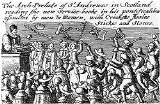
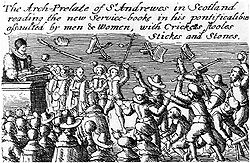
- 1637: Charles I attempts to impose Anglican services on the Presbyterian Church of ScotlandChurch of ScotlandThe Church of Scotland, known informally by its Scots language name, the Kirk, is a Presbyterian church, decisively shaped by the Scottish Reformation....
, Jenny GeddesJenny GeddesJenny Geddes was a Scottish market-trader in Edinburgh, who is alleged to have thrown her stool at the head of the minister in St Giles' Cathedral in objection to the first public use of the Anglican Book of Common Prayer in Scotland.The act is reputed to have sparked the riot which led to the...
starts riots - 1638: Signing of the National Covenant in Scotland
- 1639: Conflict between CovenanterCovenanterThe Covenanters were a Scottish Presbyterian movement that played an important part in the history of Scotland, and to a lesser extent in that of England and Ireland, during the 17th century...
s and Royalists in Scotland, beginning with the Covenanters seizing the city of Aberdeen in February - 1639: The Bishops' WarBishops' WarsThe Bishops' Wars , were conflicts, both political and military, which occurred in 1639 and 1640 centred around the nature of the governance of the Church of Scotland, and the rights and powers of the Crown...
: Charles brings his troops into Scotland but decides not to attack but to negotiate instead. Signing of the Treaty of BerwickTreaty of Berwick (1639)The Treaty of Berwick was signed on 18 June 1639 between England and Scotland. Archibald Johnston was involved in the negotiations before King Charles was forced to sign the treaty. The agreement, overall, officially ended the First Bishops' War even though both sides saw it only as a temporary...
(18 June 1639) - 1640: Charles recalls the English Parliament in order to obtain money to finance his military struggle with Scotland. Parliament agrees to fund Charles, but only on condition he answer their grievances relating to his 11-year "personal rule" or "tyranny". Charles refuses and dissolves Parliament after a mere 3 weeks, hence the name of the "Short ParliamentShort ParliamentThe Short Parliament was a Parliament of England that sat from 13 April to 5 May 1640 during the reign of King Charles I of England, so called because it lasted only three weeks....
" - 1640: The Second Bishops' War or "Second War of the Covenant" breaks out in August. Responding to Charles' attempt to raise an army against them, an army of Covenanters crosses the Tweed and overruns an English force at the Battle of NewburnBattle of NewburnThe Battle of Newburn was fought on 28 August 1640 during the Second Bishops' War between a Scottish Covenanter army led by General Alexander Leslie and English royalist forces commanded by Edward, Lord Conway. Conway, heavily outnumbered, was defeated, and the Scots went on to occupy the town of...
(28 August 1640), marching on the city of Newcastle. - 1640: The Treaty of RiponTreaty of RiponThe Treaty of Ripon was an agreement signed by Charles I, King of England, Scotland, and Ireland, and the Scottish Covenanters on 26 October 1640, in the aftermath of the Second Bishops' War...
(26 October 1640) leaves Newcastle in the hands of the Scots, who also receive a large tribute from Charles. Charles has no option but to recall Parliament in order to raise the necessary funds. Parliament convenes in November and remains convened, in one form or another, until 1660, thus earning the name of the "Long ParliamentLong ParliamentThe Long Parliament was made on 3 November 1640, following the Bishops' Wars. It received its name from the fact that through an Act of Parliament, it could only be dissolved with the agreement of the members, and those members did not agree to its dissolution until after the English Civil War and...
". - 1641: 23 October, Irish RebellionIrish Rebellion of 1641The Irish Rebellion of 1641 began as an attempted coup d'état by Irish Catholic gentry, who tried to seize control of the English administration in Ireland to force concessions for the Catholics living under English rule...
breaks out in UlsterUlsterUlster is one of the four provinces of Ireland, located in the north of the island. In ancient Ireland, it was one of the fifths ruled by a "king of over-kings" . Following the Norman invasion of Ireland, the ancient kingdoms were shired into a number of counties for administrative and judicial...
, with violence marked by the massacre of Protestants by Catholics. The rebels win a battle against Crown forces at Julianstown BridgeBattle of JulianstownThe Battle of Julianstown was fought during the Irish Rebellion of 1641, at Julianstown near Drogheda in eastern Ireland, in November 1641.- Battle :...
near DroghedaSiege of DroghedaThe siege of Drogheda at the outset of the Cromwellian conquest of Ireland. The town of Drogheda in eastern Ireland was held by a combined English Royalist and Irish Catholic garrison when it was besieged and stormed by English Parliamentarian forces under Oliver Cromwell...
in December. - 1641: 1 December, Parliament issues the Grand RemonstranceGrand RemonstranceThe Grand Remonstrance was a list of grievances presented to King Charles I of England by the English Parliament on 1 December 1641, but passed by the House of Commons on the 22nd of November 1641, during the Long Parliament; it was one of the chief events which were to precipitate the English...
to Charles, which some see as a direct challenge to the King's authority. Charles refuses to address the grievances it raises. - 1642: The Covenanters send a Protestant Scots army to UlsterUlsterUlster is one of the four provinces of Ireland, located in the north of the island. In ancient Ireland, it was one of the fifths ruled by a "king of over-kings" . Following the Norman invasion of Ireland, the ancient kingdoms were shired into a number of counties for administrative and judicial...
to defend the Protestant plantationPlantation (settlement or colony)Plantation was an early method of colonization in which settlers were "planted" abroad in order to establish a permanent or semi-permanent colonial base. Such plantations were also frequently intended to promote Western culture and Christianity among nearby indigenous peoples, as can be seen in the...
s
- 1642: Charles enters the House of Commons to arrest five "traitors". The news of his "assault" on Parliament causes uproar in London. Charles leaves the city in fear for his life. In his absence Parliament passes the Militia Bill which, in effect, seizes control of the London arsenal and places the trainbandTrainbandTrainbands were companies of militia in England or the Americas, first organized in the 16th century and dissolved in the 18th. The term was used after this time to describe the London militia. In the early American colonies the trainband was the most basic tactical unit. However, no standard...
s and militia under its authority. Charles retaliates by appointing individuals to take control of other regional militias in the King's name. From this moment both sides actively raise troops and gather munitions. - 1642–1646: The First English Civil WarEnglish Civil WarThe English Civil War was a series of armed conflicts and political machinations between Parliamentarians and Royalists...
- 1642: An alliance of Irish Catholics; Gaelic Irish and the Old EnglishOld English (Ireland)The Old English were the descendants of the settlers who came to Ireland from Wales, Normandy, and England after the Norman invasion of Ireland in 1169–71. Many of the Old English became assimilated into Irish society over the centuries...
forms the Catholic ConfederationConfederate IrelandConfederate Ireland refers to the period of Irish self-government between the Rebellion of 1641 and the Cromwellian conquest of Ireland in 1649. During this time, two-thirds of Ireland was governed by the Irish Catholic Confederation, also known as the "Confederation of Kilkenny"...
, based at KilkennyKilkennyKilkenny is a city and is the county town of the eponymous County Kilkenny in Ireland. It is situated on both banks of the River Nore in the province of Leinster, in the south-east of Ireland...
, meeting first in March 1642. - 1642: 23 October: the Battle of EdgehillBattle of EdgehillThe Battle of Edgehill was the first pitched battle of the First English Civil War. It was fought near Edge Hill and Kineton in southern Warwickshire on Sunday, 23 October 1642....
, the inconclusive first battle in the English Civil WarEnglish Civil WarThe English Civil War was a series of armed conflicts and political machinations between Parliamentarians and Royalists... - 1643: Ceasefire between the English Royalists and Irish Confederates declared
- 1643: 25 September: an alliance between the English Parliament and the Scottish Covenanters — the Solemn League and CovenantSolemn League and CovenantThe Solemn League and Covenant was an agreement between the Scottish Covenanters and the leaders of the English Parliamentarians. It was agreed to in 1643, during the First English Civil War....
— declared. Scottish troops march into England to support the English Parliamentarians - 1644: 2 July: the Battle of Marston MoorBattle of Marston MoorThe Battle of Marston Moor was fought on 2 July 1644, during the First English Civil War of 1642–1646. The combined forces of the Scottish Covenanters under the Earl of Leven and the English Parliamentarians under Lord Fairfax and the Earl of Manchester defeated the Royalists commanded by Prince...
, a major defeat of the royalists by the Parliamentarians and Scots - 1644: Scottish Civil WarScottish Civil WarBetween 1644 and 1651 Scotland was involved the Wars of the Three Kingdoms during a period when a series of civil wars that were fought in Scotland, England and in Ireland...
started by the Scottish Royalist MontroseJames Graham, 1st Marquess of MontroseJames Graham, 1st Marquess of Montrose was a Scottish nobleman and soldier, who initially joined the Covenanters in the Wars of the Three Kingdoms, but subsequently supported King Charles I as the English Civil War developed...
, with the aid of Irish Confederate troops under Alasdair MacCollaAlasdair MacCollaAlasdair Mac Colla was a Scottish soldier. His full name in Scottish Gaelic was Alasdair Mac Colla Chiotaich Mac Domhnuill . He is sometimes mistakenly referred to in English as "Collkitto", a nickname that properly belongs to his father. He fought in the Wars of the Three Kingdoms, most notably...
, including the Scots-Irish forces serving under Manus O'CahanManus O'Cahan's Regiment (English Civil War)Manus O'Cahan's Regiment of Foot was a Scots Irish regiment which served during the Wars of the Three Kingdoms in the mid-1640s.- History :Manus O’Cahan’s Regiment of Foot was a body of Scots-Irish soldiers, many of who had fought in Europe in the early years of the Thirty Years War. Some... - 1645: the English Parliament forms the New Model ArmyNew Model ArmyThe New Model Army of England was formed in 1645 by the Parliamentarians in the English Civil War, and was disbanded in 1660 after the Restoration...
- 1645: 14 June: the Battle of NasebyBattle of NasebyThe Battle of Naseby was the key battle of the first English Civil War. On 14 June 1645, the main army of King Charles I was destroyed by the Parliamentarian New Model Army commanded by Sir Thomas Fairfax and Oliver Cromwell.-The Campaign:...
: the New Model Army crushes the Royalist army, effectively ending the First English Civil War - 1645: 15 August, MontroseJames Graham, 1st Marquess of MontroseJames Graham, 1st Marquess of Montrose was a Scottish nobleman and soldier, who initially joined the Covenanters in the Wars of the Three Kingdoms, but subsequently supported King Charles I as the English Civil War developed...
wins Royalist control of Scotland at the Battle of KilsythBattle of KilsythThe Battle of Kilsyth was an engagement of the Wars of the Three Kingdoms which took place on 15 August 1645 at Kilsyth. Despite the numerical disadvantage, the battle was another victory for Royalist forces over the Covenanters, and marked the end of William Baillie's pursuit of the...
; subsequently Covenanter armies returned from England defeat him at the Battle of PhiliphaughBattle of PhiliphaughThe Battle of Philiphaugh was fought on 13 September 1645 during the Wars of the Three Kingdoms near Selkirk in the Scottish Borders. The Royalist army of the Marquess of Montrose was destroyed by the Covenanter army of Sir David Leslie, restoring the power of the Committee of Estates.-Prelude:When...
(13 September 1645) - 1646: May: Charles I surrenders to Scots Covenanters, who hand him over to the English Parliament
- 1646: June: in the battle of BenburbBattle of BenburbThe Battle of Benburb took place in 1646 during the Irish Confederate Wars, the Irish theatre of the Wars of the Three Kingdoms. It was fought between the forces of Confederate Ireland under Owen Roe O'Neill and a Scottish Covenanter and Anglo-Irish army under Robert Monro...
, an Irish Confederate army under Owen Roe O'NeillOwen Roe O'NeillEoghan Ruadh Ó Néill , anglicised as Owen Roe O'Neill , was a seventeenth century soldier and one of the most famous of the O'Neill dynasty of Ulster.- In Spanish service :...
defeats the Scottish CovenanterCovenanterThe Covenanters were a Scottish Presbyterian movement that played an important part in the history of Scotland, and to a lesser extent in that of England and Ireland, during the 17th century...
army in Ulster - 1647: in the Battle of Dungans Hill (August) and the Battle of Knocknanauss (November) English Parliamentarian forces smash the Irish Confederate armies of Leinster and Munster respectively
- 1648–1649: The Second English Civil War
- 1648–1649: Ormonde Peace — formal alliance between Irish Confederates and English Royalists declared
- 1648: the Battle of PrestonBattle of Preston (1648)The Battle of Preston , fought largely at Walton-le-Dale near Preston in Lancashire, resulted in a victory by the troops of Oliver Cromwell over the Royalists and Scots commanded by the Duke of Hamilton...
(August): Scottish Covenanter (EngagersEngagersThe Engagers were a faction of the Scottish Covenanters, who made "The Engagement" with King Charles I in December 1647 while he was imprisoned in Carisbrooke Castle by the English Parliamenterians after his defeat in the First Civil War....
faction) army invades England to restore Charles I; defeated by the Parliamentarians - 1649: 30 January: Execution of Charles I by the English Parliament
- 1649: 2 August: in the battle of RathminesBattle of RathminesThe Battle of Rathmines was fought in and around what is now the Dublin suburb of Rathmines in August 1649, during the Irish Confederate Wars, the Irish theatre of the Wars of the Three Kingdoms...
, Parliamentarians rout an Irish-Royalist force outside Dublin; 15 August, New Model ArmyNew Model ArmyThe New Model Army of England was formed in 1645 by the Parliamentarians in the English Civil War, and was disbanded in 1660 after the Restoration...
lands in Ireland — begins Cromwellian conquest of IrelandCromwellian conquest of IrelandThe Cromwellian conquest of Ireland refers to the conquest of Ireland by the forces of the English Parliament, led by Oliver Cromwell during the Wars of the Three Kingdoms. Cromwell landed in Ireland with his New Model Army on behalf of England's Rump Parliament in 1649...
. - 1649: 11 September: Cromwell takes DroghedaSiege of DroghedaThe siege of Drogheda at the outset of the Cromwellian conquest of Ireland. The town of Drogheda in eastern Ireland was held by a combined English Royalist and Irish Catholic garrison when it was besieged and stormed by English Parliamentarian forces under Oliver Cromwell...
; followed by WexfordSack of WexfordThe Sack of Wexford took place in October 1649, during the Cromwellian conquest of Ireland, when the New Model Army under Oliver Cromwell took Wexford town in south-eastern Ireland. The English Parliamentarian troops broke into the town while the commander of the garrison was trying to negotiate a...
on 11 October - 1650: Montrose tries to launch a Royalist uprising in Scotland; the Covenanters defeat, arrest and execute him
- 1650: Charles II takes the oath in support of the Solemn League and CovenantSolemn League and CovenantThe Solemn League and Covenant was an agreement between the Scottish Covenanters and the leaders of the English Parliamentarians. It was agreed to in 1643, during the First English Civil War....
and repudiates his alliance with the Irish Confederates. (The Scots subsequently crown him at SconeScone, ScotlandScone is a village in Perth and Kinross, Scotland. The medieval village of Scone, which grew up around the monastery and royal residence, was abandoned in the early 19th century when the residents were removed and a new palace was built on the site by the Earl of Mansfield...
on New Year's Day, 1651.) - 1650: Third English Civil WarThird English Civil WarThe Third English Civil War was the last of the English Civil Wars , a series of armed conflicts and political machinations between Parliamentarians and Royalists....
breaks out between the Scots and the English Parliament. Cromwell invades Scotland and smashes the Scottish army at the Battle of DunbarBattle of Dunbar (1650)The Battle of Dunbar was a battle of the Third English Civil War. The English Parliamentarian forces under Oliver Cromwell defeated a Scottish army commanded by David Leslie which was loyal to King Charles II, who had been proclaimed King of Scots on 5 February 1649.-Background:The English...
(3 September 1650) - 1651: Henry IretonHenry IretonHenry Ireton was an English general in the Parliamentary army during the English Civil War. He was the son-in-law of Oliver Cromwell.-Early life:...
besieges LimerickSiege of Limerick (1650-51)Limerick, in western Ireland was the scene of two sieges during the Irish Confederate Wars. The second and largest of these took place during the Cromwellian conquest of Ireland in 1650-51. Limerick was one the last fortified cities held by an alliance of Irish Confederate Catholics and English... - 1651: June: Capture of the Isles of ScillyIsles of ScillyThe Isles of Scilly form an archipelago off the southwestern tip of the Cornish peninsula of Great Britain. The islands have had a unitary authority council since 1890, and are separate from the Cornwall unitary authority, but some services are combined with Cornwall and the islands are still part...
by Admiral Robert BlakeRobert Blake (admiral)Robert Blake was one of the most important military commanders of the Commonwealth of England and one of the most famous English admirals of the 17th century. Blake is recognised as the chief founder of England's naval supremacy, a dominance subsequently inherited by the British Royal Navy into... - 1651: 3 September: the defeat of Charles IICharles II of EnglandCharles II was monarch of the three kingdoms of England, Scotland, and Ireland.Charles II's father, King Charles I, was executed at Whitehall on 30 January 1649, at the climax of the English Civil War...
and the Scots at WorcesterBattle of WorcesterThe Battle of Worcester took place on 3 September 1651 at Worcester, England and was the final battle of the English Civil War. Oliver Cromwell and the Parliamentarians defeated the Royalist, predominantly Scottish, forces of King Charles II...
ends the Third Civil War. Charles II goes into exile in France - 1652: Surrender of the last Irish stronghold in GalwayGalwayGalway or City of Galway is a city in County Galway, Republic of Ireland. It is the sixth largest and the fastest-growing city in Ireland. It is also the third largest city within the Republic and the only city in the Province of Connacht. Located on the west coast of Ireland, it sits on the...
— guerrilla warfare continues - 1653: Surrender of the last organised Irish troops in CavanCavanCavan is the county town of County Cavan in the Republic of Ireland. The town lies in the north central part of Ireland, near the border with Northern Ireland...
. - 1654: The end of the Royalist rising of 1651 to 1654 in Scotland
- 1655: March: Penruddock uprisingPenruddock uprisingThe Penruddock uprising was one of a series of coordinated uprisings planned by the Sealed Knot for a Royalist insurrection to start in March 1655 during the Protectorate of the Lord Protector Oliver Cromwell....
in southwest England - 1659: August: Booth'sGeorge Booth, 1st Baron DelamerGeorge Booth, 1st Baron Delamer , known as Sir George Booth, 2nd Baronet, from 1652 to 1661, was an English peer.-Civil War:...
Uprising along Welsh border - 1660: English RestorationEnglish RestorationThe Restoration of the English monarchy began in 1660 when the English, Scottish and Irish monarchies were all restored under Charles II after the Interregnum that followed the Wars of the Three Kingdoms...
- 1661: Venner'sThomas VennerThomas Venner was a cooper and rebel who became the last leader of the Fifth Monarchy Men, who tried unsuccessfully to overthrow Oliver Cromwell in 1657, and subsequently led a coup in London against the newly-restored government of Charles II...
Uprising in London
Aftermath
While the Wars of the Three Kingdoms pre-figured many of the changes that would shape modern Britain, in the short term they resolved little. The English CommonwealthCommonwealth of England
The Commonwealth of England was the republic which ruled first England, and then Ireland and Scotland from 1649 to 1660. Between 1653–1659 it was known as the Commonwealth of England, Scotland and Ireland...
did achieve a compromise (though a relatively unstable one) between a monarchy and a republic. In practice, Oliver Cromwell exercised political power because of his control over the Parliament's military forces, but his legal position remained unclear, even when he became Lord Protector
Lord Protector
Lord Protector is a title used in British constitutional law for certain heads of state at different periods of history. It is also a particular title for the British Heads of State in respect to the established church...
. None of the several proposed constitutions ever came into effect. Thus the Commonwealth and the Protectorate
The Protectorate
In British history, the Protectorate was the period 1653–1659 during which the Commonwealth of England was governed by a Lord Protector.-Background:...
established by the victorious Parliamentarians left little behind it in the way of new forms of government.
Two important legacies remain from this period:
- after the execution of King Charles I for high treasonHigh treason in the United KingdomUnder the law of the United Kingdom, high treason is the crime of disloyalty to the Crown. Offences constituting high treason include plotting the murder of the sovereign; having sexual intercourse with the sovereign's consort, with his eldest unmarried daughter, or with the wife of the heir to the...
, no future British monarch could expect that his subjects would tolerate perceived despotismDespotismDespotism is a form of government in which a single entity rules with absolute power. That entity may be an individual, as in an autocracy, or it may be a group, as in an oligarchy...
; - the excesses of New Model Army, particularly that of the Rule of the Major-GeneralsRule of the Major-GeneralsThe Rule of the Major-Generals from August 1655 – January 1657, was a period of direct military government during Oliver Cromwell's Protectorate.England was divided into 10 regions each governed by a Major-General who answered to the Lord Protector....
, left an abiding mistrust of military rule in England.
English Protestants experienced religious freedom during the Interregnum
English Interregnum
The English Interregnum was the period of parliamentary and military rule by the Lord Protector Oliver Cromwell under the Commonwealth of England after the English Civil War...
, but not English Roman Catholics. The new authorities abolished the Church of England
Church of England
The Church of England is the officially established Christian church in England and the Mother Church of the worldwide Anglican Communion. The church considers itself within the tradition of Western Christianity and dates its formal establishment principally to the mission to England by St...
and the House of Lords
House of Lords
The House of Lords is the upper house of the Parliament of the United Kingdom. Like the House of Commons, it meets in the Palace of Westminster....
. Cromwell dismissed the Rump Parliament
Rump Parliament
The Rump Parliament is the name of the English Parliament after Colonel Pride purged the Long Parliament on 6 December 1648 of those members hostile to the Grandees' intention to try King Charles I for high treason....
and failed to create an acceptable alternative. Nor did Cromwell and his supporters move in the direction of a popular democracy, as the more radical fringes of the Parliamentarians (such as the Levellers
Levellers
The Levellers were a political movement during the English Civil Wars which emphasised popular sovereignty, extended suffrage, equality before the law, and religious tolerance, all of which were expressed in the manifesto "Agreement of the People". They came to prominence at the end of the First...
) wanted.
The New Model Army occupied Ireland and Scotland during the Interregnum. In Ireland, the new government confiscated almost all lands belonging to Irish Catholics as punishment for the rebellion of 1641; harsh Penal Laws
Penal Laws (Ireland)
The term Penal Laws in Ireland were a series of laws imposed under English and later British rule that sought to discriminate against Roman Catholics and Protestant dissenters in favour of members of the established Church of Ireland....
also restricted this community. Thousands of Parliamentarian soldiers settled in Ireland on confiscated lands. The Commonwealth abolished the Parliaments of Ireland and Scotland. In theory, these countries had representation in the English Parliament, but since this body never received real powers, such representation remained ineffective. When Cromwell died in 1658 the Commonwealth fell apart without major violence, and Charles II returned as King of England, Scotland and Ireland in 1660.
Under the English Restoration
English Restoration
The Restoration of the English monarchy began in 1660 when the English, Scottish and Irish monarchies were all restored under Charles II after the Interregnum that followed the Wars of the Three Kingdoms...
, the political system returned to the constitutional position of before the wars. The new régime executed or imprisoned for life those responsible for the regicide
Regicide
The broad definition of regicide is the deliberate killing of a monarch, or the person responsible for the killing of a monarch. In a narrower sense, in the British tradition, it refers to the judicial execution of a king after a trial...
of Charles I. Neo-Royalists dug up Cromwell's corpse and gave it a posthumous execution
Posthumous execution
Posthumous execution is the ritual or ceremonial mutilation of an already dead body as a punishment.-Examples:* Li Linfu, Chancellor of Tang China during the reign of Emperor Xuanzong in the latter years, was exhumed and executed for crimes of high treason by his rival Yang Guozhong for his...
. Religious and political radicals held responsible for the wars suffered harsh repression. Scotland and Ireland regained their Parliaments, some Irish retrieved confiscated lands and the New Model Army disbanded. However, the issues that had caused the wars — religion, the power of Parliament and the relationship between the three kingdoms — remained unresolved, only postponed to re-emerge as matters fought over again in the Glorious Revolution
Glorious Revolution
The Glorious Revolution, also called the Revolution of 1688, is the overthrow of King James II of England by a union of English Parliamentarians with the Dutch stadtholder William III of Orange-Nassau...
of 1688. Only after this point did the features of modern Britain seen in the Civil Wars emerge permanently: a Protestant constitutional monarchy
Constitutional monarchy
Constitutional monarchy is a form of government in which a monarch acts as head of state within the parameters of a constitution, whether it be a written, uncodified or blended constitution...
with England dominant and a strong standing army
Standing army
A standing army is a professional permanent army. It is composed of full-time career soldiers and is not disbanded during times of peace. It differs from army reserves, who are activated only during wars or natural disasters...
.
See also
- British military historyBritish military historyThe Military history of Britain, including the military history of the United Kingdom and the military history of the island of Great Britain, is discussed in the following articles:...
- Catholicism and the wars of religion
- Thirty Years' WarThirty Years' WarThe Thirty Years' War was fought primarily in what is now Germany, and at various points involved most countries in Europe. It was one of the most destructive conflicts in European history....
Others
- www.british-civil-wars.co.uk Extensive site on the Wars of the Three Kingdoms
- Chronology of The Wars of the Three Kingdoms
- The Wars of the Three Kingdoms Article by Jane Ohlmeyer arguing that the English Civil War was just one of an interlocking set of conflicts that encompassed the British Isles in the mid-17th century
- The English Context of the British Civil Wars (Link inaccessible as of 2008-03-02.) John Adamson argues that historians have exaggerated the importance of the Celtic countries in the events of the 1640s
- The first Scottish Civil War
- The Rebellion of 1641 and the Cromwellian Occupation of Ireland
- Ireland and the War of the Three Kingdoms
- Civil War