
All Topics  
House of Lords

 
House of Lords

   Email Print
   Bookmark   Link


House of Lords


The House of Lords is the second house of the Parliament of the United Kingdom
Parliament of the United Kingdom

The Parliament of the United Kingdom of Great Britain and Northern Ireland is the supreme legislature in the United Kingdom and British overseas territories....
 and is also commonly referred to as "the Lords". The Parliament comprises the Sovereign
British monarchy

The Monarchy of the United Kingdom is the constitutional monarchy of the United Kingdom and its British overseas territory.The present monarch, Queen Elizabeth II of the United Kingdom, has reigned since 6 February 1952....
, the House of Commons
British House of Commons

The House of Commons is the lower house of the Parliament of the United Kingdom, which also comprises the British monarchy and the House of Lords ....
 (which is the lower house
Lower house

A lower house is one of two chambers of a bicameral legislature, the other chamber being the upper house.Despite its theoretical position "below" the upper house, in many legislatures worldwide the lower house has come to wield more power....
 of Parliament and referred to as "the Commons"), and the Lords. Membership of the House of Lords was once a right of birth to hereditary peers, but following a series of reforms the House now consists almost entirely of appointed members.


Discussion
Ask a question about 'House of Lords'
Start a new discussion about 'House of Lords'
Answer questions from other users
Full Discussion Forum


Timeline

1645   Lords pass Self-Denying Ordinance.

1649   The House of Commons pass an act abolishing the House of Lords, declaring that it is ''"useless and dangerous to the people of England"''.

1742   Robert Walpole was elevated to the peerage and thus moved from the House of Commons to the House of Lords, effectively ending his reign as Prime Minister of the United Kingdom (see February 16, above).

1812   Poet Lord Byron gives his first address as a member of the House of Lords, in defense of Luddite violence against Industrialism in his home county of Nottinghamshire.

1910   In the United Kingdom, General Election held in response to House of Lords rejection of the (1909) budget results in reduced Liberal Party majority (Liberals, 275 seats; Labour, 40; Irish Nationalists, 82; Unionists (the title then preferred by the British Conservative Party), 273).

1910   British Prime Minister Asquith makes second appeal in the same year to the electorate to resolve battle of wills with the House of Lords (Liberals, 272; Labour, 42; Irish Nationalists, 84; Unionists, 272 - making a majority of 126 for restriction of the powers of the Lords and for Irish Home Rule).

1913   House of Lords rejects Irish Home Rule Bill

1914   The House of Lords completed the recasting of the Amendment Bill.

1956   British House of Lords defeats the abolition of death penalty.

1966   Lord Gardiner issues the Practice Statement in the House of Lords, stating that the House is not bound to follow its own previous precedent.


Encyclopedia


The House of Lords is the second house of the Parliament of the United Kingdom
Parliament of the United Kingdom

The Parliament of the United Kingdom of Great Britain and Northern Ireland is the supreme legislature in the United Kingdom and British overseas territories....
 and is also commonly referred to as "the Lords". The Parliament comprises the Sovereign
British monarchy

The Monarchy of the United Kingdom is the constitutional monarchy of the United Kingdom and its British overseas territory.The present monarch, Queen Elizabeth II of the United Kingdom, has reigned since 6 February 1952....
, the House of Commons
British House of Commons

The House of Commons is the lower house of the Parliament of the United Kingdom, which also comprises the British monarchy and the House of Lords ....
 (which is the lower house
Lower house

A lower house is one of two chambers of a bicameral legislature, the other chamber being the upper house.Despite its theoretical position "below" the upper house, in many legislatures worldwide the lower house has come to wield more power....
 of Parliament and referred to as "the Commons"), and the Lords. Membership of the House of Lords was once a right of birth to hereditary peers, but following a series of reforms the House now consists almost entirely of appointed members. the House of Lords has 743 members, 97 more than the 646 seat House of Commons.

The full, formal title of the House of Lords is The Right Honourable the Lords Spiritual and Temporal of the United Kingdom of Great Britain and Northern Ireland in Parliament assembled.

History

Today's Parliament of the United Kingdom largely descends, in practice, from the Parliament of England
Parliament of England

The Parliament of England was the legislature of the Kingdom of England. Its roots can be traced back to the early medieval period. In a series of developments, it came increasingly to constrain the power of the King of England, and went on after the Act of Union 1707 to merge with the Parliament of Scotland and form the main basis of the Pa...
, though the 1706 Treaty of Union
Treaty of Union

The Treaty of Union is the name given to the agreement that led to the creation of the United Kingdom of Great Britain, the political union of England and Scotland, that took effect on 1 May 1707....
 and the Acts of Union that ratified the Treaty created a new Parliament of Great Britain to replace the Parliament of England and the Parliament of Scotland
Parliament of Scotland

The Parliament of Scotland, officially the Estates of Parliament, was the legislature of the Independence Kingdom of Scotland.The unicameral parliament of Scotland is first found on record during the early thirteenth century, and the first meeting for which reliable evidence survives was at Kirkliston in 1235, during the reign of A...
. This new parliament was, in effect, the continuation of the Parliament of England with the addition of 45 MPs and 16 Peers to represent Scotland.

The Parliament of England developed from the council that advised the King during medieval times. This royal council came to be composed of ecclesiastics, noblemen, and representatives of the counties
Counties of the United Kingdom

The county of the United Kingdom are a type of subnational division of historical origin; by the Middle Ages they had become established as a unit of local government....
 (afterwards, representatives of the boroughs
Parliamentary borough

Parliamentary boroughs are a type of administrative division, usually covering urban areas, that are entitled to representation in a Parliament....
 as well). The first Parliament is often considered to be the "Model Parliament
Model Parliament

The Model Parliament is the term used for the 1295 parliament of King Edward I of England. This assembly included members of the clergy and the aristocracy, as well as representatives from the various Historic counties of England and boroughs....
" (held in 1295), which included archbishops, bishops, abbots, earls, barons, and representatives of the shires and boroughs. The power of Parliament grew slowly, fluctuating as the strength of the monarchy grew or declined. For example, during much of the reign of Edward II
Edward II of England

Edward II, of Caernarfon, was Kingdom of England from 1307 until he was deposition in January 1327. His tendency to ignore his nobility in favour of low-born favourites led to constant political unrest and his eventual deposition....
 (1307–1327), the nobility
Nobility

Nobility is a government-privileged title which may be either hereditary or for a lifetime. Titles of nobility exist today in many countries although it is usually associated with present or former monarchies....
 was supreme, the Crown
The Crown

Throughout the Commonwealth realms, the Crown is an abstract metonymy concept which represents the legal authority for the existence of any government....
 weak, and the shire and borough representatives entirely powerless. In 1322, the authority of Parliament was for the first time recognised not simply by custom or royal charter, but by an authoritative statute, passed by Parliament itself. Further developments occurred during the reign of Edward II's successor, Edward III
Edward III of England

Edward III was one of the most successful List of the monarchs of the Kingdom of Englands of the Britain in the Middle Ages. Restoring royal authority after the disastrous reign of his father, Edward II of England, Edward III went on to transform the Kingdom of England into the most efficient military power in Europe....
. Most importantly, it was during this King's reign that Parliament clearly separated into two distinct chambers: the House of Commons (consisting of the shire and borough representatives) and the House of Lords (consisting of the senior clergy and the nobility). The authority of Parliament continued to grow, and, during the early fifteenth century, both Houses exercised powers to an extent not seen before. The Lords were far more powerful than the Commons because of the great influence of the aristocrats and prelates of the realm.

The power of the nobility suffered a decline during the civil wars of the late fifteenth century, known as the Wars of the Roses
Wars of the Roses

The Wars of the Roses were a series of dynastic civil wars fought in England between supporters of the Houses of House of Lancaster and House of York....
. Much of the nobility was killed on the battlefield or executed for participation in the war, and many aristocratic estates were lost to the Crown. Moreover, feudalism
Feudalism

Feudalism, a term first used in the early modern period , in its most classic sense refers to a Middle Ages European political system composed of a set of reciprocal law and military obligations among the warrior nobility, revolving around the three key concepts of lords, vassals, and fiefs....
 was dying, and the feudal armies controlled by the barons became obsolete. Henry VII (1485-1509) clearly established the supremacy of the monarch, symbolised by the 'Crown Imperial'. The domination of the Sovereign continued to grow during the reigns of the Tudor monarchs
Tudor dynasty

The House of Tudor was a prominent European royal house that ruled the Kingdom of England and its realms from 1485 until 1603. Founded by Henry VII of England, who, though his paternal family was Welsh people ?his grandfather was Owen Tudor? was himself also a legitimized descendent of the royal House of Lancaster....
 in the 16th century. The Crown was at the height of its power during the reign of Henry VIII
Henry VIII of England

Henry VIII was King of England from 21 April 1509 until his death. He was also Lordship of Ireland and claimant to the Early Modern France. Henry was the second monarch of the House of Tudor, succeeding his father, Henry VII of England....
 (1509-1547).

The House of Lords remained more powerful than the House of Commons, but the Lower House did continue to grow in influence, reaching a zenith in relation to the House of Lords during the middle 17th century. Conflicts between the King and the Parliament (for the most part, the House of Commons) ultimately led to the English Civil War
English Civil War

The English Civil War was a series of armed conflicts and political machinations between Roundhead and Cavalier. The First English Civil War and Second English Civil War civil wars pitted the supporters of Charles I of England against the supporters of the Long Parliament, while the Third English Civil War saw fighting between supporters...
 during the 1640s. In 1649, after the defeat and execution of King Charles I
Charles I of England

Charles I was List of English monarchs, List of monarchs of Scotland and King of Ireland from 27 March 1625 until his capital punishment on 30 January 1649....
, a republic (the Commonwealth of England
Commonwealth of England

The Commonwealth of England was the republic which ruled first Kingdom of England and Wales, and then Kingdom of Ireland and Kingdom of Scotland from 1649 to 1660....
) was declared, but the nation was effectively under the overall control of Oliver Cromwell
Oliver Cromwell

Oliver Cromwell was an English people Military history of the United Kingdom and Politics of England leader best known for his involvement in making England into a republican Commonwealth and for his later role as Lord Protector of England, Scotland, and Ireland....
, Lord Protector of England. The House of Lords was reduced to a largely powerless body, with Cromwell and his supporters in the Commons dominating the Government. On 19 March 1649, the House of Lords was abolished by an Act of Parliament, which declared that "The Commons of England [find] by too long experience that the House of Lords is useless and dangerous to the people of England." The House of Lords did not assemble again until the Convention Parliament
Convention Parliament

The term Convention Parliament has been applied to three different English Parliaments, of 1399, 1660 and 1689.The definition of the term convention parliament is generally taken to be:...
 met in 1660 and the monarchy was restored. It returned to its former position as the more powerful chamber of Parliament—a position it would occupy until the 19th century.

The 19th century was marked by several changes to the House of Lords. The House, once a body of only about 50 members, had been greatly enlarged by the liberality of George III
George III of the United Kingdom

George III was Kingdom of Great Britain and Kingdom of Ireland from 25 October 1760 until the union of these two countries on 1 January 1801, after which he was King of the United Kingdom of Great Britain and Ireland until his death....
 and his successors in creating peerages. The individual influence of a Lord of Parliament was thus diminished. Moreover, the power of the House as a whole experienced a decrease, whilst that of the House of Commons grew. Particularly notable in the development of the Lower House's superiority was the Reform Bill of 1832
Reform Act 1832

The Representation of the People Act 1832, commonly known as the Reform Act 1832, was an Act of Parliament that introduced wide-ranging changes to the electoral system of the United Kingdom of Great Britain and Ireland....
. The electoral system of the House of Commons was not, at the time, democratic: property qualifications greatly restricted the size of the electorate, and the boundaries of many constituencies had not been changed for centuries. Entire cities such as Manchester
Manchester

Manchester is a city and metropolitan borough of Greater Manchester, England. Manchester was granted City status in the United Kingdom in 1853....
 were not represented by a single individual in the House of Commons, but the 11 voters of Old Sarum
Old Sarum

Old Sarum is the site of the earliest settlement of Salisbury, in England. The site contains evidence of human habitation as early as 30th century BC....
 retained their ancient right to elect two Members of Parliament. A small borough was susceptible to bribery, and was often under the control of a patron, whose nominee was guaranteed to win an election. Some aristocrats were patrons of numerous "pocket boroughs
Rotten borough

The term "rotten" or "decayed" borough referred to a parliamentary borough or constituency in the United Kingdom of Great Britain and Ireland which had a very small population and was used by a patron to exercise undue and unrepresentative influence within parliament....
", and therefore controlled a considerable part of the membership of the House of Commons.

When, in 1831, the House of Commons passed a Reform Bill to correct some of these anomalies, the House of Lords rejected the proposal. The popular cause of reform, however, was not abandoned by the ministry, despite a second rejection of the bill in the Lords in 1832. The Prime Minister, Earl Grey
Charles Grey, 2nd Earl Grey

Charles Grey, 2nd Earl Grey, Order of the Garter, Privy Council of the United Kingdom , known as Viscount Howick between 1806 and 1807, was a United Kingdom of Great Britain and Ireland British Whig Party statesman and Prime Minister of the United Kingdom ....
, then advised the King to overwhelm the opposition to the bill in the House of Lords by creating about 80 new pro-Reform peers. William IV
William IV of the United Kingdom

William IV was King of the United Kingdom of Great Britain and Ireland and of Kingdom of Hanover from 26 June 1830 until his death. William, the third son of George III of the United Kingdom and younger brother and successor to George IV of the United Kingdom, was the last king and penultimate monarch of the House of Hanover....
 originally balked at the proposal, which effectively threatened the opposition of the House of Lords, but at length relented. Before the new peers were created, however, the Lords who opposed the bill admitted defeat, and abstained from the vote, allowing the passage of the bill. The crisis damaged the political influence of the House of Lords, but did not altogether end it. Over the course of the century, however, the power of the Upper House experienced further erosion, and the Commons gradually became the stronger House of Parliament.

Lloydgeorge
The status of the House of Lords returned to the forefront of debate after the election of a Liberal Government in 1906. In 1909, the Chancellor of the Exchequer
Chancellor of the Exchequer

The Chancellor of the Exchequer is the title held by the British Cabinet of the United Kingdom Minister who is responsible for all economic and financial matters....
, David Lloyd George
David Lloyd George

David Lloyd George, 1st Earl Lloyd-George of Dwyfor Order of Merit , Privy Council of the United Kingdom was a United Kingdom statesman and the only Wales Prime Minister of the United Kingdom - he is also the only one to have spoken English language as a second language, Welsh language having been his first....
, introduced into the House of Commons
British House of Commons

The House of Commons is the lower house of the Parliament of the United Kingdom, which also comprises the British monarchy and the House of Lords ....
 the "People's Budget
People's Budget

The 1909 People's Budget was a product of Herbert Asquith's Liberal government that introduced many unprecedented taxes on the wealthy and radical social welfare programmes to Britain's political life....
", which proposed a land tax targeting wealthy landowners. The popular measure, however, was defeated in the heavily Conservative House of Lords. Having made the powers of the House of Lords a primary campaign issue, the Liberals were narrowly re-elected in January 1910. Asquith then proposed that the powers of the House of Lords be severely curtailed. After a general election in December 1910, the Asquith Government secured the passage of a bill to curtail the powers of the House of Lords. The Parliament Act 1911
Parliament Act 1911

The Parliament Act 1911 was an Act of Parliament of the Parliament of the United Kingdom of Great Britain and Ireland .This Act is to be construed as one with the Parliament Act 1949....
 effectively abolished the power of the House of Lords to reject legislation, or to amend in a way unacceptable to the House of Commons: most bills could be delayed for no more than three parliamentary sessions or two calendar years. It was not meant to be a permanent solution; more comprehensive reforms were planned. Neither party, however, pursued the matter with much enthusiasm, and the House of Lords remained primarily hereditary. In 1949, the Parliament Act reduced the delaying power of the House of Lords further to two sessions or one year.

In 1958, the predominantly hereditary nature of the House of Lords was changed by the Life Peerages Act 1958
Life Peerages Act 1958

The Life Peerages Act 1958 established the modern standards for the creation of life peers by the British monarchy of the United Kingdom. Life peers are barons and are members of the House of Lords for life, but their titles and membership in the Lords are not inherited by their children....
, which authorised the creation of life baronies, with no numerical limits. The number of Life Peers then gradually increased, though not at a constant rate.

The Labour Party had for most of the twentieth century a commitment, based on the party's historic opposition to class privilege, to abolish the House of Lords, or at least expel the hereditary element. In 1968, the Labour Government of Harold Wilson
Harold Wilson

James Harold Wilson, Baron Wilson of Rievaulx, Order of the Garter, Order of the British Empire, Fellow of the Royal Society, Her Majesty's Most Honourable Privy Council was one of the most prominent British politicians of the later half of the 20th century....
 attempted to reform the House of Lords by introducing a system under which hereditary peers would be allowed to remain in the House and take part in debate, but would be unable to vote. This plan, however, was defeated in the House of Commons by a coalition of traditionalist Conservatives (such as Enoch Powell
Enoch Powell

Brigadier John Enoch Powell, Order of the British Empire was a United Kingdom politician, linguist, Author, academic, soldier and poet.He was a Conservative Party Member of Parliament between 1950 and February 1974, and an Ulster Unionist MP between October 1974 and 1987....
), and Labour members who continued to advocate the outright abolition of the Upper House (such as Michael Foot
Michael Foot

Michael Mackintosh Foot is an England politician and writer. He was leader of the Labour Party from 1980 to 1983....
). When Michael Foot attained the leadership of the Labour Party, abolition of the House of Lords became a part of the party's agenda; under Neil Kinnock
Neil Kinnock

Neil Gordon Kinnock, Baron Kinnock Privy Council of the United Kingdom is a British politician. He was a Member of Parliament from 1970 to 1995, and was Leader of the Opposition and Labour Party leader from 1983 to 1992, when he resigned after the United Kingdom general election, 1992 defeat....
, however, a reformed Upper House was proposed instead. In the meantime, the creation of hereditary peerages (except for members of the Royal Family) has been arrested, with the exception of three creations during the administration of the Conservative Margaret Thatcher
Margaret Thatcher

Margaret Hilda Thatcher, Baroness Thatcher Order of the Garter, Order of Merit, Her Majesty's Most Honourable Privy Council, Fellow of the Royal Society was Prime Minister of the United Kingdom from 1979 to 1990 and Leader of the Conservative Party of the Conservative Party from 1975 to 1990....
 in the 1980s.

Whilst some hereditary peers were at best apathetic the Labour Party's clear commitments were not lost on Baron Sudeley
Merlin Hanbury-Tracy, 7th Baron Sudeley

Merlin Charles Sainthill Hanbury-Tracy, 7th Baron Sudeley, Society of Antiquaries of London is a United Kingdom Peerage, author and veteran right-wing activist..In 1941, at the age of three, he succeeded his second cousin, the Richard Hanbury-Tracy, 6th Barony Sudeley, to the Baron Sudeley and until the House of Lords Act 1999 sat in that b...
 who for decades had been considered an expert on the House of Lords. In December 1979 the Conservative Monday Club
Conservative Monday Club

The Conservative Monday Club is a United Kingdom pressure-group "on the right-wing of the Conservative Party "....
 published his extensive paper entitled Lords Reform - Why tamper with the House of Lords? and in July 1980 The Monarchist
International Monarchist League

The International Monarchist League is an organisation dedicated to the preservation and promotion of the monarchical system of government and the principle of monarchy worldwide....
 (no. 57, p.27 - 34) carried another article by Lord Sudeley entitled Why Reform or Abolish the House of Lords?. In 1990 he authored a further booklet for The Monday Club entitled The Preservation of the House of Lords.

The Labour Party included in its 1997 General Election Manifesto
Manifesto

A manifestom is a public declaration of principles and intentions, often Politics in nature, but may also be life stance related. However, manifestos relating to religious belief are rather referred to as credo....
 a commitment to remove the hereditary peerage from the House of Lords. Their subsequent election victory in 1997 under Tony Blair
Tony Blair

Anthony Charles Lynton "Tony" Blair is a British politician, who served as Prime Minister of the United Kingdom from 2 May 1997 to 27 June 2007....
 finally heralded the demise of the traditional House of Lords. The Labour Government introduced legislation to expel all hereditary peers from the Upper House as a first step in Lords reform. As a part of a compromise, however, it agreed to permit 92 hereditary peers to remain until the reforms were complete. Thus all but 92 hereditary peers were expelled under the House of Lords Act 1999
House of Lords Act 1999

The House of Lords Act 1999 was an Act of Parliament of the Parliament of the United Kingdom that was given Royal Assent on 11 November 1999. It was a major constitutional enactment that Lords Reform greatly one of the chambers of Parliament, the House of Lords....
 (see below for its provisions), making the House of Lords predominantly an appointed house.

Since 1999 however, no further reform has taken place (see Lords Reform
Lords Reform

For almost a century, governments in the United Kingdom have attempted to find a way to undertake a comprehensive reform of the House of Lords, which is the upper house of the Parliament of the United Kingdom....
). The Wakeham Commission proposed introducing a 20% elected element to the Lords, but this plan was widely criticised. A Joint Committee
Joint committee

A Joint Committee is a term used in politics to refer to a committee made up of members of both chambers of a bicameral parliament....
 was established in 2001 to resolve the issue, but it reached no conclusion and instead gave Parliament seven options to choose from (fully appointed, 20% elected, 40% elected, 50% elected, 60% elected, 80%, and fully elected). In a confusing series of votes in February 2003, all of these options were defeated although the 80% elected option fell by just three votes in the Commons. Socialist MPs favouring outright abolition voted against all the options.

In 2005 a cross-party group of senior MPs (Ken Clarke, Paul Tyler, Tony Wright, Sir George Young
Sir George Young, 6th Baronet

Sir George Samuel Knatchbull Young, 6th Baronet, Her Majesty's Most Honourable Privy Council is an England politician, and Conservative Party Member of Parliament for North West Hampshire ....
 and the late Robin Cook
Robin Cook

Robert Finlayson Cook , better known as Robin Cook, was a politician in the British Labour Party . He was Secretary of State for Foreign and Commonwealth Affairs of the United Kingdom from 1997 to 2001....
) published a report proposing that 70% of members of the House of Lords should be elected - each member for a single long term - by the single transferable vote
Single transferable vote

The Single transferable vote is a voting system of preferential voting designed to minimize wasted votes and provide proportional representation while ensuring that votes are explicitly expressed for individual candidates rather than for party lists....
 system. Most of the remainder were to be appointed by a Commission to ensure a mix of "skills, knowledge and experience". This proposal was also not implemented. A cross-party campaign initiative called "Elect the Lords
Elect the Lords

Elect The Lords is a campaign established in September 2004 by the New Politics Network and Charter88 calling for the United Kingdom House of Lords to be replaced by a predominantly elected upper house....
" was set up to make the case for a predominantly elected Second Chamber in the run up to the 2005 general election
United Kingdom general election, 2005

The United Kingdom general election of 2005 was held on Thursday, 5 May 2005 to elect members to the British House of Commons. The Labour Party under Tony Blair won its third consecutive victory, with a reduced Majority government of 66....
.

At the 2005 election, the Labour Party proposed further reform of the Lords, but without specific details. The Conservative Party, which had, prior to 1997, opposed any tampering with the House of Lords, favoured an 80% elected Second Chamber, while the Liberal Democrats called for a fully elected Senate
Senate

A senate is a deliberative assembly, often the upper house or chamber of a legislature or Parliament. There have been many such bodies in history, the first of which was the Roman Senate....
. During 2006, a cross-party committee discussed Lords reform, with the aim of reaching a consensus: its findings were published in early 2007.

On 7 March 2007, Members of the House of Commons voted ten times on a variety of alternative compositions for the upper chamber. Outright abolition, a wholly appointed house, a 20% elected house, a 40% elected house, a 50% elected house and a 60% elected house were all defeated in turn. Finally the vote for an 80% elected chamber was won by 305 votes to 267, and the vote for a wholly elected chamber was won by an even greater margin: 337 to 224. Significantly this last vote represented an overall majority of MPs, giving it huge political authority. Furthermore, examination of the names of MPs voting at each division shows that, of the 305 who voted for the 80% elected option, 211 went on to vote for the 100% elected option. Given that this vote took place after the vote on 80% – whose result was already known when the vote on 100% took place – this shows a clear preference for a fully elected upper house among those who voted for the only other option that passed. But this was nevertheless only an indicative vote and many political and legislative hurdles remained to be overcome for supporters of an elected second chamber. The House of Lords, soon after, rejected this proposal and voted for an entirely appointed House of Lords. In July 2008 Jack Straw
Jack Straw

Jack Straw , British politician.Jack Straw may also be:* Jack Straw , English* Jack Straw * Jack Straw * Jack Straw Foundation, American public radio foundation...
, the Secretary of State for Justice and Lord Chancellor
Lord Chancellor

The Lord High Chancellor of Great Britain, or Lord Chancellor, is a senior and important functionary in the government of the United Kingdom....
, introduced a white paper
White paper

A white paper is an authoritative report or guide that often addresses problems and how to solve them. White papers are used to educate readers and help people make decisions....
 to the House of Commons proposing to replace the House of Lords with an 80-100% elected chamber, with one third being elected at each general election, for a term of approximately 12-15 years. The white paper
White paper

A white paper is an authoritative report or guide that often addresses problems and how to solve them. White papers are used to educate readers and help people make decisions....
 states that as the peerage would be totally separated from membership of the upper house, the name "House of Lords" would no longer be appropriate: It goes on to explain that there is cross-party consensus for the new chamber to be titled the Senate, however in order to ensure the debate remains on the role of the upper house rather than its title, the white paper is neutral on the title of the new house.

Lords Spiritual

Members of the House of Lords who sit by virtue of their ecclesiastical offices are known as Lords Spiritual. Formerly, the Lords Spiritual were the majority in the House of Lords, including the Church of England
Church of England

The Church of England is the State religion Christianity Ecclesia in England, the Mother Church of the worldwide Anglican Communion and the oldest among the communion's thirty-eight independent national and regional churches....
's archbishop
Archbishop

In Christianity, an archbishop is an elevated bishop. In the Roman Catholic Church, the Anglican Communion and others, this means that they lead a diocese of particular importance called an archdiocese, or in the Anglican Communion an Ecclesiastical Province, but this is not always the case....
s, diocesan bishops
Bishop

A bishop is an ordination or consecration member of the Clergy#Christian clergy who is generally entrusted with a position of authority and oversight....
, abbot
Abbot

The word abbot, meaning father, is a title given to the head of a monastery in various traditions, including Christianity. The office may also be given as an honorary title to a clergyman who is not actually the head of a monastery....
s, and priors
Prior

Prior is a title, derived from the Latin adjective for 'earlier, first', with several notable uses....
. After 1539, however, only the archbishops and bishops continued to attend, for the Dissolution of the Monasteries
Dissolution of the Monasteries

The Dissolution of the Monasteries, sometimes referred to as the Suppression of the Monasteries, denotes the administrative and legal processes between 1536 and 1541 by which Henry VIII of England disbanded all monastery, nunnery and friary in England, Wales and Ireland; appropriated their income, disposed of their assets and provided f...
 suppressed the positions of abbot and prior. In 1642, during the English Civil War
English Civil War

The English Civil War was a series of armed conflicts and political machinations between Roundhead and Cavalier. The First English Civil War and Second English Civil War civil wars pitted the supporters of Charles I of England against the supporters of the Long Parliament, while the Third English Civil War saw fighting between supporters...
, the Lords Spiritual were excluded altogether, but they returned under the Clergy Act 1661
Clergy Act 1661

The Clergy Act 1661 was an Act of Parliament of the Parliament of England passed in 1661. It "repealed, annulled and made void to all intents and purposes" the Clergy Act 1640, which had prevented those in holy orders from exercising any temporal jurisdiction or authority....
. The number of Lords Spiritual was further restricted by the Bishopric of Manchester Act 1847, and by later acts. Now, there can be no more than 26 Lords Spiritual, always including the five most ancient dioceses of the Church: the Archbishop of Canterbury
Archbishop of Canterbury

The Archbishop of Canterbury is the chief bishop and principal leader of the Church of England, the symbolic head of the worldwide Anglican Communion and the Diocesan Bishop of the Diocese of Canterbury, the Episcopal see that churches must be in communion with in order to be a part of the Anglican Communion....
, the Archbishop of York
Archbishop of York

File:Williamtemple1.jpgArchbishop of York is a high-ranking cleric in the Church of England, second only to the Archbishop of Canterbury. He is the diocesan bishop of the Diocese of York and metropolitan bishop of the Province of York, which covers the northern portion of England as well as the Isle of Man....
, the Bishop of London
Bishop of London

The Bishop of London is the Ordinary of the Church of England Diocese of London in the Province of Canterbury.The diocese covers 458 km? of 17 boroughs of Greater London north of the Thames and a small part of the County of Surrey....
, the Bishop of Durham
Bishop of Durham

The Bishop of Durham is the Church of England bishop responsible for the diocese of Diocese of Durham in the province of York. The Diocese is one of the oldest in the country and its bishop is a member of the House of Lords....
, and the Bishop of Winchester
Bishop of Winchester

The Bishop of Winchester is the head of the Church of England diocese of Winchester, with his cathedra at Winchester Cathedral in Hampshire.The bishop is one of five Church of England bishops to be a Lord Spiritual regardless of their length of service....
. Membership of the House of Lords also extends to the 21 longest-serving other diocesan bishops of the Church of England.

The Church of Scotland
Church of Scotland

The Church of Scotland , known informally by its Scots language name, The Kirk, is the national church of Scotland. It is a Presbyterianism church , decisively shaped by the Scottish Reformation....
 is not represented by any Lords Spiritual; being a Presbyterian
Presbyterianism

Presbyterianism is a group of Christian congregations adhering to the Calvinism theological tradition within Protestantism. Presbyterian theology typically emphasizes the sovereignty of God, the authority of the Bible and the necessity of Divine grace through faith in Christ....
 institution, it has no archbishops or bishops. The Church of Ireland
Church of Ireland

The Church of Ireland is an autonomous province of the Anglican Communion, operating across the island of Ireland. Like other Anglican churches, it considers itself to be both Catholicism and Protestant Reformation....
 did obtain representation in the House of Lords after the union of Ireland and Great Britain in 1801. Of the Church of Ireland's ecclesiastics, four (one archbishop and three bishops) were to sit at any one time, with the members rotating at the end of every parliamentary session (which normally lasted approximately one year). The Church of Ireland, however, was disestablished in 1871, and ceased to be represented by Lords Spiritual. The same is true for the Church in Wales
Church in Wales

The Church in Wales is a member Church of the Anglican Communion, consisting of six dioceses in Wales. Like many Anglican churches, it recognizes the primacy of the Archbishop of Canterbury, who does not however have any formal authority in Wales ....
 which was disestablished in 1920. The current Lords Spiritual, therefore, represent only the Church of England.

Other ecclesiastics have sat in the House of Lords in recent times: Immanuel Jakobovits
Immanuel Jakobovits

Immanuel Jakobovits, Baron Jakobovits of Regent's Park in Greater London, Order of the British Empire was the Chief Rabbi of the United Hebrew Congregations of the Commonwealth of Nations from 1967 to 1991....
, while he was Chief Rabbi
Chief Rabbi

Chief Rabbi is a title given in several countries to the recognized religious leader of that country's Jewish community, or to a rabbinic leader appointed by the local secular authorities....
, was appointed to the House of Lords with the consent of the Queen, who acted on the advice of Prime Minister Margaret Thatcher
Margaret Thatcher

Margaret Hilda Thatcher, Baroness Thatcher Order of the Garter, Order of Merit, Her Majesty's Most Honourable Privy Council, Fellow of the Royal Society was Prime Minister of the United Kingdom from 1979 to 1990 and Leader of the Conservative Party of the Conservative Party from 1975 to 1990....
. In recognition of his work at reconciliation and in the Peace Process
Northern Ireland peace process

When discussing the history of Northern Ireland, the "peace process" is generally considered to cover the events leading up to the 1994 Provisional Irish Republican Army ceasefire, the end of most of the violence of the Troubles, the Belfast Agreement, and subsequent political developments....
, the Archbishop of Armagh (the senior Anglican bishop in Northern Ireland
Northern Ireland

conventional_long_name = Northern Ireland|native_name= Tuaisceart ?ireannNorlin Airlann|motto =|image_map = Europe location N-IRL2.png...
), Lord Eames was appointed to the Lords by John Major
John Major

Sir John Major, Order of the Garter, Order of the Companions of Honour, Chartered Institute of Bankers , was Prime Minister of the United Kingdom of the United Kingdom and Leaders of the Conservative and Unionist Party of the Conservative Party during 1990 to 1997....
. Other clergymen appointed include Reverend Donald Soper
Donald Soper

Donald Oliver Soper, Baron Soper was a prominent Methodist minister of religion, socialist and pacifist.Soper was born at 36 Knoll Road, Wandsworth, London, the first son and first child of the three children of Ernest Frankham Soper , an average adjuster in marine insurance, the son of a tailor, and his wife, Caroline Amelia, n?e Pilcher...
, Reverend Timothy Beaumont, and some Scottish clerics. There have been no Roman Catholic clergymen appointed, though it was rumoured that Cardinal Basil Hume
Basil Cardinal Hume

George Basil Cardinal Hume Order of Saint Benedict, Order of Merit was an English prelate of the Roman Catholic Church. He served as Archbishop of Westminster from 1976 and President of the Catholic Bishops' Conference of England and Wales from 1979 until his death....
 was offered a peerage, but refused, and accepted instead the Order of Merit, a personal appointment of the Queen, shortly before his death. Roman Catholics who have received Holy Orders are forbidden by Canon Law
Canon law

Canon law is internal ecclesiastical law governing the Roman Catholic Church, the Eastern Orthodox Church churches, and the Anglicanism of churches....
 from holding offices connected with the government of any state other than the Holy See, so it is unlikely that any Catholic cleric will ever sit in the House of Lords.

In practice, although the Free Churches have never been represented by right in the Lords, some Methodist and other ministers sit as Lords Temporal. Other clerics such as the Chief Rabbi
Chief Rabbi

Chief Rabbi is a title given in several countries to the recognized religious leader of that country's Jewish community, or to a rabbinic leader appointed by the local secular authorities....
 are also often elevated as Lords Temporal; and indeed the heads of various professions and learned societies, and notably the military, academic and legal professions, are customarily considered.

Lords Temporal

Since the Dissolution of the Monasteries
Dissolution of the Monasteries

The Dissolution of the Monasteries, sometimes referred to as the Suppression of the Monasteries, denotes the administrative and legal processes between 1536 and 1541 by which Henry VIII of England disbanded all monastery, nunnery and friary in England, Wales and Ireland; appropriated their income, disposed of their assets and provided f...
, the Lords Temporal have been the most numerous group in the House of Lords. Unlike the Lords Spiritual, they may be publicly partisan. Publicly non-partisan Lords are called cross-bencher
Cross-bencher

In certain legislature, especially those which are based on the Westminster system, a crossbencher is a member of the assembly who is a member of neither the Executive nor the Opposition ....
s. Originally, the Lords Temporal included several hundred hereditary peers (that is, those whose peerages may be inherited), who ranked variously as duke
Duke

A duke is a member of the nobility, historically of highest rank below the monarch, and historically controlling a duchy or a dukedom. The title comes from the Latin language Dux Bellorum, which had the sense of "military commander" and was employed by both the Germanic peoples themselves and by the Ancient Rome authors covering them to r...
s, marquess
Marquess

A marquess or marquis is a nobleman of hereditary rank in various European monarchies and some of their colonies. The term is also used to render equivalent oriental styles as in imperial China and Japan....
es, earl
Earl

Earl was the Anglo-Saxons form and jarl the Scandinavian form of a title meaning "chieftain" and referring especially to chieftains set to rule a territory in a king's stead....
s, viscount
Viscount

A 'viscount' is a member of the European nobility whose count title ranks usually, as in the British peerage, above a baron, below an earl or a count ....
s, and baron
Baron

Baron is a specific title of nobility. The word baron comes from Old French baron, itself from Old High German and latin baro meaning " man, warrior"; it merged with cognate Old English language beorn meaning "nobleman."...
s (as well as Scottish Lords of Parliament). Such hereditary dignities can be created by the Crown, in modern times on the advice of the Prime Minister of the day.

In 1999, the Labour government brought forward the House of Lords Act expelling several hundred hereditary peers from the House. The Act provided a temporary measure that only 92 individuals may continue to sit in the Upper House by virtue of hereditary peerages. Two hereditary peers remain in the House of Lords because they hold hereditary offices connected with Parliament: the Earl Marshal
Earl Marshal

Earl Marshal is an ancient chivalric title used separately in England, Ireland and the United Kingdom....
 and the Lord Great Chamberlain
Lord Great Chamberlain

The Lord Great Chamberlain of England is the sixth of the Great Officers of State, ranking beneath the Lord Privy Seal and above the Lord High Constable....
. Of the remaining 90 hereditary peers in the House of Lords, 15 are elected by the whole House. Seventy-five hereditary peers are chosen by fellow hereditary in the House of Lords, grouped by party. The number of peers to be chosen by a party reflects the proportion of hereditary peers that belongs to that party (see current composition below). When an elected hereditary peer dies, a by-election is held, with a variant of the Alternative Vote system being used. If the recently deceased hereditary peer was elected by the whole House, then so is his or her replacement; a hereditary peer elected by a specific party is replaced by a vote of elected hereditary peers belonging to that party (whether elected as part of that party group or by the whole house).

The Lords Temporal also include the Lords of Appeal in Ordinary, a group of individuals appointed to the House of Lords so that they may exercise its judicial functions. Lords of Appeal in Ordinary, more commonly known as Law Lords, were first appointed under the Appellate Jurisdiction Act 1876
Appellate Jurisdiction Act 1876

The Appellate Jurisdiction Act 1876 is an Act of Parliament of the Parliament of the United Kingdom that created the judicial functions of the House of Lords in its modern form....
. They are selected by the Prime Minister, but are formally appointed by the Sovereign. A Lord of Appeal in Ordinary must retire at the age of 70, or, if his or her term is extended by the government, at the age of 75; after reaching such an age, the Law Lord cannot hear any further legal cases. The number of Lords of Appeal in Ordinary (excluding those who are no longer able to hear cases because of age restrictions) is limited to twelve, but may be changed by statutory instrument
Statutory Instrument

A Statutory Instrument is the principal form in which delegated legislation or secondary legislation is made in Great Britain.Statutory Instruments are governed by the Statutory Instruments Act 1946....
. Lords of Appeal in Ordinary traditionally do not participate in political debates, so as to maintain judicial independence. Lords of Appeal in Ordinary hold seats in the House of Lords for life, remaining members even after reaching the judicial retirement age of 70 or 75. Former Lord Chancellors and holders of other high judicial office may also sit as Law Lords under the Appellate Jurisdiction Act, although in practice this right is infrequently exercised. After the coming into force of the Constitutional Reform Act 2005, the existing Lords of Appeal in Ordinary will become judges of the Supreme Court of the United Kingdom and will be barred from sitting or voting until they retire as judges. One of the main justifications for the new Supreme Court was the establish a separation of powers between the judiciary and the legislature. It is therefore unlikely that future appointees to the Supreme Court of the United Kingdom will be made Lords of Appeal in Ordinary.

The largest group of Lords Temporal, and indeed of the whole House, are life peer
Life peer

In the United Kingdom, life peers are appointed members of the Peerage whose titles may not be inherited. Nowadays life peerages, always of baronial rank, are created under the Life Peerages Act 1958 and entitle the holders to seats in the House of Lords, presuming they meet qualifications such as age and citizenship....
s. Life peers with seats in the House of Lords rank only as barons or baronesses, and are created under the Life Peerages Act 1958
Life Peerages Act 1958

The Life Peerages Act 1958 established the modern standards for the creation of life peers by the British monarchy of the United Kingdom. Life peers are barons and are members of the House of Lords for life, but their titles and membership in the Lords are not inherited by their children....
. Like all other peers, life peers are created by the Sovereign, who acts on the advice of the Prime Minister. By convention, however, the Prime Minister allows leaders of other parties to select some life peers so as to maintain a political balance in the House of Lords. Moreover, some non-party life peers (the number being determined by the Prime Minister) are nominated by an independent House of Lords Appointments Commission. If an hereditary peer also holds a life peerage, he or she remains a member of the House of Lords without a need for an election. In 2000, the government announced it would set up an Independent Appointments Commission, under Lord Stevenson of Coddenham, to select fifteen so-called "People's Peers" for life peerages. However, when the choices were announced in April 2001, from a list of 3,000 applicants, the choices were treated with criticism in the media, as all were distinguished in their field, and none were "ordinary people" as some had originally hoped.

In many historical instances, some peers were not permitted to sit in the Upper House. When Scotland united with England to form Great Britain in 1707, it was provided that the Scottish hereditary peers would only be able to elect 16 representative peers to sit in the House of Lords; the term of a representative was to extend until the next general election. A similar provision was enacted in respect of Ireland when that kingdom merged with Great Britain in 1801; the Irish peers were allowed to elect 28 representatives, who were to retain office for life. Elections for Irish representatives ended in 1922, when most of Ireland became an independent state; elections for Scottish representatives ended with the passage of the Peerage Act 1963
Peerage Act 1963

The Peerage Act 1963 is a significant act in the history of the British Peerage. It allowed the disclaiming of peerages, and permitted female and Scottish hereditary peers to sit in the House of Lords....
, under which all Scottish peers obtained seats in the Upper House.

Qualifications

Several different qualifications apply for membership of the House of Lords. No person may sit in the House of Lords if under the age of 21. Furthermore, only Commonwealth
Commonwealth of Nations

The Commonwealth of Nations, also known as the Commonwealth or the British Commonwealth, is an intergovernmental organization of fifty-three independent member states....
 citizens and citizens of the Republic of Ireland
Republic of Ireland

Ireland is an Island country in north-western Europe. The modern Sovereignty state occupies about five-sixths of the island of Ireland, which was partitioned by the British on 3 May 1921....
 may sit in the House of Lords. The nationality restrictions were previously more stringent: under the Act of Settlement 1701
Act of Settlement 1701

The Act of Settlement is an act of the Parliament of England, originally filed in 1700, and passed in 1701, to settle the Order of succession to the List of English monarchs on the Electress Sophia of Hanover a granddaughter of James I of England and her Protestantism heirs....
, and prior to the British Nationality Act 1948
British Nationality Act 1948

The British Nationality Act 1948 was an Act of the Parliament of the United Kingdom which established the status of Citizen of the United Kingdom and Colonies , the national citizenship of the United Kingdom and those places that were still British colonies on 1 January 1949, when the 1948 Act came into force....
, only natural-born subjects were qualified.

Additionally, some bankruptcy
Bankruptcy

Bankruptcy is a legally declared inability or impairment of ability of an individual or organization to pay its creditors. Creditors may file a bankruptcy petition against a debtor in an effort to recoup a portion of what they are owed or initiate a restructuring....
-related restrictions apply to members of the Upper House. A person may not sit in the House of Lords if he or she is the subject of a Bankruptcy Restrictions Order (applicable in England and Wales only), or if he or she is adjudged bankrupt (in Northern Ireland), or if his or her estate is sequestered (in Scotland). A final restriction bars an individual convicted of high treason
High treason

High treason is criminal disloyalty to one's country. Participating in a war against one's country, attempting to overthrow its government, spying on its military, its diplomats, or its secret services for a hostile and foreign power, or attempting to kill its head of state are perhaps the best-known examples of high treason....
 from sitting in the House of Lords until completing his or her full term of imprisonment. An exception applies, however, if the individual convicted of high treason receives a full pardon. Note that an individual serving a prison sentence for an offence other than high treason is not automatically disqualified.

Finally, some qualifications apply only in the case of the Lords of Appeal in Ordinary. No person may be created a Lord of Appeal in Ordinary unless he or she has either held "high judicial office" for two years, or has been a practicing barrister
Barrister

A barrister is a lawyer found in many common law jurisdictions that employ a split profession in relation to legal representation. In split professions, the other type of lawyer is the solicitor....
 for fifteen years. The term "high judicial office" encompasses membership of the Court of Appeal of England and Wales
Court of Appeal of England and Wales

The Court of Appeal of England and Wales is the second most senior court in the Courts of England and Wales, with only the Judicial functions of the House of Lords above it....
, of the Inner House of the Court of Session
Court of Session

The Court of Session is the Supreme courts of Scotland civil court of Scotland. It is both a court of first instance and a court of appeal and sits exclusively in Parliament House, Edinburgh in Edinburgh....
 (Scotland), or of the Court of Appeal in Northern Ireland. Women were excluded from the House of Lords until the Life Peerages Act, passed in 1958 to address the declining number of active members, facilitated the creation of peerages for life. Women were immediately eligible and four were among the first life peers appointed. However, hereditary peeresses continued to be excluded until the passage of the Peerage Act 1963. Since the passage of the House of Lords Act 1999, hereditary peeresses remain eligible for election to the Upper House; there are three among the 92 hereditary who continue to sit.

Officers

Traditionally the House of Lords did not elect its own speaker, unlike the House of Commons; rather, the ex officio presiding officer was the Lord Chancellor
Lord Chancellor

The Lord High Chancellor of Great Britain, or Lord Chancellor, is a senior and important functionary in the government of the United Kingdom....
. With the passage of the Constitutional Reform Act 2005
Constitutional Reform Act 2005

The Constitutional Reform Act 2005 is an Act of Parliament of the Parliament of the United Kingdom. It provides for a Supreme Court of the United Kingdom to take over the existing role of the Law Lords and some powers of the Judicial Committee of the Privy Council, and remove the functions of Speaker of the House of Lords and Head of the Jud...
, the post of Lord Speaker
Lord Speaker

The Lord Speaker is the speaker of the House of Lords in the Parliament of the United Kingdom. The office is analogous to the Speaker of the British House of Commons: the Lord Speaker is "appointed" by the members of the House of Lords and is expected to be politically impartial....
 was created, a position to which a peer is elected by the House and subsequently appointed by The Crown
The Crown

Throughout the Commonwealth realms, the Crown is an abstract metonymy concept which represents the legal authority for the existence of any government....
. The first Lord Speaker, elected on 4 May 2006, is Baroness Hayman
Helene Hayman, Baroness Hayman

Helene Valerie Hayman, Baroness Hayman, Privy Counsellor, n?e Middleweek is Lord Speaker of the House of Lords in the Parliament of the United Kingdom....
, a former Labour peer. As the Speaker is expected to be an impartial presiding officer, Baroness Hayman has resigned from the Labour Party.

This reform of the post of Lord Chancellor was made due to the perceived constitutional anomalies inherent in the role. The Lord Chancellor was not only the Speaker of the House of Lords, but also a member of the Cabinet; his or her department, formerly the Lord Chancellor's Department, is now called the Ministry of Justice. The Lord Chancellor is no longer the head of the judiciary of England and Wales. Hitherto, the Lord Chancellor was part of all three branches of government: the legislative, the executive, and the judicial. The overlap of the legislative and executive roles is a characteristic of the Westminster system
Westminster System

The Westminster system is a Democracy parliamentary system of government modelled after the British government . The term comes from the Palace of Westminster, the seat of the UK Parliament....
, as the entire cabinet consists of members of the House of Commons or the House of Lords; however, in June 2003, the Blair Government announced its intention to abolish the post of Lord Chancellor because of the office's mixed executive and judicial responsibilities. The abolition of the office was rejected by the House of Lords, and the Constitutional Reform Act 2005 was thus amended to preserve the office of Lord Chancellor. The Act no longer guarantees that the office holder of Lord Chancellor is the presiding officer of the House of Lords, and therefore allows the House of Lords to elect a speaker of their own.

Lchancellor
The Lord Speaker may be replaced as presiding officer by one of his or her deputies. The Chairman of Committees, the Principal Deputy Chairman of Committees, and several Deputy Chairmen of Committees are all deputies to the Lord Speaker, and are all appointed by the House of Lords itself. By custom, the Crown appoints each Chairman, Principal Deputy Chairman, or Deputy Chairman to the additional office of Deputy Speaker of the House of Lords. There was previously no legal requirement that the Lord Chancellor or a Deputy Speaker be a member of the House of Lords, though the same has long been customary; thus the Woolsack upon which the Lord Chancellor sat was notionally not in the House of Lords, although situated in the middle of it.

Whilst presiding over the House of Lords, the Lord Chancellor traditionally wore ceremonial black and gold robes. This is no longer a requirement for the Speaker except for State occasions outside of the chamber. The Speaker or Deputy Speaker sits on the Woolsack
Woolsack

The Woolsack is the seat of the Lord Speaker in the House of Lords, the Upper House of the Parliament of the United Kingdom. From the Middle Ages until 2006, the presiding officer in the House of Lords was the Lord Chancellor and the Woolsack was usually mentioned in association with the office of Lord Chancellor....
, a large red seat stuffed with wool, at the front of the Lords Chamber. When the House of Lords resolves itself into committee (see below), the Chairman or a Deputy Chairman presides, not from the Woolsack, but from a chair at the Table of the House. The presiding officer has little power compared to the Speaker of the House of Commons. He or she only acts as the mouthpiece of the House, performing duties such as announcing the results of votes. This is because, unlike in the House of Commons where all statements are directed to "Mr/Madam Speaker", in the House of Lords they are directed to "My Lords", i.e. the entire body of the House. The Lord Speaker or Deputy Speaker cannot determine which members may speak, or discipline members for violating the rules of the House; these measures may be taken only by the House itself. Unlike the politically neutral Speaker of the House of Commons, the Lord Chancellor and Deputy Speakers originally remained members of their respective parties, and may participate in debate, however this is no longer true of the new role of Lord Speaker.

Another officer of the body is the Leader of the House of Lords
Leader of the House of Lords

Leader of the House of Lords is a function in the Her Majesty's Government that is always held in combination with a formal Cabinet of the United Kingdom position, most often Lord President of the Council, Lord Privy Seal or Chancellor of the Duchy of Lancaster....
, a peer selected by the Prime Minister. The Leader of the House is responsible for steering Government bills through the House of Lords, and is a member of the Cabinet. The Leader also advises the House on proper procedure when necessary, but such advice is merely informal, rather than official and binding. A Deputy Leader is also appointed by the Prime Minister, and takes the place of an absent or unavailable Leader.

The Clerk of the Parliaments
Clerk of the Parliaments

The Clerk of the Parliaments is the chief clerk of the House of Lords in the Parliament of the United Kingdom. His equivalent in the House of Commons is the Clerk of the House of Commons....
 is the chief clerk and officer of the House of Lords (but is not a member of the House itself). The Clerk, who is appointed by the Crown, advises the presiding officer on the rules of the House, signs orders and official communications, endorses bills, and is the keeper of the official records of both Houses of Parliament. Moreover, the Clerk of the Parliaments is responsible for arranging by-elections of hereditary peers when necessary. The deputies of the Clerk of the Parliaments (the Clerk Assistant and the Reading Clerk) are appointed by the Lord Speaker, subject to the House's approval.

The Gentleman Usher of the Black Rod
Black Rod

The Gentleman Usher of the Black Rod, generally shortened to just Black Rod, is an official in the parliaments of a number of Commonwealth of Nations countries....
 is also an officer of the House; he takes his title from the symbol of his office, a black rod. Black Rod (as the Gentleman Usher is normally known) is responsible for ceremonial arrangements, is in charge of the House's doorkeepers, and may (upon the order of the House) take action to end disorder or disturbance in the Chamber. Black Rod also holds the office of Serjeant-at-Arms
Serjeant-at-Arms

A Serjeant at Arms is an officer appointed by a deliberative body, usually a legislature, to keep order during its meetings. The word serjeant is derived from the Latin serviens, which means "servant"....
 of the House of Lords, and in this capacity attends upon the Lord Speaker. The Gentleman Usher of the Black Rod's duties may be delegated to the Yeoman Usher of the Black Rod or to the Assistant Sergeant-at-Arms.

Procedure

See also the stages of a bill
Acts of Parliament in the United Kingdom

An act of Parliament in the United Kingdom is a type of legislation called primary legislation. These acts are passed by the Parliament of the United Kingdom or the Scottish Parliament....
 section in Acts of Parliament in the United Kingdom
Acts of Parliament in the United Kingdom

An act of Parliament in the United Kingdom is a type of legislation called primary legislation. These acts are passed by the Parliament of the United Kingdom or the Scottish Parliament....


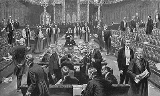
The House of Lords and the House of Commons assemble in the Palace of Westminster
Palace of Westminster

The Palace of Westminster, also known as the Houses of Parliament or Westminster Palace, in London, is where the two Houses of the Parliament of the United Kingdom meet....
. The Lords Chamber is lavishly decorated, in contrast with the more modestly furnished Commons Chamber. Benches in the Lords Chamber are coloured red; thus, the House of Lords is sometimes referred to as the "Red Chamber". The Woolsack is at the front of the Chamber; supporters of the Government sit on benches on the right of the Woolsack, while members of the Opposition sit on the left. Neutral members, known as Cross-bencher
Cross-bencher

In certain legislature, especially those which are based on the Westminster system, a crossbencher is a member of the assembly who is a member of neither the Executive nor the Opposition ....
s, sit on the benches immediately opposite the Woolsack.

The Lords Chamber is the site of many formal ceremonies, the most famous of which is the State Opening of Parliament
State Opening of Parliament

In the United Kingdom, the State Opening of Parliament is an annual event held usually in late October or November that marks the commencement of a session of the Parliament of the United Kingdom....
, held at the beginning of each new parliamentary session. During the State Opening, the Sovereign
British monarchy

The Monarchy of the United Kingdom is the constitutional monarchy of the United Kingdom and its British overseas territory.The present monarch, Queen Elizabeth II of the United Kingdom, has reigned since 6 February 1952....
, seated on the Throne in the Lords Chamber and in the presence of both Houses of Parliament, delivers a speech outlining the Government's agenda for the upcoming parliamentary session.

In the House of Lords, members need not seek the recognition of the presiding officer before speaking, as is done in the House of Commons. If two or more Lords simultaneously rise to speak, the House decides which one is to be heard by acclamation, or, if necessary, by voting on a motion. Often, however, the Leader of the House will suggest an order, which is thereafter generally followed. Speeches in the House of Lords are addressed to the House as a whole ("My Lords") rather than to the presiding officer alone (as is the custom in the Lower House). Members may not refer to each other in the second person (as "you"), but rather use third person forms such as "the noble Duke", "the noble Earl", "the noble Lord", "my noble friend", etc.

Each member may make no more than one speech on a motion, except that the mover of the motion may make one speech at the beginning of the debate and another at the end. Speeches are not subject to any time limits in the House; however, the House may put an end to a speech by approving a motion "that the noble Lord be no longer heard". It is also possible for the House to end the debate entirely, by approving a motion "that the Question be now put". This procedure is known as Closure
Cloture

In parliamentary procedure, cloture is a motion or process aimed at bringing debate to a quick end.The procedure originated in the National Assembly of France, from which the name is taken....
, and is extremely rare.

Once all speeches on a motion have concluded, or Closure invoked, the motion may be put to a vote. The House first votes by voice vote
Voice vote

A voice vote is a Voting methods used by Deliberative assembly in which a vote is taken on a topic or Motion by responding verbally.Typically the Chair of the assembly will put the question to the assembly, making it clear that the members understand the effect of an "aye" vote and a "no" vote, and will then ask first for all those in...
; the Lord Speaker or Deputy Speaker puts the question, and the Lords respond either "Content" (in favour of the motion) or "Not-Content" (against the motion). The presiding officer then announces the result of the voice vote, but if his assessment is challenged by any Lord, a recorded vote known as a division
Division (vote)

A division is a parliamentary mechanism which calls for a rising vote, wherein the members of the house literally divide into groups indicating a vote in favour of or in opposition to a motion on the floor....
 follows. Members of the House enter one of two lobbies (the "Content" lobby or the "Not-Content" lobby) on either side of the Chamber, where their names are recorded by clerks. At each lobby are two Tellers (themselves members of the House) who count the votes of the Lords. The Lord Speaker may not take part in the vote. Once the division concludes, the Tellers provide the results thereof to the presiding officer, who then announces them to the House. If there is an equality of votes, the motion is decided according to the following principles: legislation may proceed in its present form, unless there is a majority in favour of amending or rejecting it; any other motions are rejected, unless there is a majority in favour of approving it. The quorum
Quorum

In law, a quorum is the minimum number of members of a deliberative body necessary to conduct the business of that group. Ordinarily, this is a majority of the people expected to be there, although many bodies may have a lower or higher quorum....
 of the House of Lords is just three members for a general or procedural vote, and 30 members for a vote on legislation. If fewer than three or 30 members (as appropriate) are present, the division is invalid.

Committees

The Parliament of the United Kingdom uses committees for a variety of purposes; one common use is for the review of bills. Committees of both Houses consider bills in detail, and may make amendments. In the House of Lords, the committee most commonly used for the consideration of bills is the Committee of the Whole House, which, as its name suggests, includes all members of the House. The Committee meets in the Lords Chamber, and is presided over not by the Lord Speaker, but by the Chairman of Committees or a Deputy Chairman. Different procedural rules apply in the Committee of the Whole House than in normal sessions of the Lords; in particular, members are allowed to make more than one speech each on a motion. Similar to the Committee of the Whole House are the Grand Committees, bodies in which any member of the House may participate. A Grand Committee does not meet in the Lords Chamber, but in a separate committee room. No divisions are held in Grand Committees, and any amendments to the bill require the unanimous consent of the body. Hence, the Grand Committee procedure is used only for uncontroversial bills.

Bills may also be committed to Public Bill Committees, which consist of between twelve and sixteen members each. A Public Bill Committee is specifically constituted for a particular bill. A bill may also be referred to a Special Public Bill Committee, which, unlike the Public Bill Committee, has the power to hold hearings and collect evidence. These committees are used much less frequently than the Committee of the Whole House and Grand Committees.

The House of Lords also has several Select Committees. The members of these committees are appointed by the House at the beginning of each session, and continue to serve until the next parliamentary session begins. The House of Lords may appoint a chairman for a committee; if it does not do so, the Chairman of Committees or a Deputy Chairman of Committees may preside instead. Most Select Committees are permanent, but the House may also establish ad hoc committees, which cease to exist upon the completion of a particular task (for instance, investigating the reform of the House of Lords). The primary function of Select Committees is to scrutinise and investigate Government activities; to fulfil these aims, they are permitted to hold hearings and collect evidence. Bills may be referred to Select Committees, but are more often sent to the Committee of the Whole House and Grand Committees.

The committee system of the House of Lords also includes several Domestic Committees, which supervise or consider the House's procedures and administration. One of the Domestic Committees is the Committee of Selection, which is responsible for assigning members to many of the House's other committees.

Legislative functions

Most legislation may be introduced in either House, but, most commonly, is introduced in the House of Commons
House of Commons

The House of Commons is the name of the elected lower house of the bicameral parliaments of the United Kingdom and Canada.In the UK and Canada, the Commons holds much more legislative power than the upper house of parliament ....
.

The power of the Lords to reject a bill passed by the House of Commons is severely restricted by the Parliament Acts. Under those Acts, certain types of bills may be presented for the Royal Assent
Royal Assent

The granting of Royal Assent is the formal method by which a constitutional monarchy completes the legislative process of lawmaking by formally assenting to an Act of Parliament....
 without the consent of the House of Lords. The House of Lords cannot delay a money bill (a bill that, in the view of the Speaker of the House of Commons, solely concerns national taxation or public funds) for more than one month. Other public bills cannot be delayed by the House of Lords for more than two parliamentary sessions, or one calendar year. These provisions, however, only apply to public bills that originate in the House of Commons, and cannot have the effect of extending a parliamentary term beyond five years. A further restriction is a constitutional convention
Constitutional convention (political custom)

Alternative meaning: Constitutional convention A constitutional convention is an informal and uncodified procedural agreement that is followed by the institutions of a state....
 known as the Salisbury Convention
Salisbury Convention

The Salisbury Convention is a constitutional convention in the United Kingdom which puts forward that the House of Lords will not oppose the second reading or third reading of any government legislation promised in its election manifesto....
, which means that the House of Lords does not oppose legislation promised in the Government's election manifesto
Manifesto

A manifestom is a public declaration of principles and intentions, often Politics in nature, but may also be life stance related. However, manifestos relating to religious belief are rather referred to as credo....
.

By a custom that prevailed even before the Parliament Acts, the House of Lords is further restrained insofar as financial bills are concerned. The House of Lords may neither originate a bill concerning taxation or Supply (supply of treasury or exchequer funds), nor amend a bill so as to insert a taxation or Supply-related provision. (The House of Commons, however, often waives its privileges and allows the Upper House to make amendments with financial implications.) Moreover, the Upper House may not amend any Supply Bill. The House of Lords formerly maintained the absolute power to reject a bill relating to revenue or Supply, but this power was curtailed by the Parliament Acts, as aforementioned.

Hence, as the power of the House of Lords has been severely curtailed by statute and by practice, the House of Commons is clearly the more powerful chamber of Parliament.

In March 2006, it was reported that, among other reforms, the Government are considering removing the ability of the Lords to delay legislation that arises as a result of manifesto commitments, and reducing their ability to delay other legislation to a period of 60 days.

Judicial functions


The judicial functions of the House of Lords originate from the ancient role of the Curia Regis
Curia Regis

Curia regis is a Latin term meaning "royal council" or "Noble court."...
 as a body that addressed the petitions of the King's subjects.

The judicial functions of the House of Lords are exercised not by the whole House, but by a committee of "Law Lords". The bulk of the House's judicial business is conducted by the twelve Lords of Appeal in Ordinary, who are specifically appointed for this purpose under the Appellate Jurisdiction Act 1876
Appellate Jurisdiction Act 1876

The Appellate Jurisdiction Act 1876 is an Act of Parliament of the Parliament of the United Kingdom that created the judicial functions of the House of Lords in its modern form....
. The judicial functions may also be exercised by Lords of Appeal (other members of the House who happen to have held high judicial office). No Lord of Appeal in Ordinary or Lord of Appeal may sit judicially beyond the age of seventy-five. The judicial business of the Lords is supervised by the Senior Lord of Appeal in Ordinary and his or her deputy, the Second Senior Lord of Appeal in Ordinary.

The jurisdiction of the House of Lords extends, in civil and in criminal cases, to appeals from the courts of England and Wales, and of Northern Ireland. From Scotland, appeals are possible only in civil cases; Scotland's High Court of Justiciary
High Court of Justiciary

The High Court of Justiciary is the Supreme Courts of Scotland criminal justice of Scotland.The High Court is both a court of first instance and a court of appeal....
 is the highest court in criminal matters. The House of Lords is not the United Kingdom's only court of last resort; in some cases, the Privy Council
Privy Council of the United Kingdom

Her Majesty's Most Honourable Privy Council is a body of advisors to the British monarchy. Its members are largely senior politicians, who were or are members of either the House of Commons of the United Kingdom or House of Lords....
 performs such a function. The jurisdiction of the Privy Council in the United Kingdom, however, is narrower than that of the House of Lords; it encompasses appeals from ecclesiastical courts, issues related to devolution
Devolution

Devolution is the Statute granting of powers from the central government of a state to government at a subnational level, such as a regional, local, or state level....
, disputes under the House of Commons Disqualification Act 1975
House of Commons Disqualification Act 1975

The House of Commons Disqualification Act 1975 is an Act of Parliament of the Parliament of the United Kingdom that prohibits certain groups of people from becoming Member of Parliament of the British House of Commons....
, and a few other minor matters.

Not all Law Lords sit to hear cases; rather, since World War II
World War II

World War II, or the Second World War , was a global military conflict which involved a Participants in World War II, including all of the great powers, organised into two opposing military alliances: the Allies of World War II and the Axis powers....
 cases have been heard by panels known as Appellate Committees, each of which normally consists of five members (selected by the Senior Lord). An Appellate Committee hearing an important case may consist of even more members. Though Appellate Committees meet in separate committee rooms, judgement is given in the Lords Chamber itself. No further appeal lies from the House of Lords, although the House of Lords may refer a "preliminary question" to the European Court of Justice
European Court of Justice

The Court of Justice of the European Communities, usually called the European Court of Justice , is the Supreme court of the European Union ....
 in cases involving an element of European Union law
European Union law

The Law of the European Union is the unique legal system which operates alongside the laws of Member States of the European Union . EU law has direct effect within the legal systems of its Member States, and overrides national law in many areas, especially in areas covered by the Four Freedoms ....
, and a case can be brought at the European Court of Human Rights
European Court of Human Rights

The European Court of Human Rights in Strasbourg was established under the European Convention on Human Rights of 1950 to monitor compliance by Contracting Parties....
 if the House of Lords does not provide a satisfactory remedy in cases where the European Convention on Human Rights
European Convention on Human Rights

The Convention for the Protection of Human Rights and Fundamental Freedoms , was adopted under the auspices of the Council of Europe in 1950 to protect human rights and fundamental Freedom in Europe....
 is relevant.

A distinct judicial function—one in which the whole House, rather than just the Law Lords, may participate—is that of trying impeachment
Impeachment

Impeachment is the first of two stages in a specific process for a legislative body to consider whether or not to forcibly remove a government official from office....
s. Impeachments were brought by the House of Commons, and tried in the House of Lords; a conviction required only a majority of the Lords voting. Impeachments, however, are to all intents and purposes obsolete; the last impeachment was that of Henry Dundas, 1st Viscount Melville
Henry Dundas, 1st Viscount Melville

Henry Dundas, 1st Viscount Melville was a Scotland lawyer and politician. He was the last person to be impeachment in the United Kingdom.He was the fourth son of Robert Dundas, Lord Arniston, the elder , Lord President of the Court of Session, and was born at Dalkeith in 1742....
 in 1806.

Similarly, the House of Lords was once the court that tried peers charged with high treason
Treason

In law, treason is the crime that covers some of the more serious acts of loyalty to one's sovereignty or nation. Historically, treason also covered the murder of specific social superiors, such as the murder of a husband by his wife ....
 or felony
Felony

A felony is a serious crime in the United States and previously other common law countries. The term originates from English common law where felonies were originally crimes which involved the confiscation of a convicted person's land and goods; other crimes were called misdemeanors....
. The House would be presided over not by the Lord Chancellor
Lord Chancellor

The Lord High Chancellor of Great Britain, or Lord Chancellor, is a senior and important functionary in the government of the United Kingdom....
, but by the Lord High Steward
Lord High Steward

The position of Lord High Steward of England is the first of the Great Officers of State. The office has generally remained vacant since 1421, except at Coronation of the British monarch and during the trials of peers in the House of Lords, when the Lord High Steward presides....
, an official especially appointed for the occasion of the trial. If Parliament was not in session, then peers could be tried in a separate court, known as the Lord High Steward's Court. Only peers, their wives, and their widows (unless remarried) were entitled to trials in the House of Lords or the Lord High Steward's Court
List of trials of peers in the House of Lords

This is a list of trials of peers in the House of Lords. Until 1948, Peerage of the United Kingdom and its predecessor states had the Privilege of Peerage....
; the Lords Spiritual were tried in Ecclesiastical Courts. In 1948, the right of peers to be tried in such special courts was abolished; now, they are tried in the regular courts. The last such trial in the House was of Edward Southwell Russell, 26th Baron de Clifford
Edward Southwell Russell, 26th Baron de Clifford

Lieutenant-Colonel Edward Southwell Russell, 26th Baron de Clifford Order of the British Empire Territorial Decoration was the only son of Jack Southwell Russell, 25th Baron de Clifford, and Eva Carrington....
 in 1935.

The Constitutional Reform Act 2005
Constitutional Reform Act 2005

The Constitutional Reform Act 2005 is an Act of Parliament of the Parliament of the United Kingdom. It provides for a Supreme Court of the United Kingdom to take over the existing role of the Law Lords and some powers of the Judicial Committee of the Privy Council, and remove the functions of Speaker of the House of Lords and Head of the Jud...
 will lead to the creation of a separate Supreme Court of the United Kingdom
Supreme Court of the United Kingdom

The Supreme Court of the United Kingdom was established in law by Part III of the Constitutional Reform Act 2005. The Lord Chancellor has announced that it will start work in October 2009 once its new premises are ready....
, to which the judicial function of the House of Lords, and some of the judicial functions of the Judicial Committee of the Privy Council
Judicial Committee of the Privy Council

The Judicial Committee of the Privy Council is one of the highest courts in the United Kingdom, established by the Judicial Committee Act 1833....
, will be transferred. In addition, the office of Lord Chancellor has been reformed by the act, to remove his ability to act as both a government minister and a judge. This is motivated in part by concerns that the historical admixture of legislative, judicial, and executive power, may not be in conformance with the requirements of the European Convention on Human Rights
European Convention on Human Rights

The Convention for the Protection of Human Rights and Fundamental Freedoms , was adopted under the auspices of the Council of Europe in 1950 to protect human rights and fundamental Freedom in Europe....
 (a judicial officer having legislative or executive power not being likely to be considered sufficiently impartial to provide a fair trial), and in any case are considered undesirable according to modern constitutional theory concerning the separation of powers. The new Supreme Court will be located in Middlesex Guildhall
Middlesex Guildhall

The Middlesex Guildhall is a building on the south-west corner of Parliament Square in London. It is currently closed for refurbishment for use as the site of the new Supreme Court of the United Kingdom and the Judicial Committee of the Privy Council....
.

Relationship with the Government

Unlike the House of Commons, the House of Lords does not control the term of the Prime Minister or of the Government. Only the Lower House may force the Prime Minister to resign or call elections by passing a motion of no-confidence or by withdrawing supply
Loss of Supply

Loss of supply occurs where a government in a parliamentary democracy using the Westminster System or a system derived from it is denied a supply of treasury or exchequer funds, by whichever house or houses of parliament or head of state is constitutionally entitled to grant and deny supply....
. Thus, the House of Lords' oversight of the government is limited.

Most Cabinet ministers are from the House of Commons, rather than the House of Lords. In particular, all Prime Ministers since 1902 have been members of the Lower House. (Alec Douglas-Home
Alec Douglas-Home

Alexander Frederick Douglas-Home, Baron Home of the Hirsel, Order of the Thistle, Imperial Privy Council , 14th Earl of Home from 1951 to 1963, was a British Conservative Party politician, and served as Prime Minister of the United Kingdom for a year from October 1963 to October 1964 ....
, who became Prime Minister in 1963 whilst still an Earl, disclaimed his peerage and was elected to the Commons soon after his term began.) In recent history, it has been very rare for major cabinet positions (except Lord Chancellor
Lord Chancellor

The Lord High Chancellor of Great Britain, or Lord Chancellor, is a senior and important functionary in the government of the United Kingdom....
 and Leader of the House of Lords
Leader of the House of Lords

Leader of the House of Lords is a function in the Her Majesty's Government that is always held in combination with a formal Cabinet of the United Kingdom position, most often Lord President of the Council, Lord Privy Seal or Chancellor of the Duchy of Lancaster....
) to have been filled by peers. Exceptions include Lord Carrington
Peter Carington, 6th Baron Carrington

Peter Alexander Rupert Carington, 6th Baron Carrington and Baron Carington of Upton, Order of the Garter, Order of St Michael and St George, Order of the Companions of Honour, Military Cross, Her Majesty's Most Honourable Privy Council, Deputy Lieutenant is a United Kingdom Conservative Party politician and served as British Secretary...
, who was the Foreign Secretary
Secretary of State for Foreign and Commonwealth Affairs

The Secretary of State for Foreign and Commonwealth Affairs, commonly referred to as the Foreign Secretary, is a member of the Her Majesty's Government in the United Kingdom heading the Foreign and Commonwealth Office and responsible for relations with foreign countries, matters pertaining to the Commonwealth of Nations and the UK's Br...
 between 1979 and 1982, Lord Young of Graffham (Minister without Portfolio
Minister without Portfolio

A Minister without Portfolio is either a government minister with no specific responsibilities or a minister that does not head a particular ministry ....
, then Secretary of State for Employment
Secretary of State for Employment

The Secretary of State for Employment was a position in the Cabinet of the United Kingdom. In 1995 it was merged with Secretary of State for Education to make the Secretary of State for Education and Employment....
 and then Secretary of State for Trade and Industry
Secretary of State for Trade and Industry

The Secretary of State for Business, Enterprise and Regulatory Reform is a cabinet position in the United Kingdom government. Its secondary title is the President of the Board of Trade....
 from 1984 to 1989), The Lady Amos (International Development Secretary, 2003) and currently Lord Mandelson
Peter Mandelson

Peter Benjamin Mandelson, Baron Mandelson, Privy Council of the United Kingdom is a British Labour Party politician who is the current Secretary of State for Business, Enterprise and Regulatory Reform, appointed on 3 October 2008....
, who is serving as Secretary of State for Business, Enterprise and Regulatory Reform and President of the Board of Trade. Lord Cockfield and the Earl of Gowrie
Earl of Gowrie

The title of Earl of Gowrie has been created twice in the Peerage of Scotland and once in the Peerage of the United Kingdom.On 23 August 1581 William Ruthven, Lord Ruthven was created Earl of Gowrie....
 both held Cabinet posts while members of the House of Lords, and George Robertson
George Robertson

George Robertson may refer to:*George Robertson, Baron Robertson of Port Ellen , UK Defence Secretary, NATO Secretary-General*George Croom Robertson , Scottish philosopher...
 was briefly a peer whilst serving as Secretary of State for Defence
Secretary of State for Defence

The Secretary of State for Defence is the senior United Kingdom government Political minister in charge of the Ministry of Defence . It is a Cabinet of the United Kingdom position....
.

The House of Lords does remain a source for junior ministers, such as Lord Malloch-Brown (Foreign and Commonwealth Office
Foreign and Commonwealth Office

The Foreign and Commonwealth Office, commonly called the Foreign Office or the FCO, is the Departments of the United Kingdom Government responsible for promoting the interests of the United Kingdom overseas, created in 1968 by merging the Foreign Office and the Secretary of State for Commonwealth Affairs....
). Since 1999 the Attorney-General has been a Lord; currently it is Lady Scotland of Asthal. The House of Lords also has a Chief Whip
Chief Whip

The Chief Whip is a political office in some legislatures assigned to an elected member whose task is to administer the Whip that ensures that members of the Political party attend and vote as the party leadership desires....
 - currently Lord Bassam
Steve Bassam, Baron Bassam of Brighton

Steven Bassam, Baron Bassam of Brighton is a United Kingdom Labour Party and Co-operative Party politician and member of the House of Lords....
.

Current composition


The House of Lords, as of 12 January 2009:
AffiliationLife peersHereditary peersLords spiritualTotal
Elected by partyElected by whole houseRoyal office-holders
 Labour
Labour Party (UK)

The Labour Party is a political party in the United Kingdom. Founded at the start of the 20th century, it has been since the 1920s the principal party of the Left-wing politics in England, Scotland and Wales, but not Northern Ireland, where it has only recently organised again....
21222--216
 Conservative
Conservative Party (UK)

The Conservative and Unionist Party, more commonly known as the Conservative Party, is a conservative political party in the United Kingdom....
150399--198
 Liberal Democrats
Liberal Democrats

The Liberal Democrats, often shortened to Lib Dems or just Lib Dem, are a Liberalism political party in the United Kingdom, formed in 1988 by merging the Liberal Party and the Social Democratic Party ; the two parties had been SDP-Liberal Alliance for seven years, from shortly after the formation of the SDP....
6732--72
 UKIP
United Kingdom Independence Party

The United Kingdom Independence Party is a right-wing United Kingdom political party. Its principal aim is the withdrawal of the UK from the European Union....
11---2
 Crossbenchers1732922-206
 Lords Spiritual
Lords Spiritual

The Lords Spiritual of the United Kingdom, also called Spiritual Peerage, are the 26 bishops of the State religion Church of England who serve in the House of Lords along with the Lord Temporal....
----2626
 Other111---12
Total6147515226732
Note: These figures exclude 11 peers who are on leave of absence.

†The number of hereditary peers "allocated" to each party, which is based on the proportion of hereditary peers that belongs to that party, is:
  • Conservative Party: 39 peers (previously 42)
  • Labour Party: 2 peers
  • Liberal Democrats: 3 peers
  • Crossbenchers: 28 peers


Of the initial 42 hereditary peers elected as Conservatives, one (Lord Brabazon of Tara
Ivon Moore-Brabazon, 3rd Baron Brabazon of Tara

Ivon Anthony Moore-Brabazon, 3rd Baron Brabazon of Tara is the current Baron Brabazon of Tara and has been since the death of his father in 1974....
) now sits as a non-affiliated member, having become the House of Lords' Chairman of Committees, and another (Lord Willoughby de Broke) now sits as a UKIP member.

A report in 2007 stated that many members of the Lords (particularly the life peers) do not attend regularly - the average attendance was around 408.

Current political leaders in the Lords

  • Baroness Royall
    Janet Royall, Baroness Royall of Blaisdon

    Janet "Jan" Anne Royall, Baroness Royall of Blaisdon, Her Majesty's Most Honourable Privy Council is a Labour party politician and the current Leader of the House of Lords of the House of Lords....
     - Leader of the House of Lords
    Leader of the House of Lords

    Leader of the House of Lords is a function in the Her Majesty's Government that is always held in combination with a formal Cabinet of the United Kingdom position, most often Lord President of the Council, Lord Privy Seal or Chancellor of the Duchy of Lancaster....
     and Lord President of the Council
    Lord President of the Council

    The Lord President of the Council is the fourth of the Great Officers of State of the United Kingdom, ranking beneath the Lord High Treasurer and above the Lord Privy Seal....
     (Labour
    Labour Party (UK)

    The Labour Party is a political party in the United Kingdom. Founded at the start of the 20th century, it has been since the 1920s the principal party of the Left-wing politics in England, Scotland and Wales, but not Northern Ireland, where it has only recently organised again....
    )
  • Lord Strathclyde
    Thomas Galbraith, 2nd Baron Strathclyde

    Thomas Galloway Dunlop du Roy de Blicquy Galbraith, 2nd Baron Strathclyde, Privy Council of the United Kingdom is a United Kingdom politician and the leader of the Conservative Party in the House of Lords....
     - Shadow Leader of the House of Lords (Conservative
    Conservative Party (UK)

    The Conservative and Unionist Party, more commonly known as the Conservative Party, is a conservative political party in the United Kingdom....
    )
  • Lord McNally
    Thomas McNally, Baron McNally

    Thomas "Tom" McNally, Baron McNally, Privy Council of the United Kingdom is a British politician and the current Leader of the Liberal Democrats in the House of Lords....
     - Liberal Democrats
    Liberal Democrats

    The Liberal Democrats, often shortened to Lib Dems or just Lib Dem, are a Liberalism political party in the United Kingdom, formed in 1988 by merging the Liberal Party and the Social Democratic Party ; the two parties had been SDP-Liberal Alliance for seven years, from shortly after the formation of the SDP....


See also

  • Speakership of the House of Lords
  • Introduction ceremony
    Introduction (House of Lords)

    In the House of Lords, certain new members must, before sitting, be ceremonially "introduced", the ceremony being known as Introduction. Introductions in the Lords are complicated procedures, being more elaborate than Introduction in the British House of Commons....
  • Members of the House of Lords
    Members of the House of Lords

    This is a list of members of the House of Lords in the United Kingdom....
  • Reform of the House of Lords
  • Wakeham Report
    Wakeham Report

    The Wakeham Report, published in 2000, was the report of a Royal Commission headed by John Wakeham, Baron Wakeham, concerning reform of the United Kingdom's House of Lords....
  • Upper House
    Upper house

    An upper house is one of two chambers of a bicameral legislature, the other chamber being the lower house....
  • Constitution Committee (House of Lords)
    Constitution Committee (House of Lords)

    The Constitution Committee is a cross-party Select Committee of the House of Lords, the upper chamber of the Parliament of the United Kingdom. The Committee?s remit is ?to examine the constitutional implications of all public bills coming before the House; and to keep under review the operation of the constitution?....
  • House of Lords Library
    House of Lords Library

    The House of Lords Library is the library and information resource of the House of Lords of the British Parliament....
  • United States Senate
    United States Senate

    The United States Senate is the upper house of the Bicameralism United States Congress, the lower house being the United States House of Representatives....


Bibliography

  • Carmichael, Paul, Brice Dickson, and Guy Peters. (1999). The House of Lords: Its Parliamentary and Judicial Role. Oxford: Hart Publishing.
  • Farnborough, T. E. May, 1st Baron. (1896). Constitutional History of England since the Accession of George the Third, 11th ed. London: Longmans, Green and Co.
  • Longford, Frank Pakenham, 7th Earl of. (1999). A History of the House of Lords. New edition. Gloucestershire: Sutton Publishing.
  • "Parliament" (1911). Encyclopædia Britannica, 11th ed. London: Cambridge University Press.
  • Raphael, D. D., Donald Limon, and W. R. McKay. (2004). Erskine May: Parliamentary Practice, 23rd ed. London: Butterworths Tolley.


Further reading


External links

    • holds the historic records of the House of Lords.
  • BBC